


Abstract
Large-scale tree planting programs that store carbon provided by wood and non-wood products are being promoted to mitigate climate change. Assessing the biomass pool of plantations is thus an essential task in forest ecology. This study investigated biomass allocation and allometric equations for above- and belowground components along an age-sequence of Pinus tabuliformis plantations (8, 18, 32, and 46 years old) in northern Hebei Province, China. The biomass of each tree component (root, stem, branch, foliage) was quantified by destructive harvesting. Allometric equations and biomass conversion and expansion factors (BCEFs) were subsequently developed for each tree component. The mean above- and belowground biomass was 5.86, 20.05, 41.26, and 135.28 kg tree−1 and 1.73, 3.42, 11.39, and 27.30 kg tree−1 in the 8-, 18-, 32-, and 46-year-old stands, respectively. The proportion of stem biomass to total tree biomass increased from 28.7% for the 8-year-old stand to 55.8% for 46-year-old stand. In contrast, the contributions of foliage and branch decreased along the chronosequence. The root contribution to total tree biomass also showed a declining trend with stand age. Allometric models based on diameter at breast height showed a good fit (p < 0.001) and incorporating stand age as an additional variable improved the fit of allometric equations (higher R2 and lower ACI) for branch, aboveground, root, and total tree biomass. BCEFs decreased for all tree components as stand age increased. These findings indicate that changes in tree biomass allocation and allometry across stand development must be considered to improve estimates of plantation biomass and carbon stocks at regional and national scales.
1. Introduction
Global climate change and rising carbon (C) emissions represent one of the most critical environmental challenges [1,2]. All pathways to limit global warming require the substantial removal of atmospheric CO2, underscoring the importance of enhancing C uptake and storage in terrestrial ecosystems [3,4]. Forests serve as the largest C sink in land ecosystems, with a net C uptake of 2.6 Mg C ha−1 [5,6]. Since 1990, the extent of natural forests has declined, while planted forest areas have increased by 123 million ha, as reported in the Global Forest Assessment 2020 [7]. Large-scale afforestation is considered as a useful way to mitigate climate change through C sequestration and to deliver other essential ecosystem services [8,9]. Therefore, the accurate estimation of C storage amount is so important for carrying out climate change mitigation policies [10,11].
Quantifying plantation biomass helps assess the impacts of plantation management and land-use change to offset anthropogenic C emissions [12,13]. Using regression equations enables estimations of total tree biomass as well as the biomass of different components (root, stem, branch, and foliage) by using easily measurable variables like diameter at breast height (DBH) and/or height (H) [14,15]. The ground-based destructive sample of individual tree biomass is regarded as a good way to calibrate allometric equation [10,13]. Brown [16] demonstrated that DBH alone could explained over 95% of the variation in aboveground C stocks, even in the regions with high species diversity in tropical forests.
Diverse forms of allometric equations have been developed across various regions, such as China [17,18], Canada [19], Africa [20], and Kenya [21]. These models have been applied at multiple spatial scales [22,23,24,25]. In a comprehensive effort, Rojas-García et al. [26] compiled 478 allometric equations for estimating the biomass of trees and other plant life forms in Mexican forest and scrubland ecosystems. All these studies have shown that allometric relationships vary by tree species, site conditions, and stand structure [27,28,29]. Therefore, developing accurate and precise allometric equations for biomass estimates remains challenging [28].
Stand age is also a critical factor influencing tree size, morphological development, and biomass allocation and thereby shapes allometric relationships [19]. It is well established that biomass allocation among tree components shifts through the chronosequence [30]. For instance, young trees typically invest more biomass in stems for height growth and in branches and leaves for canopy expansion, which enhance their competitive ability for more light resources [31]. With succession, biomass accumulation increasingly favors stems and branches due to heartwood formation, often at the expense of foliage [17,32]. The allometric models without stand age can lead to significant over- or underestimation of tree component biomass [33]. Therefore, developing and refining the age-specific allometric equations for typical tree species is essential for improving estimation accuracy [34]. Various allometric equations have been used for estimating tree biomass in Chinese pine (Pinus tabuliformis) plantations in many regions, such as Ningxia [35], Shaanxi [36], and Gansu [37]. However, less attention has been given to the effect of stand age on allometric equations for Chinese pine plantations in Hebei province, North China.
The objectives of this study were as follows: (1) determine the partitioning of above- and below-ground tree component biomass in P. tabuliformis plantations across stand age; (2) develop allometric biomass equations; and (3) determine biomass conversion and expansion factors (BCEFs) for above- and below-ground tree components at four stand ages (8, 18, 32, and 46 years old). We hypothesized that stand age significantly influenced biomass allocation patterns in P. tabuliformis. Furthermore, incorporating tree height or stand age as predictors was expected to enhance the accuracy of allometric biomass models, and BCEFs would exhibit a declining trend with increasing stand age.
2. Materials and Methods
2.1. Site Description
P. tabuliformis is a major afforestation and reforestation species in northern China, with plantations playing a significant role in providing various goods and ecosystem services [36,37]. According to the eighth national forest inventory (2009–2013) of China, Chinese pine plantations cover 1.61 million ha, accounting for approximately 3.4% of the total plantation area [38]. The present study was carried out at the Lahailing forestry station (40°44′ N, 117°2′ E), situated to the west side of Chengde city in northern Hebei Province, China. The study site contains a chronosequence of P. tabuliformis plantations aged 8, 18, 32, and 46 years. The four stand sites are located within a 15 km radius and thus have similar environmental conditions. The sampling elevation varies between 900 m and 1000 m. The region has a continental monsoon climate, with average annual temperature of 7.6 °C and average annual rainfall of 552 mm. The soil belongs to Cinnamon soil in the Chinese system [38], corresponding to Ustalf in the USDA soil taxonomy [39].
2.2. Sampling Design and Data Collection
Tree biomass measurements were conducted in August and September 2024. For each stand age, three independent 20 m × 20 m plots (separated at least 100 m) were established. Within each plot, diameter at breast height (DBH, 1.3 m of the ground level) and tree height (H, defined as the height from ground level to crown apex of individual tree) were recorded for all trees. Stand characteristics are summarized in Table 1. Based on the plot survey, five trees were selected through random sampling and destructively harvested for biomass measurement. Random sampling ensured that the selected trees accurately represented the DBH variation observed in the plots [27]. These trees were chosen to cover the entire DBH gradient between the mini- and the maximum values recorded. In total, 60 sample trees were selected for the destructive measurement.
Table 1.
Stand characteristics for biomass measurement in Chinese pine stands.
Sample trees were felled using a chainsaw at the ground level. Total height, diameter at tree base, and DBH were recorded. The stems were sawed at 1.3 m and then every 2 m thereafter, until reaching the crown apex. Branches were removed from each stem segment, and both stem segments and the branches (together with leaves) were weighed [17]. The total fresh stem mass was calculated as the sum of the fresh weights of all stem segments for each tree. Based on branch diameter, five leafy branch samples were randomly collected to estimate the proportion biomass of branches and leaves. The branches and leaves were separately collected and measured. The leaf-to-branch mass ratio was then used to estimate the whole fresh biomass of leaves and branches for the entire tree [10,17]. Coarse roots (diameter > 5 mm) were carefully excavated using a combination of manual digging and mechanical traction, and then collected for biomass measurement [40].
A sub-sample mass of 100 g was taken from each tree component to determine the fresh-to-dry biomass ratios at 80 °C until constant mass. These ratios were used to convert the fresh weights into dry biomass of all tree components [17,19]. Aboveground biomass was calculated as the sum of stem, branch, and foliage biomass, while belowground biomass was considered equivalent to root biomass.
2.3. Data Analysis
Data of the dry biomass were fitted using stepwise regression with DBH, tree height (H), and stand age (A) as independent variables to develop power-law equations [19,20]. Following established methodologies, three allometric model forms were constructed for each tree component [41,42]:
Here, M represents the dry biomass (kg) of various tree components, a is the scaling constant, b and c are fitted parameters, D is the diameter at breast height (DBH, cm), H is tree height (m), and A is stand age (years).
At the plot scale, biomass conversion and expansion factors (BCEFs) were calculated as the ratio between biomass of tree components and stem wood volume, using the following equation:
where i denotes the tree component (e.g., root, stem, branch, foliage, aboveground, total tree), Wi is the dry biomass of the considered component, and V is the tree stem volume (m3).
Stem wood volume for each felled tree was determined using Smalian’s formula [40]:
where V is the tree stem volume (cm3), L is the segment length (m), d1 is the diameter (m) at the lower end of the stem segment, and du is the diameter (m) at the upper end.
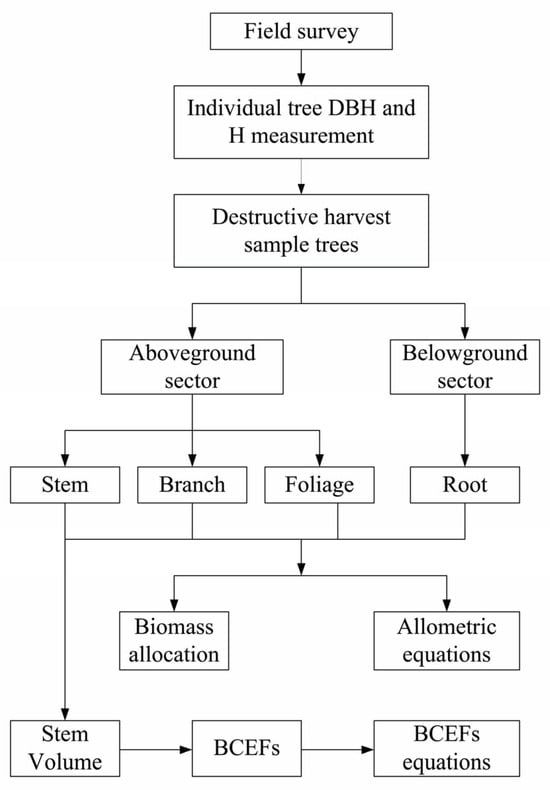
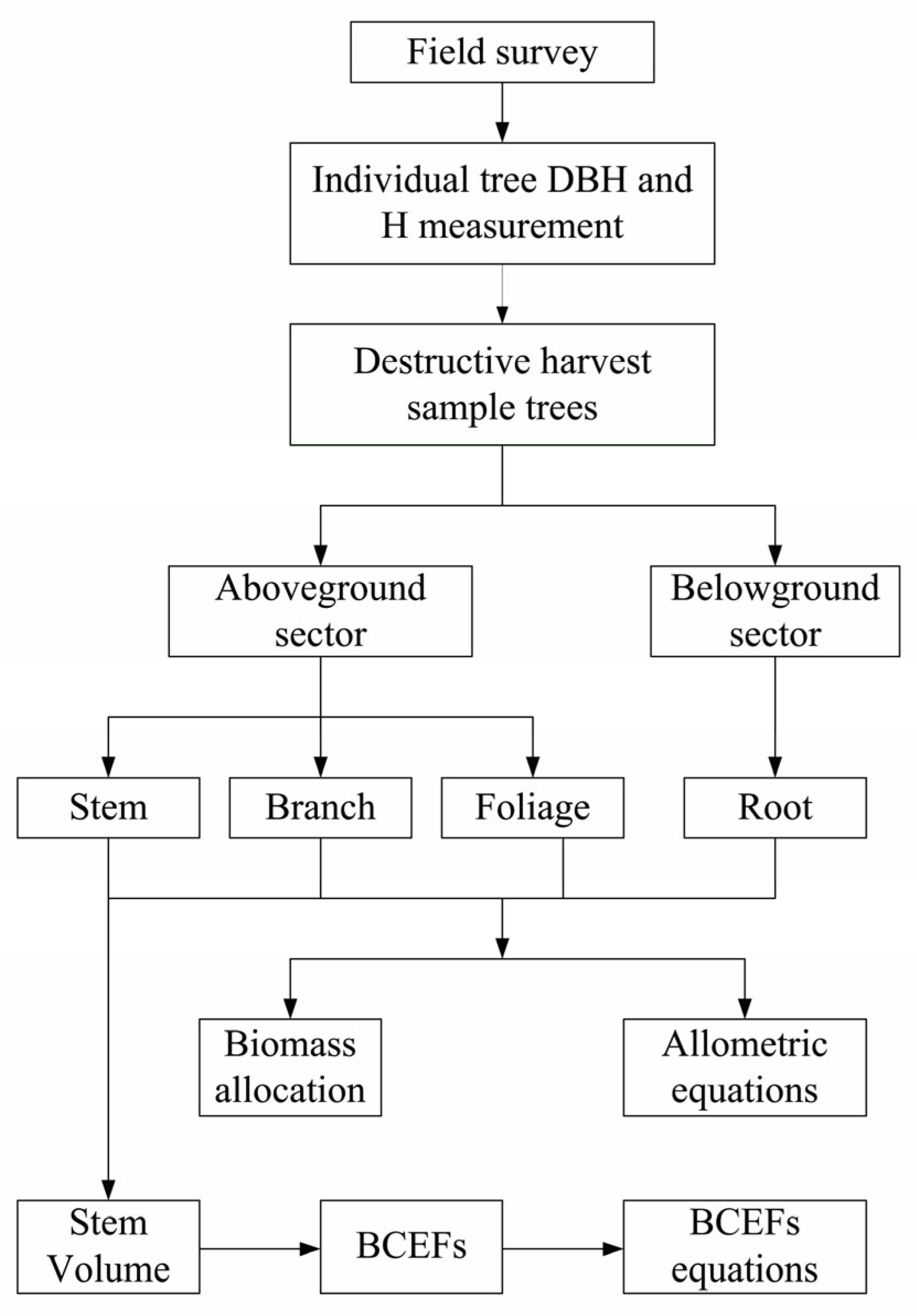
For the model’s development, we employed non-linear, least-squares regression utilizing the ggtrendline and minpack.lm packages. The variance explained (R2) and Akaike Information Criteria (AIC) were calculated to identify the most suitable models. All statistical analyses and model fittings were conducted using R software (version 4.5.2, Hornik and R Core Team, Vienna, Austria). Figure 1 illustrated the flowchart of methodology adopted in this study. Moreover, the relationships between various tree components biomass and DBH were also shown in this study. Figure 1 was created using Microsoft Visio 2016 software (Microsoft Inc., Redmond, WA, USA), while all other figures were generated with Microsoft Excel 2019 software (Microsoft Inc., Redmond, WA, USA).
Figure 1.
A flowchart of the overall methodological framework of the study. DBH and H are diameter at breast height (1.3 m) and height. BCEF is biomass conversion and expansion factor.
3. Results
3.1. Biomass Partitioning of Tree Components
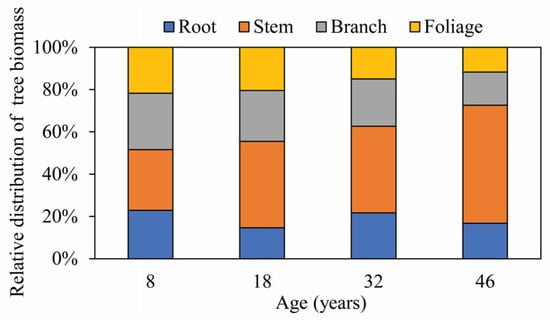
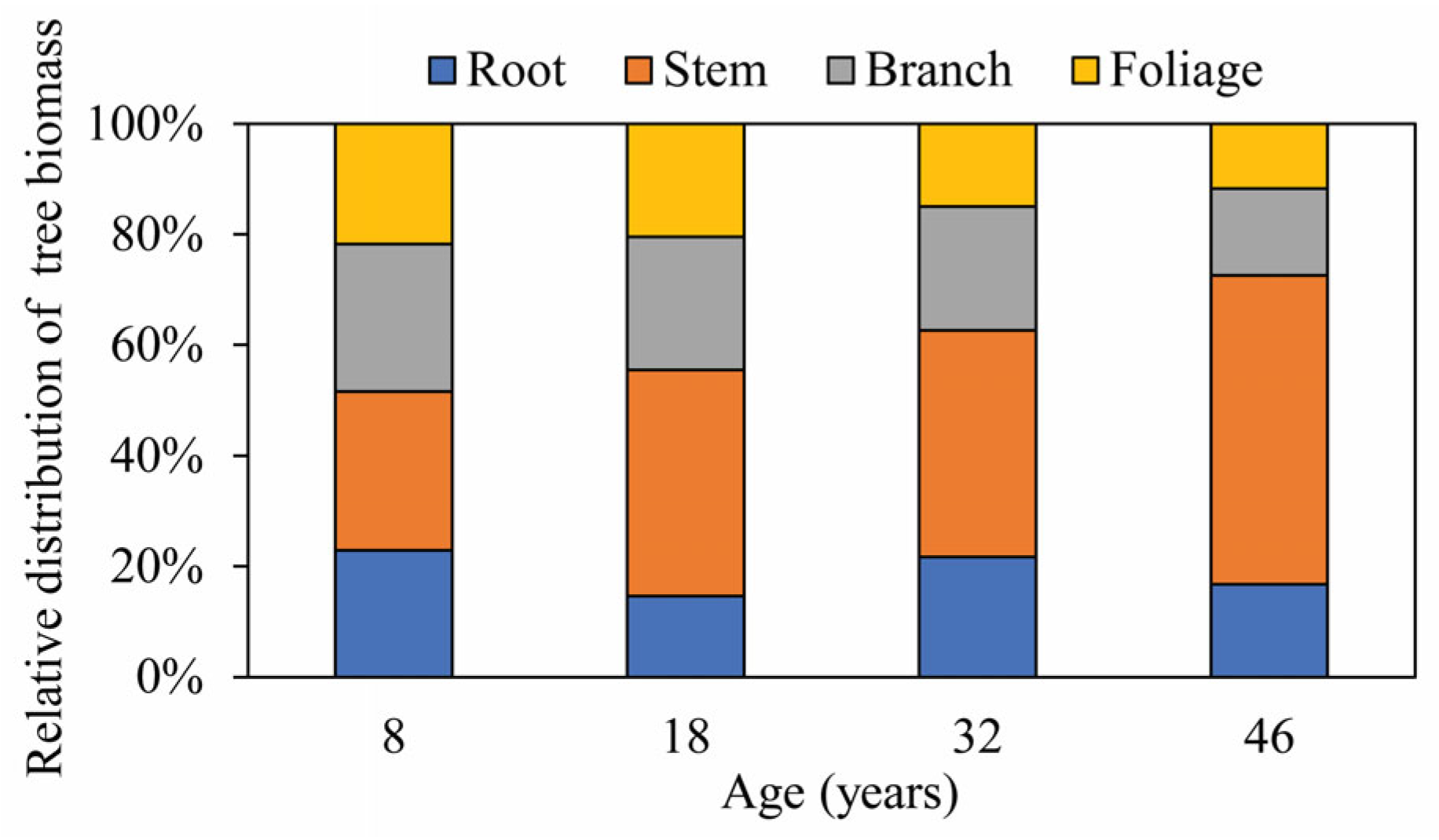
The average dry biomass of all tree components increased along the chronosequence (Table 2). Total tree biomass increased from 8.59 kg tree−1 in the 8-year-old stand to 152.58 kg tree−1 in the 46-year-old stand. The stem constituted the largest biomass pool across all stands, and its proportion relative to total tree biomass increased with age from 28.7% to 55.8% (Figure 2). In contrast, the relative contribution of foliage to total tree biomass decreased from 21.8% to 11.8%, and that of branch declined from 26.7% to 15.6%. The contribution of root to total tree biomass varied among stands, decreasing from 22.8% in the 8-year-old stand to 14.6, 21.6, and 16.8% in the 18-, 32-, and 46-year-old stands, respectively.
Table 2.
Tree component biomass across the chronosequence of Chinese pine stands (mean ± S.D.).
Figure 2.
Distribution of biomass among above- and belowground tree components across the chronosequence of Chinese pine stands.
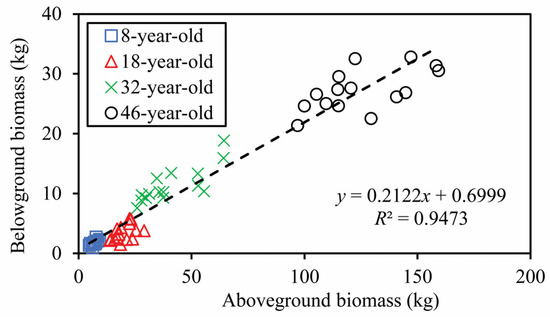
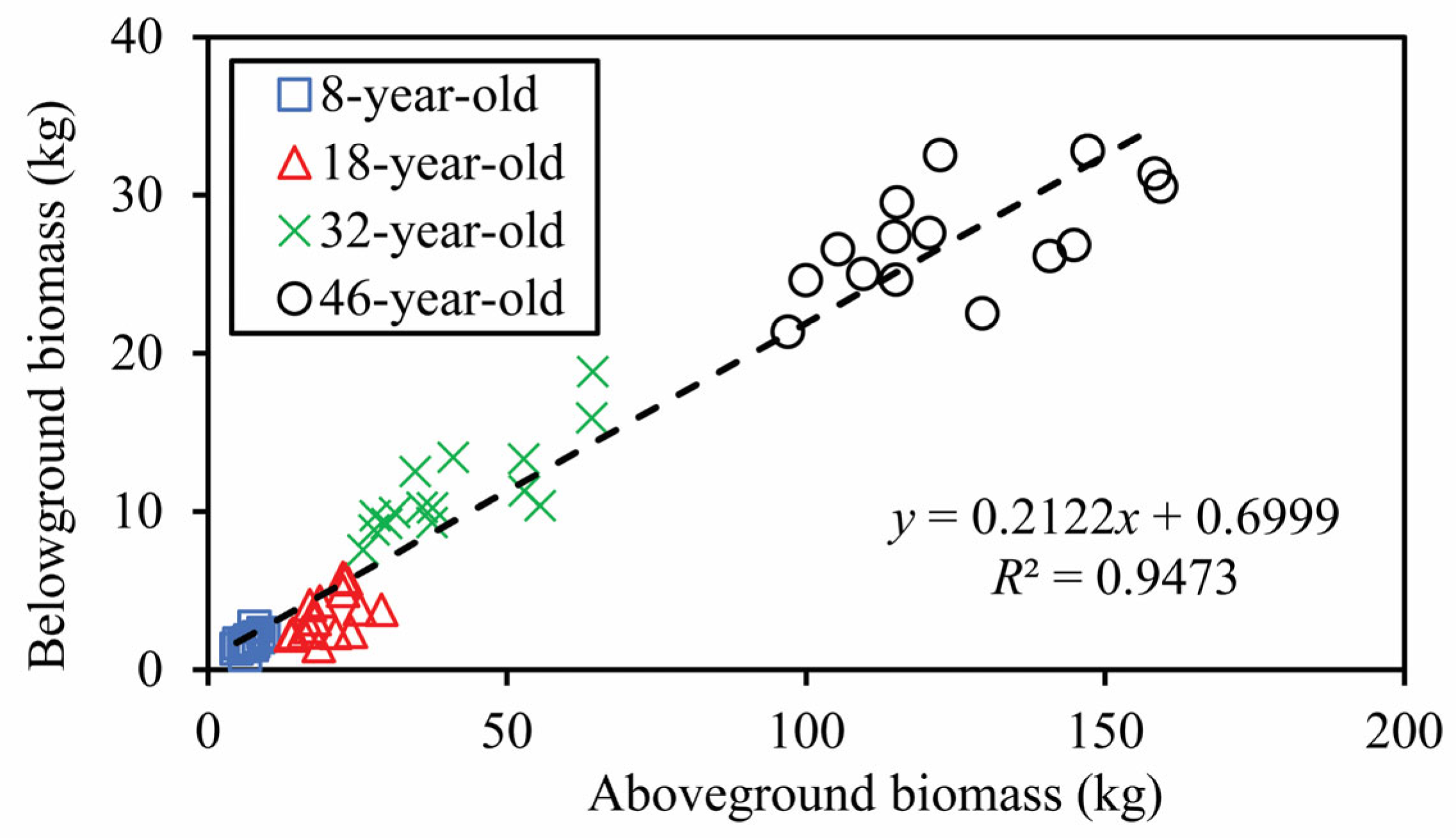
The relationship between aboveground biomass and belowground biomass was analyzed across 60 harvested trees (Figure 3). The slope of 0.21 indicated that for every 1 kg increased in aboveground biomass, there was an approximate increase of 0.21 kg belowground biomass. This consistent proportional relationship observed across various age classes suggested a stable allocation pattern between aerial and root biomass throughout tree growth. The high R2 value demonstrated that the linear model accounted for 94.7% of the variance, reflecting a strong positive correlation between above- and belowground biomass. This finding further supported the reliability of the excavation and root biomass correction methods employer in the present study.
Figure 3.
Relationship between aboveground and belowground biomass across the chronosequence of Chinese pine stands.
3.2. Allometric Equations
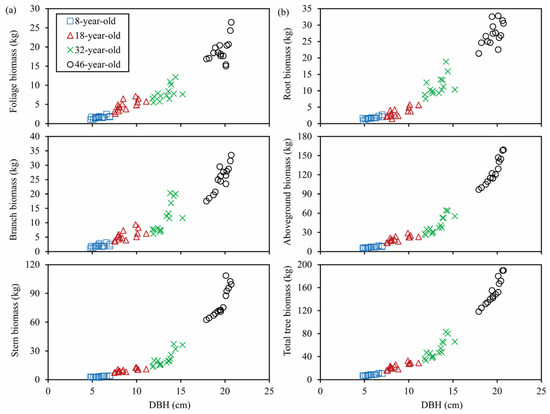
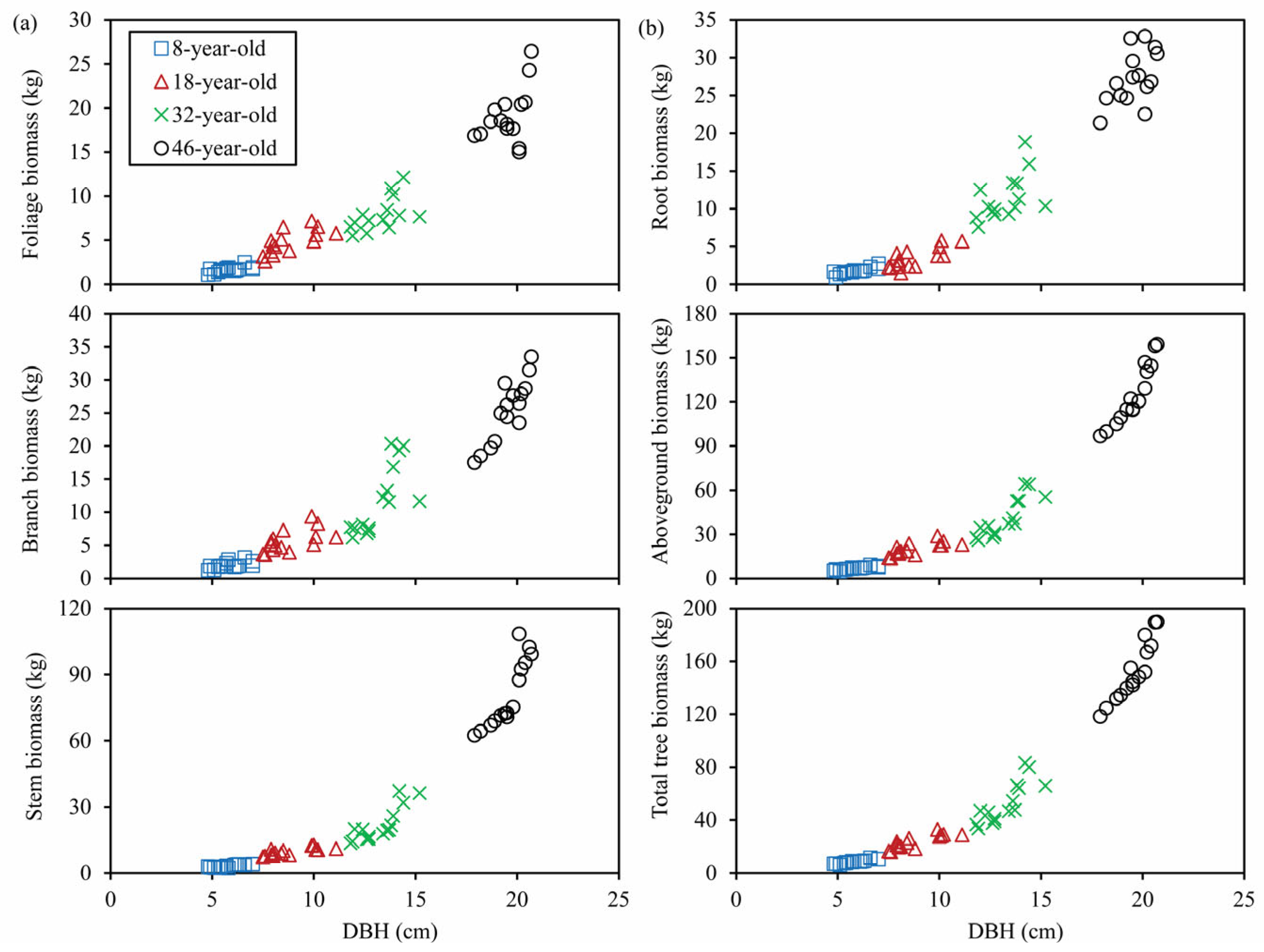
The biomass of tree components demonstrated strong correlations with DBH in this study (Figure 4). In Figure 4a, the biomass of foliage, branch, and stem exhibited consistent increasing trends as DBH increased. A similarly robust relationship was evident in Figure 4b, where biomass accumulation in root, aboveground, and total tree biomass continued to adhere to DBH-dependent patterns, even for larger tree sizes. This consistency across various developmental stages highlighted the effectiveness of Equation (1) models for estimating tree component biomass in both younger and older stands.
Figure 4.
Relationship between (a) the biomass of foliage, branch, and stem with DBH and (b) the biomass of aboveground, root, and total tree with DBH in Chinese pine stands.
Allometric equations relating tree component biomass to DBH, with tree height or age as a second variable, are presented in Table 3. The three model forms explained between 92.1% and 98.6% of variation in biomass of tree components. Foliage biomass was highly correlated with DBH (R2 = 0.940). For branch, stem, aboveground, root, and total tree biomass, the inclusion of a second variable (height or age) improved the model fit (higher R2 and lower ACI) compared to Equation (1) models. The AIC is a model selection metric in which a lower value indicates a better model fit, balancing goodness-of-fit and model complexity. Age had a negative effect on foliage and branch biomass, indicating that older trees tended to have less foliage and branch biomass for tress of the same DBH. In contrast, age showed a positive effect in the stem and root biomass models, suggesting that older trees of a given DBH allocated more biomass to stems and roots, which aligned with known ecological patterns like increased wood density and root system development over time.
Table 3.
Allometric equations for various tree components across the chronosequence of Chinese pine stands.
3.3. Biomass Conversion and Expansion Factors (BCEFs)
BCEFs facilitate the estimation of aboveground and root biomass using traditional forest inventory data. In this study, BCEFs for foliage, branch, aboveground, root, and total tree decreased along the chronosequence (Table 4). Aboveground components (excluding stem) and roots decreased by over 50%, while the total tree BCEF decreased from 1.84 to 0.89, indicating a systemic shift in biomass allocation and growth efficiency. Conversely, stem BCEFs did not exhibit a monotonic decline. Although they decreased from 0.68 in 8-year-old stands to 0.42 in 32-year-old stands, and a slight increase to 0.47 was observed in 46-year-old stands, possibly reflecting a late-stage shift in biomass allocation that favors stem maintenance or structural growth.
Table 4.
Biomass conversion and expansion factor (BCEF) for different tree component across the chronosequence of Chinese pine stands (mean ± S.D.).
Furthermore, age-based predictive equations were constructed to estimate BCEFs for various tree components within Chinese pine stands (Table 5). These equations served as practical tools for estimating biomass in trees with sub-timber dimensions. The modeling of BCEFs utilized two mathematical forms—exponential and power functions—depending on the specific component analyzed. The BCEFs of foliage, branch, aboveground, and total tree were best presented by exponential equations (BCEFi = aebx), all demonstrating strong negative correlations with age (parameter b < 0). This suggested an initial rapid decline in BCEFs during early stand development, followed by gradual stabilization at later stages. In contrast, stem and root BCEFs were more accurately modeled using power functions (BCEFi = axb), which also displayed declining trends but adhered to a more gradual and non-linear pattern over time. The models yielded reasonably good fits, with R2 values ranging from 0.475 for stem to 0.728 for total tree biomass. Although explanatory power varied among different components, all regressions were highly significant (p < 0.001), underscoring the robustness of these equations for predictive applications.
Table 5.
Relationship between biomass conversion and expansion factor (BCEF) and age (A) for different tree components of Chinese pine stands.
4. Discussion
4.1. Effect of Stand Age on Biomass Allocation
The effect of stand age on biomass allocation reflects tree growth and the balanced allocation of resources to sustain their respective physiological activities and functions [17,43]. The observed aboveground partitioning pattern, characterized by an increasing stem fraction and decreasing leaf and branch fractions with stand age (Figure 2), was consistent with the results of previous studies conducted across a range of forest types [44,45]. These shifts result from both structural constraints and physiological adjustments over the course of stand development [19]. In early stages, rapid foliage and branch expansion are critical for maximizing light interception and ensuring tree survival [12]. As trees mature, a greater proportion of growth is allocated to stems, a pattern common in wood plants [45,46], primarily to enhance mechanical stability [19,43]. Variation in biomass allocation might also arise from differences in stand age, density, and site quality, as foliage and branch production were highly sensitive to light, water, nutrient availability, and soil conditions [17,47,48].
In the present study, stems constituted the largest fraction of total tree biomass, aligning with previous reports [21,49]. Conversely, Dimobe et al. [50] observed that the branch biomass accounted for the highest proportion of Terminalia laxiflora in Burkina Faso. Such discrepancies likely reflect species- and context-specific resource allocation strategies: trees in plantation often invest more in height growth to compete for light [47,49], whereas the individuals studied by Dimobe et al. [50] may have prioritized canopy expansion through branch development, possibly as an adaptation to open-growth conditions or differing disturbance regimes.
The direct measurement of root biomass is labor-intensive and time-consuming [48]. A linear relationship between belowground and aboveground biomass has been reported in multiple forest ecosystems, including white pine forests [19] and Chinese fir plantations [17]. These relationships highlight the stability of biomass partitioning strategies across various developmental stages, which is crucial for biomass estimation, C storage modeling, and root system research. In this study, the belowground to aboveground ratios of P. tabuliformis ranged from 0.17 to 0.35, falling within the typical range for other coniferous species (0.16–0.47) [45,48,51]. The mean ratio (0.23) aligns with values for temperate coniferous forests [19,45], but is higher than those reported for P. massoniana in subtropical southern China (0.15–0.17) [48,52]. The observed differences may be attributed to site-specific climatic and hydrogeologic conditions [33], such as reduced precipitation or limited soil nutrient availability, which promote relatively greater root investment in arid or nutrient-deficient environments. Therefore, accurately accounting for interspecific and site-driven variation in belowground biomass allocation is essential to avoid significant errors in root biomass and carbon storage estimates [17].
4.2. Comparison of Allometric Equations
Previous studies have employed various predictors (e.g., DBH, height, age, crown area, wood density, etc.) to estimate tree component biomass [18,53,54]. Among these, DBH remains the most widely adopted due to its ease of measurement and strong correlation with biomass across many species and forest types. Other variables, such as crown area, though ecologically meaningful, are often impractical to quantify accurately in dense plantation settings, limiting their broad applicability [53]. In this study, Equation (1) models demonstrated strong explanatory power for all tree components (R2 > 0.931) (Table 3). Considering model simplicity, these allometric equations are highly suitable for biomass estimation [41,42,55].
However, the use of DBH as a single predictor has its limitations, particularly concerning stem biomass estimation. In even-aged stands, variations in social status—such as those between dominant and suppressed trees—can result in significant discrepancies in stem form and wood density, which DBH alone may not adequately capture [17,19]. As highlighted by Wagner and Ter-Mikaelian [56] and Cienciala et al. [57], incorporating tree height as a complementary variable improved the accuracy of stem biomass predictions. Consistent with these findings, our study demonstrated that the combined variable D2H generally improved the model fit for stem biomass compared to Equation (1) (Table 3). This improvement likely arose from D2H to better capture variations in the DBH-H relationship and tree architecture while avoiding multicollinearity between DBH and H as separate predictors [26,28,58].
The influence of stand age on allometric relationships has gained increasing recognition in recent studies [29,34]. Nevertheless, the manner in which regression coefficients shift with age remains contentious and appears to vary depending on tree component and species [47,59]. In this study, Equation (3)—which included age as an additional variable—yielded higher coefficients of determination than either Equation (1) or Equation (2) models for branch, aboveground, root, and total tree biomass (Table 3). This outcome could be attributed to the differential responsiveness of tree components to ontogeny and environmental conditions. Structural components, such as branches and roots, underwent gradual morphological and proportional changes over time, while more dynamic components like foliage were significantly influenced by short-term environmental fluctuations [17,60]. By capturing these temporal dynamics, age-inclusive models provided a more nuanced representation of biomass allocation throughout stand development.
This study established a set of generalized allometric equations for Chinese pine plantations that are applicable across a range of stand ages. The inclusion of height or age as supplementary variables had been shown to enhance model performance for specific biomass components (Table 3). These allometric patterns not only advanced our mechanistic understanding of developmental ecology in coniferous species but also provided a robust empirical foundation for refining C accounting and forest management strategies in response to environmental change. Further improvements in allometric modeling could be achieved by integrating additional factors such as stand density, competition indices, and individual tree canopy architecture [29]. Such refinements would strengthen the ecological realism and predictive accuracy of biomass estimation tools, thereby supporting their application in both scientific and management contexts.
4.3. BCEFs
According to the IPCC guidelines, BCEFs are essential for estimating total tree biomass from stem wood volume [40,41,61]. This study demonstrated that the proportional biomass of individual tree components varied with stand age, consequently influencing their respective BCEFs. The observed decline in BCEFs with increasing stand age aligned with patterns reported in other coniferous forest ecosystems [41,62]. The IPCC proposed a mean BCEF value of 1.8 (ranging from 0.6 to 2.4) for pines. However, this study documented a decrease from 1.84 at 8-year-old stand to 0.89 at 46-year-old stand (Table 4). A direct comparison was not feasible since IPCC values were based on the merchantable volume while this study utilized whole stem volume. Similarly, Peichl and Arain [19] reported a decline in BCEFs from 1.30 to 0.56 in white pine forests based on tree-level in situ measurements. Such methodological variations typically introduced relative standard errors of 4–13% at the regional scale [63], underscoring the importance of harmonizing volumetric definitions when comparing BCEFs across different studies.
This study also presented age-dependent equations for estimating BCEFs in Chinese pine plantations (Table 5). While these models served as valuable tools for local biomass estimation, their derivation from a limited sample size (n = 60) across only four age classes necessitated caution regarding extrapolation. To enhance the robustness and generalizability of these equations, future research should incorporate larger and more diverse datasets that encompass broader geographic and silvicultural conditions. Such efforts are critical for scaling tree-level estimates to regional and national C stock assessments. A key contribution of this study lies in its comprehensive tree-level in situ measurements of both above- and belowground biomass components—a dimension often underrepresented in large-scale studies of coniferous forests [40,41,61]. By integrating root biomass data and age-structured sampling, this research provided an ecologically grounded and methodologically transparent basis for refining BCEFs.
5. Conclusions
The present study demonstrated the influence of stand age on biomass partitioning and tree allometry in a chronosequence (8-, 18-, 32-, and 46-year-old) of Chinese pine plantations in northern China. With succession, the proportional allocation of biomass to stems increased, while the fractions allocated to foliage and branches decreased. The contribution of root biomass to the total tree biomass also exhibited a declining though variable trend across the studied ages. In terms of allometric relationships, single-variable models produced robust predictions of foliage biomass. For stem biomass, the combined form of D2H provided a better fit. In contrast, incorporating stand age as a complementary predictor improved the fitness of allometric equations for branches, aboveground biomass, roots, and total tree biomass. Furthermore, stand age influenced the relationship between tree component biomass and stem volume, leading to age-dependent BCEFs for the various components. These findings underscore the importance of accounting for stand developmental stage in biomass estimation. Future models could potentially be further refined by considering additional factors such as stand structure and individual tree canopy architecture.
Author Contributions
Conceptualization, H.S., and H.Y.; methodology, H.S., and H.Y.; software, H.S., and X.Y.; data curation, H.S., T.Z.; formal analysis, H.S., Y.Z., and X.L.; investigation, H.S., and T.Z.; resources, H.S., and H.Y.; supervision, Y.Z., and X.L.; visualization, H.S.; writing—original draft, H.S., and H.Y.; writing—review and editing, H.S., H.Y., and Y.Z. All authors have read and agreed to the published version of the manuscript.
Funding
This research was funded by the Innovation Project of Hebei Academy of Sciences (2025PF01), and the Operational Funding Program of Hebei Academy of Forestry and Grassland Science (13000025P001414102803).
Data Availability Statement
Data is contained within the article.
Conflicts of Interest
The authors declare no conflicts of interest.
References
- Diao, J.; Liu, J.; Zhu, Z.; Wei, X.; Li, M. Active forest management accelerates carbon storage in plantation forests in Lishui, Southern China. For. Ecosyst. 2022, 9, 100004. [Google Scholar] [CrossRef] [Scilit]
- Bai, Y.; Ding, G. Estimation of changes in carbon sequestration and its economic value with various stand density and rotation age of Pinus massoniana plantations in China. Sci. Rep. 2024, 14, 16852. [Google Scholar] [CrossRef] [Scilit]
- Forzieri, G.; Dakos, V.; McDowell, N.G.; Ramdane, A.; Cescatti, A. Emerging signals of declining forest resilience under climate change. Nature 2022, 608, 534–539. [Google Scholar] [CrossRef] [Scilit]
- Norby, R.J.; Loader, N.J.; Mayoral, C.; Ullah, S.; Curioni, G.; Smith, A.R.; Reay, M.K.; Van Wijngaarden, K.; Amjad, M.S.; Brettle, D.; et al. Enhanced woody biomass production in a mature temperate forest under elevated CO2. Nat. Clim. Change 2024, 14, 983–988. [Google Scholar] [CrossRef] [Scilit]
- Tong, X.; Xiao, J.; Liu, P.; Zhang, J.; Zhang, J.; Yu, P.; Meng, P.; Li, J. Carbon exchange of forest plantations: Global patterns and biophysical drivers. Agric. For. Meteorol. 2023, 336, 109379. [Google Scholar] [CrossRef] [Scilit]
- Laosuwan, T.; Uttaruk, Y.; Sangpradid, S.; Butthep, C.; Leammanee, S. The carbon sequestration potential of Silky Oak (Grevillea robusta A.Cunn. Ex R.Br.), a high-value economic wood in Thailand. Forests 2023, 14, 1824. [Google Scholar] [CrossRef] [Scilit]
- FAO. Global Forest Resources Assessment 2020: Main Report; FAO: Rome, Italy, 2020. [Google Scholar]
- Bukoski, J.J.; Cook-Patton, S.C.; Melikov, C.; Ban, H.; Chen, J.L.; Goldman, E.D.; Harris, N.L.; Potts, M.D. Rates and drivers of aboveground carbon accumulation in global monoculture plantation forests. Nat. Commun. 2022, 13, 4206. [Google Scholar] [CrossRef] [Scilit]
- Yao, L.; Liu, T.; Qin, J.; Jiang, H.; Yang, L.; Smith, P.; Chen, X.; Zhou, C.; Piao, S. Carbon sequestration potential of tree planting in China. Nat. Commun. 2024, 15, 8398. [Google Scholar] [CrossRef] [Scilit]
- Fayolle, A.; Ngomanda, A.; Mbasi, M.; Barbier, N.; Bocko, Y.; Boyemba, F.; Couteron, P.; Fonton, N.; Kamdem, N.; Katembo, J.; et al. A regional allometry for the congo basin forests based on the largest ever destructive sampling. For. Ecol. Manag. 2018, 430, 228–240. [Google Scholar] [CrossRef] [Scilit]
- Blujdea, V.N.B.; Pilli, R.; Dutca, I.; Ciuvat, L.; Abrudan, I.V. Allometric biomass equations for young broadleaved trees in plantations in Romania. For. Ecol. Manag. 2012, 264, 172–184. [Google Scholar] [CrossRef] [Scilit]
- Fatemi, F.R.; Yanai, R.D.; Hamburg, S.P.; Vadeboncoeur, M.A.; Arthur, M.A.; Briggs, R.D.; Levine, C.R. Allometric equations for young northern hardwoods: The importance of age-specific equations for estimating aboveground biomass. Can. J. For. Res. 2011, 41, 881–891. [Google Scholar] [CrossRef] [Scilit]
- Daba, D.E.; Soromessa, T. Allometric equations for aboveground biomass estimation of Diospyros abyssinica (Hiern) F. White tree species. Ecosyst. Health Sustain. 2019, 5, 86–97. [Google Scholar] [CrossRef] [Scilit]
- Duncanson, L.; Rourke, O.; Dubayah, R. Small sample sizes yield biased allometric equations in temperate forests. Sci. Rep. 2015, 5, 17153. [Google Scholar] [CrossRef] [Scilit]
- Muukkonen, P. Generalized allometric volume and biomass equations for some tree species in Europe. Eur. J. For. Res. 2007, 126, 157–166. [Google Scholar] [CrossRef] [Scilit]
- Brown, S. Measuring carbon in forests: Current status and future challenges. Environ. Pollut. 2002, 116, 363–372. [Google Scholar] [CrossRef] [Scilit]
- Xiang, W.; Li, L.; Ouyang, S.; Xiao, W.; Zeng, L.; Chen, L.; Lei, P.; Deng, X.; Zeng, Y.; Fang, J.; et al. Effects of stand age on tree biomass partitioning and allometric equations in Chinese fir (Cunninghamia lanceolata) plantations. Eur. J. For. Res. 2021, 140, 317–332. [Google Scholar] [CrossRef] [Scilit]
- Dong, L.; Zhang, L.; Li, F. Developing additive systems of biomass equations for nine hardwood species in Northeast China. Trees 2015, 29, 1149–1163. [Google Scholar] [CrossRef] [Scilit]
- Peichl, M.; Arain, M.A. Allometry and partitioning of above- and belowground tree biomass in an age-sequence of white pine forests. For. Ecol. Manag. 2007, 253, 68–80. [Google Scholar] [CrossRef] [Scilit]
- Djomo, A.N.; Ibrahima, A.; Saborowski, J.; Gravenhorst, G. Allometric equations for biomass estimations in cameroon and pan moist tropical equations including biomass data from Africa. For. Ecol. Manag. 2010, 260, 1873–1885. [Google Scholar] [CrossRef] [Scilit]
- Kuyah, S.; Dietz, J.; Muthuri, C.; Jamnadass, R.; Mwangi, P.; Coe, R.; Neufeldt, H. Allometric equations for estimating biomass in agricultural landscapes: I. Aboveground biomass. Agric. Ecosyst. Environ. 2012, 158, 216–224. [Google Scholar] [CrossRef] [Scilit]
- Zhou, X.; Yang, M.; Liu, Z.; Li, P.; Xie, B.; Peng, C. Dynamic allometric scaling of tree biomass and size. Nat. Plants 2021, 7, 42–49. [Google Scholar] [CrossRef] [Scilit]
- Chave, J.; Réjou-Méchain, M.; Búrquez, A.; Chidumayo, E.; Colgan, M.S.; Delitti, W.B.C.; Duque, A.; Eid, T.; Fearnside, P.M.; Goodman, R.C.; et al. Improved allometric models to estimate the aboveground biomass of tropical trees. Glob. Change Biol. 2014, 20, 3177–3190. [Google Scholar] [CrossRef] [Scilit]
- Guo, Z.; Fang, J.; Pan, Y.; Birdsey, R. Inventory-based estimates of forest biomass carbon stocks in china: A comparison of three methods. For. Ecol. Manag. 2010, 259, 1225–1231. [Google Scholar] [CrossRef] [Scilit]
- Ishihara, M.I.; Utsugi, H.; Tanouchi, H.; Aiba, M.; Kurokawa, H.; Onoda, Y.; Nagano, M.; Umehara, T.; Ando, M.; Miyata, R.; et al. Efficacy of generic allometric equations for estimating biomass: A test in japanese natural forests. Ecol. Appl. 2015, 25, 1433–1446. [Google Scholar] [CrossRef] [Scilit]
- Rojas-García, F.; De Jong, B.H.J.; Martínez-Zurimendí, P.; Paz-Pellat, F. Database of 478 allometric equations to estimate biomass for mexican trees and forests. Ann. For. Sci. 2015, 72, 835–864. [Google Scholar] [CrossRef] [Scilit]
- Xiang, W.; Zhou, J.; Ouyang, S.; Zhang, S.; Lei, P.; Li, J.; Deng, X.; Fang, X.; Forrester, D.I. Species-specific and general allometric equations for estimating tree biomass components of subtropical forests in Southern China. Eur. J. For. Res. 2016, 135, 963–979. [Google Scholar] [CrossRef] [Scilit]
- Dutcă, I.; Mather, R.; Blujdea, V.N.B.; Ioraș, F.; Olari, M.; Abrudan, I.V. Site-effects on biomass allometric models for early growth plantations of Norway spruce (Picea abies (L.) Karst.). Biomass Bioenergy 2018, 116, 8–17. [Google Scholar] [CrossRef] [Scilit]
- Forrester, D.I.; Tachauer, I.H.H.; Annighoefer, P.; Barbeito, I.; Pretzsch, H.; Ruiz-Peinado, R.; Stark, H.; Vacchiano, G.; Zlatanov, T.; Chakraborty, T.; et al. Generalized biomass and leaf area allometric equations for european tree species incorporating stand structure, tree age and climate. For. Ecol. Manag. 2017, 396, 160–175. [Google Scholar] [CrossRef] [Scilit]
- Jagodziński, A.M.; Dyderski, M.K.; Gęsikiewicz, K.; Horodecki, P. Effects of stand features on aboveground biomass and biomass conversion and expansion factors based on a Pinus sylvestris L. chronosequence in Western Poland. Eur. J. For. Res. 2019, 138, 673–683. [Google Scholar] [CrossRef] [Scilit]
- Poorter, L.; Craven, D.; Jakovac, C.C.; Van Der Sande, M.T.; Amissah, L.; Bongers, F.; Chazdon, R.L.; Farrior, C.E.; Kambach, S.; Meave, J.A.; et al. Multidimensional tropical forest recovery. Science 2021, 374, 1370–1376. [Google Scholar] [CrossRef] [Scilit]
- Matsuo, T.; Bongers, F.; Martínez-Ramos, M.; Van Der Sande, M.T.; Poorter, L. Height growth and biomass partitioning during secondary succession differ among forest light strata and successional guilds in a tropical rainforest. Oikos 2024, 2024, e10486. [Google Scholar] [CrossRef] [Scilit]
- Ma, X.; Wang, X. Biomass partitioning and allometric relations of the Reaumuria soongorica shrub in Alxa steppe desert in NW China. For. Ecol. Manag. 2020, 468, 118178. [Google Scholar] [CrossRef] [Scilit]
- Yang, B.; Xue, W.; Yu, S.; Zhou, J.; Zhang, W. Effects of stand age on biomass allocation and allometry of Quercus acutissima in the central Loess Plateau of China. Forests 2019, 10, 41. [Google Scholar] [CrossRef] [Scilit]
- Gao, Y.; Cheng, J.; Ma, Z.; Zhao, Y.; Su, J. Carbon storage in biomass, litter, and soil of different plantations in a semiarid temperate region of Northwest China. Ann. For. Sci. 2014, 71, 427–435. [Google Scholar] [CrossRef] [Scilit]
- Cao, Y.; Chen, Y. Ecosystem C:N:P stoichiometry and carbon storage in plantations and a secondary forest on the Loess Plateau, China. Ecol. Eng. 2017, 105, 125–132. [Google Scholar] [CrossRef] [Scilit]
- Xiong, N.; Qiao, Y.; Ren, H.; Zhang, L.; Chen, R.; Wang, J. Comparison of parameter estimation methods based on two additive biomass models with small samples. Forests 2023, 14, 1655. [Google Scholar] [CrossRef] [Scilit]
- Chinese Academy of Sciences, Nanjing Institute of Soil Research, Soil Taxonomy Research Group. Chinese Soil Taxonomy; Beijing University of Science and Technology of China Press: Beijing, China, 2001. (In Chinese) [Google Scholar]
- Soil Survey Staff. Keys to Soil Taxonomy, 13th ed.; United States Department of Agriculture, Natural Resources Conservation Service: Washington, DC, USA, 2012. [Google Scholar]
- Kim, C.; Jeong, J.; Kim, R.-H.; Son, Y.-M.; Lee, K.H.; Kim, J.-S.; Park, I.-H. Allometric equations and biomass expansion factors of Japanese red pine on the local level. Landsc. Ecol. Eng. 2011, 7, 283–289. [Google Scholar] [CrossRef] [Scilit]
- Jagodziński, A.M.; Dyderski, M.K.; Gęsikiewicz, K.; Horodecki, P.; Cysewska, A.; Wierczyńska, S.; Maciejczyk, K. How do tree stand parameters affect young Scots pine biomass?–Allometric equations and biomass conversion and expansion factors. For. Ecol. Manag. 2018, 409, 74–83. [Google Scholar] [CrossRef] [Scilit]
- Návar, J. Allometric equations for tree species and carbon stocks for forests of Northwestern Mexico. For. Ecol. Manag. 2009, 257, 427–434. [Google Scholar] [CrossRef] [Scilit]
- Mensah, S.; Glèlè Kakaï, R.; Seifert, T. Patterns of biomass allocation between foliage and woody structure: The effects of tree size and specific functional traits. Ann. For. Res. 2016, 59, 1–12. [Google Scholar] [CrossRef] [Scilit]
- Hu, M.; Lehtonen, A.; Minunno, F.; Mäkelä, A. Age effect on tree structure and biomass allocation in Scots pine (Pinus sylvestris L.) and Norway spruce (Picea abies [L.] Karst.). Ann. For. Sci. 2020, 77, 90. [Google Scholar] [CrossRef] [Scilit]
- King, J.S.; Giardina, C.P.; Pregitzer, K.S.; Friend, A.L. Biomass partitioning in red pine (Pinus resinosa) along a chronosequence in the upper Peninsula of Michigan. Can. J. For. Res. 2007, 37, 93–102. [Google Scholar] [CrossRef] [Scilit]
- Konôpka, B.; Pajtík, J.; Moravčík, M.; Lukac, M. Biomass partitioning and growth efficiency in four naturally regenerated forest tree species. Basic Appl. Ecol. 2010, 11, 234–243. [Google Scholar] [CrossRef] [Scilit]
- Bond-Lamberty, B.; Wang, C.; Gower, S.T. Aboveground and belowground biomass and sapwood area allometric equations for six boreal tree species of Northern Manitoba. Can. J. For. Res. 2002, 32, 1441–1450. [Google Scholar] [CrossRef] [Scilit]
- Xiang, W.; Liu, S.; Deng, X.; Shen, A.; Lei, X.; Tian, D.; Zhao, M.; Peng, C. General allometric equations and biomass allocation of Pinus massoniana trees on a regional scale in Southern China. Ecol. Res. 2011, 26, 697–711. [Google Scholar] [CrossRef] [Scilit]
- Mukuralinda, A.; Kuyah, S.; Ruzibiza, M.; Ndoli, A.; Nabahungu, N.L.; Muthuri, C. Allometric equations, wood density and partitioning of aboveground biomass in the Arboretum of Ruhande, Rwanda. Trees For. People 2021, 3, 100050. [Google Scholar] [CrossRef] [Scilit]
- Dimobe, K.; Mensah, S.; Goetze, D.; Ouédraogo, A.; Kuyah, S.; Porembski, S.; Thiombiano, A. Aboveground biomass partitioning and additive models for Combretum glutinosum and Terminalia laxiflora in West Africa. Biomass Bioenergy 2018, 115, 151–159. [Google Scholar] [CrossRef] [Scilit]
- Cairns, M.A.; Brown, S.; Helmer, E.H.; Baumgardner, G.A. Root biomass allocation in the world’s upland forests. Oecologia 1997, 111, 1–11. [Google Scholar] [CrossRef] [Scilit]
- Ding, G. Study on biomass and productivity of masson pine planting stand I. biomass and density effect of different planting density. J. Fujian Coll. For. 2003, 23, 34–38, (In Chinese with English Abstract). [Google Scholar]
- Lin, K.; Lyu, M.; Jiang, M.; Chen, Y.; Li, Y.; Chen, G.; Xie, J.; Yang, Y. Improved allometric equations for estimating biomass of the three Castanopsis carlesii H. forest types in subtropical China. New For. 2017, 48, 115–135. [Google Scholar] [CrossRef] [Scilit]
- Suchomel, C.; Pyttel, P.; Becker, G.; Bauhus, J. Biomass equations for sessile oak (Quercus petraea (Matt.) Liebl.) and hornbeam (Carpinus betulus L.) in aged coppiced forests in southwest Germany. Biomass Bioenergy 2012, 46, 722–730. [Google Scholar] [CrossRef] [Scilit]
- Luo, Y.; Wang, X.; Ouyang, Z.; Lu, F.; Feng, L.; Tao, J. A review of biomass equations for China’s tree species. Earth Syst. Sci. Data 2020, 12, 21–40. [Google Scholar] [CrossRef] [Scilit]
- Wagner, R.G.; Ter-Mikaelian, M.T. Comparison of biomass component equations for four species of northern coniferous tree seedlings. Ann. For. Sci. 1999, 56, 193–199. [Google Scholar] [CrossRef] [Scilit]
- Cienciala, E.; Černý, M.; Tatarinov, F.; Apltauer, J.; Exnerová, Z. Biomass functions applicable to Scots pine. Trees 2006, 20, 483–495. [Google Scholar] [CrossRef] [Scilit]
- Rutishauser, E.; Noor’an, F.; Laumonier, Y.; Halperin, J.; Rufi’ie; Hergoualc’h, K.; Verchot, L. Generic allometric models including height best estimate forest biomass and carbon stocks in Indonesia. For. Ecol. Manag. 2013, 307, 219–225. [Google Scholar] [CrossRef] [Scilit]
- Saint-André, L.; M’Bou, A.T.; Mabiala, A.; Mouvondy, W.; Jourdan, C.; Roupsard, O.; Deleporte, P.; Hamel, O.; Nouvellon, Y. Age-related equations for above- and below-ground biomass of a Eucalyptus hybrid in Congo. For. Ecol. Manag. 2005, 205, 199–214. [Google Scholar] [CrossRef] [Scilit]
- Shaiek, O.; Loustau, D.; Trichet, P.; Meredieu, C.; Bachtobji, B.; Garchi, S.; El Aouni, M.H. Generalized biomass equations for the main aboveground biomass components of maritime pine across contrasting environments. Ann. For. Sci. 2011, 68, 443. [Google Scholar] [CrossRef] [Scilit]
- Teobaldelli, M.; Somogyi, Z.; Migliavacca, M.; Usoltsev, V.A. Generalized functions of biomass expansion factors for conifers and broadleaved by stand age, growing stock and site Index. For. Ecol. Manag. 2009, 257, 1004–1013. [Google Scholar] [CrossRef] [Scilit]
- Luo, Y.; Wang, X.; Zhang, X.; Ren, Y.; Poorter, H. Variation in biomass expansion factors for China’s forests in relation to forest type, climate, and stand development. Ann. For. Sci. 2013, 70, 589–599. [Google Scholar] [CrossRef] [Scilit]
- Jalkanen, A.; Mäkipää, R.; Ståhl, G.; Lehtonen, A.; Petersson, H. Estimation of the biomass stock of trees in Sweden: Comparison of biomass equations and age-dependent biomass expansion factors. Ann. For. Sci. 2005, 62, 845–851. [Google Scholar] [CrossRef] [Scilit]

Disclaimer/Publisher’s Note: The statements, opinions and data contained in all publications are solely those of the individual author(s) and contributor(s) and not of MDPI and/or the editor(s). MDPI and/or the editor(s) disclaim responsibility for any injury to people or property resulting from any ideas, methods, instructions or products referred to in the content. |
© 2025 by the authors. Licensee MDPI, Basel, Switzerland. This article is an open access article distributed under the terms and conditions of the Creative Commons Attribution (CC BY) license (https://creativecommons.org/licenses/by/4.0/).