

You are currently viewing a new version of our website. To view the old version click .

Forests, Volume 10, Issue 11

November 2019 - 114 articles

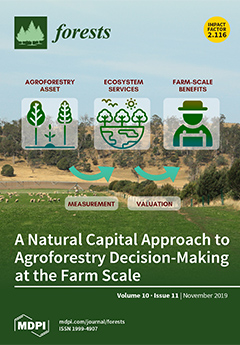
Cover Story: Agroforestry systems can improve the provision of ecosystem services at the farm scale whilst improving agricultural productivity, thereby playing an important role in the sustainable intensification of agriculture. Natural capital accounting offers a framework for demonstrating the capacity of agroforestry systems to deliver sustained private benefits to farming enterprises, but traditionally is applied at larger scales than those at which farmers make decisions. Here we review the current state of knowledge on natural capital accounting and analyse how such an approach may be effectively applied to demonstrate the farm-scale value of agroforestry assets. We also discuss the merits of applying a natural capital approach to agroforestry decision-making and present an example of a conceptual model for valuation of agroforestry assets at the farm scale. View this paper.
  • Issues are regarded as officially published after their release is announced to the table of contents alert mailing list .
  • You may sign up for email alerts to receive table of contents of newly released issues.
  • PDF is the official format for papers published in both, html and pdf forms. To view the papers in pdf format, click on the "PDF Full-text" link, and use the free Adobe Reader to open them.

Articles (114)

  • Article
  • Open Access
15 Citations
4,792 Views
20 Pages

14 November 2019

To optimize suppression, restoration, and prevention plans against wildfire, postfire assessment is a key input. Since little research has been carried out on applying Sentinel-2 imagery through an integrated approach to evaluate how environmental pa...

  • Article
  • Open Access
25 Citations
5,960 Views
18 Pages

The Growth of Mountain Tourism in a Traditional Forest Area of Greece

  • Stilianos Tampakis,
  • Veronika Andrea,
  • Paraskevi Karanikola and
  • Ioannis Pailas

14 November 2019

The recreational value of forests in mountain areas creates significant potential for local growth. Indeed, in recent decades, it has been noted that there has been an increase in the popularity of forests recognized as tourism destinations with a st...

  • Article
  • Open Access
1 Citations
2,599 Views
13 Pages

14 November 2019

In this work, we examine the effects of commercial thinning on stand volume and individual stem form in nine naturally regenerated black spruce (Picea mariana (Mill.) B.S.P.) stands. We compared these study sites with controls in the commercial borea...

  • Article
  • Open Access
18 Citations
4,034 Views
14 Pages

14 November 2019

Forest soil organic carbon (SOC) accounts for a large portion of global soil carbon stocks. Accurately mapping forest SOC stocks is a necessity for quantifying forest carbon cycling and forest soil sustainable management. In this study, we used a boo...

  • Article
  • Open Access
76 Citations
8,919 Views
15 Pages

14 November 2019

Unmanned aerial vehicle (UAV)-based remote sensing has limitations in acquiring images before a forest fire, although burn severity can be analyzed by comparing images before and after a fire. Determining the burned surface area is a challenging clas...

  • Review
  • Open Access
50 Citations
15,598 Views
24 Pages

14 November 2019

Research Highlights: This study reviews the available literature on processed non-timber forest products (NTFPs) in order to comprehensively identify relevant factors enabling or constraining their potential to contribute to rural development. Backgr...

  • Article
  • Open Access
8 Citations
4,000 Views
12 Pages

Deforestation Processes in the Polish Mountains in the Context of Terrain Topography

  • Radomir Bałazy,
  • Mariusz Ciesielski,
  • Patryk Waraksa,
  • Michał Zasada and
  • Tomasz Zawiła-Niedźwiecki

14 November 2019

In the 1980s, the Western Sudety Mountains were affected by a forest dieback process, resulting in large-scale deforestation covering an area of about 15,000 ha. A similar phenomenon is presently being observed in the Western Beskidy and Eastern Sude...

  • Review
  • Open Access
34 Citations
6,933 Views
17 Pages

14 November 2019

The genus Juniperus (of the Cupressaceae family) is the second most prevalent group of conifers on Earth. Juniper species are widely dispersed in the Northern Hemisphere, in Europe and Asia, and in Africa and Central America. Juniper species are resi...

  • Article
  • Open Access
4 Citations
3,139 Views
15 Pages

13 November 2019

Background and Objectives: Summer droughts are expected to increase in central and western Europe both in terms of frequency and intensity, justifying studies on longer term legacies of drought stress on tree species and their hybrids. Materials and...

  • Article
  • Open Access
34 Citations
6,561 Views
22 Pages

Towards the Biological Control of Devastating Forest Pathogens from the Genus Armillaria

  • Liqiong Chen,
  • Bettina Bóka,
  • Orsolya Kedves,
  • Viktor Dávid Nagy,
  • Attila Szűcs,
  • Simang Champramary,
  • Róbert Roszik,
  • Zoltán Patocskai,
  • Martin Münsterkötter and
  • Thu Huynh
  • + 4 authors

13 November 2019

Research Highlights: A large scale effort to screen, characterize, and select Trichoderma strains with the potential to antagonize Armillaria species revealed promising candidates for field applications. Background and Objectives: Armillaria species...

of 12

Get Alerted

Add your email address to receive forthcoming issues of this journal.

XFacebookLinkedIn
Forests - ISSN 1999-4907