


Abstract
This study presents the Multi-Method Convergence Protocol (MMCP), a decision-making framework designed to overcome the mono-objective limitations of HOMER Pro (Hybrid Optimization Model for Electric Renewables) and the instability commonly observed among traditional MCDM approaches. Applied to a hybrid PV–wind–grid Smart Grid (Intelligent Electrical Power Grid) in the Provence-Alpes-Côte d’Azur region (France), the protocol transforms techno-economic simulation outputs into robust and explainable multi-criteria decisions. MMCP integrates five sequential stages—normalization, AHP-based (Analytic Hierarchy Process) weighting, multi-method ranking (TOPSIS, PROMETHEE II, ELECTRE II (Elimination and Choice Expressing Reality II), and VIKOR), Borda–Copeland (Borda Count Ranking Method–Copeland Pairwise Aggregation Method) co-aggregation, and statistical validation—using Kendall’s τb (Kendall’s Rank Correlation Coefficient) and Spearman’s ρ (Spearman’s Rank Correlation Coefficient). Results reveal strong convergence between compensatory and non-compensatory models (τb ≥ 0.75; ρ ≥ 0.90), confirming the internal coherence and structural stability of the rankings. Scenario 17 emerges as the optimal configuration, combining low LCOE (Levelized Cost of Energy) with reduced emissions and balanced renewable penetration. The near-linear alignment between aggregation methods validates the protocol’s reliability and methodological transparency. Overall, MMCP provides a scalable and traceable foundation for sustainable Smart Grid planning and evidence-based energy governance.
1. Introduction
The global energy transition is fundamentally transforming energy production, distribution, and governance systems into low-carbon, decentralized, and progressively digitalized frameworks [1,2,3,4]. Achieving carbon neutrality by 2050 requires not only the large-scale deployment of renewable energy technologies—particularly photovoltaic (PV) and wind power—but also the development of advanced decision-support frameworks capable of managing intermittency, uncertainty, and competing performance objectives [2,3,4,5]. As renewable penetration increases, energy system design can no longer be addressed solely through cost-based optimization; it must explicitly integrate technical performance, environmental sustainability, and system resilience considerations [1,2,4].
At the regional and territorial scales, where local resource variability, grid constraints, and demand profiles strongly influence system behavior, these challenges become especially pronounced [3,4,5]. Regional authorities must simultaneously ensure supply security, economic efficiency, and emission reduction, all while adhering to national and supranational policy frameworks [4]. In the European context, and particularly in France, these objectives are articulated through strategic instruments such as the Multiannual Energy Program (PPE) and the National Low-Carbon Strategy (SNBC) [4]. Despite these policy efforts, many regions remain structurally dependent on centralized grids and exposed to renewable intermittency, raising critical questions regarding optimization robustness, sustainability trade-offs, and decision traceability [3,5]. To support energy planning under these conditions, techno-economic simulation and optimization tools play a central role [3,4]. Among them, HOMER Pro has become one of the most widely used tools for the design and evaluation of hybrid renewable energy systems, including PV–wind–grid configurations [6,7,8,9]. HOMER Pro enables the simulation of numerous system architectures and identifies optimal solutions primarily by minimizing economic indicators such as the Net Present Cost (NPC) or the Levelized Cost of Energy (LCOE) [6,7,8,9]. This approach provides a rigorous and transparent economic assessment and has therefore been extensively applied in both academic research and practical feasibility studies [6,7,8,9].
However, the optimization framework implemented in HOMER Pro remains fundamentally mono-objective [6,7,8,9]. Technical indicators—such as renewable fraction, grid dependency, and excess energy—and environmental indicators—such as CO2 (Carbon Dioxide), NOx (Nitrogen Oxides), PM (Particulate Matter), SO2 (Sulfur Dioxide), and CO (Carbon Monoxide) emissions—are computed only ex post and do not influence the optimization process itself [6,7,8,9]. Consequently, economic performance systematically dominates the decision process, while technical and environmental dimensions are relegated to secondary evaluation roles [1,2]. This structure often leads to apparent correlations between cost minimization and emission reduction that arise not from explicit sustainability-oriented decisions but from economic co-variation [1,2]. From a decision-support perspective, this constitutes a major limitation, as it prevents a transparent assessment of trade-offs that are central to sustainable regional energy planning [1,2,4].
In practice, decision-makers are rarely interested in identifying a single least-cost solution. Instead, they seek to compare alternative configurations that balance economic performance, renewable penetration, environmental impact, and system resilience [1,2,3,4]. A configuration that is marginally more expensive may offer substantial gains in emission reduction, energy autonomy, or grid resilience—benefits that remain invisible within a strictly mono-objective optimization framework [1,2,4]. Consequently, while HOMER Pro provides accurate techno-economic simulations, it is insufficient on its own to support robust, transparent, and sustainability-oriented decision-making in complex regional energy systems [1,2,3,4,10,11].
To overcome these limitations, Multi-Criteria Decision-Making (MCDM) methods have increasingly been proposed as complementary tools to techno-economic optimization [1,2]. Methods such as the Analytic Hierarchy Process (AHP), TOPSIS (Technique for Order Preference by Similarity to Ideal Solution), PROMETHEE II, ELECTRE II, and VIKOR enable the evaluation and ranking of alternatives based on multiple, potentially conflicting criteria [10,11,12,13,14]. Recent studies have combined HOMER Pro simulations with MCDM techniques to enrich post-optimization analysis and support multi-dimensional decision-making [10,11,12,13,14]. Despite these advances, important methodological challenges remain unresolved.
In particular, the literature highlights the strong sensitivity of decision outcomes to the choice of the MCDM method and weighting scheme [15,16,17]. The same energy scenario may be ranked as optimal under one method and only average under another, leading to inter-method instability and reduced confidence in decision outcomes [15,16,17]. Moreover, most existing studies rely on a single MCDM approach or apply multiple methods without providing systematic mechanisms to assess ranking robustness or convergence, especially in real regional contexts where decision accountability is critical [15,16,17].
The objective of this study is to address these gaps by developing and validating a robust multi-criteria decision-support framework that complements HOMER Pro simulations and explicitly integrates economic, technical, and environmental dimensions through methodological convergence [15,16,17].
More specifically, this paper introduces a Multi-Method Convergence Protocol (MMCP) that:
- integrates several widely used MCDM methods within a unified evaluation framework [10,11,12,13,14];
- applies voting-based rank aggregation techniques to assess ranking convergence and robustness [10];
- is empirically validated through a real regional case study [5,6,7,8,9,10,11,12,13,14,15,16,17,18,19,20].
The study is guided by the following research questions:
- How can mono-objective techno-economic optimization results produced by HOMER Pro be transformed into a structured multi-criteria decision-support framework [6,7,8,9,10,11,12,13,14]?
- To what extent do different MCDM methods produce stable or divergent rankings when applied to identical hybrid energy system scenarios [15,16,17]?
- Can rank aggregation and convergence mechanisms improve the robustness, transparency, and interpretability of decision outcomes at the regional scale [10,11]?
2. Literature Review
The growing complexity of sustainable energy systems and Smart Grid architectures has increasingly challenged the adequacy of purely economic optimization approaches. Recent studies published since 2022 consistently report that cost-based metrics alone—such as Net Present Cost (NPC) or Levelized Cost of Energy (LCOE)—are insufficient to support robust energy planning decisions in systems characterized by high renewable penetration, strong resource intermittency, and increasing dependence on centralized grids [1,2,3,4]. Instead, the recent literature emphasizes the necessity of integrating technical performance, environmental sustainability, and system reliability alongside economic indicators in order to enable transparent, traceable, and policy-relevant decision-making, particularly at the regional scale [2,3,4,5,6,7,8,9,10,11,12,13,14,15,16,17,18].
2.1. Recent Advances in MCDM for Sustainable Energy and Smart Grid Planning
Over the past three years, a substantial and rapidly expanding body of research has confirmed the relevance of Multi-Criteria Decision-Making (MCDM) approaches for addressing the inherently multi-dimensional nature of sustainable energy planning [1,2,17,21,22]. Recent reviews and bibliometric analyses published in high-impact journals document the widespread adoption of methods such as the Analytic Hierarchy Process (AHP), the Technique for Order Preference by Similarity to Ideal Solution (TOPSIS), the Preference Ranking Organization Method for Enrichment Evaluations (PROMETHEE), ELimination Et Choix Traduisant la REalité (ELECTRE), and VIseKriterijumska Optimizacija I Kompromisno Resenje (VIKOR) in renewable energy assessment and Smart Grid planning [13,15,16,21].
Recent applications demonstrate that these methods enable decision-makers to simultaneously evaluate economic performance, renewable penetration, environmental impact, and reliability indicators when comparing alternative hybrid renewable energy system configurations, including PV–wind and PV–wind–storage systems [10,11,12,13,14,19,20]. These studies confirm that MCDM approaches are particularly well-suited for capturing trade-offs between competing objectives that cannot be resolved through cost minimization alone. However, recent contributions also clearly underline that MCDM outcomes are highly sensitive to methodological choices, including normalization procedures, criteria weighting schemes, and the underlying decision logic adopted by each method [15,16,23]. As a result, different MCDM techniques may lead to significantly different rankings when applied to identical datasets.
2.2. Coupling HOMER Pro with MCDM Approaches: State of the Art and Limitations
HOMER Pro has become one of the most widely used software tools for the techno-economic optimization of hybrid renewable energy systems. Its success is largely attributed to its detailed component modeling capabilities and its rigorous economic optimization framework based on NPC and LCOE indicators [5,6,7,8,9]. Since 2022, an increasing number of studies have attempted to overcome HOMER Pro’s intrinsically mono-objective formulation by coupling its simulation outputs with MCDM techniques.
Recent HOMER–MCDM studies have employed combinations such as AHP–TOPSIS, AHP–VIKOR, PROMETHEE II, ELECTRE-based approaches, and hybrid fuzzy methods to enrich post-optimization analyses and to integrate technical and environmental criteria into the decision-making process [10,11,12,14,19,20]. These works demonstrate that coupling HOMER Pro with MCDM can reveal important trade-offs—particularly with respect to emissions, renewable fraction, grid dependency, and excess energy—that remain hidden under strictly economic optimization [7,8,9].
Nevertheless, the recent literature also reveals important methodological limitations. In most existing studies, HOMER Pro remains fundamentally mono-objective, with non-economic criteria evaluated only ex post and without influencing the optimization process itself. Consequently, environmental and technical indicators often exhibit implicit correlations with cost rather than reflecting explicit sustainability-driven decision priorities [22,23]. Moreover, the selection of a single MCDM method is frequently justified on pragmatic or heuristic grounds, without a systematic assessment of how alternative MCDM methods might influence ranking outcomes and decision consistency [15,23].
2.3. Inter-Method Instability and the Lack of Convergence Analysis
A critical issue increasingly emphasized in recent MCDM literature concerns inter-method instability. Because MCDM techniques rely on fundamentally different decision logics—distance-based (TOPSIS), outranking-based (PROMETHEE and ELECTRE), or compromise-oriented (VIKOR)—they frequently generate divergent or even contradictory rankings when applied to identical datasets [15,16,23,24]. Recent studies published since 2022 explicitly document rank reversal phenomena and strong method dependence in energy planning applications, raising concerns about the transparency, robustness, and credibility of MCDM-based decision-support systems [15,23,25].
Despite growing recognition of this problem, most HOMER–MCDM applications still rely on a single decision method or apply multiple methods without providing explicit mechanisms to assess ranking coherence, convergence, or robustness. Simple averaging or heuristic aggregation schemes are commonly used, while formal statistical validation tools—such as Spearman’s rank correlation coefficient or Kendall’s coefficient of concordance—remain underutilized in Smart Grid and regional energy planning contexts [10,24,26]. This methodological gap significantly limits decision traceability and weakens confidence in MCDM-based recommendations, particularly in policy-oriented and high-stakes regional decision-making processes.
2.4. Identified Research Gaps and Contribution of This Study
Based on a critical synthesis of the recent literature published between 2022 and 2024, three major research gaps can be clearly identified.
First, a transformation gap persists, reflecting the absence of a structured and transparent framework capable of transforming mono-objective HOMER Pro optimization outputs into a genuinely multi-criteria decision-support process [22].
Second, a convergence gap can be observed, as most existing studies lack systematic mechanisms to assess and enforce convergence, robustness, and stability across multiple MCDM rankings, despite well-documented inter-method instability [15,16,25,26,27,28].
Third, a contextual gap remains evident, with a limited number of empirically grounded regional case studies—particularly in Mediterranean and European contexts—where renewable intermittency, seasonal demand peaks, and grid dependency amplify the consequences of unstable or poorly justified decisions [5,6,7,8,9,10,11,12,13,14,15,16,17,18,19,20,22].
To address these gaps, this study proposes the Multi-Method Convergence Protocol (MMCP). Unlike conventional hybrid or ensemble MCDM approaches, MMCP is not introduced as a new decision-making method but as a convergence-oriented decision-support framework. Its novelty lies in explicitly integrating methodological diversity, voting-based rank aggregation techniques (Borda and Copeland), and statistical validation of inter-method coherence as core design principles, rather than post hoc analyses.
By applying the MMCP to a real hybrid Smart Grid case study in the Provence-Alpes-Côte d’Azur (PACA) region, this work demonstrates how methodological convergence and robustness analysis can significantly enhance the transparency, reliability, and interpretability of multi-criteria decisions in complex regional energy systems. In Mediterranean regions characterized by strong renewable variability and grid constraints, the proposed approach provides a clear added value for evidence-based energy governance and sustainable Smart Grid planning.
The comparative analysis presented in the Table 1 synthesizes recent developments (2022–2025) in multi-criteria energy planning approaches and simultaneously reveals persistent methodological limitations that continue to restrict their operational applicability in regional decision-support contexts.
Table 1.
Comparative synthesis positioning the MMCP framework within existing MCDM-based energy system literature.
First, recent methodological reviews and state-of-the-art syntheses confirm the theoretical maturity of Multi-Criteria Decision-Making (MCDM) techniques and provide comprehensive overviews of widely adopted methods such as AHP, TOPSIS, PROMETHEE, ELECTRE, and VIKOR. Despite this methodological richness, these contributions remain largely conceptual. Although inter-method divergence is explicitly acknowledged, no operational framework is proposed to manage ranking convergence in practical, real-world decision-making environments.
Second, studies focusing on regional energy planning demonstrate growing attention to environmental, territorial, and sustainability-related criteria. However, these works generally result in a single ranking of alternatives, without systematic sensitivity analysis across multiple MCDM methods or explicit evaluation of decision stability. Consequently, the robustness of rankings and the reliability of the final decision outcomes remain insufficiently addressed.
Third, HOMER Pro-based studies highlight the central role of this tool in the techno-economic optimization of hybrid PV–wind systems. While their practical relevance is undeniable, these approaches are overwhelmingly dominated by mono-objective economic criteria, such as Net Present Cost and Levelized Cost of Energy. Technical and environmental indicators are typically evaluated ex post and do not actively influence the decision-making process, thereby limiting the capacity of these studies to support transparent, balanced, and sustainability-oriented energy planning.
Fourth, some contributions attempt to overcome this limitation by coupling HOMER Pro with one or two MCDM methods. Although these hybrid approaches represent a step beyond purely economic optimization, they remain confined to pairwise comparisons and lack formal mechanisms for ranking convergence, aggregation, or statistical validation of inter-method coherence. As a result, the derived rankings remain highly sensitive to the choice of the decision method and offer limited decisional reliability.
Fifth, the problem of inter-method instability is well documented in the methodological literature, which introduces relevant concepts such as rank aggregation techniques and correlation-based consistency analysis. Nevertheless, these methodological advances are rarely applied to real regional energy systems and are seldom embedded within territorially grounded and policy-relevant case studies.
Finally, studies focusing on Mediterranean energy contexts provide valuable regional grounding and contextual realism. However, they generally do not implement systematic multi-method decision frameworks, explicit convergence mechanisms, or robustness validation procedures. This significantly limits their applicability to high-stakes energy governance and policy-oriented decision-making processes.
Highlighting the Novelty of the MMCP Approach
Within this context, the Multi-Method Convergence Protocol (MMCP) proposed in this study clearly differentiates itself from existing approaches. Unlike previous contributions, MMCP is neither limited to the isolated application of a single MCDM method nor restricted to ad hoc post-processing of HOMER Pro outputs. Instead, it introduces a convergence-oriented decision-support framework that explicitly integrates:
- multiple heterogeneous MCDM methods (AHP, TOPSIS, PROMETHEE II, ELECTRE II, and VIKOR),
- formal ranking aggregation rules (Borda and Copeland),
- and explicit statistical validation of inter-method coherence using Spearman’s rank correlation coefficient and Kendall’s coefficient of concordance.
Applied to a real regional hybrid Smart Grid case study in the Provence-Alpes-Côte d’Azur (PACA) region, the MMCP transforms mono-objective HOMER Pro optimization results into a robust, transparent, and interpretable multi-criteria decision-making process. By simultaneously addressing methodological gaps (lack of convergence mechanisms), decisional weaknesses (ranking instability), and contextual limitations (insufficient regional grounding) identified in the recent literature, the proposed framework constitutes an original and substantive contribution to sustainable, HOMER-based regional energy planning.
3. Methodology
This study adopts a structured, sequential, and multi-stage research methodology designed to transform mono-objective techno-economic optimization results into a robust and transparent multi-criteria decision-support framework. The proposed approach combines simulation-based optimization, multi-criteria evaluation, ranking aggregation, and statistical validation within a coherent and interpretable decision-making process. A sequential structure is deliberately adopted to preserve methodological transparency and to allow decision-makers to clearly identify the contribution of each stage to the final outcome.
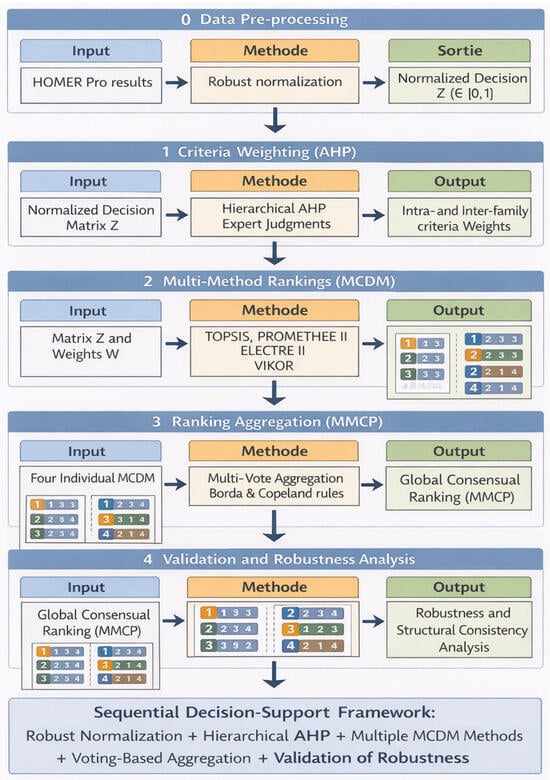
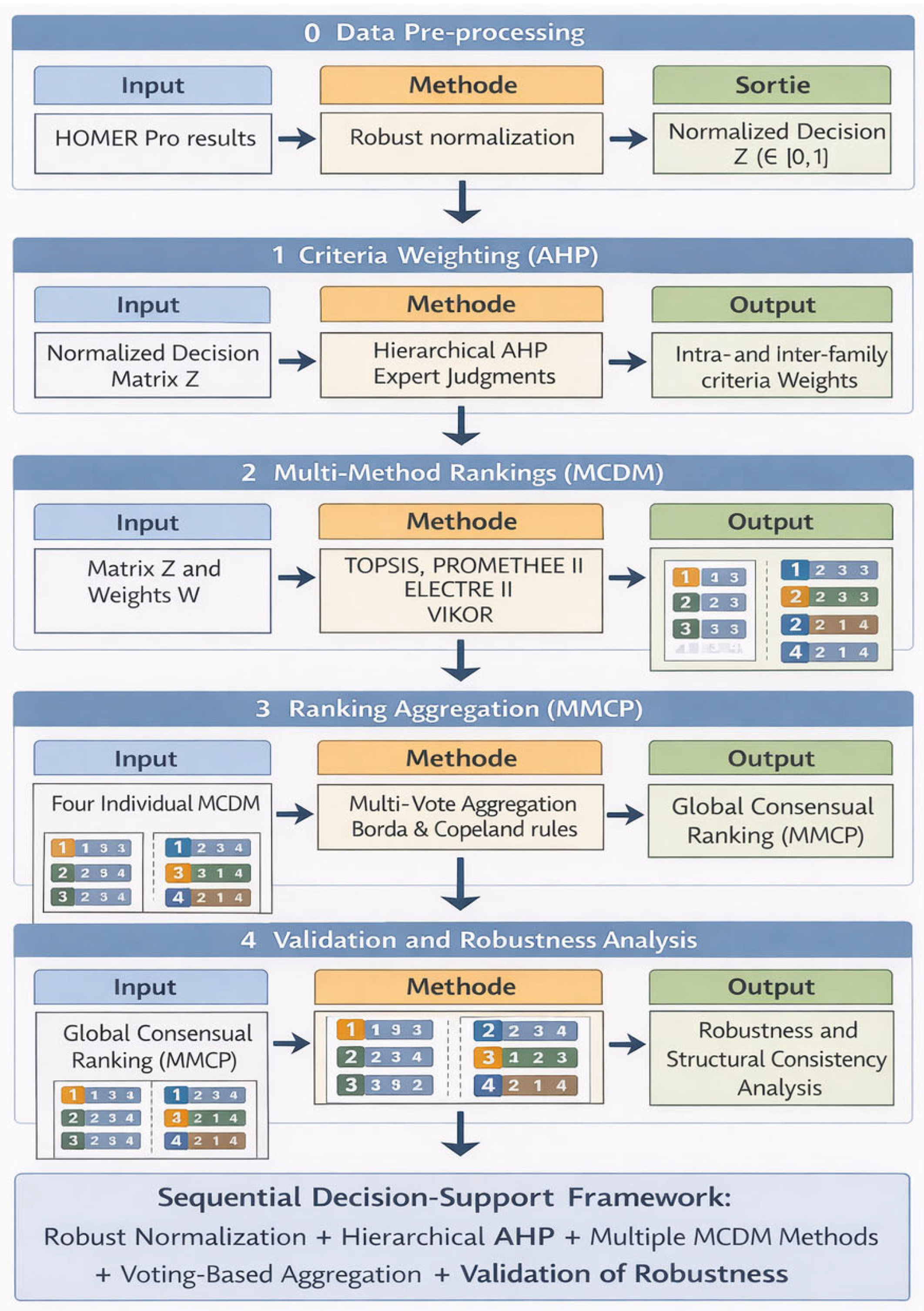
For clarity and readability, the overall research methodology is summarized in the flowchart presented in Figure 1, which provides a synthetic overview of the proposed Multi-Method Convergence Protocol (MMCP). The flowchart illustrates the logical progression of the methodology and the relationships between inputs, methods, and outputs at each stage, thereby facilitating a comprehensive understanding of the proposed framework before detailed methodological descriptions are introduced.
Figure 1.
Multi-method convergence protocol (MMCP).
As shown in Figure 1, the MMCP consists of five main stages, each corresponding to a specific function in the decision-support process. First, the techno-economic outputs generated by HOMER Pro are pre-processed and normalized to ensure comparability across heterogeneous criteria and to eliminate scale effects. Second, criteria weights are determined using a hierarchical Analytic Hierarchy Process (AHP) based on expert judgments, enabling the explicit representation of both intra-family and inter-family preferences. Third, multiple Multi-Criteria Decision-Making (MCDM) methods—namely TOPSIS, PROMETHEE II, ELECTRE II, and VIKOR—are independently applied to rank the alternative hybrid energy system configurations, thereby capturing diverse decision logics and performance perspectives. Fourth, the individual rankings obtained from these methods are aggregated using voting-based rules (Borda and Copeland) in order to derive a global consensual ranking within the MMCP framework. Finally, the robustness and structural consistency of the aggregated ranking are evaluated using statistical concordance measures, including Kendall’s coefficient of concordance and Spearman’s rank correlation coefficient.
By explicitly integrating methodological diversity, convergence analysis, and statistical validation, the proposed framework reduces dependence on any single decision model and enhances the robustness and interpretability of multi-criteria evaluations in complex regional energy planning contexts. Each of the five stages of the MMCP is detailed in the following subsections.
Following this methodological overview, the next subsection presents the regional case study, including a description of the study area, the hybrid energy system configurations considered, and the input data used for the HOMER Pro simulations.
Table 2 highlights the complementary roles of the selected MCDM methods within the MMCP framework, emphasizing their methodological diversity and strategic integration. Each method is grounded in a distinct decision logic, allowing the framework to capture multiple perspectives of the decision-making process in smart grid planning.
Table 2.
Functional Roles of Selected MCDM Methods within the MMCP Framework.
TOPSIS serves as a compensatory, distance-based reference method that provides an overall performance benchmark by balancing techno-economic trade-offs across all criteria. In contrast, PROMETHEE II and ELECTRE II adopt non-compensatory outranking logics, enabling a more discriminative analysis under conflicting criteria. PROMETHEE II focuses on dominance relationships and ranking robustness, while ELECTRE II introduces a conservative filtering mechanism that penalizes unacceptable performances, thereby eliminating weak alternatives at an early stage.
VIKOR complements these approaches through its compromise-based logic, explicitly addressing conflict resolution by identifying solutions that balance collective utility and individual regret. The combined use of compensatory, semi-compensatory, and strongly non-compensatory methods enhances the robustness and credibility of the MMCP framework by ensuring that final decisions are not driven by a single evaluation logic but rather by a convergence of consistent and methodologically justified results.
This study is based on a dual integrated approach that combines:
- The techno-economic modeling of a hybrid Smart Grid representative of the Provence-Alpes-Côte d’Azur (PACA) region using the HOMER Pro 3.18.4 software;
- The Multi-Method Convergence Protocol (MMCP), designed to transform simulation results into a robust multi-criteria decision-making framework.
This coupling aims to overcome the limitations of single-objective optimization models by establishing a systemic decision-making process tailored to the requirements of sustainable energy planning.
3.1. Study Case: Smart Grid PACA
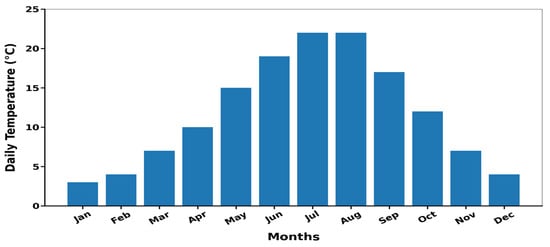
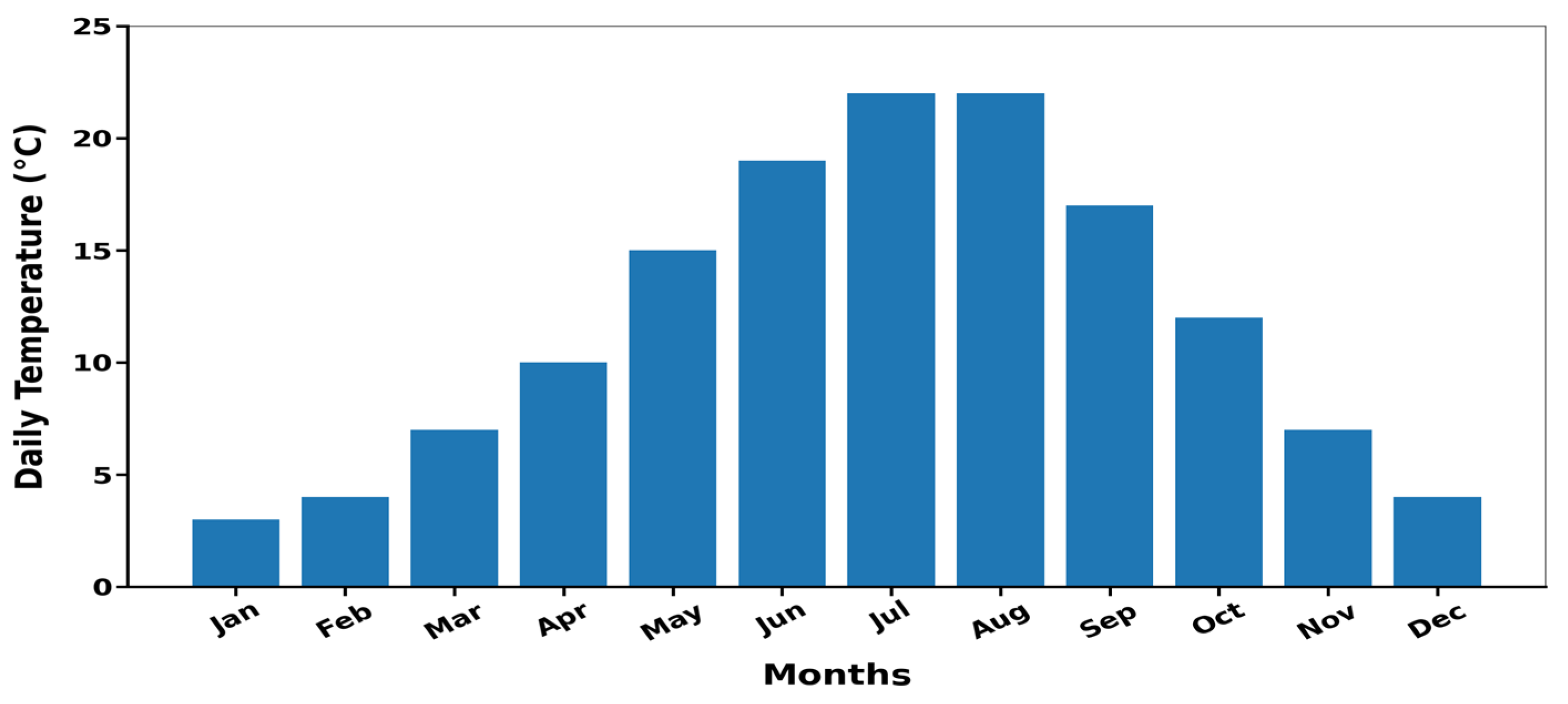
The case study is located in the Provence-Alpes-Côte d’Azur (PACA) region of France. Climatic data was obtained from the NASA POWER database, covering 22 years of solar irradiation and 30 years of temperature (Figure 2) and wind speed records, which is characterized by:
Figure 2.
Monthly average profile of daily temperature (°C).
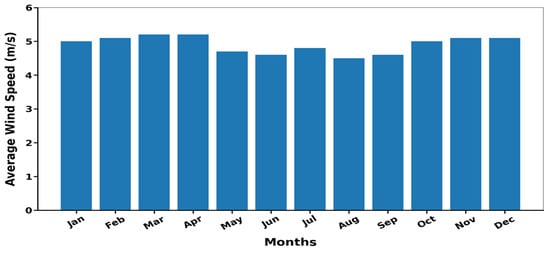
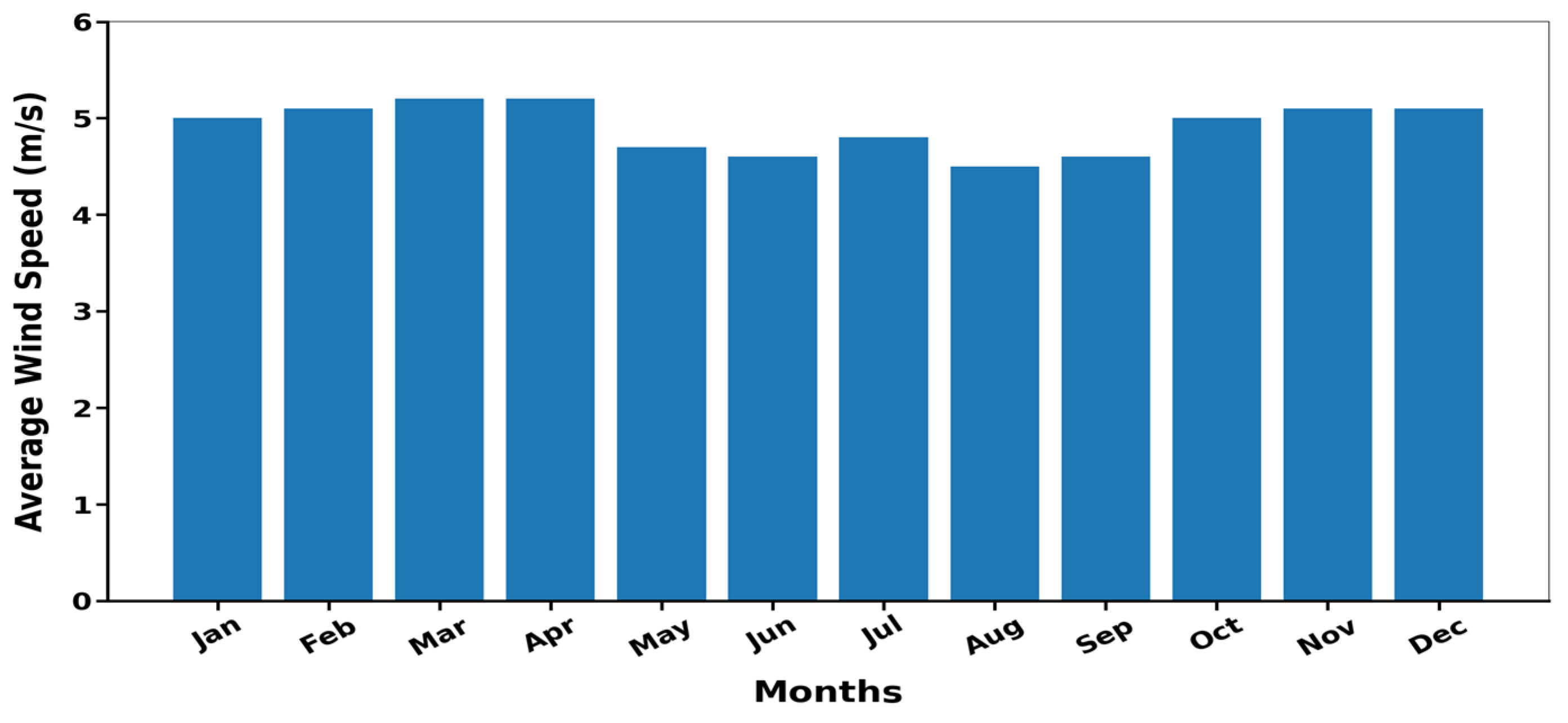
- Moderate but stable wind resources (≈5 m/s on average) as shown in Figure 3;
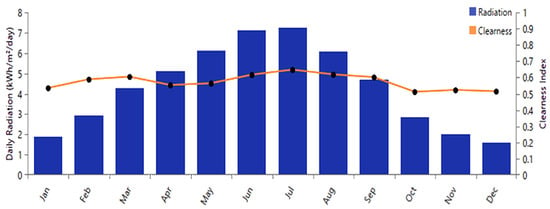
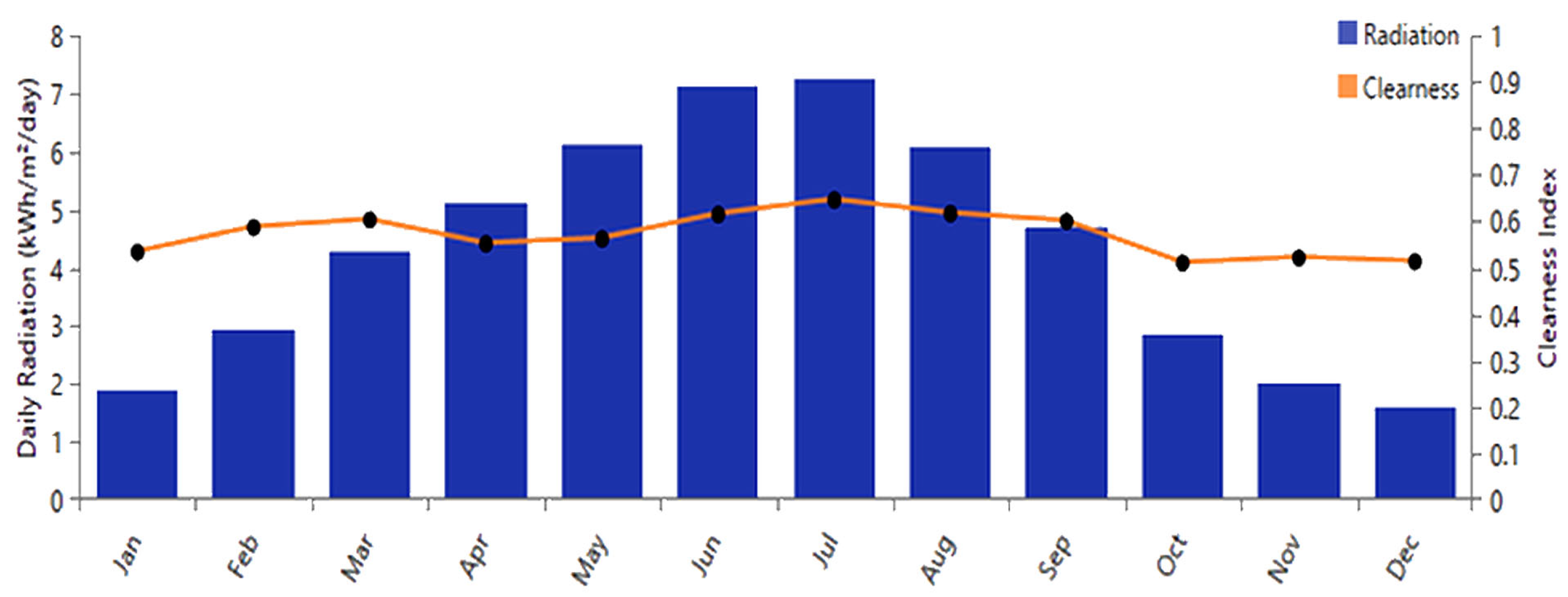
- Exceptional solar irradiance (>7 kWh/m2/day during summer) as shown in Figure 4;
- Strong dependence on the RTE South-East electrical grid;
- Continuous demographic and tourism growth (+0.6% per year), leading to increasing demand for air conditioning and electric mobility.
Figure 3.
Monthly average profile of wind speed (m/s).
Figure 4.
Monthly variation in daily solar irradiation and clearness index.
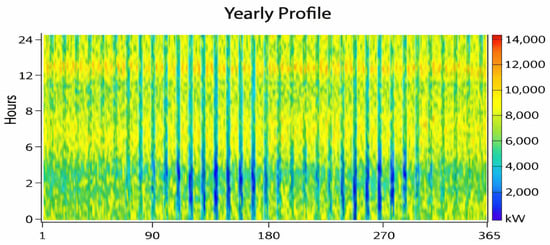
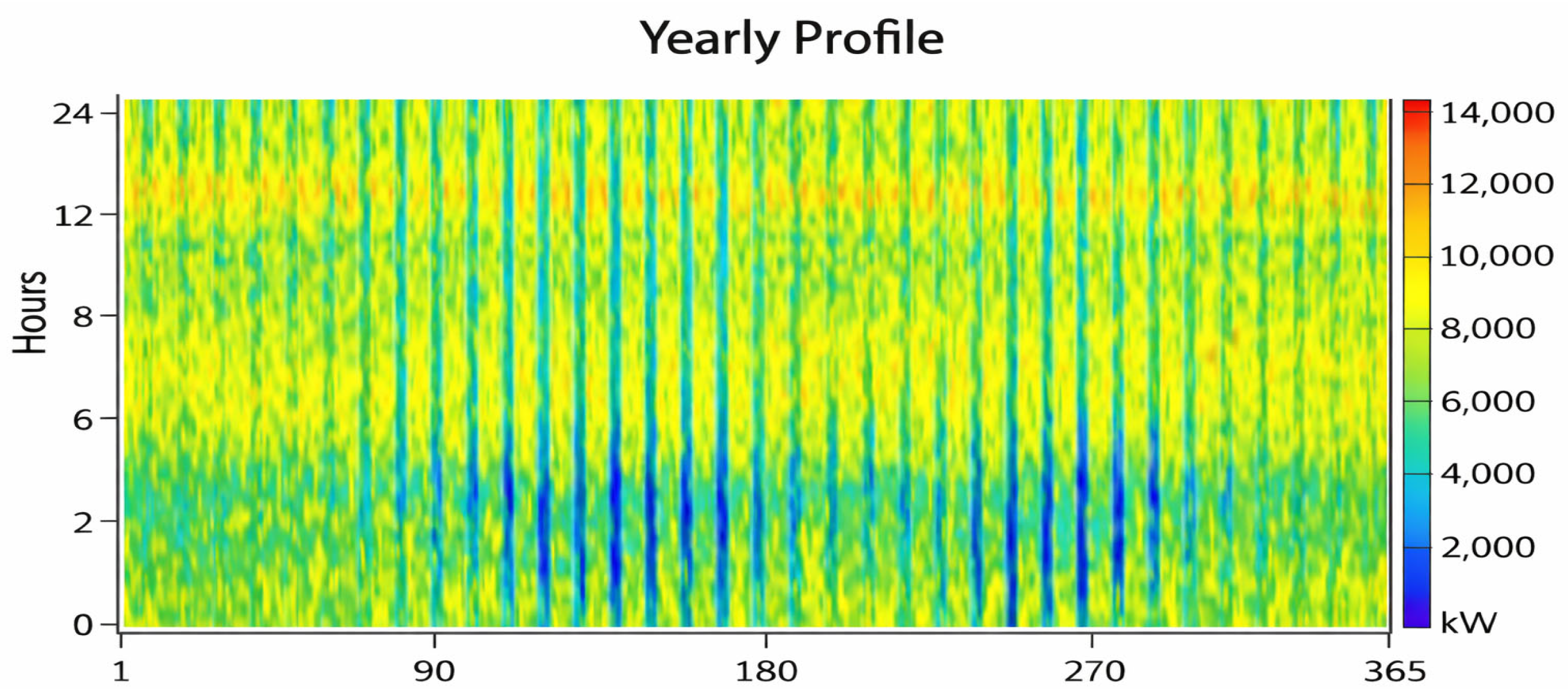
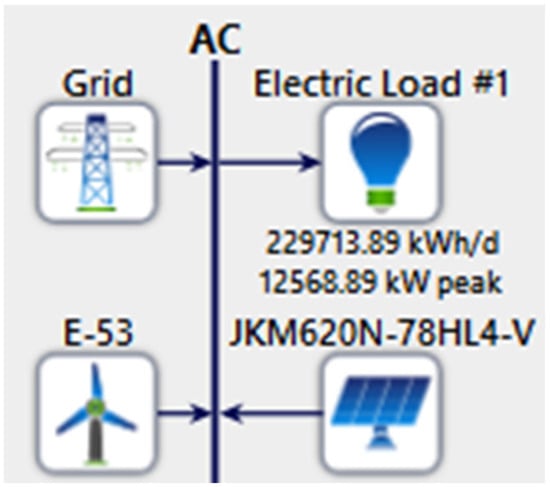
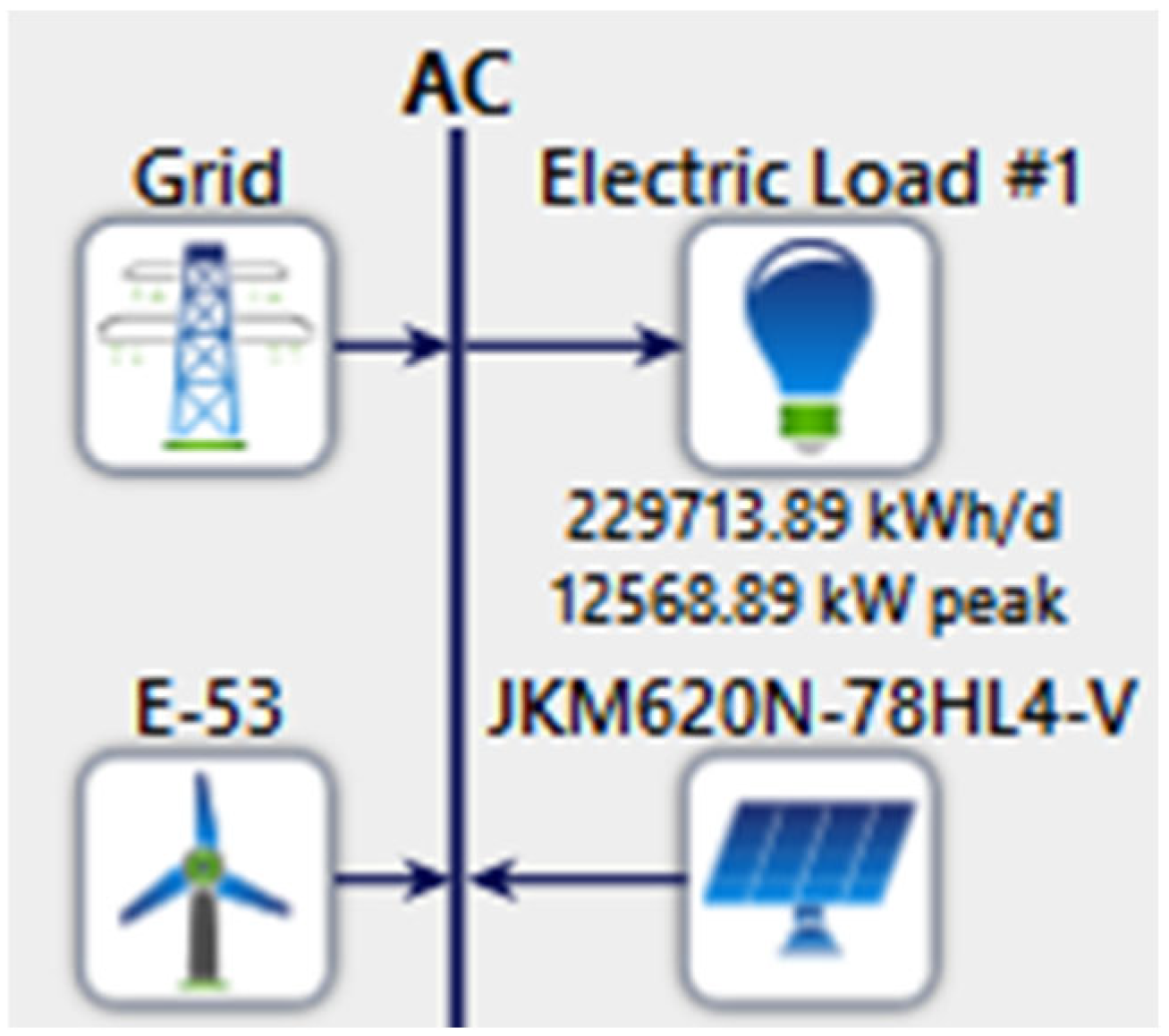
The load profile, as shown in Figure 5, corresponds to a typical village-scale energy demand, with an average daily consumption of 229,714 kWh, equivalent to an average power of 9.6 MW and a peak demand of 12.6 MW, resulting in a load factor of 0.76. The hybrid system, as shown in Figure 6, consists of:
Figure 5.
Annual hourly profile of load and energy production.
Figure 6.
Simplified schematic of the studied hybrid Smart Grid.
- A 25 MW photovoltaic power plant equipped with Jinko Tiger Neo 620 W modules;
- A 3.2 MW wind farm composed of four Enercon E-53 turbines;
- A grid connection to ensure energy balance and continuous power supply throughout the system’s operation.
The analysis horizon is set to 20 years, with a discount rate of 8% and a grid electricity cost of €0.12 per kWh. The HOMER Pro simulation engine generated 1998 scenarios, from which 21 representative configurations, as shown in Table 3 and Table 4, were selected following both technical filtering (Load Following mode, with a ratio of 0.9 ≤ PPV/Pinverter ≤ 1.3) and economic screening (LCOE < €0.10/kWh). The baseline parameters were standardized according to European norms:
Table 3.
Comparative techno-economic results of the 21 scenarios of the Smart Grid hybrid system.
Table 4.
Environmental results of the 21 scenarios of the Smart Grid hybrid energy system.
- Unit emissions: CO2 = 500 g/kWh (grid), 40 g/kWh (PV), 12 g/kWh (wind);
- PV efficiency: 23%, with a lifetime of 20–25 years.
A carbon penalty of €100 per ton of CO2 and an annual emission cap of 350,000 t CO2 were applied, in alignment with France’s National Low-Carbon Strategy (SNBC).
3.2. Multi-Method Convergence Protocol (MMCP)
The MMCP consists of five sequential stages, each mathematically formalized to ensure coherence and traceability throughout the decision process. Each stage introduces a higher level of methodological integration, progressing from data standardization to the statistical validation of ranking robustness [29].
Step 0: Pre-Processing and Normalization. Let:
be the decision matrix generated by HOMER Pro, with n = 21 scenarios and p = 12 criteria. To remove scale effects, a min–max normalization is applied:
where Cb and Cc denote the sets of benefit and cost criteria respectively.
Thus, zij′∈[0, 1] and
zij′ = 1⇒best performance, zij′ = 0⇒worst.
Step 1: Criteria Weighting via AHP
- Pairwise Comparison
An expert comparison matrix is defined by:
- Eigenvector Method
Weights derive from the principal eigenvector:
where v is the eigenvector associated with λmax
- Consistency Verification
Judgment consistency is acceptable if CR ≤ 0.1 (Consistency Ratio), ensuring transitive and coherent expert preferences [25].
Step 2: Multi-Criteria Decision-Making Methods
(a) TOPSIS—Distance to the Ideal Solution
Let:
Then define ideal points:
Relative closeness:
Higher Ci ⇒ closer to ideal.
(b) PROMETHEE II: Preference Flow Method
For each pair (i,j):
where fk(·) is the preference function (usual, U-shape, V-shape, Gaussian). Then compute:
and net flow:
Ranking is by descending Φi
(c) ELECTRE II: Outranking Logic
- Concordance Index
- Discordance Index
- Outranking Condition
Typical calibration (Smart Grid domain):
- Global Dominance Score
Higher Ei ⇒ stronger structural dominance.
(d) VIKOR: Compromise Ranking
Best and worst performances:
Compute:
Compromise index:
Lowest Qi → best compromise.
Acceptability:
Consistency: best by Qi must also top Si or Ri.
Step 3—MMCP Aggregation
- Borda Aggregation
The Borda method aggregates the rankings obtained from the different MCDM techniques into a single composite score. For each alternative i, its ranking position in each method mmm is denoted by ri,m, where a lower rank indicates better performance.
If M represents the total number of decision methods (here, M = 4), and wm denotes the reliability weight assigned to method mmm, the Borda score of alternatives i is computed as
where
- -
- ri,m is the rank of alternative i under method mmm;
- -
- wm reflects the relative credibility or influence of method m (e.g., determined via inter-method correlation analysis).
Interpretation:
- -
- Lower Bi indicates better overall performance, since the alternative consistently achieves favorable rankings across the selected methods.
- -
- Higher Bi indicates weaker global performance.
The Borda score thus provides a consensus ranking based on average performance across methods, adopting compensatory aggregation logic.
This makes it particularly useful for synthesizing results when individual methods may emphasize different aspects of performance.
When combined with the non-compensatory dominance captured by the Copeland score, the Borda aggregation contributes to a balanced and explainable final decision in the MMCP framework.
- Copeland Aggregation
The Copeland method evaluates the relative dominance of each alternative based on pairwise comparisons across the set of decision-making methods.
For every pair of alternatives (i,j), we determine whether alternative i ranks higher than j in the majority of the applied MCDM methods.
Let:
- -
- Vi be the number of “wins” of alternative i, i.e., the number of alternatives j for which i is preferred.
- -
- Di be the number of “losses”, i.e., cases where j is preferred over i.
The Copeland score for alternative i is defined as
with
where 1(·) is an indicator function equal to 1 if the condition is true and 0 otherwise, and (i j) denotes that alternative i outranks j in a majority of the considered methods.
Interpretation:
- Ci > 0 → i is globally dominant;
- Ci = 0 → balanced dominance;
- Ci < 0 → i is globally dominated.
The Copeland score therefore provides a non-compensatory dominance measure, complementing the rank-averaging logic of the Borda score. When integrated within the MMCP framework, it contributes to a stable and consensus-supported final ranking of the alternatives.
- Final MMCP Score
Higher MMCPi ⇒ globally superior, consensus-robust scenario.
Step 4—Robustness and Inter-Method Coherence
This step evaluates the stability and reliability of the rankings produced by the four MCDM methods. Since each method is based on a different decision logic (compensatory, preference flow, outranking, compromise), it is essential to check whether they produce consistent or divergent rankings. To do so, we compute the rank correlation between every pair of methods (A,B) [25].
- Spearman’s Rank Correlation Coefficient (ρ)
Spearman’s ρ measures the monotonic relationship between two rankings. It detects how similarly two methods order the alternatives, regardless of the actual distances between ranks.
- -
- riA, riB: rank of alternative i according to method A and B.
- -
- n: number of alternatives.
Interpretation:
- -
- ρ ≈ 1: the two methods rank alternatives almost identically.
- -
- ρ ≈ 0: no association.
- -
- ρ < 0: inverse rankings.
- Kendall’s Rank Correlation Coefficient (τb)
Kendall’s τb assesses the directional agreement between rankings by comparing pairs of alternatives.
where
- -
- nc: number of concordant pairs (ranked in the same order),
- -
- nd: number of discordant pairs (ranked in opposite order),
- -
- n0 = 0.5n(n − 1): total number of comparable pairs,
- -
- n1, n2: corrections to account for ties in the rankings.
Interpretation:
- -
- τb = 1: perfect agreement,
- -
- τb = 0: no relationship,
- -
- τb < 0: strong disagreement.
A weighted mean correlation (τb−,ρ−) > 0.7 indicates a stable and reliable consensus, validating the aggregation phase.
4. Simulation Results and Discussion
4.1. Step 0—Pre-Processing, Normalization, and Initial Correlations
Step 0 represents the foundational phase of the MMCP, designed to transform the raw simulation indicator matrix into a normalized and statistically robust dataset. This stage ensures metric comparability and statistical traceability of all evaluation criteria prior to any weighting or multi-criteria ranking procedures.
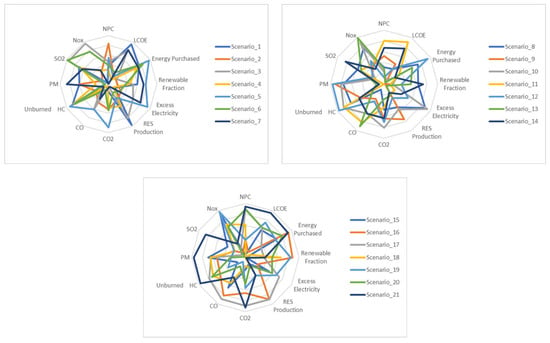
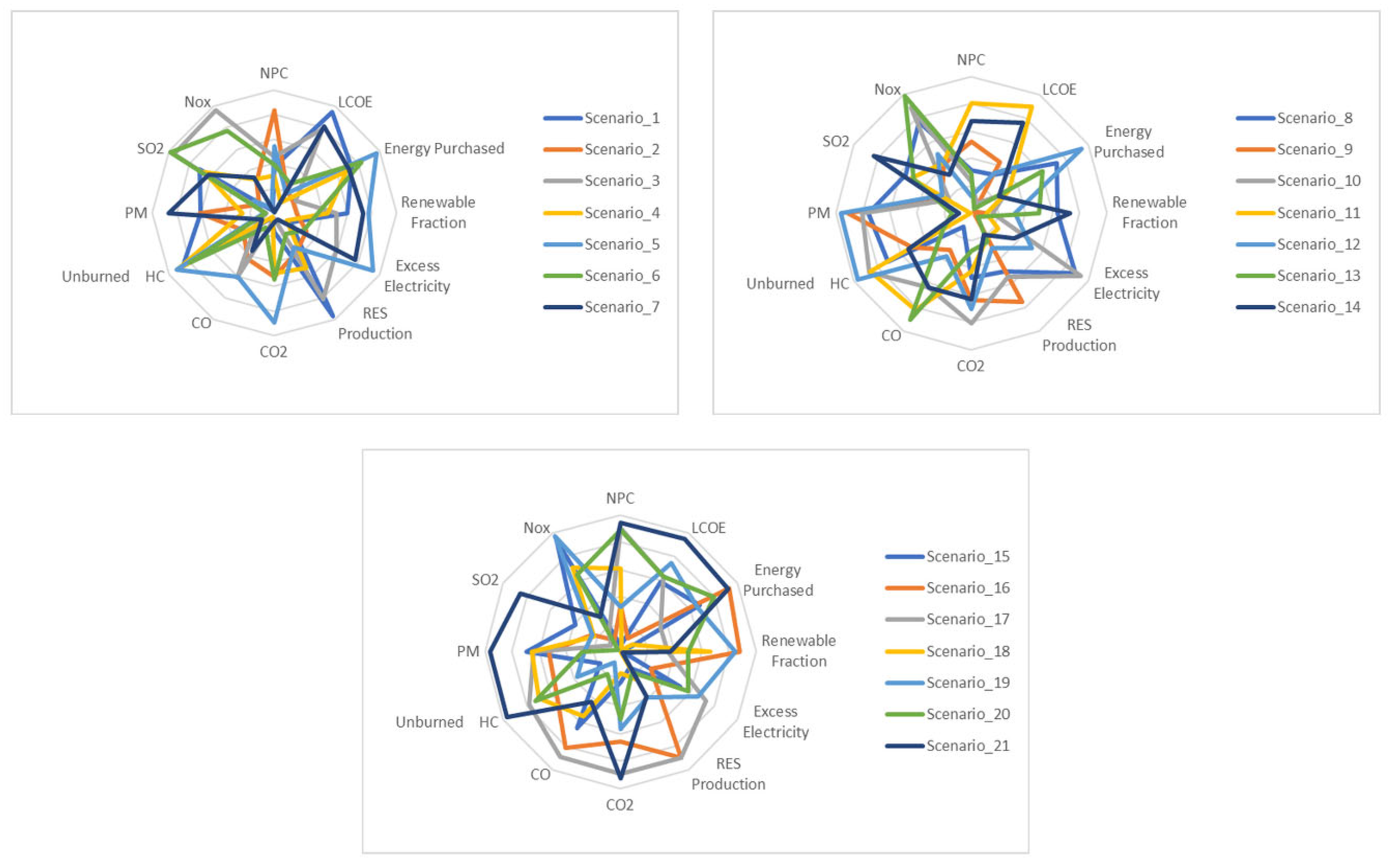
The comparative analysis of the three radar charts, as presented in Figure 7, reveals a clear evolutionary trajectory in the performance of the hybrid system, transitioning from a regime of economic maximization toward a state of sustainable stability.
Figure 7.
Radar chart of the normalized criteria.
The first group (Scenarios 1–7) illustrates an immediate profitability-driven configuration, characterized by a remarkably low Levelized Cost of Energy (LCOE = €0.072–0.079/kWh) and a high renewable output (5.2 × 10⁷ kWh/year, or 42%). However, this comes at the cost of an average energy surplus of 1.1 × 10⁷ kWh, indicating oversizing and structural inefficiency.
The second group (Scenarios 8–14) marks a transitional phase toward rationalization: costs increase slightly (LCOE ≈ €0.085/kWh), while both production and surplus decrease by approximately 15% and 33%, respectively. This trend reflects improved inter-criteria coherence (σ ≈ 0.15) and a more balanced techno-economic configuration.
Finally, the third group (Scenarios 15–21) corresponds to a maturity regime where indicators converge: LCOE stabilizes around €0.095/kWh, the energy surplus drops by 65%, and inter-criteria dispersion reaches its minimum (σ ≈ 0.08). This convergence highlights a synergistic alignment between economic viability, technical stability, and environmental efficiency.
Overall, this progression—from maximum yield to systemic coherence—illustrates the Pareto-like dynamic inherent to hybrid energy systems and confirms the ability of the MMCP to detect transition and convergence regimes within an integrated sustainability framework.
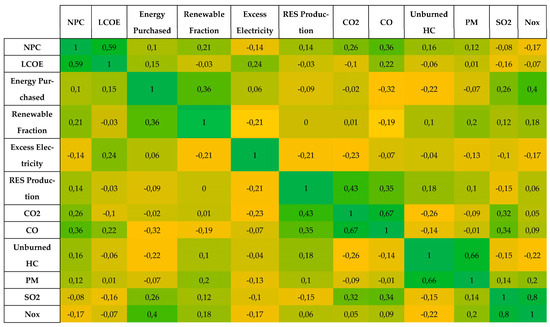
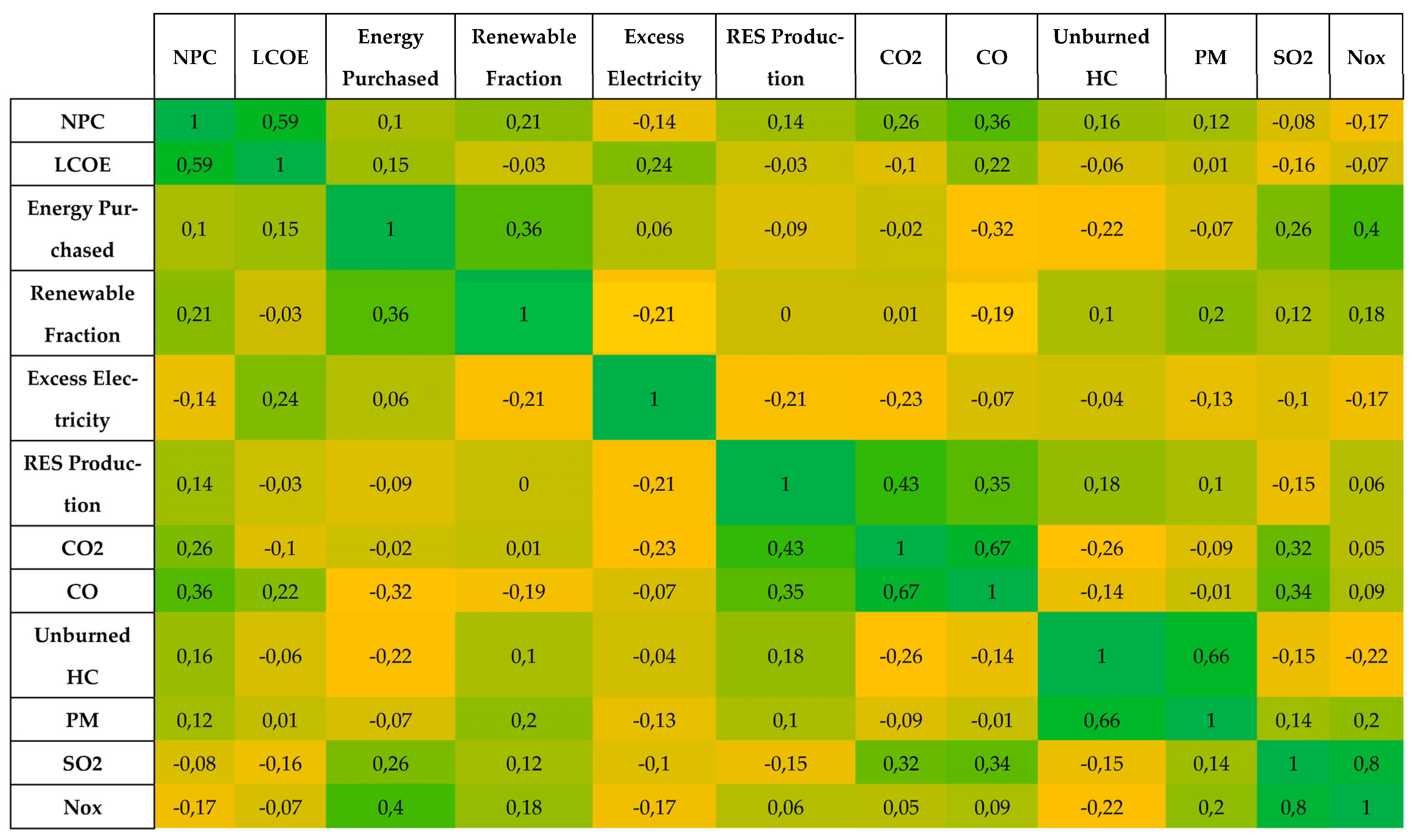
The inter-criteria correlation heatmap, as presented in Figure 8, reveals a balanced and weakly collinear statistical structure, confirming the internal coherence of the dataset prior to AHP weighting. The correlation coefficients, ranging between −0.32 and +1.00, indicate controlled dispersion and the absence of excessive redundancy—an essential condition for the reliability and validity of the MMCP.
Figure 8.
Correlation map between the normalized criteria.
Three distinct coherence clusters can be clearly identified:
- Economic coherence:
The positive correlation between the Net Present Cost (NPC) and the Levelized Cost of Energy (LCOE) (r = 0.59) validates the internal consistency of the economic indicators. Their weak correlations with environmental variables (r < 0.25) further confirm a functional independence between financial performance and ecological impact.
- Technical coherence:
Logical and moderate relationships emerge—for instance, between Energy Purchased and Renewable Fraction (r = 0.36), reflecting a partial balance between energy autonomy and grid dependence. The negative correlation between Excess Electricity and Renewable Fraction (r = −0.21) illustrates the intermittency effects inherent to systems with high renewable penetration.
- Environmental coherence:
A strongly structured and homogeneous block is observed, with notable correlations among pollutant indicators: CO2–CO (r = 0.67), SO2–NOx (r = 0.80), and HC–PM (r = 0.66). These relationships reflect shared combustion signatures, enabling a synthetic aggregation of pollutants without loss of information.
Moreover, the partial orthogonality between indicator families (|r| ≈ 0.20–0.25) confirms the independence between cost, energy flows, and emissions, while the moderate technical–environmental correlations (r ≈ 0.35–0.43) suggest a positive synergy between renewable intensification and emission reduction.
This matrix organization, both coherent and complementary, demonstrates the statistical robustness of the system and ensures the analytical neutrality of the subsequent multi-criteria decision-making stages within the MMCP framework.
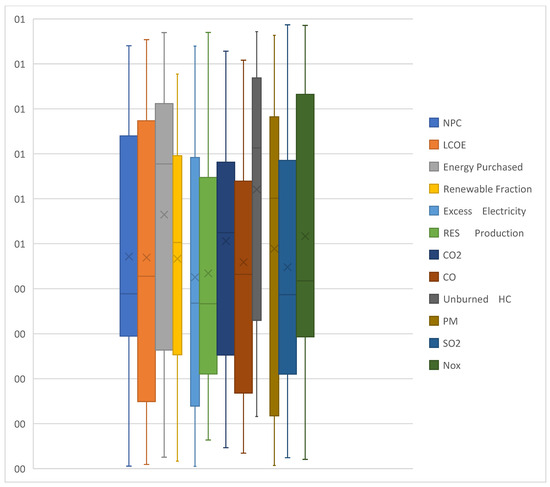
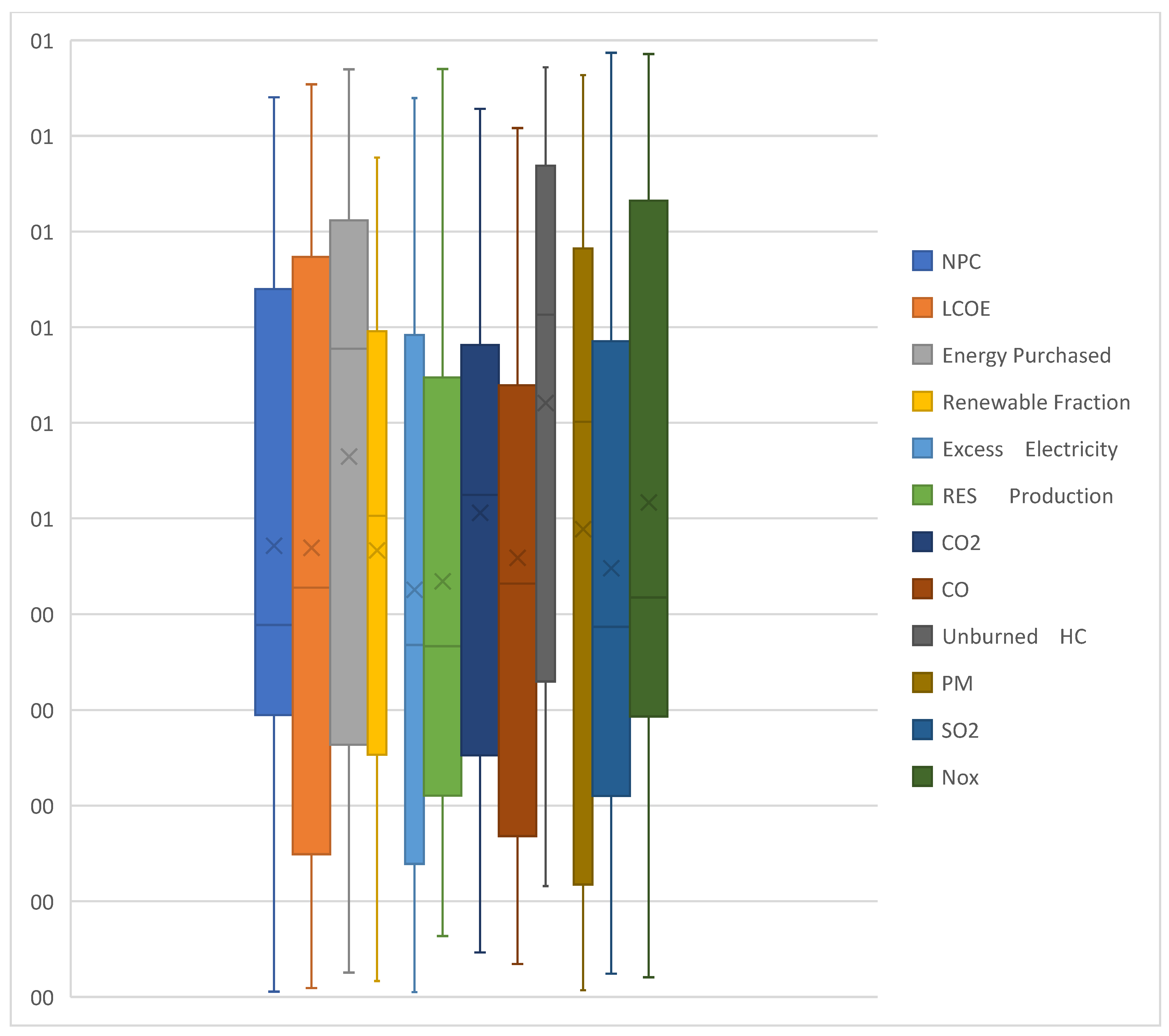
The multi-criteria boxplot, as presented in Figure 9, highlights a balanced yet differentiated statistical dispersion across the various criterion families, confirming the structural coherence of the normalized data (Z ∈ [0, 1]) obtained during Step 0 of the MMCP.
Figure 9.
Intra-criterion variability of the normalized indicators.
The economic variables (NPC, LCOE) exhibit the highest variability (IQR ≈ 0.45–0.50; σₑcₒ ≈ 0.27), reflecting a marked heterogeneity of costs across scenarios. Their medians, clustered around 0.45, show a slight right-skewness, indicating the presence of high-cost configurations (notably Scenarios S17–S21).
The technical criteria display a more moderate dispersion (IQR ≈ 0.30–0.35; σₜₑcₕ ≈ 0.22) with medians centered around 0.50, denoting satisfactory operational homogeneity. However, Renewable Fraction and RES Production present extended whiskers (min ≈ 0.05; max ≈ 0.95), illustrating the high sensitivity of the energy mix to photovoltaic system sizing.
Conversely, Energy Purchased and Excess Electricity show symmetrical and controlled variability (IQR ≈ 0.28), indicating a robust balance between self-production and grid imports; their negative correlation (ρ ≈ −0.76) further confirms the energy consistency of the model.
Finally, the environmental family remains the most stable (IQR ≈ 0.25–0.30; σₑₙᵥ ≈ 0.18), with medians clustered around 0.40 ± 0.05, suggesting a dampening of pollution contrasts despite techno-economic diversity.
This statistically harmonious structure, where economic variability dominates without undermining environmental stability, attests to the quality of the input data and ensures the reliability of subsequent multi-criteria analyses within the MMCP.
4.2. Step 1—Determination of Multi-Criteria Weights (AHP + Expert/Sustainability Approach)
4.2.1. Hierarchical Weight Determination (Step 1—AHP)
Based on the normalized matrix derived from Step 0 (n = 21 scenarios; p = 12 criteria), this phase aims to establish a global weighting vector (W = [w1, w2, …, wp]) ensuring a coherent, traceable, and justifiable weighting scheme across the technical, economic, and environmental dimensions.
This methodological choice is fully consistent with the multi-stage logic of the MMCP, in which the reliability of weighting conditions the robustness of subsequent multi-criteria rankings.
The expert group involved in the AHP-based weighting process was constituted according to explicit, predefined, and problem-driven selection criteria in order to ensure methodological rigor and transparency. Experts, as shown in Table A1, were selected based on their direct relevance to the decision structure, with demonstrated expertise in at least one of the criterion families used in the study, namely Smart Grid operation and power systems, techno-economic assessment of hybrid renewable energy systems, or environmental and sustainability analysis. To reduce epistemic uncertainty, all experts held a doctoral degree or an equivalent senior professional position and had a minimum of eight years of experience in energy systems, Smart Grids, renewable integration, or decision-support methodologies. Methodological competence constituted a further mandatory criterion, and only experts with prior experience in AHP or structured multi-criteria decision-making frameworks were retained, ensuring correct interpretation of pairwise comparison scales and consistent judgment elicitation. To limit institutional and contextual bias, the expert panel was composed of members affiliated with different institutions and research environments and drawn from multiple geographical contexts. The functional role of the expert group was deliberately restricted to criteria weighting, excluding any involvement in scenario definition, MCDM method selection, or final ranking. Judgment consistency and convergence were systematically verified through the AHP consistency ratio (CR < 0.1), aggregation by geometric mean, and inter-expert agreement assessment using Kendall’s coefficient of concordance (W = 0.87), thereby ensuring both the reliability and robustness of the elicited preferences.
4.2.2. Hierarchical Structure
The hierarchy is structured into three nested levels, ensuring the decomposability of judgments and full traceability of weight assignments:
- Level 1: Main Criterion Families: Technical (Tech), Economic (Eco), Environmental (Env).
- Level 2: Intra-family Sub-weighting: Relative importance of indicators within each family.
- Level 3: Aggregated Global Weights: Integration of intra- and inter-family weights.
4.2.3. Technical Family (Tech)
The objective is to assign weights to indicators that capture dynamic stability, supply continuity, and the optimal integration of renewable resources within the Smart Grid. Four operational sub-criteria were retained: Energy Purchased, Excess Electricity, RES Production, and Renewable Fraction.
These indicators were considered by the experts to be mutually complementary and of equal importance. Accordingly, the pairwise comparison matrix was specified as a complete indifference matrix, reflecting intra-family neutrality.
The corresponding principal eigenvector yields equal normalized weights:
Atech = [0.25, 0.25, 0.25, 0.25]
4.2.4. Economic Family (Eco)
This family evaluates the financial viability and energy competitiveness of the hybrid system over its life cycle. Two key indicators were retained:
- NPC (Net Present Cost): total life-cycle cost, including CAPEX, OPEX, replacement, and discounting over T years;
- LCOE (Levelized Cost of Energy): average unit cost of electricity production, a recognized metric of energy profitability (IRENA, 2022; REN21, 2023).
Expert judgments confirmed a strict equivalence between these indicators:
weco = [0.5, 0.5]
This equivalence reflects their complementary perspectives—NPC representing long-term economic resilience, and LCOE the short-term efficiency of energy production.
4.2.5. Environmental Family (Env)
This family quantifies the Smart Grid’s contribution to emission reduction and its alignment with international environmental frameworks—WHO (2021), IPCC AR6 (2022), EEA (2023), EU Directives (2008/50/EC, 2016/2284), GBD (2020), and ISO 14044. The approach combines normative evidence, impact severity modeling, and AHP-based hierarchical weighting:
- Normative Evidence Base: Literature establishes a clear severity hierarchy of pollutants CO2 > NOx, Particulate Matter (PM) > SO2, CO, consistent with public health and climate frameworks (WHO, 2021; Lelieveld et al., 2020; EEA, 2023).
- Severity Mapping and Saaty Translation (1–9 scale): The conversion into the Saaty scale reflects differentiated health and environmental impacts, leading to the following normalized intra-family weights:
- w_{env} = [0.577, 0.222, 0.113, 0.058, 0.031] corresponding respectively to CO2, NOx, PM, SO2, and CO.
4.2.6. Inter-Family Weighting ((Afam))
This stage establishes the global hierarchy among the three main families (Tech, Eco, Env), forming the basis for the integrated weighting in the MMCP. The comparison matrix, constructed using the scale and aggregated via geometric mean, reflects a moderate preference for operational stability over short-term profitability and immediate sustainability, consistent with continuity-of-service priorities in hybrid Smart Grids.
The weight vector derived through the LLSM method is wfam = [0.45, 0.30, 0.25], thus yielding the hierarchy: Technical > Economic > Environmental.
This structure reflects the behavior of a rational and risk-averse decision-maker in hybrid Smart Grid management, prioritizing resilience and supply security while maintaining economic viability and environmental integrity.
4.2.7. Hierarchical Synthesis of Weights
Table 5 and Table 6 presents the hierarchical weighting structure applied within the MMCP framework. Each family of criteria—technical, economic, and environmental—is first normalized internally (intra-family weighting) and then aggregated to obtain global weights reflecting their relative influence in the multi-criteria decision process.
Table 5.
Inter-Method Coherence Scale.
Table 6.
Hierarchical weighting structure of criteria families within the MMCP framework.
The results highlight a balanced distribution across the technical and economic dimensions. This weighting configuration ensures that both performance and sustainability dimensions are proportionally integrated within the final MMCP evaluation.
4.2.8. Discussion
The overall AHP weighting process demonstrates exemplary internal consistency (CR < 0.01) and full decision traceability. The resulting weights define a rational hierarchy:
- Technical performance forms the foundation of system stability,
- Economic profitability ensures long-term viability, and environmental sustainability consolidates systemic equilibrium.
This hierarchized and evidence-based approach, grounded in the triangulation of normative references, impact modeling, and expert judgment, grants the MMCP strong scientific legitimacy and operational credibility, fully consistent with the standards of multi-criteria decision-making research in energy systems.
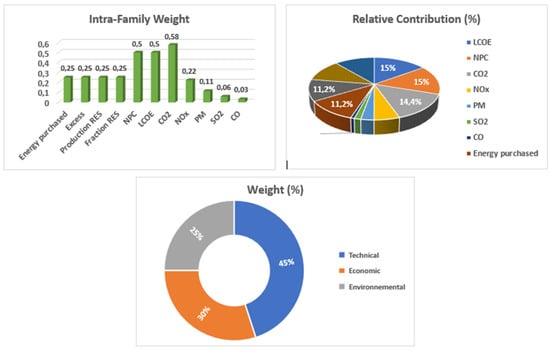
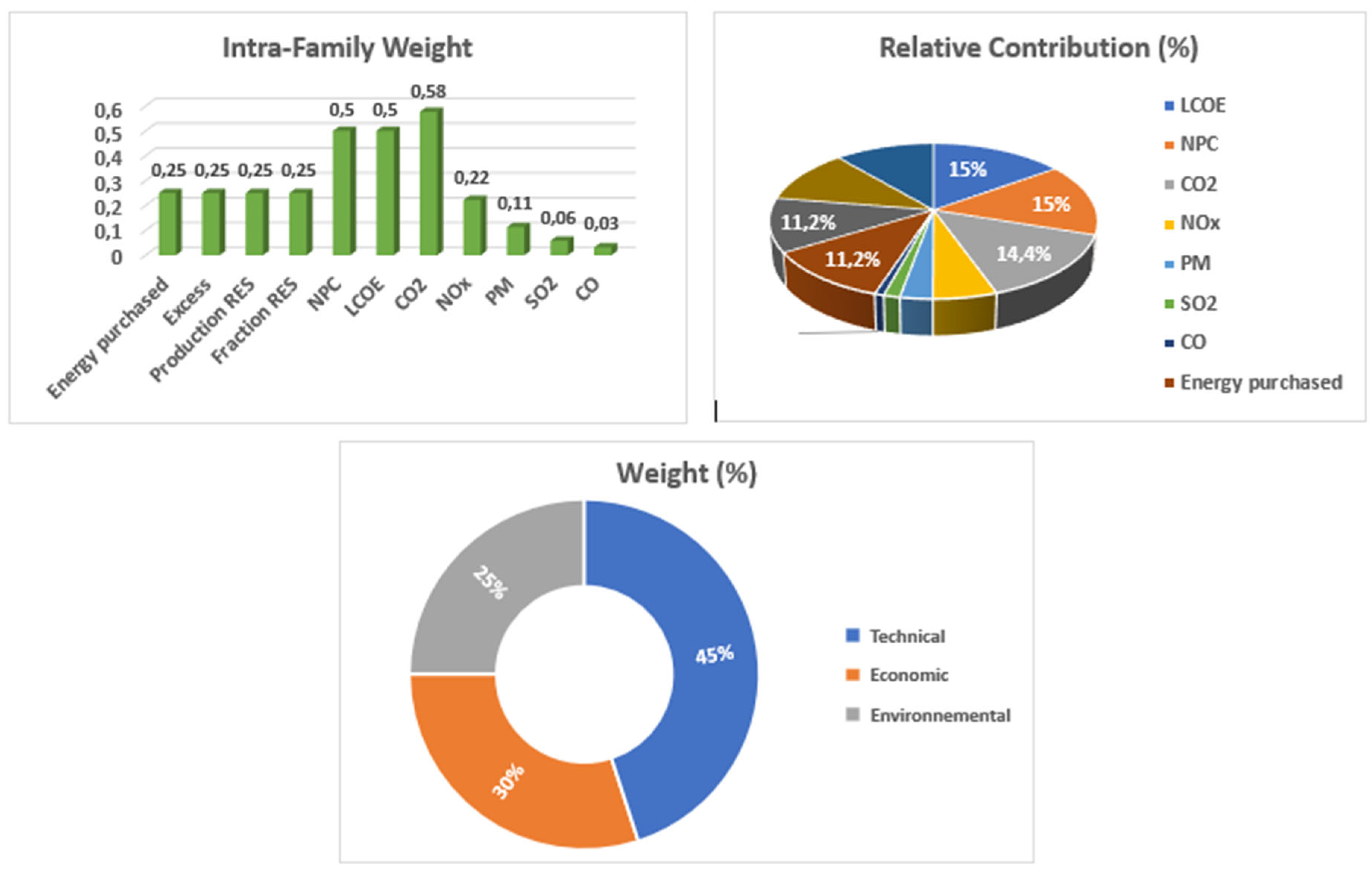
4.2.9. Simulation Results and Discussion
Figure 10 summarizes a balanced yet reliability-oriented weighting structure. At the inter-family level, priority is given to the technical dimension (45%), followed by the Economic (30%) and Environmental (25%) ones, reflecting the primacy of supply continuity in a hybrid Smart Grid. Within families, the economic dimension is equiponderated (NPC = LCOE = 0.50), the technical dimension is neutral (Energy Purchased, Excess Electricity, RES Production, Renewable Fraction = 0.25 each), while the environmental dimension is strongly hierarchical (CO2 = 0.577 ≫ NOx = 0.222 > PM = 0.113 > SO2 = 0.058 > CO = 0.031).
Figure 10.
Hierarchical structure and multi-level weighting of the criteria within the MMCP.
In terms of global contribution, the most influential levers are NPC ≈ 11.7%, LCOE ≈ 11.7%, and CO2 ≈ 11.3%, followed by the four technical indicators and PM/SO2 (≈ 8.7–8.8% each), while NOx ≈ 4.8% and CO ≈ 3.0% exhibit lower influence.
In summary, the weighting scheme avoids any over-concentration, prioritizes operational robustness, and maintains a clear environmental signal dominated by climatic (CO2) and health-related pollutants (NOx/PM)—an overall weighting architecture consistent with the objectives of system stability, economic viability, and regulatory compliance.
4.3. Step 2—Multi-Criteria Decision-Making (MCDM) Analysis
Following data preparation (Step 0) and criteria weighting (Step 1), Step 2 aims to transform the normalized and weighted matrix (Z, w) into operational rankings for the 21 HOMER scenarios. Each MCDM method embodies a distinct decision logic:
- TOPSIS assesses the global compromise between ideal and anti-ideal solutions.
- PROMETHEE II (Preference Ranking Organization Method for Enrichment Evaluations II) relies on directional outranking flows.
- ELECTRE II applies an elimination-based dominance logic.
- VIKOR focuses on compromise under maximum regret.
The parallel application of these methods enhances the robustness and interpretability of the decision process and serves as a preparatory phase for the MMCP aggregation stage [12,13].
4.3.1. Method 1—TOPSIS: Relative Closeness Index (Cᵢ)
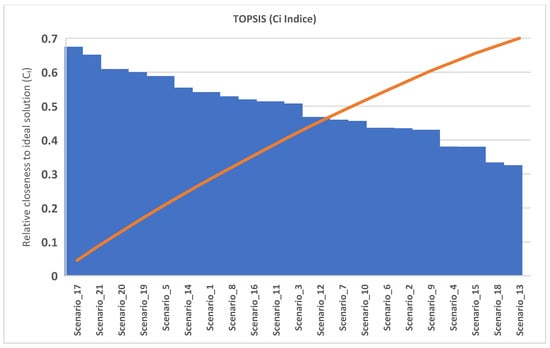
Scenario 17 achieves a closeness index of Ci = 0.675, Ci = 0.675, Ci = 0.675, As shown in Figure 11, which is 12% above the median value (0.60) and nearly 40% higher than the lower quartile (0.48).
Figure 11.
Distribution of proximity coefficients (Cᵢ) and ranking of scenarios according to the TOPSIS method.
- The values decrease in a quasi-linear pattern, indicating a stable ranking with no abrupt discontinuities or dominance reversals.
- The cumulative curve (in red) shows that 70% of the total decision weight is concentrated within the top seven scenarios, forming the efficient core of the decision space.
- From an energy perspective, these scenarios share a high renewable share (RES > 70%), a reduced Net Present Cost (~15% lower), and an LCOE < 0.09 €/kWh, indicating a robust techno-economic efficiency.
4.3.2. Method 2—PROMETHEE II: Net Flow (Φ)
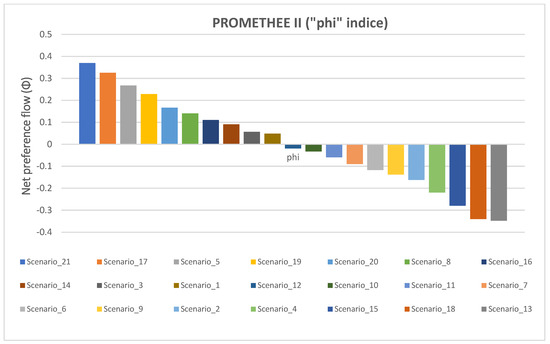
Figure 12 shows the ranking based on the net outranking flow Φ = Φ+ − Φ−, which represents the global preference of an alternative that reflects its overall dominance across the entire set of scenarios.
Figure 12.
PROMETHEE II ranking based on the net preference flow (Φ index).
- The total amplitude of net flows is ΔΦ ≈ 0.93, with Φₘₐₓ = +0.58 (Scenario 17) and Φₘᵢₙ = −0.35 (Scenario 13).
- The top-performing scenarios—S17, S21, S5, and S19—exhibit Φ > +0.3, indicating strong and consistent dominance.
- The flows are nearly symmetric around zero, revealing a balanced preference structure without excessive polarization within the decision space.
- PROMETHEE II confirms that Scenario 17 dominates the majority of strong preference pairs (preference > 0.6), validating its multi-objective consistency across both technical and economic dimensions.
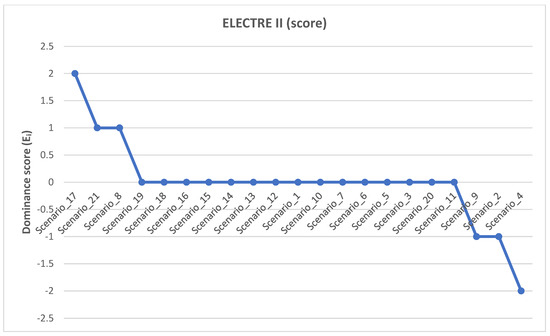
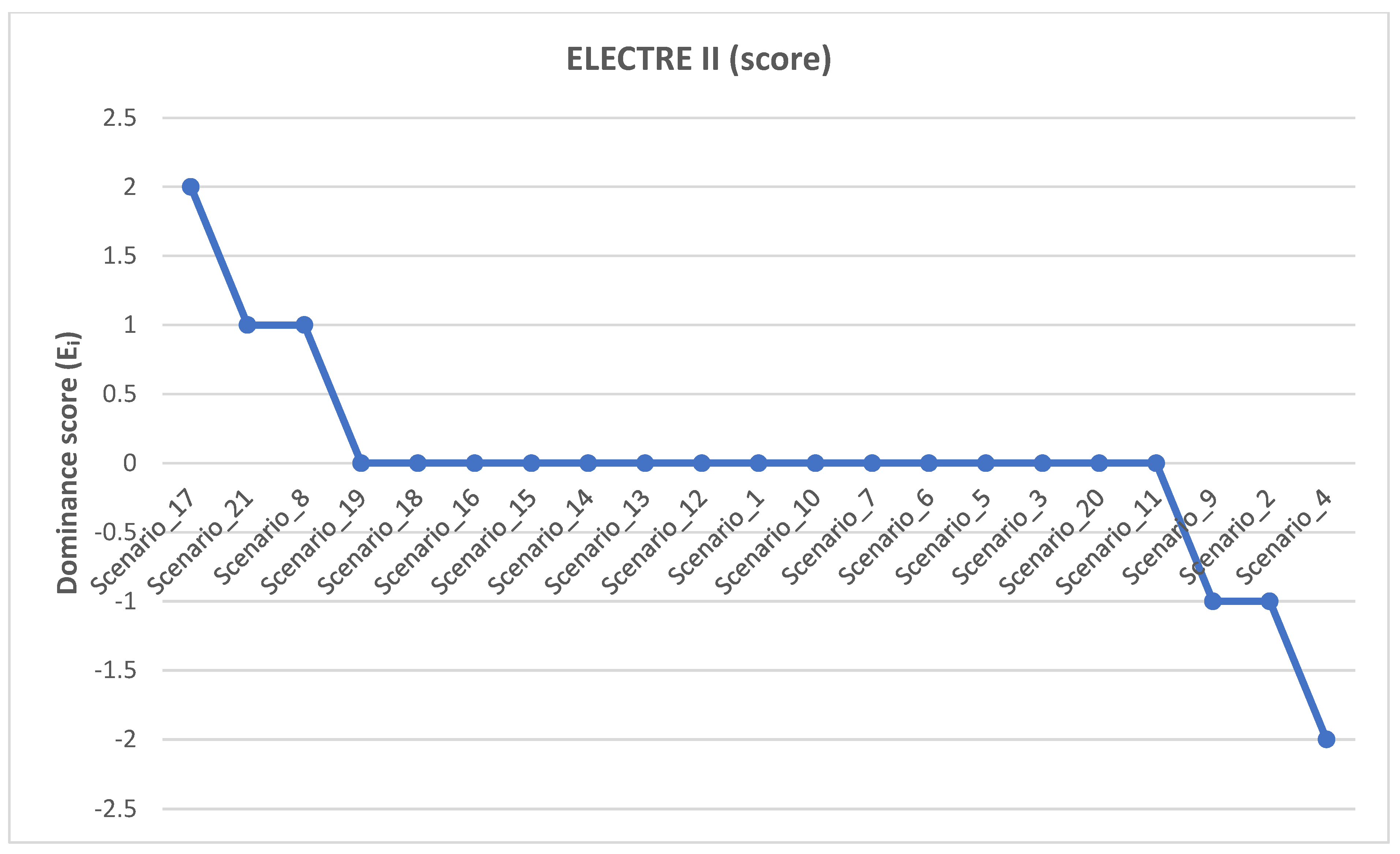
4.3.3. Method 3—ELECTRE II: Outranking Score (Eᵢ)
Figure 13 reflects the score (Ei) derived from the concordance/discordance coefficients. Three zones stand out:
Figure 13.
ELECTRE II ranking based on the dominance score (Eᵢ).
- Dominant: S17, S21, S8 with E > +1.5, indicating strong and robust outranking;
- Neutral: S19 → S10, clustered around E ≈ 0, showing no substantive contradiction;
- Dominated: S9, S2, S4 with E < −1, penalized by higher costs or emissions.
The maximum gap (ΔE ≈ 4.5) demonstrates the model’s solid discriminating power. The absence of excessive mid-range dispersion points to a clear and decisive decision profile, with very few ambiguous scenarios.
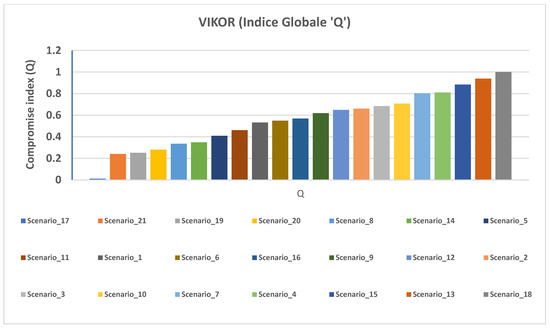
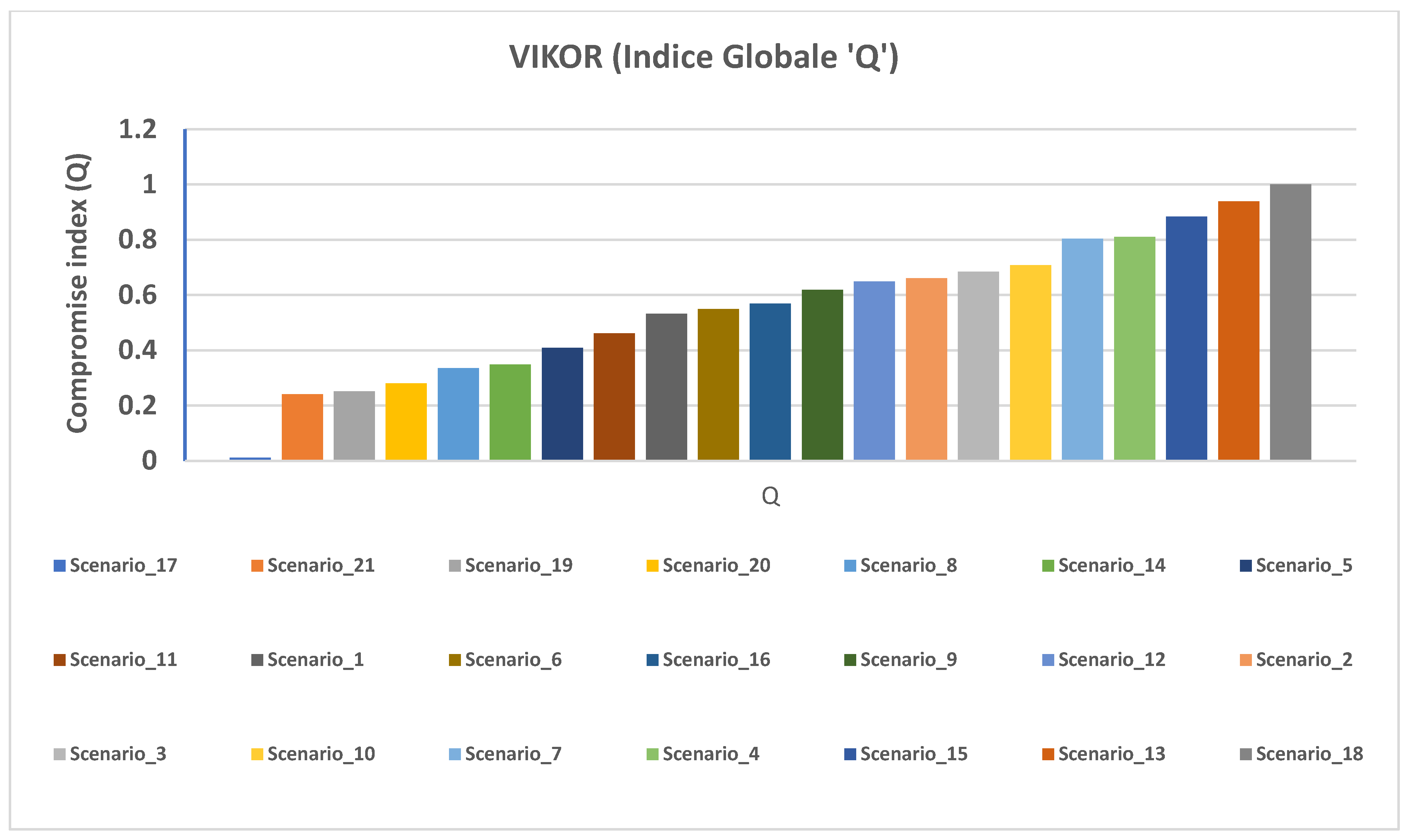
4.3.4. Method 4—VIKOR: Overall Compromise Index (Q)
Figure 14 inverts the interpretive logic: the lower the Q value, the closer the alternative lies to the optimal compromise solution.
Figure 14.
VIKOR ranking based on the overall compromise index (Q).
- Scenario 17 achieves Q = 0.011, followed by S19 = 0.241—the only two scenarios below the acceptability threshold (ΔQ ≤ 0.25).
- The remaining alternatives (S18, S15, S7) exhibit Q > 0.7, indicating significant imbalances between economic performance and sustainability metrics.
- The quasi-linear slope of the VIKOR curve reflects a steady progression of maximum regret, demonstrating a well-conditioned decision structure with no abrupt discontinuities or dominance reversals.
Overall, the VIKOR results reaffirm the statistical robustness and structural coherence of the MMCP process, confirming that Scenario 17 represents the most stable and rational compromise configuration within the hybrid Smart Grid decision space.
4.4. Step 3: MMCP Results
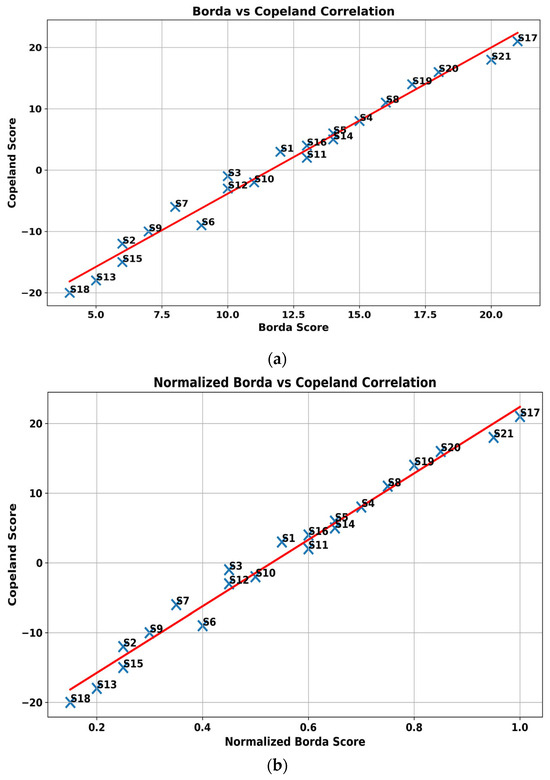
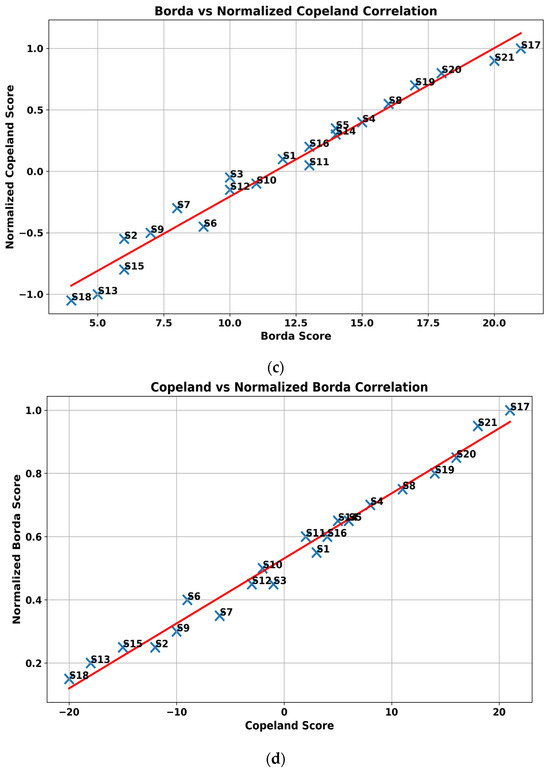
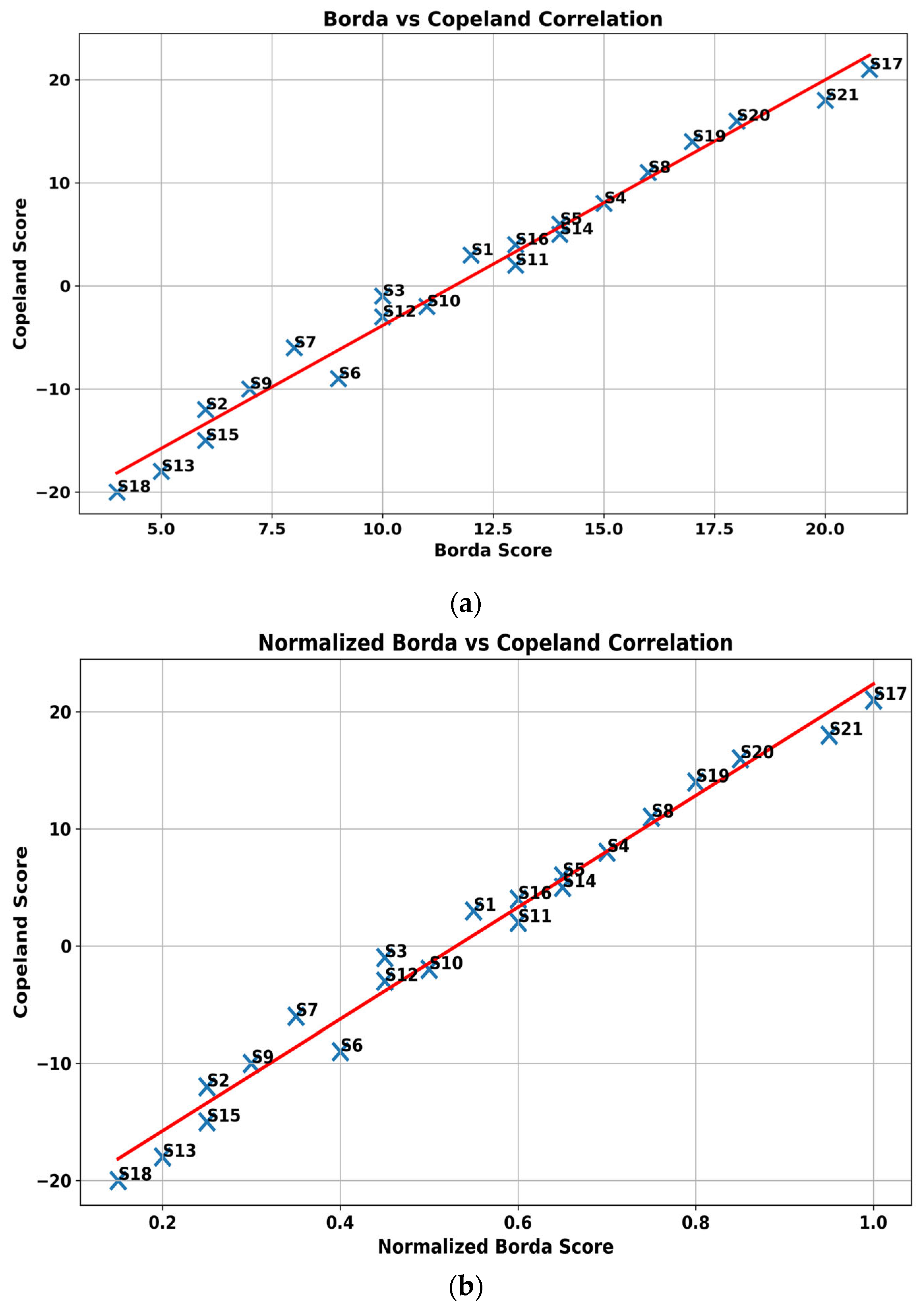
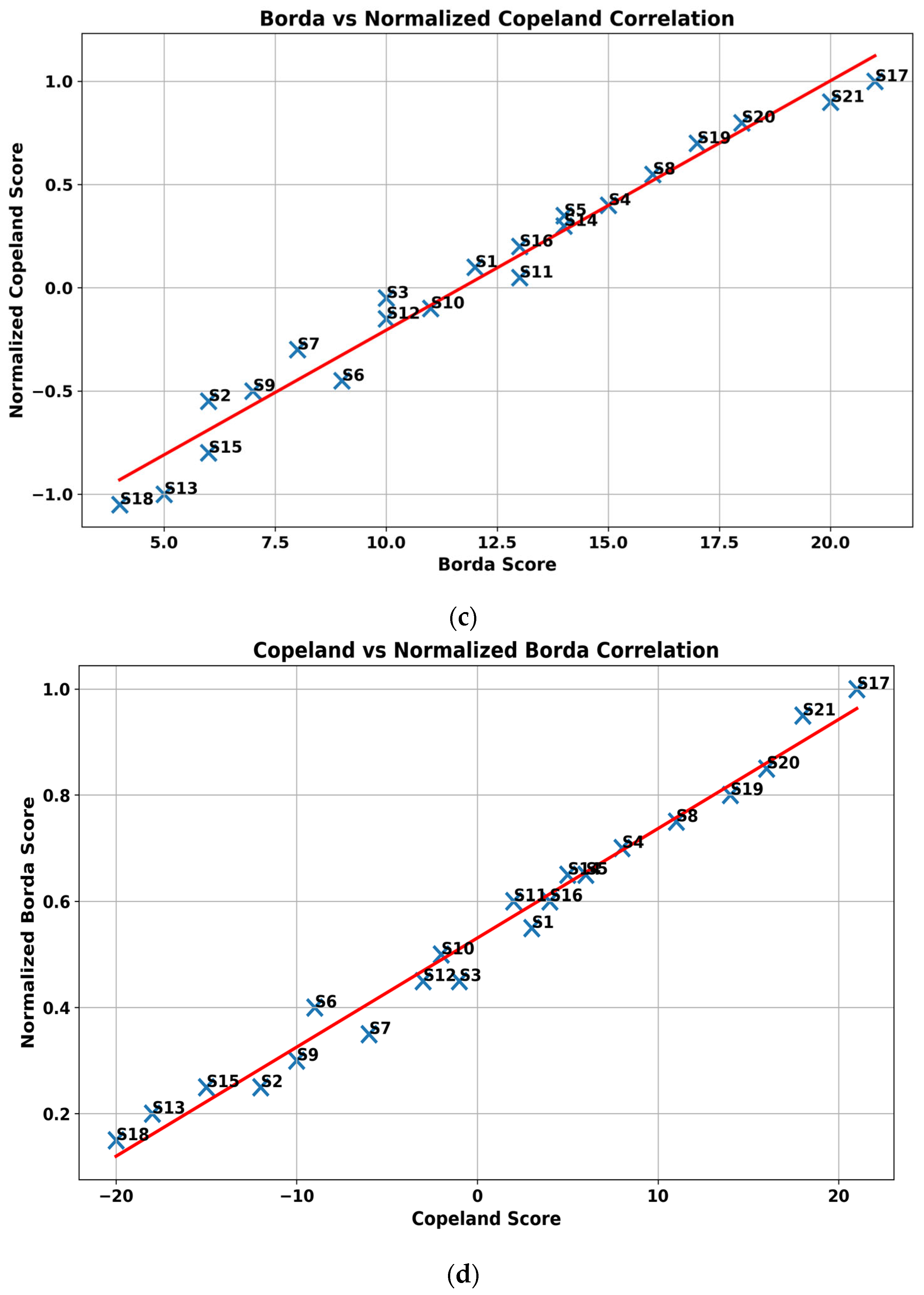
Figure 15 reveals an almost perfect concordance between the Borda and Copeland rankings, both in raw and normalized forms: the four scatter plots align closely along a line with a slope ≈ 1 and R ≈ 0.98 (thus R2 ≈ 0.96). This demonstrates that normalization does not alter the relative order and that both aggregation rules convey the same ranking information.
Figure 15.
(a) Borda Score vs. Copeland Score Correlation. (b) Normalized Borda Score vs. Copeland Score Correlation. (c) Borda Score vs. Normalized Copeland Score Correlation. (d) Copeland Score vs. Normalized Borda Score Correlation.
The four figures presented above provide a comprehensive cross-metric correlation analysis between the Borda and Copeland aggregation methods, considering both raw and normalized score formulations.
The top-performing scenarios stand out clearly in the upper-right quadrant (S17, S21, followed by S19–S20–S8), whereas the lower-performing ones cluster in the lower-left quadrant (S13, S15, S18, and S2–S9), with no significant outliers. This tight linearity implies a very low risk of rank inversion between methods, a stable consensus across scales (raw vs. normalized), and a robust final hierarchy.
In practice, either Borda or Copeland may be used interchangeably as a composite score; their dual use is not redundant but rather diagnostic, serving primarily to verify inter-method coherence rather than to influence the final decision outcome.
4.5. Step 4—Robustness and Inter-Method Convergence
This step aims to assess the global coherence and stability of the rankings obtained from the various MCDM methods (TOPSIS, PROMETHEE II, ELECTRE II, and VIKOR) within the MMCP framework. Two complementary components are mobilized:
- Inter-method agreement, measured using Kendall’s τb (rank concordance) and Spearman’s ρ (order correlation), to quantify the degree of structural alignment and identify method pairs sharing similar decision logics;
- Robustness validation, designed to ensure that the observed convergence does not result from chance, but rather from deep methodological consistency among approaches.
Together, these analyses guarantee the reliability of the multi-method consensus produced by the MMCP, thereby reinforcing the credibility of the aggregated decisions and their scientific soundness for sustainable Smart Grid governance.
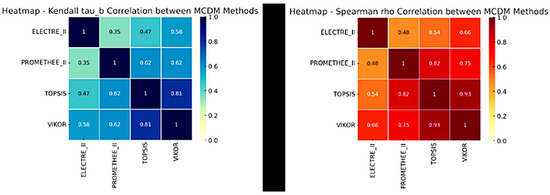
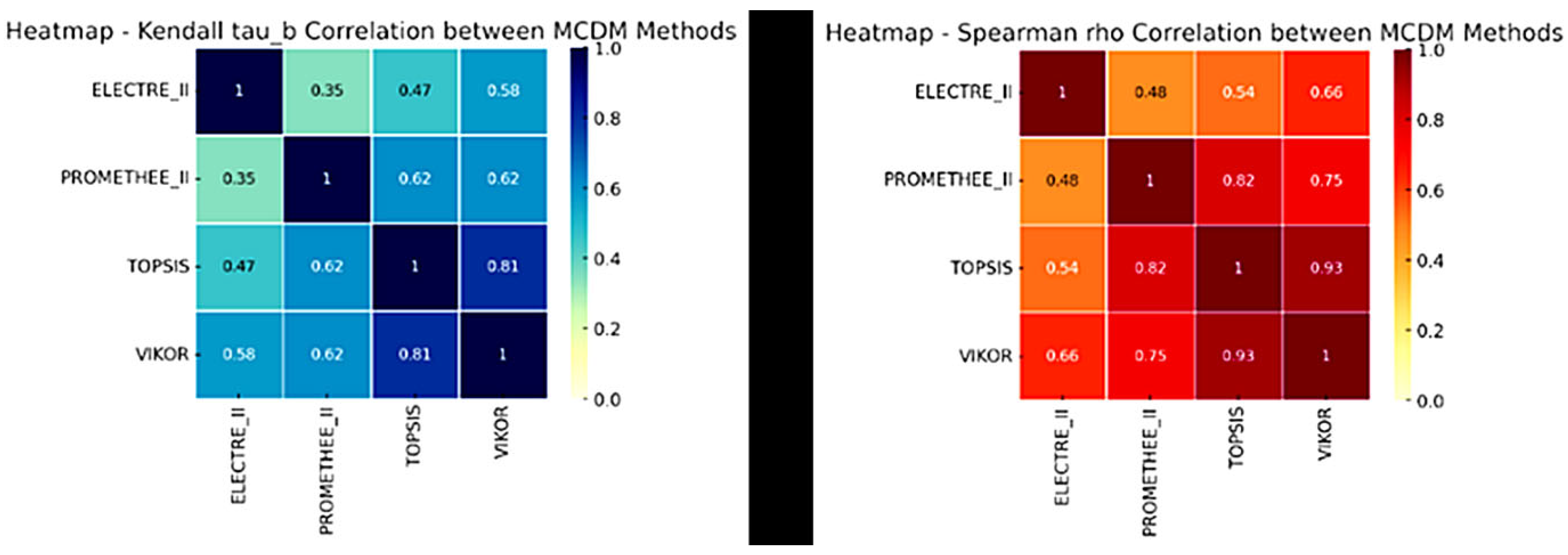
Figure 16 highlights a strong convergence among the decision-making methods, structured primarily around the TOPSIS–VIKOR pair. The highest agreement is observed between TOPSIS and VIKOR (τb = 0.81; ρ = 0.93), indicating a near-perfect alignment in their ranking logic. High correlations are also found between PROMETHEE and TOPSIS (τb = 0.62; ρ = 0.82) and between PROMETHEE and VIKOR (τb = 0.62; ρ = 0.75), confirming the methodological coherence of compensatory approaches.
Figure 16.
Robustness and structural coherence analysis of rankings within the MMCP.
In contrast, ELECTRE II shows moderate agreements—(τb = 0.58; ρ = 0.66) with VIKOR, (τb = 0.47; ρ = 0.54) with TOPSIS, and a weaker association (τb = 0.35; ρ = 0.48) with PROMETHEE—reflecting its non-compensatory and conservative decision logic.
Average inter-method centrality values confirm this structure: VIKOR (τ− ≈ 0.67; ρ− ≈ 0.78) and TOPSIS (τ− ≈ 0.63; ρ− ≈ 0.76) occupy the core of the decision network, followed by PROMETHEE (τ− ≈ 0.53; ρ− ≈ 0.68) and ELECTRE II (τ− ≈ 0.47; ρ− ≈ 0.56).
Consequently, the consensus core of the MMCP is composed of {TOPSIS, VIKOR, PROMETHEE}, while ELECTRE II remains methodologically coherent but more conservative. In operational terms, anchoring the consensus on the TOPSIS–VIKOR pair, reinforcing it through PROMETHEE, and employing ELECTRE II as a prudential filter minimizes the risk of rank inversion and enhances the stability of the final decision hierarchy.
5. Conclusions
This study introduced the Multi-Method Convergence Protocol (MMCP) as a structured decision-support framework for sustainable Smart Grid planning. By coupling techno-economic simulations generated with HOMER Pro to multiple MCDM methods and formal robustness validation tools, the proposed approach directly addresses a central limitation of conventional multi-criteria energy planning, namely ranking instability and method dependence. The integration of compensatory, outranking, and compromise-based decision logics, combined with rank aggregation and correlation analysis, enables more transparent, explainable, and reliable decision outcomes. The application to a real hybrid Smart Grid case in the Provence-Alpes-Côte d’Azur region demonstrates the practical relevance of MMCP for complex regional energy systems characterized by high renewable penetration and grid constraints.
Despite these contributions, several limitations should be acknowledged. The analysis relies on deterministic HOMER Pro simulations, which do not explicitly capture uncertainties related to renewable resource variability, demand evolution, or economic parameters such as fuel prices and discount rates. While MMCP strengthens robustness at the decision-support level, uncertainty propagation from the simulation stage remains limited. In addition, the expert-based weighting process, although carefully designed and validated through consistency and convergence metrics, inevitably introduces a degree of subjectivity that may vary across stakeholder groups or regional contexts. The empirical assessment is further constrained by the use of a single regional case study, which limits the generalizability of the quantitative results, even though the MMCP framework itself is transferable. Finally, although the selected MCDM methods were deliberately diversified, they do not cover the full spectrum of available decision-making techniques.
From a theoretical perspective, this work contributes to the MCDM and energy planning literature by shifting the focus from identifying an optimal solution derived from a single method to structuring convergence across heterogeneous decision logics. Rather than proposing a new MCDM technique, MMCP operates as a meta-decision framework in which inter-method agreement, explainability, and statistical validation are treated as core design principles. This perspective responds to long-standing concerns regarding rank reversal and methodological arbitrariness in MCDM applications and extends robustness analysis beyond conventional sensitivity testing.
From a practical standpoint, MMCP provides a transparent and reproducible decision-support tool for planners, regulators, and policymakers involved in Smart Grid development. By explicitly separating expert judgment, restricted to criteria weighting, from algorithmic evaluation and validation, the framework enhances trust in decision outcomes and facilitates stakeholder dialogue. The regional case study illustrates how MMCP can support balanced trade-offs between economic performance, environmental impact, and system reliability, particularly in regions facing climatic variability and infrastructure constraints. Its convergence-oriented design makes the framework especially suitable for policy-driven planning contexts, where consensus and explainability are critical.
Several directions for future research emerge from this work. Integrating uncertainty-aware simulation approaches, such as stochastic or robust optimization, would strengthen the coupling between system modeling and multi-criteria evaluation. Dynamic extensions of MMCP could allow criteria weights or stakeholder preferences to evolve over time, reflecting changing policy priorities or system conditions. Applying the framework to multiple regional or national Smart Grid case studies would further assess its scalability and generalizability. In addition, incorporating social acceptance, regulatory constraints, and resilience-related indicators as explicit decision criteria would enhance the comprehensiveness of the decision framework. Finally, comparative analyses with data-driven or machine-learning-based decision-support approaches could provide valuable insights into the complementary roles of explainable, rule-based methods and predictive models in sustainable energy planning.
In conclusion, MMCP provides a robust foundation for transparent, explainable, and reliable multi-criteria decision-making in Smart Grid planning. While further methodological and empirical developments are required to extend its scope, the proposed framework represents a significant step toward more trustworthy and policy-relevant energy planning tools.
Author Contributions
Conceptualization, W.O.A., Y.D., F.H.M., W.A., G.A.H. and M.G.; methodology, W.O.A., Y.D., F.H.M., W.A., G.A.H. and M.G.; software, W.O.A., Y.D., F.H.M., W.A., G.A.H. and M.G.; validation, Y.D., F.H.M. and G.A.H.; formal analysis, W.O.A., Y.D., F.H.M., W.A., G.A.H. and M.G.; investigation, W.A., G.A.H. and M.G.; resources, W.O.A., F.H.M. and G.A.H.; data curation, W.O.A.; writing—original draft preparation, W.O.A., Y.D. and F.H.M.; writing—review and editing W.A., G.A.H. and M.G.; visualization, W.O.A., Y.D., F.H.M. and W.A.; supervision, W.A., G.A.H. and M.G.; project administration, W.A.; funding acquisition, G.A.H. All authors have read and agreed to the published version of the manuscript.
Funding
This research received no external funding.
Data Availability Statement
The original contributions presented in this study are included in the article. Further inquiries can be directed to the corresponding author.
Conflicts of Interest
The authors declare no conflicts of interest.
Appendix A
Table A1.
Expert Group Selection Criteria and Validation Mechanisms.
References
- Bohra, S.S.; Anvari-Moghaddam, A. A Comprehensive Review on Applications of Multicriteria Decision-Making Methods in Power and Energy Systems. Int. J. Energy Res. 2022, 46, 4088–4118. [Google Scholar] [CrossRef] [Scilit]
- Siksnelyte-Butkiene, I.; Zavadskas, E.K.; Streimikiene, D. Addressing Sustainability Issues in the Transition to a Carbon-Neutral Society with Multi-Criteria Analysis. Energy 2022, 254, 124368. [Google Scholar] [CrossRef] [Scilit]
- Paliwal, P.; Patidar, N.P.; Nema, R.K. Planning of grid integrated distributed generators: A review of technology, objectives and techniques. Renew. Sustain. Energy Rev. 2014, 40, 557–570. [Google Scholar] [CrossRef] [Scilit]
- Sadeghi, D.; Naghshbandy, A.H.; Bahramara, S. Optimal sizing of hybrid renewable energy systems in presence of electric vehicles using multi-objective particle swarm optimization. Energy 2020, 209, 118471. [Google Scholar] [CrossRef] [Scilit]
- Pohekar, S.D.; Ramachandran, M. Application of multi-criteria decision making to sustainable energy planning—A review. Renew. Sustain. Energy Rev. 2004, 8, 365–381. [Google Scholar] [CrossRef] [Scilit]
- Yadav, S.; Kumar, P.; Kumar, A. Techno-economic assessment of hybrid renewable energy system with multi energy storage system using HOMER. Energy 2024, 297, 131231. [Google Scholar] [CrossRef] [Scilit]
- Park, C.; Son, M.; Kim, J.; Kim, B.; Ahn, Y.; Kwon, N. TOPSIS and AHP-Based Multi-Criteria Decision-Making Approach for Evaluating Redevelopment in Old Residential Projects. Sustainability 2025, 17, 7072. [Google Scholar] [CrossRef] [Scilit]
- Wang, J.-J.; Jing, Y.-Y.; Zhang, C.-F.; Zhao, J.-H. Review on multi-criteria decision analysis aid in sustainable energy decision-making. Renew. Sustain. Energy Rev. 2009, 13, 2263–2278. [Google Scholar] [CrossRef] [Scilit]
- Gouraizim, M.; Makan, A.; El Ouarghi, H. A CAR-PROMETHEE-based multi-criteria decision-making framework for sustainability assessment of renewable energy technologies in Morocco. Oper. Manag. Res. 2023, 16, 1343–1358. [Google Scholar] [CrossRef] [Scilit]
- Sharafi, M.; Elmekkawy, T.Y. Multi-objective optimal design of hybrid renewable energy systems using PSO-simulation based approach. Renew. Energy 2014, 68, 67–79. [Google Scholar] [CrossRef] [Scilit]
- Alanazi, A.; Alanazi, M. Multicriteria Decision-Making for Evaluating Solar Energy Source of Saudi Arabia. Sustainability 2023, 15, 10228. [Google Scholar] [CrossRef] [Scilit]
- Karczmarczyk, A.; Wątróbski, J.; Bączkiewicz, A.; Mróz-Malik, O.; Drożdż, W. New robust multi-criteria decision-making method for wind farm location problems. Appl. Energy 2025, 398, 126401. [Google Scholar] [CrossRef] [Scilit]
- Gao, L.; Zhou, M.; Shafieezadeh, M.M. Fuzzy TOPSIS-Based Multi-Criteria Selection of Renewable Energy Sources for Smart Grids. Wind. Energy 2025, 28, e70058. [Google Scholar] [CrossRef] [Scilit]
- Malefaki, S.; Markatos, D.; Filippatos, A.; Pantelakis, S. A Comparative Analysis of Multi-Criteria Decision-Making Methods and Normalization Techniques in Holistic Sustainability Assessment for Engineering Applications. Aerospace 2025, 12, 100. [Google Scholar] [CrossRef] [Scilit]
- Montella, L.; Liu, X.; Monaco, R.; Murino, T.; Nielsen, P.S. An integrated multi-criteria decision making framework for industrial excess heat recovery and utilization. Energy 2025, 318, 134721. [Google Scholar] [CrossRef] [Scilit]
- Zoma, F.; Sawadogo, M. A multicriteria approach for biomass availability assessment and selection for energy production in Burkina Faso: A hybrid AHP-TOPSIS approach. Heliyon 2023, 9, e20999. [Google Scholar] [CrossRef] [Scilit]
- Ammari, C.; Belatrache, D.; Touhami, B.; Makhloufi, S. Sizing, optimization, control and energy management of hybrid renewable energy system—A review. Energy Built Environ. 2022, 3, 399–411. [Google Scholar] [CrossRef] [Scilit]
- Ali, F.; Hossain, A.; Julhash, M.M.; Ashikuzzaman; Alam, S.; Sheikh, R.I. A Techno-Economic Analysis of a Hybrid Microgrid System in a Residential Area of Bangladesh: Optimizing Renewable Energy. Sustainability 2024, 16, 8051. [Google Scholar] [CrossRef] [Scilit]
- Nimako, B.K.; Carpitella, S.; Menapace, A. Novel Multi-Criteria Decision Analysis Based on Performance Indicators for Urban Energy System Planning. Energies 2024, 17, 5207. [Google Scholar] [CrossRef] [Scilit]
- Das, S.; Dutta, R.; De, S.; De, S. Review of multi-criteria decision-making for sustainable decentralized hybrid energy systems. Renew. Sustain. Energy Rev. 2024, 202, 114676. [Google Scholar] [CrossRef] [Scilit]
- Hossain, A.; Ahmed, A.; Tito, S.R.; Ahshan, R.; Sakib, T.H.; Nengroo, S.H. Multi-Objective Hybrid Optimization for Optimal Sizing of a Hybrid Renewable Power System for Home Applications. Energies 2023, 16, 96. [Google Scholar] [CrossRef] [Scilit]
- Siksnelyte-Butkiene, I.; Zavadskas, E.K.; Streimikiene, D. Multi-Criteria Decision-Making (MCDM) for the Assessment of Renewable Energy Technologies in a Household: A Review. Energies 2020, 13, 1164. [Google Scholar] [CrossRef] [Scilit]
- Mathebula, J.; Mbuli, N. Application of TOPSIS for Multi-Criteria Decision Analysis (MCDA) in Power Systems: A Systematic Literature Review. Energies 2025, 18, 3478. [Google Scholar] [CrossRef] [Scilit]
- Kaabeche, A.; Belhamel, M.; Ibtiouen, R. Techno-economic valuation and optimization of integrated photovoltaic/wind energy conversion system. Sol. Energy 2011, 85, 2407–2420. [Google Scholar] [CrossRef] [Scilit]
- Halabi, L.M.; Mekhilef, S.; Olatomiwa, L.; Hazelton, J. Performance analysis of hybrid PV/diesel/battery system using HOMER: A case study Sabah, Malaysia. Energy Convers. Manag. 2017, 144, 322–339. [Google Scholar] [CrossRef] [Scilit]
- Arslan, A.E.; Arslan, O.; Genc, M.S. Hybrid modeling for the multi-criteria decision making of energy systems: An application for geothermal district heating system. Energy 2024, 286, 129590. [Google Scholar] [CrossRef] [Scilit]
- Aljishi, S.; Alyami, S.; Alghorabi, E.; Faltakh, H.; Zentou, H.; Abdelnaby, M.; Al-Saleem, N.K.; Ameereh, G.I.; Alhajri, F. Techno-Economic Assessment of Hybrid Renewable Energy Systems for Direct Air Capture in Saudi Arabia. Sustainability 2025, 17, 7659. [Google Scholar] [CrossRef] [Scilit]
- Ukoba, M.O.; Diemuodeke, O.E.; Alghassab, M.; Njoku, H.I.; Imran, M.; Khan, Z.A. Composite Multi-Criteria Decision Analysis for Optimization of Hybrid Renewable Energy Systems for Geopolitical Zones in Nigeria. Sustainability 2020, 12, 5732. [Google Scholar] [CrossRef] [Scilit]
- Karagül, K.; Şahin, Y.; Tokat, S.; Mutlu, Ö. A novel decision-making approach using trigonometric functions: SINCOS method for ranking selected countries on environmental sustainability. J. King Saud Univ.-Sci. 2026, 38. [Google Scholar] [CrossRef] [Scilit]

Disclaimer/Publisher’s Note: The statements, opinions and data contained in all publications are solely those of the individual author(s) and contributor(s) and not of MDPI and/or the editor(s). MDPI and/or the editor(s) disclaim responsibility for any injury to people or property resulting from any ideas, methods, instructions or products referred to in the content. |
© 2026 by the authors. Licensee MDPI, Basel, Switzerland. This article is an open access article distributed under the terms and conditions of the Creative Commons Attribution (CC BY) license.