


Abstract
Energy use in transport and the associated emissions remain major challenges for the transition towards sustainable mobility and freight systems. This study provides a systematic and bibliometric review of approaches to improving energy efficiency and reducing emissions across different modes of transport. Records retrieved from Scopus up to 12 September 2026 were screened in accordance with the PRISMA 2020 framework and analysed using bibliometric mapping and structured content analysis. Of the 2885 records initially identified, 2300 formed the bibliometric corpus and 510 studies were included in the final structured analysis. The bibliometric analysis identified five major thematic clusters and revealed a rapid expansion in research activity, particularly after 2020. Road transport accounted for 71.6 percent of the analytical corpus, whilst electrification and alternative fuels constituted the dominant intervention category (45.9 per cent). Energy and emission outcomes were reported in 66.9 per cent and 66.1 per cent of studies, respectively, but only 33.1 per cent evaluated both dimensions jointly. The evidence base was strongly model-oriented: optimisation, simulation/modelling, scenario/system dynamics, and LCA/WTW accounted for 85.5% of studies, whereas directly measured evidence accounted for only 4.5%. Digital technologies were identified in 54.3% of studies and AI/data-driven methods in 39.6%. The findings indicate an increasing integration of propulsion technologies, energy management, operational optimisation and digital methods, whilst highlighting the need for stronger real-world validation, more comparable energy and emission metrics, and broader evidence across under-represented modes of transport.
1. Introduction
Transport remains one of the key sectors in terms of global energy consumption and the achievement of decarbonisation targets. According to the International Energy Agency, the transport sector currently accounts for around 30 per cent of global final energy demand, with road transport accounting for by far the largest share of energy consumption in domestic transport [1]. The significance of this sector also stems from its impact on greenhouse gas emissions. According to the United Nations Environment Programme’s Emissions Gap Report 2025, global greenhouse gas emissions reached 57.7 Gt CO2-eq in 2024. The transport sector accounted for 8.4 Gt CO2-eq, corresponding to approximately 15% of total global GHG emissions, and remained the second-largest emitting sector after power generation [2]. At the same time, the continued growth in passenger mobility, as well as the increasing volume of freight transport, means that reducing energy demand and emissions cannot rely solely on a decline in transport activity. It is becoming essential to improve the energy efficiency of transport systems, reduce the energy intensity of the processes involved, and gradually replace high-emission energy sources with lower-carbon alternatives. Consequently, the transformation of the transport sector requires simultaneous consideration of technological, energy-related, operational and organisational aspects.
Growing interest in the energy transition and the decarbonisation of transport has led, in recent years, to the publication of numerous review articles analysing selected technologies, modes of transport and methods for reducing energy consumption and emissions. The authors conducted a comprehensive review of 135 publications released between 2022 and 2026 concerning infrastructure supporting the decarbonisation of transport, covering, amongst other things, low-emission modes of transport and their power supply infrastructure, as well as decarbonisation strategies and policies, transport management systems, and the economic aspects of the transport transition [3]. Meanwhile, another publication analysed smart technologies, optimisation approaches, and policy instruments aimed at improving transport energy efficiency, with a particular focus on ASEAN countries. The authors combined electrification, ITS, energy management utilising artificial intelligence, predictive analytics, and real-time traffic management within a single framework, proposing a conceptual framework in which AI acts as a layer integrating vehicle technologies, transport operations, energy management, and transport policy [4].
There is also a strand of reviews that focuses directly on the energy characteristics of vehicles and propulsion technologies. In this strand, authors have systematised methods for assessing and managing the energy efficiency of vehicles equipped with both conventional and alternative propulsion systems. They have paid particular attention to energy consumption per unit of transport work and the impact of operating conditions [5]. Other researchers, meanwhile, have analysed the integration of renewable energy sources with transport and the potential of electric and hybrid vehicles, hydrogen technologies and biofuels. In one review, the authors compared, amongst other things, energy efficiency, life-cycle greenhouse gas emissions and the level of technological readiness. Energy storage, smart grid management and Vehicle-to-Grid were identified as key supporting solutions [6]. Other authors have focused on alternative fuels that could be used in road transport, analysing hydrogen, methanol and biofuels from the perspective of emissions reduction, environmental impact, costs, resource availability, infrastructure and regulatory conditions [7].
A significant proportion of current reviews also concern digitalisation and smart transport management. Experts analysed the application of the Industrial Internet of Things in electric vehicles, taking into account, amongst other things, predictive maintenance, connectivity and the use of AI to optimise routes, driver behaviour and energy consumption [8]. Other researchers, meanwhile, focused on the application of artificial intelligence and Big Data to forecast and optimise emissions in transport. Among other things, they highlighted the role of machine learning and deep learning in identifying factors influencing emissions, as well as the use of intelligent navigation, mobility management and traffic signal optimisation to improve the functioning of transport systems [9]. The authors of [10] conducted a systematic review of simulation-based strategies used in traffic and fleet management in the context of autonomous vehicles. The analysed results included improvements in traffic flow, safety and energy efficiency. Recent studies also demonstrate the potential of data-driven methods for real-world emission monitoring at the vehicle level. In [11], the authors showed that instantaneous CO2 concentration can be reconstructed from standard onboard engine parameters using machine-learning models trained on RDE data, providing a potential basis for lower-cost and real-time emission monitoring without continuous direct CO2 sensing. Primary studies further demonstrate that digital and electrification-based interventions have been investigated across diverse geographical and operational contexts. Real-world measurements in China have shown the potential of speed-guided intelligent transportation systems to reduce fuel consumption and vehicle emissions, while a Singapore case study demonstrated the sustainability benefits of combining electrification and automation in public bus transport [12,13].
Digital solutions are also analysed in reviews limited to specific modes of transport. Researchers conducted a systematic review of Industry 4.0 technology applications in inland waterway transport. Of the 645 records identified, 88 selected studies were included in the analysis and grouped into five segments covering traffic monitoring, smart navigation, emissions reduction, big data analytics and cybersecurity. The authors highlighted the particular importance of combining data from the Automatic Identification System with machine learning techniques [14]. Meanwhile, a publication devoted to aviation analysed the synergistic development of alternative fuels and propulsion technologies, covering battery-electric propulsion, sustainable aviation fuels, hydrogen fuel cells, hydrogen turbines, ammonia and methanol. In doing so, they introduced an energy density index that takes into account both the properties of the fuel and the specific power, as well as the efficiency of the propulsion system [15]. In the maritime sector, the authors of [16] carried out a systematic review of 39 studies from 2015 to 2025 on alternative fuels for shipping, comparing them according to environmental, economic, technical, safety and social criteria, and proposing a strategic fuel deployment matrix to support the decarbonisation of maritime transport.
A separate line of research concerns the determinants of energy consumption and emissions. Researchers reviewed methods for modelling transport demand and its significance for decarbonisation, classifying the factors influencing total transport activity and modal split. These authors proposed a taxonomy of approaches to demand modelling and highlighted the inadequate representation of some factors determining transport demand in integrated energy system models [17]. A further perspective was adopted by authors who carried out a bibliometric analysis of 151 publications from Web of Science concerning safety and risk in zero-emission transport systems. The research clusters identified focused primarily on the reliability of lithium-ion batteries and the risks associated with hydrogen. At the same time, the lack of research into the safety interactions of different fuel systems using shared infrastructure was identified as a significant gap [18]. At the vehicle level, recent studies have increasingly used operational data to investigate the determinants of energy consumption and emissions. The authors of [19] applied multiple regression to OBD data collected during experimental drives of a gasoline-powered passenger vehicle, identifying relationships between engine and vehicle operating parameters, fuel energy consumption, and CO2 emissions under start-up, urban, and extra-urban driving conditions.
A comparison of the scope of the reviews analysed indicates that existing studies provide extensive knowledge regarding individual components of the transport transition; however, they most often focus on a specific technology, mode of transport, region, research method or predominant type of outcome. Reviews on alternative fuels and propulsion technologies are well-developed in road, air, and maritime transport [7,15,16], whilst separate studies focus on IIoT, AI, big data, CAVs, and other digital solutions [8,9,10]. In turn, research on vehicle energy efficiency [5], demand modelling and decarbonisation [17], and the safety of zero-emission technologies [18] adopts different analytical perspectives and focuses on other types of outcomes.
In the set of reviews analysed, no body of work was found whose stated primary objective was to provide a simultaneous, cross-cutting comparison of technological, operational, optimisation, digital, and energy-management approaches to improving energy efficiency and reducing emissions across various transport sectors at the same time. The studies that come closest to this approach are those integrating smart technologies, optimisation, electrification, and energy management [4] and those combining AI, big data, and the optimisation of transport emissions [9], though these focus primarily on energy efficiency in a specific area or treat emissions reduction as the predominant outcome, limiting the technological scope solely to AI and big data. Reviews covering both energy efficiency and emissions, on the other hand, focus primarily on the fuel and propulsion transition and the integration of renewable energy sources [6]. A previous bibliometric review of renewable energy sources in transport identified hydrogen technologies, electric mobility, and biofuels as the three dominant research streams in this field [20]. However, that study was specifically focused on the integration of renewable energy sources into transport systems, whereas the present review adopts a broader perspective encompassing technological, operational, optimisation, digital, and energy-management approaches to both energy-efficiency improvement and emission reduction.
On this basis, the present study adopts a broader analytical perspective, in which energy efficiency and emissions reduction are treated as two equivalent outcomes of the transport system’s operation. In addition to identifying the type of approach used, the study also analyses the way in which energy and environmental impacts are represented and assessed. This allows a distinction to be made between studies using direct indicators, such as fuel consumption, electricity consumption, or energy intensity, and those in which improvements in energy or environmental performance are inferred primarily on the basis of indirect operational parameters, such as journey length, journey time, vehicle utilisation, traffic volume or waiting time. This distinction provides an additional comparative dimension to this review and enables an assessment not only of the type of proposed solutions, but also of the strength of the evidence regarding their energy and emissions outcomes.
The aim of this article is therefore to systematically identify, classify, and critically compare the approaches used to improve energy efficiency and reduce emissions in transport. The study combines a systematic literature review, bibliometric analysis, and content analysis. As an innovative feature, the analysis covers not only technological, operational, optimisation, and digital approaches, but also those directly related to energy management, taking into account their application across various transport sectors, without being limited to any specific mode of transport.
In order to achieve this objective, the following research questions have been formulated:
RQ1. How has research on improving energy efficiency and reducing emissions in transport evolved in terms of publication activity and thematic development?
RQ2. What technological, operational, optimisation, and digital approaches are used to improve energy efficiency and reduce emissions across different modes of transport?
RQ3. How are energy efficiency, energy consumption, and emission reduction represented, measured, and evaluated in transport research?
RQ4. What roles do optimisation, digitalisation, automation, artificial intelligence, and data-driven methods play in improving the energy and environmental performance of transport systems?
RQ5. What methodological, technological, and implementation gaps can be identified, and what research directions emerge for the development of more energy-efficient and low-emission transport systems?
The answers to the above questions are intended not only to characterise the development of research into energy efficiency and emission reduction in transport, but also to assess the degree of integration of technological, operational and digital mechanisms for improving transport performance with direct energy and environmental effects. The following sections of this article present the procedure for a systematic and bibliometric literature review, the results of the bibliometric analysis, a classification of the identified approaches, an analysis of the energy and emissions indicators used, a discussion of the results, research gaps, and directions for further research.
2. Materials and Methods
2.1. Review Design
This study employed an integrated approach combining a systematic literature review, bibliometric analysis, and structured content analysis. This design enables the simultaneous identification of the quantitative and thematic structure of the research area and an in-depth assessment of ways to improve energy efficiency and reduce emissions in transport. The bibliometric analysis served to identify the dynamics of the research field’s development, its main trends, and its thematic structure, whilst the systematic content analysis enabled a comparison of the approaches used, research methods, and ways of assessing energy and environmental outcomes.
The research design was structured to address the five research questions (RQ1–RQ5) presented in the Introduction. Bibliometric analysis was used primarily to assess publication activity and the thematic evolution of the literature, whilst an in-depth content analysis focused on identifying and comparing technological, operational, optimisation, digital, and energy-management approaches. A separate aspect of the analysis involved assessing how energy and emissions outcomes are represented and measured, as well as identifying methodological, technological and implementation gaps.
The procedure for identifying and selecting publications was designed in accordance with the PRISMA 2020 guidelines. It involved identifying records in the Scopus database, verifying duplicates, screening titles and abstracts, further qualifying publications, and evaluating full texts according to pre-defined criteria.
The combination of bibliometric analysis and structured content analysis enabled the compilation of a broad picture of developments in the field under study, alongside an in-depth assessment of the mechanisms for improving the energy and environmental performance of transport.
2.2. Database Selection and Search Strategy
The Scopus database served as the source of bibliographic data used in the study. It was selected due to its broad interdisciplinary scope, covering publications in the fields of transport, energy, engineering, environmental sciences, computer science, and management, as well as the availability of structured metadata necessary for bibliometric analysis.
The use of a single bibliographic database was a deliberate design choice intended to provide a uniform and internally consistent dataset for both bibliometric mapping and structured content analysis across transport, energy, engineering, environmental sciences, and computer science. The restriction to records classified as “Article” was applied to reduce document-type heterogeneity and to provide a more comparable corpus of full research papers for the subsequent cross-modal analysis. Accordingly, the resulting corpus should be interpreted as a systematic review of Scopus-indexed journal articles rather than as an exhaustive inventory of all potentially relevant publications.
The search was conducted on 12 September 2026 and covered publications from 2000 to 2026. The analysis was restricted to articles published in English and classified in the Scopus database as ‘Article’. No restrictions were applied regarding open access or subject area, given the interdisciplinary nature of the topic under investigation.
The search strategy was developed iteratively and designed to simultaneously take into account three fundamental dimensions of the research area: transport as the subject of analysis; energy or emissions outcomes; and specific technological, operational, optimisation or digital approaches. The first group of terms covered various modes and forms of transport, the second related to energy efficiency, energy and fuel consumption, energy intensity, emissions and decarbonisation, whilst the third covered solutions such as electrification, alternative fuels, energy management, route and speed optimisation, fleet and traffic management, intelligent transport systems, artificial intelligence, machine learning, the Internet of Things and digitalisation.
For selected terms relating to energy consumption, fuel consumption, energy intensity and emissions, the proximity operator W/5 was applied to increase the precision of the search. In addition, a limited set of exclusion terms was used in the title field to filter out results relating primarily to the energy efficiency of communication networks, computing systems and ICT infrastructure, rather than the energy or emissions characteristics of transport. Exclusions were applied solely at the title level to minimise the risk of omitting publications in which communication technologies played a supporting role in the actual optimisation of the transport system.
The relevance of the search strategy was verified iteratively using samples of records from different parts of the results list. Publications were assessed for compliance with the adopted scope of the study, and typical sources of irrelevant results were identified, including, amongst others, the energy efficiency of ICT infrastructure, fuel production without an assessment of the impact at the transport level, materials and component research, and predictive models not related to the evaluation of a specific intervention.
The final search returned 2885 records, which constituted the initial pool of publications subjected to further screening in accordance with the eligibility criteria set out in Section 2.3. The complete Scopus search strategy, including all search terms, Boolean and proximity operators, exclusions, and applied limits, is provided in Supplementary Table S1.
2.3. Eligibility Criteria
The eligibility criteria were developed prior to the start of the actual screening and were applied at subsequent stages of publication selection. The primary inclusion criterion was that transport, a vehicle, a fleet, a transport process, infrastructure or a transport system should be the central focus of the study. Furthermore, the publication had to analyse a specific technological, operational, optimisation, digital or organisational solution related to improving energy efficiency, reducing energy or fuel consumption, or cutting emissions.
Studies relating to road, rail, maritime, air and multimodal transport, covering both passenger and freight transport, were considered. Analyses conducted at the level of an individual vehicle, a fleet, infrastructure, a network or the entire transport system were permitted.
Direct energy and emissions outcomes included, amongst others, fuel consumption, electricity consumption, total energy consumption, energy intensity, and emissions of CO2, CO2-equivalent, and other greenhouse gases. Studies utilising indirect indicators, such as route length, journey time, waiting time, vehicle utilisation rate or congestion, were also included, provided that their relationship to energy efficiency or emissions reduction had been clearly established. The distinction between direct and indirect outcomes was subsequently retained as one of the dimensions of the structured content analysis.
Publications in which energy efficiency referred primarily to communication, ICT or computing systems, rather than to the operation of transport, were excluded. Similarly, studies concerning the production of fuels, hydrogen, materials or components were excluded from the scope if their impact on the energy or emission characteristics of a vehicle or transport system was not assessed.
Publications focusing on forecasting or monitoring were included only where the predictive model formed part of a broader decision-making, control, or optimisation procedure linked to the assessment of energy or emissions performance. Studies limited to the accuracy of predictions, without an assessment of a specific intervention, were excluded. A similar principle was applied to publications of a purely political, economic, or social nature, provided they did not analyse a specific solution leading to an improvement in the energy or environmental performance of transport.
As the in-depth content analysis was to focus on primary research, review articles, meta-analyses, bibliometric analyses, editorials, perspectives, and other secondary studies were excluded from the analytical corpus. Publications of this type could be used as a source of context, to identify research gaps and interpret results, but did not constitute units of the actual content analysis.
During the screening of titles and abstracts, a principle of cautious exclusion was applied. If the available information did not allow for an unambiguous decision, the record was retained for the next stage of assessment to minimise the risk of prematurely rejecting potentially relevant studies.
2.4. Study Selection and PRISMA Procedure
This systematic review was conducted and reported in accordance with the PRISMA 2020 guidelines. Title and abstract screening and full-text eligibility assessment were performed independently by two reviewers using the predefined eligibility criteria. Any disagreements were resolved through discussion and consensus. A search of the Scopus database identified 2885 records.
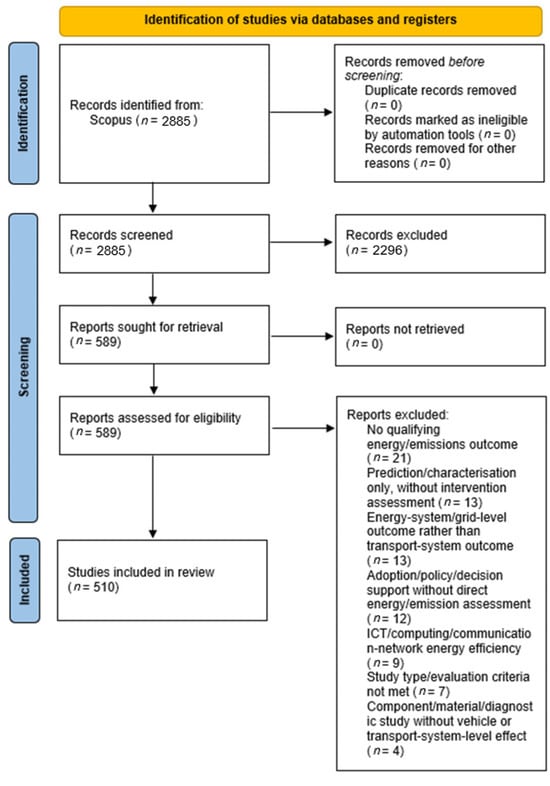
In the first stage of selection, publications were assessed for their alignment with the general scope of the study, which centred on transport as the core subject of analysis and the relationship between the solution under investigation and improvements in energy efficiency, reductions in energy or fuel consumption, or reductions in emissions. At this stage, 585 records were excluded, while the remaining 2300 publications formed the bibliometric corpus used to analyse publication activity and the thematic structure of the area under study.
As the scope of the bibliometric corpus was broader than that required for an in-depth content analysis, a more restrictive screening of publications was subsequently carried out. The assessment focused primarily on the centrality of the transport issue, the presence of a specific technological, operational, optimisation, digital, or energy management intervention, the link to energy or emissions outcomes, and the nature of the evaluation method used. Operationally, records were assigned to the Analytical Core when the title and abstract provided clear evidence of transport as the central study context, a specific intervention, a relevant energy or emissions outcome, and an evaluative component. Records that appeared potentially eligible but for which one or more of these elements could not be confirmed from the title and abstract were assigned to the Analytical Reserve and retained for additional verification. Records that did not meet the requirements for progression to structured content analysis were retained only in the broader bibliometric corpus.
As a result of this stage, 317 publications were identified to form the Analytical Core and 320 publications were classified into the Analytical Reserve. The Analytical Core comprised studies that clearly met the criteria for in-depth analysis, while the Analytical Reserve constituted a collection of cases requiring further verification. A re-evaluation of the publications from the Analytical Reserve revealed that 272 out of 320 records met the criteria for referral to full-text assessment, whilst 48 records were not selected for the next stage.
A total of 589 publications, comprising 317 records from the Analytical Core and 272 records selected from the Analytical Reserve, underwent full-text assessment in accordance with the eligibility criteria set out in Section 2.3. At this stage, it was verified whether transport, a vehicle, a fleet, infrastructure, or a transport system constituted the central subject of the study, whether a specific intervention was analysed, and whether its impact on a qualifying energy or emissions outcome was assessed. The remaining 1663 publications were retained solely in the bibliometric corpus and were not referred for full-text assessment.
Of the 589 publications assessed on the basis of the full text, 79 were excluded. A list of studies excluded after full-text assessment, together with the primary reason for exclusion, is provided in Supplementary Table S2. The most common reason for exclusion was the absence of a qualifying outcome relating to a reduction in energy consumption or emissions (n = 21). Other reasons included studies being limited to the prediction or characterisation of the phenomenon under investigation without an assessment of a specific intervention (n = 13), analyses concerning outcomes at the level of the energy system or electricity grid rather than the transport system (n = 13), studies focusing on adoption, policy or decision support without a direct assessment of energy or emissions reductions (n = 12), analyses of the energy efficiency of ICT infrastructure, computing systems or communication networks (n = 9), publications failing to meet the criteria regarding the type of study or the nature of the evaluation carried out (n = 7), and component, material, or diagnostic studies without an assessment of the effect at the vehicle or transport system level (n = 4).
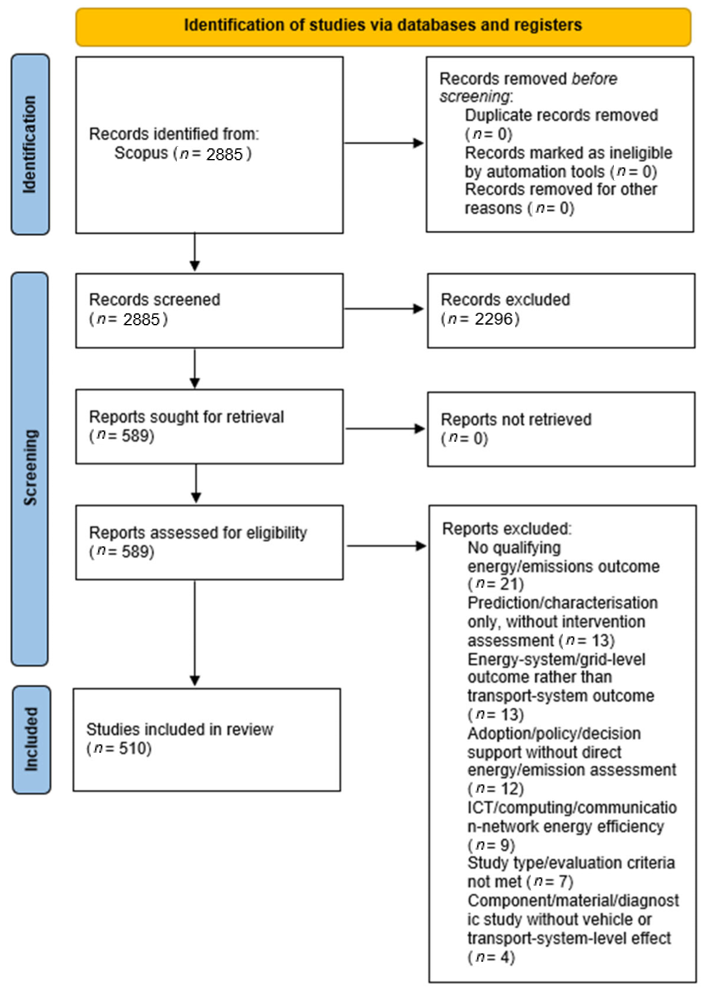
Ultimately, 510 publications met all eligibility criteria and formed the final corpus used in the structured content analysis and synthesis of results addressing RQ2–RQ5. The full process of identification, screening and selection of publications is presented in the PRISMA 2020 flow diagram (Figure 1).
Figure 1.
PRISMA 2020 flow diagram showing the identification, screening, eligibility assessment, and selection of publications for the bibliometric corpus and the final structured content analysis.
2.5. Bibliometric Analysis
The bibliometric analysis was carried out on a corpus comprising 2300 publications selected following the screening of titles and abstracts. Metadata exported from the Scopus database was utilised, including, amongst other things, the year of publication, source, authors, number of citations and authors’ keywords. The analysis covered publication trends and the thematic development of the research area.
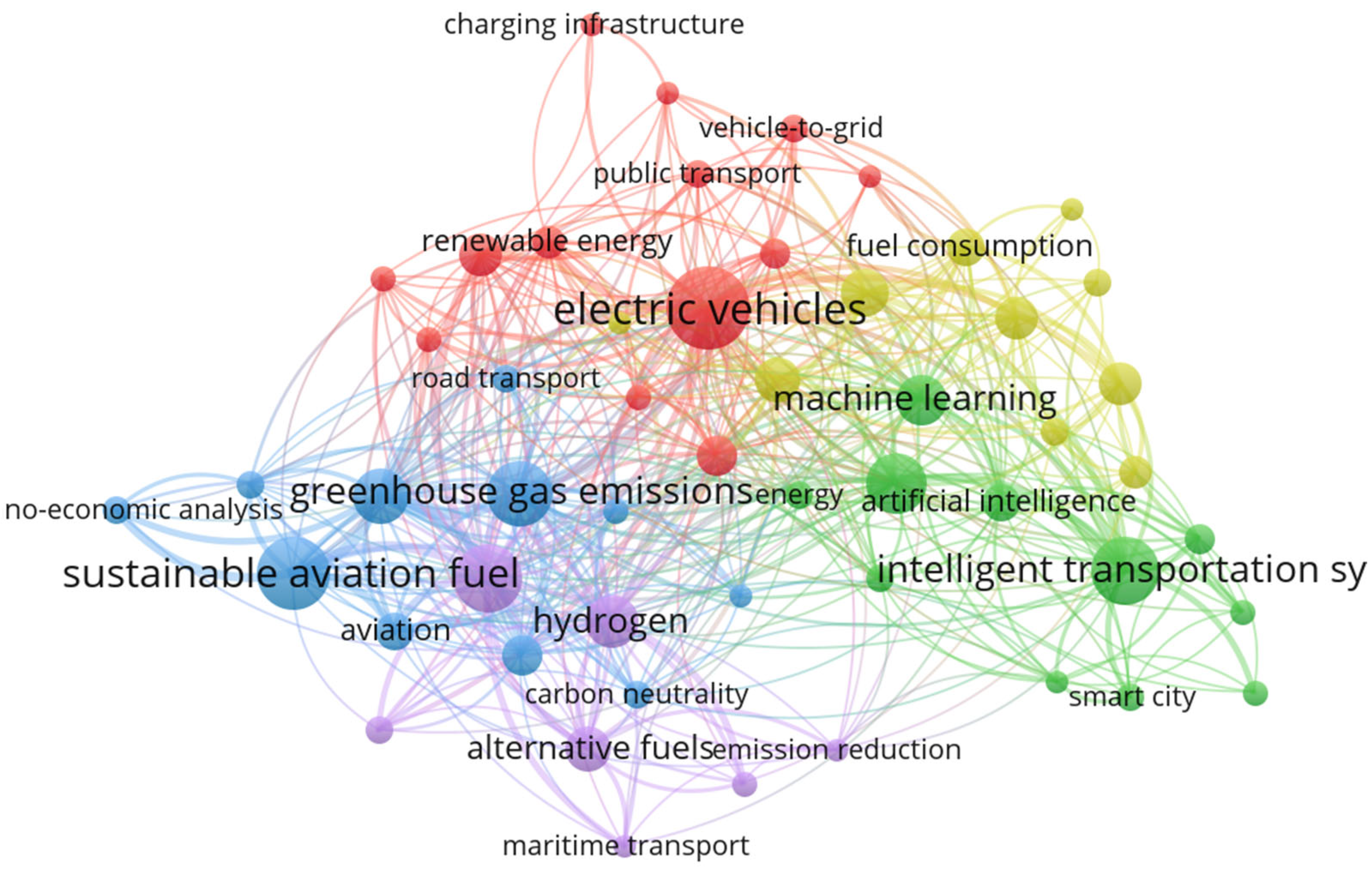
The VOSviewer to 1.6.21 programme was used to analyse the thematic structure. Mapping was carried out on the basis of the co-occurrence of authors’ keywords (Author Keywords), using the full-counting method. This analysis enabled the identification of the main thematic groups and the relationships between concepts appearing in the literature under study.
Before creating the final maps, the terminology was normalised using a thesaurus file. Variants referring to the same concepts—resulting, amongst other things, from differences in spelling, singular and plural forms, the use of abbreviations and linguistic variants—were merged. However, the distinction between terms representing different analytical categories, such as ‘energy efficiency’ and ‘energy consumption’, ‘hydrogen’ and ‘fuel cell’, and ‘carbon footprint’ and ‘greenhouse gas emissions’, was retained.
The thesaurus file comprised 129 term-normalisation and merging operations. In addition, 18 very general keyword variants with limited discriminatory value were removed; these related, amongst other things, to sustainability, transport, transportation, optimisation, efficiency, and emissions.
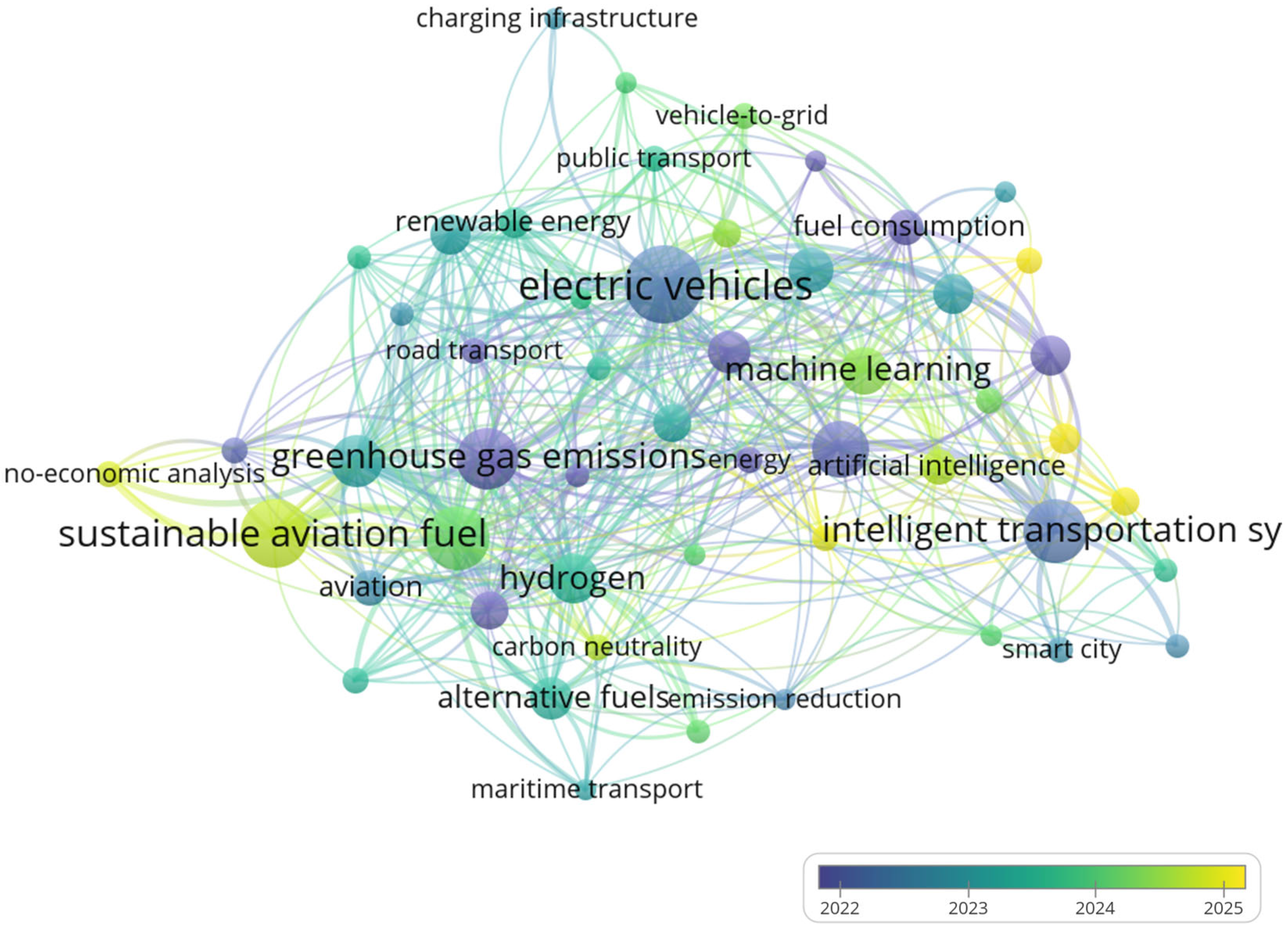
A preliminary network analysis was carried out using a minimum threshold of 10 occurrences of a given keyword, while for the final analysis the threshold was set at 15 occurrences. Based on the cleaned dataset, a network visualisation was created to illustrate the co-occurrence structure of keywords, along with an overlay visualisation showing their variation according to the average year of publication.
The results of the bibliometric analysis were used primarily to answer RQ1 and as a context for the subsequent systematic content analysis carried out on a more restrictive analytical corpus.
2.6. Structured Content Analysis
The final corpus, comprising 510 publications, was subjected to a structured content analysis aimed at answering RQ2–RQ5. For each publication, a standardised coding scheme was applied, covering the transport sector, the nature of transport operations, the level of the system under analysis, the category of approach, the type of intervention, the research method, the nature of the data and evidence, the method of validation, and the type of energy and emissions outcomes. Data extraction and coding were performed independently by two reviewers using the predefined coding framework. Any discrepancies were resolved through discussion and consensus. The scope of these variables corresponds to the assumptions previously adopted in the analysis design.
Approaches were classified according to the dominant intervention mechanism, distinguishing, amongst others, electrification and alternative fuels, energy and powertrain management, eco-driving and optimisation of speed or trajectory, traffic management and ITS, optimisation of routes and transport operations, charging management, fleet and scheduling optimisation, as well as modal shift and system-level planning. Each publication was assigned a single dominant approach category based on the predominant intervention mechanism identified during coding. This mutually exclusive classification was used to support interpretable cross-modal comparisons and to ensure that each study contributed only once to the denominator of the primary approach analysis. However, assignment to a dominant category did not imply that a study addressed only one intervention mechanism. To preserve the multidimensional character of combined interventions, a separate multi-label “intervention orientation” variable was coded, allowing each study to be classified as technological, operational, optimisation-oriented, digital/data-driven, and/or organisational/systemic. Multiple orientations could therefore be assigned to the same publication.
The manner in which energy and emission effects were represented was analysed separately. For each included study, all reported energy and emissions outcomes that met the predefined eligibility criteria were recorded. A distinction was made between direct indicators, such as fuel consumption, electricity consumption, total energy consumption, energy intensity and CO2 or CO2-equivalent emissions, and indirect operational indicators, such as route length, journey time, waiting time, congestion or vehicle utilisation. The nature of the evidence was classified as measured, estimated, simulated or based on an indirect indicator.
To address RQ4, the use of optimisation, digitalisation, automation, artificial intelligence, and data-driven methods—including machine learning, deep learning, reinforcement learning, ITS/V2X, the Internet of Things, real-time data, and digital twins—was recorded separately. For the purposes of RQ5, the validation method, study limitations and suggested directions for further work were also taken into account. Following extraction, the detailed codes were normalised and consolidated into a common set of analytical categories used in the subsequent synthesis.
2.7. Data Synthesis and Comparative Framework
Based on the results of the structured content analysis, a comparative synthesis of the eligible studies was carried out. Its aim was to organise the identified solutions in a way that would enable the comparison of different transport modes, types of intervention, research methods, and energy and emissions outcomes.
The classification structure was developed on the basis of categories observed in the analysed corpus, without imposing a predefined set of classes. The synthesis was conducted across six complementary dimensions: mode of transport, type of intervention, supporting method or technology used, mechanism of impact, energy or emissions indicator, and the type of evidence used to assess effectiveness.
This approach enabled a comparison not only of the type of proposed solutions, but also of the way in which their impact on energy efficiency and emissions was demonstrated. The synthesis was then used to identify the predominant research directions, underdeveloped areas, and methodological, technological, and implementation gaps, which formed the basis for formulating directions for further research.
3. Results
3.1. Selection of Publications and Final Research Corpus
The selection process described in Section 2.4 resulted in two complementary datasets used in the subsequent analyses: a broader bibliometric corpus comprising 2300 publications and a final analytical corpus of 510 studies included in the structured content analysis. The bibliometric corpus was used to examine the development and thematic structure of the research field, whereas the analytical corpus formed the basis for the comparative assessment of intervention approaches, research methods, and energy and emissions outcomes. The key characteristics of the 510 studies included in the structured content analysis are provided in Supplementary Table S3, while the complete study-selection pathway is presented in Figure 1.
3.2. Bibliometric Development and Thematic Structure of the Field Under Study
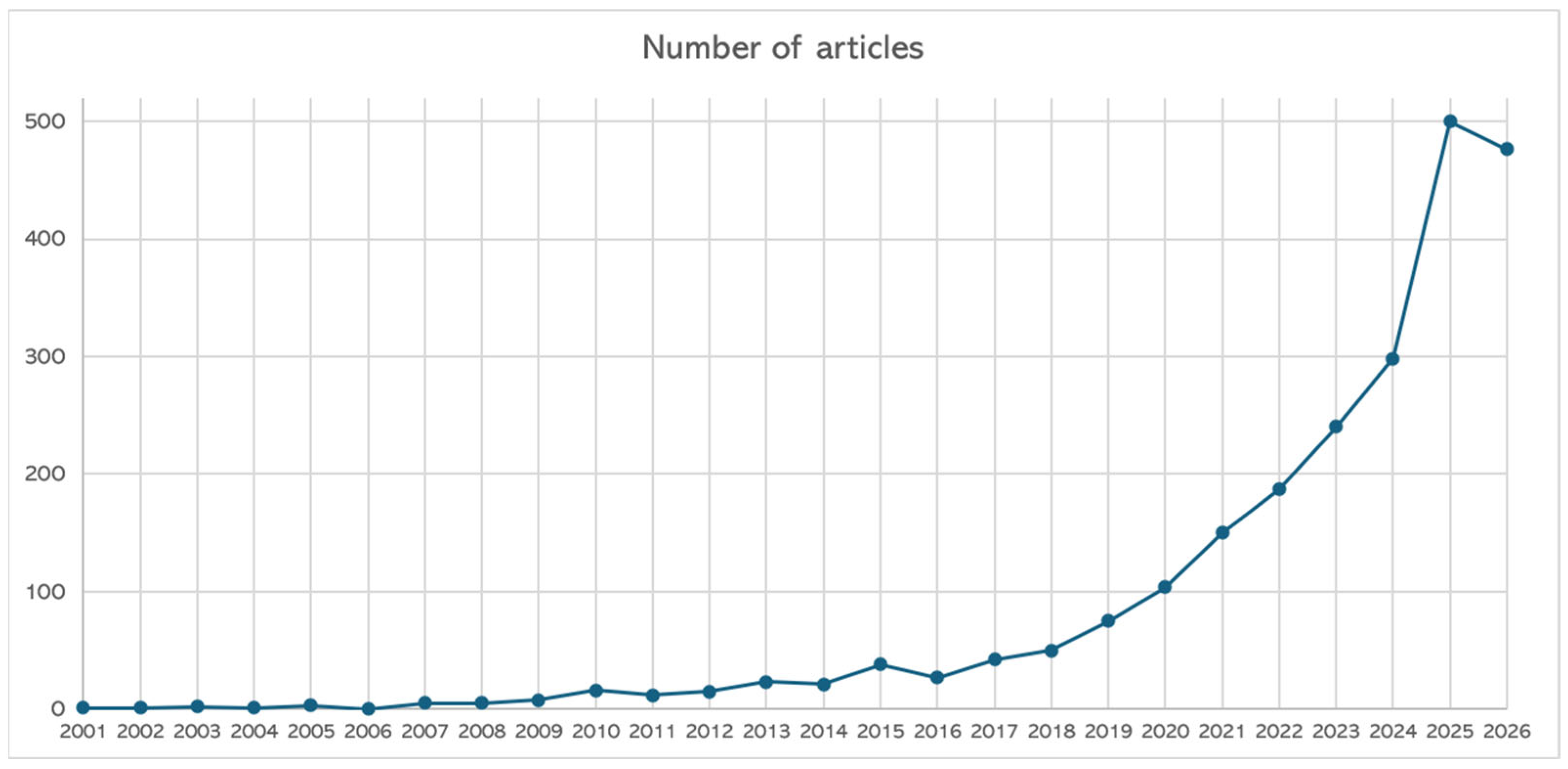
The bibliometric corpus comprised 2300 publications published between 2001 and 2026. Initially, interest in the issues of energy efficiency and emissions reduction in transport was relatively low. Between 2001 and 2009, a total of only 26 publications were identified, whilst between 2010 and 2014, this number rose to 87. A more pronounced acceleration occurred after 2015, with a particularly strong increase evident from 2020 onwards.
The number of publications rose from 75 in 2019 to 104 in 2020, 150 in 2021, 187 in 2022, 240 in 2023 and 298 in 2024 (Figure 2). The highest number of publications was recorded in 2025 (n = 500). A total of 1955 publications, or 85.0 per cent of the entire corpus, were published between 2020 and 2026. In 2026, 476 publications were identified; however, this figure includes only records available up to the date of the search, i.e., 12 September 2026, and should therefore not be interpreted as a decline in research activity. The observed trend indicates a very rapid expansion of the research field in recent years and the growing importance of energy and transport decarbonisation issues.
Figure 2.
Annual number of publications on improving energy efficiency and reducing emissions in transport in the bibliometric corpus (n = 2300). Data for 2026 include publications available up to 12 September 2026.
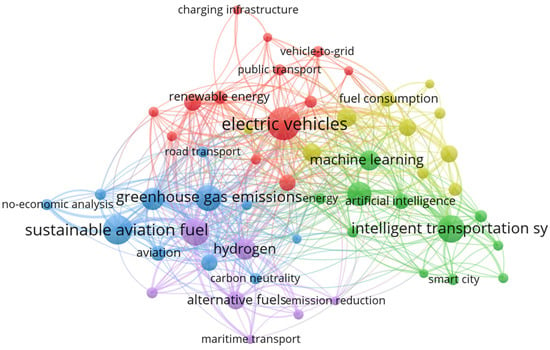
An analysis of the co-occurrence of authors’ keywords enabled the identification of the main thematic areas explored in the analysed literature. Following the normalisation of terminology using a thesaurus file and the application of a minimum threshold of 15 occurrences, 52 keywords were included in the final network. Standardisation was particularly important for terms appearing in multiple variants, such as ‘artificial intelligence’, ‘electric vehicles’, ‘greenhouse gas emissions’, ‘intelligent transportation systems’, ‘life cycle assessment’, and ‘sustainable aviation fuel’.
The most frequently occurring term was ‘electric vehicles’ (n = 184), followed by ‘sustainable aviation fuel’ (n = 140), ‘decarbonisation’ (n = 122), ‘intelligent transport systems’ (n = 120), and ‘greenhouse gas emissions’ (n = 116). A high frequency of occurrence was also recorded for ‘energy efficiency’ (n = 99), ‘life cycle assessment’ (n = 84), ‘hydrogen’ (n = 74), ‘machine learning’ (n = 71), ‘energy consumption’ (n = 62), and ‘alternative fuels’ (n = 58). This structure indicates that the research field is developing at the intersection of fuel and propulsion transformation, improvements in operational efficiency, and the increasingly widespread use of digital technologies.
Network visualisation (Figure 3) revealed a strongly interconnected thematic structure, within which five main clusters can be distinguished. The first cluster focuses on issues related to transport electrification and energy integration, covering, among others, electric vehicles, charging infrastructure, vehicle-to-grid, renewable energy, public transport, and road transport. The second focuses on smart and digital transport systems, with a particularly strong presence of intelligent transport systems, artificial intelligence, and smart cities. The third covers the application of machine learning and optimisation methods to reduce fuel and energy consumption.
Figure 3.
Network visualisation of author–keyword co-occurrence in the bibliometric corpus (n = 2300). Node size represents keyword occurrence frequency, links indicate co-occurrence relationships, and colours represent thematic clusters identified using VOSviewer.
The remaining two clusters are more closely linked to the fuel transition and the specific characteristics of individual transport sectors. One of them centres on sustainable aviation fuel, aviation, greenhouse gas emissions, and techno-economic analyses, highlighting a distinct and rapidly developing trend towards the decarbonisation of aviation. The second integrates issues relating to hydrogen, alternative fuels, carbon neutrality, emission reduction, and maritime transport, highlighting the strong link between alternative energy sources and the decarbonisation of sectors that are more difficult to electrify directly.
At the same time, the large number of links between clusters suggests that the identified trends do not develop independently. In particular, electric vehicles, energy, greenhouse gas emissions, machine learning, and artificial intelligence occupy positions that link technological solutions with the optimisation and assessment of environmental outcomes. This points to a strong connection between technological, energy, optimisation and environmental themes in the analysed literature.
Importantly, spatial proximity in the VOSviewer network should not be interpreted in isolation as evidence of a direct or uniquely strong conceptual relationship between individual terms. In particular, the relative positions of “artificial intelligence” and “public transport” reflect the overall co-occurrence structure generated by the network layout and should be interpreted together with link strength and cluster membership. Both concepts were explicitly represented in the Scopus search strategy (“artificial intelligence” and “public transport”), while keyword variants were subsequently normalised using the thesaurus procedure described in Section 2.5. The final network included keywords occurring at least 15 times in the cleaned dataset. Therefore, the observed configuration reflects the structure of the retrieved and normalised bibliometric corpus rather than an assumed direct relationship between these two concepts.
Overlay visualisation (Figure 4) enabled an assessment of changes in the thematic structure based on the average year of publication of papers containing specific keywords. The relatively earlier part of the field comprises topics related to fuel consumption (average year of publication approx. 2021.7), eco-driving (2021.7), greenhouse gas emissions (2021.9), energy efficiency (2022.1), intelligent transport systems (2022.3), and electric vehicles (2022.4). This indicates that the initial phase of the literature’s dynamic development focused primarily on fuel consumption, energy efficiency, emissions, electrification, and intelligent transport management.
Figure 4.
Overlay visualisation of author–keyword co-occurrence according to the average publication year. Colours indicate the temporal position of individual research topics, from relatively earlier to more recent themes.
The more recent literature, however, shows a clear shift towards alternative energy sources and data-driven methods. The average publication year for ‘hydrogen’ is around 2023.5, whilst for ‘machine learning’ it is 2024.3, for ‘sustainable mobility’ it is 2024.4, for ‘artificial intelligence’ it is 2024.6, for ‘carbon neutrality’ it is 2024.6, and for ‘sustainable aviation fuel’ it is 2024.6. Also among the most current topics are techno-economic analysis (approx. 2024.7), multi-objective optimisation (approx. 2025.0) and deep reinforcement learning (approx. 2025.1).
The picture that emerges therefore points to a shift in the nature of the research field. Alongside the continuing importance of electrification, energy consumption and emissions, research combining decarbonisation with advanced optimisation, artificial intelligence and the systemic assessment of new fuel technologies is developing at an ever-increasing pace. Particularly evident is the parallel emergence of two newer trends: the development of low-emission fuels for transport sectors that are difficult to electrify, and the application of AI and machine learning methods to the management and optimisation of transport systems. These results directly address RQ1, pointing both to a sharp increase in publication activity and to the evolution of the field from traditional issues of efficiency and emissions towards integrated decarbonisation and digital technologies.
3.3. Approaches to Improving Energy Efficiency and Reducing Emissions
Road transport was by far the most prevalent in the final corpus of 510 publications, accounting for 365 studies (71.6%). Air transport was represented by 53 publications (10.4%), maritime transport by 49 (9.6%), multimodal transport by 23 (4.5%), and rail transport by 20 (3.9%). The most frequently analysed category of intervention was ‘electrification and alternative fuels’, comprising 234 studies (45.9%). The next most numerous groups were ‘traffic management and ITS’ (n = 57; 11.2%), ‘energy management and powertrain control’ (n = 55; 10.8 per cent), and eco-driving and trajectory/speed optimisation (n = 52; 10.2 per cent).
The complementary multi-label coding of intervention orientations further demonstrates that the analysed studies frequently combined several mechanisms within a single intervention. Only 20 of the 510 studies (3.9%) were assigned a single intervention orientation, whereas 490 studies (96.1%) combined two or more orientations. Technological elements were identified in 402 studies (78.8%), operational elements in 361 (70.8%), organisational/systemic elements in 333 (65.3%), digital/data-driven elements in 304 (59.6%), and optimisation elements in 276 (54.1%). As multiple orientations could be assigned to the same study, these percentages are not mutually exclusive and therefore do not sum to 100%. This complementary analysis indicates that the dominant-category distribution should be interpreted as a classification of the primary intervention mechanism rather than as evidence that the interventions were mechanistically isolated.
The cross-tabulation reveals substantial differences in the structure of intervention strategies across transport modes (Table 1). Electrification and alternative fuels dominate both road transport and aviation, whereas aviation is additionally characterised by a comparatively high share of energy management and powertrain-control studies. Maritime research shows a more diversified profile, with relatively strong representation of eco-driving, trajectory/speed optimisation, and routing. Multimodal studies are distinguished by the predominance of modal shift and system-level planning, whereas rail transport exhibits a comparatively dispersed intervention structure, including a relatively high proportion of vehicle and propulsion efficiency studies.
Table 1.
Distribution of primary intervention categories across transport modes. Values are n (% within transport mode).
A further comparison was made according to the nature of transport operations. Of the 510 studies included in the structured content analysis, 251 concerned passenger transport, 87 freight transport, 21 addressed both passenger and freight applications, and in 151 studies this distinction was not sufficiently specified. Electrification and alternative fuels constituted the dominant intervention category in both passenger (49.0%) and freight transport (42.5%). However, freight-oriented studies placed substantially greater emphasis on routing and scheduling (18.4%, compared with 4.0% in passenger transport) and on eco-driving and trajectory/speed optimisation (17.2% versus 8.8%). Passenger-transport studies, in turn, showed a comparatively greater representation of energy management and powertrain control, charging and infrastructure, and modal-shift and system-planning approaches. These differences indicate that freight decarbonisation research places relatively greater emphasis on logistics and operational efficiency, whereas passenger-transport research combines propulsion transformation with a broader range of vehicle-, infrastructure-, and system-level interventions.
The scope of the analysed solutions covered both the transformation of propulsion technologies and operational activities. García-Afonso [21] demonstrated, for example, the potential to reduce total energy consumption and CO2 emissions through the electrification of intercity buses, whilst Xu et al. [22] indicated that the emissions impact of rail electrification depends heavily on the structure of the electricity mix. In maritime transport, Zhu et al. [23] combined route optimisation with the management of multiple energy sources on board a vessel, achieving a reduction in fuel consumption of up to 11.29 per cent and a reduction in CO2 emissions of approximately 12 per cent. In multimodal transport, meanwhile, Chen et al. [24] analysed low-carbon route optimisation and the selection of transport modes while taking both costs and emissions into account. These results demonstrate the wide range of mechanisms used to improve the energy and environmental performance of transport.
3.4. Method of Assessing Effects and the Role of Digitalisation and Artificial Intelligence
Energy outcomes were reported in 341 out of 510 publications (66.9 per cent), whilst emissions outcomes were reported in 337 (66.1 per cent). A simultaneous assessment of energy and emissions was carried out in 169 studies (33.1 per cent). The most frequently used methods were optimisation (n = 154; 30.2 per cent) and simulation/modelling (n = 147; 28.8 per cent), followed by scenario/system dynamics (n = 82; 16.1 per cent) and LCA/WTW (n = 53; 10.4 per cent). In total, these four groups comprised 436 publications, or 85.5 per cent of the corpus.
The dominance of modelling methods was also evident in the nature of the evidence. Results classified as ‘measured’ appeared in 23 publications (4.5%). With regard to validation, 218 studies (42.7%) were classified as ‘none/unclear’, whilst 184 (36.1%) utilised sensitivity/scenario analysis. At the same time, the corpus included studies utilising direct measurements under operational conditions. Vagg et al. [25] conducted a field study of an eco-driving support system over a distance of 39,300 km, achieving an average fuel saving of 7.6 per cent, whilst Mariscotti et al. [26] combined experimental data with a railway system model in an analysis of braking energy recovery.
For clarity, the “Empirical/real-world validation” category combines studies coded as real-world dataset, hardware-in-the-loop (HIL), field trial, or experimental rig; the original detailed validation codes are retained in the study-level coding dataset.
The validation profile differed substantially across transport modes (Table 2). More than half of the aviation, maritime, and rail studies had no clearly identifiable validation procedure, whereas multimodal studies relied predominantly on sensitivity or scenario analysis. Empirical or real-world validation remained uncommon across all transport modes, accounting for only 31 of the 510 studies overall (6.1%).
Table 2.
Distribution of validation approaches across transport modes. Values are n (% within transport mode).
Digital technologies were featured in 277 publications (54.3 per cent), while AI/data-driven methods appeared in 202 (39.6 per cent); both elements co-occurred in 133 studies (26.1 per cent). The most frequently identified group of digital technologies was ITS/V2X solutions (n = 237; 46.5%), whilst reinforcement learning and deep reinforcement learning dominated among AI methods (n = 131; 25.7%). Digitalisation was particularly prominent in studies on traffic management and ITS (86.0%), whilst the highest proportion of AI/data-driven methods was found in energy management and powertrain control (61.8%).
An example of the integration of both approaches is the study by Kumarasamy et al. [27], in which multi-agent reinforcement learning was combined with a digital twin to optimise traffic lights and reduce fuel consumption. Guan et al. [28], on the other hand, applied deep reinforcement learning to the problem of route planning for a heterogeneous fleet of electric vehicles, achieving a reduction in energy consumption even in tests using real-world data. In the analysed corpus, digital technologies and AI were therefore used primarily as tools to support control, energy management, route optimisation and traffic management, rather than as a separate objective of the intervention.
4. Discussion
The findings indicate that improvements in energy efficiency and reductions in emissions in transport are increasingly based on the integration of several mechanisms: the transformation of propulsion technologies, energy management, operational optimisation and digital solutions. At the same time, there is no single, universal decarbonisation pathway for all modes of transport. In road transport, electrification supported by ITS and energy management is of particular importance, whilst in aviation and shipping, alternative fuels and improvements in operational efficiency continue to play a greater role. The diversity of pathways is also evident within freight transport. Cooperative heavy-duty vehicle platooning has been investigated as an operational and digitally supported approach to improving fuel efficiency, whereas life-cycle assessment of overhead-cable electric trucks has shown that the decarbonisation benefits of freight electrification depend strongly on the electricity mix and the scale of system adoption [29,30]. This observation is consistent with earlier reviews concerning the integration of new propulsion technologies [6], the transformation of aviation [15], and the decarbonisation of maritime transport [16], but this analysis presents these trends within a single, cross-sectoral perspective. A further distinction emerges between passenger and freight applications. Although electrification and alternative fuels dominate both groups, freight-oriented research relies more strongly on routing, scheduling, and operational speed optimisation, reflecting the importance of logistics efficiency and vehicle utilisation, whereas passenger-transport studies show a broader combination of propulsion, charging-infrastructure, energy-management, and system-planning interventions.
A particularly significant issue is the discrepancy between modelled improvement potential and its empirical validation. The analysed literature relies heavily on optimisation, simulation, scenario analysis, and LCA, whilst evidence based on actual measurements remains considerably less widespread. This means that the maturity of computational methods does not always correspond to the implementation maturity of the proposed solutions. This is particularly significant in the case of AI and data-driven methods, whose growing role has also been highlighted in previous reviews [4,9]. In this study, these technologies primarily functioned as a layer supporting control, routing, and energy and traffic management; therefore, their energy value should be assessed on the basis of the actual transport effect, rather than solely on the performance of the algorithm. This integration is also illustrated by predictive eco-driving approaches, in which model-predictive control and real-time optimisation are combined with vehicle energy management to improve fuel economy while maintaining mobility and operational constraints [31].
The second key finding is the need for more consistent integration of energy and emissions results. A reduction in energy consumption does not necessarily imply a proportional reduction in emissions, as the effect depends, among other things, on the energy source, the fuel used, the system boundaries, and operating conditions. For this reason, future assessments should integrate direct energy and emissions indicators to a greater extent and clearly define the baseline scenario. This is particularly important in studies covering electrification, alternative fuels, and modal shifts, where the effect may occur at various levels of the transport-energy system. A similar issue arises in aviation, where life-cycle assessments of sustainable aviation fuels show that estimated GHG benefits can vary substantially depending on feedstock characteristics, land-use effects, and methodological choices such as allocation procedures [32]. At the vehicle level, powertrain characteristics constitute an additional determinant of energy and emission performance. Statistical analysis of passenger vehicles has shown that parameters such as engine displacement, transmission configuration, and fuel type are associated with differences in fuel consumption and CO2 emissions [33].
With regard to the research questions, RQ1 revealed dynamic developments in the field and a shift in focus towards electrification, alternative fuels, and digital methods and AI. RQ2 confirmed the dominant role of electrification and alternative fuels, whilst highlighting the diversity of approaches across transport modes. RQ3 highlighted the predominance of modelling approaches and the lack of a comprehensive, integrated assessment of energy and emissions impacts. In response to RQ4, it was found that digitalisation and AI primarily serve as technologies supporting the management and optimisation of transport systems. RQ5, on the other hand, points to the need for stronger validation under real-world conditions, improved comparability of indicators, and an expansion of the evidence base for less well-represented transport modes.
5. Conclusions
The review conducted shows that research into energy efficiency and emissions reduction in transport is moving towards an ever-stronger integration of propulsion technologies, energy management, optimisation, and digital solutions. The main contribution of this study is a cross-sectional comparison of these approaches across different transport modes, alongside an assessment of how their energy and emissions impacts are measured and validated. The analysis also highlights a clear predominance of modelling studies over experimental and field verification of results, which limits the possibility of directly transferring some of the findings into practice.
The limitations of this review stem primarily from the use of a single bibliographic database, the restriction of the corpus to English-language records classified as “Article”, and the dependence of the results on the adopted search strategy and classification scheme. Although Scopus provides broad multidisciplinary coverage and a consistent metadata structure, reliance on a single database may have resulted in the omission of studies indexed exclusively in other sources. In particular, the exclusion of conference proceedings may underrepresent rapidly developing engineering domains such as intelligent transport systems, vehicle control, and machine learning, where relevant work is frequently disseminated through IEEE conferences or indexed in specialised databases such as IEEE Xplore or TRID. Future reviews could therefore assess the sensitivity of the findings through cross-database searches including Web of Science and specialised engineering and transport databases. In addition, the coding framework did not classify studies according to the economic-development status of the geographical context in which they were conducted. Consequently, systematic comparisons between developed and developing regions were outside the scope of the present analysis. Future reviews could incorporate geographical and income-level classifications to examine whether the relative importance and implementation maturity of decarbonisation strategies differ across economic contexts.
Further research should focus on more robust validation under real-world conditions, the development of more comparable energy and emissions indicators, and the assessment of the transferability of AI and optimisation methods across different transport contexts. It will be particularly important to move from assessing whether a given intervention has reduction potential to determining under what conditions and with what degree of empirical evidence this effect is actually achieved.
Supplementary Materials
The following supporting information can be downloaded at https://www.mdpi.com/article/10.3390/en19215171/s1: Table S1. Full Scopus search strategy used in the systematic review; Table S2. Studies excluded after full-text assessment; Table S3. Characteristics of studies included in the structured content analysis (n = 510).
Author Contributions
Conceptualization, P.N.-G. and A.B.; methodology, P.N.-G. and A.B.; software, P.N.-G.; validation, P.N.-G. and A.B.; formal analysis, P.N.-G. and A.B.; investigation, P.N.-G. and A.B.; resources, A.B.; data curation, P.N.-G.; writing—original draft preparation, P.N.-G. and A.B.; writing—review and editing, M.K.; visualization, P.N.-G.; supervision, A.B.; project administration, P.N.-G.; funding acquisition, N.M. All authors have read and agreed to the published version of the manuscript.
Funding
This research was funded by the Military University of Technology, grant number 531-000137-W700-22/2026.
Data Availability Statement
The data presented in this study are available on request from the corresponding author.
Conflicts of Interest
The authors declare no conflicts of interest.
References
- International Energy Agency (IEA). Energy Efficiency 2025; IEA: Paris, France, 2025. [Google Scholar]
- United Nations Environment Programme (UNEP). Emissions Gap Report 2025: Off Target-Continued Collective Inaction Puts Global Temperature Goal at Risk; UNEP: Nairobi, Kenya, 2025. [Google Scholar] [CrossRef] [Scilit]
- Blokus-Dziula, A.; Dziula, P. Selected Aspects of Sustainability of Infrastructure Towards Transport Decarbonisation—Review. Sustainability 2026, 18, 7604. [Google Scholar] [CrossRef] [Scilit]
- Ismail, F.B.; Yousif, S.T.; Albayati, I.M.; Al-Hadeethi, R.H.; AL Shurafa, S.M.; AlMubaidin, M.A. Advancing Energy Efficiency in Smart Transportation through Intelligent Technologies and Policy Innovation. Int. J. Energy Water Resour. 2026, 10, 120. [Google Scholar] [CrossRef] [Scilit]
- Mateichyk, V.; Kostian, N.; Smieszek, M.; Gritsuk, I.; Verbovskyi, V. Review of Methods for Evaluating the Energy Efficiency of Vehicles with Conventional and Alternative Power Plants. Energies 2023, 16, 6331. [Google Scholar] [CrossRef] [Scilit]
- Kochanek, A.; Zacłona, T.; Pietrucha, I.; Petryk, A.; Ziemiańczyk, U.; Basak, Z.; Guzdek, P.; Akbulut, L.; Atılgan, A.; Woźniak, A.D. Renewable Energy Integration in Sustainable Transport: A Review of Emerging Propulsion Technologies and Energy Transition Mechanisms. Energies 2025, 18, 6610. [Google Scholar] [CrossRef] [Scilit]
- Vishnuram, P.; Alagarsamy, S.; Bajaj, M.; Alqahtani, M.; Khalid, M. A Critical Review on Alternative Fuels for Road Transport: Pollution Mitigation, Environment and Economic Perspective. Energy Strategy Rev. 2025, 61, 101894. [Google Scholar] [CrossRef] [Scilit]
- AlHousrya, O.; Bennagi, A.; Cotfas, P.A.; Cotfas, D.T. The Role of the Industrial IoT in Advancing Electric Vehicle Technology: A Review. Appl. Sci. 2025, 15, 9290. [Google Scholar] [CrossRef] [Scilit]
- Ouyang, S.; Zhao, P.; Gong, Z. A Review of Transport Carbon Emissions: Insights from Artificial Intelligence and Big Data. J. Clean. Prod. 2025, 532, 146906. [Google Scholar] [CrossRef] [Scilit]
- Nisyrios, E.; Gkiotsalitis, K. A Systematic Literature Review on Simulation-Based Strategies for Traffic and Fleet Management of Connected and Autonomous Vehicles. J. Simul. 2026, 1–44. [Google Scholar] [CrossRef] [Scilit]
- Merkisz, J.; Guzanek, P.; Borucka, A.; Žvirblis, T.; Matijosius, J. Modeling of Instantaneous CO2 Concentration under Real-World Operating Conditions of Passenger Vehicles Using RDE Data and Standard Onboard Engine Parameters. Eksploat. Niezawodn. Reliab. 2026, 28, 216132. [Google Scholar] [CrossRef] [Scilit]
- Yang, Z.; Peng, J.; Wu, L.; Ma, C.; Zou, C.; Wei, N.; Zhang, Y.; Liu, Y.; Andre, M.; Li, D.; et al. Speed-Guided Intelligent Transportation System Helps Achieve Low-Carbon and Green Traffic: Evidence from Real-World Measurements. J. Clean. Prod. 2020, 268, 122230. [Google Scholar] [CrossRef] [Scilit]
- Pathak, A.; Sethuraman, G.; Ongel, A.; Lienkamp, M. Impacts of Electrification & Automation of Public Bus Transportation on Sustainability-A Case Study in Singapore. Forsch. Ingenieurwes. 2021, 85, 431–442. [Google Scholar] [CrossRef] [Scilit]
- Restrepo-Arias, J.F.; Branch-Bedoya, J.W.; Zapata-Cortes, J.A.; Paipa-Sanabria, E.G.; Garnica-López, M.A. Industry 4.0 Technologies Applied to Inland Waterway Transport: A Systematic Literature Review. Sensors 2022, 22, 3708. [Google Scholar] [CrossRef] [Scilit]
- Li, C.; Yu, B.; Ha, C.; Ji, Y.; Wan, Y.; Jiang, X.; Luo, X.; Chen, Z.; Zhao, Y.; Zheng, Y.; et al. Energy and Power Transition in Green Aviation: Current Status and Prospects of Synergistic Development of Alternative Fuels and Propulsion Technologies. Chin. J. Aeronaut. 2026, 39, 104322. [Google Scholar] [CrossRef] [Scilit]
- Islam, R.; Emad, G.R.; Sheikh, W. A Systematic Review on Maritime Decarbonisation: The Synthesis, Implications, and Strategies of a Decade of Alternative Fuels for Shipping. Sustainability 2026, 18, 7776. [Google Scholar] [CrossRef] [Scilit]
- Thomas, H.; Carmona Aparicio, L.G.; Creutzig, F.; Hara, T.; Hayashi, A.; Ludovique, C.; Martinez, L.M.; Kishimoto, P.N.; Niamir, L.; Saheb, Y.; et al. Models and Methods for Transport Demand and Decarbonisation: A Review. Environ. Res. Lett. 2024, 19, 093005. [Google Scholar] [CrossRef] [Scilit]
- Lee, D.; Nam, H.; Liu, Y.; Yum, K.K.; Kwon, S.; Kim, H. Safety of Zero-Emission Transport Systems: A Bibliometric Review and Future Research Perspective. Appl. Sci. 2026, 16, 1221. [Google Scholar] [CrossRef] [Scilit]
- Rykała, M.; Borucka, A.; Grzelak, M.; Merkisz, J.; Rykała, Ł. Modeling CO2 Emissions of a Gasoline-Powered Passenger Vehicle Using Multiple Regression. Appl. Sci. 2026, 16, 934. [Google Scholar] [CrossRef] [Scilit]
- Guzanek, P.; Borucka, A.; Kęsy, M. Renewable Energy Sources in Transport: Literature Review and Development Perspective. Eur. Res. Stud. J. 2025, 28, 945–970. [Google Scholar] [CrossRef] [Scilit]
- García-Afonso, Ó. Impact of powertrain electrification on the overall CO2 emissions of intercity public bus transport: Tenerife Island test case. J. Clean. Prod. 2023, 412, 137365. [Google Scholar] [CrossRef] [Scilit]
- Xu, X.; Kent, S.; Schmid, F. Carbon-reduction potential of electrification in China’s railway transport: An analysis of three possible future scenarios. Proc. Inst. Mech. Eng. Part F J. Rail Rapid Transit 2021, 235, 226–235. [Google Scholar] [CrossRef] [Scilit]
- Zhu, B.; Li, Y.; Xiao, Y.; Sun, B.; Tan, X.; Huang, S. A bidirectionally coupled multi-energy and route optimisation framework for low-carbon maritime transport. Energy 2026, 360, 141579. [Google Scholar] [CrossRef] [Scilit]
- Chen, X.; Hu, X.; Liu, H. A low-carbon route optimisation model for multimodal freight transport considering value and time attributes. Socio-Econ. Plan. Sci. 2024, 96, 102108. [Google Scholar] [CrossRef] [Scilit]
- Vagg, C.; Brace, C.J.; Hari, D.; Akehurst, S.; Poxon, J.; Ash, L. Development and field trial of a driver assistance system to encourage eco-driving in light commercial vehicle fleets. IEEE Trans. Intell. Transp. Syst. 2013, 14, 796–805. [Google Scholar] [CrossRef] [Scilit]
- Mariscotti, A.; Giordano, D.; Signorino, D. Energy Efficiency Improvement with Reversible Substations for Electrified Transportation Systems. Open Transp. J. 2023, 17, e187444782212302. [Google Scholar] [CrossRef] [Scilit]
- Kumarasamy, V.K.; Saroj, A.J.; Liang, Y.; Wu, D.; Hunter, M.P.; Guin, A.; Sartipi, M. Integration of Decentralised Graph-Based Multi-Agent Reinforcement Learning with a Digital Twin for Traffic Signal Optimisation. Symmetry 2024, 16, 448. [Google Scholar] [CrossRef] [Scilit]
- Guan, Q.; Cao, H.; Tan, J.; Ou, B.; Wang, Y.; Yan, X.; Chen, B. Dynamic-aware deep reinforcement learning for heterogeneous fleet-based capacitated electric vehicle routing problems. Appl. Energy 2026, 413, 127757. [Google Scholar] [CrossRef] [Scilit]
- Alam, A.; Besselink, B.; Turri, V.; Mårtensson, J.; Johansson, K.H. Heavy-Duty Vehicle Platooning for Sustainable Freight Transportation: A Cooperative Method to Enhance Safety and Efficiency. IEEE Control Syst. Mag. 2015, 35, 34–56. [Google Scholar] [CrossRef] [Scilit]
- Ramshankar, A.T.; Desai, A.G.; De La Villarmois, J.A.; Bozeman, J.F., III. Sustainability Analysis of Overhead Cable Line Powered Freight Trucks: A Life Cycle Impact and Techno-Economic Assessment toward Transport Electrification. Environ. Res. Infrastruct. Sustain. 2023, 3, 015010. [Google Scholar] [CrossRef] [Scilit]
- Liu, R.; Liu, H.; Han, L.; Nie, S.; Ruan, S.; Yang, N. Predictive Eco-Driving Strategy for Hybrid Electric Vehicles on Off-Road Terrain Considering Vehicle Stability Constraint. Appl. Energy 2023, 350, 121532. [Google Scholar] [CrossRef] [Scilit]
- Seber, G.; Escobar, N.; Valin, H.; Malina, R. Uncertainty in Life Cycle Greenhouse Gas Emissions of Sustainable Aviation Fuels from Vegetable Oils. Renew. Sustain. Energy Rev. 2022, 170, 112945. [Google Scholar] [CrossRef] [Scilit]
- Grzelak, M.; Borucka, A.; Rykała, M. Analysis of the influence of selected powertrain design parameters on fuel consumption in passenger vehicles. Combust. Engines 2026, 206, 105–111. [Google Scholar] [CrossRef] [Scilit]

Disclaimer/Publisher’s Note: The statements, opinions and data contained in all publications are solely those of the individual author(s) and contributor(s) and not of MDPI and/or the editor(s). MDPI and/or the editor(s) disclaim responsibility for any injury to people or property resulting from any ideas, methods, instructions or products referred to in the content. |
© 2026 by the authors. Licensee MDPI, Basel, Switzerland. This article is an open access article distributed under the terms and conditions of the Creative Commons Attribution (CC BY) license.