


Abstract
The environmental consequences of digitalization remain contested. While digital technologies may support decarbonization through improved energy efficiency and resource allocation, empirical evidence also points to insignificant or adverse environmental associations. This study investigates whether the relationship between digitalization and carbon emissions varies with countries’ economic dependence on oil rents. Using a panel of 133 countries over 2000–2021, we construct a composite Digitalization Index through principal component analysis and estimate fixed-effects models with interactions across oil-rent dependence groups. The results indicate a negative but marginally significant association between digitalization and CO2 emissions in economies with low oil-rent dependence. The interaction coefficients are positive for moderate- and high-dependence economies, indicating differences relative to the low-dependence reference group; however, the corresponding marginal associations are not statistically significant. The lagged specification yields a statistically significant negative association in low-dependence economies, while the marginal associations in the other groups remain nonsignificant. Several robustness specifications support heterogeneity in the estimated relationships, although the interaction effects lose statistical significance when country-specific linear trends are included. These findings suggest that the environmental association of economy-wide digital connectivity may depend on the economic importance of oil rents, but they do not establish a causal relationship. The study contributes to the digitalization–environment literature by identifying oil-rent dependence as a potential source of cross-country heterogeneity and highlights the importance of considering digital development alongside economic diversification and broader environmental policies.
1. Introduction
The rapid diffusion of digital technologies has transformed production systems, resource allocation, and patterns of economic growth. Artificial intelligence, cloud computing, digital platforms, the Internet of Things, and advanced communication networks increasingly shape how firms produce, governments deliver public services, and households consume goods and services [1]. At the same time, countries have committed to ambitious climate targets under the Paris Agreement, placing considerable emphasis on technologies capable of supporting the transition towards low-carbon economies. As a result, digitalization has emerged as a central component of contemporary development strategies, with the expectation that technological progress will simultaneously enhance economic productivity and environmental sustainability [2].
Despite these expectations, whether digitalization contributes to decarbonization remains far from settled. Economic theory provides competing mechanisms through which digital transformation may influence environmental outcomes. On one hand, digital technologies reduce information asymmetries, improve coordination, optimize production processes, and increase energy efficiency, thereby lowering emissions per unit of output. These channels are consistent with endogenous growth theory, which views technological progress as a primary source of productivity improvements and long-run economic development [3]. Digital technologies also facilitate smart energy management, predictive maintenance, precision manufacturing, and more efficient logistics, all of which can reduce resource consumption and environmental externalities.
On the other hand, digitalization may increase energy demand through expanding data infrastructure, greater computing requirements, and higher levels of production and consumption induced by productivity gains. More importantly, technological progress does not operate independently of the existing economic structure. Instead, it enhances the efficiency of prevailing production systems regardless of whether those systems are based on renewable technologies or fossil-fuel-intensive industries. Consequently, improvements in digital capability do not necessarily imply reductions in carbon emissions, particularly when economic activity remains concentrated in carbon-intensive sectors. In the empirical analysis, digitalization is measured through the diffusion of internet access, mobile connectivity, and fixed broadband. These indicators capture broad economy-wide digital connectivity and enabling infrastructure rather than the direct adoption of specific production technologies. The empirical analysis therefore examines whether the emissions relationship associated with this broader dimension of digitalization varies with countries’ structural dependence on oil.
These competing mechanisms are reflected in the empirical literature. Numerous studies report that digitalization improves environmental quality by promoting technological innovation, industrial upgrading, and more efficient resource allocation [4,5]. In contrast, other studies find that digital expansion either increases emissions or produces statistically insignificant environmental effects because the energy requirements of digital infrastructure and the scale effects of economic growth offset efficiency gains [6]. The absence of consensus suggests that the environmental consequences of digitalization are unlikely to be universal and instead depend on underlying structural characteristics of the economy.
One structural characteristic that has received surprisingly limited attention is dependence on oil-based production. Resource-dependent economies differ fundamentally from more diversified economies because fossil-fuel extraction, refining, and related energy-intensive industries account for a substantial share of national income, exports, investment, and employment. Under these conditions, digital technologies may improve operational efficiency within existing carbon-intensive production systems without altering the composition of economic activity. Conversely, in economies where production is more diversified and less reliant on fossil fuels, digital technologies may reinforce structural shifts towards knowledge-intensive and lower-carbon sectors. This distinction suggests that structural oil dependence may systematically moderate the environmental returns to digitalization and help explain why previous studies have reported conflicting empirical findings.
This study addresses this gap by examining whether the relationship between digitalization and carbon emissions varies across countries with different levels of structural oil dependence. Using a global panel of 133 countries over the period 2000–2021, we estimate fixed-effects models that explicitly allow the environmental impact of digitalization to differ according to countries’ dependence on oil rents. Rather than treating digitalization as a universally beneficial technology, the analysis evaluates whether its environmental effectiveness depends on the economic structure within which it is deployed.
This study makes three contributions to the literature. First, it shifts the focus from estimating the average environmental effect of digitalization to explaining the structural conditions under which digitalization contributes to decarbonization. Second, by introducing structural oil dependence as a moderating factor, it provides a coherent explanation for the heterogeneous findings reported in previous empirical studies on the digitalization–environment nexus. Third, by employing a large global panel covering both developed and developing economies, the analysis provides evidence that the environmental effectiveness of digital transformation depends not only on technological adoption but also on the composition of national production systems. These findings suggest that digital transformation and structural economic diversification should be viewed as complementary components of sustainable development rather than independent policy objectives.
The remainder of the paper is organized as follows. Section 2 reviews the relevant literature and develops the study hypotheses. Section 3 describes the data, variables, and empirical methodology. Section 4 presents the empirical results and robustness analysis. Section 5 concludes with policy implications and directions for future research.
2. Literature Review and Theoretical Framework
2.1. Digitalization and Environmental Sustainability
Digitalization has become one of the defining drivers of economic transformation in the twenty-first century. The rapid diffusion of information and communication technologies (ICT), artificial intelligence (AI), cloud computing, digital platforms, and the Internet of Things has fundamentally changed production processes, resource allocation, and industrial organization [7]. From the perspective of endogenous growth theory, technological progress represents the primary engine of sustained productivity growth because it increases the efficiency with which labour and capital are combined in production [3]. Digital technologies extend this mechanism by reducing information asymmetries, lowering transaction costs, improving coordination among economic agents, and enabling firms to optimize production decisions through data-driven management. These productivity-enhancing effects have led policymakers to regard digitalization as an important instrument for achieving both economic competitiveness and environmental sustainability. However, efficiency gains from digitalization may be partly offset by rebound effects, as lower effective costs and improved productivity can stimulate additional production and energy use. Digitalization can therefore reduce energy demand through efficiency and structural change while simultaneously increasing it through direct ICT electricity consumption, economic expansion, and rebound mechanisms [8].
The environmental consequences of digitalization, however, remain theoretically ambiguous. One strand of the literature argues that digital technologies improve environmental quality by enhancing energy efficiency, facilitating industrial upgrading, reducing material intensity, and supporting the diffusion of cleaner production technologies [9,10]. Smart manufacturing, intelligent logistics, digital energy management systems, and precision resource allocation reduce unnecessary energy consumption while increasing production efficiency [11,12,13]. Recent empirical evidence generally supports this efficiency hypothesis, reporting that ICT development and broader digital transformation improve environmental performance across both developed and developing economies [4,14,15]. Digitalization also has direct environmental costs through the electricity requirements of telecommunications networks, cloud infrastructure, and data centres. These effects have become increasingly relevant with the expansion of cloud computing and artificial intelligence, although their emissions consequences depend strongly on the electricity-generation mix [16].
An alternative perspective suggests that digitalization may also increase environmental pressure. Expanding digital infrastructure; including data centers, communication networks, cloud computing, and AI systems requires substantial electricity consumption and capital investment [6,17,18]. Moreover, productivity improvements generated by digital technologies may stimulate additional production and consumption, creating rebound effects that offset technological efficiency gains. Recent studies therefore report positive or statistically insignificant relationships between digitalization and environmental quality, indicating that technological progress alone does not necessarily reduce carbon emissions [19,20].
The divergence in these empirical findings suggests that the environmental impact of digitalization is unlikely to be homogeneous across countries. Instead, the effectiveness of digital technologies appears to depend on broader institutional, regulatory, and structural characteristics that shape how technological progress is translated into environmental outcomes. Recent studies increasingly emphasize that digitalization interacts with complementary factors including renewable energy deployment, environmental regulation, governance quality, and financial development to determine its ultimate environmental effects [21]. These mechanisms describe the broader channels through which digital transformation may affect environmental outcomes; however, the empirical measure used in this study captures economy-wide digital connectivity rather than the adoption of individual technologies within firms or production facilities.
2.2. Structural Oil Dependence as a Moderating Mechanism
Although recent research increasingly recognises the heterogeneous effects of digitalization, relatively little attention has been paid to the role of countries’ production structures [22]. Structural economics suggests that technological progress does not operate independently of the sectors in which it is adopted [23]. Rather, innovation primarily raises productivity within existing industries, implying that the environmental consequences of digitalization depend on the composition of economic activity. This distinction is particularly relevant for economies characterised by high dependence on oil rents. In resource-dependent countries, fossil-fuel extraction and energy-intensive industries account for a substantial share of national income, exports, investment, and industrial production [24]. Under these conditions, digital technologies are frequently deployed to improve exploration, extraction, transportation, refinery management, predictive maintenance, and operational efficiency throughout the petroleum value chain [25]. While such technological improvements increase productivity, they do not necessarily alter the underlying carbon intensity of production. Consequently, digitalization may enhance the efficiency of fossil-fuel industries without generating proportional reductions in aggregate carbon emissions [26]. These production-specific applications illustrate a potential mechanism linking digital transformation to resource-dependent economies, but they are not directly measured by the economy-wide connectivity indicators employed in the empirical analysis. At the aggregate level, the relevant proposition is therefore that the environmental association of expanding digital connectivity may depend on whether the surrounding economic structure remains strongly tied to oil-based activity.
Emerging empirical evidence supports the importance of natural-resource dependence in shaping environmental outcomes. Studies have shown that natural resources and resource dependence are associated with higher environmental degradation, while the environmental benefits of digital technologies vary considerably across countries with different resource endowments. More recently, researchers have argued that ICT can mitigate some adverse environmental consequences of natural-resource dependence, although the magnitude of this effect differs substantially across institutional and economic settings [27,28,29]. Despite these advances, the existing literature has largely examined digitalization and natural resources as independent determinants of environmental performance. Few studies explicitly consider whether structural dependence on oil-based production fundamentally alters the environmental returns to digitalization itself. This omission is important because it overlooks the possibility that identical digital technologies may generate very different environmental outcomes depending on the economic structure within which they are deployed. Resource dependence may also shape environmental outcomes through the production structure and institutional incentives associated with resource-based development. Previous evidence links natural-resource rents with higher environmental degradation in several country samples, although the magnitude and direction vary across resources and institutional settings [30,31]. Evidence from oil-producing economies likewise suggests that oil rents can be associated with persistent carbon-intensive economic structures and higher emissions, while effects remain heterogeneous across countries and specifications.
2.3. Research Gap and Hypothesis Development
The preceding discussion identifies two important gaps in the literature. First, although numerous studies investigate the relationship between digitalization and environmental sustainability, the reported effects remain inconsistent across countries and regions. Existing explanations have primarily focused on differences in environmental regulation, renewable energy adoption, governance quality, or stages of economic development. Comparatively little attention has been given to whether structural dependence on fossil-fuel production conditions the environmental effectiveness of digitalization. Second, most empirical studies estimate the average environmental effect of digitalization, implicitly assuming that technological progress generates similar outcomes across heterogeneous economies. Such an assumption is inconsistent with structural economic theory, which suggests that technological change enhances productivity within prevailing production systems rather than independently transforming them. If production structures differ substantially across countries, the environmental consequences of digitalization should also differ.
Building on this theoretical argument, this study proposes that structural oil dependence moderates the relationship between digitalization and carbon emissions. Building on this theoretical argument, this study proposes that structural oil dependence moderates the relationship between broad digitalization and carbon emissions. In more diversified economies, expanding digital connectivity may complement cleaner economic activities, improve information and resource allocation, and support lower-carbon patterns of development. Conversely, where economic activity remains strongly dependent on oil rents, improvements in digital connectivity may occur without corresponding changes in the carbon-intensive composition of the economy, thereby limiting their association with lower emissions. Accordingly, this study tests the following hypothesis:
H1.
The emissions-reducing effect of digitalization is stronger in economies with low structural dependence on oil rents and weakens as structural oil dependence increases.
3. Data, Descriptive Statistics, and Model Specification
3.1. Data
This study employs an unbalanced panel dataset of 133 countries covering the period 2000–2021 to examine whether the environmental effects of digitalization differ across economies with varying levels of structural oil dependence. The final sample comprises 2587 country-year observations after excluding countries with insufficient data availability. All variables are obtained from the World Bank’s World Development Indicators (WDI), ensuring consistency and international comparability. The definitions, measurements, and data sources for all variables are reported in Table A1 (Appendix A).
The dependent variable is the natural logarithm of carbon dioxide (CO2) emissions per capita. The main explanatory variable is a digitalization index constructed from internet users (% of population), mobile cellular subscriptions (per 100 people), and fixed broadband subscriptions (per 100 people). Rather than including these highly correlated indicators separately, Principal Component Analysis (PCA) is used to extract their common variation into a single standardized index. The PCA diagnostics support this approach, with a Kaiser–Meyer–Olkin statistic of 0.642, a significant Bartlett’s test of sphericity (χ2 = 7336.54, p < 0.001), and the first principal component explaining 79.4% of the total variation. The PCA diagnostic statistics confirm the suitability of combining these indicators into a single composite measure of digitalization and are reported in Table A2 (Appendix A). Given its constituent indicators, the Digitalization Index is interpreted as a measure of economy-wide digital connectivity and enabling digital infrastructure rather than a direct measure of digital technology adoption within production. It captures the diffusion and availability of basic information and communication technologies across the economy but does not directly measure ICT capital investment, industrial robotics, enterprise information systems, artificial intelligence adoption, or data-centre capacity. This distinction is important for interpreting the empirical results, which identify the relationship between broad digital connectivity and carbon emissions rather than the environmental effects of specific production technologies.
The empirical model’s control for GDP per capita, trade openness, industry value added, and urbanization, which account for differences in economic development, production structure, international integration, and demographic characteristics across countries. To examine heterogeneous effects, countries are classified according to their average oil rents as a percentage of GDP over the sample period into low (below 1%), moderate (1–10%), and high (above 10%) oil-dependence groups. Oil rents capture the economic importance of oil-resource rents relative to GDP rather than the carbon intensity of the energy system. Averaging oil rents over the sample period reduces sensitivity to annual fluctuations and provides a measure of longer-term economic dependence on oil rents. Table 1 presents the definitions and sources of all variables used in the analysis.
Table 1.
Descriptive Statistics.
3.2. Descriptive Statistics
Table 1 reports the descriptive statistics for all variables included in the empirical analysis. The standardized Digitalization Index has a mean of zero and a standard deviation of one by construction. Considerable variation exists across countries in carbon emissions, trade openness, industrial structure, urbanization, and income levels, highlighting the heterogeneity of the sample. Such variation provides sufficient cross-country and temporal dispersion for estimating the relationship between digitalization and carbon emissions. The digitalization index displays considerable cross-country variation, indicating substantial differences in the diffusion of digital infrastructure over the sample period. Likewise, the distribution of oil rents confirms pronounced heterogeneity in resource dependence, supporting the classification of countries into low, moderate, and high oil-dependent groups. The control variables also exhibit sufficient dispersion, suggesting meaningful differences in economic development, trade openness, industrial structure, and urbanization across the sample. Table A3 (Appendix A) reports the pairwise correlation matrix, while Appendix A Table A4 presents the variance inflation factors (VIFs). Although digitalization, income, and urbanization exhibit moderate positive correlations, the highest VIF is 3.919, well below the conservative threshold of 5. These diagnostics indicate that multicollinearity is unlikely to affect the reliability of the estimated coefficients.
3.3. Model Specification
To examine whether the relationship between digitalization and carbon emissions varies across economies with different levels of structural oil dependence, this study estimates a sequence of panel regression models with country and year fixed effects. Country fixed effects control for unobserved time-invariant characteristics, such as geography, institutional quality, and historical development patterns, while year fixed effects account for common global shocks affecting all countries, including changes in energy markets, technological progress, and international climate policies. Standard errors are two-way clustered at the country and year levels to account for serial correlation and cross-sectional dependence. The baseline model estimates the average relationship between digitalization and carbon emissions:
where denotes the natural logarithm of carbon emissions per capita in country at time , represents the digitalization index, and is a vector of control variables including GDP per capita, trade openness, industry value added, and urbanization. The terms and denote country and year fixed effects, respectively.
To investigate whether the relationship between digitalization and carbon emissions effect differs across countries with different levels of structural oil dependence, the baseline model is extended by interacting the digitalization index with oil-dependence groups:
Low oil-dependent countries serve as the reference category. Consequently, the coefficient on the digitalization index captures the association between digitalization and carbon emissions in low oil-dependent economies, while the interaction terms measure how this relationship differs in moderately and highly oil-dependent countries. Since oil-dependence groups are time-invariant, their direct effects are absorbed by the country fixed effects and therefore do not appear separately in the regression. Identification of the interaction terms therefore comes from within-country changes in digitalization and differences in this relationship across the time-invariant oil-dependence groups. Although country and year fixed effects account for time-invariant country characteristics and common global shocks, they do not eliminate potential endogeneity arising from reverse causality or unobserved time-varying factors. Accordingly, the estimated coefficients are interpreted as conditional associations rather than causal effects.
To examine whether the relationship persists when explanatory variables are lagged, a lagged specification replaces digitalization and the control variables with their one-period lagged values:
As an additional robustness test, a dynamic specification is estimated to account for persistence in carbon emissions:
where denotes the one-period lagged dependent variable. The dynamic specification examines whether the estimated heterogeneity persists after accounting for emissions persistence and is interpreted as a robustness test rather than a causal identification strategy.
Estimating the contemporaneous, lagged, and dynamic specifications allows us to assess whether the estimated relationships are robust to delayed explanatory variables and persistence in carbon emissions. To facilitate interpretation, average marginal effects are computed for each oil-dependence group, and Wald tests are performed to examine whether the estimated associations differ significantly across groups. These complementary analyses assess heterogeneity in the relationship between digitalization and carbon emissions across countries with different levels of structural oil dependence.
4. Empirical Results
4.1. Baseline Results
Table 2 presents the baseline two-way fixed-effects estimates of the relationship between digitalization and carbon emissions across countries with different levels of oil-rent dependence. Among the control variables, GDP per capita is positively and significantly associated with carbon emissions (β = 0.726, p < 0.01). Industry value added (β = 0.010, p < 0.01) and urbanization (β = 0.016, p < 0.01) also exhibit positive and statistically significant associations, whereas trade openness is not statistically significant after controlling for country and year fixed effects.
Table 2.
Baseline and Robustness Fixed Effects Results.
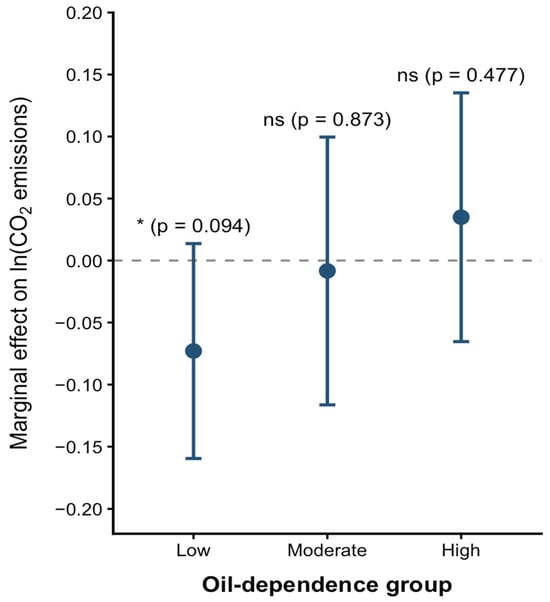
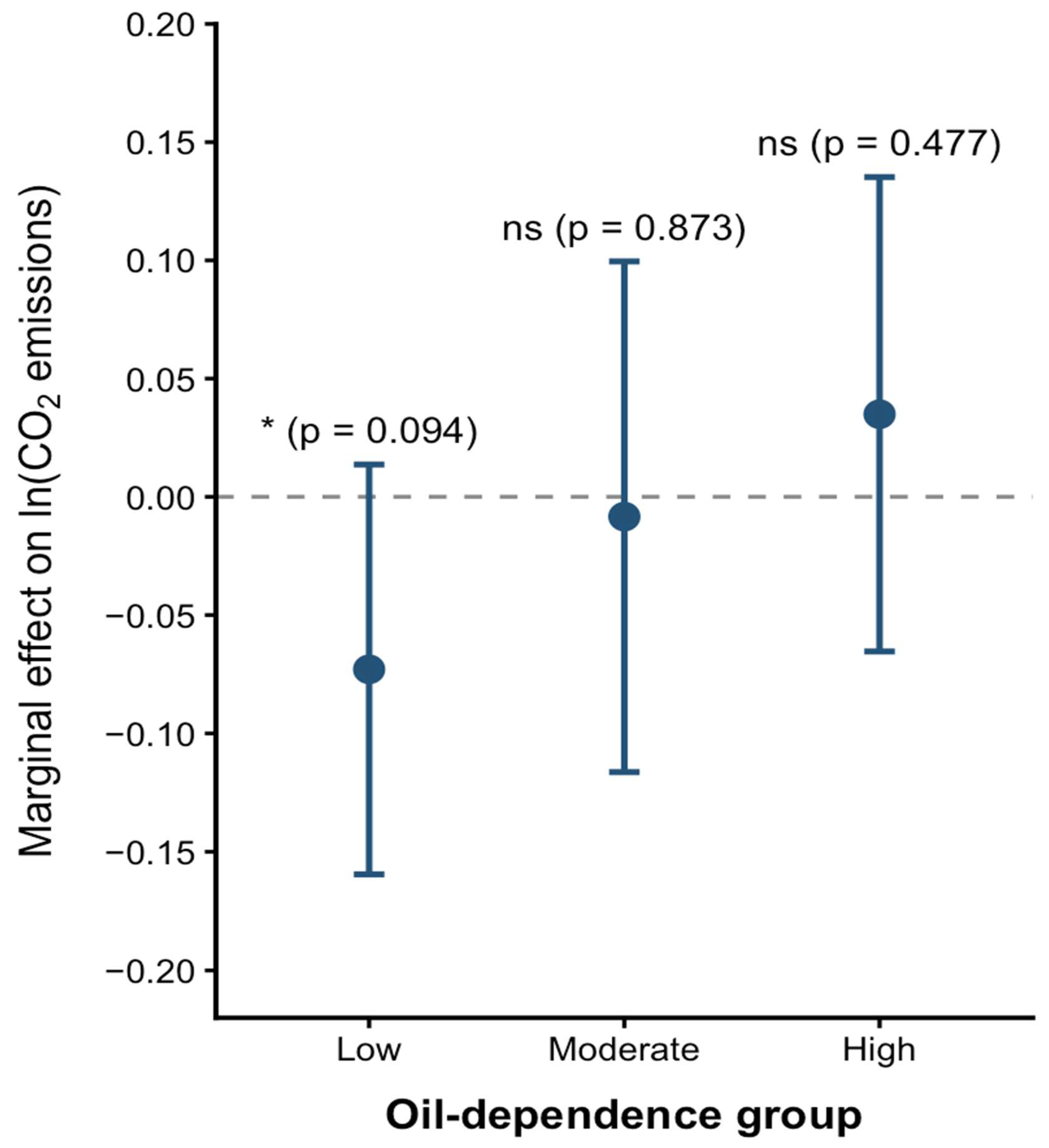
The Digitalization Index has a negative and marginally significant coefficient for the reference category of low oil-rent-dependent economies (β = −0.073, p < 0.10). The positive interaction terms for moderate (β = 0.065, p < 0.10) and high oil-rent dependence (β = 0.108, p < 0.05) indicate that the digitalization–emissions relationship differs across oil-dependence groups. Because these interaction coefficients represent differences relative to the low-oil reference category rather than the marginal association within each group, Figure 1 presents the corresponding marginal estimates and 95% confidence intervals.
Figure 1.
Marginal effects of digitalization on CO2 emissions across oil-rent dependence groups. Note: Points represent estimated marginal coefficients, and error bars indicate 95% confidence intervals based on two-way clustered standard errors. The dashed horizontal line indicates zero association. * denotes significance at the 10% level; ns indicates non significance.
The estimated marginal association is −0.073 in low oil-rent-dependent economies (95% CI: −0.160 to 0.014; p = 0.094), −0.008 in moderately oil-rent-dependent economies (95% CI: −0.116 to 0.100; p = 0.873), and 0.035 in highly oil-rent-dependent economies (95% CI: −0.065 to 0.135; p = 0.477). Although the negative association in the low-dependence group is statistically significant at the 10% level, its 95% confidence interval includes zero. The marginal associations for the moderate- and high-dependence groups are not statistically significant, and their confidence intervals encompass both negative and positive values. These findings indicate that the estimated digitalization–emissions relationship differs relative to the low-oil reference group, without establishing a statistically significant positive or negative association within the moderate- and high-dependence groups.
4.2. Robustness Analysis
Column (2) of Table 2 examines whether the estimated relationships persist when digitalization and the control variables are lagged by one period. Lagged digitalization is negatively and statistically significantly associated with emissions in low oil-rent-dependent economies (β = −0.105, p < 0.05). The interaction coefficients are positive for both moderate (β = 0.067, p < 0.10) and high oil-rent dependence (β = 0.112, p < 0.01), indicating statistically significant differences relative to the low-dependence reference group.
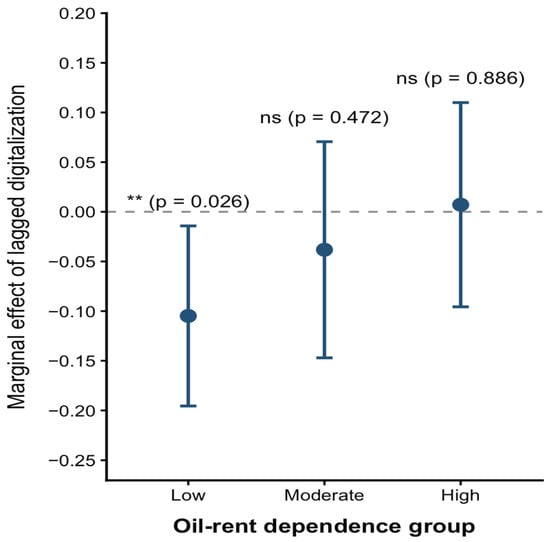
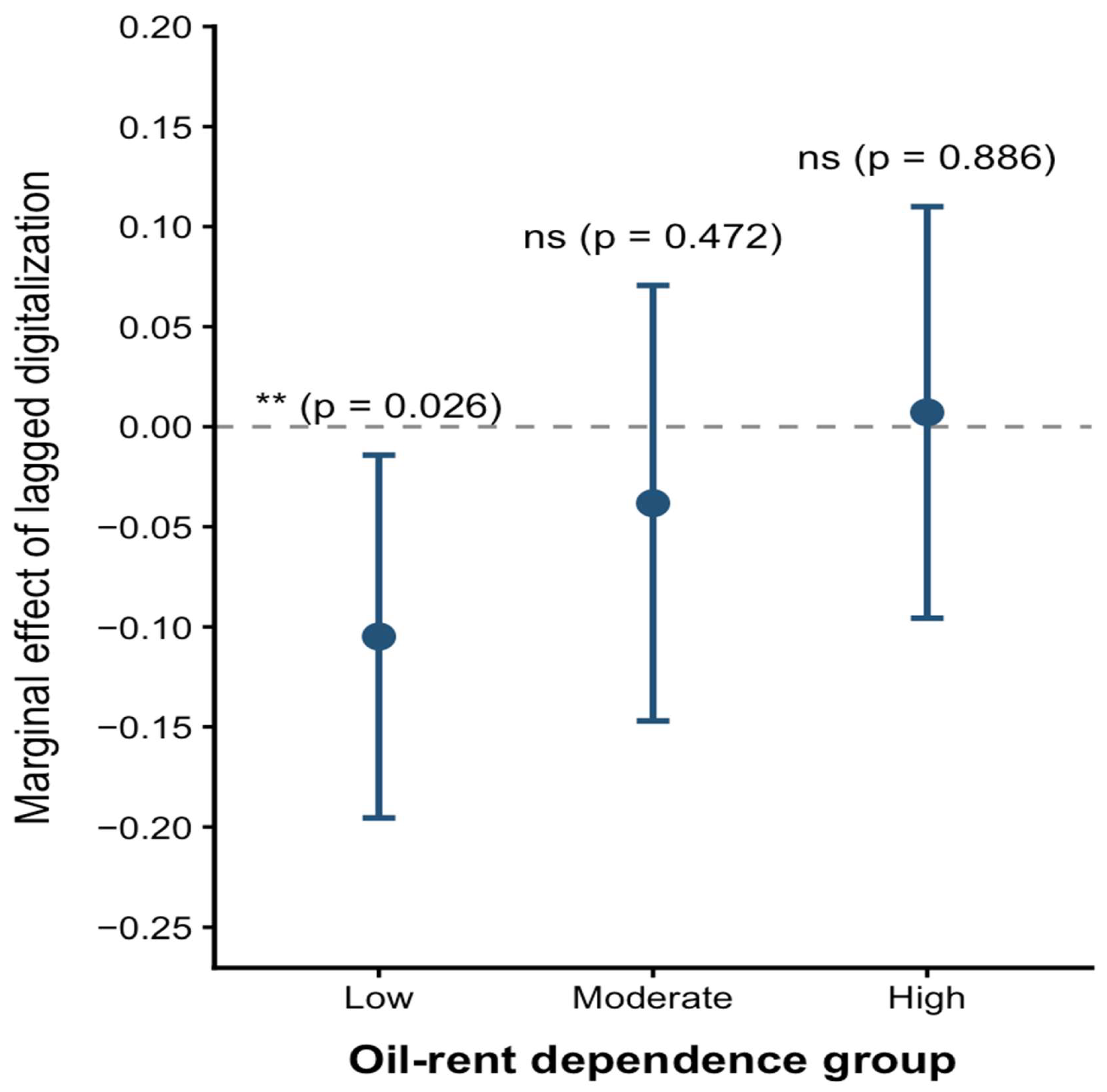
Figure 2 presents the corresponding marginal effects and 95% confidence intervals. The estimated association is negative and statistically significant in low oil-rent-dependent economies (β = −0.105, 95% CI: −0.196 to −0.014; p = 0.026). However, the marginal effects are not statistically significant in moderately (β = −0.038, 95% CI: −0.147 to 0.071; p = 0.472) or highly oil-rent-dependent economies (β = 0.007, 95% CI: −0.096 to 0.110; p = 0.886). Thus, the lagged specification supports heterogeneity in the digitalization–emissions relationship without establishing a statistically significant association within the moderate- and high-dependence groups.
Figure 2.
Marginal effects of lagged digitalization on CO2 emissions across oil-rent dependence groups. Note: Points represent estimated marginal coefficients, and error bars indicate 95% confidence intervals based on two-way clustered standard errors. The dashed horizontal line indicates zero association. ** denotes significance at the 5% level; ns indicates non significance.
Column (3) replaces the categorical oil-dependence groups with a standardized continuous measure of average oil rents. The interaction between digitalization and continuous oil dependence is positive and statistically significant (β = 0.031, p < 0.01). This provides additional evidence that the estimated digitalization–emissions relationship varies with oil-rent dependence and that the observed heterogeneity is not driven solely by the thresholds used to classify countries.
Column (4) examines the sensitivity of the results to the period used to classify countries by oil dependence. Countries are alternatively classified using average oil rents over 2000–2007, the earliest period providing coverage for all 133 countries. The early-period classification agrees with the full-period classification for 124 of 133 countries (93.2%). Under this alternative classification, the interaction between digitalization and high oil dependence remains positive and statistically significant (β = 0.091, p < 0.05), while the moderate-dependence interaction is not statistically significant (β = 0.025).
As an additional dynamic robustness check, we estimate a specification including one-period lagged CO2 emissions to account for the strong persistence of country-level emissions. The coefficient on lagged emissions is positive and highly significant (β = 0.869, p < 0.01). After accounting for emissions persistence, digitalization remains negatively associated with emissions in the low-dependence reference group (β = −0.022, p < 0.05), while the interactions remain positive for moderate (β = 0.014, p < 0.10) and high oil dependence (β = 0.031, p < 0.05). Because including a lagged dependent variable in a fixed-effects model can introduce dynamic panel bias, this specification is interpreted as a supplementary sensitivity analysis rather than a causal identification strategy.
Additional checks examine the sensitivity of the results to alternative inference and specification choices. Using Driscoll–Kraay standard errors, the interaction coefficients remain positive and statistically significant for moderate (β = 0.065, p < 0.01) and high oil dependence (β = 0.108, p < 0.01). The analysis also excludes eight countries with average oil rents exceeding 20% of GDP. In this restricted sample, the high-dependence interaction remains positive and statistically significant (β = 0.126, p < 0.05), while the moderate-dependence interaction is not statistically significant (β = 0.061).
The results are more sensitive to the inclusion of country-specific linear trends. When separate linear trends are allowed for each country, the interactions for moderate (β = 0.022, p = 0.657) and high oil dependence (β = 0.001, p = 0.981) are no longer statistically significant. This indicates that the estimated heterogeneity is sensitive to controlling for differential long-run country trends. Overall, the robustness analysis provides evidence of heterogeneity under alternative inference methods, lag specifications, oil-dependence measures, and sample restrictions, particularly for high oil-rent dependence. However, the loss of statistical significance under country-specific trends limits the strength of conclusions regarding the persistence of these differences.
4.3. Discussion of Findings
The empirical evidence indicates that the relationship between digitalization and carbon emissions varies systematically with economic structure. Across both the baseline and lagged specifications, digitalization is associated with lower carbon emissions only in economies with low structural dependence on oil rents. In contrast, this negative association weakens as oil dependence increases. From an economic perspective, one possible interpretation is the distinction between technological efficiency and structural transformation. Digital technologies may improve information processing, optimize production, reduce transaction costs, and enhance resource allocation across firms and industries. However, these efficiency gains operate within the existing production structure. In diversified economies, where production is less dependent on fossil-fuel extraction, improvements in digital capability may facilitate cleaner production processes, more efficient energy management, and the expansion of knowledge-intensive sectors. Consequently, productivity improvements may be more likely to be accompanied by lower carbon intensity.
The same relationship appears different in oil-dependent economies. Because a substantial share of national income and economic activity remains associated with fossil-fuel production and related industries, improvements in economy-wide digital connectivity do not necessarily alter the underlying composition of production. Greater digital connectivity may facilitate information flows, coordination, market access, and broader economic efficiency, but these benefits occur within the prevailing economic structure. Consequently, where that structure remains strongly dependent on oil, digitalization may coexist with continued carbon-intensive activity rather than generating measurable reductions in aggregate emissions. The results should therefore be interpreted as evidence that the environmental association of broad digital connectivity is conditioned by structural oil dependence, rather than as direct evidence about the environmental effects of specific technologies such as artificial intelligence, industrial automation, or advanced production systems.
Several mechanisms could potentially account for this observed heterogeneity, although the present analysis does not directly identify among them. Efficiency gains from digitalization may reduce resource requirements and improve energy management, while rebound effects may partly offset these gains if greater efficiency lowers production costs and increases output or energy demand. Sectoral composition may also matter because efficiency improvements within fossil-fuel-intensive activities need not produce the same aggregate emissions outcomes as improvements in less carbon-intensive sectors. In addition, fossil-fuel lock-in and political-economy characteristics associated with resource dependence may constrain the extent to which improvements in digital connectivity translate into structural decarbonization. These mechanisms provide plausible interpretations of the observed differences across oil-dependence groups, but they are not separately tested by the aggregate country-level models employed in this study.
The results also contribute to the growing literature examining the heterogeneous environmental effects of digital transformation. Previous studies generally conclude that digitalization improves environmental quality through technological innovation, industrial upgrading, and more efficient resource allocation. However, these benefits are rarely found to be universal. Evidence from China indicates that the environmental contribution of the digital economy is considerably weaker in resource-dependent regions than in more diversified economies, while recent cross-country evidence similarly identifies natural-resource dependence as an important source of heterogeneity in the digitalization–emissions relationship. Our findings extend this literature by showing that the relationship between digitalization and carbon emissions differs systematically across levels of structural oil dependence at the global level, suggesting that differences in economic structure may help explain why previous studies have reported mixed empirical results.
The stronger negative association observed in the lagged specification provides additional economic insight. Digital investments typically require complementary organizational changes, learning, and capital adjustment before productivity gains fully materialize. The significant lagged association in low oil-dependent economies is therefore consistent with, although it does not directly establish, the gradual diffusion of digital technologies and the delayed realization of efficiency improvements. In contrast, the absence of significant lagged associations in moderate and highly oil-dependent economies suggests that the relationship remains weak even when digitalization is measured with a one-period lag. These results are consistent with the possibility that digitalization and structural economic transformation are complementary processes, but the aggregate analysis does not establish this mechanism directly. More broadly, the findings suggest that the environmental association of digitalization depends on the economic structure within which digital connectivity develops, with stronger negative associations observed in economies that are less dependent on oil rents.
5. Conclusions and Policy Implications
Digitalization has become a central component of economic development and increasingly intersects with climate and energy policy. However, whether digital transformation is associated with lower carbon emissions may depend on the economic structures within which digital connectivity develops. Using a global panel of 133 countries covering 2000–2021, this study finds that digitalization is negatively associated with CO2 emissions in economies with low structural dependence on oil rents, although the baseline estimate is statistically weak. The relationship becomes less negative as structural oil dependence increases, with positive interaction coefficients for moderate and high oil dependence. The group-specific marginal effects for moderate- and high-oil economies are not statistically distinguishable from zero and therefore should not be interpreted as evidence that digitalization increases emissions in these economies.
The results contribute to the literature by identifying structural oil dependence as a potentially important conditioning factor in the digitalization–environment relationship. While previous studies report mixed evidence regarding whether digitalization is associated with lower or higher environmental pressures, the findings suggest that part of this heterogeneity may be related to differences in the economic structures within which digital connectivity expands. Greater digital connectivity does not necessarily imply a change in the composition of economic activity. Consequently, where economic activity remains strongly dependent on oil, improvements in digital connectivity may coexist with continued carbon-intensive production rather than being accompanied by measurable reductions in aggregate carbon emissions.
The policy implications should therefore be interpreted as conditional rather than causal. Digitalization should not be assumed to operate as a stand-alone instrument for reducing carbon emissions. The results suggest that its environmental association may depend partly on broader structural conditions, including the degree of reliance on oil rents. For economies pursuing both digital and low-carbon transitions, policies supporting digital connectivity may therefore be considered alongside broader strategies for economic diversification, renewable energy deployment, and technological upgrading. However, the present analysis does not establish that these complementary policies cause digitalization to reduce emissions. Rather, it indicates that the relationship between digitalization and emissions differs across economic structures and that these structural differences should be considered when evaluating the environmental implications of digital development.
Several limitations should be acknowledged. First, the Digitalization Index captures economy-wide ICT connectivity through internet use, mobile cellular subscriptions, and fixed broadband subscriptions rather than direct productive-sector adoption of technologies such as artificial intelligence, cloud computing, industrial robotics, or data-centre capacity. Second, the dependent variable is limited to CO2 emissions per capita and does not capture other greenhouse gases, consumption-based emissions, or carbon intensity. Third, oil rents as a share of GDP measure the macroeconomic importance of oil-resource rents rather than the physical carbon intensity of the energy system and may be influenced by oil prices and the GDP denominator. The time-invariant oil-dependence classification also does not capture within-country structural transitions or annual fluctuations in oil dependence.
The empirical results should be interpreted as conditional associations rather than causal effects. Although country and year fixed effects account for time-invariant country characteristics and common global shocks, reverse causality and unobserved time-varying factors may remain. The interaction estimates are also not statistically significant when country-specific linear trends are included, indicating sensitivity to differential long-run country trajectories. In addition, the aggregate country-level design does not directly identify the mechanisms underlying the observed heterogeneity. Future research using more detailed measures of digital adoption, emissions, and energy structure, together with stronger sources of exogenous variation, could examine these mechanisms and causal relationships more directly.
Author Contributions
Conceptualization, K.I. and M.M.; methodology, K.I.; software, K.I.; validation, K.I. and M.M.; formal analysis, K.I.; investigation, K.I.; resources, K.I.; data curation, M.M.; writing—original draft preparation, K.I.; writing—review and editing, K.I. and M.M.; visualization, M.M.; supervision, K.I.; project administration, K.I.; funding acquisition, M.M. All authors have read and agreed to the published version of the manuscript.
Funding
This research was funded by Taif University (TURSP-HC2026/15).
Data Availability Statement
The datasets used and analyzed during the current study are available from the corresponding author upon reasonable request.
Acknowledgments
The authors would like to acknowledge the Deanship of Graduate Studies and Scientific Research, Taif University, for funding this work.
Conflicts of Interest
The authors declare no conflicts of interest.
Abbreviations
The following abbreviations are used in this manuscript:
| CO2 | Carbon dioxide |
| PCA | Principal component analysis |
| GDP | Gross domestic product |
| FE | Fixed effects |
Appendix A
Table A1.
Definition and measurement of variables.
Table A2.
Principal Component Analysis (PCA) Results for the Digitalization Index.
Table A3.
Pairwise Correlation Matrix.
Table A4.
Variance Inflation Factors.
Table A5.
Additional Robustness Checks.
References
- Brynjolfsson, E.; Rock, D.; Syverson, C. The Productivity J-Curve: How Intangibles Complement General Purpose Technologies. Am. Econ. J. Macroecon. 2021, 13, 333–372. [Google Scholar] [CrossRef] [Scilit]
- Charfeddine, L.; Umlai, M. ICT Sector, Digitization and Environmental Sustainability: A Systematic Review of the Literature from 2000 to 2022. Renew. Sustain. Energy Rev. 2023, 184, 113482. [Google Scholar] [CrossRef] [Scilit]
- Romer, P.M. Endogenous Technological Change. J. Political Econ. 1990, 98, S71–S102. [Google Scholar] [CrossRef] [Scilit]
- Lee, J.W.; Brahmasrene, T. ICT, CO2 Emissions and Economic Growth: Evidence from a Panel of ASEAN. Glob. Econ. Rev. 2014, 43, 93–109. [Google Scholar] [CrossRef] [Scilit]
- Qayyum, M.; Zhang, Y.; Ali, M.; Kirikkaleli, D. Towards Environmental Sustainability: The Role of Information and Communication Technology and Institutional Quality on Ecological Footprint in MERCOSUR Nations. Environ. Technol. Innov. 2024, 34, 103523. [Google Scholar] [CrossRef] [Scilit]
- Salahuddin, M.; Alam, K. Information and Communication Technology, Electricity Consumption and Economic Growth in OECD Countries: A Panel Data Analysis. Int. J. Electr. Power Energy Syst. 2016, 76, 185–193. [Google Scholar] [CrossRef] [Scilit]
- Feroz, A.K.; Zo, H.; Chiravuri, A. Digital Transformation and Environmental Sustainability: A Review and Research Agenda. Sustainability 2021, 13, 1530. [Google Scholar] [CrossRef] [Scilit]
- Lange, S.; Pohl, J.; Santarius, T. Digitalization and Energy Consumption. Does ICT Reduce Energy Demand? Ecol. Econ. 2020, 176, 106760. [Google Scholar] [CrossRef] [Scilit]
- Bildirici, M.E.; Castanho, R.A.; Kayıkçı, F.; Genç, S.Y. ICT, Energy Intensity, and CO2 Emission Nexus. Energies 2022, 15, 4567. [Google Scholar] [CrossRef] [Scilit]
- He, H.; Xu, H.; Li, L.; Yang, X.; Fu, Q.; Yang, X.; Zhang, W.; Wang, D. Molecular Transformation of Dissolved Organic Matter and the Formation of Disinfection Byproducts in Full-Scale Surface Water Treatment Processes. Sci. Total Environ. 2022, 838, 156547. [Google Scholar] [CrossRef] [Scilit]
- Dehghan Shabani, Z.; Shafiei, M. How Does Digital Economy Affect the Relationship between Renewable Energy and CO2 Emissions? Energy Strategy Rev. 2026, 65, 102196. [Google Scholar] [CrossRef] [Scilit]
- Khan, R.Z.; Razak, L.A.; Premaratne, G. Green Growth and Sustainability: A Systematic Literature Review on Theories, Measures and Future Directions. Clean. Responsible Consum. 2025, 17, 100274. [Google Scholar] [CrossRef] [Scilit]
- Verhoef, P.C.; Broekhuizen, T.; Bart, Y.; Bhattacharya, A.; Qi Dong, J.; Fabian, N.; Haenlein, M. Digital Transformation: A Multidisciplinary Reflection and Research Agenda. J. Bus. Res. 2021, 122, 889–901. [Google Scholar] [CrossRef] [Scilit]
- Zhang, Y.; Khan, N.U.; Cai, H.H.; Tang, S.; Bousrih, J. Sowing the Seeds of Sustainability: Digitalization, Renewable Energy, and Carbon Emissions in Emerging Economies’ Global Value Chains. J. Environ. Manag. 2025, 393, 127119. [Google Scholar] [CrossRef] [Scilit]
- IEA. Energy Supply for AI—Energy and AI—Analysis. Available online: https://www.iea.org/reports/energy-and-ai/energy-supply-for-ai (accessed on 3 October 2026).
- Kontani, R.; Tanaka, K. Integrating Variable Renewable Energy and Diverse Flexibilities: Supplying Carbon-Free Energy from a Wind Turbine to a Data Center. Urban Clim. 2024, 54, 101843. [Google Scholar] [CrossRef] [Scilit]
- Jones, N. How to Stop Data Centres from Gobbling up the World’s Electricity. Nature 2018, 561, 163–166. [Google Scholar] [CrossRef] [Scilit]
- Luo, K.; Wang, Q.; Liang, C. The Way to Break the Resource Curse: New Evidence from China. Resour. Policy 2022, 79, 102971. [Google Scholar] [CrossRef] [Scilit]
- Naeem, M.A.; Appiah, M.; Taden, J.; Amoasi, R.; Gyamfi, B.A. Transitioning to Clean Energy: Assessing the Impact of Renewable Energy, Bio-Capacity and Access to Clean Fuel on Carbon Emissions in OECD Economies. Energy Econ. 2023, 127, 107091. [Google Scholar] [CrossRef] [Scilit]
- Adamu, S.; Yong, H.; Bello, A.; Yusuf, D.A.; Balaya, N.S.; Alhaji, M. Green Infrastructure—Urban Planning Nexus: Role, Discourse and Possibilities in Achieving Socio-Ecological Sustainability and Resilience. Cities 2026, 171, 106810. [Google Scholar] [CrossRef] [Scilit]
- Ha, L.T.; Hanh, P.T.N.; Hang, N.T.T.; Khanh, H.D.; Phuong, L.L.; Van Hop, H. Moderating Role of Knowledge-Sharing on the Nexus of Digital Business and Natural Resources. J. Knowl. Econ. 2024, 15, 408–434. [Google Scholar] [CrossRef] [Scilit]
- Meng, B.; Xue, K.; Han, M. Digitalization, Natural Resources Rents, and Financial Market Risk: Evidence from G7 Countries. Resour. Policy 2022, 79, 103074. [Google Scholar] [CrossRef] [Scilit]
- Szetela, B.; Majewska, A.; Jamroz, P.; Djalilov, B.; Salahodjaev, R. Renewable Energy and CO2 Emissions in Top Natural Resource Rents Depending Countries: The Role of Governance. Front. Energy Res. 2022, 10, 872941. [Google Scholar] [CrossRef] [Scilit]
- van der Ploeg, F. Natural Resources: Curse or Blessing? J. Econ. Lit. 2011, 49, 366–420. [Google Scholar] [CrossRef] [Scilit]
- Cullen, J. Measuring the Environmental Benefits of Wind-Generated Electricity. Am. Econ. J. Econ. Policy 2013, 5, 107–133. [Google Scholar] [CrossRef] [Scilit]
- Erdoğan, S.; Çakar, N.D.; Ulucak, R.; Danish; Kassouri, Y. The Role of Natural Resources Abundance and Dependence in Achieving Environmental Sustainability: Evidence from Resource-based Economies. Sustain. Dev. 2021, 29, 143–154. [Google Scholar] [CrossRef] [Scilit]
- Kahia, M.; Omri, A. Oil Rents and Environmental Sustainability: Do Green Technologies and Environmental Technological Innovation Matter? J. Open Innov. Technol. Mark. Complex. 2024, 10, 100366. [Google Scholar] [CrossRef] [Scilit]
- Yu, Y. Role of Natural Resources Rent on Economic Growth: Fresh Empirical Insight from Selected Developing Economies. Resour. Policy 2023, 81, 103326. [Google Scholar] [CrossRef] [Scilit]
- Ulucak, R.; Danish; Ozcan, B. Relationship between Energy Consumption and Environmental Sustainability in OECD Countries: The Role of Natural Resources Rents. Resour. Policy 2020, 69, 101803. [Google Scholar] [CrossRef] [Scilit]
- Achuo, E.D.; Miamo, C.W.; Kouhomou, C.Z. Resource Rents and Environmental Pollution in Developing Countries: Does the Quality of Institutions Matter? Rev. Dev. Econ. 2024, 28, 360–387. [Google Scholar] [CrossRef] [Scilit]
- Mahmood, H.; Furqan, M. Oil Rents and Greenhouse Gas Emissions: Spatial Analysis of Gulf Cooperation Council Countries. Environ. Dev. Sustain. Multidiscip. Approach Theory Pract. Sustain. Dev. 2021, 23, 6215–6233. [Google Scholar] [CrossRef] [Scilit]

Disclaimer/Publisher’s Note: The statements, opinions and data contained in all publications are solely those of the individual author(s) and contributor(s) and not of MDPI and/or the editor(s). MDPI and/or the editor(s) disclaim responsibility for any injury to people or property resulting from any ideas, methods, instructions or products referred to in the content. |
© 2026 by the authors. Licensee MDPI, Basel, Switzerland. This article is an open access article distributed under the terms and conditions of the Creative Commons Attribution (CC BY) license.