


Abstract
Conventional sensing expends energy at three stages: powering dedicated sensors, transmitting measurements, and executing computationally intensive inference. Wireless sensing re-purposes WiFi channel state information (CSI) inherent in every packet, eliminating extra sensors and uplink traffic, though reliance on deep neural networks (DNNs) often trained and run on graphics processing units (GPUs) can negate these gains. This review highlights two core energy efficiency levers in CSI-based wireless sensing. First ambient CSI harvesting cuts power use by an order of magnitude compared to radar and active Internet of Things (IoT) sensors. Second, integrated sensing and communication (ISAC) embeds sensing functionality into existing WiFi links, thereby reducing device count, battery waste, and carbon impact. We review conventional handcrafted and accuracy-first methods to set the stage for surveying green learning strategies and lightweight learning techniques, including compact hybrid neural architectures, pruning, knowledge distillation, quantisation, and semi-supervised training that preserve accuracy while reducing model size and memory footprint. We also discuss hardware co-design from low-power microcontrollers to edge application-specific integrated circuits (ASICs) and WiFi firmware extensions that align computation with platform constraints. Finally, we identify open challenges in domain-robust compression, multi-antenna calibration, energy-proportionate model scaling, and standardised joules per inference metrics. Our aim is a practical battery-friendly wireless sensing stack ready for smart home and 6G era deployments.
1. Introduction
1.1. Background
Wireless sensing has become a central direction in modern intelligent systems because it enables perception without relying on cameras or physical contact sensors [1,2]. As the demand for automation, remote monitoring, and context awareness increases, many applications require continuous information about human presence, activity, and environmental changes [1]. Conventional sensors such as cameras, infrared modules, and wearables achieve these goals but rely on visual access, close proximity, or continuous battery power, which limits coverage and raises privacy and legal concerns [3,4]. Wireless sensing overcomes these limitations by using existing radio signals to observe changes in the environment, allowing information to be extracted even through walls, smoke, or darkness [1,2]. This capability supports a wide range of services, including smart home management [5], healthcare monitoring [6,7], security and occupancy analytics [8,9], industrial automation [4,10], and vehicle safety [11,12].
Among different wireless modalities, WiFi sensing has emerged as one of the most practical solutions because it operates on existing network infrastructure and requires no additional sensors [1,2]. It relies on the channel state information (CSI) that devices compute for communication, which characterises how transmitted signals propagate through the environment. Variations in CSI reflect subtle motion or environmental changes, enabling accurate recognition of human activities, occupancy levels, and vital signs [6,13,14].
This reuse of communication signals also changes how energy is consumed in sensing systems. Traditional sensing uses power in three main stages. It energises dedicated sensors. It transmits their measurements to a processing unit. It performs computation to interpret the data [15]. When CSI is used for perception, these steps align with normal communication operations because the channel estimates that devices compute for data exchange already contain the information required for sensing [16,17,18]. As a result, the transmission link itself functions as the sensor, which avoids additional sensing hardware and data uploads. This property provides the central energy motivation for this review, and it emphasises the importance of data quality handling before learning [19]. Demonstrated applications include human activity recognition [13], occupancy detection [14], and vital sign tracking [6].
In this review, CSI is regarded as suitable for sensing when the motion-induced multipath structure remains visible after practical cleaning. Typical errors arise from automatic gain changes, carrier and sampling frequency offsets, timing skew, and sporadic outliers. Low-cost and well-grounded procedures stabilise amplitude and phase, yielding consistent subcarrier time tensors across devices [19]. Treating this cleaning step as a first-class component ensures that the learning model receives stable information [13]. This prepares the ground for integration with ordinary links so that energy savings at the front end are not lost during system design.
Integrated sensing and communication (ISAC) explains how CSI sensing can be harvested from ordinary traffic. IEEE 802.11bf specifies sensing procedures and data exchanges so that sensing can coexist with wireless local area network traffic [16,17]. As of 2025, an approved draft is available [20]. Prototype systems schedule sounding or training frames and reuse preambles while maintaining data link performance [18,21]. These mechanisms define a path to practice, and they lead directly to questions of platform access.
Access to CSI now extends beyond lab network interface cards. Low-cost microcontroller boards and single-board computers can expose packet-level CSI for embedded experiments and for energy-constrained deployments [22,23]. At the infrastructure end, tools for commercial WiFi 6 access points can export high-resolution CSI for research and prototyping [24]. This range of platforms enables the systematic study of accuracy, latency, and energy across microcontroller, single-board, and access-point-class devices. The presence of this span of hardware then shapes model design choices and evaluation practice.
1.2. Overview of Related Surveys on WiFi Sensing
Recent surveys and system papers collectively map WiFi CSI sensing across signal processing, learning, applications, and measurement access, revealing a common pipeline from collection and preprocessing to inference and evaluation [1,2,13]. These works also highlight persistent challenges such as domain shift across rooms and devices, limited labelled data, and inconsistent evaluation protocols that restrict cross-study comparability. On the methodological side, unified libraries such as SenseFi align datasets, data loaders, and training protocols to enable consistent comparisons across deep models, yet energy and latency are still rarely reported together with accuracy [25].
Model design trends increasingly favour lightweight backbones that balance representational power and computational cost. Compact convolution stems combined with attention or transformer blocks deliver efficient human activity recognition while reducing parameters and inference delay [26,27]. Signal studies continue to refine how raw channel estimates should be corrected to preserve motion-induced multipath structure across devices, ensuring that stable information reaches the learning model [19]. Reliable evaluation has also become essential, since non-disjoint data splits can inflate performance metrics; therefore, subject disjoint and layout disjoint splits with per-class metrics are now expected for claims of robustness or efficiency [28].
Parallel to these research efforts, standardisation in IEEE 802.11bf defines how sensing can coexist with normal WiFi operation. Prototype systems have demonstrated sensing harvested from ordinary traffic while maintaining communication throughput [16,17,18,21]. Energy has consequently become a practical comparison axis for edge and embedded deployments. Benchmarks such as MLPerf Power provide standardised measurements of power and latency across devices, and community initiatives such as the AI Energy Score propose model-level reporting metrics like joules per inference for common workloads [15,29]. Together, these efforts motivate lightweight model design, quantisation, pruning, and self- or semi-supervised learning as ways to lower the energy per decision without sacrificing accuracy. This review follows that perspective and organises methods and platforms so that readers can build energy-aware and reproducible WiFi sensing pipelines suitable for smart home and 6G era deployments.
Table 1 summarises representative surveys and system works, highlighting their main contributions and remaining limitations with respect to evaluation, energy reporting, and deployment practicality.
Table 1.
Representative works with contributions and limitations assessed from the content of each paper.
1.3. Motivation and Contribution
Conventional sensing consumes energy across three main stages: powering dedicated sensors, transmitting their measurements, and performing computation to interpret the data [15]. These repeated processes waste power that communication systems already spend on connectivity. WiFi CSI provides an energy-efficient alternative because each packet naturally contains channel estimates that can also serve for perception, removing the need for extra sensing hardware or uplink transmission [16,17,18]. True efficiency, however, depends on co-optimising sensing and computation so that model complexity and hardware capability remain balanced. Large deep networks or specialised radios can offset the savings from CSI reuse [15,30]. An effective design therefore harvests ambient CSI with minimal additional transmission, integrates sensing with communication, and applies lightweight learning matched to the device so that energy per decision remains proportional to task demand and hardware capacity [29,31].
- We explain where energy is spent in WiFi sensing systems and conduct a detailed survey in that regard, also discussing the strategies for making the system more energy-efficient.
- We present an energy-aware pipeline for off-the-shelf hardware that extracts and preprocesses ambient CSI for efficient inference and evaluation. It stabilises amplitude and phase while preserving motion-induced multipath, improving signal quality and maintaining low computational and energy cost on embedded devices.
- We review lightweight learning methods, including compact CNN and GRN designs, pruning, distillation, quantisation, and semi-supervised training, and we analyse their impact on accuracy, model size, memory use, and energy across microcontroller, single-board, and access-point devices.
- We highlight practices relevant to energy-efficient WiFi sensing, emphasising consistent reporting of energy per decision, balanced analysis of energy, latency, and accuracy trade-offs, and cross-device calibration to enable fair and reproducible comparison across hardware tiers.
1.4. Paper Organisation
The remainder of this paper is organised as follows. Section 2 introduces the principles of CSI acquisition and measurement standardisation within IEEE 802.11 systems, emphasising how these mechanisms influence sensing accuracy and energy usage. Section 3 establishes wireless CSI sensing as an energy efficient alternative to conventional sensors by reusing existing WiFi infrastructure and by highlighting the contribution of low power hardware. Section 4 reviews conventional artificial intelligence techniques applied to WiFi integrated sensing and communications, highlighting their methodological evolution and computational implications. Section 5 summarises the historical progression of CSI based model architectures across three research eras, tracing the transition from handcrafted pipelines to hybrid and transformer based networks together with their associated efficiency trends. Section 6 discusses open challenges and future research directions, covering the robustness of compressed models, the need for standardised energy benchmarks, adaptive inference mechanisms, and hardware and software co design under emerging IEEE 802.11bf frameworks. Finally, Section 7 concludes the paper by summarising key findings and outlining prospective research toward sustainable and green learning for CSI based WiFi sensing systems.
1.5. Materials and Methods
This review examines recent progress in energy-efficient wireless sensing, with a primary emphasis on methods based on WiFi Channel State Information (CSI). The relevant literature was gathered through systematic searches of major scholarly databases, including IEEE Xplore, the ACM Digital Library, and MDPI, focusing on peer-reviewed publications from 2019 to 2025. The chosen works were then analysed and synthesised to uncover major trends in sensing modalities, learning paradigms, hardware complexity, and energy-efficiency factors that are pertinent to environmentally sustainable wireless sensing.
Artificial intelligence (AI)-enabled tools were utilised during the preparation of this review. Their use was strictly limited to literature summarisation, wording refinement, and clarity enhancement. In particular, an AI tool was used to summarise author-written material in one comparative analysis Section 3 and to assist in condensing and polishing wording in a small number of paragraphs based on uploaded reference articles. Language support tools were also applied at later stages to improve grammar and readability. All technical concepts, analytical insights, manuscript structure and final conclusions were conceived and developed exclusively by the authors.
2. Principles of WiFi Sensing Systems
In this section, we introduce the basic principles and structure of WiFi sensing based on CSI. We discuss advantages and disadvantages, and provide a foundation for the reader to follow the subsequent sections on classical learning edge intelligent models and green learning.
2.1. Concept and Scope of WiFi Sensing with CSI
Wireless sensing [32] derives motion and presence information from variations in radio measurements rather than relying on separate physical sensors. In general, sensing approaches can be grouped into three categories. The first is active radar sensing [33], where a transmitter illuminates the scene and a receiver measures time, frequency, or angle structure to estimate range and motion. Millimetre-wave and ultrawideband radars provide fine range and micro-Doppler resolution [34], but they require dedicated transmit power and specialised front ends. The second category is backscatter and ambient reuse, where tags or passive objects modulate existing carriers, and readers detect these reflections [35,36,37]. Their performance depends on carrier stability, path-loss control, and the separation between the direct and reflected paths. The third and currently most widely promoted energy-efficient category is communication native sensing [9,18,38,39], where existing communication links are reused for perception. Instead of sending new probing signals, the transceivers treat their normal exchanges as a sensing opportunity, and the wireless channel itself acts as the sensor. In WiFi networks, this process is realised through CSI, which captures how transmitted signals are modified by multipath propagation, human motion, and noise.
As illustrated in Figure 1, a standard link estimates CSI for equalisation at the receiver. Historically, these estimates were used only to correct the signal and were then discarded, meaning that the sensing potential and the energy already spent on channel estimation were wasted. Modern WiFi sensing systems [1,13,25] instead retain and process the CSI to infer motion and presence, thereby reusing existing network operations without adding new radio power or hardware. Within the 802.11bf framework, CSI exchange and reporting occur inside ordinary communication frames, allowing perception to share the same transmission budget and reducing redundant energy consumption [16,17,20].
Figure 1.
Demonstration setup for WiFi CSI sensing. The WiFi access point transmits packets toward a receiver while the human subject interacts with the propagation field. The multipath reflections captured by the receiver are processed to extract CSI for sensing and activity recognition.
This reuse defines a natural bridge toward future ISAC systems, where the link simultaneously carries data and gathers environmental information. Such integration supports energy-aware designs in which channel estimation, equalisation, and inference are co-optimised so that every joule spent on transmission contributes to both communication and sensing. Embedded preprocessing and lightweight inference executed at the receiver or edge node further reduce uplink data transfer and processing energy [19,25,40,41].
In practical WiFi sensing, the transmitter emits pilots and data, the receiver estimates a complex channel matrix across subcarriers and antennas for each frame, and motion-induced variations in these estimates are analysed for perception. Converting the equalisation-oriented CSI into sensing-ready features enables diverse applications, including human activity recognition [13,26,42], occupancy detection [5,14], and vital sign monitoring [6,7]. Recent surveys further show that preprocessing quality, model design, and evaluation strategy jointly determine the trade-off between accuracy, latency, and energy efficiency [1,13,28].
The current literature rarely compares these three sensing families under a shared energy and deployment budget, which limits the strength of current green claims. Radar studies often optimise range resolution and robustness but do not normalise energy use against WiFi-based sensing or backscatter in the same environment. Backscatter work demonstrates impressive microwatt-level operation, yet is mostly limited to short-range or controlled settings and usually relies on bespoke tags and readers that are not directly comparable with commodity access points. Communication native CSI sensing is frequently presented as the most sustainable option because it reuses existing links, yet only a small number of works account for the extra traffic infrastructure power and embodied energy of the radio stack. As a result, there is still no consensus on which modality is preferable for a given accuracy target coverage requirement and lifetime constraint, and a systematic benchmark that fixes the scenario and reports accuracy together with energy and hardware cost remains an open need.
2.2. Signal Path and Measurement Chain
Early work in WiFi sensing relied on received signal strength for presence or coarse occupancy estimation. From 2023 onward, the community has shifted toward CSI as the primary measurement for WiFi sensing, as evidenced by recent surveys and benchmarks centred on CSI by standards work that formalises CSI reporting and by method papers focused on CSI quality, while RSSI studies increasingly analyse limitations [1,16,17,19,25,43,44].
CSI provides a complex channel estimate for every subcarrier and every antenna on each frame. A standard baseband relation for one pilot set is
where is the known pilot data, is the received signal after orthogonal frequency division multiplexing demodulation, is the frequency response across subcarriers and antennas, and is the additive noise. Human motion perturbs in amplitude and phase over time, so temporal sequences of CSI capture small-scale fading dynamics and Doppler-induced signatures that enable fine sensing [25,26,45]. Practical receivers introduce automatic gain updates, carrier and sampling offset, and slow phase wander that can mask scene changes if untreated. Modern preprocessing removes common phase terms, recentres and unwraps phase aligns packets in time, and normalises amplitude so that variations in H are attributed to the environment rather than hardware [19,46]. These steps yield sensing-ready inputs either as complex tensors over time or as features such as Doppler envelopes, subcarrier statistics, and learned embeddings [25,26,47].
Commodity devices already compute pilots and channel estimates during normal operation, and retaining these estimates enables sensing without extra radios while remaining compatible with deployed networks. Procedures in the 802.11bf standardise how devices request and share CSI for sensing inside ordinary exchanges, which reduces measurement overhead and supports efficient reuse of existing infrastructure [16,17,20]. Access to high-resolution measurements on commercial hardware further broadens experimental scope for building-scale studies [24].
2.3. Energy-Aware CSI Acquisition in 802.11 Systems
CSI can be obtained in two complementary ways that are both compatible with ordinary WiFi operation and differ in their energy behaviour. The first is passive harvesting, where the receiver records the channel estimates already produced during normal data exchange. The second is active acquisition, where the network schedules controlled sounding or training frames and appends measurement reports so that sensing coexists with communication. The IEEE 802.11bf amendment standardises both procedures through management messages, measurement exchanges, and coexistence rules, ensuring that sensing energy is shared with communication and not spent on additional probing [16,17,20]. Practical demonstrations confirm that commercial networks can schedule sensing while maintaining throughput and delay performance, meaning that joint operation can achieve stable perception without significant energy or quality of service penalties [18,39,48,49].
Passive harvesting is naturally energy-efficient because it introduces no additional radio transmissions. The receiver exports a complex channel per packet for each subcarrier and antenna with timestamps derived from background traffic. Since the sampling rate depends on the existing link load, the method consumes no extra transmission energy but requires efficient data handling to prevent wasted computation from irregular arrivals. Therefore, correct sensing aligns timestamps and sequence counters, compensates for missing frames, and groups consistent intervals within each analysis window [1,13]. The breadth of reported passive scenarios spans apartments, offices, and corridors, where direction agnostic gesture recognition is achieved with unmodified devices. These studies show that ambient traffic already provides sufficient diversity for low-power perception and motivate adaptive acquisition logic that balances sensing quality and compute energy [50,51].
Active acquisition achieves stronger calibration and predictable sampling by using scheduled sounding exchanges under 802.11bf. This regular timing improves measurement quality and reduces processing overhead because window boundaries and frame intervals are fixed. Although active sensing consumes modest control energy, the total cost remains bounded by the standard’s coexistence procedures, maintaining an efficient balance between radio and computation energy [16,17]. Access to high-resolution CSI on commercial WiFi 6 access points enables realistic building-scale experiments where energy, latency, and accuracy can be measured jointly on the same hardware used in deployment [24].
When direct CSI export is unavailable, networks can still support low-cost perception by using fine timing measurements or aggregated beam and rate feedback to infer distance and occupancy [5,38,52]. These options reuse link maintenance signals that are already computed in normal communication, further extending the principle of energy-efficient reuse that underpins ISAC.
2.4. Preprocessing and Sensing Representations
Preprocessing removes receiver and protocol imperfections and regularises CSI so models learn motion-induced multipath rather than hardware or scheduling effects. Restoring a physically consistent signal lowers data needs and enables compact models for edge devices [46,53]. Commodity receivers add automatic gain changes, carrier and sampling offsets, timing skew, and outliers. Closed form correction restores stable amplitude and unwrapped phase and yields tensors that reflect propagation structure [19]. Phase-focused pipelines further improve cross-domain generalisation across rooms, devices, and days [47,54]. Channel-aware augmentation, self-supervised objectives, and domain-robust transforms complement analytic correction when data are limited [55,56].
A single window of CSI can be encoded to balance information and cost. The direct view is a subcarrier by time tensor for convolutions and attention-style pooling [13,25]. Tokenisation lets models attend across time and across subcarriers with moderate parameters for embedded inference [26,41]. For rhythmic activities, time frequency maps with envelope guidance support energy-aware health monitoring, including heart rate estimation on commodity radios [6,7].
Very-low-cost pipelines use compact statistics per subcarrier or antenna group that fit classical learners and stream with fixed memory [13,25]. For the person-independent and environment-independent recognition phase, cleaned Doppler-style features with low rank correlations give stable discrimination on access-point-class devices [42]. When measurements must cross the backhaul, learned or analytic compression reduces bandwidth while keeping sensing fidelity, and recent work adds task-guided compression and efficient person-centric encoders [40,41]. We match representations to task duration and device limits and later report energy per decision for each family [1].
2.5. Key Design Dimensions for Energy-Efficient WiFi Sensing
The development of energy-efficient WiFi sensing requires coordinated design across several layers of the system. Decisions made in signal modelling, preprocessing, standard-compliant acquisition, and model selection each influence the overall energy, latency, and accuracy balance. Table 2 organises representative works into five core design dimensions. Together, they describe how sensing pipelines have evolved toward efficient reuse of existing radio functions, low-overhead signal calibration, and lightweight inference on embedded platforms.
Table 2.
Evidence map summarising recent research directions that contribute to energy-efficient WiFi sensing. Each reference appears once under its main design dimension for traceability.
3. Wireless Sensing as an Energy-Efficient Alternative to Conventional Sensors
Wireless sensing offers an energy-efficient alternative to conventional sensor networks by reusing existing communication infrastructure for environmental perception. Unlike traditional systems, such as PIR, radar, or LiDAR sensors, which rely on dedicated hardware and independent power sources, wireless sensing extracts information directly from communication signals, like WiFi channel state information. This dual use of transmitted energy eliminates the need for separate sensing transmissions and reduces overall power consumption. By integrating sensing and communication at both the hardware and network levels, the system minimises redundant circuitry, lowers operational and maintenance energy, and reduces the embodied energy associated with manufacturing and deployment. Consequently, wireless sensing not only simplifies infrastructure but also achieves comparable accuracy and coverage to conventional sensors, while delivering substantial lifecycle energy savings, positioning it as a sustainable and scalable alternative for smart infrastructure applications.
3.1. Lifecycle Energy and System-Level Impact
Lifecycle energy is the total energy attributable to a sensing solution over its entire life, including embodied energy from hardware manufacturing, deployment, routine operation, and maintenance. Wireless CSI sensing improves the lifecycle energy profile by riding on existing WiFi infrastructure, yielding cost-effective, non-invasive, and conveniently deployed perception without the need for separate sensor networks [57]. At the planning stage, realistic lifetime assessments must account for the protocol overhead, because technology choice and configuration materially shape device longevity and energy budgets [58]. Complementing this, RF energy harvesting offers a route to greener sensing and communication applications and longer device lifespans by converting ambient RF into usable power, while also mitigating the environmental burdens tied to conventional batteries [59].
Operationally, energy-harvesting IoT platforms must regulate inherently unstable harvester outputs with power management and storage, which in turn shapes how sensing, computing, and communications are co-designed for reliability at ultra-low power [60]. Because RF signals pervade modern environments, ambient RF harvesting can function as a renewable-like energy input for ultra-low-power sensing [59]. In smart buildings specifically, harvesting indoor RF signals alongside light and kinetic energy can reduce wiring and routine battery replacements, trimming both maintenance labour and the energy cost of truck-rolls at scale [60]. When ambient supply dips below demand, wireless energy-transfer tools can opportunistically top up nodes, extending network life without wholesale redeployment [61].
In practice, energy-harvesting IoT platforms must smooth the harvester’s unstable output with power management and storage, and those choices shape how sensing, computing, and communications are co-designed for reliable operation at ultra-low power [4]. Data-centric strategies such as aggregation, compression, and prediction reduce transmissions, and when paired with CSI sensing that reuses the network fabric, they lower the joules per sensing event across the whole lifecycle [61].
3.2. Eliminating Redundant Sensor Infrastructure
Wireless sensing can increasingly replace many conventional sensors because it can convert routine communication signals into environmental sensors. Recent work and standards efforts (e.g., IEEE 802.11bf) explicitly co-design WiFi for ISAC, enabling commodity devices to expose sensing alongside communication [21,62,63]. In practice, this means one network can deliver both high-rate data and device-free sensing that reduces hardware, power, and spectrum duplication [16,21,63,64]. As 5G and 6G move toward perceptive networks, operators can allocate resources to meet both communication QoS and sensing QoS, further curbing redundant deployments of hardware devices [16,21,65].
Eliminating redundant sensing infrastructure is especially compelling where WiFi and 5G are already omnipresent. Instead of deploying separate PIRs, beam sensors, or cameras, the network itself can recognise gestures, detect presence, or even image through walls by analysing CSI data [66,67,68,69]. Additionally, CSI data often offers stronger privacy advantages over video. Practical systems show that off-the-shelf WiFi can support device-free tasks without adding specialised sensing hardware, such as whole-home gesture recognition, occupancy counting with ambient traffic, and outdoor surveillance [18,21,67,69,70]. Sencom further demonstrates how to calibrate CSI, resample uneven traffic, and incentivise packets so sensing can run continuously with negligible impact on user throughput or latency [18]. Therefore, integrating sensing into the current communication infrastructure can avoid the need for parallel sensor networks, thereby reducing extra power consumption.
However, replacing conventional sensors is not plug-and-play, as several technical and operational challenges remain [49,63,71]. Generalisation is hard, where CSI-based sensing can be sensitive to environment, domain, and user orientation, so models may degrade across rooms, layouts, or angles unless designed for domain invariance and direction-agnostic operation [69,72,73,74]. Outdoor deployments reduce the sensing accuracy as they have a weaker multipath. For indoor scenarios, multi-user interference and near–far effects will complicate robust recognition [67,69]. Systemically, resource trade-offs between sensing and communications must be managed, and multi-static IoT topologies can hinder precise ranging unless architectures are rethought [16,49]. Finally, energy efficiency, security, and privacy must be engineered end-to-end as wireless sensing scales across cell-free, private, and heterogeneous networks [16,50,65,75].
3.3. Low-Power Wireless Sensing Hardware
Low-power wireless sensing hardware is the practical bridge that makes wireless sensing a genuinely energy-efficient alternative to conventional sensors. Instead of powering dedicated emitters and heavy backhaul, systems reuse existing WiFi signal and extract channel features at the edge on MCU-class devices, keeping compute, memory, and airtime to a minimum. Multiple hardware choices drive down both radiated and circuit power, including ESP microcontrollers, backscatter, low-resolution converters, and duty-cycled converters. In practice, piggybacking on routine traffic, batching I/O, and triggering higher-cost processing only on events further cut on-air time and idle draw. System-wide, this reduces embodied energy, installation and maintenance effort, and long-term storage overheads. This yields scalable, privacy-friendly perception by reflecting and reusing existing signals rather than generating and streaming new ones.
3.3.1. Transmit Power and Rate
In CSI-based WiFi sensing, the primary driver of energy consumption is time on air, which depends on both transmit power and transmit rate. Every injected probe or training frame keeps the power amplifier on, so throttling packet injection and co-scheduling with ordinary traffic is essential to avoid wasted transmit energy [58,76,77]. In contrast, mmWave radar gesture systems use dedicated transmitters and larger apertures, and reported accuracy rises as sensing hardware and radiated power increase, which ties performance more tightly to transmit power rather than opportunistic WiFi sensing [78]. Transmit rate also matters because packets per second and bits per second both create MAC and PHY overhead and extend radio awake time. For a fixed average data rate , batching into fewer and larger frames, together with aggregation, reduces per-bit energy relative to many small frames. Choosing PHY modes that shorten airtime, for example, a suitable modulation scheme and a wider channel such as HT40 rather than HT20, allows designers to meet CSI quality with fewer packets in the air [37,61,79].
Additionally, programmable backscatter synthesises standard waveforms by reflecting existing carriers, which eliminates the tag side power amplifier and delivers orders of magnitude lower radio energy than comparable active transmitters across various active radios [80]. Unified backscatter abstractions demonstrate microwatt-class operation at about 48 to 371 μW in ASIC estimates while retaining flexibility, and analogue WiFi backscatter prototypes sustain continuous sensing near 30 μW under commodity illumination [80,81]. Measurement-driven platforms also demonstrate end-to-end designs that operate at tens of microwatts, even at hundreds of kbps, indicating that useful sensing and telemetry rates do not require battery-draining active transmissions. When high sample rates are unavoidable, the rate to energy slope remains well below that of active radios [80,82].
Putting this together, an energy-aware WiFi sensing system should default to piggybacked CSI and minimal probing to curb transmit power, aggregate frames to lower per-bit overhead at a given , choose PHY settings that reduce airtime, and adopt backscatter where feasible to replace active transmissions for device-free tasks at a small fraction of the energy per sensing event [37,58,76,80,81,82].
3.3.2. ESP32 Microcontroller
The ESP32 is a practical low-power edge platform for wireless sensing. As a single, inexpensive microcontroller, it runs device-free sensing without bolting on PCs or NIC rigs [79]. It supports both station and access-point modes, so the same chip that handles WiFi can capture CSI in real time, which simplifies deployment and keeps power budgets lean [79]. It can also process CSI on device and operate fully standalone, avoiding the energy and maintenance overheads in comparison to conventional sensors that rely on separate compute, storage, or illumination [79].
Compared with legacy CSI toolchains (e.g., Intel 5300/Atheros) that require tethered computers and complex calibration, the ESP32 can reduce cost and complexity while preserving the CSI fidelity needed for gesture recognition, localisation, and similar sensing tasks [79]. With fine-grained sleep modes and integrated RF peripherals, it reuses existing WiFi illumination, extracts features locally, and transmits only what matters, delivering energy-efficient sensing in a compact, standalone device [79].
3.3.3. Backscatter Tag
Backscatter stands out because it senses by modulating and reflecting existing RF waves rather than generating its own carrier, so tags can run on microwatt budgets while riding on commodity infrastructure, a greener path than active radios, radars, or camera systems that must power emitters and heavy processing pipelines [37,83]. By leveraging ambient transmissions, it delivers sensing at a fraction of the energy of active wireless links, which lowers maintenance and enables simpler, denser deployments than traditional sensor devices [37,83].
Recent hardware results make this concrete. RF-Transformer unifies a wide class of backscatter protocols and reports to times lower power than comparable active-radio designs while remaining interoperable, showing that practical backscatter can meet real workloads without active RF chains [80]. Na et al. [81] demonstrate analogue WiFi backscatter tags that consume about 30 μW while sampling at 400 Hz, perturbing CSI in a payload-transparent way so existing WiFi receivers can decode the signal, thereby avoiding the transmit and encode cost. On the receiver side, Zhang et al. [82] remove power-hungry ADCs with analogue correlation and achieve a tens-of-microwatt backscatter receiver with 73 times lower power and times higher throughput than prior art. Jiao et al. [84] pushes this further for vital sign sensing, reporting 313.5 μW operation while eliminating ADC and DAC blocks, levels that conventional emit-and-sense designs struggle to reach.
At the application layer, backscatter has matured from lab demos to robust sensing in real environments. Simple frequency-shift tags built from an antenna and a switch deliver ultra-low-power operation and have reached F-score for seven daily activities, providing fine-grained sensing without the energy and privacy burdens of cameras or the emitter costs of active radar [37]. In settings where batteries are problematic, battery-free backscatter sensors have been shown in the wild. For example, a roughly 20 μW leaf-health tag encodes Morse-style symbols from harvested energy, highlighting lifetime and sustainability advantages over battery-powered nodes [85]. Beyond ambient monitoring, near-field backscatter enables sensitive industrial integrity checks with non-invasive, low-power hardware, a niche where traditional sensors often need bespoke probes or high transmit power [86].
Taken together, by eliminating carrier generation and reusing RF already in the environment, backscatter delivers practical, low-maintenance sensing at microwatt scales. These properties make it a compelling and energy-efficient alternative to conventional sensor deployments.
3.3.4. Comparative Analysis: Active CSI vs. Passive Backscatter
To provide a comprehensive view of green sensing, it is necessary to contrast the energy profiles and application scopes of active CSI-based sensing against passive backscatter systems. While both strategies reduce energy compared to dedicated radar hardware, they occupy distinct tiers of power consumption and operational utility.
Active CSI sensing relies on powered WiFi radios (NICs or ESP32-class MCUs) that typically operate in the milliwatt-to-watt range, driven by the power amplifiers and baseband processing required to transmit and decode OFDM packets [58,79]. In contrast, backscatter tags operate in the microwatt regime (often <50 μW) by decoupling signal generation from the sensing node [80,84]. This makes backscatter orders of magnitude more energy-efficient at the endpoint, enabling battery-free operation that active CSI nodes cannot achieve.
CSI sensing is predominantly device-free, enabling coverage of large areas for occupancy and gesture detection without requiring users to wear tags. However, this comes at the cost of higher infrastructure energy and sensitivity to multipath complexity [72]. Backscatter is typically device-based or limited to short-range near-field interactions. While it offers superior energy efficiency, its dependence on an external carrier and limited range restrict its use in large-scale volumetric surveillance compared to CSI. Consequently, the “green” choice depends on the use case: active CSI is the energy-efficient alternative for infrastructure-wide monitoring, whereas backscatter is the sustainable choice for granular, item-level, or on-body sensing where battery maintenance is prohibitive.
Table 3 provides a quantitative synthesis of hardware energy profiles, contrasting active and passive wireless sensing paradigms in terms of power consumption, sensing range, and practical limitations.
Table 3.
Quantitative synthesis of hardware energy profiles: active vs. passive sensing.
3.4. PHY-MAC Co-Design
3.4.1. Beamforming and Waveform Design
At the physical layer, joint beamforming–waveform design concentrates power only where it advances both link reliability and sensing quality. In practical systems, sensing rides on ordinary data traffic, avoiding extra probe frames and prolonged baseband activity [18,39,64]. On the hardware side, hybrid or sparse RF chains and low-resolution converters reduce circuit power while preserving usable beam patterns [30,87,88]. Learning-based beamforming adapts to V2X dynamics so energy is spent only where it lifts both SINR and target observability [89]. Collaborative mmWave ISAC allows neighbouring APs to share beam pattern duties, cutting the number of simultaneously active RF chains for a fixed joint utility [90].
Evidence shows that joint waveform–beamforming uses fewer joules per sensing estimate than designs that separate sensing and communication [30,91]. In V2X, learning-based beams sustain tracking under blockage and Doppler with fewer probes and a lower PA duty cycle [89]. Collaborative mmWave ISAC lowers the number of concurrently active RF chains while meeting coverage and rate targets, particularly in dense networks with path blocking [90]. Integrating passive bistatic sensing into existing mmWave carriers reuses illumination and reduces bespoke radar transmissions, and it achieves coherent processing under shared hardware at lower power for a fixed accuracy [92]. Prototypes further show that adding sensing objectives to the communication waveform obviates extra baseband passes, and WiFi SenCom confirms that traffic piggybacking is practical [18,64]. At the MAC layer, combining NOMA with sensing-aware scheduling and channel sharing shortens on-air time and reduces amplifier and converter energy [10,93].
Commodity hardware introduces CFO/SFO, AGC dynamics, quantisation, and precoder-induced CSI drift; without explicit handling, retries and heavy calibration erode energy savings [18,68]. Security and covertness constraints can draw energy away from sensing main lobes unless treated in robust energy-efficient formulations [65,94,95]. Full-duplex designs must budget analogue/digital cancellation and adaptation overheads [94,96]. RIS/IRS system imposes losses, phase noise, element quantisation, and control overheads that can negate energy gains if unmodeled [87,97]. LEO-satellite ISAC faces fast channels and quantised payloads, so RSMA/beam designs trade converter power against robustness to preserve energy-efficient benefits [88]. UAV ISAC must include flight energy and beam-management overheads so manoeuvres do not cost more than they save [11]. Overall, the largest gains arise when optimisation counts both transmit and circuit power, and respects practical hardware limits [30,87,91].
3.4.2. Spectrum Scheduling and Reuse for Green Sensing
As we mentioned above, wireless sensing is energy-efficient because it reuses the same OFDM subcarriers and bands that already carry data, so one waveform serves two jobs rather than two waveforms serving two jobs [16,63]. In WiFi, the 802.11bf direction formalises how pilots, training fields, and CSI reporting are structured for sensing without sacrificing data throughput, which prevents duplicate spectrum and power budgets that conventional sensors would require [16,70]. In private 5G or 6G networks, operators can dedicate part of the bandwidth to sensing QoS alongside communication QoS, while reserving the rest for payload traffic. Accurate sensing can still be achieved even with wide-band configurations, particularly when waveform design and RIS are optimised to direct power only where it is needed [49,64,73,98,99]. Energy-efficient RF chain designs, such as hybrid beamforming, low-resolution converters, and selective chain activation, further reduce power consumption across the allocated spectrum. Meanwhile, full-duplex ISAC demonstrates how frequency and power allocation can be jointly optimised to enhance energy efficiency while meeting both secrecy and sensing requirements [87,94].
Compared with conventional sensors that add extra radios, bands, and backhaul, wireless sensing can be deployed on existing infrastructure. SenCom and ISACoT showed that a practical system can leverage regular communication traffic to extract CSI and schedule only minimal extra probing, eliminating the need for continuous carrier sensing to manage RF duty cycles and circuit power [18,39]. In applications such as ambient traffic counting, whole-home gesture recognition, and through-wall imaging, all operations rely on existing communication channels, removing the need to allocate an additional frequency band. Moreover, passive bistatic sensing advances this concept by exploiting real-time network reference signals instead of transmitting active radar pulses [62,75,92,100]. Comparable energy savings have been observed in outdoor monitoring experiments and cell-free ISAC analyses, where dividing bandwidth among access points and reusing it for both sensing and communication enables the network to achieve sensing objectives with significantly lower total energy than that needed for separate, sensor-only deployments [69,74].
Several factors determine how effectively frequency spectrum reuse can be implemented. Frequency-selective fading, residual CFO, and coexistence constraints can distort Doppler or range estimates if the allocated band is too narrow or poorly coordinated. Therefore, standards and implementations must carefully allocate guard tones and manage synchronisation to maintain sensing accuracy [68,72]. Generalisation also matters, where direction-agnostic and environment-invariant models reduce per-site recalibration and its hidden energy costs, while secure-by-design ISAC mitigates the privacy and adversarial risks that come with shared spectrum sensing.
3.5. Practical Benefits and Deployment of Wireless Sensing
WiFi sensing’s biggest practical advantage is that it makes deployments cost-effective, non-intrusive, and quick to roll out when compared with installing separate networks of PIRs, cameras, or LiDARs [57]. At the standards level, 802.11bf formalises how commodity WiFi exposes sensing primitives alongside data, which eases real-world integration and allows one network to handle both roles [16].
From a “does it work at scale” perspective, over-the-air prototypes show that a single OFDM multi-user MIMO waveform can deliver both communications and sensing with a graceful trade off, which validates ISAC as a path that is efficient in hardware, power, spectrum, and cost [64]. Concretely, the testbed realises joint functions on the same time, frequency, and spatial resources, achieves bit error rates comparable to pure communications while maintaining usable sensing beam patterns, and even demonstrates an indoor people detection scenario with a 4 dB decision gap, which is strong evidence that one installed system can replace two separate ones [64].
Backscatter offers a complementary option for ultra-low-power endpoints. Tags reflect and modulate existing RF rather than generating it, which enables microwatt, battery-free sensing and telemetry on the same RF fabric that already carries data [83]. In practice, interference and instability in ambient sources are the main hurdles, yet the literature outlines viable mitigations. For example, frequency shifting tags, multicarrier reflection, and receiver designs that suppress a strong illuminator, so backscatter can be layered into WiFi and IoT deployments without heavy new infrastructure [83].
Operationally, lifetime and energy outcomes are driven by protocol choices and airtime—for example, aggregation, duty cycling, and retransmissions—so WiFi sensing that rides existing traffic and minimises extra frames has a clear path to longer device lifetimes and lower site energy [58]. On the hardware side, green RF chain design, including hybrid beamforming, low-resolution converters, and selective chain activation, targets the most power-hungry blocks, which makes ISAC deployments more energy-efficient without adding boxes in the field [87]. Looking ahead to city-scale rollouts, secure-by-design ISAC architectures for 6G describe unified IoT stacks that run from hardware to orchestration to apps, so operators can schedule spectrum and energy together for communications and sensing, which is important for sustainable, large footprint deployments [65].
Table 4 summarises key strategies for green wireless sensing system design, linking architectural, algorithmic, and system-level considerations.
Table 4.
Summary of key strategies in green design for wireless sensing system.
4. Conventional AI for WiFi Sensing
In this section, we examine designs that are judged by recognition or sensing performance without explicit accounting for power usage or device constraints. In the early phase of wireless sensing research, this focus was standard because software studies pursued accuracy gains while treating computation as abundant. Early pipelines relied on classical non-neural AI with simple temporal smoothing. These models take fixed-length handcrafted CSI features, train quickly on a CPU, and make ablation across preprocessing and split choices straightforward while delivering stable testing accuracy. As datasets and tasks grew in scope, these methods reached their performance limits, and work shifted toward deep networks. The transition improved accuracy and generalisation, yet it increased power use and inference time as GPU-class computation became common. Reinforcement learning and model-based controllers then entered ISAC to optimise spectral or training policies with performance as the primary goal. This section traces the first performance trajectory for WiFi sensing and ISAC and prepares the ground for later sections where energy and device limits are treated explicitly.
4.1. Scope and Positioning
This section treats conventional artificial intelligence as every learning paradigm applied to CSI and to integrated sensing and communication [25,102]. The scope includes supervised learning, unsupervised learning, reinforcement learning, and classical non-neural models [102,103]. We study the field from a technology performance viewpoint while recording latency and energy when reported; otherwise, we infer qualitative costs from model size, depth, and runtime statements [15,29,104]. The system context is integrated sensing and communication, where ongoing data traffic and the CSI estimated during normal exchanges are reused for sensing. When needed, controlled ping traffic is scheduled between a transmitter and a receiver or toward an access point with a passive sniffer to maintain a stable packet rate for repeatable evaluation [16,17,18,39,72,79,105]. Such reuse avoids duplicate waveforms, extra airtime, and extra hardware, which improves energy efficiency and preserves compatibility with deployed networks [10,30]. IEEE 802.11bf defines sensing exchanges and measurement points that can be scheduled alongside ongoing links [16,17,20,106], and field prototypes confirm practicality on commodity WiFi [9,18]. In the analysis that follows, accuracy, latency, and energy are treated as coequal goals. For each method, we report accuracy on subject and layout disjoint splits, and we state latency on the reported hardware tier. When authors provide power or energy per inference, we record those values, and when they do not, we explain the likely cost based on structural complexity and stated runtime [15,25,28,29,32]. Hardware co-design and device-specific tuning are outside the scope, and multi-sensor pipelines that exclude WiFi or combine with radar only are also outside the scope.
4.2. Conceptual Evaluation and Computational Implications
Conventional artificial intelligence for WiFi sensing and ISAC was first designed and assessed for software performance. Studies typically did not target energy efficiency or device feasibility. The guiding idea in this period was to raise recognition, reliability, and domain robustness. Deeper or more recurrent structures were selected for accuracy and stability rather than power economy. Supervised classifiers expanded feature spaces and reinforcement learners managed spectrum or training policies, which all required recurrent layer selection, increasing the computational demand. The resulting energy pattern across years follows a clear arc. Early statistical models ran comfortably on desktop or access-point-class devices with short runtimes. Later convolutional and attention-based networks required GPU-class processing and longer inference. In the review that follows, each algorithm family is discussed in terms of its core concept, the reasons for its performance gains, and the implied costs in terms of computation and latency. At the end of each era, we will have a comparison of resource usage in each model approach. This narrative approach enables fair comparison across papers and prepares the transition to later sections that introduce energy-aware and edge-constrained design.
4.3. Historical Arc of Methods
Early WiFi sensing relied on received signal strength (RSSI) because it was available on nearly all chipsets and easy to interpret. When a person or object crossed the link, the RSSI dropped, so strength variations could be used to detect events or infer location [43,44,107,108,109,110]. However, researchers soon observed that RSSI is dominated by the line of sight component, making small changes in motion or activity hard to distinguish. This limitation caused the technology to behave more like a trip wire detector rather than a fine-grained motion sensor. The need for richer spatial information and better efficiency motivated the shift to CSI, which provides subcarrier-level structure that reveals how each frequency component propagates through the environment [105,111,112].
From 2013 to 2019, studies adopted classical handcrafted features and shallow artificial intelligence models such as Support Vector Machines (SVMs), K Nearest Neighbours (KNN), and decision trees [1,13,47,79,102]. These early designs offered low computational cost and therefore low power consumption, achieving strong indoor accuracy on CPUs or access-point-class processors. Yet their limited generalisability across rooms and users meant frequent retraining, which indirectly increased total energy usage over deployment lifetimes. As datasets expanded and environments diversified, handcrafted features failed to adapt to the wider signal variation, prompting the search for models that could maintain accuracy without manual tuning [13,32,42,102].
Between 2020 and 2022, deeper neural networks and hybrid designs began to fuse amplitude and phase information, improve phase sanitisation, and introduce compact temporal models [13,14,28,47,54]. These architectures improved robustness and accuracy but raised inference energy because convolutional and recurrent layers required longer processing and often GPU-level resources. The energy consumption per inference increased sharply, while the overall energy efficiency factor (EEF) declined as larger models delivered higher accuracy but demanded more computation and runtime power.
From 2023 onward, the community responded to this imbalance by seeking lightweight alternatives that maintained accuracy under tighter energy budgets. Larger datasets and more rigorous splits drove the exploration of transformer variants and self-supervised pretraining to improve generalisation while introducing compression and quantisation to control model size [25,26,41,56,113,114]. Tutorials and augmentation studies have also emphasised label efficiency and compact design [53,103,115]. This ongoing trend marks the beginning of an energy-aware phase in WiFi sensing, where accuracy, latency, and energy efficiency are now treated as coequal metrics.
4.4. Energy Consumption and Efficiency Perspectives
The historical development of WiFi sensing reveals a clear progression from computational simplicity to high performance and finally toward energy awareness. Each generation of models reshaped how energy was spent across the sensing pipeline. Early RSSI and handcrafted CSI methods consumed minimal computation energy but required repeated data collection and retraining for new layouts, which limited scalability. Deep networks introduced higher recognition accuracy but sharply increased instantaneous power draw and total energy per inference as GPU-class computation became standard. These shifts highlight that accuracy gains alone cannot guarantee practical sustainability when models operate continuously or on edge devices.
Recent studies address this issue by analysing the balance between accuracy, latency, and energy efficiency under real hardware conditions [15,29,104]. Lightweight models, quantisation, pruning, and edge-level deployment strategies now aim to reduce energy per task while preserving performance. This balance defines the modern EEF perspective, where progress in WiFi sensing is judged not only by accuracy or latency but by the energy required to reach a reliable decision. Viewing model evolution through this lens connects early algorithmic trends to current green learning objectives and provides the basis for the energy-aware analysis in the following sections.
4.4.1. Pre 2020 WiFi Sensing Research with Handcrafted Features and Shallow Classifiers
This period sits before the broad adoption of deep neural networks and is characterised by pipelines that apply statistical or deterministic feature extractors followed by a light classifier. The families are separated mainly by how they transform raw link measurements into physically meaningful descriptors, rather than by the choice of classifier, which is largely interchangeable across families. In practice, the final decision stage uses small models such as SVM, KNN, decision trees, HMM, or simple Bayesian and Kalman updates, while the main computation lies in the chosen transform, for example, streaming moments, short FFT or DWT sliding correlation, or compact eigen updates. Energy use is set first by radio listening during packet capture and second by short-window preprocessing with latency tied to the analysis window plus a brief decision step. Although a few late papers began to test learned features, the mainstream practice in this period remained handcrafted features with shallow decoders. The section that follows adopts this feature-centred view, so comparisons across families read as differences in preprocessing cost and robustness under a shared light decision layer.
Statistical and Probabilistic Models
This passage focuses on pre-deep learning methods that begin with RSSI and progress to early CSI, where simple and interpretable statistics describe signal variation under environmental dynamics. Windowed variance decouples decisions from absolute link levels, which reduces environment dependency for device-free tasks [116]. In early CSI pipelines, differencing and covariance-based features suppress static backgrounds, making change patterns more consistent than those in raw CSI, and cross-layout recognition improves [117,118]. Adoption was rapid because RSSI is exposed by default, and CSI became accessible through driver exports on widely used chipsets, which enabled low-cost prototypes and easy replication across labs [100,119].
Core algorithms include probabilistic anomaly detectors and Bayesian filters. Device-free localisation is cast as posterior inference where position probabilities follow from a likelihood built from observed signal strength [108]. RASID applies moving window variance with statistical thresholds to flag motion events [116]. Crowd counting and context awareness extend this logic by modelling multi-link RSSI as a stochastic process where occupancy perturbs both distribution and dynamics [120]. Kalman filtering provides efficient multi-link fusion with practical embedded execution [121]. Building-scale deployments on commodity platforms confirm feasibility for smart environments [122,123]. These designs remain attractive because they require only streaming moments and light Bayesian updates while delivering stable device-free localisation, intrusion detection, and occupancy estimation under modest scene changes.
Signal Processing Feature Models
This family converts channel measurements into time and frequency features with explicit physical meaning and with estimation that remains stable on short windows. Pipelines begin by stabilising CSI through carrier and phase sanitisation, removal of outliers, and light denoising so that subsequent analysis focuses on motion-induced variation rather than hardware drift. They then summarise dynamics using short-time Fourier or discrete wavelet representations and extract compact descriptors that correspond to propagation effects. Typical descriptors include Doppler ridges that encode radial velocity, spectrotemporal patterns that capture gesture structure, subband energy distributions that reflect motion intensity, inter-subcarrier coherence that tracks coordinated path changes, and principal components that suppress residual static backgrounds. Early demonstrations confirmed that such cues are sufficient for device-free gesture and activity recognition as in WiSee [100], and that multi-link fingerprints built from these features support in-home context recognition as in E eyes [124]. The line generalised with Widar-style designs that explicitly estimate velocity or Doppler and reason about multipath components to improve robustness across layouts and to reduce the number of required links [125,126,127]. Complementary systems such as SpotFi added super-resolution angle and delay estimation so dominant paths could be separated and fused with time frequency cues to stabilise features when furniture or device pose changes [112]. The research rationale for this family is clarity and control. Each operator connects to a propagation effect, which enables targeted calibration and feature selection, and the resulting descriptors are compact enough for quick classical decoding that is easy to ablate across preprocessing choices. Limits remain in scenes with dense multipath or overlapping activities where fixed parameter settings may drift across rooms or devices, which later motivated hybrid pipelines that join AoA or ToF with velocity profiles and ultimately motivated learned representations that adapt the feature space while preserving the interpretability and compactness of these signal processing designs.
Deterministic Correlation-Based Inference Models
This class treats sensing as template matching on calibrated measurements and uses deterministic similarity operators instead of probabilistic updates or learned embeddings. The pipeline first stabilises CSI with amplitude and phase correction, and then builds reference exemplars from clean segments or from a short calibration pass. Online inference compares each incoming window to the stored templates using normalised cross correlation, convolution-style matched filters or time warping of feature trajectories, and selects the class with the highest similarity after a short peak search. Early gesture and activity systems showed that Doppler ridges and spectrotemporal slices can be matched to exemplars with little training while keeping decisions transparent [100]. Location and context recognition adopted the same idea by constructing libraries of multi-link fingerprints and performing deterministic matching against the calibrated set [124]. Robustness improves when angle and delay features are included to separate dominant paths so that correlation against path-selective templates becomes less sensitive to layout change [112]. The Widar line formalises velocity profile extraction from CSI and matches these profiles deterministically, which provides a physics-grounded template for device-free recognition without heavy training [125,126,127]. The research appeal of this class is clear decision logic, small calibration-driven models, and rapid iteration during early development, while its known limits are template drift under furniture or device pose changes and reduced reliability when many behaviours overlap in time.
Discriminative Feature Vector Models
This family converts raw RSSI or CSI into fixed-length statistical vectors and then applies shallow discriminative classifiers. Pipelines begin with light stabilisation to remove offsets, outliers, and short bursts of noise, and then summarise dynamics over sliding windows that are short enough to follow human motion while retaining statistical reliability. Typical descriptors include windowed moments of amplitude and phase, such as mean, variance, skewness and kurtosis, short-time spectral envelopes from FFT or DWT magnitudes, peak-to-noise indicators that capture motion salience, inter-subcarrier and inter-antenna coherence from cross-correlation or mutual information, and periodicity cues from autocorrelation or cepstral peaks that reveal gait cadence and repetitive gestures. Feature sets often append first- and second-order temporal differences to emphasise onsets and decays, and some designs aggregate across links to form multi-link statistics that stabilise room level variability. These vectors feed compact classifiers such as SVM, KNN or decision trees, which provide clear decision boundaries, fast training on a CPU, and easy ablation across preprocessing choices [128,129,130,131,132,133].
The research appeal of this line is practical control and interpretability. Each feature has a clear link to a physical or statistical effect, so designers can tune the vector to the target behaviour and compare alternatives without long training cycles. The approach proved effective for keystroke identification and gesture recognition and for coarse device-free presence detection in single-room evaluations. Limits appear under cross-room or cross-device changes where handcrafted vectors drift with multipath rearrangement, antenna pose, and oscillator offsets. Fixed descriptors also struggle when several activities overlap or when the behaviour set widens beyond the engineered cues. These weaknesses motivated richer CSI pipelines with more physics-aware structures and later motivated learned representations that adapt the feature space while aiming to preserve the compact and transparent nature of discriminative feature vectors [131,132,133].
Subspace Projection Models
This family stabilises noisy CSI by projecting measurements onto low-dimensional components that capture motion while suppressing nuisance variation. The pipeline estimates covariance or correlation across antennas and subcarriers on short windows, and then performs eigen-based decomposition or incremental principal component analysis to extract dominant modes. Early exemplars include PADS and FIMD, which use differencing and covariance to form motion-sensitive subspaces for device-free recognition, together with pilot-assisted calibration that improves robustness to hardware drift [117,118,119]. Contemporary systems extend the idea to path-aware structures. WiDeo separates reflections to recover fine motion from commodity links. Ubicarse aligns phases across antennas to localise a device by projecting onto geometrically constrained modes, and TensorBeat factorises multi-antenna multi-subcarrier measurements to track vital signs as low-rank trajectories [134,135,136].
From a computational viewpoint, the distinctive workload involves forming windowed second-order statistics and updating a small set of eigenvectors. For an array with N effective channels, a covariance update costs on the order of N squared, while a full eigensolve scales as N cubed and remains practical because N is limited by antenna count and selected subcarriers. Many designs adopt incremental or truncated updates, which keep the per-window effort near N squared and allow operations to run on compact matrices.
The research appeal is clarity and control. Subspace coordinates act as physically grounded motion descriptors that suppress static backgrounds and hardware noise, and they feed simple decoders or geometric solvers. Limits arise when the underlying subspace drifts across rooms, devices, or poses, which degrades projection stability and requires renewed calibration. These factors placed subspace models as a strong pre-2020 baseline and later motivated hybrids that fuse angle or delay cues and learning-based methods that adapt the projection while preserving interpretability.
Limits Bridge to Learned Models and Policy Notes
Recalibration burden differs across families. Templates and fixed vectors need the most frequent checks after furniture or device pose change, and under oscillator offsets. Subspace and velocity profile approaches tolerate moderate layout change because they abstract motion into propagation-based coordinates. Under overlapping activities, templates and short vectors fail first since similarity scores blur across actions. Velocity profiles and subspace projections hold longer by separating motion through speed and path structure. These observations explain the robustness ranks and motivate the later shift to learners that adapt features while keeping latency and energy low. Physics-aware cues such as Doppler ridges and subspace coordinates transfer cleanly into lightweight learners and often survive domain shift better than raw moments. Symbols are used consistently with L for samples per analysis window and N for effective channel count. For privacy and storage economy, pipelines should keep only window-level descriptors, projections, or template coordinates unless explicit consent is granted.
4.4.2. Energy and Latency Summary Across Handcrafted Families
Across all handcrafted pipelines, the dominant resource cost pattern is shared. Radio listening is the first contributor because packet capture holds the interface in active receive for the chosen sampling rate. Compute comes second and is driven by short-window preprocessing rather than by the final classifier. Latency tracks the analysis window plus a small decision step, so window span and packet rate jointly control both delay and duty. Storage and transport stay small when systems discard raw frames and retain only window-level descriptors such as moments, spectra, templates, fixed-length vectors, or low-dimensional projections. Within this common frame, each family stresses a different compute kernel. Statistical and probabilistic models update streaming moments and a light Bayesian or Kalman recursion that grows linearly with link count and window length. Signal processing feature models apply short-time transforms, followed by compact aggregation over Doppler ridges, subband energies, and coherence, so the transform dominates the cost while the decoder is small. Deterministic correlation models evaluate template similarity with sliding normalised cross-correlation or matched filters and resolve a short peak search. Discriminative feature vector models maintain streaming summaries and evaluate SVMs or trees, whose work scales with the feature count and a small set of supports or nodes. Subspace projection models form windowed covariance and update a few eigenvectors where matrix sizes follow antenna and selected subcarrier counts, so cost concentrates in these small linear algebra steps.
Comparing families under the shared budget gives a clear picture. Statistical and feature vector models are the most frugal in computation and usually the fastest in decision rate for a fixed window, yet they are more sensitive to layout change and overlapping activities. Signal processing and subspace projection spend more per window but gain stability through physics-aware structure and path separation. Deterministic correlation sits between them with a small and predictable cost and with transparency that helps early prototyping, yet template drift appears under furniture or device pose change. In all cases, radio duty is the main energy lever; therefore, practical systems tune packet rate and window span together and store only window-level artefacts. The following table gathers these comparisons into one view and assigns qualitative ranks for energy, latency, and robustness so later sections can reference a single summary rather than repeat per-family remarks.
Table 5 provides a unified comparison of representative handcrafted WiFi sensing model families in terms of compute latency, per-decision energy, storage requirements, and robustness.
Table 5.
Unified comparison of handcrafted WiFi sensing model families. The table consolidates compute latency, energy, storage, and robustness. The last column lists three integers written as E L R, where E means energy efficiency, L means latency, and R means robustness, with 1 best and 5 worst. Energy and latency ranks are judged under the same radio duty and window settings.
4.4.3. From 2020 to 2022—Hybrid Features and Compact Learning
This period marks a transition from purely handcrafted pipelines toward designs that join physical signal features with compact deep learning. Researchers adopt small convolutional and recurrent modules together with attention to learn motion patterns from CSI while keeping the runtime modest. Feature fusion and ensembles combine amplitude and phase or multiple views to improve stability across rooms. Reinforcement learning appears for sensing resource control, and model compression grows in use for deployment on limited processors. Each model family below presents a specific computational structure, and this structure shapes energy use, latency, robustness, and storage demands.
Deep Spatial Model CNN Architectures for CSI
This direction extends the signal feature model by replacing handcrafted descriptors with end-to-end feature learning that tracks structure and pattern directly in CSI. Designers reshape CSI into one-dimensional sequences across time or into two-dimensional maps across subcarriers and time, and then apply small convolutional stacks that learn local filters for multipath structure, Doppler ridges, inter-subcarrier coherence, and short-range temporal edges [137,138]. This is important in this period because fixed signal features saturate once scenes become complex, while convolution learns invariance to device pose and furniture layout through shared kernels and pooling. The core improvement over the signal feature model is that Convolutional Neural Network (CNN) layers integrate neighbourhood evidence rather than relying on fixed transforms and peak rules, so subtle motion cues are preserved and fused early, which raises accuracy on fine gestures, mixed activities, and variable speeds. Latency remains close to the analysis window because compute is dominated by short convolutions on window-sized tensors, and energy is still governed mainly by radio duty with only a modest CPU load for inference. Robustness improves within the training domain since batch normalisation and pooling stabilise activations across rooms and mild domain shifts, and storage stays small when only window-level embeddings or logits are kept. Representative designs report higher accuracy than shallow or purely signal-based pipelines while maintaining real-time operation [137,138].
Recurrent and Attention-Based Temporal Modelling
Recurrent models treat CSI as an ordered stream and learn a hidden state that evolves with each new packet, so temporal context accumulates rather than being recomputed from scratch. A recurrent unit updates its state by mixing the new input with the previous state through a nonlinearity, which allows the model to remember recent motion cues such as onsets, peaks, and decays. Long Short-Term Memory and Gated Recurrent Unit variants introduce gates that regulate retention of past state, integration of new inputs, and exposure at the output, which stabilises gradients across long sequences and supports tracking of slow motions without drift [139,140]. Bidirectional variants pass the sequence in forward and reverse directions, and then combine the two outputs so each time step benefits from both past and future contexts, which improves recognition for activities with symmetric phases. In CSI pipelines, these networks operate either directly on per-subcarrier sequences or on frame-level embeddings produced by a small convolutional front end. The recurrent layer then integrates evidence across the window and produces a compact temporal descriptor that captures cadence periodicity, dwell time, and order. Attention modules refine this process by assigning a learnable weight to each step or to each sub-segment, so the model focuses on intervals where motion imprint on the channel is strongest and suppresses idle periods or minor perturbations. Self-attention within a recurrent stack further allows the model to compare non-adjacent steps, which helps when motion bursts are separated by short pauses. Temporal pooling, such as average or max over attention-weighted states, yields a fixed-size representation for classification, while sequence-to-one decoders predict a label for the whole window, and sequence-to-sequence decoders can support frame-wise tags for fine-grained analysis. Compared with fixed window statistics, these temporal learners exploit ordering and duration, which raises performance on activities that share similar spectra but differ in evolution over time. Under short windows, the compute remains modest since cost grows with sequence length and hidden width, and latency is close to the window duration plus a small update. Stored artefacts can be limited to the attention-weighted embedding and the final prediction. Reported studies show that adding attention to bidirectional recurrent stacks improves tolerance to moderate environment change and yields consistent gains over plain recurrent baselines [141,142].
Hybrid Spatial and Temporal Model
This architecture extends the recurrent and attention-based models by adding a CNN front end that learns local structure before temporal decoding. The CNN reads each CSI window and produces frame-level embeddings that capture multipath patterns, Doppler cues, and inter-subcarrier coherence with improved invariance to device pose and layout. A Recurrent Neural Network (RNN) then aggregates these embeddings across time, so movement pattern, pause length, and action order are represented explicitly. Attention can be applied to the sequence of embeddings to emphasise informative segments and to suppress idle intervals, which strengthens the temporal decoder and improves tolerance to moderate environment change [141,142]. This pairing matters because many activities look similar within a single frame, yet differ in how evidence evolves across the window, and the CNN plus RNN split captures both views. Inference cost remains moderate since the convolutional stack is short and the recurrent state is compact, so latency stays close to the window duration with only a small extra forward pass. Energy overhead for compute is low relative to radio duty, and storage stays compact when only embeddings or final logits are retained.
Ensemble Learning and Feature Fusion
This direction combines complementary views of CSI to reduce ambiguity and stabilise decisions across rooms. The typical design uses two streams for amplitude and phase, with phase sanitisation and alignment so both cues are comparable, or uses several compact learners that look at different subcarrier groups or links. Fusion can occur early by concatenating feature maps, in the middle by attention or gating that weighs each stream according to its estimated confidence, or late by score stacking, where a light meta-learner combines classifier outputs. This is important in this period because amplitude captures coarse motion reliably, while phase is sensitive to fine movement yet noisy, so merging them recovers detail without losing stability. The core improvement over single-stream models is that disagreement between views becomes an informative signal, and the fusion block can downweight a degraded stream caused by device pose or furniture change. Compute and latency remain small since each branch is compact and the fusion head is light, and storage holds only fused embeddings or a few scores per window. Reported evaluations show consistent gains over amplitude-only baselines and better cross-layout behaviour when amplitude and phase or multiple learners are fused [143,144].
Reinforcement Learning for Sensing Efficiency
This direction frames sensing as sequential decision making, so the system learns a control policy that saves data and computation while preserving recognition quality. The model observes a compact state that summarises recent packet quality spectrum occupancy and motion proxies, and then chooses an action such as selecting a subset of subcarriers, choosing a smaller antenna set, adjusting packet rate, shortening the analysis window, or skipping expensive inference paths. A reward balances accuracy with resource cost through a weighted score or a constrained objective that maintains an accuracy floor while reducing packets and operations. Policies are trained offline with recorded traces or in closed-loop simulators and then fixed for deployment, so runtime execution is a light lookup or a tiny network that adds no noticeable delay. Energy improves because fewer packets are captured and fewer features are processed, while latency for inference remains unchanged. Robustness is maintained or slightly improved since the policy can avoid noisy channels and uninformative time intervals. Storage needs are minimal because only policy parameters are added to the base model. Representative studies use reinforcement learning to pick efficient architectures and to tailor sensing actions to the scene and report clear resource savings at near unchanged accuracy [145,146].
4.4.4. Energy and Latency Summary Across Deep Neural Families
Across these deep families, CNN models deliver the clearest accuracy gains for a single stream because learned local filters capture multipath patterns and short-range temporal edges that fixed features miss, while the compute footprint remains modest and latency stays close to the analysis window. Pure recurrent models excel at ordering and duration, yet they introduce sequential cost that grows with window length, and they are more sensitive to local distortions when used without a stabilising front end. Hybrids with a CNN front and an RNN back combine both strengths in one pass and are often the most reliable single-stream choice since the CNN suppresses local noise before temporal decoding and the RNN captures movement rhythm and action order. Fusion and ensemble designs add a second compact branch or a small stack of learners and a light fusion head, which increases compute only slightly but raises stability across rooms and device poses because disagreement between views becomes informative, and the fusion block can downweight a degraded stream. Reinforcement learning policies operate beside the recogniser and reduce packet subcarriers and optional compute paths so inference delay is unchanged, while radio time and preprocessing are trimmed, which yields the lowest energy at the same accuracy when the policy is trained on representative scenes. Lightweight compression through pruning and quantisation preserves most of the baseline accuracy while cutting operations, model size, and storage, which enables real-time execution on modest processors, yet extreme compression can lower tolerance to unseen layouts. Comparing families under identical radio duty and window settings, CNN and lightweight compressed models provide the best energy and latency mix (under identical radio duty, window length, and edge-CPU-class hardware) among single-stream learners, while hybrids match them closely and deliver higher robustness on mixed-speed actions. Fusion is the most stable within a single modality because complementary cues compensate for layout or pose changes, though its energy and latency are slightly above a single branch. Recurrent-only models lag in robustness when local distortions dominate, and their sequential cost is higher than CNN at the same window. Reinforcement learning gives the largest resource reduction at fixed accuracy, but does not by itself improve cross-environment generalisation, and the policy may need to be refreshed when conditions shift. In terms of storage, compressed models and CNN have smaller footprints than RNN and hybrid models, which retain short embeddings, while fusion stores two small branches and a light head. Overall, a practical ordering for a single-modality pipeline is to start from a compact CNN or a lightweight compressed backbone, add an RNN for temporal richness when actions are long or overlap, add fusion when stability across rooms is paramount, and then attach a reinforcement policy to lower packet and compute load without altering the decision path.
Table 6 summarises the relative energy efficiency, latency, storage characteristics, and robustness of representative deep learning model families used between 2020 and 2022 under identical radio duty and window settings.
Table 6.
Comparison of deep learning families for the period from 2020 to 2022. Rankings list energy efficiency E, latency L, and robustness R, with 1 being the best and 5 being the worst. All ranks assume identical radio duty and window settings, and storage of window-level artefacts only.
4.4.5. From 2023 to 2025—Lightweight Transformers as Comparison and Renewed Role of Shallow Models in Constrained Devices
This period extends the deep model path with attention and transformer designs while also refining CNN–Transformer hybrids and revisiting compact learners. The goal is to learn richer temporal and cross-subcarrier structure from CSI and to widen generalisation through domain-aware training and semantic guidance. Research also explores automated architecture search and compression to keep models compact. A parallel line connects WiFi sensing with large pretrained models and with multi-modal fusion to obtain stronger semantics. A smaller revival of shallow learners appears for highly constrained deployments. The paragraphs below introduce each direction and explain its motivation, core concept, and importance for this period. Brief notes on resource use are given only for context, and a consolidated comparison appears after the model descriptions.
Lightweight Transformer and Attention Models
This direction applies self-attention to capture long-range dependencies across time and subcarriers in CSI. Designers turn CSI into token sequences over time or into two-dimensional time by subcarrier patches, and then pass these tokens through shallow encoder blocks with few heads and a small hidden width. Learned or sinusoidal positional encodings along both axes preserve ordering, while a class token or pooled token average provides a compact summary for the decoder. Many systems keep a short convolutional stem to stabilise local structure before attention, so the model retains the inductive bias that helped earlier CNN pipelines. Windowed or sparse attention limits interactions to local neighbourhoods with occasional global tokens, so the quadratic cost in token count is reduced in practice. The motivation is that attention integrates global motion context and cross-subcarrier relations that CNN receptive fields and RNN recurrence can miss, especially when actions have irregular rhythm or when multiple people move asynchronously. Compared with the 2020 to 2022 CNN and RNN stacks, this design links non-adjacent frames directly and fuses distant spectral bins without deep layers, which improves recognition of mixed-speed actions and overlapping gestures while keeping the depth small. Studies report strong accuracy with compact transformers and show that simply enlarging depth or width does not always help, which guides practical model sizing for CSI sensing [26,147].
Refined Spatial Model with Transformer Hybrids
This family keeps a CNN front end to learn local structure, and then adds one or two attention blocks to fuse information over longer spans. The CNN stabilises neighbourhood patterns such as Doppler ridges, inter-subcarrier coherence, and short-range temporal edges, which provide a compact per-frame embedding. The attention stage links distant frames and distant spectral bins directly, so global motion context and cross-subcarrier relations are integrated without very deep stacks. The core idea is to balance locality and global context so the model recognises mixed-speed actions, irregular motion, and partial occlusion better than a plain CNN or a plain RNN. This matters in this period because many activities look similar within a single frame yet differ in how evidence unfolds across the window, and attention adds long-range coupling on top of CNN invariance. Hybrids also transfer easily from earlier CNN and RNN pipelines since the temporal decoder can be replaced by a light attention block with minimal retraining, which forms a natural upgrade path for existing systems. Reports show that compact hybrids match or exceed deeper baselines while keeping depth small and keeping latency near the analysis window with only a minor extra forward pass [148].
Domain Generalisation and Cross-Domain Learning
This line targets robustness when room layout, hardware, and link conditions change between training and deployment. The central idea is to expose the model to domain diversity during training and to add constraints that drive features toward environment-invariant structure, so decision boundaries depend on motion rather than on site-specific artefacts. Practical strategies include augmentation for spectrotemporal views, such as flipping time axes, adding noise masking time or frequency bands, and shuffling subcarriers so the learner sees many plausible variants of the same behaviour. Further strategies include meta-learning across rooms so the model repeatedly adapts from a source room to a target room within each training episode and adversarial learning with a light domain head that attempts to predict the room while the feature extractor learns to hide room identity. Feature alignment objectives, such as moment matching or correlation alignment, and instance normalisation on intermediate maps, also reduce sensitivity to device and layout changes. These procedures are important because naive models overfit to one site and then fail when the multipath field shifts. With the above training time additions, inference cost remains close to the base network since the domain head is used only during learning, and the deployed encoder and classifier are unchanged. Reported studies show improved cross-environment accuracy with minimal change to latency and memory relative to the underlying architecture [55].
Architecture Search Pruning and Quantisation
This direction builds compact yet accurate backbones by first discovering candidate networks through neural architecture search and then compressing them with structured pruning and low-bit quantisation. Search explores depth, width, kernel size, and temporal block type under accuracy and efficiency objectives, so the final design matches CSI statistics and the target platform. Practical workflows use latency-aware search on proxy datasets with weight sharing, so many candidates can be evaluated quickly, and then a short fine-tuning stage selects the best topology. Structured pruning removes entire filter channels and residual branches that contribute little to validation accuracy, which simplifies memory access and keeps inference regular. Quantisation then maps weights and activations to 8-bit or lower precision, for example, using mixed precision for sensitive layers, so storage and arithmetic shrink without harming recognition. Knowledge distillation often guides the compressed student so that it preserves the teacher’s decision boundary while using far fewer parameters. The motivation is to retain the benefits of deep models while cutting parameter operations and memory so inference remains fast and predictable. Reports in this period show that search followed by pruning and quantisation can match or exceed uncompressed baselines while producing much smaller models that are easier to deploy in real time.
Multi-Modal and Pretrained Semantic Models
This direction brings pretrained encoders and language-driven semantics to WiFi sensing and also fuses other sensors. The core idea is to project CSI features into a shared representation space with vision text, so the model inherits semantic structure and contextual priors learned from large corpora. In practice, a small CSI encoder is trained to align with a frozen or lightly tuned foundation backbone through contrastive or matching objectives so similar actions sit close in the joint space while dissimilar ones are separated. Text prompts generated or refined by a language model expand sparse action labels into descriptive phrases that capture body parts, motion intent, and scene context, which guide supervision and enable zero-shot and few-shot recognition of new activities [149]. Multi-modal fusion can occur early by concatenating aligned embeddings, mid-stage by cross attention that transfers cues across streams, or late by decision stacking, where a light head merges modality-specific scores. This approach is important in this period because WiFi provides through-wall motion cues while vision and text carry rich semantics, so the combined system generalises better to new rooms, devices, and subjects and can map novel actions to nearby textual anchors [150]. The main costs are large encoder backbones and fusion modules that increase parameter memory and compute, so many systems run with server assistance while the CSI front end remains compact at the edge. When storage is limited, the text or vision backbones are cached once, and only low-dimensional CSI projections and fusion heads are updated, which keeps deployment practical while retaining the semantic benefits.
Renewed Role of Shallow Learners
This trend revisits shallow classifiers and ultra-light networks for platforms with strict limits on compute memory and duty time. The guiding idea is to trade representational capacity for instant response, predictable latency, and tiny state by using small fixed vectors, decision trees, linear SVM, or binary weight networks trained on compact descriptors. These models are well-suited for always-on sensing, where a fast first stage screens windows before handing rare positives to a deeper recogniser and to simple tasks such as presence detection, coarse motion alerts, and perimeter monitoring. They start quickly after waking and tolerate aggressive duty cycling, which keeps energy low. Calibration effort is modest because the parameters are few and the decision logic is transparent, which simplifies maintenance across firmware updates. Limits appear on complex behaviours, overlapping activities, and strong scene changes where capacity is insufficient for capturing nuanced spatiotemporal patterns. In practice, the most effective use is as a cascade gatekeeper or as a fallback when bandwidth or compute is unavailable, while the main accuracy comes from a compact deep model. Comparative studies confirm that shallow learners trail deep networks on rich recognition, yet binary or other quantised tiny nets can still provide reliable front-end filtering at minimal cost [102].
4.4.6. Energy and Latency Summary Across Transformer- and Generalisability-Based Model Families
Attention-only models learn the richest global dependencies across time and subcarriers, which gives top recognition on complex and overlapping actions, yet their encoder depth and token mixing raise compute memory and latency, and storage grows with millions of weights, so they suit servers or powerful edge accelerators rather than modest processors. CNN–Transformer hybrids keep a short convolutional stem for local stability and add one or two attention blocks for long-range coupling, which preserves most of the accuracy gains while keeping depth small and forward time near the analysis window, so they give the best balance for single-modality CSI under typical deployments. Domain generalisation families keep the base network unchanged at inference and invest in training time diversity and alignment, so runtime cost and storage match the backbone, while robustness to room layout, device, and link change improves the most among single-modality designs, which makes them the safest default when environments vary widely. Search-and-compression pipelines use architecture search, pruning, and low-bit quantisation to cut parameters and operations, which yields the fastest and most energy-efficient deep backbones and the smallest model files, while accuracy on the trained domain stays high, yet robustness to large domain shifts does not improve unless combined with domain generalisation. Multi-modal and pretrained semantic systems map CSI into a joint space with vision, text, or inertial signals. This adds strong semantics and enables zero-shot and few-shot transfer, making them highly adaptable to new actions and occlusions. The trade-off is heavy inference and storage because multiple encoders, large checkpoints, and cross-stream fusion are required, so deployments often rely on a server with only a light radio front end on device. Shallow learner revivals offer the smallest footprint and instant response with tiny memory and predictable latency, which is ideal for always-on screening or simple presence detection, but their capacity limits prevent reliable fine-grained recognition under noise and scene change, so they are best used as a cascade gate before a compact deep model. Overall, CNN–Transformer hybrids are the preferred default for single-modality CSI because they achieve the strongest accuracy–cost balance. They are followed by domain generalisation backbones for robustness without added inference burden; search-and-compression variants for peak efficiency on fixed domains; attention-only models when resources are ample; multi-modal or pretrained semantic designs when server support is feasible; and shallow learners as ultra-light gatekeepers.
Table 7 summarises the relative energy efficiency, inference latency, storage footprint, and robustness of representative WiFi sensing model families proposed between 2023 and 2025 under identical radio duty and window settings.
Table 7.
Comparison of WiFi sensing model families for the period from 2023 to 2025. Rankings denote energy efficiency E, inference latency L, and robustness R, with 1 being the best and 5 being the worst. Ranks are judged under identical radio duty and window settings.
4.5. Three Era Map of CSI Model Structure and Efficiency
Figure 2 summarises the full evolution of WiFi CSI model design across three major research periods. The flowchart divides the development into pre-2019, 2020–2022, and 2023–2025 eras, aligning each family with its typical resource usage and structural contribution. Arrows trace the conceptual inheritance from handcrafted processing to hybrid learning and finally to transformer-based and multi-modal paradigms. The colour coding mirrors the relative resource profile, where green boxes indicate very low or low usage, yellow denotes medium, red represents high or very high usage, and grey captures model-dependent resource demand.
Figure 2.
Evolution of WiFi CSI sensing model families from early feature-based approaches to deep spatial–temporal architectures and recent attention-driven and multi-modal methods. The figure illustrates that overall model complexity has increased over time, reflecting the adoption of deeper and more expressive learning paradigms. In parallel, a complementary line of research has emerged that focuses on resource-aware design, including lightweight transformers, model compression, and a renewed interest in shallow learners for edge deployment. Colours indicate relative resource usage categories, and arrows denote the main evolutionary relationships between model families.
The pre-2019 period is dominated by handcrafted and shallow pipelines. Statistical and probabilistic models, signal processing features, deterministic correlation, discriminative feature vectors, and subspace projection form the early spectrum of methods. These models transform raw CSI into compact, interpretable descriptors, which are then decoded by small classifiers such as SVM, KNN, or decision trees. The emphasis is on interpretability and low-power operation on commodity devices. Resource usage remains in the low or very low range, with computation dominated by short-window statistics, covariance updates, or template matching. These methods deliver real-time inference and modest accuracy within one environment but fail to generalise across rooms or device setups.
The 2020–2022 period marks the transition to compact deep architectures that fuse spatial and temporal learning. CNNs emerge as the deep spatial model backbone, followed by recurrent networks such as LSTM and GRU for temporal reasoning, and later hybrid CNN-RNN combinations that merge both strengths. Reinforcement learning appears as a lightweight control layer for packet and feature selection, lowering energy use without adding latency. Fusion and ensemble designs combine amplitude and phase branches or multiple learners for improved stability. Resource usage in this period rises to the medium level because small convolutional and recurrent modules are introduced, yet latency remains close to the analysis window and inference remains feasible on edge CPUs or modest GPUs. The progression within this era shows that most computational cost shifts from handcrafted preprocessing toward learned feature extraction and fusion, while policy controllers and compression begin to manage efficiency explicitly.
The 2023–2025 period broadens the design space with attention, transformers, and semantic fusion. Lightweight transformer encoders capture long-range dependencies across subcarriers and time, while CNN–Transformer hybrids preserve locality and lower inference cost. Domain generalisation and cross-domain learning expand robustness across environments through training time alignment and meta-adaptation, increasing cost mainly during learning rather than at inference. Architecture search, pruning, and quantisation introduce automated model optimisation that yields compact backbones, reducing runtime resources without losing accuracy. Multi-modal and pretrained semantic models integrate CSI with vision or language encoders to achieve strong generalisation at the cost of higher compute and memory demand. Finally, the renewed role of shallow learners reappears as ultra-light classifiers for low-power embedded sensing, serving as efficient gatekeepers before deep recognisers. Resource usage in this phase spans the full spectrum—from very low for binary shallow models to very high for multi-modal semantic designs—reflecting the coexistence of server-level intelligence and edge-friendly compression.
From an energy consumption perspective, these three eras represent a continuous trade-off between accuracy, latency, and power draw. In the pre-2019 period, energy usage was dominated by radio listening during packet capture because computation was lightweight and window-based, allowing continuous operation on commodity access points or laptops with negligible additional power. The 2020–2022 era shifts the dominant cost from radio to computation as convolutional and recurrent networks replace handcrafted transforms. Although these models increase instantaneous power due to matrix operations and longer inference paths, they also enable more efficient information use per packet, reducing redundant sampling and supporting adaptive packet scheduling that lowers overall radio duty. The 2023–2025 period introduces a more complex balance. Transformer-based and multi-modal designs expand capability but risk higher dynamic power on GPUs or NPUs if uncompressed. However, this is also the first period where energy efficiency becomes a direct design goal. Techniques such as pruning, quantisation, knowledge distillation, and mixed-precision inference reduce both compute and memory energy. Radio–model co-scheduling under IEEE 802.11bf further aligns sensing intervals with traffic bursts so that transmission energy is amortised over both communication and perception tasks.
These trends show that the field has moved from passive energy saving through simplicity to active energy optimisation through co-design. Early models were frugal by default, mid-generation models traded energy for accuracy, and recent models recover efficiency through structural and hardware awareness. The overall pattern is a gradual convergence toward a joint communication-sensing operation where every joule contributes to both connectivity and inference, establishing a foundation for true green learning in future WiFi CSI systems. Across these three eras, the body of work captured in Figure 2 still shows several limitations that make it difficult to draw firm design rules. Many deep models in the middle and recent eras optimise primarily for in-domain accuracy on a single dataset or layout, with less attention to cross-environment robustness or reproducible evaluation splits. Studies frequently change window length antenna configuration or subcarrier selection at the same time as the architecture, which means that headline accuracy values are not directly comparable even within one application family. Only a small subset of papers report end-to-end latency memory footprint or energy per inference measured on realistic hardware, so the true cost of moving from shallow pipelines to hybrid or transformer-based designs remains uncertain. These inconsistencies help explain why the literature has not yet converged on a single dominant model family for green CSI sensing, and they motivate the quantitative synthesis and benchmarking agenda developed in the later sections of this survey.
4.6. Open Problems
Privacy with energy-aware logging. CSI can leak sensitive attributes (e.g., body metrics, fine movements) [3,151]. Beyond consent and minimisation, an energy-aware stance is to avoid storing raw streams and favour on-device aggregation (window-level features or masked statistics) that both reduce attack surface and cut storage/transport energy. The 802.11bf control should gate sensing windows explicitly and record audit trails [106,152].
Dataset bias with cost-aware evaluation. Same-subject/room splits inflate accuracy and also hide energy costs: overfit models often waste compute on non-transferable features. Standard practice should require leave-one-subject/layout-out testing [25,32] and report accuracy alongside mean latency and derived energy/decision on a stated device class (MCU, SBC/edge CPU, AP-class, GPU host). This couple’s generalisation quality is related to the real efficiency budget.
Reproducibility of efficiency. Results vary with drivers, packet rate, antenna count, and window size; these also shift power. Reproducibility needs immutable configs (packet/sounding rates, buffering, FFT sizes), fixed code snapshots, and hardware notes (CPU/GPU model, NIC/AP, power rail used). SenseFi-style libraries and emerging 802.11bf procedures help [25,106], but most papers still lack stable efficiency artefacts (power scripts, calibration data).
Inconsistent energy disclosure. Many works propose structural advances without reporting full efficiency. Community guidance is converging on a minimal template: (i) device class, (ii) average active power of radio and compute during sensing, (iii) mean inference time, (iv) derived energy per decision, and (v) code+weights snapshot [15,29]. Adopting this template and separating training energy from inference energy would make comparisons traceable across model families and eras.
System-level co-design. Energy is dominated by the radio duty cycle, and then by inference. Open questions include the following: optimal coordination of 802.11bf sounding with data traffic to cap airtime; where to place preprocessing (driver vs. user-space vs. NPU) to minimise wakeups; and when to offload to an AP/server vs. keep decisions on device. Standardised “budgeted sensing” protocols (fixed J/decision, max latency) would align model selection with deployment constraints.
5. Integrated Edge Computing and Green Learning for CSI-Based WiFi Sensing
5.1. Overview and Motivation
CSI-based WiFi sensing reuses existing infrastructure and offers privacy-friendly awareness at a low cost. Real-time operation on battery-powered hardware is difficult because CSI streams are high-dimensional, and many accuracy-first backbones are heavy. Recent studies show that practical accuracy can be kept while energy per inference falls when device-level design is joined with compact learning. This section sets the scope. Capture, preprocessing, runtime, and hardware mapping are tuned together with compression and training tactics. The target is accuracy within a narrow margin, while the number of parameters, the amount of memory movement, and the joules per decision all drop [15,153].
5.2. Workload Shaping and Capture Efficiency
Edge systems first shape the workload so that later stages stay efficient. Packet rate, window span, and subcarrier count are set only as large as needed for the task. Passive reuse of ambient WiFi is preferred when accuracy holds, since it avoids the cost of active transmission. When active capture is required, the device uses short bursts and then sleeps to lower average draw. Source-side preprocessing removes artefacts and reduces dimensionality. Typical steps are gain and phase calibration, light filtering and differencing, and subcarrier selection. These steps make the later stages move less data and perform fewer operations. Compact model preparation then ensures the shaped workload fits the energy budget. The toolkit includes pruning, knowledge distillation, quantisation, and semi-supervised training. These ideas are introduced here and developed in detail in the body, where we also cover model sublayer replacement as a general method to swap heavy temporal or global reasoning blocks for lighter modules while keeping accuracy within a small margin [19,154,155,156].
5.3. Model Sublayer Replacement for Low-Latency Inference
A practical strategy for energy-aware CSI sensing is model sublayer replacement, where heavy temporal or global reasoning blocks are swapped for lighter modules while keeping the surrounding architecture unchanged. The goal is to preserve the learned interface so that accuracy remains within a narrow margin while parameters, memory movement, and latency fall. One representative mapping replaces a bidirectional LSTM classifier with a graph reasoning head that performs sparse message passing over a learned graph of features, so long-range dependencies are captured with fewer operations [157]. A concrete instance replaces deep LSTM stacks with a single-layer GRU plus attention and combines this with pruning, which lowers parameters from about 252 million to about 58 thousand and reduces computation from about 18 GFLOPs to about 100 GFLOPs on ARIL while maintaining or improving recognition scores [158]. Other replacements trade stacked LSTMs for efficient transformer backbones tailored to CSI, which deliver similar recognition with far fewer parameters and faster inference, for example, about 10 ms per sample on a Jetson Orin Nano [41]. Temporal activity detectors follow the same method by replacing heavy recurrent blocks with lightweight attention and local response encoders so that inference stays fast while recognition remains strong [159]. Together, these examples show that sublayer replacement is a general method that preserves accuracy while reducing the compute and memory cost and that it integrates naturally with quantisation and pruning during deployment.
5.4. Structured Pruning for Energy-Constrained CSI Models
Structured pruning removes channel filters and even full blocks while retraining to preserve accuracy. For CSI workloads, the most effective pattern is structure-aware pruning, where entire channels or heads are removed so that tensor shapes remain friendly to dense kernels. This yields direct speed gains on microcontroller libraries and on Arm with vector instructions and also improves utilisation on embedded accelerators that favour regular memory access. Evidence from compact architecture search for CSI shows that pruning after search can reduce parameters and latency while maintaining or even raising accuracy, which is the ideal outcome for energy-aware deployment. On accelerator-class devices, sparsity that enables on-chip fit is rewarded with lower energy per decision since memory movement falls [153]. Pruning also complements model sublayer replacement because message passing or single-layer recurrent heads operate with fewer channels without losing temporal coverage when the upstream features are stable [15].
5.5. Knowledge Distillation for Compact Deployable Students
Knowledge distillation transfers predictive information from a high-capacity reference model into a compact deployable model so that the compact model approximates the same decision boundary within device limits [156]. In practice, the small model is trained with soft targets or feature matching from the reference network while also observing the task labels when they are available. This preserves calibration and class separation while allowing the small model to use far fewer parameters and lower precision arithmetic. Distillation aligns well with CSI sensing, where a strong offline model is trained with generous compute and then a compact model is produced for the target hardware. Distillation can be stacked with structured pruning since the distillation objective helps the pruned model recover accuracy, and it works well with integer training so that quantised deployment has minimal loss.
5.6. Quantisation and Integer Inference for Edge Devices
Quantisation maps weights and activations to reduced precision with integer arithmetic as the default for edge inference. An 8-bit integer reduces memory and multiplication cost and is native for microcontrollers and for neural engines in system-on-chip platforms. On ARM with vector extensions, integer inference often halves latency with a small accuracy change, and the benefit grows when memory bandwidth is tight. On embedded accelerators such as Edge Tensor Processing Units (TPUs), integer models run at high operations per joule and show much lower energy per inference than embedded GPU at similar throughput [153,160]. Quantisation-aware training is preferred for CSI models because it preserves scale under channel variations. Reporting should use energy per inference together with latency so that the gains from faster integer execution are measured fairly across devices [15].
5.7. Semi- and Self-Supervised Learning for Efficient Adaptation
Semi-supervised and self-supervised learning reduce the dependence on labelled CSI and shorten high-draw training phases. In self-supervised pretraining, the model learns invariances from large unlabelled CSI streams by reconstructing masked segments or by predicting transformations. Only a brief fine-tuning pass with a small labelled set is then needed to reach full accuracy, which limits training energy and time [155]. Semi-supervised methods combine a small labelled set with a larger unlabelled pool using consistency or pseudo-label objectives, so the decision boundary is refined without large models or long schedules. These strategies are well-suited for on-site adaptation where ambient WiFi provides abundant unlabelled data and where the deployable model must remain small. The result is a compact model that generalises across rooms and days without extensive retraining and that integrates smoothly with pruning and quantisation in the final deployment.
Table 8 summarises representative efficiency ranges for the main CSI sensing model families under typical WiFi sensing windows and hardware settings.
Table 8.
Representative efficiency ranges for CSI sensing model families. Values are order of magnitude ranges inferred from recent WiFi sensing and model compression studies and are intended as guidance rather than exact device-specific measurements.
Recent work provides quantitative evidence that the model cost for CSI-based sensing spans several orders of magnitude across different architecture families. Classical pipelines and toolkits that couple handcrafted CSI features with shallow classifiers operate with fewer than arithmetic operations per window and sub-millisecond latency, so their model side energy is negligible compared to radio duty and preprocessing cost [13,79]. Lightweight convolutional networks increase compute into the to range but still achieve single-digit to low-tens-of-milliseconds inference times on single-board computers while delivering substantially higher accuracy and spatial robustness [14,138]. Hybrid CNN RNN and attention GRU designs further improve temporal modelling yet introduce sequential processing that can push latency towards hundreds of ms on central processing units for long windows, which motivates either sequence truncation or deployment on accelerators [158]. Transformer-based backbones remove recurrency and can process all tokens in parallel, so compact CSI transformers achieve tens-of-milliseconds latency at to operations, but both computation and model size grow rapidly with depth, token count, and the addition of multi-modal branches [26,56,148]. In response, several studies apply neural architecture search, pruning, and knowledge distillation directly on CSI models and report reductions of one to two orders of magnitude in FLOPs and model size while preserving most of the accuracy of heavier baselines, enabling sub 10 ms inference with parameter footprints well below 1 MB on edge hardware [158,161]. These quantitative trends clarify the trade off between accuracy and efficiency across model families and motivate the green learning co-design strategies discussed next for microcontroller, single-board, and accelerator tiers.
Despite clear progress green learning for CSI sensing remains fragmented and the existing results do not yet form a unified design recipe for practitioners. Most pruning quantisation and distillation studies evaluate a single technique on one dataset and one hardware target and there is little evidence on how these tools interact when combined in a full deployment pipeline. Reported reductions in FLOPs and memory are promising but they usually ignore the additional training cost of architecture search teacher student optimisation or test time adaptation so the net energy impact over the full lifecycle remains unclear. In addition, only a few works test compressed models under layout change device variation or long-term channel drift, and the tension between strong domain generalisation and aggressive compression is not yet well understood. These gaps indicate that future work should treat green learning as a coupled optimisation problem that spans architecture selection compression domain generalisation and hardware-aware scheduling under shared benchmarks rather than as a collection of independent point solutions.
5.8. Energy-Aware Design Across Device Levels
5.8.1. Microcontroller-Level (ESP32-Class) Design
At the microcontroller level, memory and compute are very limited, and the radio dominates energy during active receive or transmit. Firmware should finish capture and inference quickly with integer kernels, then return the radio and CPU to sleep. The ESP32 CSI toolchain supports active and passive paths and allows implementations that sleep between capture and inference so that duty cycle and compact model size are tuned together for long battery life [22,23]. Within this budget, compact learners are preferred. Quantisation to an 8-bit integer gives predictable latency and low memory traffic. Structured pruning removes channels while retraining restores accuracy. Knowledge distillation transfers predictive information from a high-capacity reference into a compact, deployable model. When labels are scarce, short self-supervised pretraining followed by a small fine-tuning step improves robustness. Model sublayer replacement keeps the overall architecture unchanged and swaps heavy temporal or global reasoning blocks for lighter modules so that execution time and energy per decision fall, while accuracy remains within a narrow margin.
5.8.2. Single-Board Computer-Level (Raspberry Pi-Class) Design
At the single-board computer level, resources are higher, yet energy still depends strongly on latency. Runtime should employ lightweight inference engines, vector instructions, and thread-level parallelism so cores do not stall on input–output. The design flow selects efficient architectures and then applies pruning, quantisation, and distillation to meet real-time constraints. For CSI sensing, Bayesian-guided search followed by structured pruning has produced compact backbones that maintain or improve accuracy while running faster. When unlabelled CSI is abundant on site, only a brief adaptation is scheduled so that high-draw periods are short while robustness improves. Model sublayer replacement is effective here as well since lighter temporal or structural heads reduce compute without changing upstream interfaces. Reporting should use energy per inference rather than only power because a slow, low-power run can consume more energy than a fast run that finishes quickly [15].
5.8.3. Embedded Accelerator-Level (NPU or TPU-Class) Design
At the embedded accelerator level, system-on-chip platforms provide neural engines that execute integer workloads at high operations per joule. The training pipeline compresses and quantises the model and then maps it to the accelerator so that weights and activations fit within on-chip memory and streaming keeps the accelerator busy while the host sleeps. Studies that compare an edge TPU with an embedded GPU report much lower energy per inference on the TPU while keeping real-time throughput, which shows the value of specialised hardware for continuous sensing [160]. Broader evaluations show that careful model-to-hardware matching and small batch streaming yield predictable low-energy operation [153]. As WiFi sensing standardisation progresses, CSI extraction and lightweight inference move closer inside one chip, which reduces data movement and energy [106,162]. Preprocessing that corrects CSI gain and phase improves downstream robustness and reduces the model capacity required for a target score, which further lowers energy [19]. Model sublayer replacement, pruning, quantisation, and distillation are all compatible with these accelerators, and together they produce compact students whose integer execution achieves the lowest energy per decision.
5.9. Unified Taxonomy of Green Learning Techniques
Table 9 consolidates the diverse strategies used to improve the energy efficiency of CSI-based WiFi sensing across three device classes. At the smallest scale, microcontrollers emphasise strict power budgeting through aggressive duty cycling, integer-only inference, and compact feature pipelines that minimise active radio time. Single-board computers extend these principles to richer architectures discovered through search or pruning, combining higher compute capability with scheduling and quantisation to maintain real-time performance under moderate energy limits. Embedded accelerators integrate specialised neural engines capable of executing quantised or sparsified models with extremely high operations per joule, making them ideal for continuous sensing once models are properly matched to on-chip memory and bandwidth.
Table 9.
Energy-oriented co-design strategies across three device tiers for CSI-based WiFi sensing. Each tier presents distinctive methods for shaping workload, preprocessing, model structure, pruning, quantisation, and runtime behaviour under its specific compute and memory constraints.
Across all tiers, energy efficiency is achieved by co-designing software and hardware, optimising capture schedules, compression, and sublayer replacement, and aligning preprocessing and inference workloads with the available compute path. Reporting conventions must also evolve: “energy per inference” is a more meaningful indicator than instantaneous power since it reflects both latency and total energy spent per decision. The taxonomy below summarises how each hardware level applies this joint optimisation to maintain accuracy while minimising computation, data movement, and memory access. Together, these patterns establish a design framework for future low-power WiFi sensing systems, ensuring that compact learning remains sustainable under real deployment constraints.
To complement this discussion, Appendix A provides a consolidated evolution map of WiFi CSI sensing model structures from 2013 to 2025, highlighting the dominant architectural families together with their energy, latency, robustness, and deployment trade-offs.
6. Challenges and Future Directions of CSI-Based WiFi Sensing for Green Learning
CSI-based WiFi sensing is poised to benefit from green learning techniques, yet several key challenges remain. One central issue is enabling models to generalise across users’ environments and tasks under tight energy budgets. Benchmarks such as SenseFi already measure feature transferability across different sensing tasks, WiFi platforms, and domains [25], yet actual deployments on battery-powered or RF-harvested devices require models that are both compact and broadly adaptable. Short-term efforts should focus on lightweight domain adaptation and augmentation methods, for example, data augmentation meta-learning and knowledge distillation, to improve the cross-environment robustness of small models. Long-term research can explore on-device continual learning or context-aware model scaling so that a model automatically adjusts its size or retrains on new channel conditions to maintain accuracy without extra training overhead.
6.1. Robustness of Compressed and Quantised Models
Compressing models through pruning, quantisation, or distillation is essential for edge deployment, yet this can reduce accuracy and robustness. SenseFi reports that model compression may degrade performance as compression increases, which motivates careful design of compression policies [25]. In contrast, Youm and Go combine architecture search with structured pruning and show that pruning can preserve critical feature extractors and yield efficient models without compromising performance on CSI-based sensing. In the short term, lightweight robust training techniques are needed, for example, noise injection or adversarial-style perturbations tailored to quantised CSI. In the long term, we expect progress on quantisation-aware adaptation that trains models to be stable across bit precisions and across wireless conditions, together with dynamic precision scaling that adapts precision at runtime.
6.2. Challenges in Benchmarking and Reproducibility for WiFi Sensing
Despite the growing emphasis on energy efficiency in the literature, energy consumption remains a critically underreported metric compared with accuracy. Standard sensing setups often rely on energy intensive packet transmissions and high sampling rates [154], yet established benchmarks such as SenseFi primarily prioritise model size and computational complexity over unified energy measurements [25]. This lack of standardisation creates a significant barrier to evaluation, as current work uses disparate metrics, including joules per inference, joules per bit, and average wattage, making direct comparison across heterogeneous hardware platforms such as ESP32 microcontrollers, commercial access points, and backscatter tags effectively impossible.
Benchmarking is further complicated by the difficulty of defining the energy cost of a sensing event across different architectures. For microcontroller-based edge systems, efficiency is shaped by sleep to wake behaviour, radio duty cycle, and local processing overhead [58,79]. In contrast, ISAC systems integrated into base stations face the challenge of apportioning power, because there is no accepted methodology to decide what fraction of transmitted or received power should be attributed to communication streams versus sensing tasks enabled by the same signal. Existing metrics also frequently ignore the end-to-end power budget. A sensor that exports raw CSI may appear efficient when viewed in isolation, yet it can offload heavy processing to a gateway or cloud service, which hides the true energy cost of inference. To validate wireless sensing as a green technology, future standards must therefore consider the total energy budget, including transmission, reception, backhaul, and the split between edge and cloud processing [65,69].
In practice, energy in CSI-based WiFi sensing is measured using three main families of tools, each with distinct limitations. External power meters and shunt-based measurement boards provide accurate wall plug or board level current readings, but they usually aggregate radio and compute power and give limited visibility into individual subsystems. On-board monitors such as fuel gauges and current sense amplifiers can isolate specific rails or chips, yet they require hardware integration and calibration effort and are rarely available on commodity WiFi infrastructure. Software profilers and event counter-based estimators infer energy from hardware performance counters, operating system interfaces, or vendor power models, which scale across platforms but introduce model error and can hide radio, backhaul, or idle consumption. Existing CSI studies mix these methodologies and often omit details such as measurement point, sampling interval, and whether background traffic is included. As a consequence, reported values such as energy per inference or energy per bit are best interpreted as indicative ranges rather than directly comparable absolute numbers, which is why this survey focuses on order of magnitude ranges and relative rankings when contrasting model and hardware classes.
Finally, the absence of standardised validation protocols creates a reproducibility challenge with direct energy implications. While many studies report accuracies above within specific test domains, performance can degrade by 30 to 40 percentage points under cross-domain validation, such as new environments or unseen users [66,67]. Current benchmarks rarely account for the energy cost of repeated retraining and adaptation that is required to close this generalisation gap, even though retraining can dominate compute expenditure over the lifetime of a deployment. WiFi sensing therefore needs standardised benchmarks with fixed hardware configurations and shared datasets that expose both accuracy and energy under cross-environment evaluation. Such transparency is essential for co-designing signal processing pipelines and learning models that are not only accurate but also energy-efficient and reproducible in realistic settings.
6.3. Integration with Standardised CSI Frameworks (IEEE 802.11bf)
The IEEE 802.11bf amendment formally standardises WiFi sensing by defining the procedures, signalling exchanges, and reporting formats required to obtain CSI within the 802.11 protocol family [1,16,17,20,106]. This standard marks a transition from research prototypes that relied on custom or reverse-engineered drivers to a unified and interoperable interface that supports deterministic and energy-aware operation across vendors. By embedding sensing primitives into the MAC and PHY layers, 802.11bf enables the joint scheduling of communication and sensing, offering new opportunities for energy optimisation and reproducibility in WiFi-based sensing systems.
(i) Airtime and duty cycle management. The standard introduces measurement scheduling and trigger mechanisms that allow sensing operations to be co-timed with data exchanges or grouped into defined intervals. This coordination reduces unnecessary radio activity and contention overhead, thereby lowering the energy expenditure per inference while maintaining predictable latency.
(ii) Efficient payload and reporting structures. 802.11bf supports compressed CSI and capability-aware feedback, which enables devices to report only selected subcarriers or antenna pairs. This reduction in report size directly decreases host-interface transfers and memory access operations, resulting in lower computation and memory-related energy consumption on edge devices.
(iii) Multi-link coordination and spatial reuse. Through the multi-AP and multi-link extensions of the 802.11 family, the standard facilitates coordinated measurements across access points while minimising redundant probing. Such coordination improves spatial diversity and coverage without proportionally increasing energy consumption or airtime usage.
(iv) Hardware and firmware placement. By defining where CSI measurements are formed and how they are exported, the standard allows preprocessing tasks to be implemented at the network interface level, such as calibration and light denoising. This design minimises host-side data movement, which is often a dominant contributor to energy consumption in compact inference pipelines.
Near-term implementation considerations. Energy-aware WiFi sensing stacks should query and utilise 802.11bf capabilities during association, select the minimum viable report configuration (e.g., subcarrier subsets or compressed feedback), synchronise sensing windows with scheduled traffic, and cache calibration parameters within the network interface card to avoid repeated host processing. Evaluation frameworks should record sensing interval, report size, and derived energy per inference to enable fair comparison between 802.11bf-compliant and legacy systems.
Long-term research directions. Future development should co-optimise learning models with the 802.11bf sensing framework. Models should be trained directly on standardised CSI formats to maintain accuracy under compressed or partial feedback conditions, and the energy budget should be integrated into the scheduler so that sensing rate, report sparsity, and model complexity are jointly managed. As chipsets begin to expose multiband telemetry under the 802.11bf framework, research should explore energy-aware fusion of sub 7 GHz and millimetre-wave CSI through compact, band-adaptive backbones that remain compatible with low-precision inference on embedded neural accelerators.
In summary, IEEE 802.11bf establishes a unified and energy-accountable foundation for WiFi sensing. It transforms energy efficiency from an ad hoc property of implementation into a controllable design variable, enabling reproducible, standard-compliant, and power-optimised learning pipelines for future CSI-based sensing systems.
6.4. Dynamic Inference and Adaptive Pipelines
Static one-size-fits-all inference pipelines are inefficient in real deployments. Inference should adapt to context and budget. Bu and coauthors present a dynamic inference strategy for activity recognition that learns to halt early for easy inputs, which saves computation while preserving accuracy [163]. Near-term WiFi sensing systems can adopt similar early exit or cascaded heads and also adapt sampling by lowering CSI sampling rates during static scenes and ramping up only when motion is detected. Over the longer term, controllers can be learned to tune sampling, preprocessing and model depth jointly to meet dynamic energy and latency targets.
6.5. Co-Design of CSI Processing and Lightweight Models
Future gains will come from the holistic design of the sensing pipeline. Instead of optimising signal processing and learning in isolation, the two should be co-designed. One example is to jointly learn a CSI compression or feature extraction front end together with a compact classifier so that the preprocessor and the network are tuned to each other. Near-term work can explore task-oriented CSI encodings that retain salient information at very low dimensionality. Longer-term new hardware and software designs may emerge, for example, lightweight RF front ends or accelerators that implement part of the CSI correction and denoising optimised for the downstream model. By co-optimising radio level signal paths and compact neural architectures, the system can minimise redundant computation and reduce energy consumption.
Short term: Focus on portability of models and software to new standards; for example, exercise pipelines on emerging 802.11bf-style devices and integrate simple adaptive techniques such as dynamic sampling, early exits, and basic compression. Establish common energy evaluation protocols and extend benchmarks to record energy metrics. Use data-driven methods, including augmentation domain adaptation and compact architecture search, to improve generalisation of small models.
Long term: Aim for end-to-end optimised WiFi sensing systems. Define standard energy-aware benchmarks and formal hardware plus model co-design frameworks and exploit the full capabilities foreseen by 802.11bf, for example multi-static networks or multiband sensing. Investigate self-configuring sensing nodes that learn to balance accuracy and power in real time and study the theoretical limits of sensing under power constraints to guide algorithm and hardware development.
7. Conclusions
WiFi sensing based on CSI has evolved from handcrafted signal analysis to data-driven learning frameworks that approach fine-grained perception without additional sensors. Compared with conventional sensing, it is often more energy-efficient because it reuses existing WiFi/5G infrastructure instead of duplicating hardware, runs on low-power edge platforms such as ESP32 and backscatter tags, and leverages PHY-MAC co-design and spectrum reuse to deliver lifecycle energy savings while preserving privacy and simplifying deployment. This paper reviews that trajectory with an emphasis on energy efficiency and real-world feasibility, tracing three phases: the pre-2019 era of statistical and deterministic pipelines, the 2020–2022 transition toward hybrid deep learning, and the recent emergence of transformer-based and multi-modal designs. Across these stages, performance improvements have been accompanied by rising computational and energy costs, motivating the development of compact, adaptive, and hardware-aware learning strategies.
The review identified four complementary paths toward energy-efficient CSI sensing. First, model-level compression can substantially reduce parameter count and memory movement while maintaining accuracy. Second, workload shaping and capture control reduce radio-on time by exploiting passive traffic, short active bursts, and subcarrier selection. Third, adaptive inference and lightweight self-supervised learning shorten high-draw training and enable compact models to generalise across environments. Fourth, hardware co-design aligns compact architectures with the capabilities of microcontrollers, single-board computers, and embedded accelerators so that latency and energy per inference are jointly optimised.
The survey further highlighted the role of IEEE 802.11bf as a unifying framework that embeds sensing primitives into standard WiFi operation. By defining common signalling, scheduling, and reporting structures, the amendment enables reproducible CSI acquisition and predictable airtime behaviour, laying the foundation for measurable energy accounting and interoperable, energy-aware sensing pipelines. This standardisation transforms energy efficiency from an implementation-specific attribute into a controllable system variable.
Future work should consolidate these advances through unified energy benchmarks and dynamic learning pipelines. Benchmark suites should report accuracy together with joules per inference and latency to guide fair comparison across model families and device tiers. Dynamic pipelines should adjust sampling rate, precision, and model depth according to environmental context and available power. In the longer term, joint optimisation across radio hardware, signal processing, and compact neural architectures will be essential to realise truly green learning in WiFi sensing systems that are not only accurate and privacy-preserving but also sustainable and energy-proportional in continuous operation.
Author Contributions
Conceptualisation, R.K. and X.L.; methodology, R.K. and X.L.; investigation, R.K.; literature review and synthesis, R.K. and X.L.; writing—original draft preparation, R.K.; writing—review and editing, X.L., D.M. and A.S.; supervision, D.M. and A.S. All authors have read and agreed to the published version of the manuscript.
Funding
This research was partially funded by the Australian National Intelligence and Security Discovery Research Grants (NISDRG) programme under Grant NI240100147, and partially by the Australian Research Council Discovery Early Career Researcher Award (DECRA) under Grant DE230101391.
Informed Consent Statement
Informed consent was obtained from all subjects involved in the study.
Data Availability Statement
No new data were created or analysed in this study. Data sharing is not applicable to this article.
Acknowledgments
The authors acknowledge the use of ChatGPT 4o (OpenAI, San Francisco, CA, USA) for assistance with literature summarisation and language refinement during manuscript preparation.
Conflicts of Interest
The authors declare no conflicts of interest.
Appendix A. Model Structure Evolution Map from 2013 to 2025
Table A1.
Trend centric map of WiFi CSI model structures and cost drivers from 2013 to 2025. Each row lists stable traits for the family and notes the main resource and robustness implications.
References
- Zhu, H.; Dong, E.; Xu, M.; Lv, H.; Wu, F. Commodity WiFi Based Wireless Sensing Advancements over the Past Five Years. Sensors 2024, 24, 7195. [Google Scholar] [CrossRef]
- Chen, C.; Zhou, G.; Lin, Y. Cross-Domain WiFi Sensing with Channel State Information: A Survey. ACM Comput. Surv. 2023, 55, 231. [Google Scholar] [CrossRef]
- Shi, Y.; Zhang, X.; Fu, L.; Zhang, H. An investigation of the private-attribute leakage in WiFi sensing. High-Confid. Comput. 2024, 4, 100209. [Google Scholar] [CrossRef]
- Moloudian, G.; Hosseinifard, M.; Simorangkir, R.B.V.B.; Buckley, J.; Song, C.; Fantoni, G.; O’Flynn, B. RF Energy Harvesting Techniques for Battery-Less Wireless Sensing, Industry 4.0, and Internet of Things: A Review. IEEE Sens. J. 2024, 24, 5732–5745. [Google Scholar] [CrossRef]
- Salman, M.; Caceres-Najarro, L.A.; Seo, Y.D.; Noh, Y. WiSOM: WiFi-enabled self-adaptive system for monitoring the occupancy in smart buildings. Energy 2024, 294, 130420. [Google Scholar] [CrossRef]
- Kocheta, P.; Bhatia, N.; Obraczka, K. Pulse-Fi: A Low-Cost System for Accurate Heart Rate Monitoring Using Wi-Fi Channel State Information. In Proceedings of the 21st International Conference on Distributed Computing in Smart Systems and the Internet of Things (DCOSS-IoT), Lucca, Italy, 9–11 June 2025; pp. 226–230. [Google Scholar] [CrossRef]
- Ge, Y.; Ho, I.W.H. WiFi Amplitude and Phase-Based Respiratory Rate Monitoring. In Proceedings of the IEEE VTC Spring, Singapore, 24–27 June 2024; pp. 1–5. [Google Scholar] [CrossRef]
- Chen, S.; Jiang, H.; Xiong, J.; Hu, J.; Wang, P.; Liu, C.; Xiao, Z.; Li, B. BeamCount: Indoor Crowd Counting Using Wi-Fi Beamforming Feedback Information. In Proceedings of the ACM MobiHoc, Athens, Greece, 14–17 October 2024. [Google Scholar] [CrossRef]
- Yi, E.; Wu, D.; Xiong, J.; Zhang, F.; Niu, K.; Li, W.; Zhang, D. BFMSense: WiFi Sensing Using Beamforming Feedback Matrix. In Proceedings of the 21st USENIX Symposium on Networked Systems Design and Implementation (NSDI 24), Santa Clara, CA, USA, 16–18 April 2024; pp. 1697–1712. [Google Scholar]
- Dou, C.; Huang, N.; Wu, Y.; Qian, L.P.; Quek, T.Q. Channel Sharing Aided Integrated Sensing and Communication: An Energy-Efficient Sensing Scheduling Approach. IEEE Trans. Wirel. Commun. 2023, 23, 4802–4814. [Google Scholar] [CrossRef]
- Bai, Z.; Zhang, J.; Ouyang, Q.; Yan, S. An Energy-Efficient ISAC Beam Management Scheme in UAV Communications. In Proceedings of the IEEE Wireless Communications and Networking Conference (WCNC), Dubai, United Arab Emirates, 21–24 April 2024; pp. 1–6. [Google Scholar] [CrossRef]
- Zhao, Q.; Tang, A.; Wang, X. Reference Signal Design and Power Optimization for Energy-Efficient 5G V2X Integrated Sensing and Communications. IEEE Trans. Green Commun. Netw. 2023, 7, 379–392. [Google Scholar] [CrossRef]
- Armenta-Garcia, J.; González-Navarro, F.F.; Caro-Gutierrez, J. Wireless sensing applications with Wi-Fi Channel State Information, preprocessing techniques, and detection algorithms: A survey. Comput. Commun. 2024, 224, 254–274. [Google Scholar] [CrossRef]
- Shen, L.H.; Hsiao, A.H.; Chu, F.Y.; Feng, K.T. Time-Selective RNN for Device-Free Multiroom Human Presence Detection Using WiFi CSI. IEEE Trans. Instrum. Meas. 2024, 73, 1–17. [Google Scholar] [CrossRef]
- Tschand, A.; Rajan, A.T.R.; Idgunji, S.; Ghosh, A.; Holleman, J.; Kiraly, C.; Ambalkar, P.; Borkar, R.; Chukka, R.; Cockrell, T.; et al. MLPerf Power: Benchmarking the Energy Efficiency of Machine Learning Systems from Microwatts to Megawatts for Sustainable AI. arXiv 2025, arXiv:2410.12032. [Google Scholar] [CrossRef]
- Meneghello, F.; Chen, C.; Cordeiro, C.; Restuccia, F. Toward Integrated Sensing and Communications in IEEE 802.11bf Wi-Fi Networks. IEEE Commun. Mag. 2023, 61, 128–133. [Google Scholar] [CrossRef]
- Chen, C.; Song, H.; Li, Q.; Meneghello, F.; Restuccia, F.; Cordeiro, C. Wi-Fi Sensing Based on IEEE 802.11bf. IEEE Commun. Mag. 2023, 61, 121–127. [Google Scholar] [CrossRef]
- He, Y.; Liu, J.; Li, M.; Yu, G.; Han, J.; Ren, K. SenCom: Integrated Sensing and Communication with Practical WiFi. In Proceedings of the 29th Annual International Conference on Mobile Computing and Networking, ACM MobiCom ’23, New York, NY, USA, 2–6 October 2023. [Google Scholar] [CrossRef]
- Ratnam, V.V.; Chen, H.; Chang, H.H.; Sehgal, A.; Zhang, J. Optimal Preprocessing of WiFi CSI for Sensing Applications. IEEE Trans. Wirel. Commun. 2024, 23, 10820–10833. [Google Scholar] [CrossRef]
- IEEE Std 802.11bf-2025™; IEEE Standard for Information Technology— Telecommunications and Information Exchange Between Systems Local and Metropolitan Area Networks—Part 11: Wireless LAN Medium Access Control (MAC) and Physical Layer (PHY) Specifications—Amendment 4: Enhancements for Wireless LAN Sensing. IEEE Standards Association: Piscataway, NJ, USA, 2025. Available online: https://standards.ieee.org/ieee/802.11bf/11574/ (accessed on 12 January 2026).
- Wang, H.; Liang, X.; Mishra, D.; Seneviratne, A.; Ambikairajah, E. Experimental Demonstration of Integrated WiFi Communication and Occupancy Monitoring. In Proceedings of the ICC-IEEE International Conference on Communications, Montreal, QC, Canada, 8–12 June 2025; pp. 5591–5596. [Google Scholar] [CrossRef]
- Espressif Systems. ESP CSI Applications Based on Wi-Fi CSI. Online Resource (GitHub Repository), 2025. Available online: https://github.com/espressif/esp-csi (accessed on 12 January 2026).
- Hernandez, S.M. ESP32 CSI Toolkit Website and Documentation. Online Resource (GitHub Pages), 2023. Available online: https://stevenmhernandez.github.io/ESP32-CSI-Tool/ (accessed on 12 January 2026).
- Wang, Z.; Li, F.; Zhao, H.; Mao, Z.; Zhang, Y.; Huang, Q.; Cao, B.; Cao, M.; He, B.; Hou, Q. Wi-Fi Sensing Tool Release: Gathering 802.11ax Channel State Information from a Commercial Wi-Fi Access Point. arXiv 2025, arXiv:2506.16957. [Google Scholar] [CrossRef]
- Yang, J.; Chen, X.; Zou, H.; Lu, C.X.; Wang, D.; Sun, S.; Xie, L. SenseFi: A library and benchmark on deep-learning-empowered WiFi human sensing. Patterns 2023, 4, 100703. [Google Scholar] [CrossRef]
- Luo, F.; Khan, S.; Jiang, B.; Wu, K. Vision Transformers for Human Activity Recognition Using WiFi Channel State Information. IEEE Internet Things J. 2024, 11, 28111–28122. [Google Scholar] [CrossRef]
- Hussain, A.; Chen, Y.; Ullah, A.; Zhang, S. WiSigPro: Transformer for elevating CSI-based human activity recognition through attention mechanisms. Expert Syst. Appl. 2024, 258, 124976. [Google Scholar] [CrossRef]
- Varga, D. Mitigating Data Leakage in a WiFi CSI Benchmark for Human Action Recognition. Sensors 2024, 24, 8201. [Google Scholar] [CrossRef]
- Hugging Face; Salesforce; Cohere; Carnegie Mellon University. AI Energy Score: A Standardized Approach to Evaluating AI Model Energy Efficiency. 2025. Available online: https://huggingface.github.io/AIEnergyScore/ (accessed on 23 September 2025).
- Zou, J.; Sun, S.; Masouros, C.; Cui, Y.; Liu, Y.F.; Ng, D.W.K. Energy-Efficient Beamforming Design for Integrated Sensing and Communications Systems. IEEE Trans. Commun. 2024, 72, 3766–3782. [Google Scholar] [CrossRef]
- Costa, D.; Sousa, J.; Araujo, R. Towards an Energy Consumption Index for Deep Learning Models A Standardized and Adaptable Approach. Sensors 2025, 25, 846. [Google Scholar] [CrossRef]
- Ni, Y.; Chen, X.; Zhang, X.; Wu, K. A Survey on Wi-Fi Sensing Generalizability Taxonomy Techniques and Outlook. arXiv 2025, arXiv:2503.08008. [Google Scholar]
- Zhang, K.; Meng, X.; Wang, Q. A review of recent advancements and applications of 4D millimeter-wave radar in smart highways. Urban Lifeline 2025, 3, 15. [Google Scholar] [CrossRef]
- Tan, T.-H.; Tian, J.-H.; Sharma, A.K.; Liu, S.-H.; Huang, Y.-F. Human Activity Recognition Based on Deep Learning and Micro Doppler Radar Data. Sensors 2024, 24, 2530. [Google Scholar] [CrossRef]
- Lu, X.; Yang, Y.; Gong, W. Challenges of ambient WiFi backscatter systems in healthcare applications. Comput. Netw. 2024, 251, 110608. [Google Scholar] [CrossRef]
- Wu, W.; Gong, W. Concurrent WiFi backscatter communication using a single receiver in IoT networks. Comput. Netw. 2025, 258, 111029. [Google Scholar] [CrossRef]
- Iseda, H.; Yasumoto, K.; Uchiyama, A.; Higashino, T. Daily Living Activity Recognition with Frequency-Shift WiFi Backscatter Tags. Sensors 2024, 24, 3277. [Google Scholar] [CrossRef] [PubMed]
- Wu, Y.; He, M.; Li, W.; Jian, I.; Yu, Y.; Chen, L.; Chen, R. Wi-Fi fine time measurement–Principles, applications, and future trends: A survey. Inf. Fusion 2025, 118, 102992. [Google Scholar] [CrossRef]
- Chen, Z.; Zheng, T.; Hu, C.; Cao, H.; Yang, Y.; Jiang, H.; Luo, J. ISACoT: Integrating Sensing with Data Traffic for Ubiquitous IoT Devices. IEEE Commun. Mag. 2023, 61, 98–104. [Google Scholar] [CrossRef]
- Barahimi, B.; Singh, H.; Tabassum, H.; Waqar, O.; Omer, M. RSCNet: Dynamic CSI Compression for Cloud-Based WiFi Sensing. In Proceedings of the ICC 2024—IEEE International Conference on Communications, Denver, CO, USA, 9–13 June 2024; pp. 4179–4184. [Google Scholar] [CrossRef]
- Strohmayer, J.; Wödlinger, M.; Kampel, M. WiFlexFormer: Efficient WiFi-Based Person-Centric Sensing. arXiv 2024, arXiv:2411.04224. [Google Scholar] [CrossRef]
- Meneghello, F.; Garlisi, D.; Fabbro, N.D.; Tinnirello, I.; Rossi, M. SHARP: Environment and Person Independent Activity Recognition with Commodity IEEE 802.11 Access Points. IEEE Trans. Mob. Comput. 2023, 22, 6160–6175. [Google Scholar] [CrossRef]
- Wan, S.; Gu, C.; Shu, Y.; Shi, Z. Last seen time is critical Revisiting RSSI based Wi Fi indoor localization. Signal Process. 2024, 231, 109756. [Google Scholar] [CrossRef]
- Gaona Juárez, R.; García-Barrientos, A.; Acosta-Elias, J.; Stevens-Navarro, E.; Galván, C.G.; Palavicini, A.; Monroy Cruz, E. Design and Implementation of an Indoor Localization System Based on RSSI in IEEE 802.11ax. Appl. Sci. 2025, 15, 2620. [Google Scholar] [CrossRef]
- Nithya, B.; Brijesh, D.; Kumar, S.K.; Pathmakarthik, J. Pilot based channel estimation of OFDM systems using deep learning techniques. Int. J. Inf. Technol. 2023, 15, 819–831. [Google Scholar] [CrossRef]
- Tokunaga, K.; Xiang, Y.; Nagazawa, R.; Kameoka, R.; Nguyen, K.; Ma, J.; Shioda, S.; Sekiya, H. Pre-processing of CSI signal for Wi-Fi sensing-based motion detection. Nonlinear Theory Appl. IEICE 2025, 16, 506–518. [Google Scholar] [CrossRef]
- Diaz, G.; Sobron, I.; Eizmendi, I.; Landa, I.; Coyote, J.; Velez, M. Channel phase processing in wireless networks for human activity recognition. Internet Things 2023, 24, 100960. [Google Scholar] [CrossRef]
- Liu, R.; Jian, M.; Chen, D.; Lin, X.; Cheng, Y.; Cheng, W.; Chen, S. Integrated sensing and communication based outdoor multi-target detection, tracking, and localization in practical 5G Networks. Intell. Converg. Netw. 2023, 4, 261–272. [Google Scholar] [CrossRef]
- Zhang, C.; Zhou, Z.; Wang, H.; Zeng, Y. Integrated Super-Resolution Sensing and Communication with 5G NR Waveform: Signal Processing with Uneven CPs and Experiment: (Invited Paper). In Proceedings of the 21st International Symposium on Modeling and Optimization in Mobile, Ad Hoc, and Wireless Networks (WiOpt), Singapore, 24–27 August 2023; pp. 681–688. [Google Scholar] [CrossRef]
- Qin, Y.; Sigg, S.; Pan, S.; Li, Z. Direction-agnostic gesture recognition system using commercial WiFi devices. Comput. Commun. 2024, 216, 34–44. [Google Scholar] [CrossRef]
- Jayaweera, S.S.; Wang, B.; Zeng, X.; Wang, W.H.; Liu, K.J.R. Robust In Car Child Presence Detection using Commercial WiFi. In Proceedings of the ACM MobiCom, Washington, DC, USA, 18–22 November 2024. [Google Scholar] [CrossRef]
- Deng, Y. FTM Sense Robust Sensor Free Occupancy Sensing Leveraging WiFi Fine Timing Measurement. In Proceedings of the ACM BuildSys, Istanbul, Turkey, 15–16 November 2023; pp. 1–9. [Google Scholar] [CrossRef]
- Hou, W.; Wu, C. RFBoost Radio Data Augmentation for Deep Wireless Sensing. Proc. ACM Interact. Mob. Wearable Ubiquitous Technol. 2024, 8, 58. [Google Scholar] [CrossRef]
- Hasanzadeh, N.; Valaee, S. Enhancing generalization in human activity recognition through improved WiFi CSI phase processing and antenna pair selection. In Proceedings of the IEEE International Workshop on Machine Learning for Signal Processing, London, UK, 22–25 September 2024; pp. 1–6. [Google Scholar] [CrossRef]
- Strohmayer, J.; Kampel, M. Data Augmentation Techniques for Cross Domain WiFi CSI Based Human Activity Recognition. In Artificial Intelligence Applications and Innovations Lecture Notes in AI; Springer Nature: Cham, Switzerland, 2024; pp. 41–55. [Google Scholar] [CrossRef]
- Zhang, X.; Li, W.; Xie, J.; Wu, K. Self Supervised Learning for WiFi CSI Based Human Activity Recognition. arXiv 2023, arXiv:2308.02412. [Google Scholar] [CrossRef]
- Jiang, H.; Cai, C.; Ma, X.; Yang, Y.; Liu, J. Smart Home Based on WiFi Sensing: A Survey. IEEE Access 2018, 6, 13317–13325. [Google Scholar] [CrossRef]
- Morin, É.; Maman, M.; Guizzetti, R.; Duda, A. Comparison of the Device Lifetime in Wireless Networks for the Internet of Things. IEEE Access 2017, 5, 7097–7114. [Google Scholar] [CrossRef]
- Sharma, P.; Singh, A.K. A survey on RF energy harvesting techniques for lifetime enhancement of wireless sensor networks. Sustain. Comput. Inform. Syst. 2023, 37, 100836. [Google Scholar] [CrossRef]
- Ma, D.; Lan, G.; Hassan, M.; Hu, W.; Das, S.K. Sensing, Computing, and Communications for Energy Harvesting IoTs: A Survey. IEEE Commun. Surv. Tutor. 2020, 22, 1222–1250. [Google Scholar] [CrossRef]
- Engmann, F.; Katsriku, F.; Abdulai, J.D.; Adu-Manu, K.; Banaseka, F. Prolonging the Lifetime of Wireless Sensor Networks: A Review of Current Techniques. Wirel. Commun. Mob. Comput. 2018, 2018, 1–23. [Google Scholar] [CrossRef]
- Sharma, A.; Li, J.; Mishra, D.; Seneviratne, A. Robust ML Model for Human Counting Using Ambient WiFi Traffic from Multiple Sources. In Proceedings of the 2021 IEEE International Conference on Communications Workshops (ICC Workshops), Montreal, QC, Canada, 14–23 June 2021; pp. 1–6. [Google Scholar] [CrossRef]
- Wang, J.; Varshney, N.; Gentile, C.; Blandino, S.; Chuang, J.; Golmie, N. Integrated Sensing and Communication: Enabling Techniques, Applications, Tools and Data Sets, Standardization, and Future Directions. IEEE Internet Things J. 2022, 9, 23416–23440. [Google Scholar] [CrossRef] [PubMed]
- Xu, T.; Liu, F.; Masouros, C.; Darwazeh, I. An Experimental Proof of Concept for Integrated Sensing and Communications Waveform Design. IEEE Open J. Commun. Soc. 2022, 3, 1643–1655. [Google Scholar] [CrossRef]
- Zhu, X.; Liu, J.; Lu, L.; Zhang, T.; Qiu, T.; Wang, C.; Liu, Y. Enabling Intelligent Connectivity: A Survey of Secure ISAC in 6G Networks. IEEE Commun. Surv. Tutor. 2025, 27, 748–781. [Google Scholar] [CrossRef]
- Liu, Y.; Yu, A.; Wang, L.; Guo, B.; Li, Y.; Yi, E.; Zhang, D. UniFi: A Unified Framework for Generalizable Gesture Recognition with Wi-Fi Signals Using Consistency-guided Multi-View Networks. Proc. ACM Interact. Mob. Wearable Ubiquitous Technol. 2024, 7, 168. [Google Scholar] [CrossRef]
- Zhang, X.; Huang, J.; Yan, H.; Feng, Y.; Zhao, P.; Zhuang, G.; Liu, Z.; Liu, B. WiOpen: A Robust Wi-Fi-Based Open-Set Gesture Recognition Framework. IEEE Trans.-Hum.-Mach. Syst. 2025, 55, 234–245. [Google Scholar] [CrossRef]
- Zhang, D.; Wu, D.; Niu, K.; Wang, X.; Zhang, F.; Yao, J.; Jiang, D.; Qin, F. Practical Issues and Challenges in CSI-based Integrated Sensing and Communication. In Proceedings of the IEEE ICC Workshops, Seoul, Republic of Korea, 16–20 May 2022; pp. 836–841. [Google Scholar] [CrossRef]
- Cui, Y.; Jiang, J.; Zhou, E.; Xi, T.; Dong, Z. Maximizing Energy Efficiency in Sensing-Centric Cell-Free ISAC Systems. In Proceedings of the 12th International Conference on Communications and Broadband Networking, Association for Computing Machinery, ICCBN ’24, Nyingchi, China, 24–27 July 2024; pp. 161–166. [Google Scholar] [CrossRef]
- Ma, Y.; Zhou, G.; Wang, S. WiFi Sensing with Channel State Information: A Survey. ACM Comput. Surv. 2019, 52, 46. [Google Scholar] [CrossRef]
- Zhou, Y.; Fang, Y.; Zhang, Y. Securing wireless sensor networks: A survey. IEEE Commun. Surv. Tutor. 2008, 10, 6–28. [Google Scholar] [CrossRef]
- Li, X.; Cui, Y.; Zhang, J.A.; Liu, F.; Zhang, D.; Hanzo, L. Integrated Human Activity Sensing and Communications. IEEE Commun. Mag. 2023, 61, 90–96. [Google Scholar] [CrossRef]
- Dong, F.; Liu, F.; Cui, Y.; Wang, W.; Han, K.; Wang, Z. Sensing as a Service in 6G Perceptive Networks: A Unified Framework for ISAC Resource Allocation. IEEE Trans. Wirel. Commun. 2023, 22, 3522–3536. [Google Scholar] [CrossRef]
- Li, J.; Sharma, A.; Mishra, D.; Davis, J.G.; Seneviratne, A. WiFi Sensing for Outdoor Surveillance. In Proceedings of the Asilomar Conference on Signals, Systems, and Computers, Pacific Grove, CA, USA, 31 October–2 November 2022; pp. 834–836. [Google Scholar] [CrossRef]
- Strohmayer, J.; Sterzinger, R.; Stippel, C.; Kampel, M. Through-Wall Imaging Based on WiFi Channel State Information. In Proceedings of the IEEE ICIP, Abu Dhabi, United Arab Emirates, 27–30 October 2024; pp. 4000–4006. [Google Scholar] [CrossRef]
- Schäfer, J.; Barrsiwal, B.R.; Kokhkharova, M.; Adil, H.; Liebehenschel, J. Human Activity Recognition Using CSI Information with Nexmon. Appl. Sci. 2021, 11, 8860. [Google Scholar] [CrossRef]
- Tronci, E.M.; Nagabuko, S.; Hieda, H.; Feng, M.Q. Long-Range Low-Power Multi-Hop Wireless Sensor Network for Monitoring the Vibration Response of Long-Span Bridges. Sensors 2022, 22, 3916. [Google Scholar] [CrossRef]
- Patra, A.; Geuer, P.; Munari, A.; Mähönen, P. mm-Wave Radar Based Gesture Recognition: Development and Evaluation of a Low-Power, Low-Complexity System. In Proceedings of the 2nd ACM Workshop on Millimeter Wave Networks and Sensing Systems, Association for Computing Machinery, New Delhi, India, 29 October 2018; pp. 51–56. [Google Scholar] [CrossRef]
- Atif, M.; Muralidharan, S.; Ko, H.; Yoo, B. Wi-ESP-A tool for CSI-based Device-Free Wi-Fi Sensing (DFWS). J. Comput. Des. Eng. 2020, 7, 644–656. [Google Scholar] [CrossRef]
- Guo, X.; He, Y.; Yu, Z.; Zhang, J.; Liu, Y.; Shangguan, L. RF-transformer: A unified backscatter radio hardware abstraction. In Proceedings of the 28th Annual International Conference on Mobile Computing and Networking, Sydney, Australia, 17–21 October 2022; pp. 446–458. [Google Scholar] [CrossRef]
- Na, X.; Guo, X.; Yu, Z.; Zhang, J.; He, Y.; Liu, Y. Leggiero: Analog WiFi Backscatter with Payload Transparency. In Proceedings of the 21st Annual International Conference on Mobile Systems, Applications and Services, Helsinki, Finland, 18–22 June 2023; pp. 436–449. [Google Scholar] [CrossRef]
- Zhang, P.; Hu, P.; Pasikanti, V.; Ganesan, D. EkhoNet: High-Speed Ultra Low-Power Backscatter for Next Generation Sensors. GetMobile Mob. Comput. Commun. 2015, 19, 14–17. [Google Scholar] [CrossRef]
- Toro, U.S.; Wu, K.; Leung, V.C.M. Backscatter Wireless Communications and Sensing in Green Internet of Things. IEEE Trans. Green Commun. Netw. 2022, 6, 37–55. [Google Scholar] [CrossRef]
- Jiao, W.; Li, Y.; Xi, X.; Wang, J.; Fang, D.; Chen, X. BioScatter: Low-Power Sweat Sensing with Backscatter. In Proceedings of the 21st Annual International Conference on Mobile Systems, Applications and Services, Association for Computing Machinery, Helsinki, Finland, 18–22 June 2023; pp. 191–204. [Google Scholar] [CrossRef]
- Daskalakis, S.N.; Goussetis, G.; Assimonis, S.D.; Tentzeris, M.M.; Georgiadis, A. A uW Backscatter-Morse-Leaf Sensor for Low-Power Agricultural Wireless Sensor Networks. IEEE Sens. J. 2018, 18, 7889–7898. [Google Scholar] [CrossRef]
- Adibelli, S.; Juyal, P.; Nguyen, L.N.; Prvulovic, M.; Zajic, A. Near-Field Backscattering-Based Sensing for Hardware Trojan Detection. IEEE Trans. Antennas Propag. 2020, 68, 8082–8090. [Google Scholar] [CrossRef]
- Gong, Y.; Li, X.; Meng, F.; Liu, L.; Guizani, M.; Xu, Z. Toward Green RF Chain Design for Integrated Sensing and Communications: Technologies and Future Directions. IEEE Commun. Mag. 2024, 62, 36–42. [Google Scholar] [CrossRef]
- Liu, Z.; Yin, L.; Shin, W.; Clerckx, B. Rate-Splitting Multiple Access for Quantized ISAC LEO Satellite Systems: A Max-Min Fair Energy-Efficient Beam Design. IEEE Trans. Wirel. Commun. 2024, 23, 15394–15408. [Google Scholar] [CrossRef]
- Shang, C.; Yu, J.; Hoang, D.T. Energy-Efficient Learning-Based Beamforming for ISAC-Enabled V2X Networks. arXiv 2025, arXiv:2508.19566. [Google Scholar] [CrossRef]
- Cui, Y.; Ding, H.; Ma, Y.; Li, X.; Zhang, H.; Fang, Y. Energy-Efficient Integrated Sensing and Communication in Collaborative Millimeter Wave Networks. IEEE Trans. Wirel. Commun. 2025, 24, 2341–2357. [Google Scholar] [CrossRef]
- He, Z.; Xu, W.; Shen, H.; Huang, Y.; Xiao, H. Energy Efficient Beamforming Optimization for Integrated Sensing and Communication. IEEE Wirel. Commun. Lett. 2022, 11, 1374–1378. [Google Scholar] [CrossRef]
- Li, S.; Luo, C.; Tang, A.; Wang, X.; Xu, C.; Gao, F.; Cai, L. Integrating Passive Bistatic Sensing into mmWave B5G/6G Networks: Design and Experiment Measurement. In Proceedings of the IEEE ICC, Rome, Italy, 28 May–1 June 2023; pp. 2952–2957. [Google Scholar] [CrossRef]
- Dou, C.; Huang, N.; Wu, Y.; Qian, L.; Quek, T.Q.S. Sensing-Efficient NOMA-Aided Integrated Sensing and Communication: A Joint Sensing Scheduling and Beamforming Optimization. IEEE Trans. Veh. Technol. 2023, 72, 13591–13603. [Google Scholar] [CrossRef]
- Zhang, X.; Jiao, W.; Liu, W.; Qi, C. Energy Efficiency Optimization in Secure Full-Duplex ISAC Systems. IEEE Commun. Lett. 2025, 29, 220–224. [Google Scholar] [CrossRef]
- Deng, D.; Li, X.; Dang, S.; Ng, D.W.K.; Nallanathan, A.; Niyato, D. Energy Efficiency Optimization for Robust Covert ISAC Systems. IEEE J. Sel. Areas Commun. 2025. early access. [Google Scholar] [CrossRef]
- Allu, R.; Katwe, M.; Singh, K.; Duong, T.Q.; Li, C.P. Robust Energy Efficient Beamforming Design for ISAC Full-Duplex Communication Systems. IEEE Wirel. Commun. Lett. 2024, 13, 2452–2456. [Google Scholar] [CrossRef]
- Liu, W.; Jiao, W.; Zhang, X.; Qi, C. Joint Beamforming and Reflection Design for Maximizing Energy Efficiency of RIS-assisted ISAC Systems. IEEE Trans. Wirel. Commun. 2025, 25, 2297–2311. [Google Scholar] [CrossRef]
- Cogalan, T.; Camps-Mur, D.; Gutiérrez, J.; Videv, S.; Sark, V.; Prados-Garzon, J.; Ordonez-Lucena, J.; Khalili, H.; Cañellas, F.; Fernández-Fernández, A.; et al. 5G-CLARITY: 5G-Advanced Private Networks Integrating 5GNR, Wi-Fi, and LiFi. IEEE Commun. Mag. 2022, 60, 73–79. [Google Scholar] [CrossRef]
- Chen, J.; Wu, K.; Niu, J.; Li, Y.; Xu, P.; Andrew Zhang, J. Spectral and Energy Efficient Waveform Design for RIS-Assisted ISAC. IEEE Trans. Commun. 2025, 73, 158–172. [Google Scholar] [CrossRef]
- Pu, Q.; Gupta, S.; Gollakota, S.; Patel, S.N. Whole-home Gesture Recognition Using Wireless Signals. In Proceedings of the ACM MobiCom, Miami, FL, USA, 30 September–4 October 2013; pp. 27–38. [Google Scholar] [CrossRef]
- Ashraf, N.; Sheikh, S.A.; Khan, S.A.; Shayea, I.; Jalal, M. Simultaneous Wireless Information and Power Transfer With Cooperative Relaying for Next-Generation Wireless Networks: A Review. IEEE Access 2021, 9, 71482–71504. [Google Scholar] [CrossRef]
- Ali, M.; Hendriks, P.; Popping, N.; Levi, S.; Naveed, A. A Comparison of Machine Learning Algorithms for Wi-Fi Sensing Using CSI Data. Electronics 2023, 12, 3935. [Google Scholar] [CrossRef]
- Yang, Z.; Zhang, Y.; Chi, G.; Zhang, G. Hands-on Wireless Sensing with Wi-Fi: A Tutorial. arXiv 2022, arXiv:2206.09532. [Google Scholar] [CrossRef]
- Rodriguez, C.; Degioanni, L.; Kameni, L.; Vidal, R.; Neglia, G. Evaluating the Energy Consumption of Machine Learning Systematic Literature Review and Experiments. arXiv 2024, arXiv:2408.15128. [Google Scholar] [CrossRef]
- Gringoli, F.; Cominelli, M.; Blanco, A.; Widmer, J. AX-CSI: Enabling CSI Extraction on Commercial 802.11ax Wi-Fi Platforms. In Proceedings of the 15th ACM Workshop on Wireless Network Testbeds, Experimental Evaluation & CHaracterization, WiNTECH ’21, New Orleans, LA, USA, 1 April 2021; pp. 46–53. [Google Scholar] [CrossRef]
- Ropitault, T.; da Silva, C.R.C.M.; Blandino, S.; Sahoo, A.; Golmie, N.; Yoon, K.; Aldana, C.; Hu, C. IEEE 802.11bf WLAN Sensing Procedure: Enabling the Widespread Adoption of WiFi Sensing. IEEE Commun. Stand. Mag. 2024, 8, 58–64. [Google Scholar] [CrossRef]
- Bahl, P.; Padmanabhan, V.N. RADAR: An In-building RF-based User Location and Tracking System. In Proceedings of the IEEE INFOCOM, Tel Aviv, Israel, 26–30 March 2000; pp. 775–784. [Google Scholar] [CrossRef]
- Youssef, M.; Mah, M.; Agrawala, A. Challenges: Device-free passive localization for wireless environments. In Proceedings of the 13th Annual ACM International Conference on Mobile Computing and Networking, MobiCom ’07, Montréal, QC, Canada, 9–14 September 2007; pp. 222–229. [Google Scholar] [CrossRef]
- Wilson, J.; Patwari, N. Radio Tomographic Imaging with Wireless Networks. IEEE Trans. Mob. Comput. 2010, 9, 621–632. [Google Scholar] [CrossRef]
- Maduranga, M.W.P.; Tilwari, V.; Abeysekera, R. Improved-RSSI-based indoor localization by using pseudo-linear solution with machine learning algorithms. J. Electr. Syst. Inf. Technol. 2024, 11, 10. [Google Scholar] [CrossRef]
- Halperin, D.; Hu, W.; Sheth, A.; Wetherall, D. Tool Release: Gathering 802.11n Traces with Channel State Information. ACM SIGCOMM Comput. Commun. Rev. 2011, 41, 53. [Google Scholar] [CrossRef]
- Kotaru, M.; Joshi, K.; Bharadia, D.; Katti, S. SpotFi: Decimeter Level Localization Using WiFi. In Proceedings of the ACM SIGCOMM, London, UK, 18–21 August 2015; pp. 269–282. [Google Scholar] [CrossRef]
- Huang, S.; Zhang, H.; Wang, R.; Xu, Z. WiMANS A Benchmark Dataset for WiFi based Multi user Activity Sensing. arXiv 2024, arXiv:2402.09430. [Google Scholar]
- Zhu, G.; Hu, Y.; Gao, W.; Wang, W.H.; Wang, B.; Liu, K.J.R. CSI-Bench: A Large-Scale In-the-Wild Dataset for Multi-task WiFi Sensing. arXiv 2025, arXiv:2505.21866. [Google Scholar] [CrossRef]
- Zhang, Y.; Wu, D.; Wang, Y.; Zhang, Y.; Ji, G.; Ai, J. CSI GLSTN A Location Independent CSI Human Activity Recognition Method Based on Spatio Temporal and Channel Feature Fusion. IEEE Trans. Instrum. Meas. 2024, 73, 9506612. [Google Scholar] [CrossRef]
- Kosba, A.E.; Saeed, A.; Youssef, M. RASID: A Robust WLAN Device-free Passive Motion Detection System. arXiv 2012, arXiv:1105.6084. [Google Scholar] [CrossRef]
- Xiao, J.; Wu, K.; Yi, Y.; Wang, L.; Ni, L.M. FIMD: Fine-grained Device-free Motion Detection. In Proceedings of the 2012 IEEE 18th International Conference on Parallel and Distributed Systems, Singapore, 17–19 December 2012; pp. 229–235. [Google Scholar] [CrossRef]
- Qian, K.; Wu, C.; Yang, Z.; Liu, Y.; Zhou, Z. PADS: Passive detection of moving targets with dynamic speed using PHY layer information. In Proceedings of the 20th IEEE International Conference on Parallel and Distributed Systems (ICPADS), Hsinchu, Taiwan, 16–19 December 2014; pp. 1–8. [Google Scholar] [CrossRef]
- Xiao, J.; Wu, K.; Yi, Y.; Wang, L.; Ni, L.M. Pilot: Passive Device-Free Indoor Localization Using Channel State Information. In Proceedings of the 2013 IEEE 33rd International Conference on Distributed Computing Systems, Philadelphia, PA, USA, 8–11 July 2013; pp. 236–245. [Google Scholar] [CrossRef]
- Depatla, S.; Muralidharan, A.; Mostofi, Y. Occupancy Estimation Using Only WiFi Power Measurements. IEEE J. Sel. Areas Commun. 2015, 33, 1381–1393. [Google Scholar] [CrossRef]
- Zhao, Y.; Patwari, N. Noise reduction for variance-based device-free localization and tracking. In Proceedings of the 2011 8th Annual IEEE Communications Society Conference on Sensor, Mesh and Ad Hoc Communications and Networks, Salt Lake City, UT, USA, 27–30 June 2011; pp. 179–187. [Google Scholar] [CrossRef]
- Wang, W.; Chen, J.; Hong, T. Occupancy prediction through machine learning and data fusion of environmental sensing and Wi-Fi sensing in buildings. Autom. Constr. 2018, 94, 233–243. [Google Scholar] [CrossRef]
- Zou, H.; Zhou, Y.; Yang, J.; Spanos, C.J. Device Free Occupancy Detection and Crowd Counting in Smart Buildings with WiFi Enabled IoT. Energy Build. 2018, 174, 309–322. [Google Scholar] [CrossRef]
- Wang, Y.; Liu, J.; Chen, Y.; Gruteser, M.; Yang, J.; Liu, H. E-eyes: Device-free location-oriented activity identification using fine-grained WiFi signatures. In Proceedings of the 20th Annual International Conference on Mobile Computing and Networking, MobiCom ’14, Maui, HI, USA, 7–11 September 2014; pp. 617–628. [Google Scholar] [CrossRef]
- Qian, K.; Wu, C.; Yang, Z.; Liu, Y.; Jamieson, K. Widar: Decimeter-Level Passive Tracking via Velocity Monitoring with Commodity Wi-Fi. In Proceedings of the 18th ACM International Symposium on Mobile Ad Hoc Networking and Computing (MobiHoc ’17), Chennai, India, 10–14 July 2017; pp. 6:1–6:10. [Google Scholar] [CrossRef]
- Qian, K.; Wu, C.; Zhang, Y.; Zhang, G.; Yang, Z.; Liu, Y. Widar2.0: Passive Human Tracking with a Single Wi-Fi Link. In Proceedings of the 16th Annual International Conference on Mobile Systems, Applications, and Services (MobiSys ’18), Munich, Germany, 10–15 June 2018; pp. 350–361. [Google Scholar] [CrossRef]
- Zheng, Y.; Zhang, Y.; Qian, K.; Zhang, G.; Liu, Y.; Wu, C.; Yang, Z. Widar3.0: Zero-Effort Cross-Domain Gesture Recognition with Wi-Fi. In Proceedings of the 17th Annual International Conference on Mobile Systems, Applications, and Services (MobiSys ’19), Seoul, Republic of Korea, 17–21 June 2019; pp. 313–325. [Google Scholar] [CrossRef]
- Zeng, Y.; Pathak, P.H.; Mohapatra, P. WiWho: WiFi-based person identification in smart spaces. In Proceedings of the 15th International Conference on Information Processing in Sensor Networks, IPSN ’16, Vienna, Austria, 11–14 April 2016. [Google Scholar]
- Zhang, J.; Wei, B.; Hu, W.; Kanhere, S.S. WiFi-ID: Human Identification Using WiFi Signal. In Proceedings of the IEEE DCOSS, Washington, DC, USA, 26–28 May 2016; pp. 75–82. [Google Scholar] [CrossRef]
- Lv, J.; Yang, W.; Man, D.; Du, X.; Yu, M.; Guizani, M. Wii: Device-Free Passive Identity Identification via WiFi Signals. In Proceedings of the GLOBECOM 2017—2017 IEEE Global Communications Conference, Singapore, 4–8 December 2017; pp. 1–6. [Google Scholar] [CrossRef]
- Ali, K.; Liu, A.X.; Wang, W.; Shahzad, M. Keystroke Recognition Using Wi-Fi Signals. In Proceedings of the 21st Annual International Conference on Mobile Computing and Networking (MobiCom), Paris, France, 7–11 September 2015; pp. 90–102. [Google Scholar] [CrossRef]
- Tan, S.; Yang, J. WiFinger: Leveraging commodity WiFi for fine-grained finger gesture recognition. In Proceedings of the 17th ACM International Symposium on Mobile Ad Hoc Networking and Computing, MobiHoc ’16, Paderborn, Germany, 5–8 July 2016; pp. 201–210. [Google Scholar] [CrossRef]
- Xin, T.; Guo, B.; Wang, Z.; Li, M.; Yu, Z. FreeSense:Indoor Human Identification with WiFi Signals. arXiv 2016, arXiv:1608.03430. [Google Scholar]
- Joshi, K.; Bharadia, D.; Kotaru, M.; Katti, S. WiDeo: Fine-grained device-free motion tracing using RF backscatter. In Proceedings of the 12th USENIX Conference on Networked Systems Design and Implementation, NSDI’15, Oakland, CA, USA, 4–6 May 2015; pp. 189–204. [Google Scholar]
- Kumar, S.; Gil, S.; Katabi, D.; Rus, D. Accurate indoor localization with zero start-up cost. In Proceedings of the 20th Annual International Conference on Mobile Computing and Networking, MobiCom ’14, Maui, HI, USA, 7–11 September 2014; pp. 483–494. [Google Scholar] [CrossRef]
- Wang, X.; Yang, C.; Mao, S. TensorBeat: Tensor Decomposition for Monitoring Multiperson Breathing Beats with Commodity WiFi. ACM Trans. Intell. Syst. Technol. 2017, 9, 8. [Google Scholar] [CrossRef]
- Zhuravchak, A.; Kapshii, O.; Pournaras, E. Human Activity Recognition based on Wi-Fi CSI Data—A Deep Neural Network Approach. Procedia Comput. Sci. 2022, 198, 59–66. [Google Scholar] [CrossRef]
- Zhang, Y.; Yin, Y.; Wang, Y.; Ai, J.; Wu, D. CSI-based location-independent Human Activity Recognition with parallel convolutional networks. Comput. Commun. 2023, 197, 87–95. [Google Scholar] [CrossRef]
- Hochreiter, S.; Schmidhuber, J. Long short term memory. Neural Comput. 1997, 9, 1735–1780. [Google Scholar] [CrossRef]
- Cho, K.; van Merriënboer, B.; Gulcehre, C.; Bahdanau, D.; Bougares, F.; Schwenk, H.; Bengio, Y. Learning Phrase Representations using RNN Encoder–Decoder for Statistical Machine Translation. In Proceedings of the 2014 Conference on Empirical Methods in Natural Language Processing (EMNLP), Doha, Qatar, 25–29 October 2014; Moschitti, A., Pang, B., Daelemans, W., Eds.; Association for Computational Linguistics: Doha, Qatar, 2014; pp. 1724–1734. [Google Scholar] [CrossRef]
- Elkelany, A.; Ross, R.; McKeever, S. Wi-Fi Based Human Activity Recognition Using Attention Based BiLSTM. In Artificial Intelligence and Cognitive Science AICS 2022; Springer: Berlin/Heidelberg, Germany, 2023; pp. 121–133. [Google Scholar] [CrossRef]
- Ambalkar, H.; Wang, X.; Mao, S. Adversarial Human Activity Recognition Using Wi-Fi CSI. In Proceedings of the 2021 IEEE Canadian Conference on Electrical and Computer Engineering (CCECE), Virtually, 12–17 September 2021; pp. 1–5. [Google Scholar] [CrossRef]
- Duan, P.; Li, H.; Zhang, B.; Cao, Y.; Wang, E. APFNet amplitude-phase fusion network for CSI-based action recognition. Mob. Netw. Appl. 2021, 26, 2024–2034. [Google Scholar] [CrossRef]
- Zhang, Y.; Liu, Q.; Wang, Y.; Yu, G. CSI-Based Location-Independent Human Activity Recognition Using Feature Fusion. IEEE Trans. Instrum. Meas. 2022, 71, 1–12. [Google Scholar] [CrossRef]
- Ma, Y.; Arshad, S.; Muniraju, S.; Torkildson, E.; Rantala, E.; Doppler, K.; Zhou, G. Location- and Person-Independent Activity Recognition with WiFi, Deep Neural Networks, and Reinforcement Learning. ACM Trans. Internet Things 2021, 2, 3. [Google Scholar] [CrossRef]
- Ballotta, L.; Peserico, G.; Zanini, F. A Reinforcement Learning Approach to Sensing Design in Resource-Constrained Wireless Networked Control Systems. In Proceedings of the 2022 IEEE 61st Conference on Decision and Control (CDC), Cancún, Mexico, 6–9 December 2022; pp. 3914–3919. [Google Scholar] [CrossRef]
- Han, L.; Xu, W.; Li, Y. WiTransformer robust Wi-Fi-based gesture recognition with transformer architectures. Sensors 2023, 23, 2612. [Google Scholar] [CrossRef]
- Li, B.; Cui, W.; Wang, W.; Zhang, L.; Chen, Z.; Wu, M. Two-Stream Convolution Augmented Transformer for Human Activity Recognition. Proc. AAAI Conf. Artif. Intell. 2021, 35, 286–293. [Google Scholar] [CrossRef]
- Yang, Z.; Huang, Z.; Wang, G.; Ding, H.; Han, T.X.; Wang, F. Talk is Not Always Cheap: Promoting Wireless Sensing Models with Text Prompts. arXiv 2025, arXiv:2504.14621. [Google Scholar] [CrossRef]
- Chen, X.; Yang, J. X-Fi: A Modality-Invariant Foundation Model for Multimodal Human Sensing. arXiv 2025, arXiv:2410.10167. [Google Scholar] [CrossRef]
- Zhang, T.; Yu, B.; Xie, Y.; Zhang, H. Privacy Protection in WiFi Sensing via CSI Fuzzing. In Proceedings of the 2024 IEEE/ACM Symposium on Edge Computing (SEC), Rome, Italy, 4–7 December 2024; pp. 410–416. [Google Scholar] [CrossRef]
- Vrba, L.; Karan, N.; Halgas, M. Conservative Interference Injection to Minimize WiFi Sensing Privacy Risks. Future Internet 2025, 17, 20. [Google Scholar] [CrossRef]
- Kang, M.; Park, M. Power Estimation and Energy Efficiency of AI Accelerators on Embedded Systems. Energies 2025, 18, 3840. [Google Scholar] [CrossRef]
- Sharma, A.; Li, J.; Mishra, D.; Jha, S.; Seneviratne, A. Towards Energy Efficient Wireless Sensing by Leveraging Ambient WiFi Traffic. Energies 2024, 17, 485. [Google Scholar] [CrossRef]
- Radwan, A.Y.; Yildirim, M.; Hasanzadeh, N.; Tabassum, H.; Valaee, S. A Tutorial-cum-Survey on Self-Supervised Learning for Wi-Fi Sensing: Trends, Challenges, and Outlook. IEEE Commun. Surv. Tutor. 2025, 28, 2345–2376. [Google Scholar] [CrossRef]
- Ganguly, R.; Mallik, M.; Chowdhury, C. Design of a knowledge distillation network for WiFi based indoor localization. Multimed. Tools Appl. 2025, 84, 26779–26795. [Google Scholar] [CrossRef]
- Cho, Y.; Motta, E.; Nocentini, O.; Lagomarsino, M.; Merello, A.; Crepaldi, M.; Ajoudani, A. WiFi-based Human Fall and Activity Recognition using Transformer based Encoder Decoder and Graph Neural Networks. arXiv 2025, arXiv:2504.16655. [Google Scholar] [CrossRef]
- Kang, H.; Kim, D.; Toh, K.A. Human Activity Recognition Through Augmented WiFi CSI Signals by Lightweight Attention-GRU. Sensors 2025, 25, 1547. [Google Scholar] [CrossRef]
- Liu, Z.; Zhang, L.; Li, B.; Zhou, Y.; Chen, Z.; Zhu, C. WiFi CSI Based Temporal Activity Detection via Dual Pyramid Network. arXiv 2025, arXiv:2412.16233. [Google Scholar] [CrossRef]
- Rodríguez Corral, J.M.; Civit-Masot, J.; Luna-Perejón, F.; Díaz-Cano, I.; Morgado-Estévez, A.; Domínguez-Morales, M. Energy efficiency in edge TPU vs. embedded GPU for computer-aided medical imaging segmentation and classification. Eng. Appl. Artif. Intell. 2024, 127, 107298. [Google Scholar] [CrossRef]
- Youm, S.; Go, S. Lightweight and Efficient CSI-Based Human Activity Recognition via Bayesian Optimization-Guided Architecture Search and Structured Pruning. Appl. Sci. 2025, 15, 890. [Google Scholar] [CrossRef]
- Du, R.; Hua, H.; Xie, H.; Song, X.; Lyu, Z.; Hu, M.; Narengerile; Xin, Y.; McCann, S.; Montemurro, M.; et al. An Overview on IEEE 802.11bf: WLAN Sensing. IEEE Commun. Surv. Tutor. 2025, 27, 184–217. [Google Scholar] [CrossRef]
- Bu, C.; Zhang, L.; Cui, H.; Yang, G.; Wu, H. Dynamic Inference via Localizing Semantic Intervals in Sensor Data for Budget-Tunable Activity Recognition. IEEE Trans. Ind. Inform. 2024, 20, 3801–3813. [Google Scholar] [CrossRef]
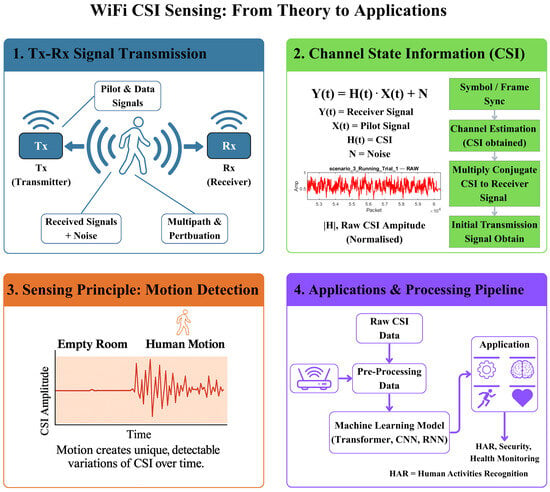
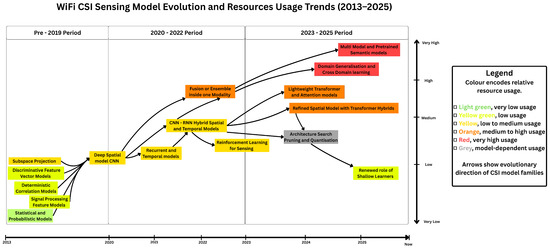
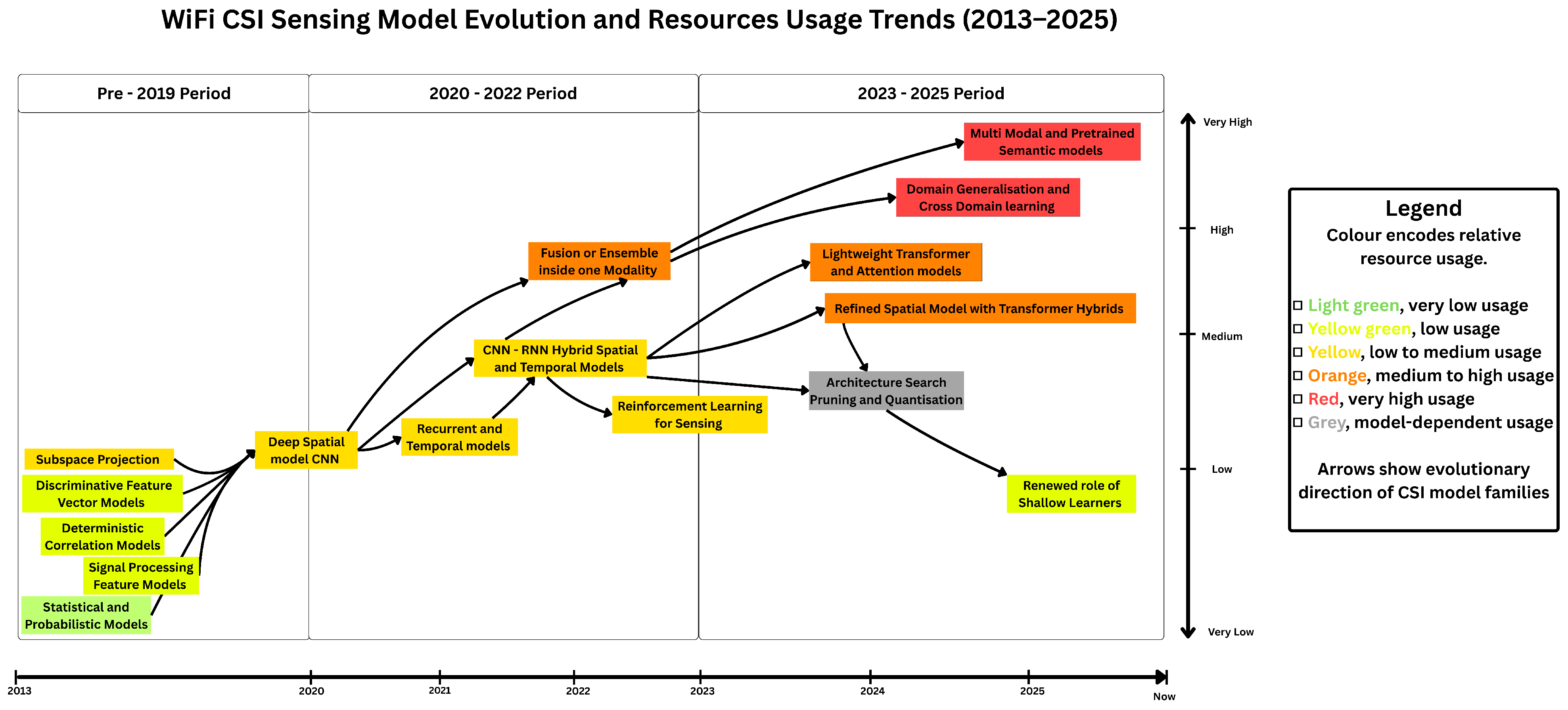

Disclaimer/Publisher’s Note: The statements, opinions and data contained in all publications are solely those of the individual author(s) and contributor(s) and not of MDPI and/or the editor(s). MDPI and/or the editor(s) disclaim responsibility for any injury to people or property resulting from any ideas, methods, instructions or products referred to in the content. |
© 2026 by the authors. Licensee MDPI, Basel, Switzerland. This article is an open access article distributed under the terms and conditions of the Creative Commons Attribution (CC BY) license.