


Abstract
Rising cooling demand in hot-arid climates requires passive, low-energy building strategies that can be compared across heterogeneous evidence. This study develops a PRISMA-informed systematic mapping review and an evidence-based energy-efficiency decision matrix for building-scale passive cooling strategies in hot-arid climates, while comparing evidence from both traditional and contemporary building contexts. Scopus and Web of Science Core Collection were searched for English-language journal articles and reviews published between 2010 and 2026. Rather than conducting statistical meta-analysis, the review uses qualitative and evidence-based synthesis to map, classify, and interpret heterogeneous performance evidence. After duplicate removal, 844 records were screened. A completed prioritized full-text synthesis assessed 92 reports and produced a core analytical evidence base of 78 studies, supported by 11 borderline or contextual studies, giving 89 mapped studies. The studies were coded by strategy cluster, climatic context, building typology, evidence type, performance metric, energy relevance, water dependency, implementation complexity, maintenance sensitivity, and evidence strength. Seven strategy clusters were identified: evaporative/windcatcher/solar-chimney systems; envelope/façade/shading strategies; courtyard/microclimate strategies; roof-based cooling; earth-to-air or ground-coupled cooling; natural ventilation/night flushing; and integrated passive cooling packages. The results show that passive cooling decisions require more than a thermal performance comparison. The proposed matrix distinguishes performance potential from implementation suitability and provides a structured design-support framework for low-energy hot-arid buildings.
1. Introduction
The built environment is entering a decisive period in which cooling demand, heat resilience, and energy-efficiency targets are becoming inseparable. Buildings are major energy consumers and contributors to greenhouse gas emissions, but they are also the primary spaces in which people experience the health, comfort, and productivity consequences of extreme heat. The buildings sector is therefore central to demand-side mitigation, operational energy reduction, and climate adaptation [1,2]. Within this broader transition, space cooling has become one of the fastest-growing end uses of electricity in buildings. The International Energy Agency warns that space-cooling demand will rise sharply without major efficiency and demand-reduction measures, while the Global Cooling Watch 2023 report frames passive cooling, efficiency standards, and refrigerant transition as complementary components of sustainable cooling [3,4].
This challenge is particularly acute in hot-arid climates. These regions are characterized by high solar radiation, large diurnal temperature swings, low relative humidity, clear skies, and prolonged cooling seasons. Such climatic conditions generate high risks of indoor overheating, while also offering environmental opportunities for passive cooling through solar control, night ventilation, thermal mass, evaporative cooling, and ground coupling. Hot-arid climates, therefore, represent both a problem and a design resource: they intensify cooling demand but also provide strong climatic potential for low-energy cooling when buildings are designed to use local heat sinks.
Passive cooling has long occupied a central position in environmental design theory. Bioclimatic approaches treated architecture as a mediator between human comfort and climatic forces, emphasizing orientation, shading, thermal mass, ventilation, and material selection as primary design instruments [5,6]. Vernacular architecture in hot-arid regions developed these principles through courtyards, windcatchers, thick walls, shaded streets, roof forms, night-time cooling, and water-assisted evaporative devices [7]. Contemporary passive cooling research has expanded the field through cool roofs, ventilated envelopes, passive downdraught evaporative cooling towers, earth-to-air heat exchangers, adaptive façades, phase-change materials, and simulation-based optimization [8,9,10,11].
Despite this growing body of work, the literature remains fragmented. Studies frequently focus on a single strategy, a specific building type, a local climatic condition, or a limited performance metric. Roof-based studies often report surface temperature reduction, indoor temperature, or cooling load effects [12,13,14]. Façade and shading studies tend to evaluate energy and visual-performance trade-offs, particularly in contemporary glazed buildings [15,16,17]. Ground-coupled systems are commonly assessed through outlet air temperature, burial depth, and energy-saving potential [18,19,20]. Windcatcher, PDEC, and solar-chimney studies often focus on airflow, thermal comfort, and natural-ventilation performance [21,22,23,24].
The conceptual problem is therefore not the absence of passive cooling knowledge. Rather, it is the absence of a structured comparative logic that can connect heterogeneous evidence to design decision-making. A roof coating, a windcatcher, a courtyard, an earth-to-air heat exchanger, and an adaptive façade cannot be evaluated through a single thermal indicator. Each operates through a different mechanism, requires different resources, and fits different building contexts. Evaporative cooling may provide strong temperature depression in dry air, but can become problematic where water scarcity, wet-media hygiene, or maintenance capacity is a constraint. Conversely, cool roofs and shading systems may offer more moderate thermal effects but provide low-water, low-maintenance, and retrofit-compatible benefits.
Existing review literature has made valuable contributions by documenting passive cooling strategies, climate-responsive design principles, ventilative cooling potential, and resilient cooling pathways [25,26]. However, several limitations remain. Many reviews discuss passive cooling techniques as categories rather than evaluating them through comparable decision dimensions. Others emphasize technological performance but pay insufficient attention to water dependence, maintenance, retrofit feasibility, or traditional-contemporary transferability. In addition, systematic review methodology is not consistently applied in passive cooling studies, particularly regarding search transparency, eligibility logic, full-text prioritization, and evidence extraction [27,28,29].
Recent building and engineering review studies also show that review-based contributions become stronger when they move beyond descriptive inventory and organize evidence through explicit comparative frameworks, classification logics, or decision-relevant gaps [30,31,32]. In this respect, the methodological issue addressed in the present review is not only whether passive cooling strategies have been studied, but how heterogeneous evidence can be made comparable without reducing it to a single thermal indicator. Conventional systematic or narrative reviews are effective for documenting strategy types, performance outcomes, and research trends, but they do not necessarily translate this evidence into design-relevant criteria such as water dependency, maintenance burden, retrofit feasibility, climatic fit, and evidence robustness. The proposed Energy-Efficiency Decision Matrix is therefore intended as an additional interpretive layer built on systematic mapping: it preserves the transparency of the review process while converting study-level findings into comparable decision dimensions for hot-arid building design and retrofit contexts.
The present study addresses this gap by developing a PRISMA-informed systematic mapping review and an energy-efficiency decision matrix for passive cooling strategies in traditional and contemporary buildings in hot-arid climates. The study does not aim to produce a universal ranking of passive cooling techniques because the included studies differ in climate, building type, scale, method, and metric. Instead, it constructs a comparative decision framework that evaluates passive cooling strategies through energy-performance evidence, hot-arid climate fit, building-scale relevance, thermal-comfort contribution, water dependency, implementation complexity, maintenance sensitivity, and evidence strength.
The research is guided by the following questions:
RQ1. Which passive cooling strategies have been investigated in traditional and contemporary buildings in hot-arid climates between 2010 and 2026?
RQ2. How can the identified strategies be classified according to their dominant physical cooling mechanisms and architectural applications?
RQ3. What types of performance evidence are reported across the literature, including energy, cooling load, temperature reduction, thermal comfort, airflow, and indoor environmental quality indicators?
RQ4. Which passive cooling strategies demonstrate the strongest balance between energy-efficiency relevance, climatic suitability, water sensitivity, implementation feasibility, and evidence strength?
RQ5. How can heterogeneous passive cooling evidence be translated into an energy-efficiency decision matrix for design and research use in hot-arid climates?
By integrating systematic mapping with design-oriented decision support, the study contributes to passive cooling research in four interrelated ways. First, it reframes passive cooling as a multi-criteria decision problem rather than a purely thermal-performance problem. Second, it makes the evidence-construction process transparent by linking database records, screening decisions, strategy clusters, performance metrics, and matrix criteria. Third, it advances existing review approaches by distinguishing performance potential from implementation suitability, especially where water availability, maintenance capacity, retrofit feasibility, and evidence strength affect real-world applicability. Fourth, it supports building design, retrofit, and conservation practice by helping designers recognize embedded passive cooling logic in traditional buildings while selecting contemporary interventions that are climatically appropriate, resource-sensitive, and implementable.
2. Materials and Methods
2.1. Review Design and Methodological Orientation
This study was designed as a PRISMA-informed systematic mapping review combined with an evidence-based decision-matrix synthesis. The methodological aim was not only to identify and summarize passive cooling strategies used in hot-arid climates, but also to translate heterogeneous evidence into a comparative energy-efficiency decision framework for architectural and building-design applications. The included literature comprises field monitoring, test-cell experiments, CFD studies, dynamic thermal simulations, parametric modeling, and mixed experimental-simulation studies. Because of this methodological and metric heterogeneity, statistical meta-analysis was not appropriate. Accordingly, the synthesis was qualitative and evidence-based: it mapped strategy clusters, performance-metric families, representative quantitative effects, and decision-matrix criteria without pooling effect sizes or producing a statistical summary estimate.
The review followed the transparency principles of PRISMA 2020 for identification, screening, eligibility reporting, and evidence-flow documentation [27], and incorporated PRISMA-S principles to strengthen the reproducibility of the database search strategy [28]. The PRISMA-ScR checklist was used as supplementary reporting material for the mapping and scoping components of the review [29]. The use of PRISMA-ScR in this manuscript, therefore, supports reporting transparency; it does not reclassify the study as a quantitative systematic review or meta-analysis.
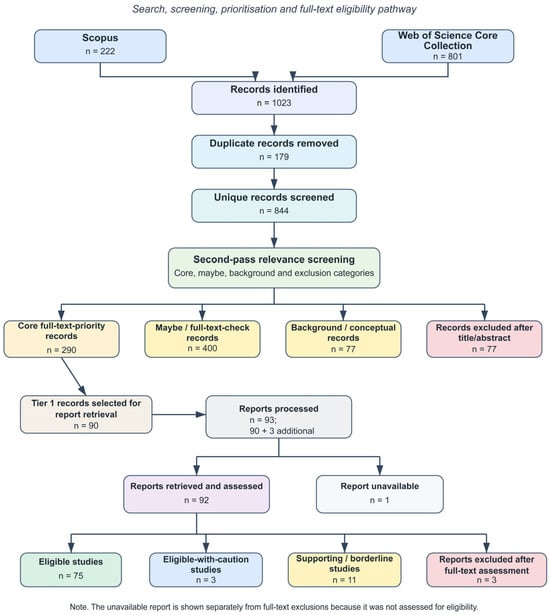
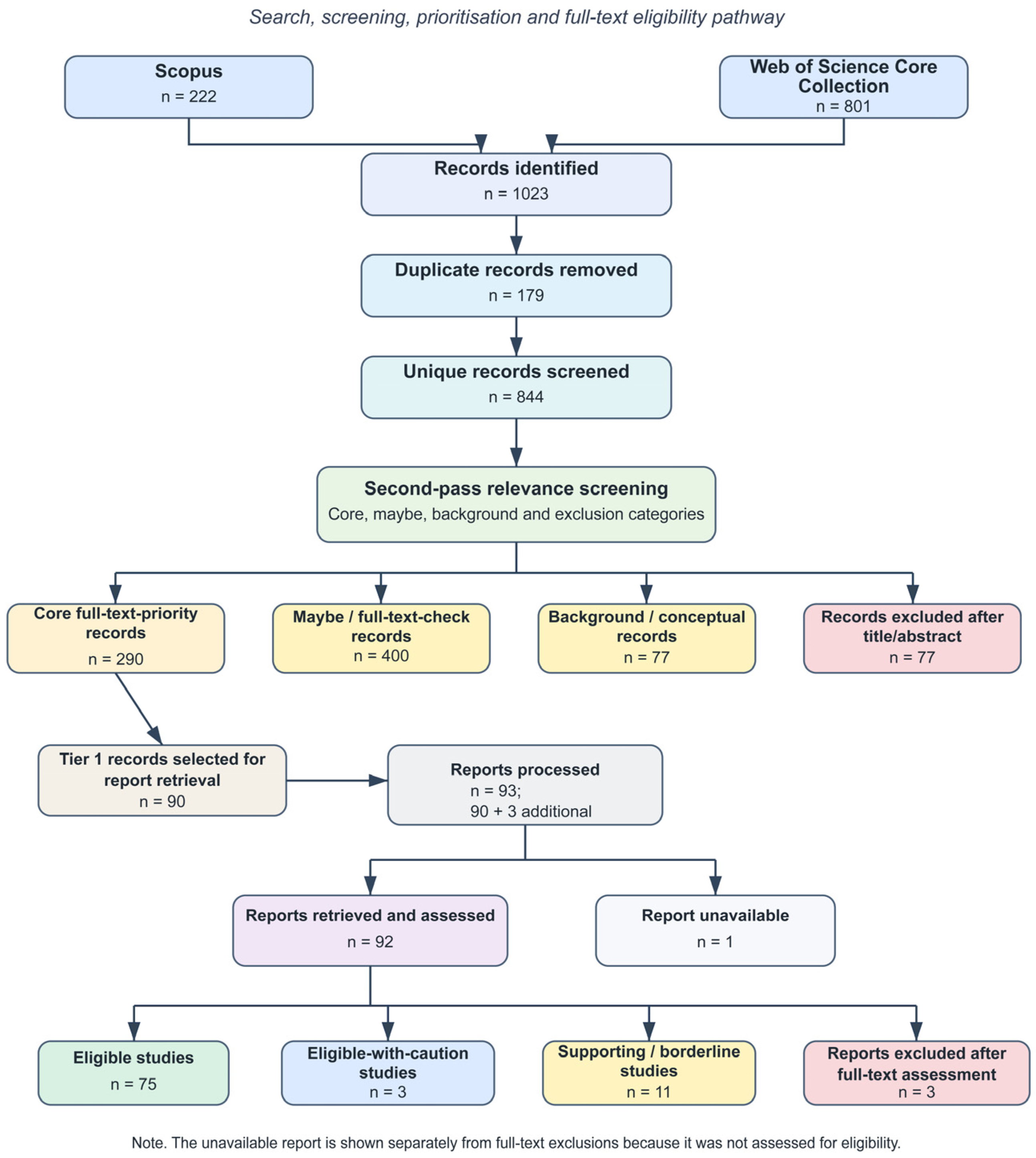
The workflow consisted of database searching, export and normalization, duplicate removal, title and abstract screening, second-pass prioritization, full-text eligibility assessment, and decision-matrix coding (Figure 1).
Figure 1.
PRISMA-informed workflow for evidence-based construction and decision-matrix synthesis. The workflow shows identification, deduplication, screening, prioritization, report retrieval, eligibility assessment, and the separation of the unavailable report from full-text exclusions.
To ensure consistent PRISMA terminology, this manuscript uses records, reports, and studies as distinct units. Records refer to database searches or exported bibliographic entries screened at the title and abstract level. Reports refer to full-text documents sought, retrieved, or assessed for eligibility. Studies refer to eligible analytical units included in the core, eligible-with-caution, or supporting synthesis.
2.2. Data Sources and Search Strategy
The literature search was conducted in Scopus and Web of Science Core Collection because these databases provide broad coverage of peer-reviewed literature in architecture, building science, energy performance, environmental design, and engineering. The search covered English-language journal articles and reviews published between 2010 and 2026. The search strategy was developed around three conceptual blocks: passive cooling strategies, hot-arid climatic context, and building or architectural relevance. The search was intentionally broad to avoid excluding studies that used different terminology for similar passive cooling mechanisms.
The final Scopus search was conducted on 8 June 2026, and the final Web of Science Core Collection search was conducted on 8 June 2026. The search strategy combined three conceptual blocks: passive cooling mechanisms, hot-arid climatic descriptors, and building-scale application terms. The same conceptual structure was used in both databases, but field syntax was adapted to the database interface. No geographical filter was applied. The limits applied in both databases were publication years 2010–2026, English language, and peer-reviewed journal document types. Conference papers, book chapters, editorials, notes, and non-English records were excluded through database filters where available and through subsequent screening where necessary. For Scopus, the search was run in TITLE-ABS-KEY fields as follows: TITLE-ABS-KEY (“passive cooling” OR “natural ventilation” OR windcatcher OR “wind tower” OR “solar chimney” OR “cool roof” OR “reflective roof” OR shading OR courtyard OR “thermal mass” OR “evaporative cooling” OR “passive downdraught evaporative cooling” OR PDEC OR “earth-to-air heat exchanger” OR “ground-coupled cooling”) AND TITLE-ABS-KEY (“hot-arid” OR “hot arid” OR “hot-dry” OR “hot dry” OR arid OR desert OR BWh) AND TITLE-ABS-KEY (building OR architecture OR envelope OR façade OR facade OR roof OR residential OR school OR “traditional building” OR vernacular).
The Scopus results were limited to 2010–2026, English-language records, Article or Review document types, and journal source type. This produced 322 raw records and 222 final exported records after filters. For Web of Science Core Collection, the search was run as a Topic search as follows:
TS = (“passive cooling” OR “natural ventilation” OR windcatcher OR “wind tower” OR “solar chimney” OR “cool roof” OR “reflective roof” OR shading OR courtyard OR “thermal mass” OR “evaporative cooling” OR “passive downdraught evaporative cooling” OR PDEC OR “earth-to-air heat exchanger” OR “ground-coupled cooling”) AND TS = (“hot-arid” OR “hot arid” OR “hot-dry” OR “hot dry” OR arid OR desert OR BWh) AND TS = (building OR architecture OR envelope OR façade OR facade OR roof OR residential OR school OR “traditional building” OR vernacular).
The Web of Science results were limited to 2010–2026, English-language records, and Article or Review Article document types. This produced 955 raw records and 801 final exported records after filters. The database-specific search fields, exact search structures, filters, and final exported records are summarized in Table 1.
Table 1.
Database-specific search syntax, search dates, limits, and exported records.
2.3. Record Export, Normalization, and Deduplication
Records were exported with bibliographic information, including title, authors, publication year, source title, abstract, keywords, DOI, and database source. The two datasets were merged into a single spreadsheet and normalized to ensure consistency across Scopus and Web of Science fields. Deduplication was performed in two stages: exact DOI matching followed by title-and-year matching for records without a DOI or with inconsistent DOI formatting. This process removed 179 duplicate records, leaving 844 unique records for title and abstract screening.
2.4. Eligibility Criteria
The eligibility criteria were developed to ensure that the review retained studies with direct relevance to building-scale passive cooling in hot-arid or closely comparable dry climatic conditions. Because passive cooling evidence is distributed across architecture, building physics, environmental design, and energy-performance research, the criteria were designed to balance specificity with sufficient breadth. Sources were therefore assessed according to climate relevance, building relevance, passive cooling relevance, performance relevance, publication type, language, and publication period. The inclusion and exclusion rules applied during screening and full-text assessment are presented in Table 2.
Table 2.
Inclusion and exclusion criteria.
Ambiguous records were not excluded immediately. Records with insufficient abstracts or partial relevance were coded as “Maybe” and retained for second-pass screening to reduce the risk of excluding relevant studies prematurely.
2.5. Screening, Prioritization, and Full-Text Assessment
The 844 deduplicated records were screened at the title and abstract level using Include, Exclude, and Maybe decisions. A second-pass screening then classified records into the following categories: Core, Maybe/full-text check, Background/conceptual use only, and Exclude. This produced 290 core-include records, 400 records requiring possible full-text check, 77 background/conceptual records, and 77 exclusions. Because the purpose of the review was to construct a decision matrix grounded in performance evidence, full-text retrieval was prioritized according to the likelihood that a record would contain extractable passive-cooling performance data.
Ninety records were initially selected for the Tier 1 full-text retrieval set. During retrieval, three additional high-value records from the core set were retrieved and assessed because the corresponding reports were available and directly relevant to the decision-matrix synthesis. The completed prioritized full-text synthesis therefore processed 93 reports. Of these, 92 reports were retrieved and assessed, while one report was recorded as unavailable because it could not be accessed through institutional, open-access, or legal retrieval routes without payment. Full texts were not purchased. This distinction was maintained to avoid conflating non-retrieval with methodological exclusion.
Full-text reports were assessed using four operational criteria: climate relevance, building-scale relevance, passive cooling relevance, and reported thermal, energy, comfort, or ventilation-performance evidence. After full-text assessment, the corresponding studies were coded as eligible, eligible with caution, supporting/borderline, or excluded from the analytical synthesis.
2.6. Data Extraction, Evidence Classification, and Decision-Matrix Development
For each eligible, eligible-with-caution, or supporting study, the following information was extracted: bibliographic details, country or location, climate type, building typology, traditional or contemporary category, passive cooling strategy, strategy cluster, evidence type, modeling or measurement method, performance metrics, quantitative effect, energy relevance, water dependency, implementation complexity, maintenance sensitivity, and recommended use in the synthesis.
The Energy-Efficiency Decision Matrix was developed to convert heterogeneous findings into a structured, comparative framework for architectural and building-design decision support. Each strategy was assessed across eight dimensions: energy-performance evidence, hot-arid climate fit, building-scale relevance, thermal-comfort contribution, water dependency, implementation complexity, maintenance sensitivity, and evidence strength (Table 3). The scoring scale was used as a conservative evidence-classification tool rather than as a statistical weighting system or a universal ranking model. Scores were assigned from the information explicitly reported in each source. Where evidence was incomplete, indirect, or ambiguous, the lower applicable score was assigned.
Table 3.
Decision-matrix scoring dimensions.
For energy-performance evidence, a score of 3 was assigned only when a study reported direct kWh, cooling load, HVAC-load, or energy-saving outcomes; temperature or comfort evidence without direct energy reporting was not treated as equivalent to direct energy evidence. For a hot-arid climate fit, studies explicitly located in BWh, desert, hot-arid, or equivalent dry climates received the highest score, whereas semi-arid or transferable dry-context studies were scored more cautiously. For building-scale relevance, whole-building or building-integrated systems were scored higher than component-only, test-cell, or isolated-room studies. For water dependency, implementation complexity, and maintenance sensitivity, the scale was suitability-oriented: low-water, low-complexity, and low-maintenance strategies received higher scores, while water-dependent, technically complex, or maintenance-intensive systems were scored more cautiously. Evidence strength was scored according to the robustness of the study design, with higher scores assigned to field evidence, validated simulations, or strong experimental designs.
The scoring process was not externally validated through a formal expert panel. To improve transparency and reproducibility, the scoring criteria were defined before synthesis, applied consistently across the mapped evidence base, and documented at the source level in Supplementary Table S1. The matrix should therefore be interpreted as a transparent evidence-classification and decision-support framework, not as a validated predictive model. Formal expert validation and sensitivity testing of the scoring assumptions remain important next steps for future development of the framework.
Retrofit potential was treated as a derived applicability judgment rather than as a separate ninth scoring dimension. It was inferred from the combined interpretation of building-scale relevance, implementation complexity, water dependency, maintenance sensitivity, and the extent to which a strategy could be added to existing buildings without major structural alteration or extensive technical integration. For example, cool roofs, high-albedo coatings, external shading, and selected envelope measures were interpreted as having relatively high retrofit potential when they combined building-scale relevance with low water dependency, moderate or low implementation complexity, and manageable maintenance requirements. By contrast, earth-to-air heat exchangers, ground-coupled systems, or integrated evaporative systems were interpreted more cautiously in retrofit contexts because their applicability depends on excavation, site conditions, system integration, water availability, or long-term maintenance access.
Final priority classes were not generated through a simple arithmetic summation of scores. Instead, they were assigned through a rule-based interpretive synthesis that combined performance evidence with implementation suitability. Energy-performance evidence and hot-arid climate fit were used to identify whether a strategy had sufficient relevance to the review objective, while water dependency, implementation complexity, maintenance sensitivity, retrofit potential, and evidence strength were used to moderate the final priority interpretation. This approach prevented strategies with strong thermal effects but high water, maintenance, or implementation burdens from being treated as universally preferable.
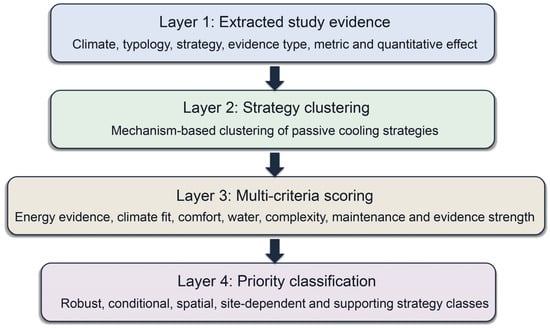
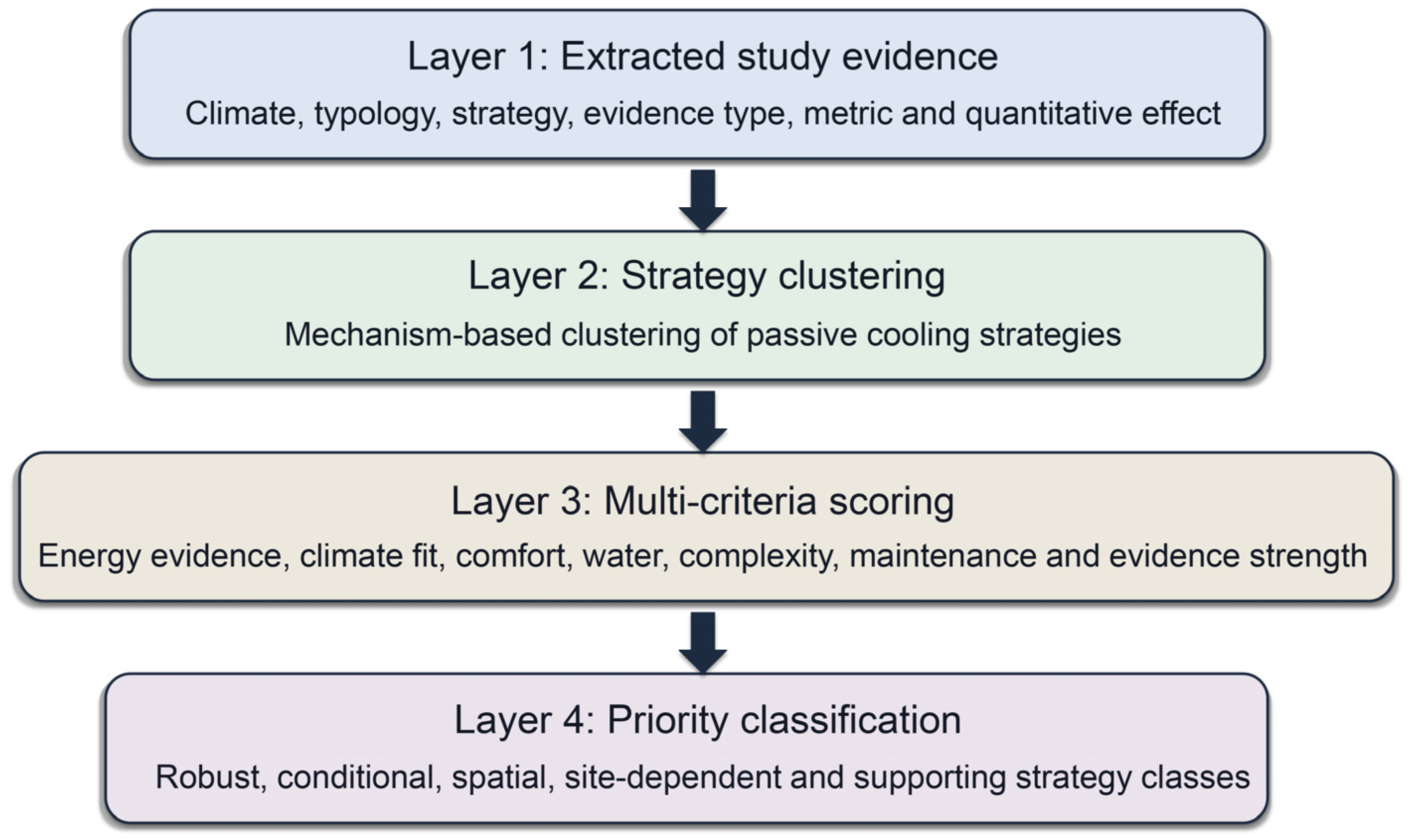
Representative scoring examples clarify how the criteria were applied. A cool-roof or cool-ventilated-roof study reporting measured indoor-temperature reduction together with simulated cooling-load reduction was treated as strong energy-performance evidence because it provided direct energy or cooling-load information as well as thermal evidence. By contrast, a windcatcher, solar-chimney, or water-spray configuration reporting large air-temperature reductions through CFD simulation but without direct kWh or cooling-load outcomes was not scored as equivalent to direct energy evidence; its interpretation was also moderated by water dependence and operational-control requirements. Similarly, earth-to-air or ground-coupled strategies were interpreted as having high thermal potential where substantial temperature reduction was reported, but their implementation score was moderated by site dependence, installation complexity, and maintenance access. These examples illustrate that the matrix evaluates both performance potential and implementation suitability rather than ranking strategies by thermal effect alone. The translation of source-level evidence into clustered strategy assessment and priority classification is illustrated in Figure 2.
Figure 2.
Construction logic of the Energy-Efficiency Decision Matrix. Extracted evidence is translated through strategy clustering, multi-criteria scoring, and priority classification.
All screening, eligibility, and coding decisions were documented in structured spreadsheets. The full Tier 1 screening and coding workbook, including source-level extraction fields, matrix dimensions, eligibility status, and decision notes, is provided as Supplementary Table S1.
3. Results
3.1. PRISMA-Based Screening Outcome and Analytical Evidence Base
The systematic search identified 1023 records from Scopus and Web of Science Core Collection. After duplicate removal, 844 unique records were retained for title and abstract screening. Second-pass screening produced a core full-text-priority set of 290 records. In the completed prioritized full-text synthesis, 93 reports were processed. Of these, 92 reports were retrieved and assessed, and one report was recorded as unavailable. Full-text eligibility assessment retained 78 studies in the core analytical evidence base, including 75 eligible studies and 3 studies retained with caution. A further 11 studies were retained for supporting or contextual synthesis, while 3 reports were excluded after full-text assessment. The unavailable report was reported separately from exclusions because it was not assessed. The complete numerical pathway from database identification to the final analytical and supporting evidence base is summarized in Table 4.
Table 4.
PRISMA-based identification, screening, and full-text eligibility status.
3.2. Strategy-Cluster Distribution
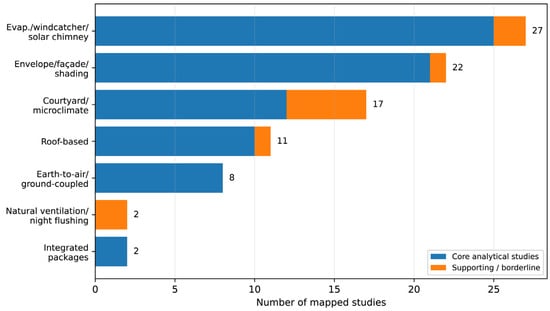
The 89 mapped studies, consisting of 78 core analytical studies and 11 supporting or borderline studies, were grouped into seven analytical strategy clusters. These clusters reflect the main physical mechanisms through which passive cooling is achieved in hot-arid climates: evaporative heat dissipation, solar heat-gain reduction, ventilation-driven heat removal, microclimatic buffering, thermal-mass modulation, and ground-coupled heat exchange.
The evidence base included studies on solar-chimney and evaporative-cooling configurations [33], earth-to-air heat-exchange performance [34], natural ventilation in hot-arid school settings [35], passive downdraught evaporative cooling configurations and monitored PDEC applications [36,37], overheating mitigation in desert school buildings under current and future climates [38], courtyard-envelope performance in hot-arid educational settings [39], climate-resilient passive cooling optimization [40], kinetic Mashrabiya performance in arid climates [41], windcatcher evidence in UAE heritage architecture [42], material-envelope and ventilation-related studies in semi-arid or hot-dry contexts [43,44,45,46], PCM and advanced shading/BIPV studies [47,48], psychrometric roof-pond evidence [49], atrium/natural-ventilation and residential passive-cooling studies [50,51], and traditional courtyard-building performance in a desert climate [52]. The distribution of mapped studies across these seven strategy clusters is summarized in Table 5.
Table 5.
Strategy-cluster distribution of mapped full-text studies.
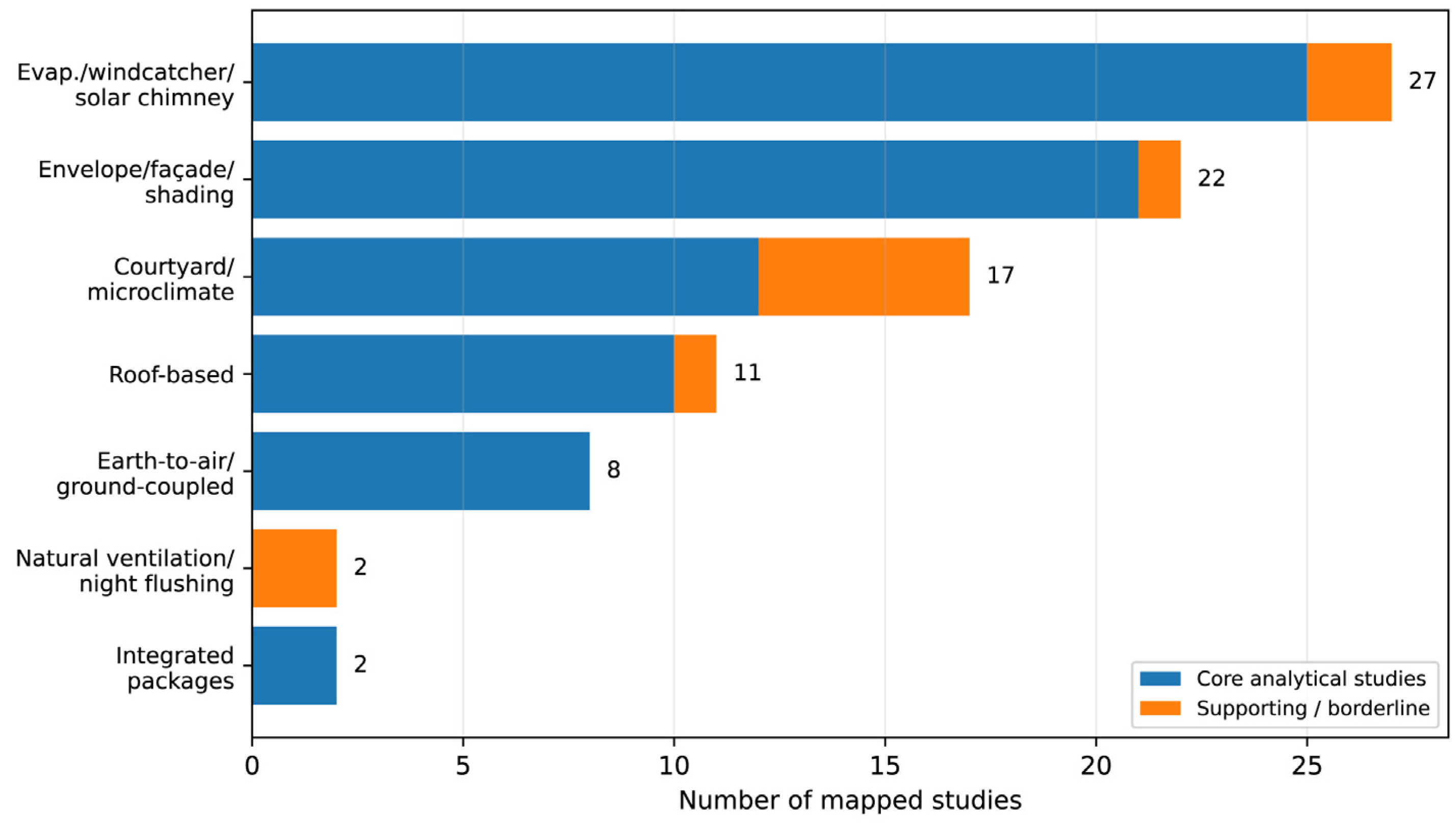
The same distribution is visualized in Figure 3 to clarify the relative weight of core analytical studies and supporting or borderline studies across the passive cooling clusters.
Figure 3.
Passive cooling strategy-cluster distribution in the mapped full-text evidence base. Bars distinguish core analytical studies from supporting or borderline studies.
3.3. Performance-Metric Mapping
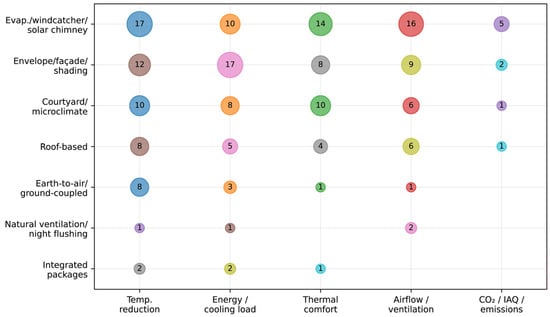
The mapped studies reported five performance-metric families: temperature reduction, energy or cooling-load reduction, thermal comfort improvement, airflow or ventilation performance, and CO2, IAQ, or emissions indicators. Studies could contribute to more than one metric family because many reported combined thermal, comfort, and energy outcomes. The five performance-metric families and their relevance for the decision-matrix interpretation are summarized in Table 6.
Table 6.
Performance-metric families identified in the mapped studies.
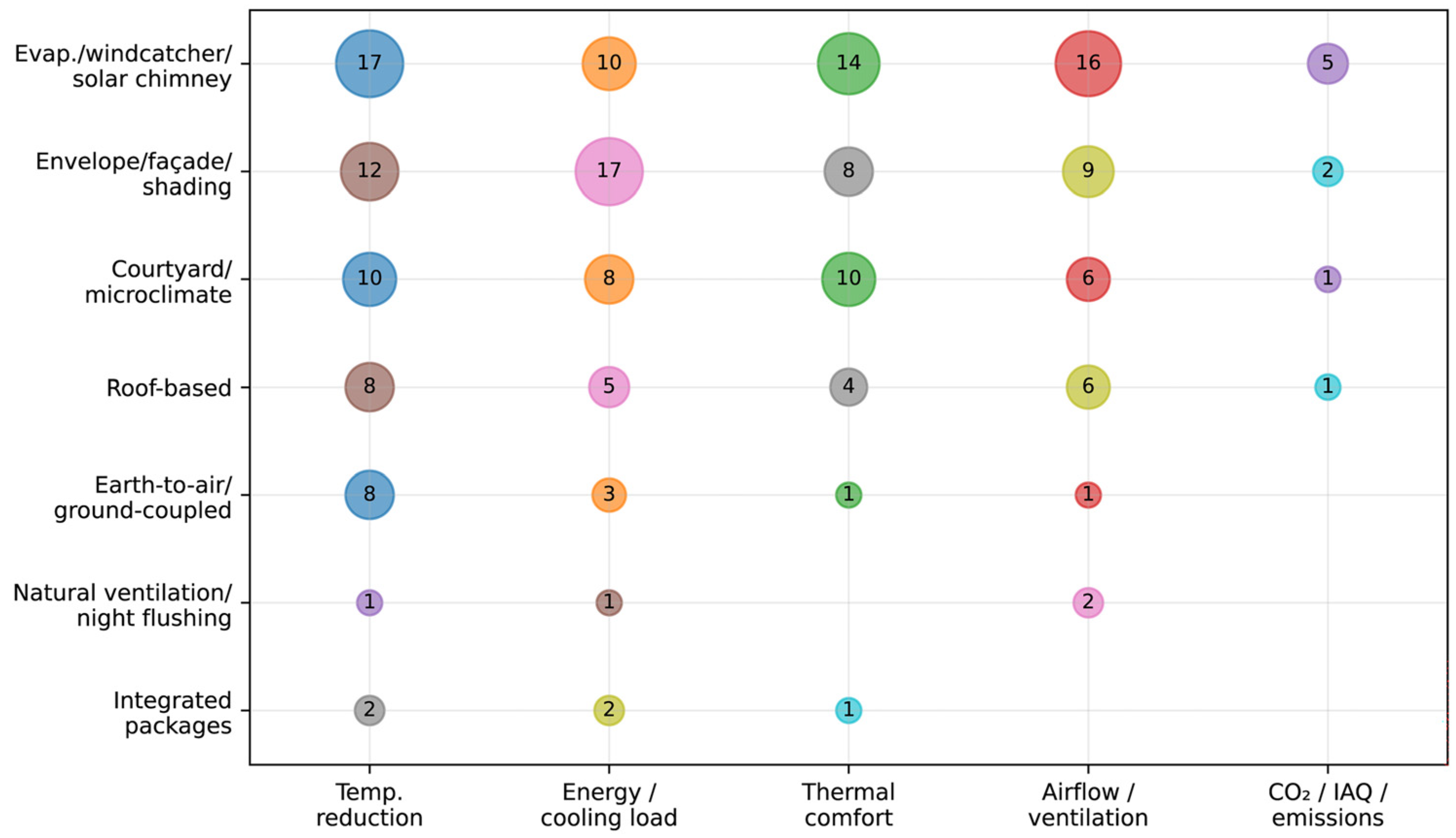
The relationship between strategy clusters and reported performance-metric families is visualized in Figure 4.
Figure 4.
Strategy-by-performance-metric evidence map. Bubble size and internal labels indicate the number of mapped studies in which each strategy cluster reported each performance-metric family; studies could contribute to more than one metric family. Colours are used only to visually distinguish performance-metric families and do not encode an additional variable.
Temperature reduction was the most frequently reported indicator, but temperature reduction alone is insufficient for an energy-efficiency review. A strategy that reduces temperature substantially may still be unsuitable if it depends heavily on water, requires difficult maintenance, or lacks building-scale energy evidence. For this reason, the decision matrix gives greater interpretive weight to studies that combine thermal-performance evidence with energy or cooling-load outcomes.
3.4. Representative Quantitative Evidence Informing the Decision Matrix
To clarify how quantitative evidence informed the decision-matrix interpretation, representative high-value studies were extracted from the mapped evidence base. These studies were not selected to create a ranked list of passive cooling techniques, but to illustrate the range of measurable effects reported across roof-based systems, integrated passive design packages, evaporative and windcatcher systems, ground-coupled cooling, PCM/envelope strategies, and shading retrofits. The examples show how reported thermal, comfort, and energy outcomes were translated into matrix-level interpretation. Table 7 presents the selected studies, their passive cooling strategies, evidence types, extracted quantitative effects, and corresponding matrix implications.
Table 7.
Representative high-value studies and extracted quantitative effects.
The representative evidence confirms that promising strategies are not concentrated in a single passive-cooling family. High-value evidence appears across roof systems, evaporative and windcatcher systems, ground-coupled cooling, PCM/envelope interventions, façade shading, and integrated packages. This reinforces the need for a decision matrix rather than a simple universal ranking.
3.5. Decision-Matrix Interpretation and Priority Classes
The decision matrix places energy-performance evidence at the center of evaluation but deliberately avoids treating energy reduction as the only criterion. In arid contexts, water dependency, maintenance, and operational reliability are decisive constraints. A strategy that produces high cooling through evaporation may be less suitable if water demand and wet-media maintenance are not addressed. Conversely, low-water strategies such as reflective roofs, roof ventilation, shading, and envelope optimization may provide more robust long-term applicability, even when their peak temperature reductions are lower. The resulting strategy-priority classes are presented in Table 8.
Table 8.
Final strategy-priority classes for hot-arid passive cooling design.
The priority classes were derived from the combined interpretation of matrix dimensions rather than from a mechanical total score. Priority A was assigned to strategies with strong energy relevance, low water dependency, manageable implementation requirements, low-to-moderate maintenance sensitivity, and relatively high retrofit potential. Priority B was assigned to strategies with high temperature-reduction or comfort potential but stronger dependency on water supply, wet-media hygiene, operational control, or maintenance capacity. Priority C includes spatial and morphological regulators, such as courtyards and shaded transitional spaces, whose climatic relevance is strong but whose direct energy savings are often less consistently quantified. Priority D includes site-dependent technical systems, such as earth-to-air or ground-coupled systems, where thermal potential may be high, but implementation feasibility depends on soil condition, excavation, system integration, and maintenance access. Priority E includes supporting control strategies such as night flushing and selective ventilation, which are valuable when coordinated with other passive measures but should not be treated as standalone solutions. Priority F captures integrated passive design packages, which have strong applied design value but are less comparable across individual mechanisms.
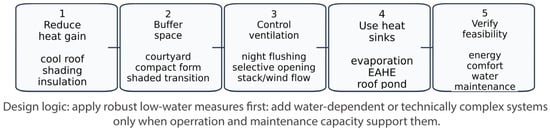
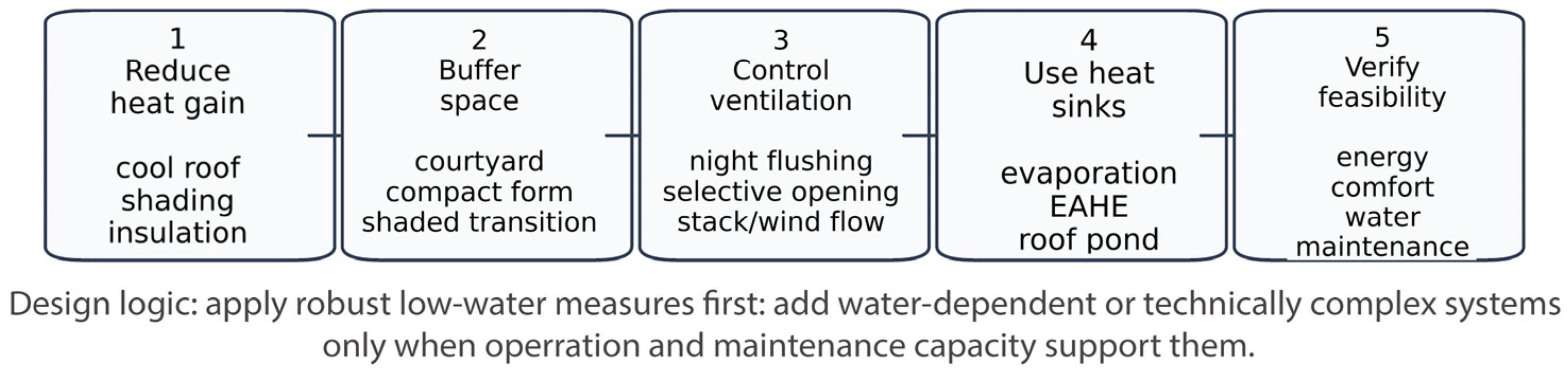
Figure 5 translates these priority classes into a staged selection pathway for hot-arid building design.
Figure 5.
Priority pathway for passive cooling selection in hot-arid buildings. The pathway prioritizes low-water heat-gain reduction, then spatial buffering and controlled ventilation, before conditional evaporative or ground-coupled systems.
The framework can be applied as a staged screening tool during both new design and retrofit decision-making. For architects, the matrix supports early-stage selection by identifying which passive cooling families are most compatible with site exposure, building form, spatial organization, and retrofit constraints. For engineers, it provides a structured basis for assessing whether a strategy has direct energy or cooling-load evidence, whether the reported thermal benefit is supported by robust evidence, and whether implementation complexity, maintenance access, or water dependence may reduce operational reliability. For policymakers, municipal retrofit programs and design-guideline development, the framework can help prioritize low-water, low-maintenance, and broadly transferable strategies before promoting more conditional systems that require water supply, technical integration, or long-term operational governance. In practical use, the matrix should therefore be read from performance potential to implementation suitability: first, reduce heat gain, then use spatial buffering and controlled ventilation, and finally consider evaporative or ground-coupled systems where site conditions and maintenance capacity support them.
3.6. Traditional Versus Contemporary Passive Cooling Logic
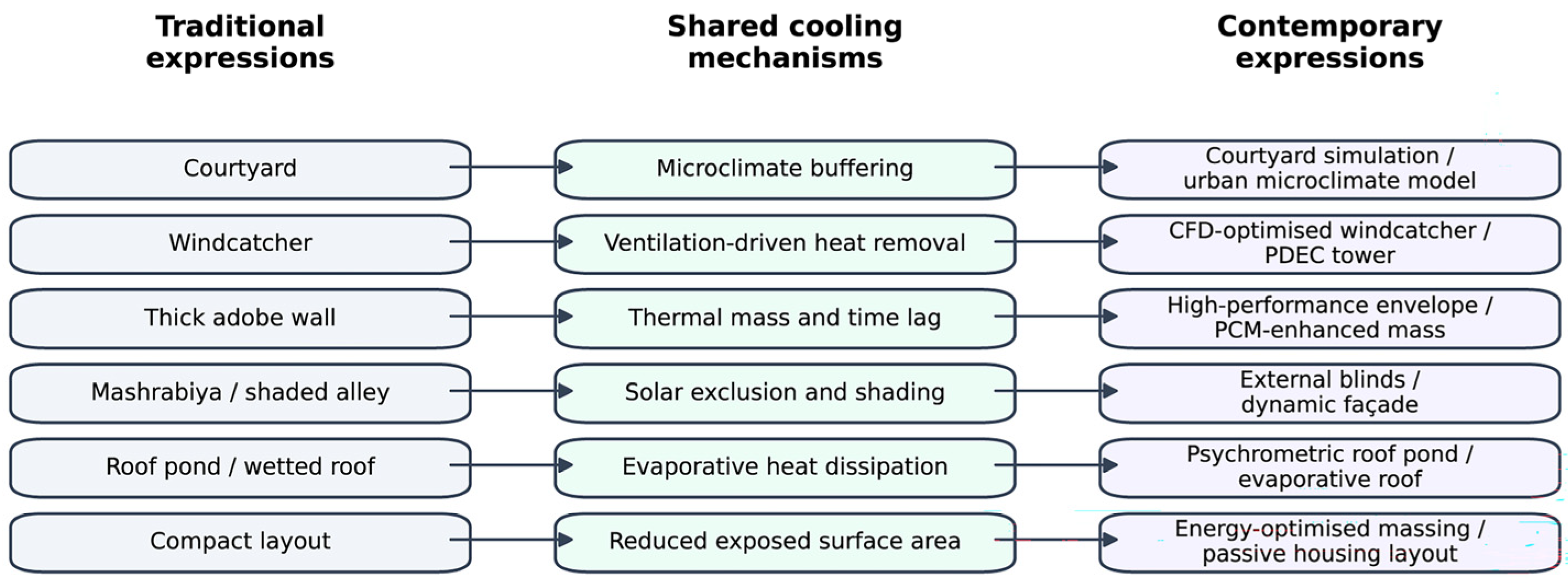
The mapped evidence shows that traditional and contemporary passive cooling strategies should not be treated as separate or competing categories. They operate through overlapping physical mechanisms. Traditional buildings frequently use spatial depth, courtyards, shaded voids, compact massing, thermal mass, windcatchers, and controlled openings. Contemporary systems often translate the same principles into engineered components, such as cool roofs, double-skin façades, PDEC towers, CFD-optimized windcatchers, adaptive shading, PCM-enhanced envelopes, and earth-to-air heat exchangers.
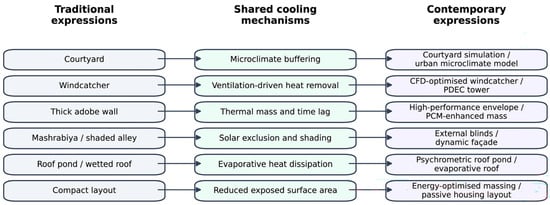
The decision matrix demonstrates that traditional strategies are often strong in climatic adaptation, cultural compatibility, and low-energy logic, but contemporary studies more frequently provide quantifiable performance evidence. This suggests that a key gap is not the absence of traditional passive cooling knowledge, but the lack of systematic quantification of its energy and comfort impacts under contemporary performance metrics. Figure 6 summarizes this traditional-contemporary bridge by connecting architectural expressions to their shared physical cooling mechanisms.
Figure 6.
Mechanism-based bridge between traditional and contemporary passive cooling. The diagram connects architectural expressions to shared physical cooling mechanisms.
4. Discussion
4.1. Reframing Passive Cooling as a Multi-Criteria Energy-Efficiency Problem
The findings show that passive cooling in hot-arid climates cannot be reduced to a single best technique. Instead, it should be interpreted as a multi-layered design problem in which different strategies operate through different environmental mechanisms, including solar heat-gain prevention, radiative reflection, evaporative heat dissipation, ventilation-driven heat removal, thermal-mass modulation, microclimatic buffering, and ground-coupled heat exchange. This interpretation is consistent with the broader sustainable cooling agenda, which stresses that cooling demand cannot be addressed only by improving mechanical air-conditioning efficiency [3,4]. The present review contributes by shifting the discussion from a catalog of passive cooling techniques to a decision-support logic that evaluates thermal benefit together with energy relevance, climate fit, water dependency, implementation complexity, and maintenance sensitivity.
At the mechanism level, the main trade-off is that passive cooling strategies do not remove heat in the same way or at the same point in the heat-flow sequence. Roof coatings, shading, and envelope measures act upstream by reducing absorbed solar radiation before it becomes indoor heat gain. Thermal mass and PCM-based envelopes delay and redistribute heat through storage and time lag, but they require appropriate night-time heat release to avoid retaining heat into the next day. Evaporative and windcatcher systems use dry-air potential and pressure-driven or buoyancy-assisted airflow to remove sensible heat, yet their performance depends on wet-bulb depression, water availability, airflow path continuity, and maintenance of wetted components. Ground-coupled strategies use the thermal inertia of the soil as a heat sink, but their effectiveness is moderated by burial depth, soil conditions, pipe configuration, and installation feasibility. These mechanisms explain why no passive cooling strategy can be interpreted independently from climate, building form, envelope exposure, ventilation timing, and operational control.
4.2. Roof-Based and Envelope-Based Strategies as Robust Low-Water Interventions
Roof-based and envelope-based strategies emerged as the most robust low-water interventions within the prioritized evidence base. This finding is physically coherent because roofs and façades are among the most exposed envelope components in hot-arid climates. Cool roofs, reflective coatings, ventilated roofs, insulation, and external shading reduce solar heat gain before it becomes an indoor cooling load. The evidence from Athmani et al. [8], Dabaieh et al. [13], Algarni [12], Rodrigues et al. [11], and Bande et al. [15] indicates that such strategies are especially valuable where water scarcity, maintenance capacity, and retrofit feasibility are major constraints. However, the results also show that reflective and ventilated systems require attention to dust, durability, glare, and construction practice.
The main interaction for roof and envelope strategies is their ability to reduce cooling load before other passive systems are activated. External shading and high-albedo or ventilated roofs lower incident and absorbed solar gains, which can improve the effectiveness of natural ventilation, night flushing, and thermal-mass strategies by reducing the heat that must later be removed. However, the same strategies also involve trade-offs. Highly reflective surfaces may lose effectiveness under dust accumulation or create glare; insulation and thermal mass may reduce daytime heat transfer but can also delay heat release if night ventilation is insufficient; and façade shading must balance cooling-load reduction with daylight and visual-performance requirements. Roof and envelope measures are therefore best interpreted as baseline heat-gain-control strategies that condition the performance of subsequent ventilation, microclimate, or evaporative interventions.
4.3. Evaporative, Windcatcher, and Solar-Chimney Systems as High-Performance Conditional Strategies
Evaporative, windcatcher, and solar-chimney systems provide some of the strongest temperature-reduction effects because hot-arid climates offer favorable psychrometric conditions. Studies on PDEC towers, windcatchers, water-spray systems, and solar-chimney-assisted configurations show large cooling and ventilation potential [21,22,23,24,36,37]. Yet these systems should not be positioned as universally superior. Their suitability depends on water availability, wet-media hygiene, humidity control, dust, maintenance, and user operation. The decision matrix, therefore, classifies them as high-performance conditional strategies rather than universal first-priority solutions.
The physical logic of these systems differs from that of roof or envelope heat-gain reduction. Evaporative systems lower air temperature by converting sensible heat into latent heat, which is particularly effective in dry air but introduces water consumption, humidity control, and hygiene considerations. Windcatchers depend on pressure differences and the continuity of inlet and outlet airflow paths, while solar chimneys depend on buoyancy generated by solar heating of the air column. Hybrid configurations can strengthen performance when wind-driven and stack-driven forces operate in the same direction, or when evaporative cooling is used to pre-cool incoming air. They can also underperform when airflow paths are obstructed, when outdoor air is too hot during daytime operation, or when added humidity conflicts with comfort and indoor air quality needs. This explains why the matrix treats these strategies as conditional high-performance systems rather than universally robust interventions.
4.4. Courtyard, Microclimate, and Conservation Implications
Courtyard and microclimate strategies occupy a distinctive position because they bridge vernacular environmental knowledge and contemporary performance analysis. They should be interpreted as spatial regulators rather than isolated cooling devices. Courtyards, shaded transitions, compact forms, and wind-oriented openings can moderate the microclimate, but their direct energy effects are not always quantified with the same precision as roof, envelope, or simulation-based façade studies. For conservation and adaptive reuse, this finding is important: preserving traditional hot-arid buildings should include the preservation and informed adaptation of environmental performance principles, not only the material fabric or visual form. This is particularly important because conservation-oriented passive retrofitting must also respect the structural vulnerabilities of traditional masonry buildings; evidence from earthquake-damaged rural masonry houses in Turkey shows that weak mortar, irregular stone bonding, insufficient tie beams, and poor wall connections can strongly affect the durability and safety of traditional building fabric [53]. Vernacular climate intelligence can support low-energy retrofitting if it is quantified, respected, and integrated carefully.
Courtyard and microclimate strategies also work through combined mechanisms rather than a single cooling process. Shaded voids reduce direct solar exposure and the mean radiant temperature; compact spatial layouts reduce exposed surface area; vegetation or water elements can influence local air temperature and humidity; and surrounding walls can produce delayed heat exchange through thermal mass. Their performance is therefore strongly dependent on proportion, orientation, surface material, sky exposure, ventilation openings, and night-time cooling potential. A courtyard can function as a microclimatic buffer when shading, mass, and airflow are coordinated, but it can also retain heat if air movement is weak or if surrounding surfaces store excessive daytime heat. This reinforces the need to evaluate vernacular spatial strategies as mechanism-based environmental systems rather than as fixed architectural forms.
4.5. Natural Ventilation, Night Flushing, and Control Sensitivity
Natural ventilation and night flushing are valuable enabling strategies when they are controlled according to diurnal and seasonal conditions. In hot-arid climates, outdoor air may remove heat effectively at night or early morning, but the same ventilation pathway can increase indoor heat stress during peak daytime conditions. The mechanism is therefore not simply air exchange, but timed heat removal: ventilation must be coordinated with thermal mass, shading, and internal heat-gain control so that stored heat can be released when outdoor air is cooler. Night flushing is most effective when exposed thermal mass can absorb heat during the day and discharge it during cooler periods, whereas daytime ventilation requires careful control of opening position, airflow path, and solar exposure. Ventilation, therefore, operates as an interaction strategy rather than a standalone solution: it can strengthen courtyards, windcatchers, stack effects, and thermal-mass systems, but it can also undermine passive cooling when introduced at the wrong time or without adequate shading.
Building aerodynamics evidence further indicates that wind-driven ventilation potential is strongly shaped by pressure-coefficient distributions across the building envelope. Wind-tunnel and numerical studies of modular building forms show that pressure and suction zones vary across windward façades, roof surfaces, and leeward areas, affecting the driving forces available for openings, collectors, or façade-integrated airflow devices [54]. For passive cooling interpretation, this means that windcatchers, selective openings, and night-ventilation paths should not be assessed only by available wind speed; they also require attention to building geometry, façade orientation, opening placement, and the pressure differential between inlet and outlet zones. This aerodynamic perspective strengthens the control-sensitive interpretation of natural ventilation adopted in the matrix.
4.6. Methodological Contribution and Future Research Agenda
The methodological contribution of this review lies in converting heterogeneous evidence into a transparent decision framework. Relative to conventional review synthesis, the matrix should be read as a translation tool between heterogeneous performance evidence and early-stage design judgment. A conventional review can show that a strategy reduces indoor temperature, cooling load, or discomfort hours, but such evidence alone does not indicate whether the same strategy is robust under water scarcity, dust exposure, limited maintenance capacity, retrofit constraints, or uneven evidence quality. The matrix addresses this gap by separating what a strategy can achieve thermally or energetically from the conditions under which it can be implemented reliably. Its practical value, therefore, lies in supporting comparative screening: low-water roof and envelope measures can be identified as robust baseline interventions, evaporative and windcatcher systems can be treated as high-performance but conditional options, and ground-coupled or integrated packages can be assessed according to site dependency, complexity, and evidence strength. Temperature reduction, energy savings, comfort hours, airflow rates, CO2/IAQ indicators, and cooling-load reductions cannot be pooled into a single effect size without distortion. The decision matrix addresses this problem by separating performance potential from implementation suitability. These implementation dimensions are discussed further below because they are central to the engineering relevance of passive cooling strategies. Future studies should also test passive cooling strategies under future climate scenarios, particularly for housing, schools, and public buildings exposed to increasing overheating risks [11,38,40].
4.7. Economic Feasibility, Durability, and Practical Implementation Considerations
Economic feasibility is a critical implementation dimension for passive cooling, but it is not reported consistently across the mapped evidence base. The present review did not conduct a life-cycle cost analysis or cost–benefit modeling, because the included studies used heterogeneous methods and only some reported cost, durability, or long-term operational data. Nevertheless, the decision matrix helps identify where economic and life-cycle considerations are likely to affect practical applicability.
Low-water and low-complexity strategies, such as cool roofs, high-albedo coatings, roof shading, external shading, and selected envelope measures, may have stronger retrofit potential because they can often be implemented without major structural alteration or mechanical-system integration. Their long-term performance, however, depends on surface durability, dust accumulation, reflectance degradation, local construction quality, and maintenance access. In hot-arid climates, these factors are not secondary details: dust deposition and material aging can reduce optical and thermal performance, while poor installation can weaken the expected energy benefit.
Evaporative, windcatcher, and PDEC-based systems raise a different implementation profile. Their thermal-performance potential can be high in dry climates, but their economic feasibility depends on water availability, wet-media replacement, hygiene management, control reliability, and maintenance capacity. Where water scarcity, poor maintenance infrastructure, or limited operational supervision are present, the life-cycle burden of these systems may offset part of their thermal advantage. For this reason, the matrix classifies such strategies as high-performance conditional options rather than universally robust solutions.
Earth-to-air heat exchangers and ground-coupled systems also require careful implementation assessment. Their cooling potential can be substantial, but initial installation cost, excavation requirements, soil conditions, pipe durability, condensation risk, cleaning access, and long-term maintenance can limit applicability, especially in retrofit contexts. By contrast, courtyard, shading, and microclimatic strategies may be economically attractive when integrated into early design stages, but their retrofit feasibility depends on available space, building morphology, heritage constraints, and the possibility of modifying circulation, openings, or exposed surfaces.
For architects and engineers, these findings suggest a staged implementation logic. Passive cooling selection should begin with robust, low-water, low-maintenance heat-gain-reduction measures, then consider spatial buffering and controlled ventilation, and only then introduce water-dependent or technically complex systems where site conditions, maintenance capacity, and operational governance support them. For policymakers and retrofit programs, the same logic implies that passive cooling guidelines should not promote strategies solely on the basis of peak temperature reduction. They should also consider affordability, maintenance infrastructure, water sensitivity, durability, local construction capacity, and the expected service life of the intervention.
4.8. Limitations
This review has several methodological limitations that should be considered when interpreting the findings. First, the search was limited to Scopus and Web of Science Core Collection. These databases provide broad coverage of peer-reviewed literature in architecture, building science, environmental design, and energy performance, but they do not cover all regional journals, technical reports, professional guidelines, or locally published studies on vernacular and passive cooling practices. As a result, some relevant evidence may have been missed.
Second, the review included only English-language journal articles and reviews published between 2010 and 2026. This restriction improved screening consistency and focused the review on recent peer-reviewed evidence, but it may have excluded relevant non-English studies from hot-arid regions, where passive cooling knowledge is often documented in local languages. It may also include underrepresented older but technically relevant vernacular or bioclimatic design literature.
Third, gray literature was excluded. Reports, design manuals, policy documents, professional case studies, and post-occupancy evaluations may contain valuable information on maintenance, cost, durability, water use, and long-term operation. Their exclusion strengthened the peer-reviewed evidence base but limited the ability of the review to capture implementation experience outside of academic publishing.
Fourth, publication bias may affect the mapped evidence. Studies reporting successful or measurable passive cooling performance are more likely to be published than studies showing weak, failed, or inconclusive results. This may lead to an overrepresentation of positive performance evidence, particularly for simulation-based or experimental studies. The decision matrix, therefore, treats evidence strength and implementation suitability cautiously rather than assuming that reported thermal effects are universally transferable.
Fifth, climate classification involved a degree of uncertainty. The review prioritized studies explicitly located in hot-arid, hot-dry, desert, BWh, or closely comparable dry climatic contexts, but not all papers reported climate classification with the same precision. Some studies used city names, regional descriptors, or general climatic terminology rather than standardized Köppen–Geiger categories. Where climate relevance was incomplete or transferable rather than explicit, the study was scored more cautiously in the matrix.
Finally, the review employed a prioritized full-text synthesis because the aim was to construct a decision matrix grounded in extractable performance evidence. This approach strengthened the relevance of the analytical evidence base, but means that not all potentially relevant records from the broader screening universe were assessed at the full-text level. In addition, the heterogeneity in study designs, building types, metrics, and simulation or monitoring methods prevented statistical meta-analysis. The matrix should therefore be interpreted as a structured evidence-mapping and decision-support framework, not as a pooled quantitative estimate of passive cooling effectiveness.
5. Conclusions
This systematic mapping review examined passive cooling strategies for traditional and contemporary buildings in hot-arid climates and developed an energy-efficiency decision matrix to support climate-responsive design decisions. By synthesizing Scopus and Web of Science Core Collection records published between 2010 and 2026, the study moved beyond a descriptive review of passive cooling techniques and proposed a structured framework for evaluating performance, applicability, and implementation constraints.
The findings show that passive cooling in hot-arid climates operates as a layered environmental design system. Heat-gain prevention, solar reflection, evaporative cooling, controlled ventilation, microclimatic buffering, thermal-mass modulation, and ground-coupled heat exchange work at different scales. The effectiveness of a strategy depends not only on reported temperature reduction or energy-saving potential but also on climate compatibility, building type, water dependency, maintenance requirements, retrofit feasibility, and evidence strength.
The decision matrix contributes to the literature by distinguishing between performance potential and implementation suitability. This distinction is critical for hot-arid regions, where the most thermally effective solution may not always be the most sustainable, affordable, or operationally reliable one. Evaporative cooling can achieve substantial temperature reductions in dry climates, yet its appropriateness depends on water availability and maintenance capacity. Reflective and ventilated roof strategies may offer more moderate cooling effects but stronger long-term applicability due to low water demand and simpler implementation. Although the review does not provide a formal life-cycle cost assessment, it shows that economic feasibility and long-term applicability depend strongly on the interaction between thermal benefit, water demand, maintenance capacity, material durability, and retrofit complexity.
The study also shows that traditional and contemporary passive cooling systems are not separate categories. They frequently rely on shared physical mechanisms such as shading, airflow induction, thermal storage, evaporation, and controlled exposure to environmental sinks. Contemporary technologies such as cool roofs, dynamic façades, PDEC towers, PCM-enhanced envelopes, and earth-to-air heat exchangers can be interpreted as technical extensions of long-established climatic design principles.
The review also has limitations, as discussed in the dedicated limitations subsection. These include database coverage, English-language and peer-reviewed journal restrictions, exclusion of gray literature, possible publication bias, uncertainty in climate classification, prioritized full-text synthesis, and heterogeneity of methods and performance metrics. These limitations mean that the matrix should be interpreted as a transparent evidence-mapping and decision-support framework rather than as a pooled quantitative estimate or universal ranking of passive cooling strategies.
Overall, the study demonstrates that passive cooling in hot-arid climates should be evaluated through a multi-criteria decision logic rather than through isolated thermal performance indicators. The proposed Energy-Efficiency Decision Matrix provides a structured framework for comparing passive cooling strategies according to energy relevance, climatic fit, comfort contribution, water sensitivity, implementation complexity, maintenance implications, and evidence strength. By linking systematic evidence mapping with design-oriented decision support, the study offers a transferable basis for low-energy building design, retrofit planning, and climate-responsive adaptation in hot-arid regions. For practitioners, the framework is intended to support early-stage comparison rather than replace project-specific simulation, cost analysis, or engineering design; it helps architects, engineers, and policymakers identify which strategies should be prioritized, which require additional feasibility checks, and which are conditional on water availability, maintenance capacity, or site-specific constraints.
Supplementary Materials
The following supporting information can be downloaded at: https://www.mdpi.com/article/10.3390/en19133146/s1. Supplementary Table S1: Preferred Reporting Items for Systematic Reviews and Meta-Analyses Extension for Scoping Reviews (PRISMA-ScR) Checklist. Reference [29] is cited in Supplementary File.
Funding
This research received no external funding.
Data Availability Statement
The original contributions presented in this study are included in the article/Supplementary Materials. Further inquiries can be directed to the author.
Conflicts of Interest
The author declares no conflicts of interest.
References
- GlobalABC; UNEP. Global Status Report for Buildings and Construction 2024/2025: Not Just Another Brick in the Wall; Global Alliance for Buildings and Construction and United Nations Environment Programme: Nairobi, Kenya, 2024. [Google Scholar]
- IPCC. Climate Change 2022: Mitigation of Climate Change. Contribution of Working Group III to the Sixth Assessment Report of the Intergovernmental Panel on Climate Change; Cambridge University Press: Cambridge, UK, 2022. [Google Scholar]
- IEA. The Future of Cooling: Opportunities for Energy-Efficient Air Conditioning; International Energy Agency: Paris, France, 2018; Available online: https://www.iea.org/reports/the-future-of-cooling (accessed on 1 June 2026).
- UNEP. Global Cooling Watch 2023: Keeping It Chill: How to Meet Cooling Demands While Cutting Emissions; United Nations Environment Programme: Nairobi, Kenya, 2023; Available online: https://www.unep.org/resources/global-cooling-watch-2023 (accessed on 2 June 2026).
- Givoni, B. Passive and Low Energy Cooling of Buildings; Van Nostrand Reinhold: New York, NY, USA, 1994. [Google Scholar]
- Olgyay, V. Design with Climate: Bioclimatic Approach to Architectural Regionalism; Princeton University Press: Princeton, NJ, USA, 1963. [Google Scholar]
- Fathy, H. Natural Energy and Vernacular Architecture: Principles and Examples with Reference to Hot Arid Climates; University of Chicago Press: Chicago, IL, USA, 1986. [Google Scholar]
- Athmani, W.; Sriti, L.; Dabaieh, M.; Younsi, Z. The potential of using passive cooling roof techniques to improve thermal performance and energy efficiency of residential buildings in hot arid regions. Buildings 2023, 13, 21. [Google Scholar] [CrossRef] [Scilit]
- Gholampour, M.; Taghipour, M.; Tahavvor, A.; Jafari, S. Retrofitting of building with double skin façade to improve indoor air quality, thermal comfort, and infection control in inpatient wards of a hospital in a semi-hot-arid climate. Energy Build. 2025, 332, 115365. [Google Scholar] [CrossRef] [Scilit]
- Nait, N.; Bourbia, F.; Benharkat, S. Experimental and numerical assessment of phase change materials for improving thermal comfort and reducing cooling demand in Algerian residential buildings. Int. J. Sustain. Build. Technol. Urban Dev. 2026, 17, 56–74. [Google Scholar] [CrossRef]
- Rodrigues, L.; Cherian, B.A.; Tokbolat, S. Reducing cooling energy demand in Saudi Arabian residential buildings using passive design approaches. Buildings 2025, 15, 1895. [Google Scholar] [CrossRef] [Scilit]
- Algarni, S. Potential for cooling load reduction in residential buildings using cool roofs in the harsh climate of Saudi Arabia. Energy Environ. 2019, 30, 235–253. [Google Scholar] [CrossRef] [Scilit]
- Dabaieh, M.; Wanas, O.; Hegazy, M.A.; Johansson, E. Reducing cooling demands in a hot dry climate: A simulation study for non-insulated passive cool roof thermal performance in residential buildings. Energy Build. 2015, 89, 142–152. [Google Scholar] [CrossRef] [Scilit]
- Kachkouch, S.; Ait-Nouh, F.; Benhamou, B.; Limam, K. Experimental assessment of thermal performance of three passive cooling techniques for roofs in a semi-arid climate. Energy Build. 2018, 164, 153–164. [Google Scholar] [CrossRef] [Scilit]
- Bande, L.; Ahmad, A.; Al Mansoori, S.; Ahmed, W.; Shibeika, A.; Anbrine, S.; Rauf, A. Energy consumption analysis of using Mashrabiya as a retrofit solution for a residential apartment in Al Ain Square, Al Ain, UAE. Buildings 2025, 15, 2532. [Google Scholar] [CrossRef] [Scilit]
- Fattah, T.R.; Jalal, S.J.; Katona, T.J.; Baranyai, B. Bio-curvilinear shading device for cooling load reduction in office buildings assessed by a novel energy simulation framework. Results Eng. 2024, 23, 102493. [Google Scholar] [CrossRef] [Scilit]
- Singh, R.; Lazarus, I.J.; Kishore, V.V.N. Uncertainty and sensitivity analyses of energy and visual performances of office building with external venetian blind shading in hot-dry climate. Appl. Energy 2016, 184, 155–170. [Google Scholar] [CrossRef] [Scilit]
- Benhammou, M.; Draoui, B.; Hamouda, M. Improvement of the summer cooling induced by an earth-to-air heat exchanger integrated in a residential building under hot and arid climate. Appl. Energy 2017, 208, 428–445. [Google Scholar] [CrossRef] [Scilit]
- Fazlikhani, F.; Goudarzi, H.; Solgi, E. Numerical analysis of the efficiency of earth-to-air heat exchange systems in cold and hot-arid climates. Energy Convers. Manag. 2017, 148, 78–89. [Google Scholar] [CrossRef] [Scilit]
- Misra, A.K.; Gupta, M.; Lather, M.; Garg, H. Design and performance evaluation of low cost earth to air heat exchanger model suitable for small buildings in arid and semi arid regions. KSCE J. Civ. Eng. 2015, 19, 853–856. [Google Scholar] [CrossRef] [Scilit]
- Abdallah, A.S.H. Experimental study of passive air condition system integrated into a single room in Assiut, Egypt. Energy Build. 2017, 153, 564–570. [Google Scholar] [CrossRef] [Scilit]
- Alshenaifi, M.A.; Sharples, S.; Abuhussain, M.A.; Alotaibi, B.S.; Aldersoni, A.A.; Abdelhafez, M.H.H. Integrating a passive downdraught evaporative cooling tower into a Saudi house: The impact of climatic conditions on PDEC performance. Build. Environ. 2023, 242, 110497. [Google Scholar] [CrossRef] [Scilit]
- Jafari, S.; Kalantar, V. Numerical simulation of natural ventilation with passive cooling by diagonal solar chimneys and windcatcher and water spray system in a hot and dry climate. Energy Build. 2022, 256, 111714. [Google Scholar] [CrossRef] [Scilit]
- Moosavi, L.; Zandi, M.; Bidi, M.; Behroozizade, E.; Kazemi, I. New design for solar chimney with integrated windcatcher for space cooling and ventilation. Build. Environ. 2020, 181, 106785. [Google Scholar] [CrossRef] [Scilit]
- Khosla, R.; Miranda, N.D.; Trotter, P.A.; Mazzone, A.; Renaldi, R.; McElroy, C.; Cohen, F.; Jani, A.; Perera-Salazar, R.; McCulloch, M. Cooling for sustainable development. Nat. Sustain. 2021, 4, 201–208. [Google Scholar] [CrossRef] [Scilit]
- Zhang, C.; Kazanci, O.B.; Levinson, R.; Heiselberg, P.; Olesen, B.W. Resilient cooling strategies: A critical review and qualitative assessment. Energy Build. 2021, 251, 111312. [Google Scholar] [CrossRef] [Scilit]
- Page, M.J.; McKenzie, J.E.; Bossuyt, P.M.; Boutron, I.; Hoffmann, T.C.; Mulrow, C.D.; Shamseer, L.; Tetzlaff, J.M.; Akl, E.A.; Brennan, S.E.; et al. The PRISMA 2020 statement: An updated guideline for reporting systematic reviews. BMJ 2021, 372, n71. [Google Scholar] [CrossRef] [Scilit] [PubMed]
- Rethlefsen, M.L.; Kirtley, S.; Waffenschmidt, S.; Ayala, A.P.; Moher, D.; Page, M.J.; Koffel, J.B.; Blunt, H.; Brigham, T.; Chang, S.; et al. PRISMA-S: An extension to the PRISMA statement for reporting literature searches in systematic reviews. Syst. Rev. 2021, 10, 39. [Google Scholar] [CrossRef] [Scilit] [PubMed]
- Tricco, A.C.; Lillie, E.; Zarin, W.; O’Brien, K.K.; Colquhoun, H.; Levac, D.; Moher, D.; Peters, M.D.J.; Horsley, T.; Weeks, L.; et al. PRISMA extension for scoping reviews: Checklist and explanation. Ann. Intern. Med. 2018, 169, 467–473. [Google Scholar] [CrossRef] [Scilit] [PubMed]
- Jiang, S.; Wu, L.; Chen, C.; Tian, J.; Ling, C.; Mai, R.; Fu, H.; Lyu, P.; Cui, H. FRP–Steel Composite Tube Confined Seawater–Sea-Sand Concrete Columns: State-of-the-Art Review. Buildings 2026, 16, 1351. [Google Scholar] [CrossRef] [Scilit]
- Mai, R.; Ibrahim, I.S.; Padil, K.H.; Sarbini, N.N.; Fu, H.; Chiew, S.M.; Jiang, S. Vehicle Induced Vibration Analysis on Floor Building: A State of the Art Review. J. Vib. Eng. Technol. 2025, 13, 520. [Google Scholar] [CrossRef] [Scilit]
- Chen, S.; An, W.; Fu, H.; Shan, Y.; Xi, F.; Wen, Y.; Nazri, F.M.; Chin, C.-L.; Ma, C.-K. Review of Dynamic Response and Pier Damage Mechanisms in Girder Bridges Under Bidirectional Seismic Excitations: Critical Role of Vertical Components in Near-Field Effects. Buildings 2025, 15, 4393. [Google Scholar] [CrossRef] [Scilit]
- Abdallah, A.S.H.; Hiroshi, Y.; Goto, T.; Enteria, N.; Radwan, M.M.; Eid, M.A. Parametric investigation of solar chimney with new cooling tower integrated in a single room for New Assiut city, Egypt climate. Int. J. Energy Environ. Eng. 2014, 5, 92. [Google Scholar] [CrossRef] [Scilit]
- Ahmad, H.; Sakhri, N.; Menni, Y.; Omri, M.; Ameur, H. Experimental study of the efficiency of earth-to-air heat exchangers: Effect of the presence of external fans. Case Stud. Therm. Eng. 2021, 28, 101461. [Google Scholar] [CrossRef] [Scilit]
- Almunyifi, A.; Almhafdy, A. Evaluating the impact of natural ventilation on indoor thermal conditions in hot and arid climate school buildings. Civ. Eng. Archit. 2023, 11, 1424–1438. [Google Scholar] [CrossRef] [Scilit]
- Alshenaifi, M.A.; Mesloub, A.; Hassen, W.; Abuhussain, M.A.; Kolsi, L. Numerical analysis of building cooling using new passive downdraught evaporative tower configuration in an arid climate. Mathematics 2022, 10, 3616. [Google Scholar] [CrossRef] [Scilit]
- Alshenaifi, M.A.; Mesloub, A.; Alfraidi, S.; Noaime, E.; Ahriz, A.; Sharples, S. Passive cooling and thermal comfort performance of passive downdraught evaporative cooling (PDEC) towers in a Saudi library: An on-site study. Build. Environ. 2024, 258, 111586. [Google Scholar] [CrossRef] [Scilit]
- Baba, F.M.; Haj Hussein, M.; Saleh, S.; Baba, M.; Awad, J. Mitigating undercooling and overheating risk in existing desert schools under current and future climate using validated building simulation model. Build. Environ. 2023, 245, 110871. [Google Scholar] [CrossRef] [Scilit]
- Balah, E.M.; Shokry, H.; Hagishima, A.; Mahmoud, H. Reversed cooling and heating performance of modernized courtyard envelope in hot-arid climates: A case study at an educational campus. Clean Technol. Environ. Policy 2024, 26, 4521–4542. [Google Scholar] [CrossRef] [Scilit]
- Bala, H.S.; Li, B.; Du, C.; Yusuf, D.A.; Adamu, S. Climate-resilient passive cooling optimization framework: Multi-dimensional trade-offs in hot semi-arid residential buildings. Build. Environ. 2026, 291, 114230. [Google Scholar] [CrossRef] [Scilit]
- Ben Bacha, C.; Bourbia, F. Simulation-based performance evaluation of kinetic Mashrabiya for thermal comfort and energy efficiency in arid climates: A case study in Biskra, Algeria. Bud. Archit. 2025, 24, 171–193. [Google Scholar] [CrossRef] [Scilit]
- Chohan, A.H.; Awad, J.; Elkahlout, Y.; Abuarkub, M. Evaluating windcatchers in UAE heritage architecture: A pathway to zero-energy cooling solutions. Ain Shams Eng. J. 2024, 15, 102936. [Google Scholar] [CrossRef] [Scilit]
- El-Bichri, F.-Z.; Sobhy, I.; Bouchefra, I.; Benhamou, B.; Chehouani, H.; Mghazli, M.O. Assessment of the impact of construction materials on the building’s thermal behaviour and indoor thermal comfort in a hot and semi-arid climate. Adv. Build. Energy Res. 2022, 16, 711–735. [Google Scholar] [CrossRef] [Scilit]
- Elhassan, Z.A. Energy consumption performance using natural ventilation in dwelling design and CFD simulation in a hot dry climate: A case study in Sudan. Front. Built Environ. 2023, 9, 1145747. [Google Scholar] [CrossRef] [Scilit]
- Hadded, M.H.; Dardouri, S.; Arıcı, M.; Sghaier, J. Towards sustainable housing in Tunisia: Optimizing passive and hybrid ventilation strategies across various climatic zones. Energy Rep. 2026, 15, 108922. [Google Scholar] [CrossRef] [Scilit]
- Hashemi, N.; Fayaz, R.; Sarshar, M. Thermal behaviour of a ventilated double skin facade in hot arid climate. Energy Build. 2010, 42, 1823–1832. [Google Scholar] [CrossRef] [Scilit]
- Köse Murathan, E.; Manioğlu, G. Evaluation of phase change materials used in building components for conservation of energy in buildings in hot dry climatic regions. Renew. Energy 2020, 162, 1919–1930. [Google Scholar] [CrossRef] [Scilit]
- Miraba, S.; Salehi, A.; Rostamzadeh-Renani, M.; Ehteshami, R.; Shahbazi, A.; Rostamzadeh-Renani, R.; Hashemi Dehkordi, S.A.H.; Baghoolizadeh, M. Adaptive BIPV shading optimization for electricity generation and building electricity management, sDA, and DGP using multi-objective algorithms. Appl. Energy 2025, 402, 126860. [Google Scholar] [CrossRef] [Scilit]
- Pearlmutter, D.; Berliner, P. Experiments with a psychrometric roof pond system for passive cooling in hot-arid regions. Energy Build. 2017, 144, 295–302. [Google Scholar] [CrossRef] [Scilit]
- Shaeri, J.; Mahdavinejad, M.; Vakilinejad, R.; Bazazzadeh, H.; Monfared, M. Effects of sea-breeze natural ventilation on thermal comfort in low-rise buildings with diverse atrium roof shapes in BWh regions. Case Stud. Therm. Eng. 2023, 41, 102638. [Google Scholar] [CrossRef] [Scilit]
- Taleb, H.M. Using passive cooling strategies to improve thermal performance and reduce energy consumption of residential buildings in U.A.E. buildings. Front. Archit. Res. 2014, 3, 154–165. [Google Scholar] [CrossRef] [Scilit]
- Zamani, Z.; Heidari, S.; Azmoodeh, M.; Taleghani, M. Energy performance and summer thermal comfort of traditional courtyard buildings in a desert climate. Environ. Prog. Sustain. Energy 2019, 38, e13256. [Google Scholar] [CrossRef] [Scilit]
- Göçer, C. Structural evaluation of traditional masonry buildings during the February 6–12, 2017 Ayvacık (Çanakkale) earthquakes in Turkey. ITU A|Z J. Fac. Archit. 2020, 17, 1–12. [Google Scholar] [CrossRef] [Scilit]
- Zhelykh, V.; Ulewicz, M.; Furdas, Y.; Adamski, M.; Rebman, M. Investigation of Pressure Coefficient Distribution on the Surface of a Modular Building. Energies 2022, 15, 4644. [Google Scholar] [CrossRef] [Scilit]

Disclaimer/Publisher’s Note: The statements, opinions and data contained in all publications are solely those of the individual author(s) and contributor(s) and not of MDPI and/or the editor(s). MDPI and/or the editor(s) disclaim responsibility for any injury to people or property resulting from any ideas, methods, instructions or products referred to in the content. |
© 2026 by the author. Licensee MDPI, Basel, Switzerland. This article is an open access article distributed under the terms and conditions of the Creative Commons Attribution (CC BY) license.