


Abstract
Power system restoration following a large-scale blackout remains a challenging task due to the need to rapidly re-establish service while maintaining operational feasibility. Although numerous restoration approaches have been proposed, many existing methods focus either on network sectionalization or restoration scheduling, with limited emphasis on restoration-oriented clustering strategies that combine island validation and similarity-based merging. This paper proposes a self-healing strategy for smart grids based on restoration island validation and Jaccard-distance-guided clustering. Following a blackout, the network is partitioned into islands that are evaluated according to predefined restoration criteria and progressively merged through a restoration-oriented decision process. The proposed approach aims to accelerate system recovery by enabling parallel restoration of validated islands while preserving restoration feasibility. The methodology is illustrated using the IEEE nine-bus system and evaluated on the IEEE 39-bus and IEEE 118-bus benchmark systems. The obtained results demonstrate the effectiveness of the proposed strategy in reducing restoration time and improving restoration efficiency when compared with reference approaches reported in the literature. The proposed framework provides a practical restoration-planning tool for large-scale power systems and constitutes a basis for future extensions incorporating renewable energy sources, energy storage systems, and dynamic operational constraints.
1. Introduction
Modern power systems are increasingly operating close to their operational limits due to growing electricity demand and increasing system complexity. The necessity to provide electrical power in various aspects of our daily lives leads researchers to develop methods and approaches that allow the upgrading of traditional power systems. The distribution system, which consists of electrical lines that transmit power from feeders to homes and businesses, has proven to be vulnerable. Therefore, redesigning power grids becomes essential when power lines fail or power outages occur, particularly due to extreme weather events. Conventional power grids are not well suited to address the increasing complexity and operational requirements of modern power systems. The outcome was the occurrence of enormous power outages in different areas. Most of those power outages were the result of extreme events like hurricanes, thunderstorms, blizzards, dust storms, or heat waves. Hurricane Sandy left around 7.5 million clients short of power in the wake of striking the eastern shore of the US and reaching 15 states [1,2]. As per ongoing estimation by the Congressional Research Service study, the budgetary losses that occurred due to climate-related blackouts ranged from 25 to 70 billion every year in the U.S [3].
Instead of developing new power feeders to handle the issue, it is highly recommended that smarter grids be utilized [4]. Smart grids are concerned with enhancing information and communication technology (ICT) apparatuses like software to investigate information, check breakdowns, store energy, and, in any event, react to a wide range of progress and harm in a short amount of time [5]. Power outages may even happen in instances of terrible climate conditions and extreme events or even equipment failure.
One can distinguish five prime features of smart grids: optimization, self-healing, renewable energy integration, compatibility, and energy integration [6,7]. Self-healing, being the most important of them all, can be defined as the process that consists of the immediate identification of the problem’s location, diffusing power around it, anticipating power isolation of initial liability, and endorsing strategies to avert potential cascading failures. Therefore, this self-healing capability represents a return on investment for smart grids [8].
Allen et al. [1] have implemented a multitude of algorithms and systems like High Voltage Direct Current (HVDC) and supervisory control and data acquisition (SCADA) frameworks in order to anticipate blackouts and facilitate the power restoration process [9].
However, power system restoration, self-healing capabilities, and system resilience remain major challenges, particularly during extreme events [10]. A robust self-healing strategy can prevent cascading failures and reduce potential economic losses and energy supply disruptions. Furthermore, an effective restoration methodology can enable the power system to recover its normal operating conditions more rapidly, minimize disturbance propagation, and reduce potential societal impacts.
This study proposes a self-healing technique that is based on the deconstruction of the grid into smaller grids and the restoration of power using a power restoration plan. The latter comprises a build-up technique, clustering, and a merging method. This research recommends the utilization of a self-healing strategy to fundamentally anticipate cascade failure and upgrade the grid’s resiliency features, especially in the period of extreme events.
This paper makes the following key contributions. We propose a restoration-oriented island merging framework based on grid decomposition and rule-based decision-making. The method integrates island validity constraints with a Jaccard similarity metric to guide the selection and merging of restoration islands. A prioritization mechanism combining restoration feasibility, generator capacity, and topological proximity is introduced to ensure an efficient restoration sequence.
The proposed approach is evaluated on IEEE 9-, 39-, and 118-bus systems and compared with existing restoration strategies, demonstrating improved restoration performance on large-scale networks.
The problem addressed in this study is the design of an efficient restoration strategy that minimizes recovery time while ensuring feasible island formation after a large-scale blackout. The objective is to minimize the restoration time through parallel recovery of validated islands under operational constraints. The working hypothesis is that incorporating island validity rules into a similarity-based decision framework improves restoration efficiency compared to conventional sectionalization-based approaches.
The remainder of the paper includes a literature review (Section 2), the power restoration plan along with its description (Section 3), and the case study with experiments and results (Section 4). Section 5 provides a summary of the results of this work, draws conclusions, and refers to future research in the domain.
2. Literature Review
A number of different approaches can be considered when tackling issues of power restoration following any weather hazards or extreme events. These include machine learning, Multi-Agent Systems, deep learning, and many others. Many researchers choose to employ machine learning and deep learning, for instance, to deal with identification and localization matters or to improve electric power grids in terms of resilience. While numerous studies have investigated power system restoration strategies such as black-start operations, network reconfiguration, and load restoration, many existing approaches rely on advanced computational techniques, including machine learning, deep learning models, graph theory, and Multi-Agent Systems [11,12,13,14,15,16,17], highlighting the increasing role of data-driven and intelligent methods in modern power system restoration.
2.1. Black Start
Also known as the preparation period, the black start (BS) stage represents the phase wherein the generator of a black-start supplies power to make a non-black-start (NBS) generator restart. The main research in the area is centered on elements like field testing, the process of selecting a black-start power source, protection-related issues, a sectionalization strategy for parallel restoration, and scheme formulation. New methods and approaches are therefore required to address power outages, particularly because conventional distribution networks often exhibit limited resilience when exposed to extreme events. This being the case, awareness about the likely consequences of these hazards is needed for immediate power restoration and the eventual prevention of extended blackouts. In order to improve distribution system restoration, researchers have attempted to renovate power grids. Therefore, and in order to manage the aforementioned limitations, a decentralized coordination strategy has been suggested [18]. This strategy, however, poses serious challenges as it fails to provide a comprehensive solution when problems arise with power systems. This paper presents a conceptual Multi-Agent System design as an illustration of power system modeling. Also, it suggests a new dynamic team mechanism to control power system agents flexibly and dynamically and make the Multi-Agent System more efficient. Simulations of various case studies attest to the efficacy of the multi-agent model being suggested. After a blackout, the restoration of the bulk power depends primarily on black start resources. Preparing for a system restoration necessitates an adequate and well-located sum of BS resources in a grid in order to reduce restoration time. To do so, resource procurement planning ought to be taken into consideration. Ref. [19] demonstrates the way a model of optimization with a minimal cost procurement plan is advanced through incorporating a restoration planning model and the BS resource procurement decision. Similarly, ref. [20] have proposed a decision support tool for power restoration that is reinforced by leveraging resources made for grid modernization. This work involves spotting all weaknesses of the present distribution restoration system and then recommending an integrated strategy for renovating grids. In fact, this decision support tool enables efficient management of crews and resources. It can also shorten the span of power outages resulting from severe blackouts.
2.2. Network Configuration
When reconfiguring the network, and in order to achieve a stable backbone network for a full load restoration, the generation capacity attained after the black start is employed to ensure the restoration of further significant units in a systematic start-up sequence. However, since the network configuration process is very intricate, it should be executed following variant restoration strategies. Restoration systems are known to integrate status assessment, optimization of generation capability, and load pickup. The main optimization problem lies in some complex constraints like the tools that ought to be mobile from one system to another with the slightest customization. Ref. [21] has recommended one useful methodology for arranging strategies of system restoration. And since the strategy followed by each power system is variant, a novel approach that takes into account the “Generic Restoration Milestones (GRMs)” is promoted. In fact, an integration of GRMs makes possible the synthesis of a particular restoration strategy, as the decision support tool would decrease the time of the restoration process and enhance the system’s accuracy. To prove the validity of the decision support tool being suggested, a simplified western electricity coordinating council (WECC) 200-Bus system, in addition to a Hawaiian electric company system, were implemented [21]. Due to the acknowledged vulnerability of modern power systems, society is confronted with some risky blackouts. And since restoration is of prime significance in power systems’ workings, adequate backbone-network reconfiguration is needed to regenerate the network and restore loads efficiently. To accelerate network reconfiguration under security constraints, a Group Decision Support System (GDSS) is advanced in [22]. Furthermore, relying on a data warehouse, a unified data plan is generated for the purpose of settling data and models’ variability. To initiate restoration measures, a three-phase restoration strategy along with a two-stage restoration-path-searching method are suggested. The GDSS utilizes some expert rules for the implementation of qualitative analysis and its numerical computation programs, which can contribute to fixing the semi-structured decision issue of network reconfiguration.
2.3. Load Restorations
The prime objective of any restoration plan is to help users and loads restore power supply. It is always significant to resume some loads in black-start and network reconfiguration stages for the sake of maintaining the balance of the unit output, power, and voltages, which is through labeled ballast loads. In order to proceed through large-scale load restoration, the backbone network should be reinstated and the network ought to be connected with the main generators. What is important at this level is the quick restoration of all loads. Ref. [23] presents a novel approach that ensures a quick evaluation of system frequency dynamic features during a cold load pickup after a large-scale blackout. A model of the generation control system is established along with a load model. While the latter is concerned with the unique time-dependent feature of inrush power surges during the cold load pickup, the model of the generation control system helps to identify some prominent variables like the initial rate of frequency change, settling frequency, and frequency. Employing the estimation and linearization methods suggested enables the fast construction of the generation control system and ensures a flexible analysis of the influence that cold load exerts on frequency response. This approach also provides system operators with strategies to secure the quick assessment of some system operation options. The application of the proposed approach is displayed through a case study based on the IEEE 39-bus system. The findings drawn from the implementation of the suggested approach are very similar to the results gained from complete power system simulators for engineering (PSS/E) simulation. This indicates that the linearized model of the generation control system is valid enough to deal with major issues linked to cold load pickup in system restoration. Other researchers [24] have endeavored to use a real-time network along with closed-loop, wide-area decentralized power system stabilizers (WD-PSSs). The latter dictates treating real-time wide-area measurement data to generate stability agents using reinforcement learning. This approach embraces a number of advantages, like being able to extend the system stability to achieve the planned goals without disturbances and without wasting any load areas.
2.4. Rising Technologies
Emerging technologies are playing an increasingly significant role in facilitating renewable energy integration and enhancing modern power grids. Despite all the existing problems, there are always novel ways that ensure quick and safe power restoration. The use of smarter and more resilient power grids is becoming vital as the need for electricity is increasing. Smart grids ensure better distribution and automation thanks to technologies like data management. In order to detect weaknesses before the actual application of the switching operations to restore the inoperative loads, ref. [25] created a Multi-Agent System (MAS) of smart grids and technologies. The proposed control structure is shown as two levels: zone and feeder. Zone agents contribute to the process of executing control actions, while feeder agents, which represent the second layer, are assigned for negotiation. A significant procedure here is considering load variation without needing possible reconfigurations during restoration. The implementation of this structure attests to the validity and usefulness of the suggested model. Blackouts’ occurrence is part of the intricate workings of power systems, even when efforts are made to put a stop to them. However, with some restoration plans, the risks of these blackouts can be diminished. The research [26] suggests a CPM/PERT graph theory that employed the two planning and programming techniques CPM and PERT and referred to them as one single technique. The CPM/PERT technique aims to improve the way restoration plans operate so as to allow a graphical visualization of those restoration plans. This methodology also contributes to pursuing previous activities’ relations, as well as the execution of the restoration process itself. This approach can also evaluate the duration and the path of the restoration by investing in the CPM/PERT calculations. The implementation of approach was illustrated through an IEEE 30-bus network along with a restoration plan used for a portion of the Brazilian interconnected power system.
2.5. Using Other Methods
To accelerate the restoration process and generate isolated islands of networks for parallel restoration, Parallel Power System Restoration (PPSR) is operated. Ref. [27] tried to work on a new methodology that takes advantage of the ‘cut-set’ matrix set in graph theory to identify a shortlist of suitable sectionalizing strategies (SSs) that are appropriate for determining the critical PPSR limitations in only a few minutes. Operators can get this shortlist of SSs to designate a restoration plan that may improve the blackouts’ availability. As reported in [27], the system presented in that study has been tested on the IEEE nine-bus system and validated on the IEEE 118-bus and Polish 3375-bus systems. The experiments demonstrate the system’s ability to identify sectionalizing strategies and develop islands for parallel restoration.
Overall, black start, network configuration, load restoration, and emerging technologies have proven significant in addressing self-healing and resiliency issues, as the related works demonstrate. Yet, each of these techniques and strategies has its advantages and disadvantages.
From the literature review, four major problematics can be extracted (Table 1): the elapsed time (P1), which refers to reducing the time needed for power restoration, avoiding of cascading failure; the sectionalization problem (P2), which refers to ensuring an initial power source; for black starts for all sub-systems, the generator startup sequencing problem (P3) which refers to restarting all generators in each network as soon as possible; and the problem of power restoration under disturbance (P4), which refers to restoring power under acute disturbance.
Table 1.
Classification of studies.
2.6. Research Gap and Motivation
Existing power system restoration studies have made significant contributions to black-start planning, network sectionalization, microgrid formation, and restoration scheduling. These approaches have improved various aspects of the restoration process, including restoration time reduction, network sectionalization, island formation, and restoration sequencing. However, these challenges are often addressed separately, resulting in restoration frameworks that optimize specific stages of the recovery process without providing an integrated restoration-oriented decision-making strategy.
Furthermore, many existing methods rely on centralized optimization procedures whose computational complexity increases significantly with network size, limiting their applicability to large-scale systems. In addition, most sectionalization approaches primarily focus on network topology and electrical connectivity while giving limited consideration to restoration feasibility constraints and island validity requirements during the restoration process. Similarly, although clustering techniques have been applied to power system restoration, existing approaches rarely integrate restoration-oriented validation criteria with similarity-based merging mechanisms. As a result, island merging decisions are often performed without explicitly accounting for both restoration feasibility and restoration priorities.
Another limitation is that similarity measures have generally been used for network partitioning and clustering purposes rather than as decision-support mechanisms during the restoration process itself. In particular, the use of similarity-based metrics to guide the progressive restoration of non-viable islands while preserving restoration feasibility remains largely unexplored in the literature.
To address these limitations, this paper proposes a restoration-oriented clustering framework that combines island validation rules, Jaccard-based similarity assessment, generator availability, and topological considerations within a unified restoration process. Unlike conventional clustering approaches that rely primarily on topological similarity, the proposed method first evaluates island validity and restoration feasibility before applying similarity-based merging decisions. This enables the progressive restoration of non-viable islands while maintaining restoration feasibility throughout the recovery process.
3. Power Restoration Plan
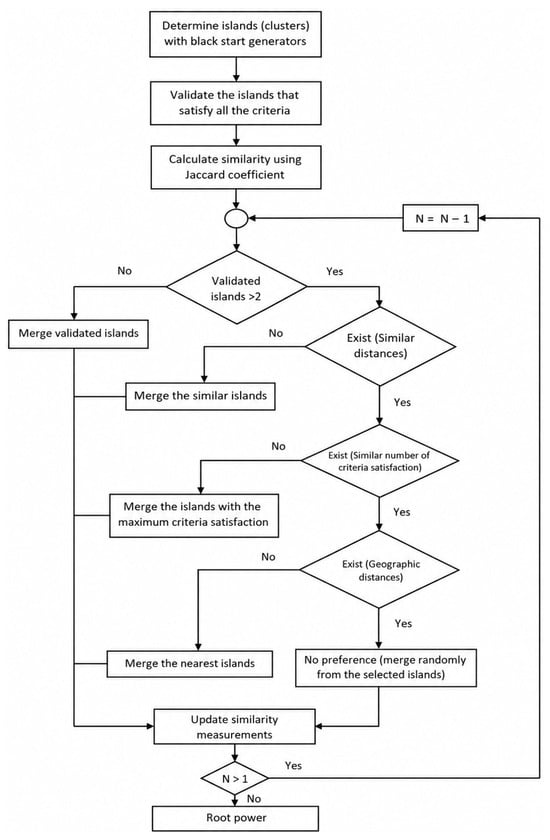
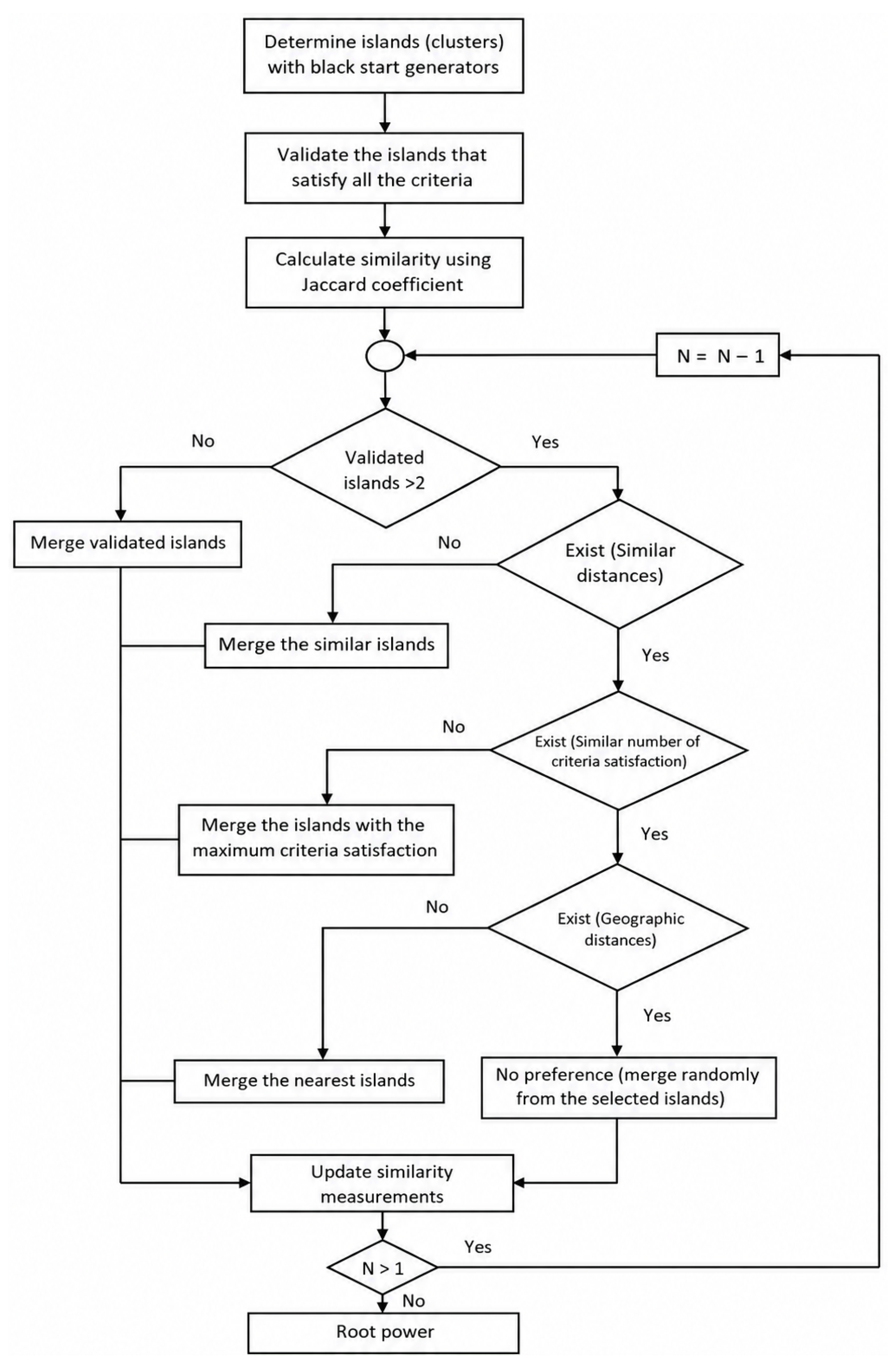
The proposed power restoration plan (Figure 1) consists of dividing the grid into smaller grids. The technique used in the power restoration process is called the build-up technique, where the system is divided into subsystems or islets. The islets formed must comply with the load balancing constraints of electricity production and voltage limits. This can be done by ensuring that the total capacity of the island’s generators is able to meet the island’s maximum load demand. The availability of black start (BS) generators on each island must also be taken into account. The BS generator, which works with an auxiliary power supply, is necessary for the restarting process [27]. Parallel reestablishment of the islands is performed before resynchronizing the islands into a complete system. The basic principle of this technique is to reduce the total recovery time and prevent the breakdown of the system from recurring due to disturbances linked to meteorological hazards and cascading failures [28]. Dividing the system into islands would improve the self-healing process and enable distribution systems to recover more quickly in the event of an outage, as well as avoiding cascade failure issues.
Figure 1.
The proposed power restoration plan.
The division of the system into subsystems (islands) must respect the following constraints [28]:
- Each island must have at least one BS unit, and the starter groups must be preserved;
- The system should have sufficient capacity to maintain a satisfactory frequency in generation and load;
- The system should have sufficient tension control resources to maintain an appropriate tension profile;
- The junction lines between the islands should all have monitoring equipment to measure the synchronization of the adjacent islands that they separate.
These constraints serve to avoid the sectionalization problem after dividing the grid into smaller networks where each has an initial black-start power. In the process of dividing the network into islands, clustering [29] was used as a single linkage method to be able to divide the system into different islands (clusters). The first step is to build the contingency table (also called the dissimilarity table). It is based on four dependent quantities, a, b, c and d [30], as indicated in (Table 2).
Table 2.
Binary decision matrix.
In the above,
The data used are binary; each island is represented by the satisfaction or non-satisfaction of each of the criteria for the division of the system. In addition, the attributes in this case are asymmetric.
In the similarity measure, the distances used depend on the type of data. For binary data, the Jaccard coefficient is used. In our clustering-based island merging strategy, we adopt the Jaccard similarity coefficient as the primary similarity measure between islands. The choice of Jaccard is grounded in its robustness to asymmetric binary data, which characterizes our island validation criteria (e.g., the presence of black-start generators, load balance, and voltage control). Compared to other similarity measures such as Dice or cosine similarity, the Jaccard index emphasizes the presence of shared attributes over the absence of features—an essential aspect when determining compatibility in island merging where only satisfied criteria (rather than unsatisfied ones) should influence similarity.
Additionally, this paper goes beyond traditional hierarchical clustering by integrating a rule-based merging logic. Merging decisions prioritize islands with higher validation scores, followed by generator capacity, and finally geographic proximity. This decision-making framework is critical for improving restoration speed and avoiding non-viable clusters, especially under operational constraints such as frequency control and synchronization.
The proposed framework focuses on restoration planning and island selection. The validity criteria are intended to ensure restoration feasibility at a planning level. Detailed operational constraints such as transient stability, frequency dynamics, voltage regulation, reactive power management, and protection system coordination are not explicitly modeled in the present study. These aspects are assumed to be handled by lower-level operational control mechanisms during the actual restoration process. Consequently, the proposed method should be interpreted as a restoration-planning strategy rather than a dynamic security assessment tool.
Jaccard Coefficient
Considering that V is the set of clusters, we define
Before applying the restoration procedure, the power system is partitioned into elementary restoration islands. Each zone containing a black-start (BS) generator is initially considered as an individual restoration island. Consequently, if N black-start generators are available, N initial islands are created. These islands constitute the starting point of the restoration process and are subsequently evaluated according to the validity criteria described below.
The proposed restoration-oriented clustering strategy can be summarized by the following algorithmic procedure:
- 1.
- Each element (zone in our case), which has a BS generator, represents a cluster (island), so N elements mean N clusters (islands).
- 2.
- Each island that meets the above criteria (above) is considered a valid island.
- 3.
- The similarity between the islands is calculated using the Jaccard coefficient.
- 4.
- Candidate islands are merged according to restoration feasibility and similarity. The merging process is performed under restoration constraints. A candidate pair is considered eligible only if at least one of the two islands is valid. During the restoration phase, priority is given to pairs composed of one valid island and one invalid island in order to progressively energize non-restored areas. Among all eligible pairs, the pair with the smallest Jaccard distance is selected. If multiple pairs have the same distance, the pair satisfying the largest number of restoration criteria is selected. If a tie still exists, preference is given to the pair with the largest available generation capacity. Geographic proximity is used as the final tie-breaking criterion. This priority is applied only during the restoration phase. Once all islands become valid, the remaining merges are performed according to the Jaccard distance hierarchy.
- 5.
- The Jaccard distance matrix is updated after each merge operation. The distance between the newly formed island and the remaining islands is calculated according to the single-linkage criterion:
- New Distance , index of the pair.
Following each merging operation, the resulting island is re-evaluated using the validation criteria described previously. Only islands satisfying the required validity conditions are considered eligible for subsequent restoration stages. - 6.
- Steps 4 and 5 are repeated until all islands become valid and the desired restoration configuration is achieved. In the final stage, the process continues until a single island representing the fully restored power system is obtained.
The restoration process terminates when all islands have been successfully merged into a single restored network. Consequently, the stopping condition corresponds to the existence of a unique island representing the complete power system.
The above procedure constitutes the formal restoration algorithm used throughout this work. Figure 1 illustrates the corresponding workflow and sequence of decision-making stages. The proposed power restoration strategy is summarized in the flowchart shown below.
In the merger process, the following priorities should be considered:
- 1.
- Merge valid islands (with invalid islands).
- 2.
- Merge recently created and invalid islands.
- 3.
- Merge recently created islands (no valid or invalid islands).
The proposed power restoration plan (Figure 1) makes it possible to restore the power grid in a reduced time period. Dividing the network into islands and restoring them in parallel by restarting all generators (generator startup sequencing problem) can offer very convincing results. The case study in the next section demonstrates how the suggested approach may actually deliver some very persuasive outcomes.
4. Case Study
Restoring electricity after a power outage represents a sensitive process. In the previous section, the suggested strategy to restore electricity following an incident (weather hazard) was outlined. This section serves to validate the proposal.
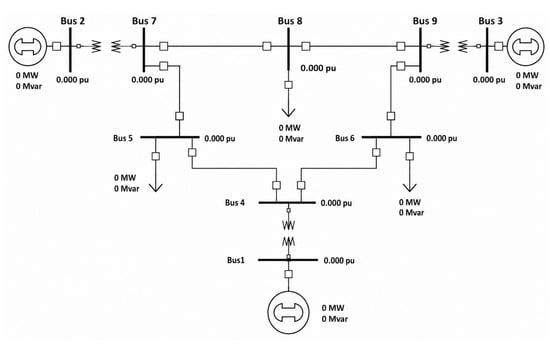
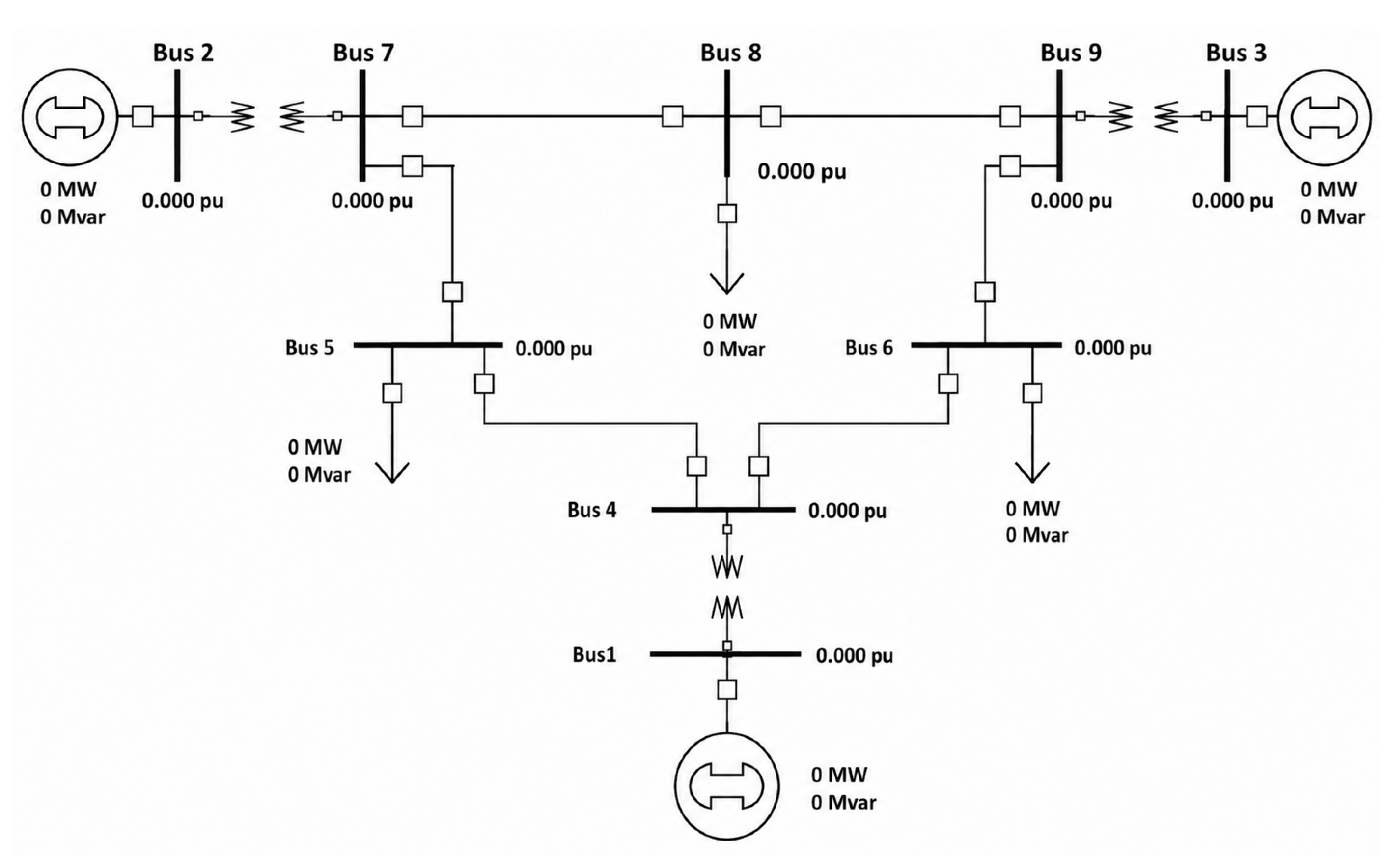
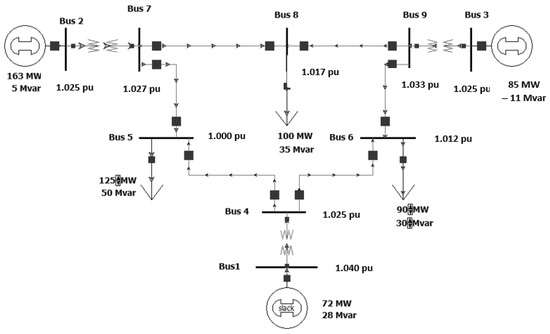
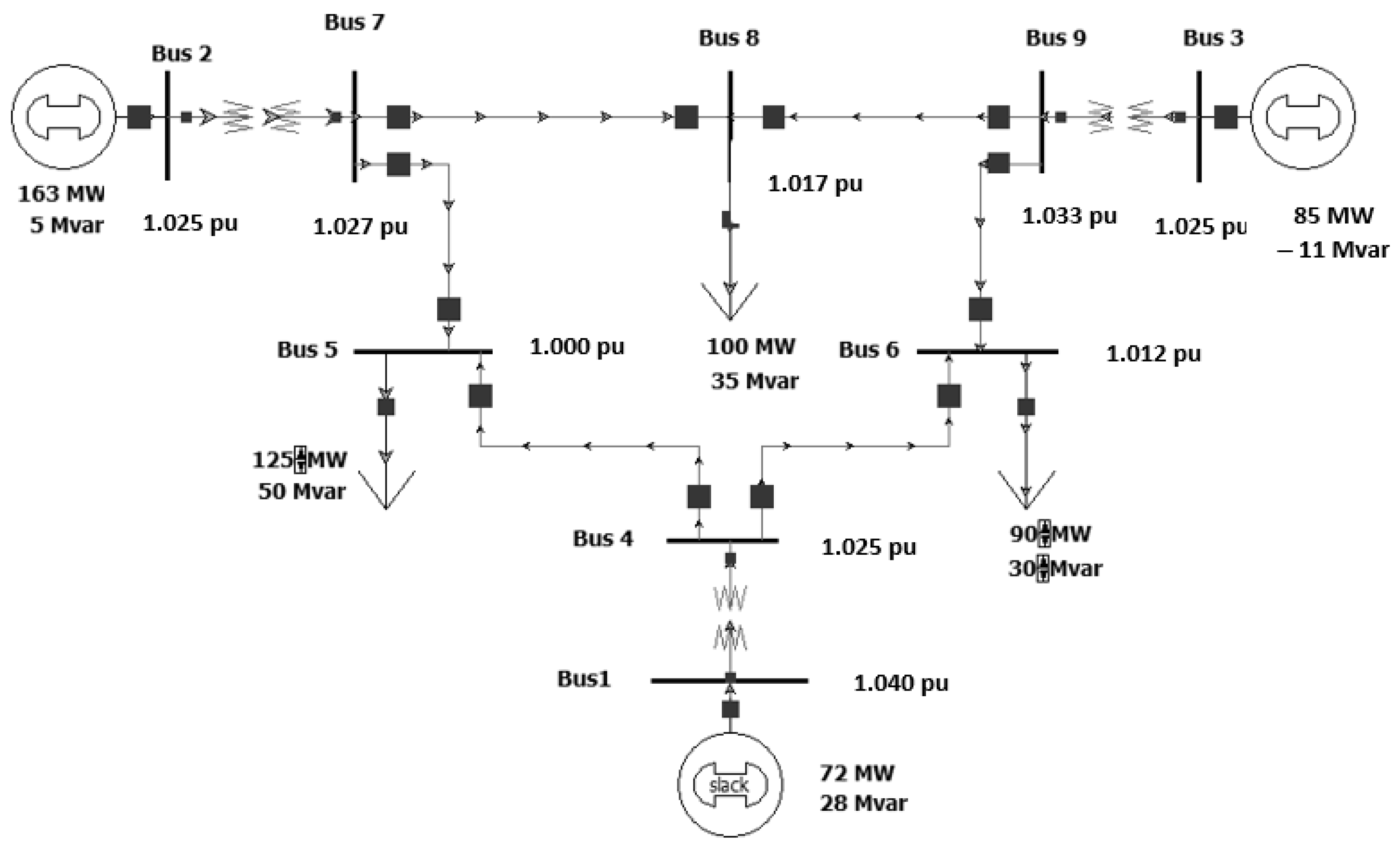
Using the IEEE nine-bus system (Figure 2) and in the Power World simulator, a power outage scenario was created. The system is considered in a full outage state, and the aim is to carry out the proposed plan to restore power. The steps of the simulation are presented below.
Figure 2.
The IEEE nine-bus system in the Power World simulator.
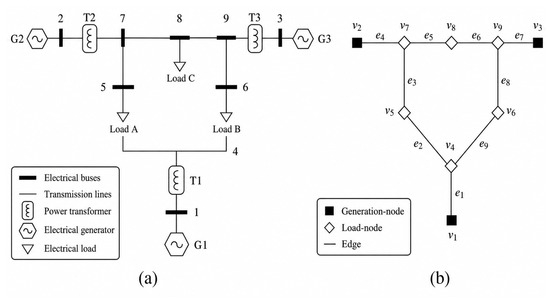
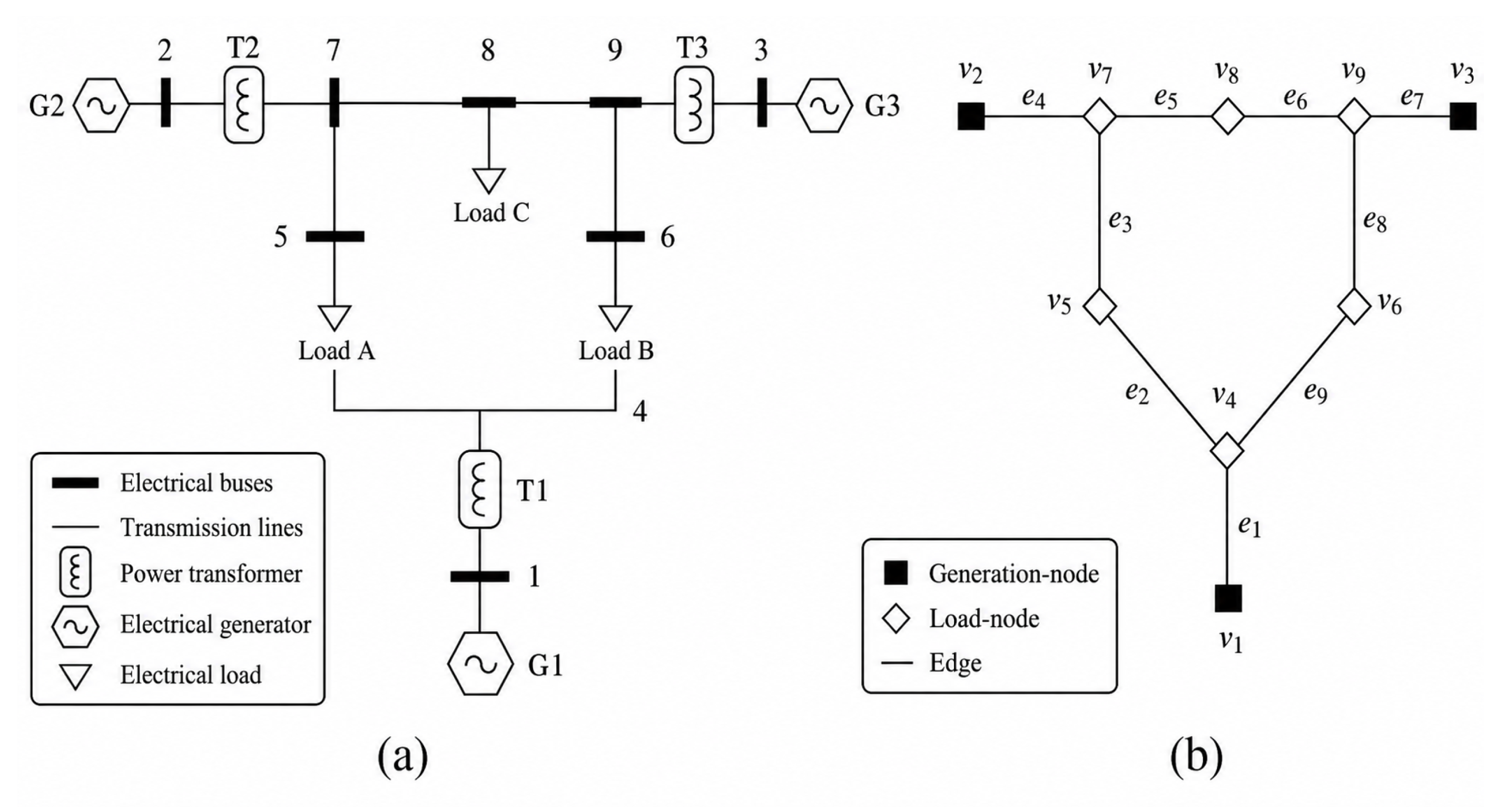
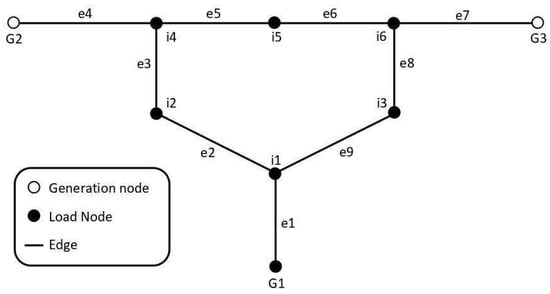
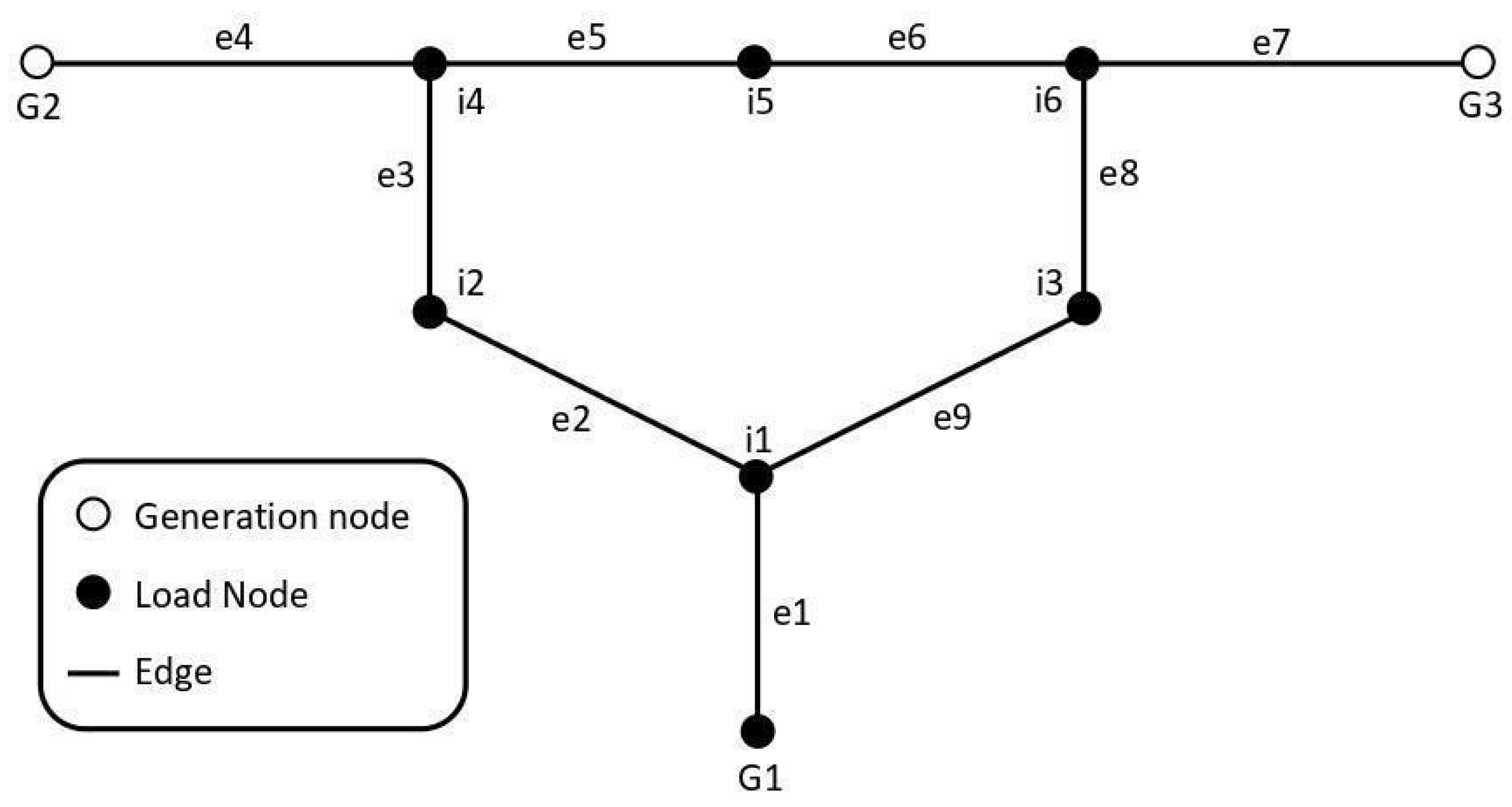
To better understand the architecture of the IEEE nine-bus system, Figure 3 shows a simplified representation of the system architecture. The first step consists of dividing the system into islands. In our case, the system contains three generators and six islands (Figure 4).
Figure 3.
Representation of the IEEE 9-bus system: (a) single-line diagram; (b) simplified graph representation [27].
Figure 4.
Island numbering.
The validity of each restoration island is assessed using five criteria (C1–C5), defined as operational and structural conditions related to connectivity, power availability, and restoration feasibility. Criteria C1–C4 represent individual operational checks that must be satisfied by each island, while C5 is not an independent input criterion but the resulting binary decision variable indicating whether an island is considered valid. Specifically, C5 is set to “Y” only when all required conditions (C1–C4) are satisfied according to the restoration rules defined in Section 3. This formulation ensures a clear distinction between input constraints and the final validation outcome used in the merging decision process.
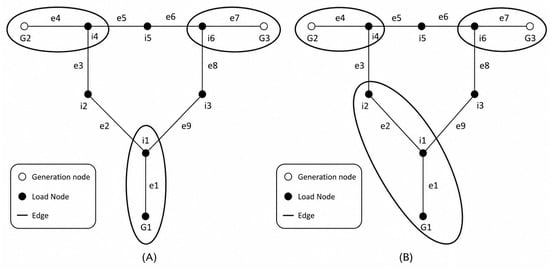
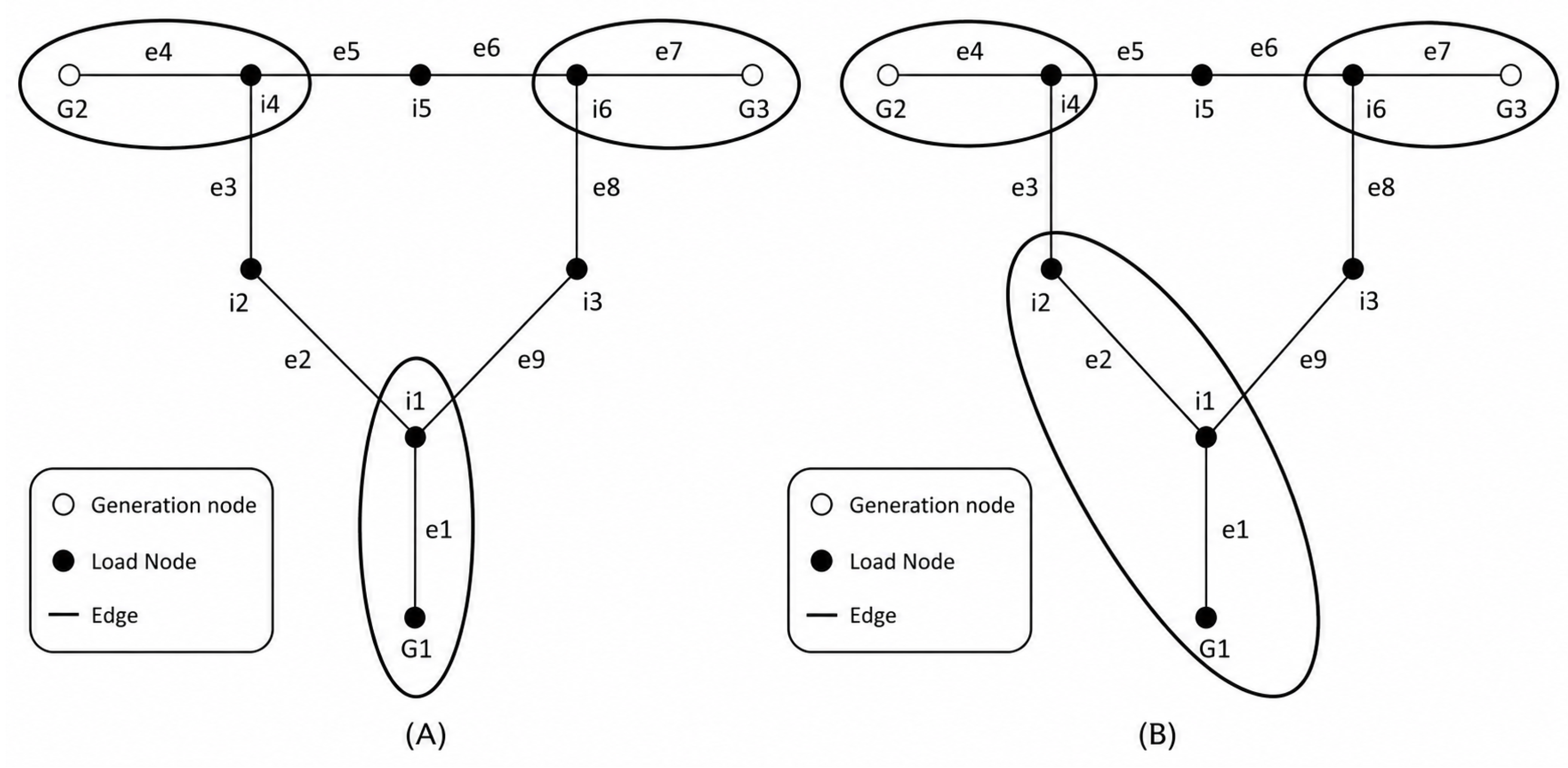
In the considered case study, islands directly connected to black-start generators are initially considered candidate valid islands. In this case, three generators are directly linked with islands (I1, I4, and I6), and they satisfy the validity criteria reported in Table 3, resulting in three valid islands.
Table 3.
Satisfaction of validation criteria for island formation.
The next step is to calculate the distance (Table 4) between the islands using the Jaccard coefficient. The Jaccard coefficient is first computed as a similarity measure between islands. The values reported in the following tables correspond to the associated Jaccard distance, defined as one minus the Jaccard similarity coefficient. Therefore, smaller distance values indicate greater similarity between islands, whereas larger distance values indicate lower similarity.
Table 4.
Distances between islands using the Jaccard coefficient.
The next step consists of selecting a candidate pair for merging. Three candidate pairs, namely (Island_1, Island_2), (Island_2, Island_4), and (Island_2, Island_6), have the same Jaccard distance (0.40). Since they satisfy the same similarity condition, the tie-breaking criteria are applied. The pair (Island_1, Island_2) is selected because it satisfies the largest number of restoration criteria.
Although the pairs (Island_1, Island_4), (Island_1, Island_6), and (Island_4, Island_6) exhibit the minimum Jaccard distance (0), they are not considered at this stage because they consist exclusively of already-valid islands (Figure 5). During the restoration phase, priority is given to valid–invalid pairs in order to progressively restore non-energized areas. Similarly, the pair (Island_2, Island_3) is not eligible because neither island is valid.
Figure 5.
(A) Valid islands; (B) network after the first phase.
In the same way, the pair that has a valid island with the shortest distance (Table 5) and is selected. In this case, two pairs are similar in terms of distance and number of criteria (Island_4, Island_3) and (Island_6, Island_3). The pair (Island_6, Island_3) is merged due to the direct connection of Island_6 and Island_3 (despite the high capacity of generator G2).
Table 5.
Distances table after the first phase.
At this stage, Island_5 is the only remaining invalid island. Consequently, restoration priority requires that it be connected to a valid island before any further merging between already-valid islands is performed. Therefore, the pair (Island_4, Island_5) is selected, as shown in Table 6, despite its larger Jaccard distance because it directly contributes to the restoration of the remaining non-energized area.
Table 6.
Distances after the second phase.
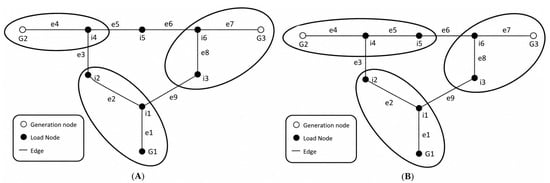
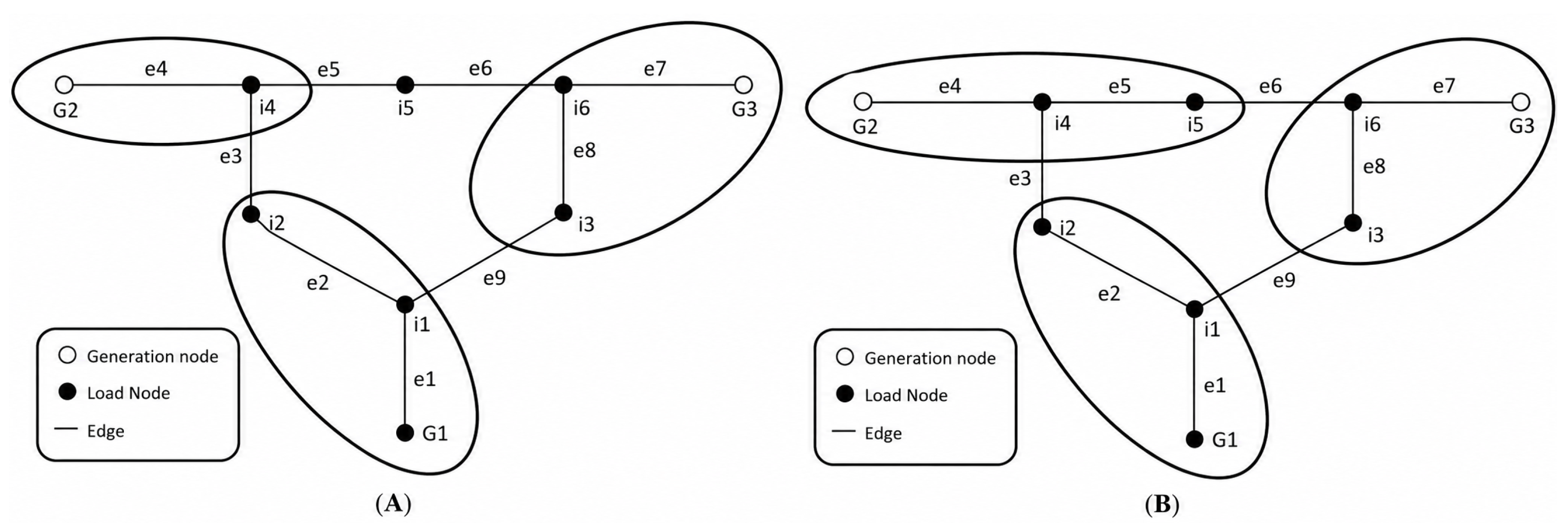
At this point, the network is fully replenished with three islands (subsystems) (Table 7). There is no longer a black area in the grid, which means the problem is resolved and the power is restored successfully (Figure 6A). The next step is to merge the sorted islands into the entire system.
Table 7.
Distances after the third phase.
Figure 6.
(A) Network after the second phase; (B) network after the third phase.
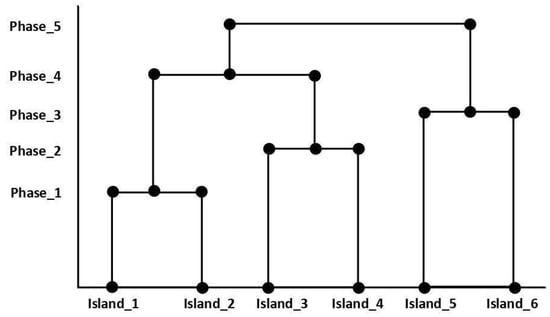
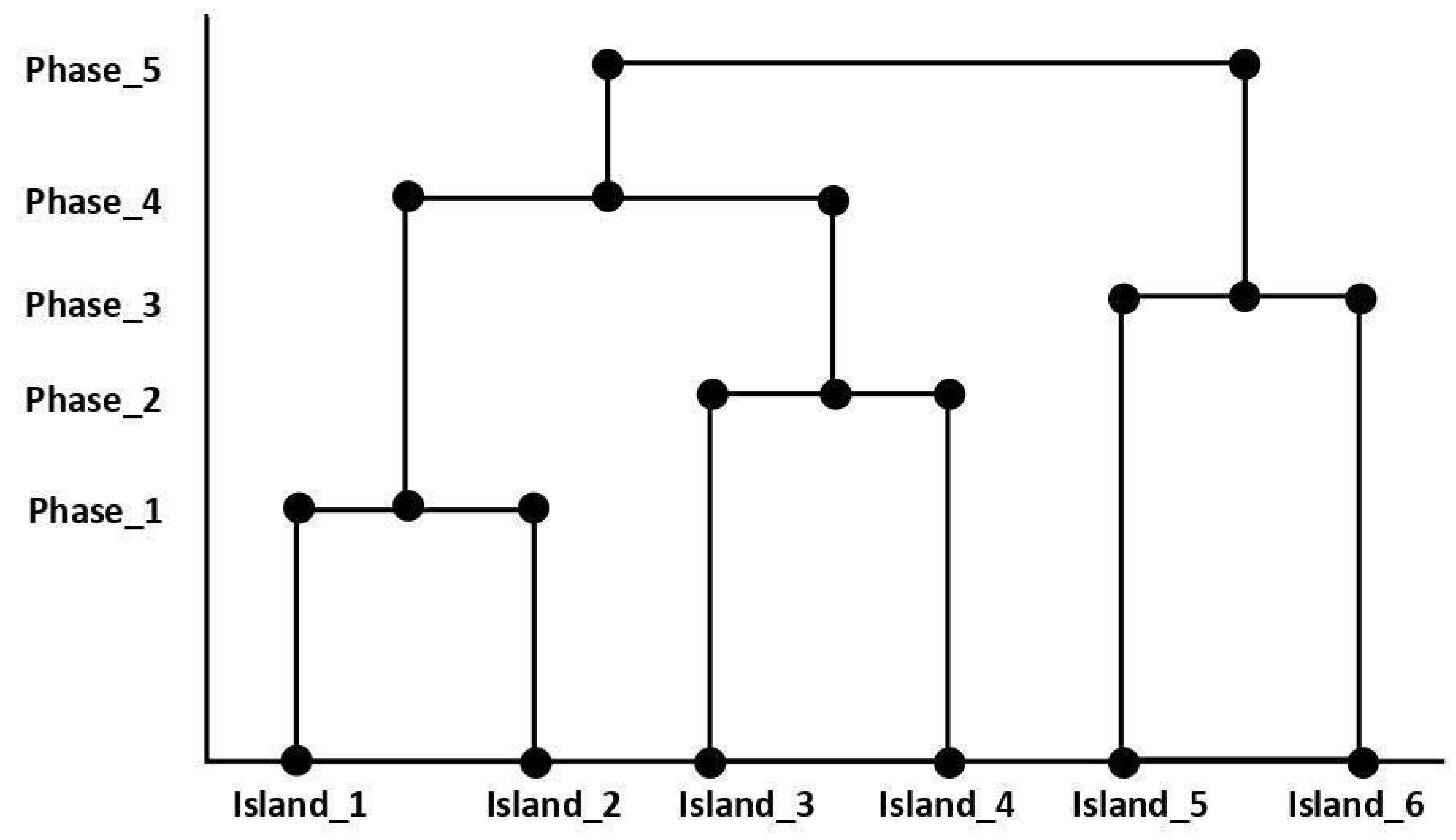
At this stage, there is no longer any priority, and there are three recently created islands, so the distances shown in the table should be respected. The process starts with the merging of the pairs (Island_1, Island_2) and (Island_4, Island_5), which have a distance of 0; then, this last island ((Island_1, Island_2) and (Island_4, Island_5)) will be merged with (Island_6, Island_3), which gives us the entire system (Figure 6B).
The sequence of merging illustrated in Figure 7 follows the restoration-oriented merging strategy described previously. During the restoration phase, valid islands are expanded by absorbing neighboring invalid islands. Once all islands become valid and no black area remains in the network, the final merging sequence is governed solely by the Jaccard distance hierarchy until the complete system is reconstructed.
Figure 7.
Merging of the dendrogram of the clustering process.
The IEEE 39-bus system, also known as the New England power system, is a standard medium-scale benchmark network widely used in power system stability and restoration studies. It consists of 39 buses, 10 generators, 34 transmission lines, and 12 load buses. Due to its interconnected structure and moderate complexity, it is commonly used to evaluate restoration and control strategies under realistic operating conditions.
The IEEE 118-bus system is a large-scale benchmark power network representing a more complex transmission system. It includes 118 buses, 54 generators, and 186 transmission lines. Its high topological complexity, increased number of generation units, and diverse load distribution make it suitable for evaluating the scalability, robustness, and efficiency of restoration strategies under large-scale blackout scenarios.
These systems complement the IEEE nine-bus system and enable the assessment of the proposed method across different levels of network complexity, ranging from small-scale to large-scale power systems.
After the IEEE nine-bus system (Figure 8), the proposed power restoration strategy is applied to the IEEE 39-bus and IEEE 118-bus systems and compared with other methods reported in the literature [31,32,33,34]. Although the results obtained on the IEEE 39-bus system are not superior to those of the other approaches (Table 8), they remain consistent and demonstrate the applicability of the proposed method.
Figure 8.
IEEE 9-bus system after power restoration.
Table 8.
Results obtained on the IEEE 39-bus system.
The time elapsed here is the time taken to restore power to the entire system after a total blackout.
The second system is the IEEE 118 bus, which tends to be more complex than the first. As mentioned earlier, the proposed method this time elicited the best results, 10 min less than those of [31], which obtained results of 360 min and 25 min less than those of [35,36,37], which obtained the result of 375 min (Table 9).
Table 9.
Results obtained on the IEEE 118-bus system.
The results presented in this study focus on elapsed restoration time, which was selected as the primary performance indicator for evaluating the proposed restoration-oriented clustering strategy. Although restoration time provides a useful measure of restoration efficiency, additional performance indicators such as restored load percentage, switching operations, voltage stability, frequency response, line loading, and robustness under different blackout scenarios were not considered in the present work. These aspects will be investigated in future studies to provide a more comprehensive assessment of restoration performance.
It should be noted that the comparative results reported in Table 8 and Table 9 were extracted from the corresponding studies cited in the tables and are reported for the same IEEE benchmark systems. The objective of these comparisons is to provide an indicative assessment of the restoration performance achieved by the proposed framework relative to representative restoration approaches from the literature. Since differences in modeling assumptions, restoration constraints, implementation details, and blackout scenarios may exist among the compared studies, the reported comparisons should not be interpreted as a fully standardized benchmark. A comprehensive comparative evaluation under identical simulation conditions constitutes an important direction for future work.
5. Discussion
The experimental results indicate that the proposed restoration-oriented clustering framework can effectively support power restoration planning. The observed improvements are primarily attributable to the decomposition of the network into restoration islands and the progressive merging strategy based on restoration feasibility and similarity assessment. The results obtained on the IEEE benchmark systems suggest that the benefits of the proposed framework become more pronounced as network size increases. In larger systems, the greater number of restoration paths and island configurations provides more opportunities for the restoration-oriented merging strategy to improve recovery efficiency.
During the restoration process, the proposed strategy operates by progressively reducing restoration complexity through network decomposition into smaller restoration islands. This decomposition enables parallel restoration actions, reducing interdependencies between restoration steps and accelerating overall system recovery. The prioritization of valid islands during the merging process ensures that restoration decisions remain feasible by maintaining access to generation resources, black-start capabilities, and sufficient operational constraints throughout the restoration sequence. The restoration-oriented merging strategy also reduces the probability of creating non-viable intermediate configurations by favoring valid–invalid island combinations before similarity optimization. As system size increases, the number of possible restoration paths and feasible island configurations also increases, allowing the hierarchical restoration strategy to exploit parallelism more effectively. This explains why larger systems such as the IEEE 118-bus network exhibit greater restoration-time improvements compared to medium-sized systems such as the IEEE 39-bus case, where fewer feasible restoration combinations are available.
Although the proposed framework achieved lower restoration times than the compared approaches for the studied benchmark systems, the comparisons should be interpreted in light of possible differences in modeling assumptions and restoration scenarios among the referenced studies.
Although the proposed framework demonstrated promising performance, the level of improvement observed in the IEEE 39-bus system was less pronounced than that achieved for larger benchmark systems. Additionally, the system has not yet been tested under severe disturbance scenarios. Additional experiments are required to investigate potential opportunities for improving system efficiency. Future work may involve applying advanced methods and tools to further strengthen smart-grid resilience and enhance the power restoration process.
6. Conclusions and Future Work
This paper presented a modular self-healing power restoration strategy aimed at reducing restoration time following large-scale blackouts and supporting restoration planning in smart grids.
The method combines grid decomposition with a rule-based clustering technique using the Jaccard similarity coefficient to enable parallel island restoration and optimized system recovery. A merging logic based on validation constraints, generator capacity, and proximity was shown to improve restoration time and support restoration-oriented decision-making during the recovery process. Although the proposed framework incorporates mechanisms intended to reduce unfavorable restoration configurations, its impact on cascading failures has not been quantitatively evaluated and remains the subject of future work. The obtained results demonstrate the effectiveness and scalability of the proposed restoration-oriented clustering framework, particularly for medium- and large-scale power systems. The proposed method achieved restoration-time reductions ranging from 10 to 25 min compared with representative benchmark approaches on the IEEE 118-bus system. Although the improvements observed for smaller systems were less pronounced, the results confirm the modularity and applicability of the proposed framework for complex power networks.
The study has some limitations. The proposed framework focuses on restoration planning under static operating conditions and does not explicitly model dynamic phenomena such as voltage regulation, frequency response, generator ramp-rate constraints, renewable generation variability, battery energy storage systems, or inverter-based resources. Consequently, the proposed method should be viewed as a restoration-planning framework rather than a complete dynamic restoration simulator. Nevertheless, restoration planning remains a necessary preliminary stage before dynamic restoration execution and operational control. Future research will focus on extending the proposed framework by incorporating renewable energy sources [38], battery energy storage systems, inverter-based generation, dynamic security assessment constraints, and detailed voltage and frequency stability analyses.
The proposed strategy contributes to ongoing efforts to develop faster and more resilient grid restoration mechanisms. Beyond direct performance gains, it has potential implications for system planning, disaster preparedness, and critical infrastructure resilience. Its modular structure also makes it a suitable candidate for integration with AI-driven decision support and multi-agent control platforms, supporting future directions toward fully automated restoration in smart grid environments.
Author Contributions
Conceptualization, A.K.; Methodology, A.K. and S.B.; Software, A.K.; Validation, A.K., S.B., H.B., P.R. and Y.M.A.; Formal analysis, A.K.; Investigation, A.K.; Resources, A.K.; Data curation, A.K.; Writing—original draft, A.K.; Writing—review & editing, A.K., S.B., H.B., P.R. and Y.M.A.; Visualization, A.K.; Supervision, A.K.; Project administration, A.K.; Funding acquisition, A.K. All authors have read and agreed to the published version of the manuscript.
Funding
This research received no external funding.
Data Availability Statement
The data supporting the findings of this study are based on the IEEE nine-bus, IEEE 39-bus, and IEEE 118-bus test systems, which are publicly available through the IEEE Power & Energy Society benchmark repositories and related literature.
Conflicts of Interest
The authors declare no conflicts of interest.
Abbreviations
The following abbreviations are used in this manuscript:
| ICT | information and communication technology |
| HVDC | High Voltage Direct Current |
| SCADA | Supervisory Control and Data Acquisition |
| BS | Black Start |
| NBS | Non-Black-Start |
| GRMs | Generic Restoration Milestones |
| WECC | Western Electricity Coordinating Council |
| GDSS | Group Decision Support System |
| PSS/E | Power System Simulators for Engineering |
| WD-PSSs | Wide-area Decentralized Power System stabilizers |
| MAS | Multi Agent System |
| PPSR | Parallel Power System Restoration |
| SSs | Suitable Sectionalizing strategies |
References
- Allen, E.H.; Stuart, R.B.; Wiedman, T.E. No light in August: Power system restoration following the 2003 North American blackout. IEEE Power Energy Mag. 2013, 12, 24–33. [Google Scholar] [CrossRef] [Scilit]
- Henderson, M.I. When the Lights Go Out: Getting Power Systems Running Again [Guest Editorial]. IEEE POwer Energy Mag. 2013, 12, 18–23. [Google Scholar] [CrossRef] [Scilit]
- Campbell, R.J.; Lowry, S. Weather-Related Power Outages and Electric System Resiliency; Technical Report; Congressional Research Service, Library of Congress: Washington, DC, USA, 2012. [Google Scholar]
- Avancini, D.B.; Rodrigues, J.J.P.C.; Martins, S.G.B.; Rabêlo, R.A.L.; Al-Muhtadi, J.; Solic, P. Energy meters evolution in smart grids: A review. J. Clean. Prod. 2019, 217, 702–715. [Google Scholar] [CrossRef] [Scilit]
- Almihat, M.G.M.; Munda, J.L. The Role of Smart Grid Technologies in Urban and Sustainable Energy Planning. Energies 2025, 18, 1618. [Google Scholar] [CrossRef] [Scilit]
- Jia, D.; Meng, X.; Song, X. Study on technology system of self-healing control in smart distribution grid. In Proceedings of the 2011 International Conference on Advanced Power System Automation and Protection, Beijing, China, 16–20 October 2011; Volume 1, pp. 26–30. [Google Scholar]
- Silva, N.S.e.; Castro, R.; Ferrão, P. Smart Grids in the Context of Smart Cities: A Literature Review and Gap Analysis. Energies 2025, 18, 1186. [Google Scholar] [CrossRef] [Scilit]
- Liu, L.; Zhao, X. Study on self-healing control strategy of smart distribution network. In Proceedings of the IEEE PES Innovative Smart Grid Technologies, Tianjin, China, 21–24 May 2012; pp. 1–3. [Google Scholar]
- Refaat, S.S.; Mohamed, A.; Kakosimos, P. Self-Healing control strategy; Challenges and opportunities for distribution systems in smart grid. In Proceedings of the 2018 IEEE 12th International Conference on Compatibility, Power Electronics and Power Engineering (CPE-POWERENG 2018), Doha, Qatar, 10–12 April 2018; pp. 1–6. [Google Scholar]
- Esparza, A.; Blondin, M.; Trovão, J.P.F. A Review of Optimization Strategies for Energy Management in Microgrids. Energies 2025, 18, 3245. [Google Scholar] [CrossRef] [Scilit]
- Abbasi, S.; Barati, M.; Lim, G. A parallel sectionalized restoration scheme for resilient smart grid systems. IEEE Trans. Smart Grid 2017, 10, 1660–1670. [Google Scholar] [CrossRef] [Scilit]
- Belkacemi, R.; Bababola, A.; Zarrabian, S.; Craven, R. Multi-agent system algorithm for preventing cascading failures in smart grid systems. In Proceedings of the 2014 North American Power Symposium (NAPS), Pullman, WA, USA, 7–9 September 2014. [Google Scholar]
- Che, L.; Khodayar, M.; Shahidehpour, M. Only Connect: Microgrids for Distribution System Restoration. IEEE Power Energy Mag. 2014, 12, 70–81. [Google Scholar]
- Che, L.; Shahidehpour, M. Adaptive formation of microgrids with mobile emergency resources for critical service restoration in extreme conditions. IEEE Trans. Power Syst. 2018, 34, 742–753. [Google Scholar] [CrossRef] [Scilit]
- Khediri, A.; Laouar, M.R.; Eom, S.B. Enhancing Resiliency Feature in Smart Grids through a Deep Learning Based Prediction Model. Recent Adv. Comput. Sci. Commun. 2020, 13, 508–518. [Google Scholar] [CrossRef] [Scilit]
- Khediri, A.; Laouar, M.R. Intelligent decision support system for electric power restoration. In Proceedings of the 7th International Conference on Software Engineering and New Technologies, Hammamet, Tunisia, 26–28 December 2018. [Google Scholar]
- Khediri, A.; Laouar, M.R.; Eom, S.B. Decision Support System Architecture for Smart Grid’s Hardening Against Weather Hazard. In Proceedings of the International Conference on Advanced Intelligent Systems for Sustainable Development, Marrakech, Morocco, 8–11 July 2019; Springer: Cham, Switzerland, 2019. [Google Scholar]
- Ren, F.; Zhang, M.; Soetanto, D.; Su, X. Conceptual design of a multi-agent system for interconnected power systems restoration. IEEE Trans. Power Syst. 2012, 27, 732–740. [Google Scholar] [CrossRef] [Scilit]
- Qiu, F.; Wang, J.; Chen, C.; Tong, J. Optimal black start resource allocation. IEEE Trans. Power Syst. 2015, 31, 2493–2494. [Google Scholar] [CrossRef] [Scilit]
- Chen, C.; Wang, J.; Ton, D. Modernizing distribution system restoration to achieve grid resiliency against extreme weather events: An integrated solution. Proc. IEEE 2017, 105, 1267–1288. [Google Scholar] [CrossRef] [Scilit]
- Hou, Y.; Liu, C.C.; Sun, K.; Zhang, P.; Liu, S.; Mizumura, D. Computation of milestones for decision support during system restoration. In Proceedings of the 2011 IEEE Power and Energy Society General Meeting, Detroit, MI, USA, 24–28 July 2011; pp. 1–10. [Google Scholar]
- Liu, Y.; Sun, P.; Wang, C. Group decision support system for backbone-network reconfiguration. Int. J. Electr. Power Energy Syst. 2015, 71, 391–402. [Google Scholar] [CrossRef] [Scilit]
- Medina, D.R.; Rappold, E.; Sanchez, O.; Luo, X.; Rodriguez, S.R.R.; Wu, D.; Jiang, J.N. Fast assessment of frequency response of cold load pickup in power system restoration. IEEE Trans. Power Syst. 2015, 31, 3249–3256. [Google Scholar] [CrossRef] [Scilit]
- Hadidi, R.; Jeyasurya, B. Reinforcement learning based real-time wide-area stabilizing control agents to enhance power system stability. IEEE Trans. Smart Grid 2013, 4, 489–497. [Google Scholar]
- Zidan, A.; El-Saadany, E.F. A cooperative multiagent framework for self-healing mechanisms in distribution systems. IEEE Trans. Smart Grid 2012, 3, 1525–1539. [Google Scholar] [CrossRef] [Scilit]
- Mota, A.A.; Mota, L.T.M.; Morelato, A. Visualization of power system restoration plans using CPM/PERT graphs. IEEE Trans. Power Syst. 2007, 22, 1322–1329. [Google Scholar] [CrossRef] [Scilit]
- Quirós-Tortós, J.; Panteli, M.; Wall, P.; Terzija, V. Sectionalising methodology for parallel system restoration based on graph theory. IET Gener. Transm. Distrib. 2015, 9, 1216–1225. [Google Scholar] [CrossRef] [Scilit]
- Khediri, A.; Laouar, M.R. Deep-belief network based prediction model for power outage in smart grid. In Proceedings of the 4th ACM International Conference of Computing for Engineering and Sciences, Kuala Lumpur, Malaysia, 6–8 July 2018. [Google Scholar]
- Johnson, S.C. Hierarchical clustering schemes. Psychometrika 1967, 32, 241–254. [Google Scholar] [CrossRef] [Scilit] [PubMed]
- Warrens, M.J. Similarity Coefficients for Binary Data: Properties of Coefficients, Coefficient Matrices, Multi-Way Metrics and Multivariate Coefficients. Ph.D. Thesis, Leiden University, Leiden, The Netherlands, 2008. [Google Scholar]
- Abu Talib, D.N.; Mokhlis, H.; Abu Talip, M.S.; Naidu, K.; Suyono, H. Power system restoration planning strategy based on optimal energizing time of sectionalizing islands. Energies 2018, 11, 1316. [Google Scholar] [CrossRef] [Scilit]
- Lin, Z.Z.; Wen, F.S.; Chung, C.Y.; Wong, K.P.; Zhou, H. Division algorithm and interconnection strategy of restoration subsystems based on complex network theory. IET Gener. Transm. Distrib. 2011, 5, 674–683. [Google Scholar] [CrossRef] [Scilit]
- Liu, W.; Lin, Z.; Wen, F.; Chung, C.Y.; Xue, Y.; Ledwich, G. Sectionalizing strategies for minimizing outage durations of critical loads in parallel power system restoration with bi-level programming. Int. J. Electr. Power Energy Syst. 2015, 71, 327–334. [Google Scholar] [CrossRef] [Scilit]
- Quirós-Tortós, J.; Terzija, V. A graph theory based new approach for power system restoration. In Proceedings of the 2013 IEEE Grenoble Conference, Grenoble, France, 16–20 June 2013; pp. 1–6. [Google Scholar]
- Quirós-Tortós, J.; Wall, P.; Ding, L.; Terzija, V. Determination of sectionalising strategies for parallel power system restoration: A spectral clustering-based methodology. Electr. Power Syst. Res. 2014, 116, 381–390. [Google Scholar] [CrossRef] [Scilit]
- Quirós Tortós, J.; Terzija, V. A smart power system restoration based on the merger of two different strategies. In Proceedings of the 2012 3rd IEEE PES Innovative Smart Grid Technologies Europe (ISGT Europe), Berlin, Germany, 14–17 October 2012; pp. 1–8. [Google Scholar]
- Wang, C.; Vittal, V.; Sun, K. OBDD-based sectionalizing strategies for parallel power system restoration. IEEE Trans. Power Syst. 2010, 26, 1426–1433. [Google Scholar] [CrossRef] [Scilit]
- Peer, M.S.; Cascetta, M.; Migliari, L.; Petrollese, M. Nanofluids in Thermal Energy Storage Systems: A Comprehensive Review. Energies 2025, 18, 707. [Google Scholar] [CrossRef] [Scilit]

Disclaimer/Publisher’s Note: The statements, opinions and data contained in all publications are solely those of the individual author(s) and contributor(s) and not of MDPI and/or the editor(s). MDPI and/or the editor(s) disclaim responsibility for any injury to people or property resulting from any ideas, methods, instructions or products referred to in the content. |
© 2026 by the authors. Licensee MDPI, Basel, Switzerland. This article is an open access article distributed under the terms and conditions of the Creative Commons Attribution (CC BY) license.