


Abstract
The trend in the power electronics industry toward higher power density and efficiency has brought high-frequency transformers (HFTs) to the forefront of critical applications, including isolated DC–DC converters, electric vehicle chargers, and solid-state transformers. This paper focuses on the leakage inductance of HFTs and presents a systematic comparative framework that evaluates five surrogate modeling and hybrid optimization approaches for the rapid and accurate estimation of leakage inductance. A comprehensive parametric dataset was constructed, comprising 1210 finite element analysis simulations conducted via finite element analysis in the ANSYS Maxwell 2024 R1 environment, varying the number of winding turns, primary winding thickness, and secondary winding thickness of the HFT. All five methods were trained and evaluated on the same dataset under identical conditions. The comparative evaluation demonstrates that the proposed hybrid Gray Wolf optimizer–artificial neural network (GWO-ANN) framework achieved the highest prediction accuracy (R2 = 0.9832, MSE = 0.01780, MAE = 0.0935 µH) and the fastest convergence among all tested approaches. The generalization capability of the proposed model was confirmed through blind validation tests across six geometric configurations spanning the full range of the design space, yielding a maximum prediction error of 8.15% and an average error of 2.14%. The functional validity of the proposed parameters was further tested in a third validation layer using MATLAB/Simulink R2024b transformer circuit studies, demonstrating a theoretical efficiency of 96.06%. This three-layer validation approach proves both the parametric and functional reliability of the proposed framework for HFT designs.
1. Introduction
The trend of the power electronics industry toward higher power density and efficiency has brought high-frequency transformers (HFTs) to the center of critical applications such as isolated DC–DC converters, electric vehicle chargers, and solid-state transformers [1,2]. In converter topologies such as phase-shifted full-bridge, dual-active-bridge, and LLC resonant converters, leakage inductance has ceased to be merely a parasitic element; it has become a functional constituent of the resonant tank or energy-transfer mechanism that must be precisely controlled to meet application-specific performance targets [1,3]. The principal geometric parameters governing leakage inductance in HFT design, including the number of winding turns, conductor dimensions, inter-winding separation, and core window geometry, interact nonlinearly, making accurate prediction during the early design phase a persistent engineering challenge [1].
Analytical methods commonly used in leakage inductance modeling, especially the Dowell model [4], offer reasonable accuracy when the transformer’s winding geometry is simple. However, the accuracy of these models decreases significantly when considering Litz wire [5], multilayer winding structures, interleaved winding arrangements, and skin and proximity effects that become apparent at high frequencies [2,6]. Specifically, analytical methods that neglect the irregular inter-turn region in Litz wire windings yield relative errors as high as 16.25% at wire densities around 62.5% over a frequency range of 50 kHz to 2000 kHz [5]. A methodology that substantially reduces this computational burden while maintaining finite element analysis (FEA)-level accuracy and enabling automated geometric optimization therefore represents a clearly unmet need in the field.
Existing research on leakage inductance modeling and optimization can be organized into three complementary areas, as follows: (i) analytical and semi-analytical models, (ii) machine learning-based surrogate approaches, and (iii) metaheuristic optimization algorithms.
On the analytical side, Dowell’s layered winding model [4] remains widely used, though its limitations in complex geometries have motivated alternative formulations [6]. The magnetic image method achieves errors below 1.25% for certain E–E core configurations [7], and an improved method grounded in precise magnetic field analysis has been presented [8]. Accurate analytical formulations for Litz wire windings that explicitly account for the irregular geometry of the winding region have been developed [5]. In contrast, an analytical model tailored to leakage reactance under radial deformation of the winding has been reported [9].
The literature on machine learning offers increasingly powerful alternatives for magnetic parameter estimation. Ref. [10] proposes a physics-informed artificial neural network (PINN) framework for medium-frequency transformer modeling that achieves errors below 5% at ten times the computational speed of FEA. Taking a complementary direction, the hybrid deep artificial neural network (HDANN) structure [11] employs an artificial neural network (ANN) to correct the frequency and geometry-dependent errors of the Dowell model, combining analytical speed with data-driven accuracy. Multilayer perceptron-based prediction of leakage inductance and parasitic capacitance in planar transformers has been addressed [12], and a data-driven approach combining homogenized FEA with the Random Forest algorithm for Litz-wire HFTs has been developed [13]. A bidirectional long short-term memory algorithm has been applied [14] to predict parameter shifts caused by thermal aging in planar transformers, and adaptive neuro-fuzzy inference system (ANFIS)-based frameworks for leakage inductance and core loss estimation have been reported respectively [15,16]. Beyond neural architectures, support vector machines (SVMs) have been shown to be compact and accurate surrogate models for uncertainty quantification of high-dimensional electromagnetic devices, achieving strong generalization from limited training data [17]. Despite this, a systematic benchmark comparison of multiple surrogate model types trained and evaluated under identical conditions on the same FEA dataset has not been reported for HFT leakage inductance estimation.
Metaheuristic algorithms have similarly been applied to transformer parameter estimation and design optimization. Evolutionary algorithms, including genetic algorithms, particle swarm optimization (PSO) [18], and gravitational search algorithms, have been used for transformer equivalent circuit parameter estimation, with errors reported below 12% [19]. The Gray Wolf optimizer (GWO) [20] has demonstrated competitive exploration–exploitation balance in surrogate-assisted engineering optimization, and its superiority among bio-inspired algorithms in ANN-coupled design tasks has been confirmed in recent comparative benchmarks [21]. The marine predators algorithm (MPA) [22], whose Lévy and Brownian foraging mechanics confer robust global search capability, and the invasive weed optimization (IWO) [23], which models the adaptive colonization strategy of invasive weeds, have both demonstrated strong convergence performance across diverse continuous engineering optimization problems. To the authors’ knowledge, however, no study has systematically compared multiple metaheuristic–ANN hybrid frameworks under identical training and evaluation conditions specifically for HFT leakage inductance optimization.
This literature review thus identifies four principal gaps. First, existing ANN surrogate models for leakage inductance are typically validated on small datasets and narrow geometric regions, with limited evidence of generalization across the full design space [6,13]. Second, advanced approaches such as PINN and HDANN, while highly accurate, involve significant implementation complexity and limited interpretability that hinder broad adoption [10,11]. Third, no benchmark study comparing surrogate model types such as SVM versus metaheuristic–ANN hybrids on a common HFT FEA dataset exists in the literature. Fourth, the integration of systematic multi-point blind validation spanning diverse geometric configurations with metaheuristic-driven geometric optimization has not been demonstrated for this problem class.
Addressing these gaps, this paper presents a framework that trains and evaluates five surrogate modeling and hybrid optimization approaches on a common 1210-point parametric FEA dataset under identical conditions. These five approaches include SVM, PSO-ANN, IWO-ANN, MPA-ANN, and GWO-ANN.
The contributions of this study are as follows:
- Construction of a 1210-point parametric FEA dataset through a full-factorial scan of three fundamental HFT geometric parameters, the number of winding turns and the primary and secondary winding thicknesses, conducted in ANSYS Maxwell 2024 R1.
- Systematic comparison of five surrogate modeling and hybrid optimization approaches (SVM, PSO-ANN, IWO-ANN, MPA-ANN, and GWO-ANN) on the same dataset under identical training, validation, and test conditions.
- Development of the best-performing GWO-ANN hybrid framework for optimal geometric parameter identification completed within seconds, achieving R2 = 0.9832 and MAE = 0.0935 µH.
- Validation of the proposed framework through a three-layer architecture comprising blind FEA tests over six geometrically diverse configurations for the most optimal HFT designs, with an average prediction error of 2.14%, independent FEA verification of the GWO-identified design point, and MATLAB/Simulink R2024b circuit-level validation, yielding a simulated efficiency of 96.06%.
The remainder of this paper is organized as follows: Section 2 presents the HFT geometry and leakage inductance formulation. Section 3 describes the parametric FEA dataset. Section 4 introduces the proposed hybrid framework and compares it with four other methods. Section 5 evaluates the performance of the proposed technique and presents its multilayer validation results. Section 6 discusses the key findings and summarizes the conclusions and limitations of the study.
2. HFT Geometry and Leakage Inductance
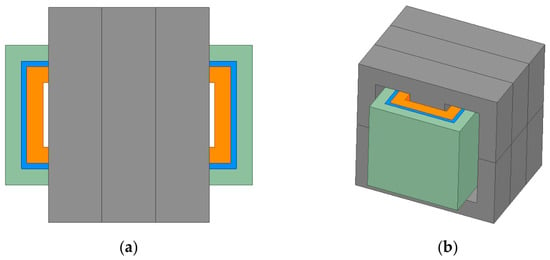
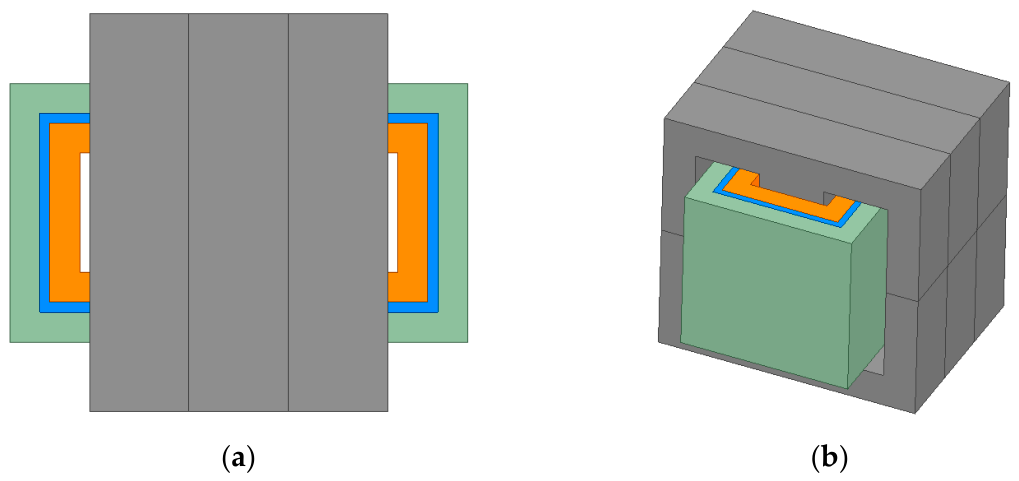
The HFT examined in this study was designed for isolated DC–DC converter applications and built on an E–E type core (Figure 1), in which the primary and secondary windings are wound together. Three fundamental geometric parameters that directly affect leakage inductance behavior in this design were identified as the independent variables for parametric study. The number of winding turns (), representing the total number of turns in the winding window, was changed only for the primary side while the secondary winding was kept constant. The primary winding thickness () in centimeter (cm) is the thickness of the copper winding forming the primary winding and directly affects the window filling ratio and the distance between the windings. The secondary winding thickness () in cm is the thickness of the secondary winding and contributes to the geometric structure that determines the leakage flux path. Equation (1) is frequently used to calculate leakage inductance in transformers, with the primary winding as stated [24]:
where = 4π H/m represents the magnetic permeability of free space (air gap), is the mean winding length in cm, is the winding height in cm, and denotes the insulation gap thickness between the windings in cm. All geometrical quantities in (1) must be expressed in SI units (m) before evaluating .
Figure 1.
Considered E–E core transformer geometry: (a) top view (b) 3D view.
In this study, , , and are considered as the optimization variables. The insulation gap in (1) is not an independent geometric parameter but is geometrically constrained by the fixed core window configuration. Within the E–E core window used in this study, the positions of the primary and secondary windings are determined by their respective thicknesses and ; as these vary across the parametric scan, the physical distance between the windings changes accordingly within the fixed core window geometry. This implicit dependency, whereby the inter-winding gap is a consequence of the conductor dimensions rather than a separately assignable variable, is consistent with established leakage inductance modeling practice for HFTs, in which the insulation thickness and winding geometry together determine the leakage flux path [25,26]. Providing a closed-form algebraic expression in the form of is not straightforward in this configuration, because the gap does not follow a simple linear rule. This is because the winding stack height depends on the number of turns, conductor cross-section, and layer arrangement simultaneously, and the residual window space is distributed across insulation layers in a manner that is fully captured by the parametric FEA. As such, is an implicit function of and , and its variation is inherently captured through the FEA simulations rather than being prescribed as a separate input.
The leakage inductance arises from a flux component that cannot connect the primary and secondary windings and flows only within the winding region. It can be expressed in terms of the stored magnetic energy in the following form [24]:
where denotes the leakage inductance in H, is the stored magnetic energy in Joule, and represents the current in the corresponding coil in A. In the FEA environment, is calculated directly from the flux density distribution in the simulation space, offering superior geometric accuracy compared to analytical methods. The objective of this study was to determine the optimal geometric parameter vector that minimizes the absolute deviation between the leakage inductance and the ANN-predicted leakage inductance. The constraints applied include the window area limit (i.e., total conductor cross-sectional area not exceeding the window capacity); core window size () in mm2, current density limit in terms of thermal limits () in A/mm2, fill factor limit (), and manufacturability constraints.
3. Parametric FEA Dataset
First, parametric studies were performed in ANSYS Maxwell 2024 R1software. The transient solver in the software was used with sinusoidal current excitation at the transformer’s operating frequency to enable AC analysis and thus capture frequency-dependent effects (i.e., surface and proximity effects). It should be emphasized that the parametric FEA dataset used in this study was created independently of previous ANFIS-based studies [15,16] and differs from these in terms of the core structure and material, winding configuration, and variable spacing considered.
The design space was systematically scanned using a full factorial sampling scheme that includes all combinations of the three independent parameters. In the applied parametric scan, was varied between 10 and 30 turns in unit increments, while the primary and secondary winding thicknesses varied respectively from 10 to 15 mm and 20 to 24 mm in 1 mm steps, based on the expected operating and design parameters of a 500 W HFT [1,27]. The parameter ranges were determined by the geometric boundaries of the selected E–E core window. The chosen increments ensure full coverage of the feasible design space within the winding window constraints, making the framework applicable to a range of HFT designs rather than a single operating point. The full factorial design offers a decisive advantage over Latin Hypercube sampling [27] in that it fully captures the pairwise interaction effects among the three parameters. The resulting dataset encompasses a broad, statistically balanced distribution of values across the design space, extending from 0.193 to 3.714 µH.
4. Proposed GWO-ANN-Based Hybrid Framework
This section introduces the proposed GWO-ANN hybrid framework for leakage inductance estimation and geometric optimization of high-frequency transformers.
4.1. ANN-Based Surrogate Model
The 1210-point FEA dataset was partitioned into training (70%), validation (15%), and test (15%) subsets using a stratified sampling strategy based on , ensuring uniform representation of all 21 turn configurations across each subset. Input variables (, , ) were normalized to the range [0, 1] prior to training. The network was trained using the Levenberg–Marquardt backpropagation algorithm, which combines the computational efficiency of the Gauss–Newton method with the stability of gradient descent, offering superior convergence speed for small-to-medium-scale regression problems of the type addressed here. The learning rate, batch size, and maximum epoch count were set to 0.001, 16, and 50, respectively, following a systematic tuning procedure. A batch size of 16 was selected from candidate values {8, 16, 32} based on validation loss convergence speed over five independent training runs, providing the best balance between gradient stability and computational efficiency. An early stopping criterion was applied to prevent overfitting; training is halted when the validation loss showed no improvement for 20 consecutive epochs, at which point the model weights corresponding to the minimum validation loss were restored. The network converged well before the maximum epoch limit under all tested conditions, confirming that the chosen hyperparameter configuration yielded stable and generalizable surrogate models.
4.2. GWO Based Optimization
GWO mathematically models the hierarchical pack behavior and hunting strategies of gray wolves [20]. The algorithm is built on four hierarchical categories: alpha wolf (), representing the best candidate solution; beta and delta wolves (respectively denoted by and ) representing the second and third best solutions; and omega wolves () that form the rest of the population. The position update equations are determined according to the following:
where denotes the component-wise absolute value function, and represent respectively the current and next position of , denotes the hunting position, while and are the coefficient vectors controlling the convergence behavior, computed as and , where and are random vectors in [0, 1].
The GWO convergence is governed by the linear decrease of from 2 to 0 over the course of iterations, governing the transition from global exploration () to local exploitation (). When , the coefficient vector satisfies , causing the wolves to converge towards the prey and shifting the search behavior from global exploration to local exploitation. The solution is considered converged when the improvement in the best fitness value falls below a predefined tolerance threshold across successive iterations, or when the maximum iteration count is reached. In this study, GWO was run with a population size of 30 and a maximum of 500 iterations. These values were selected based on the low dimensionality of the design space, and are consistent with the parameter settings recommended in the original GWO study [20] for problems of comparable complexity. The fitness function is defined as the absolute deviation between the ANN-predicted leakage inductance and the FEA-computed reference value at each candidate design point.
4.3. Developed ANN–GWO Hybrid Algorithm
The proposed hybrid framework uses the trained ANN surrogate model as the fitness function of the GWO. Rather than querying ANSYS 2024 R1 directly, GWO evaluates each candidate geometric parameter set of by passing it through the trained ANN, which returns the corresponding predicted leakage inductance instantaneously. This integration eliminates the need to rerun FEA studies during optimization, thus reducing the computation time from the 8–24 h required for classical iterative FEA-based optimization to under 3 s.
The framework’s operation consists of five stages, as follows:
- Stage 1: Preparation of the FEA-based parametric dataset;
- Stage 2: Training of the ANN-based surrogate model on 1210 FEA studies;
- Stage 3: Application of the GWO optimization using the surrogate model as the fitness function;
- Stage 4: Independent verification of the optimum point suggested by GWO with ANSYS 2024 R1; and
- Stage 5: Functional verification of the optimum parameters with MATLAB/Simulink R2024b circuit studies.
Figure 2 shows the flowchart of the proposed hybrid framework.
Figure 2.
Flowchart of the proposed ANN–GWO hybrid framework.
The constraint thresholds are established based on the geometric and thermal specifications of the selected E–E core configuration for the target rating of a 500 W HFT. Specifically, the window area limit of 480 mm2 corresponds to the maximum available winding space of the core of such transformers. The current density limit of 5 A/mm2 represents the upper bound commonly adopted in HFT design to prevent excessive copper losses and thermal degradation [24]. The fill factor limit of 0.4 reflects a practical manufacturability constraint, as higher values are not physically achievable with the winding configuration considered in this study. Physical feasibility is enforced through a multiplicative penalty scheme. The penalized fitness function is defined as follows:
where is a sufficiently large penalty constant and if any of the constraints mm2, A/mm2, or , is violated; otherwise . This formulation ensures that GWO converges exclusively within the physically feasible design space. This approach ensures that GWO evaluates only physically feasible design points within the specified 500 W HFT. It should be noted that the constraint thresholds and design variable ranges are specific to the E–E core geometry and power rating considered in this study; thus, it is obvious that extension to other core types or power ratings would require recalibration of these bounds accordingly.
5. Performance Evaluation and Validations
To evaluate the performance of the proposed GWO-ANN framework, four additional surrogate modeling and metaheuristic-ANN hybrid methods (i.e., SVM, PSO-ANN, IWO-ANN, and MPA-ANN) are implemented and evaluated on the same 1210-point FEA dataset under identical conditions. The algorithms underlying these benchmark methods are well established in the literature and are not reproduced here. This comparative evaluation provides the empirical basis for the selection of the GWO-ANN hybrid as the proposed framework. Then, the blind test results for the proposed framework are presented to assess the spatial generalization of the trained model across the full parametric design space. Finally, the functional validity of the optimal parameters determined by the proposed framework are validated against MATLAB/Simulink R2024b studies.
5.1. Comparative Benchmark of Surrogate Modeling Approaches
Accurate estimation of leakage inductance in HFTs yields fundamentally nonlinear results because the target variable arises from the combined interaction of three geometric parameters in a large and non-homogeneous design space. Therefore, a benchmark performed under precisely controlled conditions, using the same dataset, layered partitioning, and input normalization protocol is crucial. For this purpose, five surrogate modeling approaches were systematically trained and evaluated on a common 1210-point FEA dataset: SVM, PSO-ANN, IWO-ANN, MPA-ANN, and GWO-ANN. All ANN-based methods used a layered 70/15/15 training/validation/test partitioning based on ; SVM followed an 85/0/15 partitioning consistent with its non-iterative kernel-based training procedure [23]. The implementation parameters of the proposed GWO-ANN framework are summarized in Table 1, while Table 2 summarizes the implementation configuration of all five methods. Input variables were normalized to the [0, 1] range for all methods before training. Performance was evaluated only on the test set, which was kept separate from all training and hyperparameter selection procedures. This ensures that the reported metrics reflect out-of-sample generalization rather than within-sample fit. Three complementary metrics of coefficient of determination R2, mean squared error (MSE), and mean absolute error (MAE) are reported for each method (Table 3).
Table 1.
Implementation parameters of the proposed GWO-ANN hybrid framework.
Table 2.
Implementation configuration of the proposed framework against four other surrogate modeling and optimization approaches.
Table 3.
Quantitative benchmark: test-set performance of all five surrogate modeling approaches.
Table 3 shows that all five approaches achieved R2 > 0.96, confirming that the 1210-point full factorial dataset provided adequate parametric coverage for surrogate model training across the complete design space. The proposed GWO-ANN achieved the highest accuracy across all three metrics, R2 = 0.9833, MSE = 0.01780, MAE = 0.0935 µH, representing a 34.8% reduction in MAE relative to PSO-ANN (MAE = 0.1434 µH), the lowest-performing approach. IWO-ANN and SVM have very similar coefficients of determination (R2 of 0.9815 and 0.9816 respectively) but have 13.8 and 23.5% higher MAE values relative to the proposed GWO-ANN, illustrating that R2 alone is an insufficient discriminator for this regression task, and that MAE provides a more sensitive measure of point-wise prediction accuracy.
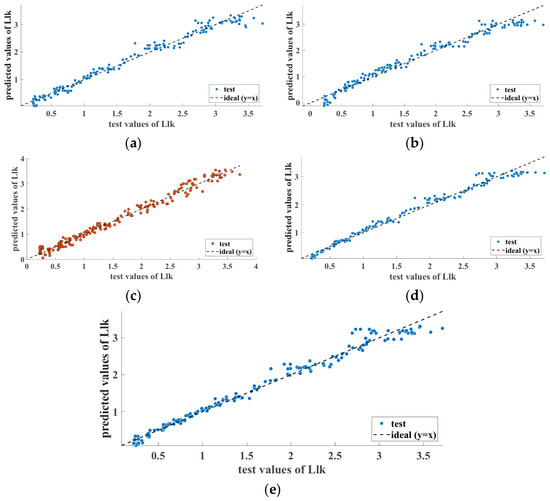
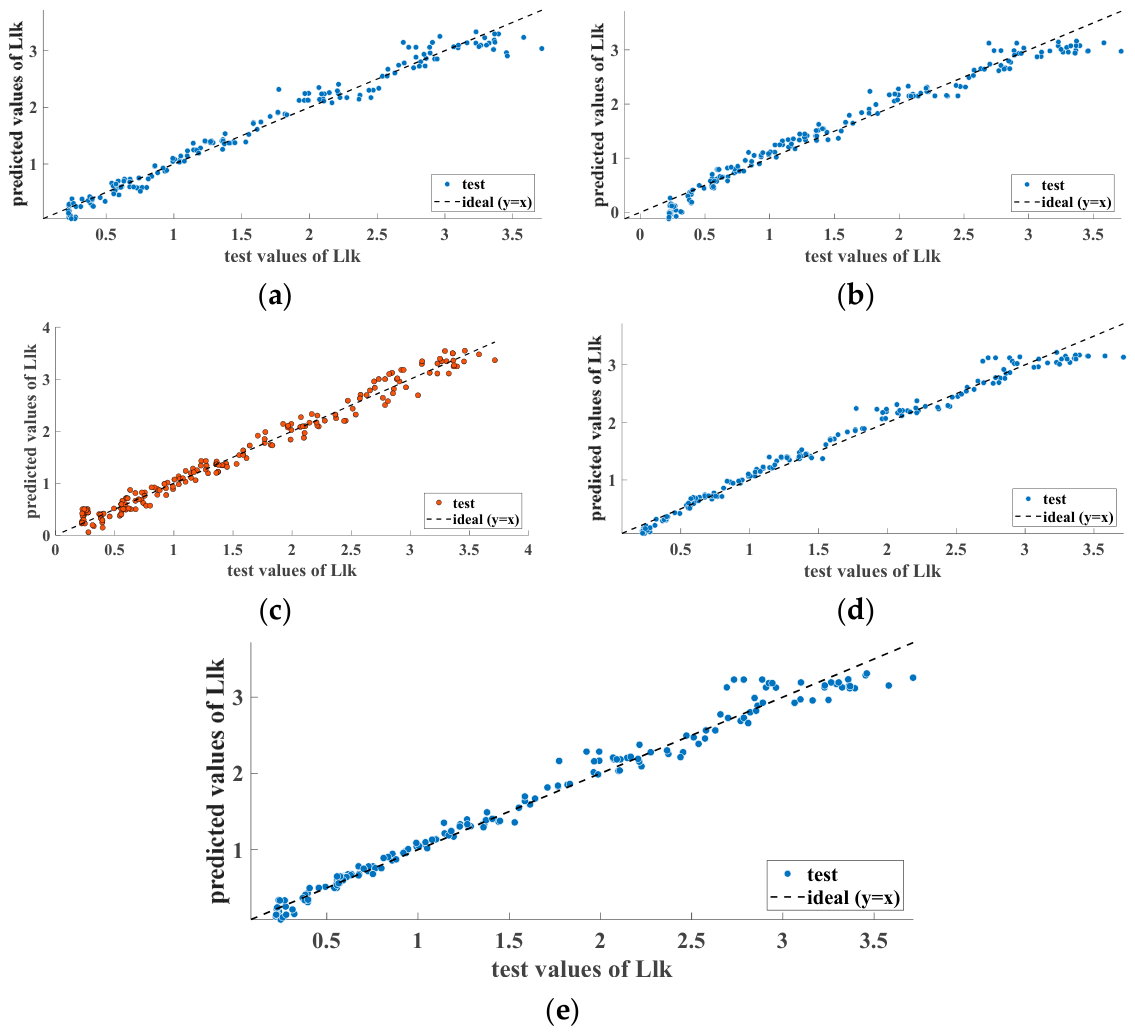
Comparison of the predicted scatter plots by the proposed framework versus the FEA computed values for all five methods are presented in Figure 3. While all approaches track the ideal line closely in the low-to-mid inductance range (0.2–2.5 µH), systematic deviations emerge at higher values (>3.0 µH), corresponding to the large winding turn configurations that represent the boundary of the design space. It can be seen that both PSO-ANN and MPA-ANN exhibit visible positive bias in this region, suggesting that their respective metaheuristic training procedures do not adequately capture the steep inductance gradient near the upper boundary. Likewise, SVM shows a systematic positive bias at high values, attributable to the global smoothness assumption of its radial basis function kernel, which limits local sensitivity at boundary regions. In contrast, the proposed GWO-ANN maintains the tightest alignment with the ideal line throughout the full range, confirming its superior generalization across all turn configurations including those at design space extremes.
Figure 3.
Comparison of the predicted values by the proposed technique versus FEA-based computation for all studied methods: (a) MPA-ANN, (b) PSO-ANN, (c) SVM, (d) IWO-ANN, (e) proposed GWO-ANN framework.
5.2. Blind Validation
Following the benchmark confirmation that the proposed GWO-ANN is the highest-performing surrogate model, six geometrically diverse blind tests were conducted with ranging from 10 to 30, spanning the full range of winding-turn configurations in the dataset. The results of the six most optimal HFT designs were then selected and are presented in Table 4 to assess the spatial generalization of the trained model across the full parametric design space. For each case, the prediction result by the proposed framework is compared against an independent FEA study conducted under identical boundary conditions, mesh settings, and excitation parameters. The validation cases have been drawn from non-training parameter combinations spanning the complete range of winding turn configurations in the dataset, ensuring that surrogate accuracy is tested at the GWO-identified optimal design point, at representative interior configurations, and at the upper boundary of the design space where the leakage inductance gradient is steepest and prediction demands are most stringent.
Table 4.
Blind validation evaluation results.
Table 4 shows the maximum prediction error of 8.15% occurred in Case 1 ( = 30, a = 12.87 mm, and b = 22.12 mm), which lies at the upper boundary of the design space. This boundary-region deviation is consistent with the well-documented tendency of data-driven surrogate models to exhibit reduced local accuracy at design space extremes [13], and remains within the 10% tolerance threshold adopted for FEA-based validation in comparable surrogate-assisted magnetic component design studies [10]. The remaining five cases yielded errors below 2.51%, with an overall average of 2.14% across all six configurations, confirming reliable generalization throughout the interior of the design space.
5.3. MATLAB/Simulink Circuit Validation
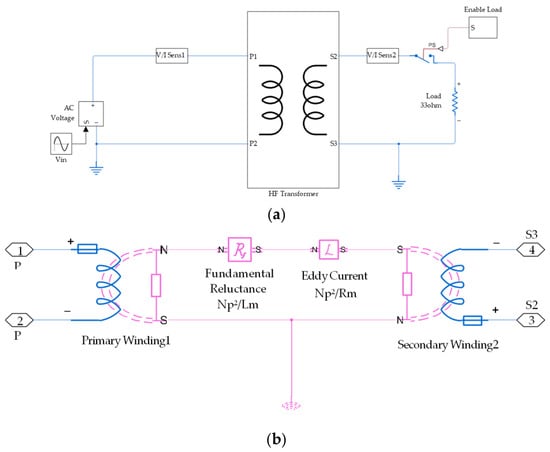
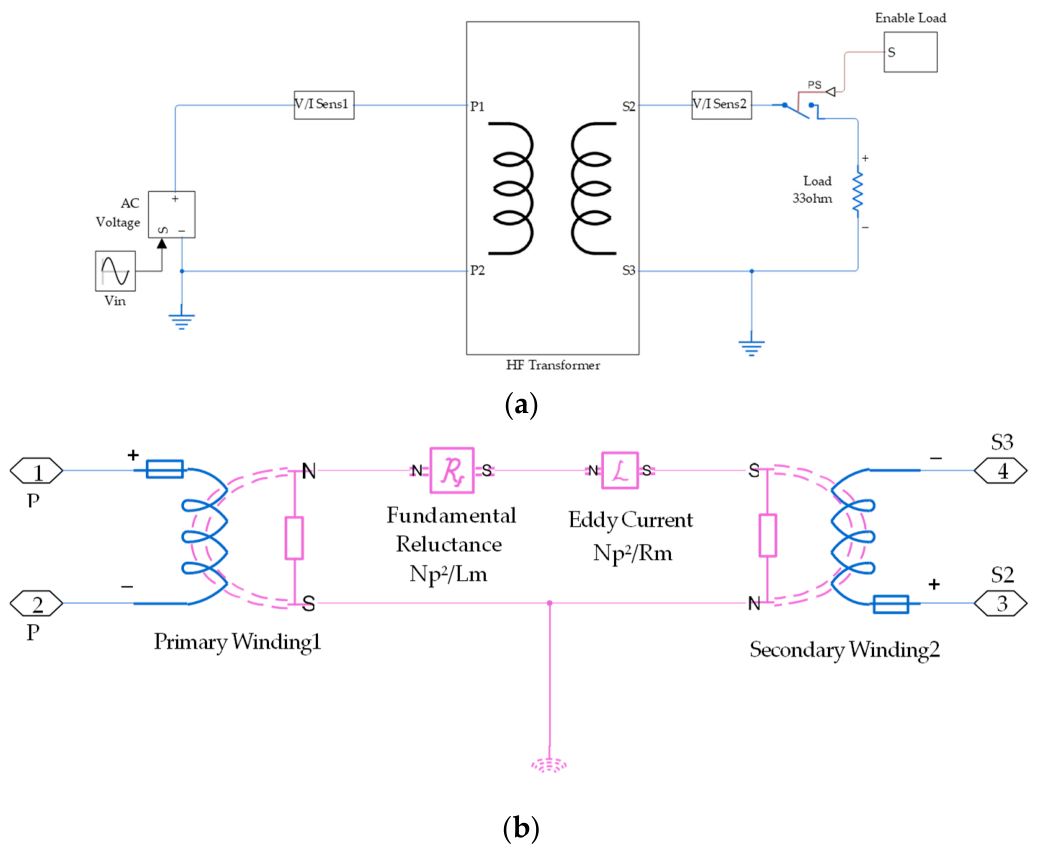
To verify the functional validity of the optimal parameters determined by the proposed GWO-ANN hybrid framework, an HFT circuit model encompassing both transient and steady-state behavior was developed in the MATLAB/Simulink R2024b environment. The assumed test conditions included 500 W output power, 110 V input/output voltage, and a 29 kHz operating frequency. The transformer circuit was modeled using an equivalent circuit structure that included winding resistance, leakage inductance, and magnetization inductance components, as depicted in Figure 4. The parameters identified as Case 1 in Table 4 were used for this circuit-level validation. To simplify the analysis, a fixed resistive load was connected to the transformer’s secondary side. The other parameters used in the simulation test are given in Table 5.
Figure 4.
MATLAB/Simulink transformer circuit model: (a) general simulation circuit, (b) equivalent transformer model.
Table 5.
MATLAB/Simulink simulation test parameters.
The analysis examined the transformer’s no-load operation over the interval 0 to and its behavior under load over the interval of to . At , a resistive load was introduced via a switching element, and the instantaneous loading response is observed. Figure 4a shows the general simulation circuit while Figure 4b shows the equivalent transformer model including the winding resistance, leakage inductance, and magnetization inductance components.
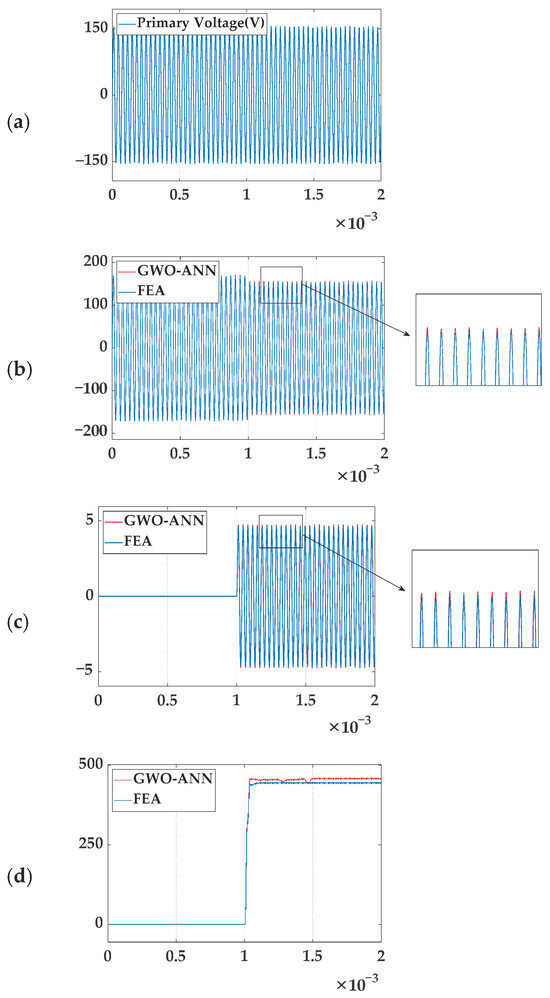
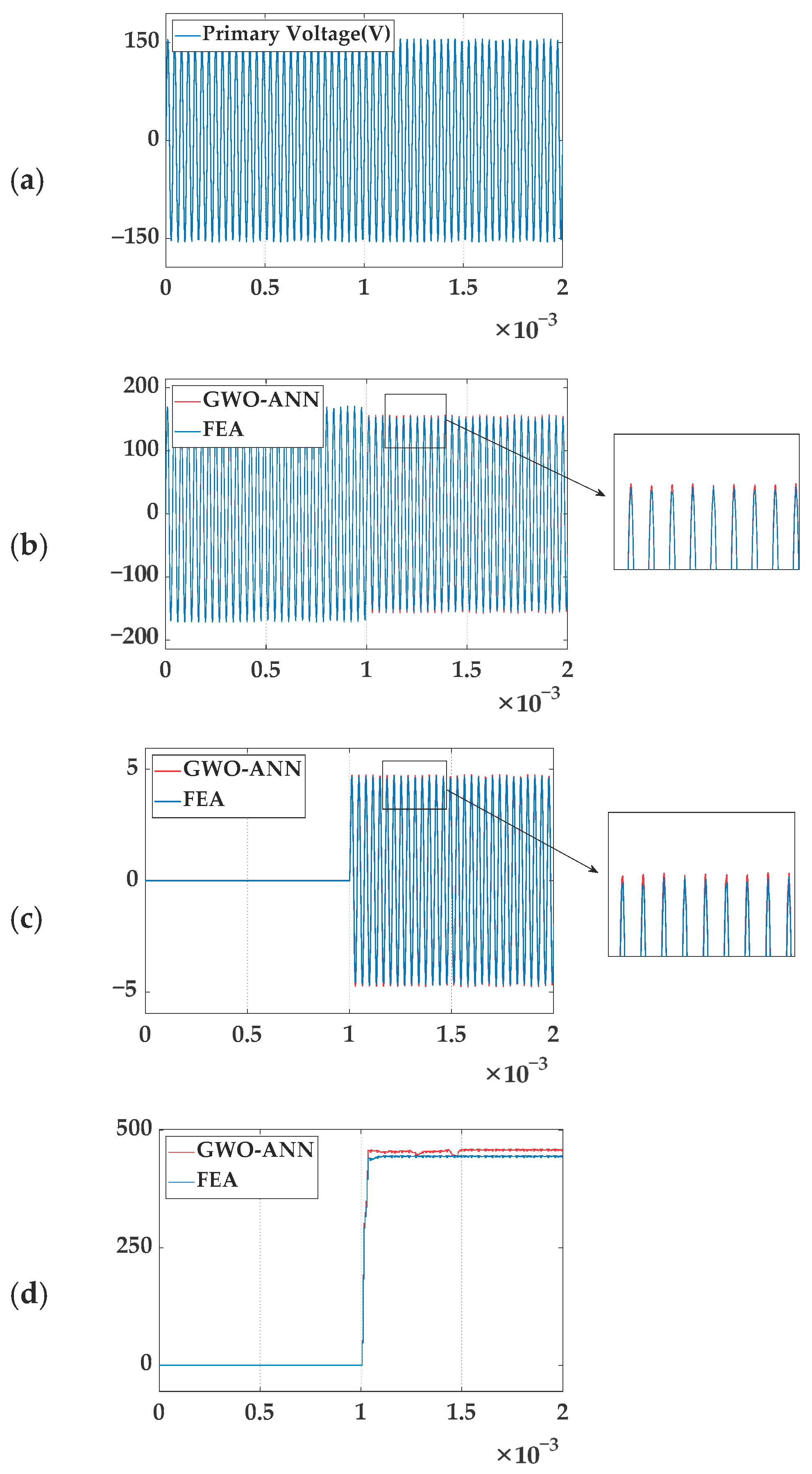
Figure 5 shows the MATLAB/Simulink R2024b study results for the optimal parameters defined by the ANN. The primary and secondary winding voltages are displayed in Figure 5a and Figure 5b, respectively, while the corresponding currents are depicted in Figure 5c. Upon applying the load at , the secondary winding experienced a voltage drop caused by the leakage inductance. Prior to this loading phase, a minor magnetizing current was attained in the primary winding. The output power response is captured in Figure 5d, with the ANN-derived parameters yielding a calculated predicted efficiency of 96.06%.
Figure 5.
MATLAB/Simulink based simulated waveforms from 0 to 2 ms; the load is applied at = 1 ms. (a) primary winding voltage in V, (b) secondary winding voltage in V, (c) secondary winding current in A, (d) output power of GWO-ANN vs. FEA parameters in W.
For a direct comparison, the waveforms generated from the FEA-derived parameters are also overlaid in Figure 5d. Both parameter sets demonstrate stable transient responses during load switching, confirming reliable dynamic behavior. The FEA approach produced a predicted efficiency of 95.54%, roughly 1.01% lower than that of the ANN model. This variation highlights how minor differences in estimating leakage inductance can translate into noticeable differences in overall circuit efficiency, emphasizing the critical role of the surrogate model accuracy in the HFT design. The slight efficiency advantage of the ANN method corresponds to the GWO algorithm’s objective of minimizing leakage inductance, which likely guides the optimization toward a design with inherently lower losses. An in-depth evaluation of this relationship is reserved for future studies within a multi-objective optimization framework.
5.4. Multilayer Validation
The proposed GWO-ANN hybrid framework was validated through three independent and complementary layers, each assessing a distinct dimension of the framework’s reliability. The first layer comprised blind FEA studies at six geometric configurations not encountered during training, evaluating surrogate generalization across the full design space with an average prediction error of 2.14% and a maximum of 8.15%, as detailed in Table 3. The second layer involved an independent FEA verification at the GWO-identified optimal design point ( = 30, = 12.87 mm, = 22.12 mm), confirming an average error of 2.14%. The third layer subjected the optimal parameters to a MATLAB/Simulink R2024b circuit-level simulation under realistic operating conditions (500 W, 110 V, 29 kHz), with power conversion efficiency as the functional performance metric; the GWO-ANN parameters yield an efficiency of 96.06%, compared to 95.54% for the FEA-derived parameters. Validation outcomes are classified as successful when prediction error remains below 10% for FEA-based layers [10] and simulated efficiency exceeds 94% for the circuit-level layer. Table 6 summarizes the results. The consistent success across all three layers confirms both the parametric accuracy and functional reliability of the proposed framework.
Table 6.
Multilayer validation summary.
6. Discussion and Conclusions
This study proposes a hybrid GWO-ANN surrogate modeling and optimization framework for leakage inductance estimation in HFTs. The superior performance of the proposed technique was validated in comparison with those of SVM, PSO-ANN, IWO-ANN, and MPA-ANN, all trained and tested on a the same 1210-point FEA dataset under identical conditions. To the authors’ knowledge, no prior study has conducted this type of controlled multi-method comparison specifically for this problem, which makes the benchmark itself one of the primary contributions of the work.
All five methods achieved R2 > 0.96, which confirms that the full factorial dataset covers the design space adequately for the surrogate model training. The proposed GWO-ANN framework achieved the best results across all three reported metrics: R2 = 0.9833, MSE = 0.01780, and MAE = 0.0935 µH. The 34.8% MAE reduction by the proposed method relative to PSO-ANN is notable. Furthermore, the proposed method reached a stable training plateau within approximately 20 iterations, while PSO-ANN, IWO-ANN, and MPA-ANN required 300 to 490 iterations to converge. At the upper boundary of the design space, the competing methods show a consistent positive bias that GWO-ANN avoids; this is precisely the region where accurate prediction matters most for practical design decisions.
Blind validation across the six most optimal configurations gave an average prediction error of 2.14%. The worst case was 8.15% at Case 1 ( = 30, = 12.87 mm, = 22.12 mm), at the steepest part of the leakage inductance gradient. This is consistent with what data-driven surrogate models typically exhibit near design space boundaries [13], and the error is within the 10% threshold used in this and comparable studies [10]. Worth noting is that, unlike PINN-based frameworks [10], the proposed GWO-ANN model requires no physics constraints during training. In addition, unlike the HDANN approach [11], it needs no pre-existing analytical model. Thes are practical advantages that lower the barrier to applying this framework to different core geometries and winding configurations.
Compared to previous research [19] that reported errors below 12% using three metaheuristic algorithms on an equivalent circuit parameter estimation problem, the proposed framework achieves better accuracy on a geometrically more complex task. A direct comparison with representative methods described in the literature is given in Table 7.
Table 7.
Comparison of error, computation time, and application scope of the proposed method with representative methods.
The MATLAB/Simulink R2024b circuit simulation for Case 1 (the design point suggested by the proposed method) yielded an efficiency of 96.06%, compared with 95.54% for the FEA-derived parameters. The 0.52% difference relative to a surrogate prediction error of 8.15% is a reasonable outcome and confirms that the model is sufficiently accurate for practical circuit-level applications.
This study has two key limitations. First, thermal effects and parasitic capacitance were not modeled, though both influence real transformer performance [2,14]. Second, while MATLAB/Simulink R2024b simulation is a widely accepted functional validation technique, hardware experiments have not been performed to enable prototype measurements that should also validate the performance of the proposed technique.
The main findings of this research can be summarized as follows. The proposed GWO-ANN surrogate trained on 1210 FEA simulations achieved R2 = 0.9833 and MAE = 0.0935 µH on the test set, outperforming all four benchmark methods across all reported metrics under identical evaluation conditions. Blind validation across = 18 to 30 gave an average error of 2.14% and a maximum of 8.15% for the most optimal HFT designs, confirming that the model generalized across the full parametric design space. Circuit-level simulation at the GWO-ANN optimal design point gave 96.06% efficiency against 95.54% for the FEA-derived parameters, consistent with the observed prediction accuracy. The presented three-layer validation approach gives a reproducible way to assess surrogate-assisted optimization frameworks in power electronics design, and the methodology can be applied to similar problems beyond leakage inductance estimation.
It is to be noted that all FEA studies in this research were run at a fixed operating frequency of 29 kHz; thus, the leakage inductance variation across a wider frequency range has not been characterized by this study, and this surrogate should not be applied at substantially different operating frequencies without retraining. Likewise, the discussed framework has been validated to the considered 500 W E–E core configuration studied here, and extensions to other power levels or core geometries require new FEA studies, retraining, and recalibration of the constraint bounds. As such, future work could address frequency-dependent surrogate modeling across a swept operating range, and adaptation to other core geometries such as toroidal or planar designs and Litz wire windings, in addition to enhancing the multi-objective optimization to minimize leakage inductance deviation while considering the thermal losses and parasitic capacitance. A tolerance-aware sensitivity/robustness analysis is another immediate future direction of this work, to evaluate and verify the reliability of the proposed method under non-ideal manufacturing/fabrication conditions.
Author Contributions
Conceptualization, S.B.; methodology, S.K.; software, S.K.; validation, S.K. and H.Y.; resources, F.S.; data curation, H.Y., S.K. and S.B.; writing—original draft preparation, S.K.; writing—review and editing, F.S.; visualization, H.Y. and S.B.; supervision, S.K. and F.S. All authors have read and agreed to the published version of the manuscript.
Funding
This research received no external funding.
Data Availability Statement
Data is available upon reasonable request to the authors.
Conflicts of Interest
The authors declare no conflicts of interest.
Abbreviations
The following abbreviations are used in this manuscript:
| ANN | Artificial neural network |
| FEA | Finite element analysis |
| GWO | Gray Wolf optimizer |
| HFT | High-frequency transformer |
| IWO | Invasive weed optimization |
| MAE | Mean absolute error |
| MPA | Marine predators algorithm |
| MSE | Mean squared error |
| PINN | Physics-informed artificial neural network |
| PSO | Particle swarm optimization |
| SVM | Support vector machine |
References
- Noh, E.; So, J.; Park, J.H.; Lee, S.H. Machine-Learning-Based Optimal Design of a 100 kW, 99% Efficiency, 70 kV Insulated, Leakage-Inductance-Integrated Medium-Frequency Transformer. IEEE Trans. Ind. Electron. 2026; early access. [CrossRef] [Scilit]
- Kolahian, P.; Grimm, F.; Baghdadi, M. A Comprehensive Review on Planar Magnetics and the Structures to Reduce the Parasitic Elements and Improve Efficiency. Energies 2023, 16, 3254. [Google Scholar] [CrossRef] [Scilit]
- Rahman, S.; Sidorov, V.; Chub, A.; Vinnikov, D. High-Frequency Split-Bobbin Transformer Design with Adjustable Leakage Inductance. In Proceedings of the 2021 IEEE 62nd International Scientific Conference on Power and Electrical Engineering of Riga Technical University (RTUCON), Riga, Latvia, 15–17 November 2021. [Google Scholar] [CrossRef] [Scilit]
- Dowell, P.L. Effects of eddy currents in transformer windings. Proc. Inst. Electr. Eng. 1966, 113, 1387–1394. [Google Scholar] [CrossRef] [Scilit]
- Yin, H.; Lai, J.; Ren, S.; Su, J.; Yu, X.; Ma, K. An Accurate Calculation Method of Leakage Inductance of High-Frequency Transformer With Litz Wire Winding Considering Irregular Region. IEEE J. Emerg. Sel. Top. Power Electron. 2022, 10, 7441–7451. [Google Scholar] [CrossRef] [Scilit]
- Wu, Y.H.; Shigematsu, K.; Omoto, Y.; Imaoka, J.; Yamamoto, M. An Investigation and Proposal for Accurate Leakage Inductance Modeling Based on Dowell Model. In Proceedings of the 2022 International Power Electronics Conference (IPEC-Himeji 2022- ECCE Asia), Himeji, Japan, 15–19 May 2022. [Google Scholar] [CrossRef] [Scilit]
- Sharma, A.; Kimball, J.W. Evaluation of Transformer Leakage Inductance Using Magnetic Image Method. IEEE Trans. Magn. 2021, 57, 1–12. [Google Scholar] [CrossRef] [Scilit]
- Wan, Z.; Li, Y.; Wang, H.; Sun, H.; Lin, S. An Improved Calculation Method of Leakage Inductance for High-Frequency Transformer Based on Precise Analysis of Magnetic Field. IEEE J. Emerg. Sel. Top. Power Electron. 2024, 12, 707–717. [Google Scholar] [CrossRef] [Scilit]
- Puntano, L.; Verucchi, C.J.; Meira, M.; Ruschetti, C.; Álvarez, R.E. Transformer Leakage Inductance Estimation with Windings Radial Displacement. In Proceedings of the 2024 IEEE Biennial Congress of Argentina (ARGENCON), San Nicolás de los Arroyos, Argentina, 18–20 September 2024. [Google Scholar] [CrossRef] [Scilit]
- Yang, X.; Shu, L.; Yang, D. Accurate and Efficient Magnetic Modeling of Medium-Frequency Transformers Based on Artificial Neural Network. In Proceedings of the 2024 Energy Conversion Congress & Expo Europe (ECCE Europe), Darmstadt, Germany, 2–6 September 2024. [Google Scholar] [CrossRef] [Scilit]
- Wu, Y.H.; Omoto, Y.; Imaoka, J.; Shigematsu, K.; Ikushima, Y.; Yamamoto, M. Efficient Multiphysics Circuit Simulation for Transformer Optimization Using Hybrid Dowell Artificial Neural Network. IEEJ J. Ind. Appl. 2024, 13, 327–337. [Google Scholar] [CrossRef] [Scilit]
- Tan, C.; Hong, J.; Wu, Z.; Huang, Q.; Wang, C. Parasitic Parameter Prediction for Planar Transformers Based on Neural Network. J. Phys. Conf. Ser. 2023, 2584, 012083. [Google Scholar] [CrossRef] [Scilit]
- Chen, T.; Zhao, Z.; Shen, Z.; Ming, L.; Wang, H. A Homogenized FEM Data-Driven Model for Calculating Leakage Inductance of High-Frequency Transformer with Litz-Wire Winding. IEEE J. Emerg. Sel. Top. Power Electron. 2024, 12, 2067–2081. [Google Scholar] [CrossRef] [Scilit]
- Chen, Y.; Shen, Z.; Xu, Z.; Jin, L.; Chen, W. Parameter Shift Prediction of Planar Transformer Based on Bi-LSTM Algorithm. CPSS Trans. Power Electron. Appl. 2023, 8, 13–22. [Google Scholar] [CrossRef] [Scilit]
- Aslan, B.; Balci, S.; Kayabaşi, A. ANFIS-based Parameter Estimation of a Single Phase Inverter Circuit with Isolation Transformer. Kastamonu Univ. J. Eng. Sci. 2022, 8, 135–144. [Google Scholar] [CrossRef] [Scilit]
- Aslan, B.; Balci, S.; Kayabasi, A.; Yildiz, B. The core loss estimation of a single phase inverter transformer by using adaptive neuro-fuzzy inference system. Measurement 2021, 179, 109427. [Google Scholar] [CrossRef] [Scilit]
- Trinchero, R.; Larbi, M.; Torun, H.M.; Canavero, F.G.; Swaminathan, M. Machine Learning and Uncertainty Quantification for Surrogate Models of Integrated Devices with a Large Number of Parameters. IEEE Access 2019, 7, 4056–4066. [Google Scholar] [CrossRef] [Scilit]
- Kennedy, J.; Eberhart, R. Particle swarm optimization. In Proceedings of the ICNN’95—International Conference on Neural Networks, Perth, Australia, 27 November–1 December 1995; Volume 4, pp. 1942–1948. [Google Scholar] [CrossRef] [Scilit]
- Ascencion-Mestiza, H.; Maximov, S.; Mezura-Montes, E.; Olivares-Galvan, J.C.; Ocon-Valdez, R.; Escarela-Perez, R. Estimation of the Equivalent Circuit Parameters in Transformers Using Evolutionary Algorithms. Math. Comput. Appl. 2023, 28, 36. [Google Scholar] [CrossRef] [Scilit]
- Mirjalili, S.; Mirjalili, S.M.; Lewis, A. Grey Wolf Optimizer. Adv. Eng. Softw. 2014, 69, 46–61. [Google Scholar] [CrossRef] [Scilit]
- Rojas-Galván, R.; García-Martínez, J.R.; Cruz-Miguel, E.E.; Álvarez-Alvarado, J.M.; Rodríguez-Resendiz, J. Performance Comparison of Bio-Inspired Algorithms for Optimizing an ANN-Based MPPT Forecast for PV Systems. Biomimetics 2024, 9, 649. [Google Scholar] [CrossRef] [Scilit] [PubMed]
- Faramarzi, A.; Heidarinejad, M.; Mirjalili, S.; Gandomi, A.H. Marine Predators Algorithm: A nature-inspired metaheuristic. Expert Syst. Appl. 2020, 152, 113377. [Google Scholar] [CrossRef] [Scilit]
- Mehrabian, A.R.; Lucas, C. A novel numerical optimization algorithm inspired from weed colonization. Ecol. Inform. 2006, 1, 355–366. [Google Scholar] [CrossRef] [Scilit]
- McLyman, T. Transformer and Inductor Design Handbook, 4th ed.; CRC Press: Boca Raton, FL, USA, 2017. [Google Scholar]
- Dira, Y.S.; Ramli, A.Q.; Amirulddin, U.A.U.; Tan, N.M.L. A modelling technique to determine the high frequency transformer leakage inductance using the winding structure. Sci. Rep. 2025, 15, 2373. [Google Scholar] [CrossRef] [Scilit] [PubMed]
- Eslamian, M.; Kharezy, M.; Thiringer, T. An Accurate Analytical Method for Leakage Inductance Calculation of Shell-Type Transformers with Rectangular Windings. IEEE Access 2021, 9, 72647–72660. [Google Scholar] [CrossRef] [Scilit]
- McKay, M.D.; Beckman, R.J.; Conover, W.J. A comparison of three methods for selecting values of input variables in the analysis of output from a computer code. Technometrics 2000, 42, 55–61. [Google Scholar] [CrossRef]



Disclaimer/Publisher’s Note: The statements, opinions and data contained in all publications are solely those of the individual author(s) and contributor(s) and not of MDPI and/or the editor(s). MDPI and/or the editor(s) disclaim responsibility for any injury to people or property resulting from any ideas, methods, instructions or products referred to in the content. |
© 2026 by the authors. Licensee MDPI, Basel, Switzerland. This article is an open access article distributed under the terms and conditions of the Creative Commons Attribution (CC BY) license.