


Abstract
The increasing integration of distributed energy resources (DERs), including photovoltaic systems, battery energy storage systems, electric vehicles, and flexible loads, is transforming modern power systems and creating new challenges for coordination, control, and cybersecurity. Conventional Virtual Power Plant (VPP) architectures typically rely on centralized energy management systems, which may face scalability limitations, communication bottlenecks, cybersecurity risks, and reduced resilience to failures. This paper presents a blockchain-enabled decentralized Virtual Power Plant framework for secure and autonomous coordination of distributed energy resources. The proposed architecture combines blockchain technology, smart contracts, IoT-based communication infrastructure, and decentralized energy management functions within a unified multi-layer coordination framework. Smart contracts automate energy scheduling, peer-to-peer transaction validation, and settlement processes, reducing dependence on centralized control entities. Lightweight blockchain consensus mechanisms are employed to improve scalability while limiting computational overhead. The effectiveness of the proposed framework is evaluated through simulation-based case studies involving decentralized DER coordination, peer-to-peer energy trading, and resilience assessment under node-failure conditions. Its performance is compared with that of a conventional centralized VPP architecture in terms of scalability, coordination reliability, communication overhead, transaction transparency, and fault tolerance. The results indicate that the decentralized framework improves operational resilience, coordination transparency, and scalability under increasing DER participation while maintaining satisfactory energy balancing performance. Although blockchain-based coordination introduces additional transaction latency, the proposed approach enhances cybersecurity, reduces dependence on centralized control structures, and provides a flexible foundation for future intelligent smart-grid applications.
1. Introduction
The rapid transition toward renewable and decentralized energy systems is fundamentally transforming modern electrical grid infrastructures. The increasing penetration of distributed energy resources (DERs), including photovoltaic (PV) systems, wind turbines, battery energy storage systems (BESS), electric vehicles (EVs), and controllable smart loads, introduces significant operational complexity associated with real-time coordination, energy balancing, communication reliability, and cybersecurity. Traditional centralized energy management approaches are increasingly challenged by the scalability requirements and dynamic behavior of modern smart grid environments [1,2,3].
Virtual Power Plants (VPPs) have emerged as an effective solution for aggregating geographically dispersed DERs into unified controllable entities capable of participating in electricity markets, demand response programs, ancillary services, and coordinated grid support operations. By integrating advanced communication technologies, distributed sensing, and energy management systems, VPPs enable coordinated operation of heterogeneous energy resources while improving energy flexibility and grid resilience [4,5,6].
Despite their advantages, most existing VPP implementations rely on centralized coordination architectures, where a central energy management system (EMS) collects operational data, performs optimization, and dispatches control commands to distributed participants. Although centralized approaches simplify coordination logic, they introduce several critical limitations, including communication bottlenecks, limited scalability under high DER penetration levels, vulnerability to cyberattacks, reduced operational transparency, and single points of failure. As modern smart grids evolve toward highly distributed and autonomous energy ecosystems, these limitations increasingly restrict the reliability and resilience of centralized VPP frameworks [7,8].
In recent years, blockchain technology has attracted considerable attention as a promising solution for enabling decentralized coordination and secure peer-to-peer interaction in smart energy systems. Blockchain-based distributed ledger technologies provide immutable transaction recording, distributed consensus mechanisms, cryptographic validation, and autonomous smart contract execution without reliance on centralized authorities. These characteristics make blockchain particularly suitable for distributed energy coordination applications involving large numbers of heterogeneous DER participants operating in dynamic and decentralized environments [8,9,10].
Several studies have investigated the application of blockchain technologies in smart grids, peer-to-peer energy trading systems, distributed market settlement, and decentralized energy management platforms. Existing research has demonstrated the potential of blockchain for improving transaction transparency, cybersecurity, trust management, and distributed communication among energy participants. However, most existing blockchain-based energy frameworks primarily focus on isolated peer-to-peer trading mechanisms rather than comprehensive decentralized Virtual Power Plant coordination architectures [11,12].
Furthermore, many current VPP implementations continue to rely on partially centralized coordination mechanisms, limiting scalability, fault tolerance, and operational autonomy under increasing DER participation. In addition, limited research has addressed the integration of blockchain coordination, smart contract automation, IoT communication infrastructure, and decentralized energy management into a unified operational framework suitable for large-scale smart grid applications. Existing studies also often lack realistic evaluation under dynamic operating conditions involving communication disruptions, node failures, and distributed coordination scenarios [13,14].
To address these limitations, this paper develops a blockchain-enabled decentralized Virtual Power Plant framework that supports secure and autonomous coordination of distributed energy resources. The proposed architecture integrates distributed ledger technology, smart contracts, IoT communication infrastructure, and decentralized energy management mechanisms within a unified operational framework. Rather than relying on a centralized control entity, coordination is achieved through distributed validation and automated smart-contract execution [15,16,17].
The proposed framework enables autonomous energy scheduling, distributed transaction settlement, and decentralized coordination through smart contract execution. Lightweight consensus mechanisms are considered to ensure scalable operation with reduced computational overhead and improved transaction efficiency suitable for smart grid environments.
To evaluate the effectiveness of the proposed approach, multiple simulation-based case studies are conducted under various operational scenarios, including decentralized DER coordination, peer-to-peer energy trading, and resilience analysis under node failure conditions. Comparative analysis between conventional centralized VPP architectures and the proposed blockchain-enabled decentralized framework is performed in terms of coordination reliability, scalability, communication overhead, cybersecurity, operational transparency, and fault tolerance [18,19,20].
The main contributions of this paper are summarized as follows:
- A blockchain-enabled decentralized Virtual Power Plant architecture integrating distributed energy resources, IoT communication infrastructure, smart contracts, and decentralized energy management mechanisms is proposed.
- A smart-contract-based coordination and transaction validation mechanism for autonomous peer-to-peer DER interaction is developed.
- A distributed coordination workflow enabling secure decentralized energy scheduling and transaction settlement without centralized control is introduced.
- Simulation-based evaluation under multiple operational scenarios, including node failures and peer-to-peer energy trading, is conducted to assess coordination reliability, scalability, and resilience.
- A comparative analysis between conventional centralized VPP architectures and the proposed decentralized framework is performed in terms of scalability, communication overhead, cybersecurity, and fault tolerance.
The remainder of this paper is organized as follows. Section 2 presents related work on Virtual Power Plants, distributed energy resources, and blockchain applications in smart grid systems. Section 3 introduces the proposed blockchain-enabled decentralized VPP architecture. Section 4 describes the blockchain coordination mechanism and smart contract execution process. Section 5 presents the simulation environment and case studies. Section 6 discusses the obtained results and comparative performance analysis. Finally, Section 7 concludes the paper and outlines future research directions.
2. Related Work
2.1. Virtual Power Plant Architectures
Virtual Power Plants (VPPs) have emerged as a key enabling technology for integrating distributed energy resources (DERs) into modern smart grid infrastructures. By aggregating heterogeneous energy assets, including photovoltaic systems, wind turbines, battery energy storage systems, electric vehicles, and flexible demand-side resources, VPPs enable coordinated operation, demand response participation, ancillary service provision, and energy market interaction [20,21,22].
Existing VPP architectures can generally be classified into centralized, hierarchical, cloud-based, and decentralized coordination models. Centralized VPP systems rely on a central energy management system (EMS) responsible for collecting operational data, performing optimization, and issuing dispatch commands to distributed participants. These architectures provide simplified operational control and centralized optimization capabilities; however, they suffer from limited scalability, communication bottlenecks, reduced operational transparency, and vulnerability to single points of failure.
To improve scalability and operational flexibility, hierarchical and cloud-based VPP architectures have been proposed. Hierarchical approaches introduce intermediate aggregation layers to reduce communication overhead and distribute optimization tasks, while cloud-based implementations utilize scalable computing infrastructure for energy scheduling and distributed monitoring. Despite these improvements, most existing approaches still rely on partially centralized coordination mechanisms that limit system autonomy and resilience under high DER penetration conditions [23,24].
More recently, decentralized VPP concepts have gained increasing research attention due to their potential to enable autonomous coordination among distributed energy participants. Decentralized approaches improve fault tolerance, reduce centralized dependency, and support scalable peer-to-peer interaction among DER units. Nevertheless, fully decentralized coordination mechanisms for large-scale Virtual Power Plants remain insufficiently explored, particularly regarding transaction validation, trust management, distributed scheduling, and secure coordination among heterogeneous participants.
2.2. Blockchain Applications in Smart Energy Systems
Blockchain technology has recently attracted significant interest in smart grid research due to its distributed, tamper-resistant, and transparent operational characteristics. Through distributed ledger mechanisms and cryptographic transaction validation, blockchain supports secure decentralized coordination without dependence on trusted third parties or centralized supervisory entities [25,26,27].
In energy systems, blockchain has primarily been investigated for peer-to-peer (P2P) energy trading, distributed market settlement, renewable energy certificate management, and decentralized transaction recording. Smart contracts deployed on blockchain platforms allow autonomous execution of predefined operational rules for energy exchange, pricing, and settlement, thereby improving transparency and reducing administrative complexity.
Several studies have demonstrated the potential of blockchain-based energy systems for improving transaction security, trust management, and distributed communication reliability among smart grid participants. In addition, blockchain technologies provide enhanced auditability and resilience against data manipulation through immutable ledger storage and distributed consensus validation [27,28,29,30].
However, despite these advantages, blockchain integration in smart energy systems introduces several technical challenges. Existing blockchain platforms often suffer from transaction latency, limited throughput, scalability constraints, and increased communication overhead under large-scale deployments. Furthermore, many current implementations focus primarily on isolated energy trading scenarios while neglecting broader Virtual Power Plant coordination requirements, including real-time dispatch management, distributed energy balancing, and resilience-oriented system coordination [31,32].
2.3. Smart Contracts and Peer-to-Peer Energy Trading
Smart contracts represent one of the most important enabling technologies within blockchain-based energy systems. These self-executing computational protocols automate transaction execution according to predefined operational conditions without requiring intermediary supervision [21,23,32].
In smart grid applications, smart contracts have been extensively investigated for automated peer-to-peer energy trading among prosumers and distributed energy participants. Through autonomous matching of energy supply and demand, smart contracts can facilitate transparent energy settlement, decentralized pricing mechanisms, and secure transaction validation [33,34].
Several recent studies have proposed blockchain-based smart contract mechanisms for local energy markets and microgrid coordination. These approaches demonstrate improved operational transparency and reduced transaction dependency on centralized entities. However, many existing implementations remain limited to small-scale energy trading environments and do not address comprehensive distributed coordination within large-scale Virtual Power Plant frameworks [35,36,37].
In addition, current smart contract implementations frequently neglect critical operational aspects such as communication latency, coordination scalability, fault tolerance, and dynamic DER participation under realistic smart grid operating conditions [38,39,40].
2.4. Limitations of Existing Approaches
Although substantial progress has been achieved in blockchain-enabled smart energy systems and decentralized energy management research, several important limitations remain unresolved.
First, most existing blockchain-based energy frameworks focus primarily on peer-to-peer energy trading applications rather than complete decentralized Virtual Power Plant coordination architectures.
Second, many current VPP systems continue to rely on centralized or partially centralized energy management structures, limiting scalability, operational resilience, and autonomous coordination capabilities under increasing DER penetration levels.
Third, limited research has addressed the integration of blockchain coordination mechanisms, smart contract automation, IoT communication infrastructure, and decentralized energy management into a unified and scalable operational framework.
Fourth, existing studies often provide conceptual discussions without comprehensive simulation-based evaluation under realistic operating scenarios involving node failures, communication disruptions, distributed coordination complexity, and dynamic renewable energy behavior.
Finally, several existing blockchain implementations are associated with significant computational overhead and transaction latency, reducing their suitability for real-time smart grid coordination applications.
Table 1 summarizes the comparison between representative blockchain-based smart energy studies and the proposed approach in terms of decentralized coordination, smart contract integration, resilience analysis, and peer-to-peer energy trading capabilities.
Table 1.
Comparative analysis of existing blockchain-based smart energy frameworks and the proposed decentralized Virtual Power Plant approach.
The comparison presented in Table 1 highlights that most existing studies focus either on peer-to-peer energy trading or centralized Virtual Power Plant coordination. In contrast, the proposed framework combines decentralized VPP coordination, blockchain-based trust mechanisms, smart contract automation, resilience-oriented operation, and peer-to-peer energy interaction within a unified architecture.
2.5. Research Gap and Positioning of the Proposed Framework
The identified limitations highlight the need for a secure, scalable, and resilient decentralized coordination framework capable of supporting autonomous operation of distributed energy resources within future smart grid ecosystems.
To address these research gaps, this paper proposes a blockchain-enabled decentralized Virtual Power Plant framework integrating distributed ledger technologies, smart contracts, IoT communication infrastructure, and decentralized energy management functionalities into a unified multi-layer coordination architecture.
Unlike many existing blockchain-based energy systems that focus exclusively on peer-to-peer trading, the proposed framework enables comprehensive decentralized DER coordination, secure transaction validation, distributed energy scheduling, and resilience-oriented operation without centralized control dependency.
Furthermore, the proposed architecture is evaluated under multiple simulation scenarios involving decentralized energy coordination, peer-to-peer trading, and node failure analysis in order to assess scalability, operational transparency, coordination reliability, and fault tolerance under dynamic smart grid conditions.
To further position the proposed framework with respect to existing blockchain-enabled energy management and Virtual Power Plant solutions, a structured comparison of representative research directions is presented. Although numerous studies have investigated blockchain-based peer-to-peer energy trading, decentralized transaction management, and smart contract execution, only a limited number of works address the broader problem of fully decentralized Virtual Power Plant coordination.
Furthermore, existing approaches often focus on specific aspects of the problem, such as market settlement, energy trading, or distributed transaction validation, without integrating these functionalities into a unified coordination framework capable of supporting resilience-oriented operation and large-scale distributed energy resource participation. Table 2 summarizes the main distinguishing characteristics of representative blockchain-enabled energy management approaches and highlights the positioning of the proposed framework.
Table 2.
Positioning of the proposed framework relative to representative blockchain-enabled VPP studies.
As shown in Table 2, most existing studies concentrate on peer-to-peer energy trading or blockchain-assisted transaction management. While these approaches improve transparency and trust among participants, they frequently address only a subset of the operational requirements associated with Virtual Power Plant management.
In contrast, the proposed framework combines blockchain-based validation, smart contract automation, IoT-supported data acquisition, decentralized energy management, and resilience-oriented coordination within a unified architecture. Particular emphasis is placed on fault-tolerant operation, distributed decision execution, and comparative evaluation against conventional centralized VPP architectures.
This positioning highlights that the contribution of the present work extends beyond blockchain adoption itself and focuses on the development of an integrated coordination framework for future decentralized smart grid environments.
2.6. Novelty and Research Contribution
Although blockchain technology has been widely investigated for peer-to-peer energy trading and decentralized transaction management, its integration into comprehensive Virtual Power Plant coordination frameworks remains relatively limited. Existing studies typically focus on individual aspects of energy-system operation, such as market settlement, local trading mechanisms, or transaction validation, while the combined interaction between distributed energy resource management, smart-contract automation, blockchain coordination, and resilience-oriented operation has received comparatively less attention.
The contribution of this work lies in the development of an integrated decentralized coordination framework that combines these functionalities within a single architecture. The proposed framework supports distributed energy scheduling, transaction validation, peer-to-peer interaction, and fault-tolerant operation while reducing dependence on centralized control structures.
The proposed framework addresses this gap by integrating blockchain-based transaction validation, smart-contract-driven coordination, IoT-enabled data acquisition, and decentralized energy management within a unified VPP architecture. Unlike conventional blockchain energy trading platforms, the proposed approach considers the entire coordination workflow of distributed energy resources, including scheduling support, transaction validation, distributed decision execution, and resilience-oriented operation.
The primary novelty of this work does not lie in the use of blockchain technology alone, but in the development of a unified decentralized coordination framework that combines operational VPP management, peer-to-peer energy interaction, smart contract automation, and fault-tolerant distributed coordination. In addition, the framework is evaluated under multiple operational scenarios, including normal coordination conditions, node-failure events, and peer-to-peer trading environments.
The main research contributions of this paper can therefore be summarized as follows:
- Development of a blockchain-enabled decentralized VPP architecture integrating DERs, IoT communication infrastructure, smart contracts, and distributed coordination mechanisms.
- Design of a smart-contract-based coordination workflow for automated transaction validation and decentralized energy exchange.
- Integration of resilience-oriented coordination mechanisms capable of maintaining operation under node-failure conditions.
- Comparative evaluation of centralized and decentralized VPP architectures with respect to scalability, reliability, transaction transparency, and fault tolerance.
- Discussion of cybersecurity implications and blockchain-based trust mechanisms for future distributed smart grid applications.
3. Proposed Blockchain-Enabled Decentralized VPP Architecture
3.1. System Overview
To overcome the limitations of centralized Virtual Power Plant (VPP) architectures, this paper proposes a blockchain-enabled decentralized coordination framework for distributed energy resources (DERs). The proposed architecture enables secure, transparent, and autonomous coordination among heterogeneous energy participants without relying on a single centralized energy management authority.
The framework integrates distributed energy resources, IoT-based communication infrastructure, blockchain-based coordination, smart contract execution, and decentralized energy management into a unified multi-layer architecture. The main objective is to enable scalable coordination, secure transaction validation, transparent energy exchange, and resilient operation under dynamic smart grid conditions.
The proposed architecture consists of the following functional layers:
- Physical Distributed Energy Resource Layer;
- IoT Communication and Data Acquisition Layer;
- Blockchain Coordination Layer;
- Smart Contract Coordination Layer;
- Decentralized Energy Management Layer;
- Operational Workflow and Decision Execution Layer.
The overall layered architecture of the proposed blockchain-enabled decentralized VPP framework is illustrated in Figure 1.
Figure 1.
Layered architecture of the proposed blockchain-enabled decentralized Virtual Power Plant framework for coordinated management of distributed energy resources. The ellipsis (“…”) denotes additional distributed energy resources and participants that may be incorporated into the framework but are omitted from the illustration for clarity.
As shown in Figure 1, blockchain technology acts as the core coordination infrastructure enabling secure and transparent interaction between distributed energy participants. Smart contracts automate operational processes such as energy scheduling, transaction validation, and decentralized dispatch execution.
The layered structure allows DER participants to operate as autonomous agents while interacting through blockchain-mediated coordination mechanisms. Each DER unit can submit generation availability, load demand, storage status, and energy trading requests to the decentralized network. Smart contracts validate these requests, execute predefined coordination rules, and record approved transactions on the distributed ledger.
The general objective of the proposed VPP coordination framework is to maintain power balance while minimizing operational cost and improving resilience. The system-level coordination objective can be expressed as:
where denotes the generation cost of DER unit i, represents the storage operation cost, denotes the transaction or trading cost, N is the number of DER participants, and T is the scheduling horizon.
This formulation provides the basis for decentralized energy scheduling, where operational decisions are performed collaboratively through blockchain-supported interactions rather than centralized dispatch commands.
3.2. Physical Distributed Energy Resource Layer
The physical DER layer represents the foundation of the proposed decentralized VPP architecture. It consists of geographically distributed energy assets capable of generation, storage, consumption, or flexible demand response participation.
The considered DER units include photovoltaic systems, wind generation units, battery energy storage systems, electric vehicle charging stations, and controllable smart loads. Each DER is modeled as an autonomous agent equipped with local measurement, communication, and control capabilities. These agents periodically report operational parameters such as active power generation, load demand, available storage capacity, state of charge, and participation status.
The power balance condition of the decentralized VPP at time ttt is defined as:
where is the generated power of DER unit i, is the exchanged power with the main grid, is the battery discharging power, is the battery charging power, and is the total load demand.
The generation capacity of each DER is constrained by:
where denotes the maximum generation capacity of DER unit i.
For battery energy storage systems, the state-of-charge dynamics are modeled as:
where SOCi(t) denotes the state of charge of battery i at time step t, Pch,i(t) and Pdis,i(t) represent the battery charging and discharging power, respectively, Δt is the simulation time step, Ecap,i is the nominal energy capacity of battery i, and ηch and ηdis are the charging and discharging efficiencies.
subject to:
where is the battery state of charge, and are the minimum and maximum allowable storage limits, and ηch and ηdis are the charging and discharging efficiencies.
By representing each physical DER as an autonomous agent, the proposed framework supports local decision-making while maintaining coordinated operation through blockchain-based validation and smart contract execution.
3.3. IoT Communication and Data Acquisition Layer
The IoT communication layer enables real-time data acquisition and information exchange between DER units, edge devices, blockchain nodes, and smart contract modules. This layer includes smart meters, sensors, local controllers, communication gateways, and edge computing devices.
The main functions of this layer are:
- Acquisition of DER operational data;
- Preprocessing and filtering of measurement data;
- Secure transmission of energy offers and requests;
- Communication between DER agents and blockchain nodes;
- Reduction in communication delay through edge processing.
Communication protocols such as MQTT, 5G-based industrial networks, and lightweight IoT protocols may be used depending on deployment requirements. Edge computing is introduced to reduce the amount of raw data transmitted to the blockchain network by performing local preprocessing and event-based data forwarding.
The total communication delay is modeled as:
where Ttx is the transmission delay, Tproc is the local processing delay, and Tqueue is the queuing delay caused by communication congestion.
The communication overhead of the decentralized system can be expressed as:
where Dij(t) represents the amount of exchanged data between nodes i and j at time t.
Compared with centralized VPP architectures, where most data must be transmitted to a central controller, the proposed decentralized communication structure distributes data exchange across the network. This reduces the risk of centralized communication bottlenecks and improves scalability under high DER participation.
3.4. Blockchain Coordination Layer
The blockchain coordination layer provides the core trust, validation, and distributed data management infrastructure of the proposed VPP framework. Instead of relying on a central authority, the blockchain network maintains a shared and immutable ledger of DER status updates, energy offers, transaction records, and coordination events.
Each participating blockchain node stores a synchronized copy of the distributed ledger. Transactions submitted by DER agents are verified through cryptographic signatures and consensus validation before being recorded permanently. This mechanism ensures transparency, data integrity, non-repudiation, and resistance to unauthorized modification.
The blockchain layer performs the following functions:
- Validation of DER transactions;
- Decentralized storage of coordination records;
- Verification of participant authenticity;
- Execution support for smart contracts;
- Consensus-based transaction approval;
- Protection against single-point data manipulation.
- The total blockchain processing delay Tblock is defined as:
The transaction throughput of the blockchain network is expressed as:
where Ntx is the number of validated transactions, and TPS represents the number of processed transactions per second.
For smart grid applications, Practical Byzantine Fault Tolerance (PBFT) is particularly suitable because it provides low computational overhead, fast transaction confirmation, deterministic finality, and reduced energy consumption compared with Proof-of-Work mechanisms.
In the proposed framework, blockchain does not directly control the physical power flow. Instead, it provides a trusted coordination and validation layer that supports secure energy scheduling, transaction settlement, and distributed decision-making.
3.5. Smart Contract Coordination Model
Smart contracts are used to automate the coordination process among DER participants. They define the operational rules for energy offer submission, transaction validation, supply-demand matching, resource scheduling, and settlement execution.
Each smart contract receives energy offers and requests from DER agents. A producer or prosumer submits available generation, while a consumer submits energy demand. The smart contract verifies whether the submitted transaction is feasible according to generation availability, demand requirements, participant eligibility, and system constraints.
A valid energy transaction between participant iii and participant j must satisfy:
where is the available generated energy of participant i, is the demand of participant j, and Pij(t) is the negotiated energy exchange.
The trading cost between participants can be modeled as:
where λij(t) represents the transaction price between participants i and j.
The smart contract coordination workflow is described in detail in Section 4.3. In general, smart contracts verify participant eligibility, validate transaction feasibility, support supply–demand matching, and automate settlement and ledger recording.
This automated mechanism reduces the need for intermediaries and ensures that coordination rules are executed transparently and consistently across the decentralized VPP network.
3.6. Decentralized Energy Management Model
The decentralized energy management layer coordinates distributed resources without relying on a central EMS. Instead of collecting all information at a single control point, decision-making is distributed among DER agents, blockchain nodes, and smart contracts.
The proposed framework does not solve a centralized global optimization problem. Instead, coordination is achieved through distributed smart-contract-based matching and validation mechanisms.
The main functions of this layer include:
- decentralized energy scheduling;
- distributed load balancing;
- storage charging and discharging coordination;
- peer-to-peer energy exchange;
- local optimization of DER operation;
- resilience management under node or communication failures.
The local objective of each DER agent can be expressed as:
subject to local operational constraints:
where and denote the energy sold and bought by DER participant iii, while and represent local surplus and deficit conditions.
The decentralized coordination mechanism ensures that each DER optimizes its local operation while contributing to the global VPP balance. Blockchain validation guarantees that local decisions remain transparent, auditable, and consistent with network-wide rules.
This approach improves system resilience because the failure of a single node does not interrupt the entire coordination process. Other participants can continue operating using the distributed ledger and smart contract rules.
3.7. Operational Workflow
The operational workflow of the proposed framework consists of a sequence of coordinated actions between DER agents, IoT devices, blockchain nodes, and smart contracts.
First, DER units measure local operating conditions, including generation, demand, storage state, and availability. These data are collected by IoT sensors and edge devices. The data are then preprocessed and transmitted to the blockchain network as energy offers, requests, or status updates.
Second, smart contracts evaluate submitted transactions according to predefined coordination rules. These rules include energy availability, demand matching, storage constraints, participant eligibility, and transaction feasibility.
Third, blockchain nodes validate the proposed transactions through a lightweight consensus mechanism. Once consensus is reached, the approved transactions are recorded on the distributed ledger.
Fourth, DER agents execute the corresponding energy exchange, scheduling, or storage operation. The final transaction status is permanently stored on the blockchain, ensuring auditability and transparency.
The complete workflow can be summarized as follows:
- DER units measure generation, load, and storage status.
- IoT devices acquire and preprocess operational data.
- DER agents submit offers, requests, and status updates.
- Smart contracts verify transaction feasibility.
- Blockchain consensus validates approved transactions.
- Energy scheduling and dispatch decisions are executed.
- Transaction and settlement records are stored on-chain.
- Updated system status is shared across participating nodes.
This workflow enables secure, autonomous, and transparent coordination of distributed energy resources without centralized control dependency.
3.8. Advantages of the Proposed Architecture
The proposed blockchain-enabled decentralized VPP architecture provides several advantages over conventional centralized VPP systems.
First, the architecture reduces dependence on single points of failure by distributing coordination and transaction validation across multiple participating nodes. This improves operational resilience under communication failures, node disruptions, or cyberattack scenarios.
Second, the proposed framework improves scalability by avoiding dependence on a central controller. As the number of DER participants increases, coordination tasks are distributed across the blockchain network and local DER agents.
Third, blockchain-based transaction validation enhances cybersecurity by ensuring cryptographic authentication, immutable data recording, and distributed consensus verification.
Fourth, smart contracts improve automation by executing predefined coordination rules without manual intervention or trusted intermediaries.
Fifth, the system improves transparency and auditability because all approved transactions are permanently recorded on the distributed ledger.
Finally, the proposed framework supports peer-to-peer energy interaction among prosumers, enabling more flexible energy trading and decentralized resource utilization.
Overall, the proposed architecture provides a scalable, secure, and resilient foundation for next-generation Virtual Power Plants operating in highly distributed smart grid environments.
4. Blockchain-Based Coordination Mechanism and Smart Contracts
This section presents the operational mechanism for decentralized coordination of distributed energy resources (DERs) within the proposed blockchain-enabled Virtual Power Plant (VPP) framework. The coordination process is implemented through blockchain transactions and smart contracts that enable secure, transparent, and automated energy management without centralized control.
4.1. Decentralized DER Coordination Mechanism
In the proposed system, each distributed energy resource (DER) operates as an autonomous agent capable of submitting energy-related information, including generation capacity, consumption demand, and storage availability. Coordination among DERs is achieved through blockchain-mediated communication and consensus validation.
The coordination process follows a market-inspired interaction model, where DERs act as energy producers, consumers, or prosumers. Energy exchange decisions are not centrally enforced but are instead determined through distributed agreement mechanisms executed on the blockchain network.
The overall coordination mechanism ensures that all energy transactions are: transparent, verifiable, tamper-resistant, and mutually agreed upon by participating nodes.
4.2. Energy Transaction and Smart Contract Model
Smart contracts are deployed on the blockchain layer to automate peer-to-peer energy exchange, resource allocation, transaction validation, and settlement among DER participants. In the proposed decentralized VPP framework, each smart contract encodes predefined operational rules that govern participant authentication, energy offer submission, demand matching, transaction feasibility verification, and ledger-based settlement.
At each scheduling interval t, a DER participant may act as a producer, consumer, or prosumer depending on its local generation, demand, and storage state. A selling participant i submits an available energy offer , while a buying participant j submits an energy demand request . The smart contract determines the feasible exchanged energy Pij(t) between participants i and j, subject to availability and demand constraints:
where Pij(t) denotes the accepted peer-to-peer energy transaction between participants i and j.
The corresponding transaction cost can be expressed as:
where λij(t) is the agreed transaction price between participants i and j. A transaction is approved only if the participant identities are verified, the exchanged energy satisfies the availability and demand constraints, and the transaction complies with the predefined VPP coordination rules.
After validation, the smart contract executes the transaction automatically and records the transaction tuple on the distributed ledger:
where τt denotes the transaction timestamp. This ledger record ensures transparency, auditability, and non-repudiation of energy exchanges within the decentralized VPP.
Thus, the proposed smart contract model provides a transparent and auditable mechanism for decentralized energy trading, ensuring that each approved transaction is technically feasible, economically traceable, and permanently recorded in the blockchain network.
4.3. Smart Contract Execution Workflow
The execution of smart contracts in the proposed system follows a sequential process:
Offer Submission: DERs submit energy offers or requests to the blockchain network.
Validation Phase: Smart contracts verify the authenticity and availability of submitted data.
Matching Process: Supply and demand are matched based on predefined optimization rules.
Consensus Verification: Blockchain nodes validate the proposed transaction using the consensus mechanism.
Execution Phase: Approved transactions are executed automatically.
Ledger Update: Transaction details are permanently recorded on the distributed ledger.
This process ensures that all coordination decisions are executed in a deterministic and trustless manner.
The operational workflow of blockchain-based coordination and transaction execution within the proposed decentralized VPP framework is illustrated in Figure 2. The workflow describes the complete lifecycle of energy coordination, from DER data generation and offer submission to blockchain validation, transaction execution, and final settlement.
Figure 2.
Blockchain-based coordination and energy transaction workflow in the proposed decentralized Virtual Power Plant framework. The ellipsis (“…”) denotes additional blockchain records, transactions, or participating nodes that are not explicitly shown for clarity.
The proposed workflow enables transparent and automated coordination among distributed participants while ensuring transaction integrity through consensus validation and immutable ledger recording. Smart contracts eliminate the need for centralized intermediaries and provide deterministic execution of coordination rules.
4.4. Consensus Mechanism for Energy Systems
To support low-latency and energy-efficient operation, the proposed decentralized VPP framework adopts a Practical Byzantine Fault Tolerance (PBFT) consensus mechanism. PBFT is particularly suitable for permissioned blockchain environments where validator nodes are known and authenticated, as is typically the case in Virtual Power Plant deployments involving utilities, aggregators, microgrids, and distributed energy resource operators [41,42,43].
Unlike Proof-of-Work mechanisms, PBFT does not require computationally intensive mining operations. Instead, consensus is achieved through message exchange among validator nodes, resulting in significantly lower energy consumption and faster transaction confirmation.
In the proposed framework, a transaction is considered valid only after receiving agreement from a sufficient number of validator nodes. PBFT can tolerate up to f malicious or faulty nodes in a network containing 3f + 1 validators while still maintaining correct system operation.
The selection of PBFT is motivated by its low confirmation latency, deterministic finality, and suitability for real-time coordination applications where transaction delays directly affect operational decision-making. These characteristics make PBFT more appropriate for decentralized VPP coordination than public blockchain consensus mechanisms designed for open cryptocurrency networks. The main PBFT configuration parameters adopted in the simulation environment are summarized in Table 3.
Table 3.
PBFT configuration adopted in the simulation environment.
The selected PBFT configuration represents a realistic compromise between transaction latency, operational security, and fault tolerance for medium-scale decentralized Virtual Power Plant deployments. Although PBFT introduces communication overhead that increases with the number of validator nodes, it provides deterministic transaction finality and predictable confirmation times, which are important requirements for energy coordination applications.
4.5. Transaction Validation and Security Model
Each transaction in the system is cryptographically signed by participating DER nodes before submission to the blockchain. This ensures authenticity, non-repudiation, and integrity of energy exchange data.
The blockchain structure helps ensure that once a transaction is recorded, it cannot be modified or deleted, providing strong auditability and transparency across all energy interactions.
Additionally, decentralized validation reduces the risk of single-point manipulation or falsification of energy data, significantly improving system security compared to centralized VPP architectures.
Figure 3 presents the detailed smart contract execution lifecycle and blockchain-based energy transaction process within the proposed decentralized VPP environment. The diagram illustrates the interaction between DER participants, blockchain nodes, smart contracts, and settlement mechanisms during decentralized energy coordination.
Figure 3.
Smart contract execution lifecycle and blockchain-based energy transaction process in the proposed decentralized Virtual Power Plant framework. Blue arrows indicate data and information flow; purple arrows indicate blockchain transaction flow; orange arrows indicate smart contract processing and validation flow; green arrows indicate execution, settlement, and operational actions; red arrows indicate transaction rejection or exception handling.
The presented process demonstrates how smart contracts automate transaction validation, participant verification, consensus execution, energy settlement, and ledger updates. This architecture ensures secure and trustless coordination while maintaining transparency and auditability across all system operations.
4.6. System-Level Coordination Logic
The overall system-level coordination logic follows the smart contract execution workflow presented in Section 4.3 and integrates DER information exchange, transaction validation, blockchain consensus, energy settlement, and ledger recording within a unified decentralized coordination process.
This fully decentralized workflow eliminates the need for a central energy management authority while maintaining coordination, reliability, and operational consistency.
4.7. Advantages of Blockchain-Based Coordination
The proposed coordination mechanism provides several key advantages: elimination of centralized dispatch dependency, automated and trustless energy trading, improved transparency of energy transactions, enhanced cybersecurity through cryptographic validation, scalability for large-scale DER integration, and real-time coordination through smart contract execution.
5. Simulation Model and Case Studies
To evaluate the performance and effectiveness of the proposed blockchain-enabled decentralized Virtual Power Plant (VPP) framework, a simulation-based analysis is conducted. The simulation environment models a distributed energy system composed of heterogeneous distributed energy resources (DERs), including photovoltaic (PV) units, battery energy storage systems (BESS), electric vehicle (EV) charging stations, and residential loads. The proposed framework is compared against a conventional centralized VPP architecture in terms of coordination efficiency, resilience, transaction performance, and system scalability.
5.1. Simulation Environment and Setup
The evaluation was performed using a custom discrete-time simulation environment developed for comparative assessment of centralized and decentralized Virtual Power Plant coordination strategies. The simulation framework represented distributed energy resource operation, communication interactions, transaction validation processes, and energy coordination workflows over a 24 h operating horizon. The scheduling interval was set to 15 min, resulting in 96 operational time steps per simulation run. The objective of the simulation study was not to reproduce a specific commercial VPP deployment, but to investigate the relative performance trends of alternative coordination architectures under comparable operating conditions.
Photovoltaic generation profiles were represented using normalized daytime production curves with peak generation occurring around midday. Residential demand profiles included typical morning and evening consumption peaks, while electric vehicle charging demand was concentrated during evening hours. Battery energy storage systems operated according to state-of-charge constraints, charging and discharging efficiency limits, and local energy balancing requirements.
For the decentralized architecture, energy transactions were processed through smart-contract-based matching and PBFT blockchain validation. For the centralized architecture, all DER information was transmitted to a central energy management entity responsible for transaction approval and coordination decisions. Both architectures were evaluated under identical generation profiles, demand profiles, communication assumptions, and transaction loads to ensure a fair comparison.
The simulated system represents a medium-scale decentralized Virtual Power Plant consisting of heterogeneous distributed energy resource agents. The modeled VPP includes photovoltaic generation units, battery energy storage systems, electric vehicle charging stations, and flexible residential loads. Each DER participant is modeled as an autonomous agent capable of reporting local generation, demand, storage state, and transaction requests to the coordination network.
The simulation considers two coordination architectures under identical operating conditions. The first is a conventional centralized VPP, in which all DER measurements are transmitted to a central energy management system responsible for dispatch calculation and transaction approval. The second is the proposed blockchain-enabled decentralized VPP, in which DER agents interact through smart contracts and transaction validation is performed through a lightweight consensus mechanism.
The simulation horizon is divided into discrete time intervals. At each interval, DER agents update their generation and demand states, submit energy offers or requests, and receive coordination decisions. Renewable generation and load demand are modeled as variable profiles in order to reflect the dynamic behavior of distributed smart grid environments.
The main simulation assumptions are summarized in Table 4.
Table 4.
Simulation parameters used for evaluating centralized and blockchain-enabled decentralized VPP coordination.
To improve the reproducibility and transparency of the simulation-based evaluation, the main operational, communication, and blockchain-related parameters used in the study are summarized in Table 5. The selected values represent a medium-scale Virtual Power Plant deployment scenario and were chosen to provide a consistent comparison between the conventional centralized architecture and the proposed blockchain-enabled decentralized framework. The parameters include assumptions related to distributed energy resources, battery storage systems, communication infrastructure, and blockchain coordination mechanisms.
Table 5.
Detailed simulation parameters.
The selected parameter set provides a representative operating environment for assessing coordination performance, scalability, transaction reliability, and resilience under increasing distributed energy resource participation. Both centralized and decentralized architectures were evaluated using identical operating assumptions to ensure objective comparison of their coordination capabilities.
To improve the realism of the simulation-based validation, the decentralized VPP operation was modeled using synthetic but physically consistent DER profiles over a 24 h scheduling horizon. Photovoltaic generation was represented by a daytime bell-shaped generation curve with variable irradiance conditions, while residential demand and EV charging demand were modeled as time-varying load profiles with evening peak behavior. Battery energy storage systems were simulated with state-of-charge constraints, charging/discharging efficiency limits, and participation in both balancing and peer-to-peer trading events.
The blockchain coordination process was emulated as a permissioned distributed ledger environment suitable for energy applications. A Practical Byzantine Fault Tolerance (PBFT) consensus mechanism was adopted, with transaction validation delay, ledger synchronization delay, and communication delay included in the simulation model. Centralized and decentralized VPP architectures were evaluated under identical DER profiles, communication assumptions, and transaction loads in order to ensure fair comparison.
For the peer-to-peer trading scenario, transaction requests were generated according to the surplus or deficit conditions of DER participants at each time interval. For the resilience scenario, selected DER communication nodes were disconnected progressively to emulate node failures, communication interruptions, or local controller outages. The evaluation metrics were then computed from the resulting coordination latency, transaction completion behavior, recovery time, and operational continuity.
This simulation configuration does not represent a specific commercial blockchain platform or field-deployed VPP installation. Instead, it provides a controlled comparative environment for assessing the expected scalability, resilience, and transaction behavior of centralized and blockchain-enabled decentralized VPP coordination under consistent operating assumptions.
The performance evaluation focuses on three operational scenarios: normal decentralized energy coordination, resilience under node failure, and peer-to-peer energy trading. These scenarios are selected because they represent the main expected advantages of the proposed framework: scalable coordination, fault-tolerant operation, and transparent energy exchange.
The reported results represent the average behavior observed under the considered operating scenarios and are intended to provide a comparative assessment of the centralized and decentralized coordination architectures under identical operating assumptions.
5.2. Case Study 1: Normal Decentralized Energy Coordination
The first case study evaluates the operational performance of the decentralized VPP framework under normal operating conditions without communication failures or malicious node behavior. The objective is to assess the ability of the decentralized architecture to coordinate distributed energy resources while maintaining stable energy balancing performance under increasing DER participation.
The simulated VPP includes photovoltaic generation units, battery energy storage systems, electric vehicle charging stations, and residential smart loads operating under variable renewable generation and load demand conditions. DER agents periodically exchange operational information through the blockchain coordination layer and execute energy scheduling decisions through smart contracts.
The coordination performance of the proposed decentralized framework is compared with a conventional centralized VPP architecture under identical operating conditions. In the centralized model, all DER information is transmitted to a central energy management system responsible for coordination, transaction approval, and dispatch decision execution. In the decentralized model, DER agents interact autonomously through blockchain transaction validation and distributed coordination mechanisms.
Figure 4 presents the coordination latency behavior of both architectures under increasing numbers of DER participants.
Figure 4.
Comparative coordination performance of centralized and blockchain-enabled decentralized Virtual Power Plant (VPP) architectures under increasing distributed energy resource (DER) participation: (a) coordination latency scalability; (b) coordination reliability under increasing communication and coordination load. The results demonstrate that the proposed decentralized framework maintains improved scalability and coordination stability under large-scale DER integration despite moderate blockchain transaction overhead.
The results indicate that the centralized VPP achieves lower coordination latency under small-scale operation because all optimization decisions are processed by a central controller. However, the coordination latency increases rapidly as the number of DER participants grows due to communication congestion and computational bottlenecks.
In contrast, the proposed blockchain-enabled decentralized framework maintains a more stable coordination profile under large-scale operation. Although the blockchain coordination mechanism introduces moderate transaction processing overhead, the distributed execution of coordination tasks prevents excessive latency growth under increasing DER penetration.
The decentralized architecture also demonstrates improved coordination reliability because DER transactions are validated through distributed consensus rather than a single centralized dispatch entity. As a result, the proposed framework maintains stable operational behavior even under high communication load conditions.
The results confirm that blockchain-enabled decentralized coordination provides improved scalability and coordination robustness for future distributed smart grid environments with high penetration of heterogeneous DER participants.
5.3. Case Study 2: System Resilience Under Node Failure
The second case study evaluates the resilience of the proposed blockchain-enabled decentralized VPP under node failure conditions. The objective is to analyze the ability of the distributed coordination framework to maintain stable operation when communication nodes or DER agents become unavailable during system operation.
In practical smart grid environments, node failures may occur due to communication interruptions, cyberattacks, hardware malfunctions, or local controller outages. Conventional centralized VPP architectures are particularly vulnerable to such failures because coordination and dispatch calculations depend on a central management entity. Failure of the central controller may significantly disrupt coordination processes and energy scheduling decisions.
To evaluate fault tolerance, multiple DER agents are intentionally disconnected during simulation execution. The performance of the decentralized architecture is compared against the centralized coordination model under identical operating conditions. The evaluation focuses on coordination recovery time, transaction continuity, and operational stability after node failure events.
Figure 5 illustrates the recovery behavior of the centralized and decentralized VPP architectures after progressive node failures.
Figure 5.
Resilience analysis of centralized and blockchain-enabled decentralized Virtual Power Plant (VPP) architectures under progressive node failures: (a) coordination recovery time after node failures; (b) operational continuity under increasing node unavailability. The results demonstrate that the proposed decentralized architecture maintains improved operational stability and fault tolerance due to distributed transaction validation and autonomous coordination among active DER participants.
The results demonstrate that the centralized architecture experiences rapid degradation in coordination performance as the number of failed nodes increases. In particular, the centralized system exhibits substantial increases in coordination latency and transaction interruption because the central controller becomes a critical operational bottleneck.
In contrast, the proposed blockchain-enabled decentralized framework maintains stable coordination behavior despite multiple node failures. Since transaction validation and dispatch coordination are distributed across multiple participating nodes, the system continues operating even when several DER agents become unavailable.
The distributed ledger architecture also improves operational transparency during fault conditions because all transaction states remain synchronized among active nodes. Smart contracts continue validating energy exchange requests without requiring a complete system shutdown.
The obtained results confirm that the decentralized blockchain architecture provides improved fault tolerance and operational resilience compared to conventional centralized VPP coordination. Such resilience is particularly important for future smart grids with high penetration of distributed renewable generation and autonomous energy trading participants.
5.4. Case Study 3: Peer-to-Peer Energy Trading Scenario
The third case study evaluates peer-to-peer energy trading among distributed DER participants. The objective is to analyze the ability of the proposed blockchain-enabled VPP framework to support transparent, automated, and reliable energy exchange between prosumers and consumers without centralized market intermediation.
In this scenario, DER participants with surplus photovoltaic generation submit energy selling offers, while flexible loads, EV charging stations, and residential consumers submit energy purchase requests. Smart contracts match supply and demand according to predefined transaction rules, including energy availability, demand requirements, participant eligibility, and transaction feasibility.
The centralized VPP architecture processes energy trading requests through a central market coordinator. In contrast, the proposed decentralized architecture validates and executes transactions through blockchain-supported smart contracts. This enables automated settlement, immutable transaction recording, and transparent verification of energy exchanges.
Figure 6 presents the peer-to-peer trading performance of both architectures under increasing transaction volume.
Figure 6.
Peer-to-peer energy trading performance comparison between centralized and blockchain-enabled decentralized Virtual Power Plant (VPP) architectures: (a) transaction completion rate under increasing trading activity; (b) settlement delay as a function of transaction volume. The results demonstrate that the proposed decentralized blockchain framework maintains improved transaction reliability and scalability under high trading activity despite moderate smart contract validation overhead.
The results show that the centralized architecture provides slightly lower transaction delay under small trading volumes. However, as the number of trading requests increases, the centralized system experiences reduced transaction completion due to communication bottlenecks and centralized processing limitations.
The blockchain-enabled decentralized VPP maintains a higher transaction completion rate under increasing trading activity. Although smart contract execution introduces moderate validation overhead, the distributed transaction mechanism improves scalability and avoids dependence on a single market operator.
These results confirm that the proposed framework is suitable for decentralized peer-to-peer energy trading in future smart grid environments. The use of smart contracts improves transaction transparency, settlement reliability, and trust among distributed participants while supporting scalable energy exchange among heterogeneous DER agents.
5.5. Comparative Performance Analysis
A comparative evaluation between the centralized and blockchain-enabled decentralized VPP architectures is performed based on key performance indicators.
The analysis highlights the following trends:
- The decentralized system provides higher resilience under failure conditions.
- Blockchain-based coordination introduces slightly higher transaction latency but improves transparency and security.
- Centralized systems show faster optimization in small-scale scenarios but suffer from scalability limitations.
- Decentralized architecture scales more effectively with an increasing number of DER participants.
5.6. Discussion of Results
The simulation results demonstrate that the proposed framework provides a viable alternative to traditional centralized energy management systems. While slight overheads in transaction processing are observed due to blockchain consensus mechanisms, these are compensated by significant improvements in resilience, security, scalability, and operational transparency.
Overall, the proposed system supports a more robust, autonomous, and scalable coordination paradigm for future distributed energy systems.
6. Results and Discussion
This section presents and discusses the results obtained from the simulation-based evaluation of the proposed blockchain-enabled decentralized Virtual Power Plant (VPP) framework. The performance of the proposed system is compared against a conventional centralized VPP architecture under identical operating conditions.
6.1. Coordination Performance Analysis
The first aspect of evaluation focuses on the efficiency of energy coordination between distributed energy resources (DERs). The results indicate that the centralized architecture achieves faster decision-making in small-scale scenarios due to direct optimization by a central controller. However, as the number of DER units increases, the centralized system exhibits performance degradation caused by communication congestion and computational bottlenecks.
In contrast, the proposed decentralized blockchain-based VPP maintains stable coordination performance under increasing system scale. Although transaction processing introduces additional overhead due to consensus mechanisms, the distributed nature of decision-making ensures consistent operational behavior without reliance on a single control entity.
6.2. Transaction Latency and Communication Overhead
A key trade-off of the proposed decentralized VPP framework is the additional transaction latency introduced by consensus validation and distributed ledger synchronization. However, this overhead becomes less critical as the number of DER participants increases because the decentralized architecture distributes coordination tasks across multiple nodes instead of relying on a single central controller.
Figure 7 compares the scalability behavior of the centralized and blockchain-enabled decentralized VPP architectures under increasing DER participation. In a small-scale operation, the centralized VPP achieves lower coordination latency because all optimization and dispatch decisions are processed by a central controller. However, as the number of DER participants increases, the centralized architecture experiences a rapid increase in coordination latency due to communication congestion and computational bottlenecks.
Figure 7.
Comparative performance analysis of centralized and blockchain-enabled decentralized virtual power plant (VPP) architectures under increasing distributed energy resource (DER) participation: (a) coordination latency as a function of DER scalability; (b) transaction success rate under increasing communication and coordination load.
In contrast, the proposed blockchain-enabled decentralized VPP maintains a more stable latency profile. Although its initial latency is slightly higher due to transaction verification and consensus processing, the rate of latency growth remains substantially lower. This confirms that the decentralized framework is more scalable under high DER participation.
The transaction success rate follows a similar trend. The centralized architecture maintains high reliability at low DER numbers, but its success rate decreases significantly as the coordination load increases. The decentralized architecture maintains a higher and more stable transaction success rate because validated transactions are distributed across the network and do not depend on a single control point.
These results show that the proposed framework introduces moderate blockchain-related overhead, but provides improved scalability, transaction reliability, and operational robustness for large-scale DER coordination.
6.3. System Resilience and Fault Tolerance
The resilience analysis demonstrates a significant advantage of the decentralized blockchain-based architecture. Under node failure scenarios, the centralized VPP experiences severe performance degradation and potential system collapse due to dependency on a single control entity.
In contrast, the proposed system maintains operational continuity even under partial node failures. The distributed ledger structure ensures that transaction history and system state are replicated across multiple nodes, enabling automatic recovery and continued operation without centralized intervention.
These results confirm the superior fault tolerance and robustness of the proposed architecture in comparison to traditional centralized systems.
In addition to operational coordination advantages, the proposed blockchain-enabled decentralized Virtual Power Plant framework also improves cybersecurity and trust management capabilities. Figure 8 illustrates the major cybersecurity threats affecting conventional smart grid and centralized VPP systems, together with the blockchain-based mitigation mechanisms integrated into the proposed architecture.
Figure 8.
Cybersecurity threat mitigation mechanisms in the proposed blockchain-enabled decentralized Virtual Power Plant framework. Red arrows indicate the mapping between cybersecurity threats and corresponding mitigation mechanisms; blue arrows indicate the resulting security benefits; purple arrows indicate blockchain-based coordination and interaction among system components. The symbols and legend correspond directly to the elements shown in the figure.
As illustrated in Figure 8, the proposed decentralized framework mitigates multiple cybersecurity threats through cryptographic transaction validation, distributed ledger replication, consensus-based verification, and immutable transaction recording. These mechanisms significantly reduce the risks associated with centralized control architectures, including single-point manipulation, unauthorized transaction modification, and coordinated cyberattacks.
6.4. Cybersecurity Threat Assessment
While blockchain technology provides enhanced transparency and tamper resistance, it does not eliminate all cybersecurity risks. To provide a more structured assessment of the security implications of the proposed framework, the major cyber threats relevant to Virtual Power Plant operation are summarized and compared with conventional centralized architectures.
The increasing digitalization of Virtual Power Plants and distributed energy resource coordination introduces a wide range of cybersecurity challenges related to communication infrastructure, transaction validation, data integrity, and participant authentication. While blockchain technology provides several mechanisms for improving transparency, trust management, and tamper resistance, different cyber threats affect centralized and decentralized architectures in different ways.
To provide a structured assessment of the security implications of the proposed framework, the major cybersecurity threats relevant to Virtual Power Plant operation are summarized in Table 6. The comparison highlights the relative impact of common attack vectors and the mitigation mechanisms enabled by the proposed blockchain-based coordination architecture.
Table 6.
Comparative cybersecurity assessment of centralized and blockchain-enabled VPP architectures.
As shown in Table 6, the proposed decentralized architecture reduces several risks commonly associated with centralized control systems, including single-point manipulation, unauthorized modification of operational data, and transaction tampering. The distributed ledger structure ensures that approved transactions remain traceable and auditable throughout the coordination process.
Nevertheless, blockchain-enabled systems introduce additional attack surfaces that must be considered. In particular, vulnerabilities in smart contract implementation, validator node compromise, and denial-of-service attacks targeting communication infrastructure remain relevant cybersecurity concerns. These risks can be mitigated through secure smart contract development practices, validator authentication mechanisms, and network-level protection strategies.
Therefore, blockchain should not be viewed as a complete cybersecurity solution, but rather as a coordination technology that improves trust, transparency, and resilience when combined with appropriate security controls.
6.5. Energy Trading Efficiency and Market Interaction
The peer-to-peer energy trading scenario evaluates the ability of the proposed blockchain-enabled VPP framework to support decentralized energy exchange among distributed DER participants. In this scenario, prosumers with surplus photovoltaic generation submit energy selling offers, while consumers, flexible loads, and EV charging units generate energy purchase requests. Smart contracts automatically validate participant eligibility, verify transaction feasibility, match supply and demand, and execute settlement procedures without requiring centralized market supervision.
As shown in Figure 6, the centralized VPP initially provides slightly faster transaction processing under low trading activity because energy matching is handled by a single market coordinator. However, this advantage decreases as the number of simultaneous transactions increases. Under higher transaction volumes, the centralized architecture experiences processing congestion and communication bottlenecks, which reduce transaction completion performance and increase settlement delay.
In contrast, the proposed blockchain-enabled decentralized VPP maintains a more stable transaction completion rate under increasing trading activity. Although smart contract execution and consensus validation introduce moderate settlement overhead, the distributed transaction validation mechanism prevents dependence on a single market entity and improves scalability under high trading load.
The results indicate that the blockchain-enabled architecture provides important advantages for decentralized energy markets, including improved transaction transparency, auditability, and trust among participants. Since each approved transaction is permanently recorded on the distributed ledger, the risk of unauthorized modification, double settlement, or opaque market operation is reduced.
Therefore, the proposed framework is suitable for future smart grid environments where large numbers of prosumers, EV charging stations, flexible loads, and storage units participate in dynamic peer-to-peer energy exchange. The slight increase in settlement delay is compensated by higher transaction reliability, stronger transparency, and reduced dependency on centralized market operators.
6.6. Comparative Summary of Key Performance Indicators
To consolidate the obtained results, this subsection summarizes the main performance differences between the conventional centralized VPP architecture and the proposed decentralized framework. The comparison considers the key indicators analyzed in the previous subsections, including scalability, latency behavior, transaction reliability, fault tolerance, cybersecurity, transparency, and peer-to-peer coordination capability.
To complement the qualitative comparison presented in the previous sections, a quantitative summary of the main performance indicators is provided in Table 7. The selected values correspond to representative operating points extracted from the comparative evaluation scenarios and illustrate the relative performance differences between centralized and blockchain-enabled decentralized VPP coordination architectures.
Table 7.
Quantitative comparison of representative performance indicators for centralized and blockchain-enabled decentralized VPP architectures.
Although blockchain validation introduces additional processing overhead at the individual transaction level, the distributed coordination architecture prevents the severe communication congestion and centralized processing bottlenecks observed under high DER participation. Consequently, the overall coordination latency remains lower than that of the centralized architecture in large-scale operating scenarios.
The quantitative comparison confirms the trends observed throughout the simulation study. Although the decentralized architecture introduces additional blockchain-related processing overhead, it demonstrates improved transaction reliability, reduced recovery time under fault conditions, and significantly better operational continuity when compared with the conventional centralized architecture. These results indicate that the proposed framework offers a favorable trade-off between coordination efficiency and system resilience in highly distributed smart grid environments.
A conceptual comparison between the centralized VPP architecture and the proposed framework is presented in Figure 9. The figure illustrates the main structural differences between the two approaches in terms of coordination logic, communication flow, transaction validation, decision execution, and resilience.
Figure 9.
Comparative analysis between the centralized VPP architecture and the proposed blockchain-enabled decentralized VPP framework. Green upward arrows indicate performance improvement relative to the centralized VPP architecture, while red downward arrows indicate performance degradation.
As illustrated in Figure 9, the centralized architecture relies on a single energy management entity for data collection, optimization, dispatch, and transaction approval. This structure provides efficient control in small-scale systems but creates communication bottlenecks and single-point failure risks as DER participation increases. In contrast, the proposed decentralized architecture distributes validation, coordination, and transaction recording across multiple blockchain nodes and DER agents. This structure improves fault tolerance, transparency, auditability, and scalability.
Table 8 summarizes the comparative operational characteristics of the conventional centralized VPP and the decentralized VPP framework based on the simulation scenarios and performance analyses presented in the previous subsections. The comparison includes coordination scalability, communication behavior, resilience, cybersecurity, transaction reliability, and peer-to-peer trading capability.
Table 8.
Comparative summary of key performance indicators for centralized and blockchain-enabled decentralized VPP architectures.
As presented in Table 8, the centralized VPP remains advantageous mainly in small-scale scenarios where communication load and coordination complexity are limited. However, its dependence on a central controller reduces its suitability for large-scale distributed energy environments. The proposed blockchain-enabled decentralized VPP introduces moderate transaction overhead, but this trade-off is justified by improved scalability, higher operational resilience, stronger cybersecurity, and enhanced transaction transparency.
Overall, the comparative analysis confirms that the proposed framework is better suited for future smart grid environments characterized by high DER penetration, dynamic peer-to-peer energy exchange, and increased requirements for secure and resilient decentralized coordination.
6.7. Discussion
The results demonstrate that blockchain-enabled coordination can provide several advantages for distributed Virtual Power Plant operation, particularly in environments characterized by high DER penetration and dynamic energy interactions. The decentralized architecture improves operational resilience and reduces dependence on centralized coordination entities, which are often associated with communication bottlenecks and single points of failure.
At the same time, the results indicate that these benefits are accompanied by additional coordination overhead associated with blockchain validation and smart-contract execution. Therefore, the suitability of decentralized coordination depends on the specific operational requirements of the application, including latency constraints, transaction volume, and scalability requirements.
These findings confirm that blockchain technology can serve as a viable enabler for decentralized Virtual Power Plants, particularly in systems with high penetration of distributed energy resources and dynamic energy interaction requirements.
Beyond simulation-based validation, the proposed blockchain-enabled decentralized Virtual Power Plant framework can be applied in multiple real-world smart energy environments. Figure 10 illustrates several representative deployment scenarios where decentralized coordination, blockchain-secured transactions, and smart contract automation can improve operational flexibility, resilience, and energy management efficiency.
Figure 10.
Representative real-world deployment scenarios of the proposed blockchain-enabled decentralized Virtual Power Plant framework. Green arrows indicate energy flow, blue dashed arrows indicate data and control flow, and purple arrows indicate blockchain interactions among system entities.
As illustrated in Figure 10, the proposed framework can support a broad range of modern distributed energy applications, including smart campuses, electric vehicle charging infrastructures, renewable residential communities, and industrial microgrids. The decentralized coordination capabilities of the proposed architecture enable scalable and secure integration of heterogeneous distributed energy resources across diverse operational environments.
Despite the advantages demonstrated by the proposed framework, several limitations should be acknowledged. First, the validation is based on simulation-based scenarios and does not represent a full-scale field deployment. Second, the blockchain layer introduces additional latency due to consensus validation and ledger synchronization, which must be carefully managed in real-time grid applications. Third, the performance of the proposed framework depends on communication reliability, node availability, and correct smart contract implementation. Finally, regulatory, interoperability, and market-integration issues remain important challenges for the practical deployment of blockchain-enabled VPPs.
7. Conclusions and Future Work
This paper presented a blockchain-enabled decentralized Virtual Power Plant framework for the coordinated management of distributed energy resources. The proposed architecture integrates blockchain technology, smart contracts, IoT communication infrastructure, and decentralized energy management principles within a unified coordination framework.
The simulation results suggest that the proposed approach can improve operational resilience, transaction transparency, and scalability when compared with conventional centralized Virtual Power Plant architectures. The decentralized coordination mechanism reduces dependence on a single control entity and supports continued operation under node-failure conditions. Although blockchain-based coordination introduces additional transaction-processing overhead, the results indicate that the associated benefits in terms of transparency, fault tolerance, and distributed trust may justify this trade-off in many smart-grid applications.
The developed layered architecture separates system functionality into physical DER components, IoT communication infrastructure, blockchain coordination mechanisms, smart contract execution, and decentralized energy management. This modular design improves scalability, enhances interoperability, and supports flexible integration of diverse distributed energy resources.
A set of simulation-based case studies was conducted to evaluate the performance of the proposed framework under different operational scenarios, including normal energy coordination, node failure conditions, and peer-to-peer energy trading. The results demonstrated that the proposed blockchain-enabled VPP improves system resilience, enhances transaction transparency, and provides robust decentralized coordination capabilities compared to traditional centralized approaches. Although a slight increase in transaction latency is observed due to blockchain consensus mechanisms, this trade-off is justified by significant improvements in fault tolerance, scalability, and cybersecurity.
Overall, the proposed framework provides a viable foundation for next-generation decentralized energy systems, where distributed intelligence and trustless coordination are key requirements.
Several directions can be considered for further research and extension of the proposed work.
First, the integration of advanced artificial intelligence techniques, such as machine learning and reinforcement learning, could further enhance the decision-making capabilities of decentralized energy management systems. This would enable predictive energy scheduling, improved demand forecasting, and adaptive optimization of distributed resources.
Second, the incorporation of federated learning approaches could be explored to enable privacy-preserving distributed intelligence across DER units, allowing local model training without sharing sensitive operational data.
Third, the combination of blockchain-based coordination with digital twin technology could provide real-time simulation and predictive monitoring capabilities for Virtual Power Plants, improving system observability and operational planning.
Finally, future research may focus on large-scale real-world deployment scenarios, including interoperability with existing energy market infrastructures, regulatory frameworks, and cross-domain energy systems integration.
These extensions would further strengthen the applicability of blockchain-enabled decentralized VPPs as a core component of future intelligent, secure, and resilient smart grid ecosystems.
In this context, blockchain-enabled decentralized VPPs can be considered an important enabling infrastructure for future autonomous energy ecosystems. By combining distributed intelligence, secure transaction validation, and transparent peer-to-peer coordination, such frameworks can support the transition from centrally managed power systems toward resilient, flexible, and participant-driven smart grids.
Funding
This work was supported by the European Regional Development Fund under the “Research Innovation and Digitization for Smart Transformation” program 2021–2027 under Project BG16RFPR002-1.014-0006 “National Centre of Excellence Mechatronics and Clean Technologies”, and the APC was funded by Project BG16RFPR002-1.014-0006.
Data Availability Statement
The original contributions presented in this study are included in the article. Further inquiries can be directed to the corresponding author.
Acknowledgments
The present research has been carried out under the project BG16RFPR002-1.014-0006 “National Centre of Excellence Mechatronics and Clean Technologies”, funded by the Operational Programme Science and Education for Smart Growth.
Conflicts of Interest
The author declares no conflicts of interest.
References
- Yang, Q.; Wang, H.; Wang, T.; Zhang, S.; Wu, X.; Wang, H. Blockchain-based decentralized energy management platform for residential distributed energy resources in a virtual power plant. Appl. Energy 2021, 294, 117026. [Google Scholar] [CrossRef] [Scilit]
- Seven, S.; Yao, G.; Soran, A.; Onen, A.; Muyeen, S.M. Peer-to-Peer Energy Trading in Virtual Power Plant Based on Blockchain Smart Contracts. IEEE Access 2020, 8, 175713–175726. [Google Scholar] [CrossRef] [Scilit]
- Mnatsakanyan, A.; Albeshr, H.; Almarzooqi, A.; Iraklis, C.; Bilbao, E. Blockchain mediated virtual power plant: From concept to demonstration. J. Eng. 2022, 2022, 732–738. [Google Scholar] [CrossRef] [Scilit]
- Alam, K.S.; Sarker, M.R.; Bashar, M.A.; Hossain, M.J.; Chakrabortty, R.K.; Ryan, D.J. A blockchain-based optimal peer-to-peer energy trading framework for decentralized energy management within a virtual power plant. Appl. Energy 2024, 365, 123243. [Google Scholar] [CrossRef] [Scilit]
- Kaif, A.M.A.D.; Alam, K.S.; Das, S.K. Blockchain Based Sustainable Energy Transition of a Virtual Power Plant: Conceptual Framework Design & Experimental Implementation. Energy Rep. 2024, 11, 261–275. [Google Scholar] [CrossRef] [Scilit]
- Li, H.; Hui, H.; Zhang, H. Blockchain-assisted virtual power plant framework for providing operating reserve with various distributed energy resources. iEnergy 2023, 2, 133–142. [Google Scholar] [CrossRef] [Scilit]
- Luan, W.; Tian, L.; Zhao, B.; Ai, Q. A Multi-Timescale Blockchain-Based Virtual Power Plant Trading Framework for Building Integrated Photovoltaic Prosumers. Appl. Energy 2025, 398, 126422. [Google Scholar] [CrossRef] [Scilit]
- Hong, J.; Song, E.; Choi, J.; Song, S.; Kim, H.; Kang, H.; Hong, T. Integrating blockchain with virtual power plants: Two-level future roadmaps for enhanced performance. Technol. Soc. 2026, 84, 103093. [Google Scholar] [CrossRef] [Scilit]
- Andoni, M.; Robu, V.; Flynn, D.; Abram, S.; Geach, D.; Jenkins, D.; McCallum, P.; Peacock, A. Blockchain technology in the energy sector: A systematic review of challenges and opportunities. Renew. Sustain. Energy Rev. 2019, 100, 143–174. [Google Scholar] [CrossRef] [Scilit]
- Mazrae, A.K.; Naderian, H.; Baghaee, H.R.; Sheikh-El-Eslami, M.K.; Karimi, M. Transactive Energy and Peer-to-Peer Energy Trading Based on Blockchain: A Comprehensive Review and a Generalized Cyber-Physical Framework. Energy Strategy Rev. 2025, 62, 101949. [Google Scholar] [CrossRef] [Scilit]
- Gorbatcheva, A.; Watson, N.; Schneiders, A.; Shipworth, D.; Fell, M.J. Defining Characteristics of Peer-to-Peer Energy Trading, Transactive Energy, and Community Self-Consumption: A Review of Literature and Expert Perspectives. Renew. Sustain. Energy Rev. 2024, 202, 114672. [Google Scholar] [CrossRef] [Scilit]
- Tanis, Z.; Durusu, A.; Altintas, N. A Comprehensive Review on Peer-to-Peer Energy Trading: Market Structure, Operational Layers, Energy Cooperatives and Multi-energy Systems. IET Renew. Power Gener. 2025, 19, e70075. [Google Scholar] [CrossRef] [Scilit]
- Aoun, A.; Adda, M.; Ilinca, A.; Ghandour, M.; Ibrahim, H. Comparison between Blockchain P2P Energy Trading and Conventional Incentive Mechanisms for Distributed Energy Resources—A Rural Microgrid Use Case Study. Appl. Sci. 2024, 14, 7618. [Google Scholar] [CrossRef] [Scilit]
- Kumari, A.; Chintukumar Sukharamwala, U.; Tanwar, S.; Raboaca, M.S.; Alqahtani, F.; Tolba, A.; Sharma, R.; Aschilean, I.; Mihaltan, T.C. Blockchain-Based Peer-to-Peer Transactive Energy Management Scheme for Smart Grid System. Sensors 2022, 22, 4826. [Google Scholar] [CrossRef] [Scilit]
- Vishwakarma, A.K.; Patro, P.K.; Acquaye, A.; Jayaraman, R.; Salah, K. Blockchain-based peer-to-peer renewable energy trading and traceability of transmission and distribution losses. J. Oper. Res. Soc. 2026, 77, 85–107. [Google Scholar] [CrossRef] [Scilit]
- Mladenov, V.; Chobanov, V.; Seritan, G.C.; Porumb, R.F.; Enache, B.-A.; Vita, V.; Stănculescu, M.; Vu Van, T.; Bargiotas, D. A Flexibility Market Platform for Electricity System Operators Using Blockchain Technology. Energies 2022, 15, 539. [Google Scholar] [CrossRef] [Scilit]
- Guo, M.; Zhang, K.; Wang, S.; Xia, J.; Wang, X.; Lan, L.; Wang, L. Peer-to-peer energy trading and smart contracting platform of community-based virtual power plant. Front. Energy Res. 2023, 10, 1007694. [Google Scholar] [CrossRef] [Scilit]
- Rahman, M.; Chowdhury, S.; Shorfuzzaman, M.; Hossain, M.K.; Hammoudeh, M. Peer-to-Peer Power Energy Trading in Blockchain Using Efficient Machine Learning Model. Sustainability 2023, 15, 13640. [Google Scholar] [CrossRef] [Scilit]
- Zhang, L.; Huang, R.; Jiao, M.; Lu, Q.; Yang, Y. Distributed Power Trading Mechanism Based on Blockchain Smart Contracts. Energies 2025, 18, 2040. [Google Scholar] [CrossRef] [Scilit]
- Zheng, C.; Huang, W.; Zhai, S.; Pan, K.; He, X.; Liu, X.; Su, S.; Shen, C.; Ai, Q. Blockchain-Enabled Cross-Chain Coordinated Trading Strategy for Electricity-Carbon-Green Certificate in Virtual Power Plants: Multi-Market Coupling and Low-Carbon Operation Optimization. Energies 2025, 18, 3443. [Google Scholar] [CrossRef] [Scilit]
- Santos, L.; Gomes, A.; Rupino, P. Energy Trading Using Blockchain: Smart Contracts Functionalities—A Systematic Review. Energy Strategy Rev. 2025, 61, 101825. [Google Scholar] [CrossRef] [Scilit]
- Sun, H.; Weingärtner, T. A Blockchain-Based Architecture for Energy Trading to Enhance Power Grid Stability. Electronics 2025, 14, 4629. [Google Scholar] [CrossRef] [Scilit]
- He, S. Blockchain-Powered Peer-to-Peer Energy Trading: A Comprehensive Framework for Secure, Transparent, and Direct Transactions in the Energy Sector Optimization Algorithm. Eksploat. I Niezawodn. Maint. Reliab. 2025, 27, 201172. [Google Scholar] [CrossRef] [Scilit]
- Uddin, F.; Hao, J.; Alsaduni, I.; Iqbal, S.; Shafiullah; Aurangzeb, M.; Uddin, S. IoT-Enhanced virtual power plants with edge computing and blockchain security for sustainable smart grid management. Sci. Rep. 2026. [Google Scholar] [CrossRef] [Scilit]
- Xu, Z.; Abawajy, J. Smart Electronics, Energy, and IoT Infrastructures for Smart Cities. Electronics 2025, 14, 407. [Google Scholar] [CrossRef] [Scilit]
- Minh, Q.N.; Nguyen, V.-H.; Quy, V.K.; Ngoc, L.A.; Chehri, A.; Jeon, G. Edge Computing for IoT-Enabled Smart Grid: The Future of Energy. Energies 2022, 15, 6140. [Google Scholar] [CrossRef] [Scilit]
- Mehmood, M.Y.; Oad, A.; Abrar, M.; Munir, H.M.; Hasan, S.F.; Muqeet, H.A.U.; Golilarz, N.A. Edge Computing for IoT-Enabled Smart Grid. Secur. Commun. Netw. 2021, 2021, 5524025. [Google Scholar] [CrossRef] [Scilit]
- Bouslimani, M.; Benbouzid-Si Tayeb, F.; Amirat, Y.; Benbouzid, M. Cyber-Physical Security in Smart Grids: A Comprehensive Guide to Key Research Areas, Threats, and Countermeasures. Appl. Sci. 2025, 15, 12367. [Google Scholar] [CrossRef] [Scilit]
- Mohammed, S.H.; Singh, M.S.J.; Al-Jumaily, A.; Islam, M.T.; Islam, S.; Alenezi, A.M.; Soliman, M.S. Dual-hybrid intrusion detection system to detect False Data Injection in smart grids. PLoS ONE 2025, 20, e0316536. [Google Scholar] [CrossRef] [Scilit] [PubMed]
- Beikbabaei, M.; Kwiatkowski, B.M.; Mehrizi-Sani, A. Model-Free Resilient Grid-Forming and Grid-Following Inverter Control Against Cyberattacks Using Reinforcement Learning. Electronics 2025, 14, 288. [Google Scholar] [CrossRef] [Scilit]
- Bedi, A.; Ramprabhakar, J.; Anand, R.; Meena, V.P.; Hameed, I.A. Empowering net zero energy grids: A comprehensive review of virtual power plants, challenges, applications, and blockchain integration. Discov. Appl. Sci. 2025, 7, 252. [Google Scholar] [CrossRef] [Scilit]
- AEMO. Virtual Power Plant Demonstrations. Australian Energy Market Operator, 2024. Available online: https://www.aemo.com.au/initiatives/major-programs/nem-distributed-energy-resources-der-program/der-demonstrations/virtual-power-plant-vpp-demonstrations (accessed on 15 January 2026).
- Almada, J.B.; Tofoli, F.L.; Gregory, R.C.F.; Sampaio, R.F.; Melo, L.S.; Leão, R.P.S. Distributed Multi-Agent Energy Management for Microgrids in a Co-Simulation Framework. Energies 2025, 18, 4620. [Google Scholar] [CrossRef] [Scilit]
- Li, G.; Zhang, Y.; Shi, Y.; Wang, Z.; Zhou, B. Distributed Coordinated Control Strategy for Grid-Forming-Type Hybrid Energy Storage Systems. Sustainability 2025, 17, 1436. [Google Scholar] [CrossRef] [Scilit]
- Song, H.; Liu, C.; Amani, A.M.; Gu, M.; Jalili, M.; Meegahapola, L.; Yu, X.; Dickeson, G. Smart Optimization in Battery Energy Storage Systems: An Overview. Energy AI 2024, 17, 100378. [Google Scholar] [CrossRef] [Scilit]
- Ruan, P.; Su, Q.; Zhang, L.; Luo, J.; Diao, Y.; Xie, L.; Zheng, H. Optimal Siting and Sizing of Hybrid Energy Storage Systems in High-Penetration Renewable Energy Systems. Energies 2025, 18, 2196. [Google Scholar] [CrossRef] [Scilit]
- Khalid, M. Smart Grids and Renewable Energy Systems: Perspectives and Grid Integration Challenges. Energy Strategy Rev. 2024, 51, 101299. [Google Scholar] [CrossRef] [Scilit]
- Ahmadi, M.; Aly, H.; Gu, J. A Comprehensive Review of AI-Driven Approaches for Smart Grid Stability and Reliability. Renew. Sustain. Energy Rev. 2026, 226, 116424. [Google Scholar] [CrossRef] [Scilit]
- Al-Shetwi, A.Q.; Atawi, I.E.; El-Hameed, M.A.; Abuelrub, A. Digital Twin Technology for Renewable Energy, Smart Grids, Energy Storage and Vehicle-to-Grid Integration: Advancements, Applications, Key Players, Challenges and Future Perspectives in Modernising Sustainable Grids. IET Smart Grid 2025, 8, e70026. [Google Scholar] [CrossRef] [Scilit]
- Kim, M.; Ghobadi, F.; Tayerani Charmchi, A.S.; Lee, M.; Lee, J. Digital Twins for Clean Energy Systems: A State-of-the-Art Review of Applications, Integrated Technologies, and Key Challenges. Sustainability 2026, 18, 43. [Google Scholar] [CrossRef] [Scilit]
- Alfraidi, W.; Alaql, F.; AlMuhanna, K.; Farh, H.M.H.; Al-Shamma’a, A.A. Designing EV Charging Energy Hubs to Meet Flexibility Requirements in Smart Grids. World Electr. Veh. J. 2025, 16, 43. [Google Scholar] [CrossRef] [Scilit]
- Wang, L.; Jiao, S.; Xie, Y.; Mubaarak, S.; Zhang, D.; Liu, J.; Jiang, S.; Zhang, Y.; Li, M. A Permissioned Blockchain-Based Energy Management System for Renewable Energy Microgrids. Sustainability 2021, 13, 1317. [Google Scholar] [CrossRef] [Scilit]
- Uche-Soria, M.; Martínez Raya, A.; Muñoz Cabanes, A.; Moya Velasco, J. Redefining Transactions, Trust, and Transparency in the Energy Market from Blockchain-Driven Technology. Technologies 2025, 13, 412. [Google Scholar] [CrossRef] [Scilit]
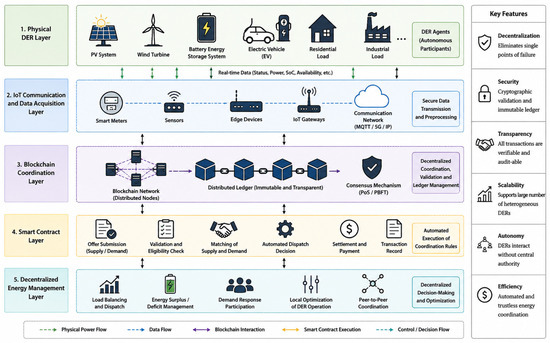
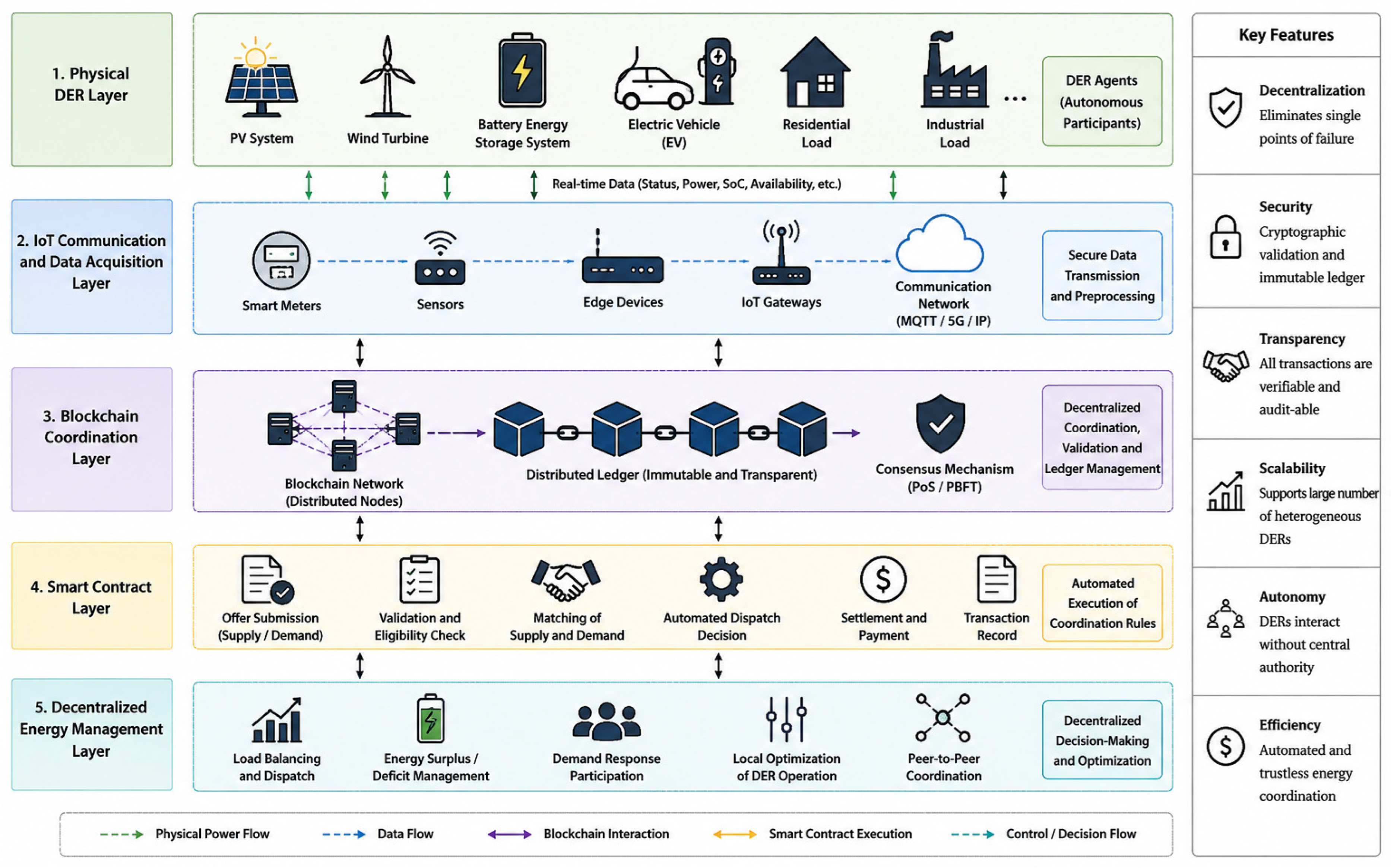
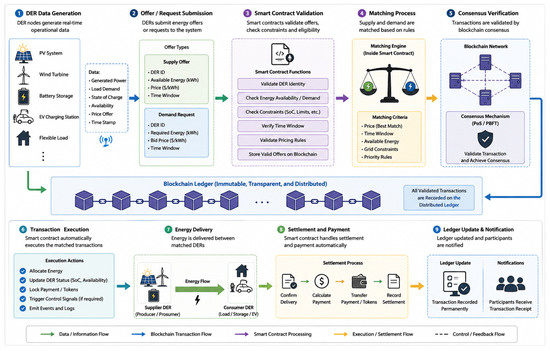
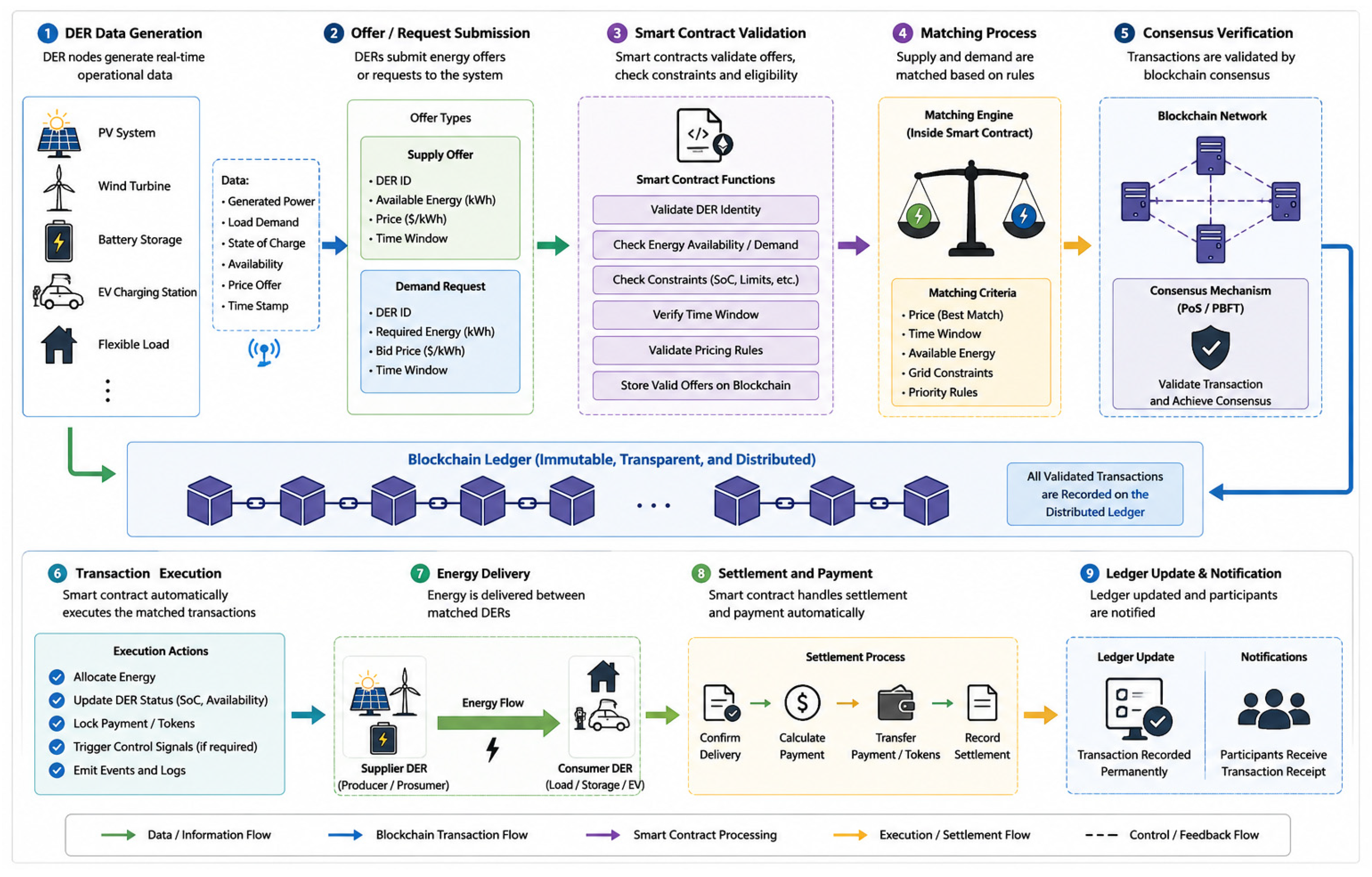
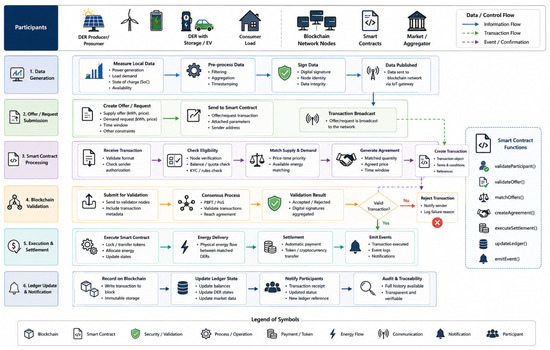
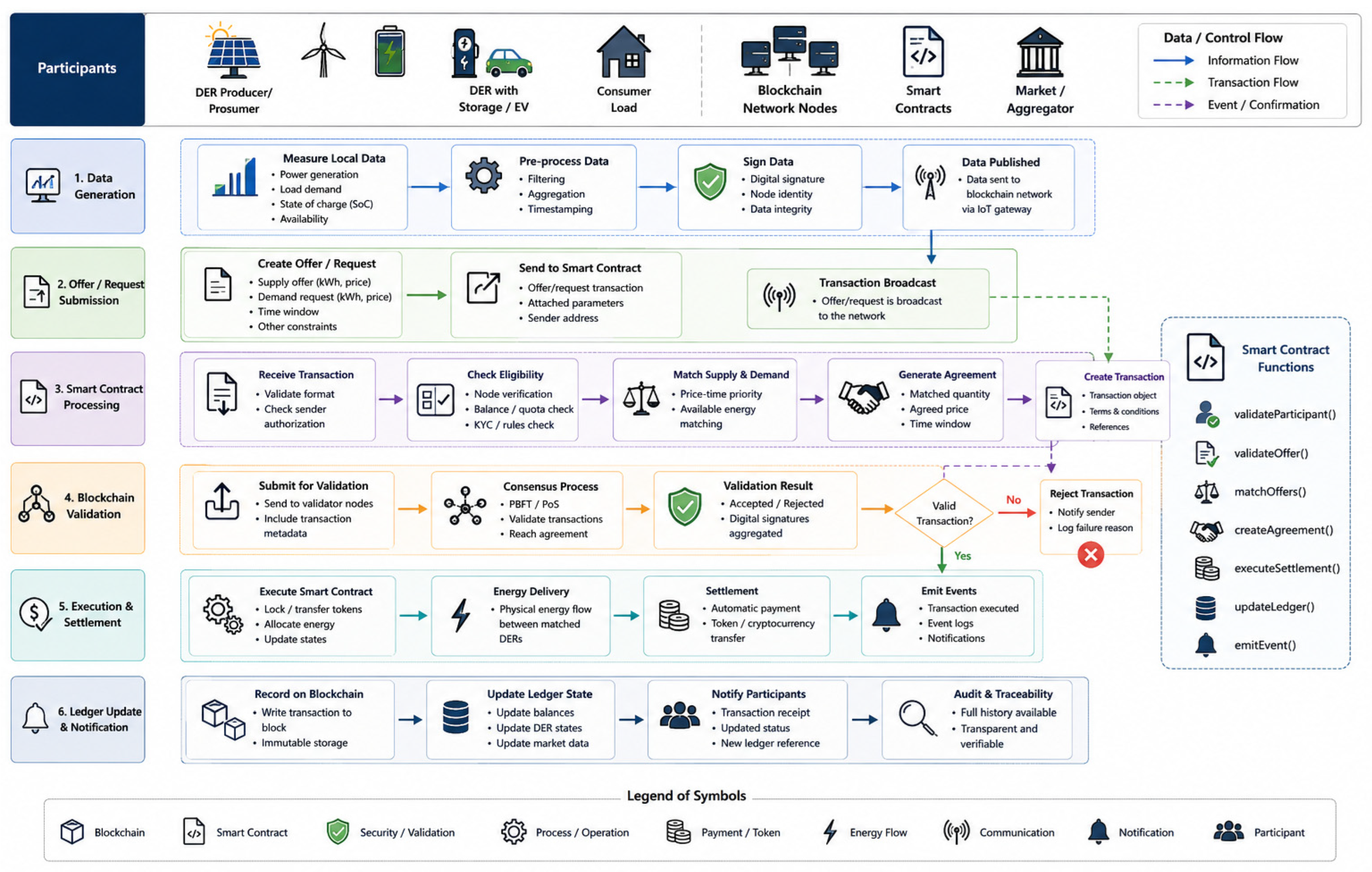
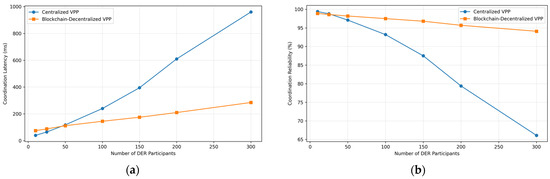
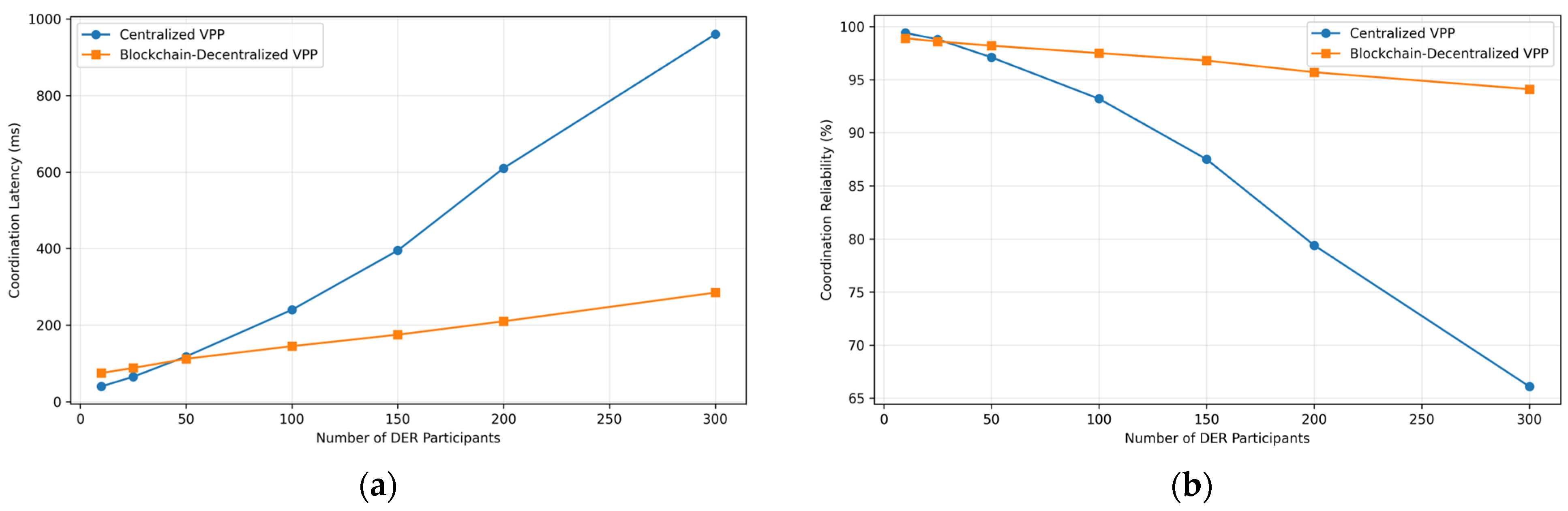
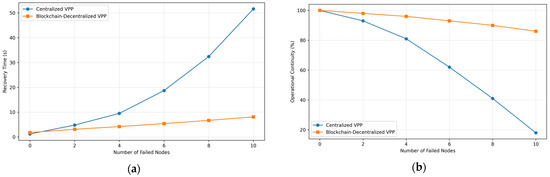
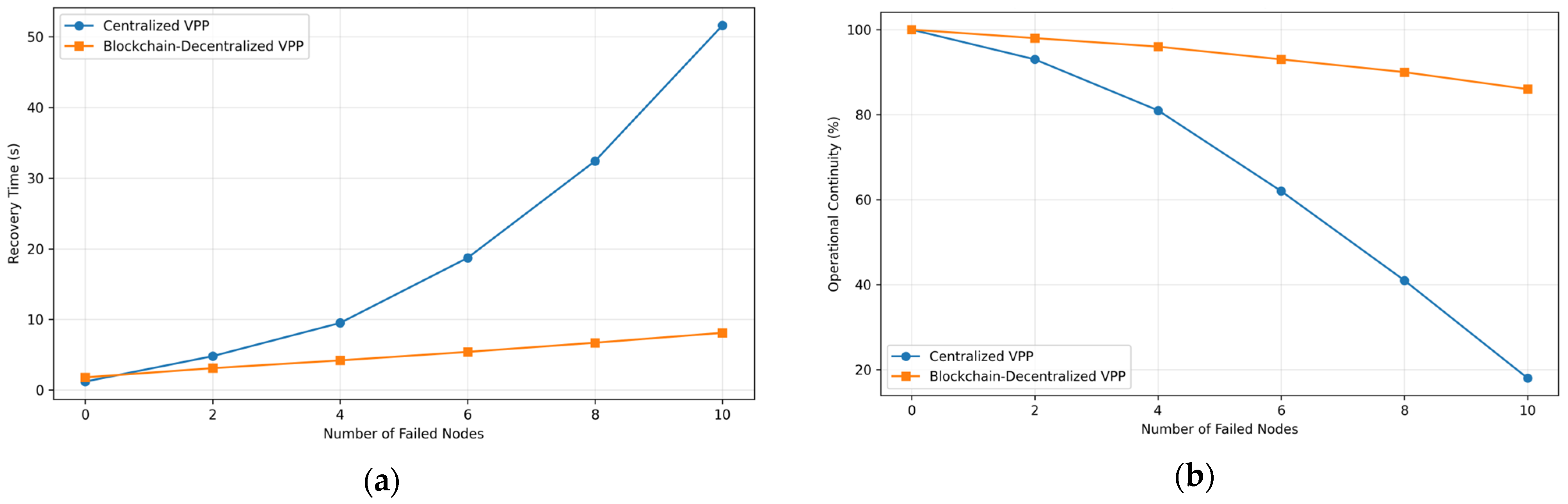
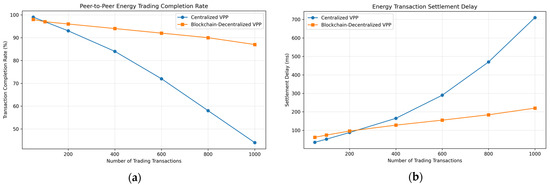
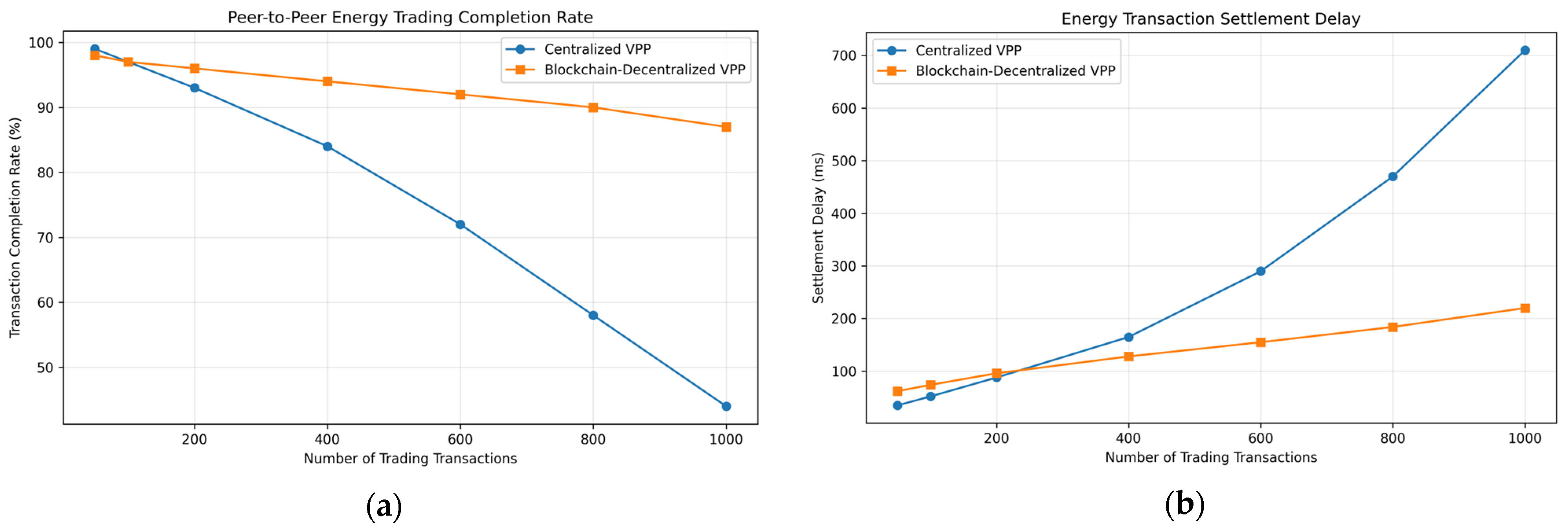
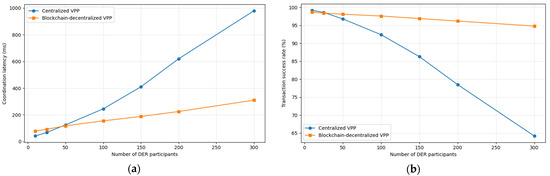
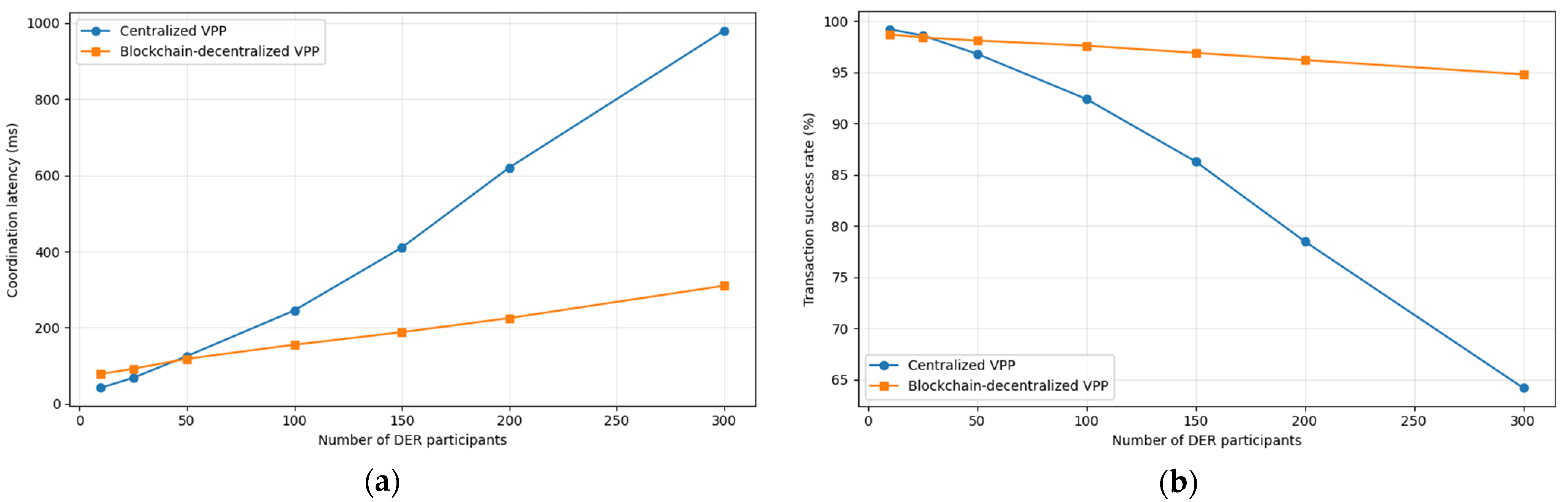
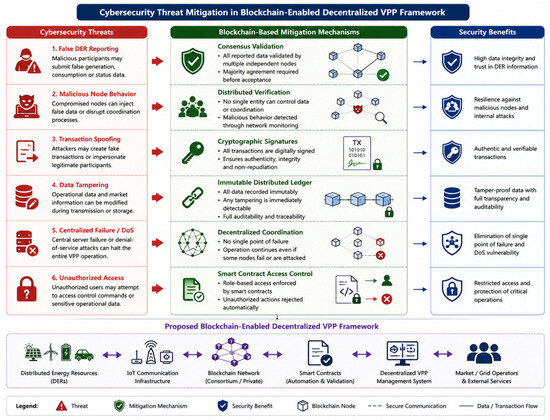
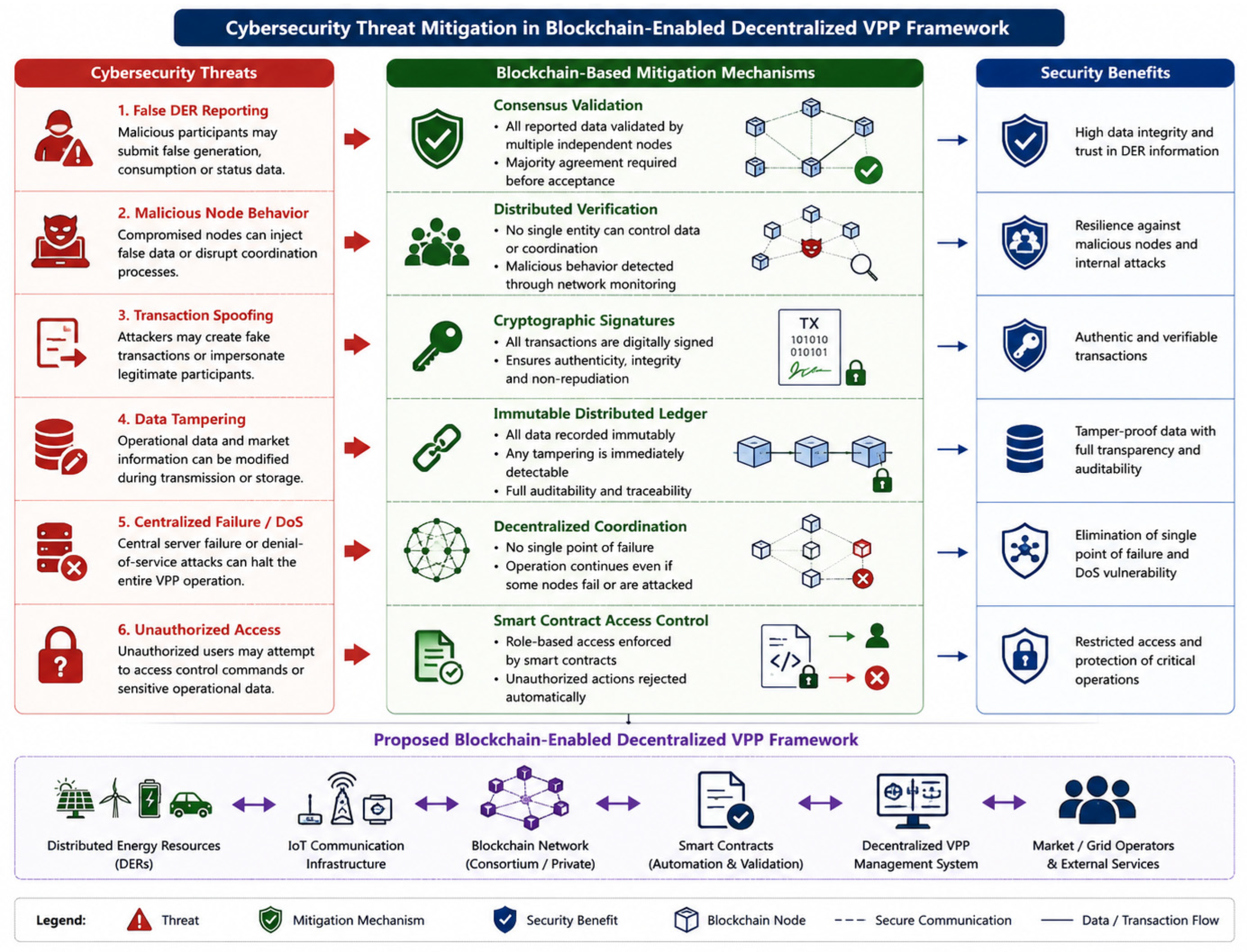
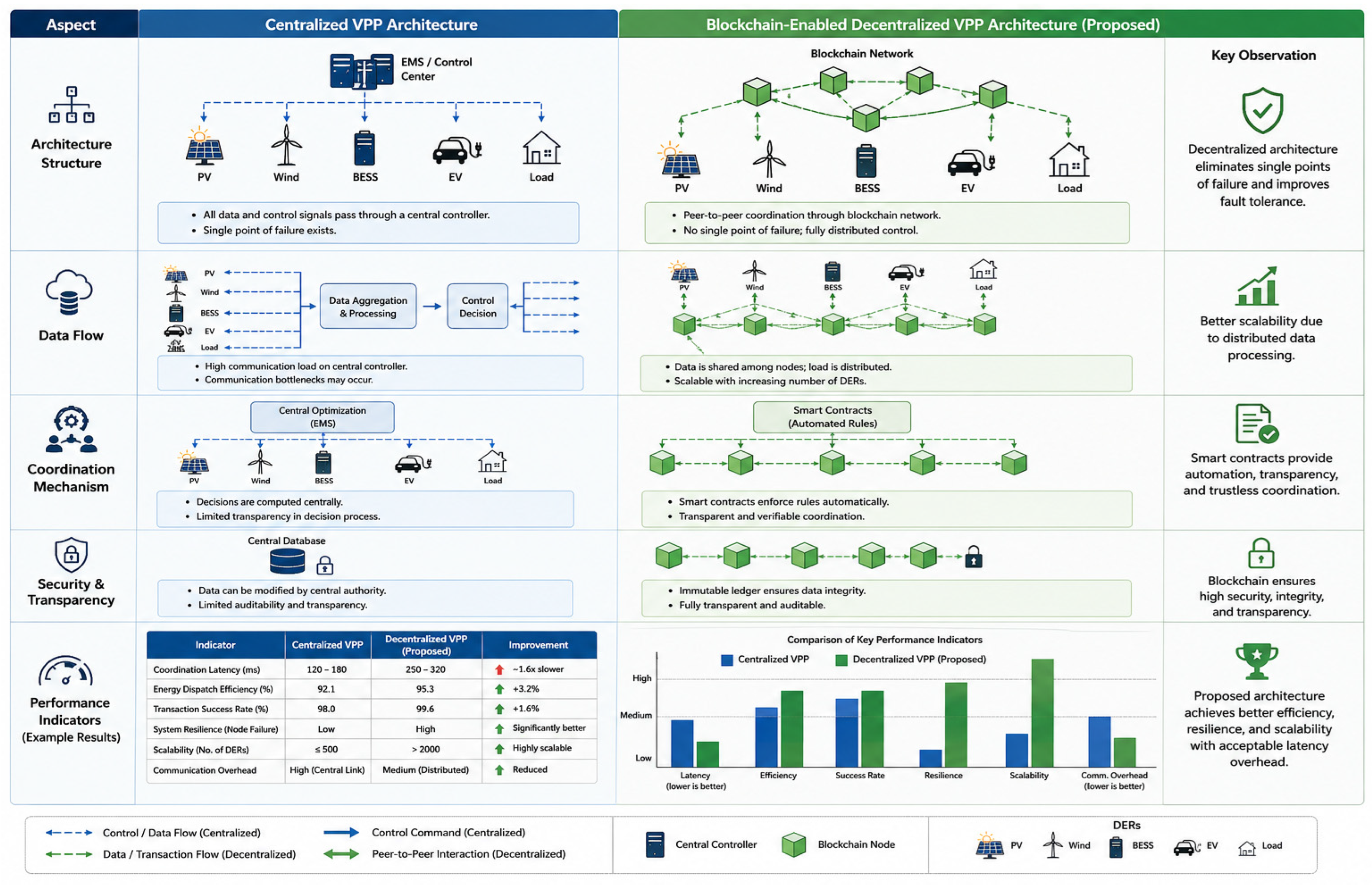
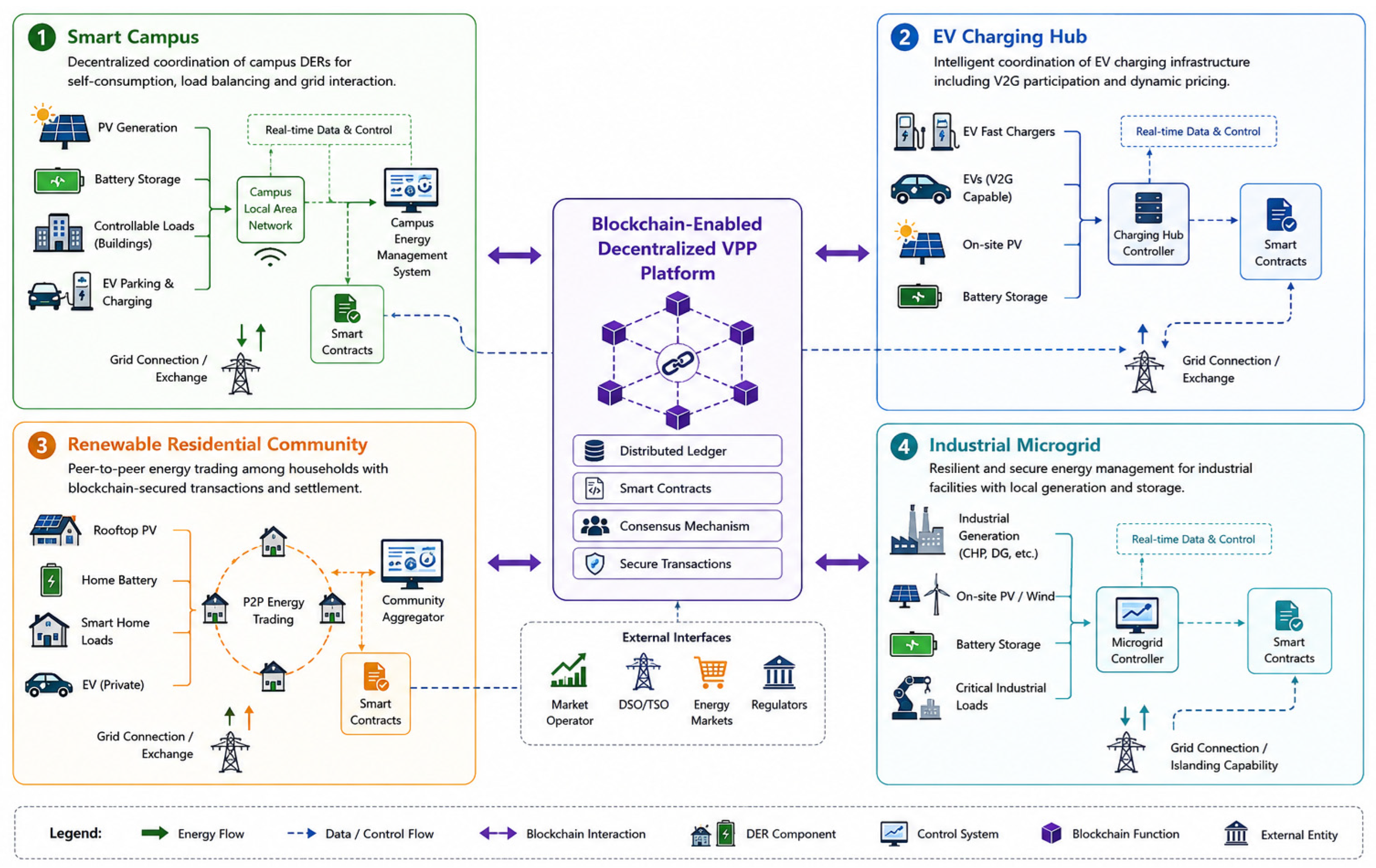

Disclaimer/Publisher’s Note: The statements, opinions and data contained in all publications are solely those of the individual author(s) and contributor(s) and not of MDPI and/or the editor(s). MDPI and/or the editor(s) disclaim responsibility for any injury to people or property resulting from any ideas, methods, instructions or products referred to in the content. |
© 2026 by the author. Licensee MDPI, Basel, Switzerland. This article is an open access article distributed under the terms and conditions of the Creative Commons Attribution (CC BY) license.