


Abstract
Skeletal kinetic mechanisms are essential for reducing the computational cost of ammonia combustion simulations while retaining the key chemical features governing ignition, flame propagation, and NO formation. This study extends the DRG-CSP-ANN reduction and optimization framework to ammonia combustion over a broader multi-condition parameter space, aiming to develop a compact skeletal mechanism applicable to different pressures, equivalence ratios, and temperatures. Sixteen detailed ammonia combustion mechanisms were first assessed against experimental data covering ignition delay time, laminar flame speed, and NOx species concentrations over wide ranges of pressure, temperature, equivalence ratio, and oxidizer composition. Based on the overall error evaluation, the detailed mechanism with the most balanced predictive performance was selected as the parent mechanism. The parent mechanism was then reduced using the Directed Relation Graph and Computational Singular Perturbation methods, yielding an initial skeletal mechanism, RA-Ori, with 20 species and 76 reactions. To compensate for the accuracy loss caused by mechanism reduction, an Artificial Neural Network surrogate was constructed to optimize the pre-exponential factors of selected sensitive reactions within their evaluated uncertainty ranges, leading to the final mechanism, RA-ANN. The validation results show that RA-ANN reasonably reproduces ignition delay times, laminar flame speeds, and NO concentrations under different ammonia combustion conditions. Quantitatively, RA-ANN reduces the overall error from 0.335 for RA-Ori to 0.206, corresponding to a 38.4% reduction, while maintaining the same compact size. Its overall error is close to that of the parent detailed mechanism and lower than that of several existing skeletal mechanisms considered in this work. These results demonstrate that the proposed DRG-CSP-ANN strategy can construct a compact ammonia skeletal mechanism that achieves a favorable balance between computational efficiency, predictive accuracy, and applicability over representative multi-condition ammonia combustion regimes.
1. Introduction
Combustion is a primary energy utilization approach for humans, but large-scale fossil fuel consumption emits substantial pollutants, among which rising CO2 emissions drive the intensified greenhouse effect and global climate change [1]. Driven by carbon reduction and energy transition, developing low-carbon/carbon-free fuels and their clean utilization technologies has become a key focus in combustion science. Ammonia (NH3) is deemed one of the most promising carbon-free fuels due to its zero-carbon nature, easy storage/transportation, and mature production/supply infrastructure [2]. Despite zero direct CO2 emissions, ammonia combustion suffers from poor ignitability, weak stability, and high NOx emissions; thus, developing efficient, stable, and low-emission ammonia combustion strategies is of great scientific and engineering significance [3].
Numerical simulation is indispensable for analyzing ammonia combustion and pollutant formation, whose accuracy relies on kinetic models that describe key intermediates, dominant pathways, and combustion characteristics over wide conditions. The development of ammonia combustion mechanisms has evolved from fundamental nitrogen chemistry networks to targeted refinement of key reaction pathways and to multi-objective optimization for complex systems, as summarized in Table 1 [4,5,6,7,8,9,10,11,12,13,14,15,16,17,18,19]. Early on, Miller et al. [20] established the basic nitrogen chemistry framework for ammonia oxidation and clarified the main oxidation path NH3 → NH2 → NH → N. Miller and Bowman [21] further integrated thermal NO, prompt NO, fuel NO, and NO2/N2O conversion into a unified system. Lindstedt et al. [22] identified the critical roles of NH2, NH, and N radicals in NO formation/reduction via flame and flow reactor validations. Konnov [4] optimized the NCN-related prompt-NO pathway to improve NO prediction for small-hydrocarbon co-combustion. Duynslaegher et al. [23] revised NH2 and N2O-related reactions and developed a 19-species/80-reaction reduced mechanism for NH3/H2 engine simulations.
Table 1.
Summary of detailed kinetic models for ammonia combustion applied in the following mechanism comparison.
With research progress, mechanism development shifted to refining key intermediate reactions under specific conditions. Based on the model of Klippenstein et al. [24], Song et al. [5] revised H2NO + O2, NH2 + O2, and NH2 + NO2 to improve N2O prediction at high pressures and low-to-intermediate temperatures. Stagni et al. [9] expanded H2NO + O2 into a competitive network involving O2, HO2, and NO2, revealing the regulatory roles of H2NO and HNO in reactivity and NO/N2 partitioning. Bertolino et al. [11] and Liu et al. [17] optimized pressure-dependent parameters and sensitive reactions via data-driven methods, deep learning, and genetic algorithms. Otomo et al. [7] adjusted NH2, HNO, and N2H2-related parameters to balance ignition delay and laminar flame speed prediction, while Glarborg et al. [6] reassessed key reactions for ammonia oxidation, NO formation, and reduction from a broad nitrogen chemistry perspective. Meanwhile, mechanism development extended to blended fuel systems, including ammonia/hydrogen [13], ammonia/hydrocarbon [25], and partially cracked ammonia combustion [14].
Existing ammonia mechanisms have evolved into detailed models applicable to complex temperature-pressure conditions and multi-component fuels, but most are developed for specific conditions, experimental targets, or performance parameters. Systematic validation and unified comparison across operating conditions, platforms, and combustion characteristics are insufficient, limiting their generality and reliability in practical applications.
Moreover, detailed mechanisms involve massive reactions, making high-fidelity CFD methods (LES, DNS) computationally prohibitive. For instance, Zhang et al. [26] performed LES of ammonia combustion with ~5 million cells using the mechanism of Xiao et al. [27], consuming 120,000 CPU hours per case; Liu et al. [28] conducted NH3/CH4 LES with the model of Okafor et al. [8], costing 50,000 CPU hours under similar grid scales; Saito et al. [29] ran DNS of ammonia combustion with 384,000 cells, requiring 3000 node-hours even with 7680 cores.
Skeletal mechanisms effectively reduce computational cost while retaining key intermediates and elementary reactions, enabling reasonable prediction of ignition, flame propagation, and pollutant formation. State-of-the-art skeletal mechanisms for ammonia combustion are summarized in Table 2 [23,30,31,32]. Li et al. [30] developed a 28-species/213-reaction reduced mechanism for NH3/H2 combustion via DRGEP-SA; Okafor et al. [31] simplified their detailed model [8] into a 42-species/130-reaction skeletal mechanism with accurate laminar flame speed prediction; Gotama et al. [32] optimized the model of Han et al. [10] into a 26-species/119-reaction reduced mechanism for NH3/H2/air flames.
Table 2.
Summary of skeletal kinetic models for ammonia combustion.
However, most existing skeletal mechanisms were derived from detailed models optimized for single combustion characteristics (e.g., laminar flame speed) rather than systematically validated mechanisms, leading to uncertain accuracy and applicability. Some skeletal mechanisms still have excessive species/reactions, failing to balance computational efficiency and prediction accuracy. Thus, developing a compact, high-accuracy skeletal mechanism is urgently needed. The DRG-CSP-ANN method [33] (combining DRG/CSP reduction with ANN parameter optimization) shows great potential: it compensates for prediction deviations caused by mechanism reduction, maximizing reduction degree while ensuring accuracy. Si et al. [33] applied this method to reduce GRI-3.0 from 53 species/325 reactions to 13 species/35 reactions, cutting the error to 1/10 of the unoptimized DRG-CSP mechanism and outperforming existing 58-reaction skeletal models.
Therefore, the present study aims to develop a skeletal reaction mechanism for ammonia combustion simulations with reliable predictions of ignition, flame propagation, flame stabilization, and pollutant formation. Based on this consideration, the present study first systematically evaluates existing detailed ammonia combustion mechanisms over a wide range of experimental conditions and selects a suitable parent mechanism with balanced predictive performance. The selected mechanism is then reduced and optimized using the DRG-CSP-ANN procedure to construct a compact skeletal mechanism for ammonia combustion. Finally, the resulting mechanism is validated against experimental data for ignition delay time, laminar flame speed, and NO concentration under different pressure, equivalence-ratio, and temperature conditions. First, existing detailed ammonia mechanisms are systematically evaluated for ignition delay, laminar flame speed, and NOx formation to select the optimal parent mechanism. Then, a skeletal mechanism is constructed via the DRG-CSP-ANN approach, and validated against existing skeletal models in terms of ignition, laminar flames, and NOx formation to assess accuracy, applicability, and efficiency. The proposed mechanism is expected to provide a reliable kinetic basis for high-fidelity ammonia combustion simulations.
2. Computational Details
This section first introduces the computational models and corresponding combustion systems employed in the present study and then describes, in detail, the methodology and implementation procedure used for skeletal mechanism construction.
2.1. Reactor Models
Ideal reactor models in CHEMKIN-Pro 18.0 (ANSYS, Inc., Canonsburg, PA, USA) are used to evaluate existing detailed mechanisms and support the construction, optimization, and validation of the skeletal mechanism. Autoignition, perfectly stirred reactor (PSR), plug flow reactor (PFR), and one-dimensional laminar premixed flame models are adopted to characterize ignition delay, species evolution, and flame propagation under corresponding experimental conditions.
The autoignition model calculates ignition delay time and serves as the core criterion for mechanism reduction, parameter optimization, and performance evaluation. This zero-dimensional model assumes homogeneous premixing at the initial state and neglects flow, diffusion, and mixing effects. It is suitable for analyzing homogeneous reaction evolution and assessing ignition prediction performance.
The PSR model approximates jet-stirred reactor (JSR) experiments. It assumes complete internal mixing, uniform temperature, pressure, and species concentrations, as well as instantaneous mixing and continuous flow. It reasonably reproduces the evolution of major species and pollutant concentrations in JSR experiments.
The PFR model simulates tubular reactor experiments. It assumes plug flow without axial back-mixing and uniform cross-sectional conditions. Reactor variables only change along the axial direction. It is suitable for simulating species evolution with residence time or axial position, especially for predicting oxidation and pollutant formation.
The one-dimensional laminar premixed flame model describes the structure and speed of freely propagating premixed flames. It effectively evaluates the flame propagation prediction ability of different mechanisms.
To ensure the systematicity and representativeness of the mechanism evaluation, ignition delay time, laminar flame speed, and NO/N2O concentrations are selected as the primary validation targets. The experimental conditions used for detailed-mechanism evaluation and skeletal mechanism construction are summarized in Table 3.
Table 3.
Experimental conditions for detailed-mechanism evaluation and skeletal mechanism construction.
2.2. Theoretical Basis of DRG-CSP-ANN Reduction
2.2.1. DRG-CSP Reduction
Directed Relation Graph (DRG) is a graph-theory-based mechanism reduction method. It treats chemical species as graph nodes and quantifies the coupling strength through direct dependence in the reaction network. The normalized contribution of species N to a key species M, denoted by rM,N, can be expressed as
In (1), the subscript i represents the elementary reaction i that contains species M; is equal to 1 or 0 if N is included in reaction i or not; is the equivalent coefficient of M in reaction i; and is the net reaction rate of elementary reaction i. The parameter rM,N reflects the importance of species N to the conversion of the key species M. By preselecting the key species set and a threshold value ε, the influence of species N on species M can be regarded as negligible when rM,N < ε, and the corresponding unimportant connection is removed. The remaining species and reactions form the preliminary reduced mechanism. More details about the theoretical basis and implementation of the DRG method can be found in Ref. [51].
Based on the initial DRG reduction, Computational Singular Perturbation (CSP) is adopted for further mechanism reduction [52]. CSP utilizes time-scale separation and identifies quasi-steady-state (QSS) species. Species with extremely short characteristic time scales or low concentrations show limited influence on temperature, ignition, flame propagation, and major species profiles, so that they are eliminated or approximated. The DRG-CSP combination achieves a deep reduction while retaining the prediction accuracy of key combustion characteristics. More details of the CSP method can be found in Ref. [52].
2.2.2. Artificial Neural Network (ANN) for Parameter Optimization
ANN is a widely used nonlinear mapping model with strong function approximation and multi-variable learning ability [53]. With an appropriately designed network architecture, an ANN can effectively establish the mapping relationship between kinetic parameters and target responses. Therefore, in the parameter optimization, the use of an ANN as a surrogate for a large number of direct numerical simulations can significantly reduce computational cost and shorten optimization time [54]. On this basis, an ANN is introduced in the present study to optimize the key kinetic parameters in the skeletal mechanism.
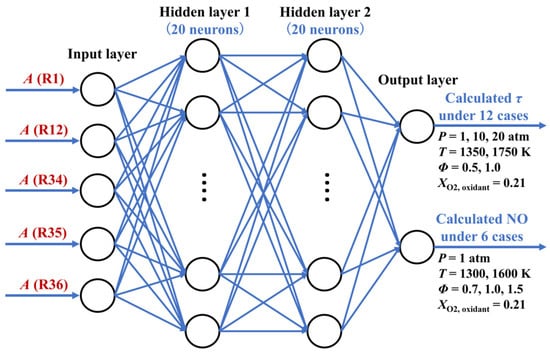
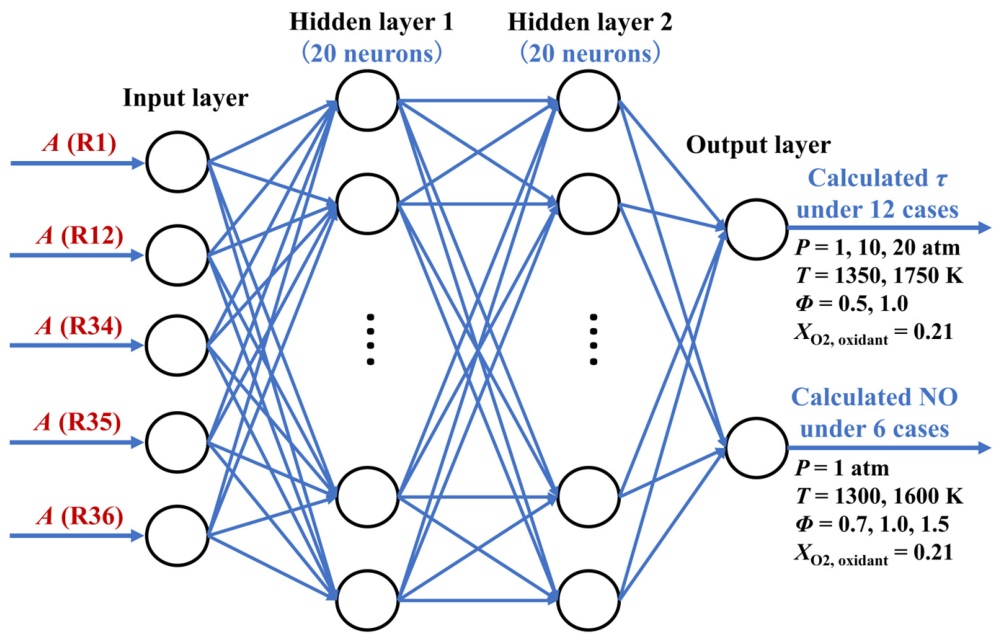
Specifically, the ANN model is constructed using the Neural Network Toolbox (NNT) in MATLAB R2020b (MathWorks, Natick, MA, USA). A fully connected feed-forward neural network is adopted, consisting of two hidden layers with 20 neurons in each layer, as shown in Figure 1. This architecture is determined through multiple comparative trials. When the number of hidden layers or neurons is further increased, no significant reduction in training error is observed, indicating that the selected architecture is sufficient for the present parameter-optimization problem.
Figure 1.
Neural network architecture used in this work.
For the input variables, the five reactions most strongly correlated with ignition delay time τ and NO concentration are first identified through first-order sensitivity analysis [55], and their kinetic parameters are selected as candidate optimization variables. The network outputs are defined as the ignition delay time predicted by the autoignition model and the NO mole fraction, XNO, predicted by the PFR model under given parameter conditions. By establishing the mapping between the input kinetic parameters and the target responses, the ANN can rapidly predict the mechanism behavior corresponding to a given parameter set, thereby substantially improving the efficiency of the parameter-optimization procedure.
The reaction rate constant k is expressed by the Arrhenius form as
where A is the pre-exponential factor, b is the temperature exponent; Ea is the activation energy; T is the temperature; and R is the universal gas constant. These units follow the CHEMKIN convention. It should be noted that elementary reaction parameters are generally obtained from experimental fitting or theoretical calculations. Among them, Ea and b directly determine the temperature dependence of the reaction rate. Arbitrary modifications of these parameters may alter the original temperature-response characteristics of the reaction and compromise the physical consistency of the optimization. Therefore, only pre-exponential factors of the selected key reactions, i.e., different values of A, are adjusted simultaneously, so as to improve the predictive accuracy of the skeletal mechanism while preserving the original temperature dependence as much as possible.
The ANN is trained using the Levenberg–Marquardt algorithm [56] to improve convergence efficiency. The loss function is defined as the mean squared error (MSE). The training process is terminated when any of the following criteria is met: the minimum MSE reaches 10−8, the minimum gradient reaches 10−6, or the number of training epochs reaches 3000. The learning rate is set to 0.005 in order to balance training accuracy and convergence efficiency. More details on the ANN training procedure and its mathematical formulation can be found in Ref. [57].
3. Selection of Parent Mechanism for Reduction and Optimization
To select an optimal parent mechanism for subsequent reduction and optimization, we systematically evaluate the predictive performance of 16 existing detailed kinetic mechanisms for ammonia combustion (listed in Table 1) against experimental data for three key targets: ignition delay time, laminar flame speed, and NOx formation.
- Ignition delay time:
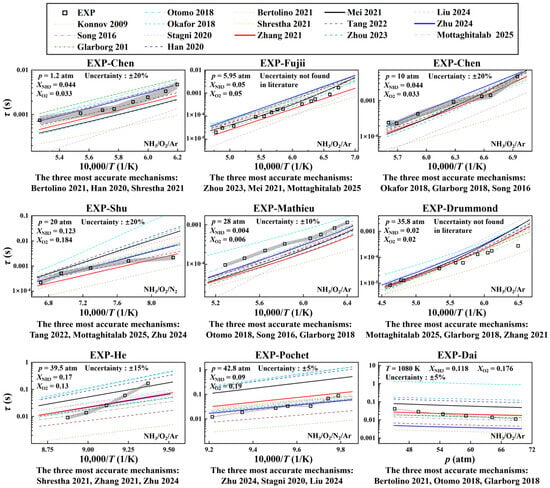
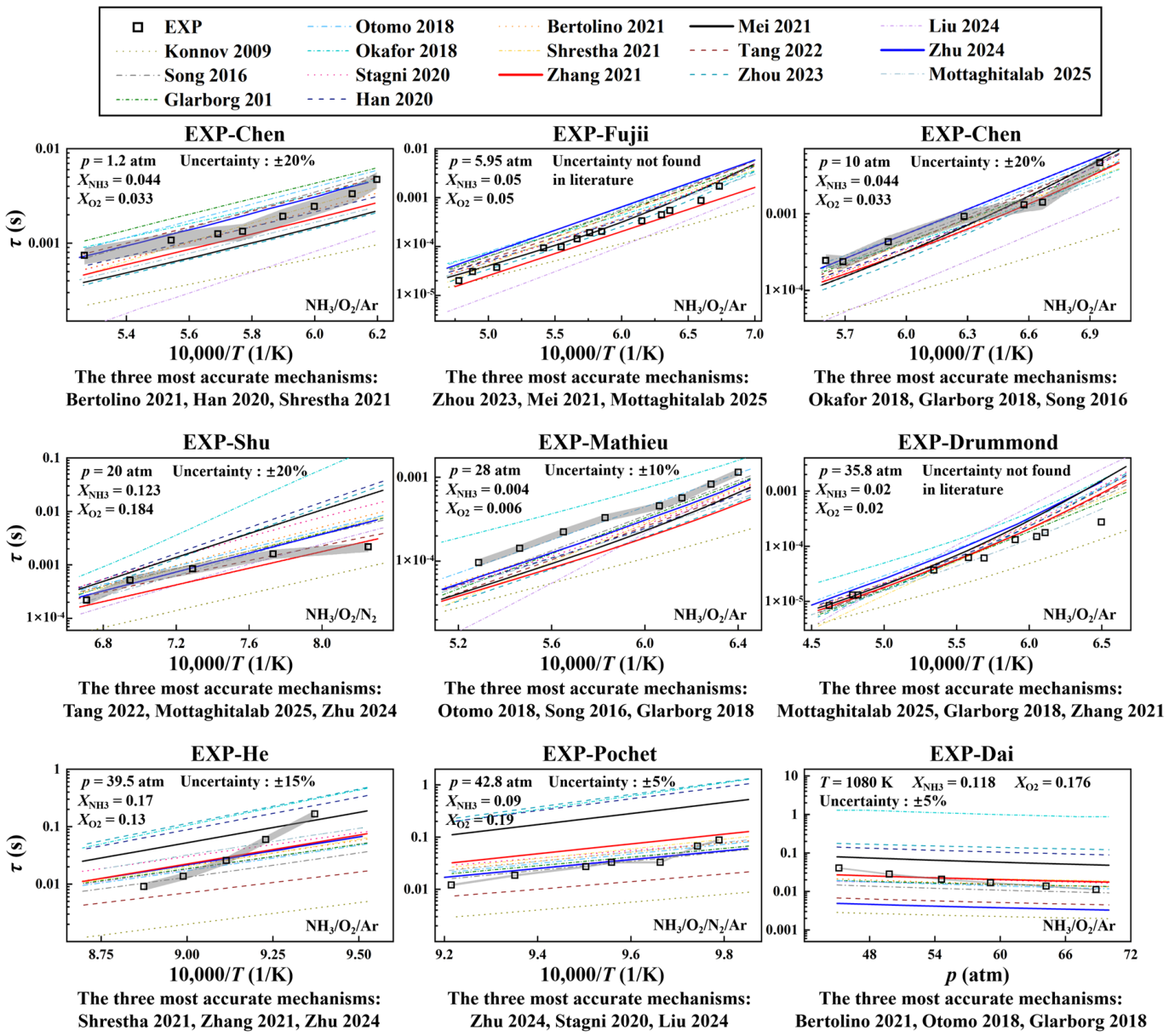
Figure 2 compares the predicted ignition delay times with experimental measurements from multiple sources [34,35,36,37,38,39,40,41] over wide ranges of pressure (p = 0.3–73.9 atm), temperature (T = 1005–2585 K), and equivalence ratio (Φ = 0.2–3.0). Substantial discrepancies exist among the mechanisms. Evidently, the Konnov 2009 mechanism [4] consistently underpredicts ignition delay times, indicating the overestimated reactivity. Also, obviously, the Liu 2024 mechanism [17] underpredicts at pressures below 10 bar, likely because it was optimized for high-pressure conditions (60–75 bar) and extrapolates poorly to low pressure. Moreover, the mechanisms of Okafor 2018 [8], Mei 2021 [14], Han 2020 [10], and Zhou 2023 [16] generally overpredict ignition delay times, especially at elevated pressures, suggesting that they underestimated the high-pressure reactivity. Nevertheless, it appears that the mechanisms of Zhang 2021 [13], Bertolino 2021 [11], Shrestha 2021 [12], and Song 2016 [5] reproduce the experimental trends most satisfactorily across the investigated conditions.
Figure 2.
Comparison of ignition delay times predicted by different ammonia combustion kinetic mechanisms under various conditions. The gray shaded regions indicate the uncertainty ranges of the experimental data reported in the corresponding literature.
- 2.
- Laminar flame speed:
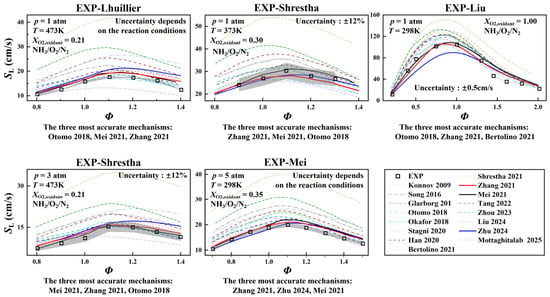
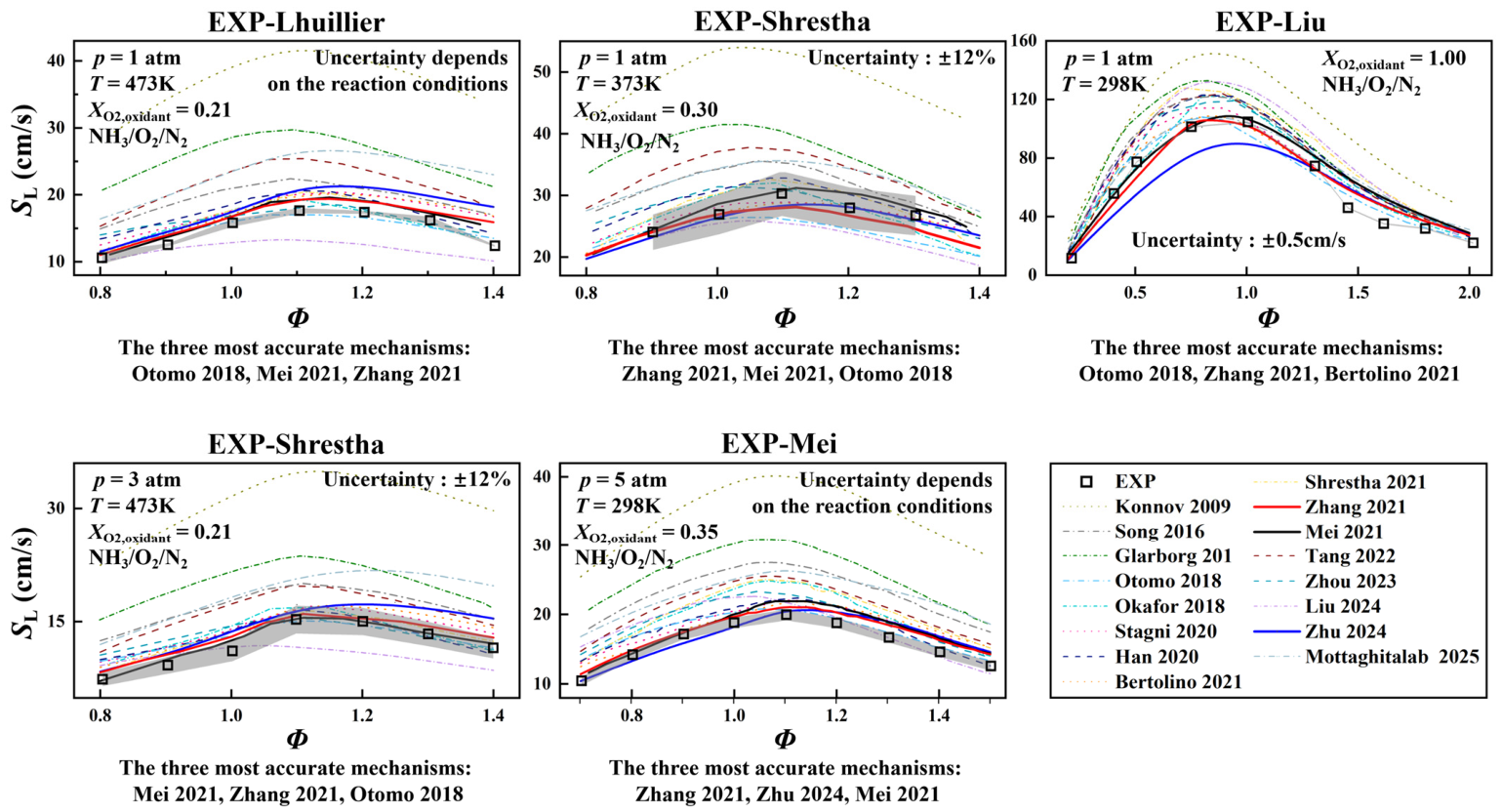
Figure 3 compares the predicted laminar flame speeds with experimental data [12,42,43,44] under various pressures (p = 1–5 atm), temperatures (T = 298–473 K), oxidant oxygen fraction (XO2,oxidant = 21–100%), and equivalence ratios (Φ = 0.2–1.5). Most mechanisms tend to overpredict the flame speed, with the Konnov 2009 [4] and Glarborg 2018 [6] mechanisms showing the largest deviations. This overprediction is particularly evident near Φ = 0.8 and 1.4.
Figure 3.
Comparison of laminar flame speeds predicted by different detailed ammonia combustion mechanisms under various operating conditions. The gray shaded regions indicate the uncertainty ranges of the experimental data where such information is available in the corresponding literature.
Under pure-oxygen conditions (p = 1 atm, T = 298 K, XO2,oxidant = 100%) [43], the peak laminar flame speed reaches SL ≈ 100 cm/s, which is the highest value among all conditions considered. Although all mechanisms capture the general trend with equivalence ratio Φ, the predicted peak magnitudes differ substantially. The Zhu 2024 mechanism [18] underpredicts over Φ = 0.25–1.0, whereas most others overpredict as well. Overall, the Zhang 2021 [13], Zhu 2024 [18], and Stagni 2020 [9] mechanisms agree most closely with experiments in both magnitude and trend.
- 3.
- NO and N2O concentrations:
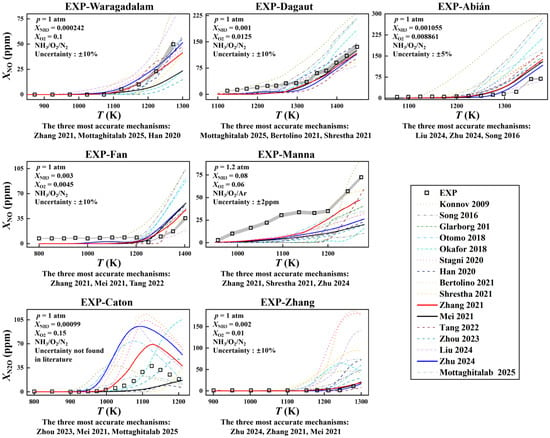
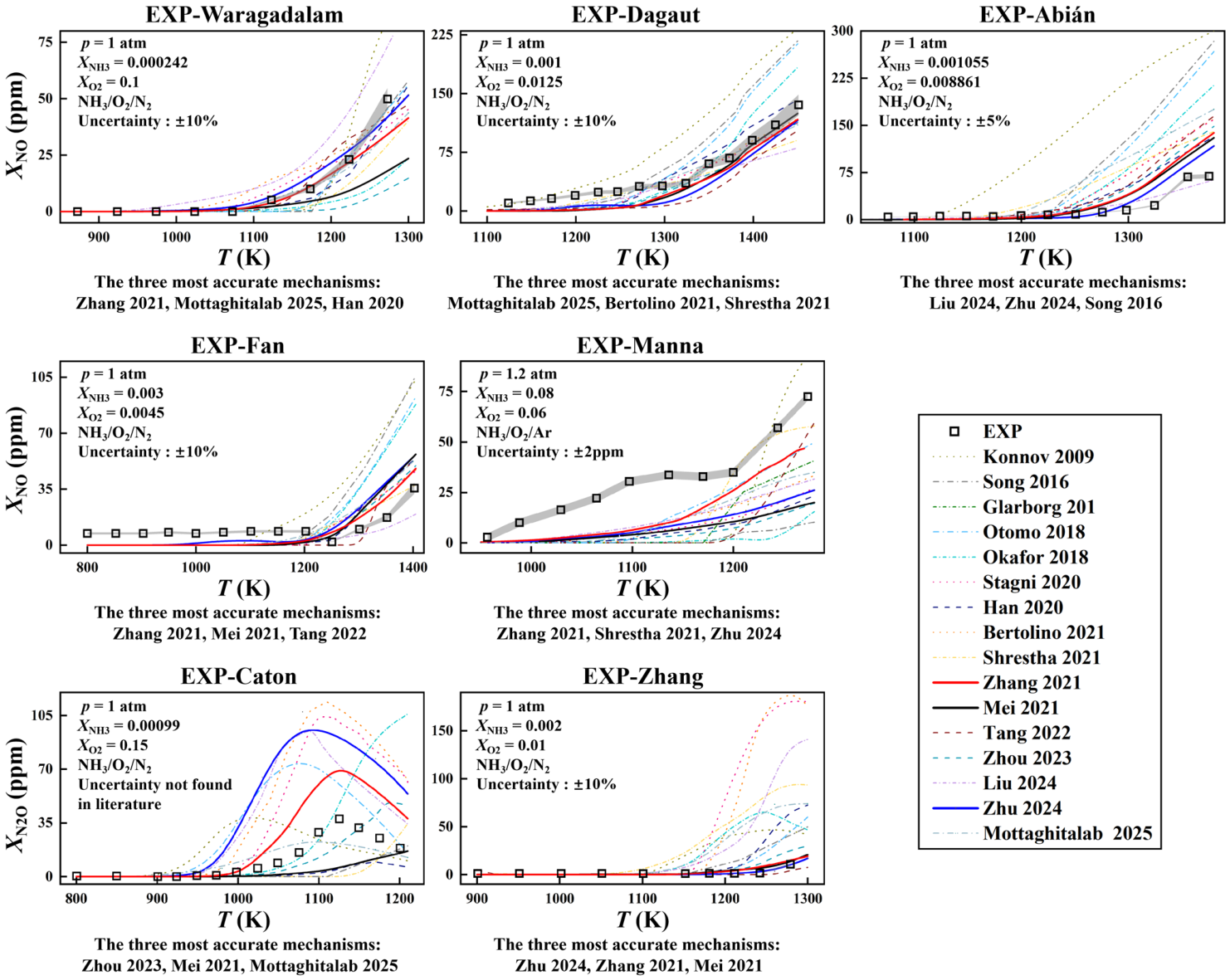
Figure 4 presents comparisons between experimental data [13,45,46,47,48,49,50] and the predicted NO and N2O concentrations obtained using different detailed ammonia combustion mechanisms under various conditions. The predictive capability of a mechanism is not judged solely by the maximum concentration. Instead, the assessment in Figure 4 considers both the overall agreement with experimental concentrations and the ability to reproduce the temperature-dependent trend of NOx formation. Obviously, the Konnov 2009 [4], Song 2016 [5], and Liu 2024 [17] mechanisms substantially overpredict NO in the low-temperature regime. For the Fan case [50] (p = 1 atm, Φ = 0.50) and Abián case [47] (p = 1 atm, Φ = 0.089), most mechanisms overpredict NO at intermediate and high temperatures. For the Manna case [49] (p = 1.2 atm, Φ = 1.0), all mechanisms tend to underpredict NO and fail to reproduce the experimental temperature dependence. For the Caton case [45] (p = 1 atm, Φ = 0.005), the N2O peak occurs at 1100–1150 K. The Zhang 2021 mechanism [13] best reproduces this temperature range, although it still overpredicts the peak magnitude; other mechanisms shift the peak toward lower temperatures. The Konnov 2009 mechanism [4] consistently overpredicts NO across all conditions, with particularly large deviations in the Dagaut [48], Fan [50], and Abián [47] cases. Overall, the Zhang 2021 mechanism [13] provides the most reasonable description of nitrogen oxide formation across the investigated conditions.
Figure 4.
Comparison of NO and N2O concentrations predicted by different detailed ammonia combustion mechanisms under various reactor conditions. The gray shaded regions indicate the uncertainty ranges of the experimental data where such information is available in the corresponding literature.
- 4.
- Quantitative error ranking:
To quantitatively rank the mechanisms, we adopt the error function Err proposed by Hu et al. [58], i.e.,
where D denotes the number of datasets for a given property, Di is the number of data points in the i-th dataset, Sij is the j-th simulated value predicted by a given mechanism, and is the corresponding experimental value. In the present study, Sij represents the calculated ignition delay time τ, laminar flame speed SL, or NOx concentration XNOx, depending on the target quantity being evaluated. This treatment is adopted because τ and XNOx concentrations may vary by several orders of magnitude during ammonia oxidation. Compared with an absolute-error-based metric, the logarithmic form provides a more balanced assessment of model deviations over different concentration ranges and avoids the error evaluation being dominated only by high-concentration data points.
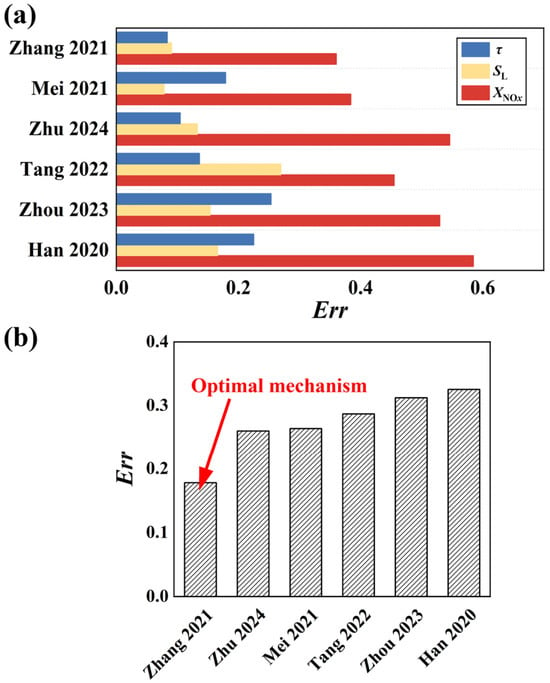
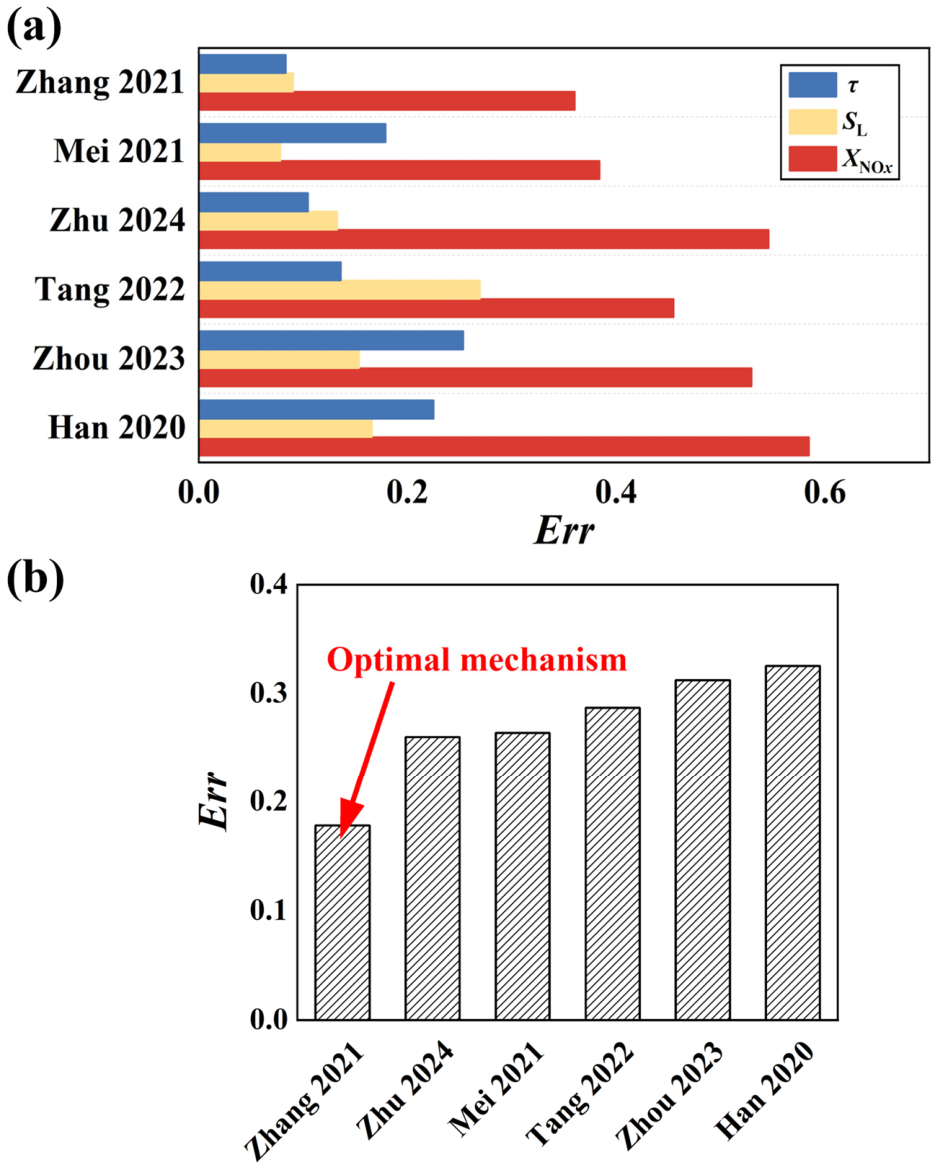
Figure 5 presents the values of Err for the three targets and the overall ranking. For clarity, only the mechanisms with the smallest overall errors are shown. The Zhang 2021 mechanism [13] achieves the lowest overall Err (0.178), outperforming all other candidates. Notably, although the Zhu 2024 [18] and Stagni 2020 [9] mechanisms perform well in laminar flame speed, their larger errors in ignition delay or NOx formation lead to higher overall Err values. Based on these results, we select the Zhang 2021 mechanism [13] as the parent mechanism for subsequent skeletal reduction and parameter optimization.
Figure 5.
Comprehensive error comparison of candidate detailed ammonia combustion mechanisms, (a) Error statistics charts for various combustion characteristics; (b) Comprehensive error chart.
4. Construction of DRG-CSP-ANN Mechanism and Its Optimization
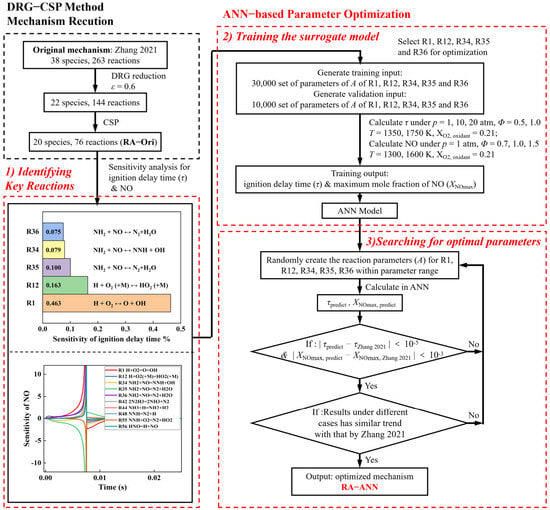
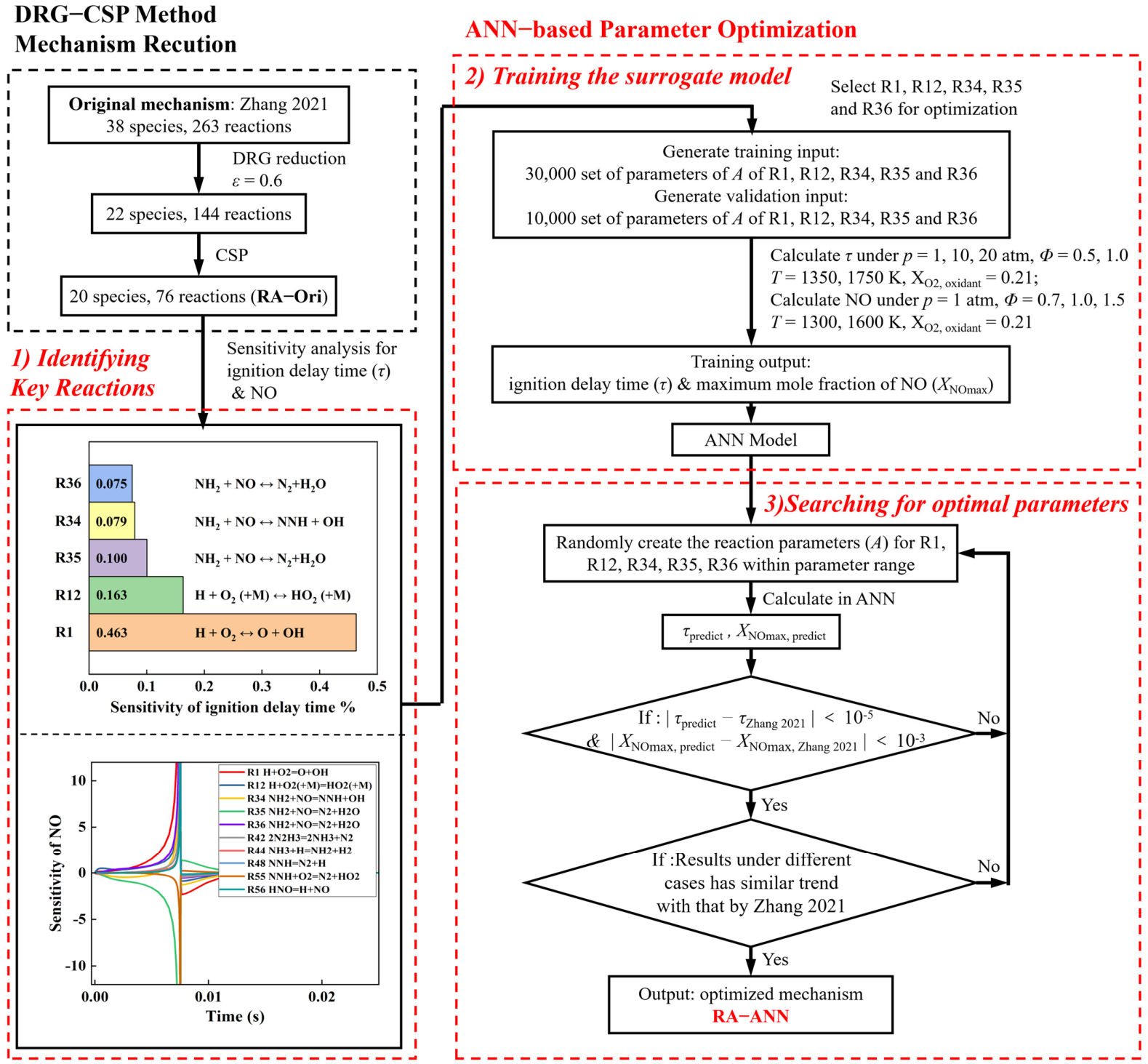
Figure 6 outlines the overall procedure for developing and optimizing the skeletal mechanism. Starting from the detailed Zhang 2021 mechanism [13], we first apply DRG-CSP reduction to obtain a preliminary skeletal mechanism, RA-Ori. Subsequently, we introduce an ANN to optimize key kinetic parameters, yielding the final skeletal mechanism, denoted as RA-ANN.
Figure 6.
Sketch of DRG-CSP-ANN method.
- DRG-CSP reduction:
This process takes the following three steps:
(1) Defining the target conditions: The predictive performance of ammonia mechanisms is highly pressure-dependent. Therefore, we define the target operating range for the skeletal mechanism as: the pressure p = 1–20 atm, the initial temperature T = 1100–1800 K, the global equivalence ratio Φ = 0.7–1.0, and oxygen mole fraction XO2 = 0.21–0.32. This range covers the majority of available experimental conditions [12,13,34,35,36,37,38,39,40,41,42,43,44,45,46,47,48,49,50]. To preserve key combustion characteristics, we select NH3, NO, OH, and H2O as target species for reduction. The reduction criteria are based on the relative errors in their peak values and temperature evolution toward the equilibrium. Laminar flame speed was not directly included in the DRG-CSP sensitivity analysis or ANN-based parameter optimization. This is because laminar flame speed is closely related to ignition delay time through the overall chemical reactivity of the mechanism, including fuel oxidation, radical-pool development, and key chain-branching reactions. Therefore, ignition delay time was used as a direct reactivity-related target to represent the low-reactivity feature of ammonia combustion. In addition, one-dimensional freely propagating flame calculations are more computationally expensive and less robust than autoignition and species-concentration calculations during mechanism reduction and random kinetic-parameter sampling. Thus, laminar flame speed was retained as an independent validation quantity rather than being directly included in the reduction and optimization loop.
(2) DRG reduction: We set the absolute error threshold ε = 0.01 and the relative error threshold to 0.6. Under these criteria, the parent mechanism reduces to an intermediate skeletal mechanism containing 22 species and 144 reactions.
(3) CSP reduction: We then apply Computational Singular Perturbation (CSP) [52] to identify and remove quasi-steady-state species. The final DRG-CSP reduced mechanism, named RA-Ori, contains 20 species and 76 reactions. This mechanism serves as the starting point for ANN-based parameter optimization.
- 2.
- ANN-based parameter optimization:
The ANN optimization consists of three steps: identifying key reactions; training the surrogate model; and searching for optimal parameters.
(i) Identifying key reactions: We select two optimization targets (shown in Figure 6): ignition delay time τ under 12 conditions and peak NO mole fraction XNOmax under 6 conditions. These targets address the two major challenges of ammonia combustion: poor ignitability and high XNOmax emissions. First-order sensitivity analysis [55] reveals that five reactions (R1, R12, R34, R35, R36) most strongly influence these targets. We therefore choose these reactions for optimization.
(ii) Training the ANN surrogate: For each selected reaction, we define an admissible range for its pre-exponential factor A (see Table 4). Within these ranges, we randomly generate 30,000 parameter sets using the logarithmic sampling of
to ensure uniform coverage across orders of magnitude; in (4), rand(0,1) is a uniformly distributed random number between 0 and 1. Here, Amin and Amax are the lower and upper bounds of A uncertainty for optimized reactions. For each set, we run CHEMKIN-Pro simulations to compute τ and XNOmax. An additional 10,000 independent sets serve for validation. We then train a fully connected feed-forward ANN (two hidden layers, 20 neurons each) using the Levenberg–Marquardt algorithm [56] with mean squared error (MSE) as the loss function. Training stops when MSE < 10−8, gradient criterion < 10−6 or 3000 epochs are reached. The trained ANN achieves R2 > 0.99 on both the training and validation sets. In addition, the training and validation errors of the ANN surrogate are 1.26 × 10⁻⁵ and 8.41 × 10⁻⁵, which are smaller than the typical magnitudes of the target responses considered in the optimization, i.e., ignition delay time on the order of 10−4–10−3 s and peak NO mole fraction on the order of 10−2. This indicates that the ANN surrogate provides sufficient accuracy for the present A-factor optimization. This indicates that the ANN surrogate provides sufficient accuracy for the present A-factor optimization. Using this ANN, predicting τ and XNOmax for a new parameter set takes only seconds, compared to approximately 12 h on a 48-core workstation for direct CHEMKIN simulations.
Table 4.
Key sensitive reactions and the corresponding pre-exponential factors before and after optimization.
(iii) Searching for optimal parameters: Using the trained ANN, we perform a parameter search to minimize the deviation of skeletal mechanism predictions from those of the detailed Zhang 2021 mechanism [13]. The optimal parameter combination is then verified by direct CHEMKIN-Pro simulations. The resulting optimized skeletal mechanism is named RA-ANN, with its optimized A factors listed in Table 4. The complete mechanism is provided in the Supplementary Material. As shown in Table 4, the optimized scaling factors are 1.32 for R1, 0.62 for R12, 0.70 for R34, 0.64 for R35, and 1.28 in magnitude for R36. These values remain within the evaluated uncertainty ranges of the corresponding reaction rate constants. Therefore, the ANN optimization introduces only moderate corrections to the selected reactions, rather than arbitrary or physically unreasonable parameter changes. Since these corrections are confined to the accepted kinetic uncertainty ranges, they do not alter the physical meaning or reaction characteristics of the selected elementary reactions.
5. Validation of the DRG-CSP-ANN Skeletal Mechanism
To evaluate the applicability of the developed skeletal mechanism, we systematically validate RA-ANN and RA-Ori against experimental data and existing skeletal mechanisms in terms of ignition delay time, laminar flame speed, and NO concentration. The comparison is made with the detailed Zhang 2021 mechanism [13] and several published skeletal mechanisms: Duynslaegher 2012 [23], Li 2019 [30], Okafor 2019 [31], and Gotama 2022 [32].
- Ignition delay time:
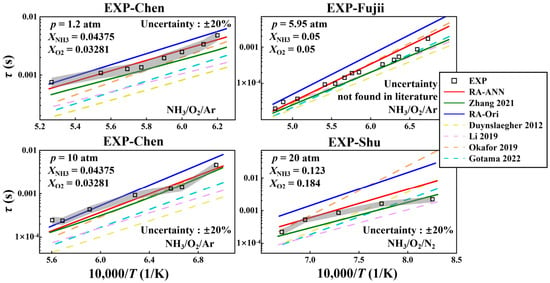
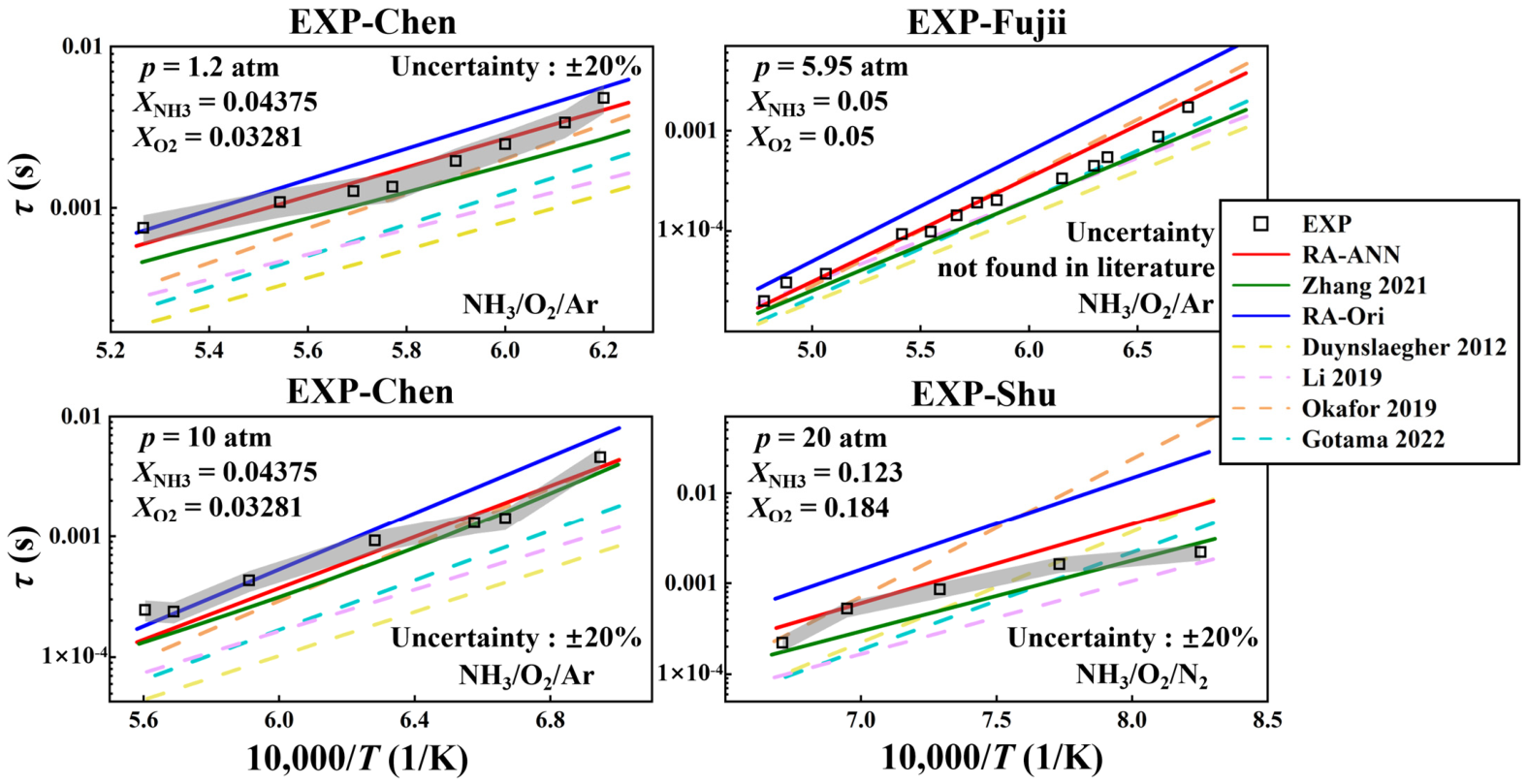
Figure 7 compares the predicted ignition delay times with experimental data [35,37,38]. All skeletal mechanisms reproduce the general trend, but RA-ANN shows the best overall agreement. Specifically, RA-Ori consistently overpredicts ignition delay times across all conditions. This deviation arises mainly from the removal of certain branching reactions during reduction, which weakens overall reactivity. After ANN optimization, RA-ANN predictions become much closer to the experimental data, and in some cases even outperform the detailed Zhang 2021 mechanism [13]. Significantly, compared with other skeletal mechanisms, RA-ANN achieves higher predictive accuracy while containing fewer reactions (20 species, 76 reactions), demonstrating the effectiveness of the DRG-CSP-ANN approach.
Figure 7.
Comparison of ignition delay times predicted by RA-Ori, RA-ANN, Zhang 2021 [13], and existing skeletal mechanisms against experimental data under different conditions. The gray shaded regions indicate the uncertainty ranges of the experimental data where such information is available in the corresponding literature. The gray shaded regions indicate the uncertainty ranges of the experimental data reported in the corresponding literature.
One exception occurs under the low-temperature, high-pressure, lean conditions of Shu et al. [37], where RA-ANN still overpredicts ignition delay. This discrepancy likely reflects that the dominant reaction pathways under such conditions differ substantially from those under conventional ignition conditions.
- 2.
- Laminar flame speed:
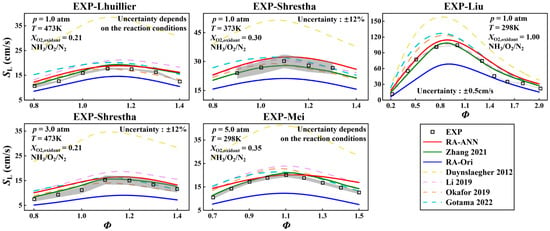
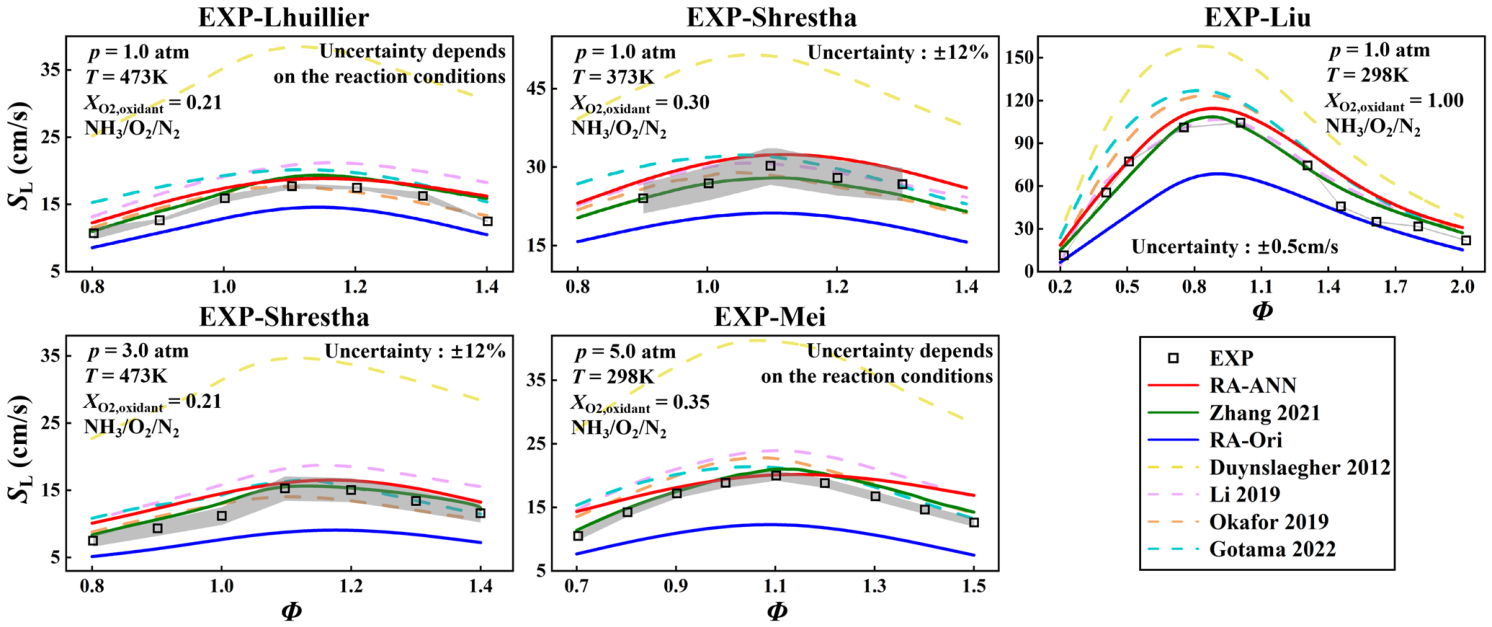
Figure 8 presents the laminar flame speeds predicted by different mechanisms against experimental data [12,42,43,44]. RA-ANN shows good accuracy across all tested conditions, closely matching both the experimental data and the Zhang 2021 mechanism [13]. In contrast, Li 2019 [30] and Duynslaegher 2012 [23] generally overpredict flame speeds; Okafor 2019 [31] and Gotama 2022 [32] capture the trend with equivalence ratio but shift the peak flame speed location away from the experimental values.
Figure 8.
Comparison of laminar flame speed predicted by RA-Ori, RA-ANN, Zhang 2021 [13], and existing skeletal mechanisms against experimental data under different conditions. The gray shaded regions indicate the uncertainty ranges of the experimental data where such information is available in the corresponding literature. The gray shaded regions indicate the uncertainty ranges of the experimental data reported in the corresponding literature.
The large difference between RA-Ori and RA-ANN further highlights that ANN-based parameter optimization effectively compensates for the loss of key propagation pathways caused by mechanism reduction. This allows the optimized skeletal mechanism to retain the parent mechanism’s flame-propagation capability while maintaining a compact size.
- 3.
- NO concentration:
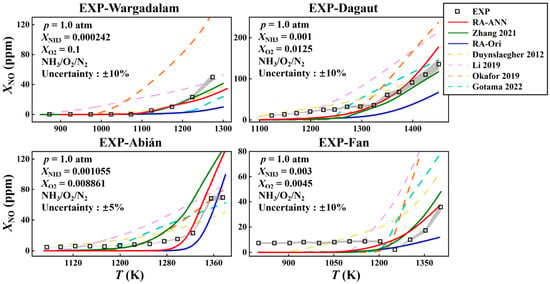
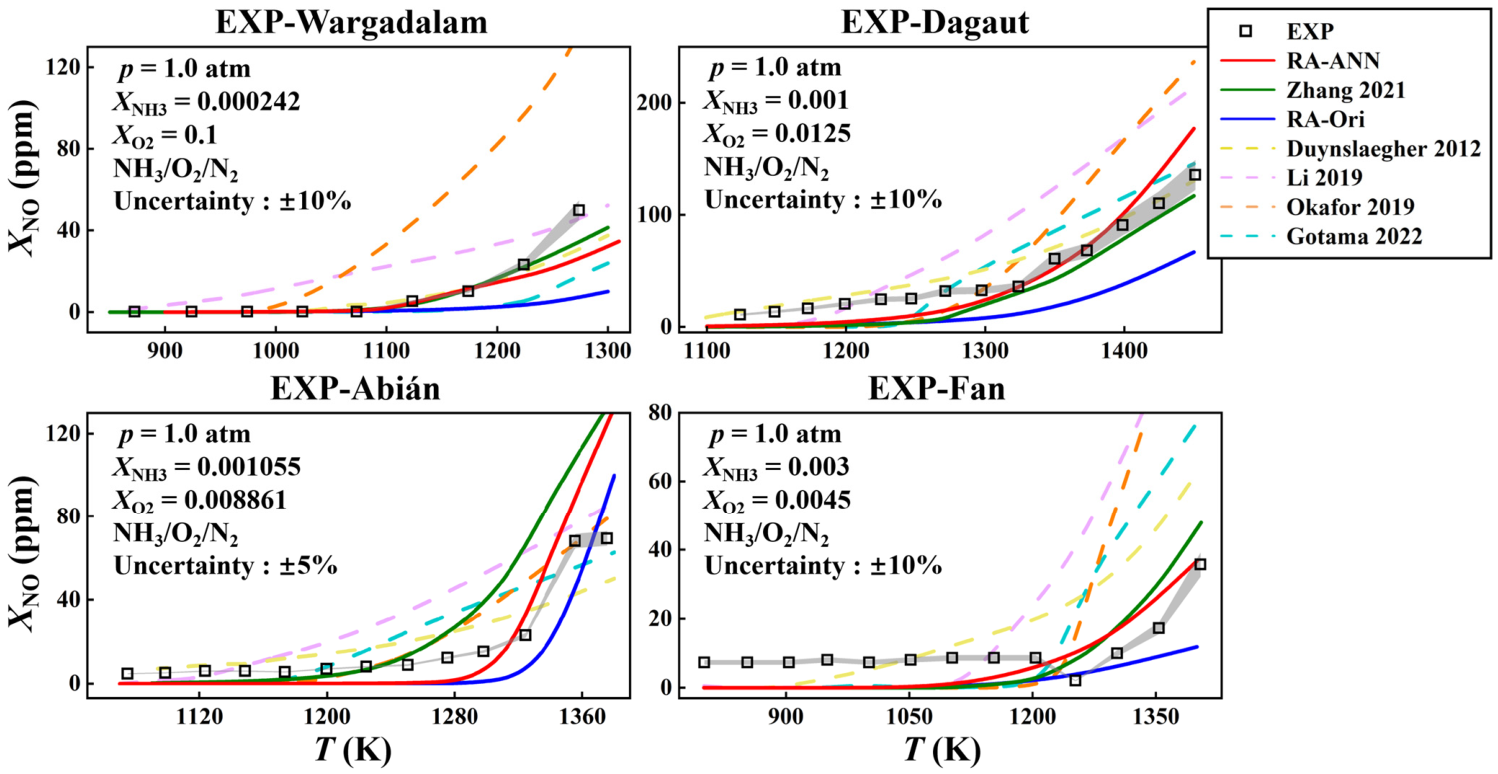
Figure 9 compares the predicted NO concentrations with experimental data [46,47,48,50]. RA-ANN successfully captures the general trend of increasing NO with temperature, including the onset temperature of rapid NO rise and the subsequent growth process. Compared with Zhang 2021 [13], RA-ANN maintains a high degree of consistency in the overall trend. Against other skeletal mechanisms, RA-ANN gives more accurate predictions of the NO rise temperature, growth rate, and high-temperature concentration levels. Moreover, based on Figure 9, two notable observations can be made under specific conditions:
Figure 9.
Comparison of NO concentration predicted by RA-Ori, RA-ANN, Zhang 2021 [13], and existing skeletal mechanisms against experimental data under different conditions. The gray shaded regions indicate the uncertainty ranges of the experimental data where such information is available in the corresponding literature. The gray shaded regions indicate the uncertainty ranges of the experimental data reported in the corresponding literature.
- Wargadalam [46] and Dagaut [48] conditions: RA-ANN and Zhang 2021 both agree well with experiments. This indicates that the proposed skeletal mechanism retains the ability to describe NO formation behavior under these reactor conditions.
- Abián [47] and Fan [50] conditions: RA-ANN shows the closest agreement with experiments. Under Abián conditions, RA-ANN even captures the rapid-growth interval of NO more accurately than Zhang 2021 [13].
These results indicate that ANN optimization not only improves the magnitude of NO predictions but also enhances the mechanism’s ability to capture the temperature sensitivity of NO formation.
Overall, Figure 9 demonstrates that RA-ANN has good applicability under different NO formation conditions. Compared with the existing skeletal mechanisms, it provides a more reasonable balance between the onset temperature of NO rise and the concentration level in the high-temperature region under most conditions. Relative to the parent mechanism Zhang 2021 [13], its overall predictive capability remains largely comparable and, under some conditions, even shows closer agreement with the experimental data. These results indicate that the combination of DRG-CSP reduction and ANN-based parameter optimization enables the constructed skeletal mechanism to retain the parent mechanism’s essential ability to describe NO formation while maintaining a compact size.
- 4.
- Quantitative error comparison:
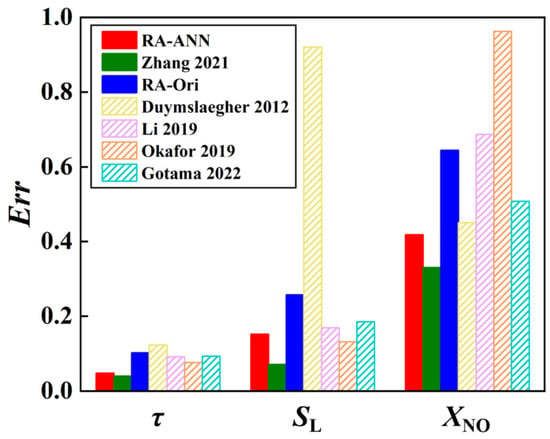
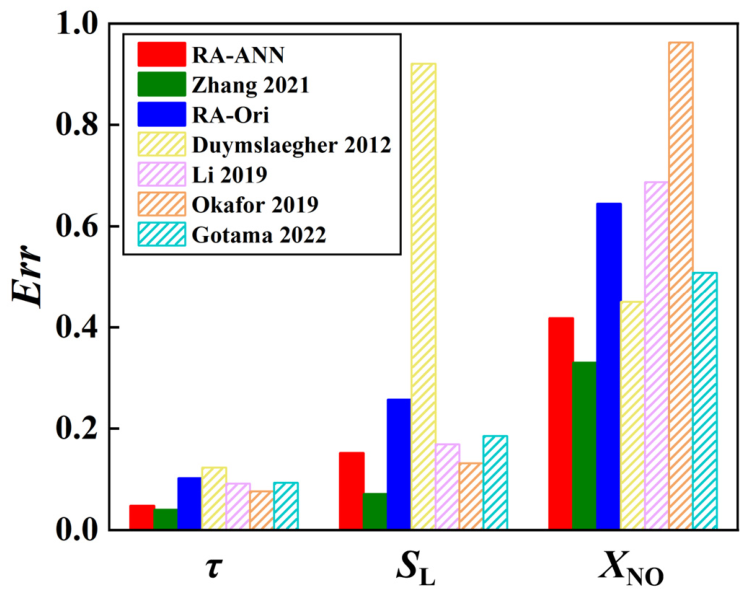
Figure 10 reports the averaged error function values Err (see Equation (3)) for ignition delay time τ, laminar flame speed SL, and NO concentration XNO. The key findings are:
Figure 10.
Averaged error function values (Err) of different kinetic mechanisms for ignition delay time, laminar flame speed, and NO concentration.
- RA-ANN yields significantly lower Err for ignition delay (0.048) and NO concentration (0.418) than any other skeletal mechanism, with values only slightly higher than those of the detailed Zhang 2021 mechanism [13].
- For laminar flame speed, RA-ANN gives Err = 0.152, which is higher than that of Zhang 2021 [13] but substantially lower than those of RA-Ori, Duynslaegher 2012 [23], Li 2019 [30], and Gotama 2022 [32]. Only Okafor 2019 [31] shows a slightly lower flame-speed error, but at the cost of a larger mechanism size (42 species vs. 20 species).
- Direct comparison between RA-Ori and RA-ANN shows that ANN optimization reduces the overall error by 38.4% (from 0.335 to 0.206). The improvement is most pronounced for ignition delay (approximately halved) and NO concentration, while flame-speed error also decreases noticeably.
These quantitative results confirm that ANN-based parameter optimization effectively corrects the systematic deviations introduced during mechanism reduction and strengthens the overall representation of key reaction pathways in the skeletal mechanism.
6. Concluding Remarks
Skeletal kinetic mechanisms play an indispensable role in enabling efficient and high-fidelity (e.g., LES, DNS) simulations of combustion of ammonia or other fuels. Although detailed mechanisms for the ammonia fuel have been progressively improved to accommodate complex temperature–pressure conditions and multi-component fuel systems, most are developed and validated for specific operating scenarios or individual combustion characteristics. Therefore, developing a compact, accurate, and widely applicable skeletal mechanism remains essential for practical ammonia combustion simulations.
In this work, we systematically evaluate 16 representative detailed ammonia combustion mechanisms against experimental data for ignition delay time, laminar flame speed, and NOx formation. Substantial discrepancies exist among the mechanisms in predicting these key combustion properties. Quantitative error analysis confirms that the Zhang 2021 mechanism [13] achieves the best overall balance in accuracy across all three targets. We therefore select it as the parent mechanism for reduction and optimization.
Using the hybrid DRG-CSP-ANN method, we develop a compact skeletal mechanism, i.e., RA-ANN, which contains 20 species and 76 reactions. The systematic validation shows that:
- RA-ANN yields an overall error of Err ≈ 0.206, which is significantly lower than those of Duynslaegher 2012 [23] (0.498), Li 2019 [30] (0.316), Okafor 2019 [31] (0.390), and Gotama 2022 [32] (0.262).
- In particular, the overall error of RA-ANN is close to, and differs only 13.6% from, that (0.178) of the detailed Zhang 2021 mechanism [13], despite being imperfect.
- Compared with the unoptimized skeletal mechanism RA-Ori, the ANN-based parameter optimization reduces the overall error by 38.4%, with the most pronounced improvements in ignition delay (error halved) and NO concentration.
These results confirm that ANN-based parameter optimization effectively corrects systematic deviations caused by mechanism reduction, allowing the skeletal model to retain the predictive performance of the parent mechanism while achieving a high degree of simplification.
Overall, the proposed DRG-CSP-ANN framework provides a robust and effective strategy for constructing highly reduced, yet quite accurate, kinetic mechanisms for ammonia combustion. The resulting RA-ANN mechanism demonstrates reliable performance in predicting autoignition, laminar flame propagation, and NOx formation over broad operating conditions. It therefore offers a computationally efficient and physically consistent kinetic foundation for high-fidelity CFD simulations and engineering design of ammonia combustion systems.
Supplementary Materials
The following supporting information can be downloaded at: https://www.mdpi.com/article/10.3390/en19112525/s1, The relevant reaction mechanism is uploaded as Supplementary Material.
Author Contributions
Conceptualization, J.Q., J.S. and T.C.; methodology, J.Q. and J.S.; validation, X.L., Q.S. and S.L.; formal analysis, J.Q.; resources, J.M.; data curation, J.Q., J.S. and T.C.; writing—original draft preparation, J.Q. and J.S.; writing—review and editing, J.Q., J.S., X.L. and J.M.; visualization, J.Q. and T.C.; supervision, M.X.; funding acquisition, L.S. and J.M. All authors have read and agreed to the published version of the manuscript.
Funding
This research was funded by the National Natural Science Foundation of China (No. 22350710788 and No. 52571401), the Basic Research Project of Liaoning Provincial Department of Education of Liaoning Province (No. 984240020) and the Horizontal Research Project of Dalian Maritime University (No. 9225038 and No. 9225378).
Data Availability Statement
The original contributions presented in this study are included in the article. Further inquiries can be directed to the corresponding authors.
Acknowledgments
The authors gratefully acknowledge the support of the High-Performance Computing Platform of Peking University.
Conflicts of Interest
The authors declare no conflicts of interest.
Nomenclature
| Symbols | |
| A | Pre-exponential factor ((cm3/mol)n−1/s), where n is the reaction order |
| b | Temperature exponent |
| D | Number of datasets for a given property |
| Di | Number of data points in the i-th dataset |
| Ea | Activation energy (cal/mol) |
| Err | Error function value |
| k | Chemical reaction rate constant |
| rM,N | Normalized contribution of species N to species M |
| R | Gas constant (m3·atm/K·kmol) |
| Equivalent coefficient of species M in reaction i | |
| Net reaction rate of elementary reaction i | |
| SL | Laminar flame speed (cm/s) |
| Sij | Simulated value for the j-th data point in the i-th dataset |
| The experimental value for the j-th data point in the i-th dataset | |
| T | Temperature (K) |
| τ | Ignition delay time (s) |
| Xk | Mole fraction for species k |
| Xkmax | Maximum mole fraction for species k |
| Greek letters | |
| Φ | Equivalence ratio |
| Abbreviations | |
| ANN | Artificial Neural Network |
| CFD | Computational Fluid Dynamics |
| CSP | Computational Singular Perturbation |
| DNS | Direct Numerical Simulation |
| DRG | Directed Relation Graph |
| JSR | Jet-stirred reactor |
| PFR | Plug flow reactor |
| LES | Large Eddy Simulation |
| MSE | Mean Squared Error |
| PSR | Perfectly Stirred Reactor |
| RA-ANN | Skeletal mechanism proposed by the present study using DRG-CSP-ANN |
| RA-Ori | Skeletal mechanism proposed by the present study using DRG-CSP without ANN |
References
- Kobayashi, H.; Hayakawa, A.; Somarathne, K.K.A.; Okafor, E.C. Science and technology of ammonia combustion. Proc. Combust. Inst. 2019, 37, 109–133. [Google Scholar] [CrossRef] [Scilit]
- Sun, R.; Sun, L.; Li, J. Techno-economic evaluation of green ammonia synthesis for renewable energy storage using rigorous models. Energy 2025, 336, 138068. [Google Scholar] [CrossRef] [Scilit]
- Ramos, C.F.; Rocha, R.C.; Oliveira, P.M.; Costa, M.; Bai, X.S. Experimental and kinetic modelling investigation on NO, CO and NH3 emissions from NH3/CH4/air premixed flames. Fuel 2019, 254, 115693. [Google Scholar] [CrossRef] [Scilit]
- Konnov, A.A. Implementation of the NCN pathway of prompt-NO formation in the detailed reaction mechanism. Combust. Flame 2009, 156, 2093–2105. [Google Scholar] [CrossRef] [Scilit]
- Song, Y.; Hashemi, H.; Christensen, J.M.; Zou, C.; Marshall, P.; Glarborg, P. Ammonia oxidation at high pressure and intermediate temperatures. Fuel 2016, 181, 358–365. [Google Scholar] [CrossRef] [Scilit]
- Glarborg, P.; Miller, J.A.; Ruscic, B.; Klippenstein, S.J. Modeling nitrogen chemistry in combustion. Prog. Energy Combust. Sci. 2018, 67, 31–68. [Google Scholar] [CrossRef] [Scilit]
- Otomo, J.; Koshi, M.; Mitsumori, T.; Iwasaki, H.; Yamada, K. Chemical kinetic modeling of ammonia oxidation with improved reaction mechanism for ammonia/air and ammonia/hydrogen/air combustion. Int. J. Hydrogen Energy 2018, 43, 3004–3014. [Google Scholar] [CrossRef] [Scilit]
- Okafor, E.C.; Naito, Y.; Colson, S.; Ichikawa, A.; Kudo, T.; Hayakawa, A.; Kobayashi, H. Experimental and numerical study of the laminar burning velocity of CH4–NH3–air premixed flames. Combust. Flame 2018, 187, 185–198. [Google Scholar] [CrossRef] [Scilit]
- Stagni, A.; Cavallotti, C.; Arunthanayothin, S.; Song, Y.; Herbinet, O.; Battin-Leclerc, F.; Faravelli, T. An experimental, theoretical and kinetic-modeling study of the gas-phase oxidation of ammonia. React. Chem. Eng. 2020, 5, 696–711. [Google Scholar] [CrossRef] [Scilit]
- Han, X.; Wang, Z.; He, Y.; Zhu, Y.; Cen, K. Experimental and kinetic modeling study of laminar burning velocities of NH3/syngas/air premixed flames. Combust. Flame 2020, 213, 1–13. [Google Scholar] [CrossRef] [Scilit]
- Bertolino, A.; Fürst, M.; Stagni, A.; Frassoldati, A.; Pelucchi, M.; Cavallotti, C.; Faravelli, T.; Parente, A. An evolutionary, data-driven approach for mechanism optimization: Theory and application to ammonia combustion. Combust. Flame 2021, 229, 111366. [Google Scholar] [CrossRef] [Scilit]
- Shrestha, K.P.; Lhuillier, C.; Barbosa, A.A.; Brequigny, P.; Contino, F.; Mounaïm-Rousselle, C.; Seidel, L.; Mauss, F. An experimental and modeling study of ammonia with enriched oxygen content and ammonia/hydrogen laminar flame speed at elevated pressure and temperature. Proc. Combust. Inst. 2021, 38, 2163–2174. [Google Scholar] [CrossRef] [Scilit]
- Zhang, X.; Moosakutty, S.P.; Rajan, R.P.; Younes, M.; Sarathy, S.M. Combustion chemistry of ammonia/hydrogen mixtures: Jet-stirred reactor measurements and comprehensive kinetic modeling. Combust. Flame 2021, 234, 111653. [Google Scholar] [CrossRef] [Scilit]
- Mei, B.; Zhang, J.; Shi, X.; Xi, Z.; Li, Y. Enhancement of ammonia combustion with partial fuel cracking strategy: Laminar flame propagation and kinetic modeling investigation of NH3/H2/N2/air mixtures up to 10 atm. Combust. Flame 2021, 231, 111472. [Google Scholar] [CrossRef] [Scilit]
- Tang, R.; Xu, Q.; Pan, J.; Gao, J.; Wang, Z.; Wei, H.; Shu, G. An experimental and modeling study of ammonia oxidation in a jet stirred reactor. Combust. Flame 2022, 240, 112007. [Google Scholar] [CrossRef] [Scilit]
- Zhou, S.; Cui, B.; Yang, W.; Tan, H.; Wang, J.; Dai, H.; Li, L.; ur Rahman, Z.; Wang, X.; Deng, S.; et al. An experimental and kinetic modeling study on NH3/air, NH3/H2/air, NH3/CO/air, and NH3/CH4/air premixed laminar flames at elevated temperature. Combust. Flame 2023, 248, 112536. [Google Scholar] [CrossRef] [Scilit]
- Liu, L.; Tan, F.; Wu, Z.; Wang, Y. Combining genetic algorithm and deep learning to optimize a chemical kinetic mechanism of ammonia under high pressure. Fuel 2024, 360, 130508. [Google Scholar] [CrossRef] [Scilit]
- Zhu, Y.; Curran, H.J.; Girhe, S.; Murakami, Y.; Pitsch, H.; Senecal, K.; Yang, L.; Zhou, C.W. The combustion chemistry of ammonia and ammonia/hydrogen mixtures: A comprehensive chemical kinetic modeling study. Combust. Flame 2024, 260, 113239. [Google Scholar] [CrossRef] [Scilit]
- Mottaghitalab, A.; Brink, A. Assessment and optimization of ammonia combustion mechanisms in the temperature interval 900–1800 K. Fuel 2025, 398, 135571. [Google Scholar] [CrossRef] [Scilit]
- Miller, J.A.; Smooke, M.D.; Green, R.M.; Kee, R.J. Kinetic modeling of the oxidation of ammonia in flames. Combust. Sci. Technol. 1983, 34, 149–176. [Google Scholar] [CrossRef] [Scilit]
- Miller, J.A.; Bowman, C.T. Mechanism and modeling of nitrogen chemistry in combustion. Prog. Energy Combust. Sci. 1989, 15, 287–338. [Google Scholar] [CrossRef] [Scilit]
- Lindstedt, R.; Lockwood, F.; Selim, M. A detailed kinetic study of ammonia oxidation. Combust. Sci. Technol. 1995, 108, 231–254. [Google Scholar] [CrossRef] [Scilit]
- Duynslaegher, C.; Contino, F.; Vandooren, J.; Jeanmart, H. Modeling of ammonia combustion at low pressure. Combust. Flame 2012, 159, 2799–2805. [Google Scholar] [CrossRef] [Scilit]
- Klippenstein, S.J.; Harding, L.B.; Glarborg, P.; Miller, J.A. The role of NNH in NO formation and control. Combust. Flame 2011, 158, 774–789. [Google Scholar] [CrossRef] [Scilit]
- Tian, Z.; Li, Y.; Zhang, L.; Glarborg, P.; Qi, F. An experimental and kinetic modeling study of premixed NH3/CH4/O2/Ar flames at low pressure. Combust. Flame 2009, 156, 1413–1426. [Google Scholar] [CrossRef] [Scilit]
- Zhang, M.; An, Z.; Wang, L.; Wei, X.; Jianayihan, B.; Wang, J.; Huang, Z.; Tan, H. The regulation effect of methane and hydrogen on the emission characteristics of ammonia/air combustion in a model combustor. Int. J. Hydrogen Energy 2021, 46, 21013–21025. [Google Scholar] [CrossRef] [Scilit]
- Xiao, H.; Howard, M.; Valera-Medina, A.; Dooley, S.; Bowen, P.J. Study on reduced chemical mechanisms of ammonia/methane combustion under gas turbine conditions. Energy Fuels 2016, 30, 8701–8710. [Google Scholar] [CrossRef] [Scilit]
- Liu, Z.; Tu, Y.; Zhang, H.; Liu, H.; Luo, Z.; Zhang, S. Comparison of combustion, emission and flame stabilization characteristics for NH3/CH4 mixtures between premixed and non-premixed modes: A joint experimental and LES investigation. Fuel 2026, 405, 136797. [Google Scholar] [CrossRef] [Scilit]
- Saito, M.; Xing, J.; Nagao, J.; Kurose, R. Data-driven simulation of ammonia combustion using neural ordinary differential equations (NODE). Appl. Energy Combust. Sci. 2023, 16, 100196. [Google Scholar] [CrossRef] [Scilit]
- Li, R.; Konnov, A.A.; He, G.; Qin, F.; Zhang, D. Chemical mechanism development and reduction for combustion of NH3/H2/CH4 mixtures. Fuel 2019, 257, 116059. [Google Scholar] [CrossRef] [Scilit]
- Okafor, E.C.; Naito, Y.; Colson, S.; Ichikawa, A.; Kudo, T.; Hayakawa, A.; Kobayashi, H. Measurement and modelling of the laminar burning velocity of methane-ammonia-air flames at high pressures using a reduced reaction mechanism. Combust. Flame 2019, 204, 162–175. [Google Scholar] [CrossRef] [Scilit]
- Gotama, G.J.; Hayakawa, A.; Okafor, E.C.; Kanoshima, R.; Hayashi, M.; Kudo, T.; Kobayashi, H. Measurement of the laminar burning velocity and kinetics study of the importance of the hydrogen recovery mechanism of ammonia/hydrogen/air premixed flames. Combust. Flame 2022, 236, 111753. [Google Scholar] [CrossRef] [Scilit]
- Si, J.; Wang, G.; Li, P.; Mi, J. A new skeletal mechanism for simulating MILD combustion optimized using Artificial Neural Network. Energy 2021, 237, 121603. [Google Scholar] [CrossRef] [Scilit]
- Drummond, L. High temperature oxidation of ammonia. Combust. Sci. Technol. 1972, 5, 175–182. [Google Scholar] [CrossRef] [Scilit]
- Fujii, N.; Miyama, H.; Koshi, M.; Asaba, T. Kinetics of ammonia oxidation in shock waves. In Symposium on Combustion; Elsevier: Amsterdam, The Netherlands, 1981. [Google Scholar]
- Mathieu, O.; Petersen, E.L. Experimental and modeling study on the high-temperature oxidation of Ammonia and related NOx chemistry. Combust. Flame 2015, 162, 554–570. [Google Scholar] [CrossRef] [Scilit]
- Shu, B.; Vallabhuni, S.K.; He, X.; Issayev, G.; Moshammer, K.; Farooq, A.; Fernandes, R.X. A shock tube and modeling study on the autoignition properties of ammonia at intermediate temperatures. Proc. Combust. Inst. 2019, 37, 205–211. [Google Scholar] [CrossRef] [Scilit]
- Chen, J.; Jiang, X.; Qin, X.; Huang, Z. Effect of hydrogen blending on the high temperature auto-ignition of ammonia at elevated pressure. Fuel 2021, 287, 119563. [Google Scholar] [CrossRef] [Scilit]
- He, X.; Shu, B.; Nascimento, D.; Moshammer, K.; Costa, M.; Fernandes, R.X. Auto-ignition kinetics of ammonia and ammonia/hydrogen mixtures at intermediate temperatures and high pressures. Combust. Flame 2019, 206, 189–200. [Google Scholar] [CrossRef] [Scilit]
- Pochet, M.; Dias, V.; Moreau, B.; Foucher, F.; Jeanmart, H.; Contino, F. Experimental and numerical study, under LTC conditions, of ammonia ignition delay with and without hydrogen addition. Proc. Combust. Inst. 2019, 37, 621–629. [Google Scholar] [CrossRef] [Scilit]
- Dai, L.; Gersen, S.; Glarborg, P.; Levinsky, H.; Mokhov, A. Experimental and numerical analysis of the autoignition behavior of NH3 and NH3/H2 mixtures at high pressure. Combust. Flame 2020, 215, 134–144. [Google Scholar] [CrossRef] [Scilit]
- Mei, B.; Zhang, X.; Ma, S.; Cui, M.; Guo, H.; Cao, Z.; Li, Y. Experimental and kinetic modeling investigation on the laminar flame propagation of ammonia under oxygen enrichment and elevated pressure conditions. Combust. Flame 2019, 210, 236–246. [Google Scholar] [CrossRef] [Scilit]
- Liu, Q.; Chen, X.; Huang, J.; Shen, Y.; Zhang, Y.; Liu, Z. The characteristics of flame propagation in ammonia/oxygen mixtures. J. Hazard. Mater. 2019, 363, 187–196. [Google Scholar] [CrossRef] [Scilit] [PubMed]
- Lhuillier, C.; Brequigny, P.; Lamoureux, N.; Contino, F.; Mounaïm-Rousselle, C. Experimental investigation on laminar burning velocities of ammonia/hydrogen/air mixtures at elevated temperatures. Fuel 2020, 263, 116653. [Google Scholar] [CrossRef] [Scilit]
- Caton, J.; Narney, J.; Cariappa, H.C.; Laster, W.R. The selective non-catalytic reduction of nitric oxide using ammonia at up to 15% oxygen. Can. J. Chem. Eng. 1995, 73, 345–350. [Google Scholar] [CrossRef] [Scilit]
- Wargadalam, V.J.; Löffler, G.; Winter, F.; Hofbauer, H. Homogeneous formation of NO and N2O from the oxidation of HCN and NH3 at 600–1000 °C. Combust. Flame 2000, 120, 465–478. [Google Scholar] [CrossRef] [Scilit]
- Abián, M.; Benés, M.; De Goñi, A.; Muñoz, B.; Alzueta, M.U. Study of the oxidation of ammonia in a flow reactor. Experiments and kinetic modeling simulation. Fuel 2021, 300, 120979. [Google Scholar] [CrossRef] [Scilit]
- Dagaut, P. On the oxidation of ammonia and mutual sensitization of the oxidation of NO and ammonia: Experimental and kinetic modeling. Combust. Sci. Technol. 2022, 194, 117–129. [Google Scholar] [CrossRef] [Scilit]
- Manna, M.V.; Sabia, P.; Ragucci, R.; de Joannon, M. Oxidation and pyrolysis of ammonia mixtures in model reactors. Fuel 2020, 264, 116768. [Google Scholar] [CrossRef] [Scilit]
- Fan, C.; Li, P.; Ding, C.; Hu, F.; Liu, Z. Evaluation, development, and validation of a new reduced mechanism for syngas oxidation and NO-reburning under air and oxy-fuel combustion. In Proceedings of the International Conference on Power Engineering (ICOPE), Online, 17–21 October 2021. [Google Scholar]
- Lu, T.; Law, C.K. A directed relation graph method for mechanism reduction. Proc. Combust. Inst. 2005, 30, 1333–1341. [Google Scholar] [CrossRef] [Scilit]
- Lu, T.; Law, C.K. A criterion based on computational singular perturbation for the identification of quasi steady state species: A reduced mechanism for methane oxidation with NO chemistry. Combust. Flame 2008, 154, 761–774. [Google Scholar] [CrossRef] [Scilit]
- Li, B.; Lee, Y.; Yao, W.; Lu, Y.; Fan, X. Development and application of ANN model for property prediction of supercritical kerosene. Comput. Fluids 2020, 209, 104665. [Google Scholar] [CrossRef] [Scilit]
- Si, J.; Wang, G.; Liu, X.; Wu, M.; Mi, J. A new global mechanism for MILD combustion using artificial-neural-network-based optimization. Energy Fuels 2021, 35, 14941–14953. [Google Scholar] [CrossRef] [Scilit]
- Li, S.; Petzold, L. Software and algorithms for sensitivity analysis of large-scale differential algebraic systems. J. Comput. Appl. Math. 2000, 125, 131–145. [Google Scholar] [CrossRef] [Scilit]
- Refaie Ali, A.; Mahmood, R.; Asghar, A.; Majeed, A.H.; Behiry, M.H. AI-based predictive approach via FFB propagation in a driven-cavity of Ostwald de-Waele fluid using CFD-ANN and Levenberg–Marquardt. Sci. Rep. 2024, 14, 11024. [Google Scholar] [CrossRef] [Scilit]
- Bishop, C.M.; Nasrabadi, N.M. Pattern Recognition and Machine Learning; Springer: New York, NY, USA, 2006. [Google Scholar]
- Hu, F.; Li, P.; Guo, J.; Wang, K.; Liu, Z.; Zheng, C. Evaluation, development, and validation of a new reduced mechanism for methane oxy-fuel combustion. Int. J. Greenh. Gas Control 2018, 78, 327–340. [Google Scholar] [CrossRef] [Scilit]
- Baulch, D.L.; Cobos, C.J.; Cox, R.A.; Esser, C.; Frank, P.; Just, T.; Kerr, J.A.; Pilling, M.J.; Troe, J.; Walker, R.W.; et al. Evaluated Kinetic Data for Combustion Modelling. J. Phys. Chem. Ref. Data 1992, 21, 411. [Google Scholar] [CrossRef] [Scilit]

Disclaimer/Publisher’s Note: The statements, opinions and data contained in all publications are solely those of the individual author(s) and contributor(s) and not of MDPI and/or the editor(s). MDPI and/or the editor(s) disclaim responsibility for any injury to people or property resulting from any ideas, methods, instructions or products referred to in the content. |
© 2026 by the authors. Licensee MDPI, Basel, Switzerland. This article is an open access article distributed under the terms and conditions of the Creative Commons Attribution (CC BY) license.