1. Introduction
All-solid-state batteries (ASSBs) have attracted considerable attention as next-generation energy storage systems because they offer both higher energy density and improved safety compared with conventional lithium-ion batteries (LIBs) [
1,
2,
3]. By replacing flammable liquid electrolytes, solid electrolytes can reduce the risk of fire and explosion and may also facilitate the use of high-capacity lithium metal anodes by alleviating issues such as lithium dendrite growth [
4,
5]. Among various solid electrolytes, sulfide-based electrolytes are considered one of the most promising candidates for next-generation ASSBs because they exhibit high ionic conductivities of approximately 10
−2–10
−1 S cm
−1, together with favorable mechanical deformability and processability [
6,
7,
8]. Despite these advantages, however, several technical challenges still need to be addressed. In particular, practical commercialization requires not only the adoption of high-capacity lithium metal anodes and highly ionically conductive solid electrolytes, but also improvements in composite cathodes, which play a decisive role in determining the electrochemical performance of the cell [
9,
10,
11].
ASSB composite cathodes are mixed electrodes composed of cathode active material (CAM), solid electrolyte (SE), and conductive additives, and their electrochemical performance is strongly governed by the solid-state microstructure formed during electrode fabrication [
12,
13]. In this structure, contact between SE particles provides lithium-ion transport pathways, whereas contact between SE and CAM particles determines the electrochemically active area (EAA) available for electrochemical reactions [
14,
15]. Accordingly, the solid–solid contact network within the composite cathode is a critical factor that simultaneously governs ionic and electronic transport as well as interfacial electrochemical reactions [
14,
15]. In this regard, establishing favorable CAM–SE interfacial contact is one of the key requirements for improving the utilization and rate capability of ASSB composite cathodes.
Recent studies have shown that the particle sizes of both CAM and SE strongly influence the interfacial contact characteristics developed within cathode microstructures [
11,
15,
16,
17,
18,
19]. In general, smaller SE particles are known to more effectively fill the voids around CAM particles, thereby improving SE–CAM interfacial contact and lithium-ion transport pathways [
9,
19,
20]. Smaller CAM particles can also be favorable for improving interfacial contact characteristics. By providing a larger specific surface area, they can increase the EAA. In addition, the resulting increase in particle number at a given electrode composition can improve interparticle connectivity and facilitate the formation of electron transport networks [
10,
19,
21,
22]. Interestingly, however, a decrease in CAM particle size does not always lead to improved performance in ASSB composite cathodes [
18,
19,
23,
24,
25,
26]. The use of smaller CAM particles can make homogeneous dispersion more difficult and promote the formation of CAM clusters within the electrode, thereby limiting CAM–SE contact characteristics and increasing tortuosity [
26]. In addition, securing a stable CAM–SE interface often requires SE particles that are smaller than the CAM particles, which can increase SE–SE interparticle/grain-boundary resistance and also involves technical challenges in the uniform preparation of fine SE powders [
25,
26].
Accordingly, the particle size ratio between CAM and SE has recently emerged as an important design parameter for composite electrodes [
16,
23,
26]. When the CAM particles are relatively larger than the SE particles, the SE can more effectively conform to the CAM particle surfaces, leading to more extensive interfacial contact. For example, Dixit et al. analyzed the effects of CAM and SE particle sizes on electrode packing structures using pseudo-random packing simulations [
23]. Their results showed that the combination of relatively small SE particles and large active-material particles can simultaneously provide high packing density and interfacial contact area. Another design strategy based on the particle size ratio concept is the use of bimodal electrode structures. In bimodal electrodes, large particles serve as a structural backbone, whereas small particles fill the interstitial voids, thereby enabling both high packing density and a stable contact network [
24,
25,
26]. In this regard, Kang et al. compared a unimodal ASSB cathode composed solely of small Ni-rich layered oxide particles with a bimodal ASSB cathode containing a mixture of small and large particles, and reported that the bimodal cathode exhibited higher packing density and more stable electron percolation pathways [
25].
These previous findings suggest that particle-size distribution is an important design parameter for improving the interfacial contact characteristics of ASSB composite cathodes. However, it remains unclear to what extent such strategies actually increase the electrochemically effective CAM–SE reaction interface in practical composite electrodes, and whether the expected structural advantages are directly translated into larger EAA under realistic fabrication conditions. In practical ASSB composite-electrode fabrication, interfacial contact characteristics can vary markedly depending not only on particle size but also on other design parameters, including particle morphology, electrode composition, and compaction pressure. Consequently, even under the same particle-size conditions, CAM–SE interfacial contact behavior may differ depending on the electrode fabrication conditions. Therefore, direct electrochemical diagnostic methods capable of quantitatively evaluating particle-size-dependent interfacial contact in practical composite cathodes are required to properly assess the effectiveness of particle-size design strategies.
Our research group previously proposed an integrated galvanostatic method (GM)–electrochemical impedance spectroscopy (EIS)-based EAA analysis framework to quantitatively evaluate CAM–SE interfacial contact characteristics in ASSB composite electrodes [
27]. The framework determines the EAA of ASSB composite cathodes by combining an area-independent diffusion response from EIS with an area-sensitive galvanostatic response through a one-step constraining procedure. In that study, the framework was applied to ASSB composite cathodes to investigate EAA variations as a function of lithium content and stack pressure. The EAA decreased with increasing lithium content, indicating that the EAA derived from this method reflects the effective intercalation reaction site [
27,
28]. At a given lithium-content condition, the EAA increased with stack pressure and reached a plateau above a certain pressure, demonstrating that CAM–SE interfacial contact characteristics can be quantitatively analyzed in terms of EAA [
27].
Although double-layer capacitance analysis has been widely used to estimate electrochemically active surface area in liquid-electrolyte electrochemical systems, its direct application to sulfide-based ASSB composite cathodes is not straightforward. In ASSB composite cathodes, the measured capacitance response can include contributions from multiple solid components and interfaces, such as the solid electrolyte, conductive carbon, interparticle contacts, grain boundaries, and distributed CAM–SE interfaces. In addition, for intercalation-type oxide cathodes, it is difficult to isolate a purely non-Faradaic potential region because Li insertion/extraction and transition-metal redox reactions occur within the relevant voltage range. Therefore, the key novelty of the integrated GM–EIS approach is that it evaluates the EAA associated with effective Li-intercalation reaction sites at the CAM–SE interface by combining diffusion-time-scale information from EIS with the area-sensitive galvanostatic response, rather than relying on a conventional double-layer-capacitance-based surface-area estimate.
In the present study, the GM–EIS framework was applied to particle-size-controlled ASSB composite cathodes to quantitatively evaluate how particle-size design influences CAM–SE interfacial contact in practical electrodes. Three cathodes were examined: a small-particle Ni-rich layered oxide cathode, a large-particle Ni-rich layered oxide cathode, and a bimodal cathode containing an equal-weight mixture of the two particle fractions. GM analysis was used to compare the area-sensitive diffusion responses reflected in the voltage behavior of each cathode, whereas EIS analysis was used to obtain an area-independent reference diffusion characteristic based on the Warburg–blocking transition behavior. By integrating these two responses, the EAA and effective surface coverage of each cathode were quantitatively determined, and their relationship with rate capability was evaluated. Through this approach, the present study aims to provide a practical electrochemical basis for quantitatively assessing particle-size-dependent CAM–SE interfacial contact and for guiding microstructure design in ASSB composite cathodes.
3. Results and Discussion
Figure S3a shows the first charge–discharge voltage profiles of two-electrode cathode half-cells employing the SP, LP, and BP cathodes. During the initial stage of charge, the LP cathode exhibited the largest overpotential. In contrast, during the subsequent charge and discharge processes, the LP cathode maintained the lowest overpotential, whereas the BP and SP cathodes showed relatively larger overpotentials. Meanwhile, all cathodes delivered similar first-discharge capacities of approximately 122 mAh g
−1, corresponding to a real capacity of approximately 0.97 mAh cm
−2, when discharged at 0.1 C over the voltage range of 4.1–2.5 V vs. Li
+/Li (
Figure S3b). This indicates that, although the initial overpotential behavior differed, the effect of CAM particle size on the discharge capacity of ASSB composite cathodes was limited under low-rate conditions.
Figure S3b also compares the first-cycle coulombic efficiencies of the cathodes. The first-cycle coulombic efficiency was highest for the SP cathode at 81%, and decreased with increasing fraction of NCM-8 particles, reaching 75% for the LP cathode. The first-cycle coulombic efficiency includes the influence of irreversible reactions occurring during the initial delithiation/lithiation process, and such reactions may be associated with initial CAM–SE interfacial stabilization and CEI formation [
38]. From this perspective, the observation of the lowest coulombic efficiency in the LP cathode may suggest that a larger electrochemically accessible CAM–SE interfacial area led to a greater area exposed to irreversible interfacial reactions during the initial charge process. However, the first charge–discharge results alone do not allow the origin of the lower initial coulombic efficiency of the LP cathode to be clearly separated and discussed. Therefore, at this stage, we first confirmed that all three cathodes operated normally and exhibited similar initial discharge capacities under low-rate conditions, and then proceeded to quantitatively compare the CAM–SE interfacial contact characteristics and EAA among cathodes with different CAM particle-size conditions through GM–EIS analysis.
For the GM–EIS analysis, each fabricated cathode half-cell was first charged to 4.1 V, followed by GM measurement.
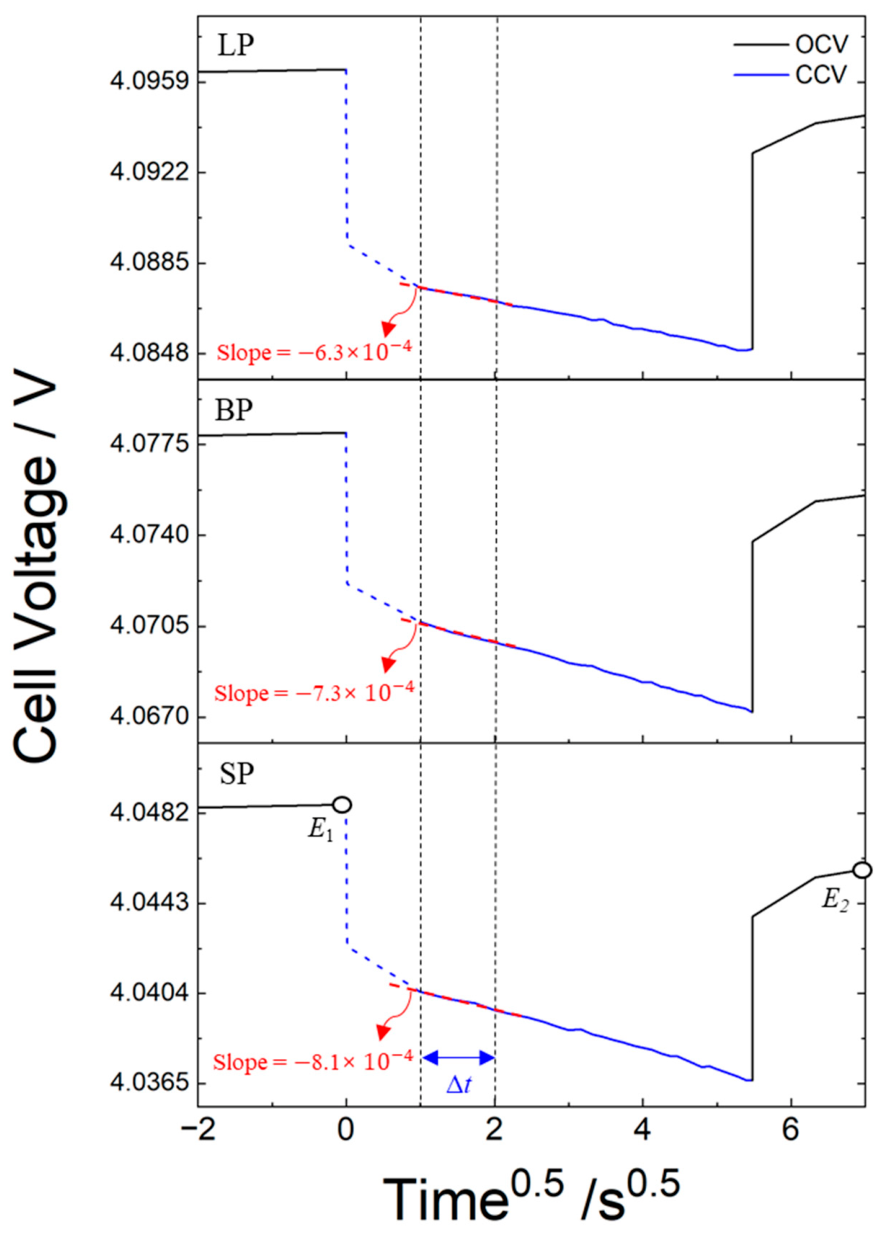
Figure 1 shows the resulting voltage (
E)–time (
t) curves replotted as
. In the GM analysis,
in Equation (1) should be determined in the initial time region where lithium diffusion in the active material follows semi-infinite diffusion behavior [
39,
40,
41]. As shown in
Figure 1, all cathodes exhibited good linearity of
with respect to
in the range of approximately 1–2 s
1/2, excluding the very initial region dominated by ohmic resistance and activation overpotential immediately after current application. Accordingly, the
value in Equation (1) was obtained from the slope of the linear fit in the 1–2 s
1/2 region. In addition,
was calculated as
, where
, using the difference between the equilibrium voltage immediately before current application (
) and that after a sufficiently long relaxation period following current application (
), together with the corresponding stoichiometric composition change (
).
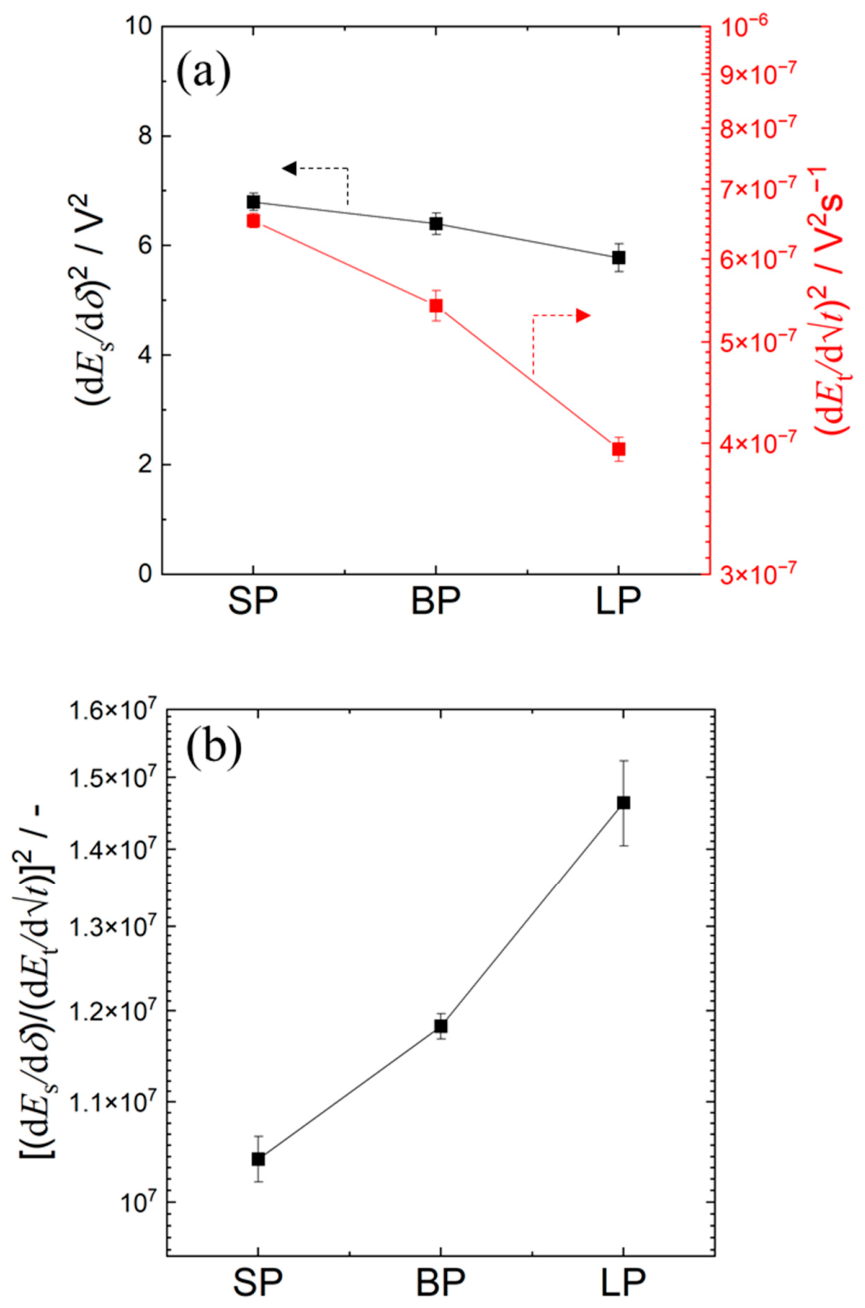
Figure 2a shows a comparison of the
and
values determined for each cathode. The slope obtained in the 1–2 s
1/2 region of
Figure 1 tended to decrease with increasing fraction of NCM-8 particles. Quantitatively,
decreased from
for SP to
for LP, corresponding to a reduction of approximately 39.2%. In contrast,
showed a relatively smaller decrease with increasing fraction of NCM-8 particles, decreasing from 6.8 for SP to 5.8 for LP, which corresponds to a change of about 15%.
Figure 2b further presents the
of the cathodes to compare the major terms in the GM equation. This value increased gradually with increasing fraction of NCM-8 particles, and the LP cathode exhibited a value approximately 1.4 times higher than that of the SP cathode.
GM analysis is based on Fick’s diffusion equation and reflects the change in lithium concentration developed at the active-material surface during current-pulse application in the form of a voltage response; accordingly, the measured response is directly influenced by the current density [
33,
42,
43]. Therefore, even under the same diffusion coefficient and applied current, a larger effective reaction area results in a lower current density, which in turn reduces the concentration gradient at the active-material surface and the rate of voltage change. In contrast, when the effective reaction area is limited, the local current density increases, which can induce a larger concentration gradient and a greater voltage response. As a result,
reflects not only the solid-state diffusion characteristics but also the influence of the effective reaction area.
Accordingly, assuming that the bulk diffusion characteristics of NCM622 with different particle sizes do not differ significantly at the same lithium-content state, the pronounced differences in observed among the cathodes in this study suggest that variations in CAM–SE interfacial contact characteristics and EAA among the SP, BP, and LP cathodes were reflected in the kinetic voltage response. In other words, the LP cathode, which exhibited a relatively low value and a correspondingly high , is likely to have a larger effective reaction area. However, because the GM-derived parameters are area-dependent diffusion indicators that simultaneously include the effects of solid-state diffusion characteristics and effective reaction area, the GM results alone do not allow quantitative separation of CAM–SE interfacial contact characteristics. Therefore, to more clearly distinguish the effect of interfacial contact, the GM results should be considered together with area-independent diffusion analysis based on EIS.
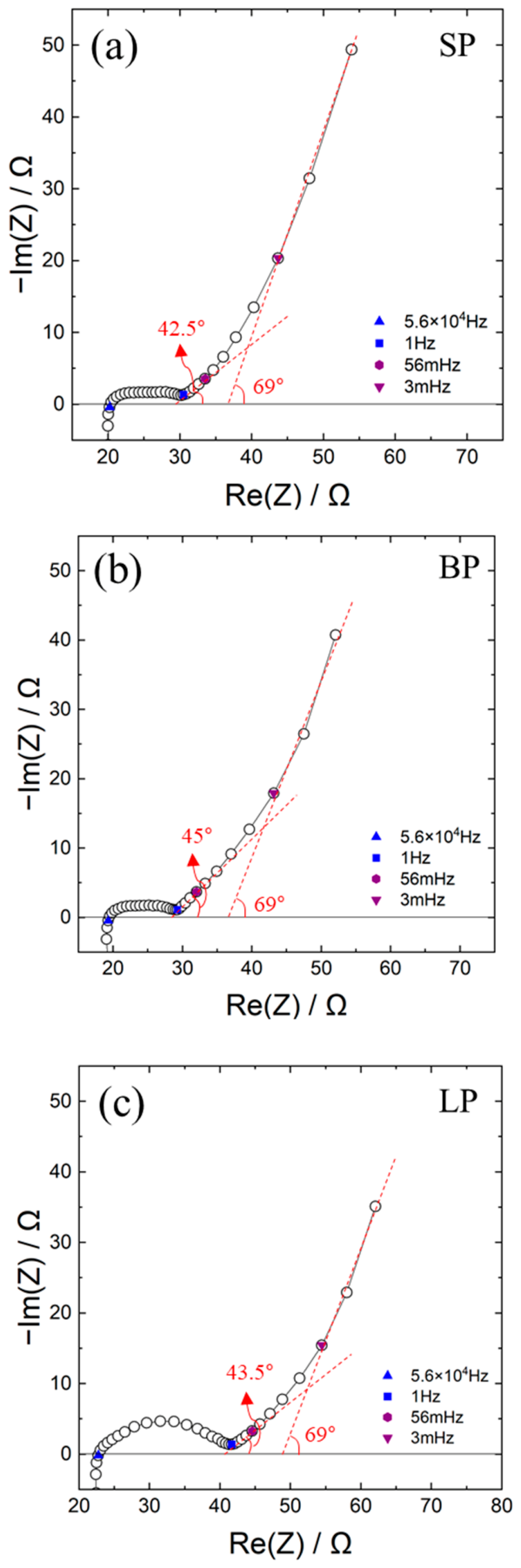
Figure 3 presents Nyquist plots of the cathode half-cell impedances obtained by EIS over the frequency range of 10
6–10
−3 Hz after the GM measurement. In our previous GM–EIS study [
27], the impedance contribution of the Li electrode in the 2-electrode half-cell configuration was reported to be approximately 3 Ω. In the present study, after excluding the high-frequency ohmic intercept, the remaining cathode-dominated impedance response of the half-cells ranged from approximately 30 to 38 Ω for the three cathodes. Therefore, the non-ohmic impedance response analyzed in this study was considered to be predominantly governed by the cathode.
For all three cathodes, the impedance exhibited a depressed arc in the frequency range 5.6 × 10
4–1 Hz, followed by two linear components with different slopes in the low-frequency region below 1 Hz. According to previous studies [
24,
27,
44], the arc observed in the mid-frequency region can be regarded as a response to which multiple interfacial resistance components contribute, including charge transfer–double-layer capacitance charging at the CAM–SE interface and lithium-ion transport–surface layer capacitance charging within interfacial products such as the cathode–electrolyte interphase (CEI). Furthermore, the two linear components observed in the low-frequency region are generally assigned to the Warburg tail and blocking line associated with semi-infinite and finite diffusion behavior, respectively, and thereby reflecting the solid-state diffusion characteristics within the CAM.
One of the most intuitive approaches for evaluating CAM–SE interfacial contact characteristics from these EIS results is to compare the interfacial resistance. In general, among the interfacial resistance components, the charge-transfer resistance (
Rct) is inversely related to the effective active area. Therefore, when the contributions of other interfacial resistance components (e.g., film resistance) are comparable, the overall interfacial resistance (
Rint), which includes a substantial contribution from
Rct, may serve as an indicator associated with the effective active area of the cathode [
24]. Accordingly, in this study, the impedance results of each cathode were fitted using the equivalent circuit shown in
Figure S4, and the resulting fitting parameters are summarized in
Table S1. In addition, the sum of
R1 and
R2 was defined as
Rint and the cathode-dependent results are also presented in
Figure S4. As a result,
Rint showed a non-monotonic trend with increasing fraction of NCM-8 particles, decreasing from SP to BP and then increasing again for LP.
If the variation in
Rint were governed solely by changes in active area,
Rint would be expected to vary monotonically with the cathode surface area, i.e., CSA, trend, which decreases with increasing fraction of NCM-8 particles (
Table 1). However, the experimental results did not follow this expectation. This indicates that, for ASSB composite cathodes with different particle-size conditions, the variation in
Rint cannot be sufficiently explained by changes in active area alone. Indeed, many previous studies have also reported that, in ASSB composite cathodes, changes in geometric area are often not directly reflected in the variation of
Rint [
24,
45,
46]. In this regard, Choi et al. analyzed the impedance of ASSB composite cathodes containing CAM particles of various sizes using a transmission line model (TLM) [
24]. They reported that
Rct decreased as the CAM particle size decreased, but that the total cathode resistance could nevertheless increase because of increased porosity and grain-boundary resistance associated with finer particles. In other words, in ASSB composite cathodes, the simple relationship that smaller CAM particles provide lower resistance because of their higher specific surface area does not always hold, and a trade-off exists between improved interfacial reactivity and increased structural resistance as particle size decreases. These findings indicate that the magnitude of the apparent interfacial resistance alone is insufficient to adequately assess CAM–SE contact characteristics in ASSB cathodes. Accordingly, in this study, the Warburg–blocking transition behavior observed in the low-frequency region of the EIS spectra was analyzed in detail as the basis for the GM–EIS-based EAA analysis.
When the cathode impedance in
Figure 3 is examined with emphasis on the low-frequency region (<1 Hz), the slope of the Warburg tail, which appeared first at higher frequencies, ranged from 42.5° to 45°, close to the 45° expected for ideal semi-infinite diffusion behavior. In contrast, the slope of the blocking line was approximately 69° for all three cathodes, which is lower than the 90° expected for ideal blocking behavior. This indicates that the low-frequency diffusion response does not fully conform to the ideal finite-diffusion model. Such non-ideal blocking behavior has been reported to arise as a CPE-like response caused by frequency dispersion in porous composite electrodes containing spherical active materials [
47,
48,
49,
50,
51]. For example, Song et al. reported that increased particle curvature and particle-size distribution can induce frequency dispersion in the low-frequency region [
50], while Levi et al. showed that frequency dispersion caused by increased electrode thickness and structural non-uniformity can appear as a CPE response [
49]. Accordingly, the reduced blocking-line slope observed in this study can be regarded as the result of multiple structural factors acting together, including CAM particle shape, particle-size distribution, and electrode thickness.
In this context, the Warburg–blocking transition behavior of the BP cathode differed somewhat from what would generally be expected for a bimodal particle system. The BP cathode, which contains a mixture of NCM-4 and NCM-8, has a broader particle-size distribution than the SP and LP cathodes. In general, when active materials of different sizes are mixed in a cathode, the distribution of characteristic diffusion times among the particles can broaden the Warburg–blocking transition or cause the low-frequency response to exhibit more non-ideal CPE-like behavior. Nevertheless, in this study, the slopes of the Warburg and blocking regions for the BP cathode remained nearly identical to those of the SP and LP cathodes, and the transition between the two regions was also observed relatively clearly without pronounced broadening.
To further examine this behavior, the frequency ranges over which the transition responses appeared in each cathode were marked with purple symbols in
Figure 3 for comparison. As a result, the transition ranges of the SP and LP cathodes were both located within approximately 56–3 mHz. In other words, the transition responses of the two particle groups were not resolved as two distinct transitions at different frequencies, but instead appeared within the same low-frequency region. Consistent with this, the transition observed for the BP cathode also appeared within the same frequency range. Therefore, the transition behavior observed for the BP cathode is more appropriately interpreted as a single effective transition arising from the combined contribution of NCM-4 and NCM-8 within the same low-frequency region.
Next, the Warburg–blocking transition behavior was quantitatively analyzed by determining
.
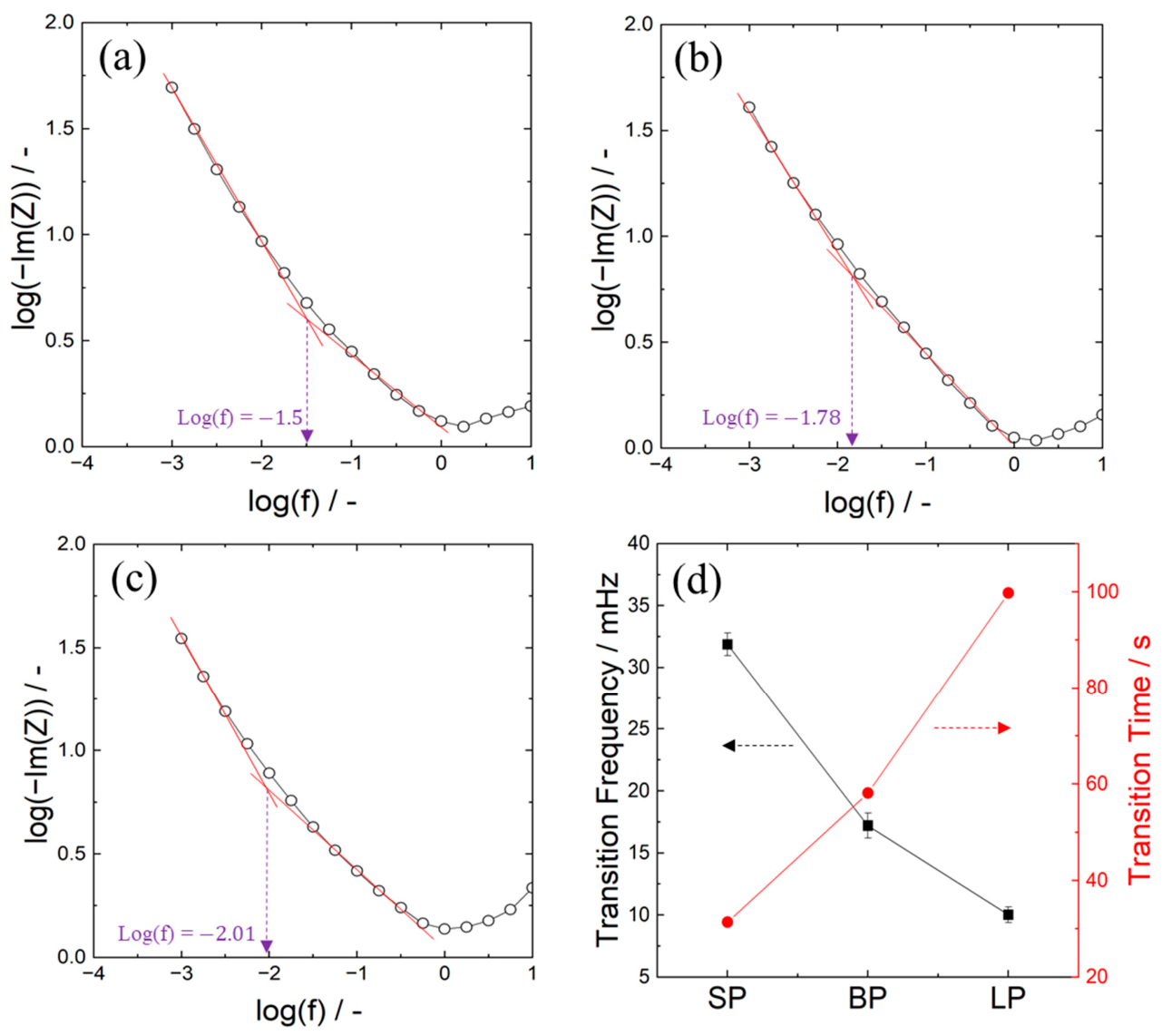
Figure 4a–c presents the impedance data in
Figure 3 replotted as log(–Im(Z))–log(
f). By converting the frequency axis to a logarithmic scale, the log(–Im(Z))–log(
f) plot distributes the imaginary-impedance response, which is otherwise crowded in the low-frequency region, more evenly and thereby allows the two linear regions corresponding to the Warburg tail and blocking line to be distinguished more clearly [
27]. In
Figure 4a–c, the intersection of the two linear fits corresponding to the Warburg tail and blocking line is indicated, and the intersection point shifted toward lower log(
f) values with increasing fraction of NCM-8 particles. This trend suggests that, as the average particle size increases, a longer time is required for lithium ions to diffuse through the particle interior before the response transitions to finite-diffusion behavior [
50,
52]. Accordingly, the frequency at the intersection point was defined as
, and the corresponding quantitative values of
and transition time
are presented in
Figure 4d. The
values of SP and LP were 31 and 99 s, respectively, corresponding to a factor of approximately 3.19.
To examine whether the
values obtained from EIS quantitatively reflect the difference in diffusion length, the measured
values for the SP and LP cathodes were analyzed on the basis of the mean-square-displacement relation for three-dimensional diffusion,
[
53,
54]. Here,
is the characteristic root-mean-square diffusion length,
is the chemical diffusion coefficient, and
is the diffusion time. From this relation, the diffusion time is expected to scale with the square of the characteristic diffusion length. Thus, assuming that
is similar for the two cathodes and the transition behavior is governed primarily by the characteristic length
,
is proportional to
. Accordingly, the
should be proportional to
, and the expected ratio based on the
values listed in
Table 1 is approximately 3.32. This agrees well with the experimentally obtained
ratio of 3.19. These results indicate that the Warburg–blocking transition behavior identified from EIS quantitatively reflects the difference in diffusion length associated with particle size. In other words, the
observed in EIS appears to be governed primarily by the bulk diffusion length within the active-material particles rather than by variations in cathode microstructure or CAM–SE interfacial contact conditions.
However, this agreement should not be interpreted as evidence that the intrinsic diffusion coefficients of NCM-4 and NCM-8 are exactly identical. Rather, it indicates that, under the constrained experimental conditions used in this study, the EIS-derived Warburg–blocking transition is largely consistent with the expected diffusion-length scaling. To minimize additional structural and interfacial changes induced by cycling and high-voltage operation, the analysis was performed only in the first charged state, and the upper cutoff voltage was limited to 4.1 V to avoid the H2–H3 phase-transition region, which is associated with large volume expansion in NCM622 cathodes. These conditions were deliberately selected to examine whether the EIS response reflects diffusion-length-dependent behavior rather than area-dependent effects, while preserving the initial states of the NCM-4 and NCM-8 particles as much as possible. Nevertheless, the actual Warburg–blocking behavior may still be influenced by differences in secondary-particle structure, primary-particle arrangement, intraparticle microcracks, LiNbO3 coating uniformity, surface reconstruction, and other local structural or interfacial non-idealities. Therefore, the EIS-derived diffusion behavior obtained in this study should be interpreted not as an absolute intrinsic material property, but as an area-independent effective reference parameter for the integrated GM–EIS analysis.
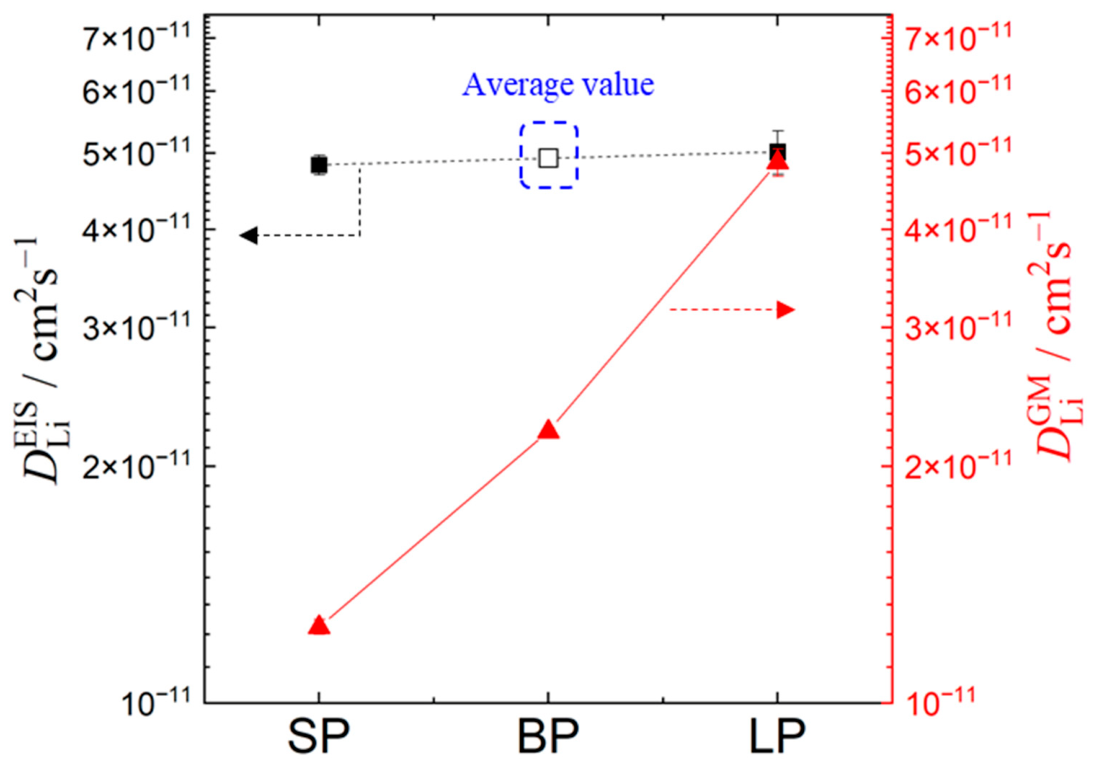
Thus far, diffusion-related parameters have been derived from both GM and EIS analyses, and their sensitivities to the effective active area have been examined. On the basis of these analyses, the lithium diffusion coefficients obtained from the two methods were comprehensively compared to identify an appropriate reference value for EAA quantification.
was calculated using the area-dependent Equation (1) together with the BET-based CSA, whereas
was determined from the area-independent Equation (2) using
.
Figure 5 compares the
and
values determined for each cathode, and the corresponding values are also summarized in
Table 2. The diffusion coefficients obtained from both methods were on the order of 10
−11 cm
2 s
−1, consistent with the range previously reported for NCM622 [
40,
41]. However, the cathode-dependent trends differed clearly between the two methods. First,
was nearly identical for the SP and LP cathodes. As discussed above, this is because the difference in
between the two cathodes corresponded closely to the difference in
. In other words, because the variation in
observed in EIS mainly reflects the difference in diffusion length associated with particle size, the
values calculated with
correction showed little difference in the diffusion coefficient. In contrast, the apparent CSA-normalized GM parameter,
showed a much larger difference between the SP and LP cathodes. As discussed above, the GM slope term excluding the explicit area factor,
, increased from the SP to the LP cathode, and the LP cathode exhibited a value approximately 1.5 times higher than that of the SP cathode. However, the apparent
value showed an approximately 3.9-fold difference between the SP and LP cathodes. This amplification arises from the additional contribution of the BET-based CSA used as the reference area in the conventional GM expression. Therefore, the GM-derived value calculated using the BET-based CSA should not be interpreted as an intrinsic Li diffusion coefficient. Rather, it should be regarded as an area-sensitive, CSA-normalized apparent parameter that contains the effect of the mismatch between the BET-based reference area and the electrochemically active reaction area. Comparison with the EIS-derived diffusion-time-scale parameter further supports this interpretation: the EIS-derived parameter does not show a correspondingly large difference between the SP and LP cathodes, indicating that the pronounced variation in the GM-derived apparent parameter mainly originates from the area-dependent contribution rather than from a large difference in intrinsic bulk diffusion. Therefore,
derived from the Warburg–blocking transition can be used as a reference anchor with relatively low area sensitivity and thus provides a more suitable basis for EAA quantification in combination with the GM results.
For the BP cathode,
could be determined from the Warburg–blocking transition region. However, because the BP cathode consists of a mixture of two different particle sizes, it was difficult to define a single
value. Therefore, the direct calculation of
in the same manner as for the SP and LP cathodes was limited. In this study, the
of the BP cathode was treated as an effective
arising from the combined contributions of the two CAM particle groups in a 1:1 composition ratio, based on the following two considerations. First, the EIS results of the SP and LP cathodes showed that
can be determined in an area-independent manner, and that the difference in transition time between NCM-4 and NCM-8 mainly originates from the difference in diffusion length. This indicates that
primarily reflects the intrinsic bulk diffusion property of the active material rather than the cathode microstructure or CAM–SE contact characteristics. Accordingly, even in the BP cathode, the EIS-based diffusion coefficients of the NCM-4 and NCM-8 particles are likely to remain within the range obtained for the SP and LP cathodes. Second, the previous literature also supports that the fundamental electrochemical response of a blended cathode can be explained by the weighted contributions of the individual cathode components [
55]. In this regard, Liebmann et al. reported that, in blended cathode systems, fundamental electrochemical properties such as voltage/entropy profiles, charge-transfer kinetics, and lithium diffusivity can generally be described by physical mixing behavior based on the properties and mass fractions of the individual cathode components [
55]. In other words, considering both that the
values of NCM-4 and NCM-8 are determined in an area-independent manner, and that their difference mainly arises from diffusion-length differences, and that the fundamental response of a blended cathode can be described by the weighted contributions of its individual components, it is reasonable to treat the overall diffusion response of the BP cathode as an effective response composed of the contributions of the two CAM particle groups in a 1:1 ratio.
Accordingly, in this study, the of the BP cathode was approximated as the arithmetic mean of the values obtained for the SP and LP cathodes, and this value was used as a practical reference for the subsequent EAA analysis. Although this treatment does not represent an independently determined diffusion coefficient, it provides a practical approximation for reflecting the effective diffusion response of a bimodal particle-size cathode. Therefore, the EAA derived for the BP cathode should be interpreted not as an exact absolute value, but rather as an indicator representing the relative comparison trend among the electrodes.
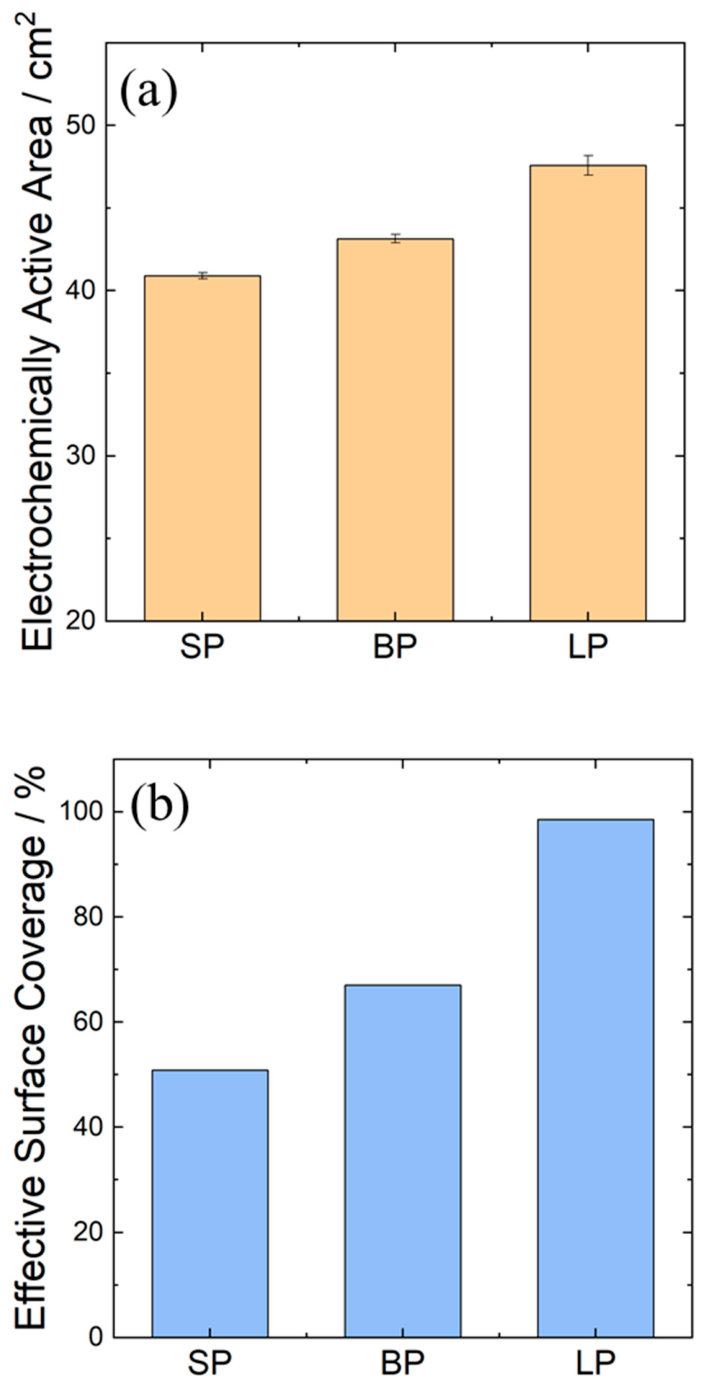
Figure 6a presents the EAA values of each cathode calculated according to Equation (4) within the integrated GM–EIS framework, and the corresponding quantitative values are also listed in
Table 2. The calculated EAA increased with increasing fraction of NCM-8 particles, and the LP cathode exhibited a value approximately 1.16 times higher than that of the SP cathode. However, because the three cathodes had substantially different CSAs depending on their particle-size compositions, the degree of interfacial utilization cannot be directly compared on the basis of the absolute EAA values alone. Accordingly, effective surface coverage (=EAA/CSA) was additionally introduced as a normalized metric for comparing the electrochemical utilization of the available surface area within the composite cathodes (
Figure 6b,
Table 2). Here, the CSA was calculated based on the BET surface area, which reflects the powder surface area accessible to N
2 gas, and therefore does not directly represent the CAM surface area that is actually accessible to SE in a compressed ASSB composite cathode. In particular, BET measurements may include surface regions that are not in actual contact with SE, such as internal pores, microcracks, and closed surfaces within CAM particles. Therefore, the BET-based CSA cannot be interpreted as being equivalent to the actual SE-accessible surface area. Nevertheless, because the BET-based CSA is still a valid reference for reflecting differences in the overall surface area arising from particle-size composition, it was used in this study as a normalization basis for comparing the relative fraction of BET-based surface area that becomes electrochemically active under different particle-size compositions. The effective surface coverage of the SP cathode remained at approximately 50.9%, whereas it increased with the fraction of NCM-8 particles and reached 98.6% for the LP cathode. Although the difference in the absolute EAA values may appear limited, the difference among the cathodes became much more pronounced in terms of effective surface coverage. These results suggest that a larger fraction of the CSA in the LP cathode was electrochemically utilized as an effective reaction interface.
However, effective surface coverage should be interpreted as an electrochemical normalization relative to the BET-based CSA, not as a direct geometrical contact fraction. In ASSB composite electrodes, point-contact structures between CAM and SE are generally expected, making it difficult for the physical surface coverage to approach 100% [
56]. Indeed, Lee et al. quantified the physical surface coverage as the fraction of the active-material particle perimeter covered by SE through SEM cross-sectional image analysis, and reported a maximum of 92% and an average of 67.2% for dry-processed electrodes [
56]. This image-based analysis supports the view that the actual physical CAM–SE coverage in ASSB composite cathodes can remain incomplete, even when the interfacial contact is substantially improved.
In contrast, the effective surface coverage defined in this study is not a direct measure of structural or physical contact coverage, but a normalized electrochemical metric defined as the ratio of the model-derived EAA to the BET-based CSA. In other words, it should not be interpreted as an absolute surface coverage, but rather as a relative metric for comparing the extent to which the CAM surface contributes to the reversible Li intercalation reaction under different particle-size conditions. Therefore, the 98% effective surface coverage obtained for the LP cathode should not be interpreted as indicating that 98% of the physical CAM surface was literally contacted by SE. Rather, it indicates that, within the present GM-EIS framework, the electrochemically effective reaction area was estimated to be close to the BET-based CSA. Overall, the LP cathode exhibited the highest EAA and effective surface coverage, suggesting that the CAM–SE interface in the LP cathode was utilized most effectively for the electrochemical reaction among the three cathodes. Therefore, based on the criteria adopted in this study, the LP cathode can be regarded as having the most favorable electrochemical interfacial contact characteristics.
These results may be rationalized from two main perspectives based on previous studies [
16,
23,
24,
25,
57], although direct three-dimensional structural evidence for local CAM–SE contact topology was not obtained in this study. First, a combination of relatively large CAM particles and small SE particles can, under certain composite-electrode conditions, form a more favorable local contact structure within the composite cathode [
16,
23,
26]. As the CAM particle size increases relative to the SE particle size, a larger number of SE particles can be arranged around each CAM particle, which may increase the probability of forming electrochemically effective CAM–SE contacts. In contrast, small CAM particles have a smaller size mismatch with the SE, which may promote local agglomeration or cluster formation depending on the mixing and packing conditions. In such cases, part of the BET-based CAM surface area may not be effectively converted into an electrochemically active CAM–SE interface. In this regard, Shi et al. reported through electrode modeling that increasing the CAM/SE particle-size ratio improves both CAM–SE contact characteristics and the continuity of SE-based ionic percolation pathways [
16]. They also experimentally showed that increasing the CAM particle size under the same SE particle-size condition led to an increase in initial capacity, which they associated with the formation of a more favorable composite-electrode microstructure.
Second, a combination of large CAM particles and small SE particles may also be advantageous in terms of electrode packing structure [
24,
25]. Small SE particles can effectively fill the interstitial spaces between large CAM particles, thereby reducing pore volume and increasing packing density, which can in turn promote the formation of a denser electrode structure after pressing. To examine the packing-related aspect, carbon-free composite cathode pellets were separately prepared, and their thicknesses after pressing were compared (
Figure S5). As a result, the electrode thickness gradually decreased from 0.383, 0.360, and 0.357 mm for SP, BP, and LP, respectively, and the thickness of the LP cathode was approximately 6.1% lower than that of the SP cathode. These results are consistent with denser electrode packing in the LP cathode, where large CAM particles are combined with small SE particles, although the porosity and relative density were not directly quantified.
Consequently, the high EAA and effective surface coverage observed for the LP cathode suggest that, in ASSB composite electrodes, a favorable contact arrangement and dense electrode structure enabled by the combination of large CAM particles and small SE particles can contribute to the formation of electrochemically active reaction interfaces, beyond the effect of geometric surface area alone. Nevertheless, the lower EAA of the SP cathode should not be interpreted as direct proof of CAM aggregation or heterogeneous dispersion. Rather, it indicates that, under the present electrode composition and fabrication conditions, the larger BET-based surface area of the smaller CAM particles was not fully utilized as an electrochemically active CAM–SE interface. Further microstructural characterization, such as three-dimensional tomography or quantitative contact-network analysis, together with additional CAM/SE particle-size combinations, would be necessary to directly verify the proposed microstructural origin.
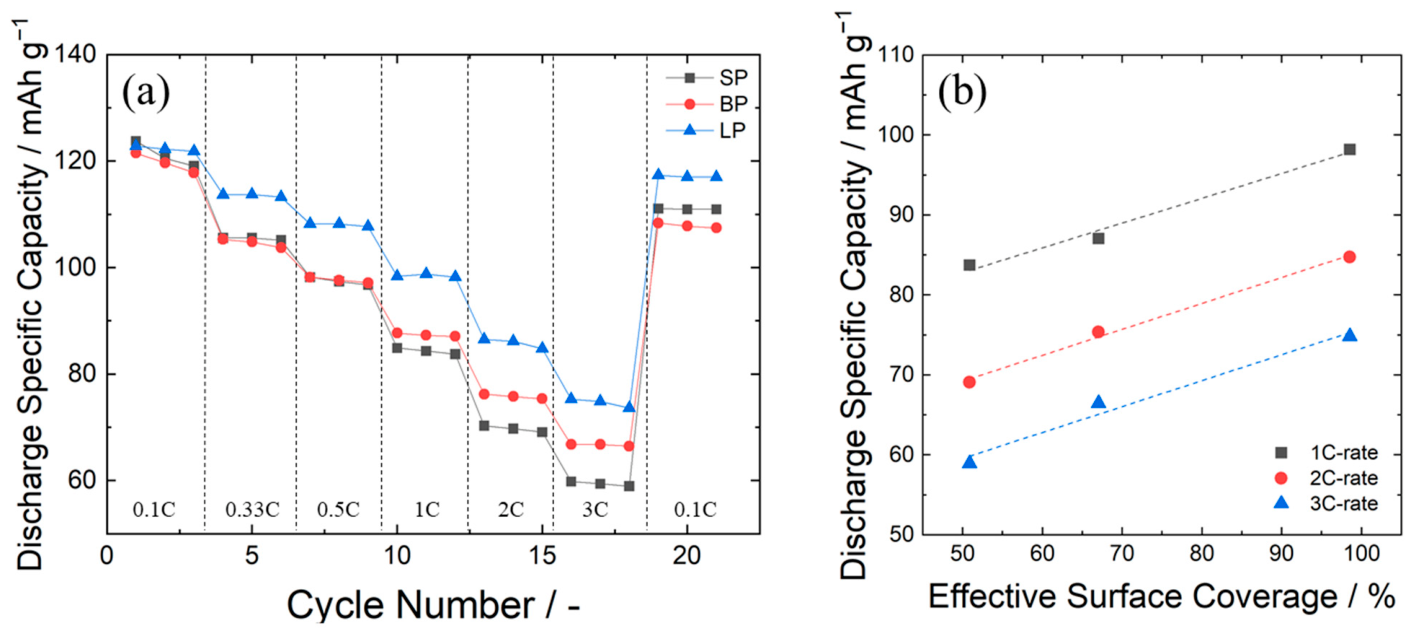
It is also important to examine how differences in CAM–SE interfacial contact characteristics are related to actual cell performance, particularly under high-rate conditions. To this end, the rate capability of each cathode was comparatively evaluated, and the results are shown in
Figure 7a. Rate capability was tested over the range of 0.1–3 C, with three charge–discharge cycles performed at each C-rate. The cells were then cycled again at 0.1 C to examine capacity recovery after the high-rate test. At 0.1 C, all cathodes delivered nearly identical capacities. However, in the range of 0.33–3 C, the LP cathode exhibited the best rate capability. The SP and BP cathodes showed similar behavior up to 0.5 C, whereas above 1 C, the BP cathode retained a higher capacity than the SP cathode. These results are qualitatively consistent with the trends identified in the EAA and effective surface coverage analyses, suggesting that CAM–SE interfacial contact characteristics are closely related to high-rate performance.
Indeed, the rate capability of ASSB composite cathodes has been reported to be closely related to CAM–SE interfacial contact characteristics [
22,
56]. Naik et al. combined modeling with experimental analysis to investigate the relationship between CAM–SE contact characteristics and particle-level reaction–transport behavior [
22]. They reported that, when CAM/SE contact is limited, the interfacial reaction overpotential increases and the lithium transport pathway within the CAM particle becomes longer, thereby inducing localized reaction and lithium-concentration heterogeneity at the particle level. They further showed that these changes aggravate reaction–transport limitations and consequently lead to reduced cathode utilization. These previous findings are consistent with the present results, in which the cathode-dependent differences in EAA and effective surface coverage qualitatively matched the trend in rate capability.
To further examine the correlation between interfacial contact characteristics and rate performance,
Figure 7b presents the relationship between the effective surface coverage and the discharge specific capacity at 1, 2, and 3 C for the SP, BP, and LP cathodes. As a result, the discharge-specific capacity increased linearly with increasing effective surface coverage under all high-rate conditions from 1 to 3 C. In addition, the slopes obtained from linear fitting at each C-rate were nearly identical, falling in the range of 0.31–0.32. This indicates that the extent to which discharge specific capacity improves with increasing effective surface coverage remains nearly constant across the high-rate range. Therefore, CAM–SE interfacial contact characteristics are closely associated with discharge-capacity retention under high-rate conditions, and the EAA-based interfacial-contact metric can serve as a practical quantitative indicator for diagnosing the high-rate performance of ASSB composite cathodes.
In this study, the integrated GM–EIS framework was applied to sulfide-based ASSB composite cathodes under a fixed cathode chemistry and electrode composition, allowing the effect of CAM particle size on the electrochemical utilization of the CAM–SE interface to be evaluated with minimized interference from other formulation variables. In particular, this approach enables a quantitative comparison between CAM–SE interfacial utilization and high-rate performance by estimating the model-derived EAA, which cannot be adequately described by particle size or BET-based surface area alone. Therefore, within the controlled experimental scope of this study, the proposed framework provides a practical electrochemical diagnostic approach for comparing particle-size-dependent interfacial utilization in ASSB composite cathodes. Further validation using different CAM chemistries, CAM/SE particle-size combinations, bimodal or multimodal particle-size distributions, electrode compositions, and pressure conditions will be necessary to examine the broader applicability of the EAA as a quantitative interfacial descriptor for the design of all-solid-state battery composite electrodes.