


Abstract
This paper presents a comprehensive review of High-Voltage Direct-Current (HVDC) systems, focusing on their technological evolution, fault characteristics, and advanced signal processing techniques for fault detection. The paper traces the development of HVDC links globally, highlighting the transition from mercury-arc valves to Insulated Gate Bipolar Transistor (IGBT)-based converters and showcasing operational projects in technologically advanced countries. A detailed comparison of converter technologies including line-commutated converters (LCCs), Voltage-Source Converters (VSCs), and Modular Multilevel Converters (MMCs) and pole configurations (monopolar, bipolar, homopolar, and MMC) is provided. The paper categorizes HVDC faults into AC, converter, and DC types, focusing on their primary locations and fault characteristics. Signal processing methods, including time-domain, frequency-domain, and time–frequency-domain approaches, are systematically compared, supported by relevant case studies. The review identifies critical research gaps in enhancing the reliability of fault detection, classification, and protection under diverse fault conditions, offering insights into future advancements in HVDC system resilience.
1. Introduction
1.1. Evolution of HVDC Systems
In the late 1880s, Thomas Edison and Nikola Tesla engaged in the War of the Currents, a battle over the future of electricity. Edison promoted Direct Current (DC), which was predominant in the United States but had limitations of geographical scalability. Tesla championed Alternating Current (AC), which could easily change voltages and proved more versatile. AC ultimately became dominant, but recently DC has seen a resurgence due to the integration of renewables, leading to the hybrid coexistence of both currents [1].
The development of HVDC technology was driven by the need to overcome the limitations of AC transmission over large distances, high energy losses, and stability issues. HVDC technology is essential for interconnecting disparate power grids, integrating renewable energy sources such as offshore wind farms, and supporting stable and efficient international electricity trade. HVDC transmission systems today are integral components of the global power infrastructure. They play a vital role in meeting the growing energy demands of modern societies while supporting the transition to sustainable and renewable energy sources.
In the early 20th century, AC systems were preferred over DC due to their technological advantages, particularly in voltage conversion and long-distance transmission. Modern HVDC systems, which have evolved significantly from their mid-20th-century origins, now offer an ideal solution for long-distance, high-capacity energy transmission. The development of power electronics has further enhanced HVDC systems, solidifying the ongoing importance of DC technology in modern electrical networks [2].
The origins of the HVDC transmission system can be traced back to the 1930s when the invention of mercury arc rectifiers marked a significant technological breakthrough. This innovation provided the necessary foundation for converting AC into DC at high voltages, making long-distance power transmission feasible. Mercury arc rectifiers were pivotal in the early stages of HVDC technology, setting the stage for subsequent advancements that have made HVDC technology a vital component of modern electrical grids [3,4].
In 1941, a significant milestone in electrical engineering was marked by awarding the first commercial HVDC transmission system contract. This ambitious project, known as the Elbe Project, was designed to deliver 60 megawatts of power from Vockerode on the Elbe River to Berlin via a 115 km underground cable driven by the increasing demand for reliable long-distance power transmission [4]. By 1945, after extensive development and construction, the HVDC system was fully prepared for operation. The project incorporated advanced technology of the time, including mercury-arc valves, which were instrumental in converting and controlling HVDC technology.
It was not until 1954 that HVDC technology achieved its first successful commercial application by commissioning the Gotland HVDC link in Sweden. This pioneering project, employed improved mercury-arc valve technology, was developed by ASEA (now part of ABB), and transmitted 10 megawatts of power over a 98 km distance, connecting the Swedish mainland to Gotland. The final and most extensive HVDC system based on mercury-arc technology was the Nelson River scheme, which was commissioned in 1971 [5].
Semiconductor technology development in the 1970s introduced thyristor valves, which quickly replaced mercury-arc valves due to their enhanced durability, reliability, and cost-effectiveness, thereby significantly advancing DC power transmission [6]. In 1970, thyristors were first utilized in a commercial HVDC link with the Gotland Island project.
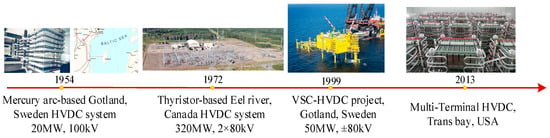
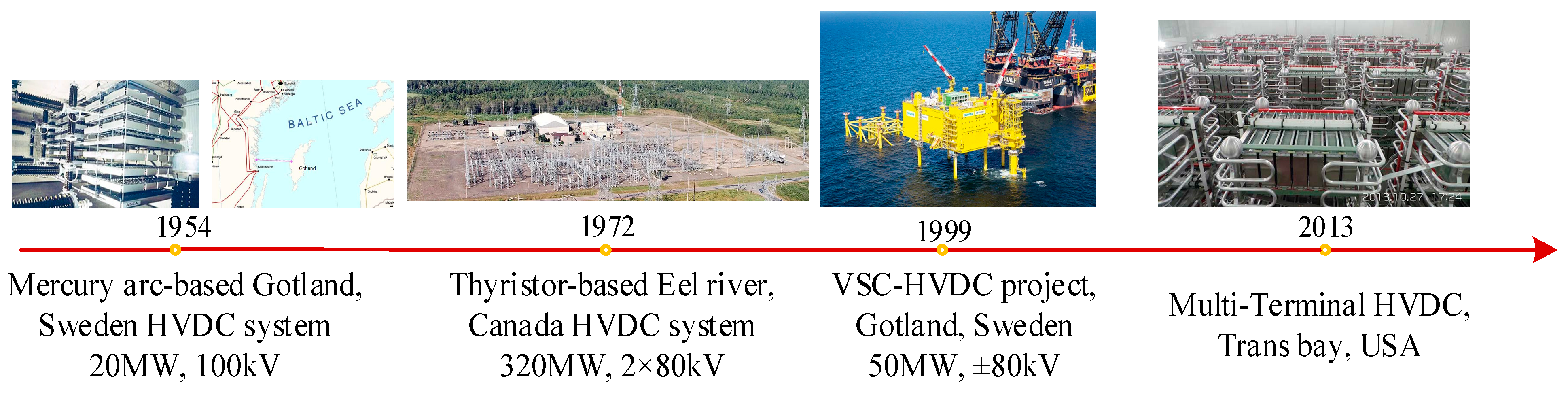
The development of IGBT valves marked a significant improvement over the earlier thyristor valves, particularly in their application within Voltage-Source Converters (VSCs). These IGBT valves offered enhanced performance characteristics, including better efficiency and control. In 1999, ABB introduced the first commercial Voltage-Source Converter High-Voltage Direct-Current (VSC-HVDC) system, connecting the island of Gotland with mainland Sweden. This pioneering system utilized submarine cables with a rated capacity of 50 megawatts and a voltage rating of ±80 kV [7]. Figure 1 illustrates the key milestones in the evolution of HVDC technology and the development of HVDC systems currently in operation.
Figure 1.
Key milestones in the evolution of HVDC technology and HVDC systems in operation.
The key milestones in the evolution of HVDC technology are presented, and in Table 1, the progression of power electronics, highlighting the transition from mercury-arc valves to IGBT transistors, alongside the advancements in HVDC converter technology and the real HVDC projects in the world, is listed [7,8,9,10,11].
Table 1.
Evolution of power electronics and HVDC converter technology: from mercury-arc valves to IGBT transistors with real-world HVDC projects.
1.2. Advantages of HVDC over HVAC Technology
The advantages of HVDC over HVAC technology are compared across several key aspects, including the following: renewable energy integration, power transmission distance, power loss, reactive power compensation necessity, grid stability and control, and eco-friendly nature. Table 2 outlines the summarized advantages of HVDC systems compared to HVAC systems.
Table 2.
Summarized advantages of HVDC systems compared to HVAC systems [12,13,14,15,16,17,18,19,20,21].
Figure 2.
Factors affect the breakeven distance in HVDC and HVAC systems.
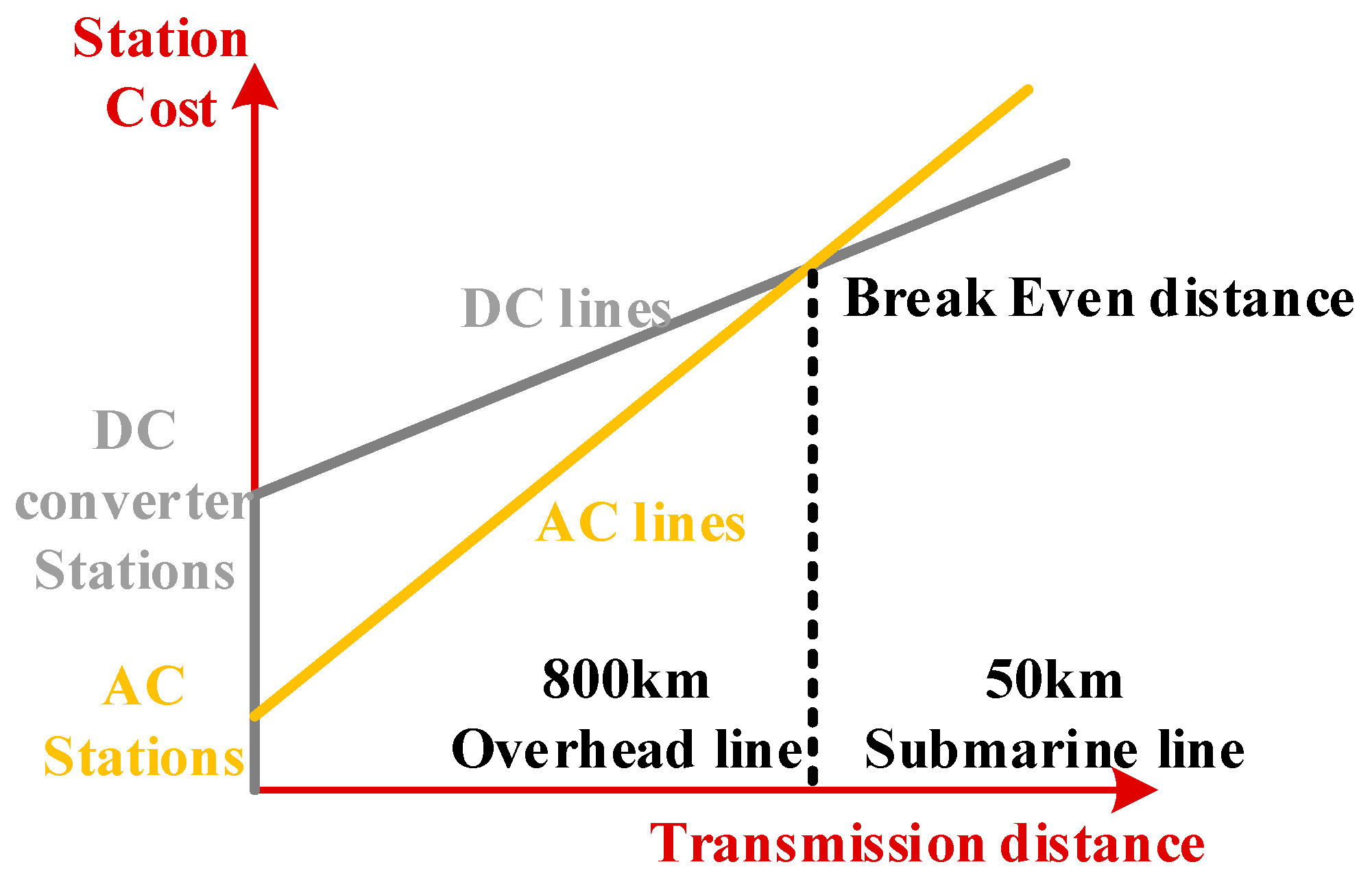
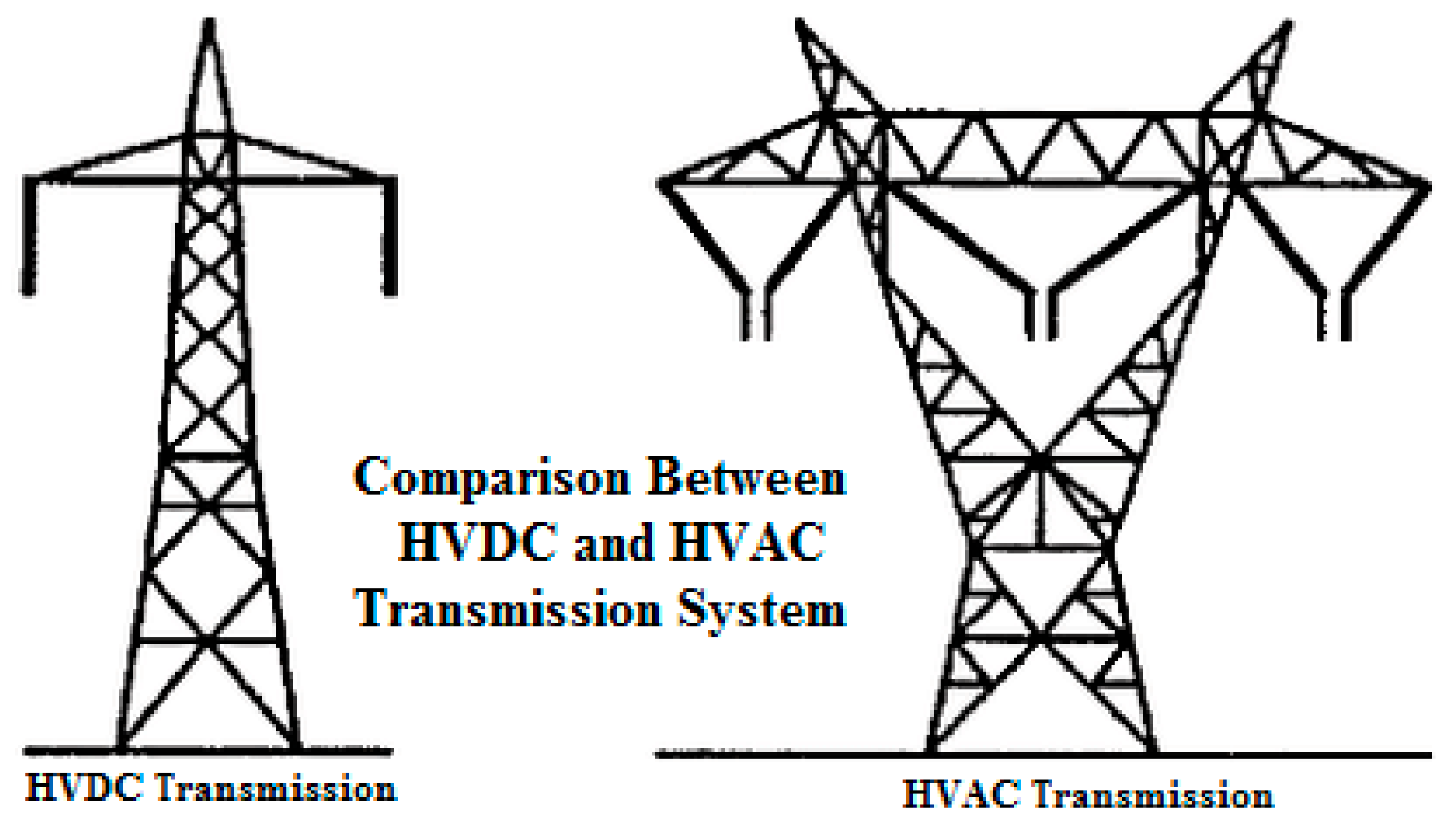
Figure 3.
Comparison between HVDC and HVAC transmission tower.
1.3. HVDC Applications in Power Networks and Developments in Asis-Pacific Region
HVDC applications can be classified into the following categories: (1) underground and submarine cables, (2) long-distance high-capacity power transmission, (3) asynchronous interconnection between AC systems, and (4) the stabilization of power flows in interconnected power networks [22]. Table 3 summarizes the summarized advantages of HVDC systems compared to HVAC systems.
Table 3.
HVDC application scenarios: summary [23,24,25,26,27,28,29,30,31,32,33].
The increasing efficiency, reliability, and capability of HVDC systems have led to their growing popularity worldwide, making them essential for power networks. Over the past decades, countries in the Asia–Pacific region—such as China, India, Japan, Australia, and New Zealand—have developed numerous HVDC systems for various purposes, including connecting distant regions, improving grid stability, supporting interconnection between states, and facilitating renewable energy integration, which are briefly introduced in detail in this subsection. They are experiencing significant growth, with numerous HVDC projects either in operation, under design, or currently under construction.
1.3.1. HVDC Systems in China
China has six major regional power grids, which differ significantly even between provinces within a grid, considering power demand, generation capacity, and resource distribution. These six regional power grid systems are in North China, East China, North-East China, North-West China, South China, and Central China [34]. The Chinese government has substantially invested in establishing a nationwide HVDC transmission network to minimize electricity transmission losses typically associated with HVAC cables between energy production hubs and load centers [35]. To achieve this goal, China is operating, planning, or constructing several HVDC projects around the country so that it has several multi-terminal HVDC systems such as Zhoushan (five-terminal VSC HVDC), Nan’ao (three-terminal VSC-HVDC), Zhangbei (four-terminal VSC-HVDC), and Wudongde–Guangxi–Guangdong (Three-Terminal hybrid LCC/VSC). The Zhoushan multi-terminal VSC-HVDC project is the first five-terminal HVDC in the world [36]. HVDC projects in China that connect the same or different regional grids and some Back-to-Back HVDC systems in China are presented in Table 4 and Table 5, respectively. All HVDC links listed in these two tables are implemented using LCC technology.
Table 4.
HVDC links in China.
Table 5.
Back-to-Back HVDCs in China.
1.3.2. HVDC Systems in India
India’s electric power system includes five regional electricity boards: the Northern, North-Eastern, Eastern, Southern, and Western regional grids. These grids operate synchronously on a single frequency, forming a unified national grid interconnected through HVAC and HVDC links. This national grid is also connected to neighboring countries, including Sri Lanka, Bangladesh, Bhutan, and Nepal [37]. HVDC projects in India are shown in Table 6 and Table 7, which represent some Back-to-Back HVDC systems in India. The technology used in the projects listed in Table 7 is LCC technology.
Table 6.
HVDC links in India.
Table 7.
Back-to-Back HVDCs in India.
1.3.3. HVDC Systems in Japan
The Japanese power system operates at two different frequencies due to historical reasons. When the electricity industry was first established, the Tokyo area adopted German-made generators while the Osaka area used US-made GE generators. As a result, the western region operates at 60 Hz while the eastern region operates at 50 Hz [38].
In Japan, HVDC is utilized for frequency conversion, non-synchronous interconnection systems, and submarine DC-link interconnection systems. Among these, frequency conversion systems are the most used [39]. Three frequency converter systems in Japan include Sakuma and Higashi-Shimizu in the Shizuoka administrative region and Shin-Shinano in the Nagano administrative region [38]. DC submarine cables connect the islands of Honshu and Hokkaido (eastern Japan, operating at 50 Hz) and establish a non-synchronous connection between two separate power systems: the Minami-Fukumitsu asynchronous tie links the Hokuriku Electric Power System and the Chubu Electric Power System with a capacity of 300 MW.
1.3.4. HVDC Systems in Australia
The Australian National Electricity Market (NEM) and the Wholesale Electricity Market (WEM) are Australia’s two main power systems, covering six states. The NEM covers the eastern and south-eastern states while the WEM covers Western Australia. The Australian Capital Territory (ACT) is connected to the NEM; Western Australia and the Northern Territory are not connected to the NEM, and they have their electricity systems and separate regulatory arrangements. HVDC links are used in Australia to connect the states [40]. Table 8 lists HVDC links in Australia and Table 9 lists the earliest HVDC system in New Zealand, recognized as one of the pioneering HVDC systems worldwide.
Table 8.
HVDC links in Australia.
Table 9.
HVDC links in New Zealand.
1.3.5. HVDC Systems in New Zealand
The HVDC Inter-Island link, commonly referred to as the Cook Strait Link, serves as a vital transmission infrastructure connecting New Zealand’s North Island (terminating at Benmore) and South Island (terminating at Haywards). Commissioned in 1965, this link holds historical significance as the world’s first commercial HVDC system to employ mercury-arc valve technology [41]. Over the decades, the link has undergone substantial technological upgrades to enhance its efficiency and reliability, reflecting advancements in HVDC transmission systems.
The original mercury-arc valve-based system was replaced in 1992 with thyristor-based line-commutated converter (LCC) technology, marking a significant leap in performance and maintenance efficiency. A subsequent upgrade in 2013 further modernized the link’s control systems and operational reliability while retaining its original specifications of ±350 kV and a 1200 MW capacity. A key engineering feat of this infrastructure is its 40 km submarine cable segment, which, at the time of installation, was the longest such cable in the Southern Hemisphere.
The HVDC Inter-Island link plays the critical role of HVDC technology in enabling efficient long-distance power transmission across challenging geographical barriers. Its evolution from using early mercury-arc systems to modern thyristor-based converters underscores the dynamic nature of power transmission advancements. Future developments, including potential VSC-HVDC deployments and capacity expansions, will be pivotal in supporting New Zealand’s transition to a sustainable energy future.
1.4. Current Challenges and Research Scopes
The emergence of renewable energy resources, such as solar photovoltage arrays and offshore wind farm power plants, due to shortages of non-sustainable resources and severe environment contaminations, is accelerating the utilization of HVDC networks in power grids. The integration of HVDC grids into modern power systems requires reliable fault detection mechanisms. However, modern voltage-sourced converter-based HVDC systems and multi-terminal DC grids face unique challenges during the faults that are far more severe and complex than those in traditional AC systems. Detecting DC faults is critical in modern power systems, but the detection is fundamentally different from that of traditional AC faults in different aspects. Table 10 shows the main differences between AC and DC faults.
Table 10.
Challenges in DC fault detection compared with AC faults [11,12,13,14,15,16,42,43,44].
With the characteristics listed above, the detection of DC faults requires fast and accurate actions to avoid unstable or vulnerable operation to DC grid equipment damage or blackout cascading. Hence, the research gaps are listed below; these constitute the motivation for us to finish this paper in this field.
- ○
- A lack of sufficient review of signal processing methods for VSC-HVDC or multi-terminal HVDC grid fault detection.
- ○
- The insufficiency of a single signal processing method that would comprehensively realize fault detection; for example, wavelet-based techniques can detect a fault but cannot detect the fault location.
- ○
- Limited real-time viability; for example, wavelet packet transformation is sometimes too slow for real-time protection, which is only applied in offline simulations or laboratory validation. Delayed detection in such faults may cause fault propagation and further cascaded failure.
- ○
- Limited use in testing and HIL framework validation under realistic and diverse grid operating conditions.
1.5. Reference Selection Methodology
Table 11 presents a summary highlighting key HVDC-related keywords over the period of 1990–2025, along with the corresponding number of publications and average citations per item.
Table 11.
Summary of key HVDC-related keywords (1990–2025) with publication counts and average citations per item.
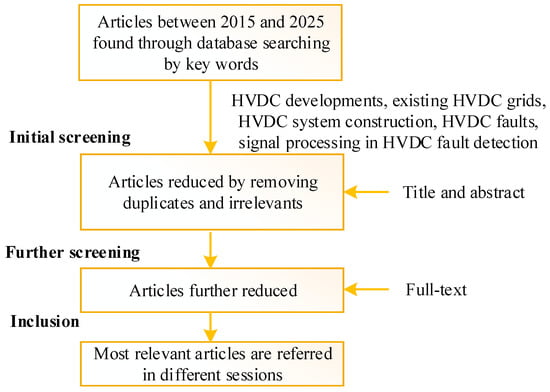
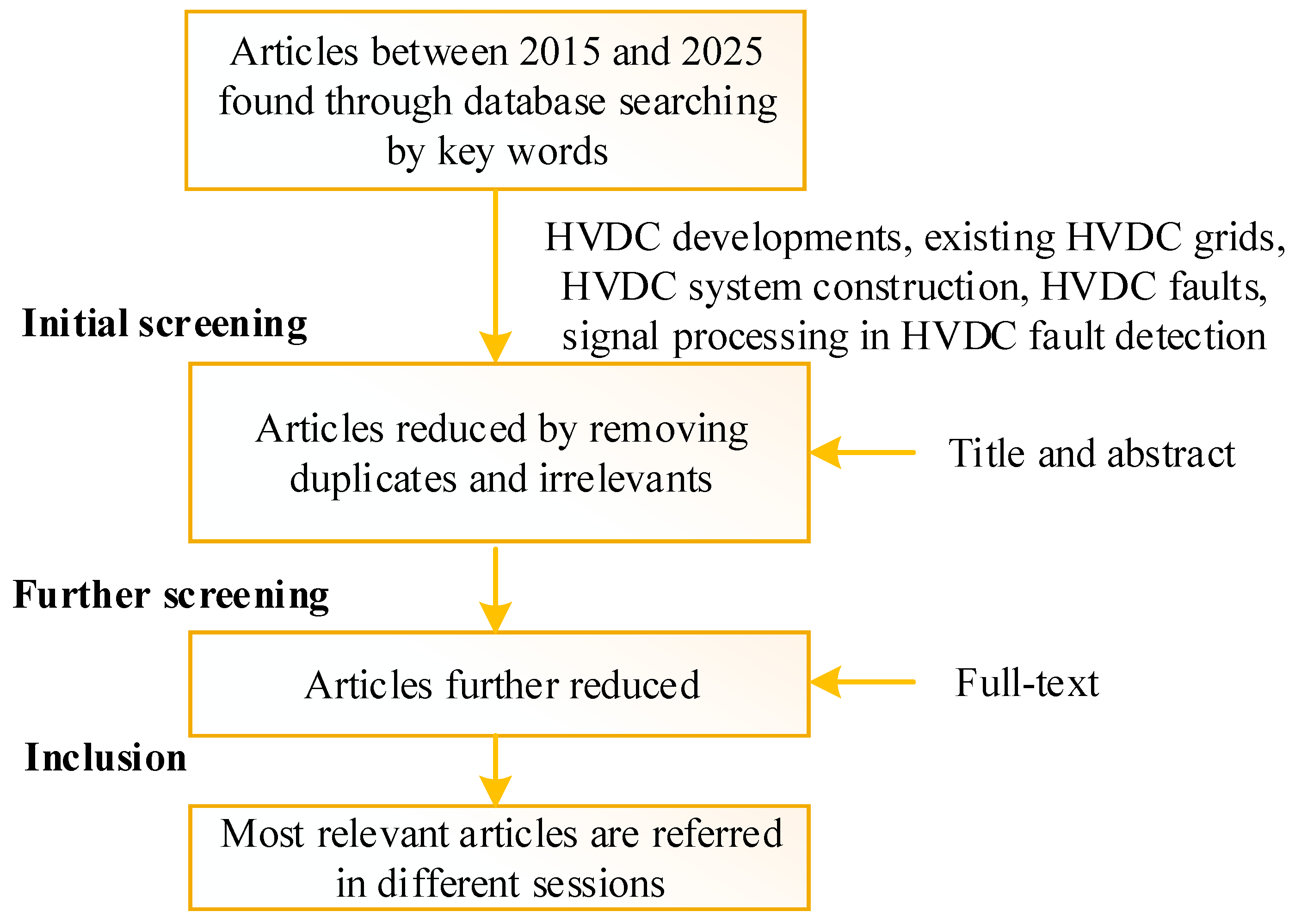
During the review process, published papers between 2015 and 2025 were searched from different databases, e.g., IEEE Xplore, Scopus, and Web of Science. Then the records were selected by title, abstract, and full-text different criteria; the most relevant ones were cited as references. Figure 4 presents a flowchart of the reference selection methodology.
Figure 4.
Flowchart of reference selection methodology.
1.6. Paper Organization
The paper is structured to provide basic knowledge of HVDC grids, including mainstream types of HVDC grids, Line-Commuted Converter–HVDC systems, Voltage Sourced Converter-HVDC systems, multi-terminal HVDC systems, and pole configurations. Section 3 summarizes common faults in HVDC grids, including AC faults, converter stations faults and DC faults. Causes, features, and locations also are compared and presented comprehensively. Section 4 first presents a guiding flow chart of fault detection, classification, and protection. This is followed by a comparison of different signal processing methods, with working domains; running principles and pros and cons are listed with each method. Then the section is structured to review signal processing techniques—ranging from Fourier transform to time–frequency methods—for identifying faults in HVDC networks. We evaluate their performance in terms of system configuration, detected fault types, detection response times, etc., supported by case studies from the recent literature. In conclusion, challenges such as real-time processing and interoperability are discussed, along with emerging trends like edge AI and digital twins for future directions in HVDC fault detection.
2. Basics of HVDC Grids
2.1. Converter-Based HVDC Systems
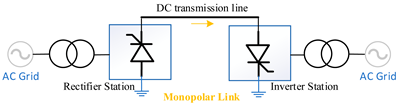
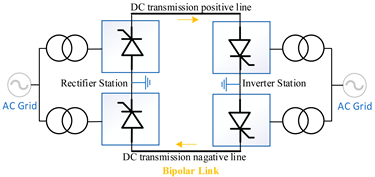
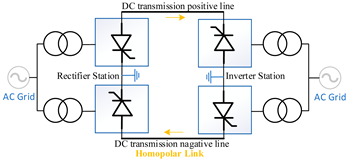
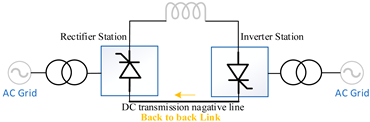
HVDC systems can be categorized into three types based on design and operational features: converter technology, pole configuration, and system configuration. Depending on the type of converter being utilized, this technology includes LCCs, VSCs, and MMCs. HVDC topologies are commonly classified into four primary types: monopolar, bipolar, homopolar, and hybrid [45]. Regarding power distribution and communication, HVDC systems can be configured as two-terminal, multi-terminal, or Back-to-Back systems.
Converters play a crucial role in HVDC systems. They are essential for converting AC and DC. HVDC systems convert AC to DC (rectification) and DC back to AC (inversion) using power electronic devices. And the key functions of such systems are listed: power flow control, interconnecting grids with different frequencies, etc. Converters in HVDC systems are classified into two leading groups: CSC converters (also called line-commutated converters (LCCs)) and VSCs [46].
LCCs are based on thyristors, and such systems have traditionally been used for large-scale power transmission in HVDC applications and for a long time. However, these systems encounter several limitations, such as high reactive power consumption, the inability to control reactive power, and the absence of black start capability [47]. Meanwhile, VSCs are not based on thyristors; instead, they use other powerful electronic devices such as IGBTs [48].
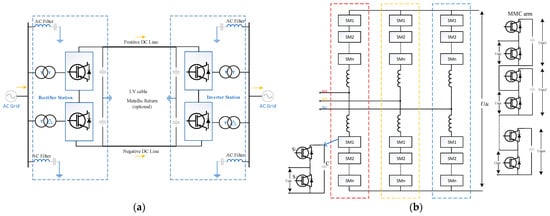
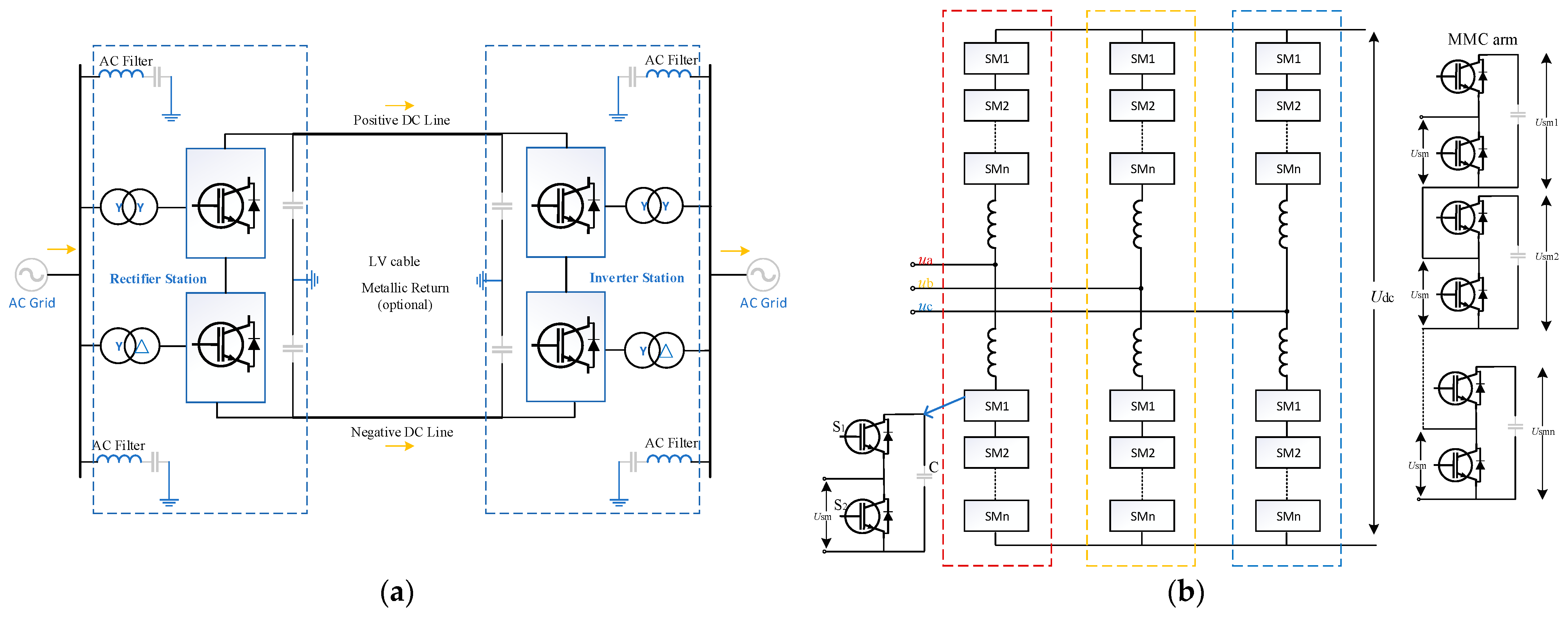
Due to the advancements in electronic devices like GTO and IGBTs during the 1990s, VSC technology became essential in HVDC systems. VSCs offer several advantages, including the independent control of reactive and active power, low harmonic levels, flexible active power control, and blackout recovery capability [49]. VSCs are particularly valued for their ability to ensure secure commutation in both AC and DC systems, achieved with Pulse Width Modulation (PWM) [50]. The MMC, an advanced version of the VSC, has gained popularity in developing VSC-MTDC systems due to its modularity and scalability [51]. Figure 5 shows an IGBT-based VSC bipolar HVDC system and Table 12 compares the working profiles from LCC-HVDC, VSC-HVDC, and MMC-HVDC systems.
Figure 5.
Commonly used VSC bipolar HVDC systems: (a) IGBT-based VSC bipolar HVDC system; (b) MMC (IGBT)-converter-based HVDC system.
On the other hand, wide-bandgap semiconductors have become increasingly popular over the past decade due to significant technological developments. Compared to conventional silicon (Si IGBT) devices, wide-bandgap semiconductors offer higher breakdown voltages, better thermal conductivity, and faster switching speeds. Among them, silicon carbide (SiC) and gallium nitride (GaN) have demonstrated the most promising viability in terms of mature technology and commercial availability. However, due to its higher voltage capability and higher current rating and superior thermal conductivity, SiC is currently better suited for high-power and high-voltage HVDC grid applications [52].
SiC devices have already begun to be applied in HVDC systems; however, their use is currently mainly limited to experimental systems, pilot projects, submodules, and auxiliary power supplies. Within HVDC power systems, SiC MOSFETs present the potential to significantly reduce switching losses and enable higher switching frequencies, thereby allowing a reduction in the size and cost of passive components such as filters and transformers [53]. They have not yet been widely deployed in mainstream commercial HVDC converter stations. Nonetheless, their application is rapidly advancing—particularly in Modular Multilevel Converter (MMC-HVDC) systems—where SiC is regarded as a key enabling technology for the future. In the medium-voltage conversion stage between wind or photovoltaic sources and the HVDC bus, SiC devices are gradually replacing traditional IGBTs, enabling more compact and efficient system designs [54,55].
Table 12.
Comparative analysis of LCC, VSC, and MMC technologies [56,57,58,59,60].
2.2. Pole Configurations in HVDC System
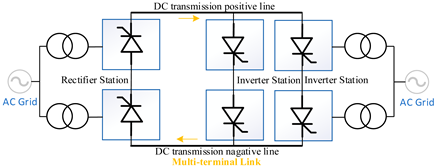
HVDC systems can deploy five types of links when in operation: monopolar, bipolar, homopolar, Back-to-Back, and multi-terminal configurations. HVDC systems are categorized based on their terminal configurations into two types: two-terminal and multi-terminal systems. Two-terminal HVDC systems feature a simple setup with one terminal at each end, making them ideal for direct point-to-point power transmission between two locations. Multi-terminal HVDC systems have more than two terminals, making them a more complex configuration than two-terminal HVDC systems due to multiple interconnections within the grid. Table 13 shows the diagrams, working principles, and typical features of different topologies.
Table 13.
Comparison of different types of HVDC technology [61,62,63,64,65,66,67,68,69].
3. Fault Types in HVDC Grids
Based on the features, HVDC systems are mainly used in long-distance high-power transmission. The HVDC system could be divided into two sections: the AC section (AC grid, converters including inverter/rectifier) and DC section (DC transmission line). Common faults that occur in the HVDC systems are categorized by location (AC/DC side).
- AC faults
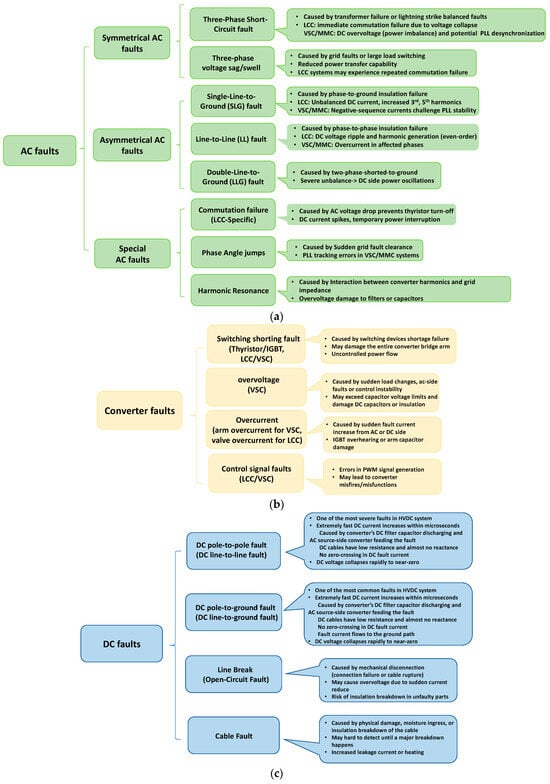
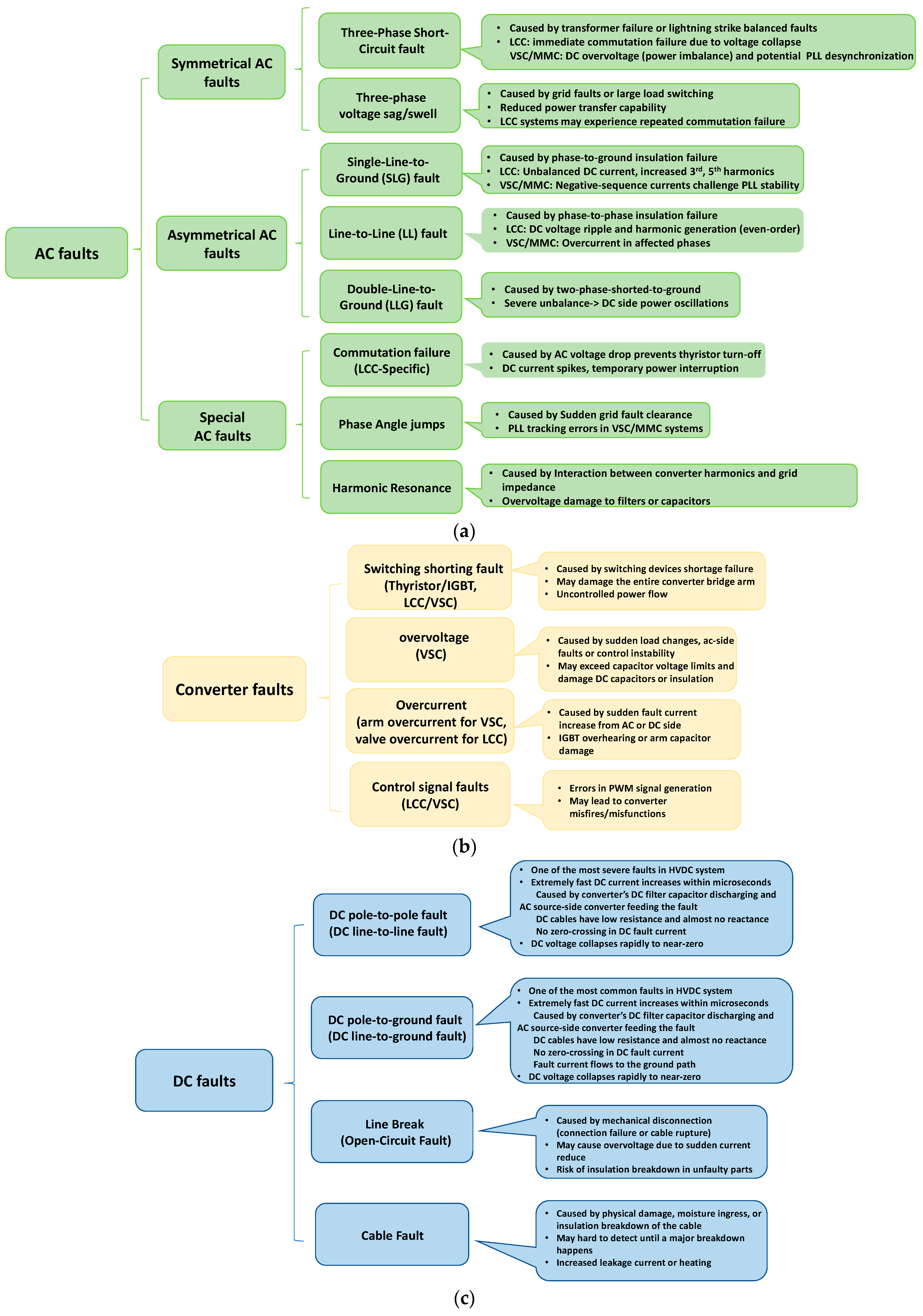
AC side faults happen in the AC section of the HVDC system. They are classified according to their location into two main categories: symmetrical faults and asymmetrical faults; there are also other special faults. Symmetrical AC faults include three-phase short-circuit and three-phase voltage sag/swell, and asymmetrical AC faults happen between the line and ground: single-line-to-ground (SLG) fault, line-to-line (LL) fault, and double-line-to-ground (LLG) fault. Other special fault scenarios include commutation failure, phase angle jumps, and harmonic resonance. For AC faults, the causes and features are presented in Figure 6a [70,71,72,73].
Figure 6.
Common converter faults in HVDC systems: (a) AC faults in HVDC systems, (b) converter faults in HVDC systems, and (c) DC faults in HVDC systems.
- 2.
- Converter faults
In HVDC systems, the converter stations, including a rectifier station converting AC to DC and an inverter station converting DC to AC, play a crucial role in power conversion. Faults in converters can disrupt the entire transmission line and may lead to facility damage or blackouts. Common converter faults are listed in Figure 6b [70,71,72,73].
- 3.
- DC faults
In the long-distance HVDC transmission system, the DC line is one of the components with high fault probability, and this generates a significant effect on effective power transmission. Faults on the DC transmission line are mainly caused by cable damage, insulation failure, and equipment malfunction. The DC line is the main part to realize power transmission, and there are two types of DC line faults, the DC-line-to-ground fault (also called the pole-to-ground fault, shorted as the PG fault) and DC-line-to-line fault (also called the pole-to-pole fault, shorted as the PP fault). There are four types of DC faults; the causes and features are shown in Figure 6c [70,71,72,73].
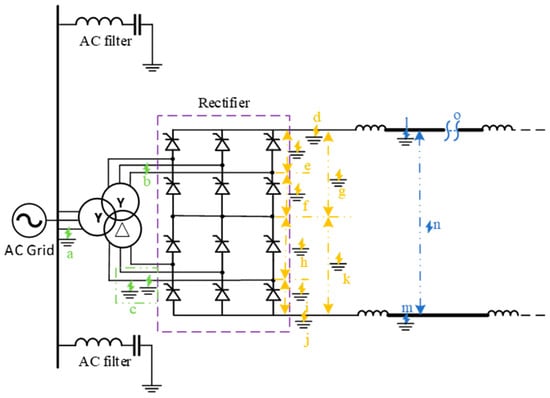
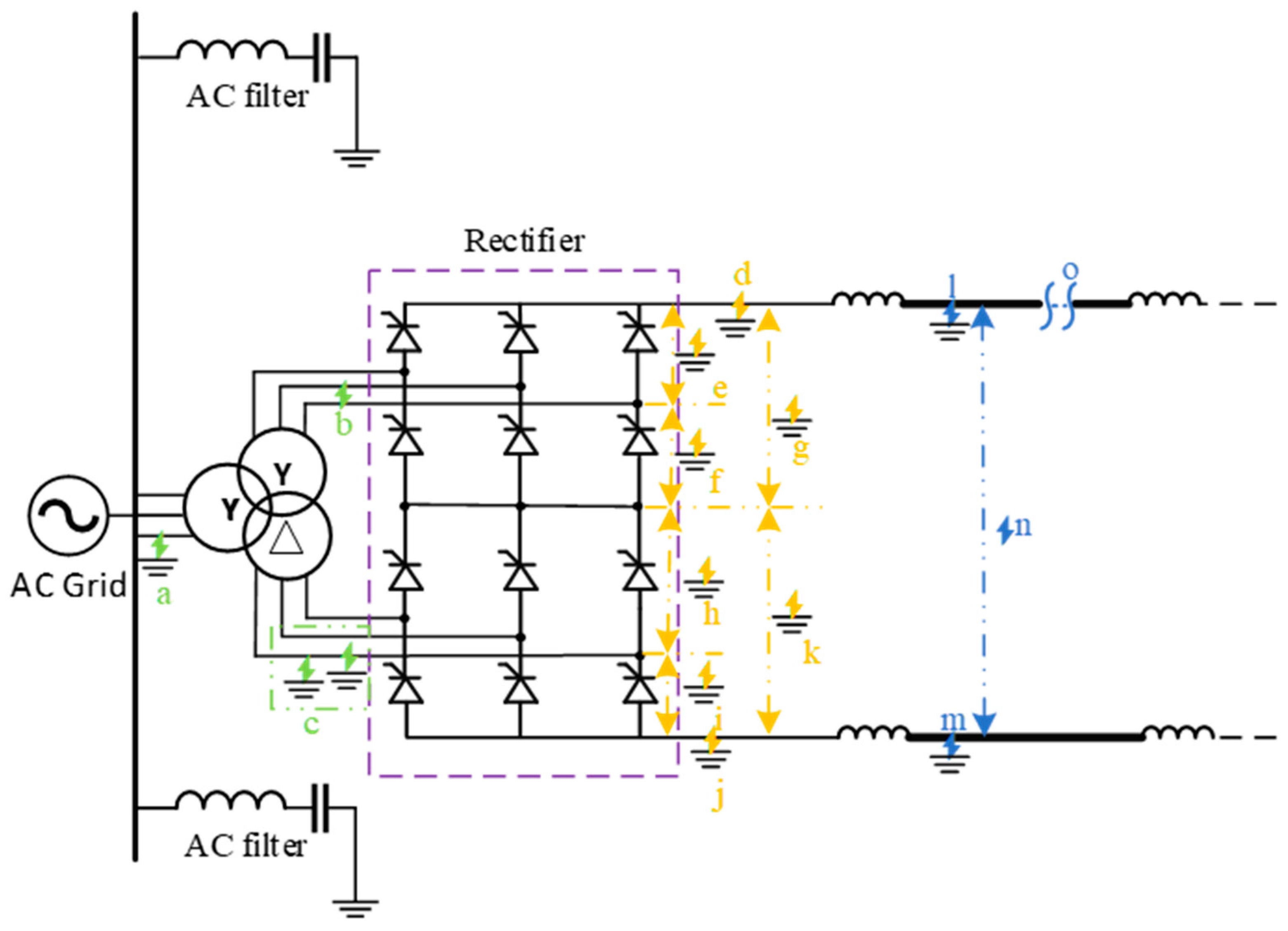
An example of a 12-pulse LCC-HVDC system is shown to show the fault locations in different sections of an HVDC system. AC faults, converter faults, and DC faults are shown separately in green, yellow, and blue colors in Figure 7. In an HVDC system, the faults shown in Figure 7 are just for the AC input side, rectifier, and DC transmission line.
Figure 7.
Common converter faults in HVDC systems. AC faults—a: AC-line-to-ground fault, b: line-to-line AC fault, and c: double-line-to-ground fault. Converter faults—d, j: ground fault of converter valves/switches. e, f, g, h, i, k: valve/switch shorting fault. DC faults—l: DC positive pole-to-ground fault. m: DC negative pole-to-ground fault. n: DC pole-to-pole fault. o: DC line-break fault.
4. Signal Processing Techniques in HVDC Fault Detection
4.1. Fault Detection, Diagnosis, and Classification in HVDC Grids
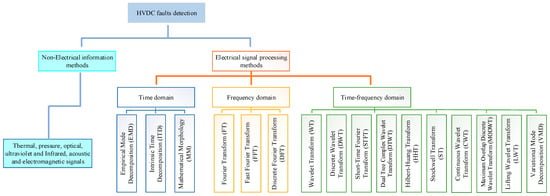
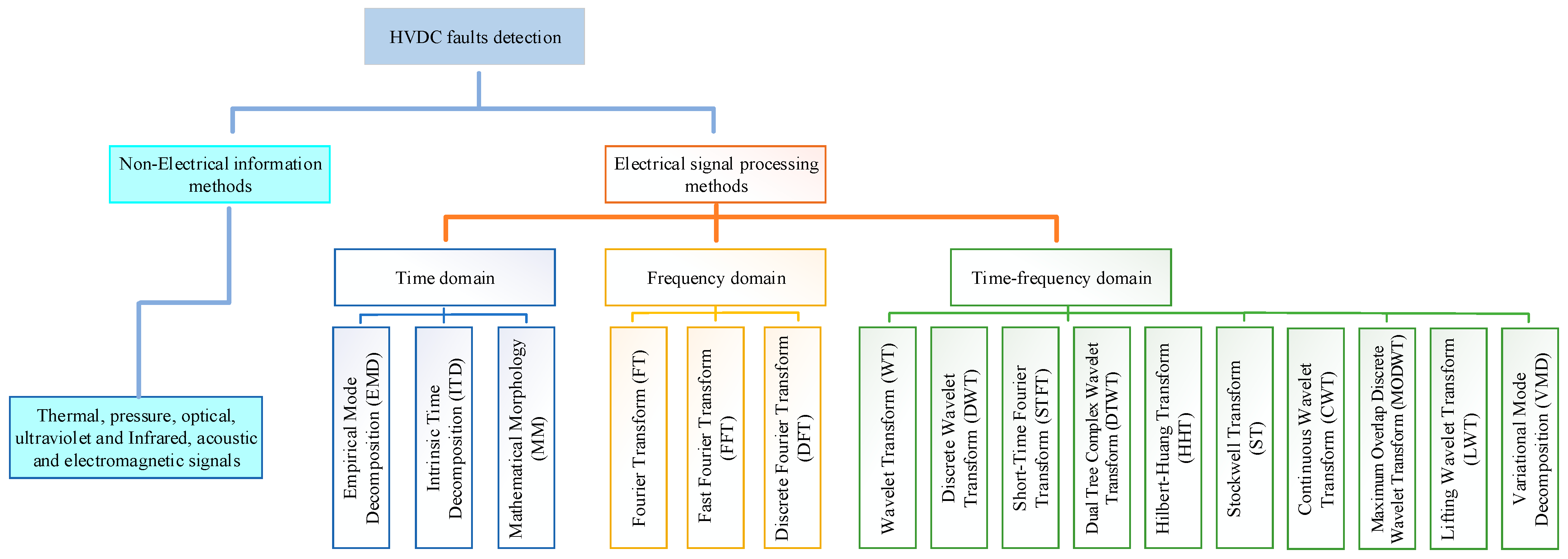
To ensure that power systems remain reliable and sustainable, detecting and classifying faults in transmission lines are essential to ensure reliable and continuous power delivery [74]. Fault detection identifies an abnormal situation or disturbance. It monitors electrical parameters such as current, voltage, and frequency to recognize deviations from normal operating conditions. Fault classification refers to identifying the type of fault that has occurred to determine which phases or poles are affected by the fault. In AC systems, recognizing the type of fault can be included in single-phase-to-ground, phase-to-phase, phase-to-ground, or three-phase faults, and in DC systems, pole-to-ground and pole-to-pole faults are the types of faults in lines. The identification of a faulted phase or pole also falls under fault classification. Fault location refers to pinpointing the exact position of the fault along with lines or determining the distance along the line where a fault has occurred. Precise fault localization on transmission lines is crucial for maintaining consistent and dependable power delivery to distant destinations [75]. The rapid isolation and repair of the faulty section to minimize downtime and reliability improvements depend on the fault location. Protection in power system lines generally refers to fault detection and classification while fault location relates to system restoration and management. Figure 8 presents comprehensive fault detection methods in HVDC grids.
Figure 8.
Commonly used methods for HVDC faults.
Non-electrical information in HVDC fault detection has also been used in HVDC fault detection because it provides complementary, early, and robust indicators of faults that traditional electrical signal measurements, voltage, or current may miss or be too late to detect.
4.1.1. Thermal
A comparative analysis between ABB’s conventional hybrid HVDC circuit breaker (CH-DCCB) and a newly proposed hybrid DCCB integrated with a solid-state fault current limiter (SSFCL) in a multi-terminal Voltage-Source Converter (VSC) HVDC system is presented in [76]. The focus is on assessing electrical and thermal stresses on key components like IGBT valves and metal oxide surge arrestors (MOSA) under low- and high-impedance DC fault conditions.
Thermal stress in Modular Multilevel Converters (MMCs) used in HVDC systems is analyzed and addresses the imbalance caused by nearest level modulation (NLM), especially under low-power-factor conditions like low-voltage ride through or reactive power injection, in [77]. The paper proposes a thermal balancing method integrated into the capacitor voltage-balancing algorithm, aiming to equalize stress across submodules and extend their lifetime.
4.1.2. Pressure
The effects of DC bias were studied via 500 kV power transformers in HVDC systems in [78]. Tests showed that DC current through the neutral terminal significantly increases transformer vibration and audible noise, introducing irregular waveforms and high-frequency harmonics. In no-load tests, vibration grows linearly with DC at low voltage and rises sharply near saturation. Under load, each 1 A DC increase raises vibration by 11 m/s and noise by 0.9 Pa; a 6 A bias boosts noise from 87 dB to 104 dB. Long-term monitoring shows that other factors may also affect vibration. Audible noise tracking is a valuable supplement and key for HVDC design.
4.1.3. Optical
A novel energy-fiber Detection and Localization (EFDL) technology for HVDC measurement systems based on Optical Time-Domain Reflectometry is proposed in [79]. The method enables the continuous monitoring and rapid fault localization of energy fibers in converter stations. Through dynamic accelerated aging tests isolating factors such as temperature, macrobending, power injection, end-face cleanliness, and pressure, key failure mechanisms were identified. Results showed that operational reliability is significantly affected by these factors, recommending operating temperatures between −20 °C and 40 °C, a bending radius ≥ 25 mm, power < 1 W, and regular fiber end-face cleaning. The EFDL technology supports the full-life-cycle management of energy fibers.
4.1.4. Ultraviolet and Infrared Imaging
Restart failures are investigated in ±800 kV HVDC lines caused by greenhouse plastic cloth in [80]. Field data and lab tests showed that under damp conditions, the plastic becomes prone to surface discharge, with a flashover voltage of −640 kV (~80% of rated). Flashover and combustion tests revealed that high fault current, dispersed discharge paths, and short restart intervals hinder arc deionization (~160 ms), leading to three failed restarts. Factors like arc drift and folded plastic contribute to persistent short circuits, resulting in a bipolar block fault.
4.1.5. Acoustic
A method combining Ensemble Empirical Mode Decomposition (EEMD) and wavelet adaptive threshold denoising to extract partial discharge (PD) acoustic emission (AE) signals from solid insulated high-voltage DC equipment was presented in [81]. The method effectively denoises low signal-to-noise ratio (SNR) signals and uses the EEMD energy entropy of intrinsic mode functions as features. Simulation and experimental results have shown that the proposed method outperforms traditional EMD in noise reduction and signal extraction accuracy, making it suitable for PD detection in various pieces of electrical equipment.
4.1.6. Electromagnetic Waves
A method combining Ensemble Empirical Mode Decomposition (EEMD) and wavelet adaptive threshold denoising to extract partial discharge (PD) acoustic emission (AE) signals from solid insulated high-voltage DC equipment was presented in [82,83]. The method effectively denoises low signal-to-noise ratio (SNR) signals and uses the EEMD energy entropy of intrinsic mode functions as features. Simulation and experimental results have shown that the proposed method outperforms traditional EMD in noise reduction and signal extraction accuracy, making it suitable for PD detection in various pieces of electrical equipment.
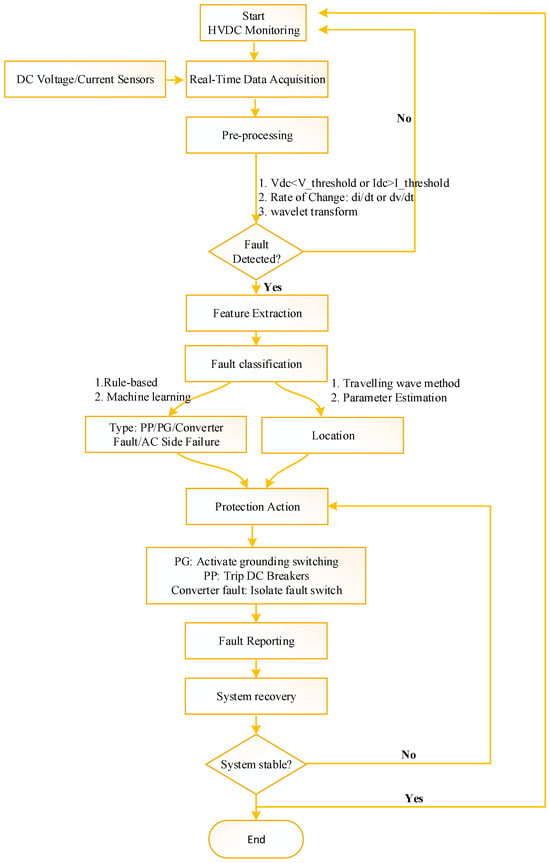
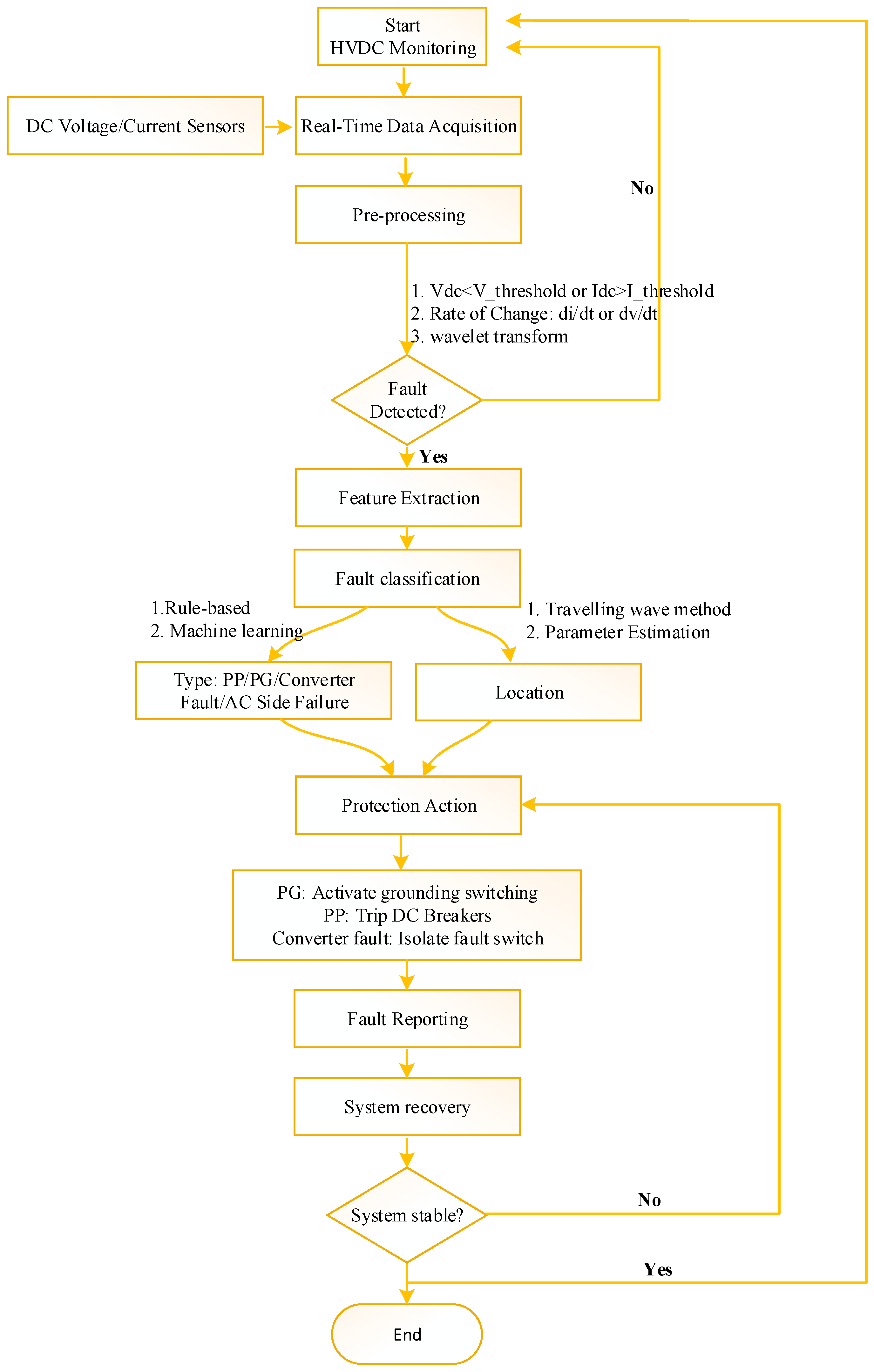
Figure 9 presents a flowchart of the progress of HVDC fault detection and classification. It helps understand the process in a straightforward way. The flowchart starts with system monitoring, then moves to the first step of real-time data acquisition.
Figure 9.
Commonly used signal processing methods for HVDC faults.
In Step 1, generally, the input data are the measurements from sensors, e.g., DC voltage (Vdc), DC current (Idc), AC side voltage and current (for converter monitoring), and control signals (e.g., firing angles for LCC, PWM signal for VSC). Generally, the tools used are phasor measurement units (PMUs) and SCADA systems.
Step 2 is to pre-process the raw time-series data. The main actions are removing noise via filters (e.g., low-pass filter).
Step 3 is to detect the fault by monitoring the anomalies through comparing the Vdc and Idc signal against the predefined thresholds. In the first method, in common sense, if Vdc < Tthreshold (e.g., 0.8 p.u.), a potential fault is flagged; if Idc > Ithreshold (e.g., 1.5 p.u.), a potential fault is flagged, too. Also, the rate of change (ROC) of voltage and current can also be used, e.g., calculating dVdc/dt and dIdc/dt, similarly, by comparing whether |dVdc/dt| > ROC_threshold or |dIdc/dt| > ROC_threshold to flag the fault. Wavelet transform could be used also to detect high-frequency components, identifying faults. Then, we come to the decision link: whether the fault is detected. If yes, proceed to Step 3. If not, the detection program returns to the start and continues monitoring.
Step 4 is to extract features for fault classification from the time or frequency domain. In the time domain, the features we have obtained are peak Vdc or Idc values and the rate-of-change values of dVdc/dt or dIdc/dt. In the frequency domain, the energy of wavelet coefficients and frequency components are obtained by FFT.
Step 5 is to classify the fault, pole-to-ground (PG), pole-to-pole (PP), and converter switching faults, etc. The method used in this step is threshold-based, or machine-learning-based, or a hybrid method of these two.
Step 6 is to classify the fault location (the commonly used method is the travelling wave) and fault resistance by the fault current and voltage to estimate the fault distance.
Step 7 is protection. Corresponding actions will be activated to protect the HVDC system, e.g., grounding switches are activated if a PG fault happens; DC circuit breakers are tripped and converters will be shut down if a PP fault happens. The fault converter will be isolated if there is a fault happening.
Step 8 is to log fault report details, including the fault type, location, and fault duration. Post-fault data will be saved for further analysis.
Step 9 is system recovery. The faults should be clear by repairing fault components, converters should be restarted and synchronized with AC grid, etc. Then the system stability will be decided. If the system is stable, the program will go back to the start and resume system monitoring; if not, the program will go back to protection to adopt new actions to maintain system running reliability or be flagged for further manual maintenance.
4.2. Signal Processing Techniques
Signal processing techniques for fault detection and classification in power systems refer to analyzing signals (such as voltage and current signals gathered from the system) using computational and mathematical techniques to identify anomalies and faults. Commonly used signal processing methods for HVDC faults are shown in Figure 9. By extracting useful information from signals, signal processing methods help improve system reliability by detecting instantaneous changes in signals to find faults, differentiating between several types of faults and enabling the identification of them. Signal processing techniques can be categorized into frequency-domain, time–frequency-domain, and time-domain methods [84]. Table 14 presents the comparison of different signal processing methods for HVDC faults, where the working domain, running principle, and pros and cons of each method are provided.
Table 14.
Comparative analysis of different signal processing methods [85,86,87,88,89,90,91,92,93,94,95,96,97,98,99,100,101,102,103,104,105].
4.3. Signal Processing Applications for Fault Detection in HVDC Lines
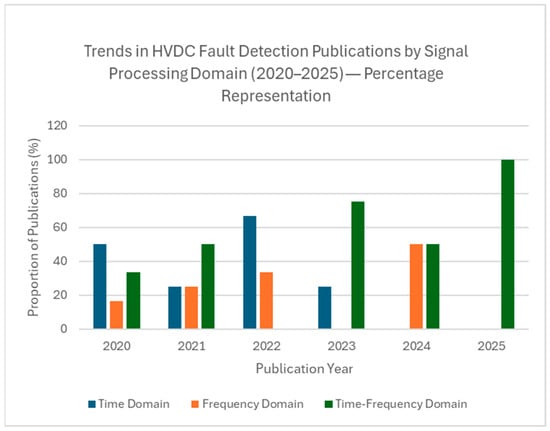
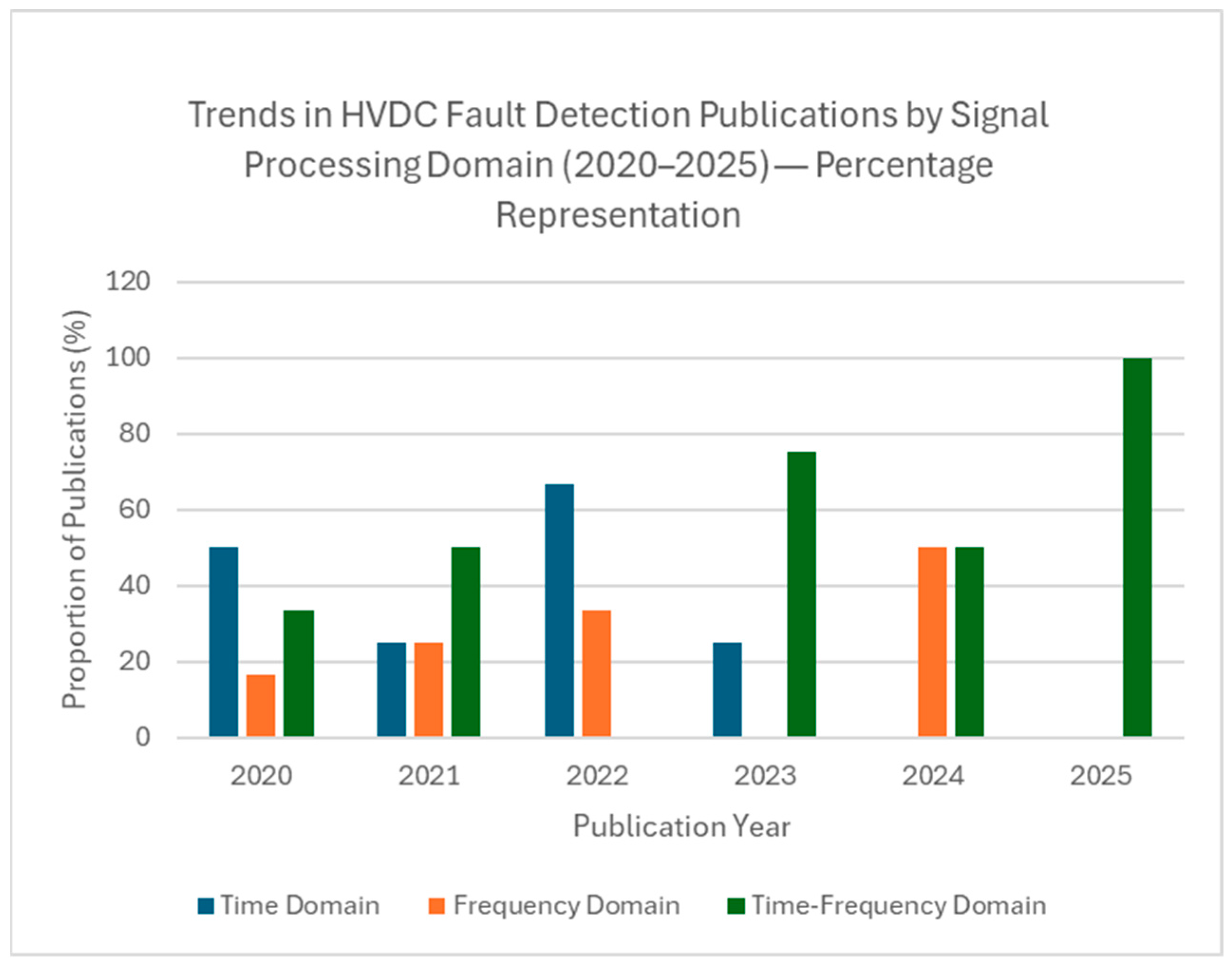
A comprehensive review of publications from 2015 to 2025 was conducted to examine research trends in HVDC fault detection. The findings in Figure 10 categorize studies based on their signal processing domain, illustrating the annual distribution of publications across different methodological approaches. This visualization provides insights into the evolution of research focus, highlighting whether specific techniques have gained or declined prominence over time.
Figure 10.
Trends in HVDC fault detection by signal processing (2020–2025).
Table 15 presents a compilation of scholarly articles that have employed signal processing techniques in the frequency, time–frequency, and time domains for detecting faults in HVDC systems in recent years.
Table 15.
Literature review on signal processing techniques in HVDC fault detection.
5. Discussion and Prospects
5.1. Discussion
In recent years, Artificial Intelligence (AI), which simulates human intelligence in machines, has been widely explored across various scientific domains. In power systems, it has attracted significant attention for its ability to analyze and solve complex nonlinear problems. AI enhances multiple aspects of electrical power systems by processing large volumes of data to address challenges such as voltage control, power quality, fault detection, planning, monitoring, forecasting, and protection [123].
Beyond traditional signal processing, AI and machine learning models are capable of detecting faults in HVDC systems independently without the need for prior signal processing techniques. Methods such as Artificial Neural Networks (ANNs), Adaptive Neuro-Fuzzy Inference Systems (ANFISs), and Support Vector Machines (SVMs) offer robust tools for HVDC fault detection by extracting valuable patterns from historical data [124]. Leveraging the pattern recognition and learning capabilities of these models, AI can analyze raw data to identify, classify, and detect anomalies that signal potential faults or abnormal conditions. These models can autonomously learn fault features and make decisions based on the patterns they have identified.
AI, as a branch of computer science, mimics human reasoning and behavior, enabling machines to make rational decisions, manage incomplete information, and adapt to dynamic conditions [125]. When combined with conventional techniques, AI has significantly improved fault detection accuracy and contributed to the development of smart protection strategies in modern power systems, though certain challenges remain [123].
While AI integration enhances signal processing by improving adaptability to changing grid conditions and enabling dynamic optimization of protection schemes, it also introduces additional complexity to the design and implementation of these systems. Moreover, the effectiveness of AI-based approaches heavily depends on the availability of large, high-quality training datasets. Such data can be difficult to obtain in diverse and rapidly evolving grid environments, leaving these models vulnerable to data errors and biases [126].
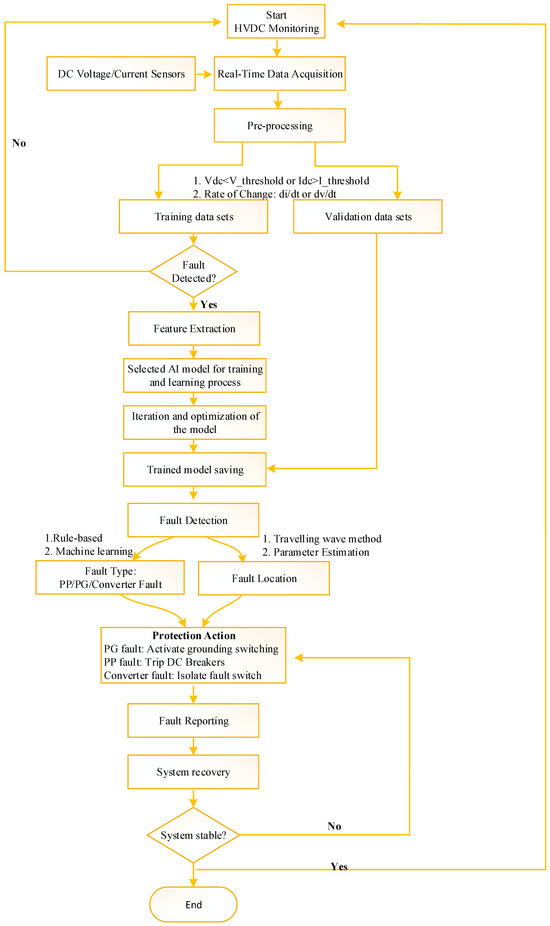
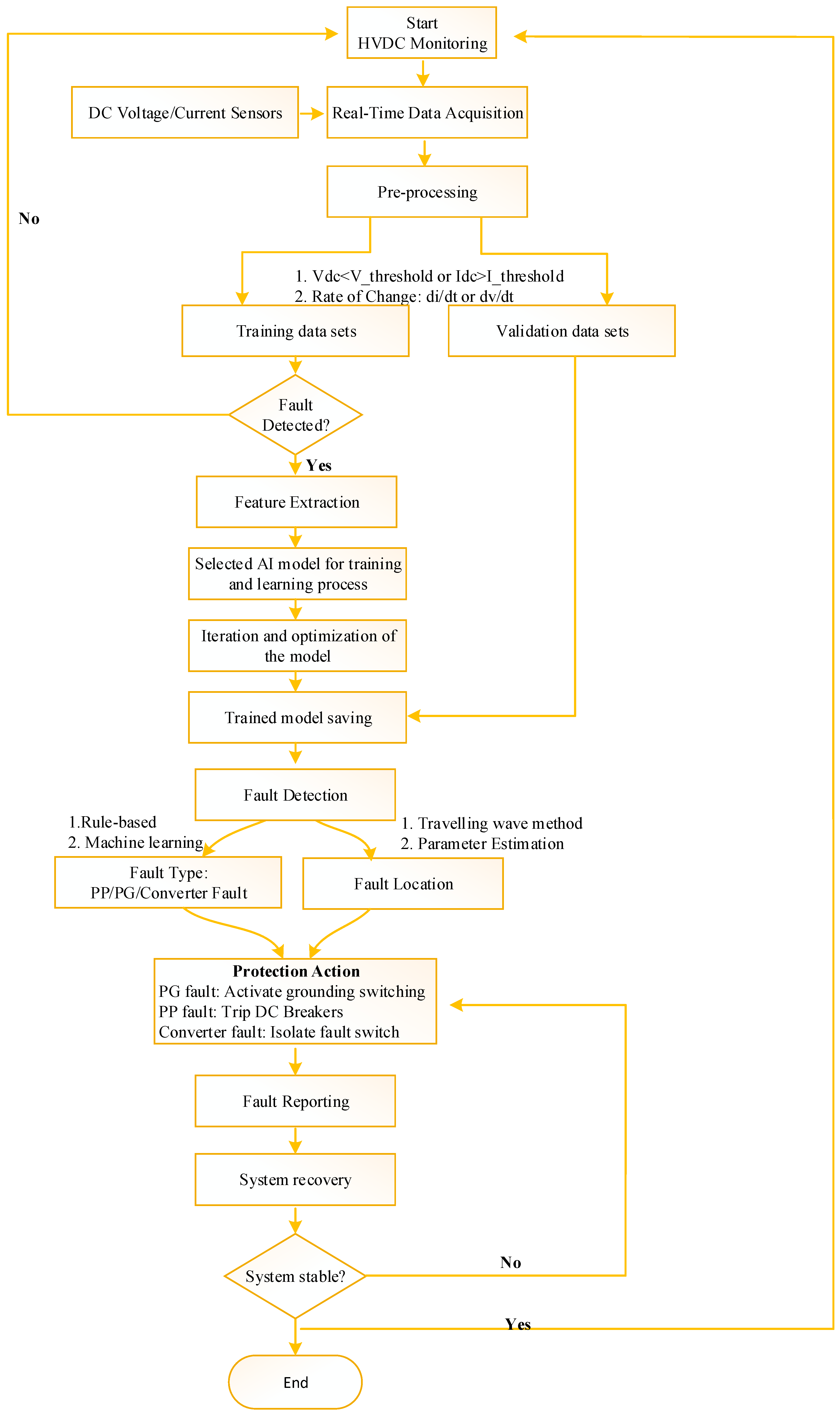
A framework for AI-machine learning-based for HVDC-system fault detection is depicted in Figure 11.
Figure 11.
Flowchart of AI–machine learning method for HVDC fault detection.
5.2. Future Research Directions
- Innovative Monitoring via Optical Sensor Networks
- ○
- We must develop magneto-optic glass sensors to replace traditional CT/PT, with increased bandwidth and integrate Optical Current Transducers (OCTs) and Optical Voltage Transducers (OVTs) for EMI-immune measurements.
- ○
- We must apply phase-sensitive Optical Time-Domain Reflectometry technology, which is an advanced technology used for the real-time monitoring of vibrations, pressure, and acoustic disturbances in DC lines without needing discrete sensors, reducing system costs.
- Digital Twin for HVDC Fault Detection
Digital twin for HVDC fault detection is an emerging and powerful application combining simulation models, real-data, and machine learning to enable intelligent fault diagnosis. A digital twin is a virtual duplicate of a physical asset, process, or system that continuously receives data from the real world (e.g., sensors, SCADA, PMUs) and mirrors its state, behavior, and evolution. For HVDC systems, it replicates transmission lines, converter stations, transformers and reactors, and protection and control systems.
The fault detection and diagnosis procedure involves integrating real-time sensing data (voltage, current, vibration, etc.) into the digital twin model, then detecting anomalies or deviations from expected behavior by comparing virtual running status of digital twin and real data, using time-domain inversion and electromagnetic propagation simulations to quickly locate fault points (e.g., line-to-ground faults or pole-to-pole short circuits).
- Quantum Machine Learning for HVDC Fault Detection
Quantum Machine Learning is an emerging interdisciplinary field combining quantum computing and machine learning. It offers novel capabilities to handle complex, high-dimensional, and time-sensitive data for more accurate and faster fault diagnosis, which is beneficial in the context of HVDC fault detection. The traditional machine learning method is easily transplanted to quantum computers to realize HVDC fault detection and classification. However, as the hardware of quantum computers is still in the early development stages and software for quantum programming frameworks is still evolving, the practical application of this technology in HVDC grids remains a future goal.
6. Conclusions
In this paper, a comprehensive review of the aspects and principles of HVDC systems, along with signal processing techniques for fault detection in these systems, has been conducted. In conclusion, the paper contributes the following key points:
- This paper has presented the developments of HVDC links in the world and the technological advancements from mercury-arc valves to IGBT-based converters, also summarizing the operational HVDC projects deployed in some technologically leading countries to showcase the state-of-the-art advancements.
- A comprehensive comparison of converter technologies (LCC, VSC and MMC) and pole configurations (monopolar, bipolar, homopolar, and MMC) of HVDC systems has been conducted.
- Different faults in HVDC systems including AC faults, converter faults, and DC faults have been summarized and compared, and the locations of major faults have been pinpointed.
- A comprehensive comparison of signal processing methods has been made, including time-domain, frequency-domain and time–frequency-domain methods, with case studies of references.
- Future research gaps have been discussed to improve reliability under diverse fault conditions in HVDC fault detection, classification, and protection.
Funding
This work was supported by the New Zealand Ministry of Business, Innovation, and Employment under the Advanced Energy Technology Platform program “Architecture of the Future Low Carbon, Resilient, Electrical Power System”, contract number UOCX2007.
Data Availability Statement
No new data were created or analyzed in this study.
Conflicts of Interest
The authors declare no conflict of interest.
Abbreviations
The following abbreviations have been used in this manuscript:
| AC | Alternating Current |
| AI | Artificial Intelligence |
| ANFIS | Adaptive Neuro-Fuzzy Inference System |
| ANN | Artificial Neural Network |
| BLIMF | Band Limited Intrinsic Mode Functions |
| CNN | Convolutional Neural Network |
| CSC | Current Source Converter |
| CWT | Continuous Wavelet Transform |
| DC | Direct Current |
| DFT | Discrete Fourier Transform |
| DTWT | Dual Tree Complex Wavelet Transform |
| DWT | Discrete Wavelet Transform |
| EMD | Empirical Mode Decomposition |
| FFT | Fast Fourier Transform |
| FT | Fourier Transform |
| GAF | Gramian Angular Field |
| GaN | Gallium Nitride |
| HHT | Hilbert Huang Transform |
| HVAC | High-Voltage Alternating-Current |
| HVDC | High-Voltage Direct-Current |
| IMF | Intrinsic Mode Function |
| ITD | Intrinsic Time Decomposition |
| LCC | Line-Commutated Converter |
| LWT | Lifting Wavelet Transform |
| MLP | Multilayer Perceptron |
| MM | Mathematical Morphology |
| MMC | Modular Multilevel Converter |
| MODWT | Maximum-Overlap Discrete Wavelet Transform |
| PRC | Proper Rotating Component |
| PWM | Pulse Width Modulation |
| ROCOC | Rate of Change of Current |
| SiC | Silicon Carbide |
| ST | Stockwell Transform |
| STFT | Short-Time Fourier Transform |
| SVM | Support and Vector Machine |
| TEO | Total Energy Operator |
| TKEO | Teager–Kaiser Energy Operator |
| VMD | Variational Mode Decomposition |
| VSC | Voltage Sourced Converter |
| VSC-HVDC | Voltage-Source Converter–High-Voltage Direct-Current |
| WT | Wavelet Transform |
References
- McPherson, S.S. War of the Currents: Thomas Edison vs. Nikola Tesla; Twenty-First Century Books: Minneapolis, MN, USA, 2012. [Google Scholar]
- De Andrade, L.; de Leão, T.P. A Brief History of Direct Current in Electrical Power Systems. In Proceedings of the 2012 Third IEEE History of Electro-Technology Conference (HISTELCON), Pavia, Italy, 5–7 September 2012; IEEE: Piscataway, NJ, USA, 2013; pp. 1–6. [Google Scholar]
- Kim, C.; Sood, V.K.; Jang, G.; Lim, S.; Lee, S. Development of HVDC Technology. In HVDC Transmission; Wiley: Hoboken, NJ, USA, 2009; pp. 1–35. [Google Scholar]
- Guarnieri, M. The Alternating Evolution of DC Power Transmission. IEEE Ind. Electron. Mag. 2013, 7, 60–63. [Google Scholar] [CrossRef] [Scilit]
- Watson, N.R.; Watson, J.D. An Overview of HVDC Technology. Energies 2020, 13, 4342. [Google Scholar] [CrossRef] [Scilit]
- Tiku, D. Dc Power Transmission: Mercury-Arc to Thyristor HVdc Valves. IEEE Power Energy Mag. 2014, 12, 76–96. [Google Scholar] [CrossRef] [Scilit]
- Stan, A.; Costinaș, S.; Ion, G. Overview and Assessment of HVDC Current Applications and Future Trends. Energies 2022, 15, 1193. [Google Scholar] [CrossRef] [Scilit]
- Ludin, G.A.; Nakadomari, A.; Yona, A.; Mikkili, S.; Rangarajan, S.S.; Collins, E.R.; Senjyu, T. Technical and Economic Analysis of an HVDC Transmission System for Renewable Energy Connection in Afghanistan. Sustainability 2022, 14, 1468. [Google Scholar] [CrossRef] [Scilit]
- Oni, O.E.; Davidson, I.E.; Mbangula, K.N.I. A Review of LCC-HVDC and VSC-HVDC Technologies and Applications. In Proceedings of the EEEIC 2016-International Conference on Environment and Electrical Engineering, Florence, Italy, 7–10 June 2016; Institute of Electrical and Electronics Engineers Inc.: Piscataway, NJ, USA, 2016. [Google Scholar]
- Pierri, E.; Binder, O.; Hemdan, N.G.A.; Kurrat, M. Challenges and Opportunities for a European HVDC Grid. Renew. Sustain. Energy Rev. 2017, 70, 427–456. [Google Scholar] [CrossRef] [Scilit]
- Kalair, A.; Abas, N.; Khan, N. Comparative Study of HVAC and HVDC Transmission Systems. Renew. Sustain. Energy Rev. 2016, 59, 1653–1675. [Google Scholar] [CrossRef] [Scilit]
- Shah Ayobe, A.; Gupta, S. Comparative Investigation on HVDC and HVAC for Bulk Power Delivery. In Materials Today; Elsevier Ltd.: Amsterdam, The Netherlands, 2021; Volume 48, pp. 958–964. [Google Scholar]
- Pillay, C.J.; Kabeya, M.; Davidson, I.E. Transmission Systems: HVAC vs. HVDC. In Proceedings of the 5th NA International Conference on Industrial Engineering and Operations Management, Detroit, MI, USA, 10–14 August 2020; Durban University of Technology: Durban, KwaZulu-Natal, South Africa, 2020; Volume 10, pp. 2061–2077. [Google Scholar]
- Alam, M.T.; Rahaman, J.; Dhali, F.D.; Dhali, F.D. Technical Comparison of Modern HVAC and HVDC Transmission System Along with Cost Analysis. J. Control Instrum. Eng. 2022, 8, 10–19. [Google Scholar] [CrossRef] [Scilit]
- May, T.W.; Yeap, Y.M.; Ukil, A. Comparative Evaluation of Power Loss in HVAC and HVDC Transmission Systems. In Proceedings of the IEEE Region 10 Annual International Conference, Proceedings/TENCON, Singapore, 22–25 November 2016; Institute of Electrical and Electronics Engineers Inc.: Piscataway, NJ, USA, 2017; pp. 637–641. [Google Scholar]
- González, M.P.; Ríos, M.A. Comparison of HVDC-Grid and HVAC into Transmission Expansion Planning. In Proceedings of the 2018 IEEE ANDESCON., Medellín, Colombia, 22–24 August 2018; IEEE: Piscataway, NJ, USA, 2018; pp. 1–5. [Google Scholar]
- Zia Ud Din, S.; Hafeez, K.; Awan, A.B.; Uddin, S.Z.; Ullah, M.N.; Khan, Z.A. To Investigate Environmental Effects of HVDC versus HVAC Transmission Systems. J. Basic. Appl. Sci. Res 2013, 3, 840–843. [Google Scholar]
- Javed, U.; Mughees, N.; Jawad, M.; Azeem, O.; Abbas, G.; Ullah, N.; Chowdhury, M.S.; Techato, K.; Zaidi, K.S.; Tahir, U. A Systematic Review of Key Challenges in Hybrid Hvac–Hvdc Grids. Energies 2021, 14, 5451. [Google Scholar] [CrossRef] [Scilit]
- Saadeh, O.; Sba, B.A.; Dalala, Z.; Bashaireh, A. Comparative Performance Analysis of HVDC and HVAC Transmission Systems in the Presence of PV Generation: A Case Study Using the IEEE-5-Bus Network. In Proceedings of the 2023 AEIT HVDC International Conference, AEIT HVDC 2023, Rome, Italy, 25–26 May 2023; Institute of Electrical and Electronics Engineers Inc.: Piscataway, NJ, USA, 2023. [Google Scholar]
- Saadeh, O.; Abu Sba, B.; Dalala, Z. Power System Analysis of Moving from HVAC to HVDC in the Presence of Renewable Energy Resources. J. Electr. Comput. Eng. 2023, 2023, 8527308. [Google Scholar] [CrossRef] [Scilit]
- Ukil, A.; Yeap, Y.M.; Satpathi, K. Fault Analysis and Protection System Design for DC Grids; Springer: Berlin, Germany, 2020. [Google Scholar]
- Ergun, H.; van Hertem, D. Comparison of HVAC and HVDC Technologies. In HVDC Grids for Transmission of Electrical Energy: Offshore Grids and a Future Supergrid; Wiley-IEEE Press: Piscataway, NJ, USA, 2016; pp. 79–96. ISBN 9781119115243. [Google Scholar]
- Mazzanti, G.; Marzinotto, M.; Battaglia, A.; Villacci, D. The Problem of the Estimation of the End of Life of HVDC Cable Systems: The Influence of Laying Environment, Operational Duty and Cable Technologies. In Proceedings of the 2021 AEIT International Annual Conference, AEIT 2021, Milan, Italy, 4–8 October 2021; Institute of Electrical and Electronics Engineers Inc.: Piscataway, NJ, USA, 2021. [Google Scholar]
- Acaroğlu, H.; García Márquez, F.P. High Voltage Direct Current Systems through Submarine Cables for Offshore Wind Farms: A Life-Cycle Cost Analysis with Voltage Source Converters for Bulk Power Transmission. Energy 2022, 249, 123713. [Google Scholar] [CrossRef] [Scilit]
- Mazzanti, G. Issues and challenges for HVDC extruded cable systems. Energies 2021, 14, 4504. [Google Scholar] [CrossRef] [Scilit]
- EPRI. HVDC Overhead Line Performance Study (Report No. 1023191); Electric Power Research Institute: Palo Alto, CA, 2011. [Google Scholar]
- Arnold, G.W.; Li, X.; Perez, R.; Fortino, G.; Lumelsky, V.; Shafer, L.; Goldgof, D.; Mak, P.-I.; Wang, Z.; Hossain, E.; et al. HVDC GRIDS For Offshore and Supergrid of the Future; Wiley-IEEE Press: Hoboken, NJ, USA, 2016; ISBN 9781118859155. [Google Scholar]
- Park, K.H.; Kwon, I.; Lee, B.W. Calculation method of allowable continuous current for direct burial laying HVDC underground cable. Energies 2021, 14, 6431. [Google Scholar] [CrossRef] [Scilit]
- Hu, Y.; Lei, X.; Huang, T.; Zhang, Y. Frequency Coordinated Control for the Asynchronous Interconnected Power System with Multiple HVDC Links. IEEE Access 2022, 10, 108216–108225. [Google Scholar] [CrossRef] [Scilit]
- Imdadullah; Alamri, B.; Hossain, M.A.; Jamil Asghar, M.S. Electric Power Network Interconnection: A Review on Current Status, Future Prospects and Research Direction. Electronics 2021, 10, 2179. [Google Scholar] [CrossRef] [Scilit]
- Zhou, B.; Rao, H.; Wu, W.; Wang, T.; Hong, C.; Huang, D.; Yao, W.; Su, X.; Mao, T. Principle and Application of Asynchronous Operation of China Southern Power Grid. IEEE J. Emerg. Sel. Top. Power Electron. 2018, 6, 1032–1040. [Google Scholar] [CrossRef] [Scilit]
- Abedin, T.; Lipu, M.S.H.; Hannan, M.A.; Ker, P.J.; Rahman, S.A.; Yaw, C.T.; Tiong, S.K.; Muttaqi, K.M. Dynamic Modeling of Hvdc for Power System Stability Assessment: A Review, Issues, and Recommendations. Energies 2021, 14, 4829. [Google Scholar] [CrossRef] [Scilit]
- Zadehbagheri, M.; Ildarabadi, R.; Javadian, A.M. Optimal Power Flow in the Presence of HVDC Lines Along with Optimal Placement of FACTS in Order to Power System Stability Improvement in Different Conditions: Technical and Economic Approach. IEEE Access 2023, 11, 57745–57771. [Google Scholar] [CrossRef] [Scilit]
- Nie, Y.; Zhang, G.; Duan, H. An Interconnected Panorama of Future Cross-Regional Power Grid: A Complex Network Approach. Resour. Policy 2020, 67, 101692. [Google Scholar] [CrossRef] [Scilit]
- Hussein, I.I.; Essallah, S.; Khedher, A. The Impact of HVDC on the Current and Future Energy Markets. Int. J. Electr. Electron. Eng. Telecommun. 2022, 11, 426–434. [Google Scholar] [CrossRef] [Scilit]
- Li, C.; Hu, X.; Guo, J.; Liang, J. The DC Grid Reliability and Cost Evaluation with Zhoushan Five-Terminal HVDC Case Study. In Proceedings of the Universities Power Engineering Conference, Stoke on Trent, UK, 1–4 September 2015; IEEE Computer Society: Piscataway, NJ, USA, 2015. [Google Scholar]
- Mitra, S.; Pandaraboyana, D.K.; Arulvendhan, K.; Srinivasan, J.D. HVDC in Indian Power Sector. Int. J. Recent Technol. Eng. 2019, 8, 1S4. [Google Scholar]
- Kerdphol, T.; Matsukawa, Y.; Watanabe, M.; Mitani, Y. Application of PMUs to Monitor Large-Scale PV Penetration Infeed on Frequency of 60 Hz Japan Power System: A Case Study from Kyushu Island. Electr. Power Syst. Res. 2020, 185, 106393. [Google Scholar] [CrossRef] [Scilit]
- Sato, T.; Nishiuchi, M.; Saito, S.; Suzuki, M.; Nosaka, N.; Yamakawa, T. Kii-Channel HVDC System. IEEJ Trans. Electr. Electron. Eng. 2009, 4, 22–23. [Google Scholar] [CrossRef] [Scilit]
- Alhelou, H.H.; Bahrani, B.; Ma, J.; Hill, D.J. Australia’s Power System Frequency: Current Situation, Industrial Challenges, Efforts, and Future Research Directions. IEEE Trans. Power Syst. 2024, 39, 5204–5218. [Google Scholar] [CrossRef] [Scilit]
- Smith, M. Culture shock: The legacy of the 1960s power generation schemes in Aotearoa New Zealand. Archit. Hist. Aotearoa 2022, 19, 61–82. [Google Scholar] [CrossRef] [Scilit]
- Shuai, Z.; He, D.; Xiong, Z.; Lei, Z.; John Shen, Z. Comparative Study of Short-Circuit Fault Characteristics for VSC-Based DC Distribution Networks with Different Distributed Generators. IEEE J. Emerg. Sel. Top. Power Electron. 2019, 7, 528–540. [Google Scholar] [CrossRef] [Scilit]
- Li, Y.; Li, J.; Wu, G.; Xiong, L.; Jia, K.; Xu, Z. DC Fault Analysis Models of Three Converter Topologies Considering Control Effects. IEEE Trans. Ind. Electron. 2020, 67, 9480–9491. [Google Scholar] [CrossRef] [Scilit]
- Pourmirasghariyan, M.; Zarei, S.F.; Hamzeh, M. DC-System Grounding: Existing Strategies, Performance Analysis, Functional Characteristics, Technical Challenges, and Selection Criteria—A Review. Electr. Power Syst. Res. 2022, 206, 107769. [Google Scholar] [CrossRef] [Scilit]
- Abbasipour, M.; Liang, X.; Mitolo, M. Power Electronics in HVDC Transmission Systems. In Smart and Power Grid Systems–Design Challenges and Paradigms; River Publishers: Norwell, MA, USA, 2023; pp. 21–82. [Google Scholar]
- Khazaei, J.; Idowu, P.; Asrari, A.; Shafaye, A.B.; Piyasinghe, L. Review of HVDC Control in Weak AC Grids. Electr. Power Syst. Res. 2018, 162, 194–206. [Google Scholar] [CrossRef] [Scilit]
- Bakas, P.; Okazaki, Y.; Shukla, A.; Patro, S.K.; Ilves, K.; Dijkhuizen, F.; Nami, A. Review of Hybrid Multilevel Converter Topologies Utilizing Thyristors for HVDC Applications. IEEE Trans. Power Electron. 2021, 36, 174–190. [Google Scholar] [CrossRef] [Scilit]
- Lebre, J.R.; Portugal, P.M.M.; Watanabe, E.H. Hybrid HVDC (H2VDC) System Using Current and Voltage Source Converters. Energies 2018, 11, 1323. [Google Scholar] [CrossRef] [Scilit]
- Constantin, A.; Dinculescu, R.N. Impact in the Power System Following the Replacement of HVAC with HVDC Lines in Dobrogea Area. In Proceedings of the 2019 8th International Conference on Modern Power Systems (MPS), Bucharest, Romania, 21–23 May 2019; IEEE: Piscataway, NJ, USA, 2019; pp. 1–5. [Google Scholar]
- Sanchez Garciarivas, R.; Rasilla Gonzalez, D.; Navarro, J.A.; Soriano, L.A.; Rubio, J.d.J.; Gomez, M.V.; Garcia, V.; Pacheco, J. Vsc-Hvdc and Its Applications for Black Start Restoration Processes. Appl. Sci. 2021, 11, 5648. [Google Scholar] [CrossRef] [Scilit]
- Chivite-Zabalza, J.; Trainer, D.R.; Nicholls, J.C.; Davidson, C.C. Balancing Algorithm for a Self-Powered High-Voltage Switch Using Series-Connected IGBTs for HVDC Applications. IEEE Trans. Power Electron. 2019, 34, 8481–8490. [Google Scholar] [CrossRef] [Scilit]
- Millan, J.; Godignon, P.; Perpina, X.; Perez-Tomas, A.; Rebollo, J. A Survey of Wide Bandgap Power Semiconductor Devices. IEEE Trans. Power Electron. 2014, 29, 2155–2163. [Google Scholar] [CrossRef] [Scilit]
- Casady, J.B.; Pala, V.; Lichtenwalner, J.D.; Brunt, E.V. New Generation 10kV SiC Power MOSFET and Diodes for Industrial Applications. In Proceedings of the PCIM Europe 2015, International Exhibition and Conference for Power Electronics, Intelligent Motion, Renewable Energy and Energy Management, Nuremberg, Germany, 19–20 May 2015; IEEE: Piscataway, NJ, USA, 2015. ISBN 9783800739240. [Google Scholar]
- Lagier, T.; Ladoux, P.; Dworakowski, P. Potential of Silicon Carbide MOSFETs in the DC/DC Converters for Future HVDC Offshore Wind Farms. High Volt. 2017, 2, 233–243. [Google Scholar] [CrossRef] [Scilit]
- Ishii, Y.; Jimichi, T. Verification of SiC Based Modular Multilevel Cascade Converter (MMCC) for HVDC Transmission Systems. Ph.D. Thesis, Ecole Centrale de Lille, Villeneuve-d’Ascq, France, 2017. [Google Scholar]
- Shinoda, K. Control and Energy Management of MMC-Based Multi-Terminal HVDC Grids. Ph.D. Thesis, École Centrale de Lille, Villeneuve-d’Ascq, France, 2017. [Google Scholar]
- He, Y.; Xiang, W.; Ni, B.; Lu, X.; Wen, J. Impact of Strength and Proximity of Receiving AC Systems on Cascaded LCC-MMC Hybrid HVDC System. IEEE Trans. Power Deliv. 2022, 37, 880–892. [Google Scholar] [CrossRef] [Scilit]
- Cheah-Mane, M.; Song, J.; Ferrer-San-Jose, R.; Prieto-Araujo, E.; Gomis-Bellmunt, O. Analysis of hybrid LCC-VSC HVDC Transmission System Configurations. In Proceedings of the 15th IET International Conference on AC and DC Power Transmission, Coventry, UK, 5–7 February 2019; IEEE: Piscataway, NJ, USA, 2019. [Google Scholar]
- Xiao, H.; Sun, K.; Pan, J.; Liu, Y. Operation and Control of Hybrid HVDC System with LCC and Full-Bridge MMC Connected in Parallel. IET Gener. Transm. Distrib. 2020, 14, 1344–1352. [Google Scholar] [CrossRef] [Scilit]
- Li, X.; Teng, Y.; Liu, L.; Fang, G. A Power Allocation Strategy for DC Line Fault in Serial Hybrid LCC-MMC HVDC System. IEEE Access 2022, 10, 84267–84278. [Google Scholar] [CrossRef] [Scilit]
- Leterme, W.; Tielens, P.; De Boeck, S.; Van Hertem, D. Overview of Grounding and Configuration Options for Meshed HVDC Grids. IEEE Trans. Power Deliv. 2014, 29, 2467–2475. [Google Scholar] [CrossRef] [Scilit]
- Dey, S.; Bhattacharya, T. Monopolar Operation of Modular Multilevel DC-DC Converter Based Hybrid Bipolar HVDC Links. In Proceedings of the 2021 IEEE Texas Power and Energy Conference, TPEC 2021, College Station, TX, USA, 2–5 February 2021; Institute of Electrical and Electronics Engineers Inc.: Piscataway, NJ, USA, 2021. [Google Scholar]
- Kutay, M.; Usman, A. A Survey on HVDC Power Transmission Systems. Bilecik. Şeyh. Edebali. Üniversitesi. Fen. Bilim. Derg. 2020, 7, 1170–1181. [Google Scholar] [CrossRef] [Scilit]
- Zhao, Q.; García-González, J.; García-Cerrada, A.; Renedo, J.; Rouco, L. HVDC in the Future Power Systems. In Transmission Expansion Planning: The Network Challenges of the Energy Transition; Springer International Publishing: Cham, Switzerland, 2020; pp. 117–151. [Google Scholar]
- Singh, S. Why and Why Not to Go for HVDC? IOSR J. Electr. Electron. Eng. 2015, 10, 38–43. [Google Scholar]
- HVDC. Links in System Operations; ENTSO-E: Brussels, Belgium, 2019. [Google Scholar]
- Amamra, S.A.; Colas, F.; Guillaud, X.; Rault, P.; Nguefeu, S. Laboratory Demonstration of a Multiterminal VSC-HVDC Power Grid. IEEE Trans. Power Deliv. 2017, 32, 2339–2349. [Google Scholar] [CrossRef] [Scilit]
- Ashouri, M.; Bak, C.L.; Faria Da Silva, F. A Review of the Protection Algorithms for Multi-Terminal VCD-HVDC Grids. In Proceedings of the IEEE International Conference on Industrial Technology, Lyon, France, 20–22 February 2018; Institute of Electrical and Electronics Engineers Inc.: Piscataway, NJ, USA, 2018; pp. 1673–1678. [Google Scholar]
- Cai, D.; Zhou, K.; Wang, W.; Liu, H.; Cao, K.; Wang, Y. Influence of Back-to-back VSC-HVDC Project on the Operation Characteristics of Hubei Power Grid. J. Eng. 2017, 2017, 801–805. [Google Scholar] [CrossRef] [Scilit]
- Chen, Q.; Li, Q.; Wu, J.; He, J.; Mao, C.; Li, Z.; Yang, B. State Monitoring and Fault Diagnosis of HVDC System via KNN Algorithm with Knowledge Graph: A Practical China Power Grid Case. Sustainability 2023, 15, 3717. [Google Scholar] [CrossRef] [Scilit]
- Jawad, R.S.; Abid, H. HVDC Fault Detection and Classification with Artificial Neural Network Based on ACO-DWT Method. Energies 2023, 16, 1064. [Google Scholar] [CrossRef] [Scilit]
- Nagar, K.; Shah, M. A Review on Different ANN Based Fault Detection Techniques for HVDC Systems. Int. J. Innov. Res. Eng. Manag. 2016, 3, 477–481. [Google Scholar] [CrossRef] [Scilit]
- Khaimar, A.K.; Shah, P.J. Study of Various Types of Faults in HVDC Transmission System. In Proceedings of the International Conference on Global Trends in Signal Processing, Information Computing and Communication, ICGTSPICC, Jalgaon, India, 22–24 December 2016; Institute of Electrical and Electronics Engineers Inc.: Piscataway, NJ, USA, 2017; pp. 480–484. [Google Scholar]
- Najafzadeh, M.; Pouladi, J.; Daghigh, A.; Beiza, J.; Abedinzade, T. Fault Detection, Classification and Localization Along the Power Grid Line Using Optimized Machine Learning Algorithms. Int. J. Comput. Intell. Syst. 2024, 17, 49. [Google Scholar] [CrossRef] [Scilit]
- Mustari, M.R.; Hashim, M.N.; Osman, M.K.; Ahmad, A.R.; Ahmad, F.; Ibrahim, M.N. Fault Location Estimation on Transmission Lines Using Neuro-Fuzzy System. In Procedia Computer Science; Elsevier B.V.: Amsterdam, The Netherlands, 2019; Volume 163, pp. 591–602. [Google Scholar]
- Khalid, S.; Yousaf, M.Z.; Luo, M.; Wenhuan, W.; Mirsaeidi, S.; Muttaqi, K.M. Evaluation of Electrical and Thermal Stresses in Conventional and Solid-State Fault Current Limiter-Based Hybrid HVDC Circuit Breaker. In Proceedings of the 2023 IEEE International Conference on Energy Technologies for Future Grids, ETFG 2023, Wollongong, Australia, 3–6 December 2023; Institute of Electrical and Electronics Engineers Inc.: Piscataway, NJ, USA, 2023. [Google Scholar]
- Hahn, F.; Andresen, M.; Buticchi, G.; Liserre, M. Thermal Analysis and Balancing for Modular Multilevel Converters in HVDC Applications. IEEE Trans. Power Electron. 2018, 33, 1985–1996. [Google Scholar] [CrossRef] [Scilit]
- He, J.; Yu, Z.; Zeng, R.; Zhang, B. Vibration and Audible Noise Characteristics of AC Transformer Caused by HVDC System under Monopole Operation. IEEE Trans. Power Deliv. 2012, 27, 1835–1842. [Google Scholar] [CrossRef] [Scilit]
- Rose, A.H.; Amano, R.; Hadley, E. Digital Optical CT Application to HVDC Earthing Line Fault Measurements. IEEE Trans. Power Deliv. 2021, 36, 2238–2240. [Google Scholar] [CrossRef] [Scilit]
- Liu, H.; Zhou, C.; Shen, Q.; Yang, B.; Sun, X.; Huang, Z.; Liu, R.; Liu, C. Flashover Characteristics of Plastic Cloth on ±800 KV HVDC Transmission Line. In Proceedings of the IOP Conference Series: Earth and Environmental Science; IOP Conference Series Earth Environment Science: Bristol, UK, 2019; Volume 227, p. 32006. [Google Scholar]
- Sirui, Z.; Rui, L.; Xiang, R.; Liang, W.; Guanping, L.; Ling, R. Extraction Method of PD Acoustic Emission Signal for Solid Insulated HVDC Equipment. In Proceedings of the 6th International Conference on HVDC, HVDC 2024, Urumqi, China, 8–9 August 2024; Institute of Electrical and Electronics Engineers Inc.: Piscataway, NJ, USA, 2024; pp. 59–64. [Google Scholar]
- Zhu, K.; Lee, W.K.; Pong, P.W.T. Non-Contact Voltage Monitoring of HVDC Transmission Lines Based on Electromagnetic Fields. IEEE Sens. J. 2019, 19, 3121–3129. [Google Scholar] [CrossRef] [Scilit]
- Zhu, K.; Lee, W.K.; Pong, P.W.T. Fault-Line Identification of HVDC Transmission Lines by Frequency-Spectrum Correlation Based on Capacitive Coupling and Magnetic Field Sensing. IEEE Trans. Magn. 2018, 54, 4001805. [Google Scholar] [CrossRef] [Scilit]
- Pazoki, M.; Yadav, A.; Abdelaziz, A.Y. Pattern-Recognition Methods for Decision-Making in Protection of Transmission Lines. In Decision Making Applications in Modern Power Systems; Elsevier: Amsterdam, The Netherlands, 2019; pp. 441–472. ISBN 9780128164457. [Google Scholar]
- Sidhu, T.; Bhajla, B.; Das, S. Numerical Algorithms for Protection and Metering Devices; Elsevier: Amsterdam, The Netherlands, 2023; pp. 45–87. [Google Scholar]
- Aleem, S.A.; Shahid, N.; Naqvi, I.H. Methodologies in Power Systems Fault Detection and Diagnosis. Energy Syst. 2015, 6, 85–108. [Google Scholar] [CrossRef] [Scilit]
- Li, D.; Ukil, A. Empirical Mode Decomposition Based DC Fault Detection Method in Multi-Terminal DC System. In Proceedings of the IEEE Power and Energy Society General Meeting, Montreal, QB, Canada, 2–6 August 2020; IEEE: Piscataway, NJ, USA. [Google Scholar]
- Damine, Y.; Bessous, N.; Pusca, R.; Megherbi, A.C.; Romary, R.; Sbaa, S. A New Bearing Fault Detection Strategy Based on Combined Modes Ensemble Empirical Mode Decomposition, KMAD, and an Enhanced Deconvolution Process. Energies 2023, 16, 2604. [Google Scholar] [CrossRef] [Scilit]
- Gnanamalar, A.J.; Bhavani, R.; Arulini, A.S.; Veerraju, M.S. CNN–SVM Based Fault Detection, Classification and Location of Multi-Terminal VSC–HVDC System. J. Electr. Eng. Technol. 2023, 18, 3335–3347. [Google Scholar] [CrossRef] [Scilit]
- Ashouri, M.; Faria da Silva, F.; Leth Bak, C. Analysis and Validation of Mathematical Morphology Filters for Single-Ended Fault Localization in VSC-HVDC Links. Electr. Eng. 2021, 103, 1583–1596. [Google Scholar] [CrossRef] [Scilit]
- Li, Y.; Zuo, M.J.; Lin, J.; Liu, J. Fault Detection Method for Railway Wheel Flat Using an Adaptive Multiscale Morphological Filter. Mech. Syst. Signal Process 2017, 84, 642–658. [Google Scholar] [CrossRef] [Scilit]
- Adly, A.R.; Abdel Aleem, S.H.E.; Elsadd, M.A.; Ali, Z.M. Wavelet Packet Transform Applied to a Series-Compensated Line: A Novel Scheme for Fault Identification. Measurement 2020, 151, 107156. [Google Scholar] [CrossRef] [Scilit]
- Wang, Y.; Li, J.; Pei, Y.; Ma, Z.; Jia, Y.; Wei, Y.C. An Adaptive High-Voltage Direct Current Detection Algorithm Using Cognitive Wavelet Transform. Inf. Process. Manag. 2022, 59, 102867. [Google Scholar] [CrossRef] [Scilit]
- Imani, A.; Moravej, Z.; Pazoki, M. A Novel MODWT-Based Fault Detection and Classification Scheme in VSC-HVDC Transmission Line. Electr. Power Syst. Res. 2023, 221, 109434. [Google Scholar] [CrossRef] [Scilit]
- Isasare, T.V.; Majumdar, D.D. Application of Wavelet Transform in Power System. Int. J. Eng. Res. Technol. IJERT 2016, 4, 212–216. [Google Scholar]
- Patnaik, B.; Mishra, M.; Bansal, R.C.; Jena, R.K. MODWT-XGBoost Based Smart Energy Solution for Fault Detection and Classification in a Smart Microgrid. Appl. Energy 2021, 285, 116457. [Google Scholar] [CrossRef] [Scilit]
- Chawda, G.S.; Shaik, A.G.; Shaik, M.; Padmanaban, S.; Holm-Nielsen, J.B.; Mahela, O.P.; Kaliannan, P. Comprehensive Review on Detection and Classification of Power Quality Disturbances in Utility Grid with Renewable Energy Penetration. IEEE Access 2020, 8, 146807–146830. [Google Scholar] [CrossRef] [Scilit]
- Ying, C.; Songhai, F.; Qiaomei, W.; Tianbao, W.; Lei, L.; Xiaomin, M.; Yiyu, G. A Novel Fault Identification Method for HVDC Transmission Line Based on Stransform Multi-Scale Area. In Proceedings of the 2020 5th International Conference on Computational Intelligence and Applications, ICCIA 2020, Beijing, China, 19–21 June 2020; Institute of Electrical and Electronics Engineers Inc.: Piscataway, NJ, USA, 2020; pp. 199–205. [Google Scholar]
- Goyal, D.; Pabla, B.S. Condition Based Maintenance of Machine Tools-A Review. CIRP J. Manuf. Sci. Technol. 2015, 10, 24–35. [Google Scholar] [CrossRef] [Scilit]
- Li, D.; Ukil, A.; Satpathi, K.; Yeap, Y.M. Improved S Transform-Based Fault Detection Method in Voltage Source Converter Interfaced DC System. IEEE Trans. Ind. Electron. 2021, 68, 5024–5035. [Google Scholar] [CrossRef] [Scilit]
- Liu, H.; Chen, C. Data Processing Strategies in Wind Energy Forecasting Models and Applications: A Comprehensive Review. Appl. Energy. 2019, 249, 392–408. [Google Scholar] [CrossRef] [Scilit]
- Huai, Q.; Liu, K.; Hooshyar, A.; Ding, H.; Chen, K.; Liang, Q. Single-Ended Line Fault Location Method for Multi-Terminal HVDC System Based on Optimized Variational Mode Decomposition. Electr. Power Syst. Res. 2021, 194, 107054. [Google Scholar] [CrossRef] [Scilit]
- Li, F.; Li, R.; Tian, L.; Chen, L.; Liu, J. Data-Driven Time-Frequency Analysis Method Based on Variational Mode Decomposition and Its Application to Gear Fault Diagnosis in Variable Working Conditions. Mech Syst Signal Process 2019, 116, 462–479. [Google Scholar] [CrossRef] [Scilit]
- Lacerda, V.A.; Monaro, R.M.; Campos-Gaona, D.; Coury, D.V.; Anaya-Lara, O. Distance Protection Algorithm for Multiterminal HVDC Systems Using the Hilbert-Huang Transform. IET Gener. Transm. Distrib. 2020, 14, 3022–3032. [Google Scholar] [CrossRef] [Scilit]
- Liu, Y.; Guo, H.; Zhu, G.; Yu, G. Single-Pole Fault Protection for MMC-HVDC Transmission Line Based on Improved Transient-Extracting Transform. Int. Trans. Electr. Energy Syst. 2021, 31, e13254. [Google Scholar] [CrossRef] [Scilit]
- Elgeziry, M.Z.; Elsadd, M.A.; Elkalashy, N.I.; Kawady, T.A.; Taalab, A.M.I. AC Spectrum Analysis for Detecting DC Faults on HVDC Systems. In Proceedings of the 2017 Nineteenth International Middle East Power Systems Conference (MEPCON), Cairo, Egypt, 19–21 December 2017; IEEE: Piscataway, NJ, USA, 2017; pp. 708–715. [Google Scholar]
- Nadeem, M.H.; Zheng, X.; Tai, N.; Gul, M.; Yu, M.; He, Y. Non-Communication Based Protection Scheme Using Transient Harmonics for Multi-Terminal HVDC Networks. Int. J. Electr. Power Energy Syst. 2021, 127, 106636. [Google Scholar] [CrossRef] [Scilit]
- Ding, C.; Wang, Z.; Ding, Q.; Yuan, Z. Convolutional Neural Network Based on Fast Fourier Transform and Gramian Angle Field for Fault Identification of HVDC Transmission Line. Sustain. Energy Grids Netw. 2022, 32, 100888. [Google Scholar] [CrossRef] [Scilit]
- Farkhani, J.S.; Niaki, S.H.A.; Ma, K.; Bak, C.L.; Chen, Z. A Fast Fault Detection for Multi-Terminal VSC HVDC Transmission Lines. J. Electr. Comput. Eng. Res. 2023, 3, 24–29. [Google Scholar]
- Ahmadi-Khaneghahi, Y.; Shahabi, M.; Barforoushi, T.; Ahmadi, I. A Fast and Robust Local-Based Protection Algorithm Based on the High-Frequency Transient for HVDC Grid. IEEE Trans. Power Deliv. 2023, 38, 2531–2540. [Google Scholar] [CrossRef] [Scilit]
- Ashouri, M.; Silva, F.F.D.; Bak, C.L. Application of Short-time Fourier Transform for Harmonic-based Protection of Meshed VSC-MTDC Grids. J. Eng. 2019, 2019, 1439–1443. [Google Scholar] [CrossRef] [Scilit]
- Psaras, V.; Tzelepis, D.; Vozikis, D.; Adam, G.P.; Burt, G. Non-Unit Protection for HVDC Grids: An Analytical Approach for Wavelet Transform-Based Schemes. IEEE Trans. Power Deliv. 2021, 36, 2634–2645. [Google Scholar] [CrossRef] [Scilit]
- Kaur, J.; Jayasooriya, M.; Iqbal, M.N.; Daniel, K.; Shabbir, N.; Peterson, K. Fault Detection and Protection Strategy for Multi-Terminal HVDC Grids Using Wavelet Analysis. Energies 2025, 18, 1147. [Google Scholar] [CrossRef] [Scilit]
- Farkhani, J.S.; Celik, O.; Ma, K.; Bak, C.L.; Chen, Z. VSC MT-HVDC Fault Identification Based on the VMD-TEO and Artificial Neural Network. In Proceedings of the 2023 2nd International Conference on Power Systems and Electrical Technology, PSET 2023, Milan, Italy, 25–27 August 2023; Institute of Electrical and Electronics Engineers Inc.: Piscataway, NJ, USA, 2023; pp. 219–224. [Google Scholar]
- Liu, S.; Han, K.; Li, H.; Zhang, T.; Chen, F. A Two-Terminal Directional Protection Method for HVDC Transmission Lines of Current Fault Component Based on Improved VMD-Hilbert Transform. Energies 2023, 16, 6987. [Google Scholar] [CrossRef] [Scilit]
- Man, W.; Bei, X.; Zhang, Z. A Protection Method of VSC-HVDC Cables Based on Generalized S-Transform. Energy Power 2021, 13, 1–10. [Google Scholar] [CrossRef]
- Ashouri, M.; Da Silva, F.F.; Bak, C.L. A Pilot Protection Scheme for VSC-MTDC Grids Based on Polarity Comparison Using a Combined Morphological Technique. Electr. Eng. 2022, 104, 1395–1411. [Google Scholar] [CrossRef] [Scilit]
- Jamali, S.; Mirhosseini, S.S. Protection of Transmission Lines in Multi-Terminal HVDC Grids Using Travelling Waves Morphological Gradient. Int. J. Electr. Power Energy Syst. 2019, 108, 125–134. [Google Scholar] [CrossRef] [Scilit]
- Imani, A.; Moravej, Z.; Pazoki, M. A Novel Time-Domain Method for Fault Detection and Classification in VSC-HVDC Transmission Lines. Int. J. Electr. Power Energy Syst. 2022, 140, 108056. [Google Scholar] [CrossRef] [Scilit]
- Li, D.; Ukil, A.; Satpathi, K.; Yeap, Y.M. Hilbert-Huang Transform Based Transient Analysis in Voltage Source Converter Interfaced Direct Current System. IEEE Trans. Ind. Electron. 2021, 68, 11014–11025. [Google Scholar] [CrossRef] [Scilit]
- Radwan, M.; Azad, S.P. A Single-Ended Protection Scheme for Multi-Terminal HVDC Grids Based on Hilbert-Huang Transform. In Proceedings of the IEEE Power and Energy Society General Meeting, Orlando, FL, USA, 16–20 July 2023; IEEE Computer Society: Piscataway, NJ, USA, 2023. [Google Scholar]
- Zhang, T.; Han, K.; Li, H.; Liu, S.; Chen, F. Two Terminals Protection Method for HVDC Transmission Lines Based on Maximal Overlap Discrete Wavelet Transform and Cross-Correlation Coefficient of Traveling Wave. Energy Rep. 2023, 9, 1133–1148. [Google Scholar] [CrossRef] [Scilit]
- Moravej, Z.; Imani, A.; Pazoki, M. Artificial Intelligence Application for HVDC Protection. In Artificial Intelligence Applications in Electrical Transmission and Distribution Systems Protection; CRC Press: Boca Raton, FL, USA, 2021; pp. 387–418. [Google Scholar]
- Wang, Q.; Yu, Y.; Ahmed, H.O.A.; Darwish, M.; Nandi, A.K. Open-Circuit Fault Detection and Classification of Modular Multilevel Converters in High Voltage Direct Current Systems (Mmc-Hvdc) with Long Short-Term Memory (Lstm) Method. Sensors 2021, 21, 4159. [Google Scholar] [CrossRef] [Scilit]
- Jawad, R.S.; Abid, H. Fault Detection in HVDC System with Gray Wolf Optimization Algorithm Based on Artificial Neural Network. Energies 2022, 15, 7775. [Google Scholar] [CrossRef] [Scilit]
- Mishra, M.; Pragati, A.; Gadanayak, D.A.; Parida, T. Signal Processing and Artificial Intelligence Based HVDC Network Protection: A Systematic and State-up-the-Art Review. e-Prime Adv. Electr. Eng. Electron. Energy 2024, 8, 100606. [Google Scholar] [CrossRef] [Scilit]

Disclaimer/Publisher’s Note: The statements, opinions and data contained in all publications are solely those of the individual author(s) and contributor(s) and not of MDPI and/or the editor(s). MDPI and/or the editor(s) disclaim responsibility for any injury to people or property resulting from any ideas, methods, instructions or products referred to in the content. |
© 2025 by the authors. Licensee MDPI, Basel, Switzerland. This article is an open access article distributed under the terms and conditions of the Creative Commons Attribution (CC BY) license (https://creativecommons.org/licenses/by/4.0/).