


Abstract
It is a well-known issue that the 2050 target of carbon emissions neutrality will be reached only with the co-operation of all the interested sectors, and the construction sector could be one of the main contributors to this change. With the built environment globally responsible for about 40% of annual global energy-related CO2 emissions, the construction sector offers an important opportunity to drive transformative change and presents the most challenging mitigation potential among all industrial sectors, which also brings opportunities for adopting sustainability practices and increasing resilience. This paper presents a systematic literature review of those two pivotal concepts to reach the decarbonization goal: sustainability and resilience. Starting from an extensive literature review (2536 scientific documents) based on the PRISMA statement, the definitions and assessment methodologies of those concepts for the construction sector have been studied. The methodological approach followed for their analysis has been conducted on a first selection of 42 documents, further reduced to 12 by using clear inclusion criteria to identify the integrated assessment procedures. The main goal of this study is to clarify the correlation between sustainability and resilience concepts for constructions and their integrated assessment, in line with the latest regulations and market needs. The results show that, currently, sustainability and resilience are mainly evaluated in a distinct way to obtain building energy performance certificates, as well as to quantify the building market value and its complementary contribution to the ‘energy efficiency first’ principle and energy-saving targets towards the emergent issue of climate change. Few works focus on the integrated assessment of both concepts considering the construction industries’ point of view about materials and/or systems for buildings. The novelty of this study is the critical review of the current sustainability and resilience integrated assessment methods used for the construction value chain, declined for four main target groups. Researchers, policymakers, industries, and professionals could gain dedicated insights and practical suggestions to put in practice the elements of circular economy, ecological innovation, and cleaner production, which are essential in order to drive the decarbonization of the built environment.
1. Introduction
During the UN Climate Change Conference (COP28) in December 2023, the first global stocktake [1] remarked upon the urgency of reducing the ecological footprint and limiting global warming to 1.5 °C according to the Paris Agreement [2], due to the slow progress and results achieved by all sectors towards the decarbonization target. In particular, looking to the construction sector, which is responsible for the consumption of about 50 percent of extracted raw materials, it globally equals to more than 42 billion tonnes of materials consumed in one year; therefore, it requires a wider vision of the different primary human activities in the function of the whole buildings’ life cycle. In fact, four billion people are exposed to climate risks and, according to the World Health Organization (WHO) guideline [3], around 99% of the world population breathe polluted air daily, and the existing building stock is expected to double in rate by 2050, dramatically affecting the environmental impacts, due to their increased demand for natural resources. Considering the increasing frequency of natural hazards because of climate change, and the lessons learned from the pandemic about the opportunities to endorse health and wellbeing, boost the circular economy in the built environment, and tackle the climate crisis, the importance of understanding the connection between sustainability (S) and resilience (R) is becoming an asserted worldwide topic for different target groups. In this context, the major objective of this study is to clarify the correlation between those two concepts and their assessment in an integrated way, focusing only on the Construction Sector, their latest regulations, and the market needs.
The existing knowledge on the topic recognized the importance of closing the environmental, economic, and social gaps, by adopting a systemic and holistic approach to evaluate S and R to: (i) support innovation for the built environment against climate change and decarbonize the sector; (ii) incentivize circularity and regeneration against the old linear economic model, and (iii) improve equity, comfort, and wellbeing for people in buildings. In particular, the previous literature addressed different aspects of their evaluation: Achour et al. [4] underlined the importance of overcoming the limits of the methodological theory, passing through its application on real cases; Mari et al. [5] focuses on the uncertainty assessment level of those concept; while Negri et al. [6] and Lopez-Castro et al. [7] address the analysis only on the supply chain to identify the S and R influence on its network design. More recent studies proposed a unified framework for their assessment of the building value chains, but they remarked on the importance of integrating their evaluation, covering the whole building process (Roostaie et al. [8]) in relation to specific building typology (Phillips et al. [9]), or under environmental risks and hazards (Jia et al. [10]). Murtagh et al. [11] stated that insufficient research has been conducted on climate resilience in the built environment and the assessment approach must address the temporal nature of value and sustainability because the value changes over time. Moreover, they remarked on the need to quantify the performances and the impacts of both existing buildings and future ones, connecting different actors of the value chain to increase their awareness of a safer, healthier, and more sustainable world. In this context, it is important to highlight how ‘energy efficiency first’ is a fundamental principle of EU energy policy as stated also in the revised Energy Efficiency Directive (EU/2023/1791) [12], which establishes a common framework of measures to promote energy efficiency within the European Union (EU), identifying rules to implement energy efficiency as a priority, with a harmonized approach, across all sectors including industry, transport, and the construction and renovation of buildings.
Nevertheless, energy efficiency is only one piece of the larger puzzle of the sustainable development and resilience evaluation for climate change. This is the main goal of this work, the reason why it is worth specifying that, being not the core aspect of the study, it has been cited to remark upon its importance and complementarity, on one hand, to reach the decarbonization target for the construction value chain, and, on the other, to increase the renovation rate of the existing buildings—in line with the “Renovation Wave” initiative—by implementing energy efficiency renovation measures with market-ready and technically mature solutions for professionals [13], promoting new renewable energy solutions [14] and adopting digital logbook and renovation passport tools [15] or emerging solution as blockchain [16] to manage and store data for construction. Salvalai et al. [17], moreover, remark that innovative green technologies and practices play a crucial role in shaping a sustainable future but are part of a broader narrative that seeks to redefine the building relationship with the environment. Innovative and resilience building, in this context, exemplifies how open innovation, when guided by sustainability principles, can create solutions that are not only functional and aesthetically pleasing but also environmentally responsible and energy-resource-efficient throughout their life cycle.
Even at the policy level, as anticipated, the importance of integrating the resilience concept for buildings besides the well-known one of sustainability is becoming a requested issue as testified by the just-launched worldwide initiative called “Buildings and Construction for Sustainable Cities: New Key Partnerships for Decarbonization, Adaptation, and Resilience” at the COP28 [1]. The goal is to join forces and skills between governments and stakeholders to develop innovative technological solutions, regulations, standards, and frameworks concerning the carbon neutrality target by 2050. The core actions agreed upon are strictly linked to the importance of coupling and quantifying S and R, where sustainability refers not only to the environmental impact but also to the economic and social impacts such as investing in nature-based materials and solutions, scaling up low-carbon building traditions, boosting the refurbishment and reuse of existing buildings, and reducing the embodied carbon, not just the operational ones.
The main objective of this research is to fill in the gap between the need to increase awareness and the potentialities of the S and R integrated assessment methods for buildings in the current practice of different target groups (researchers, policymakers, industries, and professionals), clarifying the limits but also the opportunities of applying a coupled approach to those concepts. In this content, the novelty of this study is to provide dedicated insights and practical suggestions for the above-mentioned users’ categories, to introduce the elements of circular economy, ecological innovation, and cleaner production into the current practice of the construction sector to boost its decarbonization path.
2. Methodology
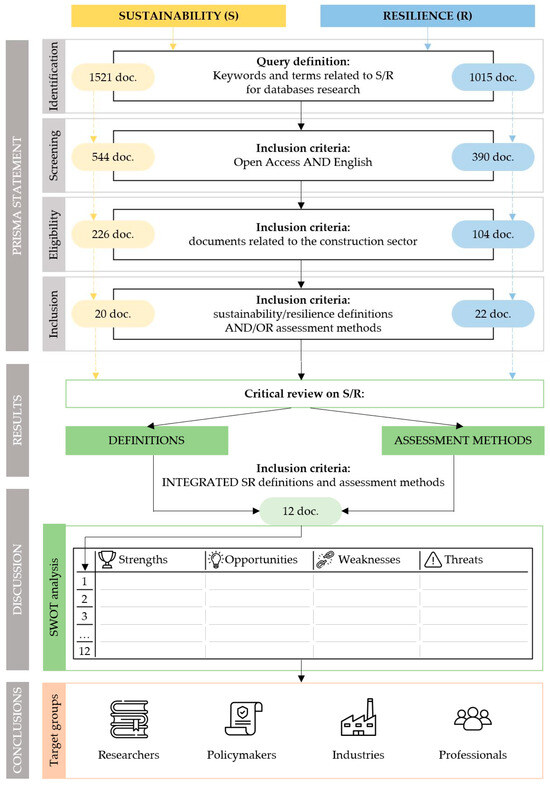
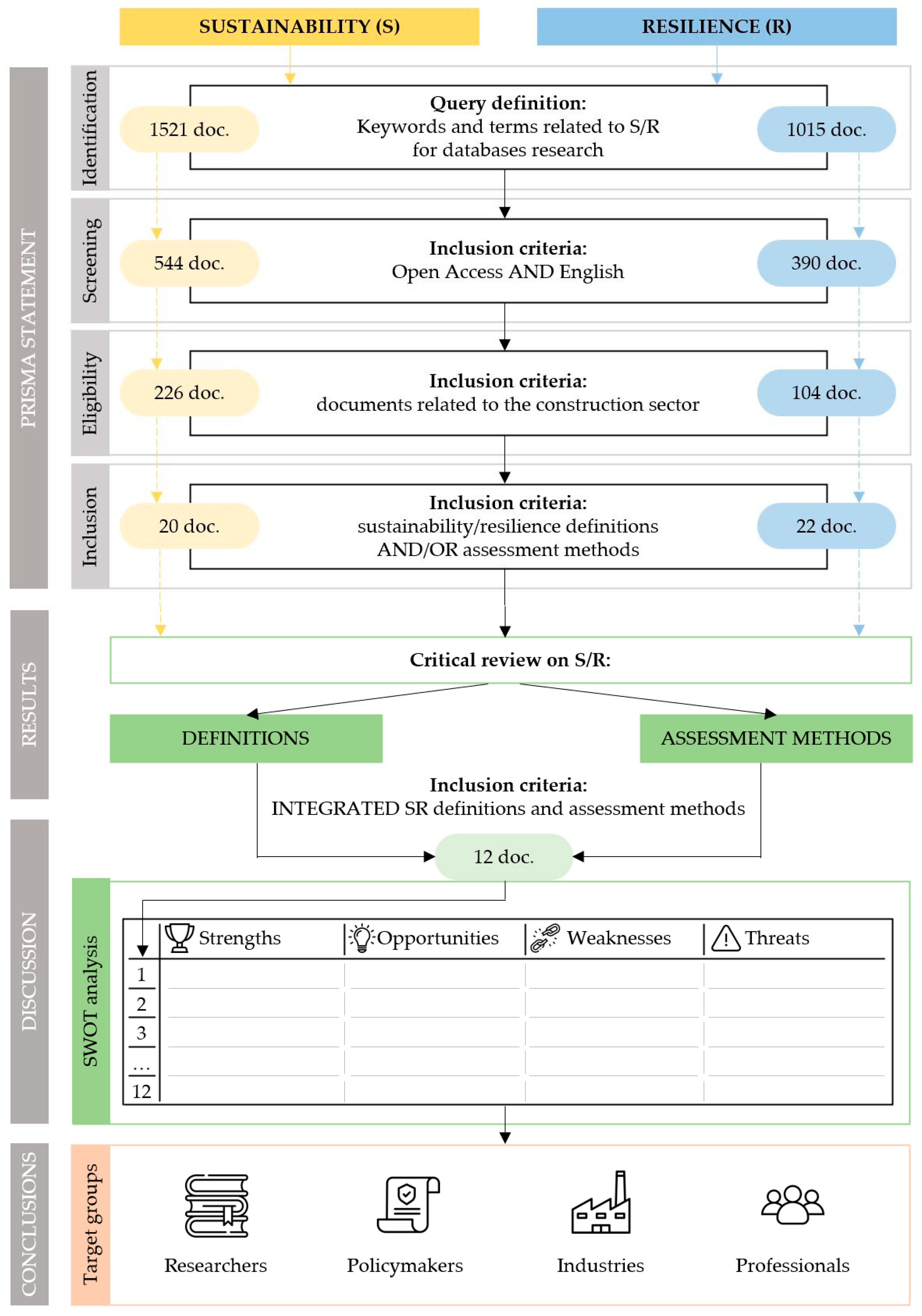
The overall methodology followed to perform the analysis summary has been graphically summarized in Figure 1, which also represents the structure of the manuscript. In fact, besides Section 1 where the topic is introduced, Section 2 corresponds to the methodology phase presentation, followed by the results phase divided into two parts (Section 3 and Section 4) to clearly illustrate, respectively, the single concept (S and R). The final phases are the discussion, in Section 5, where the results have been critically reviewed focusing only on the integrated methods for S and R assessment through a SWOT analysis and the conclusions, in Section 6, where the main observations and key takeaway have been described considering different target groups within the construction sector. To achieve this objective, a systematic literature review has been conducted following the PRISMA (Preferred Reporting Items for Systematic Reviews and Meta-analyses) statement [18].
Figure 1.
Summary diagram illustrating the methodology used to conduct the following study.
There are four steps followed to perform this analysis: (i) comprehensive research in multiple databases for the identification of articles of interest; (ii) abstract-level screening of the documents; (iii) full text-level screening of the documents (eligibility), and (iv) final inclusion for the literature review, with two most popular databases for peer-reviewed scientific articles (Scopus and Web of Science).
Table 1 summarizes the number of documents considered, respectively, for S and R, considering the inclusion criteria used per step of the PRISMA statement. Starting from a wide number of documents in the identification step (S = 1521; R = 1015), the analysis led to a reduced number of documents selected by a series of criteria through the intermediate steps of screening and eligibility, until the final step of inclusion (S = 20; R = 22).
Table 1.
PRISMA statement steps with result per two concepts analyzed: sustainability and resilience.
The definition of the query and the inclusion criteria are the main important aspect of the PRISMA application statement because they could be affected by subjective judgments; therefore, to ensure a certain grade of scientific data quality, strict filters were used to select a more effective, connected, and feasible definition and methods for S and R assessment within the construction sector. The distinct paths followed for sustainability and resilience analysis are illustrated in detail, and the respective results are graphically represented by a bibliometric network graph using VOSviewer software, version 1.6.20.
The first step of the PRISMA statement application foresees the query definition by the most relevant and used terms to define and clarify the topic on which the state of the art must be conducted. In the case of the presented study, the core subject is the decarbonization of the construction sector by the assessment of sustainability and resilience; therefore, the initial general terms used to conduct the analysis are: decarbonization, construction sector, construction industry, buildings, definition, and assessment method coupled with the term sustainability and resilience, respectively, for their two dedicated path, before the integrated ones. In all cases, a Boolean syntax was used to structure the queries, allowing the combination of keywords with operators such as AND, NOT, and OR, listed as follows: (“building* sustain*” OR “construction sector sustain*” OR “construction industr* sustain*” OR “sustain* of the construction sector” OR “sustain* construction sector” OR “sustain* of the construction industry” OR “sustain* of construction industr*” OR “sustain* construction industr*” OR “sustain* of building*” OR “sustain* building*” OR “sustain* of a building*”) AND (“concept*” OR “definition*).
Moreover, the use of an asterisk at the end of the query allows the possibility to consider in the research all the potential alternative endings, such as “sustainable”, “sustainability”, “industry”, “industries”, etc.
Titles, keywords, and abstracts are the chosen fields on which the query of the above-mentioned terms has been performed (TITLE-ABS-KEY). As anticipated, this procedure allows us to better address and filter the results; in fact, the 2274 manuscripts identified by Scopus and Web of Science became 1521 after the removal of duplicates.
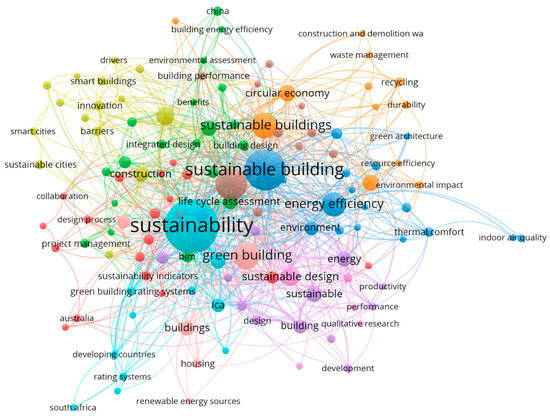
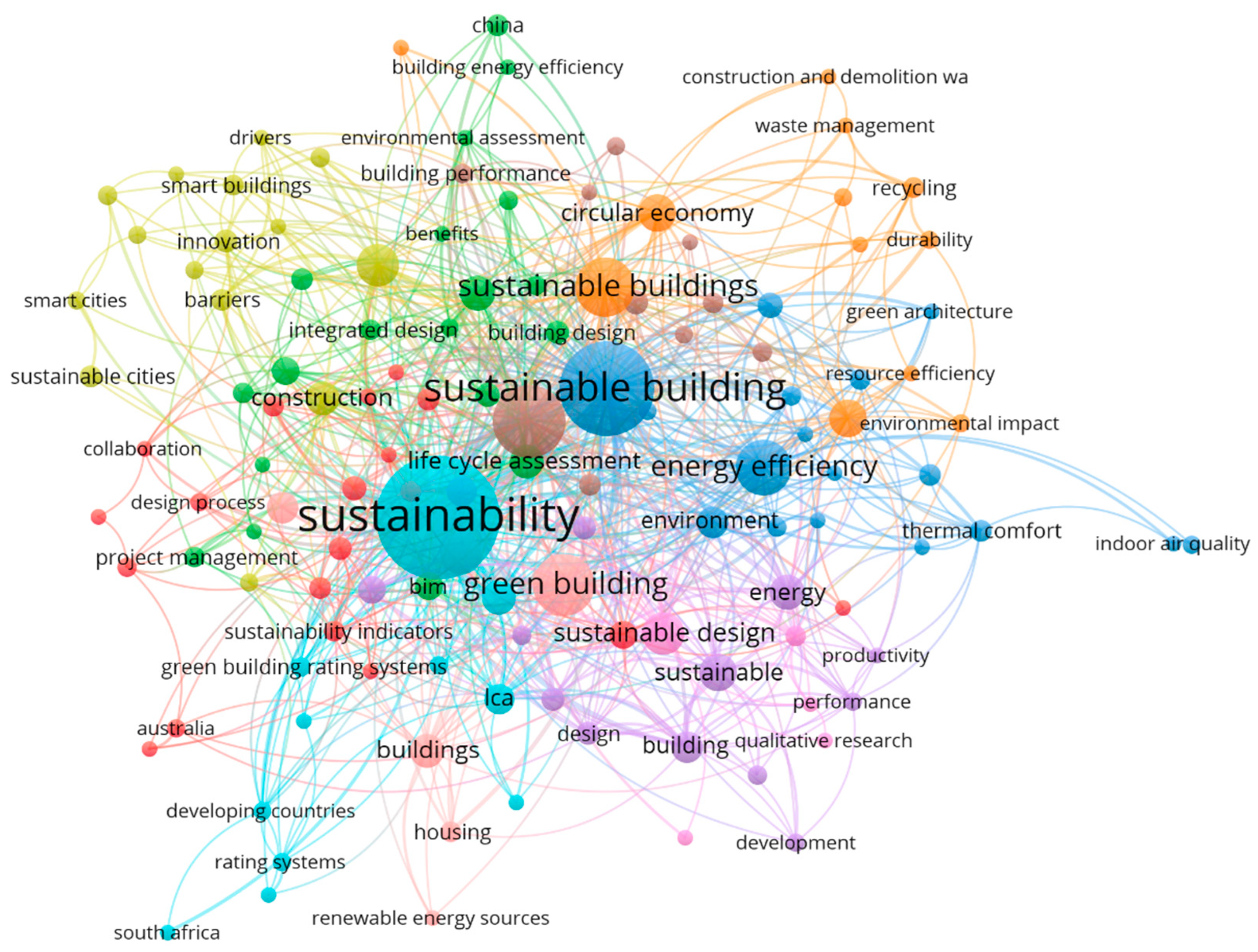
Figure 2 graphically represents the most common keywords used in at least five of those publications. The most recurrent keywords are sustainability (218 occurrences); sustainable building (131); green building (59); energy efficiency (49); and construction industry (29). During the second step of the PRISMA statement, the selection of the manuscripts focused only on documents written in the English language and which are open access (544 documents). The eligibility step allowed the reduction of the manuscript to 226 documents, excluding the ones with goals out of the scope of the abstract evaluation.
Figure 2.
Word cloud of most common keywords used in the 1521 articles individuated during the identification step of the PRISMA statement. Last update on 31 January 2024.
Only 20 out of the 226 documents were then included in the final list after a full-text screening because they contain a clear and consistent definition of sustainability for the construction sector.
The analysis for the definition of resilience in construction followed the same steps and inclusion criteria used for the sustainability path. The main difference was the definition of a specific query by selecting the most relevant and used term and concepts to define “resilience for the construction sector”, presented as follows: (“building* resilien*” OR “construction sector resilien*” OR “construction industr* resilien*” OR “resilien* of the construction sector” OR “resilien* construction sector” OR “resilien* of the construction industry” OR “resilien* of construction industr*” OR “resilien* construction industr*” OR “resilien* of building*” OR “resilien* building*” OR “resilien* of a building*”) AND (“concept*” OR “definition*”). This step allows for targeting and filtering the results; in fact, the 1532 manuscripts identified in the databases become 1015 after the removal of duplicates.
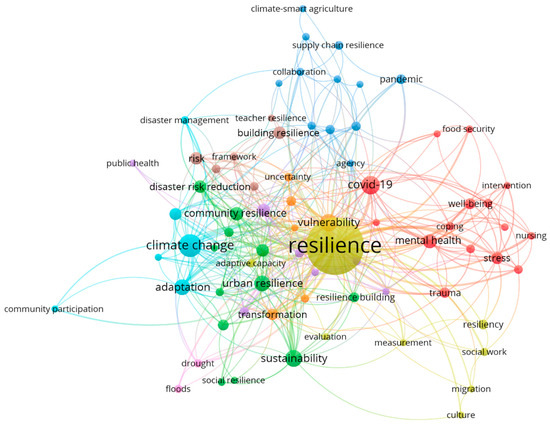
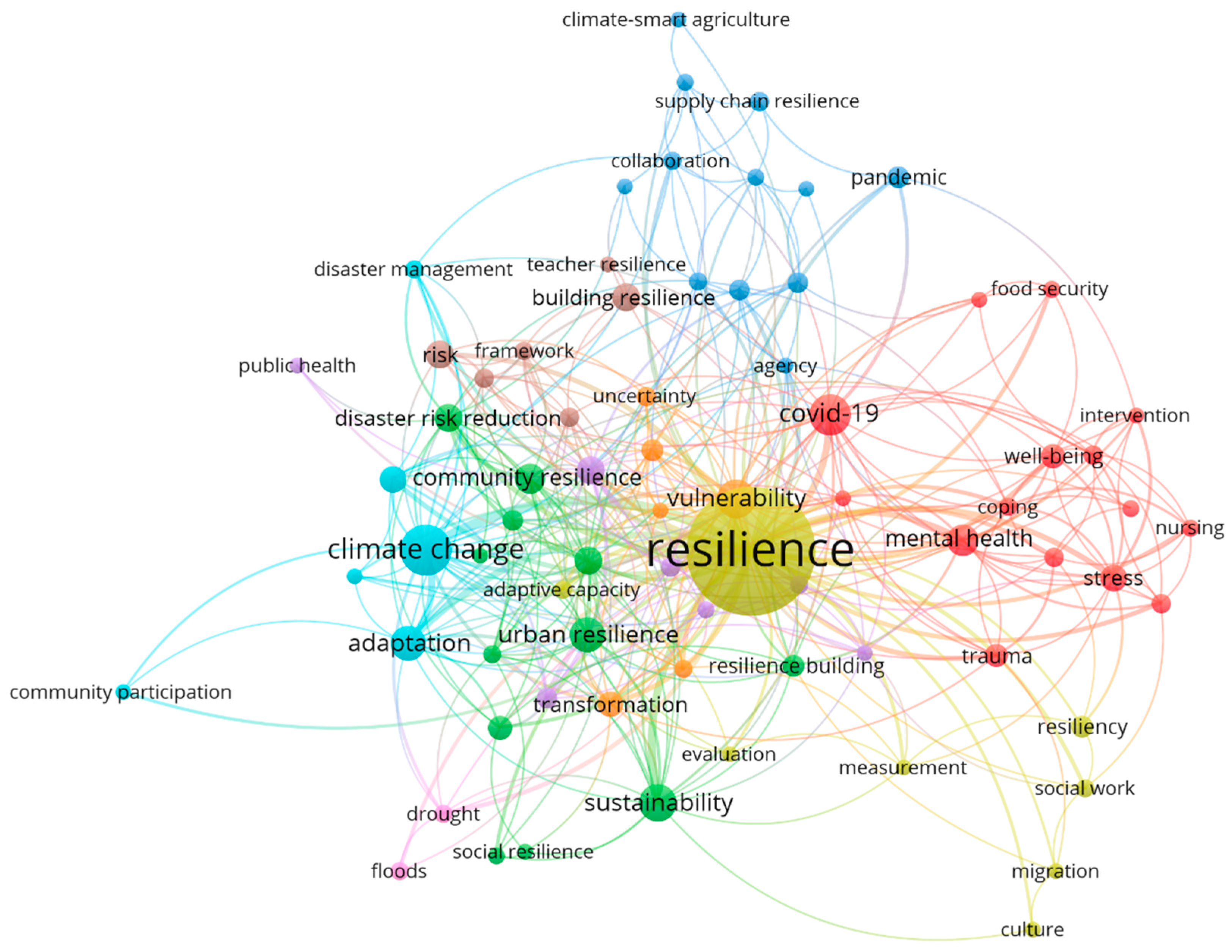
Figure 3 illustrates the most common keywords used in at least five of those publications. The most recurrent keywords are: resilience (314 occurrences); climate change (51); vulnerability (30); sustainability (27); and urban resilience (25). The inclusion of the term ‘sustainability’ as one of the most frequently used keywords is particularly noteworthy, as it demonstrates the interconnection of the two concepts. Following the same criteria used for the sustainability analysis, the screening step allowed us to reduce the number of manuscripts to 398, and then, in the eligibility step, only 104 out of those 398 documents were selected. Finally, only 22 documents remain in the inclusion step, due to a full-text screening, maintaining only ones that contain a clear and agreed definition of resilience for the construction sector.
Figure 3.
Word cloud of most common keywords used in the 1015 articles individuated during the identification step of the PRISMA statement. Last update on 31 January 2024.
The results obtained from the sustainability path (20 documents) and the resilience path (22 documents) led to the results step of the methodology in which the SR definition and methods were combined to identify and select only the results with a consistent integration of the two concepts in term of definition and assessment. The application of this inclusion criteria determines the selection of 12 documents.
The final step of the methodology corresponds to the core aspect of the overall approach because the critical review of the selected documents aims to highlight the challenges, potentialities, and limits of the SR assessment methodologies to boost the decarbonization target from different points of view. To address this scope in a precise and complete way, the authors applied the SWOT analysis to the 12 final selected documents by reviewing and describing them by strengths, weaknesses, opportunities, and potential threats, due to the integration of sustainability and resilience assessment and the clusterization by four main target groups of the construction sector (researchers, policymakers, industries, and professionals).
3. Sustainability in Construction: Definitions and Assessment Methods
Section 3 presents the results of the systematic literature review performed on the sustainability in construction concept in a wider approach that comprehends the analysis of the main sustainability definitions, to clarify the possible declination of the term, and also the main assessment methodologies currently used in practice.
3.1. Sustainability Definitions for the Construction Sector
The results of the review analysis highlight the multiple declinations and approaches to the definition of the sustainability concept for the construction value chain, depending on the field, perspective, methods, and objectives considered. They all derive from the specific declinations of the notion of sustainable development towards the three areas: environment, society, and economy. One is the aspect that appears in all the studied sustainability definitions, summarized and presented chronologically in Table A1 (Appendix A), for the construction sector: the implementation of sustainable development principles along the entire building life. This includes all the building stages, from the initial planning and design to the sourcing of raw materials, the use until the demolition, and waste management processes.
Sustainability in construction is a comprehensive approach that endeavors to keep a harmony between the impacts of the three above areas [19] with no single aspect overshadowing the others, but, in analyzing literature, a disparity in the attention given to these three dimensions emerges.
In the construction industry, environmental sustainability focuses on promoting and increasing the efficient utilization of natural sources for decreasing consumptions and ameliorating the comfort of the surrounding environment [20]. Social sustainability includes various factors such as community progress, health and safety, public participation, user comfort, and equality [21], while the economic sphere focuses on the financial advantages derived from the construction process and industry, which comprehends not only the economic cost of the products and materials but also the overall impacts and external benefits of the global building life [22].
Lima et al. [23], in their critical review spanning from 2000 to 2017 on the implementation of sustainable aspects in construction, underlined that the social sphere covers 0.2% of the overall studies against a value of 37.9% for the environmental sphere. Then, combining those two spheres, the values reached 5.5%, while the three spheres together covered 35.3%. These results underlined, on one hand, the need to further evaluate the social sustainability in construction and, on the other, the increased interest in combining the whole sphere in the sustainability assessment for construction, similar to the single environmental one.
3.2. Sustainability Assessment Methods for the Construction Sector
The sustainability assessment methodologies for the construction sector have been in use for more than three decades with the scope to check and describe the building’s characteristics under specific and verifiable standards and the use of selected criteria from the three main sustainability spheres.
The aim is to collect and manage in a common database the information along all the steps of the building design from the early phase to construction, use, and maintenance, based on key performance indicators to quantify the sustainability value or ranking score, both for new or existing buildings, and, principally, to gather green or energy performance certification.
Hastings and Wall [24] analyzed the pivotal experiences of sustainability building assessment methods, clustering them into four groups which, respectively, focus on the following: cumulative energy demand (CED); life cycle analysis (LCA) focusing on the ecological aspects; and total quality assessment (TQA) quantifying the three spheres.
Years later, Berardi [25] deeply analyzed the first three groups highlighting the importance of not rigidly considering the division, because some sustainability assessments partially belong to different categories, but, at the same time, his work provides further insights into the sustainability assessment, clarifying which and how many different parameters are evaluated.
Most of the CED methods focus only on one parameter that belongs to the energy measurement field, while LCA evaluates the impacts of more than one parameter.
Therefore, those two first categories follow a quantitative approach assessment; instead, the last one could provide a qualitative and/or quantitative evaluation. Using the Berardi classification to further complete this work on sustainability assessment, this study analyzed the results collected within the eligibility PRISMA phase, intending to update the characterization of the sustainability assessment method of the most recent one in use and respondent to regulations and standards for the construction value chain.
Starting from the results of the literature review, the work of Akadiri et al. [26] appears to be in line with the CEM group, presenting a comprehensive quantitative framework that aims to enhance the accuracy of evaluating the energy demand and consumption for both new and existing building properties, but, considering that the duration of their model evaluation covers the entire building life, it can be also used as a complementary tool of TQA methods.
The Hill and Bowen [27] method is one of the first frameworks that outlined a multi-domain procedure. Similar to this, other studies emphasized the benefits of life cycle thinking, which are perfectly classified as an LCA category.
Similarly, Sev [28] highlights the importance of using an LCA method in his research enlarging the system boundary conditions, which also incorporated the use of renewable energy sources and a performance-based design to provide a comprehensive outline of a sustainable system.
The LCA methodologies, outlined according to the ISO 14040 series [29], are usually structured according to four specific steps—goal and scope definition, inventory creation, impact assessment, and result interpretation—and they were pivotal to the integration of sustainability and resilience assessment [30].
A further declination of the LCA method is the life cycle costing (LCC) one, which places a greater emphasis on the economic aspect, providing not only a more precise estimation of the global ownership cost from cradle to gate, but also a valuable analysis in order to quantify the building’s present value, useful for supporting professionals, owners, and policymakers in building investments [31].
The last presented methods belong to the TQA category, focusing on a different and more qualitative evaluation of multidomain sustainability assessment related to the management and procurement procedure, construction site, stakeholder engagement, and social role and impacts.
Lam et al. [32] proposed a comprehensive management approach feasible for public and private buildings with a focus on procurement, costs, and the operation of projects, providing to the stakeholders a strategic and clear roadmap for construction interventions. Presley and Meade [33] developed a sustainability benchmarking framework that incorporated strategic and activity-based criteria feasible for different kind of building projects to compare with specific indicators.
Additionally, Oyegoke et al. [34] prioritized the application of the Specialist Task Organization (STO) procurement approach to achieve the three goals of sustainability by incorporating sustainable environmental requirements from the beginning of the building construction, employing value engineering management and whole-life costing in the initial phases to enhance overall value, and recognizing the positive impact of professionals’ participation in the public and social benefits for stakeholders.
Tan et al. [35] proposed a comprehensive approach to stakeholder engagement concerning sustainability, taking into account the contractor’s competitiveness and performance, in line with the findings of Holloway and Parrish [36], who emphasized the pivotal contractors’ responsibility for the accomplishment of sustainable buildings. Bal et al. [37] identified six essential steps for ensuring stakeholder engagement, including identifying key stakeholders, linking them to specific sustainability targets, prioritizing their involvement, managing their expectations, measuring performance, and translating objectives into actionable plans. In terms of addressing sustainability in onsite construction, several articles offered specific solutions. Sameh [38] advocated for the utilization of conventional building materials and technological solutions to support the three core sustainability aspects.
Similarly, Bae and Kim [39] explored the advantages of implementing lean construction to contribute to sustainability by enhancing project efficiency. However, the feasibility of adopting sustainable and lean construction practices depends on factors like project size and worker awareness. Edum, Fotwe, and Prince [40] focused on the social sphere of the sustainability assessment on their developed methodology, within the SUE-MoT (Sustainable Urban Environment—Model and Toolkit) project, to address the metrics, models, and toolkits for the evaluation of urban development. The outcome of the project is a toolkit that serves as a thorough and transparent framework that motivates important decision-makers to evaluate the sustainability of urban environments systematically, considering factors such as the scale, life cycle, location, context, and values held by all stakeholders.
In conclusion, the comprehensive critical review of the overall sustainability’s studied definitions remarked upon the importance of tackling the three pillars (economic, environmental, and social) under which the concept has been developed since its initial definition, and, regarding the sustainability assessment, the core topic included in almost all the investigated methodologies is the energy performance evaluation along the whole life cycle which recalls the CEM and LCA categories. The methods clustered into those categories result as the most continuously updated according to the respective regulations and standards. One CEM example is the well-known instrument, the so-called energy performance certification (EPC), introduced in Europe by the Energy Performance Building Directive for the first time in 2002 [41] and recently improved by the EPBD recast in 2023 [42] to increase the data quality of the tool further and to introduce new indicators for supporting the decarbonization target goal by 2050.
The EPC assessment, in fact, being mandatory for any property transaction (buying or renting), has become a hot topic in the last decades, and an extensive literature review coupled with EU-funded projects’ results are available, in which they underlined the positive effects and the potentialities they might have on supporting the decarbonization goals, and the use of a qualified sustainability assessment method since the early design phase of building projects, combined with the access to a valuable and consistent database from the public building repository [43,44,45,46,47].
4. Resilience in Construction: Definitions and Assessment Methods
Similarly to the approach used for the sustainability focus, in this section, the results of the literature review performed on the resilience concept are presented, starting from an overview of resilience definitions, followed by a critical analysis of the main assessment methodologies currently in use.
4.1. Resilience Definitions for the Construction Sector
The resilience concept has been declined and studied in various forms concerning the diverse areas of application including psychology, urban planning, and civil engineering [48]. A general definition of the resilience concept refers to the positive adaptation or the capacity to slightly adapt the original condition of the system to a new setup after adversity. For decades, and according to the scientific sector of analysis, the concept evolved simultaneously to scientific knowledge of the specific area of interest, and, notwithstanding the term use expanding rapidly, there is no consensus on a common operational and assessment description of the concept.
Focusing on the construction sector, the critical review of the resilience definitions collected with the application of the PRISMA statement reveals the presence of two recurrent perspectives to which the concept has been declined: the ecological and engineering points of view. Ecological resilience refers to systems with multiple regimes that can be shifted due to a disturbance. Meanwhile, resilience engineering, also called “bounce-back” resilience, highlights the ability of a system to quickly change back to its original state, after a disruption [49]. This perspective applies to systems that operate in a unique and steady model, whereas ecological resilience is relevant to systems with various steady models, for example, ecological and social models, ICT, or even energetical model networks [50].
Another distinction that emerges specifically for construction is the possibility to categorize the definitions according to four main dimensions: (i) technical resilience, which encompasses all aspects related to construction and other technological considerations; (ii) organizational resilience, which pertains to the management plan, maintenance activities, and emergency response strategies; (iii) social resilience, the third dimension, which involves examining the impact on society and implementing measures to mitigate adverse effects; and (iv) economic resilience, which addresses both direct and indirect costs associated with the using and maintenance of the building.
Bruneau et al. [51] presented a comprehensive study on resilience encompassing this classification and providing examples for each dimension. In parallel to this distinction, various studies [9,49,50] presented the resilience concept by four key properties, called “4R”, to properly design and build resilient buildings: (i) robustness; (ii) redundancy; (iii) resourcefulness; and (iv) rapidity.
The interdependent nature of the 4R attributes means that they inseparably interact with each other. For instance, the velocity and efficacy of the recovery process are largely determined by the properties of redundancy and resourcefulness. In other words, a higher level of resourcefulness and redundancy results in a faster recovery process. Moreover, numerous studies analyze the connection between the concepts of resilience and readiness, emphasizing that the capacity of a system to effectively address future challenges relies heavily on its level of preparedness and the capacity of social actors to learn from past experiences [9]. Besides those characterizations, a specific declination for buildings is recurrent in recent publications referring to the resilience of buildings to different hazards, including natural disasters and energy supply interruptions, and is frequently related to the principles of adaptability, recovery, and resistance, strictly connected to the architectural and technological solutions and system of the built environment.
Furthermore, from a deep analysis of the literature review results, there are two parameters often cited in the R definitions as a metric to define the resilience and resistance building level: the reduction of damage and the time it takes for recovery are influenced by the extent of the damage to building components. In this context, Folke et al. [52] emphasize the resilience capacity of buildings to withstand various disruptions and emergencies, such as air pollution and pandemics, by returning quickly to their original state.
4.2. Resilience Assessment Methods for the Construction Sector
Resilience assessment methods for the construction sector register a more recent diffusion instead of the sustainability ones and they mainly focus on the estimation of the building sector’s capability to face both adaptation and risks concerning climate change. In reviewing the literature review results for the R evaluation, there are four key recurrent metrics used by the most in-use resilience assessment methods for construction: risk, resistance, costs, and labelling.
Considering these categories, Levine [53] identifies functionality quantification as a straightforward approach to measuring resilience due to its clear definition, variable-based description, purposeful management, evaluation against known hazards, and critical objective of quantifying resilience. If, on one hand, he acknowledges the existence of tools and models such as ASPIRE and MCEER for assessing infrastructure resilience, on the other, he also highlights the difficulties in creating robust models to quantify damage, shocks, costs, recovery times, and other factors.
Besides those quantitative indicators, other factors such as the financial cost of repairs, the duration of repairs, and the number of casualties is commonly included for the building’s resistance [54]. Resource diversity and disaster management are instead qualitative indicators less frequently assessed by community resilience frameworks, challenging their quantification [55].
The labelling system is a widely employed method for measuring and quantifying resilience. Similar to the rating systems that assign points to assess sustainability in buildings, new tools have emerged to evaluate and quantify the resilience of buildings to hazards. One of these methods is the Certification of the Predisposition of Resistance of Edifices to Disasters (CePRED). CePRED utilizes a “blue shields” labelling system to assess buildings, with five blue shields representing a very high level of resistance against potential disasters and extreme conditions. In contrast, one blue shield indicates poor performance in withstanding such conditions [56].
Nevertheless, to meet the increasing demand for measuring and quantifying resilience, various other methods have been employed, including benefit assessment models, cost-to-benefit assessment models, a resilience index, decision flow diagrams, and performance-based frameworks, among others [57].
In conclusion, the implementation of those R methodologies is strictly linked to the contingent needs or goals for the specific projects or sector to trigger adaptation and lead construction sector adaptation in line with the decarbonization target. Moreover, similarly to the sustainability assessment methodologies, they cover a variety of contexts and metrics, attributable to the three spheres of environmental, economic, and social. This aspect is a key starting point for the integrated definition and assessment of S and R, as deeply described in Section 5.
5. Discussions
The distinct presentation of the literature results for S and R highlights a strong correlation and interdependence between those two concepts and, consequently, their assessments. The sustainability paradigm plays a fundamental responsibility in the development of its goals, the so-called SDGs, that request mutual attempts to be inclusive, sustainable, and resilient forthcoming both for the environment and society. In parallel, the resilience paradigm has revolutionized the understanding of risk, emphasizing the need for system adaptation after extreme events. The growing concerns surrounding climate change have further prompted the exploration of the interconnection between these two concepts and their integration within the built environment.
In literature, several authors have examined the potential connections or disparities between the concepts of resilience and sustainability. Some of them perceive the two concepts as slightly different viewpoints on the same issue [58].
For instance, Walker and Holling [59] observed the importance of considering resilience in a participatory framework to manage the sustainability of the social–ecological system. On the other hand, there are also studies in which sustainability and resilience are viewed as distinct but interconnected conceptual paradigms, where, for example, resilience is a precondition for achieving sustainable development.
Similarly, Levin et al. [60] emphasized the dependency of the resilient assessment through a quantitative approach for environmental and social sustainability for technical systems. Arrow et al. [61] underlined that economic activities can only be sustainable if they are supported by resilient ecosystems. Perrings [62] further claimed that a development approach cannot be considered sustainable if it lacks resilience.
Lebel et al. [63] debated on the need to enhance society’s capability of handling resilience and reaching sustainable development.
Lastly, Gencturk et al. [64], referring to a hazard-prone built environment, stated that a building cannot be considered sustainable without an adequate level of structural resilience. Lew et al. [65] argued that the existing reluctance to assess sustainability and resilience in an integrated way is a consequence of the lack of a clear and precise definition and conceptualization of those terms and the presence of shared assumptions, methods, and metrics.
In this context, Marchese et al. [66] studied the potential synergic integration of sustainability and resilience for 17 existing management methodologies clustering them into three relationship typologies: (i) resilience as a component of sustainability; (ii) sustainability as a component of resilience; and (iii) sustainability and resilience as separate conceptual objectives. In the first typology, resilience is considered a crucial component for the broader and integrated system assessment, under the premise that a resilience increase proportionally contributes to the overall sustainability level, but it does not work in the reverse direction.
The second relationship typology described the opposite situation of the first one, remarking upon the dependency of sustainability from the resilience concept. The third typology is characterized by a clear distinction of the two concepts with independent goals, without any hierarchical relation, either complementing or competing.
Considering also the assessment methodologies of sustainability and resilience for constructions, the results presented, respectively, in Section 3.2 and 4.2 highlighted that the approaches shared certain similarities but showed also some disparities, above all in terms of boundary conditions, and assumptions for the system to model and metrics. Precisely, these aspects are the added values found in the 12 S and R integrated assessment methodologies [67,68,69,70,71,72,73,74,75,76,77,78,79] selected with the inclusion criteria, as graphically represented in the methodological framework in Figure 1.
The evaluation of those approaches, corresponding to the last phase of this study, highlighted multiple benefits both for different context applications and target groups. The critical review of these results has been performed by a strengths, weaknesses, opportunities, and threats (SWOT) analysis to identify all the possible challenges and limits for the use of those approaches and to draft a multidomain vision under different perspectives.
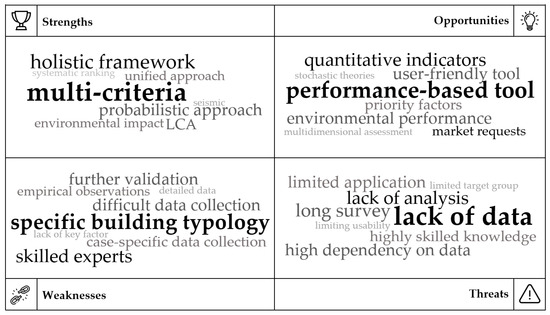
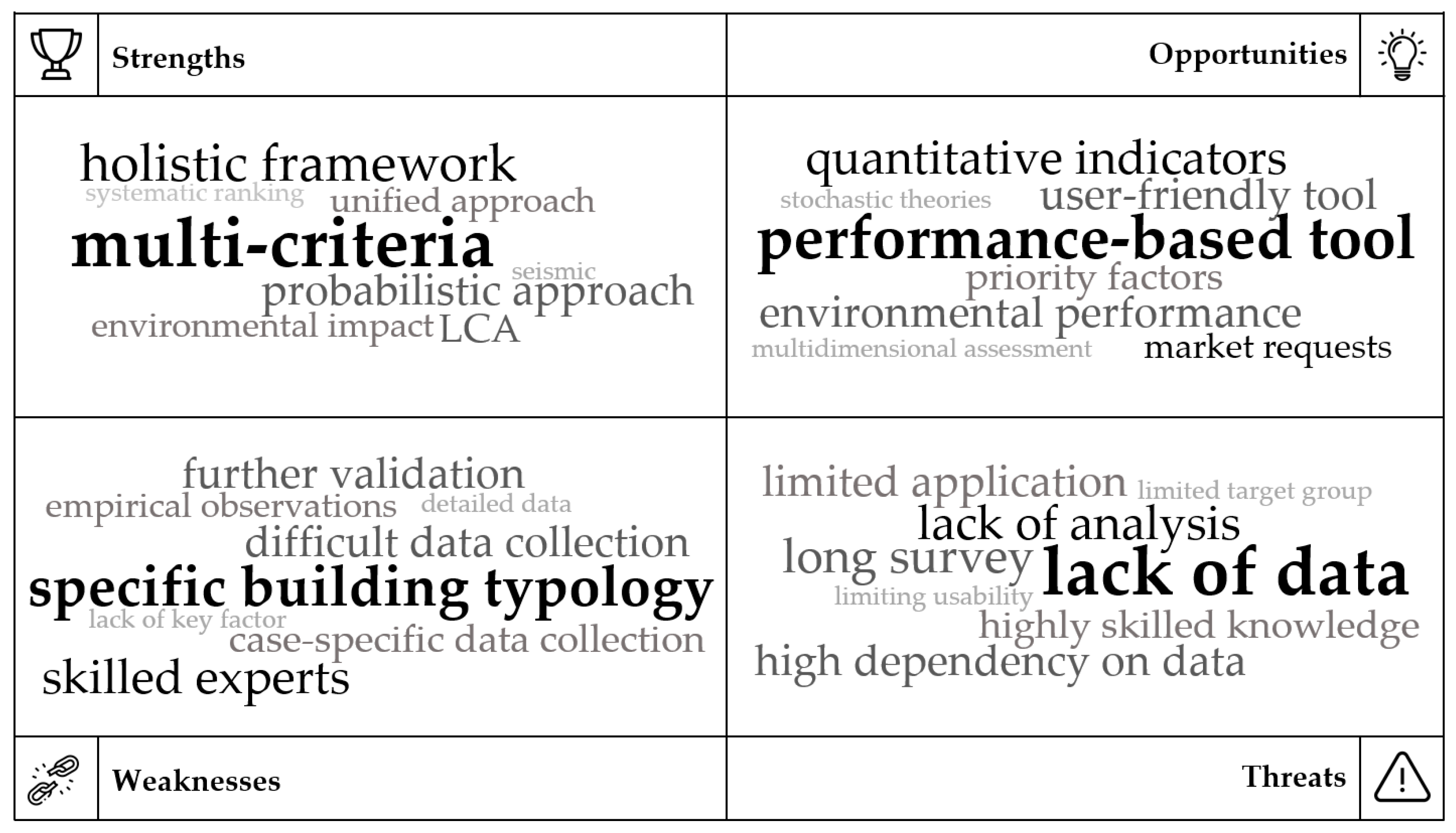
Considering the different and important considerations obtained by the critical review of the selected documents, the results are presented in two distinct ways: Figure 4 highlights the keywords per each SWOT plot to visualize immediately the respective importance by a word cloud representation, while Table 2 (strengths and opportunities) and Table 3 (weaknesses and threats) deeply analyzed the SR integrated methodologies by identifying the respective authors and year of definition, and providing a more detailed description of the concepts.
Figure 4.
Word cloud of most common keywords used in the 1015 articles individuated during the identification step of the PRISMA statement, clustered per SWOT plot to visualize their importance in function of their font dimension.
Table 2.
Strengths and opportunities of the existing SR integrated methods.
Table 3.
Weaknesses and threats of the existing SR integrated methods.
6. Conclusions
The presented work aims to support different target groups in enhancing comprehension and use of the existing integrated sustainability and resilience assessment methodologies for the construction sector. Starting from a systematic literature review on both concepts, the work focused then on the integration of those aspects, being remarked upon in the existing literature [9,50,58] the urgent need to have a more holistic vision considering the climate changes, the correlated environmental risks and impacts, and the decarbonization targets, instead of limiting the construction sector goals to the energy efficiency.
The critical review was performed through the application of the SWOT analysis to better understand the opportunities, challenges, potential threats, and benefits of the existing sustainability and resilience integrated methodologies for buildings and the actors of this value chain. The results benefit multiple target groups, which can help them to identify the pros and cons of each methodology, according to their point of view.
Referring to the results collected and summarized in Table 2 and Table 3 of Section 5, the main tentative scenarios for the four potential target groups (researchers, policymakers, industries, and professionals) have been described as follows:
- (i)
- Researchers can identify in each reviewed method a starting point for structuring integrated sustainability and resilience analysis methodologies for each value chain of the construction sector. In particular, researchers can find in the framework developed by Chhabraet al. [70] a rational probabilistic approach that can be easily integrated with LCA analyses to calculate the trade-offs within different design alternatives.
- (ii)
- Policymakers can find in the methodologies developed by Angeles et al. [73] and Asadi et al. [72] a unified multi-criteria framework to promote the adoption of specific construction methods, sustainable and resilient materials, and energy-efficient technologies. In particular, Angeles et al. [73] studied a method that easily integrates life cycle assessment (LCA) analyses and BIM methodology in order to evaluate building SR levels. At this stage, however, the studies on the application of the two methods are restricted to low- and mid-rise buildings with specific characteristics.
- (iii)
- Industries of the construction value chain have increased their interest and awareness about their sustainability assessment and resilience evaluation level in recent decades with a higher peak after the pandemic emergency. The initial application of those concepts was focused principally on the economic sphere of both sustainability and resilience, specifically for the production and selling categories of the industry. With the increased awareness of the potentialities of the S and R assessment also for other spheres such as social and environmental ones, industries have started to invest in procedures to certify their overall sustainability level concerning market needs and requests for technologically resilient and innovative products. Referring to the Roostaie et al. [76] and Sesana [79] studies, they can implement some lessons learned for the decarbonization path sector, assessing their SR level in comparison with the currently available results for some companies. Using the DEMATEL approach, they can assess whether their operations are sustainability enhancers or detractors based on their impacts. However, the application and diffusion into practice of this method are limited by the long duration and large number of queries on which it is structured and the need for advanced skills to perform the assessment. While the SARIA methodology [79], being developed specifically for steel construction industries, is a user-friendly ready-to-use assessment methodology for these specific industries and needs an adaptation for use by other value chains, nevertheless, being a tool developed in such a clear and modular structure, it can be easily adapted, slightly integrating specific details for another industry value chain.
- (iv)
- Professionals may use the frameworks proposed by Yang et al. [69] and Asadi et al. [71] to analyze and compare the available materials and construction solutions and categorize them according to stakeholders’ preferences and risk levels. Additionally, professionals can also take into consideration the use of the Taherkhani et al. [75] method to study the possibility of executing building renovations through urban district regeneration. All those methods are limited by the need for advanced skills to perform the analysis and detailed data available only by a specific data-monitoring collection and campaign.
Theoretically, the presented work advances the existing literature by detecting the main potentialities and limits in the field of the construction sector for the integrated sustainability and resilience assessment. The analysis of the literature through the PRISMA statement allows the emergence of different perspectives to interpret the relationship between sustainability and resilience clearly and in the function of the goal of the assessment. From the practical point of view, the analysis provides to the building sector community a clearer idea about the concepts of sustainability and resilience according to their relationship and the evaluation methodology. The establishment of different perspectives about how sustainability and resilience can be interpreted and managed is crucial for defining a further implementation into the construction value chain, but also for properly communicating those concepts to different stakeholders.
Future research should also quantify, through a real case study, how the sustainability and resilience assessment could contribute effectively to reaching the decarbonization target goal of the construction sector.
Author Contributions
Conceptualization and methodology, M.M.S.; investigation, P.D.; data curation, M.M.S.; writing—original draft preparation, P.D.; writing—review and editing, M.M.S.; visualization, P.D.; supervision, M.M.S. All authors have read and agreed to the published version of the manuscript.
Funding
This research received no external funding.
Data Availability Statement
Not applicable.
Conflicts of Interest
The authors declare no conflicts of interest.
Appendix A
Table A1.
Concept of sustainability in the construction sector.
Appendix B
Table A2.
Concept of resilience in the construction sector.
References
- UN Climate Change Conference COP28, United Arab Emirates, Global Stocktake Report, December 2023. Available online: https://unfccc.int/topics/global-stocktake (accessed on 23 February 2024).
- UN Climate Change Conference, COP21, Paris Agreement, Paris Climate Change Conference—November 2015. Available online: https://unfccc.int/documents/184656 (accessed on 23 February 2024).
- Who Global Air Quality Guidelines: Particulate Matter, Ozone, Nitrogen Dioxide, Sulfur Dioxide and Carbon Monoxide; World Health Organization: Geneva, Switzerland, 2021; ISBN 978-92-4-003422-8.
- Achour, N.; Pantzartzis, E.; Pascale, F.; Price, A. Integration of resilience and sustainability: From theory to application, International. J. Disaster Resil. Built Environ. 2015, 6, 347–362. [Google Scholar] [CrossRef] [Scilit]
- Mari, S.I.; Lee, Y.H.; Memon, M.S. Sustainable and resilient garment supply chain network design with fuzzy multi-objectives under uncertainty. Sustainability 2016, 8, 1038. [Google Scholar] [CrossRef] [Scilit]
- Negri, M.; Cagno, E.; Colicchia, C.; Sarkis, J. Integrating sustainability and resilience in the supply chain: A systematic literature review and a research agenda. Bus. Strategy Environ. 2021, 30, 2858–2886. [Google Scholar] [CrossRef] [Scilit]
- López-Castro, L.F.; Solano-Charris, E.L. Integrating Resilience and Sustainability Criteria in the Supply Chain Network Design. A Systematic Literature Review. Sustainability 2021, 13, 10925. [Google Scholar] [CrossRef] [Scilit]
- Roostaie, S.; Nawari, N.; Kibert, C. Sustainability and resilience: A review of definitions, relationships, and their integration into a combined building assessment framework. Build. Environ. 2019, 154, 132–144. [Google Scholar] [CrossRef] [Scilit]
- Phillips, R.; Troup, L.; Fannon, D.; Eckelman, M.J. Do resilient and sustainable design strategies conflict in commercial buildings? A critical analysis of existing resilient building frameworks and their sustainability implications. Energy Build. 2017, 146, 295–311. [Google Scholar] [CrossRef] [Scilit]
- Jia, S.; Zhan, D.J. Resilience and sustainability assessment of individual buildings under hazards: A review. Structures 2023, 53, 924–936. [Google Scholar] [CrossRef] [Scilit]
- Murtagh, N.; Scott, L.; Fan, J. Sustainable and resilient construction: Current status and future challenges. J. Clean. Prod. 2020, 268, 122264. [Google Scholar] [CrossRef] [Scilit]
- Directive (EU/2023/1791) on Energy Efficiency (EED Recast) (OJ C, C/2023/1553, 19.12.2023, ELI). Available online: http://data.europa.eu/eli/C/2023/1553/oj (accessed on 23 February 2024).
- Cholewa, T.; Balaras, C.A.; Kurnitski, J.; Mazzarella, L.; Siuta-Olcha, A.; Dascalaki, E.; Kosonen, R.; Lungu, C.; Todorovic, M.; Nastase, I.; et al. Energy Efficient Renovation of Existing Buildings for HVAC Professionals-REHVA GB No.32; REHVA Office: Brussels, Belgium, 2022; ISBN 978-2-930521-31-2. [Google Scholar]
- Jeffrey, C.; Keogh, J.; Tiwari, M.S.; Artioli, N.; Manyar, G. Techno-Economic Assessment and Sensitivity Analysis of Glycerol Valorization to Biofuel Additives via Esterification Krutarth Pandit. Ind. Eng. Chem. Res. 2023, 62, 9201–9210. [Google Scholar] [CrossRef] [Scilit]
- Sesana, M.M.; Rivallain, M.; Salvalai, G. Overview of the Available Knowledge for the Data Model Definition of a Building Renovation Passport for Non-Residential Buildings: The ALDREN Project Experience. Sustainability 2020, 12, 642. [Google Scholar] [CrossRef] [Scilit]
- Waseem, M.; Adnan Khan, M.; Goudarzi, A.; Fahad, S.; Sajjad, I.A.; Siano, P. Incorporation of Blockchain Technology for Different Smart Grid Applications: Architecture, Prospects, and Challenges. Energies 2023, 16, 820. [Google Scholar] [CrossRef] [Scilit]
- Salvalai, G.; Sesana, M.M.; Dell’Oro, P.; Brutti, D. Open Innovation for the Construction Sector: Concept Overview and Test Bed Development to Boost Energy-Efficient Solutions. Energies 2023, 16, 5522. [Google Scholar] [CrossRef] [Scilit]
- Page, M.J.; McKenzie, J.E.; Bossuyt, P.M.; Boutron, I.; Hoffmann, T.C.; Mulrow, C.D.; Shamseer, L.; Tetzlaff, J.M.; Akl, E.A.; Brennan, S.E.; et al. The PRISMA 2020 statement: An updated guideline for reporting systematic reviews. BMJ 2021, 372I, n71. [Google Scholar] [CrossRef] [Scilit]
- Yilmaz, M.; Bakis, A. Sustainability in Construction Sector. Procedia-Soc. Behav. Sci. 2015, 195, 2253–2262. [Google Scholar] [CrossRef] [Scilit]
- Grierson, D. Towards a sustainable built environment. CIC Start Online Innov. Rev. 2009, 1, 70–78. [Google Scholar]
- Goh, C.S. Towards an integrated approach for assessing triple bottom line in the built environment. In Proceedings of the SB-LAB 2017: International Conference on Advances on Sustainable Cities and Buildings Development, Porto, Portugal, 15–17 November 2017. [Google Scholar]
- Abidin, N.Z. Investigating the awareness and application of sustainable construction concept by Malaysian developers. Habitat Int. 2010, 34, 421–426. [Google Scholar] [CrossRef] [Scilit]
- Lima, L.; Trindade, E.; Alencar, L.; Alencar, M.; Silvia, L. Sustainability in the construction industry: A systematic review of the literature. J. Clean. Prod. 2021, 289, 125730. [Google Scholar] [CrossRef] [Scilit]
- Hasting, R.; Wall, M. Sustainable Solar Housing; Vol. 1—Strategies and Solutions; Earthscan: London, UK, 2007. [Google Scholar]
- Berardi, U. Sustainability Assessment in the Construction Sector: Rating Systems and Rated Buildings. Sustain. Dev. 2011, 20, 411–424. [Google Scholar] [CrossRef] [Scilit]
- Akadiri, P.O.; Chinyio, E.A.; Olomolaiye, P.O. Design of a sustainable building: A conceptual framework for implementing sustainability in the building sector. Buildings 2012, 2, 126–152. [Google Scholar] [CrossRef] [Scilit]
- Hill, R.C.; Bowen, P.A. Sustainable construction: Principles and a framework for attainment. Constr. Manag. Econ. 1997, 15, 223–239. [Google Scholar] [CrossRef] [Scilit]
- Sev, A. How can the construction industry contribute to sustainable development? A conceptual framework. Sustain. Dev. 2009, 17, 161–173. [Google Scholar] [CrossRef] [Scilit]
- ISO 14040: 2006; Environmental Management—Life Cycle Assessment—Principles and Framework. International Organization for Standardization: Geneva, Switzerland, 2006.
- Marjaba, G.E.; Chidiac, S.E. Sustainability and resiliency metrics for buildings—Critical review. Build. Environ. 2016, 101, 116–125. [Google Scholar] [CrossRef] [Scilit]
- Emekci, S.; Tanyer, A.M. Life Cycle Costing in Construction Sector: State of the Art Review. In Proceedings of the 5th international Project and Construction Management Conference (IPCMC2018), Girne, North Cyprus, 16–18 November 2018. [Google Scholar]
- Lam, P.T.I.; Chan, E.H.W.; Chau, C.K.; Poon, C.S. A sustainable framework of “green” specification for construction in Hong Kong. J. Facil. Manag. 2011, 9, 16–33. [Google Scholar] [CrossRef] [Scilit]
- Presley, A.; Meade, L. Benchmarking for sustainability: An application to the sustainable construction industry. Benchmarking Int. J. 2010, 17, 435–451. [Google Scholar] [CrossRef]
- Oyegoke, A.S.; McDermott, P.; Abbot, C. Achieving sustainability in construction through the specialist task organization procurement approach. Int. J. Procure. Manag. 2009, 3, 288–313. [Google Scholar]
- Tan, Y.; Shen, L.; Yao, H. Sustainable construction practice and contractors’ competitiveness: A preliminary study. Habitat Int. 2011, 35, 225–230. [Google Scholar] [CrossRef] [Scilit]
- Holloway, S.; Parrish, K. The contractor’s role in the sustainable construction industry. Proc. Inst. Civ. Eng.-Eng. Sustain. 2015, 168, 53–60. [Google Scholar] [CrossRef] [Scilit]
- Bal, M.; Bryde, D.; Fearon, D.; Ochieng, E. Stakeholder engagement: Achieving sustainability in the construction sector. Sustainability 2013, 5, 695–710. [Google Scholar] [CrossRef] [Scilit]
- Sameh, S.H. Promoting earth architecture as a sustainable construction technique in Egypt. J. Clean. Prod. 2014, 65, 362–373. [Google Scholar] [CrossRef] [Scilit]
- Bae, J.; Kim, Y. Sustainable value on construction projects and lean construction. J. Green Build. 2008, 3, 155–167. [Google Scholar] [CrossRef] [Scilit]
- Edum-Fotwe, F.; Price, D.F. A social ontology for appraising sustainability of construction projects and developments. Int. J. Proj. Manag. 2009, 27, 313–322. [Google Scholar] [CrossRef] [Scilit]
- European Commission. Directive 2002/91/EC of the European Parliament and of the Council of 16 December 2002 on the Energy Performance of Buildings, 2002/91/EC. 2002. Available online: https://eur-lex.europa.eu/legal-content/EN/TXT/?uri=celex%3A32002L0091 (accessed on 23 February 2024).
- European Commission. Amendments Adopted by the European Parliament on 14 March 2023 on the Proposal for a Directive of the European Parliament and of the Council on the Energy Performance of Buildings (Recast) (COM(2021)0802—C9-0469/2021—2021/0426(COD))(1). Available online: https://www.europarl.europa.eu/doceo/document/TA-9-2023-0068_EN.html (accessed on 23 February 2024).
- Fetting, C. The European Green Deal, ESDN Report, December 2020, ESDN Office, Vienna. Available online: https://www.esdn.eu/fileadmin/ESDN_Reports/ESDN_Report_2_2020.pdf (accessed on 23 February 2024).
- EPC Recast: Energy Performance Certificate Recast (2020–2023), Grant Agreement (GA) No: 893118. Available online: https://epc-recast.eu/ (accessed on 8 January 2024).
- EUB SuperHub: European Building Sustainability Performance and Energy Certification Hub (2021–2024), Grant Agreement (GA) No: 101033916, 2021. Quality, Usability and Visibility of Energy and Sustainability Certificates in the Real Estate Market. Available online: https://eubsuperhub.eu/assets/content/Deliverables/EUBSuperHub_D1.1.pdf (accessed on 8 January 2024).
- TIMEPAC: Towards Innovative Methods for Energy Performance Assessment and Certification of Buildings (2021–2024), Grant Agreement (GA) No: 101033819, 2022. . Deliverable 1.1 Context Analysis of EPC Generation. Available online: https://timepac.eu/reports/context-analysis-of-epc-generation/ (accessed on 8 January 2024).
- crossCert: Cross Assessment of Energy Certificates in Europe (2021–2024), Grant Agreement (GA) No: 101033778, 2022. D2.4 EPC Cross-Testing Procedure. Available online: https://www.crosscert.eu/fileadmin/user_upload/D2-4_EPC_cross-testing_procedure_v2-9.pdf (accessed on 8 January 2024).
- Linkov, I.; Bridges, T.; Creutzig, F.; Decker, J.; Fox-Lent, C.; Kröger, W.; Lambert, J.H.; Levermann, A.; Montreuil, B.; Nathwani, J.; et al. Changing the resilience paradigm. Nat. Clim. Chang. 2014, 4, 407–409. [Google Scholar] [CrossRef] [Scilit]
- Folke, C.; Gunderson, L. Resilience and Global Sustainability. Ecol. Soc. 2010, 15, 43. [Google Scholar] [CrossRef] [Scilit]
- Redman, C.L. Should sustainability and resilience be combined or remain distinct pursuits? Ecol. Soc. 2014, 19, 37. [Google Scholar] [CrossRef] [Scilit]
- Bruneau, M.; Chang, S.E.; Eguchi, R.T.; Lee, G.C.; O’Rourke, T.D.; Reinhorn, A.M.; Shinozuka, M.; Tierney, K.; Wallace, W.A.; von Winterfeldt, D. A Framework to Quantitatively Assess and Enhance the Seismic Resilience of Communities. Earthq. Spectra 2003, 19, 737–738. [Google Scholar] [CrossRef] [Scilit]
- Folke, C.; Carpenter, S.; Elmqvist, T.; Gunderson, L.; Holling, C.S.; Walker, B. Resilience and sustainable development: Building adaptive capacity in a world of transformations. AMBIO A J. Hum. Environ. 2002, 31, 437–440. [Google Scholar] [CrossRef] [PubMed]
- Levine, S. Assessing Resilience: Why Quantification Misses the Point; Humanitarian Policy Group: London, UK, 2014. [Google Scholar]
- Federal Emergency Management Agency (FEMA). Seismic Performance Assessment of Buildings; Vol. 1—Methodology; FEMA: Washington, DC, USA, 2012.
- The World Bank Group. Building Urban Resilience: Principles, Tools and Practice; Managing the Risks of Disasters in East Asia and the Pacific; The International Bank for Reconstruction and Development: Washington, DC, USA, 2012. [Google Scholar]
- Bignami, D.F. Testing solutions of a multi-disaster building’s certification functional to the built environment sustainability and resilience. Int. J. Disaster Resil. Built Environ. 2017, 8, 77–97. [Google Scholar] [CrossRef] [Scilit]
- Cox, R.A.; Nielsen, S.B.; Rode, C. Coupling and quantifying resilience and sustainability in facilities management. J. Facil. Manag. 2015, 13, 314–331. [Google Scholar] [CrossRef] [Scilit]
- Derissen, S.; Quaas, M.; Baumgärtner, S. The Relationship between Resilience and Sustainable Development of Ecological-Economic Systems. Work. Pap. Ser. Econ. 2009, 146, 1121–1128. [Google Scholar]
- Walker, B.; Carpenter, S.; Anderies, J.; Abel, N.; Cumming, G.S.; Janssen, M.; Lebel, L.; Norberg, J.; Peterson, G.D.; Pritchard, R. Resilience management in social-ecological systems: A working hypothesis for a participatory approach. Conserv. Ecol. 2002, 6, 14. [Google Scholar] [CrossRef] [Scilit]
- Levin, S.A.; Barrett, S.; Aniyar, S.; Baumol, W.; Bliss, C.; Bolin, B.; Holling, C. Resilience in natural and socioeconomic systems. Environ. Dev. Econ. 1998, 3, 221–262. [Google Scholar] [CrossRef] [Scilit]
- Arrow, K.; Bolin, B.; Costanza, R.; Dasgupta, P.; Folke, C.; Holling, C.S.; Jansson, B.O.; Levin, S.; Maler, K.G.; Perrings, C.; et al. Economic Growth, Carrying Capacity, and the Environment. Ecol. Econ. 1995, 15, 91–95. [Google Scholar] [CrossRef] [Scilit]
- Perrings, C. Resilience and sustainable development. Environ. Dev. Econ. 2006, 11, 417–427. [Google Scholar] [CrossRef] [Scilit]
- Lebel, L.; Anderies, J.; Campbell, B.; Folke, C.; Hatfield-Dodds, S.; Hughes, T.; Wilson, J. Governance and the capacity to manage resilience in regional social-ecological systems. Ecol. Soc. 2006, 11, 19. [Google Scholar] [CrossRef] [Scilit]
- Gencturk, B.; Hossain, K.; Lahourpour, S. Life cycle sustainability assessment of RC buildings in seismic regions. Eng. Struct. 2016, 110, 347–362. [Google Scholar] [CrossRef] [Scilit]
- Lew, A.A.; Ng, P.T.; Ni, C.C.; Wu, T.C. Community sustainability and resilience: Similarities, differences and indicators. Tour. Geogr. 2016, 18, 18–27. [Google Scholar] [CrossRef] [Scilit]
- Marchese, D.; Reynolds, E.; Bates, M.E.; Morgan, H.; Clark, S.S.; Linkov, I. Resilience and sustainability: Similarities and differences in environmental management applications. Sci. Total Environ. 2018, 613–614, 1275–1283. [Google Scholar] [CrossRef] [Scilit] [PubMed]
- Matthews, E.C.; Friedland, C.J.; Orooji, F. Integrated environmental sustainability and resilience assessment model for coastal flood hazards. J. Build. Eng. 2016, 8, 141–151. [Google Scholar] [CrossRef] [Scilit]
- Flint, M.M.; Dhulipala, L.N.S.; Shahtaheri, Y.; Tahir, H.; Ladipo, T.; Eatherton, M.R.; Irish, J.L.; Olgun, C.G.; Reichard, G.; Rodriguez-Marek, A.; et al. Developing a Decision Framework for Multi-Hazard Design of Resilient, Sustainable Buildings. In Proceedings of the 1st International Conference on Natural Hazards & Infrastructure, Chania, Greece, 28–30 June 2016. [Google Scholar]
- Yang, D.Y.; Frangopol, D.M. Bridging the gap between sustainability and resilience of civil infrastructure using. In Routledge Handbook of Sustainable and Resilient Infrastructure, 1st ed.; Routledge: London, UK, 2018; pp. 419–442. [Google Scholar]
- Chhabra, J.P.S.; Hasik, V.; Bilec, M.M.; Warn, G.P. Probabilistic assessment of the life-cycle environmental performance and functional life of buildings due to seismic events. J. Archit. Eng. 2018, 24, 4017035. [Google Scholar] [CrossRef] [Scilit]
- Asadi, E.; Salman, A.M.; Li, Y. Multi-criteria decision-making for seismic resilience and sustainability assessment of diagrid buildings. Eng. Struct. 2019, 191, 229–246. [Google Scholar] [CrossRef] [Scilit]
- Asadi, E.; Shen, Z.; Zhou, H.; Salman, A.; Li, Y. Risk-informed multi-criteria decision framework for resilience, sustainability and energy analysis of reinforced concrete buildings. J. Build. Perform. Simul. 2020, 13, 804–823. [Google Scholar] [CrossRef] [Scilit]
- Angeles, K.; Patsialis, D.; Taflanidis, A.A.; Kijewski-Correa, T.L.; Buccellato, A.; Vardeman, C. Advancing the Design of Resilient and Sustainable Buildings: An Integrated Life-Cycle Analysis. J. Struct. Eng. 2021, 147, 4020341. [Google Scholar] [CrossRef] [Scilit]
- Anwar, G.A.; Dong, Y.; Zhai, C. Performance-based probabilistic framework for seismic risk, resilience, and sustainability assessment of reinforced concrete structures. Adv. Struct. Eng. 2020, 23, 1454–1472. [Google Scholar] [CrossRef] [Scilit]
- Taherkhani, R.; Hashempour, N.; Lotfi, M. Sustainable-resilient urban revitalization framework: Residential buildings renovation in a historic district. J. Clean. Prod. 2021, 286, 124952. [Google Scholar] [CrossRef] [Scilit]
- Roostaie, S.; Nawari, N. The DEMATEL approach for integrating resilience indicators into building sustainability assessment frameworks. Build. Environ. 2022, 207, 108113. [Google Scholar] [CrossRef] [Scilit]
- Si, S.L.; You, X.Y.; Liu, H.C.; Zhang, P. DEMATEL technique: A systematic review of the state-of-the-art literature on methodologies and applications. Math. Probl. Eng. 2018, 2018, 3696457. [Google Scholar] [CrossRef] [Scilit]
- Bianchi, S. Integrating resilience in the multi-hazard sustainable design of buildings. Disaster Prev. Resil. 2023, 2, 14. [Google Scholar] [CrossRef] [Scilit]
- Sesana, M.M. Towards the development of an integrated Sustainability and Resilience Impact Assessment for industries of the construction sector. In Proceedings of the IN TRANSIZIONE, Opportunità e Sfide per l’Ambiente Costruito, Bari, Italy, 14–17 June 2023. [Google Scholar]
- Kibert, C.J. Sustainable Construction. In Proceedings of the First International Conference of CIB TG 16, Tampa, FL, USA, 6–9 November 1994. [Google Scholar]
- Vanegas, J.A.; DuBose, J.; Pearce, A.R. Sustainable Technologies for the Building Construction Industry. In Proceedings of the Designing for the Global Environment Conference, Atlanta, GA, USA, 2–3 November 1995. [Google Scholar]
- Bourdeau, L. Sustainable Development and the Future of Construction: A Comparison of Visions from Various Countries. Build. Res. Inf. 1999, 27, 354–366. [Google Scholar] [CrossRef] [Scilit]
- International Council for Research and Innovation in Building and Construction; United Nations Environment Programme International Environmental Technology Centre. Agenda 21 for Sustainable Construction in Developing Countries: A Discussion Document; CSIR Report Number; CSIR: Pretoria, South Africa, 2002. [Google Scholar]
- Ortiz, O.; Castells, F.; Sonnemann, G. Sustainability in the Construction Industry: A Review of Recent Developments Based on LCA. Constr. Build. Mater. 2009, 23, 28–39. [Google Scholar] [CrossRef] [Scilit]
- Shen, L.; Tam, V.W.Y.; Tam, L.; Ji, Y. Project feasibility study: The key to successful implementation of sustainable and socially responsible construction management practice. J. Clean. Prod. 2010, 18, 254–259. [Google Scholar] [CrossRef] [Scilit]
- Berardi, U. Clarifying the new interpretations of the concept of sustainable building. Sustain. Cities Soc. 2013, 8, 72–78. [Google Scholar] [CrossRef] [Scilit]
- Castro, M.F.; Mateus, R.; Bragança, L. A critical analysis of building sustainability assessment methods for healthcare buildings. Environ. Dev. Sustain. 2015, 17, 1381–1412. [Google Scholar] [CrossRef] [Scilit]
- Spinks, M. Understanding and actioning BRE environmental assessment method: A socio-technical approach. Local Environ. 2015, 20, 131–148. [Google Scholar] [CrossRef] [Scilit]
- Conte, E. The Era of Sustainability: Promises, Pitfalls and Prospects for Sustainable Buildings and the Built Environment. Sustainability 2018, 10, 2092. [Google Scholar] [CrossRef] [Scilit]
- Liu, Z.J.; Pyplacz, P.; Ermakova, M.; Konev, P. Sustainable Construction as a Competitive Advantage. Sustainability 2020, 12, 5946. [Google Scholar] [CrossRef] [Scilit]
- Goh, C.S.; Chong, H.Y.; Jack, L.; Faris, A.F.M. Revisiting triple bottom line within the context of sustainable construction: A systematic review. J. Clean. Prod. 2020, 252, 11988. [Google Scholar] [CrossRef] [Scilit]
- Arcila Novelo, R.A.; Álvarez Romero, S.O.; Corona Suárez, G.A.; Diego Morales Ramírez, J. Social sustainability in the planning, design, and construction in developing countries: Guidelines and feasibility for México. Civ. Eng. Archit. 2021, 9, 1075–1083. [Google Scholar] [CrossRef] [Scilit]
- Utomo, C.; Astarini, S.D.; Rahmawati, F.; Setijanti, P.; Nurcahyo, C.B. The Influence of Green Building Application on High-Rise Building Life Cycle Cost and Valuation in Indonesia. Buildings 2022, 12, 2180. [Google Scholar] [CrossRef] [Scilit]
- Li, L.; Wang, L.; Zhang, X. Technology Innovation for Sustainability in the Building Construction Industry: An Analysis of Patents from the Yangtze River Delta, China. Buildings 2022, 12, 2205. [Google Scholar] [CrossRef] [Scilit]
- Vickram, A.S.; Vidhya Lakshmi, S. Advancements in Environmental Management Strategies and Sustainable Practices for Construction Industry: A Comprehensive Review. Int. J. Civ. Eng. 2023, 10, 10–22. [Google Scholar]
- Bosher, L. Introduction: The need for built-in resilience. In Hazards and the Built Environment: Attaining Built-in Resilience, 1st ed.; Bosher, L., Ed.; Routledge: London, UK, 2008. [Google Scholar]
- Madni, A.; Jackson, S. Towards a conceptual framework for resilience engineering. IEEE Syst. J. 2009, 3, 181–191. [Google Scholar] [CrossRef] [Scilit]
- Haigh, R.; Amaratunga, D. Introduction: Resilience in the built environment. In Post Disaster Reconstruction of the Built Environment: Rebuilding for Resilience; Amaratunga, D., Haigh, R., Eds.; Willey-Blackwell: Oxford, UK, 2011; pp. 1–11. [Google Scholar]
- Bocchini, P.; Frangopol, D.M.; Ummenhofer, T.; Zinke, T. Resilience and Sustainability of Civil Infrastructure: Toward a Unified Approach. J. Infrastruct. Syst. 2013, 20, 4014004. [Google Scholar] [CrossRef] [Scilit]
- Jennings, B.J.; Vugrin, E.D.; Belasich, D.K. Resilience certification for commercial buildings: A study of stakeholder perspectives. Environ. Syst. Decis. 2013, 33, 184–194. [Google Scholar] [CrossRef] [Scilit]
- Pearson, L.J.; Flanery, T.H. Designing, planning, and managing resilient cities: A conceptual framework. Cities 2013, 35, 89–99. [Google Scholar]
- The White House. Presidential Policy Directive/PPD-21, Subject: Critical Infrastructure Security and Resilience; The White House: Washington, DC, USA, 2013; Unclassified.
- Faller, G. The resilience of timber buildings. In Research and Application in Structural Engineering, Mechanics and Computation, 1st ed.; Zingoni, A., Ed.; Balkema: Rotterdam, The Netherlands, 2013. [Google Scholar]
- Sedema (Secretaría de Medio Ambiente). Programa de Acción Climática de la Ciudad de México 2014–2020; Sedema: Mexico City, Mexico, 2014. [Google Scholar]
- Zhao, D.; McCoy, A.P.; Smoke, J. Resilient built environment: New framework for assessing the residential construction market. J. Archit. Eng. 2015, 21, B4015004. [Google Scholar] [CrossRef] [Scilit]
- Champagne, C.L.; Aktas, C. Assessing the Resilience of LEED Certified Green Buildings. Procedia Eng. 2016, 145, 380–387. [Google Scholar] [CrossRef] [Scilit]
- Lupíšek, A.; Růžička, J.; Tywoniak, J.; Hájek, P.; Volf, M. Criteria for evaluation of resilience of residential buildings in central Europe. Int. Rev. Appl. Sci. Eng. 2018, 9, 89–93. [Google Scholar] [CrossRef] [Scilit]
- Moazami, A.; Carlucci, S.; Geving, S. Robust and resilient buildings: A framework for defining the protection against climate uncertainty. IOP Conf. Ser. Mater. Sci. Eng. 2019, 609, 72068. [Google Scholar] [CrossRef] [Scilit]
- Hewitt, E.; Oberg, A.; Coronado, C.; Andrews, C. Assessing “green” and “resilient” building features using a purposeful sys-tems approach. Sustain. Cities Soc. 2019, 48, 101546. [Google Scholar] [CrossRef] [Scilit]
- Sun, K.; Specian, M.; Hong, T. Nexus of thermal resilience and energy efficiency in buildings: A case study of a nursing home. Build. Environ. 2020, 177, 106842. [Google Scholar] [CrossRef] [Scilit]
- De Angelis, A.; Ascione, F.; De Masi, R.F.; Pecce, M.R.; Vanoli, G.P. A Novel Contribution for Resilient Buildings. Theoretical Fragility Curves: Interaction between Energy and Structural Behavior for Reinforced Concrete Buildings. Buildings 2020, 10, 194. [Google Scholar] [CrossRef] [Scilit]
- The BRE Group. Building Research Establishment Assessment Method (BREEAM). Encouraging Resilient Assets Using BREEAM; The BRE Group: Watford, UK, 2020. [Google Scholar]
- Homaei, S.; Hamdy, M. Thermal resilient buildings: How to be quantified? A novel benchmarking framework and labelling metric. Build. Environ. 2021, 201, 108022. [Google Scholar] [CrossRef] [Scilit]
- Nagy, G.; Adnan, H. A Guideline for Developing Resilient Office Buildings using Nanotechnology Applications. IOP Conf. Ser. Earth Environ. Sci. 2022, 1056, 12015. [Google Scholar] [CrossRef] [Scilit]



Disclaimer/Publisher’s Note: The statements, opinions and data contained in all publications are solely those of the individual author(s) and contributor(s) and not of MDPI and/or the editor(s). MDPI and/or the editor(s) disclaim responsibility for any injury to people or property resulting from any ideas, methods, instructions or products referred to in the content. |
© 2024 by the authors. Licensee MDPI, Basel, Switzerland. This article is an open access article distributed under the terms and conditions of the Creative Commons Attribution (CC BY) license (https://creativecommons.org/licenses/by/4.0/).