


Abstract
Power system stability is greatly affected by two types of stochastic or random disturbances: (1) topological and (2) parametric. The topological stochastic disturbances due to line faults caused by a series of lightning strikes (associated with circuit breaker, C.B., opening, and auto-reclosing) are modeled in this paper as continuous-time Markov jumps. Additionally, the stochastic parameter changes e.g., the line reactance, are influenced by the phase separation, which in turn depends on the stochastic wind speed. This is modeled as a stochastic disturbance. In this manuscript, the impact of the above stochastic disturbance on power system small-disturbance stability is studied based on stochastic differential equations (SDEs). The mean-square stabilization of such a system is conducted through a novel excitation control. The invariant ellipsoid and linear matrix inequality (LMI) optimization are used to construct the control system. The numerical simulations are presented on a multi-machine test system.
1. Introduction
1.1. Brief Review
Power system stability is the most important issue in power system operation. The stability problem has become ever prominent, greatly endangering the safe and stable operation of a power system, even causing blackouts, which result in immeasurable losses to society and the economy. Power systems are vulnerable to stochastic fluctuations, which can be divided into three categories:
- (1)
- topological randomness (e.g., line faults);
- (2)
- parametric randomness (e.g., in the state matrix coefficients, which is caused by the parameters changes in the system equipment);
- (3)
- exogenous stochastic disturbances, such as variations in wind turbine mechanical power inputs.
Although randomness always exists in power systems, traditional stability studies remain almost deterministic. Considerable results exist on deterministic power system dynamic stability [1,2]. Conventional PSS may fail when the operating point changes [1]. Different designs of PSS which are robust against load changes exist. In [3], the authors use Kharitonov’s theorem to robustify the conventional PSS. In [4,5], the authors provide reliable PSS/governor control; even if either controller fails, the system stays stable. The practical control signal limits of PSS are presented in [6]. Wavelet-based PSS design is shown in [7]. The authors of [8] present the fuzzy switching of regional PSS pole placers without violating the control input limits. Robust decentralized PID-PSS design by iterative LMI is given in [9]. The uncertainty in the PSS’s parameters is shown in [10]. Graphical selection of the robust PID-PSS is given in [11].
Unlike deterministic stability, which is described by ordinary differential equations, stochastic differential or difference equations describe the dynamics of a system under random variations. In the field of stochastic stability for power systems, little research has been performed. The probabilistic eigenvalue analysis is used in [12,13,14] to construct a power system stabilizer that improves small-disturbance stability. Ref. [15] shows how to represent power system stabilization during sudden load changes using a Markov chain. Ref. [16] deals with cascading failure. The authors of [17] investigate the stabilization of a system after a succession of lightning strikes. However, as long as they are created on ordinary differential equations, these methods are not ideal for investigating the influence of stochastic disturbances.
The field of power system stochastic dynamics is relatively new. As shown in [18], it is approached as a stochastic differential equation (SDE). Ref. [19] gives a clear overview of SDEs. Wind power generation with stochastic wind speed variation is solved by SDEs in [20,21,22].
This manuscript introduces Itô’s stochastic calculus as the main tool for the stochastic stability problem. The stochastic power systems parameter uncertainties are considered as an external disturbance modeled as a Wiener (or Brownian) process. A continuous-time Markov process [23,24] is used to describe the power system under a string of lightning strikes, and the system state equation is derived using SDE. The system state equation is derived to model disturbance stability. Then an excitation control to achieve small stochastic mean-square stability and minimize the impact of the external disturbance is demonstrated [25]. The new proposed control design is derived based on the invariant (attractive) ellipsoid [26,27] and linear matrix inequalities (LMIs) optimization. Numerical simulations of the system response are carried out using the Euler–Milstein method.
1.2. The Most Important Contributions
The most important contributions in this work are:
- SDE modeling of a multi-machine system under a succession of lightning surges by continuous-time Markov jumps (representing the topology uncertainty) + external disturbance (representing the stochastic parameter uncertainty).
- A new sufficient condition for stochastic stability is derived where the external disturbance is rejected by minimizing the volume of the invariant (attractive) ellipsoid.
- A simple design of the excitation control is presented.
- The proposed design’s efficacy is tested on a 3-machine 6-bus power system.
1.3. Structure of the Paper
The following is a summary of the paper’s structure. Section 2 presents the problem description as a stochastic model of a multi-machine system based on stochastic calculus. In Section 3, preliminary mathematical tools of stochastic calculus to solve the stability problem are given. In Section 4, the stochastic disturbance stabilizer is designed. Numerical simulations are given in Section 5. Finally, the conclusions are presented in Section 6.
1.4. Notation
Throughout this paper,
- denotes the n-dimensional Euclidean space;
- is the space of real matrices of dimension ;
- refers to the Euclidean vector norm;
- The probability space with the sample space -algebra F of subsets of the sample space, and probability measure are represented by the notation ;
- signifies the expectation operator;
- For continuous-time systems, is a time-homogeneous semi-Markov process with the right continuous trajectories and takes values in a finite set with stationary transition probabilitieswhere , and is the transition rate from mode i at time t to mode j at time , satisfying for all
2. Problem Formulation
2.1. A Multi-Machine System’s Dynamic Model
Consider an generator multi-machine power system, where the i-th generator is connected to the other m generators.
The dynamics of m interconnected generators through a transmission network can be modeled by a classical model with flux decay dynamics [1] under some basic assumptions. The generator in this model is represented by the voltage behind direct axis transient reactance, with the voltage angle corresponding to the mechanical angle relative to the synchronously revolving reference frame. The network has been simplified to an internal bus representation, with loads assumed to be constant impedances and transfer conductance considered.
The classical third-order model [1] represents the dynamical model of the i-th machine as:
where
The nomenclature specifies the notation for the multi-machine power system model. Let be the operational point for generator i. Assume , and define . The linearized state equation becomes for small oscillations around the operating point.
where
Note that the linearization can be carried out numerically using the MatLab code linmod.
2.2. Continuous-Time Markov Model of Power System Subject to a Sequence of Lightning Strikes
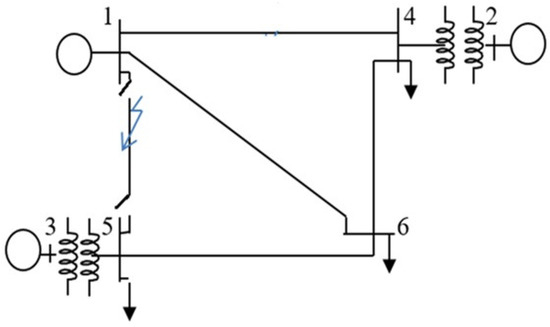
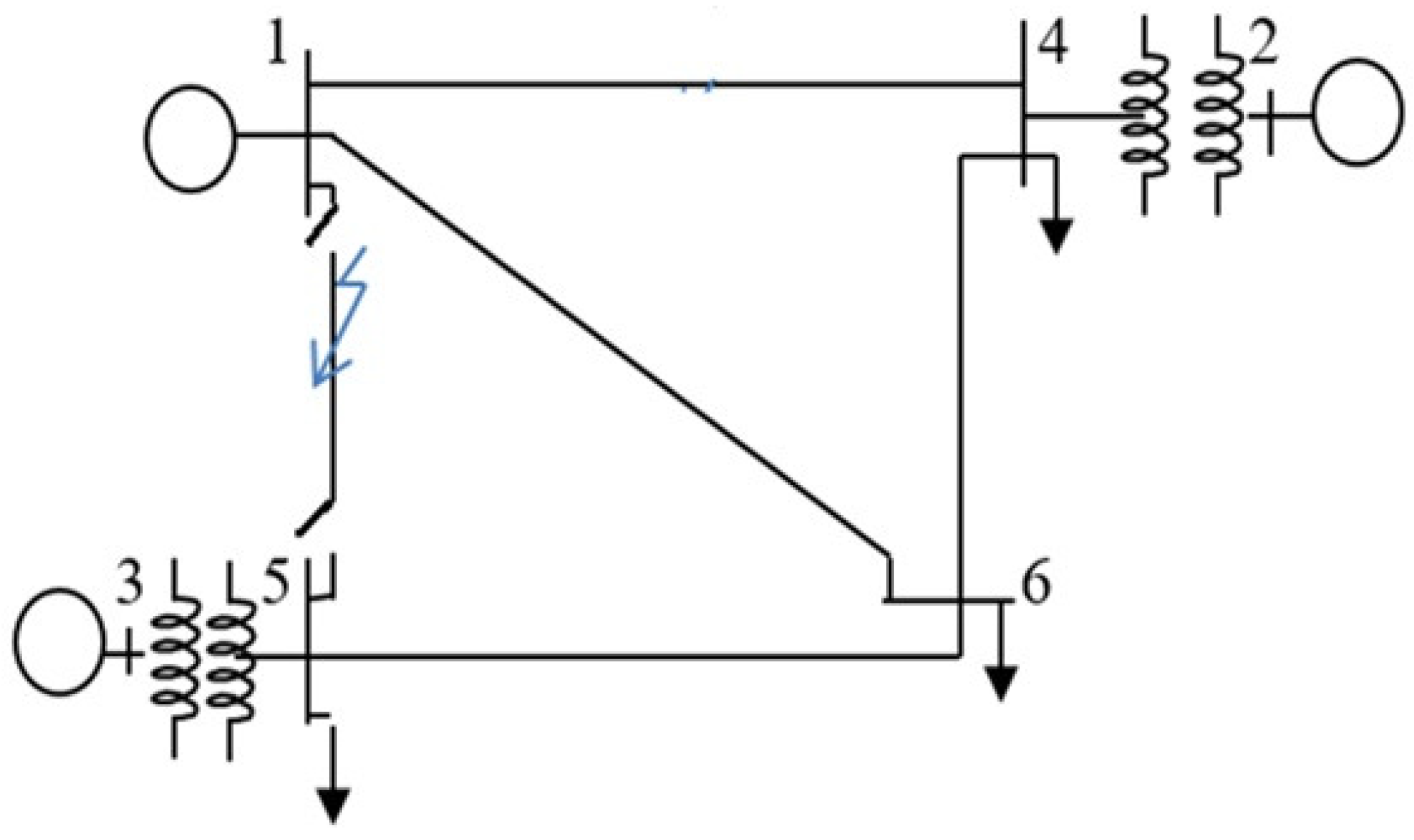
Consider the multi-machine system in the case study hit by a succession of lightning strikes (see Figure 1).
Figure 1.
Lighting strikes are applied to a multi-machine system: one-line diagram of a 6-bus 3-machine system.
We considered lightning as hitting only one line because hitting two or more lines simultaneously is very remote. We select lines 1–5 for switching because it represents one of the severe cases (generator 3 will be heavily stressed to feed its load and thus becomes nearer to instability).
Table 1 shows the system’s data (see [28]).
Table 1.
Normal loading conditions and system data.
The circuit breaker opens the line to clear the fault when a lightning strike hits the transmission line, say lines 1–5. The circuit breakers are provided with an auto-reclosure mechanism to close the line because the majority of failures are transient. When the issue persists, the auto-reclosing action is tried 1–2 times before being terminated and the line stays open (permanent).
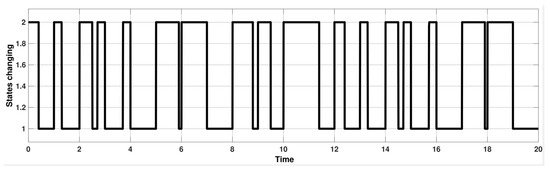
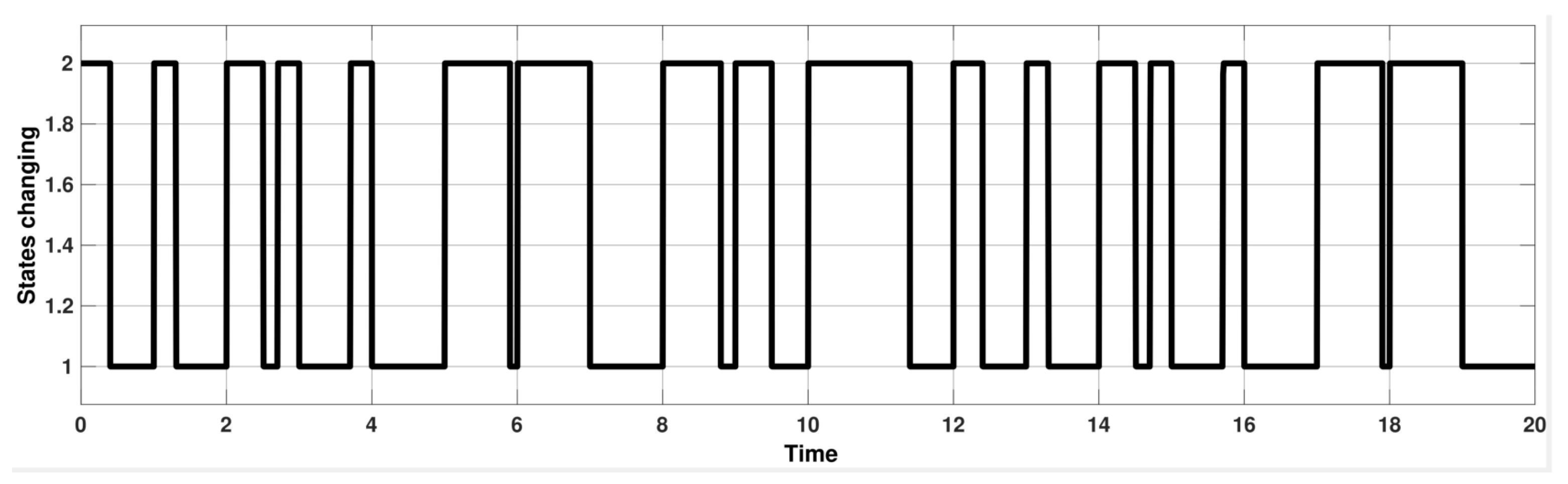
In the simplest case, the power system dynamics under a succession of lightning strikes could be represented by an N-mode Markov jump linear system, as illustrated in Figure 1 (MJLS). Particularly, the system switches between N modes at random (due to circuit breaker open/closed in respect to a series of random lightning strikes). For our case, the number of modes N = 2. The power system dynamics can be described as a Markov jump linear system (MJLS). Hence, the line’s parameter entering the state matrix A changes in random jumps. Another change in the line’s parameter is due to the random wind speed affecting the phase conductors spacing (which in turn affects the line reactance). Similarly, the random ambient temperature changes affect the line resistance. The later effects are grouped and represented as a stochastic external disturbance (noise).
This MJLS + stochastic parameter external disturbances is represented as
where , , and are the state, control, and external stochastic disturbance (noise) vectors of dimensions n, k, and l, respectively. Due to the fast, sharp changes in the slopes of the random noise, the derivative in (8) may be undefined. So, the ordinary differential Equation (8) is not suitable to model a stochastic system. It is better to cast (8) as a stochastic differential equation (SDE):
Problem 1.
The problem is to design a state feedback
such that the state trajectories of the stochastic system (9) are attracted to a small region (represented by ellipsoids with minimum volumes) around the origin in a mean-square sense. A novel excitation control mechanism is applied against the stochastic uncertainties. Sufficient conditions in the form of LMIs are given where the energetic function, containing the matrix P, characterizes the “attractive ellipsoid” for the considered controlled process independently of the system mode. The matrix P cannot be dependent on the current mode of the system model since, by its physical nature, it should characterize the final effect of the applied control action independently on a varied structure of the plant. So, this reflects the contracting property of the applied control and is clearly understandable by the engineering community.
3. Problem Solution
3.1. Closed-Loop System
3.2. Main Result
Theorem 1.
If for the linear system (11) there exist positive definite matrices and and positive numbers such that for all
and
where
then we may guarantee the simultaneous mean-square convergence of trajectories to the attractive ellipsoids , that is,
providing the mean-square convergence of all trajectories to the intersections of all ellipsoids (which is in fact not an ellipsoid), namely,
where
Proof.
It follows directly from Theorem A1 and Corollary A1 (see Appendix A.4). □
4. Optimal Feedback Gain Selection
A novel excitation control mechanism is applied against the stochastic uncertainties. Sufficient conditions in the form of LMIs are given where the energetic function, containing the matrix P, characterizes the “attractive ellipsoid” for the considered controlled process independently of the system mode. The matrix P cannot be dependent on the current mode of the system model since, by its physical nature, it should characterize the final effect of the applied control action independently on a varied structure of the plant. So, this reflects the contracting property of the applied control and is clearly understandable by the engineering community.
4.1. Optimization Problem Formulation
Optimal selection of the gain parameters consists in finding positive definite matrices and matrices , and positive numbers , which are the solutions of the following optimization problem
or equivalently,
subject to the system of nonlinear matrix inequalities (NMIs)
4.2. Transformation of the Optimization Problems under MNIs Constrains to the Problem with LMIs
(a) Using Schur’s complement lemma, the inequalities can be equivalently represented as
(b) Notice that if and only if which leads to
Using the estimates
for some positive definite matrices and Schur’s complement lemma for (19)
we are able to represent the nonlinear system of matrix inequalities (18) as the corresponding system of LMIs that gives
where
The main result of this paper follows.
5. Numerical Example
The numerical simulations are carried out using the following system parameters:
- The example below is solved numerically for ,
Mode 1 (Lines 1–5 Connected, No Fault)
Mode 2 (Lines 1–5 Disconnected Due to Fault)
5.1. Optimal Parameters
5.2. Illustrating Figures
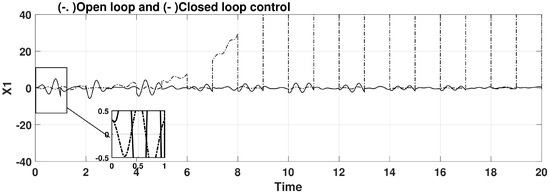
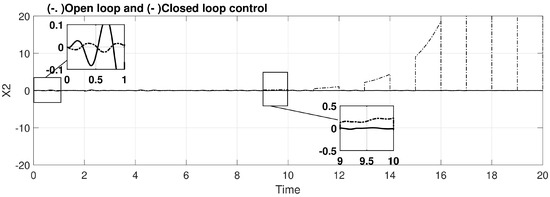
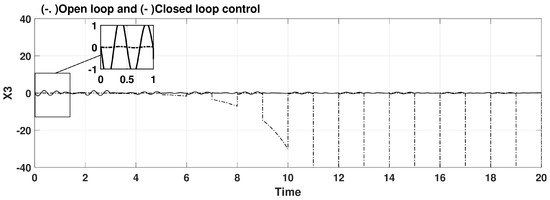
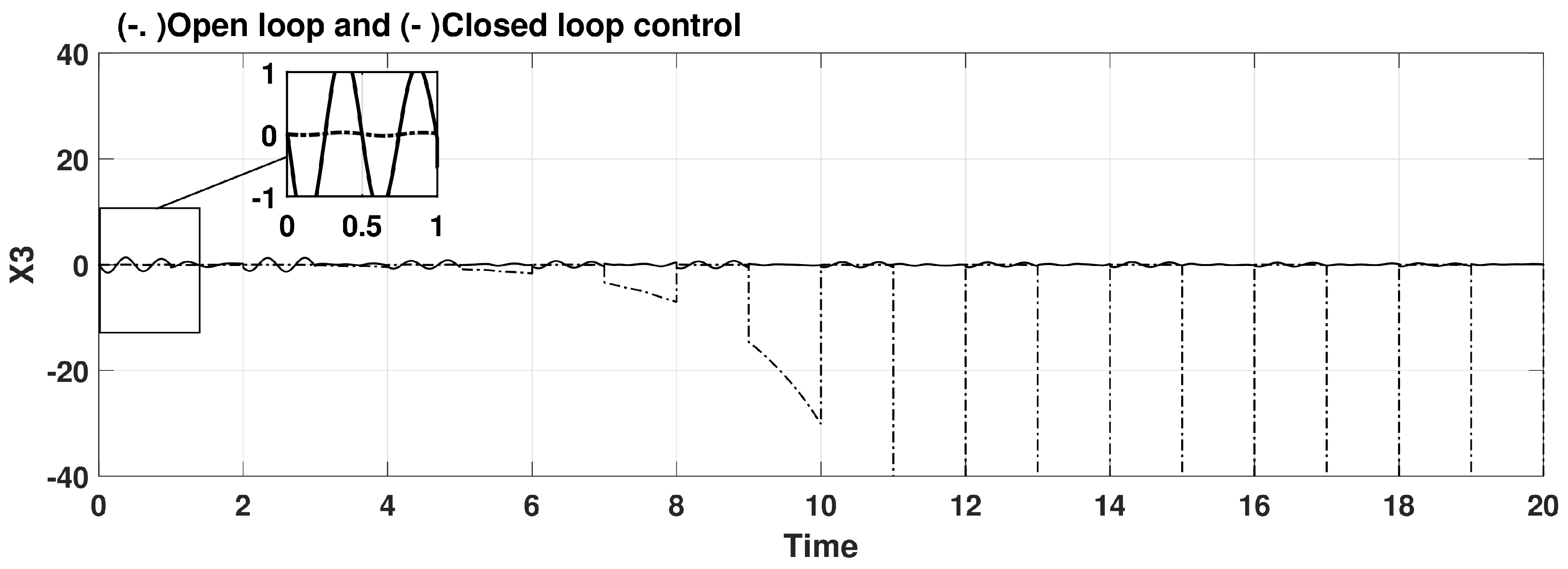
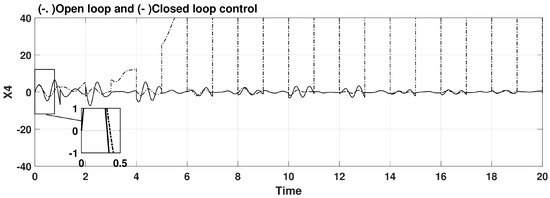
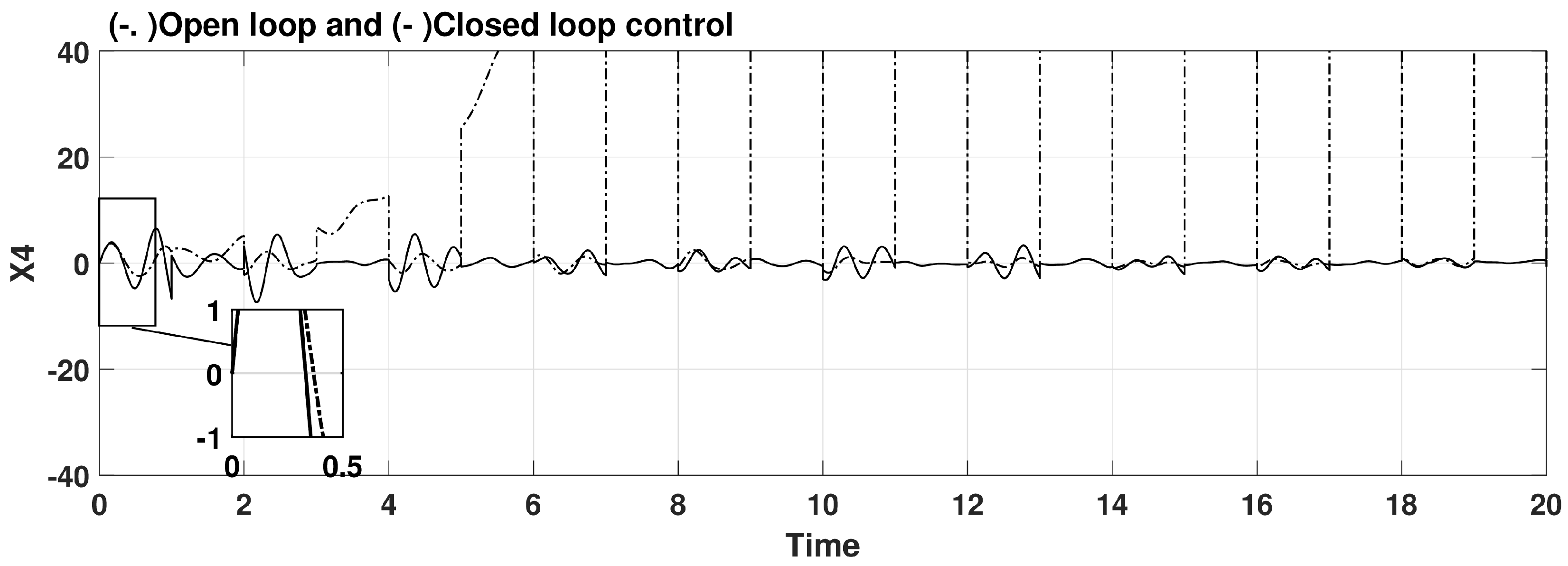
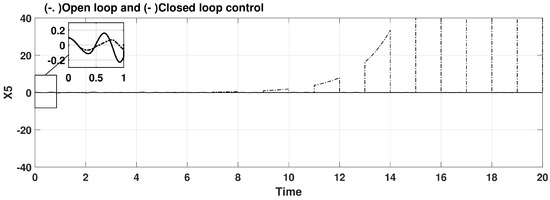
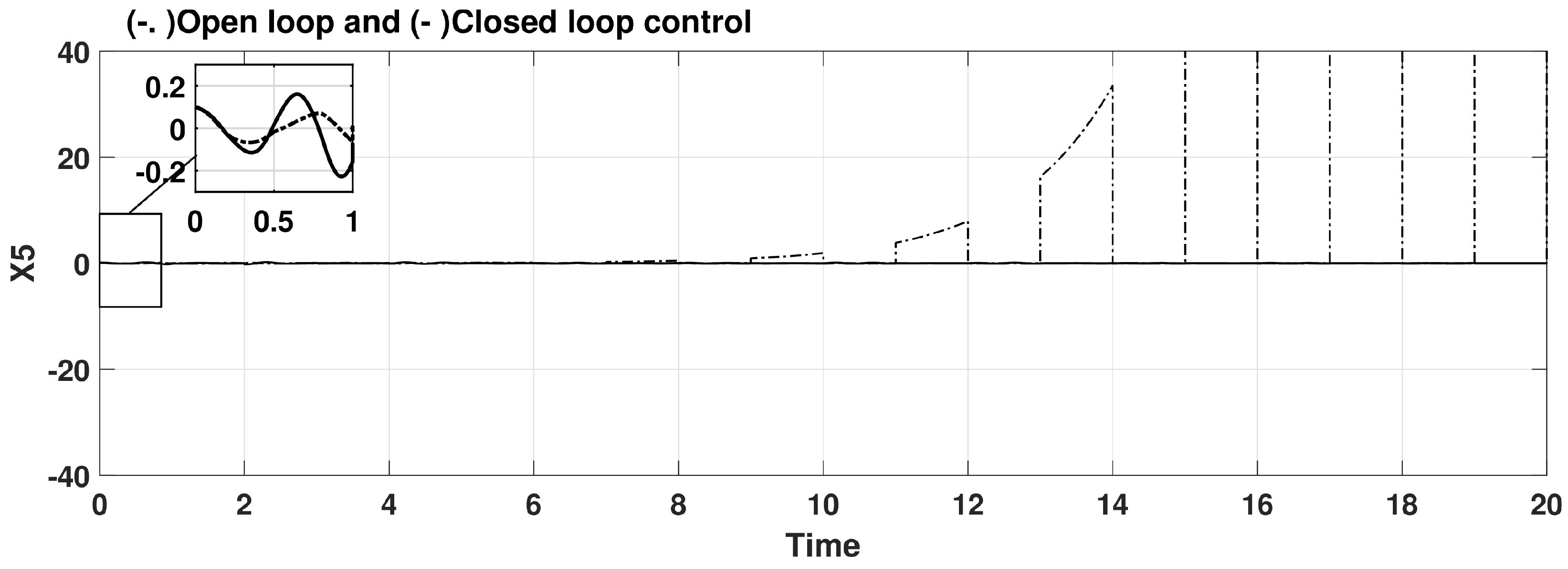
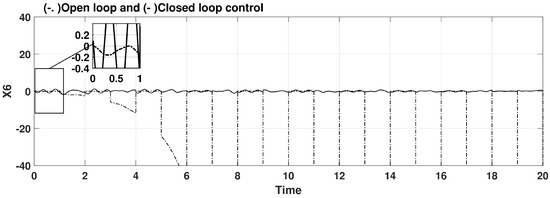
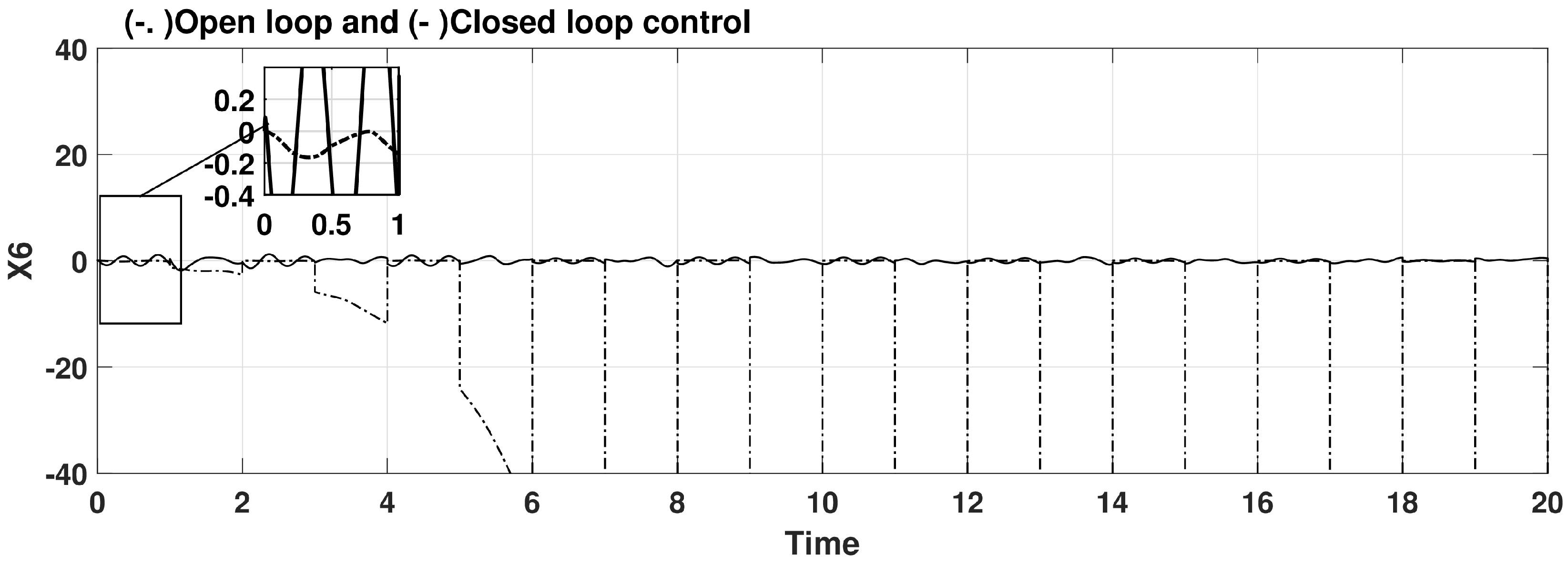
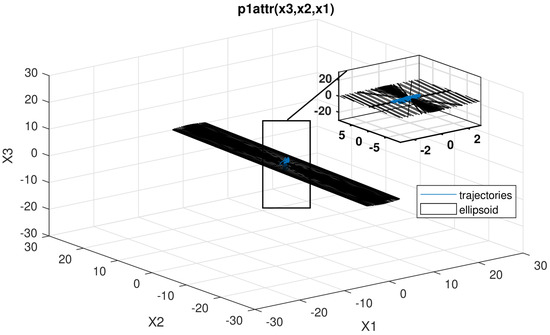
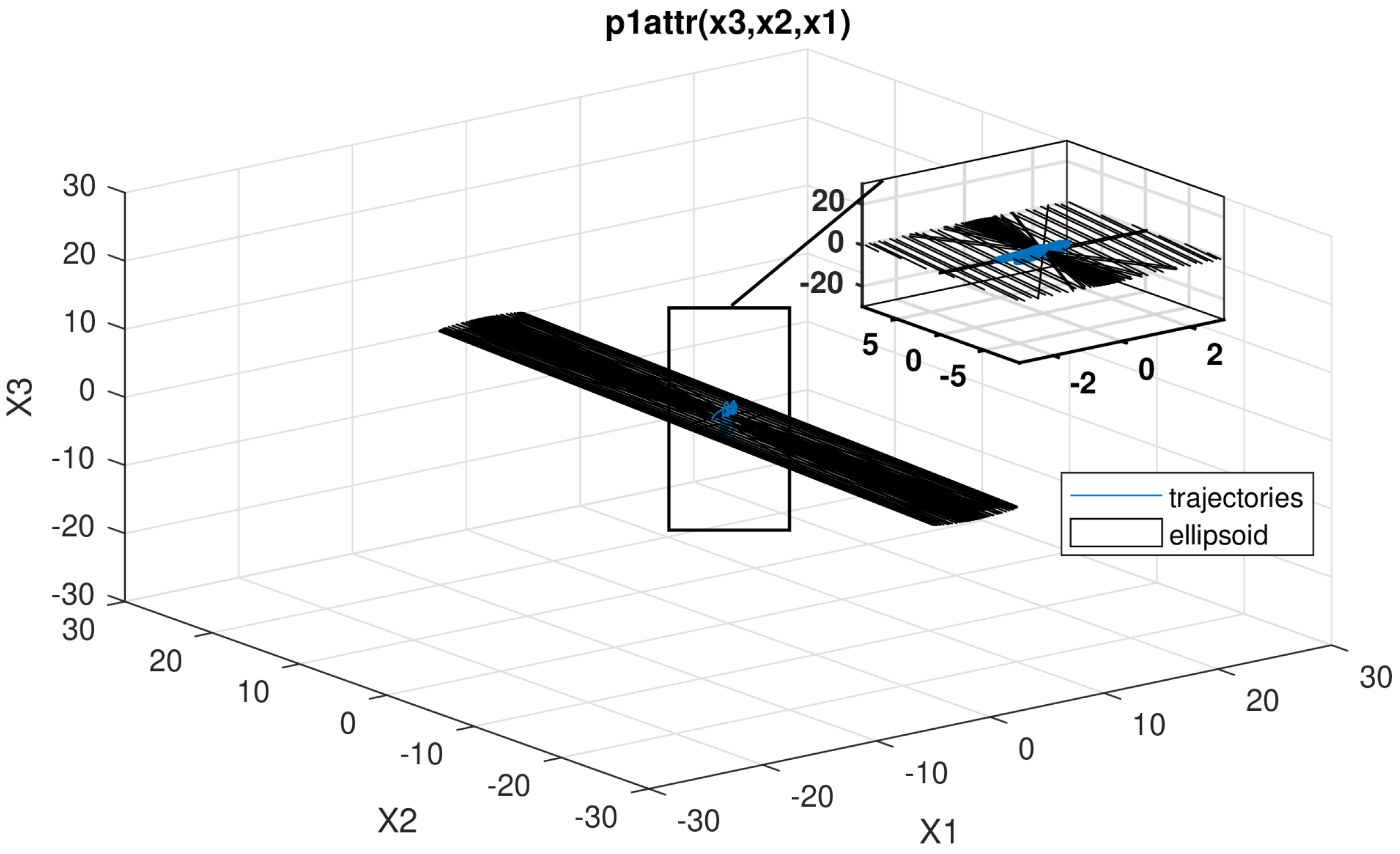
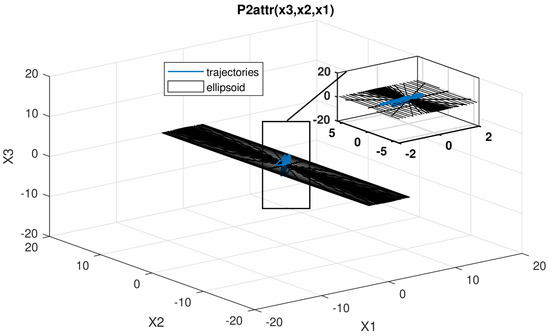
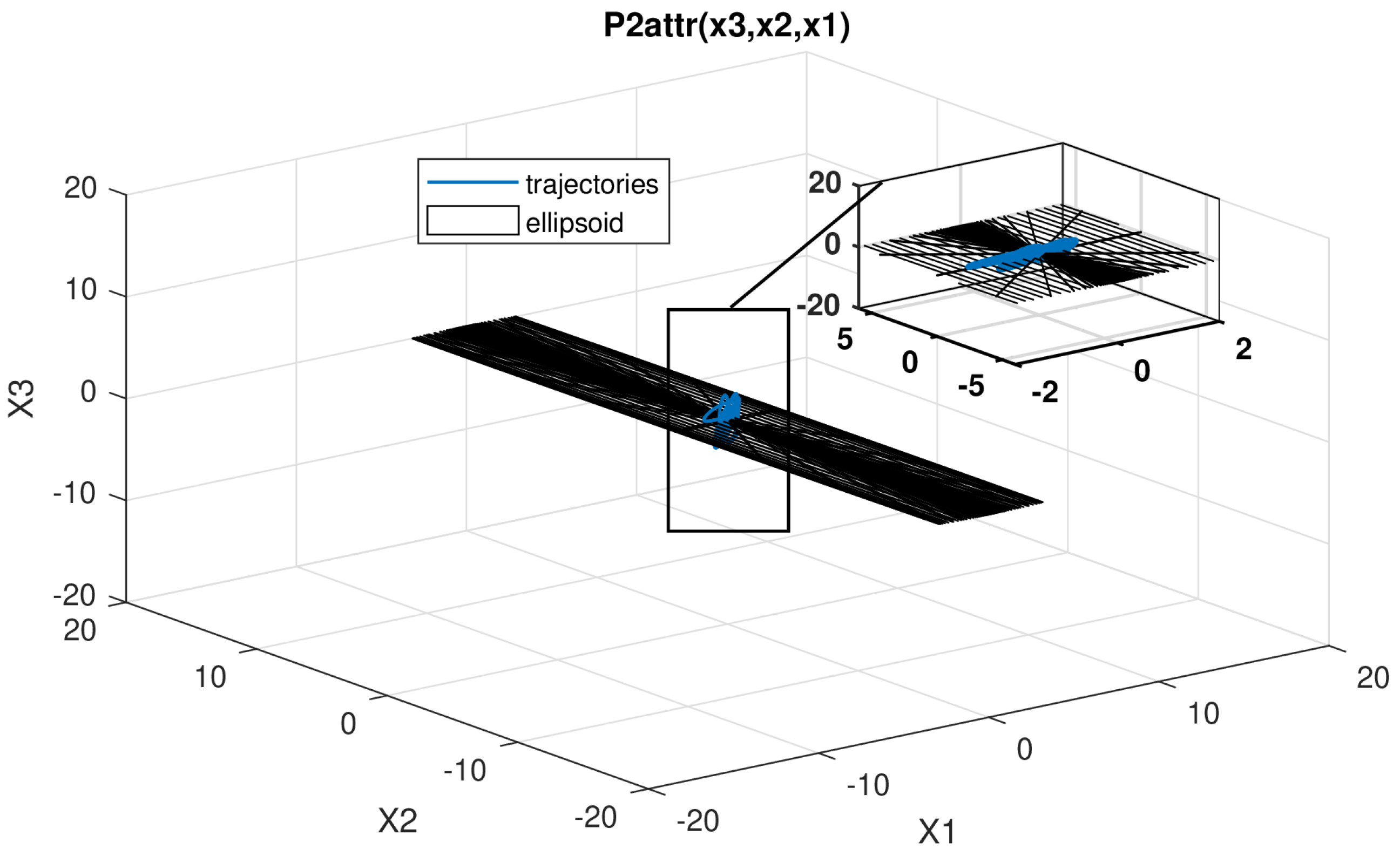
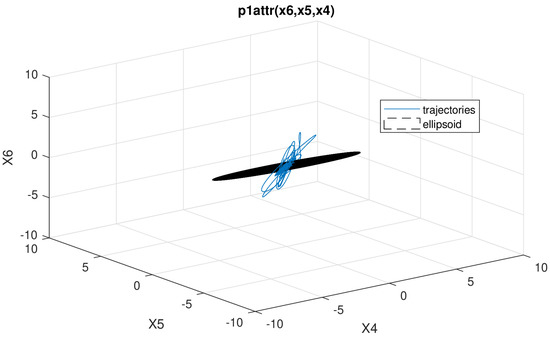
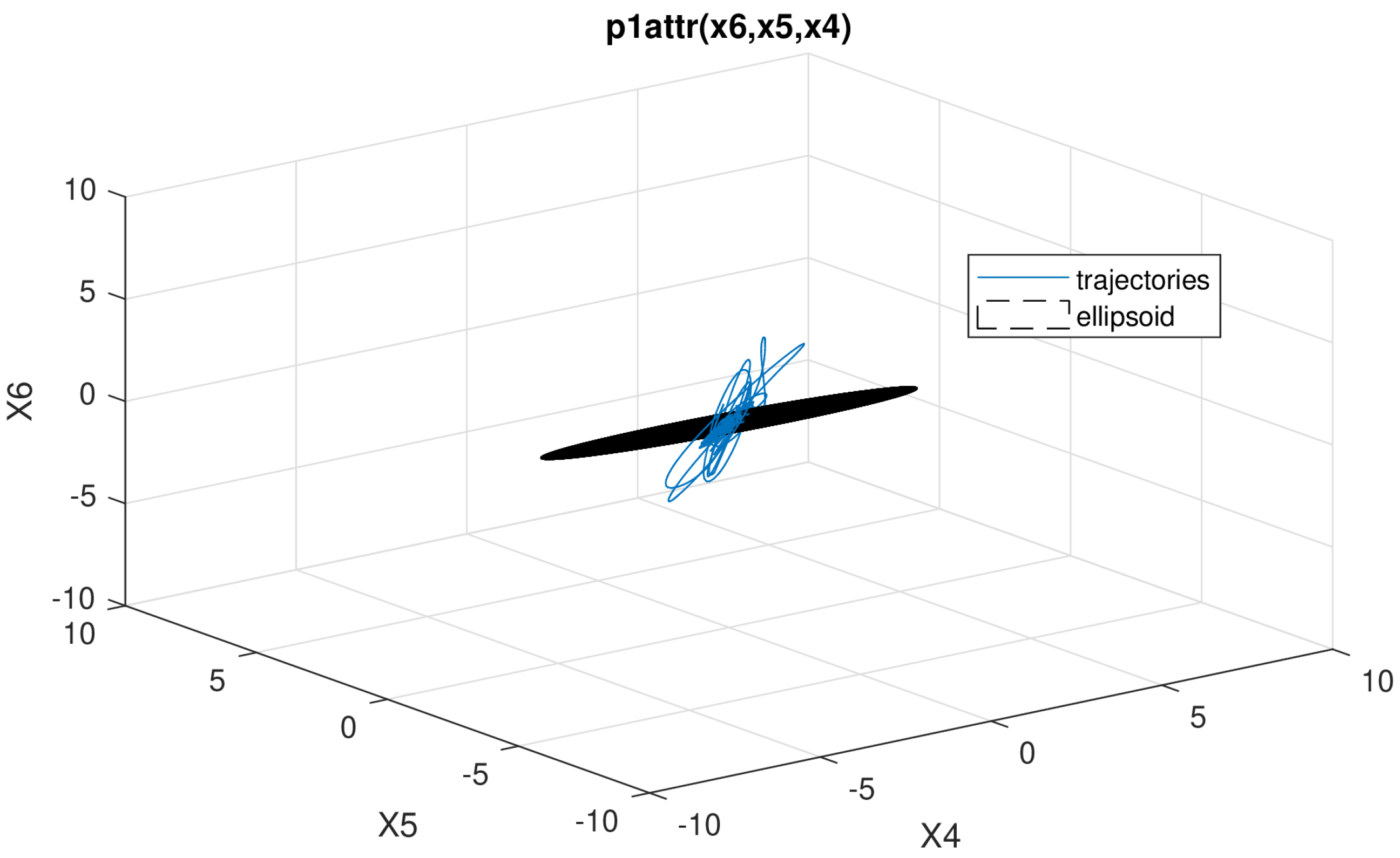
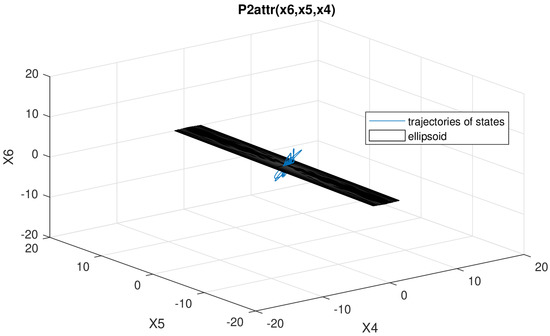
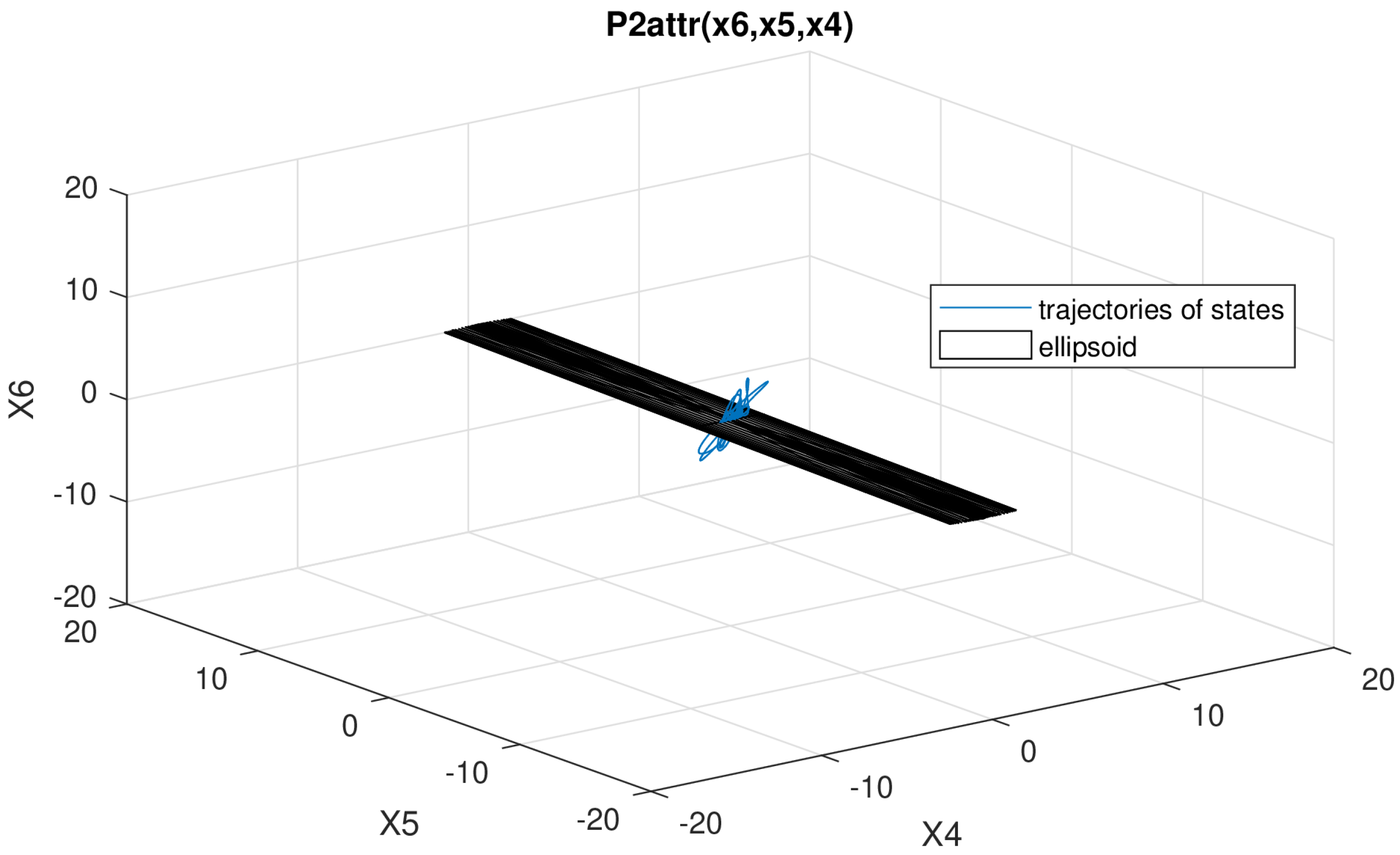
Figure 2, Figure 3, Figure 4, Figure 5, Figure 6, Figure 7, Figure 8, Figure 9, Figure 10, Figure 11 and Figure 12 depict the behavior without (shown as -.-.) and with the proposed control (shown as -). As seen, the open-loop response is unstable, whereas the proposed control stabilizes well the system in a mean-square sense under the optimal parameters (25).
Figure 2.
Changing states.
Figure 3.
Coordinate .
Figure 4.
Coordinate .
Figure 5.
Coordinate .
Figure 6.
Coordinate .
Figure 7.
Coordinate .
Figure 8.
Coordinate .
Figure 9.
Convergence of in the ellipsoid .
Figure 10.
Convergence of in the ellipsoid .
Figure 11.
Convergence of in the ellipsoid .
Figure 12.
Convergence of in the ellipsoid .
The above figures show that the system without control is unstable, whereas the proposed controller succeeds in stabilizing the system effectively.
6. Conclusions
For a stochastic power system, this work proposes a new robust excitation control of rotor angle stabilization (in a mean-square sense). A stochastic dynamic model is derived for a multi-machine test system subject to stochastic factors (random topological and parameter changes). The system subject to a series of lightning strikes associated with auto-reclosures of circuit breakers is modeled by continuous-time Markov jumps. The random parameter changes in the system are represented by external disturbances. A sufficient condition is derived as a set of nonlinear matrix inequalities (transformed into LMIs) for the proposed control. The condition is derived using the invariant ellipsoid method. The ellipsoid’s volume is minimized to achieve the optimal performance of the system. On a multi-machine system, the effectiveness of the suggested control is assessed. It damps well the system’s oscillations in a mean-square sense. The future study is to include packet loss and delays in communication networks used in power grids.
Author Contributions
A.P., H.A., H.M.S. and R.A. have equal contributions to this research. All authors have read and agreed to the published version of the manuscript.
Funding
This research received no external funding.
Data Availability Statement
Not applicable.
Conflicts of Interest
The authors declare no conflict of interest.
Nomenclature
Unless otherwise specified, the variables are all in per unit (p.u.).
| the i-th generator’s power angle (); | |
| the i-th generator’s relative speed; | |
| the speed of the synchronous generator; | |
| the mechanical input power; | |
| the active electrical power; | |
| the reactive electrical power; | |
| the inertia constant (in seconds); | |
| the quadrature axis’s transient EMF; | |
| the EMF in the quadrature axis; | |
| the excitation coil’s equivalent EMF; | |
| the transient short circuit time constant in the direct axis, ; | |
| the current along the direct axis; | |
| the quadrature axis current; | |
| the i-th generator’s terminal voltage; | |
| the i-th row and j-th column element of the nodal susceptance matrix at the internal nodes | |
| after eliminating all physical buses; | |
| the reactance along the direct axis; | |
| the quadrature axis reactance; | |
| the transient reactance along the direct axis; | |
| the transient reactance along the quadrature axis. |
Appendix A. Stability of Continuous-Time Itô-Type Stochastic Differential Equations with Jumping Parameters
Appendix A.1. General Model Description
Consider the following Itô-type stochastic differential equations with Markovian switching
with solutions defined on with initial values and . Here , and is an m-dimensional standard Brownian motion defined on the underlying probability space and independent of . Both mappings and satisfy the local Lipschitz condition and grow at most linearly. Under these conditions, (A1) has a unique solution (see, for example, [24] for more details).
Appendix A.2. Lyapunov Function Analysis
Let denote the family of all non-negative function on [0 ) which are continuously twice differentiable in x and once differentiable in t. For any define the infinitesimal operator (“generator”) by
where
Such operator exists (see [29,30]). Then, by Itô’s and Dynkin’s formulas (see, [31])
we get
and, as a result,
For from (A5) it follows
Appendix A.3. Linear Model Case
Appendix A.4. Stability Analysis for a Linear System with Jumping Parameters
Theorem A1.
If, for the linear system (A7), there exist positive definite matrices and and positive numbers such that for all
and
then we may guarantee the simultaneous mean-square convergence of trajectories to the attractive ellipsoids that is,
Proof.
Using the definition
and the upper estimate of the right-hand side of the relation (A8), it can be represented as
By the accepted assumptions, if there exists positive and such that , then we get
which implies (A11). □
Corollary A1.
Under the assumptions of Theorem A1 we may guarantee the mean-square convergence of the trajectories of the linear system with jumping parameters (A7) to the intersections of all ellipsoids (which is in fact not an ellipsoid), namely,
where is mean-square convergence and
References
- Machowski, J.; Lubosny, Z.; Bialek, J.W.; Bumby, J.R. Power System Dynamics: Stability and Control; John Wiley&Sons: Croydon, UK, 2020. [Google Scholar]
- El-Sheikhi, F.A.; Soliman, H.M.; Ahshan, R.; Hossain, E. Regional pole placers of power systems under random failures/repair Markov jumps. Energies 2021, 14, 1989. [Google Scholar] [CrossRef] [Scilit]
- Soliman, H.M.; Elshafei, A.L.; Shaltout, A.A.; Morsi, M.F. Robust power system stabilizer. IEE Proc. Gener. Distrib. 2000, 147, 285–291. [Google Scholar] [CrossRef] [Scilit]
- Soliman, H.M.; Dabroum, A.; Mahmoud, M.S.; Soliman, M. Guaranteed-cost reliable control with regional pole placement of a power system. J. Frankl. Inst. 2011, 348, 884–898. [Google Scholar] [CrossRef] [Scilit]
- Derbel, N.; Ghommam, J.; Zhu, Q. Diagnosis, Fault Detection & Tolerant Control; Springer: Berlin/Heidelberg, Germany, 2020. [Google Scholar]
- Soliman, H.M.; Yousef, H.A. Saturated robust power system stabilizers. Int. J. Electr. Power Energy Syst. 2015, 73, 608–614. [Google Scholar] [CrossRef] [Scilit]
- Yousef, H.; Soliman, H.M.; Albadi, M. Nonlinear power system excitation control using adaptive wavelet networks. Neurocomputing 2017, 30, 302–311. [Google Scholar] [CrossRef] [Scilit]
- Soliman, H.M.; El Metwally, K.A. Robust pole placement for power systems using two-dimensional membership fuzzy constrained controllers. IET Gener. Transm. Distrib. 2017, 11, 3966–3973. [Google Scholar] [CrossRef] [Scilit]
- Soliman, M.; Elshafei, A.L.; Bendary, F.; Mansour, W. Robust decentralized PID-based power system stabilizer design using an ILMI approach. Electr. Power Syst. Res. 2008, 80, 1488–1497. [Google Scholar] [CrossRef] [Scilit]
- Soliman, M. Robust non-fragile power system stabilizer. Int. J. Electr. Power Energy Syst. 2015, 64, 626–634. [Google Scholar] [CrossRef] [Scilit]
- Soliman, M. Parameterization of robust three-term power system stabilizers. Electr. Power Syst. Res. 2014, 17, 172–184. [Google Scholar] [CrossRef] [Scilit]
- Nwankpa, C.O.; Shahidehpour, S.M.; Schuss, Z.A. stochastic approach to small disturbance stability analysis. IEEE Trans. Power Syst. 1992, 7, 1519–1528. [Google Scholar] [CrossRef] [Scilit]
- Rueda, J.L.; Colome, D.G.; Erlich, I. Assessment and enhancement of small signal stability considering uncertainties. IEEE Trans. Power Syst. 2009, 24, 198–207. [Google Scholar] [CrossRef] [Scilit]
- Chung, C.Y.; Wang, K.W.; Tse, C.T.; Bian, X.Y.; David, A.K. Probabilistic eigenvalue sensitivity analysis and PSS design in multimachine systems. IEEE Trans. Power Syst. 2003, 18, 1439–1445. [Google Scholar] [CrossRef] [Scilit]
- Ugrinovskii, V.; Pota, H.R. Decentralized control of power systems via robust control of uncertain Markov jump parameter systems. Int. J. Control. 2005, 78, 662–677. [Google Scholar] [CrossRef] [Scilit]
- Ma, J.; Wang, S.; Qiu, Y.; Li, Y.; Wang, Z.; Thorp, J.S. Angle stability analysis of power system with multiple operating conditions considering cascading failure. IEEE Trans. Power Systems 2017, 32, 873–882. [Google Scholar] [CrossRef] [Scilit]
- Soliman, H.; Shafiq, M. Robust stabilisation of power systems with random abrupt changes. IET Gener. Distrib. 2015, 9, 2159–2166. [Google Scholar] [CrossRef] [Scilit]
- Ju, P. Fundamentals of Stochastic Dynamics. In Stochastic Dynamics of Power Systems; Springer: Singapore, 2019. [Google Scholar]
- Duffy, D.G. Advanced Engineering Mathematics with MATLAB®, 3rd ed.; Chapman and Hall/CRC: New York, NY, USA, 2016. [Google Scholar]
- Yuan, B.; Zhou, M.; Li, G.; Zhang, X.P. Stochastic small-signal stability of power systems with wind power generation. IEEE Trans. Power Syst. 2014, 30, 1680–1689. [Google Scholar] [CrossRef] [Scilit]
- Sun, Y.; Wang, Y.; Wei, Z.; Sun, G.; Wu, X. Robust H∞ load frequency control of multi-area power system with time delay: A sliding mode control approach. IEEE/CAA J. Autom. 2017, 5, 610–617. [Google Scholar] [CrossRef] [Scilit]
- Zhang, Z.; Liu, Y. Stochastic Small Signal Interval Stability of Power Systems with Asynchronous Wind Turbine Generators. Math. Probl. Eng. 2018, 2018, 7617394. [Google Scholar] [CrossRef] [Scilit]
- Kuppusamy, S.; Joo, Y.H.; Kim, H.S. Asynchronous Control for Discrete-Time Hidden Markov Jump Power Systems. IEEE Trans. Cybern. 2021, 52, 9943–9948. [Google Scholar] [CrossRef] [Scilit]
- Soliman, H.M.; Alazki, H.; Poznyak, A.S. Robust stabilization of power systems subject to a series of lightning strokes modeled by Markov jumps: Attracting ellipsoids approach. J. Frankl. Inst. 2022, 35, 3389–3404. [Google Scholar] [CrossRef] [Scilit]
- Poznyak, A.S.; Alazki, H.; Soliman, H.M. Invariant-set design of observer-based robust control for power systems under stochastic topology and parameters changes. Int. J. Electr. Power Energy Syst. 2016, 131, 107–112. [Google Scholar] [CrossRef] [Scilit]
- Poznyak, A.; Polyakov, A.; Azhmyakov, V. Attractive Ellipsoids in Robust Control; Birkhauser: Boston, MA, USA, 2014. [Google Scholar]
- Alazki, H.; Hernández, E.; Ibarra, J.; Poznyak, A. Attractive ellipsoid method controller under noised measurements for SLAM. Int. Control. Autom. Syst. 2017, 15, 2764–2775. [Google Scholar] [CrossRef] [Scilit]
- Saadat, H. The Power System and Electric Power Generation, 3rd ed.; PSA Publishing: Alexandria, VA, USA, 2010; pp. 154–196. [Google Scholar]
- Feng, X.; Loparo, K.A.; Ji, Y.; Chizeck, H.J. Stochastic stability properties of jump linear systems. IEEE Trans. Automatic Control. 1992, 37, 38–53. [Google Scholar] [CrossRef] [Scilit]
- Hou, Z.; Luo, J.; Shi, P.; Nguang, S.K. Stochastic stability of Ito differential equations with semi-Markovian jump parameters. IEEE Trans. Autom. Control. 2006, 51, 1383–1387. [Google Scholar] [CrossRef] [Scilit]
- Khasminskii, R. Stochastic Stability of Differential Equations; Springer Science and Business Media: Berlin/Heidelberg, Germany, 2012. [Google Scholar]

Disclaimer/Publisher’s Note: The statements, opinions and data contained in all publications are solely those of the individual author(s) and contributor(s) and not of MDPI and/or the editor(s). MDPI and/or the editor(s) disclaim responsibility for any injury to people or property resulting from any ideas, methods, instructions or products referred to in the content. |
© 2022 by the authors. Licensee MDPI, Basel, Switzerland. This article is an open access article distributed under the terms and conditions of the Creative Commons Attribution (CC BY) license (https://creativecommons.org/licenses/by/4.0/).