


Abstract
Shipboard integrated electric propulsion systems (IEPSs) are prone to suffer from system failures and security threats because of their complex functional structures and poor operational environments. An improved assessment method for failure mode and effects analysis (FMEA), integrating fuzzy logic and decision–making trial and evaluation laboratory (DEMATEL) theory, is proposed to enhance the system’s reliability and handle the correlation effects between failure modes and causes. In this method, information entropy and qualitative analysis are synthesized to determine the credibility weights of domain experts. Each risk factor and its relative importance are evaluated by linguistic terms and fuzzy ratings. The benchmark adjustment search algorithm is designed to obtain the alpha-level sets of fuzzy risk priority numbers (RPNs) for defuzzification. The defuzzified RPNs are regarded as the inputs for the DEMATEL technique to investigate the causal degrees of failure modes and causes. Accordingly, the risk levels of the failure modes are prioritized with respect to the causal degrees. The practical application to the typical failure modes of the propulsion subsystem is provided. The assessment results show that this system contributes to risk priority decision-making and disastrous accident prevention.
1. Introduction
Shipboard integrated electric propulsion systems (IEPSs) can supply power for various loads, such as propulsion system, regional loads, and high-energy weapons. By integrating propulsion power with the consumption of other electricity, this compact structure is characterized by its reduced volumes of power units and enhanced operation reliability, together with unified energy utilization and management [1,2]. The application requirements of high–power propulsion and pulse weapon are fulfilled by the next–generation medium-voltage DC IEPS for all–electric ships because of its regional power distribution features [3]. In addition, it has been recognized as one of the most promising power plants because of its remarkable advantages like high power density, small vibration and noise, strong ship vitality and combat effectiveness, and reduced life cycle maintenance costs. The shipboard IEPS is a large–scale system with high integration, a complicated structure, diversified functions, and intelligent control. Offshore working environments are harsh, usually featuring drastic temperature changes, strong mechanical impacts, and high humidity, accompanied by salt spray and oil mist, as well as other corrosive substances and explosive gases. These complex structures and hostile environments may lead to the increase in system failure rate and serious safety threats for shipboard medium voltage DC IEPSs [4,5,6], which poses a huge challenge to risk control and reliability assessment.
Failure mode and effects analysis (FMEA) is a widely used risk assessment and optimization design tool used to improve the safety and reliability of systems involved in many industries [7,8]. The so–called risk priority number (RPN) technique is employed to assess the risk levels of known or potential failure modes in traditional FMEA, defined as the product of the probability of severity (S), occurrence (O), and detectability (D) [9,10]. According to the priority ranking of failure modes, preventive and compensatory actions are introduced for the key equipment. When applied to risk assessments for safety-critical systems, like shipboard IEPSs, the traditional RPN has suffered from several weaknesses [11,12]. For example, it neglects the relative importance among risk factors S, O, and D. These three factors are assumed to have the same importance, so this may not conform to realistic situations in the FMEA process for safety-critical systems. Another prominent disadvantage is that various combinations of risk factors may produce an identical value for the RPN. However, the risk implication may be completely different. This difference will result in wasting resources and time or, in some cases, a high–risk event going unnoticed. In addition, the relative importance of different experts is not taken into consideration, thus making the risk assessment results less objective and accurate. Moreover, the traditional RPN is obtained by the product of three risk factors S, O, and D, where the assessment results are too sensitive to risk factor changes. Further, the correlation effects between the failure modes and failure causes are not taken into account, resulting in incomplete outcomes. Furthermore, each risk factor indicator is evaluated by the exact numerical values, ranging from 1 to 10, which heavily depend on the knowledge experience of domain experts and system fault databases. Nevertheless, this expertise cannot meet the requirements of newly developed systems, such as shipboard medium-voltage DC IEPSs.
Over the years, several advanced theories and techniques such as fuzzy logic theory [13,14,15,16], the decision–making trial and evaluation laboratory (DEMATEL) technique [17,18,19], the grey correlation method [20,21], the data envelopment analysis [22,23], technique for order preference by similarity to the ideal solution [24,25], quality function deployment [26,27], etc., have been developed and applied as enhancements to traditional FMEA in order to overcome these aforementioned shortcomings. However, there are still some problems in real applications, such as the credibility of domain experts, the uncertainty of fuzzy information, and the difficulty in considering the correlations between failure modes and causes. It should be noted that due to the complexity of shipboard IEPSs and the advancement of zonal medium-voltage DC distribution, there are few studies on risk and hazard assessments with respect to the systems involved [28,29]. Therefore, it is of great theoretical significance and practical value to undertake risk assessments for the typical failure modes in shipboard medium-voltage DC IEPSs.
The motivation of this study is to present an improved assessment method for FMEA by combining fuzzy logic and DEMATEL theory. Although the related approaches have already been described in some scientific studies in different fields, studies on shipboard medium-voltage DC IEPSs in the marine industry are very scarce. In the proposed method, fuzzy logic is employed to evaluate the risk factors and their relative importance, while DEMATEL theory is utilized to examine the correlation effects between the failure modes and causes. Furthermore, the credibility weights of domain experts are calculated according to information entropy and qualitative analysis. Additionally, the benchmark adjustment search algorithm is designed to obtain the alpha-level sets of fuzzy RPNs for the corresponding defuzzification. An example of propulsion subsystem failure is provided, and reasonable risk prioritization is produced. The assessment results can be used for risk priority decision-making, maintenance resource optimization, and disastrous accident prevention.
The remainder of this paper is organized as follows. The hierarchical structure of shipboard IEPSs is illustrated in Section 2. In Section 3, the proposed assessment method integrating fuzzy logic and DEMATEL theory is described in detail. The practical application of the propulsion subsystem is provided to test and validate the feasibility of the presented method in Section 4. The final section gives the related conclusions and contributions of this study.
2. System Hierarchy Description
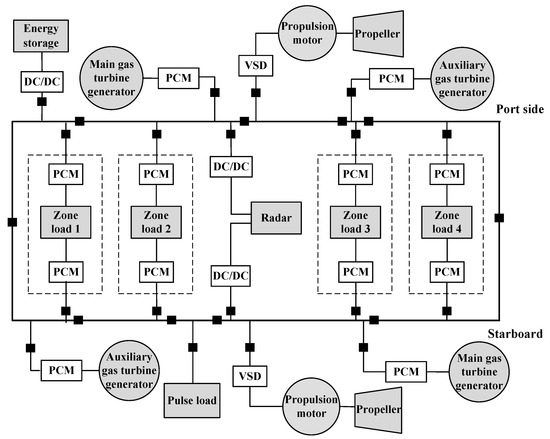
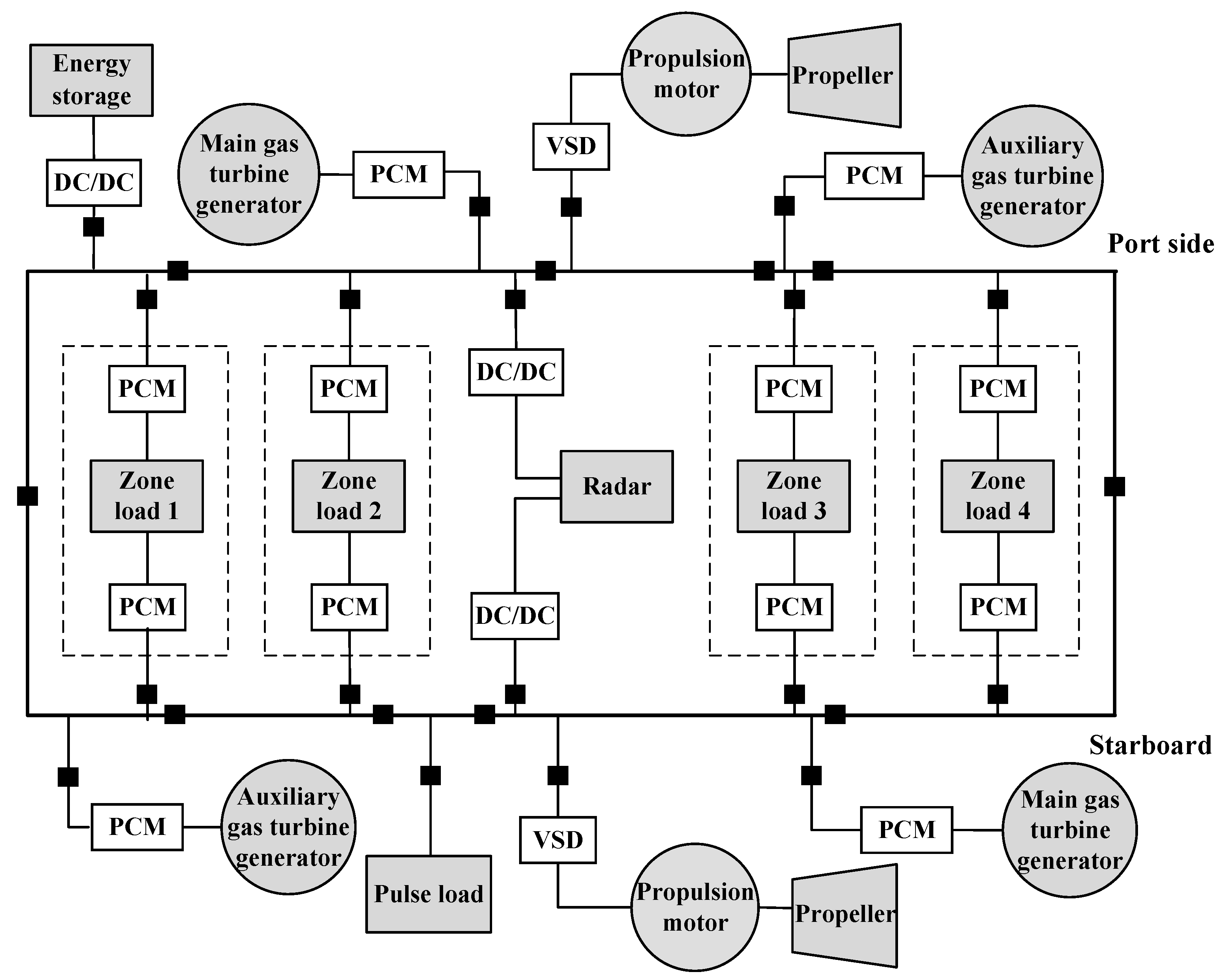
The first step in the FMEA process is the description of the considered system and a definition of its hierarchy. To acquire an exhaustive system description, it is necessary to gather information about the functional structure of the system’s components with their own positions and connections. Owing to the complexity of shipboard IEPSs, the concept of system function and hardware hybrid analysis is introduced to establish the hierarchy model. In other words, failure modes and effects are preliminarily analyzed from the perspective of system function, and then the hardware failure analysis is focused on devices with significant functional failures. In the topology prototype given by the U.S. Navy [30,31], depicted in Figure 1 where PCM is the abbreviation of power conversion modules and VSD is short for variable speed drive, the shipboard medium-voltage DC IEPS can be segmented into a generation subsystem, a propulsion subsystem, a transmission and distribution subsystem, an energy storage subsystem, and other load subsystems.
Figure 1.
Topology structure of a shipboard medium-voltage DC integrated electric propulsion system (IEPS).
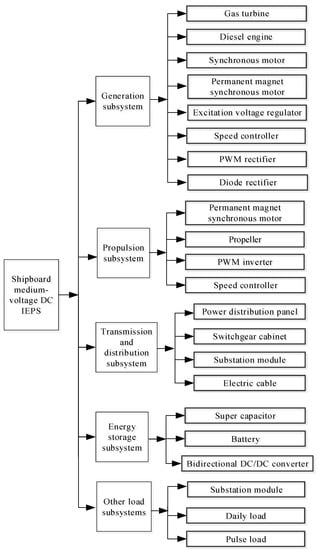
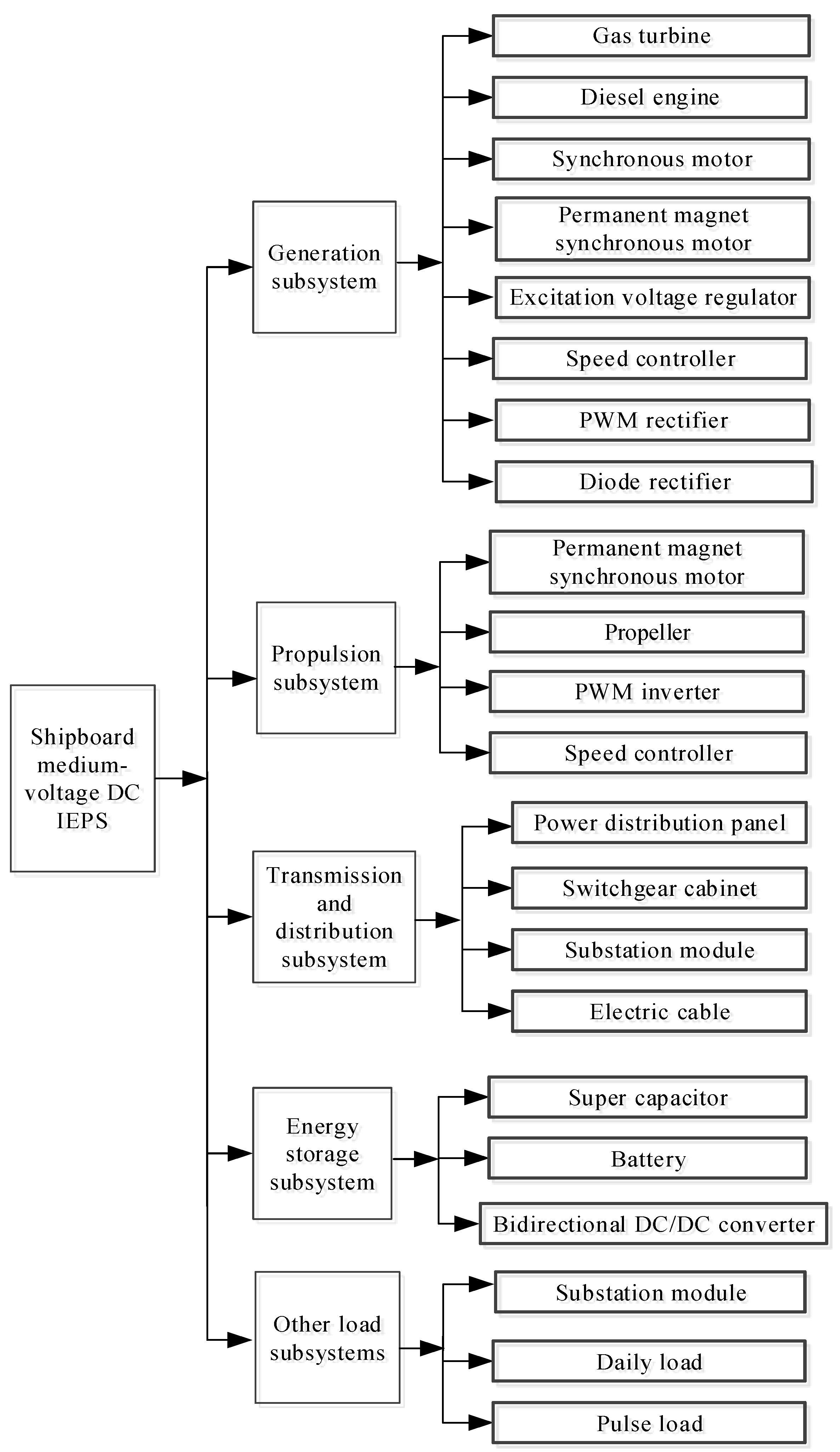
The degree of details in implementing an FMEA is determined by the hierarchical structure described. In order to facilitate the failure mode analysis and system boundary definition according to CEI IEC 60812 standard and MIL–STD–1629A [32,33], it is suggested that the initial defined level and minimum defined level are divided [34,35], as shown in Figure 2. The initial defined level is the shipboard medium-voltage DC IEPS studied, and the minimum defined level is a key piece of equipment, such as a gas turbine, diesel engine, or synchronous motor. Smaller component analyses and lower-level structural decomposition are not considered here. In addition, this hierarchy will contribute to the tracking and positioning of failure modes, as well as investigating the interactions between failure modes and causes.
Figure 2.
Hierarchical structure diagram of a shipboard IEPS. PWM represents pulse width modulation.
3. The Proposed Method Integrating Fuzzy Logic and DEMATEL Theory
In practical applications of the FMEA process, there are common cause failure phenomena and complicated failure mechanisms induced by multiple causes. However, traditional FMEA and RPN techniques cannot allow for mutual influences between the failure modes and causes. Consequently, an improved assessment method for the FMEA procedure using fuzzy logic and DEMATEL theory is proposed to solve the inherent defects stated previously. It is noteworthy that the correlation effects between the failure modes and causes are considered herein.
3.1. Fuzzy Linguistic Term Sets
In the real world, the risk ratings and the relative importance of three factors (S, O, and D) are difficult to be measured accurately. To this end, fuzzy logic is introduced to improve the assessment results of a traditional RPN. Fuzzy linguistic term sets and fuzzy number theory are exploited to evaluate risk factors and their relative weights. By referring to the fuzzy evaluation criteria of risk factors in the marine industry and combining the system characteristics of shipboard IEPSs, fuzzy term sets and linguistic descriptions can be determined. Specifically, the risk factor linguistic terms and relative weights are treated as trapezoidal fuzzy numbers and triangular fuzzy numbers, respectively. After investigating the literature and consulting experts from the research field of shipboard medium-voltage DC IEPSs, trapezoidal fuzzy numbers and triangular fuzzy numbers were defined. The fuzzy evaluation criteria and corresponding fuzzy numbers for each risk factor and its relative weight are depicted in Table 1, Table 2, Table 3 and Table 4.
Table 1.
Fuzzy evaluation criteria of severity.
Table 2.
Fuzzy evaluation criteria of occurrence.
Table 3.
Fuzzy evaluation criteria of detectability.
Table 4.
Fuzzy evaluation criteria of risk factor weights.
3.2. Fuzzy Evaluations of Risk Factors and Relative Weights
Assume that there are experts to be consulted in the FMEA assessment team, and let denote the credibility weight of specialist opinions (). Expert weights are usually qualitatively analyzed, thus making credibility results less objective and accurate. Thus, information entropy theory and qualitative analyses are synthesized to determine the credibility weights of the related experts. According to the scores of the expert members on work experience, technical field, and professional level, the entropy and its weight for each expert are calculated as
where is the score of expert associated with the performance index, and and are the total score and entropy value for expert , respectively.
Then, the total entropy value and entropy weights of expert credibility can be determined respectively:
Suppose is the credibility weight coefficient, given by the qualitative analysis considering the assessment environment, membership qualifications, and system familiarity. Accordingly, the comprehensive credibility weight of expert , defined as the normalized form of the sum of the entropy weights and qualitative weights, is represented as
The trapezoidal fuzzy number evaluations of the three risk factors by expert , with respect to the failure mode, are defined as , , and , respectively. Consequently, the overall fuzzy number evaluations of the risk factors related to the failure mode can be expressed as
Likewise, let , , and be the triangular fuzzy number evaluations of the relative importance weights for the three risk factors by expert , respectively. Afterwards, the overall fuzzy number evaluations of the risk factor weights can be represented as
3.3. Alpha-Level Set Calculation with Benchmark Adjustment Search Algorithm
The fuzzy RPN is defined as the fuzzy weighted geometric mean of the three risk factors for the failure mode [36]:
Redefine and , and it holds that
Since and are fuzzy numbers (), they cannot be computed directly in Equation (7). Alpha-level set theory is introduced to calculate the fuzzy RPNs, which can be expressed as
where is the confidence level, and is the alpha-level set of the fuzzy RPNs.
The upper and lower limits of the alpha-level sets for the three fuzzy risk factors and their relative weights are written as
where and are the alpha-level sets of the fuzzy risk factors and their relative weights, respectively.
A benchmark adjustment search algorithm is adopted to determine the alpha-level sets of the fuzzy RPNs. The fundamental design steps are briefly described as follows.
Step 1: The confidence level is evenly and discretely distributed within the range of , that is, the confidence level set is defined as , with , , and ( ).
Step 2: Let and search for the alpha-level sets of the three fuzzy risk factors and their relative weights respectively, i.e., and .
Step 3: The initial benchmark values and can be obtained by Equation (11). Define , , and , which means that each element in set is the subscript value of , satisfying , and each element in set is the subscript value of , satisfying :
Step 4: The benchmark value can be adjusted to compute the lower limits of the alpha-level sets for the three fuzzy risk factors and their relative weights according to Equation (12), where , . If , the optimal testing is satisfied, and . Otherwise, the benchmark value needs to be recalculated in this step:
Step 5: The benchmark value can be regulated to calculate the upper limits of the alpha-level sets of the three fuzzy risk factors and their relative weights by Equation (13), with , . If , the optimal testing is satisfied, and . Otherwise, the benchmark value needs to be re–determined:
Step 6: The alpha-level set of the fuzzy RPNs can be obtained at confidence level by Equation (9). Let repetitively, and the alpha-level set () of the fuzzy RPNs can be ascertained at each confidence level with the repeated steps 2–5. Ultimately, the fuzzy RPNs can be determined according to Equation (8).
3.4. Defuzzification of Fuzzy RPNs
The centroid defuzzification method is applied to defuzzify the fuzzy RPNs, which can be expressed as
where and are the defuzzified values and fuzzy membership functions of the fuzzy RPNs, respectively.
In light of the situation that only the alpha-level sets are available at different confidence levels, and the precise membership functions are not known. In this study, we assume that the precise membership functions can be approximated using piecewise linear functions based on alpha-level set theory [37]. The formulas of the centroid defuzzification method are as follows:
Obviously, and are only determined by the alpha-level set , which was acquired in Section 3.3. Therefore, the defuzzified values of the fuzzy RPNs can be determined with Equations (14) and (15).
3.5. DEMATEL Technique
In a complicated system like a shipboard IEPS, there are often ambiguous correspondences between the failure modes and their causes. In other words, each failure mode may be induced by multiple causes, and each failure cause may induce multiple failure modes. In light of the common cause failure problems and complex failure mechanisms, the DEMATEL technique is applied to a shipboard medium-voltage DC IEPS to handle the correlation effects between the failure modes and causes. The implementation details of the DEMATEL technique are described as follows.
Step 1: The initial direct–relation matrix is constructed between the failure modes and causes, where , , , and are block matrixes. indicates the direct impacts of failure causes on the failure causes, and represents the direct impacts of the failure causes on the failure modes. denotes the direct impacts of failure modes on the failure causes, and means the direct impacts of the failure modes on the failure modes. It should be noted that only the correlation effects between the failure modes and causes are considered. Consequently, , , and are all zero matrices, while is a nonzero matrix, where the elements are derived from the defuzzified values of the fuzzy RPNs. For example, the defuzzified value of the fuzzy RPN for the second failure mode induced by the third cause is the element in the third row and second column of matrix :
Step 2: The initial direct–relation matrix is normalized, and the relative direct–relation matrix is obtained as follows:
Step 3: The total–relation matrix is calculated from the following formula, where is an identity matrix, and element shows the total impact of failure mode or cause on failure mode or cause . Specifically, if and , is the total impact of failure cause on cause ; if and , is the total impact of failure cause on mode ; if and , is the total impact of failure mode on cause ; otherwise, is the total impact of failure mode on mode :
Step 4: In order to measure the degree of interactions between a certain failure mode or cause and all other failure modes and causes, the correlation effect matrices and are introduced as follows. In the formula, is the influence degree given by the failure mode or cause to all other failure modes and causes. Meanwhile, is the influence degree received by failure mode or cause from all other failure modes and causes:
Step 5: The causal degree of each failure mode and cause is given by
where is the causal degree of failure mode or cause . Specifically, indicates a net failure cause. Meanwhile, represents a net failure mode clustered into the FMEA process.
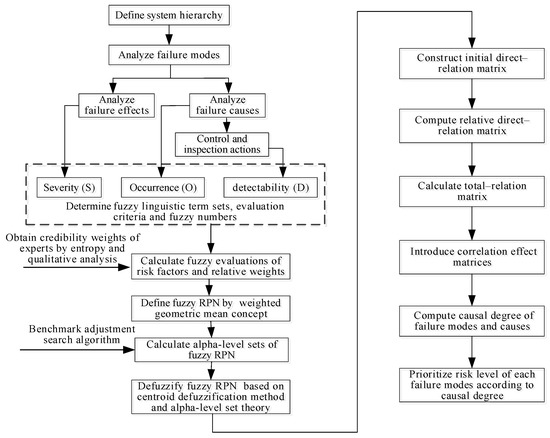
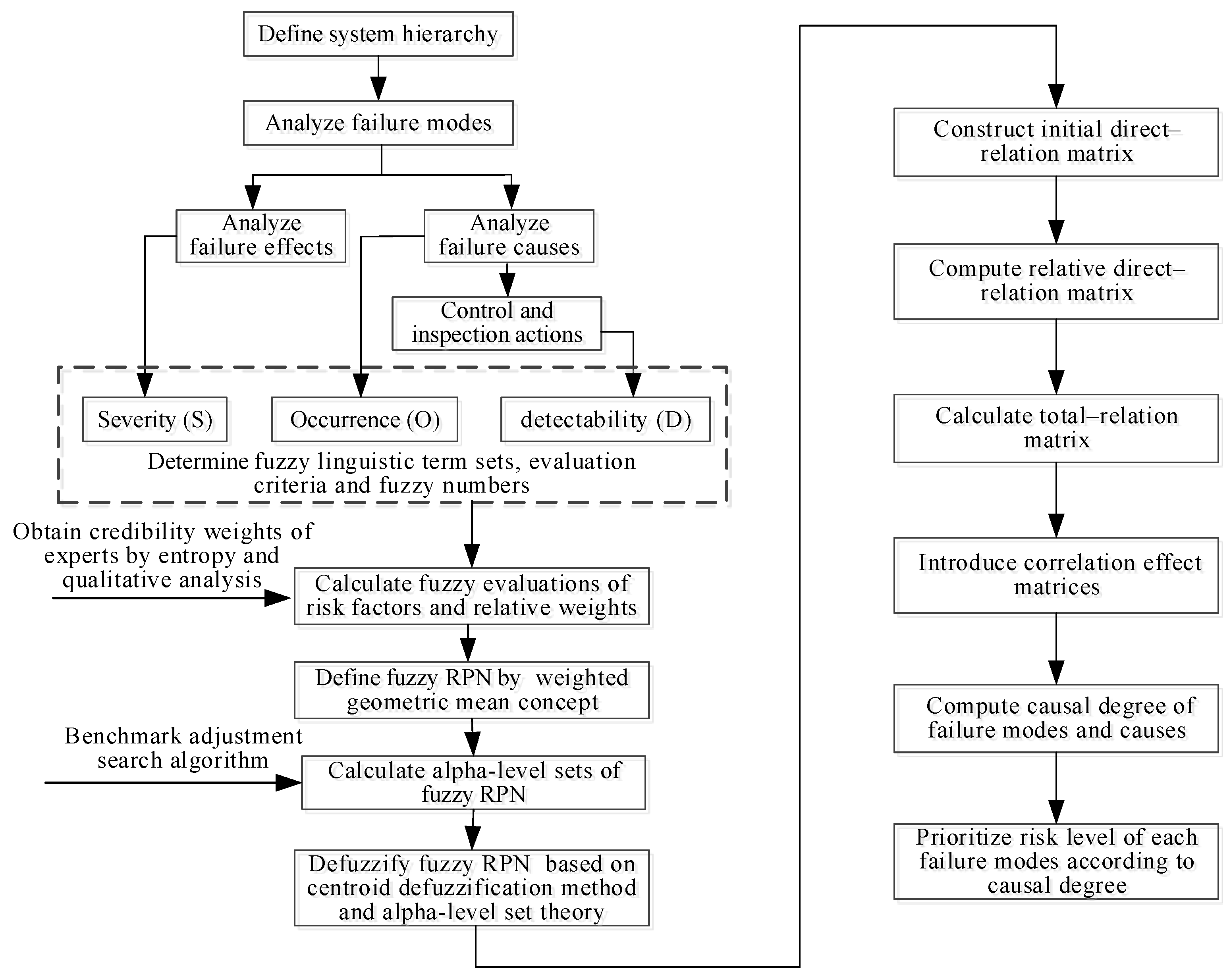
Finally, the risk level of each known or potential failure mode is prioritized according to its causal degree. In summary, the flowchart of the proposed improved risk assessment method using fuzzy logic and the DEMATEL technique is presented, as shown in Figure 3.
Figure 3.
Flowchart of the proposed improved assessment method. RPN, risk priority number.
4. Case Application and Results Analysis
To ensure that the integrated all-electric ship does not lose its propulsion power arbitrarily, the propulsion subsystem is not allowed to install circuit breaker protection devices or implement conventional overload relay protection schemes. Therefore, the known or potential failure modes of the propulsion subsystem will seriously affect the propeller propulsion’s performance and the ship’s maneuvering characteristics. Taking the typical failure modes of the propulsion subsystem for the described shipboard medium-voltage DC IEPS as a case study, the effectiveness of the risk assessment method based on fuzzy logic and DEMATEL theory is verified.
4.1. Failure Mode Analysis of the Propulsion Subsystem
The propulsion subsystem mainly includes a PWM (pulse width modulation) inverter, a permanent magnet synchronous motor, speed controller, propeller, shafting, and other key equipment. Through fault simulations, expert experience knowledge bases, and equipment instruction, typical failure modes of the propulsion subsystem, failure causes, detection methods, and their local and final effects are collected and summarized in Table 5.
Table 5.
Failure mode and effects analysis (FMEA) of the propulsion subsystem for a shipboard IEPS.
4.2. Calculation Results and Comparative Analysis
Suppose that the FMEA assessment team has four expert members. According to the assessment environment, membership qualifications, and system familiarity, the expert credibility weights obtained by the qualitative analysis can be determined as . In addition, the scores for expert members on work experience, technical field, and professional level are listed in Table 6. Accordingly, the expert entropy weights are . The comprehensive weights of expert credibility based on the combination of information entropy and qualitative analysis are written as .
Table 6.
Scores of expert members for three performance indicators.
Using expert knowledge experience combined with fuzzy linguistic terms and evaluation criteria, the fuzzy evaluation information for the three risk factors (and their relative weights) for the permanent magnet synchronous motor of a propulsion subsystem) is presented, as shown in Table 7. The fuzzy evaluations of other key equipment, such as the PWM inverter, speed controller, propeller, and shafting, can be obtained in the same way. However, for the sake of simplicity, they are not listed here.
Table 7.
Fuzzy evaluation of the risk factors and relative weights for a permanent magnet synchronous motor. Severity (S), occurrence (O), and detectability (D).
Because of the fuzzy evaluation information and the defined fuzzy numbers, the overall fuzzy number evaluation results for the risk factors and their relative weights can be determined. The confidence level is set as . With the designed benchmark adjustment search algorithm, the alpha-level sets of fuzzy RPNs for the typical failure modes of a permanent magnet synchronous motor can be computed and arranged (as shown in Table 8).
Table 8.
Alpha-level sets of fuzzy RPNs for a permanent magnet synchronous motor.
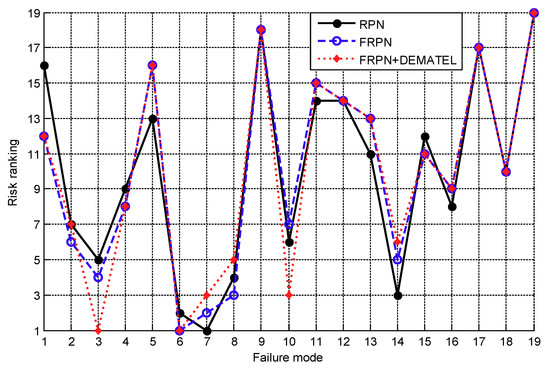
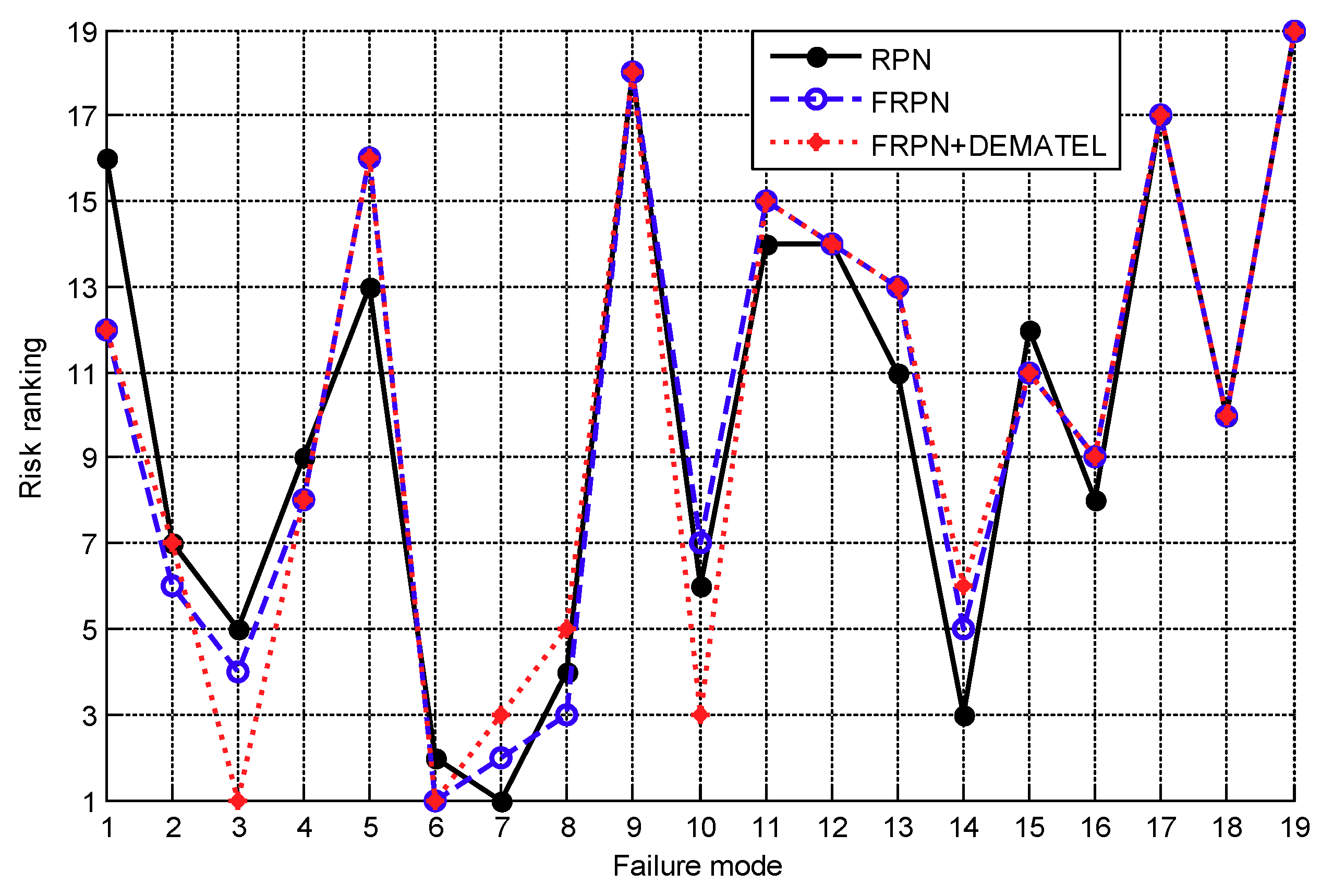
The defuzzified values of the fuzzy RPNs can be determined by employing the centroid defuzzification method and alpha-level set theory. Then, the causal degrees of the failure modes and causes are acquired based on the above DEMATEL technique. In addition, in order to verify the feasibility and superiority of the proposed risk assessment method, the traditional RPN and fuzzy RPN (FRPN) are compared and analyzed. Based on the fuzzy information given in Table 7, and exact ratings in the evaluation criteria, a traditional RPN is derived. The fuzzy RPN is defined as the defuzzified values of the fuzzy RPNs obtained in the above section. The risk calculation results of the three evaluation methods for the typical failure modes of a propulsion subsystem in a shipboard medium-voltage DC IEPS are depicted in Table 9 and Figure 4.
Table 9.
Results comparison of the three evaluation methods. FRPN, fuzzy RPN.
Figure 4.
Risk ranking of failure modes for the propulsion subsystem.
As stated in Table 9, the results of the comparative analysis show that failure modes FM6, FM8, FM13, FM14, and FM15, marked with ※ in the table, have the same risk prioritization in the three assessment methods. Furthermore, the rankings of failure mode FM5 (permanent magnet synchronous motor windings and iron core overheating), marked with + in the table (induced by different causes FC3, FC6, and FC7, respectively), are in the top five in terms of risk priority, indicating the effectiveness of the proposed method. The assessment results are consistent with the practical engineering failure cases, because the failures of propulsion motors often lead to a loss of the propulsion system’s functions, which can seriously affect the ship’s maneuvering characteristics and the crew’s safety onboard. Therefore, in the design and operation stage, it is necessary to fully consider the typical failure mode impacts of propulsion motors and develop preventive and compensatory recommendations, such as condition monitoring, maintenance management, and risk control, to enhance the system’s safety and reliability.
Compared with the other two methods, in the situation that different failure modes have an identical value for RPN, it is difficult to determine the risk implication and prioritize the risk level in a traditional RPN. For instance, the failure mode FM7, induced by FC9, and failure mode FM8, induced by FC10 (marked with ○ in the table), have the same RPN value of 45. However, the risk factor values of both these events are 6, 3, 2.5, and 3.75, 6, 2, respectively. Due to the introduction of risk factor weights into the fuzzy RPN and the proposed improved assessment method, the probabilities of severity, occurrence, and detectability are given different levels of attention to avoid the loss of risk information. Moreover, in the fuzzy RPN and the proposed method, expert credibility weights are adopted to express the relative importance of different expert opinions and decrease the subjectivity of expert knowledge. Furthermore, each risk factor, and its relative importance, is evaluated by linguistic terms and fuzzy ratings to reduce the dependence of accurate ratings. Improvements in these aspects conform to the realistic requirements of safety-critical systems like the shipboard IEPS and contribute to avoiding assessment defects with the same RPN values.
As shown in Table 9 and Figure 4, the failure modes and causes are not a one-to-one relationship (as indicated in the table) For instance, a failure mode FM5 can be induced by various failure causes, FC3, FC6, and FC7, respectively. Meanwhile, the failure cause FC3 can induce multiple failure modes (FM3 and FM5). Compared with fuzzy RPN, the fuzzy logic and DEMATEL based risk assessment method can take into account the correlation effects between failure modes and causes and give higher risk priority to common cause failure modes. In other words, if multiple failure modes are induced by the same cause, a higher risk priority is achieved, such as FM3 and FM5 induced by FC3, as well as FM5 and FM7 induced by FC6. This situation is in line with the applications of practical engineering, because, when multiple failure modes induced by common causes are given higher risk priority, more attention is paid to detect the failure’s causes and maintain the relevant equipment, thus eliminating the effects of different failures simultaneously. Consequently, the proposed assessment method can produce more reasonable risk prioritization results in the FMEA process. With the results of risk priority decision-making, preventive and compensatory recommendations can be designed purposefully to optimize maintenance resources optimization and prevent disastrous accidents.
5. Conclusions
Because of its complex structures and a poor environment, shipboard medium voltage DC IEPSs suffer from system failures and security threats. This paper proposes an improved risk assessment method integrating fuzzy logic and the DEMATEL technique to improve the system’s safety and reliability. Using this method, the loss of risk information can be avoided by the introduction of risk factor weights. Further, each risk factor and its relative importance are evaluated by linguistic terms and fuzzy ratings to reduce the dependence of accurate ratings. Additionally, expert credibility weights are adopted to decrease the subjectivity of expert knowledge and experience. By considering the correlation effects between the failure modes and their causes, the common failure modes are given higher priority to make the results more realistic and represent a flexible flection of real situations. With the results of risk priority decision-making, preventive and compensatory recommendations can be designed purposefully to optimize maintenance resources and prevent disastrous accidents.
The main contributions of this study can be stated as follows. Information entropy and qualitative analysis are synthesized to determine the credibility weights of domain experts, which can overcome the implicit subjectivity and inaccuracy of expert opinions on system failure analysis. The three risk factors and their relative importance are evaluated in the form of fuzzy linguistic terms and fuzzy ratings rather than by exact numerical values, thus making the results more realistic and objective. Since fuzzy RPNs are not trapezoidal or triangular fuzzy numbers, and their precise membership functions are unknown, a benchmark adjustment search algorithm is designed to obtain alpha-level sets of fuzzy RPNs for the corresponding defuzzification calculations. Additionally, the DEMATEL technique is employed to measure the correlation effects between the failure modes and causes, which have not been investigated in previous studies on shipboard medium-voltage DC IEPSs.
The typical failure modes of propulsion subsystems are analyzed and assessed for verification. The calculation results show that the inverter failure FM3, induced by cause FC3, and the permanent magnet synchronous motor failures FM5 and FM7, induced by causes FC3, FC6, and FC7, respectively, have higher risk levels and should be given more attention. Therefore, in the design and operation stage, it is essential to give full consideration to the failure effects of inverters and propulsion motors, to ensure effective maintenance, improvements, and control actions. In addition, it should be noted that the improved risk assessment method proposed in this paper is not only applicable to ship IEPSs, but also to the reliability analysis of safety-critical systems, such as aerospace and nuclear power plants. Considering the coupling effects of failure modes and failure causes, establishing a more comprehensive risk assessment model establishment for the FMEA process is planned for future research.
Author Contributions
The research topic was proposed by S.L.; S.L. and X.G. structured and wrote the first draft of the paper; X.G. conducted the research and drafted the methodology; X.G. and L.Z. took part in the validation and analysis of the results; S.L. made the conclusions and wrote most parts of the paper with the other co–authors.
Funding
This work was supported in part by the National Natural Science Foundation of China subsidization project (51579047), the Doctoral Scientific Research Foundation of Heilongjiang (No. LBH–Q14040), and the Open Project Program of State Key Laboratory of Millimeter Waves (K201707).
Conflicts of Interest
The authors declare no conflict of interest.
References
- Shi, J.; Amgai, R.; Abdelwahed, S. Modelling of shipboard medium-voltage direct current system for system level dynamic analysis. IET Electr. Syst. Transp. 2015, 5, 156–165. [Google Scholar] [CrossRef] [Scilit]
- Chen, Y.; Li, Z.; Zhao, S.; Wei, X.; Kang, Y. Design and implementation of a modular multilevel converter with hierarchical redundancy ability for electric ship MVDC system. IEEE J. Emerg. Sel. Top. Power Electron. 2017, 5, 189–202. [Google Scholar] [CrossRef] [Scilit]
- Cuzner, R.M.; Singh, V. Future shipboard MVdc system protection requirements and solid–state protective device topological tradeoffs. IEEE J. Emerg. Sel. Top. Power Electron. 2017, 5, 244–259. [Google Scholar] [CrossRef] [Scilit]
- Li, W.; Monti, A.; Ponci, F. Fault detection and classification in medium voltage DC shipboard power systems with wavelets and artificial neural networks. IEEE T Instrum. Meas. 2014, 63, 2651–2665. [Google Scholar] [CrossRef] [Scilit]
- Wang, Y.C.; Yu, Z.Q.; He, J.L.; Chen, S.M.; Zeng, R.; Zhang, B. Performance of shipboard medium-voltage DC system of various grounding modes under monopole ground fault. IEEE Trans. Ind. Appl. 2015, 51, 5002–5009. [Google Scholar] [CrossRef] [Scilit]
- Robert, M.C.; Daniel, A.E. Fault tolerant shipboard MVDC architectures. In Proceedings of the 2015 International Conference on Electrical Systems for Aircraft, Railway, Ship Propulsion and Road Vehicles (ESARS), Aachen, Germany, 3–5 March 2015; pp. 1–6. [Google Scholar]
- Mareike, L.; Athanasios, K. A review of reliability–based methods for risk analysis and their application in the offshore wind industry. Renew. Sustain. Energy Rev. 2018, 91, 1065–1076. [Google Scholar]
- Christian, S.; Davide, R.; Caterina, R. A state–of–the-art review of FMEA/FMECA including patents. Comput. Sci. Rev. 2017, 25, 19–28. [Google Scholar]
- Jia, H.; Li, Z.J.; Liu, H.C. New approach for failure mode and effect analysis using linguistic distribution assessments and TODIM method. Reliab. Eng. Syst. Saf. 2017, 167, 302–309. [Google Scholar]
- Alrifaey, M.; Hong, T.S.; Supeni, E.E.; As’arry, A.; Ang, C.K. Identification and prioritization of risk factors in an electrical generator based on the hybrid FMEA framework. Energies 2019, 12, 649. [Google Scholar] [CrossRef] [Scilit]
- Zhou, Q.J.; Vinh, V.T. Fuzzy and grey theories in failure mode and effect analysis for tanker equipment failure prediction. Saf. Sci. 2016, 83, 74–79. [Google Scholar] [CrossRef] [Scilit]
- Liu, H.C.; Liu, L.; Liu, N. Risk evaluation approaches in failure mode and effects analysis: A literature review. Expert Syst. Appl. 2013, 40, 828–838. [Google Scholar] [CrossRef] [Scilit]
- Dağsuyu, C.; Göçmen, E.; Narlı, M.; Kokangül, A. Classical and fuzzy FMEA risk analysis in a sterilization unit. Comput. Ind. Eng. 2016, 101, 286–294. [Google Scholar] [CrossRef] [Scilit]
- Chian, H.J.; Kai, M.T.; Chee, P.L. Application of the fuzzy failure mode and effect analysis methodology to edible bird nest processing. Comput. Electron. Agric. 2013, 96, 90–108. [Google Scholar]
- Sebnem, H.; Emre, O. Fuzzy based failure modes and effect analysis for yacht system design. Ocean Eng. 2014, 79, 131–141. [Google Scholar]
- Bahrebar, S.; Blaabjerg, F.; Wang, H.; Vafamand, N.; Khooban, M.H.; Rastayesh, S.; Zhou, D. A novel type–2 fuzzy logic for improved risk analysis of proton exchange membrane fuel cells in marine power systems application. Energies 2018, 11, 721. [Google Scholar] [CrossRef] [Scilit]
- Emre, A.; Erkan, C. A fuzzy DEMATEL method to evaluate critical operational hazards during gas freeing process in crude oil tankers. J. Loss Prev. Proc. 2015, 38, 243–253. [Google Scholar]
- Song, W.Y.; Cao, J.T. A rough DEMATEL–based approach for evaluating interaction between requirements of product-service system. Comput. Ind. Eng. 2017, 110, 353–363. [Google Scholar] [CrossRef] [Scilit]
- Lukas, J.A.; Jens, L.; Chie, H.S. Analyzing the impact of industry sectors on the composition of business ecosystem: A combined approach using ARM and DEMATEL. Expert Syst. Appl. 2018, 100, 17–29. [Google Scholar]
- Li, Z.; Chen, L.Y. A novel evidential FMEA method by integrating fuzzy belief structure and grey relational projection method. Eng. Appl. Artif. Intell. 2019, 77, 136–147. [Google Scholar] [CrossRef] [Scilit]
- Chang, K.H.; Chang, Y.C.; Tsai, I.T. Enhancing FMEA assessment by integrating grey relational analysis and the decision making trial and evaluation laboratory approach. Eng. Fail. Anal. 2013, 31, 211–224. [Google Scholar] [CrossRef] [Scilit]
- Samuel, Y.; Arash, A.; Jamileh, H.; Majid, B. HSE risk prioritization using robust DEA–FMEA approach with undesirable outputs: A study of automotive parts industry in Iran. Saf. Sci. 2018, 102, 144–158. [Google Scholar]
- Nrtto, T.A.; Honorato, H.J.; Qassim, R.Y. Prioritization of failure risk in subsea flexible pipes via data envelopment analysis. Mar. Struct. 2013, 34, 105–116. [Google Scholar]
- Silvia, C.; Antonella, C.; Joaquín, I.; Concetta, M.L.F. A combined multi–criteria approach to support FMECA analyses: A real-world case. Reliab. Eng. Syst. Saf. 2018, 169, 394–402. [Google Scholar]
- Mohammad, Y. Risk assessment based on novel intuitionistic fuzzy–hybrid–modified TOPSIS approach. Saf. Sci. 2018, 110, 438–448. [Google Scholar]
- Morteza, Y.; Cengiz, K.; Pascale, Z.; Sezi, C.O. A fuzzy multi attribute decision framework with integration of QFD and grey relational analysis. Expert Syst. Appl. 2019, 115, 474–485. [Google Scholar]
- Chen, L.H.; Ko, W.C. Fuzzy linear programming models for new product design using QFD with FMEA. Appl. Math. Model. 2009, 33, 633–647. [Google Scholar] [CrossRef] [Scilit]
- Ouroua, A.; Beno, J.; Hebner, R. Analysis of fault events in MVDC architecture. In Proceedings of the IEEE Electric Ship Technologies Symposium, Baltimore, MD, USA, 20–22 April 2009; pp. 380–387. [Google Scholar]
- Soman, R.R.; Davidson, E.M.; Mc Arthur, S.D.J. Using functional failure mode and effects analysis to design the monitoring and diagnostics architecture for the zonal MVDC shipboard power system. In Proceedings of the 2009 IEEE Electric Ship Technologies Symposium, Baltimore, MD, USA, 20–22 April 2009; pp. 123–128. [Google Scholar]
- IEEE Standards Association. IEEE std. 1709—2018 IEEE Recommended Practice for 1kV to 35 kV Medium-Voltage DC Power Systems on Ships; IEEE: Piscataway, NJ, USA, 2018. [Google Scholar]
- Andrus, M.; Bosworth, M.; Crider, J.; Ouroua, H.; Santi, E.; Sudhoff, S. Notional System Models Tech. Rep.; ESRDC: Arlington, VA, USA, 2013. [Google Scholar]
- International Electrotechnical Commission. IEC 60812 Standard. Analysis Techniques for System Reliability–Procedure for Failure Mode and Effects Analysis (FMEA); IEC: Geneva, Switzerland, 2006. [Google Scholar]
- SAI Global. MIL-STD-1629A. Procedures for Performing a Failure Mode, Effects and Criticality Analysis; SAI Global: Sydney, Australia, 1980. [Google Scholar]
- Zhu, W.; Shi, J.; Liu, S.; Abdelwahed, S. Development and application of a model-based collaborative analysis and design framework for microgrid power systems. IET Gener. Transm. Dis. 2016, 13, 3201–3210. [Google Scholar] [CrossRef] [Scilit]
- Antonella, C.; Fabrizio, H.; Roberta, I.; Concetta, M.L.F. A Dempster–Shafer theory–based approach to the failure mode, effects and criticality analysis (FMECA) under epistemic uncertainty: Application to the propulsion system of a fishing vessel. Reliab. Eng. Syst. Saf. 2017, 159, 69–79. [Google Scholar]
- Wang, Y.M.; Chin, K.S.; Poon, G.K.K.; Yang, J.B. Risk evaluation in failure mode and effects analysis using fuzzy weighted geometric mean. Expert Syst. Appl. 2009, 36, 1195–1207. [Google Scholar] [CrossRef] [Scilit]
- Wang, Y.M. Centroid defuzzification and the maximizing set and minimizing set ranking based on alpha level sets. Comput. Ind. Eng. 2009, 57, 228–236. [Google Scholar] [CrossRef] [Scilit]

© 2019 by the authors. Licensee MDPI, Basel, Switzerland. This article is an open access article distributed under the terms and conditions of the Creative Commons Attribution (CC BY) license (http://creativecommons.org/licenses/by/4.0/).