


Abstract
(1) Background: Teachers’ visual attention is central to professional vision, yet whether teacher gender influences gaze allocation in Physical Education remains unclear. This study examined gender-related differences in visual attentional deployment when teachers observed students’ motor competence, behavioural engagement, off-task behaviour, and gender. (2) Methods: Sixty pre-service Physical Education teachers observed video-recorded tasks from a class while wearing Tobii Pro Glasses 3. Fixation metrics were quantified across predefined areas of interest and compared between teacher genders. (3) Results: Female and male teachers showed comparable total and mean fixation durations. However, the former produced significantly more fixations during the closed task towards on-task students and with higher motor competence. Female teachers also showed higher fixation frequency regardless of whether off-task behaviour was successfully identified, and made more fixations towards both female and male students during this task. These differences were not consistently observed during the open task. (4) Conclusions: Teacher gender differed primarily with fixation frequency rather than fixation duration, and this effect was context-dependent. Additionally, greater visual sampling did not necessarily correspond to more accurate behavioural noticing. Mobile eye-tracking can reveal gender-related and task-sensitive differences in teachers’ visual behaviour, with potential applications in Physical Education teacher education and professional development.
1. Introduction
Vision constitutes a fundamental biological interface for human–environment interaction, operating as a continuous, iterative loop that seamlessly integrates sensory input, perceptual organisation, attentional selection, and goal-directed action, thereby enabling both reactive and anticipatory behavioural responses in dynamic contexts [1].
From an anatomical standpoint, visual perception arises from a sequential, distributed process that begins with the optical formation of an image on the retina—mediated by the cornea and lens—and progresses through retinal preprocessing via photoreceptors and ganglion cells, before being relayed along central pathways to cortical areas for complex spatiotemporal and object-based interpretation [2].
Given that retinal acuity is maximal at the fovea, the visual system strategically employs a suite of oculomotor mechanism—including saccades and fixation—to dynamically align the fovea with salient environmental features, thereby optimising sampling, stabilising the retinal image, and ensuring effective binocular coordination [3].
These physiological characteristics provide the conceptual basis for eye-tracking research. As powerful instruments, eye-tracking systems record eye position over time and allow researchers to quantify a repertoire of oculomotor events that are otherwise inaccessible to direct observation [4].
When gaze data are mapped onto theoretically meaningful areas of interest (AOI), measures such as fixation count, fixation duration, and spatial gaze distribution can consequently be used to characterise how visual information is sampled within a given environment [5].
This is particularly valuable in educational and sporting contexts, where relevant information is distributed across space and changes rapidly over time. Research conducted in authentic classrooms has demonstrated that teachers’ gaze is unevenly distributed across students and that gaze allocation may vary according to students’ characteristics, classroom position, and lesson context [6].
Within education, teachers’ gaze has increasingly been conceptualised as an observable component of professional vision. Professional vision involves the capacity to selectively notice and interpret classroom events that are relevant to teaching and learning and adapt the instructional behaviour accordingly [7].
Consequently, teachers’ visual behaviour is not merely a perceptual phenomenon, but constitutes a critical functional component of professional classroom observation, serving as the primary conduit through which relevant pedagogical information is selectively interpreted into informed instructional decisions in real time [8].
The relevance of this research is particularly evident in Physical Education. Unlike many classroom-based subjects, Physical Education involves continuous movement, multiple simultaneous events, substantial spatial dispersion, and frequent changes in task demands [9].
Teachers must monitor students’ motor execution while simultaneously attending to task organisation, safety, behavioural engagement, interpersonal interactions, and the progression of the lesson. The visual system is, therefore, required to operate under conditions in which the perceptual field is both information-rich and temporally unstable [10].
Motor competence in students is a significant but complex determinant of teachers’ visual allocation during Physical Education. While observing performance allows teachers to identify task achievement or the need for intervention, the direction of their attention is not fixed, a pattern further modulated by task structure, with open tasks imposing greater demands due to their dynamic and multi-actor nature [11].
Beyond motor skills, behavioural engagement is equally critical, as teachers must detect off-task behaviours that threaten classroom management; however, visual attention does not guarantee accurate interpretation, since looking at a student does not necessarily equate to successful professional noticing—a distinction increasingly emphasised in eye-tracking research [12].
Additional variation in visual behaviour may arise from both teacher and student gender. One study has shown that teachers’ gaze patterns differ according to students’ gender and other social characteristics, indicating that visual allocation is influenced by socio-demographic factors alongside pedagogical relevance [13].
However, considerably little is known about whether teacher’s own gender independently affects visual attentional patterns when observing identical instructional contexts. Critically, it remains to be established if female and male teachers exhibit significantly different gaze profiles [14].
This distinction is conceptually important, as teacher and student gender represent separate, non-redundant dimensions of the visual relationship and visual dynamics in the classroom and thus demands independent empirical examination to investigate their pedagogical contributions [15].
Accordingly, the present study employed mobile eye-tracking technology to investigate whether female and male pre-service Physical Education teachers differ in their visual attentional deployment during a video-based observation task depicting an authentic lesson, examining gender as an independent determinant of oculomotor behaviour.
More specifically, the study sought to: (i) compare patterns of visual attention between female and male teachers in response to students with varying levels of motor competence, across both closed and open motor tasks; (ii) contrast the visual attention allocated by female and male teachers to students who remain on-task versus those who exhibit off-task behaviour; (iii) examine whether the relationship between teachers’ visual behaviour and their capacity to identify off-task behaviour differs as a function of teacher gender; and (iv) compare female and male teachers with respect to the distribution of their visual attention towards female versus male students.
It was predicted that female and male teachers would display broadly comparable fixation durations, yet differ in fixation frequency across selected student and task characteristics. Comparisons were expected to reveal distinct visual attentional patterns between teacher genders according to students’ motor competence, behavioural engagement, off-task identification, and student gender [16].
2. Materials and Methods
2.1. Research Design
A comparative study was implemented to investigate the visual search strategies of Physical Education teachers, stratified by gender. Wearable oculometric technology (Tobii Pro Glasses 3) was used as the principal tool for registering gaze-based outcome measures in response to standardised video recordings of pedagogical content [17].
The predictor variables were defined by distinct pupil-related characteristics within the authentic classroom setting: the observed degree of motor skill proficiency, the type of behavioural engagement (active participation versus off-task conduct), and the students’ gender.
Such methodological framing offered a naturalistically valid paradigm to explore if the gender of the teachers modulates the distribution of visual focus when confronted with genuine instructional dynamics [6].
2.2. Participants
The participant cohort consisted of 60 pre-service Physical Education teachers (23 female, 37 male; mean age = 23.63 years, standard deviation = ±4.43), enlisted via purposive sampling from a Portuguese institution of higher education.
All individuals were registered on the master’s curriculum tailored for the established preparation of Physical Education practitioners for both primary and secondary educational tiers.
Recruitment was randomised, and the resultant sample magnitude aligns with prior oculomotor inquiries within the domain of teacher preparation that employed comparable methodological and statistical frameworks, thereby offering a solid empirical groundwork for the subsequent between-group evaluations [7].
2.3. Ethical Considerations
The present investigation was executed in strict accordance with the ethical tenets articulated in the Declaration of Helsinki and the Oviedo Convention on Human Rights and Biomedicine.
Prospective ethical endorsement was formally obtained from the Ethics Committee of the Faculty of Sport Sciences and Physical Education, University of Coimbra (reference CE/FCDEF-UC/00142024).
Before the initiation of data collection, all participants received information regarding the investigation’s aims, operational procedures, and their prerogative to discontinue participation at any stage without penalty [18].
Written informed consent was properly procured from every individual, thus guaranteeing observance of the utmost standards of research probity and participant self-determination.
2.4. Instruments
2.4.1. Eye-Tracker Glasses
The visual behaviour of both female and male instructors directed towards predefined AOI was registered employing Tobii Pro Glasses 3, with subsequent data processing and analysis conducted via Tobii Pro Lab software (version 1.207).
These portable eye-tracking glasses allow the continuous, non-intrusive capture of participants’ oculomotor activity under conditions that preserve ecological validity, producing high-fidelity gaze information temporally aligned with a scene video that depicts the participant’s visual perspective [19].
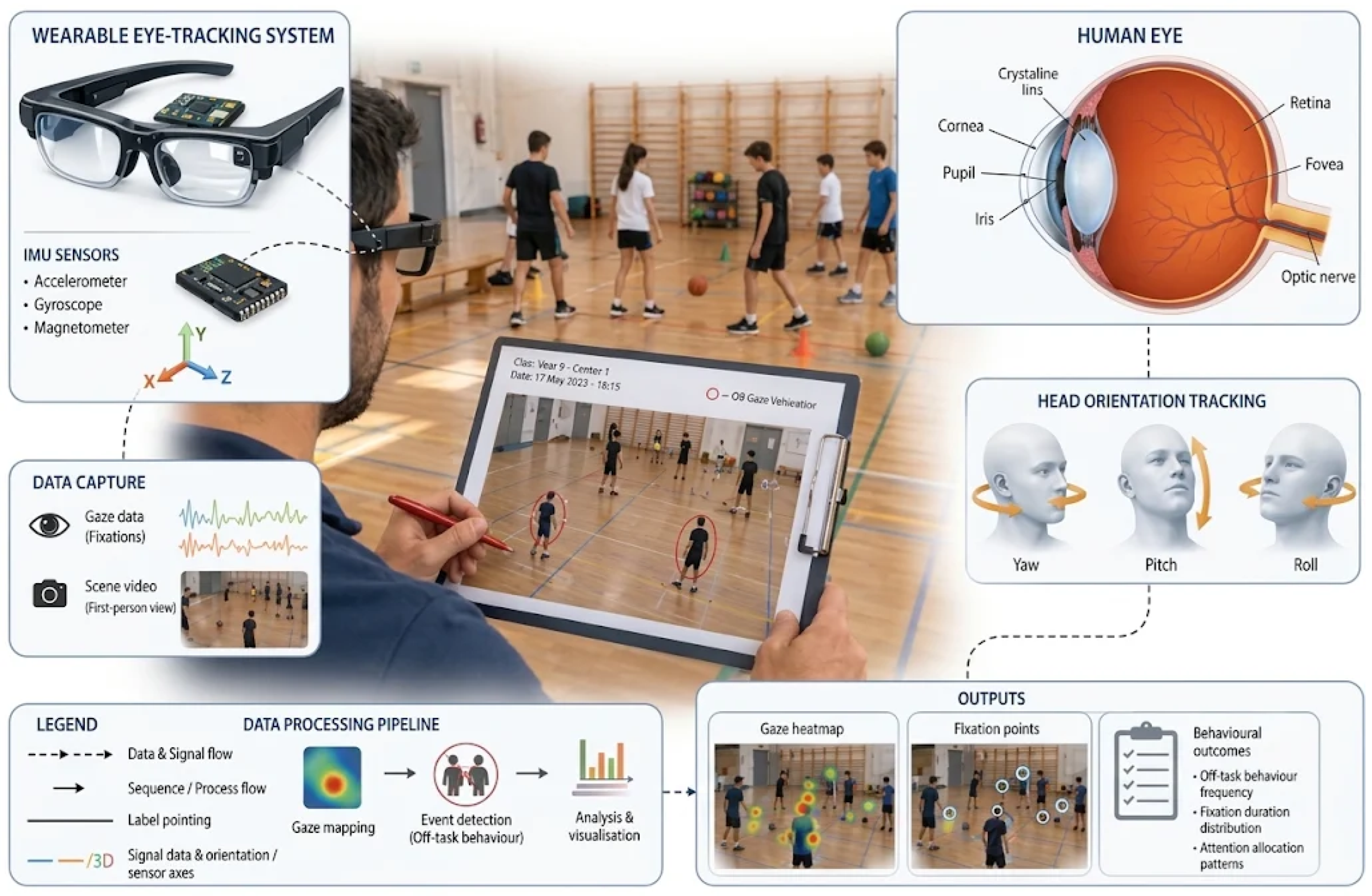
The system’s functioning relies on the pupil centre corneal reflection principle, deploying near-infrared illumination in tandem with miniature ocular cameras to detect the pupil centre and corneal reflections. These signals undergo real-time processing to calculate gaze vectors and ascertain the orientation of visual attention concerning the observed environment (Figure 1).
Figure 1.
Human eye’s cross-sectional anatomy, integrated wearable eye-tracking system and data-processing framework for analysing teachers’ visual behaviour. Source: Authors’ own elaboration.
The Tobii Pro Glasses 3 execute binocular monitoring using four integrated ocular cameras (two per eye) and register gaze data at sampling rates attaining 100 Hz, thus facilitating the dependable detection of fixation episodes, saccadic movements, and attentional reorientations during complex perceptual activities.
The apparatus delivers a mean spatial accuracy in terms of visual angle, ensuring exact quantification of gaze dispersion patterns, even within dynamic observational conditions. Moreover, the device incorporates a forward-directed scene camera equipped with an expansive field of view, enabling precise projection of gaze coordinates onto the recorded visual field [20].
To augment resilience during natural cephalic movements, the spectacles are fitted with an integrated inertial measurement unit encompassing a gyroscope, accelerometer, and magnetometer. These sensors facilitate the monitoring of head orientation and adjustment for motion-induced fluctuations, thus enhancing the stability and reliability of gaze approximation across the recording duration.
The convergence of elevated temporal resolution, spatial precision, and scene-referenced gaze mapping renders this system particularly apt for exploring perceptual–cognitive mechanisms and visual attentional allocation within educational and sport pedagogical milieus [21].
2.4.2. Video Camera
A high-definition digital video camera, adjusted to operate at a temporal frequency of 60 frames per second, was utilised to document two discrete motor practice tasks executed during an authentic Physical Education session [22].
2.4.3. Motor Competence Level Assessment Scale
To quantify the motor competence of the 9th-grade pupils featured in the instructional unit, a six-point Likert-type scale was adopted. Defined by the endpoints (1) “Very low performance” and (6) “Very high performance”, this instrument enabled a detailed appraisal of motor execution quality throughout the observed activities [23].
2.4.4. Off-Task Behaviour Identification Questionnaire
The detection of off-task conduct was operationalised through a sequential two-phase protocol, derived from established observational methodology in educational research [24].
Initially, participants responded to a dichotomous filter question: “Do you know which students displayed off-task behaviours?”. Following an affirmative reply, respondents were shown a photographic still of the 9th-grade class, captured during task performance, and asked to designate the particular pupils they had identified as disengaged (“Which ones?”).
2.5. Procedure
The empirical work was conducted across two consecutive stages: an initial period for stimulus procurement and student evaluation, followed by the experimental component involving the female and male teachers.
2.5.1. Stage 1—Classroom Documentation and Student Assessment
An authentic 9th-grade Physical Education lesson from a football instructional module was documented. Two motor practice situations were selected for subsequent analysis to establish a methodological framework for capturing ecologically representative classroom interactions: a closed motor task consisting of a technical circuit involving dribbling, passing and ball control, and an open motor task consisting of a 4-versus-4 small-sided game [17].
The selection of the target lesson and its corresponding instructional unit was conducted in close consultation with the class’s regular teacher, with careful attention paid to the academic calendar, the annual curriculum schedule, and the spatial distribution of content across the available school facilities [25].
Upon completion of the lesson, the “Motor competence level assessment scale” was administered for each student by the regular class teacher, who brought 36 years of teaching experience to the evaluation. Students were categorised across three levels: “Sufficient” (n = 2), “Good” (n = 2), and “Very good” (n = 4). This procedure guaranteed that the evaluations leveraged deep, pre-existing familiarity with student performance within authentic educational settings [23].
For the present assessment, motor competence was operationally conceptualised as the capacity to perform a broad and varied repertoire of motor tasks with proficiency, integrating fine and gross motor coordination, movement quality, and postural stability as core constitutive dimensions [26,27].
2.5.2. Stage 2—Oculometric Assessment
Participants individually viewed the recorded lesson on a 1920 × 1080 pixel monitor while wearing Tobii Pro Glasses 3. They were seated approximately 60 cm from the display, with eye level aligned to the centre of the screen [24].
Prior to data collection and before each video segment, a calibration procedure was performed using a three-second fixation target (“+”) and verified to ensure accurate gaze registration while minimising potential attentional bias. Gaze data were recorded continuously throughout observation [28].
Before viewing the video, participants received standardised contextual information concerning the lesson objectives, instructional content and performance criteria. The briefing detailed the instructional sequence (specifying lesson number and pedagogical objective), as well as the core pedagogical components—namely, the tasks administered, the critical performance elements and the success criteria anticipated from the 9th-grade students [11].
This information was provided to facilitate pedagogically informed observation, ensuring that participants possessed sufficient contextual understanding of the instructional setting while minimising potential priming effects that might otherwise bias their visual attention patterns [29].
Immediately after viewing the stimulus, participants completed the off-task behaviour identification questionnaire. Prior to questionnaire administration, a standardised definition of off-task behaviour was provided to ensure conceptual consistency across participants. This preliminary exposition served to establish a shared conceptual foundation prior to the elicitation of subjective reports [30,31].
The assessment followed a two-step structure: participants first indicated whether they could identify which students displayed off-task behaviour, and then proceeded to explicitly select those students. Because the task focused specifically on the detection of target behaviours, successful identification was defined by the accurate selection of the students who exhibited off-task behaviour. Based on this criterion, participants were categorised into successful (22) and unsuccessful (38) identification groups.
2.6. Variables
2.6.1. Independent Variables
The predictor variables operationalised within this study encompassed four conceptually disparate categories of student-level attributes: (i) the overt motor competence level of each 9th-grade pupil during the observed motor tasks; (ii) the prevalence of off-task behaviour exhibited by pupils throughout the recorded session; (iii) the precision with which female and male teachers recognised pupils displaying off-task behaviour; (iv) the gender of the observed pupils.
These variables were chosen to incorporate both objective pupil characteristics and the perceptual outcomes of the female and male teachers’ observational processes, thereby harmonising with the study’s principal objective of clarifying the relationship between visual attention and pedagogical noticing [8].
2.6.2. Dependent Variables
The outcome measures comprised the full set of gaze parameters derived from teachers’ oculomotor activity during stimulus observation. The stimulus material consisted of two standardised video clips recorded during an authentic Physical Education lesson: task 1 (a closed motor task lasting 60 s) and task 2 (an open 4-versus-4 motor task lasting 60 s).
Eye-tracking data were processed using Tobii Pro Lab software (version 1.207). Fixation events were detected using the Tobii I-VT (Velocity-Threshold Identification) Fixation Filter, set to a velocity threshold of 30°/s over a minimum fixation duration window of 60 ms. Data quality was strictly checked; recordings with gaze sample availability below 85% or displaying unrecoverable loss of tracking due to excessive head movements were excluded prior to statistical analysis [32].
Because students moved continuously throughout both tasks, dynamic, frame-by-frame polygon dynamic Areas of Interest (AOIs) were delineated and continuously updated for each individual pupil (AOI1 through AOI8). Overlapping or temporarily obscured students were handled by adjusting AOI boundaries to match visible body contours, ensuring that gaze points were correctly mapped onto the corresponding pupil.
Collectively, these metrics furnish a multidimensional characterisation of visual attention distribution across the observed pupil sample, capturing both the spread and concentration of perceptual involvement [33].
2.7. Statistical Analysis
For analytical purposes, discrete AOI were delineated for each 9th-grade pupil visible in the video stimulus (designated AOI1 through AOI8). Utilising Tobii Pro Lab software (version 1.207), each AOI was demarcated to extract fixation metrics specific to each individual pupil, thereby enabling granular, pupil-level examination of gaze dispersion across the observed class.
To evaluate visual attention allocation during pedagogical observation, linear mixed models (LMM) with type III tests of fixed effects were executed for each of the three dependent eye-tracking parameters: total fixation duration (ms), average fixation duration (ms), and number of fixations.
A random intercept for teacher ID was included in all models to account for baseline subject-level variability. To address the nested non-independence of repeated observations originating from the same pupils (AOI1 through AOI8) across distinct task environments (closed task 1 and open task 2), a repeated-measures covariance matrix (first-order autoregressive/unstructured) was explicitly specified within the LMM architecture.
The fixed-effects structure was fully specified as a full factorial model comprising the primary fixed factors—teacher’s sex (female vs. male) and task typology (closed vs. open)—alongside their full two-way and three-way interaction terms with pupil-level contextual variables (motor competence level, behaviour, off-task identification, and student’s sex) [34].
Models were estimated using restricted maximum likelihood, and denominator degrees of freedom for all fixed-effects tests were computed using Satterthwaite’s approximation method. Model assumptions, including normality and homoscedasticity of conditional residuals, were confirmed visually via Q-Q plots and residual-versus-fitted value scatterplots, alongside formal diagnostic checks. To control for type I error rate and safeguard against false positives arising from multiple pairwise comparisons across sub-groups and contexts, Bonferroni corrections were applied to all estimated marginal means (EMM) post hoc tests.
All statistical procedures were carried out employing IBM SPSS Statistics (version 29; Armonk, New York, United States of America), with the criterion for statistical significance set at p = 0.05 across all tests.
3. Results
3.1. Teachers’ Total Fixation Duration
With respect to overall viewing time, statistically significant main effects were observed for both primary independent variables. A significant main effect of teacher’s sex, F(1, 58) = 4.19, p = 0.045, demonstrated systemic differences in the total duration of visual attention allocated by male and female teachers. Furthermore, task typology yielded a robust main effect, F(1, 1354) = 123.97, p < 0.001, indicating that total fixation duration was strongly modulated by the specific perceptual and cognitive demands inherent to each observational task (Table 1).
Table 1.
Statistical analysis of teachers’ total fixation duration.
Statistically significant differences in total fixation duration across teacher sex and task typology further varied according to contextual student characteristics. Specifically, significant differential effects were identified for student motor competence level, F(5, 1354) = 37.27, p < 0.001, student behaviour, F(3, 1354) = 3.12, p = 0.025, and student identification, F(3, 1354) = 2.70, p = 0.044. In contrast, visual duration patterns across teacher sex and task typology showed no significant differentiation as a function of student’s sex, F(3, 1354) = 0.97, p = 0.405.
3.2. Teachers’ Average Fixation Duration
Regarding cognitive processing depth—as operationalised by average fixation duration—no statistically significant main effect was detected for teacher’s sex, F(1, 58) = 0.55, p = 0.460, indicating that male and female teachers maintained comparable mean processing times per fixation. Conversely, task typology exerted a significant main effect, F(1, 1354) = 7.10, p = 0.008, confirming that visual processing depth per individual fixation was primarily governed by task structure rather than teacher sex (Table 2).
Table 2.
Statistical analysis of teachers’ average fixation duration.
When evaluating visual processing depth across teacher sex and task conditions in specific student contexts, statistically significant differences were observed across student motor competence level, F(5, 1354) = 11.28, p < 0.001. However, patterns of average fixation duration across teacher sex and task type did not differ significantly across student behaviour, F(3, 1354) = 1.73, p = 0.159, student identification, F(3, 1354) = 0.23, p = 0.875, or student’s sex, F(3, 1354) = 0.81, p = 0.488.
3.3. Teachers’ Number of Fixations
Analysis of visual sampling frequency and search strategy revealed significant main differences for both primary factors. Teacher’s sex significantly influenced fixation count, F(1, 58) = 17.44, p < 0.001, demonstrating distinct visual sampling densities between male and female teachers. Similarly, task typology exerted a pronounced main effect on fixation frequency, F(1, 1354) = 138.49, p < 0.001, reflecting substantial changes in visual exploration density across task conditions (Table 3).
Table 3.
Statistical analysis of teachers’ number of fixations.
Differences in visual sampling strategies between male and female teachers across task typologies were further moderated by student context. Statistically significant variations were detected across student motor competence level, F(5, 1354) = 12.99, p < 0.001. In contrast, fixation frequency patterns across teacher sex and task typology did not reach statistical significance for student behaviour, F(3, 1354) = 2.50, p = 0.058, student identification, F(3, 1354) = 1.60, p = 0.187, or student’s sex, F(3, 1354) = 1.12, p = 0.339.
4. Discussion
The present study investigated whether teacher gender gave rise to differences in visual attentional deployment during a video-based observation task depicting authentic Physical Education teaching situations, considering students’ motor competence, behavioural engagement, off-task behaviour identification, and gender.
Rather than revealing a uniform attentional bias, the LMM demonstrate that gender-related differences in teacher gaze are metric-specific and highly context-dependent, manifesting prominently in total viewing duration and visual sampling frequency rather than individual processing duration [35].
Specifically, while total duration and fixation counts varied significantly between male and female teachers, average fixation durations showed no statistically significant differences across conditions (p > 0.05). Rather than demonstrating formal statistical equivalence, this pattern simply indicates that individual processing time per fixation did not significantly differ as a function of teacher gender under the tested conditions [32].
From an eye-tracking perspective, this distinction between sampling frequency and duration per fixation is critical, as they index distinct cognitive operations: fixation duration indexes the immediate visual processing load at a specific location, whereas fixation frequency reflects the rate of visual sampling density and gaze shifts across space. Higher fixation counts should be interpreted as increased visual exploration rather than direct evidence of functional attentional reorientation or cognitive processing depth [36].
Consequently, female and male pre-service teachers spent comparable time processing information during any given gaze pause, yet female teachers exhibited a significantly higher fixation frequency, generating more fixations across observed students under specific task demands. This indicates that when spatial arrangements are predictable, female teachers adopt a higher visual sampling density, displaying a greater number of fixations without lengthening individual fixation pauses [37,38].
When considering student motor competence, the interaction model revealed that during structured, closed motor tasks, female teachers allocated significantly greater total fixation time and a higher number of fixations towards students, particularly those displaying high motor competence. This indicates that when spatial arrangements are predictable, female teachers display a higher visual sampling density, generating a greater number of fixations towards students without lengthening individual fixation pauses [39,40].
In contrast, during open motor tasks characterised by continuous spatial fluidity and unpredictable interactions, gender-related differences in visual deployment largely vanished across all motor competence categories. The dynamic complexity of open tasks likely imposes severe perceptual demands that override individual gaze tendencies, forcing all teachers into a reactive visual search pattern constrained by scene dynamics [15,41].
A similar contextual pattern emerged regarding student behavioural engagement. After adjusting for multiple comparisons via Bonferroni correction, the interaction between teacher sex, task typology, and student behaviour for fixation frequency showed a non-significant trend (F(3, 1354) = 2.50, p = 0.058). Crucially, the equivalence in average fixation duration towards off-task students demonstrates that male and female teachers dedicated equal temporal investment per gaze pause when observing disruptive behaviour [42,43].
This reinforces that visual sampling frequency must be distinguished from cognitive processing depth or pedagogical interpretation. This finding underscores that visual allocation cannot be directly equated with cognitive processing depth or pedagogical interpretation, reinforcing established frameworks of teacher professional vision [12].
Regarding off-task identification, female teachers produced a higher fixation count in task 1, regardless of whether they successfully detected off-task events. Because the direct statistical association between fixation frequency and diagnostic identification accuracy was not explicitly tested, higher visual sampling cannot be assumed to drive successful off-task detection [7].
Differences in visual attention allocation should be interpreted cautiously and not directly equated with differences in cognitive processing depth or pedagogical noticing. In Physical Education, visual monitoring demands continuous discrimination between constructive movement and off-task behaviour, making mobile eye-tracking a valuable tool for describing underlying visual search patterns [32].
The broader literature confirms that teacher gaze is unevenly distributed across physical space and student sub-groups; the present findings show that teacher gender and task structure act as key interacting boundary conditions [44].
Regarding student gender, no significant interaction with teacher sex was identified across any eye-tracking parameter, although female teachers generated more fixations overall towards both male and female students in task 1. This indicates that female teachers’ increased visual sampling operated symmetrically across student gender, confirming that teacher sex and student sex represent distinct analytical dimensions in attentional research [45,46].
Collectively, these insights advance our understanding of teacher professional vision by illustrating how visual deployment adapts to the interplay between observer characteristics and task structure in dynamic environments. By demonstrating that gender differences reside in fixation frequency rather than fixation length, this study reveals subtle attentional dynamics that remain invisible under conventional observational methods [41,47].
From a didactic standpoint, these results imply that Physical Education teacher education must explicitly address patterns of visual attention allocation, treating classroom observation as a trainable skill rather than as an intuitive habit. Eye-tracking recordings can be integrated into reflective teacher training, providing empirical gaze visualisation to help pre-service teachers evaluate their own visual scanning routines [43,48].
Furthermore, teacher education programmes should carefully distinguish between visual sampling patterns and pedagogical interpretation. Because looking at an event does not inherently imply accurate cognitive processing, future research should directly model the relationship between specific oculomotor metrics and diagnostic noticing accuracy. Pedagogical interventions should train pre-service teachers not merely where to look, but how to extract meaningful diagnostic cues from their visual sampling routines [29,42].
Graduated exposure to observational tasks—moving from structured closed environments to complex open settings—may help trainees build flexible visual search habits that hold up under high environmental complexity. Developing such flexible visual strategies is essential in Physical Education, where teachers must concurrently monitor technique, tactical execution, safety, and engagement across multiple moving targets [45,49].
5. Conclusions
This study establishes that gender-related differences in pre-service Physical Education teachers’ visual behaviour are localised in specific metrics (total duration and fixation frequency) and are highly context-dependent, manifesting primarily during predictable closed tasks.
Moreover, gender-related differences in visual sampling density did not mirror off-task identification accuracy. As the direct association between fixation frequency and diagnostic success was not explicitly evaluated, these findings underscore the functional distinction between visual search deployment and pedagogical noticing.
These outcomes confirm the utility of mobile eye-tracking for mapping the complex visual demands placed on Physical Education teachers in real-time, multi-target learning environments. Pedagogically, gaze-based feedback offers a powerful medium for professional development, enabling pre-service teachers to critically reflect on their visual sampling habits and align them with instructional goals.
Study limitations include the reliance on pre-service teachers from a single institution and a standardised video-based observation setup, which may constrain generalisability to real-world teaching. Future research should evaluate in-service teachers across varying expertise levels in live classroom settings, exploring how targeted gaze training can enhance professional vision and instructional effectiveness in Physical Education.
Author Contributions
Conceptualisation, R.M. and G.D.; methodology, R.M., P.N. and G.D.; software, R.M., P.N. and G.D.; validation, R.M., P.N. and G.D.; formal analysis, P.N. and G.D.; investigation, R.M. and G.D.; resources, R.M., P.N. and G.D.; data curation, R.M.; writing—original draft preparation, R.M. and G.D.; writing—review and editing, R.M., P.N. and G.D.; visualisation, R.M., P.N. and G.D.; supervision, P.N. and G.D. All authors have read and agreed to the published version of the manuscript.
Funding
This research received no external funding.
Institutional Review Board Statement
The study was conducted in accordance with the Declaration of Helsinki, and approved by the Ethics Committee of Faculty of Sport Sciences and Physical Education, University of Coimbra (protocol code: CE/FCDEF-UC/00142024; date of approval: 5 March 2025).
Informed Consent Statement
Written informed consent has been obtained from all subjects involved in the study to publish this paper.
Data Availability Statement
The original contributions presented in this study are included in the article. Further inquiries can be directed to the corresponding author.
Acknowledgments
We thank Rui Mendes (Polytechnic Institute of Coimbra, Coimbra Education School, Coimbra, Portugal; Sport Physical Activity and Health Research & Innovation Center) for all the technical support given, as well as the Physical Education internship group of the school where the data were collected under the supervision of Rafael Baptista.
Conflicts of Interest
The authors declare no conflicts of interest.
Abbreviations
The following abbreviations are used in this manuscript:
| AOI | Area(s) of Interest |
| EMM | Estimated Marginal Means |
| LMM | Linear Mixed Models |
References
- Eckstein, M. Probabilistic Computations for Attention, Eye Movements, and Search. Annu. Rev. Vis. Sci. 2017, 3, 319–342. [Google Scholar] [CrossRef] [Scilit] [PubMed]
- Grünert, U.; Martin, P. Morphology, Molecular Characterization, and Connections of Ganglion Cells in Primate Retina. Annu. Rev. Vis. Sci. 2021, 7, 73–103. [Google Scholar] [CrossRef] [Scilit] [PubMed]
- Carrasco, M. How Visual Spatial Attention Alters Perception. Cogn. Process. 2018, 19, 77–88. [Google Scholar] [CrossRef] [Scilit] [PubMed]
- Jarodzka, H.; Holmqvist, K.; Gruber, H. Eye Tracking in Educational Science: Theoretical Frameworks and Research Agendas. J. Eye Mov. Res. 2017, 10, 3. [Google Scholar] [CrossRef] [Scilit] [PubMed]
- Gunawardena, N.; Ginige, J.A.; Javadi, B. Eye-Tracking Technologies in Mobile Devices Using Edge Computing: A Systematic Review. ACM Comput. Surv. 2022, 55, 1–33. [Google Scholar] [CrossRef] [Scilit]
- Smidekova, Z.; Janik, M.; Minarikova, E.; Holmqvist, K. Teachers’ Gaze over Space and Time in a Real-World Classroom. J. Eye Mov. Res. 2020, 13, 28. [Google Scholar] [CrossRef] [Scilit] [PubMed]
- Mendes, R.; Pereira, M.; Nobre, P.; Dias, G. Analysis of Teachers’ Visual Behaviour in Classes: A Systematic Review. Eur. J. Investig. Health Psychol. Educ. 2025, 15, 54. [Google Scholar] [CrossRef] [Scilit] [PubMed]
- Minarikova, E.; Smidekova, Z.; Janik, M.; Holmqvist, K. Teachers’ Professional Vision: Teachers’ Gaze During the Act of Teaching and After the Event. Front. Educ. 2021, 6, 716579. [Google Scholar] [CrossRef] [Scilit]
- Seidel, T.; Schnitzler, K.; Kosel, C.; Stürmer, K.; Holzberger, D. Student Characteristics in the Eyes of Teachers: Differences Between Novice and Expert Teachers in Judgment Accuracy, Observed Behavioral Cues, and Gaze. Educ. Psychol. Rev. 2021, 33, 69–89. [Google Scholar] [CrossRef] [Scilit]
- Jarodzka, H.; Skuballa, I.; Gruber, H. Eye-Tracking in Educational Practice: Investigating Visual Perception Underlying Teaching and Learning in the Classroom. Educ. Psychol. Rev. 2021, 33, 1–10. [Google Scholar] [CrossRef] [Scilit]
- Mendes, R.; Dias, G.; Pereira, M.; Nobre, P. Pre-Service Teachers’ Visual Attention to Student Performance in Physical Education Classes: Insights from Eye-Tracking Technology. J. Phys. Educ. Sport 2026, 26, 527–536. [Google Scholar] [CrossRef] [Scilit]
- Wyss, C.; Bäuerlein, K.; Mahler, S. Pre-Service and In-Service Teachers’ Professional Vision Depending on the Video Perspective—What Teacher Gaze and Verbal Reports Can Tell Us. Front. Educ. 2023, 8, 1282992. [Google Scholar] [CrossRef] [Scilit]
- Gabel, S.; Alijagic, A.; Keskin, Ö.; Gegenfurtner, A. Teacher Gaze and Attitudes toward Student Gender: Evidence from Eye Tracking and Implicit Association Tests. Soc. Psychol. Educ. 2025, 28, 72. [Google Scholar] [CrossRef] [Scilit]
- Witt, J.; Schorer, J.; Loffing, F.; Roden, I. Eye-Tracking Research on Teachers’ Professional Vision: A Scoping Review. Teach. Teach. Educ. 2024, 144, 104568. [Google Scholar] [CrossRef] [Scilit]
- Keskin, Ö.; Seidel, T.; Stürmer, K.; Gegenfurtner, A. Eye-Tracking Research on Teacher Professional Vision: A Meta-Analytic Review. Educ. Res. Rev. 2024, 42, 100586. [Google Scholar] [CrossRef] [Scilit]
- Stürmer, K.; Seidel, T.; Müller, K.; Häusler, J.; Cortina, K.S. What Is in the Eye of Preservice Teachers While Instructing? An Eye-Tracking Study about Attention Processes in Different Teaching Situations. Z. Erzieh. 2017, 20, 75–92. [Google Scholar] [CrossRef] [Scilit]
- Mendes, R.; Nobre, P.; Dias, G. Novice teachers’ visual behaviour to students’ performance in Physical Education: A mobile eye-tracking investigation. J. Phys. Educ. Sport 2026, 26, 1239–1248. [Google Scholar] [CrossRef] [Scilit]
- British Educational Research Association. Ethical Guidelines for Educational Research, 4th ed.; British Educational Research Association: London, UK, 2018; Available online: https://www.bera.ac.uk/publication/ethical-guidelines-for-educational-research-2018-online (accessed on 1 July 2026).
- Onkhar, V.; Dodou, D.; de Winter, J. Evaluating the Tobii Pro Glasses 2 and 3 in static and dynamic conditions. Behav. Res. Methods 2024, 56, 4221–4238. [Google Scholar] [CrossRef] [Scilit] [PubMed]
- Pro, T. Tobii Pro Glasses 3: Product Description and Technical Specifications; Tobii Pro: Danderyd, Sweden, 2023; Available online: https://www.tobii.com/products/eye-trackers/wearables/tobii-pro-glasses-3 (accessed on 1 July 2026).
- Dilbeck, M.; Gentry, T.; Economides, J.; Horton, J. Quotidian profile of vergence angle in ambulatory subjects monitored with wearable eye tracking glasses. Transl. Vis. Sci. Technol. 2023, 12, 17. [Google Scholar] [CrossRef] [Scilit] [PubMed]
- Hirotaka, J.; Kenichiro, N.; Yoshiaki, K. Reliability of interval time measurement method using video images in short distance sprint for STEAM physical education. Sport People 2022, 7, 37–48. Available online: https://shizusan.repo.nii.ac.jp/records/1993 (accessed on 1 July 2026).
- Holler, C.; Schüßler, A. Gauging acceptance: A multifaceted examination of physical ability and its role for peer networks in adolescent physical education. J. Early Adolesc. 2025, 45, 1124–1151. [Google Scholar] [CrossRef] [Scilit]
- Shinoda, H.; Yamamoto, T.; Imai-Matsumura, K. Teachers’ visual processing of children’s off-task behaviors in class: A comparison between teachers and student teachers. PLoS ONE 2021, 16, e0259410. [Google Scholar] [CrossRef] [Scilit] [PubMed]
- Villalta-Paucar, M.; Rebolledo-Etchepare, J.V. Visual attention in real classrooms: A study with eye-tracking in urban and rural schools of Chile. J. Eye Mov. Res. 2026, 19, 32. [Google Scholar] [CrossRef] [Scilit] [PubMed]
- Estevan, I.; Bardid, F.; Utesch, T.; Menescardi, C.; Barnett, L.; Castillo, I. Examining early adolescents’ motivation for physical education: Associations with actual and perceived motor competence. Phys. Educ. Sport Pedagog. 2021, 26, 359–374. [Google Scholar] [CrossRef] [Scilit]
- Lorås, H. The effects of physical education on motor competence in children and adolescents: A systematic review and meta-analysis. Sports 2020, 8, 88. [Google Scholar] [CrossRef] [Scilit] [PubMed]
- Niehorster, D.; Siu, W.; Li, L. GlassesValidator: A data quality tool for eye tracking glasses. Behav. Res. Methods 2023, 55, 3525–3541. [Google Scholar] [CrossRef] [Scilit] [PubMed]
- Gabel, S.; Keskin, Ö.; Kollar, I.; Lewalter, D.; Gegenfurtner, A. Guiding Pre-Service Teachers’ Visual Attention through Instructional Settings: An Eye-Tracking Study. Front. Educ. 2023, 8, 1282848. [Google Scholar] [CrossRef] [Scilit]
- Broad, A.; Bornath, D.; Grisebach, D.; McCarthy, S.; Bryden, P.; Robertson-Wilson, J.; Hazell, T. Classroom activity breaks improve on-task behavior and physical activity levels regardless of time of day. Res. Q. Exerc. Sport 2023, 94, 331–343. [Google Scholar] [CrossRef] [Scilit] [PubMed]
- Ludyga, S.; Gerber, M.; Brand, S.; Möhring, W.; Pühse, U. Do different cognitive domains mediate the association between moderate-to-vigorous physical activity and adolescents’ off-task behaviour in the classroom? Br. J. Educ. Psychol. 2022, 92, 194–211. [Google Scholar] [CrossRef] [Scilit] [PubMed]
- Chaudhuri, S.; Muhonen, H.; Pakarinen, E.; Lerkkanen, M.-K. Teachers’ Visual Focus of Attention in Relation to Students’ Basic Academic Skills and Teachers’ Individual Support for Students: An Eye-Tracking Study. Learn. Individ. Differ. 2022, 98, 102179. [Google Scholar] [CrossRef] [Scilit]
- King, A.; Bol, N.; Cummins, R.; John, K. Improving visual behavior research in communication science: An overview, review, and reporting recommendations for using eye-tracking methods. Commun. Methods Meas. 2019, 13, 149–177. [Google Scholar] [CrossRef] [Scilit]
- Pallant, J. SPSS Survival Manual: A Step by Step Guide to Data Analysis Using IBM SPSS; Routledge: London, UK, 2020. [Google Scholar]
- Huang, Y.; Miller, K.; Cortina, K.; Richter, D. Teachers’ Professional Vision in Action: Comparing Expert and Novice Teachers’ Real-Life Eye Movements in the Classroom. Z. Pädagog. Psychol. 2021, 35, 122–139. [Google Scholar] [CrossRef] [Scilit]
- Orquin, J.; Holmqvist, K. A Primer on Eye-Tracking Methodology for Behavioral Science. In A Handbook of Process Tracing Methods, 2nd ed.; Routledge: London, UK, 2019; pp. 53–64. [Google Scholar] [CrossRef] [Scilit]
- Kosel, C.; Holzberger, D.; Seidel, T. Identifying Expert and Novice Visual Scanpath Patterns and Their Relationship to Assessing Learning-Relevant Student Characteristics. Front. Educ. 2021, 5, 612175. [Google Scholar] [CrossRef] [Scilit]
- Beach, P.; McConnel, J. Eye Tracking Methodology for Studying Teacher Learning: A Review of the Research. Int. J. Res. Method Educ. 2019, 42, 485–501. [Google Scholar] [CrossRef] [Scilit]
- Goldberg, P.; Schwerter, J.; Seidel, T.; Müller, K.; Stürmer, K. How Does Learners’ Behavior Attract Preservice Teachers’ Attention during Teaching? Teach. Teach. Educ. 2021, 97, 103213. [Google Scholar] [CrossRef] [Scilit]
- Grub, A.-S.; Biermann, A.; Lewalter, D.; Brünken, R. Professional Vision and the Compensatory Effect of a Minimal Instructional Intervention: A Quasi-Experimental Eye-Tracking Study with Novice and Expert Teachers. Front. Educ. 2022, 7, 890690. [Google Scholar] [CrossRef] [Scilit]
- Grub, A.-S.; Biermann, A.; Brünken, R. Process-Based Measurement of Professional Vision of (Prospective) Teachers in the Field of Classroom Management: A Systematic Review. J. Educ. Res. Online 2020, 12, 75–102. Available online: https://www.proquest.com/openview/df5c3a4ca156b47979b297777972f8d8/1?pq-origsite=gscholar&cbl=1066349 (accessed on 1 July 2026).
- Kosel, C.; Böheim, R.; Schnitzler, K.; Holzberger, D.; Pfeffer, J.; Bannert, M.; Seidel, T. Keeping Track in Classroom Discourse: Comparing In-Service and Pre-Service Teachers’ Visual Attention to Students’ Hand-Raising Behavior. Teach. Teach. Educ. 2023, 128, 104142. [Google Scholar] [CrossRef] [Scilit]
- Gegenfurtner, A.; Lewalter, D.; Lehtinen, E.; Schmidt, M.; Gruber, H. Teacher Expertise and Professional Vision: Examining Knowledge-Based Reasoning of Pre-Service Teachers, In-Service Teachers, and School Principals. Front. Educ. 2020, 5, 59. [Google Scholar] [CrossRef] [Scilit]
- Dagienė, V.; Jasutė, E.; Dolgopolovas, V. Professional Development of In-Service Teachers: Use of Eye Tracking for Language Classes, Case Study. Sustainability 2021, 13, 12504. [Google Scholar] [CrossRef] [Scilit]
- Reuker, S.; Schicklinski, K. The Professional Vision of Physical Education Teachers. Ger. J. Exerc. Sport Res. 2024, 54, 531–540. [Google Scholar] [CrossRef] [Scilit]
- Meißner, M.; Oll, J. The Promise of Eye-Tracking Methodology in Organizational Research: A Taxonomy, Review, and Future Avenues. Organ. Res. Methods 2019, 22, 590–617. [Google Scholar] [CrossRef] [Scilit]
- Kaminskienė, L.; Horlenko, K.; Matulaitienė, J.; Ponomarenko, T.; Rutkienė, A.; Tandzegolskienė-Bielaglovė, I. Mobile Eye Tracking Evoked Teacher Self-Reflection about Teaching Practices and Behavior towards Students in Higher Education. Front. Educ. 2023, 8, 1209856. [Google Scholar] [CrossRef] [Scilit]
- Emhardt, S.N.; Jarodzka, H.; Brand-Gruwel, S.; Drumm, C.; van Gog, T. Introducing Eye Movement Modeling Examples for Programming Education and the Role of Teacher’s Didactic Guidance. In Proceedings of the 2020 Symposium on Eye Tracking Research and Applications (ETRA ’20 Short Papers); Association for Computing Machinery: New York, NY, USA, 2020; pp. 1–4. [Google Scholar] [CrossRef] [Scilit]
- Telgmann, L.; Müller, K. Training & Prompting Pre-Service Teachers’ Noticing in a Standardized Classroom Simulation—A Mobile Eye-Tracking Study. Front. Educ. 2023, 8, 1266800. [Google Scholar] [CrossRef] [Scilit]

Disclaimer/Publisher’s Note: The statements, opinions and data contained in all publications are solely those of the individual author(s) and contributor(s) and not of MDPI and/or the editor(s). MDPI and/or the editor(s) disclaim responsibility for any injury to people or property resulting from any ideas, methods, instructions or products referred to in the content. |
© 2026 by the authors. Licensee MDPI, Basel, Switzerland. This article is an open access article distributed under the terms and conditions of the Creative Commons Attribution (CC BY) license.