


Abstract
The determinants of bank credit quality have been studied extensively, yet much of the existing evidence rests on a single regression specification, so a variable’s apparent significance may be conditioned on which controls a researcher chooses to include. We confront this problem directly for the Gulf Cooperation Council (GCC) countries, providing a robustness analysis of non-performing loans (NPL) determinants for the region’s banks. We employ a balanced panel of 45 listed commercial banks drawn from all six GCC countries over the period 2010 to 2024. We examine fifteen bank-specific and four macroeconomic potential determinants of NPLs, utilizing two variants of extreme bounds analysis (EBA), namely, the strict criterion of Leamer and the more lenient criterion of Sala-i-Martin, estimated within a panel fixed-effects framework. The findings show that of the nineteen determinants routinely cited in the literature, seventeen prove fragile once their coefficients are tested across the full range of possible model specifications. None survives Leamer’s strict criterion, whereas Sala-i-Martin’s less restricted test suggests that only two variables are robust, namely, asset quality (loan intensity), which enters positively, and capital adequacy, which enters negatively, while all four macroeconomic variables are fragile on both tests. For regulators, bank-level balance sheet indicators, especially loan intensity and capital adequacy, offer a more robust starting point for NPL early-warning and stress-testing frameworks and complement macroeconomic forecasts.
1. Introduction
Credit quality lies at the heart of banking stability. The share of loans that cease to perform, commonly captured by the non-performing loans (NPL) ratio, signals not only the riskiness of a bank’s portfolio but also the resilience of the wider financial system. When NPLs accumulate, banks are required to tie up capital in loss provisions and curtail new lending, and may ultimately face threats to the solvency of the institution itself. Episodes of sharp NPL growth have repeatedly preceded banking crises in both advanced and emerging markets, prompting regulators worldwide to treat asset quality as a frontline indicator of systemic risk (Berger & DeYoung, 1997; Klein, 2013; Louzis et al., 2012). In the Gulf Cooperation Council (GCC), Bahrain, Kuwait, Oman, Qatar, Saudi Arabia, and the United Arab Emirates, this concern is sharpened by the region’s heavy dependence on hydrocarbon revenues, which transmits oil price volatility into credit cycles and exposes bank portfolios to recurrent shocks (Adedeji et al., 2019; Squalli, 2011).
A substantial empirical literature has examined the drivers of NPLs across advanced and emerging economies. Yet two problems limit what this literature can tell us about the GCC. The first is contextual: the region’s structural features, oil dependence, near-universal dollar peg, dual conventional–Islamic banking system, and recurrent geopolitical uncertainty limit the transferability of results obtained elsewhere and motivate a region-specific reassessment. The second is methodological, and it is the problem this paper foregrounds. In the literature in which theory rarely pins down the exact set of regressors that should enter the empirical model, researchers typically report a handful of specifications selected from a much larger universe of plausible alternatives. Leamer (1983) labeled this practice ‘con’ econometrics, and I. Moosa (2012) described it as ‘stir-fry’ regressions, in which covariates are added or removed until the estimates align with prior expectations. The result is a body of evidence in which the same variable is reported with opposite signs across studies, and in which apparent statistical significance may reflect specification choice rather than a genuine underlying relationship (I. N. Khatatbeh & Moosa, 2022; Moral-Benito, 2015; Steel, 2020).
This specification uncertainty is precisely what extreme bounds analysis (EBA) was designed to address. Developed by Leamer (1983, 1985) and extended by Sala-i-Martin (1997), EBA estimates a large number of alternative models and asks whether the sign and significance of each coefficient survive variation in the conditioning set; variables that remain stable are classified as robust, those that do not are classified as fragile. Applying EBA to GCC credit quality therefore does more than add another regional study: it screens the determinants that the prior literature reports, many of them with conflicting signs, for stability and so separates findings that are genuine features of the data from those that are artifacts of the particular model in which they were reported.
Against this background, this paper’s contribution is single and accurately scoped. We provide the first robustness-screened account of NPL determinants for the GCC, using EBA to distinguish the determinants that survive comprehensive specification variation from those that do not. The originality lies not in a new estimator but in bringing a robustness discipline to the regional literature that has, to date, relied exclusively on single-specification panel and GMM models. This core contribution has three direct implications, which we develop rather than present as separate novelties: it clarifies which determinants merit inclusion in regional early-warning and stress testing frameworks; it speaks to the long-standing debate over the relative weight of bank-specific versus macroeconomic factors in credit-quality formation; and it does so for a set of dollar-pegged, oil-dependent economies in which that debate is especially consequential.
Two theoretical premises discipline the exercise. The first is the trade-off, formalized by Berger and DeYoung (1997), between a moral hazard channel, in which thinly capitalized banks reach for credit risk, and a bad management channel, in which weak cost control foreshadows future loan losses. The second is the contest between a risk-taking view, under which aggressive loan expansion raises subsequent defaults, and a specialization view, under which loan-intensive banks screen borrowers more effectively. EBA is a natural adjudicator between these mechanisms: a determinant that genuinely encodes one of them should retain its sign and significance as the conditioning set varies, whereas one that merely reflects a convenient specification should not. We return to these premises when interpreting the two determinants that survive the robustness screen.
The remainder of this paper is organized as follows. Section 2 reviews the international and GCC-specific literature. Section 3 describes the data and the EBA methodology. Section 4 reports and discusses the empirical results. Section 5 sets out the research implications, recommendations, and limitations, and Section 6 concludes.
2. Literature Review and Hypotheses
Research on the determinants of non-performing loans dates back to the 1970s. Early empirical studies focused on the failures of commercial banks and thrift institutions (e.g., Altman, 1977; Martin, 1977; Sinkey, 1977) and worked on developing early-warning systems. A second generation of studies (e.g., Avery & Hanweck, 1985; Barth et al., 1985; Benston, 1985; Gajewski, 1988) sought to identify the financial factors that raise the likelihood of bank failure (Demirgüç-Kunt, 1989). The literature that followed splits into two strands, one emphasizing bank-specific drivers and the other macroeconomic ones, and, as we show below, the two strands disagree not only with each other but with themselves. Hence, it is this internal divergence that makes a robustness-based econometric methodology the appropriate tool.
2.1. Bank-Specific Determinants
Most empirical research finds that NPLs are shaped primarily by bank-specific factors, size, profitability, capital, cost efficiency, capital structure, liquidity risk, and asset composition (Saliba et al., 2023). However, the signs attached to these factors are strikingly inconsistent. For instance, on capital structure, Berger and DeYoung (1997) and Boudriga et al. (2010) report that better-capitalized banks carry fewer problem loans, consistent with the moral hazard channel; Boudriga et al. (2009) emphasize capital adequacy, bank ownership, and the legal–institutional environment. On size and loan exposure, the evidence is openly contradictory: whereas Cotugno et al. (2010) find that NPLs rise with bank size and gross loans but fall with profitability, Espinoza and Prasad (2010) report a negative capital and efficiency effect alongside a positive size, margin, and lagged credit growth effect. De Bock and Demyanets (2012) add that profitability, capital adequacy, asset quality, and ownership all push NPLs downward. The theoretical line running through these results is the one Berger and DeYoung (1997) drew: whether thin capital and weak cost control cause future losses (moral hazard and bad management channels) or whether loan-intensive expansion reflects prudent specialization rather than reckless risk-taking. Because the same variable proxies opposite mechanisms depending on the controls included, its reported coefficient is the kind of quantity EBA is built to test (Leamer, 1985).
2.2. Macroeconomic Determinants
A parallel strand emphasizes macroeconomic drivers, inflation, GDP growth, interest rates, and unemployment. Keeton and Morris (1987) showed that poor economic conditions damage loan portfolios; Salas and Saurina (2002) found real GDP growth central to NPL variation; Quagliariello (2007) reported that growth lowers NPLs while inflation raises them; Khemraj and Pasha (2009) found that growth reduces and interest rates raise NPLs; Adebola and Dahalan (2011) documented a positive interest rate effect; Anastasiou et al. (2016) found that growth lowers and unemployment raises NPLs; and Anita et al. (2022) confirmed that growth and inflation are significant in SAARC banking. Badar et al. (2013) established a long-run link between NPLs, money supply, and interest rates, while Ghosh (2015, 2017) showed regional and sector-specific conditions, public debt and unemployment prominent among them, shaping US NPLs. The pattern here mirrors the bank-specific strand, whereby GDP growth, inflation, and interest rates all switch sign and significance across studies, tracking differences in monetary regime and financial development rather than any stable structural relationship. Crucially, almost none of these studies confront the specification uncertainty this variation implies, as each reports a fixed model and treats its coefficients as settled (I. Moosa, 2012; Moral-Benito, 2015).
2.3. Cross-Country Evidence
In the international context, Gjeçi and Marinč (2018) analyzed banks in 195 countries and found that corruption is positively associated with NPLs; the effect is weaker for larger and thinly capitalized banks and stronger where the legal environment is weak. Gjeçi et al. (2023) extend this by showing that elevated NPLs feed back into more conservative lending, a reminder that credit quality determinants and credit supply are jointly determined. Kuzucu and Kuzucu (2019) compared emerging and advanced economies and concluded that GDP growth is the leading NPL driver, with bank-specific factors being insignificant for emerging markets, suggesting macroeconomic dominance. Karadima and Louri (2021) found that economic policy uncertainty raises NPLs in four European economies, an effect moderated by bank concentration, with GDP growth and ROA lowering NPLs and the net-loans-to-assets ratio raising them. Boussaada et al. (2022) identified threshold effects in the liquidity-risk–NPL relationship for MENA banks. Fitriani et al. (2025) found that growth, lending rates, and credit growth all lower NPLs in the G7, while Ozili and Delgado (2026) documented divergent significant determinants across European and African sub-samples. M. Khan et al. (2020) reach a similar conclusion for developing economies, reporting that the determinants they identify are sensitive to the estimator and control set adopted. Annas et al. (2024) reach a comparable conclusion for an emerging economy, finding that both macroeconomic and bank-specific factors shape non-performing loans, while the significance of individual determinants remains contingent on the specification adopted. Read together, these studies are less a cumulative body of knowledge than a catalogue of context-dependent findings, the very condition under which robustness screening, rather than another point estimate, is the informative next step.
2.4. Evidence from GCC Banking Systems
Studies of GCC banks point to structural features, oil dependence, fixed exchange rate regimes, and the coexistence of Islamic and conventional banks that may shape NPLs differently than elsewhere. Espinoza and Prasad (2010), using a dynamic panel of roughly 80 banks, linked rising NPLs to weaker growth, higher interest rates, and greater risk aversion, with macroeconomic shocks accumulating over a three-year window. Abdelbaki (2019), applying OLS, fixed effects, Arellano–Bond GMM, and VAR, found that non-oil GDP growth, domestic private credit, and inflation lower NPLs and interest rates and financial crises raise them. Farooq et al. (2019), using two-step GMM, reported that ROA lowers NPLs, the cost-to-income ratio raises them, and inflation lowers them. Al-Romaihi and Kumar (2026) found that non-oil real GDP growth and inflation lower NPLs and that a volatility index and inefficiency raise them, alongside adverse crisis effects. Research concerning the region’s listed banks consistently concludes that bank-level fundamentals are paramount for stability outcomes (I. N. Khatatbeh et al., 2025). A notable point of controversy arises from four GCC studies utilizing overlapping samples, where inflation is alternately reported to reduce and increase non-performing loans (NPLs). Additionally, the significance of bank size and efficiency fluctuates depending on the estimator and control set employed.
Table 1 provides an overview of the key characteristics of the selected literature. The table highlights the diversity in estimation approaches, model specifications, and explanatory variables employed across prior studies, which motivates the adoption of a robust empirical design in the present study. Given the considerable variation in methodological choices and control variables, the consistency and significance of potential determinants cannot be presumed and should be examined through direct empirical testing.
Table 1.
Summary of the surveyed empirical literature.
3. Data and Methodology
3.1. Sample and Data Sources
We construct a balanced panel of 45 listed conventional commercial banks operating in the six GCC countries (Bahrain, Kuwait, Oman, Qatar, Saudi Arabia, and the United Arab Emirates) over fifteen consecutive years (2010–2024). Bank-level financial data are sourced from Bloomberg, while macroeconomic series are obtained from the IMF’s World Economic Outlook database. The sample period begins in 2010 to align with the post-global financial crisis period and ends in 2024, the most recent year for which complete data is available across all banks. The resulting panel comprises 675 bank-year observations. Table 2 presents the distribution of sample banks by country, along with the proportion of each country’s listed conventional commercial banking sector that the sample encompasses.
Table 2.
Sample composition by country.
Islamic banks are excluded from the sample because their distinctive risk-sharing structure and Shari’a-compliant asset composition produce profitability and credit quality dynamics that differ systematically from those of conventional commercial banks (Hadriche, 2015; Alharthi, 2017). Accordingly, two considerations bear on the exclusion. First, the direction of the bias is analytically determinate for the pooled alternative. Most importantly, Islamic banks recognize impairment on profit and loss sharing and “Murabaha” exposures under different contractual triggers, so the mapping from a given balance sheet configuration to a reported non-performing ratio is not the same function across the two bank types. Hence, pooling would therefore impose a common slope vector on two distinct data-generating processes, and the resulting coefficients would be a variance-weighted average of the two and informative about neither. Second, the exclusion does limit external validity, as Islamic banks hold a material and rising share of GCC banking assets, so the conventional segment findings cannot be extrapolated to the region’s banking system in aggregate. We accordingly narrow the policy implications in Section 5 and Section 6 to the listed conventional segment and consider a formal conventional-versus-Islamic comparison.
3.2. Variables and Measurement
The dependent variable is the non-performing loans (NPL) ratio, measured as non-performing loans divided by total loans. The potential set comprises 19 regressors drawn from the empirical NPL literature: 15 bank-specific variables, capturing liquidity, size, profitability, efficiency, loan intensity, asset and operating management, deposit funding, loan growth, capitalization, intermediation spreads, and revenue diversification, and 4 macroeconomic variables, capturing the exchange rate, the lending rate, inflation, and GDP growth. Variable definitions are reported in Table 3.
Table 3.
Variables, definitions, and measurements.
3.3. Outliers and Data Screening
The descriptive statistics display extreme values for several variables, notably efficiency (X6), loan growth (X11), the NPL ratio, and loan intensity (X7). These arise from a small number of bank-years in which operating income approaches zero or a bank undertakes a step change in its loan book. The presence of these tails matters in an EBA setting, and we do not minimize it: because the procedure classifies a variable by the behavior of its coefficient across hundreds of specifications, a handful of leverage points can in principle move the extreme bounds and shift a classification without reflecting anything systematic in the data. The design and results disposition incorporate two features that address this concern without eliminating it. Firstly, the Sala-i-Martin criterion, which underpins both robust classifications, evaluates the entire distribution of coefficients rather than focusing solely on the extreme bounds. This approach reduces its susceptibility to a single leverage-driven specification compared to the Leamer criterion. The Leamer criterion, being more sensitive to outliers, classifies every variable as fragile, ensuring that no positive claim in the paper relies on it. Secondly, variables with the most pronounced tails (X6, X11) are deemed fragile, ensuring that no robust classification is influenced by an outlier-heavy series. Moreover, this limitation is explicitly noted in Section 5, where re-estimation on a winsorized panel is identified as a priority for future research.
3.4. Model Specification and the Extreme Bounds Procedure
The issue EBA addresses is that a researcher testing whether, say, capital adequacy affects NPL must also decide which other variables to control for, where theory offers little guidance (I. Moosa, 2012). In this sense, different defensible choices yield different coefficients, and EBA declines to make that choice. Instead, it estimates the model repeatedly under every admissible combination of controls and inspects the resulting distribution of the coefficient on the variable of interest. Accordingly, a variable is deemed robust if its estimated effect keeps the same sign and remains statistically significant no matter which controls accompany it; thus, the conclusion does not depend on the model specification (selection of the control variables set). By the same logic, a variable is fragile if its coefficient changes sign, or loses significance, as the control set varies, indicating that a study reporting it as significant may simply have chosen a control set in which it was.
In this study, we utilize two variants of EBA. First, the strict variant of EBA is Leamer’s (1985), which looks only at the two extreme estimates (the lowest and highest coefficient obtained across all specifications) and requires both to be significant with the same sign. It is an all-or-nothing test, where a single specification in which the coefficient crosses zero condemns the variable, regardless of how well it performs in the other several hundred estimates. Second, Sala-i-Martin (1997) argued this is an unreasonably hard-to-pass test since it lets one outlying model overturn an otherwise consistent body of evidence. His alternative examines the whole distribution of coefficients and asks what fraction of it falls on one side of zero; a variable is robust if at least 95% does.
The baseline specification is a fixed-effects (within) regression of the NPL ratio on the focus variable Z and a rotating subset of the remaining doubtful variables, with bank-level fixed effects:
where Yit is the NPL ratio of bank i in year t; Zf,it is the focus variable whose robustness is being tested; M is a subset of three regressors drawn from the remaining eighteen potentials; Xj,it denotes those doubtful regressors; α is the intercept; μi is a bank fixed effect; and εit is an idiosyncratic error term, for which heteroskedasticity-consistent (HC1) standard errors clustered at the bank level are computed following MacKinnon and White (1985).
Yit = α + βf Zf,it + Σj∈M βj Xj,it + μi + εit
For a given focus variable, the procedure draws every possible subset of three doubtful variables from the eighteen remaining potentials. This yields C(18,3) = 816 candidate specifications per focus variable. Because each of the 19 potential determinants takes its turn as the focus variable, the procedure estimates 19 × 816 = 15,504 regressions in total. Accordingly, the number of distinct four-variable models spanned C(19,4) = 3876.
Furthermore, the choice of three doubtful variables per subset follows the convention established in the applied EBA literature (e.g., Levine & Renelt, 1992; Sala-i-Martin, 1997; I. A. Moosa & Cardak, 2006) and reflects a trade-off rather than a natural constant. A larger conditioning set tests robustness against richer models; however, it rapidly exhausts the degrees of freedom available in a panel of 675 observations across 45 bank fixed effects and raises the incidence of near-singular design matrices that the collinearity filter must then discard, so the surviving specifications become a selected, rather than a representative, subset of the model space. On the other hand, a smaller set makes the test weaker and less informative. Following Sala-i-Martin’s (1997) seminal work, three is the standard compromise, and it is the size used in the canonical applications against which our results are comparable.
We implement the procedure using the ExtremeBounds package in R (version 4.5.2) (Hlavac, 2016). The fixed-effects estimator is used as the baseline because the within transformation absorbs time-invariant bank heterogeneity, differences in business model, ownership, and supervisory regime across the 45 banks that would otherwise contaminate the cross-sectional comparison of determinants (Sala-i-Martin, 1997; Hlavac, 2016). Multicollinearity is addressed at the specification level, where any combination of regressors yielding a variance inflation factor above 10 is automatically excluded, ensuring that surviving estimates are not artifacts of near-singular design matrices (I. Khatatbeh, 2019).
4. Empirical Results
4.1. Descriptive Statistics and Pairwise Correlations
Appendix A Table A1 reports descriptive statistics for the dependent variable and the 19 potential regressors. The mean NPL ratio across the panel is 4.15% with a standard deviation of 5.59%, indicating considerable cross-sectional and time-series variation in credit quality. Bank size (X3, log of total assets) has a mean of 24.05 and a standard deviation of 1.83, reflecting the well-known concentration of GCC banking around a small number of large institutions. Profitability (X5, ROA) averages 1.31%. The efficiency ratio (X6) and loan growth (X11) exhibit the most pronounced tails, driven by bank-years with near-zero operating income and by step changes in loan books, respectively. Moreover, Appendix A Table A2 reports the pairwise Pearson correlation matrix. Two pairs warrant attention. Total assets (X3) and cash liquid assets (X4) correlate at 0.932, reflecting their shared scale dependence on bank size. Profitability (X5) and asset management (X8) correlate at 0.970, since asset management is a near-mechanical reformulation of operating income relative to total assets. These patterns are addressed at the specification level by the VIF > 10 exclusion rule described in Section 3.4.
4.2. Leamer’s EBA
Table 4 reports the strict variant of EBA introduced by Leamer (1985). For each potential determinant, we report the minimum and maximum coefficient estimates obtained across all admissible specifications, their associated t-statistics, the percentage of regressions in which the coefficient is statistically significant at the 5% level with the same sign as the median, and the resulting classification. Of the 19 potential determinants, none survives Leamer’s strict test: for every variable, the extreme bounds straddle zero or at least one bound is statistically insignificant. The variable that comes closest is efficiency (X6), which is statistically significant in 57.2% of the admissible regressions but reverses sign across specifications, with a minimum coefficient of −0.0032 (t = −2.03) and a maximum of 0.0030 (t = 1.36). All 19 potential variables are accordingly fragile under the Leamer criterion.
Table 4.
Fragile and robust determinants of NPLs (Leamer’s EBA—fixed effects).
Nevertheless, Leamer’s criterion is exceptionally demanding and is failed by the great majority of variables in most published applications (Levine & Renelt, 1992; I. N. Khatatbeh & Abu-Alfoul, 2024); therefore, its informational value is comparative as it tells us that no NPL determinant in this literature is unconditionally stable and it establishes the baseline for the Sala-i-Martin results in the following subsection.
4.3. Sala-i-Martin’s EBA
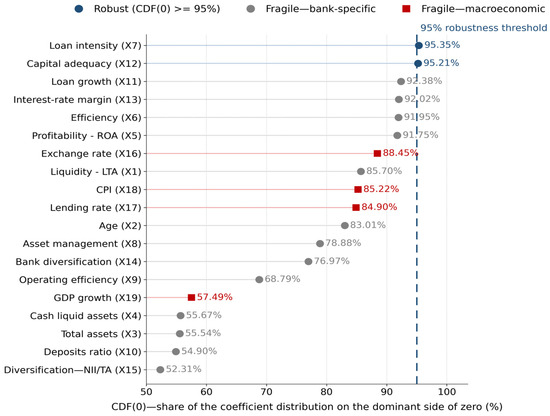
Table 5 reports Sala-i-Martin’s (1997) less restrictive EBA. We report the weighted mean coefficient across all admissible specifications and the value of the cumulative distribution function on the dominant side of zero, CDF(0), under the generic model variant, which makes no distributional assumption about the coefficient distribution across specifications. A variable is classified as robust if its CDF(0) is at least 95% on either side of zero. Only two variables emerge as robust: loan intensity (X7), with CDF(0) = 95.35% and a positive sign, and capital adequacy (X12), with CDF(0) = 95.21% and a negative sign. Efficiency (X6), significant in the majority of Leamer specifications, falls short here (CDF(0) = 91.95%) and is classified as borderline robust.
Table 5.
CDF(0) of fragile and robust determinants of NPLs (Sala-i-Martin’s EBA—fixed effects).
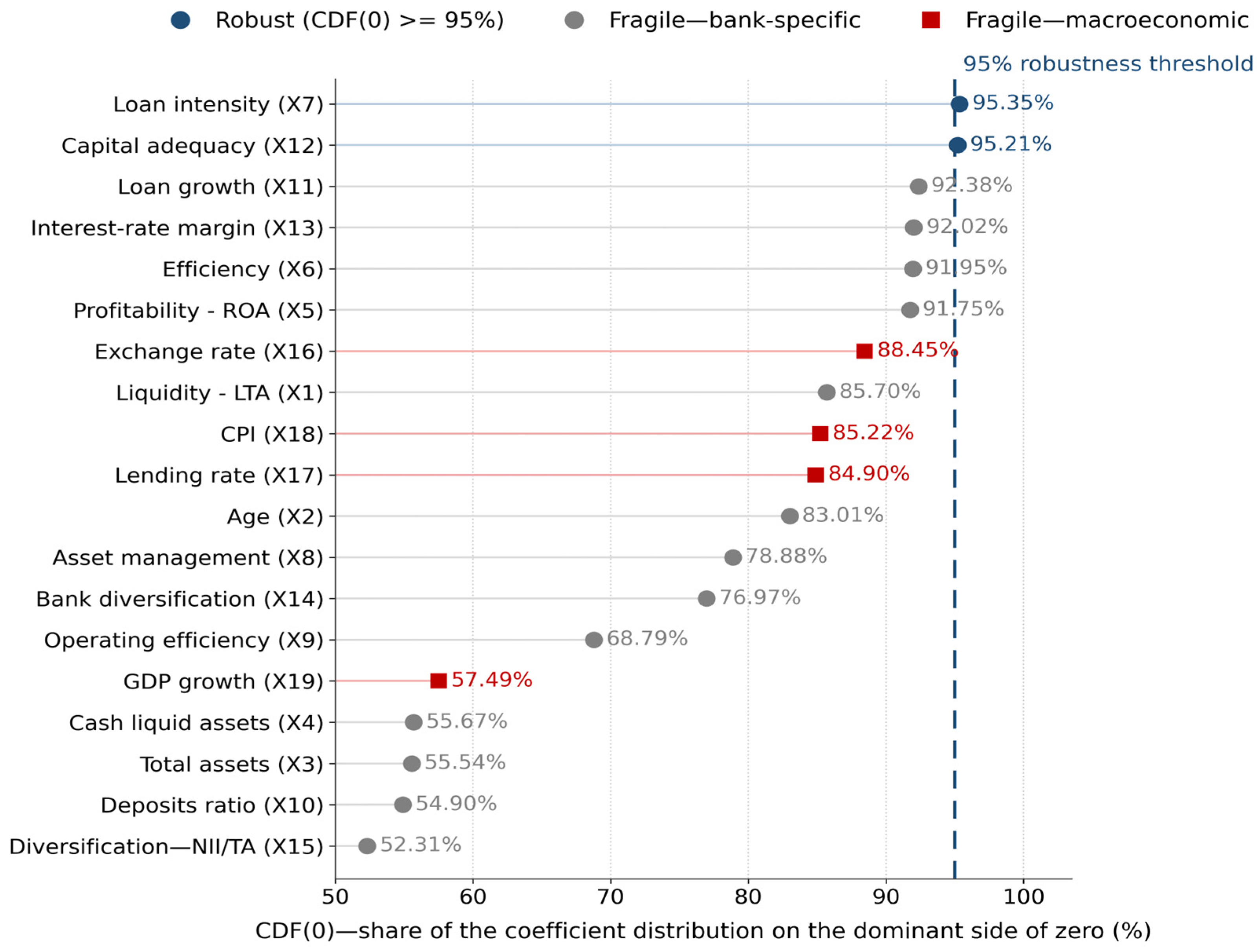
Furthermore, Figure 1 plots each determinant’s CDF(0) against the 95% cut-off, marking the proximity of the two robust variables to the threshold. Moreover, four variables, clustered between 91% and 93%, could also be considered robust under the 90% cut-off threshold (loan growth, interest rate margin, efficiency, ROA).
Figure 1.
Distribution of CDF(0) across the nineteen potential determinants.
4.4. Discussion of Results
Under the fixed-effects EBA, no determinant satisfies Leamer’s strict robustness criterion. Efficiency (X6) comes closest, significant in 57.2% of the specifications, but its sign is not stable across conditioning sets, and its Sala-i-Martin CDF(0) of 91.95% is marginal to the threshold. Its fragility is directly instructive for the theoretical debate of EBA application. The bad management hypothesis of Berger and DeYoung (1997) predicts that cost inefficiency precedes loan losses, and single-specification GCC studies have duly reported efficiency (measured by the cost-to-income ratio) as a significant NPL driver (Espinoza & Prasad, 2010; Al-Romaihi & Kumar, 2026; Farooq et al., 2019). Our results do not refute that hypothesis, but they do show that the empirical support for it in this region is conditional on the control set; once bank fixed effects absorb persistent differences in the operating model, the efficiency–NPL relationship cannot be signed reliably.
Under the 95% threshold cut-off suggested by Sala-i-Martin (1997), two variables are deemed robust. First, loan intensity (X7), which is measured by the ratio of loans to total assets, has a weighted mean coefficient of +0.0472 with CDF(0) = 95.35%. The positive sign indicates that banks committing a larger share of their balance sheet to lending exhibit higher NPL ratios, an association consistent with the risk-taking channel, in which expansion of loan exposure relative to total assets raises subsequent default rates (Naili & Lahrichi, 2022; Misman & Bhatti, 2020), and inconsistent with the specialization view under which loan-intensive banks develop superior screening capabilities. The result also corresponds to the prior literature, in which Karadima and Louri (2021) report a positive net-loans-to-assets effect for European banks, whereas the specialization reading has been advanced for banks operating in more concentrated lending markets. Boussaada et al. (2023) document comparable loan-growth–credit-risk dynamics for European banks under system GMM. Accordingly, we stress that a bank whose loan book is deteriorating will mechanically show both a rising NPL ratio and, if impairment shrinks other asset classes more slowly, a shifting loans-to-assets share.
Second, capital adequacy (X12), which is measured by the ratio of total equity to total assets, has a weighted mean coefficient of −24.9913 with CDF(0) = 95.21%. The negative sign indicates that better-capitalized banks have lower NPL ratios, consistent with the moral hazard hypothesis (Berger & DeYoung, 1997). From this perspective, banks with thinner equity buffers face stronger incentives to take credit risk in pursuit of higher returns (Saliba et al., 2023; Bayar, 2019; Makri et al., 2014). Moreover, a complementary mechanism, distinct from moral hazard and observationally similar, is regulatory arbitrage, under which banks holding equity buffers close to the regulatory minimum may have incentives to delay recognition of impaired exposures, since each additional NPL recognized erodes the capital ratio further (Beck et al., 2013).
Furthermore, the results show that there are four determinants classified as borderline robust that exhibit cumulative distribution function (CDF(0)) values ranging from 90% to less than 95%. Specifically, these four determinants fall just below the robust threshold, with CDF(0) values between 91.75% and 92.38%, and could be considered as robust using the less restrictive requirements of Sala-i-Martin EBA. Namely, profitability (X5, CDF(0) = 91.75%), efficiency (X6, 91.95%), interest rate margin (X13, 92.02%), and loan growth (X11, 92.38%). Each of these determinants is associated with a negative weighted mean coefficient. To begin with, profitability (X5) has a negative weighted mean (−0.8712), indicating that more profitable banks tend to report lower NPL ratios. Economically, this is the most intuitive, as banks generating stronger operating returns can absorb loan losses, can price risk more conservatively, and are less pressed to reach for yield in marginal borrowers. The sign accords with the bad management hypothesis of Berger and DeYoung (1997), with weak profitability being a symptom of the same managerial deficiencies that later surface as impaired loans. The results correspond to previous studies by De Bock and Demyanets (2012), Ghosh (2015), Karadima and Louri (2021), and, within the GCC, Farooq et al. (2019) and Al-Romaihi and Kumar (2026).
Likewise, the interest rate margin (X13) has a negative weighted mean (−1.0392). Thus, a wider net interest margin is associated with lower NPLs. Accordingly, margin proxies franchise value and pricing power, whereby banks able to sustain wide spreads enjoy charter value rents they are reluctant to jeopardize through lax underwriting, dampening risk-taking (Keeley, 1990). Moreover, a wide margin reflects efficient intermediation and strong core earnings, the same underlying quality that profitability captures. Loan growth (X11) exhibits a negative weighted mean coefficient (−0.0207), suggesting that higher lending growth is associated with lower contemporaneous NPL ratios. This result may reflect a denominator effect, whereby rapid loan expansion increases total loans faster than new loans become non-performing, temporarily reducing the NPL ratio. Its borderline robustness (CDF(0) = 92.38%) indicates a relatively stable but timing-sensitive relationship, highlighting the need for future dynamic analyses using lagged credit growth measures.
Lastly, efficiency (X6) has a CDF(0) value of 91.95% and is based on a predominantly negative weighted mean (−0.0010), indicating that lower operating expenses relative to income are associated with lower non-performing loans (NPLs), as predicted by the bad management hypothesis (Berger & DeYoung, 1997) and supported by the findings of Farooq et al. (2019). The GCC literature has regarded cost efficiency as a definitive NPL driver (Espinoza & Prasad, 2010; Al-Romaihi & Kumar, 2026).
The fragility of the macroeconomic determinants is equally notable. None of GDP growth (X19), inflation (X18), the lending rate (X17), or the exchange rate (X16) survives either test. The fragility indicates specification sensitivity, not economic irrelevance. That a variable’s coefficient changes sign or loses significance as the conditioning set varies establishes that studies reporting it as significant may owe that significance to their control set; it does not establish that the variable carries no information about future credit quality. In other words, a macroeconomic indicator can be fragile in the EBA sense and still have genuine early-warning value. The finding is that GDP growth, inflation, and interest rates are not unconditionally stable determinants of NPLs in the GCC. This is a corrective to the macro-dominant conclusions of Kuzucu and Kuzucu (2019), Abdelbaki (2019), and Al-Romaihi and Kumar (2026), whose specifications omit the bank-level aggregates against which the macroeconomic effect does not survive, but it is not a verdict against macroeconomic monitoring.
5. Research Implications, Limitations, and Future Research
The findings carry far-reaching implications for prudential supervision in the GCC banking sector, but their scope is bounded in two respects that we state first. Particularly, the estimates describe listed conventional commercial banks and not the GCC banking system as a whole, and they identify stable associations rather than causal effects.
The results reveal two robust bank-level balance sheet indicators: loan intensity and capital adequacy. These indicators set a starting point for NPL early-warning frameworks. This argues for weighting balance sheet indicators at least as heavily as macroeconomic forecasts in supervisory dashboards. Moreover, the negative association between capital adequacy and NPLs provides conditional empirical support for the emphasis on equity-based capital buffers in the GCC’s implementation of Basel III.
Furthermore, four limitations bound the findings and serve as venues for future research. First, the sample covers listed conventional commercial banks only; Islamic banks, which hold a material share of GCC banking assets, are excluded, so the results do not describe the regional banking system in aggregate. Second, the macroeconomic potential set is narrow, omitting the oil price, non-oil GDP growth, the fiscal stance, real estate dynamics, and macro-governance factors. Third, the EBA framework addresses specification uncertainty, not endogeneity; the estimates are robust associations, and a causal account of the capital–NPL and loan-intensity–NPL relationships would require an identification strategy the current design does not supply. Fourth, the static framework leaves aside other sources of model uncertainty, functional form, dynamic specification, and structural breaks, as well as emerging risks, including climate exposure, digital disruption, and geopolitical instability.
These boundaries define a constructive agenda that would extend and generalize the present evidence. A natural first step is to broaden the sample beyond listed conventional commercial banks to include Islamic institutions, whose risk-sharing contracts reshape the moral hazard calculus and whose inclusion would permit a system-wide characterization of GCC credit risk and a test of whether the robust determinants identified here carry over to that segment. A second avenue is to enlarge the macroeconomic conditioning set by incorporating oil prices, non-oil output growth, the fiscal stance, and real estate dynamics so that regional credit risk is assessed against a specification more fully matched to the area’s structural features. A third research direction is to complement the extreme-bounds screen with dynamic panel estimators, notably system GMM, that accommodate the feedback between credit quality and balance sheet composition and advance the analysis from robust association to causal identification. The static design further invites attention to additional sources of model uncertainty, including functional form and structural breaks. Finally, as longer panels become available, the framework can be extended to emerging banking risks, climate exposure, digital disruption, and geopolitical instability, whose relevance to the region is set to intensify.
6. Conclusions
This study examines the robustness of NPL determinants in GCC banking systems. Using a balanced panel of 45 listed conventional commercial banks across the six GCC countries over the period 2010–2024, we evaluate the stability of commonly employed NPL determinants under model uncertainty arising from specification choice. We apply two complementary variants of EBA, namely, Leamer’s (1985) stringent criterion and Sala-i-Martin’s (1997) modified variant of EBA, to assess whether the estimated effects of candidate determinants remain stable across a comprehensive set of alternative model specifications.
The findings indicate that most determinants traditionally associated with NPLs in the GCC and the broader banking literature are not robust to specification changes. In particular, under Leamer’s strict criterion, none of the examined variables satisfy the robustness requirement. However, under the less restrictive Sala-i-Martin criterion, only two bank-specific variables remain robust: loan intensity, which is positively associated with NPLs, and capital adequacy, which exhibits a negative association. In contrast, all four macroeconomic variables considered, namely, GDP growth, inflation, lending rates, and exchange rates, fail to demonstrate robustness under either criterion, suggesting that their estimated effects are highly sensitive to model specification.
These findings carry important implications for prudential supervision and risk monitoring frameworks in the GCC. The evidence suggests that bank-level balance sheet indicators, particularly loan intensity and capital adequacy, provide a more reliable basis for monitoring credit risk than the macroeconomic variables examined in this study. Consequently, variables that fail the robustness screen may still possess predictive value in particular institutional or macroeconomic environments. Supervisory frameworks should therefore view robust bank-specific indicators as a stronger foundation for early-warning systems while continuing to incorporate broader macroeconomic surveillance. This consideration is particularly relevant in the GCC context, where banking sector performance remains closely linked to oil market dynamics and fiscal conditions, factors not explicitly incorporated into the present analysis.
The interpretation of these results is subject to several limitations. First, the analysis is restricted to listed conventional commercial banks and therefore does not capture the credit risk dynamics of Islamic banks, which constitute a significant component of GCC financial systems. Second, the study focuses on a predefined set of conventional determinants and does not consider other potentially important drivers of credit risk, including oil prices, non-oil economic activity, fiscal sector indicators, climate-related financial risks, and geopolitical uncertainty. Future research may extend the analysis by incorporating these factors and by employing dynamic estimation techniques capable of addressing potential endogeneity.
The principal contribution of this study is methodological. It offers a more rigorous evaluation of the credit risk literature in the region by distinguishing between determinants whose relationships with NPLs remain stable across a wide range of plausible model specifications and those whose significance depends on particular modeling choices. The results demonstrate that bank-specific fundamentals exhibit greater stability than the macroeconomic variables considered, while several determinants commonly regarded as established predictors of NPLs fail to withstand robustness testing. More broadly, the findings underscore the importance of explicitly addressing model uncertainty when identifying the drivers of credit risk. Determinants that appear significant in a single specification may not retain their explanatory power once alternative model structures are considered. By separating robust relationships from fragile ones, this study provides a more cautious and methodologically grounded understanding of the factors shaping credit risk in GCC banking systems.
Author Contributions
I.A.: Conceptualization, Formal Analysis, Data Curation, Writing—Original Draft Preparation, Writing—Reviewing and Editing. I.K.: Conceptualization, Formal Analysis, Writing—Original Draft Preparation, Writing—Reviewing and Editing. R.F.: Conceptualization, Formal Analysis, Data Curation, Writing—Original Draft Preparation, Writing—Reviewing and Editing. A.B.: Conceptualization, Formal Analysis, Data Curation, Writing—Original Draft Preparation, Writing—Reviewing and Editing. All authors have read and agreed to the published version of the manuscript.
Funding
This research received no external funding.
Institutional Review Board Statement
Not applicable.
Informed Consent Statement
Not applicable.
Data Availability Statement
Restrictions apply to the availability of some of the data used in this study. Data obtained from Bloomberg are available through a Bloomberg subscription and are subject to the data provider’s licensing terms. Data obtained from the International Monetary Fund’s World Economic Outlook database are publicly available. The dataset used in this study may also be made available by the corresponding author upon reasonable request, subject to Bloomberg’s licensing restrictions.
Conflicts of Interest
The authors declare no conflicts of interest.
Appendix A
Appendix A Table A2 presents the Pearson correlation matrix. The results indicate two high correlations exceeding the conventional multicollinearity threshold of |r| = 0.80. Specifically, total assets (X3) and cash liquid assets (X4) show a strong correlation (r = 0.932), reflecting their common scale effect related to bank size. Similarly, profitability (X5) and asset management (X8) are highly correlated (r = 0.970) due to the close conceptual relationship between these measures.
Table A1.
Descriptive statistics.
Table A2.
Pairwise Pearson correlations (reformatted).
References
- Abdelbaki, H. H. (2019). Macroeconomic determinants of non-performing loans in GCC economies: Does the global financial crisis matter? International Journal of Economics and Business Research, 17(4), 433–447. [Google Scholar] [CrossRef] [Scilit]
- Adebola, S., & Dahalan, J. (2011). An ARDL approach to the determinants of nonperforming loans in Islamic banking system in Malaysia. Arabian Journal of Business and Management Review (Kuwait Chapter), 1(2), 20–30. [Google Scholar]
- Adedeji, M. O. S., Alatrash, Y., & Kirti, M. D. (2019). How do changing US interest rates affect banks in the Gulf Cooperation Council (GCC) countries? (IMF working paper No. 19/268). International Monetary Fund. [Google Scholar]
- Alharthi, M. (2017). Financial performance and stability in Islamic banks: Evidence from GCC countries. Corporate Ownership and Control, 14(4), 103–113. [Google Scholar] [CrossRef] [Scilit]
- Al-Romaihi, M. A., & Kumar, M. (2026). Analysis of credit risk in the GCC banking sector: A dynamic panel data analysis. Journal of Financial Regulation and Compliance, 34(2), 237–258. [Google Scholar]
- Altman, E. I. (1977). Predicting performance in the savings and loan association industry. Journal of Monetary Economics, 3(4), 443–466. [Google Scholar] [CrossRef] [Scilit]
- Anastasiou, D., Louri, H., & Tsionas, M. (2016). Determinants of non-performing loans: Evidence from Euro-area countries. Finance Research Letters, 18, 116–119. [Google Scholar] [CrossRef] [Scilit]
- Anita, S. S., Tasnova, N., & Nawar, N. (2022). Are non-performing loans sensitive to macroeconomic determinants? An empirical evidence from banking sector of SAARC countries. Future Business Journal, 8(1), 7. [Google Scholar] [CrossRef] [Scilit]
- Annas, M., Humairoh, H., & Endri, E. (2024). Macroeconomic and bank-specific factors on non-performing loans: Evidence from an emerging economy. Calitatea, 25(199), 155–161. [Google Scholar] [CrossRef] [Scilit]
- Avery, R., & Hanweck, G. (1985). A dynamic analysis of bank failures. In Bank structure and competition (Conference proceedings). Federal Reserve Bank of Chicago. [Google Scholar]
- Badar, M., Javid, A. Y., & Zulfiquar, S. (2013). Impact of macroeconomic forces on nonperforming loans: An empirical study of commercial banks in Pakistan. WSEAS Transactions on Business and Economics, 10(1), 40–48. [Google Scholar]
- Barth, J., Brumbaugh, R., Sauerhaft, D., & Wang, G. (1985). Thrift institutions failures: Causes and policy issues. In Bank structure and competition (Conference proceedings). Federal Reserve Bank of Chicago. [Google Scholar]
- Bayar, Y. (2019). Macroeconomic, institutional and bank-specific determinants of non-performing loans in emerging market economies: A dynamic panel regression analysis. Journal of Central Banking Theory and Practice, 8(3), 95–110. [Google Scholar] [CrossRef] [Scilit]
- Beck, R., Jakubik, P., & Piloiu, A. (2013). Non-performing loans: What matters in addition to the economic cycle? (ECB working paper No. 1515). European Central Bank. [Google Scholar]
- Benston, G. (1985). An analysis of the causes of savings and loan associations failures (Monograph series in finance and economics). New York University. [Google Scholar]
- Berger, A. N., & DeYoung, R. (1997). Problem loans and cost efficiency in commercial banks. Journal of Banking and Finance, 21(6), 849–870. [Google Scholar] [CrossRef] [Scilit]
- Boudriga, A., Boulila, N., & Jellouli, S. (2009). Does bank supervision impact nonperforming loans: Cross-country determinants using aggregate data (MPRA paper No. 18068). Munich Personal RePEc Archive. [Google Scholar]
- Boudriga, A., Taktak, N. B., & Jellouli, S. (2010). Bank specific, business and institutional environment determinants of banks nonperforming loans: Evidence from MENA countries. In Economic research forum working paper (Vol. 547, pp. 1–28). The Economic Research Forum (ERF). [Google Scholar]
- Boussaada, R., Hakimi, A., & Karmani, M. (2022). Is there a threshold effect in the liquidity risk–non-performing loans relationship? A PSTR approach for MENA banks. International Journal of Finance and Economics, 27(2), 1886–1898. [Google Scholar]
- Boussaada, R., Hakimi, A., & Karmani, M. (2023). Non-performing loans and bank performance: What role does corporate social responsibility play? A system GMM analysis for European banks. Journal of Applied Accounting Research, 24(5), 859–888. [Google Scholar] [CrossRef] [Scilit]
- Cotugno, M., Stefanelli, V., & Torluccio, G. (2010, December 15–17). Bank intermediation models and portfolio default rates: What’s the relation? 23rd Australasian Finance and Banking Conference, Sydney, Australia. [Google Scholar]
- De Bock, R., & Demyanets, A. (2012). Bank asset quality in emerging markets: Determinants and spillovers (IMF working paper No. 12/71). International Monetary Fund. [Google Scholar]
- Demirgüç-Kunt, A. (1989). Deposit-institution failures: A review of empirical literature. Economic Review (Federal Reserve Bank of Cleveland), 25(4), 2–18. [Google Scholar]
- Elmonshid, L. B. E. (2026). Determinants of non-performing financing in GCC Islamic banks: Evidence from fixed-effects and panel quantile regression. Working paper. Preprint. [Google Scholar] [CrossRef] [Scilit]
- Espinoza, R. A., & Prasad, A. (2010). Nonperforming loans in the GCC banking system and their macroeconomic effects (IMF working paper No. 10/224). International Monetary Fund. [Google Scholar]
- Farooq, M. O., Abou Elseoud, M. S., Turen, S., & Abdulla, M. (2019). Causes of non-performing loans: The experience of Gulf Cooperation Council countries. Entrepreneurship and Sustainability Issues, 6(4), 1955–1974. [Google Scholar] [CrossRef] [Scilit]
- Fitriani, F., Yusuf, M., & Maksar, M. S. (2025). Evolution and determinants of non-performing loan burden in the Group of Seven (G7) banking sector. Golden Ratio of Finance Management, 5(2), 372–385. [Google Scholar] [CrossRef] [Scilit]
- Gajewski, G. (1988). Bank risk, regulator behavior, and bank closure in the mid-1980s: A two-step logit model [Doctoral dissertation, The George Washington University]. [Google Scholar]
- Ghosh, A. (2015). Banking-industry specific and regional economic determinants of non-performing loans: Evidence from US states. Journal of Financial Stability, 20, 93–104. [Google Scholar] [CrossRef] [Scilit]
- Ghosh, A. (2017). Sector-specific analysis of non-performing loans in the US banking system and their macroeconomic impact. Journal of Economics and Business, 93, 29–45. [Google Scholar] [CrossRef] [Scilit]
- Gjeçi, A., & Marinč, M. (2018). Corruption and non-performing loans (SSRN working paper No. 3263966).
- Gjeçi, A., Marinč, M., & Rant, V. (2023). Non-performing loans and bank lending behaviour. Risk Management, 25(1), 7. [Google Scholar] [CrossRef] [Scilit]
- Hadriche, M. (2015). Banks performance determinants: Comparative analysis between conventional and Islamic banks from GCC countries. International Journal of Economics and Finance, 7(9), 169–177. [Google Scholar] [CrossRef] [Scilit]
- Hlavac, M. (2016). ExtremeBounds: Extreme bounds analysis in R. Journal of Statistical Software, 72(9), 1–22. [Google Scholar] [CrossRef] [Scilit]
- Karadima, M., & Louri, H. (2021). Economic policy uncertainty and non-performing loans: The moderating role of bank concentration. Finance Research Letters, 38, 101458. [Google Scholar] [CrossRef] [Scilit]
- Keeley, M. C. (1990). Deposit insurance, risk, and market power in banking. American Economic Review, 80(5), 1183–1200. [Google Scholar]
- Keeton, W. R., & Morris, C. S. (1987). Why do banks’ loan losses differ? Economic Review, 72(5), 3–21. [Google Scholar]
- Khan, M., Siddique, A., & Sarwar, Z. (2020). Determinants of non-performing loans in the banking sector in developing state. Asian Journal of Accounting Research, 5(1), 135–145. [Google Scholar] [CrossRef] [Scilit]
- Khan, S. (2022). Determinants of banks’ profitability: An evidence from GCC countries. Journal of Central Banking Theory and Practice, 11(3), 99–116. [Google Scholar] [CrossRef] [Scilit]
- Khatatbeh, I. (2019). The macroeconomic consequences of financialisation [Doctoral dissertation, RMIT University]. [Google Scholar]
- Khatatbeh, I. N., & Abu-Alfoul, M. N. (2024). The determinants of the hidden economy in developed and developing countries. Applied Economics Letters, 31(18), 1851–1855. [Google Scholar]
- Khatatbeh, I. N., & Moosa, I. A. (2022). Financialization and income inequality: An extreme bounds analysis. The Journal of International Trade and Economic Development, 31(5), 692–707. [Google Scholar]
- Khatatbeh, I. N., Tayeh, M., Freihat, A. F., & Aldeki, R. G. (2025). ESG and bank stability in Gulf Cooperation Council countries: Empirical evidence from listed commercial banks. South African Journal of Economic and Management Sciences, 28(1), 9. [Google Scholar] [CrossRef] [Scilit]
- Khemraj, T., & Pasha, S. (2009). The determinants of non-performing loans: An econometric case study of Guyana (MPRA paper No. 53128). Munich Personal RePEc Archive. [Google Scholar]
- Klein, N. (2013). Non-performing loans in CESEE: Determinants and impact on macroeconomic performance (IMF working paper No. 13/72). International Monetary Fund. [Google Scholar]
- Kuzucu, N., & Kuzucu, S. (2019). What drives non-performing loans? Evidence from emerging and advanced economies during pre- and post-global financial crisis. Emerging Markets Finance and Trade, 55(8), 1694–1708. [Google Scholar] [CrossRef] [Scilit]
- Leamer, E. E. (1983). Let’s take the con out of econometrics. The American Economic Review, 73(1), 31–43. [Google Scholar]
- Leamer, E. E. (1985). Sensitivity analyses would help. The American Economic Review, 75(3), 308–313. [Google Scholar]
- Levine, R., & Renelt, D. (1992). A sensitivity analysis of cross-country growth regressions. The American Economic Review, 82(4), 942–963. [Google Scholar]
- Louzis, D. P., Vouldis, A. T., & Metaxas, V. L. (2012). Macroeconomic and bank-specific determinants of non-performing loans in Greece: A comparative study of mortgage, business and consumer loan portfolios. Journal of Banking and Finance, 36(4), 1012–1027. [Google Scholar] [CrossRef] [Scilit]
- MacKinnon, J. G., & White, H. (1985). Some heteroskedasticity-consistent covariance matrix estimators with improved finite sample properties. Journal of Econometrics, 29(3), 305–325. [Google Scholar] [CrossRef] [Scilit]
- Makri, V., Tsagkanos, A., & Bellas, A. (2014). Determinants of non-performing loans: The case of Eurozone. Panoeconomicus, 61(2), 193–206. [Google Scholar] [CrossRef] [Scilit]
- Martin, D. (1977). Early warning of bank failure: A logit regression approach. Journal of Banking and Finance, 1(3), 249–276. [Google Scholar] [CrossRef] [Scilit]
- Misman, F. N., & Bhatti, M. I. (2020). The determinants of credit risk: An evidence from ASEAN and GCC Islamic banks. Journal of Risk and Financial Management, 13(5), 89. [Google Scholar] [CrossRef] [Scilit]
- Moosa, I. (2012). The failure of financial econometrics: Stir-fry regressions as an illustration. Journal of Financial Transformation, 34, 43–50. [Google Scholar]
- Moosa, I. A., & Cardak, B. A. (2006). The determinants of foreign direct investment: An extreme bounds analysis. Journal of Multinational Financial Management, 16(2), 199–211. [Google Scholar] [CrossRef] [Scilit]
- Moral-Benito, E. (2015). Model averaging in economics: An overview. Journal of Economic Surveys, 29, 46–75. [Google Scholar]
- Naili, M., & Lahrichi, Y. (2022). The determinants of banks’ credit risk: Review of the literature and future research agenda. International Journal of Finance and Economics, 27(1), 334–360. [Google Scholar]
- Ozili, P., & Delgado, E. (2026). Bank non-performing loan determinants: A comparison of European and African countries. Journal of Central Banking Theory and Practice, 15(1), 119–143. [Google Scholar] [CrossRef] [Scilit]
- Quagliariello, M. (2007). Banks’ riskiness over the business cycle: A panel analysis on Italian intermediaries. Applied Financial Economics, 17(2), 119–138. [Google Scholar] [CrossRef] [Scilit]
- Sala-i-Martin, X. (1997). I just ran two million regressions. The American Economic Review, 87(2), 178–183. [Google Scholar]
- Salas, V., & Saurina, J. (2002). Credit risk in two institutional regimes: Spanish commercial and savings banks. Journal of Financial Services Research, 22, 203–224. [Google Scholar] [CrossRef] [Scilit]
- Saliba, C., Farmanesh, P., & Athari, S. A. (2023). Does country risk impact the banking sectors’ non-performing loans? Evidence from BRICS emerging economies. Financial Innovation, 9(1), 86. [Google Scholar] [CrossRef] [Scilit] [PubMed]
- Sinkey, J. F., Jr. (1977). Identifying large problem/failed banks: The case of Franklin National Bank of New York. Journal of Financial and Quantitative Analysis, 12(5), 779–800. [Google Scholar] [CrossRef] [Scilit]
- Squalli, J. (2011). Is the dollar peg suitable for the largest economies of the Gulf Cooperation Council? Journal of International Financial Markets, Institutions and Money, 21(4), 496–512. [Google Scholar] [CrossRef] [Scilit]
- Steel, M. F. (2020). Model averaging and its use in economics. Journal of Economic Literature, 58(3), 644–719. [Google Scholar] [CrossRef] [Scilit]

Disclaimer/Publisher’s Note: The statements, opinions and data contained in all publications are solely those of the individual author(s) and contributor(s) and not of MDPI and/or the editor(s). MDPI and/or the editor(s) disclaim responsibility for any injury to people or property resulting from any ideas, methods, instructions or products referred to in the content. |
© 2026 by the authors. Licensee MDPI, Basel, Switzerland. This article is an open access article distributed under the terms and conditions of the Creative Commons Attribution (CC BY) license.