


Abstract
This study investigates the determinants of borrower repayment intentions in Marketplace Lending (MPL) platforms, focusing on the interplay between behavioural factors and Environmental, Social, and Governance (ESG) awareness in the Hungarian context. A Partial Least Squares Structural Equation Modelling (PLS-SEM) approach was employed to analyze survey responses from 477 participants familiar with MPL platforms. The study integrates constructs from behavioural finance (Perceived Usefulness, Perceived Ease of Borrowing, Theory of Planned Behaviour) and ESG-related factors (Socially Responsible Investment Theory, Reciprocity Theory) to assess their influence on repayment intentions. Perceived Usefulness (PU) emerged as the strongest predictor of Repayment Intention (RI) (β = 0.554, p < 0.001), highlighting the importance of platform functionality. Socially Responsible Investment Theory (SRIT) also had a significant positive impact (β = 0.194, p < 0.01), suggesting that ethical lending practices enhance borrower accountability through reciprocity mechanisms. Conversely, Continuance Intention to Borrow (CIB) and Credit Risk Theory (CRT) showed no significant effects. This study contributes to the literature by bridging behavioural finance, credit risk theory, and ESG principles in FinTech lending, offering a novel framework for sustainable lending practices.
1. Introduction
In recent years, the global financial landscape has experienced a paradigm shift driven by digital innovation, financial inclusion efforts, and changing consumer behaviour. Among the most significant developments is the rise of Marketplace Lending (MPL), also known as peer-to-peer (P2P) lending. MPL platforms have revolutionized traditional lending by using digital infrastructures to directly connect borrowers with individual or institutional investors, bypassing conventional financial intermediaries (Milne & Parboteeah, 2016; Claessens et al., 2018; Frost et al., 2019). These platforms offer greater accessibility and convenience, particularly for under-banked populations, while posing new challenges in terms of credit risk, borrower trust, and repayment behaviour.
One of the central concerns for MPL platforms is the sustainability and predictability of borrower repayment intentions. Unlike traditional banking, MPL lacks uniform credit scoring models and established relationships, increasing the importance of non-financial indicators and behavioural insights (Jagtiani & Lemieux, 2019; Morse, 2015; Navaretti et al., 2018). In this context, it becomes critical to understand the psychological and attitudinal dimensions that shape a borrower’s intention to repay, especially in a digitally mediated, trust-sensitive environment.
Behavioural theories, particularly the Theory of Planned Behaviour (TPB) (Ajzen, 1991), provide a strong foundation for understanding the cognitive determinants of repayment behaviour. The role of psychological biases and bounded rationality in financial decision-making has been well established (Thaler, 2016; Barberis, 2018; Kahneman & Tversky, 2013). Constructs such as Perceived Usefulness (PU) and Perceived Ease of Borrowing (PEB) have been shown to influence financial technology adoption and behavioural intentions. Similarly, Credit Risk Theory (CRT) remains central to understanding the traditional risk factors such as repayment history, income stability, and loan usage patterns. However, in MPL settings, these classical indicators are often insufficient due to limited borrower histories and the absence of standardized financial disclosures.
Simultaneously, global discourse on Environmental, Social, and Governance (ESG) considerations has intensified, affecting how individuals and institutions engage with financial platforms (Friede et al., 2015; Sparkes & Cowton, 2004; Berg et al., 2022; Gillan et al., 2021; Pedersen et al., 2021). While ESG metrics are increasingly applied in investment decision-making and institutional governance, their role in influencing borrower behaviour in MPL platforms remains underexplored. The integration of ESG awareness and attitudes into borrower decision-making may signal a shift towards more responsible financial conduct, particularly among borrowers who are conscious of sustainability and social impact (Friede et al., 2015; Sparkes & Cowton, 2004).
Despite growing research on FinTech credit markets (Claessens et al., 2018; Chen et al., 2022) and ESG-financial performance linkages (Berg et al., 2022; Zerbib, 2019; Drempetic et al., 2020), limited empirical attention has been devoted to how ESG awareness shapes individual borrower repayment behaviour in MPL platforms, particularly in Central and Eastern European markets such as Hungary. Furthermore, the role of financial literacy (Lusardi & Mitchell, 2014) and behavioural biases (Thaler, 2016) in digital lending repayment remains underexplored.
1.1. Research Objectives
This study aims to investigate the determinants of borrower repayment intention in MPL platforms, with a specific focus on behavioural factors and ESG awareness in the Hungarian context. The core objectives are:
- To examine the impact of behavioural constructs (e.g., PU, PEB, Attitude towards Repayment) on borrower repayment intention.
- To assess the role of Credit Risk Theory indicators, such as Continuance Intention to Borrow (CIB), in influencing repayment behaviour.
- To explore the influence of ESG-related factors, Awareness of ESG Practices (AESG) and Attitude towards ESG (ATESG), on repayment intention.
- To develop a hybrid structural model integrating RI, CRT, and ESG constructs for assessing repayment intentions in MPL platforms.
1.2. Research Significance
The findings of this research are expected to contribute to the academic literature by offering an interdisciplinary model that bridges behavioural finance, credit risk theory, and ESG values. For practitioners and policymakers, the insights will be instrumental in enhancing risk assessment tools, promoting sustainable borrowing culture, and designing more inclusive, trust-centric MPL platforms. In the context of Hungary and similar emerging MPL markets, this study provides a timely investigation into the convergence of digital finance and sustainability.
2. Literature Review
2.1. Marketplace Lending and Borrower Behaviour
Marketplace Lending (MPL), also referred to as peer-to-peer (P2P) lending, has emerged as a disruptive innovation in the financial sector, challenging traditional credit systems through disintermediation (Milne & Parboteeah, 2016; Morse, 2015; Claessens et al., 2018). These platforms leverage technology to match borrowers directly with individual or institutional lenders (Navaretti et al., 2018; Frost et al., 2019). While MPL offers speed and convenience, it also presents new risks, especially related to borrower behaviour, which remains a crucial determinant of loan performance (Jagtiani & Lemieux, 2019).
The literature highlights that borrower repayment intention, a proxy for creditworthiness in digital lending ecosystems, is shaped not only by financial metrics but also by behavioural and attitudinal factors (Wei & Lin, 2016). Understanding these factors is vital for reducing default risks and improving algorithmic credit risk assessment models.
2.2. Theory of Planned Behaviour (TPB) and Financial Decision-Making
Ajzen’s (1991) Theory of Planned Behaviour (TPB) provides a foundational lens for examining behavioural intentions in financial contexts. The broader behavioural economics literature (Thaler, 2016; Barberis, 2018) confirms that financial decisions are systematically influenced by psychological factors beyond rational utility maximization. Prospect theory (Kahneman & Tversky, 2013) further demonstrates that individuals evaluate financial obligations asymmetrically, with potential losses (loan default consequences) weighted more heavily than equivalent gains. According to TPB, intention to perform behaviour is influenced by attitude, subjective norms, and perceived behavioural control. In the context of MPL, constructs like Perceived Usefulness (PU) and Perceived Ease of Borrowing (PEB) can be seen as behavioural beliefs that influence borrower decision-making. However, there is a notable gap in applying TPB to examine how digital borrowers in MPL platforms form their repayment intentions in relation to ESG practices.
2.3. Credit Risk Theory (CRT) in MPL Platforms
Credit Risk Theory traditionally focuses on quantifiable indicators such as income, credit score, and debt-to-income ratios (Altman, 1968; Beaver, 1966). In MPL environments, information disclosure mechanisms (Chen et al., 2022) and digital footprint data (Frost et al., 2019) are increasingly used to supplement traditional credit assessments. Financial literacy (Lusardi & Mitchell, 2014) has been identified as a critical moderator of credit risk perception, suggesting that borrowers with higher financial knowledge are better equipped to internalize risk-adjusted pricing. While these models serve well in conventional banking, their applicability in MPL is limited due to the lack of historical credit data and standardized metrics.
In MPL environments, trust mechanisms, peer ratings, and alternative data sources (e.g., social media, digital footprints) are often used to infer creditworthiness (Balyuk, 2019). Still, the influence of Continuance Intention to Borrow (CIB) as a predictor of repayment has not been consistently supported in empirical research, suggesting a need to explore alternative determinants such as behavioural and ESG-related constructs.
2.4. ESG Awareness, Reciprocity, and Responsible Borrowing
There is a growing body of research linking Environmental, Social, and Governance (ESG) factors to investment decisions, yet the role of ESG awareness in borrower behaviour is underexplored (Friede et al., 2015; Berg et al., 2022; Gillan et al., 2021). The divergence in ESG ratings (Berg et al., 2022) highlights the complexity of measuring ESG commitment, yet empirical evidence consistently demonstrates that ESG preferences translate into measurable behavioural differences in financial markets (Zerbib, 2019; Pedersen et al., 2021).
From the perspective of Socially Responsible Investment Theory (SRIT), both lenders and borrowers can be influenced by ethical considerations beyond pure financial gain (Sparkes & Cowton, 2004; Drempetic et al., 2020). Research on green bond markets (Zerbib, 2019) confirms that pro-environmental preferences affect individual willingness to accept different financial terms, providing micro-level evidence for the ESG–behaviour linkage proposed in this study.
ESG disclosure practices have been shown to affect market reactions and individual financial decisions suggesting that when MPL platforms demonstrate transparent ESG commitments, borrowers respond through Reciprocity Theory mechanisms (Gouldner, 1960), increasing their repayment intention.
However, SRIT primarily explains lender behaviour. To understand how lender ESG practices influence borrower repayment, we draw on Reciprocity Theory (Gouldner, 1960). Reciprocity suggests that individuals respond to positive actions with positive actions in return. When MPL platforms demonstrate ethical behaviour through ESG commitments, such as environmental sustainability, fair loan terms, and transparent governance, borrowers perceive this as fair and trustworthy. In response, borrowers are motivated to reciprocate by acting responsibly, which includes honouring their repayment commitments. This psychological mechanism provides the missing link between platform-level ESG practices and individual borrower behaviour.
2.5. Research Gap and Contribution
While prior research has focused extensively on credit risk metrics (Altman, 1968; Merton, 1974) and platform-level trust factors (Jagtiani & Lemieux, 2019; Morse, 2015), little attention has been paid to the interaction between behavioural intention and ESG awareness in MPL platforms (Berg et al., 2022; Chen et al., 2022), particularly within Central and Eastern European contexts such as Hungary. The role of financial literacy (Lusardi & Mitchell, 2014) and behavioural biases (Thaler, 2016; Barberis, 2018) in digital lending repayment decisions remains an important gap in the FinTech lending literature (Claessens et al., 2018; Frost et al., 2019).
3. Proposed Hypotheses
Marketplace lending (or peer-to-peer lending) has emerged as a disruptive financial innovation, providing borrowers with alternative financing options outside traditional banking systems. However, the sustainability of these platforms depends heavily on borrowers’ repayment behaviour. This literature review examines key theoretical frameworks, Perceived Usefulness, Perceived Ease of Borrowing, Theory of Planned Behaviour, Continuance Intention to Borrow, Socially Responsible Investment Theory, and Credit Risk Theory, to understand their influence on borrowers’ repayment intentions. The Theory of Planned Behaviour (TPB) (Ajzen, 1991) explains repayment intention (RI) through three key factors: attitude (confidence in repayment ability, RI1), subjective norms (social expectations, RI2), and perceived behavioural control (financial resources, RI3). Borrowers who believe they have the means to repay (RI3) and feel social pressure to do so (RI2) are more likely to follow through.
3.1. Perceived Usefulness and Repayment Intention (H1)
Perceived Usefulness (PU) refers to the extent to which borrowers believe that using marketplace lending platforms enhances their financial well-being. According to Wong et al. (2020), borrowers who perceive these platforms as beneficial are more likely to exhibit positive repayment behaviour. This is consistent with behavioural economics evidence showing that perceived utility drives financial engagement (Thaler, 2016) and that digital platform functionality shapes user financial decisions (Frost et al., 2019). This aligns with the Technology Acceptance Model (Davis, 1989), which posits that perceived usefulness significantly influences user behaviour. Hypothesis H1 suggests that higher perceived usefulness will lead to stronger repayment intentions, as borrowers value the platform’s utility and wish to maintain access to future loans.
H1.
The higher the perceived usefulness, the higher the borrower’s intention to repay in Marketplace lending companies.
3.2. Perceived Ease of Borrowing and Repayment Intention (H2)
Perceived Ease of Borrowing (PEB) reflects the simplicity and convenience of obtaining loans through marketplace lending platforms. Chandra et al. (2010) argue that user-friendly platforms reduce cognitive effort, increasing borrower satisfaction and trust. When borrowing is hassle-free (PEB5) and requires minimal expertise (PEB4), borrowers are more likely to engage responsibly with repayment. This concept is rooted in the Effort Expectancy dimension of the Unified Theory of Acceptance and Use of Technology (UTAUT) (Venkatesh et al., 2003). Hypothesis H2 posits that easier borrowing processes enhance repayment intentions by reducing frustration and increasing borrower confidence.
H2.
The higher the perceived ease of borrowing, the higher the borrower’s intention to repay in Marketplace lending companies.
3.3. Continuance Intention to Borrow and Repayment Intention (H3)
Continuance Intention to Borrow (CIB) reflects borrowers’ long-term engagement with marketplace lending platforms. Financial literacy research (Lusardi & Mitchell, 2014) suggests that borrowers with greater financial knowledge are more likely to maintain consistent repayment behaviour to protect their credit access. Lew et al. (2020) suggest that satisfied borrowers (CIB4) who plan future loans (CIB1, CIB2) are motivated to maintain good repayment records to retain access. This aligns with Expectation-Confirmation Theory (Oliver, 1980), where positive experiences reinforce loyalty and responsible behaviour. Hypothesis H3 thus argues that borrowers with high continuance intention prioritize timely repayment to sustain their borrowing privileges.
H3.
The higher the perceived continuance intention to borrow, the higher the borrower’s intention to repay in Marketplace lending companies.
3.4. Socially Responsible Investment Theory and Repayment Intention (H4)
Socially Responsible Investment Theory (SRIT) examines how environmental, social, and governance (ESG) factors influence borrower behaviour (Gillan et al., 2021). Empirical evidence from green bond markets (Zerbib, 2019) and ESG disclosure research confirms that individuals respond to ethical platform commitments with more responsible financial conduct. The ESG-efficient frontier framework (Pedersen et al., 2021) further demonstrates that sustainable financial practices generate behavioural co-benefits including enhanced borrower accountability. Oehmke and Opp (2025) found that lenders emphasizing sustainability (SRIT1), fair terms (SRIT2), and transparency (SRIT3) foster stronger borrower commitment. Ethical considerations create psychological accountability, increasing repayment likelihood (SRIT4). Hypothesis H4 posits that borrowers aligned with socially responsible lending practices are more conscientious in repayment to support ethical finance.
H4.
Borrowers’ awareness of and positive attitude toward ESG practices in Marketplace Lending platforms positively influence their intention to repay.
3.5. Credit Risk Theory and Repayment Intention (H5)
Credit Risk Theory (Merton, 1974) highlights how perceived risk and loan terms influence repayment. Prospect theory (Kahneman & Tversky, 2013) suggests that borrowers may asymmetrically weight repayment obligations, while financial literacy (Lusardi & Mitchell, 2014) moderates the effectiveness of risk-adjusted pricing signals on borrower decisions. Fair interest rates (CRT1) and accessible repayment information (CRT2) enhance borrower trust and capability. Digital accessibility (CRT3) further aids repayment management. Hypothesis H5 suggests that borrowers who perceive fair risk-adjusted terms are more likely to repay, as they view the loan as equitable and manageable.
H5.
The higher the perceived credit risk theory, the higher the borrower’s intention to repay in Marketplace lending companies.
This literature review synthesizes key theories explaining borrower repayment intentions in marketplace lending. Perceived usefulness, ease of borrowing, continuance intention, ethical lending practices, and fair credit risk assessments all contribute to repayment behaviour. These insights can guide platform designers and policymakers in enhancing borrower engagement and reducing default rates. Future research should empirically validate these hypotheses across diverse borrower demographics.
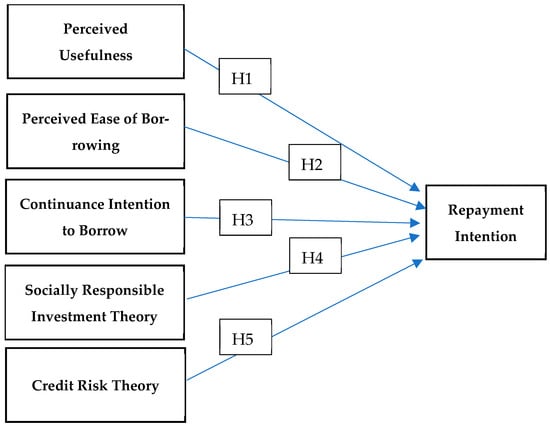
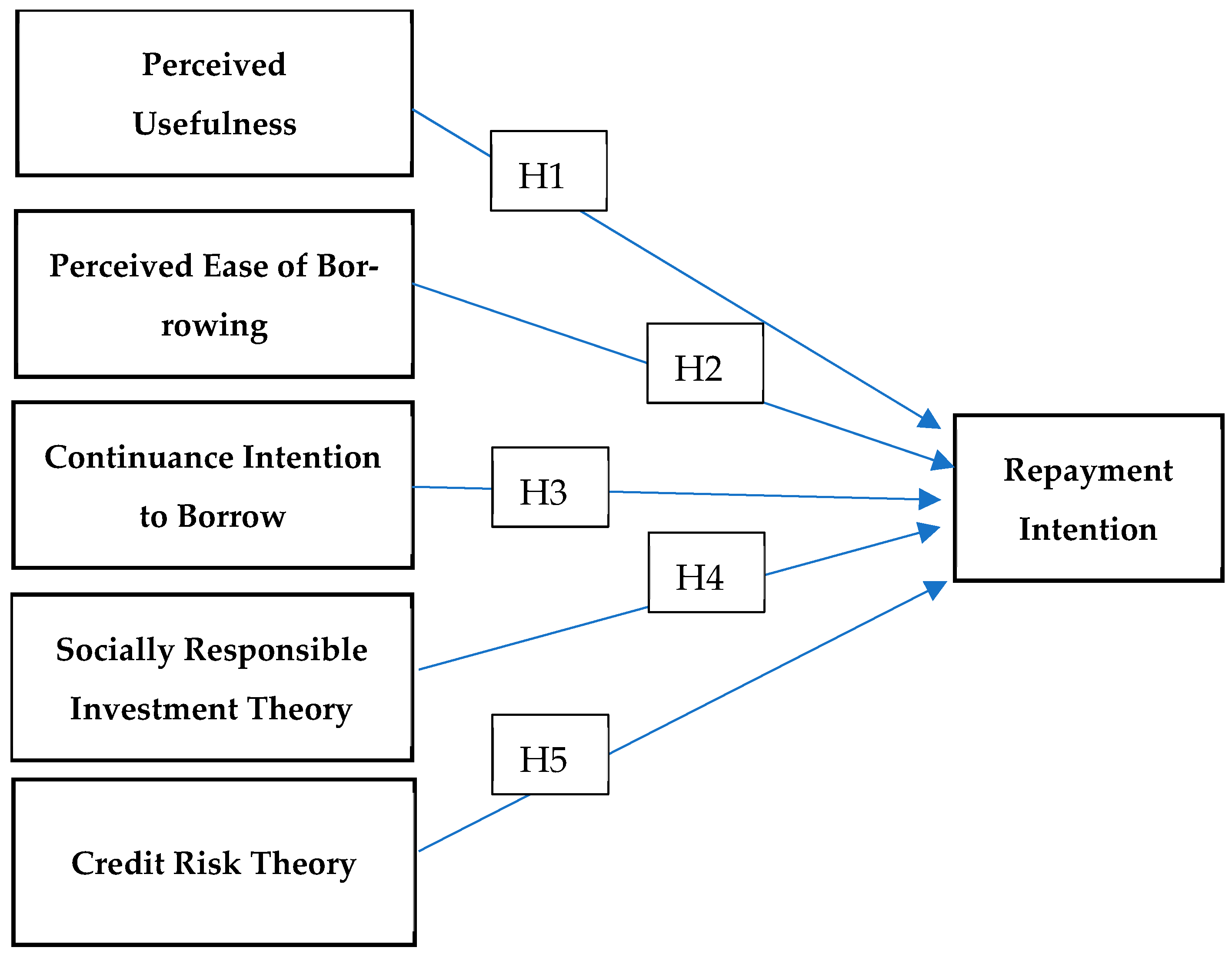
To operationalize the constructs introduced in the conceptual framework (Figure 1) and the corresponding hypotheses (H1–H5), a structured questionnaire was developed. Each measurement item was adapted from prior validated scales and tailored to the context of marketplace lending. Appendix A (Table A1) provides a complete mapping of each construct to its underlying theory, the specific hypothesis it supports, the associated survey items, and the original source references. Specifically, Perceived Usefulness (PU) and Perceived Ease of Borrowing (PEB) items were drawn from the Technology Acceptance Model and UTAUT (Davis, 1989; Venkatesh et al., 2003); Repayment Intention (RI) items were based on the Theory of Planned Behaviour (Ajzen, 1991); Continuance Intention to Borrow (CIB) items followed Lew et al. (2020); Socially Responsible Investment Theory (SRIT) items were informed by Oehmke and Opp (2025); and Credit Risk Theory (CRT) items were derived from Merton (1974). This systematic linkage between theory, hypothesis, and measurement ensures content validity and transparency in the operationalization of the structural model. The framework thus integrates behavioural, continuance, ethical, and credit-risk perspectives into a unified model for explaining borrower repayment intentions in marketplace lending platforms.
Figure 1.
Conceptual framework. Source: Author’s prediction.
4. Methodology
The data for this study were collected through an online questionnaire distributed via the Qualtrics platform. The survey targeted individuals in Hungary who use or are familiar with Marketplace Lending (Peer-to-Peer, or P2P) platforms. The questionnaire included questions on demographics, perceptions of P2P lending, behavioural factors, and attitudes toward environmental, social, and governance (ESG) factors in lending. Responses were anonymized, and the data was used solely for academic purposes. A total of 585 responses were collected, and after cleaning for missing data, 477 were included in the analysis.
4.1. Research Design and Sampling
A cross-sectional survey was employed to collect data from users of the Hungarian Marketplace Lending platform. The sampling frame included individuals who had actively used MPL platforms for borrowing within the past 12 months. Participants were recruited through online forums, social media groups focused on personal finance and P2P lending, and targeted email invitations between September and November 2025.
4.2. Data Collection and Sample
A total of 585 responses were received. After screening for incomplete responses, straight-lining, and invalid entries, 477 valid responses were retained (effective response rate: 81.5%). The sample size exceeds the minimum requirements for PLS-SEM analysis (Hair et al., 2019).
4.3. Analytical Approach: PLS-SEM
This study employs Partial Least Squares Structural Equation Modelling (PLS-SEM) using SmartPLS 4. PLS-SEM was chosen over CB-SEM due to its suitability for predictive analysis (Hair et al., 2019; Chin, 1998), ability to handle complex models with multiple constructs (Ringle et al., 2015), and robustness with non-normally distributed data (Hair et al., 2019). Measurement model assessment followed Fornell and Larcker (1981) criteria for AVE and Composite Reliability. Discriminant validity was assessed using the HTMT criterion (Henseler et al., 2015). Common method bias was evaluated using Harman’s Single Factor Test (Podsakoff et al., 2003) and full collinearity VIF assessment (Kock, 2015). The analysis followed a two-step approach: (1) assessment of the measurement model for reliability and validity, and (2) assessment of the structural model for hypothesis testing.
4.4. Demographics Analysis
The demographic data collected includes age, gender, education level, and employment status. Below is a summary of the demographic characteristics of the respondents:
Table 1 presents the demographic analysis of survey respondents, revealing key insights into the user profile of peer-to-peer (P2P) lending platforms. A significant portion of respondents (43.8%) fall within the 25–34 age group, followed by 25.0% in the 35–44 age bracket, indicating that younger and middle-aged adults are the most engaged demographic in this financial service sector. This aligns with broader trends of digital platform adoption among tech-savvy age groups. The gender distribution shows a notable disparity, with males comprising 65.0% of respondents (n = 310) and females comprising 35.0% (n = 167), suggesting that men may be more inclined or better informed to use or explore P2P lending options in the Hungarian context. In terms of education, exactly half of the participants (50.0%) hold a Bachelor’s degree, suggesting a possible correlation between higher education and awareness or trust in alternative financial services. Furthermore, 56.2% of respondents are employed full-time, reinforcing the notion that financially active and professionally engaged individuals form the core user base of P2P lending platforms. Together, these findings provide a clearer understanding of the typical borrower profile in the marketplace lending ecosystem. The demographic analysis also reveals that the typical respondent is a male aged 25–34 with a Bachelor’s degree and employed full-time. This information can help tailor P2P lending platforms to better serve their primary user base. Further analysis could examine how these demographics influence perceptions and behaviours regarding P2P lending and ESG factors.
Table 1.
Demographic Characteristics of Respondents.
5. Data Analysis
Table 2 shows that the Kaiser–Meyer–Olkin (KMO) measure of sampling adequacy yielded a value of 0.770, indicating middling to good suitability for factor analysis. KMO values above 0.70 are generally considered acceptable, while those exceeding 0.80 are deemed excellent, suggesting that the dataset is sufficiently adequate for conducting factor analysis. Additionally, Bartlett’s Test of Sphericity produced a highly significant result (χ2 = 9280.692, df = 300, p < 0.001), confirming that the correlation matrix is not an identity matrix and that the variables share sufficient common variance for meaningful factor extraction. Together, these results demonstrate that the dataset meets the necessary assumptions for factor analysis and is well suited for advanced latent variable modelling techniques, such as partial least squares SEM (PLS-SEM). This provides a strong foundation for further multivariate analysis, including the examination of hypothesized relationships between constructs.
Table 2.
KMO and Bartlett’s Test.
Table 3 shows the communality analysis, which reveals that the extracted components effectively capture the variance in the observed variables, with most items demonstrating adequate to strong representation. The extraction values predominantly fall within the 0.60–0.80 range, indicating substantial shared variance between items and their respective latent constructs. Notably, variables such as PU5 (0.761) and CRT2 (0.867) show particularly strong loadings, confirming their robust association with the underlying factors. While SRIT3 exhibits a more moderate communality of 0.556, it remains above the acceptable threshold, suggesting it still contributes meaningfully to the factor structure. Importantly, no items fall below the critical 0.50 cutoff, confirming that all measurement indicators are sufficiently explained by the extracted components and none require elimination due to inadequate representation. These results collectively support the structural validity of the measurement model and justify retaining all items in subsequent analyses.
Table 3.
Exploratory Factor Analysis (EFA) Results.
To address concerns regarding Common Method Bias (CMB), which is a potential threat in cross-sectional, single-source survey designs (Podsakoff et al., 2003), this study employed two complementary diagnostic approaches. First, Harman’s Single Factor Test was conducted via Principal Component Analysis (PCA) in IBM SPSS Statistics version 29.0. The results revealed that the single largest extracted factor accounted for only 28.3% of the total variance, remaining well below the critical threshold of 50% (Podsakoff et al., 2003; Harman, 1976). This finding provides preliminary evidence that common method variance does not represent a dominant source of systematic bias in the dataset. Second, to supplement and strengthen this assessment, a Full Collinearity Variance Inflation Factor (VIF) test was performed on all predictor constructs within the structural model, following the procedure recommended by Kock (2015) as a more rigorous and comprehensive alternative to Harman’s single-factor approach. As presented in Table 4, all inner VIF values fall comfortably below the conservative threshold of 3.3 prescribed by Kock (2015), with values ranging from 1.143 (CRT) to 1.412 (PU), indicating the complete absence of collinearity-driven common method bias among the latent constructs. Taken together, the convergent evidence from both diagnostic procedures confirms that common method variance does not pose a meaningful threat to the validity and interpretability of the structural path estimates reported in this study.
Table 4.
Common Method Bias Assessment—Full Collinearity VIF Results.
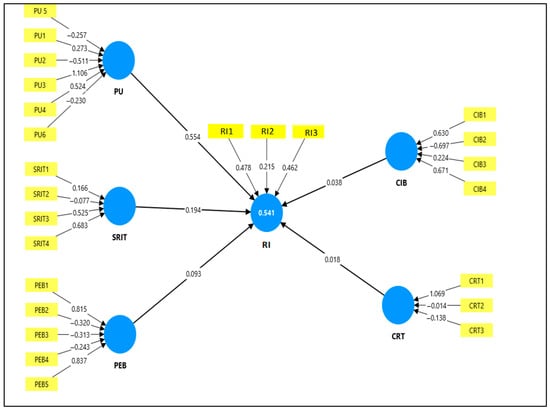
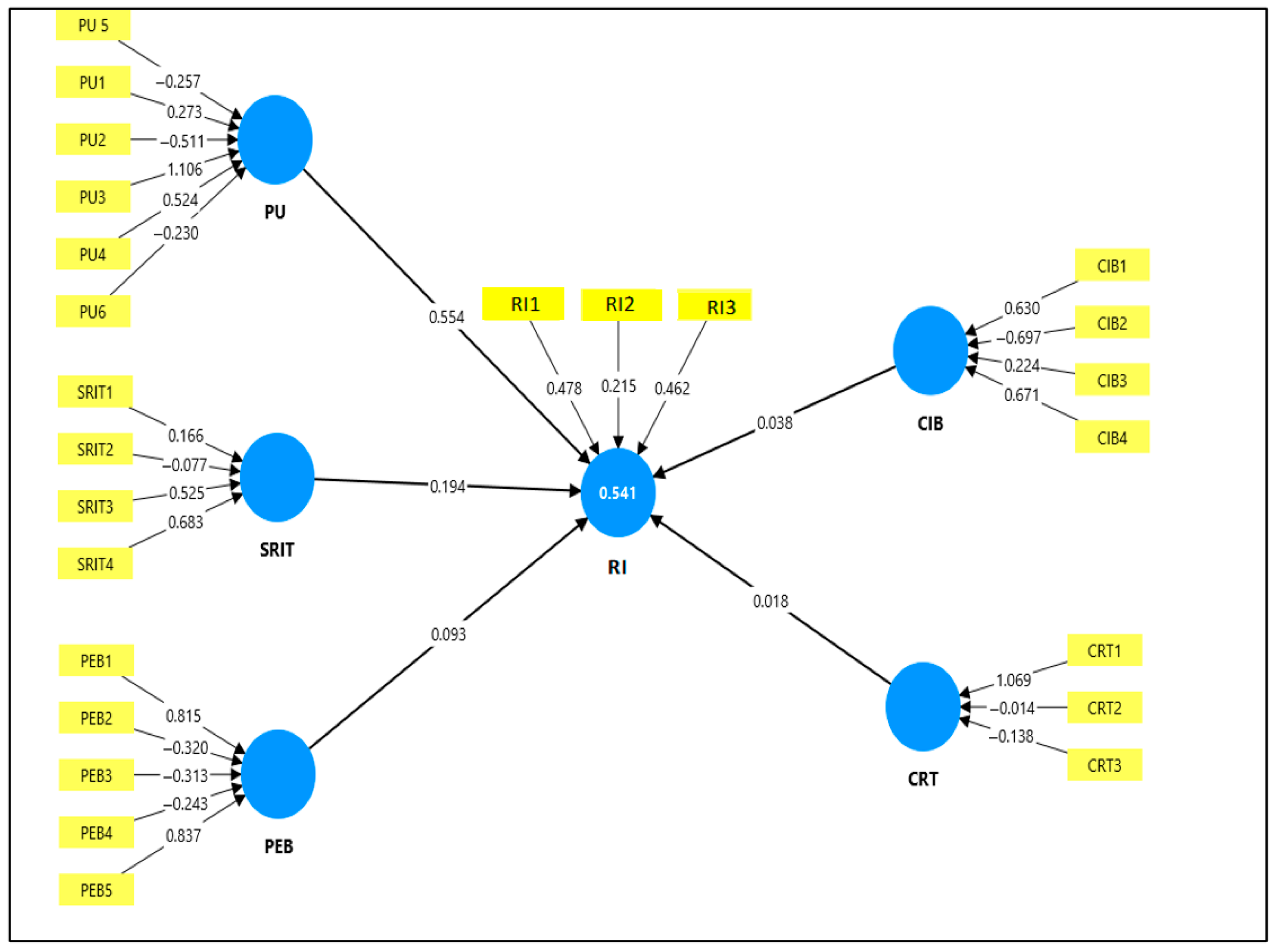
Figure 2 shows partial least squares SEM (PLS-SEM), and Table 5 shows the Structural Model Assessment, which reveals that Perceived Usefulness (PU) emerges as the strongest and most statistically significant predictor of borrowers’ intention to repay (RI), underscoring the critical role of perceived financial benefits in shaping repayment behaviour. Additionally, ESG-related attitudes (SRIT) exert a moderate yet significant influence, suggesting that borrower’ awareness of environmental, social, and governance factors in lending platforms contributes to their repayment intentions. While Perceived Ease of Borrowing (PEB) has a small but statistically significant effect, its impact is relatively limited compared to PU and SRIT. Interestingly, Continuance Intention to Borrow (CIB) and Credit Risk Awareness (CRT) do not significantly influence repayment intention, suggesting that long-term borrowing plans and risk perception may not be decisive factors in borrowers’ repayment decisions. These findings highlight the importance of enhancing platform usefulness and ethical lending practices to foster responsible repayment behaviour in marketplace lending.
Figure 2.
Partial Least Squares Structural Equation Model (PLS-SEM). Source: SmartPLS 4 output.
Table 5.
Structural Model Assessment (SmartPLS Output).
Table 6 presents the measurement model assessment results for all latent constructs employed in this study, following established PLS-SEM guidelines (Hair et al., 2019; Fornell & Larcker, 1981). The evaluation encompasses indicator reliability, internal consistency reliability, and convergent validity. All indicator loadings exceed the recommended threshold of 0.70 (Hair et al., 2019; Chin, 1998), with values ranging from 0.746 (SRIT3) to 0.931 (CRT2), demonstrating that each item sufficiently explains its respective construct. Composite Reliability (CR) values range from 0.807 to 0.891, all surpassing the 0.70 criterion and indicating strong internal consistency across constructs (Fornell & Larcker, 1981). Furthermore, the Average Variance Extracted (AVE) for each construct exceeds the minimum requirement of 0.50, with values between 0.515 (SRIT) and 0.677 (CRT), thereby confirming adequate convergent validity (Fornell & Larcker, 1981). These results collectively establish that the measurement model is reliable and valid for subsequent structural analysis.
Table 6.
Measurement Model Assessment.
Table 7 reports the Heterotrait-Monotrait (HTMT) ratio of correlations, which assesses discriminant validity among the constructs. As recommended by Henseler et al. (2015), discriminant validity is established when HTMT values remain below the conservative threshold of 0.85, or below 0.90 using the liberal criterion (Gold et al., 2001; Franke & Sarstedt, 2019). All HTMT ratios in the analysis fall comfortably within this range, with the highest value observed between Perceived Usefulness (PU) and Repayment Intention (RI) at 0.682, followed by PU and Continuance Intention to Borrow (CIB) at 0.443. The remaining HTMT values range from 0.178 to 0.427, all well below the critical threshold. These findings confirm that each construct empirically captures a distinct phenomenon, and there is no evidence of multicollinearity or conceptual overlap that would compromise the interpretation of structural path coefficients.
Table 7.
Discriminant Validity (HTMT Ratio).
Together, Table 6 and Table 7 provide robust evidence that the measurement model satisfies all psychometric property requirements, thereby establishing a solid foundation for testing the hypothesized structural relationships.
To address potential common method variance concerns inherent in single-source survey data (Podsakoff et al., 2003), two complementary tests were conducted. First, Harman’s Single Factor Test (Podsakoff et al., 2003) indicated that the largest single factor accounted for 28.3% of total variance, well below the 50% threshold. Second, a full collinearity VIF assessment (Kock, 2015) confirmed that all inner VIF values remained below 3.3, providing convergent evidence that common method bias does not threaten the validity of findings.
6. Findings and Discussions
This study examined the behavioural and ESG-driven determinants of borrower repayment intentions in Marketplace Lending (MPL) platforms using partial least squares SEM (PLS-SEM). The findings provide critical insights into the factors that influence repayment behaviour, with implications for both financial theory and platform design.
6.1. Key Findings and Theoretical Contributions
The strongest predictor of repayment intention was Perceived Usefulness (PU), with a highly significant path coefficient (β = 0.554, p < 0.001). This aligns with prior research (Wong et al., 2020) suggesting that borrowers who perceive MPLs as instrumental in achieving financial goals are more likely to repay on time. The dominance of PU underscores the importance of functional utility in digital financial platforms (Frost et al., 2019). When borrowers view loans as beneficial for financial management, they exhibit greater repayment discipline, consistent with behavioural economics evidence that perceived utility drives positive financial engagement (Thaler, 2016).
Socially Responsible Investment Theory (SRIT) demonstrated a moderate yet significant effect (β = 0.194, p < 0.01), supporting the notion that ESG-conscious borrowers are more likely to honour repayment commitments. This extends Oehmke and Opp’s (2025) work and is consistent with evidence from green bond markets (Zerbib, 2019) showing that ESG preferences translate into measurable financial behavioural differences. ESG disclosure practices appear to activate reciprocity mechanisms (Gouldner, 1960), creating psychological accountability that enhances repayment intention. This finding is consistent with the ESG-efficient frontier framework (Pedersen et al., 2021) suggesting that responsible finance generates behavioural co-benefits beyond financial returns.
Contrary to expectations, Continuance Intention to Borrow (CIB) and Credit Risk Theory (CRT) had no significant impact on repayment behaviour. The negligible effect of CIB (β = 0.038, p > 0.05) suggests that while borrowers may intend to reuse MPL services, this does not necessarily translate into better repayment habits. This is consistent with the intention-behaviour gap documented in behavioural finance (Thaler, 2016; Barberis, 2018), where positive attitudes toward a platform do not automatically generate responsible financial conduct.
Similarly, CRT’s non-significance (β = 0.018, p > 0.05) challenges traditional credit risk models (Merton, 1974; Altman, 1968), implying that MPL borrowers may not internalize risk-based pricing in their decision-making. This may be explained by prospect theory (Kahneman & Tversky, 2013), which demonstrates that individuals systematically underweight risk in contexts where other motivational factors (such as platform utility) are salient. Furthermore, low financial literacy levels (Lusardi & Mitchell, 2014) among some borrower segments may limit the effectiveness of credit risk signals in influencing repayment intentions.
6.2. Practical Implications
- (a)
- Platform Design and Borrower Engagement: Since PU is the strongest driver, MPL platforms should emphasize user-centric features (e.g., financial planning tools, flexible repayment options) to reinforce perceived benefits. ESG integration (e.g., green loan products, social impact disclosures) can further incentivize repayment by appealing to borrowers’ ethical values.
- (b)
- Risk Management and Policy: The weak role of CRT suggests that traditional risk signals (e.g., interest rates, credit scores) may need augmentation with behavioural nudges (e.g., reminders, moral appeals) to improve repayment rates. Loyalty programmes (often tied to CIB) may not inherently reduce defaults; instead, platforms should pair retention strategies with financial literacy interventions.
6.3. Limitations and Future Research
This study has several limitations that should be acknowledged:
- Social Desirability Bias: Self-reported repayment intentions may be subject to social desirability bias, where respondents overstate their creditworthiness. Future research should incorporate a social desirability scale (e.g., Marlowe-Crowne) to statistically control for this effect.
- Common Method Variance: Although both Harman’s Single Factor Test (28.3% variance explained by the largest factor) and the Full Collinearity VIF assessment (all VIF values between 1.143 and 1.412, well below the 3.3 threshold of Kock, 2015) indicate that common method bias is not a dominant concern in this study, the inherent limitations of cross-sectional, self-reported survey data mean that residual method variance cannot be entirely eliminated. Future research should consider procedural remedies such as temporal separation of predictor and outcome measurements, or the use of objective administrative repayment records from MPL platforms to validate self-reported repayment intentions.
- Intention–Behaviour Gap: This study measured repayment intention, not actual repayment behaviour. While intention is a strong predictor of behaviour (Ajzen, 1991), a gap may exist. Future research should track actual repayment data from MPL platforms to validate these findings.
- Sample Demographics and Generalizability: The sample was skewed toward younger (25–44 years) and male (65%) respondents, which may limit the generalizability of findings regarding ESG awareness. Female and older age groups often have different ethical and governance perspectives. Future studies should employ stratified sampling to ensure balanced representation across gender and age groups.
- Cross-Sectional Design: The cross-sectional nature captures relationships at a single point in time. Repayment behaviour is dynamic and may change over the loan lifecycle. Panel data or longitudinal studies would better capture these dynamics.
- Cultural Context: The study was conducted exclusively in Hungary. ESG awareness and reciprocity norms may vary significantly across cultural contexts. Cross-cultural comparative studies are needed to assess the universality of these findings.
- Moderation Effects: As suggested by Reviewer 1, the non-significance of CRT and CIB may mask important moderating effects. Future research should explore whether factors such as income level, financial literacy (Lusardi & Mitchell, 2014), ESG awareness sophistication (Berg et al., 2022; Drempetic et al., 2020), or age moderate the relationship between traditional credit risk factors and repayment intention. Cross-country comparative studies examining ESG–behaviour linkages across FinTech markets (Claessens et al., 2018; Navaretti et al., 2018) would also enrich the theoretical framework.
7. Conclusions
This study set out to explore the behavioural and ESG-related determinants of borrower repayment intentions in Marketplace Lending (MPL) platforms, using survey data from 477 Hungarian respondents and PLS-SEM analysis. Given the cross-sectional, single-source nature of the data and the emerging context of MPL in Central Europe, the findings should be interpreted as exploratory rather than definitive causal evidence. Nevertheless, they offer several consistent patterns that contribute to theory and practice.
Empirical findings: Perceived Usefulness (PU) emerged as the strongest predictor of Repayment Intention (RI) (β = 0.554, p < 0.001), confirming that borrowers’ perception of MPL platforms as financially beneficial is the primary driver of their willingness to repay. Socially Responsible Investment Theory (SRIT) also showed a moderate but significant positive effect (β = 0.194, p < 0.01), suggesting that ESG-conscious platform practices activate borrower reciprocity and ethical accountability. In contrast, Perceived Ease of Borrowing (PEB) had a weak but statistically significant influence (β = 0.093, p = 0.034), while Continuance Intention to Borrow (CIB) and Credit Risk Theory (CRT) were not significant predictors. The non-significance of CRT (β = 0.018, p = 0.740) indicates that traditional risk signals (interest rates, credit scores) may not be internalized by MPL borrowers as strongly as in conventional banking, possibly due to limited financial literacy or the salience of platform-related utility.
Theoretical contributions: This study bridges three previously siloed domains—behavioural finance (TAM, TPB), ESG awareness (SRIT, reciprocity theory) and credit risk perception—within a single PLS-SEM framework applied to digital lending. It provides initial evidence that ESG considerations influence borrower repayment intentions, extending the application of Socially Responsible Investment Theory from investors/lenders to borrowers. The findings also suggest that the Technology Acceptance Model’s core construct (PU) remains highly relevant in FinTech lending contexts, while traditional credit risk theory may need augmentation with behavioural and ethical variables when modelling borrower behaviour on MPL platforms.
Practical implications: For MPL platform designers, the dominance of PU implies that investments in user-centric financial tools (e.g., loan calculators, repayment reminders, goal-tracking features) are likely to yield better repayment outcomes. Integrating ESG features—such as green loan labels, transparent governance disclosures and fair-term commitments—can further strengthen borrower accountability via reciprocity. For policymakers and regulators, the weak role of CRT suggests that relying solely on risk-based pricing or credit scores may be insufficient; instead, financial literacy programmes and behavioural nudges (e.g., moral appeals, social norms) could complement traditional risk assessments.
Limitations and future research: The exploratory nature of this study calls for cautious interpretation. Key limitations include the cross-sectional design (capturing intention, not actual repayment behaviour), the single-country Hungarian context (limiting generalisability), the self-reported nature of the data (potential social desirability bias) and a sample skewed towards younger, male and bachelor-degree-educated respondents. Future research should employ longitudinal designs with objective repayment records, conduct cross-cultural comparisons, and include balanced samples to test whether the observed relationships hold across different demographic and institutional settings. Additionally, the non-significant paths for CIB and CRT may mask moderation effects (e.g., by financial literacy or income level), which deserves dedicated investigation.
In summary, while the findings are preliminary, they highlight the importance of perceived usefulness and ESG awareness in shaping MPL borrowers’ repayment intentions. By integrating behavioural, ethical and credit-risk perspectives, this study lays a foundation for more holistic, sustainable lending models that go beyond traditional financial metrics.
Funding
This research received no external funding.
Institutional Review Board Statement
The study was conducted in accordance with the Declaration of Helsinki, Science Ethics Committee of Scientific Advisory Board unanimously supports the proposal of the Doctoral School of Regional and Business Administration Sciences, Széchenyi István University, and authorizes the research. This study is approved by University: Széchenyi István University, Győr, Egyetem tér 1, 9026, Hungary. Approval Number: SZE/ETT-37/2025 (VII.7.).
Informed Consent Statement
Informed consent was obtained from all subjects involved in the study.
Data Availability Statement
The data that support the findings of this study are available from the corresponding author upon reasonable request.
Conflicts of Interest
The author declares no conflicts of interest.
Appendix A
Table A1.
Theories and hypothesis to support questionnaire.
References
- Ajzen, I. (1991). The theory of planned behaviour. Organizational Behavior and Human Decision Processes, 50(2), 179–211. [Google Scholar] [CrossRef] [Scilit]
- Altman, E. I. (1968). Financial ratios, discriminant analysis and the prediction of corporate bankruptcy. The Journal of Finance, 23(4), 589–609. [Google Scholar] [CrossRef]
- Balyuk, T. (2019). Financial innovation and borrowers: Evidence from peer-to-peer lending. Available online: https://www.fdic.gov/system/files/2024-08/balyuk-paper.pdf (accessed on 16 January 2026).
- Barberis, N. (2018). Psychology-based models of asset prices and trading volume. In Handbook of behavioral economics: Applications and foundations 1 (Vol. 1, pp. 79–175). Elsevier. Available online: http://www.nber.org/papers/w24723 (accessed on 16 January 2026). [CrossRef] [Scilit]
- Beaver, W. H. (1966). Financial ratios as predictors of failure. Journal of Accounting Research, 4, 71–111. [Google Scholar] [CrossRef] [Scilit]
- Berg, F., Kölbel, J. F., & Rigobon, R. (2022). Aggregate confusion: The divergence of ESG ratings. Review of Finance, 26(6), 1315–1344. [Google Scholar] [CrossRef] [Scilit]
- Chandra, S., Srivastava, S. C., Kim, W., & Theng, Y. L. (2010). Evaluating the role of trust in consumer adoption of mobile payment systems: An empirical analysis. Communications of the Association for Information Systems, 27(29), 561–588. Available online: http://aisel.aisnet.org/cais/vol27/iss1/29 (accessed on 16 January 2026). [CrossRef] [Scilit]
- Chen, X., Huang, B., & Shaban, M. (2022). Naïve or sophisticated? Information disclosure and investment decisions in peer to peer lending. Journal of Corporate Finance, 77, 101805. [Google Scholar] [CrossRef] [Scilit]
- Chin, W. W. (1998). The partial least squares approach to structural equation modeling. In G. A. Marcoulides (Ed.), Modern methods for business research (pp. 295–336). Lawrence Erlbaum Associates. [Google Scholar]
- Claessens, S., Frost, J., Turner, G., & Zhu, F. (2018, September). Fintech credit markets around the world: Size, drivers and policy issues. In BIS quarterly review (pp. 29–49). BIS. Available online: https://www.bis.org/publ/qtrpdf/r_qt1809e.pdf (accessed on 16 January 2026).
- Davis, F. D. (1989). Perceived usefulness, perceived ease of use, and user acceptance of information technology. MIS Quarterly: Management Information Systems, 13(3), 319–339. [Google Scholar] [CrossRef] [Scilit] [PubMed]
- Drempetic, S., Klein, C., & Zwergel, B. (2020). The influence of firm size on the ESG score: Corporate sustainability ratings under review. Journal of Business Ethics, 167(2), 333–360. [Google Scholar] [CrossRef] [Scilit]
- Fornell, C., & Larcker, D. F. (1981). Evaluating structural equation models with unobservable variables and measurement error. Journal of Marketing Research, 18(1), 39–50. [Google Scholar] [CrossRef] [Scilit]
- Franke, G., & Sarstedt, M. (2019). Heuristics versus statistics in discriminant validity testing: A comparison of four procedures. Internet Research, 29(3), 430–447. [Google Scholar] [CrossRef] [Scilit]
- Friede, G., Busch, T., & Bassen, A. (2015). ESG and financial performance: Aggregated evidence from more than 2000 empirical studies. Journal of Sustainable Finance and Investment, 5(4), 210–233. [Google Scholar] [CrossRef] [Scilit]
- Frost, J., Gambacorta, L., Huang, Y., Shin, H. S., & Zbinden, P. (2019). BigTech and the changing structure of financial intermediation. Economic Policy, 34(100), 761–799. [Google Scholar] [CrossRef] [Scilit]
- Gillan, S. L., Koch, A., & Starks, L. T. (2021). Firms and social responsibility: A review of ESG and CSR research in corporate finance. Journal of Corporate Finance, 66, 101889. [Google Scholar] [CrossRef] [Scilit]
- Gold, A. H., Malhotra, A., & Segars, A. H. (2001). Knowledge management: An organizational capabilities perspective. Journal of Management Information Systems, 18(1), 185–214. [Google Scholar] [CrossRef] [Scilit]
- Gouldner, A. W. (1960). The norm of reciprocity: A preliminary statement. American Sociological Review, 25(2), 161–178. [Google Scholar] [CrossRef] [Scilit]
- Hair, J. F., Risher, J. J., Sarstedt, M., & Ringle, C. M. (2019). When to use and how to report the results of PLS-SEM. European Business Review, 31(1), 2–24. [Google Scholar] [CrossRef] [Scilit]
- Harman, H. H. (1976). Modern factor analysis (3rd ed.). University of Chicago Press. [Google Scholar]
- Henseler, J., Ringle, C. M., & Sarstedt, M. (2015). A new criterion for assessing discriminant validity in variance-based structural equation modeling. Journal of the Academy of Marketing Science, 43, 115–135. [Google Scholar] [CrossRef] [Scilit]
- Jagtiani, J., & Lemieux, C. (2019). The roles of alternative data and machine learning in fintech lending: Evidence from the LendingClub consumer platform. Financial Management, 48(4), 1009–1029. [Google Scholar] [CrossRef] [Scilit]
- Kahneman, D., & Tversky, A. (2013). Prospect theory: An analysis of decision under risk. In Handbook of the fundamentals of financial decision making (pp. 99–127). World Scientific. [Google Scholar] [CrossRef] [Scilit]
- Kock, N. (2015). Common method bias in PLS-SEM: A full collinearity assessment approach. International Journal of e-Collaboration (IJeC), 11(4), 1–10. [Google Scholar] [CrossRef] [Scilit]
- Lew, S., Tan, G. W. H., Loh, X. M., Hew, J. J., & Ooi, K. B. (2020). The disruptive mobile wallet in the hospitality industry: An extended mobile technology acceptance model. Technology in Society, 63, 101430. [Google Scholar] [CrossRef] [Scilit] [PubMed]
- Lusardi, A., & Mitchell, O. S. (2014). The economic importance of financial literacy: Theory and evidence. Journal of Economic Literature, 52(1), 5–44. [Google Scholar] [CrossRef] [Scilit]
- Merton, R. C. (1974). On the pricing of corporate debt: The risk structure of interest rates. Journal of Finance, 29, 449–470. [Google Scholar] [CrossRef] [Scilit]
- Milne, A., & Parboteeah, P. (2016). The business models and economics of peer-to-peer lending (European Credit Research Institute (ECRI) Research Report, No 17). Available online: https://ssrn.com/abstract=2876110 (accessed on 16 January 2026).
- Morse, A. (2015). Peer-to-peer crowdfunding: Information and the potential for disruption in consumer lending. Annual Review of Financial Economics, 7, 463–482. [Google Scholar] [CrossRef] [Scilit]
- Navaretti, G. B., Calzolari, G., Mansilla-Fernandez, J. M., & Pozzolo, A. F. (2018). Fintech and banking: Friends or foes? European Economy: Banks, Regulation, and the Real Sector, 2018(2), 9–26. [Google Scholar] [CrossRef] [Scilit]
- Oehmke, M., & Opp, M. M. (2025). A theory of socially responsible investment. The Review of Economic Studies, 92(2), 1193–1225. [Google Scholar] [CrossRef] [Scilit]
- Oliver, R. L. (1980). A cognitive model of the antecedents and consequences of satisfaction decisions. Journal of Marketing Research, 17(4), 460–469. [Google Scholar] [CrossRef] [Scilit]
- Pedersen, L. H., Fitzgibbons, S., & Pomorski, L. (2021). Responsible investing: The ESG-efficient frontier. Journal of Financial Economics, 142(2), 572–597. [Google Scholar] [CrossRef] [Scilit]
- Podsakoff, P. M., MacKenzie, S. B., Lee, J. Y., & Podsakoff, N. P. (2003). Common method biases in behavioral research: A critical review of the literature and recommended remedies. Journal of Applied Psychology, 88(5), 879–903. [Google Scholar] [CrossRef] [Scilit]
- Ringle, C. M., Wende, S., & Becker, J.-M. (2015). SmartPLS 3. Boenningstedt: SmartPLS GmbH. Available online: http://www.smartpls.com (accessed on 16 January 2026).
- Sparkes, R., & Cowton, C. J. (2004). The maturing of socially responsible investment: A review of the developing link with corporate social responsibility. Journal of Business Ethics, 52(1), 45–57. [Google Scholar] [CrossRef] [Scilit]
- Thaler, R. H. (2016). Behavioral economics: Past, present, and future. American Economic Review, 106(7), 1577–1600. [Google Scholar] [CrossRef] [Scilit]
- Venkatesh, V., Morris, M. G., Davis, G. B., & Davis, F. D. (2003). User acceptance of information technology: Toward a unified view. MIS Quarterly, 27(3), 425–478. [Google Scholar] [CrossRef] [Scilit]
- Wei, Z., & Lin, M. (2016). Market mechanisms in online peer-to-peer lending. Management Science, 63(12), 4236–4257. [Google Scholar] [CrossRef] [Scilit]
- Wong, L. W., Tan, G. W. H., Hew, J. J., Ooi, K. B., & Leong, L. Y. (2020). Mobile social media marketing: A new marketing channel among digital natives in higher education? Journal of Marketing for Higher Education, 32(1), 113–137. [Google Scholar] [CrossRef] [Scilit]
- Zerbib, O. D. (2019). The effect of pro-environmental preferences on bond prices: Evidence from green bond market. Journal of Banking & Finance, 98, 39–60. [Google Scholar] [CrossRef] [Scilit]

Disclaimer/Publisher’s Note: The statements, opinions and data contained in all publications are solely those of the individual author(s) and contributor(s) and not of MDPI and/or the editor(s). MDPI and/or the editor(s) disclaim responsibility for any injury to people or property resulting from any ideas, methods, instructions or products referred to in the content. |
© 2026 by the author. Licensee MDPI, Basel, Switzerland. This article is an open access article distributed under the terms and conditions of the Creative Commons Attribution (CC BY) license.