Article

The Reform Study and Recommendation of Public Labor Pension in Taiwan: Considering the Effect of Reemployed Retired Laborers


Department of Insurance and Finance Management, Chaoyang University of Technology, Taichung 413310, Taiwan
*
Author to whom correspondence should be addressed.
J. Risk Financ. Manag. 2026, 19(4), 299; https://doi.org/10.3390/jrfm19040299
Submission received: 3 March 2026 / Revised: 11 April 2026 / Accepted: 14 April 2026 / Published: 21 April 2026
(This article belongs to the Section Sustainability and Finance)

Abstract

Reform and sustainability of the defined benefit pension system has received considerable attention because it addresses the challenges of an aging population and the risk of fund insolvency. However, previous studies have little consideration to the effects of reemployed retired laborers and the sensitivity of each key reform element. The study established a financial forecasting model incorporating reemployed retired laborers and employed comparative static analysis to examine the effects of several variables on Taiwan’s public labor pension. In Scenario Three, the fund balance was projected to remain positive until 2064. Furthermore, increasing the premium rate to 17% had the strongest positive effect on the fund balance with 16-year delay, while an annual government subsidy of NT$100 billion had the second-most positive effect with 10-year delay. Moreover, solely reducing the old-age annuity amount by 10% had a positive impact on the fund balance with 7-year delay. Furthermore, allowing 50% of reemployed retired laborers to reenroll in the system had the positive effect with 9-year delay before bankruptcy. Finally, the study proposes a comprehensive reform plan for the public labor pension and offers valuable insights for other countries.

1. Introduction

In recent years, reform and sustainability of defined benefit pension plans has received considerable academic attention due to population aging and the fund bankruptcy crisis (Alonso-García & Rosado-Cebrian, 2021; Aysan, 2013; Börsch-Supan, 2007; Chen & Chung, 2019; Focacci et al., 2023; Inzunza & Madeira, 2025; Jian & Wang, 2020; Li and Lin, 2024; Poteraj, 2025). Many countries have completed reforms of their defined benefit pension plans; however, Taiwan’s public labor pension system remains pending (Presidential Office National Pension Reform Committee [POPRC], 2026).
In Taiwan, the public labor pension system is government-managed, partially funded, and compulsory. The old-age pension system is one of the benefits of the labor insurance system. Investment and operations are the responsibility of the government. The pension reform Act was rejected or returned over two times due to strong criticism from a large number of laborers (Ministry of Labor, 2025). Consequently, pension reform remains a topic of discussion in Taiwan, and a collective consensus has yet to be reached regarding the public labor pension system. Moreover, the Taiwanese government has decided that the reform of the public labor pension will maintain a partially funded defined benefit plan in accordance with the past reform Act and government policy.
According to statistics from Taiwan’s Ministry of Labor in 2025, the number of individuals insured under the public labor pension represented more than 45% of Taiwan’s population that year. This high proportion of insured individuals highlights the importance of public labor pension within Taiwan’s social security system. However, an actuarial and financial evaluation report (hereafter referred to as the Actuarial Report), (Taiwan Labor Insurance Bureau, 2024), published by the Labor Insurance Bureau in 2024, indicated that the public labor pension will reach an actuarial liability of nearly NT$14.1 trillion and face insolvency in 2031.
Most studies on reforming the defined benefit plan have focused on substantially increasing the premium rate, reducing the old-age annuity payment amount, extending the calculation period of the average salary, and revising the payment formula in Taiwan (Chen & Chung, 2019; Presidential Office National Pension Reform Committee [POPRC], 2026; Wang et al., 2017, 2019). However, past studies have done little to indicate the extent of the sensitivity or influence of each key reform element within a comprehensive reform plan. To make a decision to undertake a comprehensive reform, the government needs to consider the sensitivity or impact of each key factor and select the optimal portfolio for the plan. Furthermore, Taiwan’s population is aging, and many retired laborers have reentered the labor market but have been unable to reenroll in the public labor pension because they are not insurable under existing regulations. Consequently, most studies have not accounted for the effect of retired laborers in their financial forecasting models, representing another gap in the literature.
To address these gaps, the study developed a financial forecasting model to predict how retired laborers re-entering the labor market and being reenrolled in the public labor pension system would affect Taiwan’s public labor pension fund. Second, the study conducted a sensitivity test based on comparative static analysis to indicate the influence of each key reform element. Third, the study endeavors to propose a comprehensive reform plan, taking into account the criticisms from insured individuals.
In addition, the study is expected to make several contributions. First, it compares two scenarios which involve reemployed retired laborers reenrolling in the public labor pension system. Second, it applies sensitivity analysis to formulate feasible recommendations for the reform of public labor pension system. Third, the findings offer valuable insights for other countries undertaking defined benefit pension reforms.

2. Background and Literature Review

Public defined benefit pension systems must be continually reformed to ensure the sustainability of social security schemes. Regarding the type of pension plan, the Taiwan public labor pension is classified as a partial-funded, defined benefit plan within the public insurance pension system.
In Taiwan, the premium rate of public labor pension is much lower than balance rate and the government’s shared proportion of the rate in 2026. In addition, recent studies proposing reforms to Taiwan’s public labor pension system have proposed measures the same as substantially increasing premium rates, reducing old-age annuity payments, and revising or lowering payment formulas (Chen & Chung, 2019; Presidential Office National Pension Reform Committee [POPRC], 2026; Wang et al., 2017, 2019).
To further highlight the old-age annuity of the Taiwan public labor pension, as of 2026, the retired laborers will be able to apply for an old-age annuity at the age of 65, although insured individuals may choose to apply 1–5 years before or after this age. This choice results in an annual reduction or increase of 4% in their pension payments, respectively. Generally, the amount a retired individual receives as an annuity is calculated by multiplying the average monthly salary of the insured individual by the statutory ratio, 1.55%, and the number of coverage years according to the Labor Insurance Act. The average monthly salary is based on the highest-earning 60 months of the insured’s salary income. Furthermore, as of 2024, there are approximately 0.72 million foreign employed laborers in Taiwan, according to Ministry of Labor statistics (2025). Those foreign employed laborers should enroll in the public labor pension scheme in accordance with Taiwanese labor regulations.
However, previous studies have based their predictions on the current age limits and have little considered the impact of reenrolling reemployed retired laborers (Chen & Chung, 2019; Jian & Wang, 2020; Presidential Office National Pension Reform Committee [POPRC], 2026; Wang et al., 2017, 2019). Moreover, past studies indicate little how much the sensitivity or influence of each key reform element within a comprehensive reform plan. The present study developed a financial forecasting model to assess how retired laborers reentering the labor market would affect Taiwan’s public labor pension fund despite current restrictions.
Additionally, Wang et al. (2017) proposed that if the Taiwan public labor pension system remains solvent for at least 50 years, the government would need to increase its subsidies to NT$100 billion and reduce annuity payments to insured individuals to 80%, with the premium rate gradually rising each year until it reaches the target of 18%. Furthermore, Maggs and Zhang (2025) analyzed the China retirement longitudinal study to identify trends and individual- and household-level factors associated with working after retirement. In addition, Alonso-García and Rosado-Cebrian (2021) reported that, in the short term, economic risks are the primary cause of unsustainability in the pension system, whereas in the long term, it is driven by population aging.
In addition, some studies have proposed revising the pension system from a defined benefit scheme to a defined contribution or notional defined contribution scheme (Altiparmakov, 2023; Bonin, 2009; Börsch-Supan, 2007; Focacci et al., 2023; Li and Lin, 2024; Liao, 2013). Public pension pillar in Germany is greatly improved by the additional decision of gradually raising retirement age from 65 to 67 and accumulated point pension payment (Bonin, 2009). On the other hand, because the government commitment of pension payments and the consideration of labor’s criticisms, the Taiwanese government has decided that the reform of the public labor pension will maintain the defined benefit plan direction rather than switch to a (notional) defined contribution plan.
Finally, the Taiwan Legislative Yuan rejected the 2017 labor pension reform Act due to a significant reduction in the monthly annuity. The average monthly salary was based on the highest-earning 180 months of the insured’s salary income, as determined under the 2017 reform Act (Presidential Office National Pension Reform Committee [POPRC], 2026). In addition, the premium rate was decided without precise levels, and the government subsidized more than NT$200 billion annually in the 2017 reform Act (Presidential Office National Pension Reform Committee [POPRC], 2026).

3. Data and Method

3.1. Theoretical Formulas for Financial Cash Flow

The scenario analysis is primarily based on the principles of the income statement in financial accounting theory. In its forecasting model, this study assumes that all pension reforms will be implemented at the beginning of 2026. The relevant data and variables are mainly collected and filtered from government statistics, annual reports, mortality tables, or author’s assumptions. These variables and data sources are summarized in Table 1.
The theoretical financial formulas for calculating the public labor pension balance are as follows:
Yearly profit (loss) of Labor insurance = (premium revenue) + (investment income) + (other revenue) − (old-age annuity payment) − (other payment)
Labor insurance fund balance (year end) = Fund balance (beginning of year) + Yearly profit (loss)

3.2. Revenue Assumptions

According to statistics from the Ministry of Labor in Taiwan, the average insured salary in 2024 was approximately NT$35,180. Based on the 2025 regulations, the premium rate will be 11.5% during 2025–2026 and 12% from 2027 onwards (Taiwan Labor Insurance Bureau, 2025). Moreover, according to the Actuarial Report, the balanced premium rate is approximately 17.2%, excluding the amortization of past unfunded liabilities.
To postpone the bankruptcy year of public labor pension, the research assumed that the premium rate would gradually increase by 1% each year until it reached 17%. The model considered an annual salary growth rate of 2.5% for laborers. The estimates of the number of insureds were based on the number of payers relative to the estimated number of aged 15-64 laborers (National Development Council, 2025). The assumed annual number of foreign laborers was approximately 0.72 million in 2024 (Ministry of Labor, 2025), with the study assuming a 5% annual growth rate for foreign laborers.
The formula for the estimated premium revenue is as follows:
Estimated total labor insurance premium revenue = (estimated average premium per person) × (estimated number of insureds)
This study assumed the average long-run investment return rate is 6%. The related formula is referred from Actuarial Report as follows:
Investment income = [fund balance (beginning of year) + (premium revenue − payment)/2 + government subsidy] × (yearly return rate)

3.3. Expenditure Formula and Assumption

The long-term total payment amount was determined based on the number of in-sured laborers, average payment ratio, and the lapse rate, with reference to statistics or mortality tables (Ministry of The Interior, 2025). Additionally, the inflation rate ad-justment for annuity payments was assumed to be consistently 0% due to deficit pres-sures. The average insured salary was defined according to the 2025 regulations (i.e., the average of the highest-earning 60 months of insured salary); however, the monthly annuity payment amount was calculated with a 10% reduction.
Furthermore, the annual government subsidy was set at NT$100 billion. The annual lapse rate was assumed to be 1.83% for age 15–64 laborers and 3.07% for retired laborers according to the average national mortality rate during the specified period (Ministry of The Interior, 2025). Related expenditure assumptions and formulas are listed below:
Estimated old-age annuity payment = (average old-age annuity payment per person) × (estimated number of old-age annuitants)
Estimated number of old-age annuitants = (accumulated numbers from new annuitants) + (accumulated numbers from in-force annuitants)

3.4. Assumptions Regarding Other Payments and Expenditures

The other payments and expenditures (excluding old-age annuities) were estimated using the average amount of other payments per person, the projected number of insured laborers and the payment ratio according to the 2024 statistics (Taiwan Labor Insurance Bureau, 2025). Furthermore, as the government covers all related operational costs, the study assumed that no additional expenditures exist.

3.5. Assumptions Regarding Payments and Expenditures for Reemployed Retired Laborers

Retired laborers who are reemployed in the workplace are further considered to evaluate their impact on the labor insurance fund. The study assumes that the insured salary for those reemployed retired laborers is the minimum insured salary, NT$ 29,500 in 2026 in Taiwan, as some retired laborers were part-time laborers. The yearly annuity payment is 54,870 in 2026, according to the annuity payment formula, with an average insured period of 10 years. Moreover, the number of reemployed laborers is predicted based on the estimated population aged over 65, according to the projection by the National Development Council of Taiwan in 2023. The number of reemployed laborers will be incorporated simultaneously into projections of old-age annuity payments, other benefits, and premium revenue. The study assumes that 15% or 50% of these retired laborers would reenroll in the public labor pension system if the government adjusted the age restrictions. Furthermore, the number of new old-age annuitants from reemployed retired laborers are personally estimated to be 1% of the projected annual number of reemployed retired laborers during 2026–2030, increasing to 5% thereafter.

4. Result and Discussion

4.1. Scenario One: Gradually Comprehensive Reform

In Scenario One, the premium rate increased by 1% annually until it reached 17%. The average monthly annuity amount was calculated as 90% of the 2025 formula, and government subsidies were set at NT$100 billion per year. Moreover, the reemployed retired laborers are not included in Scenario One.
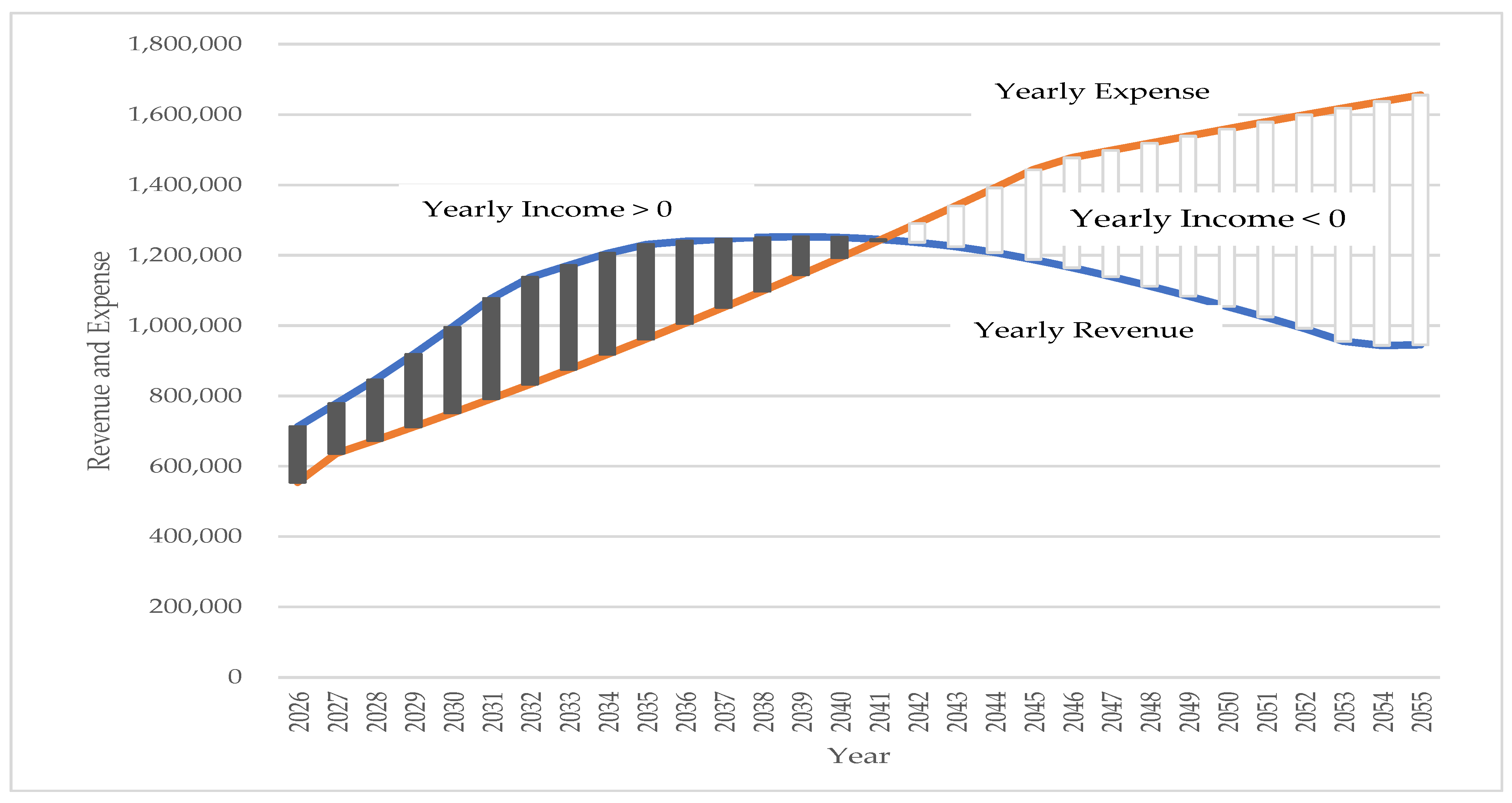
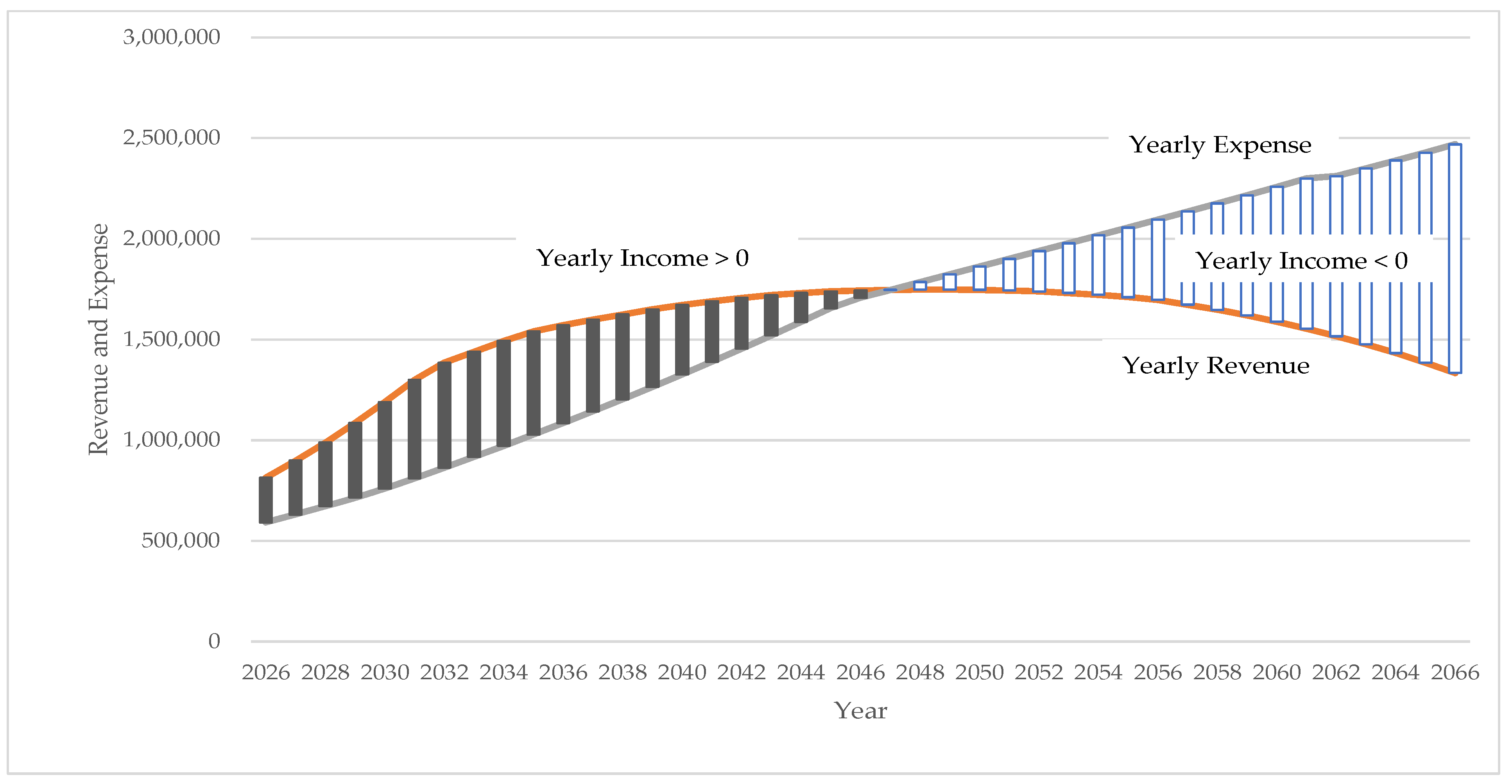
  • Yearly income: Following comprehensive reform measures, annual revenue is expected to increase gradually, showing a positive yearly income before 2041. However, revenue will decline due to a reduction in the number of insured individuals, and the annual loss will increase significantly after 2042, as detailed in Figure 1.
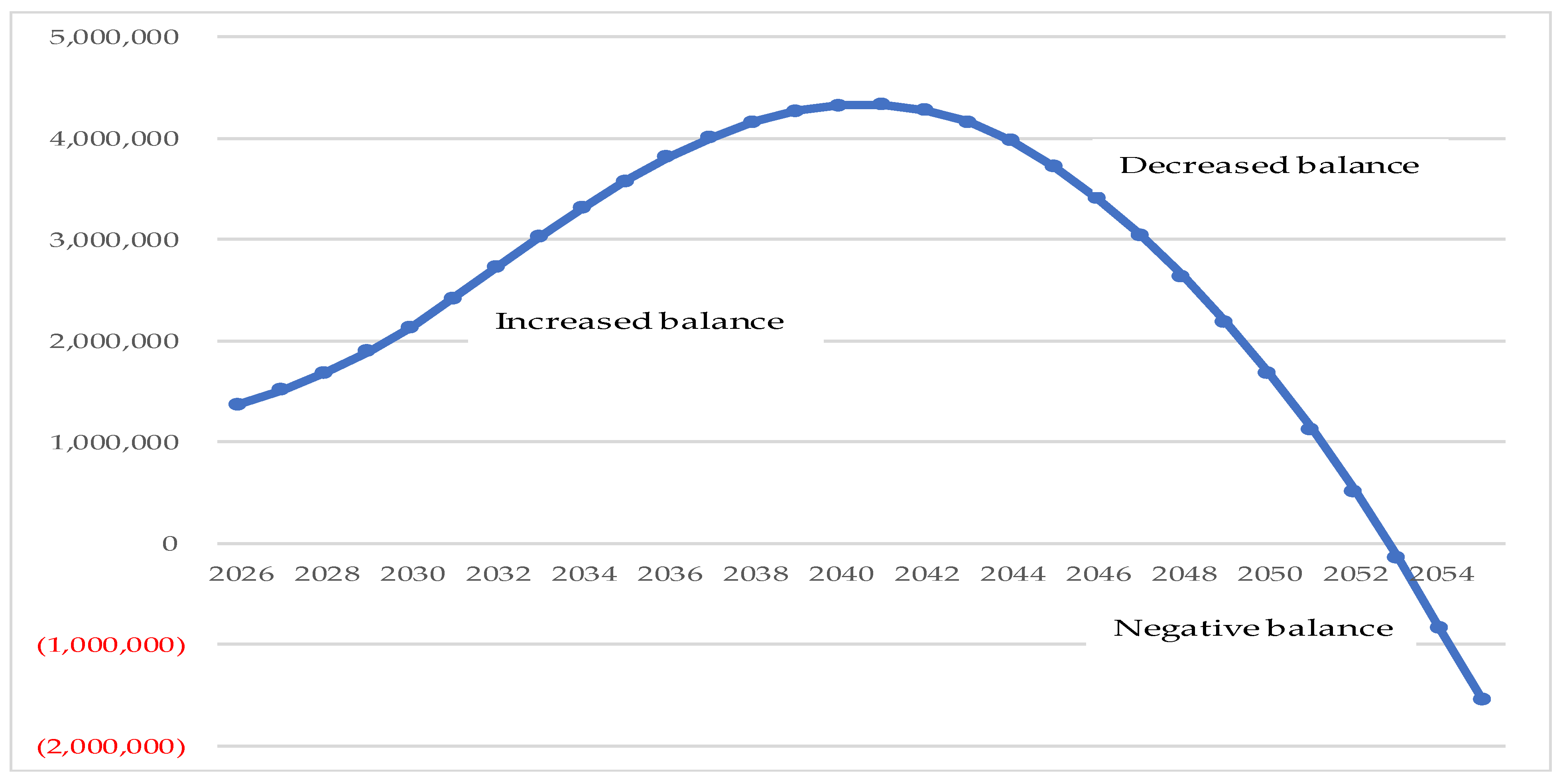
  • Fund balance: In Scenario One, the pension fund is projected to become insolvent by 2053, with a fund balance of NT$−140 billion at that time. Details are shown in Figure 2.
After reviewing the long-term trend of public labor pension’s growing annual deficit, the partial funding system will not be sustainable under the consideration of multi-generational equity and the substantial burden.

4.2. Scenario Two: Gradual Comprehensive Reform with 15% of Reemployed Retired Laborers Reenrolling in the System

In Scenario Two, this study applied the reform measures of Scenario One but also accounted for the effect of 15% of retired laborers reenrolled in the pension system. This involved expanding the number of insured individuals within the public labor pension scheme. In this scenario, the premium rate increased by 1% each year until it reached 17%. The average monthly annuity was calculated to be 90% of the 2025 formula, and government subsidies amounted to NT$100 billion annually.
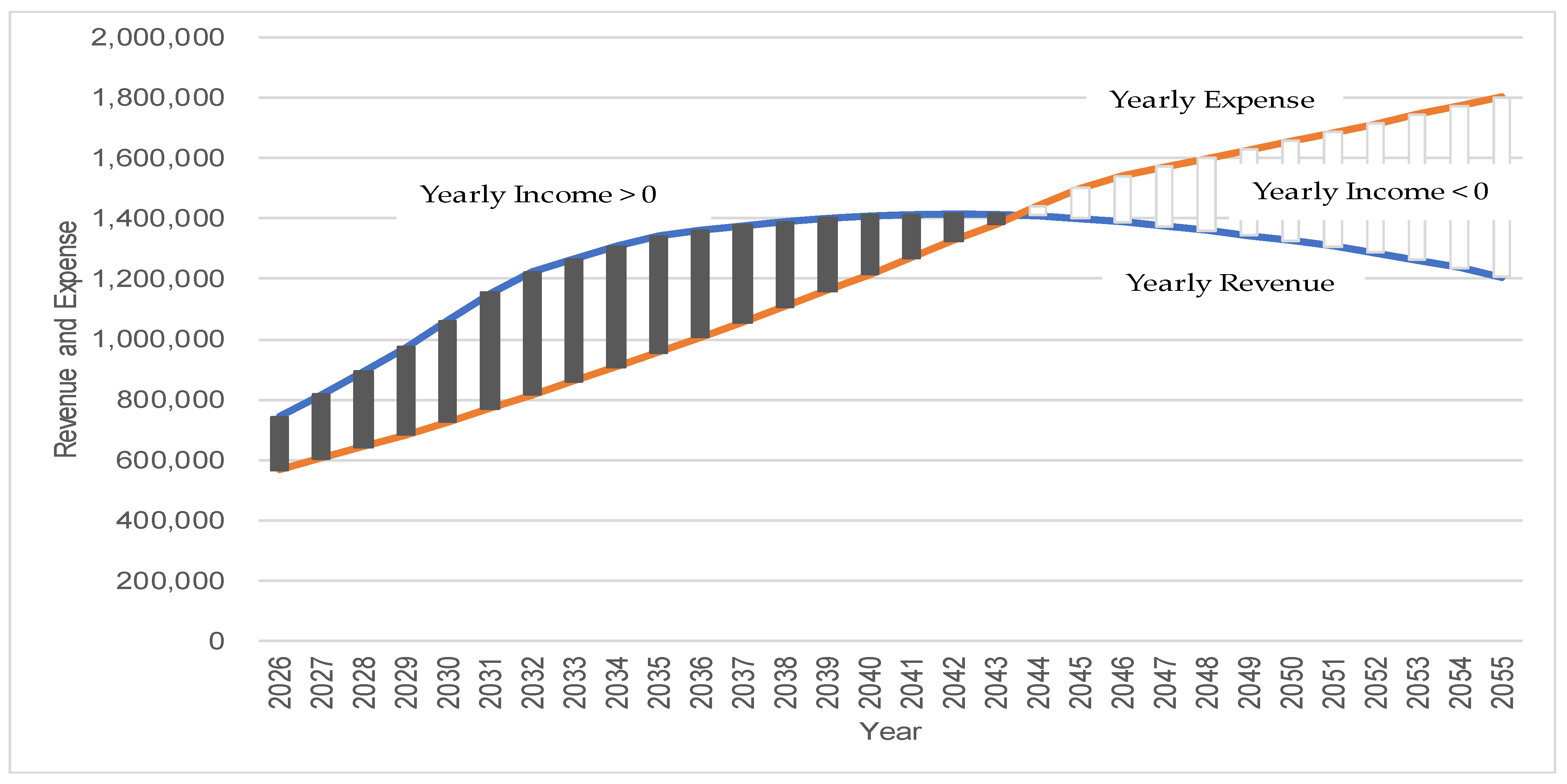
  • Yearly income: Following comprehensive reform measures, annual revenue is expected to increase gradually, showing a positive yearly income before 2043. However, revenue will decline due to a reduction in the number of insured individuals, and the annual loss will increase significantly after 2044, as detailed in Figure 3.
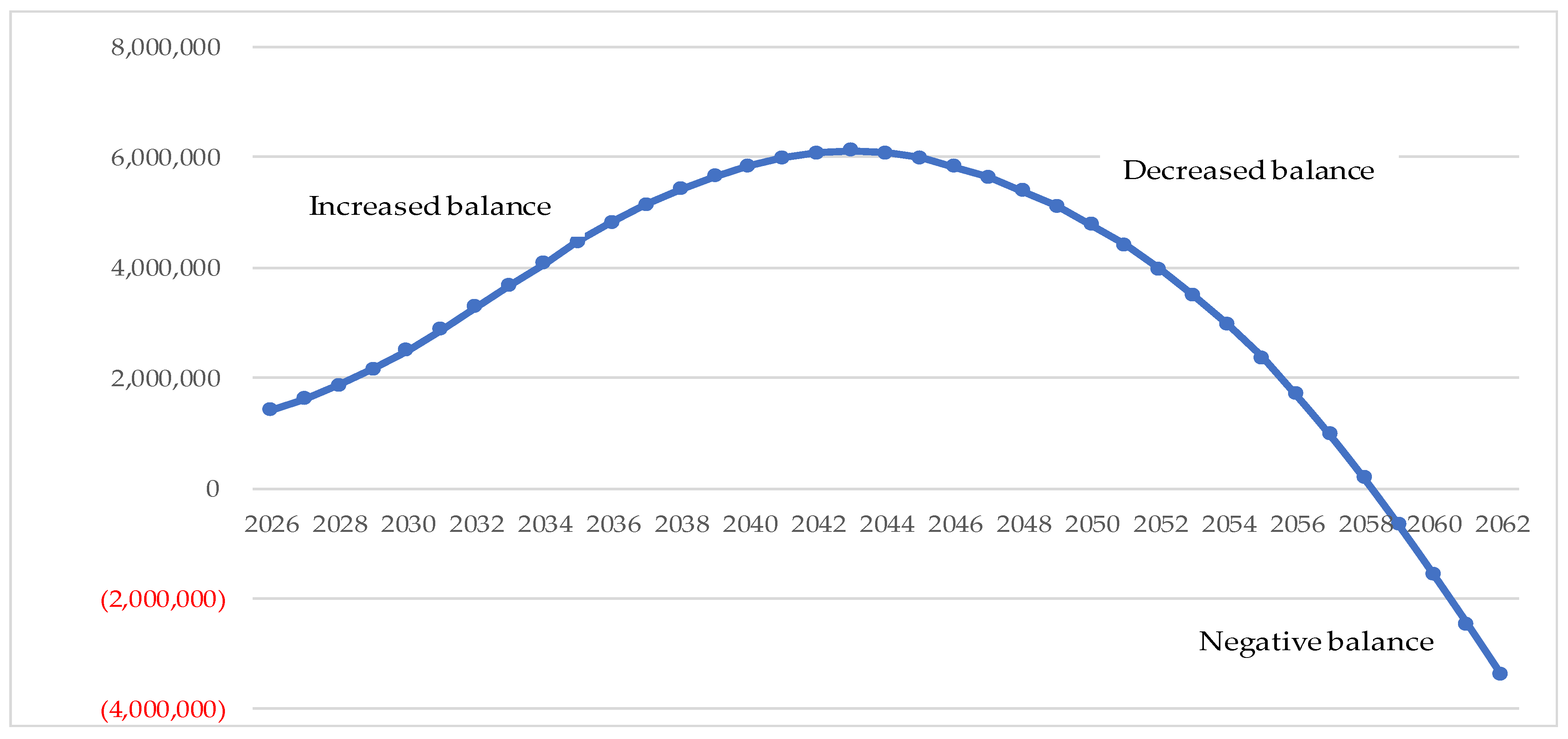
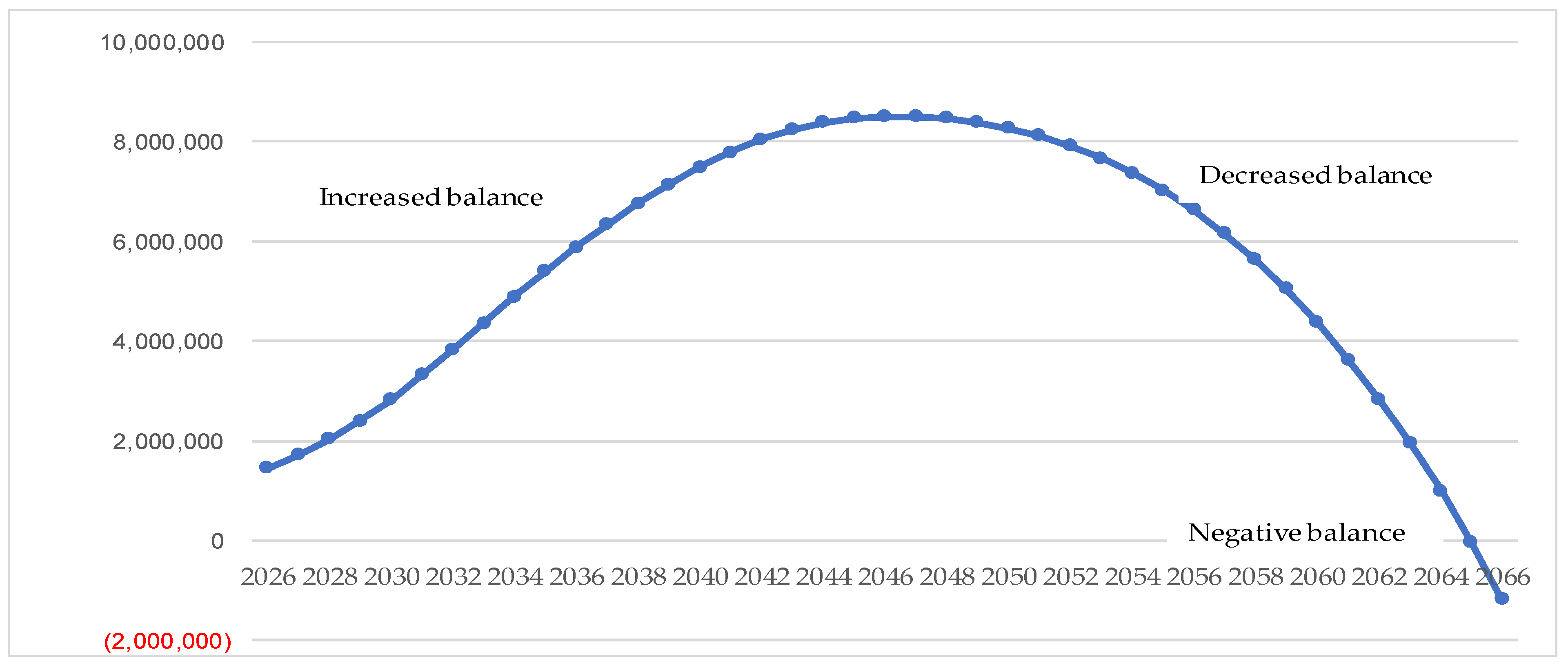
  • Fund balance: In Scenario 2, the pension fund balance is projected to remain positive until 2058, reaching NT$185 billion that year. However, the pension fund is expected to become insolvent by 2059, with a fund balance of NT$−671 billion, as detailed in Figure 4.

4.3. Scenario Three: Gradual Comprehensive Reform with 50% of Higher Reemployed Retired Laborers Reenrolling in the System

In Scenario Three, this study applied the reform structure of Scenario Two but revised the proportion of 50% retired laborers reenrolled in the pension system.
  • Yearly income: Following comprehensive reform measures, annual revenue is expected to increase gradually, showing a positive yearly income before 2046. However, revenue will decline due to a reduction in the number of insured individuals, and the annual loss will increase gradually after 2047, as detailed in Figure 5.
  • Fund balance: In Scenario 3, the pension fund balance is projected to remain positive until 2064, reaching NT$1004 billion that year. However, the pension fund is expected to become insolvent by 2065, with a fund balance of NT$−39 billion, as detailed in Figure 6.
Scenario Three indicated a more sustainable pension and relatively lower impact on the laborers. Specifically, the positive effect of reemployed retired laborers demonstrated a large positive effect. In addition, from the viewpoint of reemployed retired laborers, there are annuity payments to motivate them to reenroll in the public labor pension, indicating a win–win pension game.

4.4. Comparison and Discussion for Three Scenarios

After comparing Scenarios 1~3 in Section 4.1, Section 4.2 and Section 4.3, the study further prepared a comparison table (as Table 2) to summarize the key cross-scenario results. First, the year of yearly loss is in 2047 in Scenario 3, far better than in Scenario 1 and 2. Second, the year of bankruptcy in Scenario 3 is in 2065, with better sustainability than Scenario 1 and 2. Finally, the fund balance in 2058 for Scenario 3 is NT$5637 billion, indicating better financial sustainability than Scenario 1 and 2.

4.5. Sensitivity Analysis

The study further conducted a comparative static analysis based on the model in Scenario Two and Three. The sensitivity result is the concept of comparative static analysis to indicate the effect of a single variable while other variables are constant. As shown by the results presented in Table 3, only increasing the premium rate to 17% had the strongest positive effect on the fund balance with 16-year delay, while solely an annual subsidy of NT$100 billion had the second-most positive effect with 10-year delay. Moreover, solely reducing the old-age annuity amount by 10% had a positive impact on the fund balance with 7-year delay. Furthermore, purely allowing 15% of reemployed retired laborers to reenroll in the system had a positive effect of approximately NT$2.2 trillion, with a 3-year delay before bankruptcy. Finally, allowing 50% of reemployed retired laborers to reenroll in the system had a larger positive effect and the expected financial contribution was predicted to be approximately NT$7.6 trillion, with a 9-year delay before bankruptcy. The sensitivity results highlighted the significant positive effect of allowing larger numbers of reemployed retired laborers to reenroll in the public labor pension system.

4.6. Implications for Taiwan Government

After the scenario test and sensitivity analysis, the study indicated that the feasible reform project included reemploying retired laborers to reenroll in the public labor pension, a premium adjustment, a slight reduction in payments, and a regular government subsidy. We emphasize that the government subsidy is only a small element of the reform project. The Taiwan Ministry of Labor should raise the Act amendment version and consult with the Legislative Yuan on schedule.
Furthermore, the study compares Scenario Three in the research and the 2017 Labor Reform Act, which was rejected by the Taiwan Legislatiiv Yuan, as shown in Table 4. After comparing Scenario Three in the research with the Act in 2017, the study found that Taiwan laborers noticed a significant reduction in their monthly annuity payments. In Scenario Three, the study recommends a 10% gentle reduction to reduce laborers’ criticism. Furthermore, the highest premium rate is precise at the 17% level. While the government subsidies are higher, the premium rate can be lower. Last but most important, Scenario Three included 50% retired laborers reenrolled in the pension system to expand the number of insured. After comparisons, the study suggested that Scenario Three is a more feasible reform project.

5. Conclusions and Recommendation

This study noted that previous research on reforming Taiwan’s public labor pension has given little consideration to the impact of reemployed retired laborers reenrolling in the system and not included the sensitivity test on every key reform element. The study established a financial forecasting model incorporating reemployed retired laborers and employed comparative static analysis to examine the effects of several variables on Taiwan’s public labor pension. In Scenario Three, the fund balance was projected to remain positive until 2064, with a fund balance of NT$−39 billion in 2065.
Furthermore, the study further conducted a comparative static analysis based on the model in Scenario Two and Three. Only increasing the premium rate to 17% had the strongest positive effect on the fund balance with 16-year delay, while solely an annual subsidy of NT$100 billion had the second-most positive effect with 10-year delay. Moreover, solely reducing the old-age annuity amount by 10% had a positive impact on the fund balance with 7-year delay. Furthermore, purely allowing 15% of reemployed retired laborers to reenroll in the system had a positive effect of approximately NT$2.2 trillion, with a 3-year delay before bankruptcy. Finally, solely allowing 50% of reemployed retired laborers to reenroll in the system had a larger positive effect, and the expected financial contribution was predicted to be approximately NT$7.6 trillion, with 9-year delay before bankruptcy.
After reviewing the annual increasing losses in the long-term trend of the public labor pension, the partial funding system will not be feasible due to intergenerational equity concerns and the substantial deficit. Therefore, this study recommends that the Taiwanese government consider the positive impact of reemployed retired laborers reenrolling in the pension system and adjust age regulations to include more of these laborers.
Finally, the study suggests that the Taiwanese government should promptly communicate and make a decision regarding the reform of its public labor pension system. If the government adopts only a temporary subsidy scheme, the pension fund is likely to become insolvent by approximately 2031, as indicated by the 2024 Actuarial Report. The impact of Taiwan’s population aging on the public labor pension system is increasing over time, so efforts to reform the system must be intensified. The government should arrange the Act amendment process earlier by considering the following main revisions:
  • Regularly raise the premium rate annually to 17%.
  • Government regularly subsidizes NT$100 billion annually.
  • The inflation rate adjustment for annuity payments needs to be canceled.
  • Reducing the old-age annuity amount by 10% gradually.
  • Allowing many more reemployed retired laborers to reenroll in the public labor pension and promote broadly.

5.1. Research Restrictions

This study has several limitations that should be acknowledged. First, as the Taiwanese government intends to retain defined benefit plans with partial funding in its pension reform, this study focused specifically on reforming a defined benefit plan. Second, due to the lack of statistics on the number of reemployed retired laborers in Taiwan for forecasting purposes, this study made personal assumptions regarding this figure in its analysis. Third, the study is not involved in investment strategies, operational administration, or regulatory revisions.

5.2. Recommendation for Future Research

This study recommends that future research may focus on the following areas:
  • It is recommended to research other feasible and comprehensive public defined benefit pensions or notional defined contribution reform projects, particularly considering potential public criticism and political issues.
  • A feasible recommendation and communication for revised regulations is necessary for the Taiwan public labor pension following the determination of the reform direction.

Author Contributions

Writing—original draft preparation: Y.-C.L.; writing—review and editing: M.-S.C. All authors have read and agreed to the published version of the manuscript.

Funding

This research received no external funding.

Institutional Review Board Statement

Not applicable.

Informed Consent Statement

Not applicable.

Data Availability Statement

The data used in this study are mainly derived from publicly available government statistics.

Conflicts of Interest

The authors declare no conflict of interest.

References

  1. Alonso-García, J., & Rosado-Cebrian, B. (2021). Financial crisis and pension reform in Spain: The effect of labor market dynamics. Journal of Economic Policy Reform, 24(2), 201–218. [Google Scholar] [CrossRef]
  2. Altiparmakov, N. (2023). The 2022 Greek pension reform: The rebirth of carve-out privatization in Eastern Europe. International Social Security Review, 76, 57–78. [Google Scholar] [CrossRef]
  3. Aysan, M. F. (2013). Reforms and challenges: The Turkish pension regime revisited. Emerging Markets Finance and Trade, 49(5), 148–162. [Google Scholar] [CrossRef][Green Version]
  4. Bonin, H. (2009). 15 years of pension reform in Germany: Old successes and new threats. The Geneva Papers, 34, 548–560. [Google Scholar] [CrossRef]
  5. Börsch-Supan, A. (2007). Rational pension reform. The Geneva Papers, 32(4), 430–446. [Google Scholar] [CrossRef]
  6. Chen, F. L., & Chung, S. L. (2019). The new thought of labor insurance’s pension benefits. NTU Management Review, 29, 103–138. [Google Scholar]
  7. Focacci, C. N., Öylü, G., Motel-Klingebiel, A., & Kelfve, S. (2023). The value of pension reforms for late working life: Evidence from Sweden. International Journal of Sociology and Social Policy, 43(13), 79–89. [Google Scholar] [CrossRef]
  8. Inzunza, A., & Madeira, C. (2025). The Chilean pension withdrawals and the 2025 reform: Fiscal and retirement consequences. Journal of Pension Economics and Finance, 24, 516–542. [Google Scholar] [CrossRef]
  9. Jian, S. Z., & Wang, H. W. (2020). The Impact of Taiwan labor insurance’s under-reporting of employees’ income behavior on labor insurance finance. Journal of Public Administration & Policy, 70, 67–101. [Google Scholar]
  10. Li, S., & Lin, S. (2024). Social security reforms, capital accumulation, and welfare: A notional defined contribution system vs. a modified PAYG system. Journal of Population Economics, 37(1), 1–34. [Google Scholar] [CrossRef]
  11. Liao, Y. C. (2013). A comparative study on the public pension systems of Singapore, Chile, and Taiwan and suggestions for Taiwan’s labor insurance old-age benefit system. Journal of Life Insurance Management, (26), 157–171. [Google Scholar]
  12. Maggs, C., & Zhang, J. (2025). Active ageing in the People’s Republic of China: A case study of working after retirement. Asian Development Review, 42(2), 111–146. [Google Scholar] [CrossRef]
  13. Ministry of Labor. (2025). The statistic report, regulation and reform progress of social labor insurance (TW, 2022–2024). Available online: https://www.mol.gov.tw/ (accessed on 2 January 2026).
  14. Ministry of The Interior. (2025). National life and mortality table (2023 version). Available online: https://www.moi.gov.tw/cL.aspx?n=2906 (accessed on 2 January 2026).
  15. National Development Council. (2025). Demographic forecast (TW). Available online: https://www.ndc.gov.tw/Content_List.aspx?n=DB1708E9D8084B23 (accessed on 2 January 2026).
  16. Poteraj, J. (2025). Pension economics paradigms and pension system reforms in Uruguay—Compliance analysis. European Research Studies Journal, 28(1), 559–574. [Google Scholar] [CrossRef]
  17. Presidential Office National Pension Reform Committee [POPRC]. (2026). 2017 pension reform act. Available online: https://pension.president.gov.tw/Content_List.aspx?n=3E52255E5F7FBFFC (accessed on 2 January 2026).
  18. Taiwan Labor Insurance Bureau. (2024). Actuarial and financial evaluation report (TW, 2021 & 2024 version). Available online: https://www.bli.gov.tw/0013023.html (accessed on 2 January 2026).
  19. Taiwan Labor Insurance Bureau. (2025). Labor insurance statistics (TW, 2023–2025/4). Available online: https://www.bli.gov.tw/0013087.html (accessed on 2 January 2026).
  20. Wang, J. L., Huang, H. C., Chen, Y. C., & Cheng, M. H. H. (2019). Financial effects and intergenerational inequity of pension reform in Taiwan. NTU Management Review, 29, 139–172. [Google Scholar]
  21. Wang, J. L., Huang, H. C., Yang, S. S. W., Chen, Y. C., & Cheng, M. H. H. (2017). Pension reform and building a sustainable pension system in Taiwan. Journal of Taiwan Economic Forecast and Policy, 48, 1–39. [Google Scholar]
Figure 1. Yearly Revenue and Expense Trend: Scenario One. Unit: NT$ Million. Source: Authors. Blue line indicates the trend of yearly revenue and orange-red line shows the trend of yearly expense. The black background area indicates positive yearly income and the white background area shows negative income.
Jrfm 19 00299 g001
Figure 2. The Estimated Fund Balance Trend: Scenario One. Unit: NT$ Million. Source: Authors. The red figure indicates negative balance.
Jrfm 19 00299 g002
Figure 3. Yearly Revenue and Expense Trend: Scenario Two. Unit: NT$ Million. Source: Authors. Blue line indicates the trend of yearly revenue and orange-red line shows the trend of yearly expense. The black background area indicates positive yearly income and the white background area shows negative income.
Jrfm 19 00299 g003
Figure 4. The Estimated Fund Balance Trend: Scenario Two. Unit: NT$ Million. Source: Authors. The red figure indicates negative balance.
Jrfm 19 00299 g004
Figure 5. Yearly Revenue and Expense Trend: Scenario Three. Unit: NT$ Million. Source: Authors. Orange-red line indicates the trend of yearly revenue and grey line shows the trend of yearly expense. The black background area indicates positive yearly income and the white background area shows negative income.
Jrfm 19 00299 g005
Figure 6. The Estimated Fund Balance Trend: Scenario Three. Unit: NT$ Million. The red figure indicates negative balance.
Jrfm 19 00299 g006
Table 1. The summary of variables in the model.
The VariablesReference ValueSources or Reference
Estimated average premium per personaverage insured salary: NT$35,180 in 20242024/2025 Labor insurance statistics
Estimated number of insureds10,479,398 persons in 2024Year 2023 estimation of National Development Council in Taiwan (Medium estimate) & 2024 Labor insurance statistics
Premium rate adjustmentgradually rise by 1% every year until it reaches the target rate of 17%Assumed by the research
Annual salary growth rate2.5%
(1.5% for reemployed retired laborers)
Assumed by the research
Average long-run investment return rate6%Assumed by the research
Average old-age annuity payment per personNT$223,219 in 20242024–2025 Labor insurance statistics
Old-age annuity payment reduced ratio10%Assumed by the research
Accumulated numbers from new annuitants149,853 in 2024Year 2023 estimation of National Development Council in Taiwan, 2024 Actuarial report &
2024 Labor insurance statistics
Accumulated numbers from in-force annuitants1,721,069 in 2024Year 2023 estimation of National Development Council in Taiwan &
2024 Labor insurance statistics
Inflation rate adjustment for annuity payments0%Assumed by the research
Annual lapse rate for old-
age annuitants
1.83%
(3.07% for retired laborers)
2023 average national mortality table (Age 66–75) and (Age 70–80)
The number of reemployed laborers reenrolled15% or 50% of old ageYear 2023 estimation of National Development Council (Medium estimate) in Taiwan and assumed the ratio by the research
Accumulated numbers from new annuitants of reemployed laborers1% of the estimated number of reemployed retired laborers during 2026–2030 and 5% thereafterAssumed by the research
Source: Author.
Table 2. Summary of cross-scenario results.
ScenariosScenario 1Scenario 2Scenario 3
The year of yearly loss204220442047
The year of
bankruptcy
205320592065
Fund balance in 2058 (NT$ Million)(3,762,140)185,388 5,637,266
Source: Authors.
Table 3. Sensitivity test for selected variables in Scenario Two and Three. Unit: NT$ Million.
Items/EffectFund Balance in 2058
(A)
Fund Balance in 2058 After Maintaining Unchanged (B)Amount Difference
(A–B)
Bankruptcy Year (C)Bankruptcy Year After Maintaining Unchanged (D)Year Difference
(C–D)
1. Premium rate raised to 17% 185,388(14,486,488)14,671,876 2059204316
2. Government subsidizes 100 billion annually(7,717,247)7,902,635204910
3. Reduced 10% of old-age annuity amount(4,946,753)5,132,141 20527
4. Included reemployed retired laborers (15%)(2,010,060)2,195,448 20563
5. Included reemployed retired laborers (50%)5,637,266(2,010,060)7,647,327 206520569
Source: Authors.
Table 4. The reform comparison between Scenario Three and rejected Act in 2017.
ScenariosScenario 3Rejected Reform Act
(2017 Version)
Included Insured
1.
50% retired laborers reenrolled in the pension system.
2.
15~65 years old laborers
Mainly 15~65 years old laborers
Main reform in monthly payment
1.
The average monthly annuity was calculated to be 90% of the formula.
2.
The average monthly salary maintained the same as the highest-earning 60 months of the insured’s salary income.
The average monthly salary is based on the highest-earning 180 months of the insured’s salary income.
The expected reduction in monthly payment10%
(The inflation rate adjustment for annuity payments needs to be canceled)
20~30%
(Assumed the reduction in average income is equal to 10 thousand and working year is 40).
The premium rate The premium rate increased by 1% each year until it reached 17%.The premium rate should be reviewed and adjusted in the future without precise level.
Government subsidiesGovernment subsidies amounted to NT$100 billion annually.Government subsidies amounted more than NT$20 billion annually.
Disclaimer/Publisher’s Note: The statements, opinions and data contained in all publications are solely those of the individual author(s) and contributor(s) and not of MDPI and/or the editor(s). MDPI and/or the editor(s) disclaim responsibility for any injury to people or property resulting from any ideas, methods, instructions or products referred to in the content.