


Abstract
This paper studies the effects of leasing on credit risk and access to credit. The repossession of a leased asset is generally easier than the enforcement of collateral associated with securing a standard loan agreement. We argue that this greater efficiency in enforcement mitigates, ceteris paribus, the counterparty’s moral hazard. To test this hypothesis, we developed a credit rationing model in which income is privately observed and non-verifiable, and financial intermediaries share credit risk information about borrowers. Financial contracts that are more rapidly enforced, such as in leasing, enable the screening of relatively safer projects or credit rationing reduction. We provide empirical evidence consistent with this prediction for the Italian credit market and considerations for the effects of monetary policy variables on the model’s equilibrium.
1. Introduction
Leasing has been considered by much of the economic literature as a substitute for debt for “risky” firms (as in Crawford et al., 1981; Schallheim et al., 1987; Altman, 1989; Asquith et al., 1989; Lease et al., 1990). In the Italian market, however, short-term default rates for leasing contracts have been lower than or equal to those for loans to corporate and SMEs in recent years. We, therefore, try to reassess the validity of this assumption.
We focus on the effect of enforcement on default rates of leasing contracts. Under Italian law, the repossession of a leased asset is generally easier than the enforcement of collateral under a standard loan agreement. This enhanced enforceability can reduce the borrower’s moral hazard (Eisfeldt & Rampini, 2009). To test this hypothesis, we developed a credit rationing model in which income is privately observed and non-verifiable (on the lines of Stiglitz & Weiss, 1981; Bolton & Scharfstein, 1990; Holmström & Tirole, 1997). We also assume that financial intermediaries share credit risk information about borrowers (by means of private credit bureaus or public credit registers). Under these conditions, financial contracts that are more rapidly enforced, such as in the leasing case, allow either to screen relatively safer projects or reduce credit rationing.
We then constructed a time series of short-term default rates on leasing contracts using data from the Italian Leasing Association credit register. We found evidence that leasing is associated with default rates lower than or equal to those measured on loans to corporate and SMEs reported by Banca d’Italia. We found some indications that interest rates affect the riskiness of bank loans more, as they already operate on a narrower incentive margin; however, we cannot rule out the hypothesis that the risk gap between leases and loans is unaffected by monetary policy instruments. To the best of our knowledge, this work is the first to analyze the effect of shared information on credit rationing across different types of loan agreements, focusing on Italian leasing data. The paper proceeds as follows. Section 2 presents the literature on leasing. Section 3 highlights some features of the Italian leasing market and legislation. Section 4 describes the model. Section 5 describes the data and tests the model’s main hypotheses. Section 6 briefly describes the model’s monetary implications. Section 7 concludes.
2. Leasing in Economic Literature
Financial leases are commonly acknowledged among corporate finance authors as a form of financing (Brealey et al., 2000). This is a direct consequence of the specific features of the financial leasing contracts, which are not cancellable and extend over most of the economic life of the leased asset, i.e., “the lease payments are fixed obligations equivalent to debt service.” Therefore, some authors (Miller & Upton, 1976; Myers et al., 1976; Miller, 1977) have derived the economic rationale for leasing by solving a firm’s “lease vs. borrow” problem.
This approach is deeply rooted in the classical Modigliani–Miller framework and treats taxes as the key determinant of the firm’s optimal capital structure. In particular, straight-line depreciation of a financed asset creates a net tax deferral whenever a tax depreciation scheme does not match the principal repayments implicit in the lease (Brealey & Young, 1980; Bierman, 1988). However, this opportunity of tax arbitrage rests on the very restrictive hypothesis that the lessor is subject to a higher marginal tax rate than the lessee. It also suffers from the well-known limitation of the Modigliani–Miller approach in determining the optimal level of leverage ratio for a competitive firm.
In seeking other reasons to explain the economic rationale of leasing, its use as an off-balance-sheet financing tool, especially in the form of an operating lease, has deserved some consideration in the literature (Mayer, 2005; Kilpatrick & Wilburn, 2011). However, the introduction of IFRS 16 has almost ruled out lease capitalization avoidance, requiring lessees, both in operating and financial cases, to recognize assets and liabilities for all leases with a term of more than 12 months1.
Smith and Warner (1979) and Stulz and Johnson (1985) have stressed that leasing can help overcome underinvestment problems by allowing the project to segregate its claim to its expected cash flows. Smith and Watts (1982) have claimed that managers prefer leasing instead of purchasing an asset because it (artificially) improves the firm’s performance indicator, such as return on investment, and allows for a more efficient risk management thanks to the distribution of wealth among different assets (in a Fama and Jensen approach).
Part of the literature on principal-agent theory has focused on the “lease vs. buy” problem, highlighting the agency costs implicit in leasing agreements relative to standard debt financing. In leasing contracts, agency costs increase because of the need to maximize the maintenance incentives of the financed asset (Alchian & Demsetz, 1972). Klein et al. (1978) stress that differences in asset valuation between the lessor and the lessee increase enforcement costs due to conflicts over the division of the quasi-rent implicit in the leasing contract. In both cases, incentives to internalize these contracting problems can either lead to adverse selection issues or rule out leasing in favor of direct ownership of the productive asset.
On the supply side, Benston and Smith (1976) have shown that the “lease vs. buy” problem can be resolved in favor of leasing whenever the lessor has market power or a comparative advantage in asset disposal. Lessors can benefit from reduced search, information, and transaction costs associated with supplying and maintaining the leased asset.
More recently, Eisfeldt and Rampini (2009) have switched their attention to the long-debated idea, quite popular among practitioners (Schallheim, 1994) but disregarded by some authors (Brealey et al., 2000; Ross et al., 2002), that the relevance of leasing as a financial instrument alternative to standard debt financing rests in its “capital preserving” nature, i.e., on its ability to allow the full financing of the leased asset, leaving the cash balances of the lessee unaffected2. In particular, the choice of leasing is supposed to hinge on a debt capacity–agency costs trade-off. On the one hand, in bankruptcy, it is much easier for a lessor to regain control of an asset than it is for a secured lender to repossess it. This “ability to repossess” affects what lessor and lender can reasonably expect to be repaid outside of bankruptcy. On the other hand, allocating ownership to the agent providing funds amplifies agency costs due to the separation of ownership and control.
Leasing is also a particularly important source of financing for financially constrained firms because it increases debt capacity. Survey data from the European Central Bank (Kraemer-Eis & Lang, 2012), the European Commission (European Commission, 2025), the European Leasing Federation—Leaseurope (Oxford Economics, 2011) and the Italian Leasing Association—Assilea (2012, 2013, 2014, 2015, 2016, 2017, 2018, 2019, 2020, 2021, 2022, 2023, 2024, 2025)3 show that leasing ranks consistently among the primary sources of funding for micro-, small-, and medium-sized enterprises (SMEs), both in the European and in the Italian market.
The literature has stressed, both theoretically and empirically, the effects of market imperfections on the access of economic agents—and, among them, smaller firms—to the capital market. The reasons for differences in financing sources between SMEs and large firms have been found in agency problems, asymmetric information, and “behavioral” issues. All these themes have been largely analyzed in the literature with regard to general corporate finance theory (e.g., Jensen & Meckling, 1976; Stiglitz & Weiss, 1981, 1983; Diamond, 1984; Myers & Majluf, 1984; Asquith & Mullins, 1986a, 1986b; Masulis & Korwar, 1986; Mikkelson & Partch, 1986; Lucas & McDonald, 1990; Korajczyk et al., 1991; Berger & Udell, 1998; Baker & Wurgler, 2002), and subsequently adapted to the studies on links between firm dimension and access to finance.
In the presence of moral hazard, authors such as Barro (1976), Stiglitz and Weiss (1981), and, on slightly different lines, Williamson (1988) have shown that lower-quality borrowers, that is, those that are likely to default or otherwise to undertake riskier projects than initially proposed, will be required to provide (a higher degree of) collateral4. If borrowers deviate from the lending agreements, lenders can rely on their collateral claims to recover a greater share of the project’s outcome (i.e., even in the case of shirking). The following literature (Bolton & Scharfstein, 1990; Hart & Moore, 1998) has identified an incentive-compatible agreement between lenders and borrowers that, under the threat of termination, allows the revelation of the project’s actual outcome, thereby, under given circumstances, avoiding borrower shirking.
The threat of termination of the borrowing agreement can also reduce the borrower’s moral hazard in an intertemporal scheme. In this sense, the effectiveness of contract enforcement can have positive effects on the perceived riskiness of the counterparty and access to funding (Jappelli et al., 2005).
More recently, the role of information sharing in borrowers’ credit performance has been considered5. Jappelli and Pagano (2002) show that information sharing among lenders through both private credit bureaus and public credit registers attenuates adverse selection and moral hazard, thereby increasing lending and reducing default rates. Brown and Zehnder (2007) use an experimental setting to analyze how information sharing increases repayment rates, as borrowers anticipate that a good credit record improves their access to credit. Bennardo et al. (2015) study how information sharing reduces the incentive to overborrow.
3. Features of Italian Leasing Legislation
In the Italian market, leasing has long been a so-called “atypical” contract, not regulated by a specific legal standard. During the years following the introduction of this type of contract in the financial market, only a few legal aspects and specific cases of leasing contracts6 had been considered. Therefore, the actual definition of the different features of the leasing contract has been essentially delegated to practitioners (Camera di Commercio di Milano, 2010). A consensus gradually emerged, identifying financial leasing as an atypical contract with a financing purpose and structure. The subsequent legislative innovation was key to the emerging definition of a “financial leasing” contract. In 2017, the legislative innovation was finally translated into a specific discipline and a comprehensive definition of financial lease, closely resembling those applied in the U.S. and U.K. markets.
Prior to the reform, leasing agreements and secured loans were subject to similar provisions regarding the legal authorization of the service provider (i.e., the financial institution), relevant contractual terms—such as transparency requirements, price identification, usury ceiling rates—and (gradually) an accounting perspective. However, they differed substantially in their views on contract termination. In fact, both financial and operating standard lease contracts usually included an express termination clause or “clausola risolutiva espressa”, which entitled the lessor to the right to a unilateral, early breach of the leasing contract whenever the lessee did not comply with one or more contractual obligations. Among these, failure to make installment payments when due was expressly included (La Torre, 2002).
In these cases, the lessor could resort to either an injunction process or an order of payment (“decreto ingiuntivo”) for movable leased assets or to an interim proceeding (“giudizio sommario di cognizione”) for real estate leasing to repossess the leased asset. If the lessee did not oppose, the lessor could obtain7 an enforceable court order. The order, together with the injunction to fulfill the defaulted obligations (“atto di precetto”), allowed the lessor to recover at short notice—10 days or more—the amounts past due as well as repossess the leased asset, both from the defaulted lessee or from third parties, even with the employment of a judicial officer. After the leased asset was repossessed, the leasing company could sell it and use the proceeds to satisfy its claims. If any residual claim was unsatisfied, the lessor had the right to resort to foreclosure on the debtor’s remaining assets. In this case, the process was the same as for standard credit collection. Thus, the physical repossession of the leased asset was a substantially immediate consequence of the enforceable order of payment; this implied preferential treatment for the leasing contract regarding the timeliness of collateral repossession.
Enforcement of other types of collateral—surety, insurance contracts, pledge on movable goods, and personal property of the shareholders (such as pledge or charge on equity or corporate bonds)—usually entitles the creditor to a prior claim on the pledged collateral or on the guarantor’s assets, and only subsequently on the principal borrower’s property. Unlike mortgages, leasing contracts are not subject to the debtor’s objections for envisaging an unlawfully short express termination clause. Unlike obligations backed by a fixed charge, as well as non-collateralized debt contracts, the enforcement of a defaulted leasing contract was not subject to any limitation with respect to the recovery of collateral, and it was also not subject to conversion or to payment in installments (as typically required in the standard foreclosure process).
The specific discipline of financial leasing, introduced in 2017, set, among other conditions, a minimum number of missed installments as a condition for a lawful termination of the contract (La Torre, 2018). Therefore, it tightened the conditions for identifying the lessor’s default, aligning it more closely with those for other types of financial instruments, particularly standard term loans such as mortgages. The new provision applied only to leasing contracts signed after the entry into force of the new regulation or to non-defaulted pre-existing leasing contracts. The absence of a retroactive effect was eventually stated by a pronouncement of the Corte di Cassazione in 2021. Prior to the intervention, however, both legal scholarship and practitioners had already construed the provision as non-retroactive (see, for example, La Torre, 2018), and it was widely understood in practice to apply only prospectively.
4. The Model
Following Bolton and Scharfstein (1990) and Holmström and Tirole (1997), we assume there are two representative agents: an investor (a bank) and an entrepreneur (a firm), both risk neutral. The firm is protected by limited liability and financially constrained, i.e., it needs external funding to finance a project that lasts more than one period. We assume that the firm is endowed with an initial net worth of E, while the value of the investment needed to undertake a project, I, is greater than .
A lending agreement can be signed between the two parties. If the firm can borrow money from the bank and undertake the project, it yields the firm stochastic income in each period (see the Appendix A.1 for details). The firm cannot observe the project’s outcome and, therefore, unless some incentive-compatible agreement is signed between the two parties, it can retain the whole outcome with impunity8.
Three instruments can be assumed to be capable of reducing, and possibly eliminating, the incentive to shirk. The first one is the threat of termination of the borrowing agreement. In an intertemporal framework, if the bank ceases to finance the firm, the entrepreneur will subsequently be unable to continue relying on external debt to finance the project. This implies that the effectiveness of contract enforcement can positively affect the perceived riskiness of the counterparty and, consequently, access to funding, as in Jappelli et al. (2005).
The second one—sometimes related to a so-called “theory of hostages” (as in Williamson, 1988; Bolton & Scharfstein, 1990; Hart & Moore, 1998)—is that the signing of the credit contract can be linked to the condition that the firm pledges some form of collateral to the bank. In this way, if the firm deviates from the lending agreement, the bank can rely on its claim on collateral, which can be either a specific asset or a personal or third-party guarantee, to recover a greater part of the project’s outcome (i.e., even in the case of shirking). By foreclosing on the firm’s assets, the bank insures itself ex ante with an acceptable expected ex post stake in the project’s outcome, independent of the firm’s strategy.
The third is the sharing of information among intermediaries through credit registers (as in Jappelli & Pagano, 2002). In most markets, both private credit bureaus and public credit registers, at competitive costs, allow banks and financial intermediaries to monitor borrowers’ actual behavior and past credit history. Therefore, each intermediary can access information from all other creditors regarding the overall financial situation of their actual or potential customers. When a borrower is labeled as a bad payer in a credit register, all participating intermediaries receive the related information. The information is kept in a credit register for a specified period after the lending agreement expires. Moreover, if claims from intermediaries continue to hold, credit information is not withdrawn. The structure of credit registers, therefore, implies that the “stigma” of default influences lending decisions even after claims are eventually set between lender and borrower. If “punishment” is sufficiently long, it is no longer convenient for entrepreneurs to “steal money from the firm’s cash flow” because the subsequent loss in expected outcome, measured not only on the current activity, but also on the expected missed future opportunities, induces them to behave.
The model presents all three concepts in a compact form. Moreover, it formalizes existing intuitions regarding leasing as a discipline-enhancing financial contract under shared information and non-verifiable income. In fact, the bank can use various financial instruments to lend to the firm, and its earnings will depend, among other things, on the firm’s ability to repay its debt. The model allows us to illustrate the outcomes of using either a lease or a standard collateralized loan contract.
If the firm does not repay its debt, i.e., if it defaults, the bank has two options. If it has granted a lease, it remains the owner of the productive asset and, therefore, has the option to take it back (through enforcement). If, however, it has granted a standard loan, it will have to stake a claim on the firm’s net assets—in this case, the financed asset itself—to recover its receivable amount. In both cases, the bank will achieve revenue equal to the (residual) value (market price) of the financed asset. It is key to note, as verified by financial intermediaries’ behavior and by the regulation of credit registers, that the “punishment” lasts longer than the maturity of the credit contract9. In this sense, defaulting on the borrowing agreement results not only in termination of the contract but also in the loss of the opportunity to undertake new projects in the following periods.
Let us assume that a lending agreement is signed between the bank and the firm. For optimal performance, the underlying contract must ensure that the firm uses the asset only for investment projects. Moreover, in the event of failure, no shares of the project must be distributed to either agent. Assuming, as posited by Holmström and Tirole (1997), that “no shirking” ensures a positive net present value for the project (i.e., the expected profit for the bank, contingent upon the firm’s compliance, must exceed the losses incurred from project failure and corresponding default), that the incentive compatibility constraint is satisfied for the firm and that the bank must achieve break even to be inclined to finance the project, we derive the following participation constraint:
where T is the length of the project, R is the stochastic outcome of the project for each period, and x is the probability that the project succeeds in each period. is the time in which the defaulted contract is enforced, n is the length of the “punishment” period (i.e., the period in which the “stigma” prevents the firm from obtaining new funds), V is the residual value of the financed asset, and r is the nominal interest rate (see the Appendix A.3 for details).
The constraint implies that for the firm to obtain funds, the initial amount of net worth (E) it holds must be greater than or equal to the following threshold:
There is credit rationing whenever . This means that it is impossible to undertake a project while simultaneously preventing the firm from misbehaving, unless the firm agrees to share at least part of the project’s surplus with the bank. Given limited liability—i.e., the firm cannot deliver to the bank more than the overall amount of assets invested in the project—the only way to achieve this is to make an initial contribution equal to , i.e., to provide (part of) its own net worth, the pledgeable income, to investors (in these cases, the firm itself and the bank). With , the firm would be willing to undertake the project, accepting that a major part of the project’s outcome would be to the bank. However, the amount of net worth it can deliver to the project is unable to ensure effort and, at the same time, allow investors to break even. If, on the contrary, , the firm can secure lending.
It is straightforward to observe that the left-hand side of the participation constraint is an increasing function of x: less risky projects require a lower contribution from the firm. The right-hand side of (1) is an increasing function of the expected payoff of the project R; this is plausible. Investments that are expected to accrue more to the parties require lower capital on the part of the firm, because creditors expect to gain more from financing the project. For the same reasons, a higher residual value of the financed asset V reduces the need for other types of collateral.
More interestingly, the pledgeable income, i.e., —see the Appendix A.3 for details—is an increasing function of x., i.e., a decreasing function of the probability of default. The reason lies in the fact that, when the project is riskier, i.e., when x is smaller, the firm will be willing to undertake it only if the lending agreement envisages leaving a minor part of the project’s outcome to the bank.
By considering an infinitely repeated game, we account for the roles of collateral enforcement and shared information through credit registers. The two mechanisms operate distinctly, but their overall effect is synthesized by the time variables. Efficient enforcement reduces the “shirking” phase, thereby affecting the firm’s expected profit by shortening the time between default and enforcement). At the same time, information sharing allows us to incorporate an infinite-horizon model, thereby ruling out non-cooperative solutions. The relative impact of the two instruments is obviously guided by the former; the longer the period between default and enforcement, the lower the pledgeable income.
Assuming for the moment that borrowers, i.e., firms, are all equal, that is, they are all equipped with the same amount of equity (“net worth”), and that the “benchmark” interest rate is determined on a competitive market for funds, the r.h.s. of the participation constraint is fixed.
Let us now suppose that the firm can choose between a riskier and a safer project, i.e., two projects, H and J, such that and , so that a risk-neutral agent is indifferent between the two.
From the participation constraint, we can state that if the enforcement process is more efficient, that is, it encompasses either shorter time to seize collateral, or a higher residual value for the seized asset, or both, it will allow, ceteris paribus, to screen relatively safer projects.
Alternatively, if the borrowing agreement is more efficient in terms of reducing time for enforcement (i.e., of seizing collateral), it yields a higher stake in the project for investors (intermediaries) for equally risky projects, or an equal stake in the project for riskier projects with respect to less efficient borrowing agreements.
The reason is that the firm has a lower stake in the project, which reduces the incentive to choose a riskier, if more remunerative, project, given that, in any case, a relatively larger part of this increased outcome would flow to investors.
Suppose instead that firms are heterogeneous, in the sense that they are endowed with different amounts of net worth. In this case, more efficient borrowing agreements, in terms of timeliness and collateral repossession effectiveness, can be used to finance firms with lower initial net worth. We expect that these types of lending agreements allow us to finance smaller firms without requiring as stringent covenants as for larger firms (see, e.g., Williamson, 1988).
Once the credit agreement has been executed, monetary policy shocks affect the two types of financial instruments asymmetrically. We can see it by analyzing the discounted incentive compatibility constraint, which is defined by the inequality between the present value of contractually specified rents accrued to the borrower () and the short-term gains of shirking (see Appendix A.3 for details).
The right-hand side of the constraint—the discounted payoff from the “shirk” strategy—increases with the time of enforcement (it extends the period during which the borrower can appropriate the full payoff from the investment with impunity). Therefore, instruments with a higher operate on a thinner incentive margin.
An increase in interest rates has a more pronounced negative effect on the “comply” payoff—the left-hand side of Equation (3)—due to its longer duration. The magnitude of the decrease in the incentive margin escalates with an increase in . For instance, assuming , , , , and , an instrument with exhibits an initial incentive margin of 1.55. A counterpart with a higher enforcement lag—for example, —has a lower initial margin of 0.92. A 1% increase in r reduces the incentive margin of the first instrument by 34.8%, while it erodes that of the second by 55.4%. Consequently, as monetary conditions tighten, we expect the strategic default constraint to be breached more likely in the loan case.
These results are likely to hold even more strongly in common law jurisdictions, where repossession for a lessor is generally easier than for a secured lender (see Eisfeldt & Rampini, 2009). The literature has instead found no effect of the nature of information-sharing arrangements—i.e., public or private—on default rates, treating the two as substitutes (see Jappelli & Pagano, 2002)10. The availability of both positive and negative information on creditworthiness of the counterparties, as in the Italian case, is usually found to enhance the bank’s screening ability (Jappelli & Pagano, 2002); therefore, we should expect the effects on default rates to be less significant in countries in which credit bureaus collect only negative information (such as Brazil before the recent legislative innovations and most of the Scandinavian countries).
5. Empirical Results: Time for Enforcement, Efficiency of Seizing Collateral, and Default Rates in the Italian Leasing Market
The legislative analysis presented in Section 2 suggests, in line with Eisfeldt and Rampini (2009), that the process of seizing a leased asset under the Italian regulation, at least up to the 2017 reform, was quicker, or at least not longer, than the enforcement of collateral in the standard loan contract. This implies that it took a given period (which could be either certain or uncertain) to recover the asset, whereas it took a longer period to collect credit.
Therefore, leasing contracts should be expected to finance relatively safer firms (i.e., those with lower default rates). As we have said before, however, the 2017 reform should have narrowed the risk gap between the two instruments by tightening the conditions for terminating leasing contracts.
To measure the riskiness of leasing, we use default rates derived from data collected in the Association credit register, the Banca Dati Centrale Rischi Assilea (BDCR), and the Credit Register of the Italian Leasing Association11. The BDCR, which was introduced in 1985, collects monthly information on leasing contracts underwritten and currently managed by the leasing companies participating in the Register. The Register collects data from roughly every operator in the Italian leasing market and contains around 1 million records per month. We compare leasing data with the quarterly default rate published by Banca d’Italia related to non-financial corporates and SMEs. These rates (“tassi di decadimento”) measure the percentage of the outstanding loans that are performing at the beginning of a given quarter but become non-performing by the end of it. For the scope of the indicators, non-performing loans (NPLs) are defined either as “rectified” bad loans (“sofferenza rettificata”) or “rectified” defaulted loans (“default rettificato”). NPLs classified as bad loans—“sofferenze”—are exposures to debtors that are insolvent or in substantially similar circumstances. Defaulted loans refer to the standard NPL classification defined at the EU level (past-due and unlikely-to-pay exposures), as well as bad loans. The term “rectified” refers to the fact that the definition is applied with regard to the borrower’s overall exposure to the banking system (Banca d’Italia, 2025, p. 109).
The classification of non-performing exposures in BDCR has changed over time and is now slightly different from that adopted by Banca d’Italia. NPLs are classified into four categories: mild past due (“insolvenza leggera”), severe past due (“insolvenza grave”), contracts for which a claim or theft has occurred (“sinistro”), and “contenzioso” (Bruccola, 2016; Assilea, 2026). “Contenzioso” refers to contracts terminated due to default by the lessee, for which the lessor no longer anticipates any future fee accrual. Thus, it implies that the lessor has evaluated the financial position of the counterparty so that no possibility of repaying his/her debt is envisaged.
Given that the leasing contract classification has changed over time, the homogeneity of the sample required us to analyze data from January 2011 onward. This way, we can rely on a time series that is now almost 15 years old. The sample, however, is representative of the entire Italian leasing and banking sector.
It is common in the leasing industry to use the definitions of “sofferenza” and “contenzioso” to define the scope of credit quality comparisons between leasing and bank loans (Assilea, 2016, 2017, 2022). NPLs classified as bad loans are usually considered to be a subset of the “contenzioso” monitored by Assilea (2016, p. 40), so that default rates calculated for “contenziosi” should underestimate the default rates measured for bad loans. Therefore, we start by comparing the quarterly default rates for “contenzioso” and “sofferenze”.
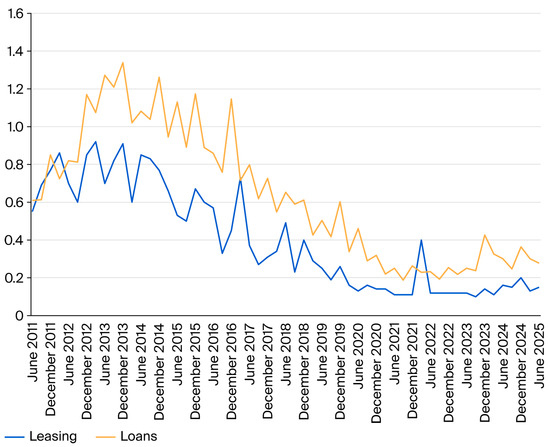
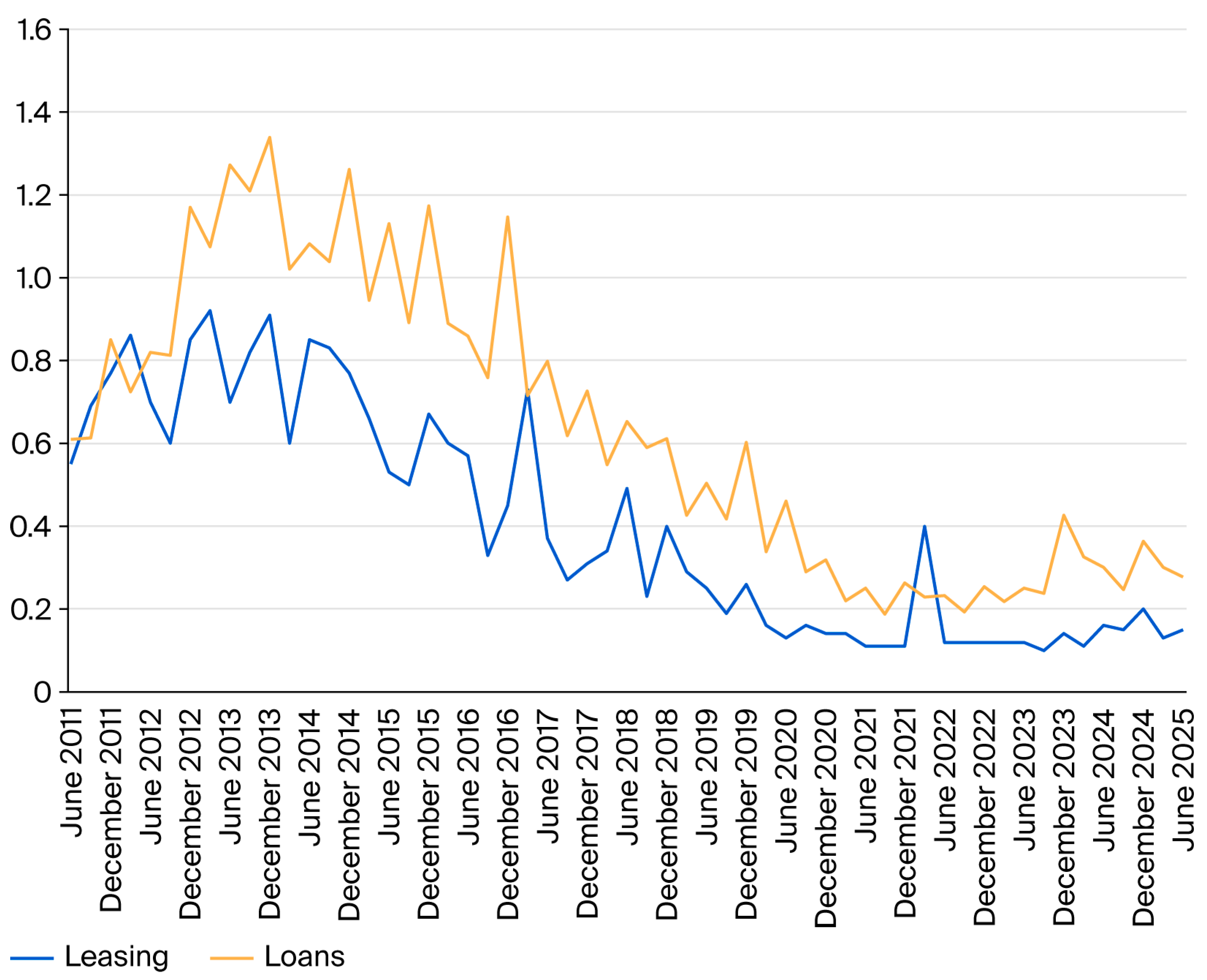
Results for outstanding exposure are shown in Figure 1. They indicate that the default rate for leasing reached its highest value in the last quarter of 2013, followed by a gradual decrease in the following months. As confirmed by the t-test (p < 0.001), default rates on loans are statistically higher than or equal to those on leasing.
Figure 1.
Default rates (new NPL inflow ratio), quarterly base—outstanding exposure—leasing (“contenzioso”), and bank loans. Italian market. Source: Assilea and Banca d’Italia.
To avoid spurious regressions, we test for stationarity using the Augmented Dickey–Fuller (ADF) and Phillips–Perron (PP) tests. Upon confirming that the variables are integrated of order one, we employ the Johansen procedure to test for the presence of a long-run equilibrium (cointegration) between the pairwise portfolios of leases and loans.
We estimate a baseline Vector Error Correction Model (Table 1). We then extend the model by introducing the European Central Bank (ECB) policy rate (measured as the quarterly average deposit facility rate) as an exogenous driver and a 2017 shift dummy. The monetary indicator allows us to test the effect of policy on the difference between the two rates. The 2017 dummy is used to capture the impact of the new leasing regulatory framework.
Table 1.
VECM estimation results and diagnostic tests.
The results provide consistent evidence of a long-run relationship between leasing and bank-loan default rates across all specifications. The trace statistics strongly reject the null of no cointegration, while the stability condition is satisfied in all models. The error correction mechanism appears asymmetric: adjustment is primarily driven by bank loan defaults (with the VECM coefficient for loans negative and statistically significant in all specifications), whereas the leasing equation shows no statistically significant response to deviations from the long-run equilibrium. This suggests that short-run adjustments occur mainly through the banking sector, while leasing dynamics are comparatively less reactive. Short-run dynamics exhibit substantial persistence in both series. Bank-loan defaults are strongly driven by their own past values, while leasing dynamics are influenced by both their own lags and, to a lesser extent, lagged movements in bank-loan defaults.
When isolating the monetary transmission channel (Model 2), the specification suggests a heterogeneous transmission of shocks. The coefficient on the ECB policy rate is significant for bank loans (coef. 0.0196), whereas it is statistically negligible and near zero for leasing default rates. However, the Wald test on the equality of coefficients across the two equations fails to reject the null hypothesis of equal effects. Therefore, the apparent asymmetry in responses should be interpreted with caution.
We find contrasting evidence of the effects of the 2017 legislative reform. A preliminary t-test shows that the average risk gap between bank loans and leasing defaults significantly narrowed from 29.5 bps (pre-2017) to 17.7 bps (post-2017), with a p-value of 0.016. The estimated coefficients of the “reform” dummy indicate that default rates declined after 2017 for both segments, with a larger and statistically significant reduction for bank loans (−0.038, p < 0.05). As a result, the gap between loan and leasing defaults narrows over time, driven primarily by a relative reduction in bank-loan default rates. These results do not support a straightforward causal interpretation and instead suggest a broader reduction in default dynamics affecting both segments.
In particular, the observed reduction in loan defaults (−0.038) could be explained by the implementation of GACS (“Garanzia sulla Cartolarizzazione delle Sofferenze”). GACS is a public-guarantee mechanism for securitizing bad loans introduced in Italy following the financial crisis. It was formally introduced in 2016 to support banks in reducing the stock of non-performing exposures and improving asset quality, but was materially implemented during 2017. While leasing exposures could in principle be included in securitization structures, the GACS scheme was predominantly used by banking institutions to dispose of non-performing loans. Leasing companies—typically operating as non-bank financial intermediaries—were therefore only indirectly and marginally affected, with possible involvement mainly limited to banking groups with integrated leasing activities.
When both the ECB policy rate and the 2017 reform dummy are included simultaneously, the estimates suggest the coexistence of two partially independent channels. Monetary policy continues to affect mainly bank loan defaults, while its impact on leasing remains weaker and less robust statistically. However, while the ECB policy rate retains a statistically significant effect on bank loan defaults, its impact on the default differential is not consistently statistically significant across specifications. The reform dummy enters the leasing equation with a negative sign. However, the magnitude and interpretation of this coefficient should be treated cautiously, given that the reform was not designed to directly affect the cyclical sensitivity of leasing defaults. Rather than indicating a direct reduction in leasing risk, the results are more consistent with a relative adjustment between the two markets.
Overall, the transition from the baseline VECM (Model 1) to the fully specified Model 4 demonstrates a slight improvement in explanatory power. The trace statistics remain above the 5% critical value in all specifications, providing robust evidence of a stable long-run cointegrating relationship. The Portmanteau test does not reject the null of no residual autocorrelation across all specifications, while the Jarque–Bera test suggests multivariate normality of residuals. The multivariate ARCH tests do not reject the null of homoskedastic residuals across all specifications, suggesting no evidence of conditional heteroskedasticity.
To complement the analysis, we estimate a different VECM considering quarterly leasing severely past due with “rectified” defaulted loan rates. In this case, lag selection criteria suggest a parsimonious specification. Given that the Johansen procedure requires at least two lags in levels, we set K = 2. The dependent variables capture flows into non-performing exposures (NPEs) rather than flows into litigation or bad-loan resolution. For this reason, we expect the 2017 reform not to affect the risk gap, since the new legislation is more likely to affect the transition from distress to contract termination than the earlier transition into NPE. The trace statistics provide consistent evidence of a single cointegrating relationship across all specifications. The error correction term is statistically significant in both equations, with opposite signs, indicating a stable long-run equilibrium between leasing and bank-loan default rates. In particular, bank loan defaults continue to exhibit a stronger, more significant adjustment to deviations from equilibrium, while leasing adjusts more gradually.
Short-run dynamics are primarily driven by autoregressive components, whereas neither the ECB policy rate nor the 2017 reform dummy displays robust statistical significance. The former result suggests that the effect of policy rate on the risk gap could be overall non-significant. Diagnostic tests indicate no residual autocorrelation, while deviations from normality and some evidence of heteroskedasticity remain, suggesting caution in interpreting the inferences.
6. Monetary Policy Implications
Although the model does not explicitly include the role of monetary institutions, it can be analyzed by considering the impacts of variations in the values of policy variables and instruments.
Restrictive or expansionary monetary policies influence the participation constraint via the competitive interest rate, modifying the level of capitalization required for firms to access the credit market.
In particular, the reduction in market rates relaxes the participation constraint by discounting less heavily the expected one-period outcomes of the project and the residual value of the financed assets, thus increasing firms’ ability to borrow for investment, while a restrictive policy reduces the firm’s net wealth, in line with the literature on the financial accelerator (Bernanke et al., 1996; Kiyotaki & Moore, 1997). Keeping the firm’s net wealth constant, a reduction in market rates allows us to screen for safer projects (i.e., with a higher probability of success, x), as in standard financial models. The time series of default rates in the leasing market closely tracks the trend in policy rates.
The model also suggests that reductions in the pledgeable income, that is , have a positive effect on the net wealth of firms by reducing the amount of the project’s surplus that has to be shared with the bank. In this sense, recent research has stressed that non-conventional monetary policies, such as Quantitative Easing (QE) programs that purchase corporate bonds, could reduce the cost of debt via a “capital structure channel” of monetary policy. Grosse-Rueschkamp et al. (2019) show that, in the context of the European Central Bank (ECB) corporate sector purchase program (CSPP), the announcement of purchases has reduced the bond yields of eligible firms. Consequently, firms have substituted bank term loans with bond debt, thereby relaxing banks’ lending constraints. Nocera and Pesaran (2023) analyze the analogous long-term, non-financial firms’ asset purchase programs (LSAPs) adopted by the Federal Reserve Bank (FED) over the period 2007-Q1 to 2018-Q3 and find that LSAPs facilitated firms’ access to external financing. To identify the effects of LSAPs on firms’ financing decisions, while isolating them from general macroeconomic conditions, the authors exploit heterogeneity in firms’ debt capacity constraints both before and after the asset purchase programs. In general, empirical evidence suggests that quantitative easing alleviated financial conditions for non-financial firms (Bernanke, 2020).
The “capital structure channel” affects borrowing indirectly. If bond financing becomes more attractive relative to bank loans, firms shift from bank loans to longer-term bonds. Banks thus experience a decline in loan demand, which reduces their regulatory or economic constraints and allows them to increase lending to other firms. In our partial equilibrium model, the reduction in the cost of external finance directly increases borrowing to less capitalized firms.
The eligible firms in asset purchase programs must have an investment-grade rating, which, at first, excludes many SMEs from the ECB’s intervention perimeter. However, the effect is particularly pronounced for bonds close to the eligibility threshold—i.e., BBB-rated bonds (Grosse-Rueschkamp et al., 2019, p. 358)—which are more comparable to unrated bonds issued by SMEs. We can, therefore, assume a positive effect of QE programs on small and medium firms’ bond yields. Nocera and Pesaran (2023) show that LSAP programs increase leverage—measured as the debt-to-asset ratio—of recipient firms but do not provide insights into their effects on non-eligible firms.
Conversely, the effect of shared information and enforcement measures on the riskiness of corporate debt could increase the effectiveness of non-conventional monetary policies by broadening the range of corporate bonds eligible for QE programs.
7. Conclusions
This paper investigates the combined roles of collateral, enforcement rules, and shared information among intermediaries in shaping the credit performance of poorly capitalized firms.
Analysis has provided insights into the role of collateral in increasing borrowing capacity for financially constrained firms. The proposed model suggests that asset collateralization indirectly benefits both creditors by reducing the counterparty’s moral hazard and borrowers by reducing the amount of net wealth needed to access the credit market. This convinces us, as stated in the Section 1 of this paper, that the rationale for leasing can be found in the peculiar role of collateral as a means of increasing the debt capacity of borrowers of this specific financial instrument, rather than in tax considerations (as in the classical Modigliani–Miller model of corporate finance).
Data from the Italian market provide mixed evidence. Leasing contracts generally exhibit lower default rates than bank loans and show less sensitivity to interest rate fluctuations, as the model predicts. However, no significant and direct effect of the 2017 legislative reform on the risk gap between the two instruments can be clearly identified. In this sense, a reconsideration of the basic results from comparing leasing default rates to other types of financing could benefit from more granular financial data on different types of collateral and financial instruments, as well as on the efficiency of judicial procedures.
Some aspects of the analysis remain open to further in-depth analysis. The model presented here does not consider general equilibrium issues, which could be analyzed by introducing uninformed investors, as in the work of Holmström and Tirole (1997). Intermediaries, on the other hand, are considered pure profit-seeking agents. A more complex approach could involve an analysis of the effects of using different types of financial instruments on the balance sheets of financial institutions, where risk monitoring, economic margins, and regulatory issues are equally relevant for the decision on whether to grant credit to firms and households.
Funding
This research received no external funding.
Institutional Review Board Statement
Not applicable.
Informed Consent Statement
Not applicable.
Data Availability Statement
Restrictions apply to the availability of data used in the article. BDCR data, from which leasing default rates were calculated, are confidential and subject to the Code of Conduct of Italian private Credit Bureaus as well as to BDCR Regulation and GDPR. Requests to access the dataset should be directed to Assilea (www.assilea.it).
Acknowledgments
The author wishes to thank Assilea for enabling access to and the use of Italian leasing market data, as well as for technical support in analyzing the Italian leasing market and legislation.
Conflicts of Interest
The author declares no conflicts of interest.
Abbreviations
The following abbreviations are used in this manuscript:
| BDCR | Banca Dati Centrale Rischi del Leasing |
| CSPP | Corporate Sector Purchase Program |
| ECB | European Central Bank |
| FED | Federal Reserve Bank |
| GACS | Garanzia sulla Cartolarizzazione delle Sofferenze |
| LSAP | Large-Scale Asset Purchases |
| NPE | Non-Performing Exposure |
| NPLs | Non-Performing Loans |
| QE | Quantitative Easing |
Appendix A
In this section, we analyze in more detail the credit rationing model described in the paper. We start by introducing the two agents, the firm (F) and the bank (B). We then describe their interaction. Lastly, we characterize the equilibrium.
Appendix A.1. Firm
F is a resource-constrained firm operating in a perfectly competitive market where each agent has access to the same production technology and relies (fully or partially) on external debt to finance its production. It is assumed to be endowed with an initial net worth of E. It therefore needs financing to purchase equipment or commercial real estate that allows it to undertake a project, whose value, i.e., investment (I), is . The project, and the corresponding lending agreement, lasts T periods. If F can borrow money from B, and the project is undertaken, it yields to F, in each , an ex-post verifiable income, whose amount depends on the realization of a random variable. For the sake of simplicity, we assume that the outcome can take only two values, R (success) and 0 (failure), with known probabilities and . If F can borrow money from B, it can subsequently decide whether to repay its debt. If it repays its debt, its profit will be reduced by the amount it devotes to paying B’s stake in the project (more on this later). However, B will continue to grant it the amount of credit it needs to carry on the project in the upcoming periods. If it shirks, i.e., avoids repaying B’s stake in the project, its profit will be higher, but it will be labelled a “bad payer” by the banking system. We assume that, when shirking, F will retain all the project’s outcome, whereas, on the contrary, after enforcement, it will retain nothing, that is , where in is the time of default and in is the time of enforcement of the defaulted loan/lease.
Appendix A.2. Bank
B is a financial intermediary that provides funds to firms through two types of contracts. Funds are traded on a competitive market, i.e., B behaves competitively and hence makes zero profit in equilibrium. The nominal interest rate that clears the funds market, i.e., the cost of liquidity, is equal to r. Given that B earns zero profit in equilibrium, the following condition must hold for a T-period lending agreement, assuming for the moment, as stated earlier, that one-period outcomes are i.i.d. Bernoulli variables with probability mass function : , provided F does not shirk. This implies a rate of return on the investment for B, which, unless , is higher than the nominal interest rate. The difference can be thought of as a default premium for B. B can grant either a lease or a standard collateralized loan contract to F at time 0. Its earnings will depend, among other things, on F’s ability to repay his debt. If F does not repay its debt—i.e., if F defaults—B has two options. If it has granted a lease, it is still the owner of the productive asset and therefore has the possibility of taking it back (through enforcement). If, however, it has granted a standard loan, it will have to stake a claim on F’s net assets—in this case, the financed asset itself—to recover its receivable amount. In both cases, B will achieve revenue equal to the (residual) value (market price) V of the financed asset. We assume, as stated in the paper, that seizing the leased asset is quicker, or at least no longer, than enforcing collateral under a standard loan contract.
Appendix A.3. Interaction Between F and B and Characterization of Equilibrium
F demands funds and uses them to finance the project, i.e., to purchase the productive assets. When the asset is purchased, both F and B know the distribution of outcomes, and this information is common knowledge between them. However, the actual level of the outcome is determined by the ex-post realized state of nature. We now assume that the level of information is not spread evenly among agents. In particular, can observe the level of outcome at the beginning of each period, depending on the evolution of the economy. On the contrary, must decide whether to grant a loan and whether to retrieve it, knowing only the probability distribution of . Based on our assumptions, B’s best guess regarding the outcome will be the observed level of the variable of the preceding period. The scheme is as follows:
- In , F decides whether to borrow money from B.
- In , B decides whether to grant a lease or a loan.
- Nature extracts the level of outcome for the upcoming period.
- observes the level of outcome for the upcoming periods and decides the optimal level of production, given the observed level of prices, the decision of B, and the assumption regarding the realization of outcome in the following periods. Moreover, if the outcome is , F decides whether to pay back its obligation or not (we assume that obligations must be paid upfront at the beginning of each period).
- If, at any moment , F does not pay back its obligation, B has two options:
- If B has granted a loan to F, it can stake a claim on F’s net asset. In this case, F will nevertheless be left with its full productive capacity unchanged for a given interval of time (). Afterwards, will retrieve a sum from F.
- If B has granted a lease, it can retrieve the productive equipment at an earlier stage, or, at least, at the same stage (this is equal to stating that ), leaving F with an upper-bounded output capacity in the upcoming periods. The value of the retrieved productive equipment is equal to . As stated in the paper, we assume that the enforcement period lasts longer than the maturity of the credit contract, the probability of deviating would reach 1 for sufficiently high values of , or when t approaches T. What we shall state more precisely is therefore that the punishment period will last exactly n periods, where n is known in advance both by F and B. In this sense, shirking—i.e., defaulting on the borrowing agreement—determines not only termination of the contract in , but also no opportunity to undertake new projects in the following periods. In this sense, throughout the enforcement period and even after the loan matures, the outcome for F is 0. Conversely, if F does not shirk, it can enter a new project in T, which, for simplicity, we assume has the same characteristics as the previous one.
For optimal performance, the lending agreement must ensure that F uses the asset solely for investment projects. Moreover, in case of failure, no shares of the project must be distributed to either F or B. Finally, if the project succeeds, the respective shares in gross monetary payoff for the two parties are respectively and , . Therefore, the respective net payoffs are, respectively, (assuming F does not shirk) and . We assume that “no shirking” ensures a positive net present value of the project, i.e., , which states that the expected profit for B in case F behaves must be greater than the loss associated with the failure of the project and the corresponding default of F. To rule out shirking, the following incentive compatibility constraint must hold for F (having in mind that, the payoff associated with both strategies is the same.: , or, put it differently (and normalizing to 0): , i.e., the standard condition that remuneration for the borrower must be high enough to ensure that behaving is preferred to shirking.
This condition can be satisfied with standard covenants of the loan agreement and effectiveness of the enforcement procedures, i.e., the terms of the borrowing agreement can be chosen by B to assure that . Correspondingly, the maximum remuneration that F can promise to B in case of s, i.e., the pledgeable income, is equal to . Together with the condition that B has to break even in order to be willing to finance the project——it implies that (participation constraint) . Thus, the condition for F to obtain funds is that the initial amount of net worth (E) it holds is greater than or equal to the following threshold: .
There is credit rationing whenever . This condition is equivalent to stating that , which implies that the expected outcome from the project is less than the expected amount that must be paid to F to avoid shirking, i.e., the agency rent. If E is insufficient to downsize agency rent to ensure that its expected value is not greater than the expected outcome of the project, F will be credit rationed. If, on the contrary, , F can secure lending. If the loan agreement is set up so as to ensure no participation of B in the project’s outcome (B will earn the competitive nominal interest rate on funds provided, i.e., . F’s share in gross monetary payoff will be equal to , thus ensuring that the “no shirking” condition holds.
Notes
| 1 | In Italy, differences in the scope of application of the new accounting standards remain as regards to listed companies on one side and smaller ones on the other. Nevertheless, it is a common opinion among practitioners that smaller companies will also be affected in the medium term by the changes in the accounting standards. The IFRS Foundation has recently released an IFRS Standard for SMEs, which, albeit, not mandatory, defines the information needs of lenders, creditors and other users of SME financial statements who are interested primarily in information about cash flows, liquidity, and solvency of non-financial counterparts. |
| 2 | The idea was already present in Smith and Wakeman (1985). |
| 3 | Assilea’s survey has been conducted on a sample of Italian leasing companies representing, on average, 74.5% of the amount of outstanding leasing contracts as of December of each reporting year. The surveyed companies have been asked to provide information regarding the actual composition of their leasing portfolio, broken down into three client classes: small and medium-sized enterprises, consumers and self-employed, and other businesses (residual). |
| 4 | Even in the absence of moral hazard, but in the presence of asymmetric valuation of the financed project by borrowers and lenders, collateral can be shown to have a signaling role in indirectly conveying information between the two transactors (Chan & Kanatas, 1985). |
| 5 | For a comprehensive review, see Iakimenko et al. (2022). |
| 6 | Such as subsidized leasing or specific features concerning the treatment of leased assets in the bankruptcy law. |
| 7 | Roughly between 40 and 90 days after having appealed to the court in the case of the injunction process: within 30 days after the court order in the first hearing in the case of the interim proceedings. |
| 8 | The entrepreneur could, in theory, simply state that the project has failed and subsequently divert its full outcome for private consumption (i.e., utility), leaving investors as passive retainers of the mere “leftover” of the project’s outcome once the optimal entrepreneur scheme is derived (see Tirole, 2006). |
| 9 | If this were not true, the probability of deviating from the lending agreement would reach 1 for sufficiently high values of the time to enforcement or for dates sufficiently close to the maturity of the financial instrument (see Appendix A.3 for details). |
| 10 | For African countries, however, some authors suggest that private credit bureaus could be more effective as information intermediaries than public credit registers (Kusi et al., 2017). |
| 11 | The default rates were developed as part of a project to monitor the credit portfolios of the member companies of Assilea. We thank Assilea for the opportunity to participate in the project and use the indicators for the current paper. The procedure to develop default rates is as follows. Classifications for each contract have been monitored at both the beginning and end of the reference period. For example, to monitor variation in a contract’s classification/status throughout the first quarter of 2017, the classification as of 31 December 2016, and 31 March 2017, has been considered. Transition matrices have subsequently been developed to measure the frequency of transitions from a performing (i.e., none unpaid) status to a default (“contenzioso”) status. |
References
- Alchian, A. A., & Demsetz, H. (1972). Production, information costs, and economic organization. American Economic Review, 62, 777–795. [Google Scholar]
- Altman, E. I. (1989). Measuring corporate bond mortality and performance. The Journal of Finance, 44, 909–922. [Google Scholar] [CrossRef]
- Asquith, P., & Mullins, D. W., Jr. (1986a). Equity issues and offering dilution. Journal of Financial Economics, 15, 61–89. [Google Scholar] [CrossRef] [Scilit]
- Asquith, P., & Mullins, D. W., Jr. (1986b). Signaling with dividends, stock repurchases, and equity issues. Financial Management, 15(3), 27–44. [Google Scholar] [CrossRef] [Scilit]
- Asquith, P., Mullins, D. W., Jr., & Wolff, E. D. (1989). Original issue high yield bonds: Aging analyses of defaults, exchanges, and calls. The Journal of Finance, 44, 923–952. [Google Scholar] [CrossRef]
- Assilea. (2012). Rapporto sul leasing: Anno 2011. Assilea Servizi S.u.r.l. [Google Scholar]
- Assilea. (2013). Rapporto sul leasing: Anno 2012. Assilea Servizi S.u.r.l. [Google Scholar]
- Assilea. (2014). Rapporto sul leasing: Anno 2013. Assilea Servizi S.u.r.l. [Google Scholar]
- Assilea. (2015). Rapporto sul leasing: Anno 2014. Assilea Servizi S.u.r.l. [Google Scholar]
- Assilea. (2016). Rapporto sul leasing: Anno 2015. Assilea Servizi S.u.r.l. [Google Scholar]
- Assilea. (2017). Rapporto annuale sul leasing: Anno 2016. Assilea Servizi S.u.r.l. [Google Scholar]
- Assilea. (2018). To lease 2018: Dati 2017–2018. Assilea Servizi S.u.r.l. [Google Scholar]
- Assilea. (2019). To lease 2019: Dati 2018–2019. Assilea Servizi S.u.r.l. [Google Scholar]
- Assilea. (2020). To lease 2020: Dati 2019–2020. Assilea Servizi S.u.r.l. [Google Scholar]
- Assilea. (2021). To lease 2021: Dati 2020–2021. Assilea Servizi S.u.r.l. [Google Scholar]
- Assilea. (2022). To lease 2022: Dati 2021–2022. Assilea Servizi S.u.r.l. [Google Scholar]
- Assilea. (2023). Rapporto annuale sul leasing 2022. Assilea Servizi S.u.r.l. [Google Scholar]
- Assilea. (2024). Rapporto annuale sul leasing 2023. Assilea Servizi S.u.r.l. [Google Scholar]
- Assilea. (2025). Rapporto annuale sul leasing 2024. Assilea Servizi S.u.r.l. [Google Scholar]
- Assilea. (2026). Centrale rischi-BDCR-come funziona. Assilea. Available online: https://www.assilea.it/ActionPagina_2185.do (accessed on 26 March 2026).
- Baker, M., & Wurgler, J. (2002). Market timing and capital structure. The Journal of Finance, 57(1), 1–32. [Google Scholar] [CrossRef] [Scilit]
- Banca d’Italia. (2025). Relazione annuale—Appendice: Anno 2024—Centotrentunesimo esercizio. Banca d’Italia. [Google Scholar]
- Barro, R. J. (1976). The loan market, collateral, and rates of interest. Journal of Money, Credit and Banking, 8(4), 439–456. [Google Scholar] [CrossRef] [Scilit]
- Bennardo, A., Pagano, M., & Piccolo, S. (2015). Multiple bank lending, creditor rights, and information dharing. Review of Finance, 19(2), 519–570. [Google Scholar] [CrossRef] [Scilit]
- Benston, G. J., & Smith, C. W. (1976). A transactions cost approach to the theory of financial intermediation. The Journal of Finance, 31(2), 215–231. [Google Scholar] [CrossRef] [Scilit]
- Berger, A. N., & Udell, G. F. (1998). The economics of small business finance: The roles of private equity and debt markets in the financial growth cycle. Journal of Banking and Finance, 22, 613–673. [Google Scholar] [CrossRef] [Scilit]
- Bernanke, B. (2020). The new tools of monetary policy. American Economic Review, 110(4), 943–983. [Google Scholar] [CrossRef] [Scilit]
- Bernanke, B., Gertler, M., & Gilchrist, S. (1996). The financial accelerator and the flight to quality. Review of Economics and Statistics, 78(1), 1–15. [Google Scholar] [CrossRef] [Scilit]
- Bierman, H., Jr. (1988). Buy versus lease with an alternative minimum tax. Financial Management, 17(4), 87–91. [Google Scholar] [CrossRef] [Scilit]
- Bolton, P., & Scharfstein, D. S. (1990). A theory of predation based on agency problems in financial contracting. American Economic Review, 80(1), 93–106. [Google Scholar]
- Brealey, R. A., Myers, S. C., & Allen, F. (2000). Principles of corporate finance (6th ed.). McGraw-Hill. [Google Scholar]
- Brealey, R. A., & Young, C. M. (1980). Debt, taxes, and leasing: A note. The Journal of Finance, 35, 1245–1250. [Google Scholar] [PubMed]
- Brown, M., & Zehnder, C. (2007). Credit reporting, relationship banking, and loan repayment. Journal of Money, Credit and Banking, 39(8), 1883–1918. [Google Scholar] [CrossRef] [Scilit]
- Bruccola, L. (2016). Evidenze sulla efficacia delle azioni di early collection nel leasing. La Lettera di Assilea, 3, 38–41. [Google Scholar]
- Camera di Commercio di Milano. (2010). Raccolta provinciale degli usi. Camera di Commercio di Milano. [Google Scholar]
- Chan, Y. S., & Kanatas, G. (1985). Asymmetric valuations and the role of collateral in loan agreements. Journal of Money, Credit and Banking, 17(1), 84–95. [Google Scholar] [CrossRef] [Scilit]
- Crawford, P. J., Harper, C. P., & McConnell, J. J. (1981). Further evidence on the terms of financial leases. Financial Management, 10, 7–14. [Google Scholar] [CrossRef] [Scilit]
- Diamond, D. W. (1984). Financial intermediation and delegated monitoring. Review of Economic Studies, 51, 393–414. [Google Scholar] [CrossRef] [Scilit]
- Eisfeldt, A. L., & Rampini, A. (2009). Leasing, ability to repossess, and debt capacity. Review of Financial Studies, 22(4), 1621–1657. [Google Scholar]
- European Commission. (2025). Survey on the access to finance of enterprise (SAFE): Analytical report 2024. Publications Office of the European Union. [Google Scholar]
- Grosse-Rueschkamp, B., Steffen, S., & Streitz, D. (2019). A capital structure channel of monetary policy. Journal of Financial Economics, 133, 357–378. [Google Scholar] [CrossRef] [Scilit]
- Hart, O., & Moore, J. (1998). Default and renegotiation: A dynamic model of debt. Quarterly Journal of Economics, 113(1), 1–41. [Google Scholar]
- Holmström, B., & Tirole, J. (1997). Financial intermediation, loanable funds, and the real sector. Quarterly Journal of Economics, 112(3), 663–691. [Google Scholar] [CrossRef] [Scilit]
- Iakimenko, I., Semenova, M., & Zimin, E. (2022). The more the better? Information sharing and credit risk. Journal of International Financial Markets, Institutions and Money, 80, 101651. [Google Scholar] [CrossRef] [Scilit]
- Jappelli, T., & Pagano, M. (2002). Information sharing, lending and defaults: Cross-country evidence. Journal of Banking and Finance, 26(10), 2017–2045. [Google Scholar] [CrossRef] [Scilit]
- Jappelli, T., Pagano, M., & Bianco, M. (2005). Courts and banks: Effects of judicial costs on credit market performance. Journal of Money, Credit and Banking, 37, 223–244. [Google Scholar] [CrossRef] [Scilit]
- Jensen, M. C., & Meckling, W. H. (1976). Theory of the firm: Managerial behavior, agency costs and ownership structure. Journal of Financial Economics, 3, 305–360. [Google Scholar] [CrossRef] [Scilit]
- Kilpatrick, B. G., & Wilburn, N. L. (2011). Convergence on a global accounting standard for leases. International Business & Economics Research Journal, 10(10), 55–59. [Google Scholar]
- Kiyotaki, N., & Moore, J. (1997). Credit cycles. Journal of Political Economy, 105, 211–248. [Google Scholar] [CrossRef] [Scilit]
- Klein, B., Crawford, R. G., & Alchian, A. A. (1978). Vertical integration, appropriable rents, and the competitive contracting process. Journal of Law and Economics, 21(2), 297–326. [Google Scholar] [CrossRef] [Scilit]
- Korajczyk, R. A., Lucas, D. J., & McDonald, R. L. (1991). The effect of information releases on the pricing and timing of equity issues. Review of Financial Studies, 4, 685–708. [Google Scholar] [CrossRef] [Scilit]
- Kraemer-Eis, H., & Lang, F. (2012). The importance of leasing for SME finance (EIF Working Paper No. 2012/15). European Investment Fund (EIF). [Google Scholar]
- Kusi, B. A., Agbloyor, E. K., Ansah-Adu, K., & Gyeke-Dako, A. (2017). Bank credit risk and credit Information sharing in Africa: Does credit information sharing institutions and context matter? Research in International Business and Finance, 42, 1123–1136. [Google Scholar] [CrossRef] [Scilit]
- La Torre, M. R. (2002). Manuale della locazione finanziaria. Giuffrè. [Google Scholar]
- La Torre, M. R. (2018). La nuova disciplina della locazione finanziaria: III. L’inadempimento dell’utilizzatore e la risoluzione del contratto. La Lettera di Assilea, 4, 26–28. [Google Scholar]
- Lease, R. C., McConnell, J. J., & Schallheim, J. S. (1990). Realized returns and the default and prepayment experience of financial leasing contracts. Financial Management, 19, 11–20. [Google Scholar] [CrossRef] [Scilit]
- Lucas, D. J., & McDonald, R. L. (1990). Equity issues and stock price dynamics. The Journal of Finance, 45(4), 1019–1143. [Google Scholar] [CrossRef]
- Masulis, R. W., & Korwar, A. N. (1986). Seasoned equity offerings: An empirical investigation. Journal of Financial Economics, 15, 91–118. [Google Scholar] [CrossRef] [Scilit]
- Mayer, D. G. (2005). True leases under attack: Lessors face persistent challenges to true lease transactions. Journal of Equipment Lease Financing, 23(3), 25. [Google Scholar]
- Mikkelson, W. H., & Partch, M. M. (1986). Valuation effects of security offerings and the issuance process. Journal of Financial Economics, 15, 31–60. [Google Scholar] [CrossRef] [Scilit]
- Miller, M. H. (1977). Debt and taxes. The Journal of Finance, 32(2), 261–275. [Google Scholar]
- Miller, M. H., & Upton, C. W. (1976). Leasing, buying, and the cost of capital services. The Journal of Finance, 31, 761–786. [Google Scholar] [CrossRef] [Scilit]
- Myers, S. C., Dill, D. A., & Bautista, A. J. (1976). Valuation of financial lease contracts. The Journal of Finance, 31(3), 799–819. [Google Scholar] [CrossRef]
- Myers, S. C., & Majluf, N. S. (1984). Corporate financing and investment decisions when firms have information that investors do not have. Journal of Financial Economics, 13, 187–221. [Google Scholar] [CrossRef] [Scilit]
- Nocera, N., & Pesaran, M. H. (2023). Causal effects of the Fed’s large-scale asset purchases on firms’ capital structure. arXiv, arXiv:2310.18638. [Google Scholar] [CrossRef] [Scilit]
- Oxford Economics. (2011). The use of leasing amongst European SMEs. In A report prepared for Leaseurope. Oxford Economics. Available online: http://www.leaseurope.org/index.php?page=smes (accessed on 26 March 2026).
- Ross, S. A., Westerfield, R. W., & Jaffe, J. F. (2002). Corporate finance (6th ed.). McGraw-Hill. [Google Scholar]
- Schallheim, J. S. (1994). Lease or buy? Principles of sound decision making. Harvard Business School Press. [Google Scholar]
- Schallheim, J. S., Johnson, R. E., Lease, R. C., & McConnell, J. J. (1987). The determinants of yields on financial leasing contracts. Journal of Financial Economics, 19, 45–68. [Google Scholar] [CrossRef] [Scilit]
- Smith, C. W., Jr., & Wakeman, L. M. (1985). Determinants of corporate leasing policy. The Journal of Finance, 40, 895–908. [Google Scholar] [CrossRef]
- Smith, C. W., Jr., & Warner, J. B. (1979). Bankruptcy, secured debt, and optimal capital structure: Comment. The Journal of Finance, 34(1), 247–251. [Google Scholar] [CrossRef]
- Smith, C. W., Jr., & Watts, R. L. (1982). Incentive and tax effects of executive compensation plans. Australian Journal of Management, 7(2), 139–157. [Google Scholar] [CrossRef] [Scilit]
- Stiglitz, J. E., & Weiss, A. (1981). Credit rationing in markets with imperfect information. American Economic Review, 71(3), 393–410. [Google Scholar]
- Stiglitz, J. E., & Weiss, A. (1983). Incentive effects of terminations: Applications to the credit and labor markets. American Economic Review, 73(5), 912–927. [Google Scholar]
- Stulz, R. M., & Johnson, H. (1985). An analysis of secured debt. Journal of Financial Economics, 14, 501–521. [Google Scholar] [CrossRef] [Scilit]
- Tirole, J. (2006). The theory of corporate finance. Princeton University Press. [Google Scholar]
- Williamson, O. E. (1988). Corporate finance and corporate governance. The Journal of Finance, 43(3), 567–591. [Google Scholar] [CrossRef]

Disclaimer/Publisher’s Note: The statements, opinions and data contained in all publications are solely those of the individual author(s) and contributor(s) and not of MDPI and/or the editor(s). MDPI and/or the editor(s) disclaim responsibility for any injury to people or property resulting from any ideas, methods, instructions or products referred to in the content. |
© 2026 by the author. Licensee MDPI, Basel, Switzerland. This article is an open access article distributed under the terms and conditions of the Creative Commons Attribution (CC BY) license.