


Abstract
This study investigates the forward discount puzzle by examining the dynamic relationships among excess returns arising from interest rate parity deviations, interest rate differentials, and the USD/JPY exchange rate. The empirical analysis employs correlation analysis, the Autoregressive Distributed Lag (ARDL) cointegration test, and variance decomposition together with impulse response functions derived from a Toda–Yamamoto augmented Vector Autoregressive (VAR) model, using data spanning January 2001 to September 2025. The correlation results indicate that the spot exchange rate is negatively related to both the swap rate and the interest rate differential. Impulse response analysis shows that the USD/JPY rate responds positively to swap rate shocks in the medium to long run, while responding negatively to interest rate differential shocks in the short run. Variance decomposition results are consistent with the impulse response analysis and underscore the dominant bilateral linkage between the exchange rate and the swap rate. The long-run ARDL estimates further reveal that the swap rate is positively associated with dollar appreciation, whereas both the interest rate differential and relative output are negatively related. Overall, although short-run arbitrage appears temporarily, the cointegration and dynamic results provide robust evidence that the forward discount puzzle persists for a substantial period rather than interest rate parity holding.
1. Introduction
One of the long-standing puzzles in exchange rate economics that has yet to be fully resolved is the so-called exchange rate disconnect puzzle, which refers to the weak and unstable empirical relationship between exchange rate movements and major macroeconomic fundamentals. A wide range of exchange rate determination models incorporating key macroeconomic variables have failed to receive strong empirical support, or have achieved only limited success.1
In particular, the so-called forward discount puzzle—whereby high-interest-rate currencies tend to appreciate rather than depreciate, contrary to the prediction of uncovered interest parity (UIP)—remains one of the most persistent anomalies in international finance. A large body of empirical studies, beginning with Fama (1984) and subsequently documented by Backus et al. (1993), and Engel (1996), reports systematic violations of UIP in major currency pairs. These findings suggest that the forward premium is negatively correlated with subsequent exchange rate changes, thereby contradicting the standard parity condition.
However, the interpretation of this anomaly remains highly contested. Some studies attribute the puzzle to time-varying risk premia and conditional heteroskedasticity (e.g., Bekaert & Hodrick, 1993; Engel, 2016), while others emphasize the role of peso problems, rare disasters, or small-sample biases (e.g., Lewis, 1995; Burnside et al., 2011). More recent research further argues that deviations from UIP may reflect limits to arbitrage, funding liquidity constraints, or global risk factors embedded in carry trade strategies. As a result, despite decades of empirical investigation, no unified theoretical explanation has achieved broad consensus.
The Japanese yen, together with the U.S. dollar, occupies a structurally central position in the international monetary system. The U.S. dollar functions as the dominant global reserve and invoicing currency, while the yen remains one of the most actively traded and widely held reserve currencies worldwide. Owing to the exceptional depth, liquidity, and transparency of the Yen–USD market, this currency pair provides a particularly suitable setting for examining deviations from interest parity that are unlikely to be driven by market segmentation or limited arbitrage capacity.
Japan has experienced a prolonged period of persistently low interest rates relative to the United States, generating sustained interest rate differentials and establishing the yen as a primary funding currency in global carry trade strategies. As a result, fluctuations in the Yen–USD exchange rate have played a pivotal role in shaping cross-border capital flows and global risk-taking behavior. More recently, episodes of yen carry trade unwinding have had measurable spillover effects on international financial markets, further underscoring the global relevance of this currency pair.
While several prior studies extend their analysis to multiple currencies, focusing on the Yen–USD exchange rate allows for a clearer identification of macro-financial transmission mechanisms within a market characterized by substantial trading volume and institutional maturity. Accordingly, this paper investigates the dynamic relationships among the Yen–USD exchange rate, bilateral interest rates, and key macroeconomic variables, with particular emphasis on excess returns associated with deviations from interest rate parity and the role of foreign exchange market liquidity.
Recently, a growing body of the literature has examined exchange rate dynamics through deviations from uncovered interest parity (UIP) and covered interest parity (CIP), yet the two strands of research have evolved along distinct empirical and theoretical paths. Studies on UIP primarily focus on excess returns and risk premia embedded in currency markets. For example, Engel and Wu (2023) and Cohen et al. (2017) show that time-varying risk premia and liquidity components embedded in forward rates help explain exchange rate fluctuations across advanced economies. Brunnermeier and Pedersen (2009) further highlight that funding liquidity and market liquidity interact to generate deviations from UIP, thereby linking carry trade returns to broader financial conditions.
Meanwhile, the literature on CIP has concentrated on cross-currency basis spreads and funding constraints in swap markets. Prior to the global financial crisis (GFC), empirical evidence largely supported the validity of CIP, with arbitrage mechanisms quickly eliminating temporary deviations (Frenkel & Levich, 1977; Akram et al., 2008). However, a structural break emerged during the GFC. Post-GFC studies document persistent and economically significant CIP deviations, often interpreted as reflecting U.S. dollar funding shortages, regulatory constraints, and balance sheet costs faced by global financial intermediaries (Du et al., 2019; Brauning & Puria, 2017; Liao, 2020; Cerutti et al., 2020).
More recently, post-COVID analyses suggest that global liquidity shocks and unconventional monetary policy interventions further amplified cross-currency funding pressures, altering both UIP and CIP dynamics. Yet, most of these studies treat UIP and CIP deviations separately, focusing either on excess returns in carry trade strategies or on swap-implied funding costs in isolation. Consequently, the literature lacks a unified empirical framework that jointly evaluates how deviations from both UIP and CIP interact dynamically with exchange rate movements, particularly in the context of shifting global liquidity regimes spanning the pre-GFC, post-GFC, and post-COVID periods.
In the yen–U.S. dollar market, deviations from UIP and CIP display distinctive and time-varying dynamics. The yen’s role as a primary funding currency and the U.S. dollar’s position as the dominant global reserve currency imply that shifts in monetary policy divergence, global risk appetite, and dollar liquidity conditions significantly affect parity relationships. Periods of wide U.S.–Japan interest rate differentials have often been associated with persistent excess returns to yen-funded carry trades, while episodes of global financial stress have led to safe-haven appreciation of the yen, altering UIP dynamics. At the same time, sustained USD/JPY cross-currency basis spreads since the GFC reflect structural dollar funding pressures, indicating persistent CIP deviations. These patterns suggest that, in the yen–dollar context, UIP and CIP evolve dynamically across global liquidity regimes rather than representing static parity conditions.
This study addresses that gap by integrating UIP, CIP-based excess returns and funding deviations within a common dynamic framework. Rather than analyzing carry trade profitability or cross-currency basis spreads independently, we examine how both parity conditions jointly shape exchange rate adjustments and how their relative importance evolves across different global financial regimes. By doing so, this paper differs from recent post-GFC and post-COVID studies that focus predominantly on dollar funding constraints or liquidity premia alone. Our approach provides a comparative and dynamic assessment of the mechanisms underlying parity deviations, thereby offering new insights into the persistence of the forward discount puzzle in the presence of structural changes in global financial markets.
This paper tests several hypotheses. First, in the short run, excess returns arising from deviations from interest rate parity are expected to be arbitraged away through arbitrage trading. Carry trade activity driven by interest rate differentials between Japan and the United States, which involves arbitrage based on interest rate parity, implies an inverse relationship between spot and forward exchange rates, as well as a negative relationship between swap rates and spot exchange rates. Second, in the medium to long run, excess returns generated by deviations from interest rate parity act as incentives for carry trade activity, implying that high interest rate currencies may instead appreciate—a forward discount puzzle or bias that persists for a considerable period. Consequently, swap rates reflecting excess returns and spot exchange rates are expected to exhibit a positive relationship in the medium to long run, and the forward discount bias is likely to persist. Accordingly, the primary objective of this study is to examine the relationships among deviations from UIP and CIP, domestic and foreign factors, and the exchange rate. This paper does not aim to identify whether excess returns generated by violations of interest rate parity stem from liquidity premia or related sources but rather to analyze how parity deviations are associated with exchange rate dynamics.
To achieve these research objectives, this study analyzes the short- and long-run effects of interest rate parity deviations on the yen–dollar exchange rate over the period from January 2001 to September 2025. The empirical analysis employs correlation analysis, the Autoregressive Distributed Lag (ARDL) cointegration test, and variance decomposition together with impulse response functions derived from a Toda–Yamamoto augmented Vector Autoregressive (VAR) model.
The remainder of this paper is organized as follows. Section 2 reviews UIP and CIP deviations from the perspectives of excess return opportunities and foreign exchange market liquidity. Section 3 describes the data and the empirical models employed. Section 4 presents the empirical results, and Section 5 concludes.
2. Interest Parity Deviations and Excess Returns
This chapter examines the implications of deviations from UIP and CIP from the perspective of excess return opportunities, and discusses the relationship between UIP and CIP deviations and foreign exchange market liquidity. First, when the UIP equilibrium condition holds, financial assets denominated in different currencies but with identical maturities and risk characteristics yield the same expected return when exchange rate risk is not hedged. For example, if a Japanese investor purchases U.S. Treasury securities without hedging exchange rate risk, the return on Japanese government bonds equals the sum of the return on U.S. Treasuries and the expected appreciation of the U.S. dollar.
Here, Rt$ denotes the return on U.S. Treasury securities at time t, Rt denotes the return on home-country government bonds at time t. In this study, the home country is assumed to be Japan. St represents the spot exchange rate at time t, measured as the home currency price of one U.S. dollar. Set+1 denotes the expected future exchange rate at time t + 1, where the superscript e indicates expectations formed at time t. When a home-country investor purchases U.S. bonds without forward hedging, the return is given by Rt$ + (Set+1 − St)/St, whereas the return on home-country bonds is Rt.
Under UIP, if the return on Japanese government bonds exceeds that on U.S. Treasuries, the Japanese yen is expected to depreciate, and the U.S. dollar is expected to appreciate. However, a large body of the empirical literature reports results contrary to UIP. Specifically, high-interest-rate currencies tend to appreciate, while low-interest-rate currencies tend to depreciate (Fama, 1984; Brunnermeier & Pedersen, 2009; Bacchetta & van Wincoop, 2010; Engel & Wu, 2023). Such exchange rate behavior inconsistent with UIP is commonly referred to as the forward discount puzzle.
When the U.S. dollar is the relatively high-interest-rate currency and the Japanese yen is the relatively low-interest-rate currency, the excess return from investing in U.S. Treasuries can be expressed as in Equation (2). In this sense, deviations from UIP reflect the potential excess returns associated with carry trade strategies.
In this expression, the excess return (ER) is defined as the difference between the return on U.S. government bonds, the investment-currency country, and the return on Japanese government bonds, the funding-currency country, minus the expected depreciation rate of the U.S. dollar. The investment portfolio consists of a long position in relatively high-yielding U.S. Treasuries and a short position in low-yielding Japanese government bonds. St denotes the spot exchange rate at time t, measured as the logarithm of the nominal JPY/USD exchange rate.
Because Set+1 is not directly observable, expectations of future exchange rates are often proxied using survey data or fitted values obtained from standard regression models. However, such measures are subject to data limitations and reliability concerns. If the forward exchange rate (Ft,t+1) is a statistically unbiased predictor of the future spot rate(St+1), then the excess return in Equation (2) can be measured through deviations from CIP, as shown in the following expression.
This formulation demonstrates that CIP-based excess returns are directly linked to the forward premium, i.e., the swap rate((Ft − St)/St). When the forward rate deviates from the level implied by the interest rate differential, the swap-implied hedged return diverges from the domestic return, generating arbitrage incentives. Hence, the swap rate serves as an observable market-based measure that captures the pricing component of CIP deviations. In this framework, the swap rate provides a theoretically consistent proxy for excess returns associated with CIP violations, as it embeds the wedge between direct and synthetic funding costs in international financial markets.
When the CIP equilibrium condition holds, financial assets denominated in different currencies but with identical maturities and risk characteristics yield the same hedged return. For instance, when a Japanese investor purchases U.S. Treasury securities while hedging exchange rate risk, the return on Japanese government bonds equals the sum of the return on U.S. Treasuries and the forward premium.
Here, Rt$ denotes the return on U.S. bonds at time t, Rt denotes the return on Japanese bonds, Ft,t+1 represents the forward exchange rate at time t, for maturity t + 1, and St is the spot exchange rate at time t. When a home-country investor purchases foreign bonds with forward hedging, the return is given by Rt$ + (Ft − St)/St, whereas the return on home-country bonds remains Rt.
In the context of global investment with exchange rate hedging, the magnitude of CIP deviations reflects excess returns earned by global investors. These excess returns are determined by the relative liquidity of funding and investment currencies traded in currency swap and interest rate swap markets, as well as by liquidity yields or liquidity premia associated with those currencies (Du et al., 2018; Engel & Wu, 2023).
Short-term government bond markets are highly liquid because such securities are safe and easily tradable. Liquidity yield therefore refers to the non-pecuniary return obtained from holding liquid short-term government bonds and is measured as the interest rate differential between marketable securities (Rm) and short-term government bonds (R). Accordingly, the liquidity yield from holding home-country short-term government bonds is given by (Rm − R) and, while that from holding foreign short-term government bonds is (R$m − R$). The difference between home- and foreign-country liquidity yields represents the excess return from global investment. Under covered interest parity, the forward-minus-spot exchange rate spread equals the yield differential between marketable securities in the home and foreign countries, Rm − R$m (Engel & Wu, 2023). Thus, excess returns arising from CIP deviations (ERcip) capture excess returns driven by differences in domestic and foreign liquidity yields or liquidity premia.
Excess returns associated with CIP deviations can be measured using the cross-currency swap basis or swap rates observed in actual global investment transactions. In hedged global bond investments, most institutional investors obtain foreign currency funding through swap markets. Specifically, exchange rate risk is hedged and foreign currency or U.S. dollar funding is obtained through spot–forward transactions in FX swap or currency swap markets, such as buy-and-sell or sell-and-buy structures.
When CIP holds, funding and investment through FX swap markets implies equality between the currency rate swap (CRS) rate—Rt$ + [Ft − St]/St—and the domestic interest rate Rt. However, when CIP deviations arise, arbitrage incentives emerge.
The magnitude of CIP deviations can be interpreted as reflecting global investors’ demand for U.S. dollar funding (Iida et al., 2018). When a wedge arises between actual dollar money market rates and swap-implied rates, the resulting CIP deviation is reflected in the swap basis or swap rate (Baba et al., 2008). The swap rate, defined as the forward minus spot exchange rate spread, and the swap basis, defined as the CRS rate (U.S. dollar interest rate plus swap rate) minus the IRS rate (yen-denominated asset yield), create incentives for risk-free arbitrage even under full exchange rate hedging. The swap rate captures the forward premium embedded in FX prices, whereas the swap basis measures the interest rate wedge that quantifies the extent of CIP deviations.
For example, when heightened demand for U.S. dollar liquidity generates a dollar funding shortage, the cost of obtaining dollars via FX swaps rises relative to direct money market borrowing. In such cases, the cross-currency basis typically turns negative, indicating that synthetic dollar funding through the swap market is more expensive than borrowing directly in dollars. During the global financial crisis, the cross-currency basis was persistently negative across major currency pairs (Avdjiev et al., 2019).
A negative cross-currency basis swap implies arbitrage incentives to raise funds in U.S. dollars and invest those funds in Asian bonds through foreign interbank and FX swap markets. As the absolute value of the negative swap basis increases, arbitrage incentives for global investors investing in Asian bonds become stronger. Conversely, the cost of dollar funding and hedging rises for Asian investors investing in U.S. bonds. If the swap basis turns positive, dollar funding costs decline for Asian investors investing in U.S. bonds, while funding costs in Asian currencies increase for U.S. investors investing in Asian bonds.
3. Data and Estimation Model
To establish a baseline empirical specification for examining the effects of deviations from UIP and CIP, as well as domestic and foreign macroeconomic factors, on the exchange rate, the UIP condition derived in Equation (2) can be reformulated under the assumption of rational expectations. Under rational expectations, the expected future exchange rate is replaced by its realized value at time t + 1, such that the model can be expressed in terms of observable variables.
Equation (6) provides a structural relationship implied by interest parity conditions. However, in practice, exchange rate adjustments may be gradual due to market frictions, heterogeneous expectations, and liquidity constraints. To allow for dynamic adjustment and to address potential non-stationarity in levels, we express the model in first differences and estimate the following reduced-form specification:
This reduced-form equation can be interpreted as a linear approximation to the parity condition, where changes in the interest rate differential and innovations in CIP-based excess returns drive exchange rate adjustments. The disturbance term captures residual risk premia and other macroeconomic shocks. Here, S, RD, and ERcip denote the nominal exchange rate; the interest rate differential between Japan and the United States—defined as the Japanese interest rate minus the U.S. interest rate; and the excess returns arising from deviations from covered interest parity (CIP), respectively.
To test the hypotheses consistent with the research objectives, this study estimates an extended model that incorporates additional control variables. The extended specification augments the baseline UIP framework with variables that potentially affect exchange rate movements. These variables are motivated by the monetary model of exchange rate determination and the framework of Engel and Wu (2023). Specifically, in addition to traditional monetary fundamentals—such as money supply, real GDP, and inflation—the model also includes a risk-related variable. To ensure stationarity of the time-series data, all variables are transformed by taking first differences.
The currency analyzed in this study is the Japanese yen, a major vehicle currency that has attracted substantial attention in carry trade activities. The yen is chosen because Japan has experienced a prolonged period of interest rate differentials relative to the United States, with persistently lower interest rates, which has fostered extensive yen carry trade transactions and exerted significant influence on international financial markets. The sample period spans from January 2001 to September 2025, determined by the availability of all relevant data.
The estimating equation for the extended model is specified as follows.
In the above equation, S denotes the spot exchange rate, measured as the logarithm of the nominal JPY/USD exchange rate. RD denotes the interest rate differential between Japan and the United States, defined as the Japanese interest rate minus the U.S. interest rate, and is calculated as the difference between the two countries’ one-year government bond yields. ERcip reflects excess returns from deviations from CIP in cross-border securities investment and is proxied by the swap rate. Since the objective of this study is not limited to detecting pure arbitrage opportunities but rather to dynamically examine the existence of the forward discount puzzle and the validity of interest parity conditions, the swap rate is employed instead of the swap basis.
VIX serves as a proxy for global financial market risk appetite and is measured as the logarithmic level of the CBOE implied volatility index (VIX) derived from S&P 500 index options. The VIX captures investors’ assessments of market risk and uncertainty based on option prices.
Mus represents a U.S. monetary policy variable that influences dollar liquidity and is measured by the year-over-year growth rate of the U.S. monetary base. The federal funds rate is not used because it is constrained by the zero lower bound during the global financial crisis and the COVID-19 pandemic and therefore fails to adequately reflect the effects of quantitative easing policies during those periods.
π denotes the inflation differential between the two countries. Due to the lack of reliable expected inflation data, ex post realized inflation rates are used, calculated as the difference between Japan’s CPI inflation and U.S. CPI inflation. Y represents the difference in real economic activity between the two countries. Because monthly real GDP data are unavailable, this study uses the difference in seasonally adjusted industrial production indices, computed as the log of Japan’s industrial production index minus the log of the U.S. industrial production index. Industrial production is employed as a proxy because it is highly correlated with real GDP. The GFC variable is a dummy variable included to account for potential structural changes before and after the Global Financial Crisis (July 2007–December 2009). Appendix A presents the definitions of all variables employed in the analysis, along with their respective data sources and operational measures.
The primary objective of this study is to examine both the short-run and dynamic relationships among deviations from interest parity, interest rate differentials, and the JPY/USD exchange rate. The first research question concerns whether short-run arbitrage opportunities exist. When arbitrage is present, the spot and forward exchange rates may exhibit a short-run inverse relationship. For example, if U.S. interest rates—already higher than those in Japan—rise further, investors may borrow yen at relatively low interest rates and sell them in the spot market (thereby purchasing U.S. dollars), while simultaneously selling U.S. dollars in the forward market. In this case, the spot and forward rates move in opposite directions. Accordingly, the swap rate and the spot exchange rate are expected to display a negative relationship in the short run.
The second research question investigates whether excess returns arising from deviations from interest parity provide incentives for carry trade activities, thereby generating the forward discount puzzle (or bias), whereby relatively high-interest-rate currencies tend to appreciate rather than depreciate, in both the short and long run. For instance, when an increase in U.S. interest rates reduces the interest rate differential with Japan—defined as the Japanese interest rate minus the U.S. interest rate—and market participants expect the exchange rate to rise over the medium to long term, investors purchase forward contracts to hedge against exchange rate risk. As a result, the spot exchange rate and the swap rate move in the same direction. Consequently, expectations of future exchange rate appreciation among market participants cause the forward discount bias to persist over time. When such a bias exists, the interest rate differential and the swap rate are expected to exhibit a negative relationship in the medium to long run.
Therefore, as discussed above, the swap rate—which reflects excess returns from deviations from covered interest parity—should exhibit a negative relationship with the exchange rate in the short run due to arbitrage trading. However, if the forward discount bias persists for a prolonged period, the swap rate is expected to display a positive relationship with the exchange rate in the medium to long run, while showing a negative relationship with the interest rate differential.
To address these research objectives, this study employs both short-run and dynamic empirical approaches. For short-run analysis, the correlation between the CIP-deviation variable and the JPY/USD exchange rate is examined. To investigate medium- and long-run relationships among the variables, cointegration analysis is conducted. Furthermore, to capture short- and long-run dynamics, impulse response functions together with variance decomposition based on an augmented Vector Autoregressive (VAR) model by Toda and Yamamoto (1995) are employed.
First, unit root tests are performed to examine the stationarity properties of each time series. Table 1 reports the results of the Augmented Dickey–Fuller (ADF) and Phillips–Perron unit root tests. The test results indicate that, among the seven variables considered, three variables (ERtcip, VIXt, and Mtus) are stationary and follow an I(0) process, whereas the remaining four variables (St, RDt, πt, and Yt) are non-stationary in levels and are integrated of order one, I(1).
Table 1.
Unit root test results.
Simply differencing the variables to ensure stationarity and estimating the model by OLS may result in the loss of important dynamic information embedded in the time series. Accordingly, this study first examines the long-run equilibrium relationships among the variables by conducting cointegration analysis and then estimates a Vector Autoregressive (VAR) model suggested by Toda–Yamamoto to capture both long- and short-run dynamics.
Next, based on the Toda–Yamamoto Vector Autoregressive (VAR) framework, this study performs impulse response function (IRF) analysis. The IRF traces the dynamic responses of the exchange rate and other variables to a one–standard-deviation shock to the excess return variable and to each variable in the VAR model, allowing an examination of both short- and long-run adjustment paths.
For cointegration testing, the Autoregressive Distributed Lag (ARDL) approach is employed following Pesaran et al. (2001) and Narayan (2005). The ARDL framework adopts the bounds testing procedure for cointegration and does not require pre-classification of variables as strictly I(0) or I(1). This feature is particularly useful because variables integrated of order zero can be accommodated within a unified framework. In contrast, traditional cointegration tests such as the Engle–Granger and Johansen procedures require variables to be classified as either I(0) or I(1). The ARDL bounds testing approach provides two sets of critical values: an upper bound assuming all variables are I(1) and a lower bound assuming all variables are I(0), thereby allowing inference on cointegration regardless of the integration order of the regressors.
Let xt denote the 7 × 1 vector of endogenous variables defined as
The long-run equilibrium relationship is specified as
where λ is the cointegrating vector and yt denotes a scalar term comprising deterministic and weakly exogenous components, including the global financial crisis dummy variable (GFCt). The parameter vector λ characterizes the long-run equilibrium relationship among the elements of xt.
Allowing for short-run deviations from equilibrium, the cointegrating relation can be written as
where εt is the equilibrium error term. Under the assumption of cointegration, εt∼I(0), implying that deviations from the long-run equilibrium are stationary and mean-reverting. This specification ensures that, although short-run deviations from the long-run equilibrium may arise, the stationarity of the equilibrium error term implies convergence toward the long-run equilibrium over time.
Although a cointegrating relationship may exist, the variables are integrated of different orders (e.g., I(0) and I(1)). Accordingly, instead of estimating a Vector Error Correction Model (VECM), the augmented Vector Autoregressive (VAR) approach developed by Toda and Yamamoto (1995) is employed and specified as follows. The Toda–Yamamoto procedure can be applied irrespective of the presence of cointegration and is valid whether the variables are integrated of order zero, I(0), or order one, I(1).
In the above equation, the vector xt consists of seven variables, namely, xt = [St+1 RDt ERtcip VIXt Mtus πt Yt]′. The term u denotes the constant term and εt represents a white-noise disturbance term. The term αi and αj denote coefficient matrices to be estimated, k represents the optimal lag length, and dmax corresponds to the maximum order of integration for the variables in the system. The lag length is selected using the Schwarz Information Criterion (SIC).
The ordering of variables in the VAR system follows the direction of predictive causality: variables that are found to Granger-cause others, but are not themselves Granger-caused contemporaneously, are placed earlier in the Cholesky ordering. Conversely, variables that predominantly respond to innovations in other variables are placed later in the system. Granger-causality tests provide evidence on the predictive precedence among variables. When a variable systematically Granger-causes another, it is reasonable—within a recursive framework—to treat it as relatively more exogenous in the contemporaneous structure. Hence, the ordering reflects the empirical direction of dynamic information flow.
The use of the Toda–Yamamoto approach mitigates endogeneity concerns. In the VAR framework, all variables—including exchange rates and swap rates—are treated as jointly endogenous. This system-based approach avoids the simultaneity bias that would arise in single-equation regressions. Unlike structural models that require strong contemporaneous exclusion restrictions, the Toda–Yamamoto VAR framework allows for unrestricted lagged interdependence among exchange rates and swap rates. Endogeneity in the sense of dynamic feedback is therefore internalized within the system. The estimation does not rely on exogenous instruments; rather, it exploits the temporal ordering of information embedded in the lag structure. This system-based estimation framework substantially alleviates concerns regarding simultaneity and reverse causality.
Next, impulse response function (IRF) analysis is conducted based on the estimated VAR model. The Toda–Yamamoto approach can be extended to incorporate impulse response analysis, thereby enabling the assessment of both causal relationships and dynamic shock responses within a VAR framework without requiring pre-tests for cointegration (Yamamoto, 2019). The IRFs trace the dynamic responses of the exchange rate to a one–standard-deviation shock to each variable in the VAR system, illustrating how the exchange rate evolves over subsequent months and capturing its short- and medium-run adjustment dynamics.
While impulse response functions (IRFs) characterize the dynamic propagation of a one-standard-deviation shock to a particular endogenous variable within the VAR system, they do not quantify the relative contribution of each structural innovation to the overall variability of the system. To address this limitation, we complement the IRF analysis with forecast error variance decomposition (FEVD). The FEVD partitions the h-step-ahead forecast error variance of each endogenous variable into proportions attributable to orthogonalized shocks to each variable in the VAR. In doing so, it provides a quantitative assessment of the relative importance of different innovations in explaining fluctuations in the system over various horizons. Unlike impulse responses, variance decomposition evaluates the contribution of each shock to the total forecast uncertainty, thereby offering a more comprehensive perspective on the sources of exchange rate and interest parity dynamics. Accordingly, the joint use of IRFs and FEVD enables us to distinguish between the transmission mechanism of shocks and their relative explanatory power within the VAR framework.
4. Estimation Results
Table 2 reports the results of the correlation analysis among the exchange rate, the swap rate, and the interest rate differential. To ensure stationarity of the time-series data, the log levels of the spot exchange rate, the swap rate, and the interest rate differential are first-differenced prior to analysis.
Table 2.
Correlation matrix for the exchange rate, swap rate, and interest rate differential.
The results indicate a statistically significant negative correlation between the spot exchange rate and the swap rate. This finding supports the hypothesis discussed above that, in the short run, arbitrage activity induces an inverse relationship between the swap rate and the spot exchange rate. The interest rate differential, defined as the Japanese interest rate minus the U.S. interest rate, does not exhibit a statistically significant correlation with the swap rate. This suggests that, despite temporary arbitrage opportunities, the validity of covered interest parity is not clearly established in the short run.
In addition, Table 2 shows that the interest rate differential is significantly negatively correlated with the JPY/USD exchange rate. This result implies that excess returns arising from deviations from interest parity provide incentives for carry trade activity, causing higher-interest-rate currencies to appreciate rather than depreciate. Hence, the forward discount puzzle is shown to exist in the short run.
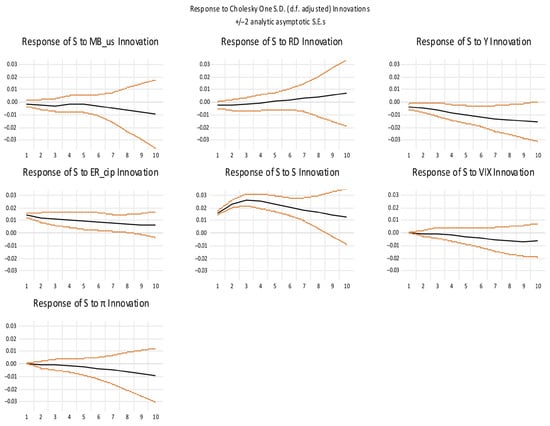
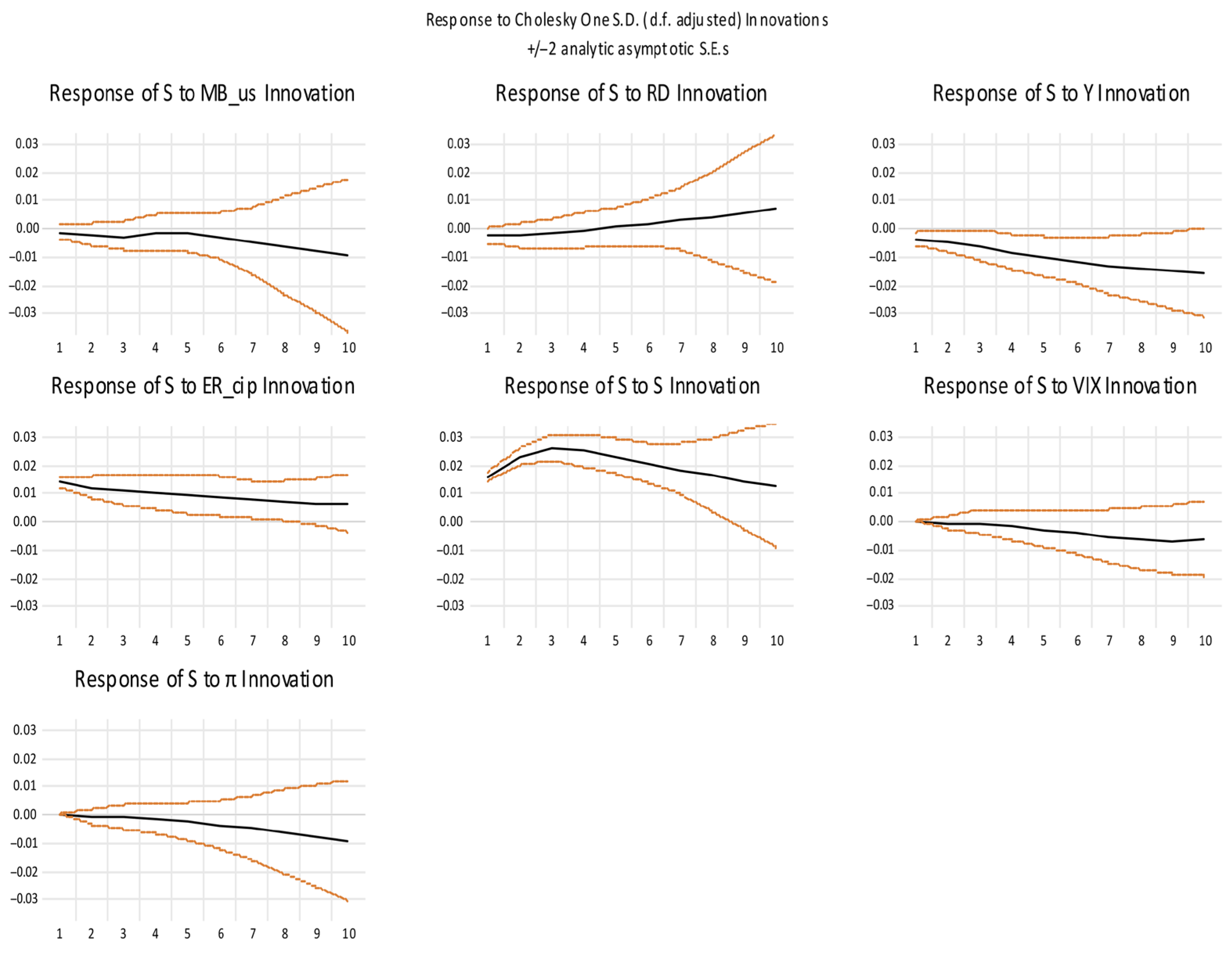
Figure 1 presents the results of the impulse response function (IRF) analysis, illustrating how the JPY/USD exchange rate responds to shocks in each variable. The exchange rate exhibits a statistically significant positive response to an increase in the swap rate over the medium to long run. The response remains statistically significant for an extended period, indicating that deviations from covered interest parity exert not only statistically detectable but also quantitatively non-trivial effects on exchange rate dynamics. The persistence of this response suggests that the forward discount puzzle is not a short-lived anomaly but rather reflects sustained adjustments in currency markets.
Figure 1.
Impulse response functions: responses of the JPY/USD exchange rate.
The exchange rate also exhibits a negative short-run response—concentrated within one to two months—to a positive shock in the Japan–U.S. interest rate differential. This implies that when the interest rate inversion is mitigated due to an increase in Japanese interest rates or a decline in U.S. interest rates, the JPY/USD exchange rate decreases (an appreciation of the yen). Although the magnitude of this response is moderate in size, its direction is economically informative: a narrowing of the interest rate inversion leads to an appreciation of the yen, contrary to the prediction of uncovered interest parity. The effect dissipates relatively quickly, indicating that short-run interest rate adjustments influence exchange rates primarily through temporary channels rather than long-lasting structural shifts.
Moreover, the JPY/USD exchange rate exhibits a significantly negative response over a prolonged horizon to a positive shock in U.S. output relative to Japanese output. This result can be interpreted as an appreciation of the U.S. dollar when U.S. production increases more strongly than Japan’s, reflecting productivity-related effects. The magnitude of the response, while gradually diminishing over time, remains economically meaningful over several months, consistent with productivity-based exchange rate movements and medium- and long-term macroeconomic fundamentals.
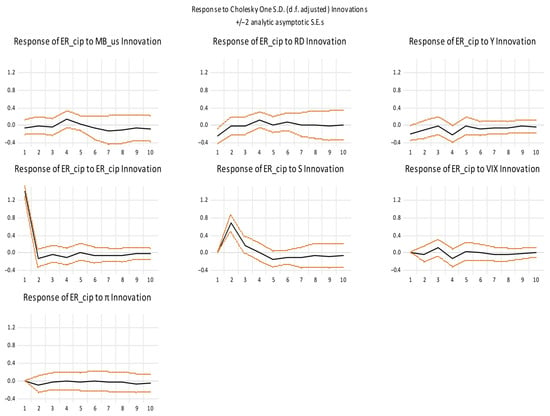
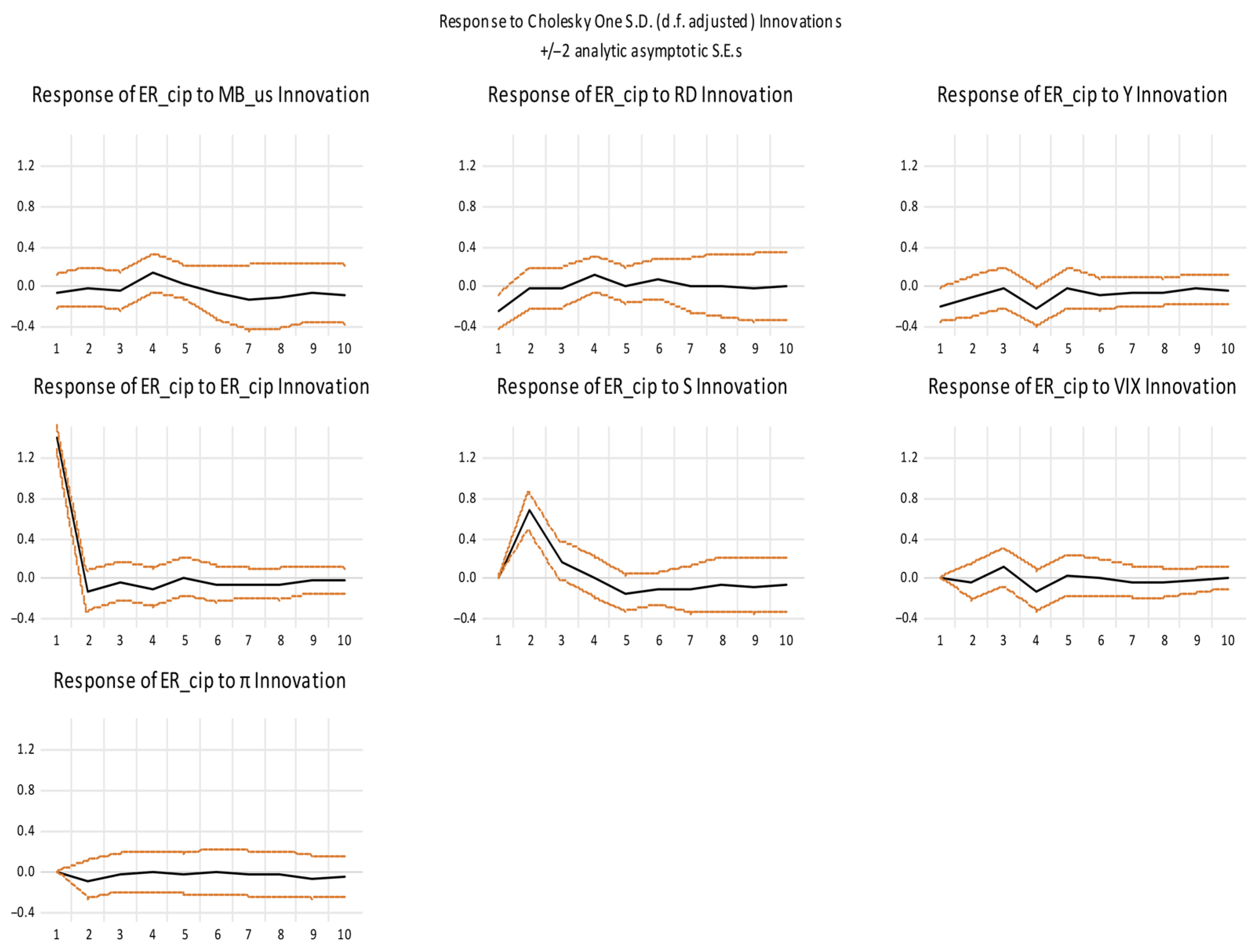
Figure 2 presents the IRFs for the swap rate. A positive shock to the interest rate differential induces a statistically significant but short-lived decline in the swap rate, concentrated within the first two months. The limited persistence of this effect suggests that deviations from interest parity adjust relatively quickly in response to interest rate movements. Notably, the direction of the response contradicts the prediction of covered interest parity, thereby reinforcing the presence of the forward discount puzzle.
Figure 2.
Impulse response functions: responses of the swap rate.
In addition, shocks to the JPY/USD exchange rate generate a positive and economically sizable response in the swap rate, which persists beyond the immediate horizon. This sustained adjustment indicates that exchange rate movements play a central role in shaping excess returns arising from parity deviations. Overall, the IRF results highlight not only statistical significance but also economically meaningful magnitudes and persistence patterns, underscoring the dynamic and reciprocal relationship between exchange rate movements and deviations from interest parity.
Table 3 reports the results of the forecast error variance decomposition (FEVD) for the JPY/USD exchange rate and the swap rate. The decomposition indicates that, after accounting for its own innovations, shocks to the swap rate constitute the largest external contributor to fluctuations in the JPY/USD exchange rate. Specifically, the swap rate explains approximately 13–28% of the forecast error variance of the exchange rate over the 2- to 10-month horizon. In addition, U.S. output relative to Japanese output accounts for roughly 11–18% of the exchange rate variance beginning at the six-month horizon.
Table 3.
Variance decomposition results.
Turning to the swap rate, the variance decomposition reveals that, aside from its own shocks, innovations in the JPY/USD exchange rate represent the most important source of variation. Over the 2- to 10-month horizon, exchange rate shocks explain approximately 18–19% of the forecast error variance of the swap rate. The remaining variables contribute less than 5% to the variation in both the JPY/USD exchange rate and the swap rate across the same horizon, indicating relatively limited explanatory power. These findings are consistent with the results obtained from the impulse response function analysis.
Table 4 reports the results of the ARDL cointegration test for the sample period from January 2001 to September 2025. The F-statistic rejects the null hypothesis of no cointegration at the 1% significance level when the JPY/USD exchange rate is treated as the dependent variable. Because the variables are not all I(1), inference is based on the lower-bound critical values, and the results indicate the existence of a cointegrating relationship at the 1% level of significance.
Table 4.
ARDL cointegration test results.
Table 5 reports the long-run coefficient estimates from the cointegrating equation based on the Autoregressive Distributed Lag (ARDL) model. The ARDL cointegration results indicate that the swap rate—representing excess returns arising from deviations from covered interest parity—exhibits a statistically significant positive relationship with U.S. dollar appreciation in the long run.
Table 5.
Long-run coefficients based on ARDL cointegration.
Moreover, the interest rate differential, defined as the Japanese interest rate minus the U.S. interest rate, shows a statistically significant negative relationship with dollar appreciation. In addition, the output differential, measured as Japanese industrial production minus U.S. industrial production, also displays a negative long-run relationship with the JPY/USD exchange rate. This implies that an increase in U.S. production relative to Japan, reflecting productivity differentials, contributes to long-run appreciation of the U.S. dollar.
Taken together, these findings suggest that, rather than interest parity holding in the long run, the forward discount puzzle persists. This result is consistent with the impulse response function results discussed above.
5. Conclusions
This study examines whether the forward discount puzzle holds in both the short and long run by analyzing the short-run and dynamic relationships among excess returns arising from deviations from interest parity, interest rate differentials, and the JPY/USD exchange rate. The Japanese yen is selected because, together with the U.S. dollar, it serves as a major vehicle currency, and Japan has experienced a prolonged period of lower interest rates relative to the United States. This persistent interest rate inversion has fostered extensive yen carry trade activities and subsequent unwinding episodes, which are closely related to the forward discount puzzle.
To investigate the short- and long-run relationships among the variables, this study employs correlation analysis, the Autoregressive Distributed Lag (ARDL) bounds test for cointegration, and impulse response analysis based on a Vector Autoregressive (VAR) model suggested by Toda–Yamamoto. The sample period spans from January 2001 to September 2025.
The correlation analysis shows a statistically significant negative relationship between the spot exchange rate and the swap rate, which can be interpreted as reflecting short-run arbitrage activity. In addition, the interest rate differential exhibits a statistically significant negative correlation with the JPY/USD exchange rate. This implies that, due to carry trade incentives, relatively high-interest-rate currencies tend to appreciate rather than depreciate, providing evidence that the forward discount puzzle exists in the short run.
The impulse response function (IRF) results indicate that the JPY/USD exchange rate responds positively and significantly over the medium to long run to a positive shock in the swap rate. Likewise, the swap rate displays a clear and statistically significant positive response to a shock in the JPY/USD exchange rate. These findings support the hypothesis that the forward discount puzzle persists for a substantial period.
Moreover, the JPY/USD exchange rate exhibits a statistically significant negative response in the short run (one to two months) to a positive shock in the interest rate differential. This suggests that, after a certain horizon, interest parity deviates from equilibrium and the forward discount puzzle emerges. The IRF results for the swap rate further show a statistically significant negative response to a positive shock in the interest rate differential over one to two months. This again indicates that interest parity departs from equilibrium over time and that the forward discount puzzle is present.
The forecast error variance decomposition further confirms the strong dynamic interdependence between the JPY/USD exchange rate and the swap rate. Beyond their own innovations, each variable emerges as the primary external source of fluctuations in the other. These findings are consistent with the impulse response analysis and underscore the dominant bilateral linkage between the exchange rate and the swap rate in the adjustment process.
Finally, the ARDL cointegration results reveal that the swap rate is positively and significantly associated with U.S. dollar appreciation in the long run. The interest rate differential, measured as the Japanese interest rate minus the U.S. interest rate, shows a significant negative relationship with dollar appreciation. In addition, an increase in U.S. output relative to Japan contributes positively to long-run dollar appreciation. Consistent with the IRF evidence, these results suggest that, rather than interest parity holding in the long run, the forward discount puzzle persists.
Taken together, although the correlation analysis indicates a temporary negative relationship between the spot exchange rate and the swap rate due to short-run arbitrage, the overall evidence from dynamic and long-run analyses implies that the forward discount puzzle exists in both the short and long run.
Beyond confirming the persistence of the forward discount puzzle, this study provides new evidence that parity deviations in the yen–dollar market are dynamically structured across different horizons. The results suggest that short-run arbitrage responses to interest rate differentials can coexist with medium- and long-run excess returns driven by funding conditions and liquidity frictions. In particular, the significant interaction between swap-implied funding costs and exchange rate movements indicates that deviations from UIP and CIP are not isolated anomalies but are jointly shaped by global liquidity cycles and monetary policy divergence.
These findings contribute to the literature by integrating interest rate differentials, cross-currency funding costs, and exchange rate dynamics within a unified empirical framework. Theoretically, the results support models incorporating time-varying risk premia and funding constraints embedded in forward rates rather than relying solely on static parity conditions. From a policy and financial perspective, persistent parity deviations imply that monetary policy divergence and cross-border liquidity conditions can generate sustained exchange rate pressures and carry trade incentives. Accordingly, exchange rate dynamics in the JPY/USD market should be understood as regime-dependent and liquidity-sensitive rather than as simple deviations from traditional interest parity benchmarks.
Funding
This research received no external funding.
Institutional Review Board Statement
Not applicable.
Informed Consent Statement
Not applicable.
Data Availability Statement
The original contributions presented in this study are included in the article. Further inquiries can be directed to the corresponding author.
Conflicts of Interest
The author declares no conflict of interest.
Appendix A. Variable Definitions, Sources, and Operational Measures
| Variable | Symbol | Data Source | Operational Definition |
| Spot Exchange Rate | St | Federal Reserve (FRED) | Log of nominal JPY/USD spot exchange rate |
| Interest Rate Differential | RDt | OECD/FRED | Japanese one-year government bond yield minus U.S. one-year treasury bond yield |
| CIP-related Excess Return (Swap Rate) | ERtcip | Bloomberg | Swap rate used as proxy for excess returns from deviations from covered interest parity (CIP) |
| Global Risk (VIX) | VIXt | CBOE | Log of implied volatility index derived from S&P 500 index options |
| U.S. Monetary Policy Variable | Mtus | Federal Reserve | Year-over-year growth rate of the U.S. monetary base |
| Inflation Differential | πt | OECD/IMF IFS | Japan CPI inflation rate minus U.S. CPI inflation rate |
| Output Differential | Yt | OECD/FRED | Log of Japan’s industrial production index minus log of U.S. industrial production index (seasonally adjusted) |
| Global Financial Crisis Dummy | GFCt | Author’s Construction | Dummy variable equal to 1 for July 2007–December 2009, 0 otherwise |
Note
| 1 | For detailed discussions on the relationship between exchange rates and macroeconomic variables, see Obstfeld and Rogoff (2000), Engel (2016), and Mark (2001). |
References
- Akram, Q. F., Dagfinn, R., & Lucio, S. (2008). Arbitrage in the foreign exchange market: Turning on the microscope. Journal of International Economics, 6(2), 237–253. [Google Scholar] [CrossRef] [Scilit]
- Avdjiev, S., Wenxin Du, W., Koch, C., & Shin, H. S. (2019). The dollar, bank leverage and deviations from covered interest parity. American Economic Review, 1(2), 193–208. [Google Scholar] [CrossRef] [Scilit]
- Baba, N., Packer, F., & Nagano, T. (2008). The spillover of money market turbulence to FX swap and cross-currency swap markets. BIS Quarterly Review, 73–86. [Google Scholar]
- Bacchetta, P., & van Wincoop, E. (2010). Infrequent portfolio decisions: A solution to the forward discount puzzle. American Economic Review, 100, 870–904. [Google Scholar] [CrossRef] [Scilit]
- Backus, D. K., Gregory, A. W., & Telmer, C. I. (1993). Accounting for forward rates in markets for foreign currency. Journal of Finance, 48(5), 1887–1908. [Google Scholar] [CrossRef]
- Bekaert, G., & Hodrick, R. J. (1993). On biases in the measurement of foreign exchange risk premiums. Journal of International Money and Finance, 12(2), 115–138. [Google Scholar] [CrossRef] [Scilit]
- Brauning, F., & Puria, K. (2017). Uncovering covered interest parity: The role of bank regulation and monetary policy. In Federal reserve bank of boston current policy perspectives. Federal Reserve Bank of Boston. [Google Scholar]
- Brunnermeier, M. K., & Pedersen, L. H. (2009). Market liquidity and funding liquidity. The Review of Financial Studies, 22, 2201–2238. [Google Scholar] [CrossRef] [Scilit]
- Burnside, C., Eichenbaum, M., Kleshchelski, I., & Rebelo, S. (2011). Do peso problems explain the returns to the carry trade? Review of Financial Studies, 24(3), 853–891. [Google Scholar] [CrossRef] [Scilit]
- Cerutti, E., Obstfeld, M., & Zhou, H. (2020). Covered interest parity deviations: Macro-financial determinants. In CEPR discussion paper (No. 13886). CEPR Press. [Google Scholar]
- Cohen, B. H., Domanski, D., Fender, I., & Shin, H. S. (2017). Global liquidity: A selective review. Annual Review of Economics, 9, 587–612. [Google Scholar] [CrossRef] [Scilit]
- Du, W., Hebert, B., & Huber, A. W. (2019). Are intermediary constraints priced? In NBER working paper (26009). National Bureau of Economic Research, Inc. [Google Scholar]
- Du, W., Joanne Im, J., & Schreger, J. (2018). US treasury premium. Journal of International Economics, 112, 167–181. [Google Scholar] [CrossRef] [Scilit]
- Engel, C. (1996). The forward discount anomaly and the risk premium. Journal of Empirical Finance, 3(2), 123–192. [Google Scholar] [CrossRef] [Scilit]
- Engel, C. (2016). Interest rates, exchange rates and the risk premium. American Economic Review, 106, 436–474. [Google Scholar] [CrossRef] [Scilit]
- Engel, C., & Wu, S. P. Y. (2023). Liquidity and exchange rates: An empirical investigation. The Review of Economic Studies, 90(5), 2395–2438. [Google Scholar] [CrossRef] [Scilit]
- Fama, E. F. (1984). Forward and spot exchange rates. Journal of Monetary Economics, 14, 319–338. [Google Scholar] [CrossRef] [Scilit]
- Frenkel, J. A., & Levich, R. (1977). Transaction costs and interest arbitrage: Tranquil versus turbulent periods. Journal of Political Economy, 85, 1209–1226. [Google Scholar] [CrossRef] [Scilit]
- Iida, T., Kimura, T., & Sudo, N. (2018). Deviations from covered interest rate parity. International Journal of Central Banking, 14(4), 275–325. [Google Scholar]
- Lewis, K. K. (1995). Puzzles in international financial markets. In G. M. Grossman, & K. Rogoff (Eds.), Handbook of international economics (Vol. 3, pp. 1913–1971). Elsevier. [Google Scholar]
- Liao, G. (2020). Credit migration and covered interest rate parity. Journal of Financial Economics, 138(2), 504–525. [Google Scholar] [CrossRef] [Scilit]
- Mark, N. C. (2001). International macroeconomics and finance: Theory and econometric methods. Blackwell Publishers. [Google Scholar]
- Narayan, P. K. (2005). The saving and investment nexus for China: Evidence from cointegration tests. Applied Economics, 37(17), 1979–1990. [Google Scholar] [CrossRef] [Scilit]
- Obstfeld, M., & Rogoff, K. (2000). The six major puzzles in international macroeconomics: Is there a common cause? In B. Bernanke, & K. Rogoff (Eds.), NBER macroeconomics annual (Vol. 15, pp. 339–412). University of Chicago Press. [Google Scholar]
- Pesaran, M. H., Shin, Y., & Smith, R. J. (2001). Bounds testing approaches to the analysis of level relationships. Journal of Applied Econometrics, 16, 289–326. [Google Scholar] [CrossRef] [Scilit]
- Toda, H. Y., & Yamamoto, T. (1995). Statistical inference in vector autoregressions with possibly integrated processes. Journal of Econometrics, 66(1–2), 225–250. [Google Scholar] [CrossRef] [Scilit]
- Yamamoto, Y. (2019). Bootstrap inference for impulse response functions in factor-augmented vector autoregressions. Journal of Applied Econometrics, 34(2), 247–267. [Google Scholar] [CrossRef] [Scilit]

Disclaimer/Publisher’s Note: The statements, opinions and data contained in all publications are solely those of the individual author(s) and contributor(s) and not of MDPI and/or the editor(s). MDPI and/or the editor(s) disclaim responsibility for any injury to people or property resulting from any ideas, methods, instructions or products referred to in the content. |
© 2026 by the author. Licensee MDPI, Basel, Switzerland. This article is an open access article distributed under the terms and conditions of the Creative Commons Attribution (CC BY) license.