


Simple Summary
Endobiliary photodynamic therapy (PDT) uses light-activated drugs delivered inside bile ducts to treat cholangiocarcinoma, a cancer of the bile duct lining. This review examines whether endobiliary PDT improves patient outcomes. The strongest evidence supports PDT as a palliative treatment that may help maintain bile duct drainage, reduce bilirubin levels, and delay stent blockage in selected patients with inoperable extrahepatic or perihilar tumors. However, evidence that PDT prolongs overall survival is inconsistent: early positive studies conflict with a later negative randomized trial, and results are complicated by differences in drainage adequacy, infection management, stent strategy, and systemic therapy access. We conclude that PDT should be understood as a context-dependent local palliative strategy rather than a proven survival treatment. Future studies should standardize procedural reporting and use biliary-specific endpoints alongside survival to better capture clinical value.
Abstract
Endobiliary photodynamic therapy (PDT) in cholangiocarcinoma (CCA) is used mainly for local palliation of malignant biliary obstruction, particularly in extrahepatic and perihilar disease. This Review synthesizes the clinical evidence on endobiliary PDT while using drainage, infection control, stent strategy, light delivery, and systemic-therapy context as an interpretive framework rather than as practice recommendations. This narrative review was informed by targeted searching of PubMed/MEDLINE, Embase, and Web of Science from database inception through to 31 December 2025, supplemented by reference-list screening. We prioritized prospective studies, comparative cohorts, systematic reviews, and relevant guidance documents. Across the literature, the clearest support for PDT concerns selected local biliary palliation, including decompression, stent patency or delayed dysfunction, and symptom relief. Survival signals remain inconsistent: early positive studies contrast with the negative PHOTOSTENT-02 randomized trial and are highly confounded by drainage adequacy, infection control, retreatment strategy, and systemic-therapy access. We therefore interpret PDT as a context-dependent local biliary strategy rather than an established survival-prolonging treatment, and we highlight the clinical variables that make published outcome signals more or less interpretable.
1. Introduction
Cholangiocarcinoma is often diagnosed when local biliary control and systemic disease management must be pursued simultaneously. Endobiliary photodynamic therapy (PDT) is a locoregional treatment in which a photosensitizer is administered and subsequently activated by intraductal light delivery, usually through endoscopic or percutaneous biliary access. The resulting photochemical reaction generates reactive oxygen species within the treated biliary segment [1,2,3,4,5]. In cholangiocarcinoma, the clinical rationale for endobiliary PDT is closely linked to palliation of malignant biliary obstruction, where local ductal control, drainage quality, stent patency, cholangitis risk, and continuity of systemic therapy may jointly influence patient outcomes.
Endobiliary PDT has therefore attracted interest because it can be delivered within the ductal lumen, paired with stenting and systemic therapy, and it is linked to plausible local photochemical effects, with broader vascular or immune consequences remaining less clinically defined. This Review is intended as a narrative clinical synthesis, not as a guideline or protocol statement. We focus on what current studies suggest about patient outcomes, where a local biliary role appears most plausible, and which procedural variables have the strongest effect on the interpretation of those outcomes [6,7,8,9,10,11,12,13].
2. Methods
This narrative review was informed by targeted searching of PubMed/MEDLINE, Embase, and Web of Science from database inception through to 31 December 2025, supplemented by reference-list screening. Search terms included combinations of cholangiocarcinoma, photodynamic therapy, endobiliary, endoscopic retrograde cholangiopancreatography, biliary stent, radiofrequency ablation, perihilar, distal, and intrahepatic. We prioritized prospective trials, comparative clinical studies, large observational cohorts, systematic reviews, and guideline or consensus documents for the clinical synthesis, while using mechanistic studies selectively for context. Supplementary materials provide additional context on registered biliary PDT trials, mechanistic/translational evidence, reporting items, and technical details relevant to endobiliary PDT interpretation. Because this was a narrative review, formal PRISMA screening and formal risk-of-bias grading were not performed; accordingly, translational concepts are discussed as exploratory and evidence-tiered rather than clinically established claims [1,2,3,4,5,6,7,8,9,10,11,12,13,14,15,16,17,18,19,20,21,22,23,24,25,26,27,28,29,30,31,32,33,34,35,36,37,38,39,40,41,42,43,44,45,46,47,48,49,50,51,52,53,54,55,56,57,58,59,60,61,62,63,64,65,66,67,68,69,70,71,72,73,74,75,76,77,78].
3. Clinical Context and Where Endobiliary PDT Fits
Endobiliary PDT is represented mainly in patients with malignant biliary obstruction from extrahepatic disease, especially perihilar cholangiocarcinoma (pCCA) and distal cholangiocarcinoma (dCCA), which are usually treated during endoscopic retrograde cholangiopancreatography (ERCP) and less often through percutaneous approaches. Read conservatively, the literature supports a narrow conclusion: in selected patients, PDT has been associated with more favorable local biliary outcomes, with signals of benefit most consistent for decompression, stent-related outcomes, and symptom control. By contrast, overall survival is difficult to interpret because both early positive and later negative studies are constrained by important uncertainty. Evidence in mass-forming intrahepatic cholangiocarcinoma (iCCA) is much thinner, so extrapolation from perihilar or distal extrahepatic obstruction to broader intrahepatic disease should remain restrained [6,7,8,10,11,12,13,15,16]. A more plausible use case appears to be obstruction-predominant extrahepatic or perihilar disease, whereas uncontrolled sepsis, inability to achieve interpretable drainage, rapidly progressive extra-biliary disease, or predominantly mass-forming iCCA materially weaken the case for endobiliary PDT.
3.1. Structured Synthesis of Clinical Outcomes
Does endobiliary PDT improve meaningful patient outcomes? The most defensible answer is narrow and qualified. Across randomized studies, comparative cohorts, and meta-analyses, the clearest support is for selected local biliary palliation in obstructing extrahepatic or perihilar disease. Signals for bilirubin improvement, stent patency or delayed stent dysfunction, and symptom or quality of life (QoL) benefit are more consistent than signals for overall survival (OS). However, even these biliary endpoints are difficult to compare across studies because the descriptions of drainage targets, stent strategy, cholangitis definitions, retreatment rules, and systemic-therapy exposure vary [2,10,11,12,13,20,21,22,23,24,27,28,29,30,31,32,33,34].
3.2. PDT Versus Endobiliary Radiofrequency Ablation (RFA) in Clinical Context
Comparisons between endobiliary PDT and endobiliary RFA remain context-dependent and inadequately standardized. PDT may be technically attractive in some long-segment or multifocal strictures, whereas RFA may be simpler in shorter focal lesions, but comparative effectiveness remains uncertain and cannot be reduced to a single anatomy-based rule [12,13,22,26,28].
3.3. Why Studies Disagree: A Clinical-Methodological Framework
For local biliary outcomes, the literature is somewhat more supportive, although still methodologically limited. Several studies describe improved biliary decompression, bilirubin response, delayed stent dysfunction, or reduced need for early reintervention after PDT-based treatment, although endpoint definitions and follow-up windows vary. Reported QoL or symptom benefits are limited but directionally supportive in some early and observational studies, whereas cholangitis and other infectious complications remain major competing risks [10,11,12,13,18,25,31,32,33,34]. The key clinical messages for interpreting endobiliary PDT are summarized in Table 1.
Table 1.
Key take-home messages for clinical interpretation of endobiliary PDT.
3.4. Practical Procedural Considerations That Affect Interpretation
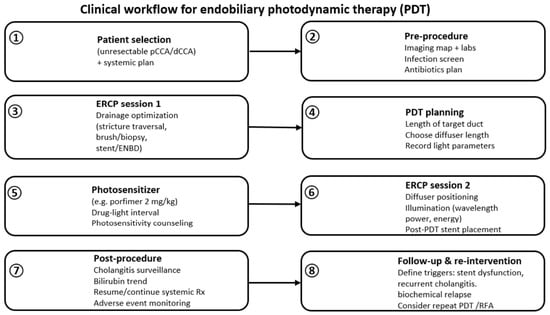
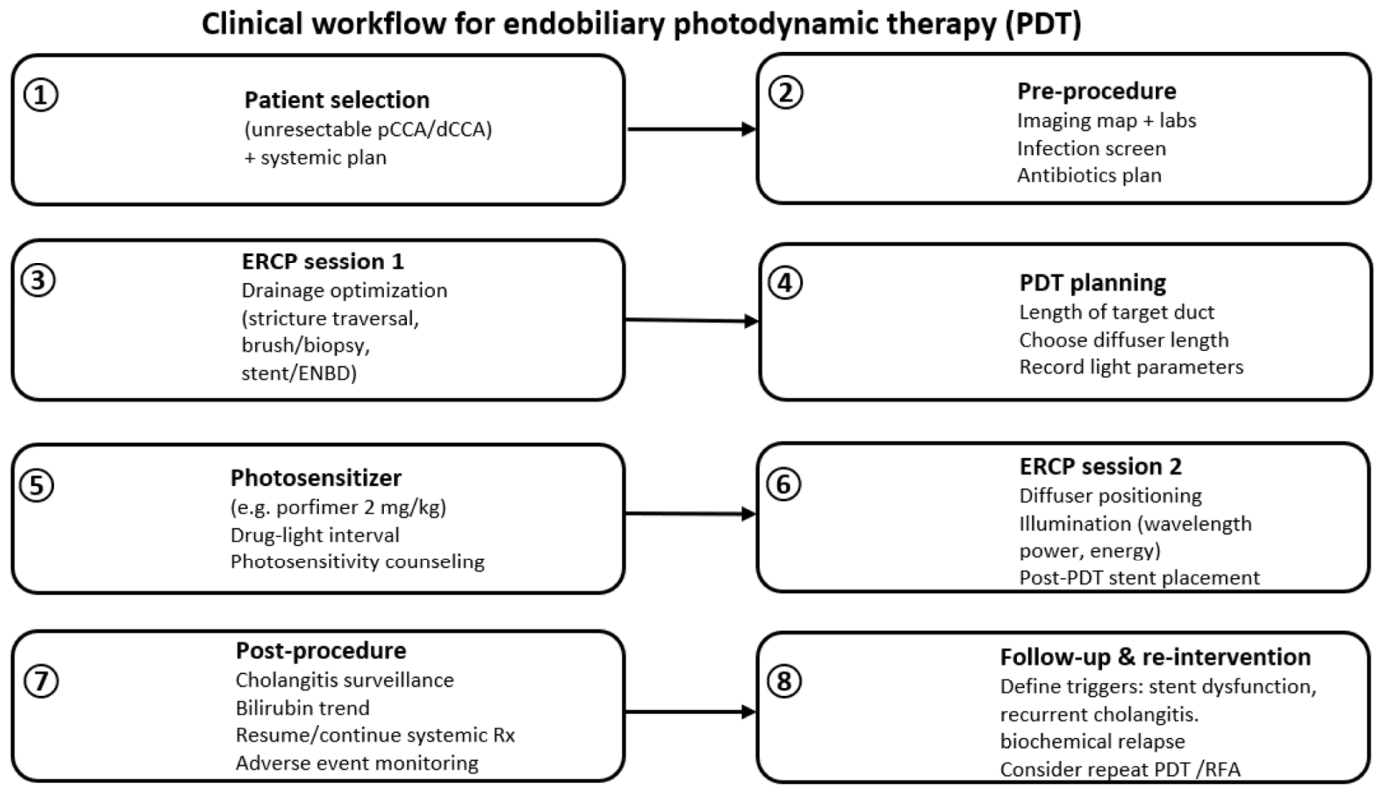
Procedural detail matters because local biliary outcomes can be obscured by differences in drainage adequacy, infection prevention, stent strategy, and delivery documentation. These variables should be understood as effect modifiers and reporting priorities, not as formal practice recommendations. Figure 1 summarizes a practical framework for interpreting endobiliary PDT studies, informed where relevant by ESGE and ASGE guidance [17,18,19,25,29,30].
Figure 1.
Clinical workflow for endobiliary photodynamic therapy (PDT) in cholangiocarcinoma. The workflow summarizes key clinical and procedural domains relevant to endobiliary PDT, including patient selection, pre-procedure assessment, ERCP-based drainage, PDT planning, photosensitizer administration, intraductal illumination, post-procedure care, and follow-up or re-intervention. Workflow elements are informed, where relevant, by ESGE and ASGE guidance on malignant hilar obstruction, ERCP adverse events, and antibiotic prophylaxis, but are intended as interpretive reporting domains rather than formal practice recommendations [17,18,19,25,29,30].
Among these factors, cholangitis and incomplete drainage are especially important because they can dominate morbidity, trigger unplanned reintervention, and confound both patency and survival endpoints. Studies are more clinically readable when they specify drainage targets, antibiotic approach when incomplete drainage is anticipated, stent type and exchange strategy, and how post-procedure infections were defined and adjudicated [17,18,19,25,29,30].
When interpreting studies, readers should also consider whether post-PDT stent management was specified, whether self-expandable metal stents (SEMSs) or plastic stents were used appropriately for the setting, and whether rescue reintervention criteria were predefined [17,18,19,29].
Resource Use and Repeat Intervention Burden
From a practical standpoint, PDT may require additional procedure time, photosensitizer procurement and counseling, coordination of light-delivery equipment, and repeated ERCP for reassessment or retreatment. Formal cost-effectiveness data are limited, but procedure burden, healthcare use, and center-level availability should be considered part of the real-world treatment context rather than dismissed as implementation detail alone [11,18,25,33,34].
These issues do not negate a local palliative role, but they matter when judging whether a technically feasible strategy is also worthwhile for patients and health systems. The context-dependent comparison between endobiliary PDT and endobiliary RFA is summarized in Table 2.
Table 2.
Context-dependent interpretation of endobiliary PDT and endobiliary RFA.
Table 3.
Clinical outcome signals across major endobiliary PDT studies.
Table 4.
Outcome domains for clinical interpretation of endobiliary PDT studies.
Taken together, current studies suggest that endobiliary PDT is best understood as a context-dependent local biliary palliative strategy whose clinical signal is driven more reliably by biliary than by oncologic endpoints. Survival benefit remains uncertain, and practical value depends in part on whether local palliation appears to improve decompression, infection control, retreatment burden, and continuity of systemic therapy in an individual patient.
In this review, randomized and prospective comparative studies are treated as the most informative clinical evidence, with observational cohorts used for context and mechanistic data treated as hypothesis-generating rather than practice-defining.
3.5. Future Research Priorities
Table 5 summarizes the variables most likely to improve interpretability are anatomy-aware enrollment, explicit drainage targets, protocolized infection management, defined retreatment rules, reproducible light-delivery records, and clear documentation of systemic-therapy timing. These elements do not guarantee efficacy, but they help readers judge whether survival or biliary signals are being attributed to comparable clinical situations. Registered biliary PDT trials are summarized in Supplementary Table S1.
Table 5.
Clinical and reporting variables that most affect interpretation of endobiliary PDT studies.
3.6. Practical Implications and Low-Yield Settings
For unresectable CCA, endobiliary PDT is used in a palliative setting in which feasibility, adverse events, and healthcare use are part of the clinical signal rather than peripheral implementation details [12,13]. Cholangitis, stent dysfunction, photosensitivity management, repeat ERCP, and access to photosensitizers or compatible equipment all influence whether a local biliary strategy remains worthwhile [11,18,25,33,34].
3.7. Clinical Boundaries and Low-Yield Settings
Even with careful procedural reporting, biliary PDT is unlikely to be equally persuasive across all cholangiocarcinoma contexts. The clearest use case remains nonresectable extrahepatic or perihilar obstruction where maintaining ductal patency, bilirubin control, and continuity of systemic therapy are meaningful objectives in their own right. The rationale weakens substantially when trajectories are dominated by rapidly progressive metastatic disease, profound frailty or hepatic failure, uncontrolled infection, inability to achieve a prespecified drainage target, or predominantly mass-forming intrahepatic disease that is poorly represented in endobiliary datasets.
These settings are better regarded as low-yield or difficult-to-interpret contexts unless a study provides a specific rationale for inclusion. Counterevidence should therefore function as a boundary-setting signal, not merely as heterogeneity around a positive narrative.
4. Outcome Measures for Future Studies
OS remains clinically important but is particularly vulnerable to confounding in this literature. Future studies would be easier to interpret if OS were reported alongside:
- Time to stent dysfunction or reintervention;
- Bilirubin response and durability;
- Cholangitis defined by TG18 criteria;
- Hospitalization burden;
- Validated QoL instruments (e.g., EORTC QLQ-BIL21);
- Ability to deliver intended systemic therapy without biliary interruption.
These composite endpoints would better capture the clinical value of local biliary palliation [10,11,12,13,18,25,31,32].
These outcome layers depend on variables that are partly controllable and, at minimum, documentable: drainage adequacy, infection control, treated-segment coverage, light-delivery geometry, photosensitizer exposure, and retreatment policy. The practical task is to record enough procedural context to make study results clinically readable rather than to imply that reporting alone can resolve efficacy uncertainty.
Negative and positive studies should therefore be read as signals within a procedure-sensitive clinical context, not as simple proof for or against PDT in all cholangiocarcinoma settings.
Condensed Procedural Context
Technical detail remains relevant only insofar as it changes clinical interpretation. The most portable descriptors are treated segment, diffuser length, power or power per diffuser length, treatment time, resulting energy per diffuser length, drug-light interval, catheter positioning method, and whether overlapping illuminations or repeat sessions were used [1,2,14,27,39].
Studies that omit these elements are harder to compare, but detailed dosimetry discussion should remain subordinate to clinical outcomes in a narrative review. More extensive technical material has therefore been kept in the supplement [1,14,17,18,19]. Additional reporting items and technical details are summarized in Supplementary Tables S3 and S4.
5. Exploratory Translational Directions
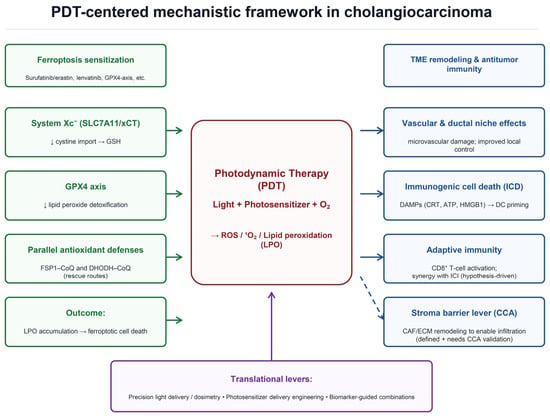
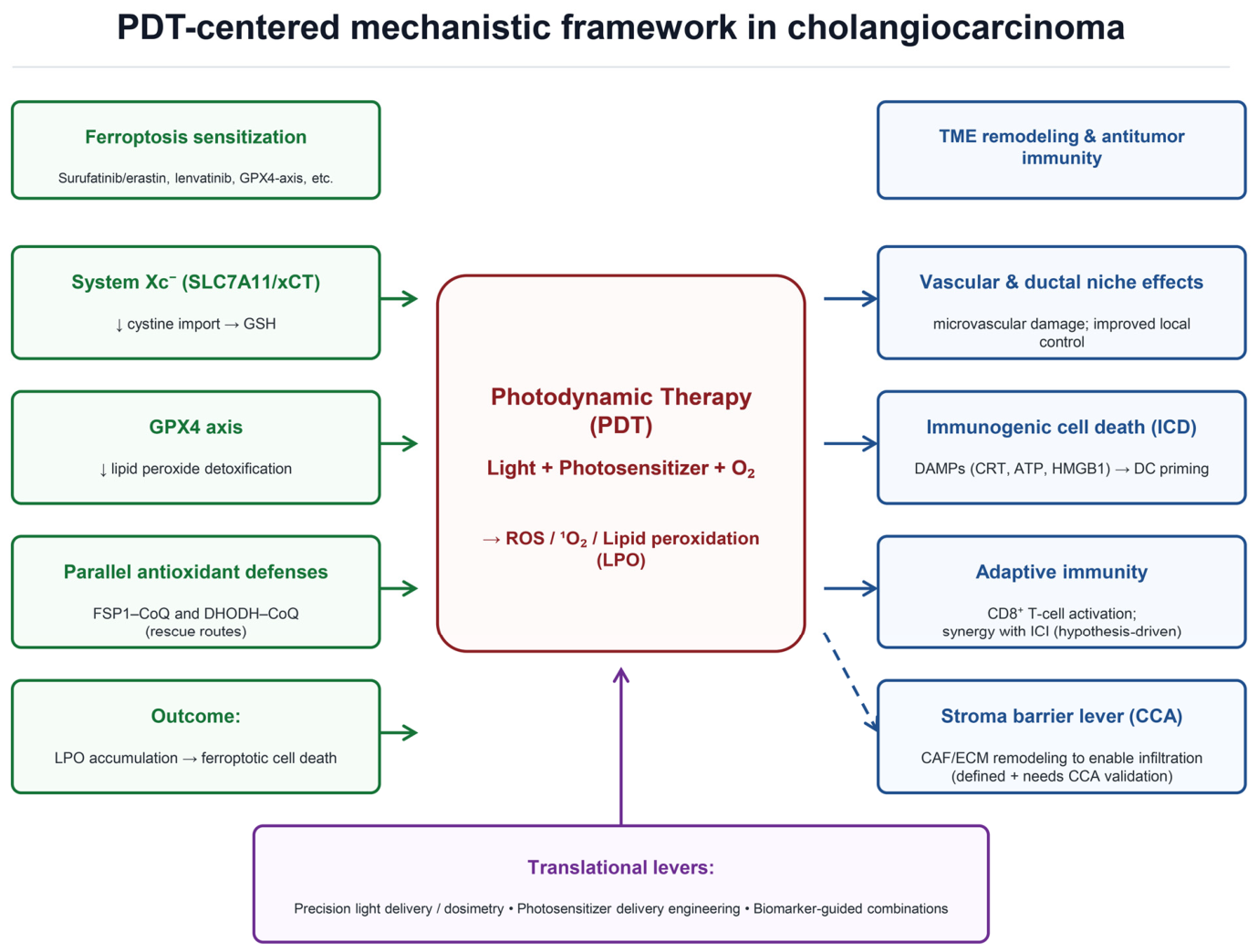
Exploratory combination strategies should not be presented as a way to rescue an uncertain local procedure. Figure 2 summarizes largely preclinical concepts involving ferroptosis, immune modulation, targeted therapy, and delivery engineering; these ideas remain hypothesis-generating and require human biliary validation before they can influence routine clinical interpretation [36,42,43,44,45,46,47,48,49,50,51,52,53,54,55,56,57,58,59,60,61,62,63,64,65,66,67,68,69,70,71,72,73,74,75,76,77,78]. Additional mechanistic and translational evidence is summarized in Supplementary Table S2.
Figure 2.
Exploratory mechanisms relevant to PDT intensification in cholangiocarcinoma. The figure summarizes predominantly preclinical or indirect evidence linking PDT-induced reactive oxygen species (ROS), lipid peroxidation (LPO), ferroptosis sensitization, tumor microenvironment remodeling, immunogenic cell death, adaptive immunity, and translational levers such as light delivery, photosensitizer delivery, and biomarker-guided combinations. This framework is hypothesis-generating and should not be interpreted as a clinically validated map of human endobiliary PDT response.
In the same spirit, biomarkers such as bile or brushing correlates, circulating tumor DNA (ctDNA), inflammatory markers, or oxidized lipid signatures may be informative only if linked to sampling timing, drainage status, cholangitis, antibiotic exposure, and procedural metadata. At present, they should not be treated as validated response markers for endobiliary PDT [37,51,57,65,66,67,72,73,74,75].
6. Conclusions
Therefore, the current evidence supports endobiliary PDT as a context-dependent palliative biliary intervention in selected obstruction-predominant extrahepatic or perihilar disease, but does not support broad claims of survival prolongation across unselected CCA populations.
This narrative review treats procedural context as essential to interpreting outcomes, not as a substitute for outcome evidence itself. Future studies will be most useful when they report anatomy, drainage targets, stent and antibiotic strategy, photosensitizer and light-delivery parameters, retreatment rules, and patient-centered as well as biliary endpoints. Translational combinations and biomarker strategies remain exploratory until validated in human biliary PDT cohorts. Priority areas for future research include standardized dosimetry protocols, prospectively collected biomarker candidates linked to procedural metadata, and trials evaluating PDT within contemporary systemic-therapy backbones in well-defined anatomic and disease-stage subgroups.
Supplementary Materials
The following supporting information can be downloaded at https://www.mdpi.com/article/10.3390/curroncol33060343/s1, Supplementary Table S1 (registered biliary PDT trials), Supplementary Table S2 (mechanistic and translational evidence), Supplementary Table S3 (manuscript reporting items), and Supplementary Table S4 (technical details for endobiliary PDT reports).
Author Contributions
X.Z. and A.J. conceived the review scope and developed the outline. X.Z. performed the literature search, organized the evidence base, drafted the manuscript, prepared the figures, and curated the tables. A.J. provided critical revision for important intellectual content, supervised the work, and finalized the submission. All authors have read and agreed to the published version of the manuscript.
Funding
This work was supported by The Special Research Fund for Talent Cultivation of the Second Affiliated Hospital of Xi’an Jiaotong University [RC(GG)202010].
Data Availability Statement
No new datasets were generated or analyzed for this review. All information discussed in this article is derived from published sources, which are cited in the reference list.
Conflicts of Interest
The authors declare no conflicts of interest.
References
- Rumalla, A.; Baron, T.H.; Wang, K.K.; Gores, G.J.; Stadheim, L.M.; de Groen, P.C. Endoscopic application of photodynamic therapy for cholangiocarcinoma. Gastrointest. Endosc. 2001, 53, 500–504. [Google Scholar] [CrossRef] [Scilit]
- Talreja, J.P.; Kahaleh, M. Photodynamic Therapy for Cholangiocarcinoma. Gut Liver 2010, 4, S62–S66. [Google Scholar] [CrossRef] [Scilit]
- Dolmans, D.E.; Fukumura, D.; Jain, R.K. Photodynamic therapy for cancer. Nat. Rev. Cancer 2003, 3, 380–387. [Google Scholar] [CrossRef] [Scilit]
- Agostinis, P.; Berg, K.; Cengel, K.A.; Foster, T.H.; Girotti, A.W.; Gollnick, S.O.; Hahn, S.M.; Hamblin, M.R.; Juzeniene, A.; Kessel, D.; et al. Photodynamic therapy of cancer: An update. CA Cancer J. Clin. 2011, 61, 250–281. [Google Scholar] [CrossRef] [Scilit] [PubMed]
- Dougherty, T.J.; Gomer, C.J.; Henderson, B.W.; Jori, G.; Kessel, D.; Korbelik, M.; Moan, J.; Peng, Q. Photodynamic Therapy. JNCI J. Natl. Cancer Inst. 1998, 90, 889–905. [Google Scholar] [CrossRef] [Scilit] [PubMed]
- Banales, J.M.; Marin, J.J.G.; Lamarca, A.; Rodrigues, P.M.; Khan, S.A.; Roberts, L.R.; Cardinale, V.; Carpino, G.; Andersen, J.B.; Braconi, C.; et al. Cholangiocarcinoma 2020: The next horizon in mechanisms and management. Nat. Rev. Gastroenterol. Hepatol. 2020, 17, 557–588. [Google Scholar] [CrossRef] [Scilit] [PubMed]
- Brindley, P.J.; Bachini, M.; Ilyas, S.I.; Khan, S.A.; Loukas, A.; Sirica, A.E.; Teh, B.T.; Wongkham, S.; Gores, G.J. Cholangiocarcinoma. Nat. Rev. Dis. Primers 2021, 7, 65. [Google Scholar] [CrossRef] [Scilit]
- Vogel, A.; Bridgewater, J.; Edeline, J.; Kelley, R.; Klümpen, H.; Malka, D.; Primrose, J.; Rimassa, L.; Stenzinger, A.; Valle, J.; et al. Biliary tract cancer: ESMO Clinical Practice Guideline for diagnosis, treatment and follow-up. Ann. Oncol. 2023, 34, 127–140. [Google Scholar] [CrossRef] [Scilit]
- Oh, D.-Y.; He, A.R.; Qin, S.; Chen, L.-T.; Okusaka, T.; Vogel, A.; Kim, J.W.; Suksombooncharoen, T.; Lee, M.A.; Kitano, M.; et al. Durvalumab Plus Gemcitabine and Cisplatin in Advanced Biliary Tract Cancer. NEJM Évid. 2022, 1, EVIDoa2200015. [Google Scholar] [CrossRef] [Scilit]
- Ortner, M.E.; Caca, K.; Berr, F.; Liebetruth, J.; Mansmann, U.; Huster, D.; Voderholzer, W.; Schachschal, G.; Mössner, J.; Lochs, H. Successful photodynamic therapy for nonresectable cholangiocarcinoma: A randomized prospective study. Gastroenterology 2003, 125, 1355–1363. [Google Scholar] [CrossRef] [Scilit]
- Pereira, S.P.; Jitlal, M.; Duggan, M.; Lawrie, E.; Beare, S.; O’Donoghue, P.; Wasan, H.S.; Valle, J.W.; Bridgewater, J. PHOTOSTENT-02: Porfimer sodium photodynamic therapy plus stenting versus stenting alone in patients with locally advanced or metastatic biliary tract cancer. ESMO Open 2018, 3, e000379. [Google Scholar] [PubMed]
- Mohan, B.P.; Chandan, S.; Khan, S.R.M.; Kassab, L.L.M.; Ponnada, S.; Artifon, E.L.M.; Otoch, J.P.; McDonough, S.B.; Adler, D.G.M. Photodynamic Therapy (PDT), Radiofrequency Ablation (RFA) with Biliary Stents in Palliative Treatment of Unresectable Extrahepatic Cholangiocarcinoma. J. Clin. Gastroenterol. 2021, 56, e153–e160. [Google Scholar] [CrossRef] [Scilit]
- Leggett, C.L.; Gorospe, E.C.; Murad, M.H.; Montori, V.M.; Baron, T.H.; Wang, K.K. Photodynamic therapy for unresectable cholangiocarcinoma: A comparative effectiveness systematic review and meta-analyses. Photodiagn. Photodyn. Ther. 2012, 9, 189–195. [Google Scholar] [CrossRef] [Scilit] [PubMed]
- Wilson, B.C.; Patterson, M.S.; Lilge, L. Implicit and explicit dosimetry in photodynamic therapy: A New paradigm. Lasers Med. Sci. 1997, 12, 182–199. [Google Scholar] [CrossRef] [Scilit] [PubMed]
- Murakami, G.; Nanashima, A.; Nonaka, T.; Tominaga, T.; Wakata, K.; Sumida, Y.; Akashi, H.; Okazaki, S.; Kataoka, H.; Nagayasu, T. Photodynamic Therapy Using Novel Glucose-Conjugated Chlorin Increases Apoptosis of Cholangiocellular Carcinoma in Comparison with Talaporfin Sodium. Anticancer Res. 2016, 36, 4493–4502. [Google Scholar] [CrossRef] [Scilit]
- Shimizu, S.; Nakazawa, T.; Hayashi, K.; Naitoh, I.; Miyabe, K.; Kondo, H.; Nishi, Y.; Umemura, S.; Hori, Y.; Kato, A.; et al. Photodynamic Therapy Using Talaporfin Sodium for the Recurrence of Cholangiocarcinoma After Surgical Resection. Intern. Med. 2015, 54, 2321–2326. [Google Scholar] [CrossRef] [Scilit]
- Dumonceau, J.M.; Tringali, A.; Papanikolaou, I.S.; Blero, D.; Mangiavillano, B.; Schmidt, A.; Vanbiervliet, G.; Costamagna, G.; Devière, J.; García-Cano, J.; et al. Endoscopic biliary stenting: Indications, choice of stents, and results: European Society of Gastrointestinal Endoscopy (ESGE) Clinical Guideline—Updated October 2017. Endoscopy 2018, 50, 910–930. [Google Scholar] [CrossRef] [Scilit]
- Dumonceau, J.-M.; Kapral, C.; Aabakken, L.; Papanikolaou, I.S.; Tringali, A.; Vanbiervliet, G.; Beyna, T.; Dinis-Ribeiro, M.; Hritz, I.; Mariani, A.; et al. ERCP-related adverse events: European Society of Gastrointestinal Endoscopy (ESGE) Guideline. Endoscopy 2020, 52, 127–149. [Google Scholar] [CrossRef] [Scilit]
- ASGE Standards of Practice Committee; Khashab, M.A.; Chithadi, K.V.; Acosta, R.D.; Bruining, D.H.; Chandrasekhara, V.; Eloubeidi, M.A.; Fanelli, R.D.; Faulx, A.L.; Fonkalsrud, L.; et al. Antibiotic prophylaxis for GI endoscopy. Gastrointest. Endosc. 2015, 81, 81–89. [Google Scholar] [CrossRef] [Scilit]
- Möhring, C.; Khan, O.; Zhou, T.; Sadeghlar, F.; Mahn, R.; Kaczmarek, D.J.; Dold, L.; Toma, M.; Marinova, M.; Glowka, T.R.; et al. Comparison between regular additional endobiliary radiofrequency ablation and photodynamic therapy in patients with advanced extrahepatic cholangiocarcinoma under systemic chemotherapy. Front. Oncol. 2023, 13, 1227036. [Google Scholar] [CrossRef] [Scilit]
- Inoue, T.; Yoneda, M. Recent Updates on Local Ablative Therapy Combined with Chemotherapy for Extrahepatic Cholangiocarcinoma: Photodynamic Therapy and Radiofrequency Ablation. Curr. Oncol. 2023, 30, 2159–2168. [Google Scholar] [CrossRef] [Scilit]
- Natha, C.; Vemulapalli, V.; Thosani, N. Endoscopic Ablation in Cholangiocarcinoma. Cancers 2025, 17, 2843. [Google Scholar] [CrossRef] [Scilit]
- Moole, H.; Tathireddy, H.; Dharmapuri, S.; Moole, V.; Boddireddy, R.; Yedama, P.; Dharmapuri, S.; Uppu, A.; Bondalapati, N.; Duvvuri, A. Success of photodynamic therapy in palliating patients with nonresectable cholangiocarcinoma: A systematic review and meta-analysis. World J. Gastroenterol. 2017, 23, 1278–1288. [Google Scholar] [CrossRef] [Scilit] [PubMed]
- Yu, Y.; Wang, N.; Wang, Y.; Shi, Q.; Yu, R.; Gu, B.; Maswikiti, E.P.; Chen, H. Photodynamic therapy combined with systemic chemotherapy for unresectable extrahepatic cholangiocarcinoma: A systematic review and meta-analysis. Photodiagn. Photodyn. Ther. 2023, 41, 103318. [Google Scholar] [CrossRef] [Scilit]
- Kiriyama, S.; Kozaka, K.; Takada, T.; Strasberg, S.M.; Pitt, H.A.; Gabata, T.; Hata, J.; Liau, K.-H.; Miura, F.; Horiguchi, A.; et al. Tokyo Guidelines 2018: Diagnostic criteria and severity grading of acute cholangitis (with videos). J. Hepato-Biliary-Pancreat. Sci. 2018, 25, 17–30. [Google Scholar] [CrossRef] [Scilit] [PubMed]
- Schmidt, A.; Bloechinger, M.; Weber, A.; Siveke, J.; von Delius, S.; Prinz, C.; Schmitt, W.; Schmid, R.; Neu, B. Short-term effects and adverse events of endoscopically applied radiofrequency ablation appear to be comparable with photodynamic therapy in hilar cholangiocarcinoma. United Eur. Gastroenterol. J. 2016, 4, 570–579. [Google Scholar] [CrossRef] [Scilit] [PubMed]
- Talreja, J.P.; DeGaetani, M.; Ellen, K.; Schmitt, T.; Gaidhane, M.; Kahaleh, M. Photodynamic Therapy in Unresectable Cholangiocarcinoma: Not for the Uncommitted. Clin. Endosc. 2013, 46, 390–394. [Google Scholar] [CrossRef] [Scilit]
- Mohammad, T.; Kahaleh, M. Comparing palliative treatment options for cholangiocarcinoma: Photodynamic therapy vs. radiofrequency ablation. Clin. Endosc. 2022, 55, 347–354. [Google Scholar] [CrossRef] [Scilit]
- Qumseya, B.J.; Jamil, L.H.; Elmunzer, B.J.; Riaz, A.; Ceppa, E.P.; Thosani, N.C.; Buxbaum, J.L.; Storm, A.C.; Sawhney, M.S.; Pawa, S.; et al. ASGE guideline on the role of endoscopy in the management of malignant hilar obstruction. Gastrointest. Endosc. 2021, 94, 222–234.e22. [Google Scholar] [CrossRef] [Scilit]
- Cotton, P.B.; Eisen, G.M.; Aabakken, L.; Baron, T.H.; Hutter, M.M.; Jacobson, B.C.; Mergener, K.; Nemcek, A., Jr.; Petersen, B.T.; Petrini, J.L.; et al. A lexicon for endoscopic adverse events: Report of an ASGE workshop. Gastrointest. Endosc. 2010, 71, 446–454. [Google Scholar] [CrossRef] [Scilit]
- On behalf of the EORTC Quality of Life Group; Friend, E.; Yadegarfar, G.; Byrne, C.; Johnson, C.D.; Sezer, O.; Pucciarelli, S.; Pereira, S.P.; Chie, W.-C.; Banfield, A.; et al. Development of a questionnaire (EORTC module) to measure quality of life in patients with cholangiocarcinoma and gallbladder cancer, the EORTC QLQ-BIL21. Br. J. Cancer 2011, 104, 587–592. [Google Scholar] [CrossRef] [Scilit] [PubMed]
- Kaupp-Roberts, S.D.; Yadegarfar, G.; Friend, E.; O’Donnell, C.M.; Valle, J.W.; Byrne, C.; Bahar, I.; Finch-Jones, M.; Gillmore, R.; Johnson, C.D.; et al. Validation of the EORTC QLQ-BIL21 questionnaire for measuring quality of life in patients with cholangiocarcinoma and cancer of the gallbladder. Br. J. Cancer 2016, 115, 1032–1038. [Google Scholar] [CrossRef] [Scilit]
- Cheon, Y.K.; Lee, T.Y.; Lee, S.M.; Yoon, J.Y.; Shim, C.S. Longterm outcome of photodynamic therapy compared with biliary stenting alone in patients with advanced hilar cholangiocarcinoma. HPB 2012, 14, 185–193. [Google Scholar] [CrossRef] [Scilit]
- Hong, M.J.; Cheon, Y.K.; Lee, E.J.; Lee, T.Y.; Shim, C.S. Long-Term Outcome of Photodynamic Therapy with Systemic Chemotherapy Compared to Photodynamic Therapy Alone in Patients with Advanced Hilar Cholangiocarcinoma. Gut Liver 2014, 8, 318–323. [Google Scholar] [CrossRef] [Scilit]
- Li, Z.; Jiang, X.; Xiao, H.; Chen, S.; Zhu, W.; Lu, H.; Cao, L.; Xue, P.; Li, H.; Zhang, D. Long-term results of ERCP- or PTCS-directed photodynamic therapy for unresectable hilar cholangiocarcinoma. Surg. Endosc. 2020, 35, 5655–5664. [Google Scholar] [CrossRef] [Scilit]
- Yuan, Z.; Li, Y.; Zhang, S.; Wang, X.; Dou, H.; Yu, X.; Zhang, Z.; Yang, S.; Xiao, M. Extracellular matrix remodeling in tumor progression and immune escape: From mechanisms to treatments. Mol. Cancer 2023, 22, 48. [Google Scholar] [CrossRef] [Scilit]
- Shui, S.; Zhao, Z.; Wang, H.; Conrad, M.; Liu, G. Non-enzymatic lipid peroxidation initiated by photodynamic therapy drives a distinct ferroptosis-like cell death pathway. Redox Biol. 2021, 45, 102056. [Google Scholar] [CrossRef] [Scilit]
- Segura-Díaz, A.; Stuckey, R.; Florido, Y.; González-Martín, J.M.; López-Rodríguez, J.F.; Sánchez-Sosa, S.; González-Pérez, E.; Perdomo, M.N.S.; Perera, M.d.M.; de la Iglesia, S.; et al. Thrombotic Risk Detection in Patients with Polycythemia Vera: The Predictive Role of DNMT3A/TET2/ASXL1 Mutations. Cancers 2020, 12, 934. [Google Scholar] [CrossRef] [Scilit]
- Wilson, B.C.; Lilge, L.; Weersink, R.A.; Pires, L. Photodynamic therapy dosimetry: Current status and the emerging challenge of immune stimulation. J. Biomed. Opt. 2025, 30, S34118. [Google Scholar] [CrossRef] [Scilit] [PubMed]
- De Jode, M. Monte Carlo Simulations of Light Distributions in an Embedded Tumour Model: Studies of Selectivity in Photodynamic Therapy. Lasers Med. Sci. 2000, 15, 49–56. [Google Scholar] [CrossRef] [Scilit] [PubMed]
- Wang, S.; Dai, X.Y.; Ji, S.; Saeidi, T.; Schwiegelshohn, F.; Yassine, A.-A.; Lilge, L.; Betz, V. Scalable and accessible personalized photodynamic therapy optimization with FullMonte and PDT-SPACE. J. Biomed. Opt. 2022, 27, 083006. [Google Scholar] [CrossRef] [Scilit]
- Allison, R.R.; Huang, Z.; Dallimore, I.; Moghissi, K. Tools of clinical Photodynamic Therapy (PDT): A Mini Compendium. Photodiagn. Photodyn. Ther. 2024, 46, 104058. [Google Scholar] [CrossRef] [Scilit]
- Siriwardane, D.A.; Jiang, W.; Mudalige, T. Profiling in-vitro release of verteporfin from VISUDYNE® liposomal formulation and investigating verteporfin binding to human serum albumin. Int. J. Pharm. 2023, 646, 123449. [Google Scholar] [CrossRef] [Scilit]
- Fahmy, S.A.; Azzazy, H.M.E.-S.; Schaefer, J. Liposome Photosensitizer Formulations for Effective Cancer Photodynamic Therapy. Pharmaceutics 2021, 13, 1345. [Google Scholar] [CrossRef] [Scilit]
- Brown, M.B.; Blair, H.A. Liposomal Irinotecan: A Review as First-Line Therapy in Metastatic Pancreatic Adenocarcinoma. Drugs 2025, 85, 255–262. [Google Scholar] [CrossRef] [Scilit] [PubMed]
- Zhang, Z.; Tang, Y.; Luo, D.; Qiu, J.; Chen, L. Advances in nanotechnology for targeting cancer-associated fibroblasts: A review of multi-strategy drug delivery and preclinical insights. APL Bioeng. 2025, 9, 011502. [Google Scholar] [CrossRef] [Scilit] [PubMed]
- Zhang, P.-J.; Liu, M.-D.; Fan, F.-Y.; Liu, K.-X. A Study on Mesoporous Silica Loaded with Novel Photosensitizers HCE6 and Oxaliplatin for the Treatment of Cholangiocarcinoma. Front. Oncol. 2021, 11, 665182. [Google Scholar] [CrossRef] [Scilit]
- Li, G.; Wang, C.; Jin, B.; Sun, T.; Sun, K.; Wang, S.; Fan, Z. Advances in smart nanotechnology-supported photodynamic therapy for cancer. Cell Death Discov. 2024, 10, 466. [Google Scholar] [CrossRef] [Scilit]
- Lee, H.M.; Jeong, Y.-I.; Kim, D.H.; Kwak, T.W.; Chung, C.-W.; Kim, C.H.; Kang, D.H. Ursodeoxycholic acid-conjugated chitosan for photodynamic treatment of HuCC-T1 human cholangiocarcinoma cells. Int. J. Pharm. 2013, 454, 74–81. [Google Scholar] [CrossRef] [Scilit] [PubMed]
- Jeong, Y.-I.; Cha, B.; Lee, H.L.; Song, Y.H.; Jung, Y.H.; Kwak, T.W.; Choi, C.; Jeong, G.-W.; Nah, J.W.; Kang, D.H. Simple nanophotosensitizer fabrication using water-soluble chitosan for photodynamic therapy in gastrointestinal cancer cells. Int. J. Pharm. 2017, 532, 194–203. [Google Scholar] [CrossRef] [Scilit]
- Dixon, S.J.; Lemberg, K.M.; Lamprecht, M.R.; Skouta, R.; Zaitsev, E.M.; Gleason, C.E.; Patel, D.N.; Bauer, A.J.; Cantley, A.M.; Yang, W.S.; et al. Ferroptosis: An Iron-Dependent Form of Nonapoptotic Cell Death. Cell 2012, 149, 1060–1072. [Google Scholar] [CrossRef] [Scilit] [PubMed]
- Bersuker, K.; Hendricks, J.M.; Li, Z.; Magtanong, L.; Ford, B.; Tang, P.H.; Roberts, M.A.; Tong, B.; Maimone, T.J.; Zoncu, R.; et al. The CoQ oxidoreductase FSP1 acts parallel to GPX4 to inhibit ferroptosis. Nature 2019, 575, 688–692. [Google Scholar] [CrossRef] [Scilit]
- Doll, S.; Freitas, F.P.; Shah, R.; Aldrovandi, M.; da Silva, M.C.; Ingold, I.; Grocin, A.G.; da Silva, T.N.X.; Panzilius, E.; Scheel, C.H.; et al. FSP1 is a glutathione-independent ferroptosis suppressor. Nature 2019, 575, 693–698. [Google Scholar] [CrossRef] [Scilit]
- Mao, C.; Liu, X.; Zhang, Y.; Lei, G.; Yan, Y.; Lee, H.; Koppula, P.; Wu, S.; Zhuang, L.; Fang, B.; et al. DHODH-mediated ferroptosis defence is a targetable vulnerability in cancer. Nature 2021, 593, 586–590, Erratum in Nature 2021, 596, E13. https://doi.org/10.1038/s41586-021-03820-9. [Google Scholar] [CrossRef] [Scilit] [PubMed] [PubMed Central]
- Kojima, Y.; Tanaka, M.; Sasaki, M.; Ozeki, K.; Shimura, T.; Kubota, E.; Kataoka, H. Induction of ferroptosis by photodynamic therapy and enhancement of antitumor effect with ferroptosis inducers. J. Gastroenterol. 2023, 59, 81–94. [Google Scholar] [CrossRef] [Scilit]
- Huang, Y.-P.; Wang, Y.-X.; Zhou, H.; Liu, Z.-T.; Zhang, Z.-J.; Xiong, L.; Zou, H.; Wen, Y. Surufatinib combined with photodynamic therapy induces ferroptosis to inhibit cholangiocarcinoma in vitro and in tumor models. Front. Pharmacol. 2024, 15, 1288255. [Google Scholar] [CrossRef] [Scilit]
- Dong, S.; An, S.; Liu, Q.; Wang, X.; Hu, Y.; Jiang, A. Study on the Synergistic Mechanism of Photodynamic Therapy Combined with Ferroptosis Inducer to Induce Ferroptosis in Cholangiocarcinoma. Lasers Surg. Med. 2024, 56, 845–853. [Google Scholar] [CrossRef] [Scilit]
- Yan, X.; Li, Z.; Chen, H.; Yang, F.; Tian, Q.; Zhang, Y. Photodynamic therapy inhibits cancer progression and induces ferroptosis and apoptosis by targeting P53/GPX4/SLC7A11 signaling pathways in cholangiocarcinoma. Photodiagn. Photodyn. Ther. 2024, 47, 104104. [Google Scholar] [CrossRef] [Scilit]
- Wang, Z.; Zhang, Y.; Chen, Y.; Liu, S.; Li, C.; Li, X. Identification of a ferroptosis-related gene signature for predicting the prognosis of cholangiocarcinoma. Expert Rev. Gastroenterol. Hepatol. 2022, 16, 181–191. [Google Scholar] [CrossRef] [Scilit]
- Broutier, L.; Mastrogiovanni, G.; Verstegen, M.M.A.; Francies, H.E.; Gavarró, L.M.; Bradshaw, C.R.; Allen, G.E.; Arnes-Benito, R.; Sidorova, O.; Gaspersz, M.P.; et al. Human primary liver cancer–derived organoid cultures for disease modeling and drug screening. Nat. Med. 2017, 23, 1424–1435. [Google Scholar] [CrossRef] [Scilit] [PubMed]
- Tang, R.; Xu, J.; Zhang, B.; Liu, J.; Liang, C.; Hua, J.; Meng, Q.; Yu, X.; Shi, S. Ferroptosis, necroptosis, and pyroptosis in anticancer immunity. J. Hematol. Oncol. 2020, 13, 110. [Google Scholar] [CrossRef] [Scilit]
- Abou-Alfa, G.K.; Sahai, V.; Hollebecque, A.; Vaccaro, G.; Melisi, D.; Al-Rajabi, R.; Paulson, A.S.; Borad, M.J.; Gallinson, D.; Murphy, A.G.; et al. Pemigatinib for previously treated, locally advanced or metastatic cholangiocarcinoma: A multicentre, open-label, phase 2 study. Lancet Oncol. 2020, 21, 671–684. [Google Scholar] [CrossRef] [Scilit]
- Abou-Alfa, G.K.; Macarulla, T.; Javle, M.M.; Kelley, R.K.; Lubner, S.J.; Adeva, J.; Cleary, J.M.; Catenacci, D.V.; Borad, M.J.; Bridgewater, J.; et al. Ivosidenib in IDH1-mutant, chemotherapy-refractory cholangiocarcinoma (ClarIDHy): A multicentre, randomised, double-blind, placebo-controlled, phase 3 study. Lancet Oncol. 2020, 21, 796–807. [Google Scholar] [CrossRef] [Scilit] [PubMed]
- Oh, D.-Y.; He, A.R.; Bouattour, M.; Okusaka, T.; Qin, S.; Chen, L.-T.; Kitano, M.; Lee, C.-K.; Kim, J.W.; Chen, M.-H.; et al. Durvalumab or placebo plus gemcitabine and cisplatin in participants with advanced biliary tract cancer (TOPAZ-1): Updated overall survival from a randomised phase 3 study. Lancet Gastroenterol. Hepatol. 2024, 9, 694–704. [Google Scholar] [CrossRef] [Scilit]
- Garg, A.D.; Krysko, D.V.; Verfaillie, T.; Kaczmarek, A.; Ferreira, G.B.; Marysael, T.; Rubio, N.; Firczuk, M.; Mathieu, C.; Roebroek, A.J.M.; et al. A novel pathway combining calreticulin exposure and ATP secretion in immunogenic cancer cell death. EMBO J. 2012, 31, 1062–1079. [Google Scholar] [CrossRef] [Scilit]
- Turubanova, V.D.; Balalaeva, I.V.; Mishchenko, T.A.; Catanzaro, E.; Alzeibak, R.; Peskova, N.N.; Efimova, I.; Bachert, C.; Mitroshina, E.V.; Krysko, O.; et al. Immunogenic cell death induced by a new photodynamic therapy based on photosens and photodithazine. J. Immunother. Cancer 2019, 7, 350. [Google Scholar] [CrossRef] [Scilit]
- Alzeibak, R.; Mishchenko, T.A.; Shilyagina, N.Y.; Balalaeva, I.V.; Vedunova, M.V.; Krysko, D.V. Targeting immunogenic cancer cell death by photodynamic therapy: Past, present and future. J. Immunother. Cancer 2021, 9, e001926. [Google Scholar] [CrossRef] [Scilit] [PubMed]
- Hua, J.; Wu, P.; Gan, L.; Zhang, Z.; He, J.; Zhong, L.; Zhao, Y.; Huang, Y. Current Strategies for Tumor Photodynamic Therapy Combined with Immunotherapy. Front. Oncol. 2021, 11, 738323. [Google Scholar] [CrossRef] [Scilit] [PubMed]
- Zhao, Y.; Liu, X.; Liu, X.; Yu, J.; Bai, X.; Wu, X.; Guo, X.; Liu, Z.; Liu, X. Combination of phototherapy with immune checkpoint blockade: Theory and practice in cancer. Front. Immunol. 2022, 13, 955920. [Google Scholar] [CrossRef] [Scilit] [PubMed]
- Tong, Q.; Xu, J.; Wu, A.; Zhang, C.; Yang, A.; Zhang, S.; Lin, H.; Lu, W. Pheophorbide A–Mediated Photodynamic Therapy Potentiates Checkpoint Blockade Therapy of Tumor with Low PD–L1 Expression. Pharmaceutics 2022, 14, 2513. [Google Scholar] [CrossRef] [Scilit]
- Sleeboom, J.J.F.; van Tienderen, G.S.; Schenke-Layland, K.; van der Laan, L.J.W.; Khalil, A.A.; Verstegen, M.M.A. The extracellular matrix as hallmark of cancer and metastasis: From biomechanics to therapeutic targets. Sci. Transl. Med. 2024, 16, eadg3840. [Google Scholar] [CrossRef] [Scilit]
- Kotsifa, E.; Saffioti, F.; Mavroeidis, V.K. Cholangiocarcinoma: The era of liquid biopsy. World J. Gastroenterol. 2025, 31, 104170. [Google Scholar] [CrossRef] [Scilit] [PubMed]
- Teixeira, M.F.; Borad, M.; Junior, P.L.S.U. Circulating tumor DNA in biliary tract cancers: A review of current applications. World J. Clin. Oncol. 2025, 16, 107875. [Google Scholar] [CrossRef] [Scilit]
- Wang, Y.; Li, Y.; Liang, Z.; Zhang, Y.; Li, T.; Tian, C.; Zhao, J.; Jin, B.; Cao, J.; Lin, Y. Circulating tumor DNA in cholangiocarcinoma: Current clinical applications and future perspectives. Front. Cell Dev. Biol. 2025, 13, 1616064. [Google Scholar] [CrossRef] [Scilit]
- Han, J.-Y.; Ahn, K.S.; Kim, M.J.; Kim, T.-S.; Kim, Y.H.; Cho, K.B.; Kang, K.J. Optimization of bile preparation for liquid biopsy in cholangiocarcinoma focusing on circulating tumor DNA and protein stability. Sci. Rep. 2025, 15, 12090. [Google Scholar] [CrossRef] [Scilit]
- Stockwell, B.R.; Angeli, J.P.F.; Bayir, H.; Bush, A.I.; Conrad, M.; Dixon, S.J.; Fulda, S.; Gascón, S.; Hatzios, S.K.; Kagan, V.E.; et al. Ferroptosis: A Regulated Cell Death Nexus Linking Metabolism, Redox Biology, and Disease. Cell 2017, 171, 273–285. [Google Scholar] [CrossRef] [Scilit] [PubMed]
- Galluzzi, L.; Vitale, I.; Aaronson, S.A.; Abrams, J.M.; Adam, D.; Agostinis, P.; Alnemri, E.S.; Altucci, L.; Amelio, I.; Andrews, D.W.; et al. Molecular Mechanisms of Cell Death: Recommendations of the Nomenclature Committee on Cell Death 2018. Cell Death Differ. 2018, 25, 486–541. [Google Scholar] [CrossRef] [Scilit] [PubMed]
- Almeida, J.L.; Cole, K.D.; Plant, A.L. Standards for Cell Line Authentication and Beyond. PLoS Biol. 2016, 14, e1002476. [Google Scholar] [CrossRef] [Scilit]

Disclaimer/Publisher’s Note: The statements, opinions and data contained in all publications are solely those of the individual author(s) and contributor(s) and not of MDPI and/or the editor(s). MDPI and/or the editor(s) disclaim responsibility for any injury to people or property resulting from any ideas, methods, instructions or products referred to in the content. |
© 2026 by the authors. Licensee MDPI, Basel, Switzerland. This article is an open access article distributed under the terms and conditions of the Creative Commons Attribution (CC BY) license.