1. Introduction: Why Re-Thinking Osteosarcoma Therapy Is Necessary
Osteosarcoma is an aggressive primary bone malignancy that disproportionately affects adolescents and young adults [
1,
2,
3]. Despite multimodality treatment combining surgery and multi-agent chemotherapy, outcomes for high-risk disease remain poor, and population-level survival gains have plateaued over recent decades [
1,
2,
3,
4]. Early multimodality strategies established the importance of pathologic response and postoperative adaptation [
5,
6]. Large and cooperative group experiences further demonstrated that histologic response—often defined using a ≥90% necrosis threshold—is a strong prognostic marker [
7,
8,
9]. However, attempts to intensify therapy for poor responders have not reliably improved event-free survival, underscoring the need for new strategy-level approaches [
8].
Recent observational data have also challenged long-standing assumptions regarding the optimal sequencing of neoadjuvant chemotherapy versus surgery-first approaches, suggesting this question may warrant renewed prospective evaluation [
9,
10]. Collectively, these realities highlight the need for innovation beyond incremental modifications of existing systemic regimens [
2,
3,
4,
8,
9,
10].
This educational review evolved from our recently published case report describing a chemo-nonresponsive telangiectatic osteosarcoma with oligometastatic recurrence managed with multimodality therapy, including SABR [
9].
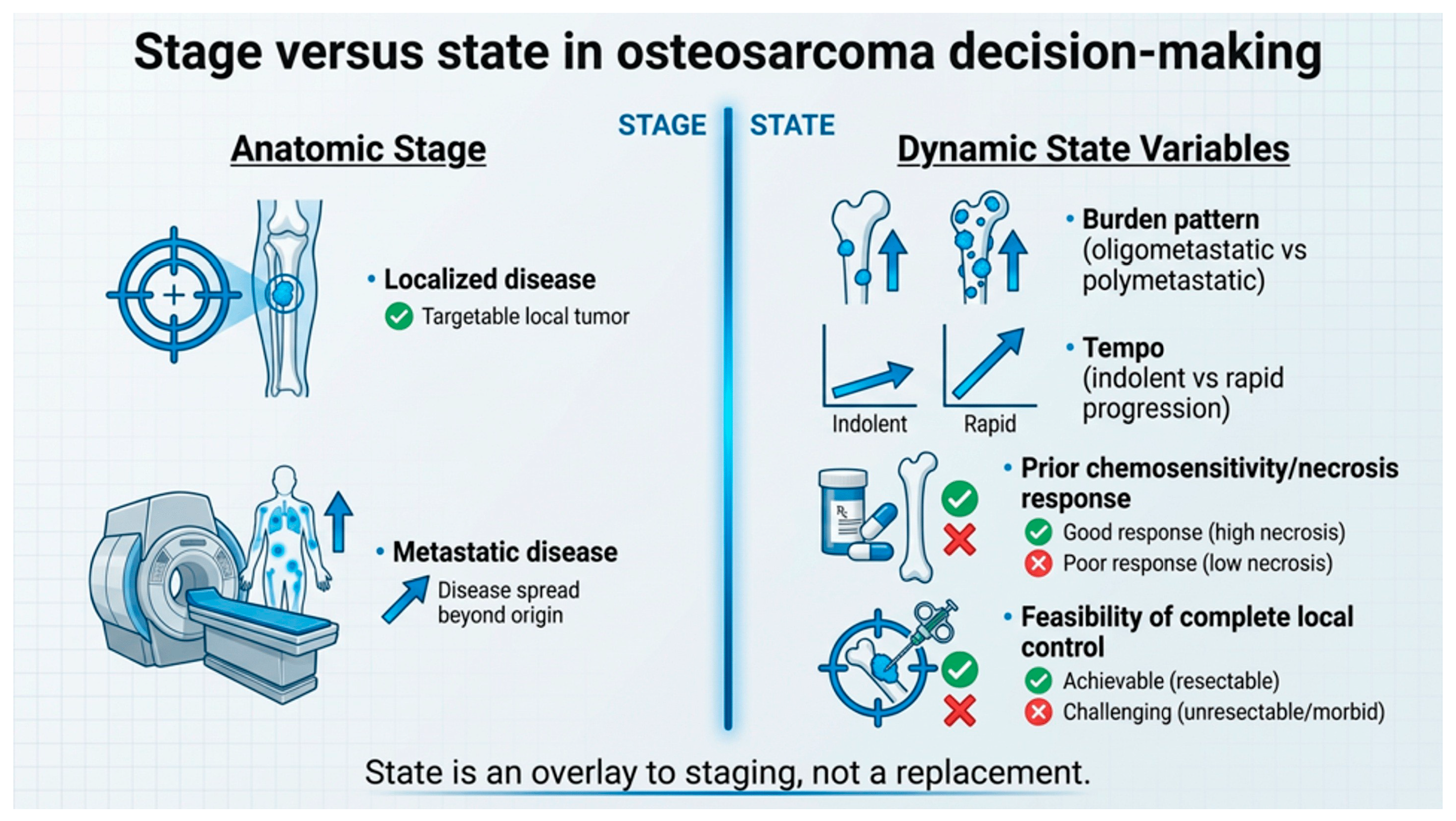
To help distinguish conventional stage-based thinking from the dynamic, strategy-oriented approach used throughout this review,
Figure 1 and
Table 1 provide a concise visual and side-by-side comparison.
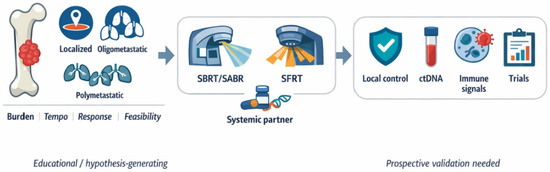
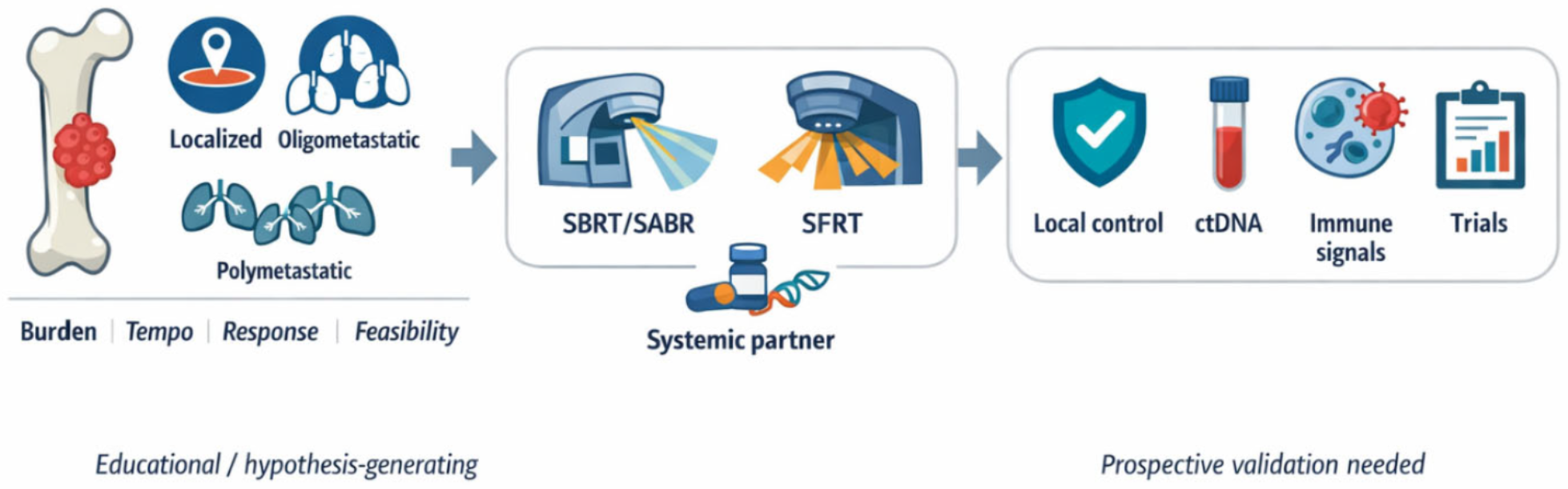
This review is intended as a narrative, educational, and hypothesis-generating synthesis of the current literature rather than as a practice guideline. Its purpose is to examine osteosarcoma through a state-based decision-making framework that integrates disease burden, tempo, prior treatment response, and feasibility of complete local control. Within that framework, the article explores how radiobiotherapy concepts may inform strategy selection and identifies areas in which prospective, biomarker-embedded clinical trials are needed. The sections that follow are therefore designed to highlight current knowledge gaps, organize the field conceptually, and suggest practical directions for future research.
2. Article Roadmap and Intended Audience
This review synthesizes osteosarcoma biology and radiobiology into a state-based framework for strategy selection and trial design. The figures and tables are intended as teaching schematics that translate biologic principles into clinically usable state variables, radiotherapy platforms, and biomarker-embedded trial concepts. Clinicians may use the framework to support multidisciplinary discussion, whereas trialists and translational researchers may use it to refine prospective study design.
3. Methods: Literature Search and Selection for This Educational Narrative Review
This manuscript is a narrative (non-systematic) educational review. The authors prioritized three categories of evidence: (1) high-quality clinical sources that define current osteosarcoma management and prognostic factors, (2) precision oncology literature characterizing osteosarcoma’s genomic architecture and heterogeneity, and (3) translational radiobiology literature relevant to SBRT/SABR, SFRT (spatially fractionated radiotherapy), immune modulation, and non-targeted effects.
Evidence was selected for conceptual relevance to an educational framework rather than for quantitative synthesis or pooled effect estimation. Targeted keyword searches (e.g., osteosarcoma, radiobiology, SBRT/SABR, precision medicine, SFRT) were supplemented by PubMed’s “similar articles” function and citation snowballing to identify additional sources. Because this review is intended to be educational and hypothesis-generating, it is not a systematic review, and the references included are not exhaustive.
A note about SBRT versus SABR nomenclature used for the purposes of this paper (terminology clarification): Stereotactic body radiotherapy (SBRT) is used as an overarching term encompassing stereotactic radiotherapy delivered with modern image guidance, motion management, and quality assurance across a range of hypofractionated dose–fractionation schemes. The term stereotactic ablative radiotherapy (SABR) is used more specifically to denote regimens employing ablative dose intensities, typically ≥600 cGy per fraction, delivered using SBRT-related techniques and quality assurance practices. This distinction is used for conceptual clarity and does not imply separate technologies, but rather differing biologic and dosimetric intents within stereotactic radiotherapy.
4. Review and Discussion
4.1. Why Mutation-Centric Precision Oncology Underperforms in Osteosarcoma—A Brief Biology Rationale
Precision oncology has transformed outcomes in several malignancies by matching recurrent driver alterations to targeted therapies, but osteosarcoma has not benefited proportionately from mutation-centric paradigms [
11,
12,
13]. Genome-informed analyses consistently show that osteosarcoma is dominated by extensive somatic copy number alterations and structural rearrangements, while recurrent actionable point mutations are relatively uncommon [
12]. This genomic architecture contributes to profound inter- and intratumoral heterogeneity and complicates single-target “drug-to-mutation” matching [
12,
14].
Recent multi-region whole-genome sequencing demonstrates that chromothripsis remains an active, ongoing process in osteosarcoma, driving genome complexity and clonal evolution [
14]. Longitudinal sequencing similarly reveals dynamic evolution during progression, including accumulation of structural variants and shifting copy number profiles [
15]. Studies of recurrent disease further show the emergence and dominance of subclonal copy number alterations and treatment-resistant clones [
16]. Reviews of precision oncology programs—including MATCH-style frameworks—highlight both the promise and the operational challenges of implementing precision approaches in osteosarcoma, given its rarity, tissue limitations, and genomic complexity [
17]. A recent open-access review also summarizes how multi-omics subtyping efforts may eventually support more refined precision strategies aligned with this heterogeneity [
18].
Together, these data support a
state-based precision model, in which strategy selection is aligned to tumor state—burden, tempo, prior response, and resectability—rather than to single molecular events [
12,
13,
14,
15,
16,
17,
18].
4.2. Where Radiobiotherapy May Fit in Osteosarcoma Care: A State-Based Framework
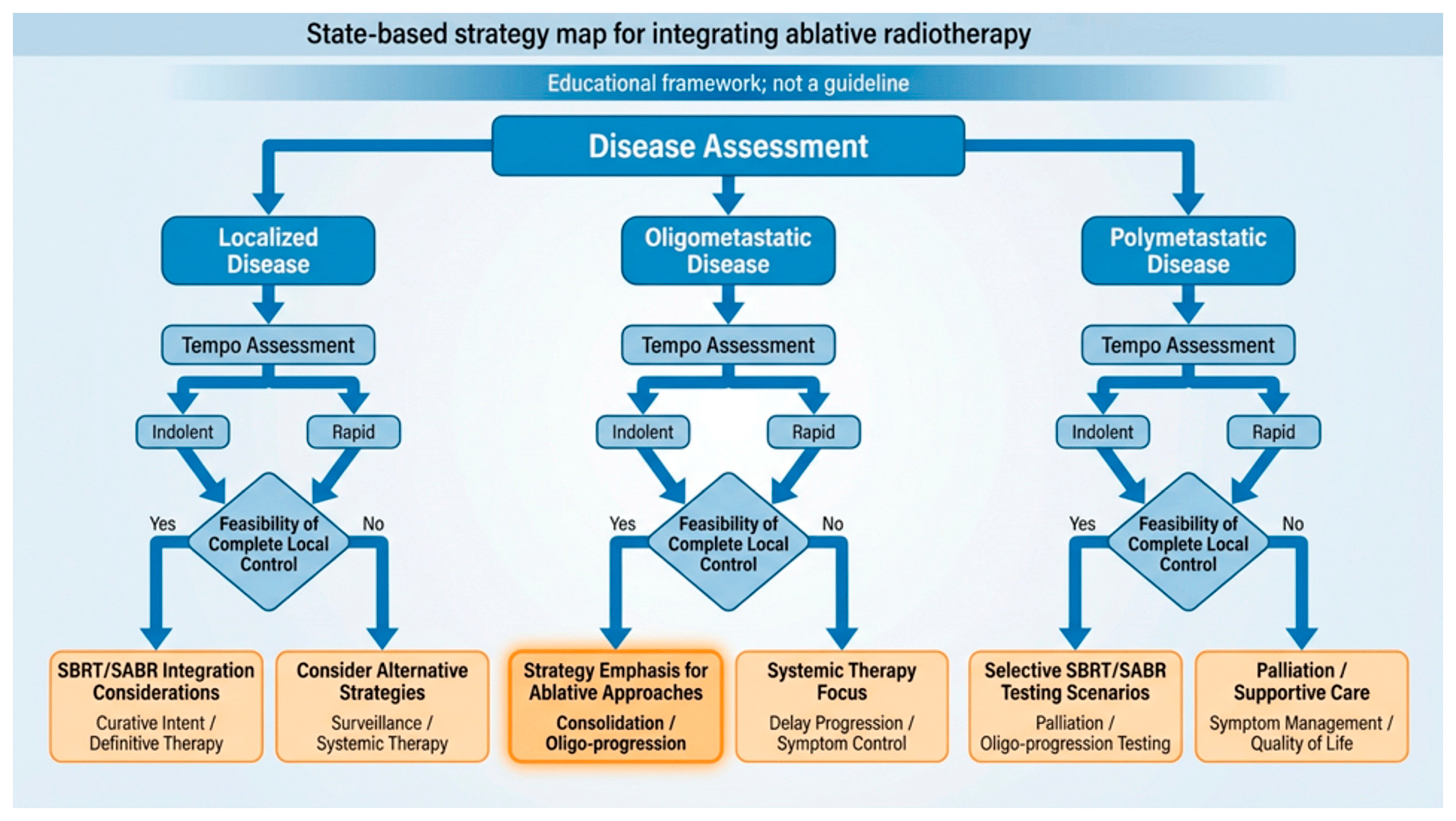
With this state-based framing in mind,
Figure 2 and
Table 2 translate these variables into a strategy map and practical phenotype table.
For lung-dominant relapse, complete surgical resection of metastases remains a key predictor of survival; retrospective analyses consistently support an association between pulmonary metastasectomy and improved outcomes in resectable osteosarcoma lung metastases [
19]. For unresectable, recurrent, or high-risk lesions, stereotactic body radiotherapy (SBRT) has been explored as a feasible local control modality in metastatic or recurrent osteosarcoma and Ewing sarcoma, though caution is warranted in settings such as re-irradiation and concurrent chemotherapy [
20]. Because osteosarcoma has historically been considered relatively radioresistant—and because high-level SBRT evidence remains limited to small series and retrospective reports—SBRT/SABR should be viewed primarily as a
local control tool for selected lesions [
9]. Any systemic or biologic effects should be treated as
secondary, testable hypotheses, not assumed benefits [
21,
22].
Osteosarcoma “state” can be operationalized using clinically tractable features such as: (a) localized vs oligometastatic vs polymetastatic burden, (b) tempo of progression, (c) prior chemotherapy response (including necrosis), and (d) feasibility of complete local control [
1,
7,
8].
In relapsed disease, prognosis is strongly influenced by relapse-free interval, metastatic burden, and the ability to achieve complete resection, supporting explicit stratification by these factors in future trials [
1,
2,
3,
9,
14,
15].
Considering these state-based “dynamic stages,”
Figure 3 and
Table 3 translate these variables into a strategy map and practical phenotype table.
4.3. Brief Applied Example: Using the State-Based Model in Practice
A practical illustration comes from our recently published case report [
9]. The patient developed pulmonary and adrenal metastases with a relatively slow tempo and limited overall burden, and the lesions were considered amenable to definitive local therapy using metastasis-directed approaches (metastasectomy and SABR, as described in the report). Classification within the state-based framework:
oligometastatic lung relapse with slow tempo and potentially fully ablatable disease.
Strategy implication: prioritize complete local control of all visible disease (metastasectomy and/or SABR to all lesions, as feasible) and treat any proposed systemic partner or sequencing choice as a testable biologic hypothesis, not an assumed benefit.
In a radiobiotherapy trial context, this state would support:
Explicit definitions for “oligometastatic” and “tempo”;
Prospective documentation of the feasibility of complete ablation;
Embedded correlative sampling (e.g., ctDNA and immune profiling) to evaluate both beneficial and potentially adverse systemic signaling (abscopal vs “badscopal”) rather than relying on anecdotal outcomes.
An interesting aspect of the case was the use of a targeted agent (cabozantinib) combined with preoperative SABR for a recurrent lesion in a challenging anatomic location. Remarkably, post-resection histopathology demonstrated
no viable tumor cells—an unusual finding in osteosarcoma, which is generally considered radioresistant to conventional radiotherapy [
9].
4.4. Radiobiotherapy: Definition and Core Concept
Radiobiotherapy describes the deliberate integration of radiotherapy with systemic biotherapies—including cytotoxic chemotherapy, targeted agents, monoclonal antibodies, and immunotherapies—based on biologic rationale rather than solely anatomic targeting [
9,
10,
11,
12,
13,
14,
15,
16,
17,
18,
19,
20,
21,
22,
23]. It is intended as a
framework for mechanism-based combination strategies and trial design, rather than a clinical practice recommendation [
23].
Within this framework, radiotherapy is used as a purposeful biologic intervention, providing both high-probability local control and a measurable perturbation of the tumor ecosystem. Combinations are defined by mechanism, schedule, and embedded biomarkers, distinguishing radiobiotherapy from routine “concurrent chemoradiation,” where chemotherapy is primarily used as a radiosensitizer without a broader biologic hypothesis.
A conceptual definition of radiobiotherapy is summarized in
Table 4.
It is intended as an illustrative outline rather than an exhaustive practice management reference. 4.5. SBRT Radiobiology: Why Dose and Fractionation Matter
Modern stereotactic techniques enable highly conformal delivery of large fraction sizes to limited volumes, creating radiobiological conditions distinct from conventional fractionation [
9,
24]. Much of the mechanistic and clinical immunology literature informing these concepts derives from melanoma, non-small cell lung cancer (NSCLC), and other more common solid tumors;
therefore, the discussion here reflects an extrapolated biologic rationale rather than osteosarcoma-specific proof.High-dose stereotactic radiotherapy can induce indirect tumor cell death mechanisms—including vascular injury and immune-associated effects—in addition to direct clonogenic cell kill [
24]. A foundational review of vascular biology highlights that doses above ~10 Gy per fraction can cause severe vascular damage in experimental tumors, with implications for SBRT/SRS/SABR and indirect tumor cell death through microenvironmental disruption [
24]. A critical perspective on SBRT radiobiology argues that, for many tumors, classic radiobiological principles (the “5 Rs”) may remain sufficient to explain excellent outcomes, while acknowledging that enhanced antitumor immunity may occur in selected contexts [
24,
25]. SBRT is widely viewed as immunomodulatory, and there is substantial interest in combining SBRT with immunotherapies to augment both local and systemic antitumor responses [
9,
23].
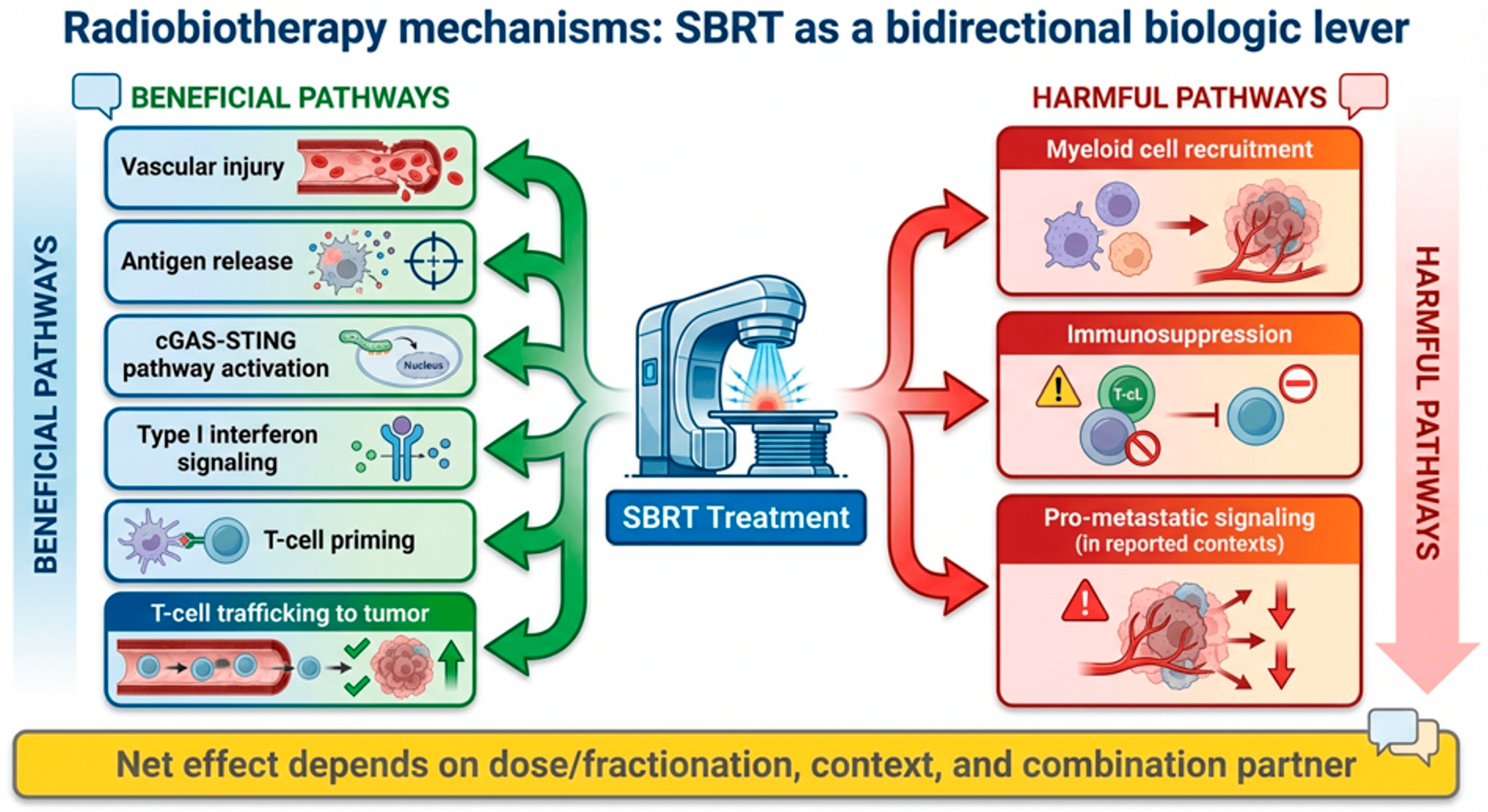
Radiotherapy (
Figure 3) can remodel inflammatory signaling and tumor microenvironment contexture through tumor cell autonomous pathways, including the activation of the cyclic GMP–AMP synthase (cGAS)–stimulator of interferon genes (STING) pathway via micronuclei—an innate immune DNA-sensing mechanism that can drive type I interferon signaling. Extracellular vesicle biology has also been incorporated into modern radiobiology frameworks, including expanded “six Rs” models that explicitly incorporate immune reactivation. Tumor-associated macrophage (TAM) polarization and reprogramming are central to tumor ecosystem behavior and may be influenced by radiotherapy, representing another mechanistic integration point [
25,
26,
27].
Table 5 summarizes key radiobiology mechanisms relevant to SBRT/SABR combinations and highlights why dose and fractionation decisions are biologically meaningful.
From a practical perspective, one question is how commonly used SABR dose/fractionation schedules may differ in their clinical tradeoffs and in their hypothesized immunologic implications.
Table 6 provides a simplified overview.
Abscopal and Non-Targeted Effects: Opportunity, Limits, and New Cautions
The abscopal effect—regression of distant, non-irradiated tumors following localized radiotherapy—has been linked to immune-mediated mechanisms, but remains uncommon in routine clinical practice [
28,
29,
30,
31,
32,
33,
34,
35,
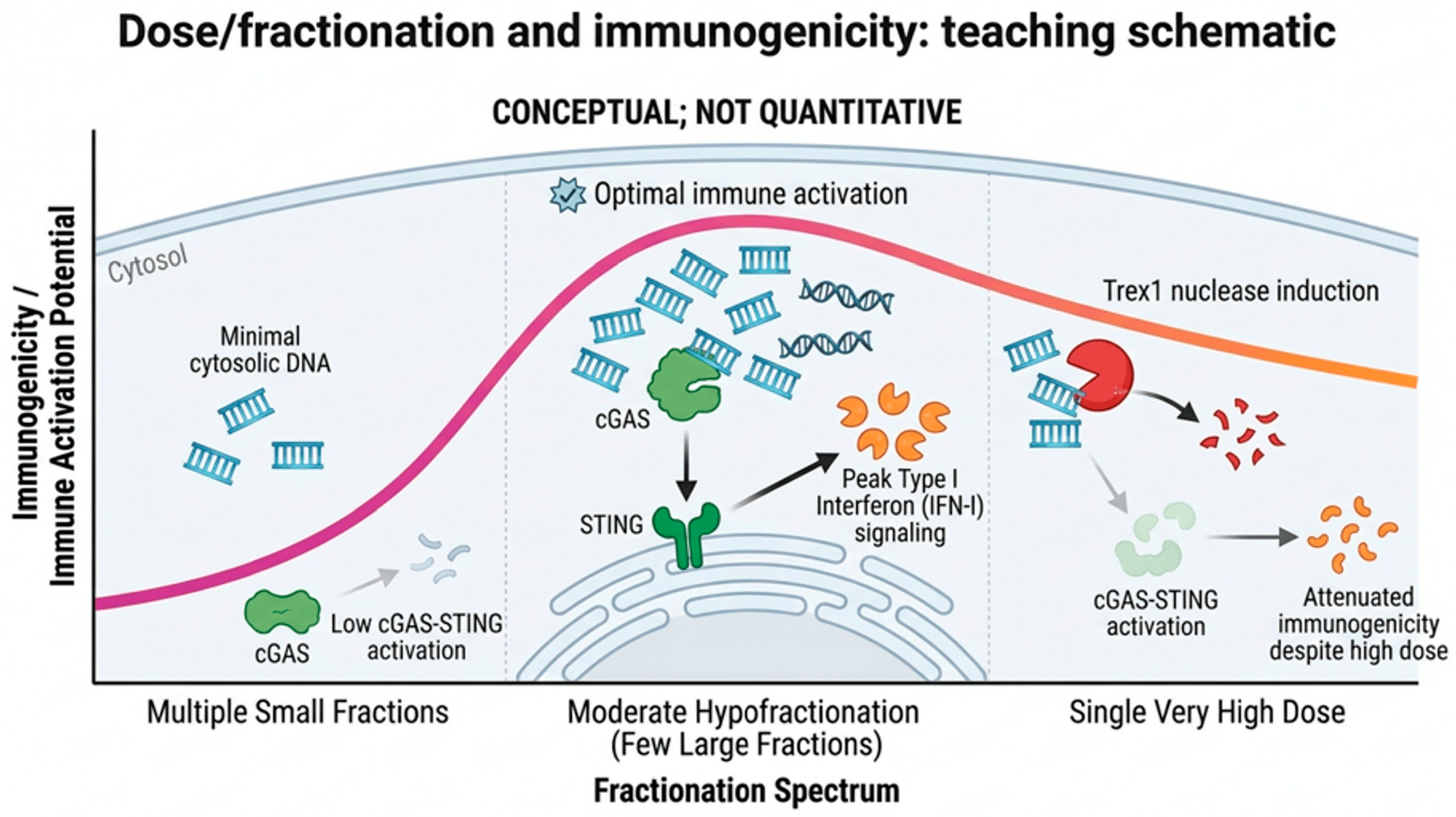
36]. Mechanistic studies demonstrate that dose and fractionation strongly influence immunogenicity; for example, induction of Trex1 at higher single-fraction doses can attenuate immune activation by degrading cytosolic DNA, underscoring the importance of fractionation when combining radiotherapy with immunotherapies [
27,
28]. Preclinical evidence further shows that
fractionated regimens, but not single-dose regimens, may be required to elicit abscopal responses when paired with immune checkpoint blockade [
27,
28,
29].
To illustrate the schedule-dependent nature of immunogenicity—and why fractionation matters—
Figure 4 presents a simplified schematic linking dose/fractionation choices to immune activation and potential attenuation pathways.
4.6. Abscopal and Non-Targeted Effects: Opportunity, Limits, and New Cautions
Clinical reports document abscopal responses in humans, including early mechanistic correlates in melanoma and a reported abscopal response in treatment refractory NSCLC treated with radiotherapy plus ipilimumab [
29,
30,
34,
35]. A landmark study demonstrated that radiation combined with dual checkpoint blockade can activate non-redundant immune mechanisms, informing rational triplet combinations in selected contexts [
31]. Reviews emphasize that radiotherapy–immunotherapy combinations may increase abscopal response rates, while also highlighting limitations, variability, and barriers to reproducibility [
32,
33,
34,
35]. A comprehensive review further delineates bystander and abscopal effects and mechanisms relevant to radiotherapy–immunotherapy integration [
33]. Contemporary clinical perspectives summarize abscopal responses in patients receiving immunotherapy and discuss emerging biomarkers and resistance mechanisms [
33,
34,
35,
36].
Importantly, emerging evidence also cautions that radiotherapy can, under certain conditions, promote distant metastatic progression. A 2025
Nature study reported that radiotherapy can induce amphiregulin expression in tumor cells, reprogramming EGFR-expressing myeloid cells toward immunosuppression and stimulating distant metastasis growth—sometimes termed a “badscopal” effect [
36]. Educationally, this underscores that radiobiotherapy is a
bidirectional biologic lever, requiring careful trial design, mechanistic counter-strategies, and biomarker evaluation rather than assumptions of net benefit [
36,
37]. Predicting the balance between beneficial versus adverse immunomodulation, measuring minimal residual disease, and adapting clinical trials to capture these dynamics remain active areas of investigation [
38,
39,
40,
41].
4.7. Spatially Fractionated Radiation Therapy (SFRT) for Bulky or Unresectable Sarcoma States: Where It May Fit
Spatially fractionated radiation therapy [
42,
43,
44,
45,
46,
47,
48,
49,
50,
51] (SFRT) encompasses techniques—historically “GRID” and more recently three-dimensional “lattice” approaches—that intentionally deliver a highly heterogeneous dose distribution within a bulky tumor, creating alternating high-dose “peaks” (vertices) and lower-dose “valleys.” SFRT has re-emerged as a practical option for very large, symptomatic, and/or unresectable tumors where uniform dose escalation is limited by normal-tissue constraints. In contemporary sarcoma series, SFRT is often delivered as an upfront high-dose spatial “boost” followed by conventional or moderately hypofractionated external beam radiotherapy (EBRT), with reported symptom relief and radiographic responses in selected patients [
42,
43,
45].
From a radiobiology perspective, SFRT is frequently framed as a form of partial-volume irradiation that may enable clinically meaningful tumor responses while improving normal-tissue tolerance. Proposed—but still incompletely validated—mechanisms include vertex-centered microvascular disruption and indirect tumor cell death, radiation-induced bystander signaling from high-dose regions into adjacent lower-dose compartments, and immune/inflammatory remodeling that may differ from uniform dose plans. Because SFRT dosimetry is inherently heterogeneous, studies increasingly report technical descriptors such as peak dose, valley dose, vertex size/spacing, and peak-to-valley dose ratio; however, these parameters are not yet standardized across trials [
43].
Within this review’s state-based framework, SFRT is most relevant to states characterized by bulky primary or locoregional disease that is unresectable or morbidity-prohibitive, where the dominant objective is symptom relief and/or achieving sufficient tumor regression to enable later surgery or other definitive local therapy. Conceptually, SFRT
complements SBRT/SABR rather than replaces it: SBRT/SABR typically treats small targets uniformly to ablative doses with steep falloff, whereas SFRT is designed for very large targets by accepting heterogeneity to respect normal-tissue constraints. Bottom line: SFRT is best presented as a
pragmatic bulky disease strategy and a research opportunity—particularly for biomarker-embedded studies of bystander and immune signaling—rather than a standardized osteosarcoma regimen [
43,
44,
45,
46,
47,
48,
49,
50,
51].
4.8. Additional Discussion: SFRT Within a Radiobiotherapy Framework (Bulky Disease, Endpoints, and Open Questions)
While SBRT/SABR is most naturally applied to small-volume targets, SFRT may be particularly useful when sarcoma burden is dominated by bulky and/or unresectable disease and uniform dose escalation would exceed normal-tissue constraints. Across contemporary lattice/GRID experiences, SFRT is commonly used as a spatial boost integrated into a broader EBRT course, with frequent reports of symptom improvement and local responses in selected cohorts (often treated with palliative intent). However, the SFRT literature remains heterogeneous in technique, prescription, and outcome reporting, and prospective comparative data are still emerging. Accordingly, in an osteosarcoma-focused educational review, SFRT is most appropriately framed as a
promising, hypothesis-generating approach that requires standardized reporting and prospective, biomarker-embedded evaluation [
43,
44,
45,
46,
47,
48,
49,
50,
51].
Mechanistically, SFRT can be viewed as an extreme form of spatial dose heterogeneity: very high-dose vertices embedded within lower-dose tumor “valleys.” Proposed biologic consequences—still incompletely validated—include vertex-centered vascular injury, gradients of inflammatory signaling, and non-targeted/bystander effects that may propagate beyond high-dose regions. These hypotheses intersect with broader radiobiotherapy themes discussed for SBRT/SABR (microenvironment remodeling, innate immune activation, and myeloid reprogramming), but SFRT may create distinct tissue states because large valley volumes remain relatively spared compared with uniform plans [
43,
47,
48,
49,
51].
SFRT is not simply “dose escalation by another name.” Its clinical and biologic behavior depends on its deliberately heterogeneous geometry and on how the SFRT boost is integrated with any external beam radiotherapy (EBRT) base dose. Across published series, key dosimetric descriptors vary substantially—including peak dose, valley dose, peak-to-valley dose ratio, vertex diameter and spacing, number and placement of vertices, and whether (and when) an EBRT “base dose” is delivered [
44]. From a practical standpoint, sarcoma targets may involve skin, subcutaneous tissues, bone, neurovascular bundles, or postoperative beds; therefore, toxicity considerations include skin breakdown, wound-healing complications (particularly when combined with preoperative radiotherapy), neuropathy, pathologic fracture risk, and cumulative dose constraints if retreatment is contemplated [
42,
43,
45,
48,
49,
50].
For osteosarcoma specifically, the most plausible SFRT use-cases align with state-based categories in which the dominant challenge is
bulky local disease—for example, axial or pelvic primaries, locally recurrent tumors, or large soft tissue components that are unresectable at presentation or require downstaging to make surgery feasible [
10,
42,
43,
45]. In these settings, SFRT can be conceptualized as either:
To maintain scientific rigor in this educational review, the most important trial design consideration is
endpoint selection. Beyond RECIST, relevant measures include patient-reported pain and function trajectories, time to local progression, conversion-to-resectability rates, wound-healing and fracture outcomes, and integration of systemic biomarkers such as circulating tumor DNA (ctDNA) as a measure of residual disease burden, and immune/myeloid signatures as indicators of systemic perturbation [
10,
39,
40,
41,
42,
43,
44,
45,
51].
4.9. Key Educational Research Questions for SFRT (Especially in Rare Tumors Such as Osteosarcoma)
At this time, several questions must be addressed in clinical research designs:
Which patient/tumor “states” benefit most? This includes clarifying whether SFRT is most effective for bulky symptomatic palliation, conversion-to-resectability, or local recurrence scenarios [
10,
42,
43,
44,
45].
What SFRT parameters should be standardized and reported? Key dosimetric descriptors—such as peak and valley doses, peak-to-valley ratio, vertex geometry, and EBRT base dose integration—require harmonization to enable comparison across trials [
43,
48,
49,
50].
How should SFRT be sequenced with surgery and systemic therapy? Optimal sequencing is essential to maximize benefit while minimizing wound-healing complications, skin toxicity, and bone-related risks [
19,
42,
45,
50].
What biomarkers best reflect response and risk, and how should they be sampled? Potential candidates include symptom endpoints, volumetric response, ctDNA dynamics, and immune/myeloid signatures, each requiring thoughtful timing and integration [
26,
39,
40,
41,
42,
45,
51].
4.10. Overall Implications for Clinical Trial Design in Osteosarcoma
Clinical trials in osteosarcoma face persistent challenges, including
rarity,
biologic heterogeneity, and
endpoints that may not capture the benefits of integrated local-systemic strategies [
3,
4,
12,
16,
17,
40,
41]. Precision radiation oncology initiatives emphasize that genomic and biologic metrics increasingly influence radiation personalization and combination logic [
11,
12,
37]. Systems pharmacology modeling has also been applied to analyze radiation plus PD(L)1 combinations and to prospectively evaluate sequences and schedules, supporting
in silico optimization approaches [
38].
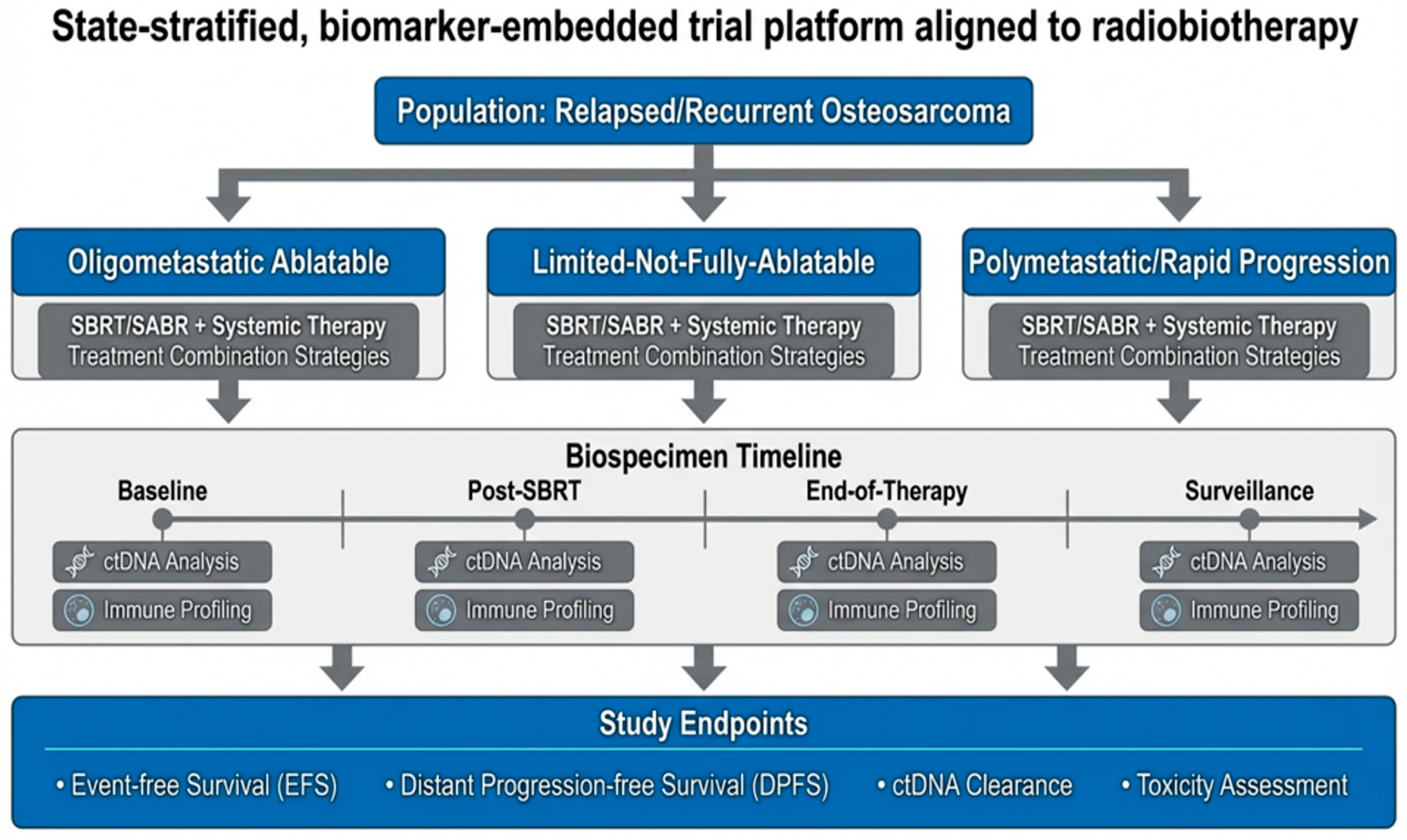
An example of platform-style trial schematic aligned with this approach is shown in
Figure 5.
Table 7 [
39,
40,
41,
42,
52,
53,
54,
55,
56,
57,
58,
59] provides example trial concepts that operationalize this framework using biomarker-embedded, state-stratified designs in oligometastatic disease-states intended to accelerate learning in a rare and heterogeneous disease.
Because immune effects depend on dose and fractionation, schedule optimization is integral to radiobiotherapy trial design [
21,
27,
28,
38]. Adaptive enrichment designs have been increasingly utilized to balance all-comers’ enrollment with biomarker-defined subpopulations, potentially improving efficiency in heterogeneous diseases [
12,
40,
41]. Biomarkers for minimal residual disease (MRD), such as circulating tumor DNA (ctDNA), have been proposed as potentially transformative for detecting residual disease and predicting relapse after definitive therapy, though implementation requires careful validation [
39,
54,
59]. Foundational work in adaptive trials supports the broader rationale for adaptive, learning-oriented strategies [
40,
41].
Taken together, the SFRT discussion above and the state-stratified trial concepts in
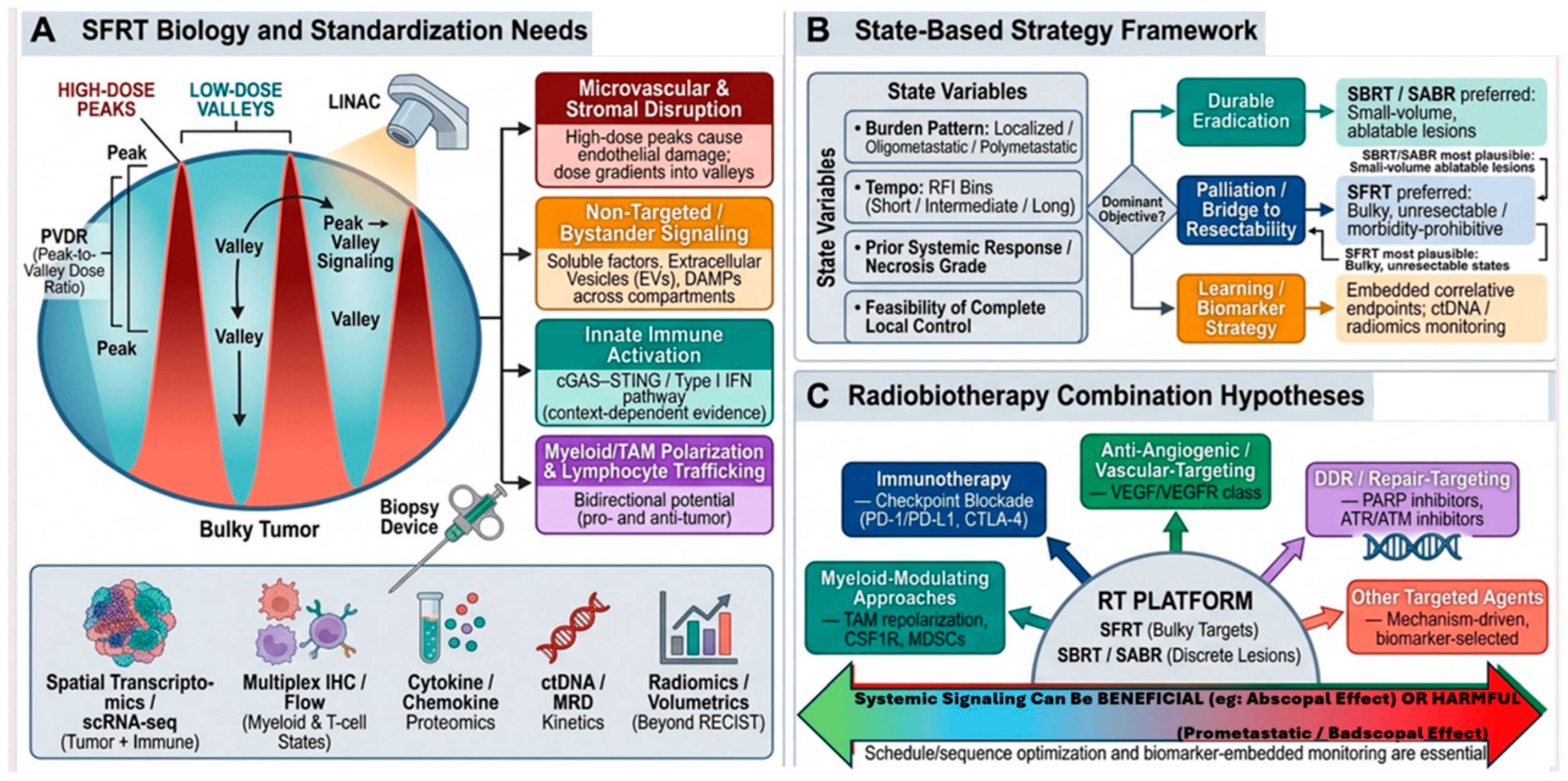
Table 7 motivate a single integrative idea for translational programs: treat spatial dose heterogeneity (SFRT/GRID/lattice) and ablative uniform dose (SBRT/SABR) as complementary radiation “platforms,” then match each platform to the patient’s state (burden, tempo, and feasibility of complete local control) and pair it with mechanism-based systemic partners while measuring multi-omics and biomarker readouts prospectively.
Figure 6 provides a conceptual schematic intended to help trainees and trial designers visualize how SFRT biology (including modern multi-omics), state-based strategy selection, and radiobiotherapy combination logic can be connected in a hypothesis-generating manner.
A second educational takeaway is that radiotherapy may be viewed not only as a local control modality but also as a dose-, fractionation-, and context-dependent biologic intervention whose systemic consequences require prospective validation.
5. Limitations
Evidence supporting radiobiotherapy concepts in osteosarcoma remains limited and is largely extrapolated from mechanistic radiobiology and broader oncology experiences, including melanoma, NSCLC, and other solid tumors [
21,
27,
28,
29,
30,
31,
32,
33,
34,
35,
36,
37,
38]. Much of the SBRT/SABR radiobiology and immuno-oncology literature is therefore not osteosarcoma-specific, in part because osteosarcoma has historically been considered relatively radioresistant and radiotherapy has played a more restricted role in standard management [
1,
3,
4,
9,
20,
21]. Similarly, the emerging SFRT (GRID/lattice) literature is predominantly sarcoma-general, often includes mixed histologies, and remains characterized by heterogeneous techniques and early phase outcome reporting, such that osteosarcoma-specific evidence is still sparse [
42,
43,
44,
45,
49,
50,
51].
Recent advances in osteosarcoma biomarker and liquid biopsy research may help refine future state-based clinical trials by improving risk stratification, minimal residual disease assessment, and longitudinal monitoring. In particular, circulating tumor DNA (ctDNA) is emerging as a promising investigational tool for relapse prediction and dynamic response assessment, although osteosarcoma-specific validation remains limited and technical challenges related to structural variation, assay standardization, and low disease burden persist. Broader liquid biopsy approaches, including circulating tumor cells, extracellular vesicles, and integrated blood-based correlatives, may eventually provide complementary biologic information, but these applications remain early and should currently be regarded as hypothesis-generating rather than trial-defining [
11,
12,
13,
14,
15,
16,
25,
39,
54,
59,
60,
61,
62,
63,
64,
65,
66,
67,
68]. These concepts are detailed in
Table 8.
Additional barriers also deserve emphasis. A related biologic hypothesis worth testing is that carefully selected SABR/SBRT schedules may enhance tumor antigen release, innate immune sensing, and subsequent immune visibility in osteosarcoma, thereby partially countering its frequently immunologically constrained or “immune-cold” microenvironment; however, this concept remains extrapolated largely from broader radiobiology and immunogenic-cell-death literature, together with limited osteosarcoma-specific clinical observation, and should not be interpreted as an established therapeutic effect [
9,
21,
24,
27,
28,
30,
65,
66,
67]. Furthermore, prospective trial development in osteosarcoma is inherently difficult because of disease rarity, biologic heterogeneity, small eligible populations within specific state-defined subsets, and the practical burden of multi-institutional biomarker collection [
3,
4,
12,
16,
17,
40,
41,
45,
68]. Cumulative toxicity also remains a major concern, particularly in patients undergoing multimodality therapy, re-irradiation, surgery, reconstruction, or treatment near weight-bearing bone and critical normal tissues. Finally, although ctDNA and other liquid biopsy approaches are promising, biomarker reproducibility remains limited by assay heterogeneity, low disease burden, variable shedding, timing of sample acquisition, and incomplete standardization across platforms [
25,
39,
48,
53,
61]. These factors reinforce the need for cautious interpretation and carefully staged prospective validation [
40,
41,
43,
68].
Taken together, the limited osteosarcoma-specific clinical evidence and the still-evolving biomarker landscape mean that the concepts outlined here should be interpreted as tools for prospective study design rather than definitive clinical guidance. Future progress will depend on improved trial structure, feasible biomarker standardization, reproducible sampling strategies, and clear separation of exploratory correlatives from validated clinical decision tools.
6. Summary
Osteosarcoma illustrates a broader challenge in modern oncology: biology and clinical behavior do not always map cleanly onto static anatomic stage or single-gene targets. This review synthesizes evidence that osteosarcoma’s copy-number/structural-variant-driven genomic architecture and heterogeneity can limit mutation-centric precision strategies, motivating a complementary state-based approach that emphasizes disease burden pattern, tempo, prior treatment response, and feasibility of complete local control.
Across cancers, an expanding radiobiology literature supports viewing radiotherapy—especially SBRT/SABR and spatially fractionated approaches—as more than a local cytotoxic modality. Dose, fractionation, and spatial distribution can reshape tumor vasculature, inflammation, innate DNA sensing (e.g., cGAS–STING), and myeloid/lymphoid programs, creating a plausible mechanistic basis for combination therapy. What remains to be defined, in osteosarcoma and beyond, is how to reliably translate these bidirectional effects into net clinical benefit.
Key unknowns include: which tumor/host states are most “actionable” by local-systemic integration; which radiation schedules and platforms best match specific biologic hypotheses; which biomarkers (ctDNA/MRD kinetics, immune/myeloid signatures, cytokine panels, radiomics/volumetrics, patient-reported outcomes) are feasible, reproducible, and predictive; and how to detect and mitigate unintended systemic consequences (including rare abscopal benefit and potential pro-metastatic signaling).
In this sense, radiobiotherapy is best regarded as an investigational, cross-disease framework for designing biomarker-embedded studies that treat radiation parameters as biologic variables—analogous to dose and schedule in systemic therapy—rather than as fixed technical details.
6.1. Relationship to Prior Work and Avoiding Duplicate Publication
The lead authors have recently published a case report describing a single patient’s clinical course and management that contributed to the conceptual development summarized in this review [
9]. They also plan to submit a more translational, research-oriented perspective paper. These manuscripts are distinct in aims, scope, and content: the current article is a
narrative educational review that synthesizes published clinical and translational literature to propose a generalizable, state-based conceptual framework for integrating ablative radiotherapy into osteosarcoma strategies.
This article does not reproduce patient-level text, images, tables, timelines, or unique clinical details from the case report. Any overlap is limited to brief, high-level background statements that are standard in the field and rewritten for the educational review context.
6.2. Key Takeaways
Osteosarcoma biology and genomic architecture often limit mutation-centric “drug-to-mutation” precision approaches; strategy selection may be more effective when aligned to
tumor state (burden, tempo, chemosensitivity, and feasibility of complete local control). SBRT/SABR can provide high local control for selected metastatic/recurrent lesions and may also act as a
biologic modifier via vascular injury and immune/inflammatory signaling.
Dose and fractionation matter for immunogenicity; schedule optimization is part of combination-therapy design, not a technical afterthought. Abscopal responses are real but uncommon; radiotherapy can also plausibly promote distant progression in certain biologic contexts, underscoring the need for
biomarker-embedded trials. Radiobiotherapy should be treated as a
testable framework requiring prospective validation, not as routine care guidance.
Appendix A and
Appendix B further expand on these ideas [
11,
12,
13,
14,
15,
16,
25,
39,
54,
59,
60,
61,
62,
63,
64,
65,
66,
67,
68,
69,
70,
71,
72].
7. Conclusions
Modern radiobiology indicates that high-dose stereotactic radiotherapy can exert vascular, inflammatory, and immune-modulating effects relevant to combination therapy; however, these effects are bidirectional and context-dependent. For osteosarcoma—where rarity and heterogeneity complicate trial design—the next step is to convert this concept into measurable, prospective programs.
For trainees and learners (students, residents, fellows), a practical action item is to adopt a shared vocabulary: state variables (burden, tempo/RFI, prior response, ablatability), radiation “platforms” (SBRT/SABR vs. SFRT), and biologic hypotheses (cGAS–STING, myeloid/TAM reprogramming, bystander/non-targeted effects). For each case, the key question becomes: what should be measured, and when? (ctDNA, immune/myeloid signatures, cytokines, patient-reported outcomes).
For clinical oncologists (surgical, radiation, and medical), a near-term action is to strengthen multidisciplinary state-based decision-making by explicitly documenting feasibility of complete local control, normal-tissue constraints, and the intended objective (eradication vs palliation vs bridge-to-resectability), and by preferentially routing eligible patients to prospective protocols.
For laboratory and translational researchers, priority actions include developing assays and models that reflect osteosarcoma’s structural-variant- and copy-number-driven heterogeneity; testing dose/fractionation and spatial heterogeneity as biologic variables; and pairing radiation exposure with mechanistic readouts (myeloid and T-cell states, interferon programs, extracellular vesicles, ctDNA kinetics) to identify both beneficial and potentially pro-metastatic signaling.
For clinical trialists, the actionable agenda is to build state-stratified, biomarker-embedded trial platforms that:
Prespecify lesion treatability and local control feasibility;
Explicitly test dose/fractionation and sequencing rather than treating them as fixed;
Use endpoints beyond short-term RECIST response (e.g., ctDNA clearance, time to new metastases, symptom/function trajectories, conversion-to-resectability);
Monitor for bidirectional systemic effects (abscopal and “badscopal”) with predefined safety and stopping rules.
The central take-home: SBRT/SABR should be viewed not only as a local control tool, but as a hypothesis-generating biologic lever whose optimal integration in osteosarcoma must be defined prospectively through coordinated clinical, translational, and trial design efforts.
More broadly, the rarity of osteosarcoma should not be viewed only as a barrier, but also as a reason for stronger cooperative clinical trial organization. Pediatric oncology has shown through highly collaborative group-based research in rare tumors such as Wilms tumor and other childhood cancers that meaningful progress is possible when large proportions of eligible patients are enrolled in shared prospective studies. Because osteosarcoma spans children, adolescents, and young adults, future progress will likely depend on similarly coordinated, multi-institutional, state-stratified, biomarker-embedded trial platforms that can convert biologic hypotheses into reproducible clinical knowledge.
8. Future Directions
Future work should investigate whether the concept of state-based decision-making can inform osteosarcoma care more broadly, beyond radiotherapy alone. In principle, this framework may help organize multidisciplinary cancer care decision-making by integrating disease burden, tempo of progression, prior treatment response, feasibility of complete local control, and evolving biologic information. However, this concept remains educational and hypothesis-generating at present, and its broader role in cancer care decision-making must be evaluated carefully in prospective clinical and translational studies.
A major next step will be the development of state-stratified, biomarker-embedded clinical trials that test not only radiotherapy platforms and dose/fractionation strategies, but also how state-based logic may guide patient selection, endpoint choice, and adaptive treatment planning across different osteosarcoma scenarios. The suggestions outlined in this review are intended to support that next phase of investigation. More broadly, if validated, this framework could contribute to a more patient-focused precision cancer care model in osteosarcoma—one that aligns treatment decisions not only with tumor biology, but also with disease behavior, feasibility of local control, and the individual clinical context.
Author Contributions
All authors have reviewed the final version to be published and agreed to be accountable for all aspects of the work. Concept and design: S.V., A.S., M.M., A.B.C., N.D., S.L., R.J.V., and V.V.; acquisition, analysis, or interpretation of data: S.V., A.S., M.M., A.B.C., N.D., Z.L., S.L., R.J.V., J.B., W.R.O., M.R.N., and V.V.; drafting of the manuscript: S.V., A.S., M.M., A.B.C., N.D., Z.L., S.L., R.J.V., J.B., W.R.O., M.R.N., and V.V.; critical review of the manuscript for important intellectual content: S.V., A.S., M.M., A.B.C., N.D., Z.L., S.L., R.J.V., J.B., W.R.O., M.R.N., and V.V.; supervision: S.V. All authors have read and agreed to the published version of the manuscript.
Funding
All authors have declared that no financial support was received from any organization for the submitted work.
Data Availability Statement
No new data were created or analyzed in this study. Data sharing is not applicable to this article.
Acknowledgments
Artificial intelligence-assisted tools, including Microsoft Copilot (used for drafting and language support; current publicly available version at the time of use) and SciSpace (used for literature navigation and summarization support; current publicly available version at the time of use), were employed in the development of selected conceptual figures, summary tables, and related educational content to enhance visualization and educational clarity. All AI-assisted outputs were generated under direct human supervision and were extensively reviewed, edited, and validated by the authors to ensure scientific accuracy, consistency with the published literature, and alignment with the educational objectives of this narrative review. These tools were not used to generate or analyze primary data, fabricate results, or replace scholarly judgment. All interpretations, conclusions, and final content remain the responsibility of the authors. No primary human or animal data were generated for this review.
Conflicts of Interest
In compliance with the ICMJE uniform disclosure form, all authors declare the following: All authors have declared that they have no financial relationships at present or within the previous three years with any organizations that might have an interest in the submitted work. All authors have declared that there are no other relationships or activities that could appear to have influenced the submitted work.
Appendix A
A concise supplementary summary of selected high-dose radiotherapy concepts worth prospective testing in osteosarcoma is provided in
Appendix A.
This appendix is intended as a focused, hypothesis-generating summary of why selected high-dose radiotherapy strategies may be worth prospective testing in osteosarcoma, including immunomodulations induced by SBRT/SABR. Current evidence is restricted to common disease such as cancers of the breast, lung, colon, prostate etc. It is deliberately restrained and emphasizes that current support is limited, largely retrospective, and insufficient for practice-changing conclusions. The purpose is to justify future biomarker-embedded phase I/II studies rather than to imply established efficacy [
21,
22,
24,
27,
28,
29,
30,
31,
32,
33,
34,
35,
36,
37,
38,
46,
47,
48,
49,
50,
51,
52,
53,
58,
59,
60,
61,
69,
70,
71,
72].
| Concept Worth Testing | Why It Is Biologically/Clinically Relevant | Current Support in Osteosarcoma | What Future Studies Should Test |
| Metastasis-directed SBRT/SABR for limited recurrent disease | Some relapsed patients have limited-volume, potentially ablatable disease in which durable local control may alter progression patterns or delay further dissemination. | Support remains limited to retrospective series, mixed sarcoma cohorts, and case-level observations, but these suggest feasibility and local control in selected lesions. | Prospective state-defined studies should evaluate lesion control, time to new metastases, ctDNA kinetics, and patient selection factors such as relapse-free interval and complete ablation feasibility. |
| High-dose radiotherapy in chemo-nonresponsive or poor necrosis states | Patients with poor response to systemic therapy represent a biologically high-risk group in whom local strategies may also serve as biologic probes in translational trials. | Evidence is preliminary and hypothesis-generating, including the authors’ recent case experience and limited published reports. | Early phase trials should test whether carefully selected high-dose regimens can improve local control and provide measurable biologic readouts without overstating systemic benefit. |
| SBRT/SABR as a biologically informative intervention | Radiotherapy dose and fractionation can influence vascular injury, inflammatory signaling, innate immune pathways, and myeloid programs, making schedule a potentially important trial variable. | Most mechanistic support is extrapolated from broader radiobiology and other cancers, not osteosarcoma-specific clinical proof. | Biomarker-embedded studies should compare schedules and measure immune/myeloid correlates, ctDNA, and toxicity to distinguish biologic hypothesis generation from proven clinical benefit. |
| SFRT for bulky or unresectable disease (see Appendix B) | Very large tumors may not be suitable for uniform ablative treatment, and SFRT may offer a pragmatic strategy for symptom relief, local regression, or bridge-to-resectability approaches. | Current support is mainly from sarcoma-general and SFRT literature, with little osteosarcoma-specific evidence. | Prospective studies should standardize peak/valley reporting, define clinical states clearly, and evaluate symptom response, wound/bone toxicity, and conversion-to-resectability. |
Appendix B
For readers seeking a concise supplementary synthesis of this pragmatic bulky disease perspective, a brief summary is provided in this appendix with a focus on SFRT.
Spatially fractionated radiation therapy (SFRT) refers to intentional intratumoral dose heterogeneity, historically associated with GRID approaches and more recently with lattice-style techniques [
42,
43,
44,
45,
46,
47,
48,
49,
50,
51,
72]. Its relevance to this review is practical rather than doctrinal: SFRT may be most useful in bulky, symptomatic, or morbidity-prohibitive disease states where uniform dose escalation is not feasible. Although proposed mechanisms include bystander signaling, vascular disruption, and immune remodeling, these remain incompletely validated and should be regarded as hypotheses to be tested prospectively rather than assumed advantages.
Most relevant use-case: bulky or unresectable disease in which the dominant goal is palliation, local regression, or bridge-to-resectability.
Key reporting variables: peak dose, valley dose, peak-to-valley relationship, vertex geometry, and integration with external beam radiotherapy.
Key cautions: heterogeneous technique, limited standardization, uncertain biologic reproducibility, and toxicity concerns including wound, skin, and bone complications.
Research priority: prospective state-based trials with standardized dosimetry, patient-reported outcomes, local control endpoints, and feasible biomarker sampling.
A review of biologically directed radiotherapy concepts for ‘state-based radiobiotherapy’ in the context of an educational framework would be incomplete without a mention of the importance of educating future generations of clinicians and researchers on evolving radiobiology, cancer biology, and radioimmunobiology [
23,
70].
References
- PDQ Pediatric Treatment Editorial Board. Osteosarcoma and Undifferentiated Pleomorphic Sarcoma of Bone Treatment (PDQ®)–Health Professional Version; National Cancer Institute: Bethesda, MD, USA, 2002. Available online: https://www.cancer.gov/types/bone/hp/osteosarcoma-treatment-pdq (accessed on 29 May 2026).
- Mirabello, L.; Troisi, R.J.; Savage, S.A. Osteosarcoma incidence and survival rates from 1973 to 2004: Data from the Surveillance, Epidemiology, and End Results Program. Cancer 2009, 115, 1531–1543. [Google Scholar] [CrossRef] [Scilit]
- Meltzer, P.S.; Helman, L.J. New horizons in the treatment of osteosarcoma. N. Engl. J. Med. 2021, 385, 2066–2076. [Google Scholar] [CrossRef] [Scilit]
- Gill, J.; Gorlick, R. Advancing therapy for osteosarcoma. Nat. Rev. Clin. Oncol. 2021, 18, 609–624. [Google Scholar] [CrossRef] [Scilit]
- Rosen, G.; Caparros, B.; Huvos, A.G.; Kosloff, C.; Nirenberg, A.; Cacavio, A.; Marcove, R.C.; Lane, J.M.; Mehta, B.; Urban, C. Preoperative chemotherapy for osteogenic sarcoma: Selection of postoperative adjuvant chemotherapy based on the response of the primary tumor to preoperative chemotherapy. Cancer 1982, 49, 1221–1230. [Google Scholar] [CrossRef] [Scilit] [PubMed]
- Souhami, R.L.; Craft, A.W.; Van der Eijken, J.W.; Nooij, M.; Spooner, D.; Bramwell, V.H.; Wierzbicki, R.; Malcolm, A.J.; Kirkpatrick, A.; Uscinska, B.M.; et al. Randomised trial of two regimens of chemotherapy in operable osteosarcoma: A study of the European Osteosarcoma Intergroup. Lancet 1997, 350, 911–917. [Google Scholar] [CrossRef] [Scilit] [PubMed]
- Bacci, G.; Mercuri, M.; Longhi, A.; Ferrari, S.; Bertoni, F.; Versari, M.; Picci, P. Grade of chemotherapy-induced necrosis as a predictor of local and systemic control in 881 patients with non-metastatic osteosarcoma of the extremities treated with neoadjuvant chemotherapy in a single institution. Eur. J. Cancer 2005, 41, 2079–2085. [Google Scholar] [CrossRef] [Scilit]
- Marina, N.M.; Smeland, S.; Bielack, S.S.; Bernstein, M.; Jovic, G.; Krailo, M.D.; Hook, J.M.; Arndt, C.; van den Berg, H.; Brennan, B.; et al. Comparison of MAPIE versus MAP in patients with a poor response to preoperative chemotherapy for newly diagnosed high-grade osteosarcoma (EURAMOS-1): An open-label, international, randomised controlled trial. Lancet Oncol. 2016, 17, 1396–1408. [Google Scholar] [CrossRef] [Scilit]
- Orr, W.S.; Vijayakumar, S.; Al Hmada, Y.; Mobit, P.; Collier, A.B.; Barr, J.; De Delva, P.E.; Davis, D.B.; Yang, C.C.; Nittala, R.; et al. Chemo-Nonresponsive Telangiectatic Osteosarcoma with Oligometastatic Recurrence Managed with Multimodality Therapy Including Stereotactic Ablative Body Radiotherapy (SABR): A Case Report with a Pathologic Treatment Effect. Cureus 2026, 18, e106242. [Google Scholar] [CrossRef] [Scilit]
- Danese, M.D.; Groundland, J.S. Effect of chemotherapy and surgery timing on mortality in upper and lower extremity osteosarcoma. JNCI J. Natl. Cancer Inst. 2024, 117, 611–618. [Google Scholar] [CrossRef] [Scilit]
- Sayles, L.C.; Breese, M.R.; Koehne, A.L.; Leung, S.G.; Lee, A.G.; Liu, H.Y.; Spillinger, A.; Shah, A.T.; Tanasa, B.; Straessler, K.; et al. Genome-Informed Targeted Therapy for Osteosarcoma. Cancer Discov. 2019, 9, 46–63. [Google Scholar] [CrossRef] [Scilit] [PubMed]
- Tirtei, E.; Campello, A.; Asaftei, S.D.; Mareschi, K.; Cereda, M.; Fagioli, F. Precision Medicine in Osteosarcoma: MATCH Trial and Beyond. Cells 2021, 10, 281. [Google Scholar] [CrossRef] [Scilit] [PubMed]
- Espejo Valle-Inclan, J.; De Noon, S.; Trevers, K.; Elrick, H.; van Belzen, I.A.; Zumalave, S.; Sauer, C.M.; Tanguy, M.; Butters, T.; Muyas, F.; et al. Ongoing chromothripsis underpins osteosarcoma genome complexity and clonal evolution. Cell 2025, 188, 352–370.e22. [Google Scholar] [CrossRef] [Scilit]
- Meijer, D.M.; Ruano, D.; Briaire-de Bruijn, I.H.; Wijers-Koster, P.M.; van de Sande, M.A.J.; Gelderblom, H.; Cleton-Jansen, A.; de Miranda, N.F.C.C.; Kuijjer, M.L.; Bovée, J.V.M.G.; et al. The Variable Genomic Landscape During Osteosarcoma Progression: Insights from a Longitudinal WGS Analysis. Genes Chromosomes Cancer 2024, 63, e23253. [Google Scholar] [CrossRef] [Scilit]
- Kinnaman, M.D.; Zaccaria, S.; Makohon-Moore, A.; Arnold, B.; Levine, M.F.; Gundem, G.; Arango Ossa, J.E.; Glodzik, D.; Rodríguez-Sánchez, M.I.; Bouvier, N.; et al. Subclonal Somatic Copy-Number Alterations Emerge and Dominate in Recurrent Osteosarcoma. Cancer Res. 2023, 83, 3796–3812. [Google Scholar] [CrossRef] [Scilit]
- Xu, Y.; Bai, Y.; Yang, F.; Yang, B.; Huang, Z.; Su, L.; Peng, K. Decoding osteosarcoma from heterogeneity to precision therapy. Discov. Oncol. 2026, 17, 192. [Google Scholar] [CrossRef] [Scilit]
- Rubio-San-Simón, A.; Wilson, W.; Sironi, G.; le Deley, M.C.; Palmerini, E.; Gaspar, N.; Piperno-Neumann, S.; Hecker-Nolting, S.; Strauss, S.; van Ewijk, R.; et al. Prognostic factors in patients with relapsed high-grade osteosarcoma: A systematic review. Br. J. Cancer 2025, 133, 1020–1028. [Google Scholar] [CrossRef] [Scilit]
- Bojic, L.; Peric, M.; Karanovic, J.; Milosevic, E.; Kovacevic Grujicic, N.; Milivojevic, M. Exploratory Analysis of Molecular Subtypes in Early-Stage Osteosarcoma: Identifying Resistance and Optimizing Therapy. Cancers 2025, 17, 1677. [Google Scholar] [CrossRef] [Scilit]
- Salah, S.; Fayoumi, S.; Alibraheem, A.; Massad, E.; Abdel Jalil, R.; Yaser, S.; Albadainah, F.; Albaba, H.; Maakoseh, M. The influence of pulmonary metastasectomy on survival in osteosarcoma and soft-tissue sarcomas: A retrospective analysis of survival outcomes, hospitalizations and requirements of home oxygen therapy. Interact. Cardiovasc. Thorac. Surg. 2013, 17, 296–302. [Google Scholar] [CrossRef] [Scilit]
- Brown, L.C.; Lester, R.A.; Grams, M.P.; Haddock, M.G.; Olivier, K.R.; Arndt, C.A.S.; Rose, P.S.; Laack, N.N. Stereotactic Body Radiotherapy for Metastatic and Recurrent Ewing Sarcoma and Osteosarcoma. Sarcoma 2014, 2014, 418270. [Google Scholar] [CrossRef] [Scilit]
- Marciscano, A.E.; Haimovitz-Friedman, A.; Lee, P.; Tran, P.T.; Tomé, W.A.; Guha, C.; (Spring) Kong, F.M.; Sahgal, A.; El Naqa, I.; Rimner, A.; et al. Immunomodulatory Effects of Stereotactic Body Radiation Therapy: Preclinical Insights and Clinical Opportunities. Int. J. Radiat. Oncol. 2021, 110, 35–52. [Google Scholar] [CrossRef] [Scilit] [PubMed]
- Park, H.J.; Griffin, R.J.; Hui, S.; Levitt, S.H.; Song, C.W. Radiation-Induced Vascular Damage in Tumors: Implications of Vascular Damage in Ablative Hypofractionated Radiotherapy (SBRT and SRS). Radiat. Res. 2012, 177, 311–327. [Google Scholar] [CrossRef] [Scilit]
- Joseph, S.A.; Vijayakumar, S. Radiobiotherapy and Radiobiomedicine—Two Novel Paradigms in Radiation Medicine. Int. J. Radiat. Oncol. 2020, 108, 326–327. [Google Scholar] [CrossRef] [Scilit]
- McLaughlin, M.; Patin, E.C.; Pedersen, M.; Wilkins, A.; Dillon, M.T.; Melcher, A.A.; Harrington, K.J. Inflammatory microenvironment remodelling by tumour cells after radiotherapy. Nat. Rev. Cancer 2020, 20, 203–217. [Google Scholar] [CrossRef] [Scilit]
- Ripoll-Viladomiu, I.; Prina-Mello, A.; Movia, D.; Marignol, L. Extracellular vesicles and the “six Rs” in radiotherapy. Cancer Treat. Rev. 2024, 129, 102799. [Google Scholar] [CrossRef] [Scilit]
- Genard, G.; Lucas, S.; Michiels, C. Reprogramming of Tumor-Associated Macrophages with Anticancer Therapies: Radiotherapy versus Chemo- and Immunotherapies. Front. Immunol. 2017, 8, 828. [Google Scholar] [CrossRef] [Scilit]
- Vanpouille-Box, C.; Alard, A.; Aryankalayil, M.J.; Sarfraz, Y.; Diamond, J.M.; Schneider, R.J.; Inghirami, G.; Coleman, C.N.; Formenti, S.C.; Demaria, S.; et al. DNA exonuclease Trex1 regulates radiotherapy-induced tumour immunogenicity. Nat. Commun. 2017, 8, 15618. [Google Scholar] [CrossRef] [Scilit] [PubMed]
- Dewan, M.Z.; Galloway, A.E.; Kawashima, N.; Dewyngaert, J.K.; Babb, J.S.; Formenti, S.C.; Demaria, S. Fractionated but Not Single-Dose Radiotherapy Induces an Immune-Mediated Abscopal Effect when Combined with Anti–CTLA-4 Antibody. Clin. Cancer Res. 2009, 15, 5379–5388. [Google Scholar] [CrossRef] [Scilit] [PubMed]
- Postow, M.A.; Callahan, M.K.; Barker, C.A.; Yamada, Y.; Yuan, J.; Kitano, S.; Mu, Z.; Rasalan, T.; Adamow, M.; Ritter, E.; et al. Immunologic Correlates of the Abscopal Effect in a Patient with Melanoma. N. Engl. J. Med. 2012, 366, 925–931. [Google Scholar] [CrossRef] [Scilit] [PubMed]
- Golden, E.B.; Demaria, S.; Schiff, P.B.; Chachoua, A.; Formenti, S.C. An Abscopal Response to Radiation and Ipilimumab in a Patient with Metastatic Non–Small Cell Lung Cancer. Cancer Immunol. Res. 2013, 1, 365–372. [Google Scholar] [CrossRef] [Scilit]
- Twyman-Saint Victor, C.; Rech, A.J.; Maity, A.; Rengan, R.; Pauken, K.E.; Stelekati, E.; Benci, J.L.; Xu, B.; Dada, H.; Odorizzi, P.M.; et al. Radiation and dual checkpoint blockade activate non-redundant immune mechanisms in cancer. Nature 2015, 520, 373–377. [Google Scholar] [CrossRef] [Scilit]
- Ngwa, W.; Irabor, O.C.; Schoenfeld, J.D.; Hesser, J.; Demaria, S.; Formenti, S.C. Using immunotherapy to boost the abscopal effect. Nat. Rev. Cancer 2018, 18, 313–322. [Google Scholar] [CrossRef] [Scilit]
- Daguenet, E.; Louati, S.; Wozny, A.S.; Vial, N.; Gras, M.; Guy, J.B.; Vallard, A.; Rodriguez-Lafrasse, C.; Magné, N. Radiation-induced bystander and abscopal effects: Important lessons from preclinical models. Br. J. Cancer 2020, 123, 339–348. [Google Scholar] [CrossRef] [Scilit] [PubMed]
- Nelson, B.E.; Adashek, J.J.; Lin, S.H.; Subbiah, V. The abscopal effect in patients with cancer receiving immunotherapy. Med 2023, 4, 233–244. [Google Scholar] [CrossRef] [Scilit] [PubMed]
- Wang, X.; Zhang, H.; XinZhang Liu, Y. Abscopal effect: From a rare phenomenon to a new frontier in cancer therapy. Biomark. Res. 2024, 12, 98. [Google Scholar] [CrossRef] [Scilit] [PubMed]
- Piffkó, A.; Yang, K.; Panda, A.; Heide, J.; Tesak, K.; Wen, C.; Zawieracz, K.; Wang, L.; Naccasha, E.Z.; Bugno, J.; et al. Radiation-induced amphiregulin drives tumour metastasis. Nature 2025, 643, 810–819. [Google Scholar] [CrossRef] [Scilit]
- Hall, W.A.; Bergom, C.; Thompson, R.F.; Baschnagel, A.M.; Vijayakumar, S.; Willers, H.; Li, X.A.; Schultz, C.J.; Wilson, G.D.; West, C.M.; et al. Precision Oncology and Genomically Guided Radiation Therapy: A Report from the American Society for Radiation Oncology/American Association of Physicists in Medicine/National Cancer Institute Precision Medicine Conference. Int. J. Radiat. Oncol. Biol. Phys. 2018, 101, 274–284. [Google Scholar] [CrossRef] [Scilit]
- Kosinsky, Y.; Dovedi, S.J.; Peskov, K.; Voronova, V.; Chu, L.; Tomkinson, H.; Al-Huniti, N.; Stanski, D.R.; Helmlinger, G. Radiation and PD-(L)1 treatment combinations: Immune response and dose optimization via a predictive systems model. J. ImmunoTher. Cancer 2018, 6, 17. [Google Scholar] [CrossRef] [Scilit]
- Moding, E.J.; Nabet, B.Y.; Alizadeh, A.A.; Diehn, M. Detecting Liquid Remnants of Solid Tumors: Circulating Tumor DNA Minimal Residual Disease. Cancer Discov. 2021, 11, 2968–2986. [Google Scholar] [CrossRef] [Scilit]
- Tu, Y.; Renfro, L.A. Latest Developments in “Adaptive Enrichment” Clinical Trial Designs in Oncology. Ther. Innov. Regul. Sci. 2024, 58, 1201–1213. [Google Scholar] [CrossRef] [Scilit]
- Coffey, C.S.; Kairalla, J.A. Adaptive Clinical Trials. Drugs R D 2008, 9, 229–242. [Google Scholar] [CrossRef] [Scilit]
- Ahmed, S.K.; Petersen, I.A.; Grams, M.P.; Finley, R.R.; Haddock, M.G.; Owen, D. Spatially Fractionated Radiation Therapy in Sarcomas: A Large Single-Institution Experience. Adv. Radiat. Oncol. 2024, 9, 101401. [Google Scholar] [CrossRef] [Scilit]
- Prezado, Y.; Grams, M.; Jouglar, E.; Martínez-Rovira, I.; Ortiz, R.; Seco, J.; Chang, S. Spatially fractionated radiation therapy: A critical review on current status of clinical and preclinical studies and knowledge gaps. Phys. Med. Biol. 2024, 69, 10TR02. [Google Scholar] [CrossRef] [Scilit]
- Shang, P.; Li, M.; Zhang, X.; Zhu, D.; Yue, J. Spatially fractionated radiotherapy versus conventional radiotherapy in the treatment of soft tissue sarcoma: A multicenter, prospective, phase II, randomized controlled clinical trial protocol. Precis. Radiat. Oncol. 2026, 10, 59–64. [Google Scholar] [CrossRef] [Scilit]
- Yanagihara, T.; Rankine, L.; Chang, S.; Casey, D.; Pisanie, L.D.; Dodd, L.; Esther, R.; Kowalczyk, C.; Lee, Y.; Mody, P.; et al. Spatially Fractionated Radiotherapy Followed by Pre-Operative Radiotherapy for Resectable Soft Tissue Sarcoma: Interim Safety Results of a Prospective Trial. Int. J. Radiat. Oncol. Biol. Phys. 2025, 123, e124–e125. [Google Scholar] [CrossRef] [Scilit]
- Laissue, J.A.; Blattmann, H.; Slatkin, D.N. Alban Köhler (1874–1947): Erfinder der Gittertherapie. Z. Med. Phys. 2012, 22, 90–99. [Google Scholar] [CrossRef] [Scilit] [PubMed]
- Yan, W.; Khan, M.K.; Wu, X.; Simone, C.B.; Fan, J.; Gressen, E.; Zhang, X.; Limoli, C.L.; Bahig, H.; Tubin, S.; et al. Spatially fractionated radiation therapy: History, present and the future. Clin. Transl. Radiat. Oncol. 2020, 20, 30–38. [Google Scholar] [CrossRef] [Scilit] [PubMed]
- Billena, C.; Khan, A.J. A Current Review of Spatial Fractionation: Back to the Future? Int. J. Radiat. Oncol. Biol. Phys. 2019, 104, 177–187. [Google Scholar] [CrossRef] [Scilit]
- Li, H.; Mayr, N.A.; Griffin, R.J.; Zhang, H.; Pokhrel, D.; Grams, M.; Penagaricano, J.; Chang, S.; Spraker, M.B.; Kavanaugh, J.; et al. Overview and Recommendations for Prospective Multi-institutional Spatially Fractionated Radiation Therapy Clinical Trials. Int. J. Radiat. Oncol. 2024, 119, 737–749. [Google Scholar] [CrossRef] [Scilit]
- Grams, M.P.; Deufel, C.L.; Kavanaugh, J.A.; Corbin, K.S.; Ahmed, S.K.; Haddock, M.G.; Lester, S.C.; Ma, D.J.; Petersen, I.A.; Finley, R.R.; et al. Clinical aspects of spatially fractionated radiation therapy treatments. Phys. Med. 2023, 111, 102616. [Google Scholar] [CrossRef] [Scilit]
- Lukas, L.; Zhang, H.; Cheng, K.; Epstein, A. Immune Priming with Spatially Fractionated Radiation Therapy. Curr. Oncol. Rep. 2023, 25, 1483–1496. [Google Scholar] [CrossRef] [Scilit]
- Hektoen, H.H.; Tsuruda, K.M.; Fjellbirkeland, L.; Nilssen, Y.; Brustugun, O.T.; Andreassen, B.K. Real-world evidence for pembrolizumab in non-small cell lung cancer: A nationwide cohort study. Br. J. Cancer 2024, 132, 93–102. [Google Scholar] [CrossRef] [Scilit]
- Tsai, C.J.; Yang, J.T.; Shaverdian, N.; Patel, J.; Shepherd, A.F.; Eng, J.; Guttmann, D.; Yeh, R.; Gelblum, D.Y.; Namakydoust, A.; et al. Standard-of-care systemic therapy with or without stereotactic body radiotherapy in patients with oligoprogressive breast cancer or non-small-cell lung cancer (Consolidative Use of Radiotherapy to Block [CURB] oligoprogression): An open-label, randomised, controlled, phase 2 study. Lancet 2024, 403, 171–182. [Google Scholar] [CrossRef] [Scilit]
- Normanno, N.; Morabito, A.; Rachiglio, A.M.; Sforza, V.; Landi, L.; Bria, E.; Delmonte, A.; Cappuzzo, F.; De Luca, A. Circulating tumour DNA in early stage and locally advanced NSCLC: Ready for clinical implementation? Nat. Rev. Clin. Oncol. 2025, 22, 215–231. [Google Scholar] [CrossRef] [Scilit] [PubMed]
- Milano, M.; Valenza, C.; Ferrari, A.; Gandini, S.; Trapani, D.; Santoro, C.; Battaiotto, E.; Carnevale Schianca, A.; Giordano, E.; Katrini, J.; et al. Metastasis-directed stereotactic radiotherapy and systemic treatment continuation for patients with oligoprogressive metastatic breast cancer. Eur. J. Cancer 2025, 215, 115164. [Google Scholar] [CrossRef] [Scilit]
- Tang, C.; Sherry, A.D.; Haymaker, C.; Bathala, T.; Liu, S.; Fellman, B.; Cohen, L.; Aparicio, A.; Zurita, A.J.; Reuben, A.; et al. Addition of Metastasis-Directed Therapy to Intermittent Hormone Therapy for Oligometastatic Prostate Cancer. JAMA Oncol. 2023, 9, 825–834. [Google Scholar] [CrossRef] [Scilit] [PubMed]
- Sherry, A.D.; Siddiqui, B.A.; Haymaker, C.; Bhatt, M.; Zhao, L.; Goldberg, S.; Chiou, S.H.; Corn, P.; Aparicio, A.; Zurita, A.J.; et al. Continuous androgen deprivation therapy with or without metastasis-directed therapy for oligometastatic prostate cancer: The multicenter phase 2 randomized EXTEND trial. Eur. Urol. 2025, 88, 496–509. [Google Scholar] [CrossRef] [Scilit] [PubMed]
- Lukovic, J.; Dawson, L.A. Stereotactic body radiation therapy for colorectal cancer liver metastases. J. Gastrointest. Oncol. 2024, 15, 1917–1925. [Google Scholar] [CrossRef] [Scilit]
- Zheng, J.; Qin, C.; Wang, Q.; Tian, D.; Chen, Z. Circulating tumour DNA-Based molecular residual disease detection in resectable cancers: A systematic review and meta-analysis. eBioMedicine 2024, 103, 105109. [Google Scholar] [CrossRef] [Scilit]
- Audinot, B.; Drubay, D.; Gaspar, N.; Corradini, N.; Marec-Berard, P.; Pacquement, H.; Piperno-Neumann, S.; Tabone, M.D.; Taque, S.; Vassal, G.; et al. ctDNA quantification improves estimation of outcomes in patients with high-grade osteosarcoma: A translational study from the OS2006 trial. Ann. Oncol. 2024, 35, 559–568. [Google Scholar] [CrossRef] [Scilit]
- Kwan, E.M.; Ng, S.W.S.; Tolmeijer, S.H.; Emmett, L.; Sandhu, S.; Buteau, J.P.; Iravani, A.; Joshua, A.M.; Francis, R.J.; Subhash, V.; et al. Lutetium-177–PSMA-617 or cabazitaxel in metastatic prostate cancer: Circulating tumor DNA analysis of the randomized phase 2 TheraP trial. Nat. Med. 2025, 31, 2722–2736. [Google Scholar] [CrossRef] [Scilit]
- Jiang, W.; Chan, C.K.; Weissman, I.L.; Kim, B.Y.; Hahn, S.M. Immune Priming of the Tumor Microenvironment by Radiation. Trends Cancer 2016, 2, 638–645. [Google Scholar] [CrossRef] [Scilit]
- Vaes, R.D.W.; Hendriks, L.E.L.; Vooijs, M.; De Ruysscher, D. Biomarkers of radiotherapy-induced immunogenic cell death. Cells 2021, 10, 930. [Google Scholar] [CrossRef] [Scilit] [PubMed]
- Fucikova, J.; Kepp, O.; Kasikova, L.; Petroni, G.; Yamazaki, T.; Liu, P.; Zhao, L.; Spisek, R.; Kroemer, G.; Galluzzi, L.; et al. Detection of immunogenic cell death and its relevance for cancer therapy. Cell Death Dis. 2020, 11, 1013. [Google Scholar] [CrossRef] [Scilit] [PubMed]
- Fu, Y.; Xu, Y.; Liu, W.; Zhang, J.; Wang, F.; Jian, Q.; Huang, G.; Zou, C.; Xie, X.; Kim, A.H.; et al. Tumor-informed deep sequencing of ctDNA detects minimal residual disease and predicts relapse in osteosarcoma. eClinicalMedicine 2024, 73, 102697. [Google Scholar] [CrossRef] [Scilit]
- Yamazaki, T.; Vanpouille-Box, C.; Demaria, S.; Galluzzi, L. Immunogenic Cell Death Driven by Radiation—Impact on the Tumor Microenvironment. In Cancer Treatment and Research; Springer Nature: Berlin, Germany, 2020; pp. 281–296. [Google Scholar] [CrossRef] [Scilit]
- Hernández, Á.P.; Juanes-Velasco, P.; Landeira-Viñuela, A.; Bareke, H.; Montalvillo, E.; Góngora, R.; Fuentes, M. Restoring the Immunity in the Tumor Microenvironment: Insights into Immunogenic Cell Death in Onco-Therapies. Cancers 2021, 13, 2821. [Google Scholar] [CrossRef] [Scilit]
- Massaccesi, M.; Boldrini, L.; Romano, A.; Rossi, E.; Schinzari, G.; Lepre, E.; Gambacorta, M.A.; Valentini, V. Unconventional Radiotherapy to Enhance Immunotherapy Efficacy in Bulky Tumors: A Case Report. Immunotherapy 2021, 13, 1457–1463. [Google Scholar] [CrossRef] [Scilit]
- Vijayakumar, S.; King, M.; Nittala, M.R.; Duhe, R.J. Do we need a new approach to cancer biology education for radiation oncology residents? Cureus 2021, 13, e20662. [Google Scholar] [CrossRef] [Scilit]
- Demaria, S.; Golden, E.B.; Formenti, S.C. Role of local radiation therapy in cancer immunotherapy. JAMA Oncol. 2015, 1, 1325–1332. [Google Scholar] [CrossRef] [Scilit]
- Golden, E.B.; Marciscano, A.E.; Formenti, S.C. Radiation therapy and the in situ vaccination approach. Int. J. Radiat. Oncol. Biol. Phys. 2020, 108, 891–898. [Google Scholar] [CrossRef] [Scilit]
- Wang, K.; Sabouri, P.; Wolfe, A.; Siegel, E.; Marrufo, J.; Cothran, C.; McClain, P.; Lewis, G.; Penagaricano, J.; Griffin, R.J.; et al. Grid Spatially Fractionated Radiation Therapy for Bulky Tumors: A Large Single Institution Experience. Int. J. Radiat. Oncol. Biol. Phys. 2026, 124, 147–158. [Google Scholar] [CrossRef] [Scilit]
Figure 1.
Stage-based versus state-based frameworks in osteosarcoma. This figure contrasts anatomic staging (e.g., localized vs metastatic disease) with a state-based framework that adds clinically actionable, time-varying features such as disease burden pattern (localized/oligometastatic/polymetastatic), tempo of progression, prior treatment response (including necrosis), and feasibility of complete local control. The goal is to support strategy selection and trial stratification rather than to replace standard staging systems.
Figure 1.
Stage-based versus state-based frameworks in osteosarcoma. This figure contrasts anatomic staging (e.g., localized vs metastatic disease) with a state-based framework that adds clinically actionable, time-varying features such as disease burden pattern (localized/oligometastatic/polymetastatic), tempo of progression, prior treatment response (including necrosis), and feasibility of complete local control. The goal is to support strategy selection and trial stratification rather than to replace standard staging systems.
Figure 2.
State-based osteosarcoma strategy map. Clinically tractable state variables (burden, tempo, prior systemic response, and feasibility of complete local control) can be used to frame multimodality strategy selection and to identify settings in which ablative radiotherapy (e.g., SBRT/SABR) may be tested as part of biomarker-embedded trials. The figure is intended to support trial design thinking rather than serve as a clinical practice guide.
Figure 2.
State-based osteosarcoma strategy map. Clinically tractable state variables (burden, tempo, prior systemic response, and feasibility of complete local control) can be used to frame multimodality strategy selection and to identify settings in which ablative radiotherapy (e.g., SBRT/SABR) may be tested as part of biomarker-embedded trials. The figure is intended to support trial design thinking rather than serve as a clinical practice guide.
Figure 3.
Radiobiotherapy concept—SBRT/SABR as a bidirectional biologic lever. Beyond direct tumor cell kill, ablative radiotherapy can remodel the tumor microenvironment through vascular injury and immune/inflammatory signaling. These effects may support systemic tumor control in some contexts (abscopal responses) but may also promote immunosuppression or pro-metastatic signaling under certain conditions, emphasizing the need for schedule optimization and biomarker-embedded validation.
Figure 3.
Radiobiotherapy concept—SBRT/SABR as a bidirectional biologic lever. Beyond direct tumor cell kill, ablative radiotherapy can remodel the tumor microenvironment through vascular injury and immune/inflammatory signaling. These effects may support systemic tumor control in some contexts (abscopal responses) but may also promote immunosuppression or pro-metastatic signaling under certain conditions, emphasizing the need for schedule optimization and biomarker-embedded validation.
Figure 4.
Dose/fractionation and immunogenicity—a conceptual teaching schematic. This figure illustrates—conceptually rather than quantitatively—how different fractionation choices may influence immune activation, including cytosolic DNA signaling and downstream pathways such as cGAS–STING. Moderate hypofractionation is shown as potentially supporting stronger immune activation, whereas very high single-fraction doses may attenuate immunogenicity through mechanisms such as Trex1 induction. The schematic is intended to support trial design thinking about schedule optimization rather than to prescribe a specific regimen.
Figure 4.
Dose/fractionation and immunogenicity—a conceptual teaching schematic. This figure illustrates—conceptually rather than quantitatively—how different fractionation choices may influence immune activation, including cytosolic DNA signaling and downstream pathways such as cGAS–STING. Moderate hypofractionation is shown as potentially supporting stronger immune activation, whereas very high single-fraction doses may attenuate immunogenicity through mechanisms such as Trex1 induction. The schematic is intended to support trial design thinking about schedule optimization rather than to prescribe a specific regimen.
Figure 5.
Example trial architecture aligned to a radiobiotherapy framework. A state-stratified platform can test the integration of SBRT/SABR with systemic partners while embedding serial biomarkers (e.g., ctDNA minimal residual disease dynamics and immune profiling) to identify which disease states derive benefit and to detect potentially adverse systemic signaling.
Figure 5.
Example trial architecture aligned to a radiobiotherapy framework. A state-stratified platform can test the integration of SBRT/SABR with systemic partners while embedding serial biomarkers (e.g., ctDNA minimal residual disease dynamics and immune profiling) to identify which disease states derive benefit and to detect potentially adverse systemic signaling.
Figure 6.
Integrating SFRT biology (including multi-omics), state-based precision strategy selection, and radiotiotherapy combination logic: a conceptual framework. Panel (A) shows SFRT peak–valley dose geometry (LINAC) and key mechanisms: microvascular/stromal disruption, non-targeted/bystander signaling, cGAS–STING/type I IFN innate activation, and myeloid/TAM polarization with lymphocyte trafficking. Correlative readouts include spatial transcriptomics/single-cell RNA-seq, multiplex IHC/flow cytometry, cytokine/chemokine proteomics, ctDNA/MRD kinetics, and radiomics/volumetrics. Panel (B) outlines a state-based strategy in which burden pattern, tempo (recurrence-free interval [RFI] bins), prior systemic response/necrosis grade, and feasibility of complete local control determine the dominant objective: durable eradication (favor SBRT/SABR), palliation/bridge-to-resectability for bulky unresectable disease (favor SFRT), or a learning/biomarker strategy with embedded correlatives. Panel (C) summarizes radiobiotherapy combinations: SFRT and SBRT/SABR as radiation platforms paired with checkpoint blockade, VEGF/VEGFR-class vascular targeting, DDR/repair targeting (e.g., PARP, ATR/ATM), and myeloid-modulating approaches (e.g., TAM repolarization, CSF1R, MDSC strategies). Bidirectional systemic signaling—beneficial (abscopal) or harmful (pro-metastatic/“badscopal”)—supports schedule/sequence optimization and biomarker monitoring. Abbreviations: PVDR, peak-to-valley dose ratio; SFRT, spatially fractionated radiotherapy; SBRT, stereotactic body radiotherapy; SABR, stereotactic ablative body radiotherapy; TAM, tumor-associated macrophage; DDR, DNA damage response; ctDNA, circulating tumor DNA; MRD, minimal residual disease; RFI, recurrence-free interval; IFN, interferon; DAMPs, damage-associated molecular patterns; EVs, extracellular vesicles; LINAC, linear accelerator; MDSCs, myeloid-derived suppressor cells.
Figure 6.
Integrating SFRT biology (including multi-omics), state-based precision strategy selection, and radiotiotherapy combination logic: a conceptual framework. Panel (A) shows SFRT peak–valley dose geometry (LINAC) and key mechanisms: microvascular/stromal disruption, non-targeted/bystander signaling, cGAS–STING/type I IFN innate activation, and myeloid/TAM polarization with lymphocyte trafficking. Correlative readouts include spatial transcriptomics/single-cell RNA-seq, multiplex IHC/flow cytometry, cytokine/chemokine proteomics, ctDNA/MRD kinetics, and radiomics/volumetrics. Panel (B) outlines a state-based strategy in which burden pattern, tempo (recurrence-free interval [RFI] bins), prior systemic response/necrosis grade, and feasibility of complete local control determine the dominant objective: durable eradication (favor SBRT/SABR), palliation/bridge-to-resectability for bulky unresectable disease (favor SFRT), or a learning/biomarker strategy with embedded correlatives. Panel (C) summarizes radiobiotherapy combinations: SFRT and SBRT/SABR as radiation platforms paired with checkpoint blockade, VEGF/VEGFR-class vascular targeting, DDR/repair targeting (e.g., PARP, ATR/ATM), and myeloid-modulating approaches (e.g., TAM repolarization, CSF1R, MDSC strategies). Bidirectional systemic signaling—beneficial (abscopal) or harmful (pro-metastatic/“badscopal”)—supports schedule/sequence optimization and biomarker monitoring. Abbreviations: PVDR, peak-to-valley dose ratio; SFRT, spatially fractionated radiotherapy; SBRT, stereotactic body radiotherapy; SABR, stereotactic ablative body radiotherapy; TAM, tumor-associated macrophage; DDR, DNA damage response; ctDNA, circulating tumor DNA; MRD, minimal residual disease; RFI, recurrence-free interval; IFN, interferon; DAMPs, damage-associated molecular patterns; EVs, extracellular vesicles; LINAC, linear accelerator; MDSCs, myeloid-derived suppressor cells.

Table 1.
Stage-based versus state-based frameworks in osteosarcoma. This table compares how conventional staging and a state-based approach differ in their core questions, typical inputs, decision-making implications, and potential use in strategy selection and clinical trial design.
Table 1.
Stage-based versus state-based frameworks in osteosarcoma. This table compares how conventional staging and a state-based approach differ in their core questions, typical inputs, decision-making implications, and potential use in strategy selection and clinical trial design.
| Feature | Stage-Based Framework | State-Based Framework (Used in This Review) |
|---|
| Core question | “Where is the cancer (anatomic extent) right now?” | “What is the cancer doing right now, and what is feasible to control it?” |
| What it is | An anatomic classification of disease extent at a point in time (e.g., localized vs metastatic). | A clinically actionable description of the disease’s current behavior and constraints that can change over time. |
| Typical inputs | Primary tumor extent/size, presence of distant metastasis (and sometimes grade). Nodal status is often less central in osteosarcoma. | Burden pattern (localized/oligometastatic/polymetastatic), tempo of progression, prior chemosensitivity (e.g., necrosis response), resectability/ablatability, patient constraints (age, prior RT/surgery, organ reserve). |
| How it guides decisions | Broad prognosis grouping and standard treatment pathways (e.g., localized: surgery + chemotherapy; metastatic: intensified multimodality approaches). | Strategy selection within and across stages (e.g., attempt complete ablation of all known disease vs systemic backbone focus) and trial stratification aligned to feasibility of local control and disease tempo. |
| Examples in osteosarcoma | “Localized disease at diagnosis” vs. “metastatic at diagnosis.” | “Oligometastatic lung relapse with all lesions ablatable” vs.
“polymetastatic rapid progression despite chemotherapy.” |
| Best use | Initial risk communication, baseline treatment planning, and eligibility definitions. | Relapse/metastatic strategy selection, integration of local therapies (metastasectomy/SBRT/SABR), and hypothesis-driven trial design. |
| Key limitation | May not capture evolution, prior treatment response, tempo, or feasibility of complete local control—factors that often drive outcomes in relapse settings. | Not a replacement for staging; it is an overlay that must be operationalized with clear definitions to avoid ambiguity. |
Table 2.
State-based osteosarcoma phenotypes and potential roles for ablative radiotherapy.
Table 2.
State-based osteosarcoma phenotypes and potential roles for ablative radiotherapy.
Tumor State
(Simplified) | Dominant Objective | Typical Local Control Options | Where SBRT/Ablative RT (SABR) May Fit
(Hypothesis-Generating) | Key Cautions/Research Needs |
|---|
| Localized, resectable primary | Durable local control + systemic micrometastatic control | Surgery ± perioperative chemotherapy | Generally limited role; potential research role in margin-challenged sites or unresectable subsets
(axial and pelvic osteosarcomas) | Long-term toxicity in young patients; need prospective indication definition |
| Localized but unresectable or morbidity-prohibitive | Local control/palliation/conversion-to-resectability/prevent distant metastases | Radiotherapy, systemic therapy, selected surgery | For bulky targets, consider SFRT (GRID/lattice) as a high-dose spatial boost followed by EBRT; SBRT/ablative RT may be used for selected subvolumes or as consolidation in smaller residual lesions | Bone/soft tissue toxicity; fracture risk; integration with reconstruction |
| Oligometastatic relapse (lung- or bone-dominant), potentially ablatable | Complete
eradication of visible disease | Metastasectomy, ablation, (SBRT–
SABR) | SBRT as alternative/complement when surgery not feasible; multi-site ablation strategies | Patient selection; cumulative dose constraints; endpoints beyond
RECIST |
| Polymetastatic or rapidly progressive disease | Symptom control; systemic disease modulation | Systemic therapy
± palliative radiotherapy/selected metastases
SABR | Selective SBRT for dominant lesions (pain, bleeding, impending fracture) or for trial-based immunomodulation | Risk of
overtreatment; need biomarkers to identify who benefits |
| Chemotherapy-nonresponsive or poor necrosis responders | Learning/biomarker strategy; local control | Surgery; trial systemic options | SBRT as biologic “lever” in biomarker-embedded trials; evaluate immune and ctDNA dynamics | Avoid assuming immunogenic
benefit; monitor potential pro-metastatic signaling |
Table 3.
Suggested operational definitions for state-based variables (illustrative; not consensus criteria).
Table 3.
Suggested operational definitions for state-based variables (illustrative; not consensus criteria).
| State Variable | Illustrative Operationalization (Examples) | Why This Matters |
|---|
Burden
pattern:
oligometastatic vs. polymetastatic | Oligometastatic: limited number of metastatic lesions that are all amenable to complete local therapy (surgery and/or ablation and/or SBRT/SABR). In many solid tumor trials, “limited” commonly means ~1–5 lesions (sometimes also limiting the number of involved organs); osteosarcoma-specific consensus thresholds are not established. | Trial eligibility and stratification depend on explicit lesion-count and “all sites treatable” criteria. |
| Tempo/progression kinetics | Tempo can be approximated by relapse-free interval (RFI) and/or imaging growth kinetics. Example bins for educational use: early relapse (RFI < 6 months), intermediate (6–12 months), late (>12 months). Alternative trial cutpoints (e.g., 3 or 24 months) may be used depending on question. | RFI is a reproducible clinical proxy for tumor aggressiveness and is strongly prognostic in relapsed osteosarcoma. |
Feasibility of complete local
control | “Ablatable” means all known sites can be treated to definitive intent within normal-tissue constraints (by metastasectomy, ablation, and/or SBRT/SABR), with acceptable anticipated morbidity. This should be defined prospectively (e.g., by organ-at-risk constraints and surgical criteria). | Complete resection/ablation is one of the strongest predictors of survival in relapsed disease, so it is a key state variable. |
Table 4.
What is radiobiotherapy and what is not (a few examples).
Table 4.
What is radiobiotherapy and what is not (a few examples).
Defining
Principles | What Is It? | What Is It Not? |
|---|
| State-based (time-varying) logic | A mechanism-driven integration of radiation with systemic biotherapies that is tailored to the patient’s current “state” (e.g., oligometastatic relapse with slow tempo and all sites ablatable) and paired with a plan to measure biologic effects (biomarkers/correlatives). | A stage-only cookbook (e.g., “metastatic = give RT
+ drug X”) without explicit state definition, mechanism, schedule/sequencing, and biomarker plan. |
| Radiation + a systemic partner (broadly defined) | The partner may be cytotoxic chemotherapy, targeted therapy, monoclonal antibodies, immunotherapy, or combinations—selected because a testable interaction with radiation biology is hypothesized (including dose, fractionation, and sequencing). | Generic “concurrent chemoradiation” where the systemic agent is used primarily as a radiosensitizer without a broader biologic hypothesis or correlative plan (a common paradigm in other cancers). |
| Radiation as a biologic lever (local + systemic signaling) | Radiation is used intentionally for high-probability local control and for biologic perturbation of the tumor ecosystem (vascular injury, inflammatory/immune remodeling). Effects may be beneficial (abscopal) or harmful (“badscopal”), so trials should prospectively measure both. | A promise that abscopal benefit is expected or routine; or use of radiation as a purely technical local modality with no biologic intent or measurement. |
| Integration across radiation medicine modalities | When relevant, the framework can encompass external beam RT
(including SBRT/SABR), brachytherapy, and radiopharmaceutical/radiotheranostic approaches as “radiation delivery platforms,” each paired with mechanism-based systemic partners and state-defined objectives. | A claim that all radiopharmaceutical or theranostic advances are automatically “radiobiotherapy”; inclusion should be justified by a concrete biologic hypothesis and measurable endpoints. |
Radiation as another “drug” inducing systemic
effects (in combination with systemic agents) * | Radiation is treated as a doseable, schedule-dependent therapeutic with on-target (local/regional control) and off-target (systemic signaling) effects that can be intentionally paired with systemic agents (e.g., immunotherapy, targeted agents, myeloid/vascular modulators) to test mechanistic synergy. This includes using different radiation delivery platforms (SBRT/SABR for small-volume lesions; SFRT for bulky disease) to create distinct biologic perturbations that are measured with embedded biomarkers. | An assumption that “more radiation” automatically improves systemic outcomes, or that systemic benefit is guaranteed. Also, not a justification for empiric RT + drug combinations without explicit mechanism, sequencing rationale, normal-tissue constraints, and prospective monitoring for both desirable (abscopal) and undesirable (pro-metastatic/immunosuppressive) systemic effects. |
Table 5.
Radiobiology concepts relevant to SBRT combinations.
Table 5.
Radiobiology concepts relevant to SBRT combinations.
| Concept | What It Means | Why it Matters for Combinations | Practical Implication for Trials |
|---|
| Vascular injury/indirect tumor cell death | High-dose fractions can damage tumor vasculature and microenvironment. | May synergize with agents that exploit hypoxia/vascular disruption or immune recruitment. | Capture microenvironment biomarkers; monitor normal-tissue constraints. |
| cGAS–STING (cyclic GMP– AMP synthase–stimulator of interferon genes) and inflammatory signaling | Radiation-induced DNA damage can trigger innate immune signaling (DNA sensing via the cGAS–STING pathway), which can promote type I interferon responses. | May support checkpoint blockade synergy, but can be schedule-dependent. | Predefine dose/fractionation; collect immune correlates. |
| Trex1 induction at very high single doses | Very high single-fraction doses may blunt cytosolic DNA signaling by degrading DNA. | Could reduce
immunogenicity for some schedules. | Compare fractionated vs. single-fraction regimens in translational substudies. |
| TAM polarization/myeloid reprogramming | Radiotherapy can alter macrophage phenotypes toward pro- or antitumor states. | Myeloid biology may determine whether RT helps or harms systemically. | Include myeloid/chemokine panels; consider myeloid-targeted partners. |
| Bystander/non-targeted effects | Signals from irradiated tissue can affect non-irradiated sites. | Explains both “abscopal” benefit and potential systemic harm. | Build biology monitoring for unintended systemic effects. |
Table 6.
Common SABR/SBRT dose–fractionation patterns (illustrative) and their implications.
Table 6.
Common SABR/SBRT dose–fractionation patterns (illustrative) and their implications.
| Illustrative Regimen Pattern | Where It Is Often Used (General Oncology Practice) | Practical Considerations
(Tradeoffs) | Hypothesized Biologic/Immune Implications (Conceptual) |
Selected vertebra(e),
axial or pelvic bone
Single-fraction metastases; some
high dose (e.g., lung/liver protocols in
1 × 16–24 Gy)
selected settings | Convenient; may increase risk in
organs-at-risk depending on
site; may be less forgiving for
setup/motion | Very high single-fraction doses may induce
exonucleases (e.g., Trex1) that could attenuate cytosolic
DNA-driven innate signaling in some models; schedule
may matter for synergy |
| Hypofractionated high dose (e.g., 3 × 8–12 Gy) | Common across
lung/liver/adrenal oligometastases; some bone lesions | Balances convenience with normal-tissue constraints; often used for lesions near critical structures | Fractionation may better support immune-mediated mechanisms in some preclinical models; useful backbone for combination trials |
Moderate Central lung lesions; Lower per-fraction dose may
May provide sustained microenvironmental remodeling;
Hypofractionation near-hilar/mediastinal reduce toxicity in sensitive sites; immune effects likely context-dependent and should be
(e.g., 5 × 6–10 Gy) regions; sites with tighter may trade some ablative biomarker-measured
constraints intensity for safety |
| More fractions (e.g., 8–10 fractions, SBRT-like) | Re-irradiation scenarios; larger targets; proximity to serial organs | Primarily selected to meet dose constraints and reduce late toxicity; longer overall treatment time | Biologic effects may differ from classic SBRT; combination rationale may depend more on local control and microenvironment modulation than on strong systemic immune priming |
| Notes: Regimens are illustrative (site- and protocol-dependent) and not osteosarcoma-specific recommendations. For osteosarcoma, optimal schedules for local control and any systemic immunomodulation remain to be prospectively defined. |
Table 7.
Biomarker-embedded trial concepts aligned to a radiobiotherapy framework in osteosarcoma.
Table 7.
Biomarker-embedded trial concepts aligned to a radiobiotherapy framework in osteosarcoma.
| Trial Concept | Population/State | Intervention Idea | Biomarker/Learning Objective | Endpoint Suggestions |
|---|
| State-stratified local ablation platform | Oligometastatic relapse; limited lesions | Surgery and/or
SBRT/SABR to all sites
± systemic partner | ctDNA kinetics as MRD; immune profiling pre/post-radiotherapy | Event-free survival; time to new metastases; ctDNA clearance |
| Schedule optimization translational substudy | Metastatic/recurrent candidates for SBRT/SABR
+ immunotherapy | Compare fractionation schedules | Immune signatures; Trex1-related hypotheses; T-cell exhaustion markers | Response durability; systemic lesion control; toxicity |
| Myeloid-focused combination | Relapsed disease with myeloid-dominant signatures | SBRT/SABR + myeloid-modulating agent | Myeloid reprogramming markers; cytokine panels | Distant progression-free survival; safety |
| Adaptive enrichment design | Mixed states (predefined strata) | Drop/expand cohorts based on early biomarker response | Identify responder states rather than single-gene responders | Bayesian/adaptive endpoints; learning-focused outputs |
Table 8.
Emerging biomarker-embedded concepts that may help operationalize state-based clinical trials in osteosarcoma.
Table 8.
Emerging biomarker-embedded concepts that may help operationalize state-based clinical trials in osteosarcoma.
| Biomarker/Approach | Potential Relevance to State-Based Trials | Current Support in Osteosarcoma | Key Limitations/Caution |
|---|
| Tumor-informed ctDNA | May improve minimal residual disease detection, relapse risk stratification, and dynamic assessment of treatment effect after local or multimodality therapy. | Emerging osteosarcoma-specific evidence suggests postoperative ctDNA positivity is associated with inferior outcomes and may precede radiographic relapse. | Assay design is challenging because osteosarcoma is dominated by structural variation and copy number complexity rather than recurrent shared point mutations. |
| Serial ctDNA monitoring | May help define disease tempo, detect occult progression earlier than imaging in selected patients, and support adaptive trial enrichment. | Early data are promising but remain limited and not yet standardized across platforms or disease states. | Timing, assay sensitivity, and interpretation at low disease burden remain unresolved. |
| Circulating tumor cells (CTCs) | Could provide complementary information regarding dissemination biology and metastatic risk in selected translational studies. | Investigational; less mature than ctDNA in osteosarcoma. | Technical reproducibility, rarity of detectable events, and uncertain added value limit near-term clinical integration. |
| Extracellular vesicles/exosomal cargo | May capture tumor microenvironment signaling, including pathways relevant to treatment response and systemic perturbation. | Conceptually promising and increasingly studied in osteosarcoma biomarker research, but still exploratory. | Lack of standardization, variable isolation methods, and uncertain clinical validity currently limit application. |
| Immune/myeloid blood correlatives | May help test whether specific radiotherapy schedules produce measurable systemic immune or myeloid changes in biomarker-embedded trials. | Supported mainly by broader radiobiology and immunotherapy literature rather than osteosarcoma-specific prospective trials. | Peripheral blood signatures may not reliably reflect intratumoral biology and are vulnerable to sampling and timing effects. |
| Integrated multi-analyte longitudinal monitoring | Combining ctDNA, immune correlatives, imaging, and clinical state variables may better support state refinement over time. | Conceptually strong and aligned with adaptive trial design, but prospective osteosarcoma-specific implementation remains limited. | Complexity, cost, assay harmonization, and feasibility in a rare cancer remain substantial barriers. |
| Disclaimer/Publisher’s Note: The statements, opinions and data contained in all publications are solely those of the individual author(s) and contributor(s) and not of MDPI and/or the editor(s). MDPI and/or the editor(s) disclaim responsibility for any injury to people or property resulting from any ideas, methods, instructions or products referred to in the content. |



 ,
,