Integrating Exercise and Education into Lung Cancer Care: Results from the OVER-CRF Pilot Study on Cancer-Related Fatigue and Quality of Life
by
 , , , , , and
Maria Beatrice Galavotti
1, 
Alessia Pecorari
1,*,
Carlotta Mainini
1,
Monica Denti
1,
Monica Messori
1,
Stefania Costi
2,3 ,
,
Barbara Bressi
2,
Martina Pellegrini
2,
Patrizia Ciammella
4,
Francesco Falco
5,
Francesca Zanelli
6,
Luca Braglia
7 and
Stefania Fugazzaro
1 1
Physical Medicine and Rehabilitation Unit, Azienda USL-IRCCS di Reggio Emilia, 42123 Reggio Emilia, Italy
2
Research, EBP & IRCCS Unit, Health Professions Department, Azienda USL-IRCCS di Reggio Emilia, 42123 Reggio Emilia, Italy
3
Department of Surgery, Medicine, Dentistry and Morphological Sciences, University of Modena and Reggio Emilia, 41125 Modena, Italy
4
Radiation Oncology Unit, Azienda USL-IRCCS di Reggio Emilia, 42123 Reggio Emilia, Italy
5
Pneumology Unit, Azienda USL-IRCCS di Reggio Emilia, 42123 Reggio Emilia, Italy
6
Medical Oncology, Azienda USL-IRCCS di Reggio Emilia, 42123 Reggio Emilia, Italy
7
Clinical Trial Center–Statistics Unit, SOC Infrastructure, Research and Statistics, Azienda USL-IRCCS di Reggio Emilia, 42123 Reggio Emilia, Italy
*
Author to whom correspondence should be addressed.
Curr. Oncol. 2026, 33(6), 313; https://doi.org/10.3390/curroncol33060313
Submission received: 2 April 2026
/
Revised: 22 May 2026
/
Accepted: 24 May 2026
/
Published: 27 May 2026
(This article belongs to the Special Issue Self-Management/Patient Activation and Self-Management Support Interventions for Cancer Survivors)
Simple Summary
Patients with lung cancer often suffer from severe exhaustion, known as cancer-related fatigue, which affects their quality of life and physical performance. The study evaluated a 3-month program combining supervised exercise and education on symptom management during anticancer treatment. Two groups were compared: one initiating the program immediately at the start of anticancer therapy and another starting three months later. Results showed that this approach is feasible and safe, as demonstrated by high adherence rates and the absence of adverse events. While health outcomes improved in both groups during the intervention, more sustained improvements in quality of life were observed at the long-term follow-up in the group that started the program later. These findings suggest that exercise and education should be integrated into cancer care to help patients remain active and improve well-being during and after oncological treatment.
Abstract
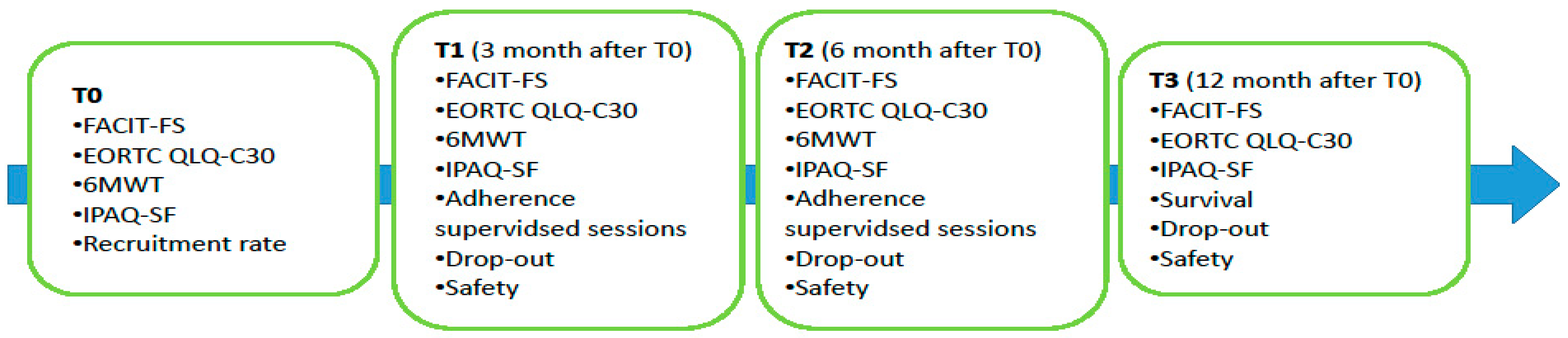
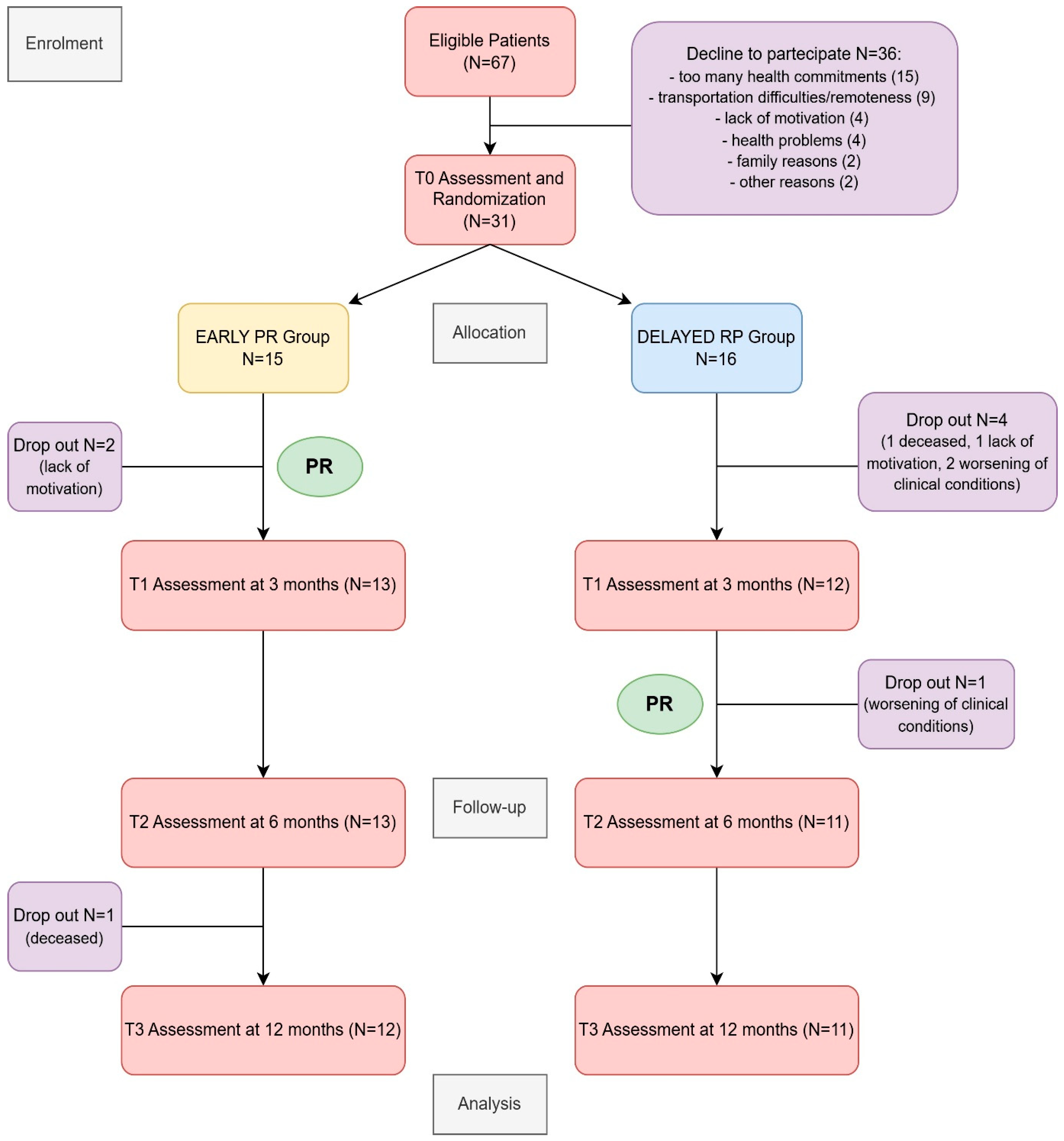
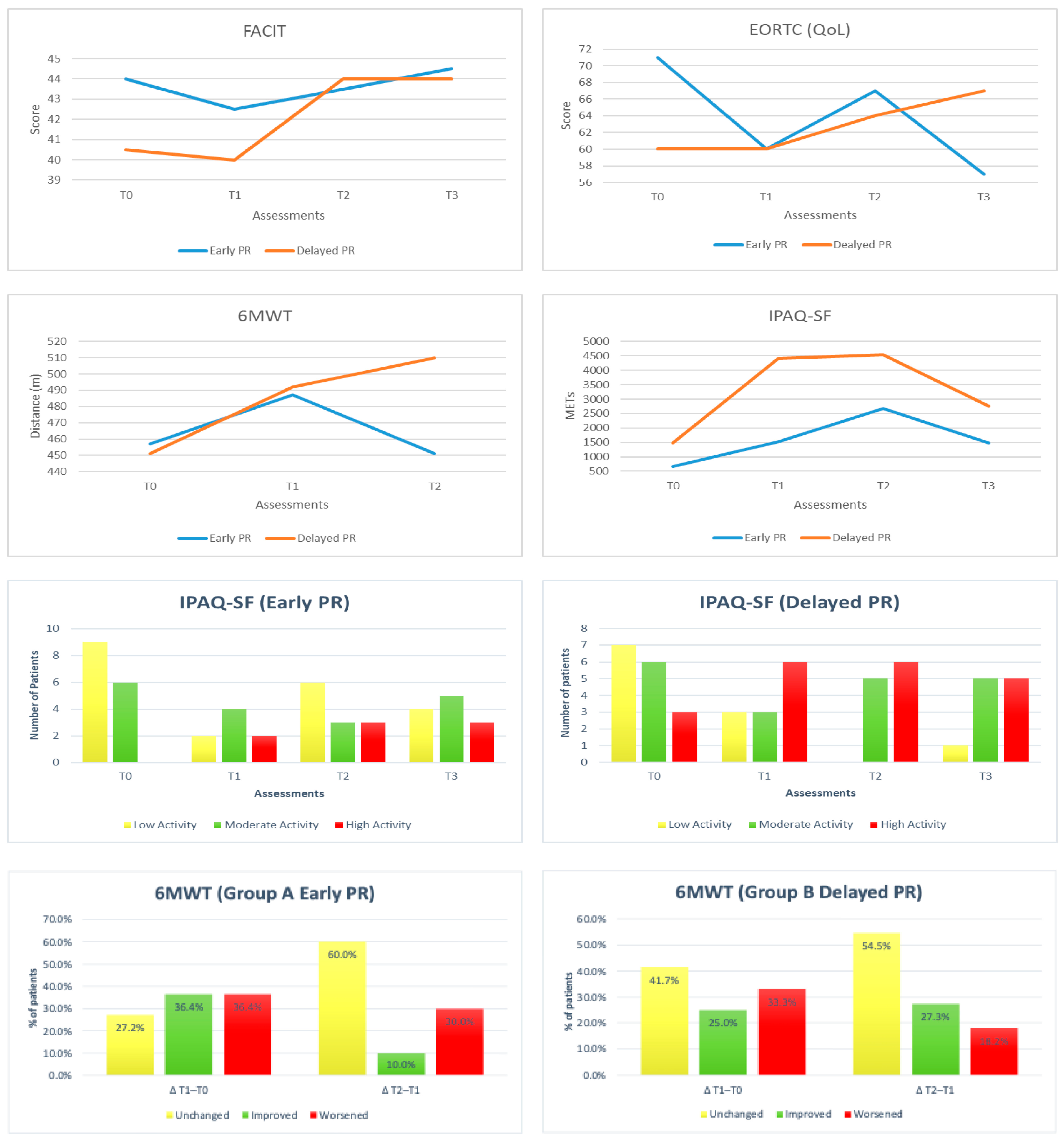
Background: Cancer-Related Fatigue (CRF) significantly impairs physical performance and quality of life (QoL) in patients with non-small-cell lung cancer (NSCLC). The OVER-CRF study evaluated the feasibility, safety, and preliminary efficacy of a personalized pulmonary rehabilitation (PR) program combining supervised exercise and education during active treatment. Methods: Patients with stage II–III NSCLC were randomized to Early-PR (initiated at the start of anticancer therapy) or Delayed-PR (initiated three months later). The 3-month intervention included two educational sessions and eight supervised exercise sessions. The primary outcome was adherence; secondary outcomes included safety, CRF (FACIT-FS), QoL (EORTC-QLQ-C30), and physical performance (6MWT). Results: Thirty-one patients were randomized (mean age 67.4 years). Adherence was excellent (Early: 86.7%; Delayed: 91.7%), exceeding feasibility thresholds. No exercise-related adverse events occurred. At 12 months, 50% of participants showed clinically meaningful CRF improvements. While both groups improved 6MWT performance during the intervention, the Delayed-PR group demonstrated more sustained QoL improvements from T1 through T3 compared to the Early-PR group. The dropout rate (25.8%) was consistent with the existing literature. Conclusions: Personalized PR is feasible and safe for NSCLC patients undergoing multimodal therapy. While early intervention provides immediate benefits, initiation timing may influence long-term QoL trajectories. These findings support integrating exercise and education into standard oncological care pathways.