


Simple Summary
Bone and soft tissue sarcomas are rare cancers that develop in bones, muscles, fat, and other body tissues. Because they are uncommon and their early symptoms can resemble harmless conditions, many people are not familiar with them. This lack of awareness may lead to delayed medical consultation and diagnosis, which can result in more-advanced disease and more-complex treatments. In this study, we surveyed 626 members of the public to understand how much people know about these cancers, including their risk factors, warning signs, and when to seek medical care. The results showed that most participants had limited knowledge about sarcomas. Many people were unsure about who is most at risk, what symptoms might suggest a problem, and when medical evaluation is necessary. Some participants also reported barriers to seeking healthcare, including fear, lack of information, and difficulties accessing medical services. These findings highlight an important gap in public knowledge. Increasing public education about bone and soft tissue sarcomas could encourage earlier medical evaluation of suspicious symptoms, leading to earlier diagnosis and better outcomes for patients.
Abstract
Background: Bone and soft tissue sarcomas, while rare, making up less than 2% of adult cancers with an incidence below 5 per 100,000 annually, present a significant challenge due to their varied and often obscure pathology. Additionally, the absence of global sarcoma awareness contributes to delayed interventions, necessitating more-aggressive treatments and increasing mortality risks. Conversely, cancers such as breast and colon have seen improved outcomes through effective screening and early-management strategies. Methods: In this cross-sectional study, out of the total number of participants approached, using a preset questionnaire, by trained medical students to participate in this study, 626 met the inclusion criteria. The questionnaire started with an informed consent process followed by a set of questions regarding sociodemographic characteristics and lifestyle. Subsequently, the questionnaire delved into their understanding and awareness of bone and soft tissue sarcomas, focusing on risk factors, recognizable signs and symptoms, and tendencies regarding health-seeking behavior. Results: In this study with 626 participants, demographic insights showed a young cohort, with 43.5% between 21 and 30 years, and a male predominance of 60.1%. Risk factor awareness was moderate; genetics and smoking were recognized as primary risks for sarcomas. Participants showed limited awareness of sarcoma signs, symptoms, and management, with a substantial percentage unsure about the most at-risk age group, gender differences in risk, and recognizability of symptoms. Barriers to seeking medical care included a passive attitude towards healthcare, fear, and accessibility issues. Most participants had limited knowledge of sarcomas, with 58% unaware of risk factors and 72.3% of signs and symptoms. Conclusions: This study emphasizes the necessity for targeted interventions to bridge the knowledge gap and promote early detection practices, which could significantly impact the prognosis of sarcoma patients.
1. Introduction
Globally, there has been an increase in the incidence of cancer, which is the leading cause of death worldwide, responsible for nearly 10 million deaths in 2020 [1]. It is anticipated that the number of cancer deaths will continue to rise, reaching 21.4 million worldwide by 2030, as a result of changes in population demographics in the coming decades [2]. Cancer requires a complex and multi-step approach for diagnosis and prognosis. One of the factors is the doctor and patient’s active communication regarding the patient’s awareness of the disease, the diagnostic procedure, the therapeutic options, and the perception of the disease’s prognosis [3]. Another essential factor that determines the clinical outcomes of the patients is health literacy [3].
Sarcomas are a group of heterogeneous cancers that affect soft tissues and bone alike. They are considered rare cancers as their annual incidence is less than 5 per 100.000 people, accounting for <2% of all adult tumors [4]. Bone sarcomas and soft tissue sarcomas include about 100 different pathologic entities as described in the WHO’s Classification of Tumors 2020, many of which are considered ultra-rare, with an incidence of 1 per 1,000,000 people [5]. The obscure nature of bone sarcomas and soft tissue sarcomas and their insidious progression make them prone to late diagnosis. Delays in referral and seeking a second opinion from expert centers all affect the outcomes of sarcoma patients, making them prone to more radical modalities of treatment and increasing the risk of mortality [6]. Furthermore, the number of years of life lost by these patients can be significant because of their young age at presentation [7].
Early diagnosis and treatment of soft tissue and bone sarcomas is crucial for reducing the mortality rate. Individuals with symptoms that may be indicative of sarcoma [8] (e.g., pain, presence of swelling/lump), should be swiftly sent to a sarcoma specialist center, which can perform diagnostic testing, pathology, and therapy as required [6]. This may be achieved by a public health approach aimed at raising sarcoma knowledge, awareness, and health-seeking behaviors [6]. Thus, in this study, we aim to quantify the knowledge and awareness of the general population in Saudi Arabia about bone sarcoma and soft tissue sarcoma, in addition to health-seeking behaviors.
2. Methodology
Participants were recruited via convenience sampling from a major high-traffic shopping mall in Riyadh, Saudi Arabia, enabling efficient engagement with a broad segment of the general public during the study period. The study was performed between September 2022 and January 2023. We targeted adults aged 16 years and above who were willing to participate in the study. We excluded patients who were <16 years old and those with cognitive deficits or who could not read or write. The aforementioned individuals were excluded from the study due to their failure to satisfy the research objectives.
The study adhered to the principles of the Helsinki Declaration and received its ethical approval from the Institutional Review Board (IRB) at the College of Medicine, King Saud University, Riyadh, Saudi Arabia (approval no E-22-7328). After being told of the study’s goals and given the option to withdraw at any time without incurring any obligations to the study team, each subject completed a signed consent form indicating their agreement to participate.
To ensure an adequate sample size, reaching at least 420 individuals was the target for enrolment in the study. The calculation of the sample size took into account the current population size of Riyadh, aiming for a 95% confidence level and a margin of error of 5%. We approached more than 1000 individuals: 626 accepted enrollment in the study, and 60 participants were excluded for not meeting the research inclusion criteria or having significant missing data in the research questionnaire.
Questionnaire items were generated following an extensive literature review on cancer awareness, sarcoma epidemiology, and health-seeking behavior surveys. Existing validated awareness instruments were reviewed and selectively adapted to align with the study objectives and local cultural context. Content validity was assessed by a multidisciplinary expert panel comprising orthopedic oncology consultants, epidemiologists, and survey methodology specialists. Panel members evaluated item relevance, clarity, and coverage of key domains, including risk factor awareness, symptom recognition, treatment knowledge, and healthcare access behavior. Recommendations were incorporated iteratively until consensus was achieved on the final instrument structure. To minimize potential self-reported data biases, the study participants were assured that their responses would be kept anonymous and confidential. The questionnaire’s validity was evaluated by survey research experts, and it was designed to minimize fatigue. The questionnaire was divided into five sections. The first section assessed sociodemographic characteristics. The second section had questions regarding desire to change lifestyle. The third section encompassed questions about the knowledge of, awareness of, and attitude toward bone and soft tissue sarcoma. The fourth section dealt with barriers and facilitators to healthcare access. The fifth section comprised items about knowledge-seeking behaviors.
The questionnaire was originally developed in English and subsequently translated into Arabic using a standardized forward–backward translation approach. Forward translation was independently performed by three bilingual translators (two with medical backgrounds and one non-medical professional) to ensure both conceptual accuracy and comprehension. A separate bilingual expert, blinded to the original version, conducted backward translation into English. Discrepancies between versions were reviewed and resolved through consensus discussion among the research team to ensure semantic and conceptual equivalence. The finalized Arabic version was reviewed for cultural appropriateness and readability prior to pilot testing. A pilot study involving 10 participants from the target population was conducted to evaluate the clarity, comprehension, and feasibility of questionnaire completion. Feedback obtained during pilot testing led to minor wording refinements and improved question sequencing. Internal consistency of the knowledge items was assessed using Cronbach’s alpha, demonstrating acceptable reliability (Cronbach’s alpha = 0.643). The data obtained from the pilot sample were not utilized for subsequent analysis. The final version of the questionnaire was distributed in both Arabic and English, and participants were expected to spend approximately 5–6 min to complete it.
Participants were approached at the shopping center by pre-trained medical students and were provided with a consent form explaining the goals of the study and their rights. They were then subsequently given a questionnaire in their preferred language. Medical students were instructed to clarify any questions without providing any hint or clue about the questions. After finishing the questionnaire, the participants were then invited to attend a health awareness campaign about bone and soft tissue sarcoma. Participants were invited to the campaign only after finishing the questionnaire or after refusing to participate in the study. Duplications were minimized by asking if the participant had participated before being invited to participate.
Data was then inserted manually in MS Excel 16.46 (Microsoft, Redmond, WA, USA) and was then cleaned by the removal of any responses with more than 20% missing data per domain. Any missing response of less than 20% per section was assigned as a missing variable in the analysis. Finally, participation with responses that were deemed invalid, such as contradictory responses, was also eliminated.
The research assessed participants’ knowledge and attitudes regarding bone and soft tissue sarcoma. Knowledge assessment was presented using three scores that were calculated based on the participants’ responses. The first score was about the knowledge of risk factors for bone and soft tissue sarcoma. This score was calculated by adding the number of correct responses for questions 11 to 13. The second score measured the knowledge of signs and symptoms of bone and soft tissue sarcoma. This measure rose by adding the number of correct responses for question 14. The third measure regarded the knowledge of management of bone and soft tissue sarcoma, which corresponded to the number of correct responses for question 16. The attitude assessment was assessed using questions 15, 21, 22, and 23.
Qualitative variables are presented using numbers and percentages in the form of descriptive statistics, while the mean and standard deviation are utilized for quantitative variables. To examine the association of the total barriers and facilitator scores with sociodemographic characteristics, the Mann–Whitney Z-test and Kruskal–Wallis H-test were employed. Associations were examined using a univariable Logistic regression model, reporting odds ratios (ORs) and 95% confidence intervals (CIs). Data analysis was conducted using IBM Statistical Packages for Social Sciences (SPSS) Statistics for Windows, version 26 (IBM Corp., Armonk, NY, USA). Statistical significance was determined at a threshold of p < 0.05.
3. Results
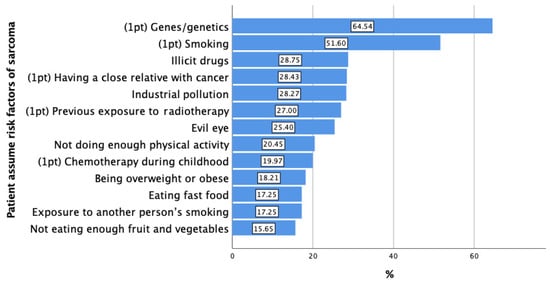
This study of 626 participants showed varied age demographics, with 43.5% aged 21–30 and a 60.1% male majority. Education-wise, 45.8% had a bachelor’s degree, and employment figures showed that 55.6% were working, with 23.2% unemployed. Income levels varied, with 17.4% earning under 5000 SAR. Notably, 64.9% had no family cancer history, while 32.1% were smokers. Interest in lifestyle changes varied, with only 7.0% strongly inclined to change. These demographics provide insights into the educational, economic, and health characteristics of the cohort (Table 1). The population study indicates that 64.54% consider genetics a primary sarcoma risk, with 51.60% identifying smoking. Other risks include illicit drugs at 28.75%, a cancerous family history at 28.43%, and exposure to industrial pollutants at 28.27%. Radiotherapy exposure concerns 27.00%, and the evil eye is believed to be a factor by 25.40%. Lesser risks include insufficient exercise at 20.45%, childhood chemotherapy at 19.97%, and obesity at 18.21%. Fast-food consumption and second-hand smoke are noted by 17.25%, and a fruit- and vegetable-deficient diet is a concern for 15.65% (Figure 1).
Table 1.
Sociodemographic and lifestyle characteristics of participants (n = 626).
Figure 1.
General population assumed risk factors of soft tissue and bone sarcomas.
Participants’ knowledge concerning soft tissue and bone sarcomas reveals that when asked about the age group most at risk for developing sarcomas, 22.7% believed it to be between 31 and 50 years, while 29.6% were unsure. Regarding gender susceptibility, 39.8% perceived no difference in sarcoma risk between males and females, and 39.9% were uncertain. In identifying warning signs of bone and soft tissue sarcomas, the most recognized symptom was an unexplained lump or swelling at 32.6%. Persistent unexplained pain was acknowledged by 33.5%, and 33.7% were unsure about the signs altogether. Regarding bone sarcoma treatability, 49.7% responded affirmatively, while 43.9% expressed uncertainty. Finally, when asked about management modalities for bone and soft tissue sarcomas, radiotherapy was identified by 35.6% of participants and limb-salvaging surgery was mentioned by 22.2%, while 43.8% acknowledged a lack of knowledge on the subject (Table 2).
Table 2.
Soft tissue and bone sarcoma knowledge (n = 626).
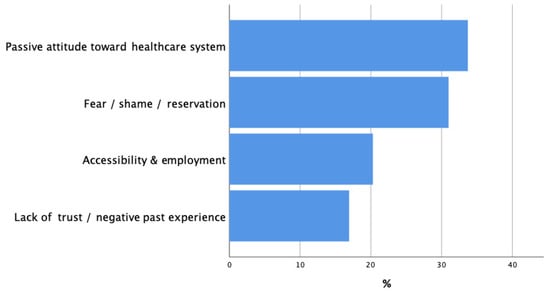
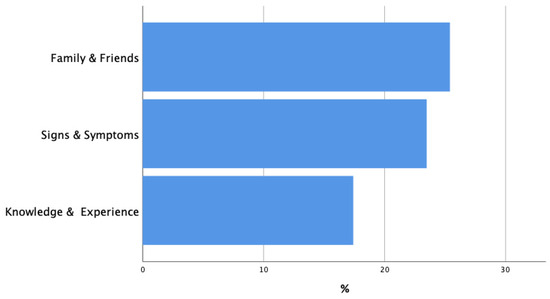
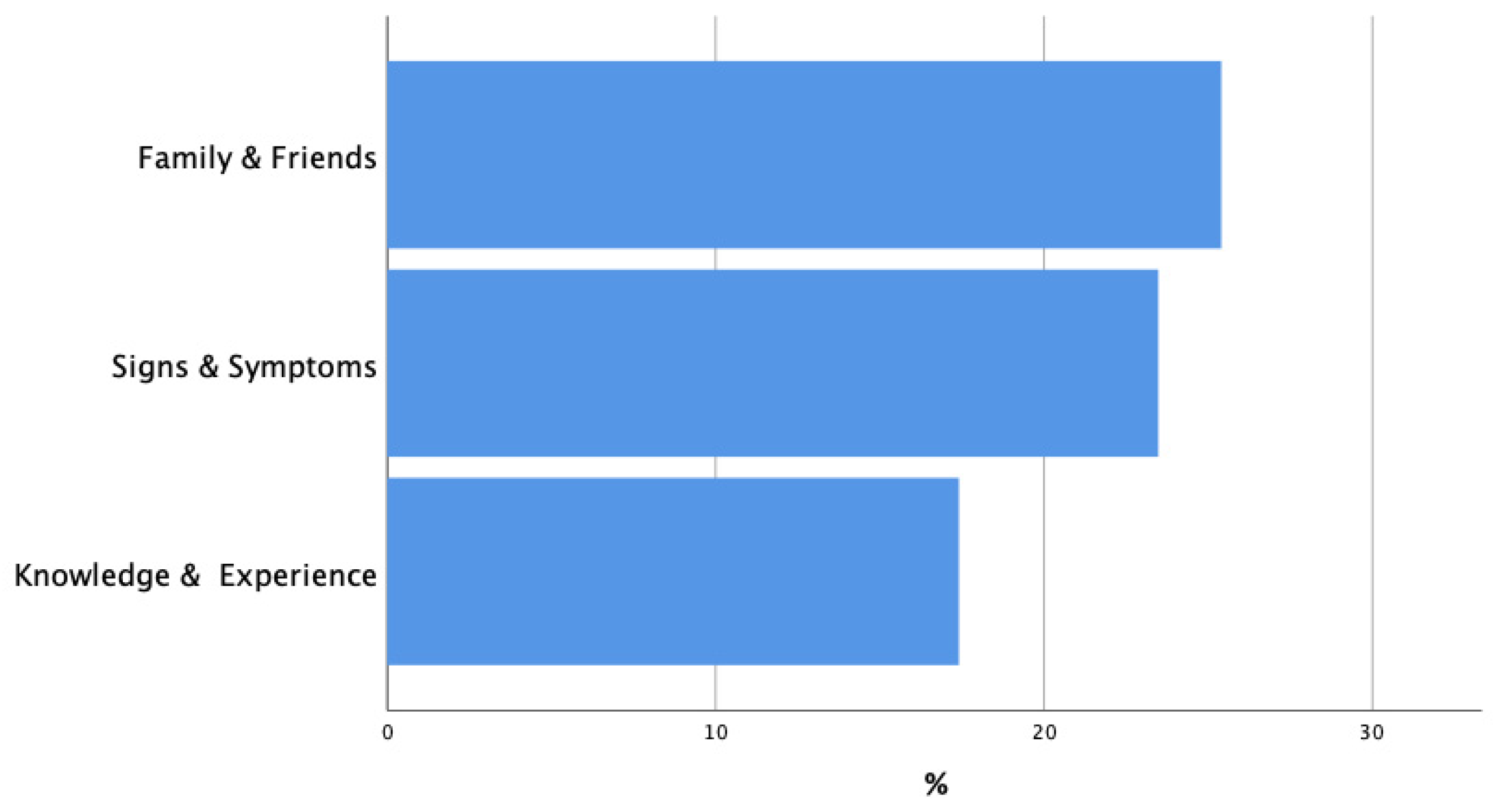
The primary barriers influencing individuals’ decisions to seek medical attention include a passive attitude toward the healthcare system at approximately 40%; feelings of fear, shame, or reservation at around 30%; concerns related to accessibility and employment at about 25%; and negative past experiences or lack of trust in the healthcare system at close to 10%. In contrast, the main facilitators driving individuals to seek medical care are encouragement from family and friends at roughly 30%, recognizing specific signs and symptoms at about 25%, and one’s knowledge and past experiences with the medical system at approximately 10% (Figure 2 and Figure 3).
Figure 2.
Barriers to seeking medical attention.
Figure 3.
Facilitators of seeking medical attention.
The study found that most participants had limited knowledge about sarcoma, with 58% showing poor awareness of risk factors and 72.3% having a poor understanding of signs and symptoms. Only 7% and 3.7% had good knowledge in these areas, respectively. Additionally, 57.5% had poor knowledge of sarcoma management. A majority, 70.1%, believed cancer prevention is possible, while 29.9% disagreed. Information-seeking was observed in 40.9% of the sample, with 51.6% relying on non-official sources. Social media was considered a trustworthy source by 59.9%. Opinions on responsibility for early cancer detection varied: 42.5% viewed it as a shared responsibility, 28.3% felt it was an individual’s duty, 9.6% assigned it to the healthcare system, and 19.7% were uncertain (Table 3).
Table 3.
Knowledge and attitudes of participants (n = 626).
In the survey, 40.9% of participants actively sought cancer information, while 40.1% did not, and 18.8% could not recall. Family and friends were the primary sources for 35%, followed by official medical websites at 30.8%, and interactions with cancer patients or survivors at 21.4%. The Saudi Orthopedics Association website was used by 11.7%, healthcare providers by 16.9%, and non-medical websites by 16.1%, and a notable 41.7% turned to social media. Other sources were cited by 16.9%. For social media, 23.5% preferred Twitter and Facebook, 15.5% YouTube, and 12.9% various platforms. Snapchat/TikTok and Instagram were less trusted, at 4.6% and 1.6%, with 41.9% distrusting social media for cancer information (Table 4).
Table 4.
Sarcomas and cancer information-seeking behavior (n = 626).
In a sarcoma awareness study with 626 participants, age emerged as a significant factor; those over 30 had a better grasp of sarcoma risks (OR = 2.10, 95% CI [1.6–2.7], p < 0.001) and management (OR = 0.44, 95% CI [0.27–0.72], p = 0.001) than their younger counterparts. Women surpassed men in recognizing symptoms (OR = 1.29, 95% CI [0.92–1.80], p = 0.030). Higher education, specifically a bachelor’s degree or more, was linked to better management knowledge (OR = 1.66, 95% CI [1.07–2.57], p = 0.022). Income levels above 10,000 SAR were associated with greater awareness of risk factors (OR = 1.75, 95% CI [1.29–2.37], p = 0.024) and management (OR = 0.39, 95% CI [0.24–0.64], p = 0.022). Employment positively affected understanding of risks (OR = 0.50, 95% CI [0.31–0.80], p = 0.033) and management (OR = 0.49, 95% CI [0.31–0.79], p = 0.022). The desire for lifestyle changes was significant, as those with moderate to solid intention had better overall knowledge, notably in risks (OR = 0.32, 95% CI [0.1–0.8], p = 0.011) and management (OR = 0.26, 95% CI [0.1–0.67], p = 0.001) (Table 5).
Table 5.
Association between sarcoma knowledge and demographic factors (n = 626).
In the analysis of demographic factors and their association with attitudes towards sarcomas, younger participants (<30 years) tended to use non-official sources for cancer information (OR = 0.46, 95% CI [0.29–0.74], p = 0.021) and trust social media for such data (OR = 0.61, 95% CI [0.41–0.90], p = 0.011). Higher education correlated with less reliance on non-official sources (OR = 0.48, 95% CI [0.31–0.74], p = 0.001). Those earning over 10,000 SAR monthly were more proactive regarding early cancer detection (OR = 0.29, 95% CI [0.14–0.59], p = 0.001). A family cancer history significantly increased the pursuit of cancer information (OR = 1.8, 95% CI [1.3–2.5], p < 0.001) and the belief in healthcare’s role in detection (OR = 0.47, 95% CI [0.25–0.87], p = 0.015). Individuals desiring lifestyle changes were more likely to trust social media (OR = 0.46, 95% CI [0.3–0.70], p = 0.003) and to accept personal responsibility in detecting cancer early (OR = 0.48, 95% CI [0.28–0.82], p = 0.007) (Table 6).
Table 6.
Association between sarcoma knowledge and participants’ attitudes (n = 626).
4. Discussion
The management and prognosis of any form of cancer can be aided by knowledge and awareness of the risk factors and early symptoms of the disease. Bone and soft tissue sarcomas often do not initially exhibit any signs that would allow for an early diagnosis. In addition, young people and adolescents are more likely than older adults and children to develop bone and soft tissue sarcomas; thus, despite lower incidence rates, the number of years of life lost may frequently be significant [9]. Therefore, raising awareness of the disease’s risk factors and early warning signs can help with disease prevention and early identification, which can enhance the prognosis overall [10]. This study, which sought to assess general Saudi Arabians’ knowledge and awareness of various aspects of bone and soft tissue sarcomas, was conducted in light of the paucity of research on sarcomas and knowledge and awareness of them among the general population.
We have examined the general Saudi population’s knowledge and attitudes on bone and soft tissue sarcomas in light of several demographic parameters. The results of our study show that, in comparison to males, women exhibit better levels of awareness about the risk factors, early symptoms, and markers of malignancies. This result is consistent with earlier studies that have repeatedly shown that women are more knowledgeable about different tumors. Societal, cultural, and biological variables may all play a role in this disparity [11,12,13]. Women usually prioritize their health and interact more regularly with healthcare institutions due to societal expectations and gender roles, which increases awareness of diseases. In addition, biological aspects like women’s greater breast cancer prevalence and the emphasis on breast health awareness campaigns may help women have a deeper understanding of tumors in general [14,15].
Additionally, the findings of this study indicate a positive correlation between higher education levels and knowledge concerning the signs and symptoms of bone and soft tissue sarcomas. Similarly, individuals with higher educational attainment and higher family income demonstrated greater awareness regarding the management strategies for bone and soft tissue sarcomas. These results suggest that socioeconomic factors, such as education level and income, play a significant role in shaping the level of knowledge within the community regarding these malignancies. This is consistent with earlier research that looked at the relationship between educational attainment and financial stability and knowledge of various cancer types [11,13].
Furthermore, our study investigated the association between smoking practices and awareness of bone and soft tissue sarcomas. Our findings show that smokers had lower knowledge and awareness of sarcoma risk factors, symptoms, and warning signs compared to non-smokers. This may reflect less engagement with preventive health behaviors and limited exposure to formal health information. Sociodemographic factors, such as education, occupation, and health literacy, may also influence this relationship. Interpret this association cautiously, as the cross-sectional study design precludes causal inference regarding the relationship between smoking status and knowledge or awareness. Residual confounding may exist, and the relationship may reflect broader behavioral or socioeconomic factors rather than smoking status alone. Nevertheless, these findings underscore the value of targeted awareness interventions for high-risk behavioral groups to improve early recognition and health-seeking behavior. This finding is consistent with other research, which has consistently demonstrated that smokers frequently lack basic understanding of malignancies associated with smoking [16].
In light of the potential consequences for early identification, prevention, and treatment outcomes, it is important to note that addressing this knowledge gap among smokers is crucial. In order to provide people with the resources they need to make wise health decisions, efforts should be made to increase awareness and offer tailored educational interventions that are explicitly directed towards smokers.
We additionally investigated the awareness of bone and soft tissue sarcomas and whether or not there was a family history of cancer. It turned out that there was no difference in knowledge of the risk factors and the signs and symptoms of these cancers between people with and without a family history of cancer, which is intriguing, as it goes against earlier research that found that people with a family history of cancer frequently have better knowledge of the risk factors [17].
Nonetheless, according to our study, individuals with a history of cancer in their families were more knowledgeable about the management of bone and soft tissue sarcomas than people without a family history.
This result raises the likelihood that those who have seen or experienced cancer in their relatives may be more motivated to research and educate themselves about the illness. Through a family member’s experience, people may become more aware of cancer and be motivated to actively learn about the curative regimens and assistance programs available for bone and soft tissue sarcomas. This highlights the importance of considering the impact of family history when developing educational initiatives and support programs. Tailoring interventions to address the specific needs of individuals with a family history of cancer can empower them with the knowledge required to make informed decisions, actively engage in their healthcare, and potentially contribute to better outcomes in the management of bone and soft tissue sarcomas.
We also looked at the connection between people’s motivation to alter their lifestyle and their familiarity with various aspects of bone and soft tissue sarcomas. Surprisingly, our research found a link between people’s understanding of the risk factors, symptoms, and treatment options for these malignancies and how strongly they desired to change their lifestyles.
According to this finding, those who show a mild, moderate, or strong desire to make changes to their lifestyles have, on average, more information about bone and soft tissue sarcomas than people who have a weak desire to do so. It is plausible that people who are driven to make better choices are more likely to get informed about the risks associated with those choices.
This finding highlights the significance of promoting a desire for lifestyle changes in order to boost cancer awareness and knowledge. A more informed populace can be achieved by motivating people to actively make healthier decisions and by giving them access to relevant knowledge and resources. We can promote early detection, prevention, and generally improved outcomes in the field of bone and soft tissue sarcomas by educating people about risk factors, signs, symptoms, and management techniques.
A prerequisite for the encouragement of preventive or screening practices is the healthcare provider’s belief that a condition or its worst prognostication may be avertible when detected early in its natural course; thus, we aimed to assess whether our participants shared the ascertainment that sarcomas are preventable. Our results show that 70.1% of our respondents believe that sarcomas can be prevented. This is higher than what was reported by the 1987 Health Information Survey, in which 44% of the participants believed that there was nothing they could do to alter their risk of acquiring cancer [18]. Similarly, a study among Arab women in Qatar showed that 57.2% of the respondents believed in the nonpreventability of cancer [19]. The reasons for such disparity are subject to speculation; however, the nonuniformity in the choices presented may have contributed to the difference in the results, as our questionnaire allowed for an equivocal answer, whereas the former study adopted a dichotomous approach in answering this question.
Moreover, information-seeking behavior was reported only by 40.9% of our respondents. The arbitrary definition of information-seeking may have conceivably confounded the result; as such, these questions are probably best answered through a qualitative approach or by careful delineation of what constitutes an information-seeking behavior. The majority of our respondents reported the use of non-official sources in finding cancer-related information; expectedly, this was also reflected by the trust of 59.9% of our participants in social media as a source of information. Social media platforms are channels through which both official and non-official sources can conveniently be navigated. Moreover, the use of social media may persist in spite of low self-reported trust [20]. The majority of our participants believe early cancer detection to be a responsibility that at least in part involves personal agency, with 42.5% proclaiming it to be a shared responsibility between the individual and the healthcare provider, and 28.3% believing it to be solely a matter of personal responsibility. Overall, these findings reassuringly indicate a low prevalence of medical nihilism among our participants; this, coupled with the belief in personal agency in cancer management, suggests fertile grounds to sow the seeds of health-promoting behavior.
We are aware of the limitations of our study; the closed-ended approach precluded the exploration of more personal viewpoints unaddressed by the self-administered questionnaire. Furthermore, recruiting from a single shopping mall through convenience sampling may compromise the representativeness of the study population, as mall-based surveys may differentially capture specific demographic and socioeconomic groups. Additionally, the study was geographically limited to Riyadh, Saudi Arabia; thus, the generalizability of our findings cannot be assumed for the entire region, and they are evidently in need of replication.
This study underscores the substantial gap in public awareness and understanding of bone and soft tissue sarcomas. The demographic profile of the participants, predominantly young adults with a male majority, reflects a segment of the population that is relatively unaware of the risk factors, signs, and symptoms associated with these sarcomas. In light of these findings, there is a critical need for targeted educational initiatives and awareness campaigns that focus on the unique aspects of bone and soft tissue sarcomas. Such efforts should aim to improve the general public’s understanding of these cancers, including their risk factors, symptoms, and available treatments. Emphasis should also be placed on encouraging proactive health-seeking behaviors and guiding individuals towards credible sources of medical information. By bridging this knowledge gap, we can potentially expedite early detection and intervention, thereby improving the prognosis and outcomes for those affected by these challenging cancers.
Author Contributions
Conceptualization, M.A., O.A.A., Z.A.A. and M.N.A.; methodology, M.A., O.A.A., Z.A.A. and M.N.A.; investigation, M.A., O.A.A., A.A., W.A., M.N.A., Z.A.A., B.A., N.A., N.M.A. and I.S.A.; data curation, M.A., O.A.A., A.A., W.A., M.N.A., Z.A.A., B.A., N.A., N.M.A. and I.S.A.; formal analysis, M.A., O.A.A., Z.A.A. and M.N.A.; writing—original draft preparation, M.A.; writing—review and editing, M.A., O.A.A., A.A., W.A., M.N.A., Z.A.A., B.A., N.A., N.M.A. and I.S.A.; supervision, M.A.; project administration, M.A. All authors have read and agreed to the published version of the manuscript.
Funding
This research received no external funding.
Institutional Review Board Statement
The study adhered to the principles of the Helsinki Declaration and received its ethical approval from the Institutional Review Board (IRB) at the College of Medicine, King Saud University, Riyadh, Saudi Arabia (approval no E-22-7328; approval date: 25 February 2022).
Informed Consent Statement
After being told of the study’s goals and given the option to withdraw at any time without incurring any obligations to the study team, each subject completed a signed informed consent form indicating their agreement to participate.
Data Availability Statement
The datasets used in this study are available from the corresponding author on reasonable request.
Conflicts of Interest
The authors declare no conflicts of interest.
References
- WHO. Cancer Fact Sheets 2020. Available online: https://gco.iarc.fr/today/data/factsheets/cancers/39-All-cancers-fact-sheet.pdf (accessed on 17 November 2024).
- World Health Organization. Global Status Report on Noncommunicable Diseases 2010; World Health Organization: Geneva, Switzerland, 2011. [Google Scholar]
- Lyratzopoulos, G.; Vedsted, P.; Singh, H. Understanding missed opportunities for more timely diagnosis of cancer in symptomatic patients after presentation. Br. J. Cancer 2015, 112, S84–S91. [Google Scholar] [CrossRef] [Scilit] [PubMed]
- Gatta, G.; van der Zwan, J.M.; Casali, P.G.; Siesling, S.; Dei Tos, A.P.; Kunkler, I.; Otter, R.; Licitra, L.; Mallone, S.; Tavilla, A.; et al. Rare cancers are not so rare: The rare cancer burden in Europe. Eur. J. Cancer 2011, 47, 2493–2511. [Google Scholar] [CrossRef] [Scilit] [PubMed]
- WHO Classification of Tumours Editorial Board. Soft Tissue and Bone Tumours: International Agency for Research on Cancer; World Health Organization: Geneva, Switzerland, 2020. [Google Scholar]
- Weaver, R.; O’Connor, M.; Carey Smith, R.; Halkett, G.K.B. The complexity of diagnosing sarcoma in a timely manner: Perspectives of health professionals, patients, and carers in Australia. BMC Health Serv. Res. 2020, 20, 711. [Google Scholar] [CrossRef] [Scilit] [PubMed]
- Burningham, Z.; Hashibe, M.; Spector, L.; Schiffman, J.D. The epidemiology of sarcoma. Clin. Sarcoma Res. 2012, 2, 14. [Google Scholar] [CrossRef] [Scilit] [PubMed]
- Buvarp Dyrop, H.; Vedsted, P.; Rædkjær, M.; Safwat, A.; Keller, J. Routes to Diagnosis for Suspected Sarcoma: The Impact of Symptoms and Clinical Findings on the Diagnostic Process. Sarcoma 2016, 2016, 8639272. [Google Scholar] [CrossRef] [Scilit] [PubMed]
- Sadykova, L.R.; Ntekim, A.I.; Muyangwa-Semenova, M.; Rutland, C.S.; Jeyapalan, J.N.; Blatt, N.; Rizvanov, A.A. Epidemiology and Risk Factors of Osteosarcoma. Cancer Investig. 2020, 38, 259–269. [Google Scholar] [CrossRef] [Scilit] [PubMed]
- Ferguson, J.L.; Turner, S.P. Bone Cancer: Diagnosis and Treatment Principles. Am. Fam. Physician 2018, 98, 205–213. [Google Scholar] [PubMed]
- Alnafisah, R.A.; Alsuhaibani, R.; Alharbi, M.A.; Alsohaibani, A.A.; Ismail, A.A. Saudi Women’s Knowledge and Attitude toward Cervical Cancer Screening, Treatment, and Prevention: A Cross-Sectional Study in Qassim Region (2018–2019). Asian Pac. J. Cancer Prev. 2019, 20, 2965–2969. [Google Scholar] [CrossRef] [Scilit] [PubMed]
- Alqahtani, T.; Alqahtani, A.M.; Alshahrani, S.M.; Orayj, K.; Almanasef, M.; Alamri, A.H.; Easwaran, V.; Khan, N.A. Assessment of knowledge and practice of mammography and breast self-examination among the general female population in Asir region of KSA. Eur. Rev. Med. Pharmacol. Sci. 2021, 25, 7231–7237. [Google Scholar] [PubMed]
- Elmaghraby, D.A.; Alshalla, A.A.; Alyahyan, A.; Altaweel, M.; Al Ben Hamad, A.M.; Alhunfoosh, K.M.; AlJuwaysim, M.F.; Aljumah, D.J.; Albahrani, M.A. Public Knowledge, Practice, and Attitude Regarding Cancer Screening: A Community-Based Study in Saudi Arabia. Int. J. Env. Res. Public Health 2023, 20, 1114. [Google Scholar] [CrossRef] [Scilit] [PubMed]
- Al-Zalabani, A.H.; Alharbi, K.D.; Fallatah, N.I.; Alqabshawi, R.I.; Al-Zalabani, A.A.; Alghamdi, S.M. Breast Cancer Knowledge and Screening Practice and Barriers Among Women in Madinah, Saudi Arabia. J. Cancer Educ. 2018, 33, 201–207. [Google Scholar] [CrossRef] [Scilit] [PubMed]
- Alshahrani, M.; Alhammam, S.Y.M.; Al Munyif, H.A.S.; Alwadei, A.M.A.; Alwadei, A.M.A.; Alzamanan, S.S.M.; Aljohani, N.S.M. Knowledge, Attitudes, and Practices of Breast Cancer Screening Methods Among Female Patients in Primary Healthcare Centers in Najran, Saudi Arabia. J. Cancer Educ. 2019, 34, 1167–1172. [Google Scholar] [CrossRef] [Scilit] [PubMed]
- Monu, J.; Triplette, M.; Wood, D.E.; Wolff, E.M.; Lavallee, D.C.; Flum, D.R.; Farjah, F. Evaluating Knowledge, Attitudes, and Beliefs About Lung Cancer Screening Using Crowdsourcing. Chest 2020, 158, 386–392. [Google Scholar] [CrossRef] [Scilit] [PubMed]
- Seven, M.; Bağcivan, G.; Akyuz, A.; Bölükbaş, F. Women with Family History of Breast Cancer: How Much Are They Aware of Their Risk? J. Cancer Educ. 2018, 33, 915–921. [Google Scholar] [CrossRef] [Scilit] [PubMed]
- Cotugna, N.; Subar, A.F.; Heimendinger, J.; Kahle, L. Nutrition and cancer prevention knowledge, beliefs, attitudes, and practices: The 1987 National Health Interview Survey. J. Am. Diet. Assoc. 1992, 92, 963–968. [Google Scholar] [CrossRef] [Scilit]
- Donnelly, T.T.; Al Khater, A.H.; Al-Bader, S.B.; Al Kuwari, M.G.; Al-Meer, N.; Malik, M.; Singh, R.; Chaudhry, S.; Fung, T. Beliefs and attitudes about breast cancer and screening practices among Arab women living in Qatar: A cross-sectional study. BMC Womens Health 2013, 13, 49. [Google Scholar] [CrossRef] [Scilit] [PubMed]
- Brown-Johnson, C.G.; Boeckman, L.M.; White, A.H.; Burbank, A.D.; Paulson, S.; Beebe, L.A. Trust in Health Information Sources: Survey Analysis of Variation by Sociodemographic and Tobacco Use Status in Oklahoma. JMIR Public Health Surveill. 2018, 4, e8. [Google Scholar] [CrossRef] [Scilit] [PubMed]

Disclaimer/Publisher’s Note: The statements, opinions and data contained in all publications are solely those of the individual author(s) and contributor(s) and not of MDPI and/or the editor(s). MDPI and/or the editor(s) disclaim responsibility for any injury to people or property resulting from any ideas, methods, instructions or products referred to in the content. |
© 2026 by the authors. Licensee MDPI, Basel, Switzerland. This article is an open access article distributed under the terms and conditions of the Creative Commons Attribution (CC BY) license.