Life Years Gained and Healthcare Dollars Saved: National Economic Evidence Supporting Comprehensive Genomic Profiling as Standard of Care for Canadian Cancer Patients

 ,
,  ,
,
Simple Summary
Abstract
1. Introduction
2. Economic Evidence Supports CGP as Standard of Care for Individuals with Metastatic Cancer
2.1. Findings from the National Costs and Benefits Analysis of CGP as SOC
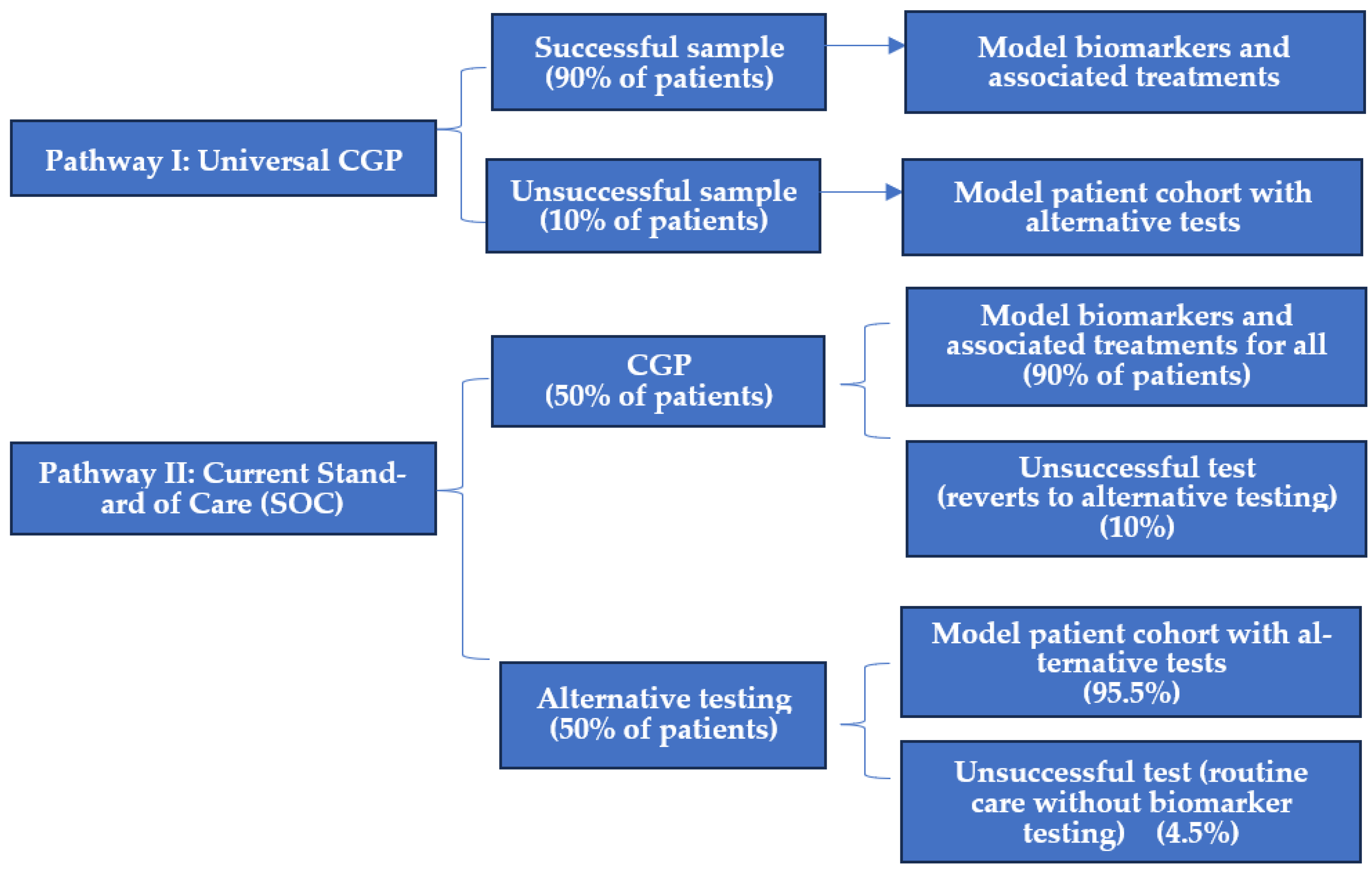
- Actionable biomarker identification rate for CGP: 32% [19];
- Matched therapy administration rate for CGP when a biomarker is identified: 43% [19];
- Actionable biomarker identification rate for alternative testing: 14% [19];
- Matched therapy administration rate for alternative testing when a biomarker is identified: 38% [19];
- Increase in overall survival from receiving CGP: eight months [19].
- Due to the lack of Canadian data regarding the clinical utility and application of CGP for de novo Stage IV cancers, related assumptions were based on a combination of peer-reviewed data (where available) and expert opinion. Data for NSCLC was used as a proxy for other cancer types where insufficient data were available to compare the rate of identifying actionable biomarkers, receiving matched therapies, and overall survival between CGP-NGS and current single biomarker testing for each stage IV disease and panel type.
- Treatment costs reflect publicly available data rather than real-world hospital pricing that may have included possible discounts.
- Estimates on the proportion of patients receiving each therapy, and subsequent attrition, were derived from expert opinion (oncologists from each cancer specialty), which may have created inconsistencies due to varying treatment choices across Canadian provinces and territories.
Long-Term Medical and Economic Value of CGP as SOC
- Data-driven health systems will generate evidence for clinical and research use [24], and realize the potential of large CGP panels through the identification of other actionable mutations, accelerating the increase in CGP’s clinical utility for tumour types for which CGP is not currently cost-effective.
- Utility will further increase as (i) novel biomarkers emerge, particularly for cancers where CGP previously had limited value, and (ii) indications for existing targeted therapies expand to include new tumour types.
- Identification of specific patient populations for whom potentially toxic suboptimal “standard” therapies offer little benefit will avoid healthcare system funds being inappropriately spent on the “one size fits all” approach to prescribing that exists when CGP testing is unavailable altogether or subject to access delays.
- Population-level CGP data within the diverse Canadian landscape population is likely to hold economic value for industry, directing future rounds of cancer therapy research and development.
3. Advancing Towards CGP as Standard of Care
3.1. Canada’s State of Readiness for Implementation of Genome-Based Testing Programmes
International Experiences with Adoption of CGP
3.2. Facilitators of CGP Program Implementation
3.2.1. Enhancing Clinician Awareness and Knowledge of CGP
3.2.2. Expedited Turnaround Time for CGP Results
3.2.3. Incorporating Partnerships into Decision-Making Towards Implementation
- The Alberta Diagnostic Ecosystem Platform for Translation (ADEPT) is a translational research programme that provides clinical samples and related data to commercial innovators of diagnostic tools and platforms [40]. While programmes such as ADEPT do not guarantee such laboratory technology will have widespread adoption, they can support the generation of evidence needed to facilitate uptake. Additionally, other provinces can leverage findings.
- Genome Canada, an independent and federally funded not-for-profit organization, founded the Canadian Precision Health Initiative (CPHI), a PPP programme supported by the Government of Canada with investments from industry, academia and public sector partners [41]. The CHPI funded 12 foundation projects (including oncology projects) to generate large-scale data, mobilize and advance the utility of genomic health datasets.
- Healthy Outcomes Through Genomic Innovations, a Genome Alberta and Genome British Columbia programme focuses on PPP solutions to accelerate the equitable adoption of genomic testing into routine clinical care [42].
4. Conclusions
- Collaboration must be facilitated between regulators, payers and industry to identify regional differences in current access to CGP, and to create a cohesive national strategy to implement CGP as SOC for all individuals with metastatic cancer. Inter-provincial and territorial efforts as well as the further development of PPPs will be critical to eliminate variation in access to and availability of timely CGP, enhance physician prescribing flexibility and share best practices in adopting innovation.
- Funding should be allocated so that CGP is first publicly covered for the five tumour types that contribute to the highest cancer-related mortality (lung, CRC, pancreas, breast, and prostate). This initial investment will build the foundation within the public health system that will provide the proof-of-concept evidence needed to demonstrate the clinical utility of CGP, and serve as the impetus for program extension to other tumour types as emerging biomarkers are realized.
- Investment in CGP education for oncologists and other healthcare providers is needed to ensure that these providers stay current on important advancements in precision medicine. Pathways include ongoing continuing medical education (CME) on how to interpret CGP results, facilitation of improved interprofessional collaboration between pathology and oncology professionals, and enacting on-site or virtual molecular tumour boards in cancer centres and regional hospitals to provide support and knowledge on patient cases.
- Investment in laboratory medicine infrastructure and health human resources is critical to improving equitable and timely access to CGP and results.
Supplementary Materials
Author Contributions
Funding
Data Availability Statement
Acknowledgments
Conflicts of Interest
References
- Warkentin, M.T.; Ruan, Y.; Ellison, L.F.; Billette, J.M.; Demers, A.A.; Liu, F.F.; Brenner, D.R. Progress in cancer control leads to a substantial number of cancer deaths avoided in Canada. JNCI Cancer Spectr. 2023, 7, pkad105. [Google Scholar] [CrossRef]
- Ruan, Y.; Poirier, A.; Yong, J.; Garner, R.; Sun, Z.; Than, J.; Brenner, D.R. Long-term projections of cancer incidence and mortality in Canada: The OncoSim all cancers model. Prev. Med. 2023, 168, 107425. [Google Scholar] [CrossRef] [PubMed]
- Kaviani, E.; Passi, K. Forecasting cancer incidence in Canada by age, sex, and region until 2026 using machine learning techniques. Algorithms 2025, 18, 265. [Google Scholar] [CrossRef]
- Garaszczuk, R.; Yong, J.H.E.; Sun, Z.; de Oliveira, C. The economic burden of cancer in Canada from a societal perspective. Curr. Oncol. 2022, 29, 2735–2748. [Google Scholar] [CrossRef]
- Cell Editorial Team. Five decades of advances in cancer research. Cell 2024, 187, 1567–1568. [Google Scholar] [CrossRef]
- Pankiw, M.; Brezden-Masley, C.; Charames, G.S. Comprehensive genomic profiling for oncological advancements by precision medicine. Med. Oncol. 2023, 41, 1. [Google Scholar] [CrossRef] [PubMed]
- Esposito Abate, R.; Morabito, A.; Milella, M.; Tabbò, F.; Guarneri, V.; Pelizzari, G.; Rapposelli, I.G.; Berardi, R.; Buffoni, L.; Bennicelli, E. Germline findings from tumor-only comprehensive genomic profiling in the RATIONAL study: A missed opportunity? JCO Precis. Oncol. 2025, 9, e2500399. [Google Scholar] [CrossRef] [PubMed]
- Carr, A.; Jackson, J.B.; Coldren, C.; Chandra, P.; Koohestani, F.; Shiller, M.; Auber, R. Tumor diagnosis recharacterization enabled by comprehensive genomic profiling to guide precision medicine strategy. NPJ. Precis. Oncol. 2025, 9, 149. [Google Scholar] [CrossRef]
- Tjota, M.Y.; Segal, J.P.; Wang, P. Clinical utility and benefits of comprehensive genomic profiling in cancer. J. Appl. Lab. Med. 2024, 9, 76–91. [Google Scholar] [CrossRef]
- Sultana, H.; Solomon, A.D.; Wani, A.K.; Shukla, S.K. Epigenetic dysregulation in pancreatic cancer: Emerging biomarkers and clinical applications. Front. Epigenet. Epigenom. 2025, 3, 1723159. [Google Scholar] [CrossRef]
- Yasmin, A.; Jha, R.; Passi, A.; Saha, P.; Goyal, J.; Jindal, S.; Goyal, K. Emerging biomarkers in breast cancer: Translational and multi-omics perspectives in precision oncology. Biomarkers 2025, 30, 516–540. [Google Scholar] [CrossRef]
- Shweikeh, F.; Zeng, Y.; Jabir, A.R.; Whittenberger, E.; Kadatane, S.P.; Huang, Y.; Mouchli, M.; Castillo, D.R. The emerging role of blood-based biomarkers in early detection of colorectal cancer: A systematic review. Cancer Treat. Res. Commun. 2024, 42, 100872. [Google Scholar] [CrossRef]
- Huang, Y.; Mao, J.; Li, X. Emerging biomarkers in prostate cancer diagnosis and treatment: Insights into genetic, RNA and metabolic markers (Review). Int. J. Oncol. 2026, 68, 15. [Google Scholar] [CrossRef]
- Huang, Q.; Li, Y.; Huang, Y.; Wu, J.; Bao, W.; Xue, C.; Li, X.; Dong, S.; Dong, Z.; Hu, S. Advances in molecular pathology and therapy of non-small cell lung cancer. Transduct. Target. Ther. 2025, 10, 186. [Google Scholar] [CrossRef]
- Snow, S.; Brezden-Masley, C.; Carter, M.D.; Dhani, N.; Macaulay, C.; Ramjeesingh, R.; Raphael, M.J.; Slovinec D’Angelo, M.; Servidio-Italiano, F. Barriers and unequal access to timely molecular testing results: Addressing the inequities in cancer care delays across Canada. Curr. Oncol. 2024, 31, 1359–1375. [Google Scholar] [CrossRef]
- Sheffield, B.S.; Banerji, S.; Chankowsky, A.; Dudani, S.; Gill, S.; Gorski, Z.; Kassam, S.; Macaulay, C.; Manna, M.; Perdrizet, K.; et al. Toward timely and equitable advanced biomarker testing for patients with metastatic cancer in Canada. Curr. Oncol. 2025, 32, 141. [Google Scholar] [CrossRef]
- Signal49 Research. Precision in Practice—Costs and Benefits of Comprehensive Genomic Profiling for Five Stage 4 Cancers. Available online: https://cdn.prod.website-files.com/62874663569d676deb3ae6c8/690ce69865541f19fca8cefd_Precision%20in%20Practice%20-%20Costs%20and%20Benefits%20of%20CGP.pdf (accessed on 20 November 2025).
- Canadian Cancer Statistics Dashboard. Mortality. Available online: https://cancerstats.ca/ (accessed on 10 February 2026).
- Wallenta Law, J.; Bapat, B.; Sweetnam, C.; Mohammed, H.; McBratney, A.; Izano, M.A.; Scannell Bryan, M.; Spencer, S.; Schroeder, B.; Hostin, D.; et al. Real-world impact of comprehensive genomic profiling on biomarker detection, receipt of therapy, and clinical outcomes in advanced non-small cell lung cancer. JCO Precis. Oncol. 2024, 8, e2400075. [Google Scholar] [CrossRef]
- Statistics Canada. Total Income of Person. Available online: https://www23.statcan.gc.ca/imdb/p3Var.pl?Function=DEC&Id=100736 (accessed on 18 March 2026).
- Statistics Canada. Consumer Price Index Portal. Available online: https://www.statcan.gc.ca/en/subjects-start/prices_and_price_indexes/consumer_price_indexes. (accessed on 18 March 2026).
- Spencer, S.; Ye, W.; Peng, S.; Zou, D. Cost-effectiveness analysis of comprehensive genomic profiling in patients with advanced non-small-cell lung cancer using real-world data. J. Mol. Diagn. 2025, 27, 850–858. [Google Scholar] [CrossRef] [PubMed]
- Johnston, K.M.; Sheffield, B.S.; Yip, S.; Lakzadeh, P.; Qian, C.; Nam, J. Costs of in-house genomic profiling and implications for economic evaluation: A case example of non-small cell lung cancer (NSCLC). J. Med. Econom. 2020, 23, 1123–1129. [Google Scholar] [CrossRef] [PubMed]
- Hsu, E.R.; Klemm, J.D.; Kerlavage, A.R.; Kusnezov, D.; Kibbe, W.A. Cancer moonshot data and technology team: Enabling a national learning healthcare system for cancer to unleash the power of data. Clin. Pharmacol. Ther. 2017, 101, 613–615. [Google Scholar] [CrossRef] [PubMed]
- Huang, R.S.P.; Lee, J.K.; Lofgren, K.T. Clinical value of comprehensive genomic profiling on clinical trial enrollment for patients with advanced solid tumors. Oncologist 2025, 30, oyae293. [Google Scholar] [CrossRef] [PubMed]
- Singal, G.; Madduri, D.; Yuan, L.; Luo, D.; Upadhyay, A.; Wiener, M.B.; Wander, S.A.; Lynam, E.B.; Bourque, D.; Parker, A.; et al. Accelerating clinical trial enrollment with comprehensive genomic profiling (CGP) and just-in-time clinical trial sites: An index case of a paradigm shift. J. Clin. Oncol. 2017, 35, 6539. [Google Scholar] [CrossRef]
- Abdel-Rahman, O. Geographic disparities in access to cancer clinical trials in Canada. Am J Clin Oncol. 2023, 46, 512–516. [Google Scholar] [CrossRef]
- Innovative Medicines Canada. Commentary: Canadians Making Desperate Choices with Limited Clinical Trials Access. July 2024. Available online: https://innovativemedicines.ca/newsroom/all-news/commentary-canadians-making-desperate-choices-with-limited-clinical-trials-access/ (accessed on 24 November 2025).
- Angus Reid Institute. Cancer in Canada: Nearly all Canadians Support Federal Government Increasing Access to Clinical Trials. 10 November 2025. Available online: https://angusreid.org/wp-content/uploads/2025/11/2025.11.10_CCS_Clinical_Trials.pdf (accessed on 24 November 2025).
- Husereau, D.; Villalba, E.; Muthu, V.; Mengel, M.; Ivany, C.; Steuten, L.; Spinner, D.S.; Sheffield, B.; Yip, S.; Jacobs, P.; et al. Progress toward health system readiness for genome-based testing in Canada. Curr Oncol. 2023, 30, 5379–5394. [Google Scholar] [CrossRef]
- Husereau, D.; Servidio-Italiano, F. Towards the Routine Use of Genome-Based Testing in Canada’s Largest Regions: An Update to the State of Readiness Progress Report; Resilient Healthcare Coalition: Ottawa, ON, Canada, 2026; 66p. [Google Scholar]
- Canada’s Drug Agency. Assessment Framework Planning for a Coordinated Assessment Framework for Biomarkers Used in Cancer Care: A Report from the Biomarker Advisory Panel Draft for Feedback [draft]. Available online: https://www.cda-amc.ca/sites/default/files/hta-he/CP0048-Biomarker-Assessment-Framework_DRAFT_V1.0_EN.pdf (accessed on 19 November 2025).
- Volders, P.J.; Aftimos, P.; Dedeurwaerdere, F.; Martens, G.; Canon, J.L.; Beniuga, G.; Froyen, G.; Van Huysse, J.; De Pauw, R.; Prenen, H.; et al. A nationwide comprehensive genomic profiling and molecular tumor board platform for patients with advanced cancer. NPJ Precis. Oncol. 2025, 9, 66. [Google Scholar] [CrossRef]
- Oncology News. 5000 Australians with Toughest Cancers Referred to PrOSPeCT for Free Comprehensive Genomic Profiling. Available online: https://oncologynews.com.au/latest-news/5000-australians-with-toughest-cancers-referred-to-prospect-for-free-comprehensive-genomic-profiling/ (accessed on 12 December 2025).
- Herrero Colomina, J.; Johnston, E.; Duffus, K.; Zaïr, Z.M.; Thistlethwaite, F.; Krebs, M.; Carter, L.; Graham, D.; Cook, N. Real-world experience of molecular tumour boards for clinical decision-making for cancer patients. NPJ. Precis. Oncol. 2025, 9, 87. [Google Scholar] [CrossRef]
- Sheffield, B.S.; Eaton, K.; Emond, B.; Lafeuille, M.H.; Hilts, A.; Lefebvre, P.; Morrison, L.; Stevens, A.L.; Ewara, E.M.; Cheema, P. Cost savings of expedited care with upfront next-generation sequencing testing versus single-gene testing among patients with metastatic non-small cell lung cancer based on current Canadian practices. Curr Oncol. 2023, 30, 2348–2365. [Google Scholar] [CrossRef]
- Stewart, D.J.; Maziak, D.E.; Moore, S.M.; Brule, S.Y.; Gomes, M.; Sekhon, H.; Dennie, C.; Lo, B.; Fung-Kee-Fung, M.; Bradford, J.P.; et al. The need for speed in advanced non-small cell lung cancer: A population kinetics assessment. Cancer Med. 2021, 10, 9040–9046. [Google Scholar] [CrossRef]
- Medical Laboratory Professionals’ Association of Ontario. Supplemental Report: Shortage of Lab Professionals Continues Post-Pandemic (July 2023). Available online: https://25a97c6d-47fb-474b-a64c-d3ec079ca668.usrfiles.com/ugd/86fd4b_49664db22eef45a19cb44a07ec1a491b.pdf (accessed on 21 November 2025).
- Maung, R.; Bonert, M.; Soll, B.; Dow, H. Canadian pathologists in crisis: A review of national well-being and workload data. Can. J. Physician Leadersh. 2025, 11, 120–130. [Google Scholar] [CrossRef]
- The Alberta Diagnostic Ecosystem Platform for Translation. Leading Diagnostic Innovation. Available online: https://www.albertalabdiagnostics.ca/ (accessed on 20 November 2025).
- Genome Canada. Canadian Precision Health Initiative. Available online: https://genomecanada.ca/challenge-areas/canadian-precision-health-initiative/ (accessed on 20 November 2025).
- Genome Alberta. Accelerating Health Outcomes for Patients Through Precision Medicine and Advancing Genetic Testing in Routine Care. Available online: https://genomealberta.ca/accelerating-health-outcomes-for-patients-through-precision-medicine-and-advancing-genetic-testing-in-routine-care/ (accessed on 20 November 2025).


| FoundationOne CDx (324 Gene) | Oncomine Precision Assay (50 Gene) | AmpliSeq Focus Panel (52 Gene) | Oncomine Comprehensive Assay V3 (161 Gene) | |
|---|---|---|---|---|
| Lung cancer | −$131 | $1075 | $933 | $715 |
| Colorectal cancer | −$306 | $2495 | $2138 | $1677 |
| Pancreatic cancer | −$730 | $1751 | $1560 | $1161 |
| Breast cancer | −$770 | $272 | $130 | $4 |
| Prostate cancer | −$639 | $392 | $250 | $130 |
| CGP | Current SOC | |
|---|---|---|
| Lung cancer | 5933 | 4114 |
| Colorectal cancer | 2503 | 1735 |
| Pancreatic cancer | 1342 | 930 |
| Breast cancer | 447 | 310 |
| Prostate cancer | 991 | 687 |
Disclaimer/Publisher’s Note: The statements, opinions and data contained in all publications are solely those of the individual author(s) and contributor(s) and not of MDPI and/or the editor(s). MDPI and/or the editor(s) disclaim responsibility for any injury to people or property resulting from any ideas, methods, instructions or products referred to in the content. |
© 2026 by the authors. Licensee MDPI, Basel, Switzerland. This article is an open access article distributed under the terms and conditions of the Creative Commons Attribution (CC BY) license.
Share and Cite
Snow, S.; Banerji, S.; Bombard, Y.; Husereau, D.; Karamchandani, J.; Nason, E.; Ohashi, P.S.; van Rooijen, G.; Vainer, G.; Macaulay, C.; et al. Life Years Gained and Healthcare Dollars Saved: National Economic Evidence Supporting Comprehensive Genomic Profiling as Standard of Care for Canadian Cancer Patients. Curr. Oncol. 2026, 33, 191. https://doi.org/10.3390/curroncol33040191
Snow S, Banerji S, Bombard Y, Husereau D, Karamchandani J, Nason E, Ohashi PS, van Rooijen G, Vainer G, Macaulay C, et al. Life Years Gained and Healthcare Dollars Saved: National Economic Evidence Supporting Comprehensive Genomic Profiling as Standard of Care for Canadian Cancer Patients. Current Oncology. 2026; 33(4):191. https://doi.org/10.3390/curroncol33040191
Chicago/Turabian StyleSnow, Stephanie, Shantanu Banerji, Yvonne Bombard, Don Husereau, Jason Karamchandani, Eddy Nason, Pamela S. Ohashi, Gijs van Rooijen, Gilad Vainer, Cassandra Macaulay, and et al. 2026. "Life Years Gained and Healthcare Dollars Saved: National Economic Evidence Supporting Comprehensive Genomic Profiling as Standard of Care for Canadian Cancer Patients" Current Oncology 33, no. 4: 191. https://doi.org/10.3390/curroncol33040191
APA StyleSnow, S., Banerji, S., Bombard, Y., Husereau, D., Karamchandani, J., Nason, E., Ohashi, P. S., van Rooijen, G., Vainer, G., Macaulay, C., & Servidio-Italiano, F. (2026). Life Years Gained and Healthcare Dollars Saved: National Economic Evidence Supporting Comprehensive Genomic Profiling as Standard of Care for Canadian Cancer Patients. Current Oncology, 33(4), 191. https://doi.org/10.3390/curroncol33040191