


Summary
Cardiology in the Netherlands has developed as an independent specialty already in the sixties. With a strong tradition of famous cardiologists such as Wenckebach, Eindhoven, Durrer, Wellens, Hugenholtz and others, cardiology had a natural strenght both as an academic and clinical discipline in this country with a population of about 16 millions, The Netherlands have around 100 hospitals with cardiology departments (separate from internal medicine), and 700 cardiologists. Fourteen centers are equipped for cardiopulmonary surgery and coronary interventions and several also have strong basic research divisions. The model of a Thoraxcenter as it has started in Rotterdam has been copied now in several other centers in the Netherlands where cardiology joined with cardiopulmonary surgery in a single center. Through this development, cardiologists in this country independently take care of patients with heart disease both on an emergency basis as well as electively. Academically, the Inter-University Cardiology Institute located in Utrecht has succeeded to network research efforts in this country which are importantly supported by The Netherlands Heart Foundation. Strong clinical research organisation such as Cardialysis in Rotterdam have contributed to the worldwide reputation of clinical research and cardiology in the Netherlands. The organization of healthcare is based on a dual system whereby about two thirds are covered by a government-directed healthcare plan, while about approximately one third is privately insured. Recently, many smaller hospitals have been amalgalated and it is expected that the number of hospitals will be further reduced and regional collaborations stengthened. Through local and regional national collaborations cardiology in the Netherlands continues to grow.
Zusammenfassung
Das Fach Kardiologie hat sich in Holland schon in den sechziger Jahren als unabhängige Spezialität entwickelt. Aufgrund einer eindrücklichen Tradition von berühmten Kardiologen wie Wenckebach, Eindhoven, Durrer, Wellens, Hugenholtz und anderen konnte sich die Kardiologie sowohl akademisch wie auch klinisch in diesem Land sehr gut entwickeln. Mit einer Bevölkerung von ungefähr 16 Millionen weist Holland rund 100 Spitäler mit kardiologischen Departementen auf (unabhängig von der Inneren Medizin), sowie 700 Kardiologen. Vierzehn Zentren weisen zudem eine Herz-Gefässchirurgie sowie Möglichkeiten zur interventionellen Kardiologie auf, während einige auch erfolgreiche Forschungsabteilungen haben. Das Modell eines Thoraxzentrums wie es in Rotterdam gegründet wurde, wurde nun in manchen anderen Zentren in Holland kreiert, so dass die Kardiologie zusammen mit der Herz- und Thoraxchirurgie ein gemeinsames Zentrum bilden. Durch diese Entwicklung wurde es möglich, dass in Holland die Kardiologen selbständig Patienten mit Herzerkrankungen sowohl in der Notfallstation wie auch unter elektiven Bedingungen behandeln. Akademisch versuchte das Inter-UniversitätsInstitut für Kardiologie in Utrecht ein Netzwerk von Forschungsprogrammen in diesem Land zu kreieren, welche substantiell von der holländischen Herzstiftung unterstützt werden. Erfolgreiche Forschungsorganisationen wie Cardialysis in Rotterdam haben zudem für einen weltweiten Bekanntheitsgrad der klinischen Forschung im Bereiche Kardiologie in Holland beigetragen. Die Organisation des Gesundheitswesens ist in Holland auf einem globalen System basiert, wobei zwei Drittel der Patienten durch einen staatlichen Gesundheitsplan gedeckt, und andererseits etwa ein Drittel privatversichert sind. In den letzten Jahren wurden viele kleinere Spitäler zusammengelegt und es wird erwartet, dass die Anzahl von Spitälern in Zukunft weiter reduziert wird und dass auch eine regionale Zusammenarbeit verstärkt angestrebt wird. Ausgeprägte lokale und nationale Kollaborationen haben es der Kardiologie in Holland erlaubt, weiter zu wachsen.
Cardiology in The Netherlands has developed as an independent specialty since the 1960’s and has achieved a strong position in the Western world.
The origin of modern cardiology may be defined as the invention and subsequent introduction of electrocardiography by Willem Eindhoven in Leiden/The Netherlands. Another pioneer was Wenckebach, who started his career in Groningen and subsequently moved to Vienna. The development of modern cardiology however started mainly after 1945, as a subspecialty of internal medicine. In the Netherlands, independent departments of cardiology were created throughout the country in the 1960’s. These departments are reporting directly to the hospital management, and organise their own infrastructure including hospital beds, cardiac catheterisation facilities and Other clinical laboratories, and outpatient clinic.
A next Stage in the development was initiated in Rotterdam where cardiology joint with cardiopulmonary surgery in a Single Thoraxcenter. This initiative has been copied now in several Other centers in the Netherlands. The Thoraxcenter in Rotterdam is part of the University Hospital with approximately 1200 hospital beds. The Thoraxcenter has 100 beds (50 cardiology; 50 surgery) 18 of which are devoted to intensive care, and another 12 to high care. There are 4 operating theatres for cardiopulmonary surgery as well as 4 cardiac catheterisation rooms, which serve diagnostic angiography, percutaneous coronary intervention, cardiac biopsies for the transplant programme and clinical electrophysiology.
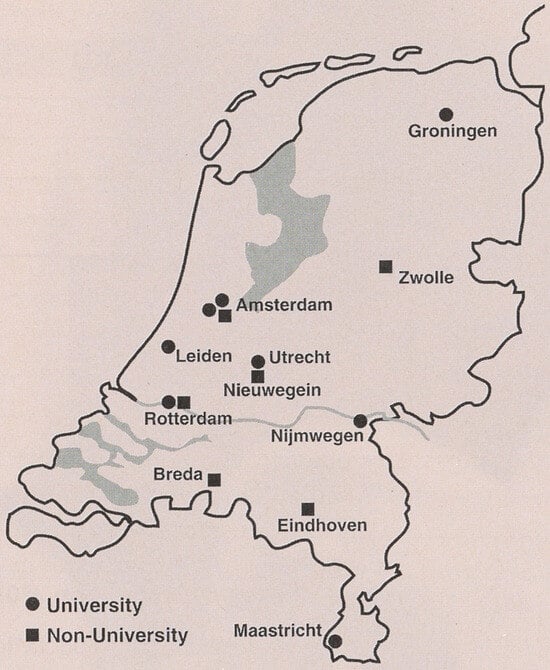
On a population of approximately 16 million inhabitants the Netherlands has some 100 hospitals with a cardiology department and a total of approximately 700 cardiologists (Table 1). There are 8 university hospitals (Amsterdam 2×; Groningen, Leiden, Maastricht, Nijmegen, Rotterdam, Utrecht) as well as 6 nonUniversity Hospitals which have facilities for cardio-pulmonary surgery and coronary intervention (Onze Lieve Vrouwe Gasthuis Amsterdam, St. Antonius Ziekenhuis Nieuwegein, Zuiderziekenhuis Rotterdam, Ignatius Ziekenhuis Breda, Isala Klinieken Zwolle, Catharina Gasthuis Eindhoven; Figure 1). The Zuiderziekenhuis in Rotterdam is part of the Rotterdam Heart Centre which is led by the staff of the university based Thoraxcenter.
Table 1.
Key features of cardiology in the Netherlands.
Figure 1.
Geographic distribution of major cardiology centers in the Netherlands.
Research in cardiology has a strong position in the Netherlands, both in basic science as well as in clinical application. In the context of this Short overview it is impossible to pay tribute to all who have made or continue to make a contribution. Yet, some areas may be mentioned specifically.
Snellen (University of Leiden), promoted the development of cardiology in relation to cardiac pulmonary surgery. In this context it should be remembered that Snellen was a founder and one of the past presidents of the European Society of Cardiology.
Early research in pacemakers was initiated by Talens (Groningen), who unfortunately died at young age. Clinical electrophysiology was initiated by Durrer (Amsterdam) and further developed by Wellens (Maastricht), Robles de Medina (Utrecht), Hauer (Utrecht), Van Hemel (Nieuwegein) and more recently Crijns (Groningen).
At the same time Hugenholtz and his coworkers in Rotterdam focussed on left ventricular function and coronary circulation with major contributions by Serruys (Rotterdam) with his colleagues Van den Brand, Van der Giessen and De Feijter; and subsequent contributions by Bär (Maastricht) and Piek (Amsterdam).
Also in Rotterdam, echocardiography was fostered by the inventions led by Bom and its clinical application was developed by Roelandt. Also Visser (Amsterdam) contributed to the development of echocardiography. Other imaging techniques were promoted by Van der Wall (Leiden). In this setting also contributions by Simoons (Rotterdam) and Verheugt (Nijmegen) should be mentioned, who led investigations in acute coronary syndromes.
While most of the above were/are university based, several general hospitals developed strong departments for cardiology and cardiopulmonary surgery. In particular, the development of the Antonius Hospital in Nieuwegein led by Van Nieuwenhuizen and subsequently Bruschke, Ascoop en Plokker should be mentioned as well as the development of direct PTCA for myocardial infarction by Zijlstra and his colleagues in Zwolle.
The Netherlands Society of Cardiology celebrated its 60th anniversary at the end of the previous century. The society is led alternatively by a university professor and a general cardiologist from a non-university environment. The prefessional bureau is located in the offices of the Inter University Cardiology Institute in Utrecht.
The Netherlands Heart Foundation has made a major contribution to cardiology in the Netherlands. Currently the Netherlands Heart Foundation supports cardiovascular research in the Netherlands with some Euro 10 million per year, while similar amounts are being spent on the education of the population on different aspects of heart healthy lifestyle, prevention of cardiovascular disease as well as education on diagnostic and therapeutic methods.
Another important organisation is the Inter University Cardiology Institute in the Netherlands, initiated by Durrer and subsequently led by Meiler and currently by Wellens and Bom. It is a center for collaboration among the university departments, with contributions from non-university departments as well. The Inter University Cardiology Institute receives financial support directly from the government through the Royal Netherland Academy of Sciences.
Together the Inter University Cardiology Institute, and the Netherlands Society of Cardiology have initiated the CVOI (cardiovascular teaching institution). This bureau organizes postgraduate (CME-accredited) courses, and accredits post graduate teaching programmes organised throughout the country.
A programme for recertification was started in the early 1990’s. Currently all cardiologists in the Netherlands must prove every 5 years that they have in fact continued their medical practice and that they have followed 80 hours post graduate training every year.
A strong organisation for clinical trials has been set up in Rotterdam. This incorporated company Clinical Research Organisation (CRO) — Cardialysis — is led by the cardiology staff of the Thoraxcenter and collaborates with over 500 centers throughout most European countries as well as in other continents. Several similar all be it much smaller organisations have been set up by other cardiology groups. Clinical investigators in currently 30 non-university hospitals have joint in the Netherlands Working group for Cardiovascular Research (WCN). Through Cardialysis, the other university centers as well as through the WCN, the Netherlands has made a major contribution to many international clinical trials.
The organisation of Health Care in the Netherlands is based on a dual system. About two thirds of the population is part of the government directed health care plan while approximately one third is privately ensured. Yet, there is a close collaboration between the insurance companies and the government health care plan. In the last decade many smaller hospitals have been amalgamated. We expect that the number of hospital organisations will further reduce and that this will strenghten the regional collaboration between large university or large general hospitals and medium sized hospitals in the same region. Smaller hospitals (less than 500 beds for example) will most likely cease to exist.
Reflecting on the development of cardiology in the Netherlands, I believe that the spirit of collaboration within the profession (group practices within each hospital, Inter University Cardiology Institute, Netherlands Heart Foundation, Clinical Research Organisations) has played a major role. Through local, regional and national collaboration cardiology in the Netherlands continues to grow.

© 2001 by the author. Attribution - Non-Commercial - NoDerivatives 4.0.