


Abstract
A project was initiated by the German Cardiac Society to assess the structure of cardiological departments and their association to other specialties of internal medicine in university and non-university hospitals. The project is still ongoing. Initial results are based on a survey of 27 university hospitals. The results show that cardiology is well represented in these hospitals, mostly representing independent units with their own personell and budget. Patients with cardiac diseases are largely managed by these units. All departments are equipped with catheterization facilities and offer a broad spectrum of other diagnostic and therapeutic techniques. Most of the research work is considered to be clinically oriented but a substantial proportion also do basic research.
Introduction
Cardiology has seen a rapid growth and expansion during recent decades with cardiological services today not being restricted to university hospitals but available in a great number of non-university hospitals. In order to get more insight into the present status and structure of cardiology departments in university hospitals in Germany, a questionnaire was sent to a total of 36 cardiological departments of whom 27 responded. The preliminary results will be presented here but will be followed by a more extensive second inquiry not only of the university hospitals but of all other ones as well. Therefore, this survey is to be considered as a pilot project before a more intensive inquiry that is being presently performed by the Project Group on “Manpower Planning and Structure” (“Bedarfsplanung und Struktur”) of the German Cardiac Society.
Results
Department structure
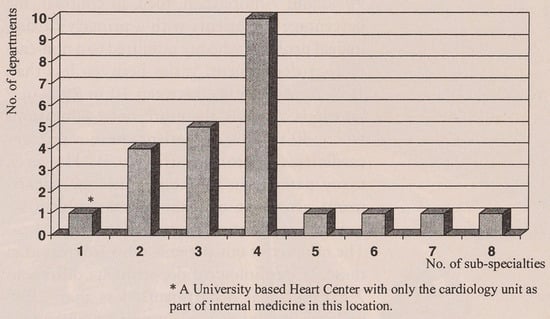
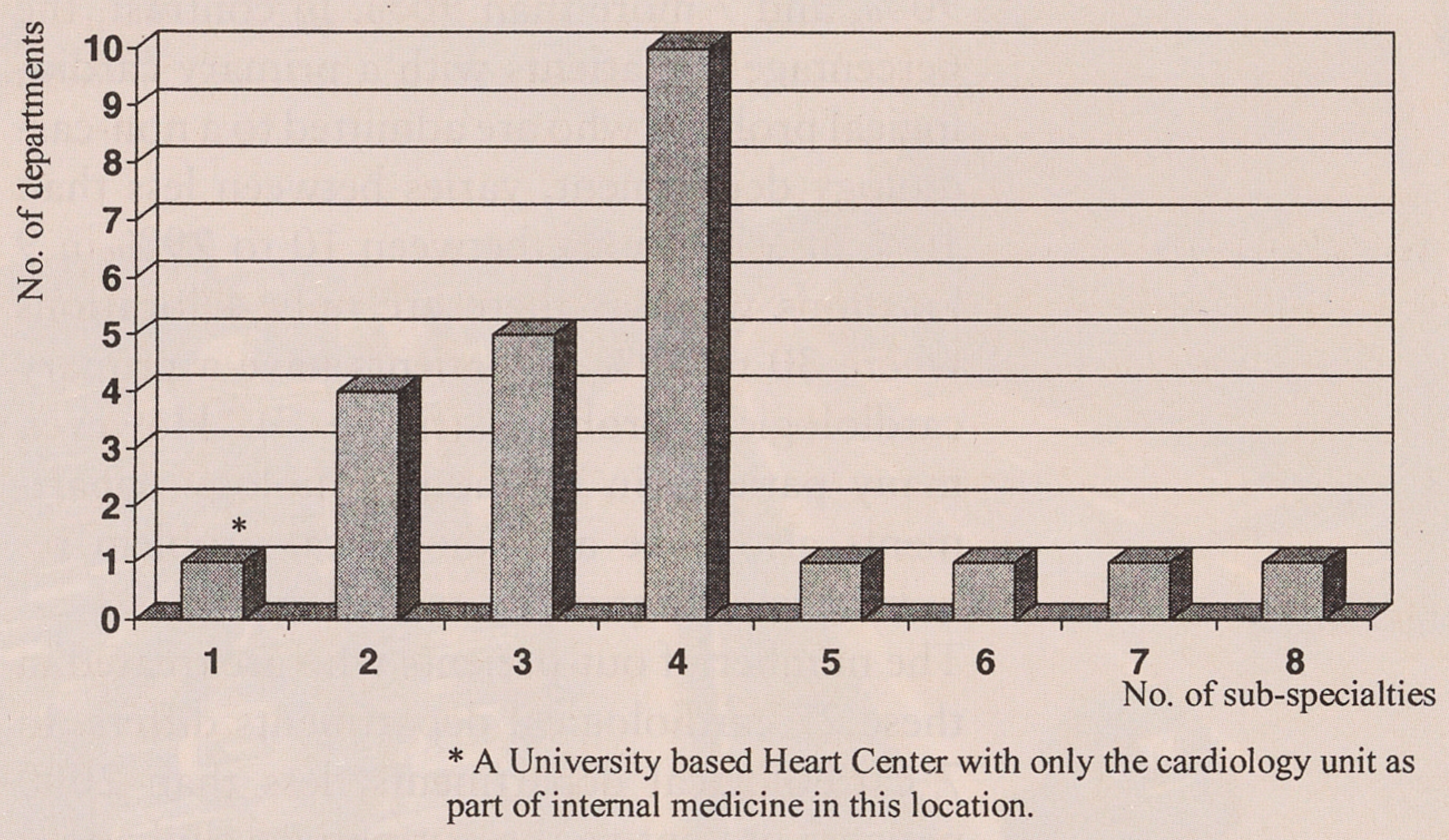
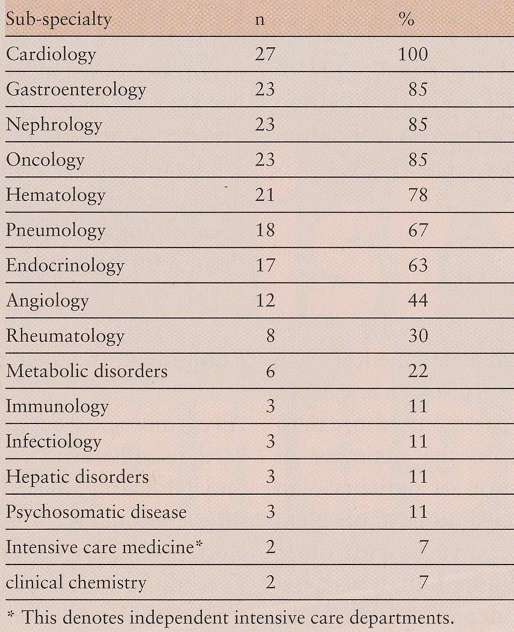
In Germany, internal medicine usually is divided into different sub-specialities (Table 1). In all locations, cardiology was among the 16 different sub-specialities. Figure 1 shows the distribution of the number of sub-specialities per location. As an example, Figure 2 gives the structure of the Departments of Internal Medicine at the University of Münster. In more than half of all locations, there were either 3 or 4 departments of sub-specialities of internal medicine. More than 4 (up to 8) sub-specialty departments existed in only one location each. Thus, a total of 3 to 4 departments seems to be considered as the “optimum” by most faculties. Sub-specialities most frequently represented by separate departments, besides cardiology that was present in all locations that responded, included gastroenterology (n = 23), nephrology (n = 23), and oncology and haematology (n = 23 each).
Table 1.
Overall number of sub-specialities of internal medicine in 27 university hospitals.
Figure 1.
Number of sub-specialties per location in 27 university hospitals in Germany.
Figure 2.
The structure of the department of Internal medicine at the Westfälische Wilhelms-University of Münster. Patients are admitted either through the Emergency Admission Ward or directly to the various departments. All departments have specialized out-patient clinics.
Personnel
In these 27 university hospitals, a total of 76 fully tenured professors (C-4) are heads of departments. Another 13 C-3 professors (corresponding to the position of associate professors in a tenured position) exist.
Nearly all cardiological departments have their own medical staff for patient care and for research. Since internal medicine almost exclusively exists in the form of separate departments, 24 of 27 cardiological departments have established a regular rotational program for the medical trainees to offer training within the full spectrum of internal medicine.
Budget
Most of the cardiological departments (25 of 27) have a budget of their own. In only two cardiological departments, there is a common budget which is shared between all sub-specialities at these 2 locations.
Patient numbers
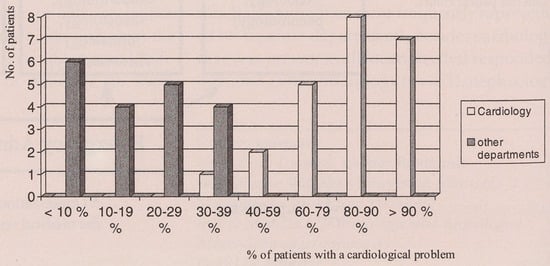
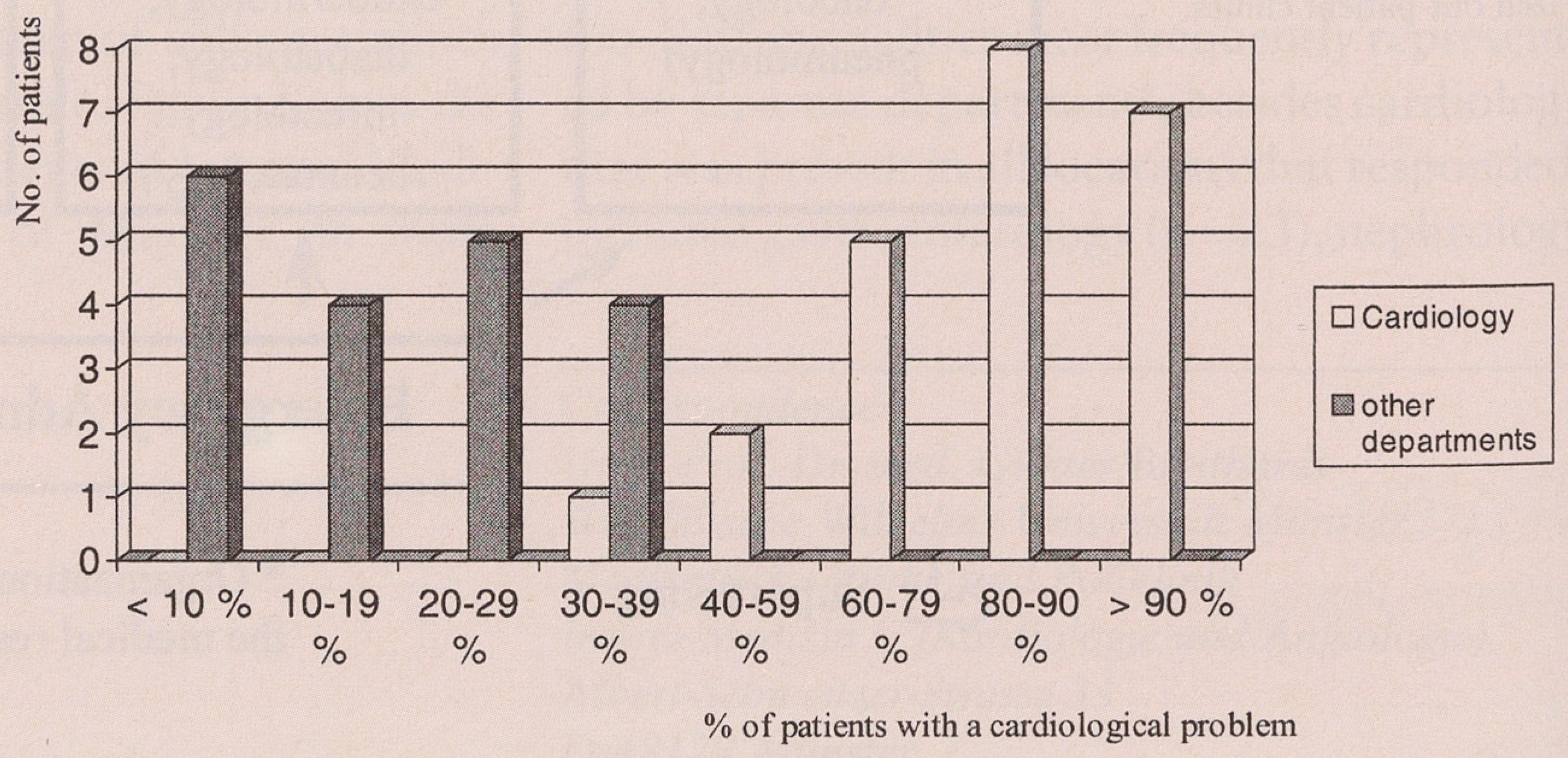
In 52% of the cardiological departments (14 of 27), the number of beds varies between 50 to 100. In 6 cardiological departments, more than 100 beds are available. In the majority of departments, the proportion of patients who primarily present with a cardiological problem is above 60% (i.e., also patients with other major diagnoses are admitted in a varying proportion). In detail, 5 departments accommodated between 60 to 80%, 8 between 80 to 90%, and 7 more than 90%. In contrast, the percentage of patients with a primary cardiological problem who are admitted to a non-cardiology department, varies between less than 10% in 6 locations, between 10 to 29% in 9 locations whereas there are only 4 locations where 30 to 39% of patients have a primary cardiological problem (Figure 3). However, many patients in the non-cardiology departments also have a cardiological problem requiring consultation by cardiologists.
Figure 3.
Number of patients in the departments of cardiology versus other departments who are admitted for a primary cardiological problem. Only those departments that responded, are presented here.
The number of out-patients who are treated in these 27 cardiological departments differs. In 7 cardiological departments, less than 2000 patients present to the out-patient clinic, in 4 cardiological departments, 2000 to 4000 patients, and in another 5 departments, 4000 to 6000 patients are seen whereas 8 cardiological departments see more than 6000 out-patients per year. In 16 cardiological departments, the number of in-hospital patients ranges between 2000 and 4000. Eight cardiological departments see 4000 to 6000 in-hospital patients but 2 cardiological departments treat even more than 6000 patients.
Equipment and special activities
All cardiological departments are equipped with cardiac catheterization facilities allowing right and left heart catheterization, angiography and interventional techniques. Most perform both electrophysiological studies and interventions. Transthoracic echocardiography (TTE) and transesophageal echocardiography (TEE) are integral parts of all cardiological departments as are non-invasive ECG recording and testing facilities.
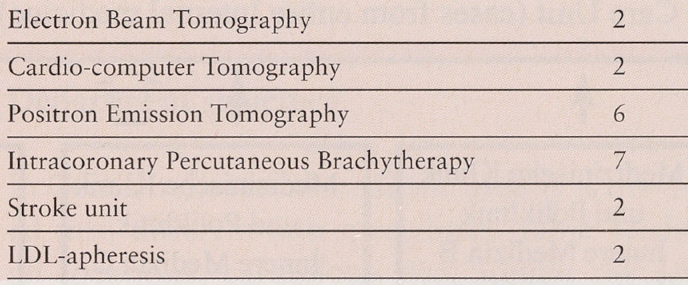
A variety of special diagnostic and therapeutic techniques is offered at most cardiological departments, sometimes in collaboration with other specialities like radiology, nuclear medicine, and recently, radio-oncology (Table 2).
Table 2.
Overall number of sub-specialities of internal medicine in 27 university hospitals.
In almost all cardiological departments, cardiological patients regularly undergo invasive diagnostic procedures and percutaneous interventions, although these patients do not necessarily stay on the cardiological ward. However, the percentage of these patients outside the cardiology departments is quite low (less than 10% in 18 locations, between 10 to 20% and 20 to 30% in 3 locations each). Thus, most of the patients are admitted to and managed in cardiological departments.
Nearly all cardiological consultants (“Oberärzte”) (in 24 of 27 cardiological departments) participate in the consultant service for internal medicine patients. Nearly all cardiological departments (n = 25) offer a permanent service for heart catheterization and coronary interventions throughout 24 hours a day and during weekends and holidays.
The majority of cardiological departments (23 of 27) have their own cardiological intensive care unit on which only the cardiological staff is responsible. In 11 locations, an interdisciplinary intensive care unit for internal medicine altogether exists (the overlap between these two types is explained by the fact, that in some places, both types coexist).
Quite a number of cardiological departments have established clinics for special cardiovascular problems to deal with pacemaker patients, patients with heart failure, patients before and after heart transplantation, patients with peripheral vascular disease, patients with implantable cardioverters/defibrillators, and patients with special rhythm disturbances. Furthermore, one department also manages patients with psychosomatic problems.
Research programs
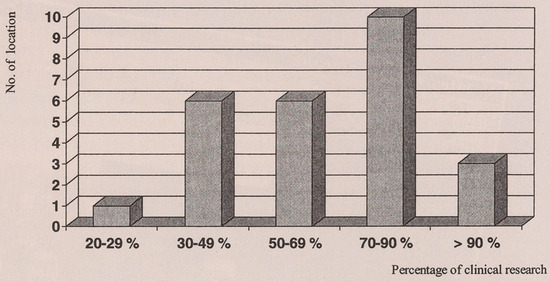
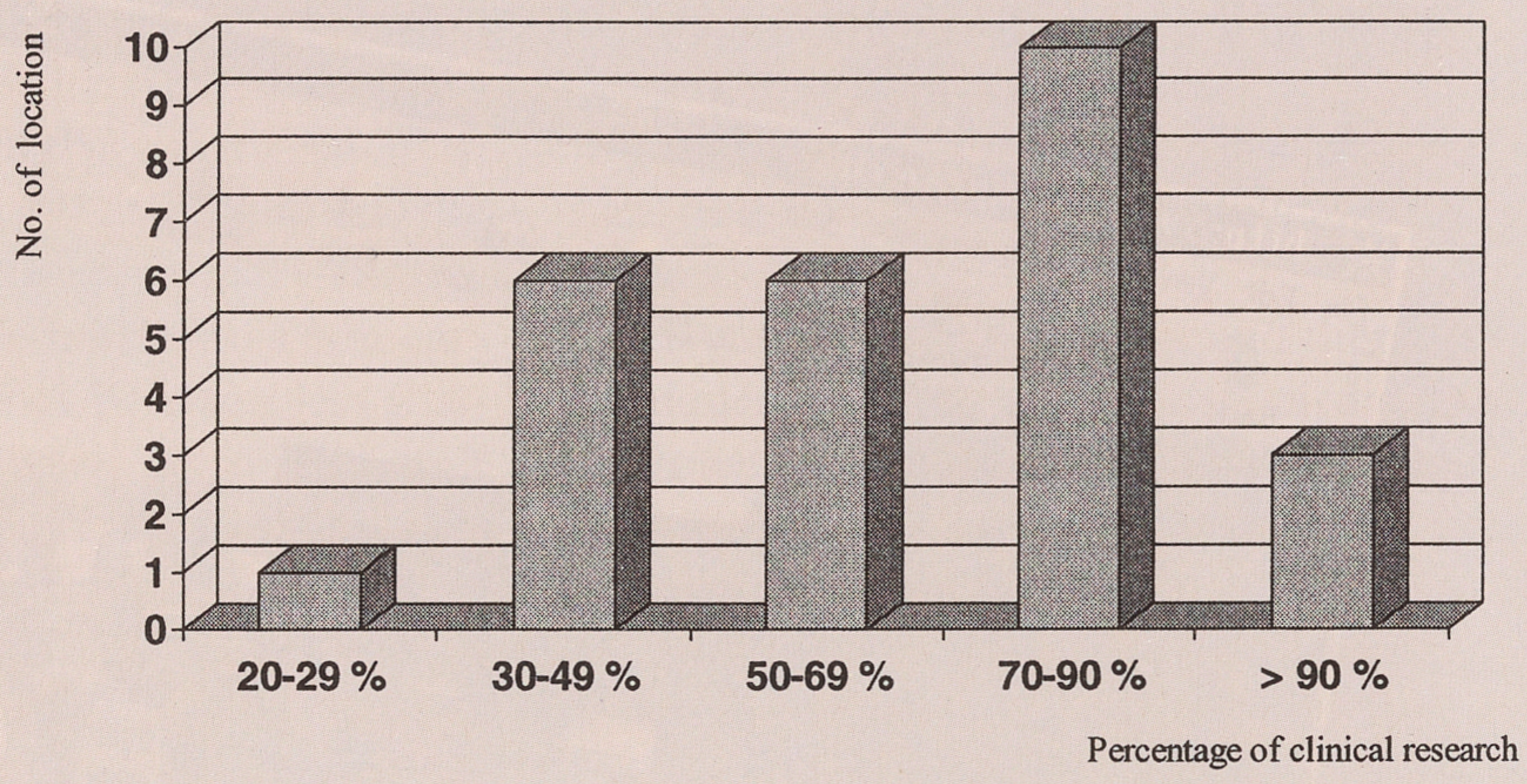
In most of the departments, some basic science-oriented research is performed although clinical research dominates (Figure 4). Thirteen of the locations classified more than 70% of their research as clinical research. In contrast, seven locations do more basic science-oriented research than clinical research. The majority of these departments deal with more clinically orientated questions. The minority concentrates on basic science research programs.
Figure 4.
Proportion of clinically oriented research as percentage of total research activities. The bars indicate the number of locations that perform clinical research up to a given proportion.
Conclusion
This short interim report from an ongoing survey on the structure and function of cardiology departments in Germany is restricted to university hospitals. It will soon be expanded in the number of items asked and extended to other, non-university hospitals. This is part of a strategic plan of the German Cardiac Society which assesses the future needs for resources in cardiology, especially with regard to manpower planning and equipment.
We would like to thank those departments, their heads and staff that responded to our questionnaire: Aachen, Bad Nauheim, Bad Oeynhausen, Berlin, Berlin-Buch, Bochum, Bonn, Dresden, Erlangen, Essen, Giessen, Göttingen, Greifswald, Halle, Hannover, Herne, Jena, Kiel, Köln, Lübeck, Mainz, Marburg, München, Münster, Regensburg, Tübingen, Ulm.

© 2001 by the author. Attribution-Non-Commercial-NoDerivatives 4.0.