


In 1999 cardiology was finally accredited as a full specialty by the Swiss Federation of Physicians (FMH), after having been increasingly disenchanted with its status as a subdiscipline of internal medicine over the past two decades. On this occasion, the Board of the Swiss Society of Cardiology decided to dedicate a special issue of its publication organ to the role of cardiology in medicine in Switzerland.
To fully appreciate the requirements for cardiology in this country to function at its best, a status paper by a task force on the current and future structure of cardiology in tertiary hospitals in Switzerland is presented. The issue also contains articles of opinion leaders of European countries describing the role of cardiology in their environment. Finally, an experienced practicing cardiologist and member of the Board was asked to give an assessment of the role of the cardiologists in private practice in Switzerland.
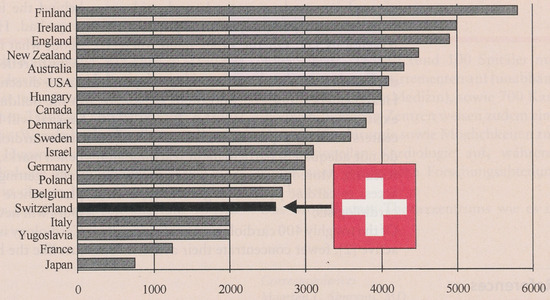
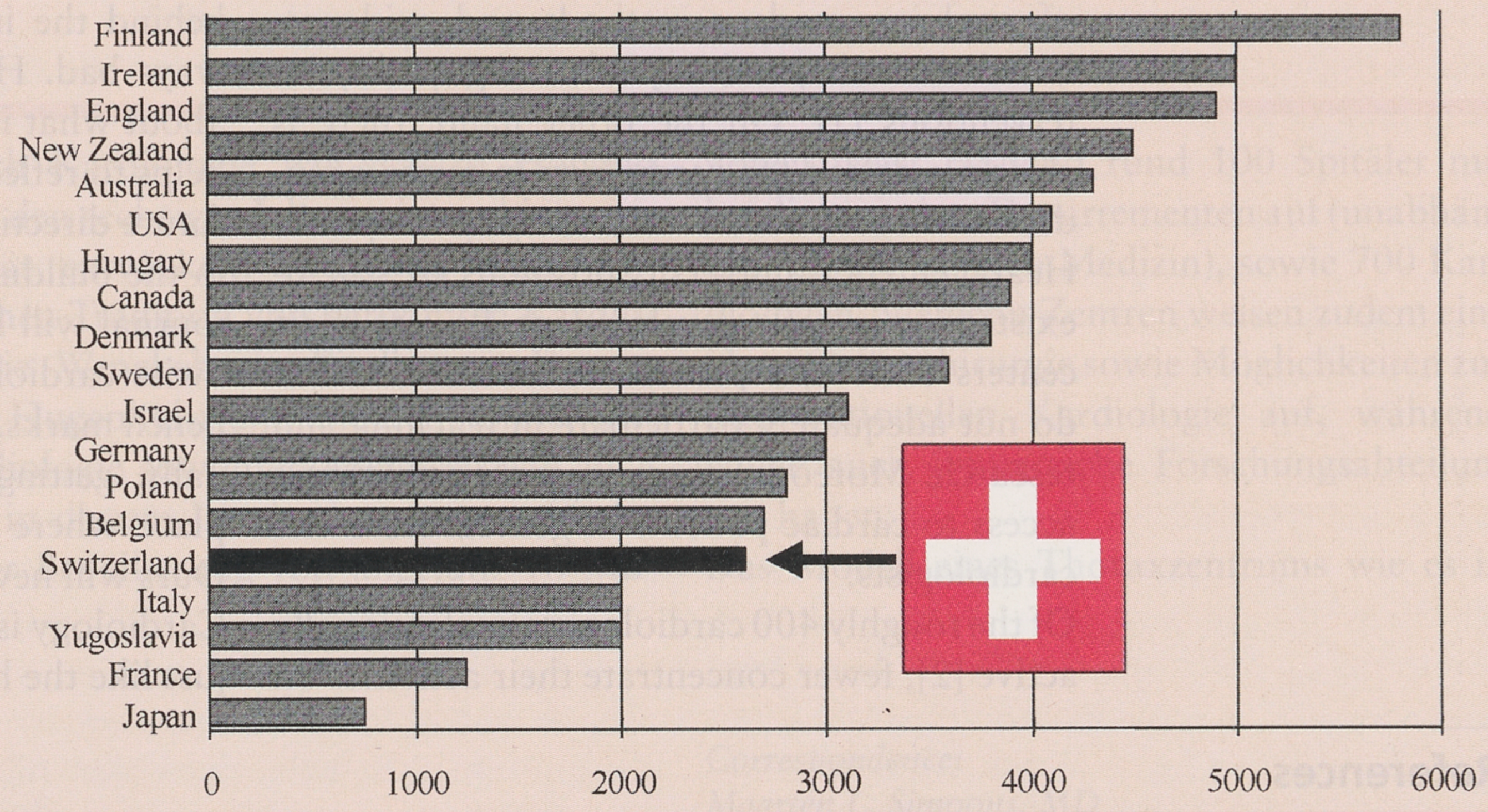
Cardiovascular disease represents the leading cause of mortality in Switzerland as in the majority of industrialised countries. Roughly 40% of deaths are on its account and about 4000 inhabitants per 1 million die of it every year. Switzerland has a relatively low mortality rate of cardiovascular disease compared with other countries, and there is an apparent affinity to the culturally congruent neighbours. Mortality rates in the German speaking part of Switzerland are similar to those of Germany, and the same holds true for the Italian and French speaking parts, respectively (fig. 1). This may be due to genetics, life style, or diet. Likely, it is partially due to variations in the definition of the cause of death.
Figure 1.
Death rates per 1 million of inhabitants and year for coronary artery disease, the most important of the cardiovascular diseases. The mortality in Switzerland is about half of that of Finland but twice that of France.
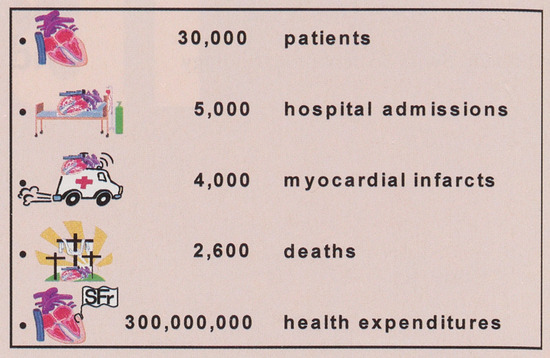
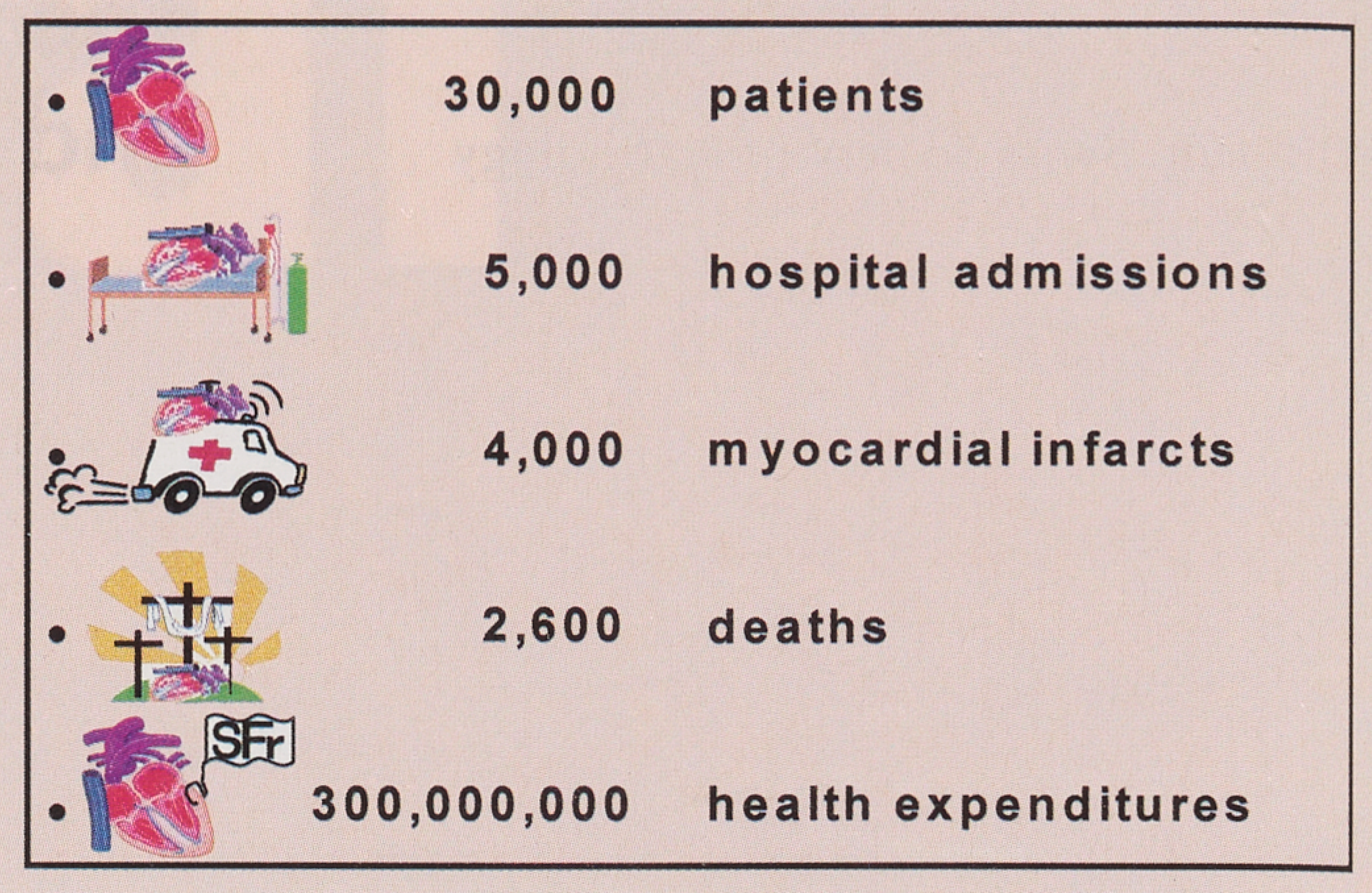
Cardiovascular problems are also the most frequent reason for hospitalisations and one of the leading reasons for outpatient visits and drug prescriptions. Among cardiovascular problems, coronary artery disease accounts for more than half of morbidity and mortality. Figure 2 depicts estimates of the implications of coronary artery disease for the Swiss health care system.
Figure 2.
Estimates of yearly key figures of coronary artery disease in Switzerland per 1 million of inhabitants.
While the incidence of coronary artery disease adjusted for age has decreased since 1970, the prevalence continues to increase with the growth of the proportion of elderly people.
The cardiologist is the specialist not only for this disease but also for another rampaging epidemic, i.e., heart failure. With a prevalence approaching 2%, an incidence of about 0.2% per year, and a mortality of about 30% per year, heart failure is another serious affection warranting professional attention.
Cardiology has a long tradition in Switzerland. Eminent people such as Holzmann and Duchosal have laid the ground. Gruentzig has introduced coronary angioplasty to the world in 1977 in this country, one of the break throughs of cardiology in the past century. Switzerland compares well with western countries in terms of applying modern methods and evidencebased medicine, and in performing quality interventions [1]. On the other hand, there is clearly a deficit for cardiology in terms of independence of action at university hospitals. Heart centers at university hospitals are still inexistent or in early development. Private heart centers exist and provide excellent care but do not adequately participate in teaching and research. Moreover, there is insufficient direct access to cardiac patients in general for Swiss cardiologists.
Of the roughly 400 cardiologists professionally active [2], fewer concentrate their activities on cardiology in terms of primary care for cardiac patients than in neighbouring countries. Besides, the density of practicing cardiologists (50 per million inhabitants) is lower than that of, e.g., France (80) or Italy (90).
Health expenditures for cardiovascular disease amount to about 10% of the Swiss gross domestic product which is comparable to the situation in Germany and France. However, these means are invested in a health care system that is less structured and specialised than in the neighbouring countries. Significant cost is generated by initial care delivered by generalists before specialised care is summoned. While in the past this may have saved cost, simply by keeping the patient away from the more efficient professional care [3], this is no longer accepted by a population much better informed about medical issues.
The garden behind the fence is not always the garden Eden. The view of the involved and the informed is not always the best view. Dragging behind the international evolution is not always bad. However, it helps to be informed about what is going on outside the country. It helps to reflect on the current position and the future direction. It helps to actively participate in the building of the future. This issue of the journal will hardly beget a better situation of Swiss cardiology on its own. Yet, it provides bench marks, goals, and means to get there. Finally, getting there only means to reach the place where the next goal comes into sight. Ours will never be a time to rest complacently. Cardiology is destined to always pound ahead, just like the heart.
References
- Roffi, M. Arbicigruppc PTCA und Fibrinolyse der Schweizerischen Gesellschaft für Kardiologie. Herzeingriffe in der Schweiz 1998. Kardiovask. Med. 2000, 3, 89–103. [Google Scholar] [CrossRef] [Scilit]
- Venzin, R.; Lüscher, T.F. Demographische Untersuchung: Kardiologie in der Schweiz. 1. Entwicklung der letzten Jahre und gegenwärtiger Stand. Kardiovask. Med. 1999, 2, 89–99. [Google Scholar] [CrossRef] [Scilit]
- Nash, I.S.; Nash, D.B.; Fuster, V. Do cardiologists do it better? J. Am. Coll. Cardiol. 1997, 29, 475–478. [Google Scholar] [CrossRef] [Scilit] [PubMed]
© 2001 by the author. Attribution - Non-Commercial - NoDerivatives 4.0.