


Abstract
The actual guidelines on the treatment of pulmonary arterial hypertension (PAH) advocates, besides the prescription of nonspecific measures such as oxygen and diuretics, the sequential use of PAH-specific drugs according to predefined clinical targets. The PAH drugs licensed for this indication amount to 9 different compounds divided into three main therapeutic classes. Although most clinical studies, except for the most recent ones, were of short duration with questionable primary endpoints, there is some evidence that these specific therapies have improved the morbidity and the mortality of the disease. In addition to pharmacological treatment, pulmonary rehabilitation has also recently been shown to be beneficial in these patients. Despite all this encouraging progress, PAH remains an incurable disease, and further therapeutic modalities are much awaited.
Introduction
Pulmonary arterial hypertension (PAH) is a severe chronic condition for which there is no cure up to the present time. However, the better understanding of the pathophysiology of the disease has allowed for an evidence-based therapeutic strategy that has greatly improved the morbidity and the prognosis of patients with PAH. Since 1998, 4 international consensus conferences have been organised on this topic, the most recent one in Nice in February 2013. In this clinical review, we will summarise the knowledge acquired so far on PAH treatment, based on the proceedings of this conference [1,2] together with more recent studies published within the last 18 months.
Nonspecific therapy
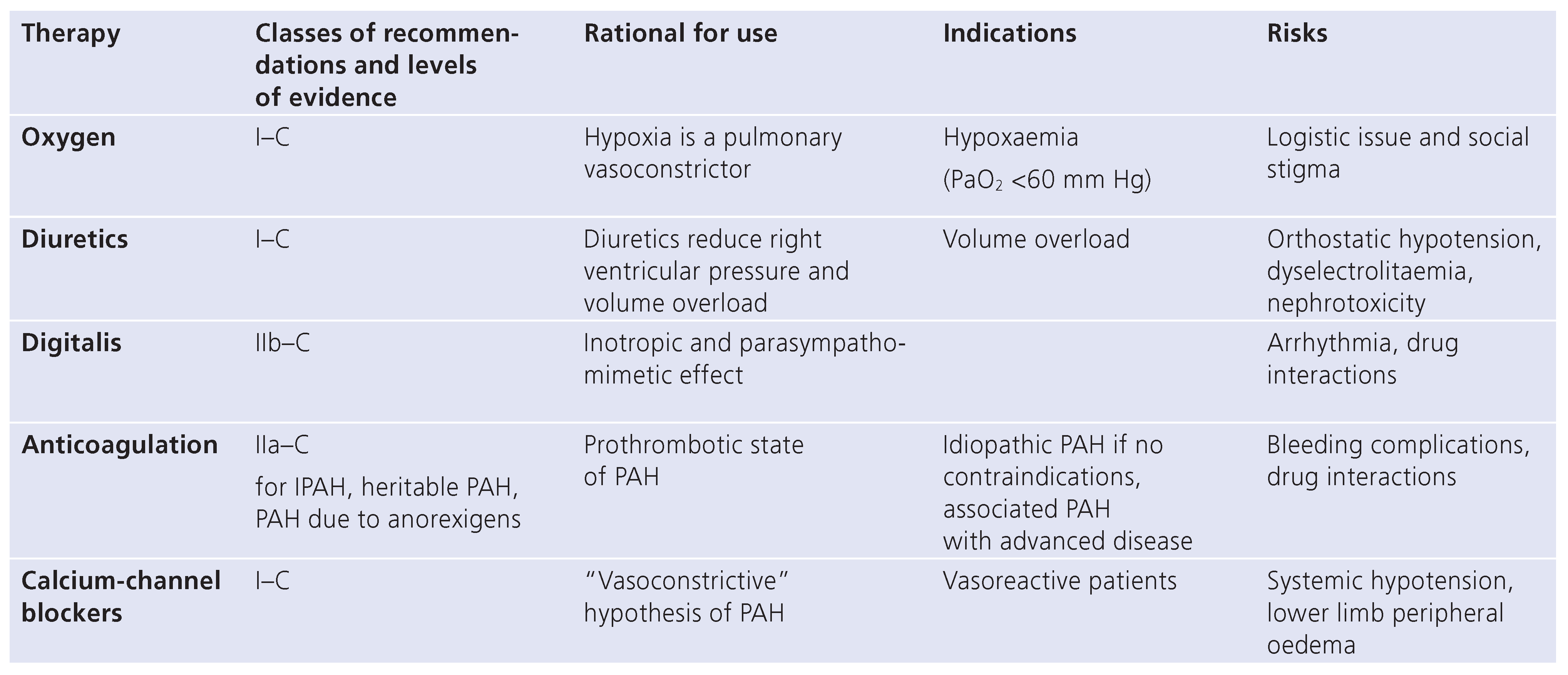
Nonspecific supportive therapies in PAH, including oxygen, diuretics, digoxin and anticoagulation are supported by expert opinions despite the lack of randomised controlled studies for most of these drugs and the recent advances in PAH-specific drugs. The indications for the prescription of these supportive treatments are usually adapted from guidelines applied to other more common cardiopulmonary diseases but without formal proof of efficacy in PAH. In addition, their use is also based on the current pathologic understandings of PAH and on some evidence extrapolated from small studies. For a review, see ref [3]. A summary of the use of supportive therapy, and evidence for this, is given in Table 1.
Table 1.
Nonspecific PAH therapy.
Oxygen therapy
The use of oxygen therapy has been extrapolated from data in patients with chronic obstructive pulmonary disease, and is already recommended when PaO2 is consistently <60 mm Hg [2]. This indication is controversial in congenital heart disease-associated PAH as a randomised controlled study in 23 adult patients showed no improvement in 6-minute walk distance (6-MWD), quality of life and survival with nocturnal oxygen administration [4]. Ambulatory O2 therapy may be considered when there is symptomatic benefit and correctable desaturation on exercise [5]. In addition, a recent study suggests a benefit on exercise capacity when nocturnal oxygen is administered to PAH patients [6].
Altitude exposure may worsen pre-existing hypoxaemia and current air travel recommendations propose for patients with NYHA functional class III and IV to have in-flight oxygen administration [5]. However, an uncontrolled study in 36 PAH patients suggested that functional class does not predict hypoxaemia during a hypoxic challenge testing and that its assessment does not identify patients who may have symptoms during aircraft travel [7].
Diuretics
Diuretics are beneficial in patients with signs of volume overload. Systemic hypotension should not be considered an absolute contraindication because the causative factor is decreased cardiac output due to PH and not decreased circulating volume. Loop diuretics are the first-line therapy. Animal experiments show evidence for attenuation of pulmonary artery hypertrophy when the mineralocorticoid receptor is antagonised [8]. In addition, similarities in left and right ventricular failure on the renin-angiotensin system suggest that for patients in functional class III or IV, the addition of aldosterone antagonists may also be beneficial, but caution must be taken for patients with renal failure, diabetes and at risk for hyperkalaemia [9]. For patients with clinical right heart failure, associated oedema of the mucosa of the GI tract, intravenous administration of diuretics may be more efficient and beneficial [10].
Digitalis
Except for patients with atrial fibrillation or flutter in whom digoxin slows ventricular rate, its long-term effect in PAH is unknown. Its use is controversial, especially as it has potential toxicity which is increased in case of renal failure or drug interaction.
Anticoagulation
The survival benefit of anticoagulation therapy in patients with idiopathic, heritable and anorexigen-induced PAH was suggested by a few observational studies before or in the early era of PAH specific therapy and is now supported by the analysis of the CompERA register including incipient subjects since 2007 [11,12]. Anticoagulation needs to be balanced against the risk of bleeding. On the other hand, the use of anticoagulants was not associated with any survival benefit in patients with other forms of PAH. In our experience the major concern is gastrointestinal haemorrhage. This particularly affects patients with systemic sclerosis who are prone to gastro-intestinal bleeding because of endoluminal telangiectasia and patients with porto pulmonary associated PAH. Despite the lack of controlled trials, it seems appropriate not to use warfarin in these patients [13]. Drug interaction is also of concern, especially for the new anticoagulants. Warfarin therapy, or other anti-vitamin K drugs, remains the recommended form of anticoagulation although the target INR has not been defined. Low-molecularweight heparin and direct factor Xa inhibitors have not been studied in humans with PAH.
Specific therapy for PAH in adults
Currently approved drugs for PAH
For the last two decades, calcium channel blockers (CCB) have been the cornerstone of therapy for the 5–10% of PAH patients who respond acutely to inhaled nitric oxide (NO) (or alternatively iloprost [14], epoprostenol or adenosine [15,16]) with a striking decrease of pulmonary pressure and preserved or increased cardiac output. Of note, only half of the initial responders experience sustained haemodynamic benefit at 1 year on CCB. They thus require frequent monitoring for residual vasoreactivity with right heart catheterisation [17].
During the same period, approved drugs for nonvasoreactive PAH have evolved from 1 available molecule, intravenous epoprostenol, to presently 9 compounds with a level of recommendation from class I to IIa according to the proceedings of the 2013 World Symposium on Pulmonary Hypertension [2]. The main target of all these compounds is the pulmonary artery (PA) smooth muscle cell with an inhibition of constriction and proliferation either along the endothelin-1 (ET-1), the NO/guanylate cyclase, or the prostacyclin (PGI2) pathways.
Endothelin receptor antagonists
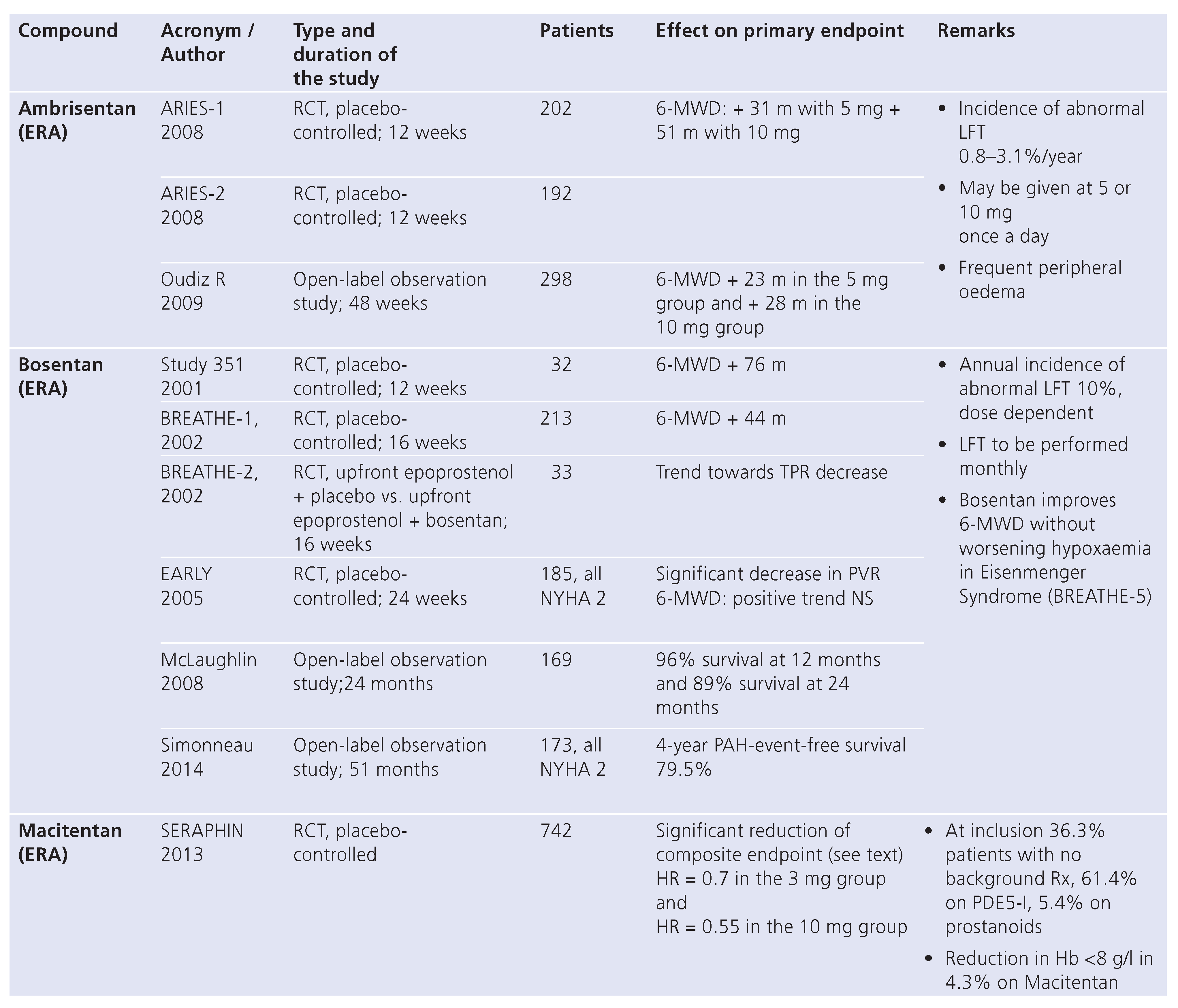
ET-1 is a potent vasoconstrictor with the ability to induce smooth muscle cell proliferation through the binding of the endothelin receptor A and B (ETA/ ETB). Selective ETA antagonist ambrisentan and dual ETA/ ETB antagonist bosentan are oral drugs that were approved for PAH therapy on the basis of results of 12–16-week randomised, placebo-controlled trials demonstrating their efficacy in improving exercise capacity as measured by the 6-MWD (Table 2, Table 3 and Table 4). Long-term open-label studies have confirmed the benefit of this class of medication [18,19,20,21], including initially, mildly symptomatic patients [22]. Increased incidence of peripheral oedema, potentially harmful elevation of hepatic aminotransferases, mild anaemia and headaches are the major side effects of these 2 drugs. With bosentan, the annual rate of aminotransferase elevation is about 10%, and 3.2% of patients on this medication had to discontinue the drug for this reason in a 30-month surveillance study of 4994 patients [23]. Aminotransferase elevation was found to be dose-dependent and reversible after drug reduction or discontinuation, with no permanent liver injury. In spite of this hepatotoxicity, first-line bosentan therapy appears to be safe in portopulmonary hypertension (PoPH), as recently shown in a retrospective study of 34 patients with Child-Pugh A and B cirrhosis [24]. Finally, bosentan is cleared by CYP3A4 and CYP2C9 and is also an inducer of these 2 enzymes. Serum concentrations of concomitant drugs metabolised by CYP3A4 and CYP2C9 may thus be decreased, but it is most important to avoid strong inhibitors of these enzymes that would enhance bosentan toxicity. With ambrisentan, the risk of liver injury appears lower and unrelated to the dose, with a 3.1% incidence of elevated serum aminotransferase concentrations >3 times the upper limit of normal in a 24-week trial [25]. Ambrisentan can also be safely administered to patients who discontinued bosentan because of elevated liver enzymes [26]. Drug-drug interactions are also of less importance with ambrisentan which is mainly cleared by glucuro-conjugation. The ETA-selective antagonist sitaxentan has been withdrawn due to severe cases of liver toxicity.
Table 2.
ERA.
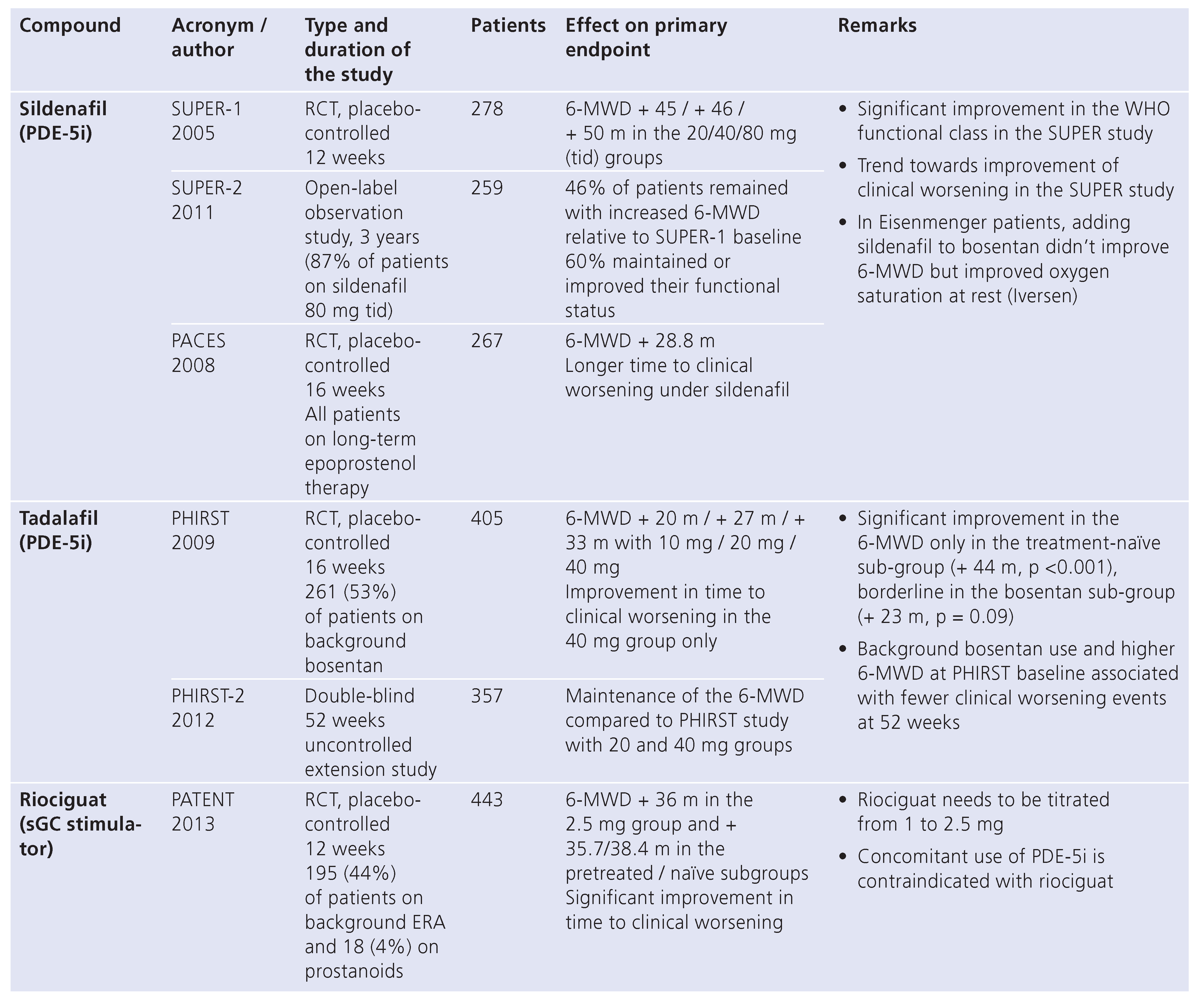
Table 3.
PDE-5i.
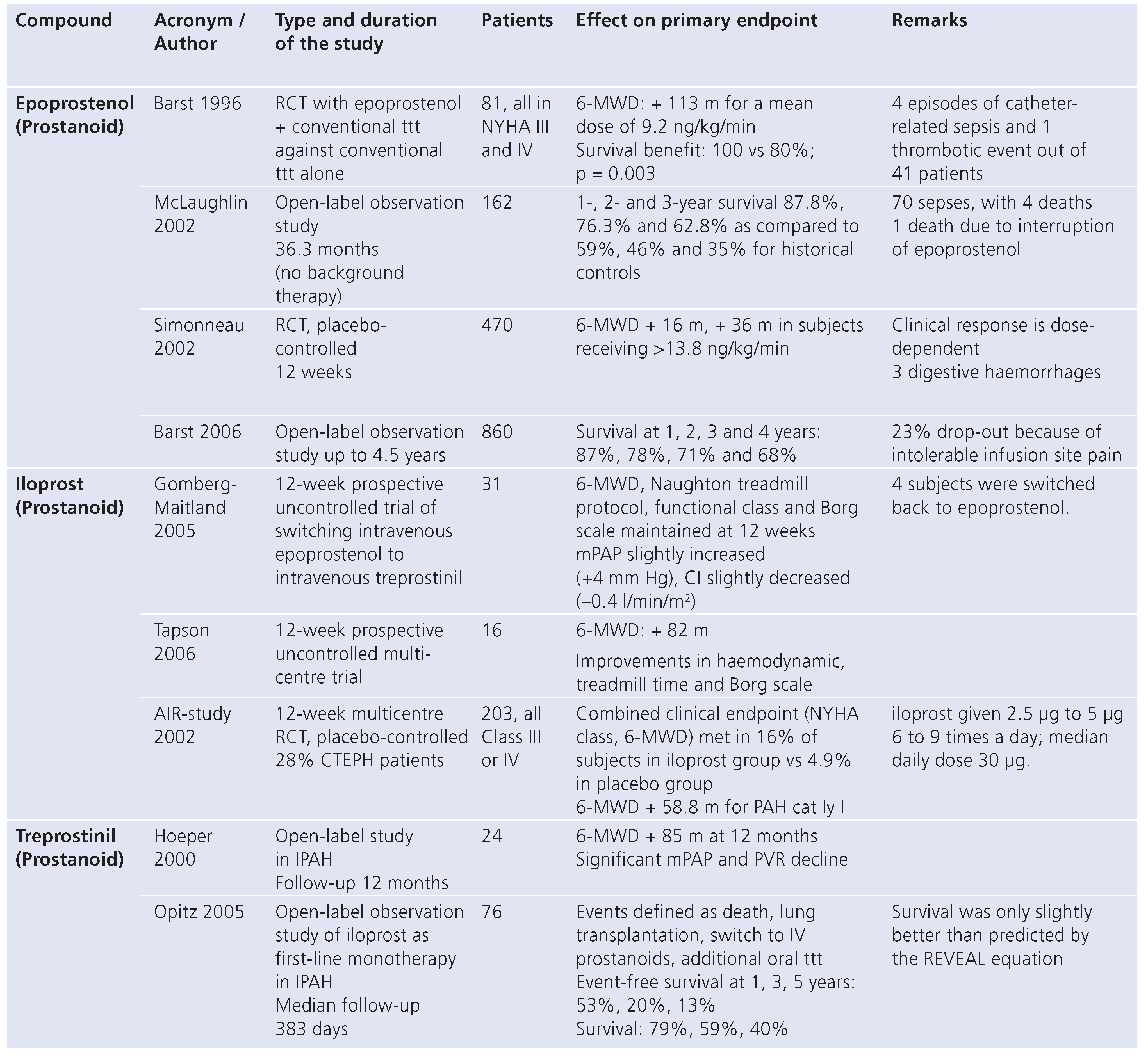
Table 4.
Prostanoid.
The most recent member of the endothelin receptor antagonist family (ERA) on the market, macitentan, is a dual ETA/ETB antagonist with high lipophilicity and long-lasting pharmacologically active metabolites, enabling enhanced tissue penetration and more sustained receptor binding [27]. These properties allow a once-a-day regimen with significantly lower drug doses and optimised safety profile compared to bosentan, with no effect on liver enzymes in a phase II trial [28]. However, as ERA-induced aminotransferase elevations are typically seen after repeated dosing and sometimes months on therapy, longer trials are needed to truly demonstrate a lack of liver toxicity with that new compound [29]. Macitentan is the first ERA to have been studied in a long-term event-driven trial with a composite primary endpoint of mortality, atrial septostomy, lung transplantation, initiation of treatment with prostanoids, or PAH worsening. Actually, macitentan significantly reduced this primary endpoint to 31.4% in the 10 mg dose group and to 38% in the 3 mg dose group, compared to 46.4% in the placebo group [30]. The number-needed-to-treat in that study was 6, with a positive effect in both naïve patients as well as those already under background PAH therapy. In this study, macitentan was well tolerated, but anaemia occurred in 13.2% of treated patients, with haemoglobin levels falling to <80 g/l in 4.3% of subjects.
Drugs acting on the NO/guanylate cyclase pathway
The nitric oxide (NO)-cyclic Guanosine Monophosphate (cGMP) pathway plays a pivotal role in the homeostasis of pulmonary vascular tone. NO is synthetised in the PA endothelial cells from L-arginine by the “e” isoform of NO synthase and passively diffuses in PA smooth muscle cells as a very low weight molecule. There, NO activates soluble guanylate cyclase (sGC) to generate cGMP which in turn induces vasor elaxation and inhibits smooth muscle cell growth [31]. In PAH, NO bioavailability can be reduced by numerous mechanisms [32] and sGC may be unresponsive to NO in conditions of oxidative stress [33]. Furthermore, phosphodiesterase (PDE) type 5, which is the predominant PDE isoform in lung vessels and which hydrolyses and inactivates cGMP, is found to be greater in lung homogenates and pulmonary arteries of patients with PAH. Consequently, the 3 orally active PDE-5 inhibitors (PDE-5i) initially licensed for the treatment of erectile dysfunction were evaluated in PAH, but only sildenafil and tadalafil are currently approved in this indication (Table 2, Table 3 and Table 4). Both drugs cause significant pulmonary vasodilation in PAH patients, with maximum effects after 60 and 75–90 minutes respectively [34], and sildenafil has also been shown to inhibit the proliferation and to stimulate the apoptosis of PA smooth muscle cells in vitro [35,36]. As for the two first ERA compounds, sildenafil and tadalafil were approved on the basis of results of a 12- to 16-week randomised placebo-controlled trial demonstrating their efficacy by improving exercise capacity (Table 2, Table 3 and Table 4) [37,38]. The SUPER-1 study showed no difference in the 6-MWD between patients on 20 mg, 40 mg or 80 mg doses of sildenafil leading the US and European regulatory authorities to license that drug at 20 mg thrice a day in the PAH indication. Nevertheless, pulmonary vascular resistance decreased linearly with increasing sildenafil doses and many physicians continue to uptitrate their patients to 80 mg 3 times a day if necessary despite off-label use [39]. The open-label extension of the SUPER-1 study suggested long-term efficacy of sildenafil given at 80 mg thrice (Table 2, Table 3 and Table 4) but uncertainty remains with the 20 mg dose [40]. Of note, the PACES trial also showed that sildenafil uptitrated to 40–80 mg improved exercise capacity and time to clinical worsening in patients under background epoprostenol therapy, and the 7 reported deaths all occurred in the placebo arm of the study [41].
Compared to sildenafil, tadalafil has a longer plasma half-life (17.5 hours compared to 4 hours), can be given once a day and increases 6-MWD in a dose- dependent manner, the most effective dose being 40 mg (Table 2, Table 3 and Table 4) [38]. In patients receiving either tadalafil 20 or 40 mg, the improvements in 6-MWD demonstrated in the 16-week PHIRST study appeared sustained for up to 52 additional weeks of treatment in PHIRST-2 [42]. Both drugs are generally well tolerated and most side effects are essentially related to vasodilation like headache, flushing, epistaxis, dyspepsia, diarrhoea, myalgia and hypotension. Ocular complications with blurred vision and altered colour perception due to a sildenafil effect on the retinal PDE type 6 were described, but doses up to 80 mg thrice daily have recently been shown to be safe in an ocular perspective [43].
Riociguat belongs to a novel class of drugs able to activate sGC in its oxidised form independently of NO and to sensitise sGC to low endogenous NO levels [44]. This NO-independent production of cGMP might confer to riociguat a potential therapeutic advantage on PDE-5i whose effect depends on NO availability which is typically reduced in PAH. At a 1.0–2.5 mg dose given 3 times a day and titrated according to blood pressure, riociguat decreased PA pressure while cardiac index increased in a phase II study involving 33 PAH patients [45]. In October 2013 and January 2014, the FDA and the EMA approved riociguat in PAH on the basis of a phase III trial showing 12-week significant improvement in exercise capacity with a favourable safety profile (Table 2, Table 3 and Table 4). The most common serious adverse event in the placebo group and the 2.5 mg-maximum group was syncope (4% and 1%, respectively). Hypotension occurred in 10% of patients in the 2.5 mg-maximum group, but most cases were mild or moderate [46].
Prostanoids
Prostacyclin (PGI2) is a member of the prostaglandin family that stays as the third major mediator of endothelial function after ET-1 and NO in PA. PGI2 is produced in PA endothelial cells by PGI2 synthase, whose expression is severely reduced in PAH [47]. It exerts a relaxation and anti-proliferative effect on PA smooth muscle cells through binding to PGI2 receptor which is also down-regulated in PAH [48]. In addition, PGI2 is a potent inhibitor of platelet aggregation. From the mid 1990s, when there was still no effective treatment option for PAH, epoprostenol, a stable freezedried preparation of PGI2, has transformed the care of PAH patients. Actually, rapid escalating doses of epoprostenol (2–12 ng/kg/min) were first shown to increase cardiac output and decrease PVR by +56% and -43% respectively, in patients with severe PAH [49]. These observational data led to a randomised trial that demonstrated improvements in functional capacity, quality of life, functional class and survival at 12 weeks with epoprostenol (Table 2, Table 3 and Table 4) [50]. Of note, the benefit of epoprostenol was not predicted by the shortterm haemodynamic response to the drug, bringing clinical validation to the concept of a therapeutic effect beyond vasodilation. Long-term observational studies confirmed improved outcomes as compared to predicted survival without epoprostenol (Table 2, Table 3 and Table 4), but also pointed at the difficulties of conducting such a chronic parenteral therapy. The short plasmatic halflife (~ 6 minutes) of epoprostenol is responsible for severe rebounds of pulmonary pressure with potentially fatal acute right heart failure in case of trouble associated with the intravenous catheter or with the pump delivering the drug [51]. For these reasons, epoprostenol is often considered as first-line therapy only for functional class IV patients or in combination therapy in patients deteriorating under ERA and PDE-5i. Epoprostenol overdose can also occur with typical side effects of flushing, headache, diarrhoea, hypotension and high cardiac output state. Jaw pain occurs in nearly all patients whatever drug dose [52].
In order to circumvent these limitations, prostacyclin analogues like treprostinil sodium and iloprost were developed for subcutaneous or inhaled administration. Subcutaneous treprostinil is approved for functional classes III and IV PAH with the potential advantages of no need for central venous access (i.e., no risk of catheter occlusion, less risk of bacteraemia and endocarditis, no risk of venous thromboembolism) and minimal risk for sudden clinical deterioration from transient drug interruption (elimination half-life of 2.9–4.6 hours) [53]. Subcutaneous treprostinil is rapidly absorbed with complete bioavailability. At shortterm maximal tolerated dose, intravenous epoprostenol, intravenous treprostinil and subcutaneous treprostinil display similar PVR reductions [54], and treprostinil was shown to increase exercise capacity at 12 weeks when compared to placebo (Table 2, Table 3 and Table 4) [55]. Long-term observational studies also suggested a survival benefit with treprostinil but furthermore mentioned high rates of drug discontinuation due to intolerable infusion site pain and inflammation, which are the major side effects of this therapy [56]. Given these tolerance concerns and that subcutaneous and intravenous administration routes have similar bioa vailability and haemodynamic effects, long-term intravenous therapy was also attempted in PAH with positive results (Table 2, Table 3 and Table 4) [57]. However, there is so far no reliable multicentre randomised placebo-controlled study with intravenous treprostinil [2]. Nevertheless, in order to avoid the risk associated with sudden interruption of intravenous epoprostenol and the tolerability concerns associated with subcutaneous treprostinil, intravenous treprostinil is currently the first choice of parenteral prostanoid therapy for PAH at our institution.
Inhaled iloprost is delivered by specific nebulisers aerosolising the drug to 3 µm diameter particles, which enables rapid diffusion from the terminal airways to adjacent pulmonary arterioles. Peak concentrations in systemic blood are obtained immediately after cessation of the inhalation [58], but due to its short serum half-life (20–25 min), iloprost needs administration 6 to 9 times a day. It was approved by European authorities for class IV PAH on the basis of the AIR study demonstrating 12-week clinical efficacy on a combined clinical endpoint including 6-MWD and functional class [59]. Unfortunately, long-term observational studies displayed conflicting results and one of them concluded that chronic iloprost inhalation had only a limited role in PAH as a first-line monotherapy (Table 2, Table 3 and Table 4) [60]. Furthermore, an additional randomised controlled trial (RCT) failed to show any positive effect of adding inhaled iloprost to bosentan in IPAH patients [61].
It should be clearly emphasised that PAH specific drugs are approved and licensed for PAH, category 1 (Nice 2013) only. Their use in other PH categories, even in the so-called “combined” or “out of proportion” cases are not supported by controlled studies. The only exception at the present time is the use of riociguat for inoperable chronic thromboembolic hypertension [46].
Nonpharmacological treatment: exercise, rehabilitation
Impaired exercise tolerance is a prominent feature of PAH and contributes significantly to reduced quality of life [62,63]. Since 2006, three RCTs have shown that medically supervised aerobic exercise training has beneficial effects in patients with PH as an add-on to disease-targeted medical therapy [64,65,66]. Thus the 5th World Symposium on PH upgraded supervised exercise training as a class 1 recommendation with a level A of evidence [2].
This recommendation applies to patients in NYHA functional class II to III who are stable on medical therapy. Only one uncontrolled study included patients with NYHA functional class IV and the beneficial effect observed in this small cohort – 18 patients with PH of different aetiologies – cannot be generalised [67].
Exercise training increases the level of physical activity and the quality of life, and decreases fatigue severity. It also improves NYHA functional class, exercise endurance, six-minutes walking distance, peak oxygen consumption and peripheral muscle function [64,65,66]. Time to clinical worsening and survival also seem to improve and an economic evaluation of exercise training in PH patients suggests a decrease in healthcare costs [68,69].
The optimal training modalities still have to be determined but exercise training can easily be incorporated into an existing clinical pulmonary or cardiac outpatient rehabilitation programme. The usefulness of adaptations such as high-flow oxygen supply in cyanotic patients or increased physiotherapy in PAH associated with connective tissue diseases still has to be demonstrated.
Severe adverse events including syncope and supraventricular tachycardia associated with the exercise training programme have been described but are rare and are comparable to that of patients in rehabilitation programmes for left heart failure [67]. The American Thoracic Society and European Respiratory Society states that exercise should be discontinued if the patient develops light-headedness, chest pain, palpitations, or syncope [70]. Understandably, high-intensity exercise and Valsalva manoeuvres are not recommended.
As in other diseases, the challenge is to make severely affected patients change their life style and continue regular exercise at home after a training programme.
The challenge of applying results from phase III RCT to daily clinical practice
As in many fields of clinical medicine, the translation of data from randomised controlled trials to the individual patient is not straightforward in clinical practice: patients included in studies are usually not older than 75–80 years, and concomitant disease such as mild COPD, left ventricular diastolic dysfunction, or systemic hypertension are absent. In addition, the inclusion limits of the 6-MWD exclude both frail patients and the well-trained, usually younger ones, from studies.
Another limitation of most of the phase III studies is their short duration, usually from 12–16 weeks, and the reliance on the 6-MWD as the primary outcome, as a surrogate marker for mortality [71]. The observation that a well-conducted rehabilitation programme was able to increase more than twice the gain in the walking distance compared to specific pharmaceutical therapy came as a shock in the PAH community [64,68] and, among other considerations, convinced the drug regulating agencies to adopt more robust and relevant endpoints tested in a longer time frame [71,72]. This is the reason why a composite endpoint, named time to clinical worsening, and resulting from the aggregation of several clinical events considered as markers of disease severity, has been implemented as the primary endpoint in recent clinical studies [71].
Despite this significant improvement in the search for valid surrogate markers for mortality, the prescribing physician remains confronted by many uncertainties:
- Of the three pharmacological classes of drugs available, which one is the best first-line treatment?
- Which criteria to apply for switching from monotherapy to combination therapy?
- How to choose between the several combination therapy regimens available?
- How to handle the patient who falls just out of the strict definition of PAH category 1 (e.g., pulmonary wedge pressure between 15–17 mm Hg, FEV1/FVC between 0.6 and 0.7)?
- Is it necessary to treat exercise-induced PAH?
While the last two questions may remain unanswered for a long time, ongoing studies have the potential to address, at least partially, the first three challenges. In particular the RCT “Ambition” (ClinicalTrials.gov Identifier:NCT01178073) will be the first of its kind to compare upfront monotherapy, either with the ERA ambrisentan or the PDI tadalafil, with a combination of the two drugs. The primary outcome will be a composite index of time to clinical worsening. Results are expected at the end of year 2014.
Monitoring the treatment
Unlike systemic hypertension, pulmonary pressure measurement is not a good marker of treatment efficacy: on the one hand, pulmonary pressure, neither systolic nor diastolic, has determinant prognostic value, and, on the other hand, a decrease in pulmonary pressure may occasionally even be the consequence of a worsening of the disease, due to right heart failure. Therefore, the goals of PAH therapy are a composite of clinical parameters known to be correlated to the prognosis. A practical approach has been proposed in the European guidelines published in 2009 [5]: the main clinical parameters are the NYHA functional class, the 6-MWD, the presence of signs of right ventricle failure, the presence of a pericardial effusion, and the BNP levels. In the USA, the REVEAL cohort has also allowed identification of a set of clinical characteristics that is the base of a prognostic score at the time of diagnosis [73]. Although it makes sense that surrogate markers of survival at diagnosis are also valid markers for follow-up, this has not been formally proven by adequate clinical studies. In other words, it remains to be established that the correction of an unfavourable surrogate marker through a targeted approach (e.g., BNP level), is always paralleled with survival improvement. However, and despite the shortcomings of the already described RCTs, there is some evidence that PAH treatment with the new specific drugs decreases mortality [74].
When the target of treatment is not achieved, it is recommended to combine 2 or 3 drugs from other therapeutic categories [2]. There is no recommendation however on the order of stepping up the drugs. Therefore the physician is free to choose which compounds to add to the baseline treatment. Usually, for practical reasons, preference is given to oral drugs for first- and second-line treatment while prostanoids are often reserved for third-line treatment. Some advocate the upfront instauration of a double drug regimen in patients in NYHA III-IV. A recent pilot study by a French group showed excellent 3-year survival in 19 patients with severe PAH treated with upfront triple therapy [75]. While in severe cases it is judicious not to wait for the usual 3 months before scaling up the treatment, we prefer a minimum of a 1–2-week delay before combining drugs, in order to check for tolerance to the specific drug.
Unmet needs with current PAH treatments
Although the last 15 years were marked by a significant improvement in our understanding and in the management of patients with PAH, the disease remains without cure to date. The survival rate, which is significantly lower in registries than in RCT [76], demonstrates dramatically that PAH is a deadly disease, and few patients are eligible for lung transplantation [76,77,78,79]. It is striking to note that the goal of the present drugs for PAH under study is to decrease the “time to clinical worsening”, whereas the patient and the physician in charge seek therapies aiming at “clinical improvement”.
The availability of oral drugs acting on the prostanoid pathway is also much awaited as the difficulties associated with subcutaneous or i.v. prostanoid derivatives is a significant hurdle to their prescription to patients who are not in NYHA class IV.
Last but not least, specific drugs for PAH are very expensive, and this is a concern in countries where health care management is deficient and resources limited [80].
In conclusion, although the treatment of PAH has significantly improved in the last two decades, there is no room so far for self-satisfaction or for rest on the acquired knowledge. The treatment of PAH remains a palliative one for a too large proportion of patients, despite the many drugs available. As for other chronic diseases like diabetes or COPD, a global disease management approach with pharmaceutical and nonpharmaceutical treatment, involving health care providers together with the patient’s significant others, could be a way to overcome the present limits in PAH care.
Funding/potential competing interests:
Maura Prella has received travel support from Novartis. Patrick Yerly has received travel support and conference remuneration from Actelion and Eli Lilly. John-David Aubert has received travel support from Actelion and Bayer. He has been involved in advisory boards for Actelion, Bayer, Eli Lilly and Novartis.
Abbreviations
| PA | Pulmonary Artery |
| PAH | Pulmonary Arterial Hypertension |
| PH | Pulmonary Hypertension |
| PAP | Pulmonary Arterial Pressure |
| PAWP | Pulmonary Artery Wedge Pressure |
| 6-MWD | 6-minute walking distance |
| ERA | Endothelin Receptor Antagonist |
| PDI | Phosphodiesterase Inhibitor |
| RCT | Randomised Controlled Trial |
References
- Galie, N.; Simonneau, G. The Fifth World Symposium on Pulmonary Hypertension. J Am Coll Cardiol. 2013, 62 (Suppl. 25), D1–D3. [Google Scholar] [CrossRef] [Scilit]
- Galie, N.; Corris, P.A.; Frost, A.; Girgis, R.E.; Granton, J.; Jing, Z.C.; et al. Updated treatment algorithm of pulmonary arterial hypertension. J Am Coll Cardiol. 2013, 62 (Suppl. 25), D60–D72. [Google Scholar] [CrossRef] [Scilit]
- Sauler, M.; Fares, W.H.; Trow, T.K. Standard nonspecific therapies in the management of pulmonary arterial hypertension. Clin Chest Med. 2013, 34, 799–810. [Google Scholar] [CrossRef] [Scilit] [PubMed]
- Sandoval, J.; Aguirre, J.S.; Pulido, T.; Martinez-Guerra, M.L.; Santos, E.; Alvarado, P.; et al. Nocturnal oxygen therapy in patients with the Eisenmenger syndrome. Am J Respir Crit Care Med. 2001, 164, 1682–1687. [Google Scholar] [CrossRef] [Scilit] [PubMed]
- Galie, N.; Hoeper, M.M.; Humbert, M.; Torbicki, A.; Vachiery, J.L.; Barbera, J.A.; et al. Guidelines for the diagnosis and treatment of pulmonary hypertension. Eur Respir J. 2009, 34, 1219–1263. [Google Scholar] [CrossRef] [Scilit] [PubMed]
- Ulrich, S.; Keusch, S.; Hildenbrand, F.F.; Lo Cascio, C.; Huber, L.C.; Tanner, F.C.; et al. Effect of nocturnal oxygen and acetazolamide on exercise performance in patients with pre-capillary pulmonary hypertension and sleep-disturbed breathing: Randomized, double-blind, cross-over trial. Eur Heart J. 2013. [CrossRef] [Scilit]
- Burns, R.M.; Peacock, A.J.; Johnson, M.K.; Church, A.C. Hypoxaemia in patients with pulmonary arterial hypertension during simulated air travel. Respiratory medicine 2013, 107, 298–304. [Google Scholar] [CrossRef] [Scilit]
- Preston, I.R.; Sagliani, K.D.; Warburton, R.R.; Hill, N.S.; Fanburg, B.L.; Jaffe, I.Z. Mineralocorticoid receptor antagonism attenuates experimental pulmonary hypertension. Am J Physiol Lung Cell Mol Physiol. 2013, 304, L678–L688. [Google Scholar] [CrossRef] [Scilit]
- Elinoff, J.M.; Rame, J.E.; Forfia, P.R.; Hall, M.K.; Sun, J.; Gharib, A.M.; et al. A pilot study of the effect of spironolactone therapy on exercise capacity and endothelial dysfunction in pulmonary arterial hypertension: Study protocol for a randomized controlled trial. Trials 2013, 14, 91. [Google Scholar] [CrossRef] [Scilit]
- Barst, R.J.; Gibbs, J.S.; Ghofrani, H.A.; Hoeper, M.M.; McLaughlin, V.V.; Rubin, L.J.; et al. Updated evidence-based treatment algorithm in pulmonary arterial hypertension. J Am Coll Cardiol. 2009, 54 (Suppl. 1), S78–S84. [Google Scholar] [CrossRef] [Scilit]
- Johnson, S.R.; Mehta, S.; Granton, J.T. Anticoagulation in pulmonary arterial hypertension: A qualitative systematic review. Eur Respir J. 2006, 28, 999–1004. [Google Scholar] [CrossRef] [Scilit] [PubMed]
- Olsson, K.M.; Delcroix, M.; Ghofrani, H.A.; Tiede, H.; Huscher, D.; Speich, R.; et al. Anticoagulation and survival in pulmonary arterial hypertension: Results from the Comparative, Prospective Registry of Newly Initiated Therapies for Pulmonary Hypertension (COMPERA). Circulation 2014, 129, 57–65. [Google Scholar] [CrossRef] [Scilit]
- Johnson, S.R.; Granton, J.T.; Tomlinson, G.A.; Grosbein, H.A.; Le, T.; Lee, P.; et al. Warfarin in systemic sclerosis-associated and idiopathic pulmonary arterial hypertension. A Bayesian approach to evaluating treatment for uncommon disease. J Rheumatol. 2012, 39, 276–285. [Google Scholar] [CrossRef] [Scilit]
- Jing, Z.C.; Jiang, X.; Han, Z.Y.; Xu, X.Q.; Wang, Y.; Wu, Y.; et al. Iloprost for pulmonary vasodilator testing in idiopathic pulmonary arterial hypertension. Eur Respir J. 2009, 33, 1354–1360. [Google Scholar] [CrossRef] [Scilit] [PubMed]
- Sitbon, O.; Humbert, M.; Jais, X.; Ioos, V.; Hamid, A.M.; Provencher, S.; et al. Longterm response to calcium channel blockers in idiopathic pulmonary arterial hypertension. Circulation 2005, 111, 3105–3111. [Google Scholar] [CrossRef] [Scilit]
- Zuo, X.R.; Zhang, R.; Jiang, X.; Li, X.L.; Zong, F.; Xie, W.P.; et al. Usefulness of intravenous adenosine in idiopathic pulmonary arterial hypertension as a screening agent for identifying long-term responders to calcium channel blockers. Am J Cardiol. 2012, 109, 1801–1806. [Google Scholar] [CrossRef] [Scilit]
- Judge, E.P.; Gaine, S.P. Management of pulmonary arterial hypertension. Current opinion in critical care 2013, 19, 44–50. [Google Scholar] [CrossRef] [Scilit]
- Blalock, S.E.; Matulevicius, S.; Mitchell, L.C.; Reimold, S.; Warner, J.; Peshock, R.; et al. Long-term outcomes with ambrisentan monotherapy in pulmonary arterial hypertension. J Card Fail. 2010, 16, 121–127. [Google Scholar] [CrossRef] [Scilit]
- Klinger, J.R.; Oudiz, R.J.; Spence, R.; Despain, D.; Dufton, C. Long-term pulmonary hemodynamic effects of ambrisentan in pulmonary arterial hypertension. Am J Cardiol. 2011, 108, 302–307. [Google Scholar] [CrossRef] [Scilit] [PubMed]
- Oudiz, R.J.; Galie, N.; Olschewski, H.; Torres, F.; Frost, A.; Ghofrani, H.A.; et al. Long-term ambrisentan therapy for the treatment of pulmonary arterial hypertension. J Am Coll Cardiol. 2009, 54, 1971–1981. [Google Scholar] [CrossRef] [Scilit]
- Girgis, R.E.; Mathai, S.C.; Krishnan, J.A.; Wigley, F.M.; Hassoun, P.M. Long-term outcome of bosentan treatment in idiopathic pulmonary arterial hypertension and pulmonary arterial hypertension associated with the scleroderma spectrum of diseases. J. Heart Lung Transplant. Off. Publ. Int. Soc. Heart Transplant. 2005, 24, 1626–1631. [Google Scholar] [CrossRef] [Scilit]
- Simonneau, G.; Galie, N.; Jansa, P.; Meyer, G.M.; Al-Hiti, H.; Kusic-Pajic, A.; et al. Long-term results from the EARLY study of bosentan in WHO functional class II pulmonary arterial hypertension patients. Int J Cardiol. 2014, 172, 332–339. [Google Scholar] [CrossRef] [Scilit]
- Humbert, M.; Segal, E.S.; Kiely, D.G.; Carlsen, J.; Schwierin, B.; Hoeper, M.M. Results of European post-marketing surveillance of bosentan in pulmonary hypertension. Eur Respir J. 2007, 30, 338–344. [Google Scholar] [CrossRef] [Scilit]
- Savale, L.; Magnier, R.; Le Pavec, J.; Jais, X.; Montani, D.; O’Callaghan, D.S.; et al. Efficacy, safety and pharmacokinetics of bosentan in portopulmonary hypertension. Eur Respir J. 2013, 41, 96–103. [Google Scholar] [CrossRef] [Scilit]
- Galie, N.; Badesch, D.; Oudiz, R.; Simonneau, G.; McGoon, M.D.; Keogh, A.M.; et al. Ambrisentan therapy for pulmonary arterial hypertension. J Am Coll Cardiol. 2005, 46, 529–535. [Google Scholar] [CrossRef] [Scilit]
- McGoon, M.D.; Frost, A.E.; Oudiz, R.J.; Badesch, D.B.; Galie, N.; Olschewski, H.; et al. Ambrisentan therapy in patients with pulmonary arterial hypertension who discontinued bosentan or sitaxsentan due to liver function test abnormalities. Chest 2009, 135, 122–129. [Google Scholar] [CrossRef] [Scilit]
- Iglarz, M.; Binkert, C.; Morrison, K.; Fischli, W.; Gatfield, J.; Treiber, A.; et al. Pharmacology of macitentan, an orally active tissue-targeting dual endothelin receptor antagonist. J Pharmacol Exp Ther. 2008, 327, 736–745. [Google Scholar] [CrossRef] [Scilit] [PubMed]
- Sidharta, P.N.; van Giersbergen, P.L.; Halabi, A.; Dingemanse, J. Macitentan: Entry-into-humans study with a new endothelin receptor antagonist. Eur J Clin Pharmacol. 2011, 67, 977–984. [Google Scholar] [CrossRef] [Scilit] [PubMed]
- Montani, D.; Chaumais, M.C.; Guignabert, C.; Gunther, S.; Girerd, B.; Jais, X.; et al. Targeted therapies in pulmonary arterial hypertension. Pharmacol. Ther. 2014, 141, 172–191. [Google Scholar] [CrossRef] [Scilit]
- Pulido, T.; Adzerikho, I.; Channick, R.N.; Delcroix, M.; Galie, N.; Ghofrani, H.A.; et al. Macitentan and morbidity and mortality in pulmonary arterial hypertension. N Engl J Med. 2013, 369, 809–818. [Google Scholar] [CrossRef] [Scilit] [PubMed]
- Klinger, J.R.; Abman, S.H.; Gladwin, M.T. Nitric oxide deficiency and endothe-lial dysfunction in pulmonary arterial hypertension. Am J Respir Crit Care Med. 2013, 188, 639–646. [Google Scholar] [CrossRef] [Scilit]
- Morrell, N.W.; Adnot, S.; Archer, S.L.; Dupuis, J.; Jones, P.L.; MacLean, M.R.; et al. Cellular and molecular basis of pulmonary arterial hypertension. J Am Coll Cardiol. 2009, 54 (Suppl. 1), S20–S31. [Google Scholar] [CrossRef] [Scilit]
- Stasch, J.P.; Schmidt, P.M.; Nedvetsky, P.I.; Nedvetskaya, T.Y.; H, SA.; Meurer, S.; et al. Targeting the heme-oxidized nitric oxide receptor for selective vasodilatation of diseased blood vessels. J Clin Invest. 2006, 116, 2552–2561. [Google Scholar] [CrossRef] [Scilit] [PubMed]
- Ghofrani, H.A.; Voswinckel, R.; Reichenberger, F.; Olschewski, H.; Haredza, P.; Karadas, B.; et al. Differences in hemodynamic and oxygenation responses to three different phosphodiesterase-5 inhibitors in patients with pulmonary arterial hypertension: A randomized prospective study. J Am Coll Cardiol. 2004, 44, 1488–1496. [Google Scholar] [PubMed]
- Wharton, J.; Strange, J.W.; Moller, G.M.; Growcott, E.J.; Ren, X.; Franklyn, A.P.; et al. Antiproliferative effects of phosphodiesterase type 5 inhibition in human pulmonary artery cells. Am J Respir Crit Care Med. 2005, 172, 105–113. [Google Scholar] [CrossRef] [Scilit]
- Tantini, B.; Manes, A.; Fiumana, E.; Pignatti, C.; Guarnieri, C.; Zannoli, R.; et al. Antiproliferative effect of sildenafil on human pulmonary artery smooth muscle cells. Basic Res Cardiol. 2005, 100, 131–138. [Google Scholar] [CrossRef] [Scilit] [PubMed]
- Galie, N.; Ghofrani, H.A.; Torbicki, A.; Barst, R.J.; Rubin, L.J.; Badesch, D.; et al. Sildenafil citrate therapy for pulmonary arterial hypertension. N Engl J Med. 2005, 353, 2148–2157. [Google Scholar] [CrossRef] [Scilit]
- Galie, N.; Brundage, B.H.; Ghofrani, H.A.; Oudiz, R.J.; Simonneau, G.; Safdar, Z.; et al. Tadalafil therapy for pulmonary arterial hypertension. Circulation 2009, 119, 2894–2903. [Google Scholar] [CrossRef] [Scilit]
- Hoeper, M.M.; Welte, T. Sildenafil citrate therapy for pulmonary arterial hypertension. N Engl J Med. 2006, 354, 1091–1093, author reply -3. [Google Scholar]
- Rubin, L.J.; Badesch, D.B.; Fleming, T.R.; Galie, N.; Simonneau, G.; Ghofrani, H.A.; et al. Long-term treatment with sildenafil citrate in pulmonary arterial hypertension: The SUPER-2 study. Chest 2011, 140, 1274–1283. [Google Scholar] [CrossRef] [Scilit]
- Simonneau, G.; Rubin, L.J.; Galie, N.; Barst, R.J.; Fleming, T.R.; Frost, A.E.; et al. Addition of sildenafil to long-term intravenous epoprostenol therapy in patients with pulmonary arterial hypertension: A randomized trial. Ann Intern Med. 2008, 149, 521–530. [Google Scholar] [CrossRef] [Scilit] [PubMed]
- Oudiz, R.J.; Brundage, B.H.; Galie, N.; Ghofrani, H.A.; Simonneau, G.; Botros, F.T.; et al. Tadalafil for the treatment of pulmonary arterial hypertension: A double-blind 52-week uncontrolled extension study. J Am Coll Cardiol. 2012, 60, 768–774. [Google Scholar] [CrossRef] [Scilit]
- Wirostko, B.M.; Tressler, C.; Hwang, L.J.; Burgess, G.; Laties, A.M. Ocular safety of sildenafil citrate when administered chronically for pulmonary arterial hypertension: Results from phase III, randomised, double masked, placebo controlled trial and open label extension. Bmj 2012, 344, e554. [Google Scholar] [CrossRef] [Scilit]
- Grimminger, F.; Weimann, G.; Frey, R.; Voswinckel, R.; Thamm, M.; Bolkow, D.; et al. First acute haemodynamic study of soluble guanylate cyclase stimulator riociguat in pulmonary hypertension. Eur Respir J. 2009, 33, 785–792. [Google Scholar] [CrossRef] [Scilit]
- Ghofrani, H.A.; Hoeper, M.M.; Halank, M.; Meyer, F.J.; Staehler, G.; Behr, J.; et al. Riociguat for chronic thromboembolic pulmonary hypertension and pulmonary arterial hypertension: A phase II study. Eur Respir J. 2010, 36, 792–799. [Google Scholar] [CrossRef] [Scilit]
- Ghofrani, H.A.; D’Armini, A.M.; Grimminger, F.; Hoeper, M.M.; Jansa, P.; Kim, N.H.; et al. Riociguat for the treatment of chronic thromboembolic pulmonary hypertension. N Engl J Med. 2013, 369, 319–329. [Google Scholar]
- Christman, B.W.; McPherson, C.D.; Newman, J.H.; King, G.A.; Bernard, G.R.; Groves, B.M.; et al. An imbalance between the excretion of thromboxane and prostacyclin metabolites in pulmonary hypertension. N Engl J Med. 1992, 327, 70–75. [Google Scholar] [CrossRef] [Scilit]
- Hoshikawa, Y.; Voelkel, N.F.; Gesell, T.L.; Moore, M.D.; Morris, K.G.; Alger, L.A.; et al. Prostacyclin receptor-dependent modulation of pulmonary vascular remodeling. Am J Respir Crit Care Med. 2001, 164, 314–318. [Google Scholar] [CrossRef] [Scilit] [PubMed]
- Rubin, L.J.; Groves, B.M.; Reeves, J.T.; Frosolono, M.; Handel, F.; Cato, A.E. Prostacyclin-induced acute pulmonary vasodilation in primary pulmonary hypertension. Circulation 1982, 66, 334–338. [Google Scholar] [CrossRef] [Scilit]
- Barst, R.J.; Rubin, L.J.; Long, W.A.; McGoon, M.D.; Rich, S.; Badesch, D.B.; et al. A comparison of continuous intravenous epoprostenol (prostacyclin) with conventional therapy for primary pulmonary hypertension. N Engl J Med. 1996, 334, 296–301. [Google Scholar] [CrossRef] [Scilit] [PubMed]
- McLaughlin, V.V.; Shillington, A.; Rich, S. Survival in primary pulmonary hy-pertension: The impact of epoprostenol therapy. Circulation 2002, 106, 1477–1482. [Google Scholar] [CrossRef] [Scilit]
- Rich, S.; McLaughlin, V.V. The effects of chronic prostacyclin therapy on cardiac output and symptoms in primary pulmonary hypertension. J Am Coll Cardiol. 1999, 34, 1184–1187. [Google Scholar] [CrossRef] [Scilit]
- Olschewski, H.; Rose, F.; Schermuly, R.; Ghofrani, H.A.; Enke, B.; Olschewski, A.; et al. Prostacyclin and its analogues in the treatment of pulmonary hypertension. Pharmacol. Ther. 2004, 102, 139–153. [Google Scholar] [CrossRef]
- McLaughlin, V.V.; Gaine, S.P.; Barst, R.J.; Oudiz, R.J.; Bourge, R.C.; Frost, A.; et al. Efficacy and safety of treprostinil: An epoprostenol analog for primary pulmonary hypertension. J Cardiovasc Pharmacol. 2003, 41, 293–299. [Google Scholar] [CrossRef] [Scilit]
- Simonneau, G.; Barst, R.J.; Galie, N.; Naeije, R.; Rich, S.; Bourge, R.C.; et al. Continuous subcutaneous infusion of treprostinil, a prostacyclin analogue, in patients with pulmonary arterial hypertension: A double-blind, randomized, placebo-controlled trial. Am J Respir Crit Care Med. 2002, 165, 800–804. [Google Scholar] [CrossRef] [Scilit] [PubMed]
- Barst, R.J.; Galie, N.; Naeije, R.; Simonneau, G.; Jeffs, R.; Arneson, C.; et al. Longterm outcome in pulmonary arterial hypertension patients treated with subcutaneous treprostinil. Eur Respir J. 2006, 28, 1195–1203. [Google Scholar] [CrossRef] [Scilit] [PubMed]
- Tapson, V.F.; Gomberg-Maitland, M.; McLaughlin, V.V.; Benza, R.L.; Widlitz, A.C.; Krichman, A.; et al. Safety and efficacy of IV treprostinil for pulmonary arterial hypertension: A prospective, multicenter, open-label, 12-week trial. Chest 2006, 129, 683–688. [Google Scholar] [CrossRef] [Scilit]
- Krause, W.; Krais, T. Pharmacokinetics and pharmacodynamics of the prostacyclin analogue iloprost in man. Eur J Clin Pharmacol. 1986, 30, 61–68. [Google Scholar] [CrossRef] [Scilit]
- Olschewski, H.; Simonneau, G.; Galie, N.; Higenbottam, T.; Naeije, R.; Rubin, L.J.; et al. Inhaled iloprost for severe pulmonary hypertension. N Engl J Med. 2002, 347, 322–329. [Google Scholar] [CrossRef] [Scilit]
- Opitz, C.F.; Wensel, R.; Winkler, J.; Halank, M.; Bruch, L.; Kleber, F.X.; et al. Clinical efficacy and survival with first-line inhaled iloprost therapy in patients with idiopathic pulmonary arterial hypertension. Eur Heart J. 2005, 26, 1895–1902. [Google Scholar] [CrossRef] [Scilit] [PubMed]
- Hoeper, M.M.; Leuchte, H.; Halank, M.; Wilkens, H.; Meyer, F.J.; Seyfarth, H.J.; et al. Combining inhaled iloprost with bosentan in patients with idiopathic pulmonary arterial hypertension. Eur Respir J. 2006, 28, 691–694. [Google Scholar] [CrossRef] [Scilit]
- Mainguy, V.; Provencher, S.; Maltais, F.; Malenfant, S.; Saey, D. Assessment of daily life physical activities in pulmonary arterial hypertension. PLoS ONE 2011, 6, e27993. [Google Scholar] [CrossRef] [Scilit]
- Pugh, M.E.; Buchowski, M.S.; Robbins, I.M.; Newman, J.H.; Hemnes, A.R. Physical activity limitation as measured by accelerometry in pulmonary arterial hypertension. Chest 2012, 142, 1391–1398. [Google Scholar] [CrossRef] [Scilit]
- Mereles, D.; Ehlken, N.; Kreuscher, S.; Ghofrani, S.; Hoeper, M.M.; Halank, M.; et al. Exercise and respiratory training improve exercise capacity and quality of life in patients with severe chronic pulmonary hypertension. Circulation 2006, 114, 1482–1489. [Google Scholar] [CrossRef] [Scilit] [PubMed]
- Chan, L.; Chin, L.M.; Kennedy, M.; Woolstenhulme, J.G.; Nathan, S.D.; Weinstein, A.A.; et al. Benefits of intensive treadmill exercise training on cardiorespiratory function and quality of life in patients with pulmonary hypertension. Chest 2013, 143, 333–343. [Google Scholar] [CrossRef] [Scilit]
- Weinstein, A.A.; Chin, L.M.; Keyser, R.E.; Kennedy, M.; Nathan, S.D.; Woolstenhulme, J.G.; et al. Effect of aerobic exercise training on fatigue and physical activity in patients with pulmonary arterial hypertension. Respiratory medicine 2013, 107, 778–784. [Google Scholar] [CrossRef] [Scilit]
- Grunig, E.; Lichtblau, M.; Ehlken, N.; Ghofrani, H.A.; Reichenberger, F.; Staehler, G.; et al. Safety and efficacy of exercise training in various forms of pulmonary hypertension. Eur Respir J. 2012, 40, 84–92. [Google Scholar] [CrossRef] [Scilit]
- Grunig, E.; Ehlken, N.; Ghofrani, A.; Staehler, G.; Meyer, F.J.; Juenger, J.; et al. Effect of exercise and respiratory training on clinical progression and survival in patients with severe chronic pulmonary hypertension. Respir. Int. Rev. Thorac. Dis. 2011, 81, 394–401. [Google Scholar] [CrossRef] [Scilit] [PubMed]
- Ehlken, N.; Verduyn, C.; Tiede, H.; Staehler, G.; Karger, G.; Nechwatal, R.; et al. Economic Evaluation of Exercise Training in Patients with Pulmonary Hypertension. Lung 2014. [Google Scholar] [CrossRef] [Scilit] [PubMed]
- Spruit, M.A.; Singh, S.J.; Garvey, C.; ZuWallack, R.; Nici, L.; Rochester, C.; et al. An official American Thoracic Society/European Respiratory Society statement: Key concepts and advances in pulmonary rehabilitation. Am J Respir Crit Care Med. 2013, 188, e13–64. [Google Scholar] [CrossRef] [Scilit]
- Gomberg-Maitland, M.; Bull, T.M.; Saggar, R.; Barst, R.J.; Elgazayerly, A.; Fleming, T.R.; et al. New trial designs and potential therapies for pulmonary artery hypertension. J Am Coll Cardiol. 2013, 62 (Suppl. 25), D82–D91. [Google Scholar] [CrossRef] [Scilit]
- Frost, A.E.; Badesch, D.B.; Miller, D.P.; Benza, R.L.; Meltzer, L.A.; McGoon, M.D. Evaluation of the predictive value of a clinical worsening definition using 2–year outcomes in patients with pulmonary arterial hypertension: A REVEAL Registry analysis. Chest 2013, 144, 1521–1529. [Google Scholar] [CrossRef] [Scilit]
- Benza, R.L.; Gomberg-Maitland, M.; Miller, D.P.; Frost, A.; Frantz, R.P.; Foreman, A.J.; et al. The REVEAL Registry risk score calculator in patients newly diagnosed with pulmonary arterial hypertension. Chest 2012, 141, 354–362. [Google Scholar] [CrossRef] [Scilit]
- Macchia, A.; Marchioli, R.; Tognoni, G.; Scarano, M.; Marfisi, R.; Tavazzi, L.; et al. Systematic review of trials using vasodilators in pulmonary arterial hypertension: Why a new approach is needed. Am Heart J. 2010, 159, 245–257. [Google Scholar] [CrossRef] [Scilit]
- Sitbon, O.; Jais, X.; Savale, L.; Cottin, V.; Bergot, E.; Macari, E.A.; et al. Upfront triple combination therapy in pulmonary arterial hypertension: A pilot study. Eur Respir J. 2014, 43, 1691–1697. [Google Scholar] [CrossRef] [Scilit] [PubMed]
- Pauwaa, S.; Machado, R.F.; Desai, A.A. Survival in pulmonary arterial hypertension: A brief review of registry data. Pulm. Circ. 2011, 1, 430–431. [Google Scholar] [CrossRef] [Scilit]
- Hurdman, J.; Condliffe, R.; Elliot, C.A.; Davies, C.; Hill, C.; Wild, J.M.; et al. ASPIRE registry: Assessing the Spectrum of Pulmonary hypertension Identified at a REferral centre. Eur Respir J. 2012, 39, 945–955. [Google Scholar] [CrossRef] [Scilit] [PubMed]
- McGoon, M.D.; Miller, D.P. REVEAL: A contemporary US pulmonary arterial hypertension registry. Eur. Respir. Rev. Off. J. Eur. Respir. Soc. 2012, 21, 8–18. [Google Scholar] [CrossRef] [Scilit] [PubMed]
- Tueller, C.; Stricker, H.; Soccal, P.; Tamm, M.; Aubert, J.D.; Maggiorini, M.; et al. Epidemiology of pulmonary hypertension: New data from the Swiss registry. Swiss Med Wkly 2008, 138, 379–384. [Google Scholar] [CrossRef] [Scilit]
- Joish, V.; Divers, C.; Cburudpakdee, C.; Shah, A.; Mathai, S. Guideline based estimates of diagnostic and treatment-related resource use and costs of a typical pulmonary arterial hypertension patient to u.s. Health plan. Chest 2014, 145 (Suppl. 3), 510A. [Google Scholar] [CrossRef] [Scilit]

© 2014 by the author. Attribution - Non-Commercial - NoDerivatives 4.0.