


Highlights
Public health relevance—How does this work relate to a public health issue?
- A high proportion of participants in this convenience sample reported NCDs and multimorbidity.
- Understanding multimorbidity and associated lifestyle and sleep-related factors is essential for developing effective public health interventions.
Public health significance—Why is this work of significance to public health?
- Nearly half of participants with at least one NCD experienced multimorbidity, indicating a substantial burden of disease.
- Obesity, lifetime tobacco use, and sleep disturbance were independently associated with self-reported multimorbidity in the primary adjusted analysis.
Public health implications—What are the key implications or messages for practitioners, policy makers and/or researchers in public health?
- Public health strategies should integrate lifestyle modification and sleep health into routine NCD prevention and management programs.
- The observed associations support further investigation of integrated lifestyle, weight-management, and sleep-health approaches in multimorbidity prevention and management.
Abstract
Non-communicable diseases (NCDs) are a leading cause of morbidity and mortality worldwide, yet limited evidence exists regarding multimorbidity and its associations with lifestyle and sleep-related factors in the United Arab Emirates (UAE). A cross-sectional study was conducted among 662 adults recruited using convenience sampling from healthcare facilities and public locations in the UAE. The sample was predominantly young, female, and highly educated. Data were collected using a structured questionnaire incorporating the Pittsburgh Sleep Quality Index (PSQI). Descriptive statistics, chi-square tests, and multivariable logistic regression were used to examine factors associated with self-reported multimorbidity. Among the total sample, 242/662 (36.6%) reported two or more included conditions; among participants reporting at least one included condition (n = 534), 242 (45.3%) had multimorbidity. In the primary adjusted analysis restricted to these 534 participants, obesity (adjusted odds ratio [AOR] 3.86, 95% CI 2.16–6.91), lifetime tobacco exposure (AOR 1.89, 95% CI 1.20–2.96), and sleep disturbance (AOR 1.57, 95% CI 1.05–2.35) were associated with higher odds of multimorbidity. Underweight, overweight, lifetime alcohol exposure, sleep-medication use, and individual daytime-dysfunction categories were not independently associated. These findings describe multimorbidity and associated factors within this convenience sample and should not be interpreted as population-representative estimates for the UAE.
1. Introduction
Non-communicable diseases (NCDs) remain a leading cause of morbidity and mortality worldwide. According to the World Health Organization, NCDs accounted for at least 43 million deaths in 2021, representing approximately 75% of all non-pandemic-related deaths globally. Approximately 18 million NCD-related deaths occurred before the age of 70 years, with the majority of premature deaths occurring in low- and middle-income countries. Cardiovascular diseases, cancers, chronic respiratory diseases, and diabetes account for most NCD-related mortality worldwide [1].
The burden of NCDs disproportionately affects low- and middle-income countries (LMICs), where healthcare systems are often under-resourced and ill-equipped to manage chronic disease care. These trends have driven a global public health response, with NCD prevention and control embedded in the Sustainable Development Goals (SDG 3.4), aiming to reduce premature mortality from NCDs by one-third by 2030 [1].
Despite this growing awareness, the high prevalence of modifiable behavioral risk factors, including tobacco use, alcohol consumption, physical inactivity, and unhealthy diets, continues to drive the rise in NCDs globally and regionally. These risk factors frequently cluster, meaning that individuals often exhibit two or more risk behaviors simultaneously, increasing their susceptibility to multiple chronic diseases. Clustering has been observed across age groups and socioeconomic levels and is particularly pronounced in rapidly urbanizing societies undergoing lifestyle transitions [2,3].
In the Middle East, including the UAE, the combination of demographic diversity, rapid urbanization, and varying cultural norms has created a unique context in which both traditional and emerging NCD risk factors coexist. National surveys and regional studies have reported persistent gender disparities, high smoking prevalence among men, low physical activity levels, poor dietary habits, and increasing exposure to unhealthy behaviors at younger ages. Moreover, the UAE has a high proportion of expatriates, each with their own cultural and behavioral norms, which may influence risk factor patterns and health outcomes in complex ways.
Understanding how these behavioral risk factors cluster within populations and contribute to the development of multiple NCDs is essential for informing effective, targeted public health interventions. Beyond conventional behavioral risk factors, sleep health may also play an important role in multimorbidity. Poor sleep and sleep disturbances have been associated with metabolic dysregulation, chronic low-grade inflammation, obesity, impaired glucose regulation, cardiovascular disease, and mental health disorders [4,5]. These relationships may be bidirectional, as chronic conditions may themselves adversely affect sleep through disease-related symptoms, psychological distress, medication use, and functional limitations. Examining sleep alongside established lifestyle factors may therefore provide a broader understanding of the factors associated with multimorbidity. Multimorbidity is also shaped by social and structural determinants of health. Sociodemographic characteristics such as age, sex, educational attainment, employment, socioeconomic circumstances, and population background may influence exposure to health risks, health behaviors, access to healthcare, and opportunities for disease prevention [6,7,8]. These considerations are particularly relevant in the UAE because of its culturally diverse citizen and expatriate populations, rapid urbanization, socioeconomic heterogeneity, and ongoing epidemiological transition. Examining these characteristics alongside lifestyle and sleep-related factors may therefore provide a more contextually relevant understanding of multimorbidity within the UAE.
Multimorbidity, commonly defined as the coexistence of two or more chronic conditions within the same individual, is increasingly recognized as a major challenge for healthcare systems. Although the terms multimorbidity and disease clustering are sometimes used in related contexts, they represent distinct analytical concepts. In the present study, multimorbidity refers to the coexistence of two or more chronic conditions within an individual and is assessed using a disease-count approach; no formal statistical clustering method was applied. Large population-based studies have demonstrated that multimorbidity is common and is strongly patterned by age and socioeconomic circumstances, while its management is complicated by healthcare systems traditionally organized around individual diseases rather than patients with multiple coexisting conditions [9]. Multimorbidity is therefore increasingly regarded as a defining challenge for contemporary health systems because of its implications for healthcare utilization, clinical decision-making, continuity of care, and prevention strategies [10]. In the Eastern Mediterranean and Middle Eastern regions, available evidence indicates a substantial burden of multimorbidity, although estimates vary considerably across countries and study populations because of differences in study design, populations, and operational definitions of multimorbidity [11,12]. A systematic review of observational studies from the Middle East highlighted both the presence of multimorbidity across regional populations and the need for more standardized approaches to its measurement [12]. Recent evidence from the UAE has also demonstrated multimorbidity among adults attending primary care [13]; however, evidence examining multimorbidity in the UAE remains comparatively limited, particularly regarding its relationship with sociodemographic, lifestyle, and sleep-related characteristics.
Therefore, this study aimed to assess self-reported multimorbidity and examine its associations with sociodemographic, lifestyle, BMI, and sleep-related characteristics among adults recruited through convenience sampling in the United Arab Emirates. Given the UAE’s distinctive demographic and epidemiological context, we hypothesized that adverse lifestyle characteristics, abnormal BMI, and poorer sleep-related measures would be associated with greater odds of multimorbidity. Sociodemographic characteristics were additionally examined for their associations with multimorbidity within this heterogeneous study sample.
2. Materials and Methods
2.1. Study Design and Population
A cross-sectional study was conducted among adults residing in the United Arab Emirates over an 8-month period. Participants were recruited using convenience sampling from tertiary healthcare facilities and public locations, including shopping malls and parks. As a non-probability sampling approach was used, the resulting sample was not intended to be nationally representative of the UAE adult population.
2.2. Sample Size and Sampling Procedure
The minimum required sample size was calculated using the single population proportion formula based on a previously reported prevalence of NCDs, assuming a 95% confidence level, a 5% margin of error, and a 10% non-response rate, resulting in a final sample size of 662 participants.
2.3. Study Instrument
A structured questionnaire was developed following a comprehensive review of the literature to address the objectives of the study. The questionnaire was reviewed by experts in community medicine and public health to assess its content validity, relevance, clarity, and comprehensiveness. A pilot study involving five adults was subsequently conducted to evaluate the clarity, feasibility, and average completion time of the questionnaire. No major modifications were required following pilot testing. The final questionnaire included sociodemographic characteristics, medical history and other health-condition items, lifestyle-related factors, and sleep quality assessment. The condition count used in the present analysis comprised migraine and 14 participant-reported chronic health conditions: diabetes, hypertension, hyperlipidemia, obesity, cardiovascular disease, respiratory disorders, obstructive sleep apnea, thyroid disease, stroke, anxiety, depression, arthritis, gout, and musculoskeletal disorders. Multimorbidity was operationally defined as the self-reported presence of two or more of these included conditions. Participants reporting exactly one included condition were classified as having one condition, whereas those reporting two or more were classified as having multimorbidity. No formal cluster analysis, latent class analysis, or network analysis was performed. Disease status was based on participant self-report and was not independently verified using medical records, laboratory investigations, blood pressure measurements, or other objective diagnostic assessments. Self-reported obesity was one of the conditions contributing to the disease count, whereas BMI categories were derived from reported height and weight. The lifestyle domain captured tobacco use, alcohol exposure, and physical activity. Tobacco exposure was assessed using the question, “Have you ever smoked cigarettes or other tobacco products?” with a binary yes/no response. Current smoking status, frequency, quantity, duration, and pack-years were not collected; therefore, this variable represents lifetime ever/never tobacco exposure. Alcohol exposure was assessed using the question, “Have you ever consumed alcohol?” with a binary yes/no response. Frequency, quantity, duration, and current alcohol consumption were not assessed; therefore, this variable represents lifetime ever/never alcohol exposure.
The fourth domain focused on evaluating sleep quality using the Pittsburgh Sleep Quality Index (PSQI), a validated self-rated instrument designed to measure sleep quality over the past month [14]. The PSQI consists of 19 self-rated items grouped into seven components: subjective sleep quality, sleep latency, sleep duration, habitual sleep efficiency, sleep disturbances, use of sleep medication, and daytime dysfunction. Each component is scored on a scale from 0 to 3. The sum of the seven component scores gave an overall PSQI score ranging from 0 to 21, with a higher score indicating poorer sleep quality. In accordance with established cut-off values, participants with a global PSQI score greater than 5 were classified as poor sleepers, while those with a score of 5 or less were considered good sleepers. This classification is supported by previous studies demonstrating the PSQI’s high sensitivity in distinguishing between good and poor sleep quality.
2.4. Ethical Aspects
Ethical approval was received from the Institutional Review Board (IRB) of Gulf Medical University (Ref no: IRB-COM-STD-84-NOV-2024). The aims of the research were explained, and informed consent was given by the participants. Participants were provided with a self-administered questionnaire, with interviewers available to address any questions or provide clarification. Additionally, the questionnaire was distributed via Google Forms to facilitate remote data collection and enhance the overall reach and efficiency of the study. Both genders and people who were over 18 years of age were included in the study, and those who did not give informed consent or those who were unable to comprehend the questions were excluded.
2.5. Methodology
Before data collection, participants were informed about the objectives and scope of the study, after which their consent was obtained. The consent process emphasized the voluntary nature of participation, the right to withdraw at any time, and assurances of confidentiality and anonymity. The questionnaire, administered in Google Forms, was interviewer-guided, allowing participants to seek clarifications whenever required. During data collection, any doubts or concerns raised by participants were immediately addressed by the research team to ensure clarity and comfort in responding through face-to-face interviews. Once completed, the interviewer carefully reviewed each form to check for completeness and accuracy, thereby minimizing the risk of missing responses and reducing nonresponse bias. On average, the entire process, from explaining the study, obtaining consent, clarifying questions, to completing and reviewing the questionnaire, took approximately 8–10 min per participant, ensuring both efficiency and a participant-friendly approach. Potential sources of bias were minimized through the use of a standardized interviewer-administered questionnaire, interviewer guidance to clarify participant queries, and immediate review of completed questionnaires to ensure completeness and reduce missing responses. Nevertheless, this study may still be subject to recall bias due to self-reported information and selection bias associated with the use of convenience sampling. These limitations were considered during the interpretation of the findings.
2.6. Data Management and Statistical Analysis
Data were exported to an Excel worksheet and analyzed using IBM SPSS Statistics version 28.0. Descriptive statistics were used to summarize participant characteristics. The PSQI global score was classified as good sleep quality (score ≤ 5) or poor sleep quality (score > 5). BMI was categorized using standard cut-offs as underweight (<18.5 kg/m2), normal weight (18.5–24.9 kg/m2), overweight (25.0–29.9 kg/m2), and obesity (≥30.0 kg/m2).
For inferential analysis, the primary analytical sample comprised participants reporting at least one included condition (n = 534), and the outcome contrasted exactly one condition with multimorbidity (two or more conditions). Associations between multimorbidity and categorical variables were initially examined using Pearson’s chi-square test. Consistent with the original analytical strategy, variables showing p < 0.05 in the initial bivariate analyses were entered simultaneously into the multivariable logistic regression model; these variables were BMI category, lifetime tobacco exposure, lifetime alcohol exposure, sleep disturbance, sleep-medication use, and daytime dysfunction. Normal BMI, never tobacco exposure, never alcohol exposure, no sleep disturbance, no sleep-medication use, and no daytime dysfunction were reference categories. Crude and adjusted odds ratios (ORs) with 95% confidence intervals (CIs) were reported. Multicollinearity was assessed using variance inflation factors (VIFs), model calibration using the Hosmer–Lemeshow test, explanatory performance using Nagelkerke R2, and discrimination using the area under the receiver operating characteristic curve (AUC). To address multiplicity across the seven PSQI component-level chi-square tests, Holm-adjusted p-values were additionally calculated. Two sensitivity analyses were performed: (1) self-reported obesity was excluded from the multimorbidity count to assess potential circularity between obesity in the outcome and BMI as an associated factor; and (2) the full sample (n = 662) was analyzed using multimorbidity (≥2 conditions) versus zero or one condition as the outcome. A two-sided p-value < 0.05 was considered statistically significant. Missing responses coded as 999 were defined as user-missing values and excluded only from the relevant variable-specific analysis.
3. Results
All 662 participants were adults; 467 (70.5%) were younger than 25 years and 436 (65.9%) were female. Participants were mainly from the Eastern Mediterranean Region (297, 44.9%) and South-East Asia Region (235, 35.5%). Most had a bachelor’s or postgraduate education (626, 94.6%), 466 (70.4%) were unemployed, and 520 (78.5%) were single. BMI categories were underweight in 40 (6.0%), normal weight in 364 (55.0%), overweight in 170 (25.7%), and obesity in 88 (13.3%). Among the 196 employed participants, 48 (24.5%) worked part-time and 148 (75.5%) worked full-time. The baseline sociodemographic characteristics are presented in Table 1.
Table 1.
Sociodemographic characteristics of the participants.
3.1. Prevalence of Non-Communicable Diseases
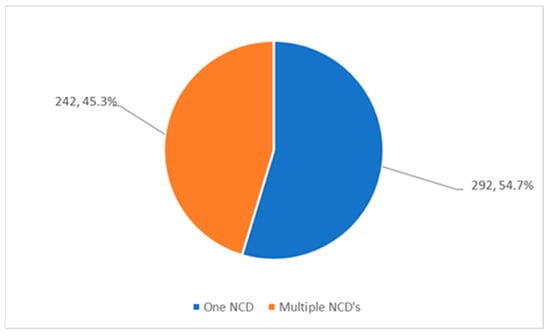
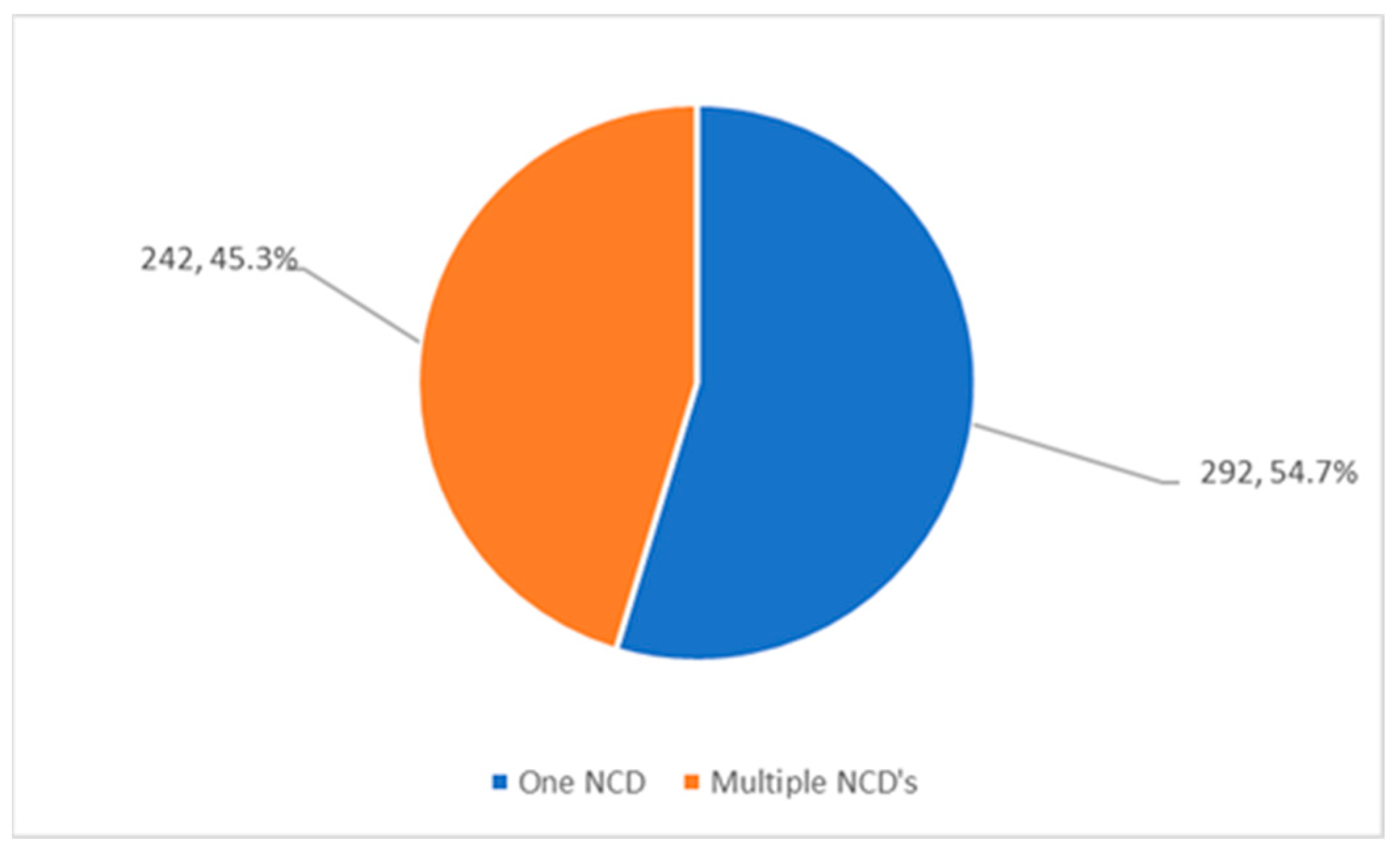
Among the total sample of 662 participants, 128 (19.3%) reported none of the included conditions, 292 (44.1%) reported exactly one condition, and 242 (36.6%) reported two or more conditions and were classified as having multimorbidity (Figure 1). Overall, 534 (80.7%) reported at least one included condition. Within this subgroup (n = 534), 292 (54.7%) had exactly one condition and 242 (45.3%) had multimorbidity.
Figure 1.
Distribution of participants according to the presence of non-communicable diseases.
Across the full sample, migraine was the most frequently reported included condition (463/662, 69.9%), followed by anxiety (137, 20.7%), depression (82, 12.4%), and self-reported obesity (73, 11.0%). Among participants reporting exactly two conditions, the most frequent exact dyads were migraine–anxiety (n = 35), migraine–obesity (n = 14), migraine–respiratory disorder (n = 12), and anxiety–depression (n = 8). Among participants reporting exactly three conditions, migraine–anxiety–depression was the most frequent exact triad (n = 21). Full condition prevalence rates and common exact dyads and triads are provided in Supplementary Table S1.
3.2. Lifestyle Characteristics
Regarding lifetime tobacco exposure, 124 participants (23.2%) reported having ever smoked cigarettes or other tobacco products, whereas 410 (76.8%) reported never having smoked. Regarding lifetime alcohol exposure, 87 participants (16.3%) reported having ever consumed alcohol, while 447 (83.7%) reported never having consumed alcohol. In addition, 304 participants (56.9%) were not physically active, whereas 230 (43.1%) reported being physically active.
3.3. Association Between Sociodemographic Characteristics and Multimorbidity
Table 2 presents the association between sociodemographic characteristics and multimorbidity among participants with at least one included condition (n = 534). BMI category was significantly associated with multimorbidity (p < 0.001). Multimorbidity was present in 73.3% of participants with obesity, compared with 48.4% of those who were underweight, 39.7% of those with normal BMI, and 41.3% of those who were overweight. No statistically significant associations were observed for age (p = 0.066), gender (p = 0.081), marital status (p = 0.498), nationality (p = 0.182), education level (p = 0.127), or student status (p = 0.712).
Table 2.
Association Between Sociodemographic Characteristics and Multimorbidity.
3.4. Association Between Lifestyle Factors and Multimorbidity
The association between lifestyle factors and multimorbidity is presented in Table 3. Lifetime history of tobacco use (ever versus never; p < 0.001) and lifetime alcohol exposure (ever versus never; p = 0.013) were significantly associated with multimorbidity in the unadjusted analysis. Participants who reported ever using tobacco or ever consuming alcohol were more likely to report two or more NCDs than those reporting no lifetime exposure. Physical activity was not significantly associated with multimorbidity (p = 0.311).
Table 3.
Association Between Lifestyle Factors and Multimorbidity.
3.5. Association Between Employment Characteristics and Multimorbidity
Table 4 shows the association between employment characteristics and multimorbidity. Employment status (p = 0.270) and type of employment (p = 0.924) were not significantly associated with multimorbidity.
Table 4.
Association Between Employment Characteristics and Multimorbidity.
3.6. Association Between Sleep Quality and Multimorbidity
In the full sample, 320/662 participants (48.3%) had a global PSQI score > 5 and were therefore classified as having poor overall sleep quality, while 342 (51.7%) had scores ≤ 5. Table 5 presents associations between the seven individual PSQI component scores and multimorbidity among participants with at least one included condition (n = 534). The subjective sleep-quality variable in Table 5 represents PSQI component 1 and is distinct from the global PSQI classification. In the unadjusted component-level analyses, sleep disturbance (raw p < 0.001), sleep-medication use (raw p = 0.013), and daytime dysfunction (raw p = 0.006) were associated with multimorbidity. After Holm correction across the seven PSQI component tests, sleep disturbance (adjusted p = 0.004) and daytime dysfunction (adjusted p = 0.037) remained statistically significant, whereas sleep-medication use did not (adjusted p = 0.067). Subjective sleep quality, sleep latency, sleep duration, and habitual sleep efficiency were not statistically significant.
Table 5.
Association Between PSQI Components and Multimorbidity. Holm-adjusted p-values control the family-wise error rate across the seven PSQI component-level chi-square tests.
3.7. Multivariable Logistic Regression Analysis
Table 6 presents the primary multivariable logistic regression analysis among participants reporting at least one included condition (n = 534). With normal BMI as the reference category, obesity was associated with higher odds of multimorbidity (AOR = 3.86, 95% CI 2.16–6.91, p < 0.001), whereas underweight (AOR = 1.31, 95% CI 0.61–2.85, p = 0.489) and overweight (AOR = 0.98, 95% CI 0.63–1.51, p = 0.922) were not. Lifetime tobacco exposure (AOR = 1.89, 95% CI 1.20–2.96, p = 0.006) and sleep disturbance (AOR = 1.57, 95% CI 1.05–2.35, p = 0.029) were also associated with multimorbidity. Lifetime alcohol exposure, sleep-medication use, and the individual daytime-dysfunction categories were not statistically significant after adjustment. The model showed acceptable calibration (Hosmer–Lemeshow χ2(8) = 9.48, p = 0.303), Nagelkerke R2 = 0.151, and AUC = 0.698; all VIF values were <1.69.
Table 6.
Multivariable Logistic Regression Analysis of Factors Associated with Multimorbidity (n = 534).
Sensitivity analyses supported the primary findings. After excluding self-reported obesity from the multimorbidity count, BMI-defined obesity remained associated with multimorbidity (AOR = 1.92, 95% CI 1.10–3.35, p = 0.022), as did lifetime tobacco exposure (AOR = 1.69, 95% CI 1.09–2.64, p = 0.020) and sleep disturbance (AOR = 1.65, 95% CI 1.11–2.45, p = 0.014) (Supplementary Table S2). In the full-sample sensitivity analysis (n = 662) comparing multimorbidity with zero or one condition, obesity (AOR = 3.53, 95% CI 2.11–5.90, p < 0.001), lifetime tobacco exposure (AOR = 1.75, 95% CI 1.15–2.67, p = 0.009), and sleep disturbance (AOR = 1.85, 95% CI 1.27–2.71, p = 0.002) remained associated with multimorbidity (Supplementary Table S3).
4. Discussion
This cross-sectional study examined self-reported multimorbidity and its associated sociodemographic, lifestyle, and sleep-related factors in a convenience sample of adults residing in the UAE. Among participants reporting at least one included condition, 45.3% reported multimorbidity. In the primary adjusted analysis, obesity, lifetime tobacco exposure, and sleep disturbance were associated with higher odds of multimorbidity. Underweight, overweight, lifetime alcohol exposure, sleep-medication use, and the individual daytime-dysfunction categories did not show statistically significant independent associations.
The high proportion of participants reporting at least one NCD (80.7%) should be interpreted cautiously and should not be directly compared with prevalence estimates derived from nationally representative surveillance or clinically verified diagnoses. Several methodological factors may have contributed to this finding. First, disease status was based entirely on participant self-report without verification using medical records, laboratory investigations, or objective clinical measurements. Second, the questionnaire included a broad range of physical and mental health conditions, which may have increased the likelihood of participants reporting at least one condition. Third, recruitment partly from healthcare facilities may have preferentially included individuals with existing health concerns. Finally, convenience sampling and the demographic composition of the study sample may have further influenced the observed prevalence. Consequently, the reported estimates should be regarded as characteristics of this study sample rather than estimates of the prevalence of clinically confirmed NCDs in the UAE population.
4.1. Behavioral Risk Factors
4.1.1. Body Mass Index
When BMI was modeled using the four conventional categories, the adjusted association was concentrated in the obesity category: participants with obesity had higher odds of multimorbidity than those with normal BMI (AOR = 3.86, 95% CI 2.16–6.91, p < 0.001), whereas underweight and overweight were not independently associated. This more granular specification avoids combining physiologically distinct BMI groups and is consistent with evidence linking obesity with multimorbidity [15]. Obesity-related chronic low-grade inflammation and insulin resistance may contribute to metabolic dysfunction and the development of multiple chronic conditions, providing a plausible biological explanation for the observed association between obesity and multimorbidity [16]. Because self-reported obesity was also one of the conditions contributing to the multimorbidity count, we performed a sensitivity analysis excluding self-reported obesity from the outcome. The association with BMI-defined obesity was attenuated but remained statistically significant (AOR = 1.92, 95% CI 1.10–3.35, p = 0.022), suggesting that the primary association was not solely attributable to this definitional overlap. Nevertheless, the cross-sectional design cannot establish temporality, and BMI may precede, coexist with, or follow the development of chronic conditions.
4.1.2. Smoking
Lifetime tobacco exposure was significantly associated with multimorbidity in the present study. Among participants reporting lifetime tobacco exposure, 60.5% had multimorbidity compared with 40.7% among those reporting no lifetime exposure (p < 0.001). This association remained statistically significant after multivariable adjustment (AOR = 1.89, 95% CI 1.20–2.96, p = 0.006). Tobacco exposure is an established contributor to a broad range of chronic diseases, including cardiovascular, respiratory, metabolic, and malignant conditions, providing a plausible explanation for its association with the coexistence of multiple chronic conditions [17]. Evidence from systematic reviews of multimorbidity has also identified smoking as a behavioral factor associated with multimorbidity, although the magnitude and consistency of this association vary across populations and study methodologies [18].
The observed association is particularly relevant within the UAE context, where tobacco use remains an important modifiable public health risk factor. The UAE National Health Survey 2017–2018 reported an overall current smoking prevalence of 9.1% among adults, with substantial differences according to sex and nationality; current smoking was reported by 20.5% of Emirati men, 1.0% of Emirati women, 14.9% of non-Emirati men, and 2.6% of non-Emirati women [19]. These national data highlight the continued relevance of tobacco control within the UAE, although direct comparison with the present study should be made cautiously because our questionnaire assessed lifetime ever versus never tobacco exposure rather than current smoking.
The exposure measure used in the present study should therefore be considered when interpreting the observed association. Tobacco use was assessed as lifetime ever versus never use and did not distinguish current from former users or capture frequency, quantity, duration, or cumulative exposure. Consequently, the observed association reflects a history of tobacco exposure rather than the effect of current smoking, and a dose–response relationship could not be evaluated. Residual confounding by other behavioral, socioeconomic, or clinical characteristics also cannot be excluded. Therefore, although lifetime tobacco exposure was independently associated with multimorbidity in this study sample, the cross-sectional design and limitations of the exposure measure preclude conclusions regarding temporality or causality.
4.1.3. Alcohol Consumption
In the present study, lifetime alcohol exposure was associated with multimorbidity in the unadjusted analysis (p = 0.013), with 57.5% of participants reporting lifetime alcohol exposure having multiple conditions compared with 43.0% among those reporting no lifetime exposure. However, this association did not remain statistically significant after multivariable adjustment (AOR = 1.44, 95% CI 0.85–2.41, p = 0.172). The attenuation after adjustment suggests that the crude relationship may have been partly explained by other characteristics included in the multivariable model.
Measurement limitations may also have contributed to the absence of an independent association. Alcohol exposure in the present study was assessed only as lifetime ever versus never consumption, without information regarding current consumption, frequency, quantity, duration, or drinking patterns. Consequently, participants with limited or experimental lifetime exposure could not be distinguished from those with more sustained alcohol consumption, and a dose–response relationship could not be evaluated. Furthermore, alcohol consumption may represent a sensitive behavior within some Middle Eastern sociocultural contexts, and under-reporting related to concerns regarding disclosure, cultural or religious considerations, or social desirability cannot be excluded [20,21]. Previous research conducted in Jordan identified reluctance to report alcohol consumption in research and highlighted religious beliefs and concerns regarding disclosure of sensitive information as potential influences on reporting [20]. More broadly, social desirability has been shown to affect self-reported alcohol consumption, potentially resulting in underestimation of alcohol exposure [21].
Therefore, the nonsignificant adjusted association observed in the present study should not be interpreted as evidence that alcohol consumption is unrelated to chronic disease. Rather, an independent statistical association between the measured lifetime alcohol exposure variable and multimorbidity was not demonstrated after adjustment in this study sample.
4.1.4. Sleep-Related Characteristics
Sleep-related characteristics showed several associations with multimorbidity. At the component level, sleep disturbance, sleep-medication use, and daytime dysfunction had raw p-values < 0.05; after Holm correction for the seven PSQI component tests, only sleep disturbance (adjusted p = 0.004) and daytime dysfunction (adjusted p = 0.037) remained statistically significant. In the multivariable model, sleep disturbance remained associated with higher odds of multimorbidity (AOR = 1.57, 95% CI 1.05–2.35, p = 0.029). Although the adjusted odds ratios for mild, moderate, and severe daytime dysfunction were above 1, their confidence intervals included the null value and none of the individual categories met the conventional p < 0.05 threshold in the primary model. These results suggest that sleep disturbance may be a more robust sleep-related correlate of multimorbidity in this sample than the other individual PSQI components. These findings are broadly consistent with systematic-review evidence demonstrating associations between several dimensions of sleep disturbance and multimorbidity, although the strength and consistency of associations vary according to the specific sleep measure examined [22,23].
Several interconnected pathways may help explain the observed association between sleep disturbance and multimorbidity. Disturbed sleep has been associated with metabolic and neuroendocrine dysregulation, chronic low-grade systemic inflammation, impaired glucose metabolism, obesity, and adverse cardiovascular and mental health outcomes [4,5]. These pathways may plausibly contribute to the development and coexistence of multiple chronic conditions. However, the relationship may also operate in the opposite direction. Individuals with multiple chronic conditions may experience disease-related symptoms, pain, psychological distress, functional impairment, or treatment-related effects that adversely affect sleep [4,22]. Therefore, the relationship between sleep disturbance and multimorbidity may be bidirectional. Given the cross-sectional design of the present study, it is not possible to determine whether sleep disturbance preceded multimorbidity or developed as a consequence of existing chronic conditions.
Not all PSQI components demonstrated statistically significant associations with multimorbidity. Subjective sleep quality, sleep latency, sleep duration, and habitual sleep efficiency were not significant in the unadjusted analyses. Sleep-medication use did not remain significant after Holm adjustment for multiple component-level comparisons and was also nonsignificant in the multivariable model. Daytime dysfunction remained significant as an overall component-level unadjusted comparison after Holm correction, but none of its individual categories was independently significant after multivariable adjustment. These differences may reflect measurement limitations, relatively small numbers in some PSQI categories, or characteristics of the predominantly young study sample.
4.1.5. Physical Activity
Physical activity was not significantly associated with multimorbidity in the present study (p = 0.311). Although physical inactivity is an established modifiable risk factor for non-communicable diseases, including cardiovascular disease, diabetes, and several cancers [24], the present analysis did not demonstrate a statistically significant association between the measured physical activity variable and multimorbidity. This finding may partly reflect characteristics of the study sample, limitations in the measurement of physical activity, residual confounding, or insufficient differentiation between the frequency, duration, intensity, and types of physical activity undertaken by participants. Furthermore, the predominantly young composition of the sample may have influenced the observed relationship. The absence of statistical significance in the present analysis should therefore not be interpreted as evidence that physical activity is unrelated to chronic disease. Rather, it indicates that an association between the physical activity measure used in this study and multimorbidity was not demonstrated within this convenience sample. Future studies using more detailed and validated measures of physical activity and more representative population-based samples may provide a clearer understanding of its relationship with multimorbidity in the UAE.
Although participants from multiple nationalities residing in the UAE were included, the convenience sampling strategy and demographic composition of the sample limit the extent to which the findings can be generalized to the wider UAE population.
4.1.6. Sociodemographic Characteristics
None of the examined sociodemographic characteristics, including age, sex, marital status, nationality, educational attainment, student status, and employment-related characteristics, demonstrated statistically significant associations with multimorbidity in the reported analyses. Nevertheless, these variables remain epidemiologically relevant when interpreting multimorbidity within the UAE context. The UAE population is highly heterogeneous with respect to nationality, migration background, occupation, socioeconomic circumstances, lifestyle patterns, and healthcare access. Such characteristics may influence exposure to behavioral and occupational risk factors, healthcare-seeking practices, opportunities for preventive care, and the likelihood of chronic disease recognition and reporting.
The absence of statistically significant associations in the present study should be interpreted cautiously. The convenience sample was predominantly young, female, highly educated, and composed largely of students or unemployed participants, resulting in relatively limited variation within some sociodemographic categories. In addition, nationality was grouped into broad WHO regional categories, which may obscure heterogeneity within regions. These sampling and measurement characteristics may have reduced the ability to identify sociodemographic differences in multimorbidity. Consequently, the findings do not establish an absence of socioeconomic or demographic inequalities in multimorbidity within the wider UAE population. Future population-based studies with more representative distributions of nationality, occupation, education, and socioeconomic position are required to examine these relationships more robustly.
4.1.7. Strengths and Limitations
This study has several strengths, including a relatively large sample size, inclusion of participants from diverse nationality groups residing in the UAE, and the use of the validated Pittsburgh Sleep Quality Index to assess multiple dimensions of sleep. Nevertheless, several limitations should be considered when interpreting the findings. First, the cross-sectional design prevents determination of temporal sequence and precludes causal inference. Reverse causation is therefore possible, particularly for the observed associations involving BMI and sleep-related characteristics; for example, sleep disturbance may coexist with or precede multimorbidity, but symptoms, psychological burden, functional limitations, or treatment of existing chronic conditions may themselves adversely affect sleep.
Second, the use of convenience sampling may have introduced selection bias. The sample was predominantly young, female, highly educated, and composed largely of students or unemployed participants. In addition, recruitment partly from healthcare facilities may have increased the likelihood of enrolling individuals with existing health concerns. Consequently, both the proportion of participants reporting chronic conditions and the observed associations may differ from those in the general UAE adult population, and the findings should not be interpreted as nationally representative estimates.
Third, chronic conditions and lifestyle behaviors were based on self-report and were not independently verified using medical records, laboratory investigations, or objective clinical measurements. This may have introduced recall bias, reporting inaccuracies, and misclassification. Sensitive behaviors, particularly tobacco and alcohol exposure, may also have been affected by social desirability bias. Furthermore, tobacco and alcohol were measured as lifetime ever/never exposures without information on current use, frequency, quantity, duration, or cumulative exposure, limiting assessment of dose–response relationships.
Finally, residual confounding cannot be excluded because potentially relevant clinical, behavioral, socioeconomic, and healthcare-related factors may not have been measured or fully accounted for in the multivariable model. The relatively small number of participants within some exposure categories may also have limited statistical precision, as reflected by wide confidence intervals for some estimates. Future longitudinal studies using probability-based sampling, more detailed exposure measurements, and objectively verified chronic disease information are required to establish temporality and provide more representative estimates of multimorbidity and its associated factors in the UAE.
5. Conclusions
A high proportion of participants in this convenience sample reported at least one included condition, and 45.3% of those reporting at least one condition had multimorbidity. In the primary adjusted analysis, obesity, lifetime tobacco exposure, and sleep disturbance were associated with higher odds of multimorbidity. Sensitivity analyses supported the robustness of the obesity association when self-reported obesity was removed from the multimorbidity count and showed broadly consistent findings when the full sample was analyzed using multimorbidity versus zero or one condition. These findings should be interpreted as associations within the study sample rather than causal effects or population-representative estimates for the UAE.
Supplementary Materials
The following supporting information can be downloaded at https://www.mdpi.com/article/10.3390/ijerph23101315/s1, Supplementary File S1, Informed Consent Form; Supplementary File S2, Study Questionnaire; Supplementary File S3, Supplementary Analysis Tables (Tables S1–S3) Table S1: Individual Condition Prevalence and Common Exact Disease Combinations, Table S2: Sensitivity Analysis Excluding Self-Reported Obesity from the Multimorbidity Count; Table S3: Full-Sample Sensitivity Analysis. The participant information sheet and the deidentified underlying dataset are available in the Zenodo repository at https://doi.org/10.5281/zenodo.21013983 (accessed on 11 September 2026).
Author Contributions
K.M., V.R.F., K.J., H.A.M., R.G. and A.S.M.H. were involved in conceptualizing the study, data collection, and writing. V.K. provided clinical guidance. J.M. supervised the study design and final manuscript review. All authors have read and agreed to the published version of the manuscript.
Funding
This research received no external funding.
Institutional Review Board Statement
The study was conducted in accordance with the Declaration of Helsinki and approved by the Institutional Review Board of Gulf Medical University, Ajman, United Arab Emirates (Ref. No. IRB-COM-STD-84-NOV-2024).
Informed Consent Statement
Informed consent was obtained from all subjects involved in the study.
Data Availability Statement
The datasets generated and analyzed during the current study are publicly available in the Zenodo repository at DOI: https://doi.org/10.5281/zenodo.21013983.
Acknowledgments
Our heartfelt gratitude goes to all the participants who generously contributed their time and effort, making this research possible.
Conflicts of Interest
The authors declare no conflicts of interest.
Abbreviations
The following abbreviations are used in this manuscript:
| AOR | Adjusted Odds Ratio |
| BMI | Body Mass Index |
| CI | Confidence Interval |
| EMR | Eastern Mediterranean Region |
| SEAR | South-East Asia Region |
| SD | Standard Deviation |
| IRB | Institutional Review Board |
| LMICs | Low- and Middle-Income Countries |
| NCDs | Non-Communicable Diseases |
| OR | Odds Ratio |
| PSQI | Pittsburgh Sleep Quality Index |
| SDGs | Sustainable Development Goals |
| SPSS | Statistical Package for the Social Sciences |
| STEPS | STEPwise Approach to NCD Risk Factor Surveillance |
| UAE | United Arab Emirates |
| WHO | World Health Organization |
References
- World Health Organization. Noncommunicable Diseases; WHO: Geneva, Switzerland, 2025. [Google Scholar]
- Hilger, J.; Loerbroks, A.; Diehl, K. Eating behaviour of university students in Germany: Dietary intake, barriers to healthy eating and changes in eating behaviour since the time of matriculation. Appetite 2017, 109, 100–107. [Google Scholar] [CrossRef] [Scilit] [PubMed]
- Uddin, R.; Lee, E.Y.; Khan, S.R.; Tremblay, M.S.; Khan, A. Clustering of lifestyle risk factors for non-communicable diseases in 304,779 adolescents from 89 countries: A global perspective. Prev. Med. 2020, 131, 105955. [Google Scholar] [CrossRef] [Scilit] [PubMed]
- Irwin, M.R. Why sleep is important for health: A psychoneuroimmunology perspective. Annu. Rev. Psychol. 2015, 66, 143–172. [Google Scholar] [CrossRef] [Scilit] [PubMed]
- St-Onge, M.P.; Grandner, M.A.; Brown, D.; Conroy, M.B.; Jean-Louis, G.; Coons, M.; Bhatt, D.L. Sleep duration and quality: Impact on lifestyle behaviors and cardiometabolic health: A scientific statement from the American Heart Association. Circulation 2016, 134, e367–e386. [Google Scholar] [CrossRef] [Scilit] [PubMed]
- Solar, O.; Irwin, A. A conceptual framework for action on the social determinants of health. In Social Determinants of Health Discussion Paper 2 (Policy and Practice); World Health Organization: Geneva, Switzerland, 2010. [Google Scholar]
- World Health Organization. World report on social determinants of health equity. In WHO World Report on Social Determinants of Health Equity; World Health Organization: Geneva, Switzerland, 2025. [Google Scholar]
- Álvarez-Gálvez, J.; Ortega-Martín, E.; Carretero-Bravo, J.; Pérez-Muñoz, C.; Suárez-Lledó, V.; Ramos-Fiol, B. Social determinants of multimorbidity patterns: A systematic review. Front. Public Health 2023, 11, 1081518. [Google Scholar] [CrossRef] [Scilit] [PubMed]
- Barnett, K.; Mercer, S.W.; Norbury, M.; Watt, G.; Wyke, S.; Guthrie, B. Epidemiology of multimorbidity and implications for health care, research, and medical education: A cross-sectional study. Lancet 2012, 380, 37–43. [Google Scholar] [CrossRef] [Scilit] [PubMed]
- Pearson-Stuttard, J.; Ezzati, M.; Gregg, E.W. Multimorbidity—A defining challenge for health systems. Lancet Public Health 2019, 4, e599–e600. [Google Scholar] [CrossRef] [Scilit] [PubMed]
- Boutayeb, A.; Boutayeb, S.; Boutayeb, W. Multi-morbidity of non communicable diseases and equity in WHO Eastern Mediterranean countries. Int. J. Equity Health 2013, 12, 60. [Google Scholar] [CrossRef] [Scilit] [PubMed]
- Singh, K.; Alomari, A.; Lenjawi, B. Prevalence of Multimorbidity in the Middle East: A Systematic Review of Observational Studies. Int. J. Environ. Res. Public Health 2022, 19, 16502. [Google Scholar] [CrossRef] [Scilit] [PubMed]
- Rashid, A.; Ismail, M.; Ahmed Saeed, I.M.; Mohamed Saeed, F.A. Multimorbidity Prevalence, Patterns, and Associated Factors: A Cross-Sectional Study Among Adults Visiting the Family Medicine Department at Hatta Hospital, United Arab Emirates. Cureus 2025, 17, e100452. [Google Scholar] [CrossRef] [Scilit] [PubMed]
- Buysse, D.J.; Reynolds, C.F., III; Monk, T.H.; Berman, S.R.; Kupfer, D.J. The Pittsburgh Sleep Quality Index: A New Instrument for Psychiatric Practice and Research. Psychiatry Res. 1989, 28, 193–213. [Google Scholar] [CrossRef] [Scilit] [PubMed]
- Shan, J.; Yin, R.; Panuthai, S. Body mass index and multimorbidity risk: A systematic review and dose-response meta-analysis. Arch. Gerontol. Geriatr. 2024, 123, 105418. [Google Scholar] [CrossRef] [Scilit] [PubMed]
- Garg, S.S.; Kushwaha, K.; Dubey, R.; Gupta, J. Association between obesity, inflammation and insulin resistance: Insights into signaling pathways and therapeutic interventions. Diabetes Res. Clin. Pract. 2023, 200, 110691. [Google Scholar] [CrossRef] [Scilit] [PubMed]
- Larsson, S.C.; Burgess, S. Appraising the causal role of smoking in multiple diseases: A systematic review and meta-analysis of Mendelian randomization studies. EBioMedicine 2022, 82, 104154. [Google Scholar] [CrossRef] [Scilit] [PubMed]
- Skou, S.T.; Mair, F.S.; Fortin, M.; Guthrie, B.; Nunes, B.P.; Miranda, J.J.; Boyd, C.M.; Pati, S.; Mtenga, S.; Smith, S.M. Multimorbidity. Nat. Rev. Dis. Primers 2022, 8, 48. [Google Scholar] [CrossRef] [Scilit] [PubMed]
- Ministry of Health and Prevention, United Arab Emirates. UAE National Health Survey 2017–2018; Ministry of Health and Prevention: Abu Dhabi, United Arab Emirates, 2018. [Google Scholar]
- Alhashimi, F.H.; Khabour, O.F.; Alzoubi, K.H.; Al-Shatnawi, S.F. Attitudes and beliefs related to reporting alcohol consumption in research studies: A case from Jordan. Pragmatic Obs. Res. 2018, 9, 55–61. [Google Scholar] [CrossRef] [Scilit] [PubMed]
- Davis, C.G.; Thake, J.; Vilhena, N. Social desirability biases in self-reported alcohol consumption and harms. Addctv. Behav. 2010, 35, 302–311. [Google Scholar] [CrossRef] [Scilit] [PubMed]
- Nistor, P.; Chang-Kit, B.; Nicholson, K.; Anderson, K.K.; Stranges, S. The relationship between sleep health and multimorbidity in community dwelling populations: Systematic review and global perspectives. Sleep Med. 2023, 109, 270–284. [Google Scholar] [CrossRef] [Scilit] [PubMed]
- Zhou, Y.; Jin, Y.; Zhu, Y.; Fang, W.; Dai, X.; Lim, C.; Mishra, S.R.; Song, P.; Xu, X. Sleep Problems Associate with Multimorbidity: A Systematic Review and Meta-analysis. Public Health Rev. 2023, 44, 1605469. [Google Scholar] [CrossRef] [Scilit] [PubMed]
- World Health Organization. Physical Activity WHO Physical Activity Fact Sheet; World Health Organization: Geneva, Switzerland, 2024; Available online: https://www.who.int/news-room/fact-sheets/detail/physical-activity (accessed on 11 September 2026).

Disclaimer/Publisher’s Note: The statements, opinions and data contained in all publications are solely those of the individual author(s) and contributor(s) and not of MDPI and/or the editor(s). MDPI and/or the editor(s) disclaim responsibility for any injury to people or property resulting from any ideas, methods, instructions or products referred to in the content. |
© 2026 by the authors. Licensee MDPI, Basel, Switzerland. This article is an open access article distributed under the terms and conditions of the Creative Commons Attribution (CC BY) license.