


Highlights
Public health relevance—How does this work relate to a public health issue?
- Leprosy-related disability remains a public health concern in Indonesia despite national elimination status.
- Disability outcomes were compared across five endemic regions with diverse healthcare and social contexts.
Public health significance—Why is this work of significance to public health?
- Disability severity varied markedly between regions, with the highest WHO Grade 2 disability in Sitanala.
- In the primary ordinal logistic general estimating equation (GEE) analysis, longer disease duration and higher SALSA scores were associated with higher WHO disability grade.
Public health implications—What are the key implications or messages for practitioners, policy makers and/or researchers in public health?
- Early detection, timely diagnosis, and integrated rehabilitation should be strengthened in endemic areas.
- Disability and participation outcomes should be interpreted according to regional and social context.
Abstract
Leprosy remains a public health challenge in several endemic regions of Indonesia, with varying degrees of disability and functional impairment. This study aimed to compare factors associated with WHO disability grade among leprosy patients across five endemic regions: Sitanala, Likupang, Lembata, Ambon, and Jayapura. A cross-sectional study was conducted using data from the KATAMATAKU program. Individuals diagnosed with leprosy were included. Demographic and clinical characteristics, World Health Organization (WHO) disability grade, functional limitation assessed with Screening of Activity Limitation and Safety Awareness (SALSA score), and participation restriction were assessed. Bivariate analyses were followed by multivariable analysis using generalized estimating equations (GEE), with region as the clustering variable. A sensitivity analysis excluding Sitanala and an ordinal logistic regression model with region as a fixed effect were performed. Among 580 participants, disability severity varied across regions. Longer disease duration was consistently associated with higher WHO disability grade (GEE aOR = 1.005; 95% CI: 1.002–1.007; p < 0.001). Higher SALSA score was associated with higher disability grade in the complete cohort (aOR = 1.096; 95% CI: 1.047–1.148; p < 0.001), but this association was not observed after excluding Sitanala. These findings highlight the importance of early detection and timely management to reduce disability progression among patients with leprosy.
1. Introduction
Leprosy remains a chronic infectious disease and continues to pose a significant public health challenge in many parts of the world despite the widespread availability of multidrug therapy. According to the World Health Organization (WHO), more than 200,000 new cases of leprosy are still reported globally each year, indicating ongoing transmission and persistent gaps in early detection and prevention strategies. The global burden of leprosy is unevenly distributed, with the majority of cases concentrated in a limited number of endemic countries. Countries such as Indonesia, India, and Brazil maintain high incidence rates, collectively accounting for 74% of new cases. Beyond its clinical manifestations, leprosy is closely associated with long-term disability, functional impairment, and social consequences, making it a disease of both medical and social importance. The continued occurrence of disability among newly diagnosed patients reflects delays in diagnosis and highlights the need for strengthened surveillance, timely case detection, and comprehensive management approaches [1,2].
Although several countries, including Indonesia, have achieved national-level elimination of leprosy as a public health problem based on prevalence thresholds, substantial subnational heterogeneity persists. Within endemic countries, new cases are often clustered in specific provinces and districts, where geographic barriers, limited access to healthcare services, socioeconomic disadvantage, and stigma contribute to delayed diagnosis and ongoing transmission. Such regional concentration of cases indicates that national averages may mask localized areas with a high burden of disease and disability. Understanding these subnational variations is therefore essential for identifying context-specific determinants of leprosy-related disability and for guiding targeted interventions aimed at early detection, prevention of impairment, and reduction in long-term functional and social consequences [2].
Within this broader pattern of regional persistence and subnational heterogeneity, Indonesia represents a prominent example of a country where leprosy remains unevenly distributed despite achieving national-level elimination status. Indonesia continues to rank among the three countries with the highest number of newly detected leprosy cases globally, alongside India and Brazil [2]. According to the Indonesian Ministry of Health, in 2024 a total of 14,698 new leprosy cases were reported nationwide, with more than 90% classified as multibacillary, a form associated with increased transmissibility and disability risk. Among these, 1420 cases (9.7%) occurred in children and 869 cases (5.9%) were accompanied by disability, suggesting ongoing transmission and delays in early detection and management. Furthermore, data through 31 August 2025 indicate 5474 newly detected cases, including 489 pediatric cases (8.9%) and 287 cases (5.2%) with disability, reinforcing that the burden of disease persists over time. In specific endemic settings such as Papua Barat, 422 registered cases were documented up to September 2025, of which 62 were children and 7 were associated with disability, with Manokwari district reporting the highest case load within the province. Such continued detection of new and severe cases highlights that national-level elimination does not preclude substantial subnational burden, and underscores the imperative for intensified surveillance, early detection, and targeted programmatic responses across provinces with high leprosy transmission [3].
In settings where leprosy transmission persists at the subnational level, disability remains a critical outcome for evaluating the effectiveness of leprosy control programs. The World Health Organization disability grading system is widely used to assess the extent of nerve damage and physical impairment, emphasizing impairments in the eyes, hands, and feet. Grade 2 disability representing visible impairments that often result from delayed diagnosis and prolonged disease progression. The occurrence of disability at the time of diagnosis is therefore considered a proxy indicator of late case detection and reflects gaps in surveillance, health-seeking behavior, and access to timely care [4]. In 2022, 7198 new Grade 2 disabilities cases were reported globally, with Southeast Asia contributing a significant proportion (37.7%) [5,6].
The persistence of Grade 2 disabilities is closely linked to long-term physical impairment, reduced functional capacity, and diminished quality of life. Individuals with visible impairments are more likely to experience stigma, discrimination, and social isolation, which in turn can reduce healthcare utilization and delay further care-seeking [7]. This cyclical relationship between disability, stigma, and delayed diagnosis reinforces the need for comprehensive approaches that integrate medical treatment with functional rehabilitation and social reintegration.
Recently, leprosy control efforts have increasingly focused on disability prevention. Around the world, health authorities and governments are directing their attention toward addressing the stigma associated with leprosy. Much of this stigma stems from the fact that people with leprosy are often identifiable in society because of noticeable impairments [8]. Individuals living with leprosy are likely to experience limitations in functional activities, particularly older adults, the unemployed (sudent and housewifes), those with little education, and people with multiple impairments. Overcoming these functional barriers can improve their chances of accessing better occupational opportunities [9].
According to the WHO Global Leprosy Strategy (2016–2020), the goals include eliminating visible impairments among children diagnosed with leprosy, bringing the incidence of new cases with visible impairments to below one per million people, and ensuring that no nation upholds discriminatory laws against individuals with leprosy [10]. WHO’s Global Leprosy Strategy 2021–2030 aims to stop leprosy transmission, many countries, including Indonesia, still face major challenges. Indonesia’s leprosy program began in 1932, became part of the primary health care system in 1969, and adopted multi-drug therapy (MDT) in 1982 [6].
Beyond clinical impairment, leprosy-related disability profoundly affects individuals’ ability to perform daily activities and to participate in social and economic life. Functional limitations commonly involve difficulties in mobility, self-care, manual dexterity, and work-related tasks, while participation restrictions may manifest as exclusion from employment, education, and community engagement [9]. These multidimensional consequences are consistent with the International Classification of Functioning, Disability and Health (ICF) framework, which conceptualizes disability as the result of interactions between health conditions, personal factors, and environmental contexts rather than impairment alone [11].
In this context, early diagnosis and timely rehabilitation are essential to prevent or minimize activity limitations and to preserve functional independence. Evidence suggests that appropriate rehabilitation services can reduce functional decline, while community-based rehabilitation programs play a critical role in enhancing social participation and reintegration [12]. However, in many endemic settings, leprosy rehabilitation services remain centralized, limiting accessibility for affected individuals. Decentralizing rehabilitation services and strengthening them with modern assistive tools and adequately trained personnel are therefore necessary to address the long-term functional and social needs of people affected by leprosy [12].
To support comprehensive evaluation and planning of rehabilitation interventions, standardized instruments such as the Screening of Activity Limitation and Safety Awareness (SALSA) Scale and the Participation Scale are widely used. These tools provide a broader assessment of disability by capturing activity limitations and participation restrictions beyond anatomical impairment alone, offering valuable insights into the lived experiences of individuals affected by leprosy [12,13]. Importantly, functional limitations and participation restrictions may persist even after microbiological cure, underscoring that leprosy-related disability is often a lifelong condition requiring sustained rehabilitation and social-support interventions [7].
Previous studies have highlighted substantial regional variation in leprosy prevalence and case characteristics across Indonesia; however, evidence comparing the severity of disability, activity limitations, and participation restrictions across multiple endemic regions remains limited. Existing research has predominantly focused on single provinces or facility-based populations, constraining the ability to assess how differences in socio-demographic profiles, healthcare access, and program implementation influence disability outcomes across diverse settings [14]. Consequently, there is a lack of comparative analyses examining how demographic factors, disease duration, functional limitation, and participation restriction interact across regions with differing epidemiological and health-system contexts. Addressing this evidence gap is essential to identify region-specific challenges and to inform targeted rehabilitation strategies, early detection efforts, and more equitable leprosy control interventions across endemic areas.
Accordingly, this study aimed to compare WHO disability grades, SALSA scores, and levels of Participation Scales among leprosy patients in five endemic regions of Indonesia: Sitanala, Likupang, Lembata, Ambon, and Jayapura. The SALSA score was used to assess functional limitation, with higher scores indicating greater functional limitation. The Participation Scale score was used to assess perceived participation restriction, with higher scores indicating greater self-reported restriction in social participation. By investigating inter-regional differences and examining the relationships between functional outcomes and demographic factors, this study provides valuable insights to support region-specific disability prevention, rehabilitation, and community reintegration programs for individuals affected by leprosy.
2. Materials and Methods
This study employed a cross-sectional design using data obtained from the KATAMATAKU community outreach program conducted across five regions in Indonesia: Jayapura, Maluku, Lembata, Likupang, and Sitanala. KATAMATAKU is a social outreach initiative dedicated specifically to patients affected by leprosy. The program was developed through a multidisciplinary collaboration among the Departments of Ophthalmology, Dermatology and Venereology, Otorhinolaryngology–Head and Neck Surgery, and Physical and Rehabilitation Medicine, University of Indonesia. The initiative aims to provide comprehensive screening, early detection of complications, and functional rehabilitation for individuals living with leprosy. Data collection was carried out during the implementation of the program in these locations and included demographic characteristics, clinical information, and disability-related measures of the participants.
2.1. Ethics Statement
The recruitment period was conducted during the implementation of the KATAMATAKU program in Sitanala, Lembata, Likupang, Maluku, and Papua. The research was approved by the Committee of Ethics, Faculty of Medicine, University of Indonesia (No. KET-990/UN2.F1/ETIK/PPM.00.02/2025 on 21 July 2025, KET-733/UN2.F1/ETIK/PPM.00.02/2022 on 25 July 2022, and KET-698/UN2.F1/ETIK/PPM.00.02/2022 on 18 April 2022). The data used in this study were accessed for research purposes between 1 September 2025 and 15 January 2026. The researchers accessed anonymized participant data obtained from the KATAMATAKU community outreach program database during this period for data cleaning, verification, and statistical analysis. Data were anonymized prior to analysis to ensure confidentiality. Written informed consent was obtained from all adult participants prior to data collection. For participants aged below 18 years, written informed consent was obtained from their parents or legal guardians.
The inclusion criterion for this study was individuals diagnosed with leprosy. Only participants with a confirmed clinical diagnosis were enrolled in the analysis. Individuals without a history of leprosy or with incomplete assessment data were excluded. Leprosy diagnosis was based on the clinical diagnosis documented by the KATAMATAKU program team, in accordance with the WHO diagnostic framework. According to WHO, leprosy can be diagnosed when at least one of the three cardinal signs is present: (1) definite loss of sensation in a pale (hypopigmented) or reddish skin patch; (2) a thickened or enlarged peripheral nerve with associated sensory loss and/or weakness of the muscles supplied by that nerve; or (3) detection of acid-fast bacilli in a slit-skin smear [1]. Histopathological and slit-skin smear results were not consistently available in the secondary database across all participating sites and therefore were not required as uniform eligibility criteria for this analysis.
Before data collection, field personnel underwent standardized training on the administration of the study instruments and assessment procedures. Data collection at each participating site was subsequently conducted using the same standardized questionnaires, structured clinical assessments, and uniform data collection forms. Field teams followed standardized operational procedures to ensure consistency across sites. Completed forms were reviewed for completeness and consistency and subsequently compiled into a centralized database for analysis.
The primary outcome of interest was the WHO disability grade, while independent variables included sociodemographic factors, clinical measurements, and functional assessment scores. WHO disability grading was assessed separately for each eye, hand, and foot, with each site graded from 0 to 2. The overall WHO disability grade was defined by the highest grade recorded across the individual body sites. The SALSA score consists of 20 items assessing activity limitation. The total score ranges from 0 to 80, with higher scores indicating greater activity limitation; scores of 0–24 indicate no substantial limitation, 25–39 mild limitation, 40–49 moderate limitation, 50–59 severe limitation, and 60–80 extreme limitation. The Participation Scale consists of 18 items assessing perceived participation restriction. The total score ranges from 0 to 90, with higher scores indicating greater participation restriction; scores of 0–12 indicate no significant restriction, 13–22 mild restriction, 23–32 moderate restriction, 33–52 severe restriction, and 53–90 extreme restriction. In the present analysis, both total scores were entered as continuous variables. [12,13] Ethical considerations were addressed in accordance with applicable institutional and community guidelines.
2.2. Statistical Analysis
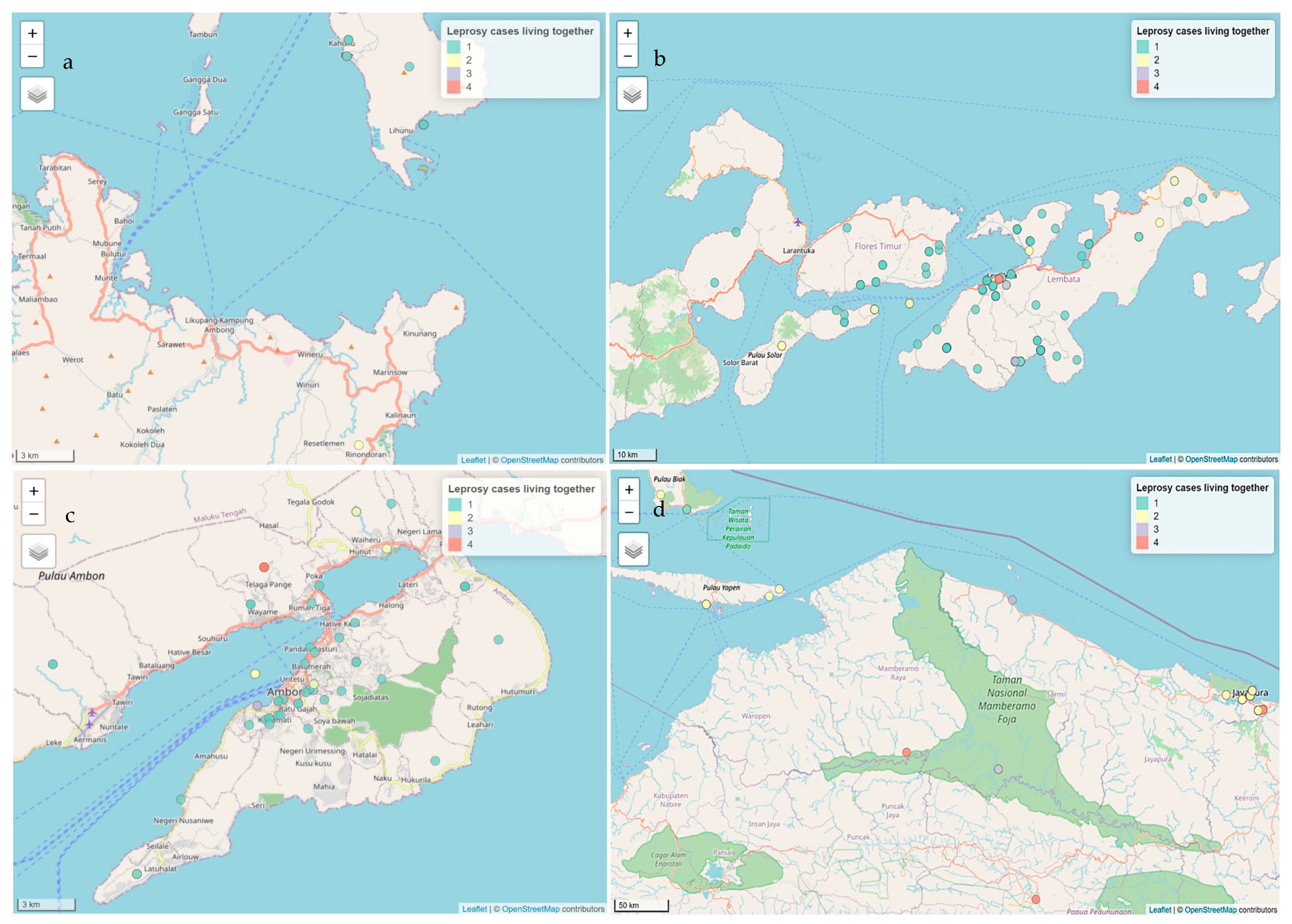
Spatial visualization was used for descriptive presentation of the geographic distribution of participants across the four regions for which address information was available (Lembata, Likupang, Ambon, and Jayapura). The purpose was to provide geographic context for the study sites and to descriptively display the number of patients living at the same reported address. It was not intended to assess spatial clustering, spatial autocorrelation, or transmission patterns. Individual geographic coordinates (latitude and longitude) were obtained from address-based (district) searches using Google Earth version 10.119.62.03 (Google LLC, Mountain View, CA, USA) and were visualized using R version 4.3.1 (R Foundation for Statistical Computing, Vienna, Austria), with the sf and tmap packages. Leprosy patients in Sitanala cohabited in one cluster and were therefore not visualized. For each region, coordinates were converted into simple feature (sf) objects using the World Geodetic System 1984 coordinate reference system (WGS84; EPSG:4326). Participants with missing address information or invalid geographic coordinates were excluded prior to visualization. Interactive base maps were generated using OpenStreetMap raster tiles and captured for presentation. Case locations were displayed as point symbols overlaid on the base map. Points were color-coded according to the number of leprosy patients living together at the same address, categorized as 1 (living alone), 2 (one other leprosy patient), 3 (two other leprosy patients), or 4 (>2 other leprosy patients).
Microsoft Excel for Mac version 16.113.4 (Microsoft Corporation, Redmond, WA, USA) was used to clean and store the raw data. Bivariate and multivariate analysis were performed using IBM Statistical Package for Social Sciences (SPSS) Statistics Software version 25.0 (IBM Corp., Armonk, NY, USA). Participants with incomplete assessment data were excluded. Normality and homogeneity test were performed in all numerical variables according to location and WHO disability grading. All numerical variables were not normally distributed and non-homogeneous according to regions and WHO disability grade hence were analyzed using Kruskal–Wallis test. Categorical variables were compared using Chi-square tests. Variables considered clinically relevant to disability, including age, sex, multibacillary status, duration of illness, duration of complaints, SALSA score, and Participation Scale score, were included in the multivariable analysis with general estimating equation (GEE).
Multivariable analysis was performed using GEE with an ordinal logistic link because the primary outcome, WHO disability grade, was an ordered categorical variable. Study location/region was specified as the clustering or subject variable to account for potential within-region correlation among participants recruited from the same site. Location was therefore used to define the correlation structure of the GEE model rather than entered as a fixed-effect covariate in the primary GEE model. An independent working correlation matrix was specified. Adjusted odds ratios (aORs) and 95% confidence intervals (CIs) were estimated for age, sex, leprosy type, duration of illness, duration of complaints, total SALSA score, and Participation Scale score. WHO disability grade was coded in ascending order of severity as Grade 0 = 0, Grade 1 = 1, and Grade 2 = 2. In the multivariable ordinal GEE model, coefficients and aORs were presented in the direction of higher WHO disability grade to facilitate clinical interpretation. Thus, an aOR greater than 1 indicates higher odds of being classified into a higher disability grade, whereas an aOR below 1 indicates lower odds of being classified into a higher disability grade. Because only five study regions were available and cluster sizes were unequal, the precision of GEE variance estimates may be limited [15,16,17,18]; therefore, GEE estimates were interpreted cautiously.
As an additional region-adjusted analysis, ordinal logistic regression was performed with study region entered as a fixed-effect covariate rather than solely as the clustering variable. Sitanala was used as the reference region. The same covariates as in the primary model were included, and adjusted odds ratios with 95% confidence intervals were estimated. This analysis was used to assess whether the main associations were materially changed after explicitly accounting for differences between study regions. To assess the disproportionate contribution of Sitanala, the same region-fixed-effect model was also refitted after excluding all 225 participants recruited from Sitanala. The primary sensitivity analysis using ordinal GEE was retained for comparison. The proportional odds assumption was evaluated using a score test for nonparallel cumulative logits; a non-significant result was interpreted as supporting the proportional odds assumption.
3. Results
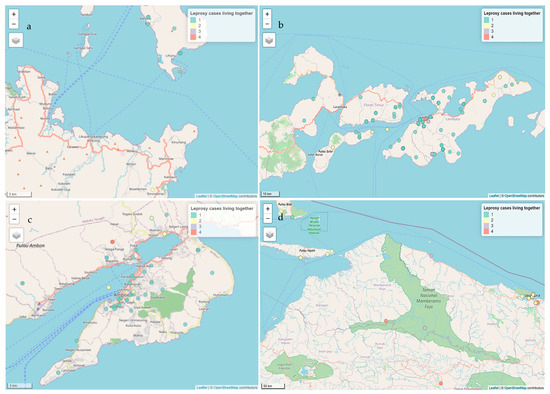
A total of 580 leprosy patients from five regions (Sitanala, Likupang, Lembata, Ambon, and Jayapura) were included in this study. Figure 1 provides a descriptive geographic overview of the four regions for which participant address information was available and shows the number of patients living together at the same reported address. The figure is intended to provide geographic context only and does not represent a formal spatial-clustering or transmission analysis. Patients from Sitanala all lived in the same building site and were therefore not included in the figure. Not all patients disclosed their living place, address, or co-residents. Data on living places were available for 37 of 46 (80.43%) patients in Likupang, 114 of 118 (96.61%) in Lembata, 71 of 100 (71.0%) in Ambon, and 70 of 91 (76.92%) in Jayapura.
Figure 1.
Descriptive maps of (a) Likupang, North Sulawesi, (b) Lembata, East Nusa Tenggara, (c) Ambon, Maluku, and (d) Jayapura, Papua. Base map: © OpenStreetMap contributors, available under the Open Database License (ODbL) v1.0. The maps provide geographic context for the study sites and display the number of leprosy patients living together at the same reported address; they are not intended as a formal spatial-clustering or transmission analysis.
Color of the dots indicates the number of leprosy patients living together at the same reported address. 1 indicates that the patient was living alone, 2 indicates that the patient lived with one other leprosy patient, 3 indicates that the patient lived with two other leprosy patients, and 4 indicates that the patient lived with more than two other leprosy patients. n = 37 for Likupang, 114 for Lembata, 71 for Ambon, and 70 for Jayapura.
The overall distribution, age characteristics, disability profiles, and functional outcomes (SALSA score and Participation Scale) are summarized in Table 1.
Table 1.
Demographics of the study participants according to region.
Participants in Sitanala were substantially older (mean 53.40 ± 10.82 years) compared with other regions, while Jayapura had the highest proportion of children (<18 years). Gender distribution also varied significantly, with Lembata showing the highest proportion of females and Jayapura the highest proportion of males. Occupational patterns differed across sites, with informal work predominating in all regions, while unemployment (currently not working) was most frequent in Jayapura. Educational attainment showed marked variation, with Sitanala having the highest proportion with no formal education, whereas Ambon and Jayapura had the largest percentage completing senior high school. Marital status also differed significantly, with Lembata having the greatest proportion of married participants.
Clinical characteristics demonstrated substantial heterogeneity. The duration of illness and complaints differed significantly across sites, with Sitanala reporting the longest median durations. The proportion of multibacillary (MB) leprosy ranged from 52.2% in Likupang to over 80% in Lembata. Marked differences were observed in WHO disability grades, with Sitanala exhibiting an exceptionally high proportion of Grade 2 disability (87.1%), compared with 0% in Likupang and 5.5% in Jayapura. Similar patterns were observed in disability of the hands and feet, where Grade 2 impairment was overwhelmingly concentrated in Sitanala across all extremities. Detailed site-specific WHO disability grades are presented in Supplementary Table S1.
Functional limitations and participation also varied significantly. SALSA score was highest in Sitanala (mean 35.26 ± 11.85) and lowest in Ambon (22.87 ± 5.92). Differences were also noted across SALSA score subdomains, particularly in visual function, lower limb mobility, and hand skill performance. Participation Scale scores also differed significantly across study sites but the pattern was not parallel to the distribution of physical disability. Jayapura showed the highest mean Participation Scale score, whereas Sitanala, despite having the highest proportion of Grade 2 disability and the longest illness duration, showed relatively low self-reported participation restriction.
Overall, the findings demonstrate substantial geographic disparities in demographic characteristics, clinical profiles, disability severity, functional limitations, and social participation among individuals affected by leprosy across the five study locations.
Bivariate analyses demonstrated significant differences in several participant characteristics across WHO disability grades. (Table 2). Age was strongly associated with disability grade (p < 0.001), with adults (≥18 years) comprising the vast majority of Grade 1 (97.1%) and Grade 2 (97.8%) cases. Gender distribution did not differ significantly across grades (p = 0.054). Occupational status showed a significant association (p = 0.002), where individuals in informal employment and those categorized as not in the labor force (students and housewives) were more frequently represented in Grade 2 disability. Educational background also differed significantly (p < 0.001), with Grade 2 showing a higher proportion of participants who completed elementary school (39%) and without formal education (37.6%).
Table 2.
Bivariate Analysis of WHO Disability Grade and Participant’s Characteristics.
Marital status was significantly associated with disability grade (p < 0.001); the majority of Grade 2 participants were married (80.5%), whereas single individuals were more common in Grade 0. Leprosy type was also associated with disability grade (p = 0.025), with MB cases more prevalent in Grade 2 (72.4%). Functional limitations, measured through the SALSA score, increased progressively across disability severity (p < 0.001), with Grade 2 presenting the highest mean score (32.88 ± 11.91). In contrast to the SALSA score, the Participation Scale did not increase progressively with higher WHO disability grade. Participants with Grade 2 disability had lower mean Participation Scale scores than those with Grade 0 disability.
Clinical durations showed significant associations with disability severity. The median duration of illness increased from 14 months in Grade 0 to 60 months in Grade 2 (p < 0.001). Likewise, the duration of complaints was longest among Grade 2 participants (median 12 months; p < 0.001).
The primary multivariable analysis used an ordinal logistic GEE model with study region as the clustering variable. Because only five regions were available and cluster sizes were unequal, an additional ordinal logistic regression model with study region entered as a fixed-effect covariate was performed to assess the sensitivity of the estimates to the treatment of region. In the primary GEE model, WHO disability grade was coded in ascending order of severity as Grade 0 = 0, Grade 1 = 1, and Grade 2 = 2. The estimates were oriented toward higher WHO disability grade. In the GEE model, longer duration of illness was significantly associated with higher WHO disability grade (aOR = 1.005 per month; 95% CI: 1.002–1.007; p < 0.001), and higher total SALSA score was also associated with higher WHO disability grade (aOR = 1.096 per point; 95% CI: 1.047–1.148; p < 0.001). Participation Scale score showed an inverse association in the GEE model (aOR = 0.946; 95% CI: 0.906–0.987; p = 0.011).
In the additional region-fixed-effect model, duration of illness remained associated with higher WHO disability grade (aOR = 1.003 per month; 95% CI: 1.001–1.005; p = 0.010), while the SALSA association was attenuated (aOR = 1.032 per point; 95% CI: 1.003–1.062; p = 0.031) and Participation Scale was no longer significant (aOR = 0.996; 95% CI: 0.969–1.024; p = 0.784). Thus, duration of illness showed greater consistency across model specifications, whereas the SALSA association was more sensitive to how region was modeled (Table 3).
Table 3.
Multivariable ordinal logistic regression models for higher WHO disability grade: primary GEE and additional region-fixed-effect analysis.
Because Sitanala is a well-established leprosy settlement (“kampung kusta”) and represented a substantial proportion of the study population (225 of 580 participants), with a markedly different disability profile including a high proportion of Grade 2 disability, a sensitivity analysis excluding Sitanala was conducted to assess the robustness of the observed associations. The primary analysis retained all five study regions.
In the region-fixed-effect sensitivity model excluding Sitanala, the association between duration of illness remained significant, while SALSA score and Participation Scale were not significantly associated with higher WHO disability grade. These results were consistent with the primary Sitanala-excluded GEE sensitivity analysis. After excluding participants from Sitanala, 355 participants from four regions remained in the sensitivity analyses. In the ordinal GEE model, the association between duration of illness and higher WHO disability grade remained stable (aOR = 1.005; 95% CI: 1.002–1.007; p < 0.001). In contrast, the association between total SALSA score and higher WHO disability grade was no longer statistically significant (aOR = 0.995; 95% CI: 0.950–1.042; p = 0.836), and the Participation Scale also remained non-significant (aOR = 0.992; 95% CI: 0.966–1.018; p = 0.532). Multibacillary leprosy became significantly associated with higher WHO disability grade (aOR = 2.604; 95% CI: 1.390–4.878; p = 0.003). In the additional region-fixed-effect model excluding Sitanala, duration of illness remained significant (aOR = 1.003; 95% CI: 1.001–1.006; p = 0.011), whereas SALSA score (aOR = 0.999; 95% CI: 0.959–1.041; p = 0.952) and Participation Scale (aOR = 1.001; 95% CI: 0.973–1.029; p = 0.969) were not significant. Multibacillary leprosy remained significantly associated with higher WHO disability grade (aOR = 1.985; 95% CI: 1.020–3.861; p = 0.043). These findings indicate that the association between duration of illness and disability grade was consistent across analyses, whereas the association between SALSA score and WHO disability grade was sensitive to the inclusion of Sitanala (Table 4).
Table 4.
Sensitivity analysis excluding Sitanala using the primary ordinal GEE model.
The proportional odds assumption was assessed for the final adjusted ordinal GEE model. The score test did not indicate violation of this assumption (χ2 = 5.00, df = 7, p = 0.660), supporting the use of the ordinal logistic GEE model and the presentation of a single adjusted odds ratio for each covariate. In the sensitivity model excluding Sitanala, the assumption was also not rejected (χ2 = 4.00, df = 7, p = 0.780).
4. Discussion
4.1. Geographical and Social Determinants
This study highlights regional variation in the severity of disability, activity limitations, and participation restrictions among people affected by leprosy across five endemic areas in Indonesia. These differences reflect ongoing challenges, as supported by recent national data indicating that leprosy-related disability remains a significant issue despite Indonesia having achieved post-elimination status [14]. Global surveillance reports identify Indonesia as one of the countries with the highest number of newly detected cases worldwide, emphasizing ongoing transmission and persistent challenges in achieving early diagnosis [19]. Delays in diagnosis contribute to preventable disability and negatively affect patients’ quality of life through increased stigma, social exclusion, and discrimination [20]. In this context, our results reveal notable inter-regional variation, with Jayapura showing the highest proportion of pediatric cases and Sitanala demonstrating the most severe disability profiles.
The substantial inter-regional differences observed in this study reflect the heterogeneous nature of leprosy epidemiology and service delivery across Indonesia. Geographic variation in disability severity likely arises from a combination of factors, including differences in case detection strategies, referral patterns, healthcare infrastructure, and community awareness [21]. Regions with more accessible primary healthcare services and stronger integration of leprosy programs may identify cases earlier, resulting in lower disability severity at presentation. Conversely, areas characterized by geographic isolation or limited health resources may experience delayed diagnosis, leading to prolonged disease duration and greater cumulative nerve damage. Such disparities are not unique to Indonesia and have been reported in other endemic countries, underscoring the global relevance of regional analyses in leprosy research [22].
Sitanala in Tangerang, Banten, was included as it serves as a long-standing national referral center for leprosy, providing comprehensive clinical management and rehabilitation and managing a large proportion of chronic and advanced cases including OPYMK (Orang Pernah Mengalami Kusta) [23]. In contrast, Lembata Regency in East Nusa Tenggara, with a mid-2024 population of approximately 143,000, represents a geographically isolated island setting within the Solor Archipelago, where limited healthcare access and delayed case detection may contribute to higher disability risk [24]. Maluku Province, an eastern Indonesian archipelago with nearly 2 million inhabitants and Ambon as its administrative and health-service hub, illustrates the challenges of service delivery across dispersed islands with persistent leprosy burden [25]. Jayapura City, the capital of Papua Province with more than 410,000 residents, represents a high-burden and border-area context characterized by difficult terrain, access barriers, and a high proportion of pediatric cases, indicating ongoing transmission [3]. Likupang, a coastal district in North Minahasa Regency, North Sulawesi, reflects a semi-rural maritime setting with distinct service-access constraints compared with urban referral centers [26]. The inclusion of these five sites, spanning a national referral hospital, remote island regencies, provincial capitals, and coastal districts allows a comparative assessment of how geographic isolation, population characteristics, and health-system capacity interact to influence disability severity, functional limitations, and participation restrictions among persons affected by leprosy in Indonesia.
In Indonesia, 9.7% leprosy cases occurred in children. At the regional level, 62 of 254 new cases were pediatric cases [3]. This aligns with our finding that Jayapura had the highest proportion of pediatric patients (19.8%) compared with other regions. The high proportion of pediatric leprosy in Jayapura reinforces the indication of active and recent transmission within the community [27]. Childhood leprosy is a well-recognized marker of ongoing household or community transmission, as children have shorter exposure windows and typically acquire infection from undiagnosed adult contacts. Regions with geographic barriers, limited health-service access, and socioeconomic constraints are more likely to report increased pediatric burdens. Similar patterns have been documented in other endemic settings such as India, Brazil, and Nepal, where elevated pediatric case proportions highlight surveillance gaps and delayed case finding [22,27,28].
In Papua, communal living, often involving more than one nuclear family sharing the same household, is a common condition that increases the risk of Mycobacterium leprae exposure among children [29]. Moreover, the probability of infection in children increases substantially when one or both parents are affected, as cumulative exposure rises in proportion to the number of infectious adults within the home. Epidemiological evidence demonstrates that families with more than one index case experience markedly elevated secondary transmission [30]. The relatively low proportion of Grade 2 disability in Jayapura compared to other study sites may reflect earlier case detection in children or shorter disease duration, despite sustained transmission intensity [1]. The presence of pediatric cases therefore underscores the urgency of strengthening household contact tracing, improving community awareness, and enhancing early detection strategies. Targeted public health interventions in such high-risk living environments are essential to interrupt transmission, reduce the burden of childhood disease, and prevent long-term disability.
Sitanala stands out with the oldest mean age, highest Grade 2 disability rate and had the longest duration of illness. The absence of pediatric cases and the high disability burden can be explained by two key factors, the first one is Sitanala hosts a national leprosy referral center. This referral pattern results in a disproportionately high number of long-standing patients, many of whom have lived with symptoms for years. The second one is the establishment of “Kampung Kusta” (Leprosy Settlement) in Sitanala more than 20 years ago due to high stigma and family abandonment. Patients lived in centralized settlements because access to medication was historically difficult [23]. An important finding requiring careful interpretation is the relatively low Participation Scale score observed among participants from Sitanala despite the high burden of Grade 2 disability and longer illness duration at this site. This apparent discrepancy may reflect adaptive mechanisms rather than the absence of participation-related challenges. As a long-standing leprosy referral and settlement community, Sitanala provides a distinctive social environment in which individuals affected by leprosy may have developed coping strategies, peer support networks, shared illness experiences, and daily routines adapted to chronic impairment. Within such a setting, visible impairments and functional limitations may be more socially normalized than in the general community, potentially reducing perceived participation restriction as captured by self-reported instruments. In addition, environmental familiarity, access to rehabilitation services, and mutual assistance among residents may allow individuals to maintain social roles despite substantial physical disability. Therefore, the lower Participation Scale scores in Sitanala should not be interpreted as indicating minimal social burden, but rather as a possible reflection of response shift, contextual adaptation, and settlement-related social buffering.
Differences in gender distribution, marital status, education level, and occupational patterns further highlight the influence of sociocultural and socioeconomic factors on leprosy epidemiology and access to care [31]. The predominance of informal employment across all sites, along with higher unemployment (currently not working) in Jayapura, aligns with previous evidence linking socioeconomic vulnerability to delayed health-seeking behavior and increased leprosy risk [31].
Clinically, the marked variation in MB leprosy and disability severity across study sites likely reflects differences in how early cases are detected and managed. In regions with a higher proportion of MB disease and more advanced disability, delays in diagnosis may allow the disease to progress silently, leading to cumulative nerve damage before treatment is initiated. In contrast, Likupang, which showed lower MB proportions and virtually no Grade 2 disability, may reflect more timely case detection or better integration of leprosy services within primary healthcare, enabling earlier intervention before irreversible impairment develops [1,21].
4.2. Determinants of Disability Severity in Leprosy
The present findings indicate that leprosy-related disability is shaped by a complex interaction of demographic, clinical, functional, and contextual factors [21]. The strong association between increasing age and higher WHO disability grades observed in bivariate analysis is consistent with the cumulative nature of nerve damage and prolonged exposure to untreated disease among adults [1,32]. However, the loss of significance after multivariable adjustment suggests that age may mainly reflect underlying factors, such as longer disease duration and accumulated functional impairment, rather than serving as an independent driver of disability severity [1,21,33].
The significant associations between lower educational attainment, informal employment or unemployment (currently not working), and higher disability grades underscore the role of social vulnerability in leprosy-related disability [31]. Limited education and unstable employment have been consistently linked to reduced health literacy, delayed care-seeking, and barriers to accessing early diagnosis and continuous treatment, which in turn increase the risk of advanced disability [34]. The higher proportion of married individuals among those with Grade 2 disability likely reflects age-related and socioeconomic pathways rather than a causal relationship, as married participants tended to be older and to have longer disease durations [21].
Clinically, the higher prevalence of MB leprosy among participants with Grade 2 disability in bivariate analysis aligns with established evidence that higher bacterial loads and delayed diagnosis contribute to progressive nerve damage and disability [1,35]. However, this association did not persist after adjustment, suggesting that leprosy subtype alone is insufficient to account for differences in disability severity when functional limitations and participation restrictions are considered. Taken together, these findings highlight that disability in leprosy is not determined solely by biological classification, but is largely shaped by the resulting functional impairments and their impact on everyday life and social participation [7].
In contrast, duration of illness remained independently associated with disability severity in the multivariable analysis, indicating that the cumulative burden of disease has a stronger influence on long-term disability than leprosy subtype. A longer illness duration was associated with a higher likelihood of being classified into a more severe disability category. Although the estimated effect per unit increase appears small, it is clinically meaningful in the context of leprosy as a chronic condition. Longer illness duration may reflect a greater cumulative burden of disease, including possible histories of recurrent inflammatory reactions, neuritis, nerve impairment, muscle weakness, deformity, and secondary complications [36,37]. These findings suggest that while leprosy type reflects the immunological spectrum of the disease, duration of illness better captures the cumulative biological and health-system-related processes that drive disability progression. Moreover, duration of illness likely reflects delays in diagnosis and sustained exposure to factors that increase the risk of disability, such as recurrent reactional episodes, suboptimal early management, and barriers to accessing care, including stigma and limited health literacy. Consistent with this interpretation, previous studies have repeatedly shown that longer delays to diagnosis are strongly associated with the development of Grade 2 disability, both at the time of diagnosis and during follow-up, independent of leprosy classification [21,38].
The progressive increase in functional limitation, reflected by rising SALSA scores across WHO disability grades, underscores the role of activity limitations in disability outcomes. In the primary GEE model, SALSA score was statistically associated with higher WHO disability grade. However, the association was attenuated in the region-fixed-effect model and was no longer statistically significant after Sitanala was excluded in either modeling approach. Therefore, SALSA score should not be described as a robust region-independent determinant of WHO disability grade across the five study regions. Rather, the findings indicate an association in the complete cohort that is sensitive to site composition and the inclusion of Sitanala.
The Participation Scale showed a different pattern from the SALSA score. The inverse association observed in the full-sample GEE model was not reproduced in the region-fixed-effect model and disappeared after exclusion of Sitanala. This finding should not be interpreted as indicating that participation restriction reduces or prevents clinical disability. Rather, it suggests that perceived participation restriction is strongly shaped by social, environmental, and adaptive contexts. Participation is not determined solely by physical impairment, it may also be influenced by stigma, family support, community acceptance, environmental familiarity, peer support, and individual adaptation to long-standing disability. Therefore, the Participation Scale findings in this study should be interpreted as context-sensitive rather than as a direct linear measure of physical disability severity.
These results are consistent with the International Classification of Functioning, Disability and Health (ICF) framework, which conceptualizes disability as the interaction between impairments, activity limitations, and participation restrictions within specific environmental contexts [11]. The consistency of the association between duration of illness and higher WHO disability grade across the primary GEE and region-fixed-effect models suggests that duration of illness may be an important clinical correlate of disability severity. In contrast, the site-sensitive findings for SALSA and Participation Scale indicate that functional and participation measures should be interpreted in the context of regional characteristics and referral patterns.
Collectively, these findings underscore the need for context-specific strategies that prioritize early case detection, functional rehabilitation, and interventions aimed at reducing participation restrictions, rather than reliance on demographic characteristics or clinical classification alone [1,7]. In areas with significant pediatric cases, priority should be given to proactive surveillance, routine household contact screening, and community education. Meanwhile, referral centers like Sitanala should focus on rehabilitation, patient self-care education, and social reintegration, using culturally sensitive and inclusive health-education and anti-stigma approaches, to reduce the long-term burden of disability [39]. Recent evidence further demonstrates that timely diagnosis, comprehensive patient education, and improved access to care are crucial in reducing disability and improving functional outcomes [9].
4.3. Limitations
Several limitations should be considered when interpreting these findings. First, the cross-sectional design precludes causal inference between identified determinants and disability severity, particularly for functional limitation and participation restriction, which may act both as contributors to and consequences of disability. Second, the study population was drawn from multiple sites with differing roles within the healthcare system, including a referral center, which may have resulted in overrepresentation of severe disability and limited generalizability to community-based populations. Sitanala accounted for 225 of 580 participants and had a substantially higher proportion of Grade 2 disability, creating an important potential source of site-related influence and referral bias. Third, the primary GEE analysis included only five study regions, with unequal cluster sizes. With a small number of clusters, the precision of GEE variance estimates may be limited; therefore, the GEE estimates should be interpreted cautiously. We addressed this concern by performing an additional ordinal logistic regression with study region entered as a fixed-effect covariate. This alternative analysis produced similar findings for duration of illness, while the SALSA score association was attenuated and the Participation Scale association was no longer significant.
Fourth, reliance on self-reported measures for functional limitation and participation may introduce reporting bias, although validated instruments were used. As a self-reported measure, participation restriction may be influenced by response shift, adaptive coping, social desirability, environmental familiarity, and the presence of peer support. This is particularly relevant for Sitanala, where many participants live in a long-standing leprosy referral and settlement context. Consequently, lower Participation Scale scores in this group may not necessarily indicate the absence of social disadvantage, but may instead reflect adaptation to chronic disability within a socially familiar environment. The attenuation of the Participation Scale association after region adjustment and after excluding Sitanala further supports cautious interpretation of this variable.
Fifth, important clinical variables such as leprosy reactions, timing of nerve function impairment, and adherence to multidrug therapy were not included in the analysis and may have influenced disability outcomes. Sixth, the geographic figure was descriptive and did not constitute a formal spatial analysis; therefore, no inference about spatial clustering or transmission patterns should be drawn from Figure 1. Finally, additional unmeasured factors such as stigma, environmental barriers, and access to rehabilitation may contribute to disability severity and should be explored in future longitudinal studies.
Taken together, these findings highlight the multidimensional nature of leprosy-related disability. Higher WHO disability grade was consistently associated with longer illness duration across the primary GEE and region-fixed-effect analyses, while the associations involving SALSA score and Participation Scale were more sensitive to study-site composition, particularly Sitanala. These results support the integration of functional assessment into leprosy services while emphasizing that functional and participation outcomes should be interpreted in relation to local social environments, referral patterns, adaptive coping, and access to rehabilitation.
5. Conclusions
This study demonstrates that leprosy-related disability is a multidimensional outcome that extends beyond clinical classification and demographic characteristics. While bivariate analyses identified associations between disability severity and several demographic and clinical characteristics, multivariable modeling showed that longer disease duration was consistently associated with higher WHO disability grade across the primary GEE and region-fixed-effect models. The association between SALSA and WHO disability grade was present in the complete cohort but was attenuated after accounting for region and disappeared after exclusion of Sitanala; therefore, it should not be interpreted as a robust region-independent determinant. Participation Scale was not consistently associated with WHO disability grade across models.
The findings support cautious interpretation of functional and participation measures in heterogeneous, site-based leprosy populations. In particular, the strong contribution of Sitanala to the distribution of disability and the sensitivity of SALSA score and Participation Scale estimates to its exclusion indicate that regional context and referral patterns are important considerations when interpreting associations with WHO disability grade.
Collectively, the findings emphasize the need for leprosy control strategies that integrate early case detection with timely functional assessment, rehabilitation, and community-based interventions, while recognizing the contextual differences between endemic and referral-based settings.
Supplementary Materials
The following supporting information can be downloaded at: https://www.mdpi.com/article/10.3390/ijerph23101314/s1, Table S1: Detailed Participant Characteristics, Clinical Features, and Site-Specific WHO Disability Grades According to Study Region.
Author Contributions
Conceptualization, L.K.W. and N.; methodology, L.K.W.; software, J.L.; validation, L.K.W., N. and Y.I.; formal analysis, S.L.M.; investigation, T.R.; resources, W.K. and N.; data curation, M.H.P.; writing—original draft preparation, L.K.W., N. and J.L.; writing—review and editing, N. and I.A.P.; visualization, I.A.P.; supervision, L.K.W. and Y.I.; project administration, Y.I., M.H.P., T.R. and S.L.M.; funding acquisition, W.K. All authors have read and agreed to the published version of the manuscript.
Funding
This research received no external funding.
Institutional Review Board Statement
The research was approved by the Committee of Ethics, Faculty of Medicine, University of Indonesia (No. KET-990/UN2.F1/ETIK/PPM.00.02/2025 on 21 July 2025, KET-733/UN2.F1/ETIK/PPM.00.02/2022 on 25 July 2022, and KET-698/UN2.F1/ETIK/PPM.00.02/2022 on 18 April 2022).
Informed Consent Statement
Informed consent was obtained from all subjects involved in the study.
Data Availability Statement
The datasets generated and/or analyzed during the current study are not publicly available due to the presence of sensitive patient information and ethical restrictions imposed by the institutional review board. The data contain identifiable and clinical information from individuals affected by leprosy collected through the KATAMATAKU program across five endemic regions in Indonesia (Sitanala, Likupang, Lembata, Ambon, and Jayapura). However, de-identified data may be made available from the corresponding author upon reasonable request and with permission from the affiliated institution, in accordance with applicable ethical and data protection regulations.
Acknowledgments
The authors would like to express their sincere gratitude to all participants involved in this study and to the healthcare workers and field teams of the KATAMATAKU program in Sitanala, Likupang, Lembata, Ambon, and Jayapura for their invaluable support during data collection. We also acknowledge the local health authorities for their cooperation and facilitation of this research.
Conflicts of Interest
The authors declare no conflicts of interest that could have appeared to influence the work reported in this paper.
Abbreviations
The following abbreviations are used in this manuscript:
| SALSA | Screening of activity limitation and safety awareness |
| GEE | Generalized estimating equations |
| ICF | International Classification of Functioning, Disability and Health |
| aOR | Adjusted odds ratio |
| CI | Confidence interval |
References
- WHO. WHO Expert Committee on Leprosy: Eighth Report. 2012. Available online: https://www.leprosy-information.org/resource/who-expert-committee-leprosy-eighth-report (accessed on 3 January 2026).
- WHO. Weekly Epidemiological Record. Wkly. Epidemiol. Rec. 2024, 99, 497–522. [Google Scholar]
- Kemenkes. Kemenkes Pastikan Stok Obat Kusta di Papua Barat Aman. 2025. Available online: https://kemkes.go.id/id/kemenkes-pastikan-stok-obat-kusta-di-papua-barat-aman (accessed on 3 January 2026).
- Brandsma, J.W.; Van Brakel, W.H. WHO Disability Grading: Operational Definitions. 2024. Available online: https://www.researchgate.net/publication/8896084_WHO_disability_grading_Operational_definitions (accessed on 2 January 2026).
- Sudaryanto, A.; Nurwijayanti; Anggraini, N.A. Burden of Leprosy in Indonesia: A Comprehensive Analysis from the Global Burden of Disease Study 2021. Texila Int. J. Public Health 2024, 12, 20250009673. [Google Scholar] [CrossRef] [Scilit]
- Sebong, P.H.; Ferdiana, A.; Tegu, F.A.R.; Harbianto, D.; Soviandhi, R. Participatory development of Indonesia’s national action plan for zero leprosy: Strategies and interventions. Front. Public Health 2025, 13, 1453470. [Google Scholar] [CrossRef] [Scilit] [PubMed]
- van Brakel, W.H.; Sihombing, B.; Djarir, H.; Beise, K.; Kusumawardhani, L.; Yulihane, R.; Kurniasari, I.; Kasim, M.; Kesumaningsih, K.I.; Wilder-Smith, A. Disability in people affected by leprosy: The role of impairment, activity, social participation, stigma and discrimination. Glob. Health Action 2012, 5, 18394. [Google Scholar] [CrossRef] [Scilit] [PubMed]
- Rathod, S.P.; Jagati, A.; Chowdhary, P. Disabilities in leprosy: An open, retrospective analyses of institutional records. An. Bras. Dermatol. 2020, 95, 52–56. [Google Scholar] [CrossRef] [Scilit] [PubMed]
- Menaldi, S.L.; Harini, M.; Nelfidayani, N.; Irawati, Y.; Setiono, S.; Wahyuni, L.K.; Rahayu, T.; Andayani, G.; Friska, D.; Nugraha, B. Functional activity limitation of leprosy cases in an endemic area in Indonesia and recommendations for integrated participation program in society. PLoS Negl. Trop. Dis. 2022, 16, e0010646. [Google Scholar] [CrossRef] [Scilit] [PubMed]
- WHO. Global Leprosy Strategy 2016–2020: Accelerating Towards a Leprosy-Free World. 2016. Available online: https://www.who.int/publications/i/item/9789290225096 (accessed on 2 January 2026).
- WHO. International Classification of Functioning, Disability and Health (ICF). 2001. Available online: https://www.who.int/standards/classifications/international-classification-of-functioning-disability-and-health (accessed on 4 January 2026).
- Abdela, S.G.; van Henten, S.; Abegaz, S.H.; Bayuh, F.B.; Zewdu, F.T.; Berhe, F.T.; van Griensven, J. Activity limitation and social participation restriction among leprosy patients in Boru Meda Hospital, Amhara Region, Ethiopia. PLoS Neglected Trop. Dis. 2020, 14, e0008702. [Google Scholar] [CrossRef] [Scilit] [PubMed]
- Peter, R.M.; Joseph, A. An exploratory study on the application of screening of activity limitation and safety awareness (SALSA) scale for evaluation of activity limitation among elderly. J. Educ. Health Promot. 2022, 11, 394. [Google Scholar] [CrossRef] [Scilit] [PubMed]
- Samosir, P.M.; Axelia, P.G.; Alkaff, F.F.; Salamah, S.; Alinda, M.D. Prevalence and risk factors for disability in leprosy patients in Indonesia during the post-elimination era. Dermatol. Rep. 2023, 15, 9777. [Google Scholar] [CrossRef] [Scilit] [PubMed]
- Mahalingam, V.; Singh, R.; Santhanakrishnan, R.K.; Bhaskar, A.; Chinnaiyan, P. Generalized estimating equations for modeling cluster randomized trial data on smoking cessation among tuberculosis patients. PLoS ONE 2025, 20, e0333992. [Google Scholar] [CrossRef] [Scilit] [PubMed]
- Wang, M.; Kong, L.; Li, Z.; Zhang, L. Covariance estimators for Generalized Estimating Equations (GEE) in longitudinal analysis with small samples. Stat. Med. 2016, 35, 1706–1721. [Google Scholar] [CrossRef] [Scilit] [PubMed]
- Li, P.; Redden, D.T. Small Sample Performance of Bias-corrected Sandwich Estimators for Cluster-Randomized Trials with Binary Outcomes. Stat. Med. 2015, 34, 281–296. [Google Scholar] [CrossRef] [Scilit] [PubMed]
- Thompson, J.; Hemming, K.; Forbes, A.; Fielding, K.; Hayes, R. Comparison of small-sample standard-error corrections for generalised estimating equations in stepped wedge cluster randomised trials with a binary outcome: A simulation study. Stat. Methods Med. Res. 2021, 30, 425–439. [Google Scholar] [CrossRef] [Scilit] [PubMed]
- WHO. Global Leprosy (Hansen Disease) Update, 2023: Elimination of Leprosy Disease Is Possible—Time to Act! 2024. Available online: https://www.who.int/publications/i/item/who-wer9937-501-521 (accessed on 3 January 2026).
- Lubis, R.D.; Darmi, M.; Prakoeswa, C.R.S.; Agusni, R.I.; Kusumaputra, B.H.; Alinda, M.D.; Listiawan, M.Y.; Anum, Q.; Argentina, F.; Menaldi, S.L.; et al. Leprosy Epidemiology According to Leprosy Type in 13 Teaching Hospitals in Indonesia between 2018 and 2020. Open Access Maced. J. Med. Sci. 2022, 10, 1812–1817. [Google Scholar] [CrossRef] [Scilit]
- Richardus, J.H.; Ignotti, E.; Smith, W.C.S. Epidemiology of Leprosy. In International Textbook of Leprosy; Scollard, D.M., Gillis, T.P., Eds.; American Leprosy Missions: Greenville, SC, USA, 2016; Available online: https://internationaltextbookofleprosy.com/clinical-sciences/epidemiology/epidemiology-of-leprosy (accessed on 3 January 2026).
- Rodrigues, T.S.V.; Gomes, L.C.; Cortela, D.C.B.; Silva, E.A.; Silva, C.A.L.; Ferreira, S.M.B. Factors associated with leprosy in children contacts of notified adults in an endemic region of Midwest Brazil. J. Pediatr. 2020, 96, 593–599. [Google Scholar] [CrossRef] [Scilit] [PubMed]
- RSUP Dr. Sitanala. Sejarah RSUP Dr. Sitanala. 2025. Available online: https://rsup-drsitanala.go.id/sejarah/ (accessed on 3 January 2026).
- Badan Pusat Statistik Provinsi Nusa Tenggara Timur. East Nusa Tenggara Province in Figures 2024. 2024. Available online: https://ntt.bps.go.id/en/news/2024/02/28/438/telah-rilis--provinsi-nusa-tenggara-timur-dalam-angka-2024-.html (accessed on 6 February 2026).
- Badan Pusat Statistik Provinsi Maluku. Maluku Province in Figures 2024. 2024. Available online: https://maluku.bps.go.id/en/publication/2024/02/28/96a8ee596d346811c1e602b9/maluku-province-in-figures-2024.html (accessed on 6 February 2026).
- Badan Pusat Statistik Minahasa. Minahasa Regency in Figures. 2023. Available online: https://minahasakab.bps.go.id/en/publication/2023/02/28/412a5986038e0a4496e15ef7/minahasa-regency-in-figures-2023.html (accessed on 6 February 2026).
- Ghunawat, S.; Relhan, V.; Mittal, S.; Sandhu, J.; Garg, V.K. Childhood Leprosy: A Retrospective Descriptive Study from Delhi. Indian J. Dermatol. 2018, 63, 455–458. [Google Scholar] [CrossRef] [Scilit] [PubMed]
- Jha, R.; Marahatta, S. Profiles of Pediatric Leprosy: A Report from a University Hospital of Nepal in the Post-Elimination Era. Am. J. Trop. Med. Hyg. 2021, 104, 219–222. [Google Scholar] [CrossRef] [Scilit] [PubMed]
- Krismawati, H.; Oktavian, A.; Maladan, Y.; Wahyuni, T. Risk factor for Mycobacterium leprae detection in household contacts with leprosy patients: A study in Papua, East Indonesia. Med. J. Indones. 2020, 29, 64–70. [Google Scholar] [CrossRef] [Scilit]
- Rao, P.S.; Karat, A.B.; Kaliaperumal, V.G.; Karat, S. Transmission of leprosy within households. Int. J. Lepr. Other Mycobact. Dis. 1975, 43, 45–54. [Google Scholar] [PubMed]
- Kerr, L.R.F.S.; Barreto, M.L.; Rodrigues, L.C.; Evangelista, C.M.N. Socioeconomic, environmental, and behavioural risk factors for leprosy in North-east Brazil: Results of a case-control study. Int. J. Epidemiol. 2025, 35, 994–1000. [Google Scholar] [CrossRef] [Scilit] [PubMed]
- Reyila, V.P.; Betsy, A.; Riyaz, N.; Sasidharanpillai, S.; Sherjeena, P.V.B.; Majitha, M.P.; Joseph, D.M. Clinico-epidemiological Study of Disability Due to Leprosy at the Time of Diagnosis among Patients Attending a Tertiary Care Institution. Indian J. Dermatol. 2019, 64, 106–111. [Google Scholar] [CrossRef] [Scilit] [PubMed]
- de Paula, H.L.; de Souza, C.D.F.; Silva, S.R.; Martins-Filho, P.R.S.; Barreto, J.G.; Gurgel, R.Q.; Cuevas, L.E.; Santos, V.S. Risk Factors for Physical Disability in Patients with Leprosy: A Systematic Review and Meta-analysis. JAMA Dermatol. 2019, 155, 1120–1128. [Google Scholar] [CrossRef] [Scilit] [PubMed]
- Kurane, S.C.; Dani, P. Risk factors for disabilities among leprosy patients: A systematic review. South East. Eur. J. Public Health 2025, 828–835. [Google Scholar] [CrossRef]
- Hambridge, T.; Coffeng, L.E.; de Vlas, S.J.; Richardus, J.H. Establishing a standard method for analysing case detection delay in leprosy using a Bayesian modelling approach. Infect. Dis. Poverty 2023, 12, 12. [Google Scholar] [CrossRef] [Scilit] [PubMed]
- Walker, S.L.; Lockwood, D.N.J. The clinical and immunological features of leprosy. Br. Med. Bull. 2006, 77–78, 103–121. [Google Scholar] [CrossRef] [Scilit] [PubMed]
- Scollard, D.M.; Adams, L.B.; Gillis, T.P.; Krahenbuhl, J.L.; Truman, R.W.; Williams, D.L. The continuing challenges of leprosy. Clin. Microbiol. Rev. 2006, 19, 338–381. [Google Scholar] [CrossRef] [Scilit] [PubMed]
- Moschioni, C.; Antunes, C.M.d.F.; Grossi, M.A.F.; Lambertucci, J.R. Risk factors for physical disability at diagnosis of 19,283 new cases of leprosy. Rev. Soc. Bras. Med. Trop. 2010, 43, 19–22. [Google Scholar] [CrossRef] [Scilit] [PubMed]
- Fastenau, A.; Willis, M.; Vettel, C.; Stuetzle, S.C.W.; Penna, S.; Chahal, P.; Schlumberger, F.; Mow, M.B.; Ekeke, N.; Chukwu, J.N.; et al. Integrating Community Engagement in Zero Leprosy Efforts: A Pathway to Sustainable Early Detection, Control and Elimination. Trop. Med. Infect. Dis. 2024, 9, 296. [Google Scholar] [CrossRef] [Scilit] [PubMed]

Disclaimer/Publisher’s Note: The statements, opinions and data contained in all publications are solely those of the individual author(s) and contributor(s) and not of MDPI and/or the editor(s). MDPI and/or the editor(s) disclaim responsibility for any injury to people or property resulting from any ideas, methods, instructions or products referred to in the content. |
© 2026 by the authors. Licensee MDPI, Basel, Switzerland. This article is an open access article distributed under the terms and conditions of the Creative Commons Attribution (CC BY) license.