


Abstract
Handball is a team sport involving a great physical demand from its practitioners in which a high number of injuries occur, affecting individual and collective performance. Knowledge of the injuries is of great importance for their prevention. The objective of the present study was to identify, locate and compare the most frequent injuries and injury mechanisms in handball practice. It was carried out following the Preferred Informed Item for Systematic Reviews and Meta-analysis (PRISMA) guidelines. The source of data collection was direct consultation of the PubMed and Medline databases. Several keywords were used for the documentary retrieval, and the quality of the studies that were selected was evaluated. Of the 707 studies retrieved, only 27 were considered appropriate for the review, and quality scores were obtained that ranged from 10 to 26 points, out of a maximum of 28. The most frequent injuries in handball players are located in the lower limbs (thigh, knee and ankle), and in the shoulder in the upper limbs. Regarding the playing position, the players who play over the 6-m line are the most affected by injuries, while the women players have a higher probability of injury. Most injuries occur during competition.
1. Introduction
Handball is a team sport involving a high physical demand from its players, as, during the game, there are accelerations, changes of direction, throws, jumps and numerous contacts between players [1,2], which cause this sport to present a high incidence of injury [3].
The injury rate in young players has been established between 9.9 and 41.0 injuries per 1000 match hours and between 0.9 and 2.6 per 1000 training hours [3]. In the case of elite senior players, this number is increased by the occurrence of recurrences of old injuries and overuse injuries [3,4]. As a result, the International Olympic Committee (IOC) surveillance system ranks it as one of the Olympic sports with the highest injury rates [5]. This is why injury prevention in young handball players is one of the priorities for researchers [1].
It is important to be able to have relevant information to be up-to-date on the different aspects related to the game and training [6], and systematic reviews allow access to the latest studies and advances made in the scientific field. In a systematic review focused on doctoral theses defended in handball [6], it can be observed that the section on injuries is not a topic that has attracted much attention in this sport. However, in recent years, systematic reviews on handball have been identified, focusing on aspects of the game and performance [7,8] and on injury profiles [9,10].
In this line of research, the first aspect that must be addressed with the aim of preventing injuries, is the identification of the injury profile of the players, for which it is essential to know the most frequent injuries associated with the practice of this sport. This will allow us to identify the risk factors associated with an injury, to know the possible mechanisms that produce it, as well as to determine whether the specific playing position, age or sex are associated in a particular way with one type of injury or another. In this way, it will be easier for coaches to design training tasks focused on the prevention of these injuries, improving the performance of the player and the team, as well as extending the sporting life of these professionals.
For all these reasons, the aim of this study was to identify, locate and compare the most frequent injuries and injury mechanisms in handball.
2. Materials and Methods
2.1. Search Strategy
This systematic review was conducted following the Preferred Reported Item for Systematic Reviews and Meta-analyses (PRISMA) standards [11]. The source of data collection was direct consultation and access, via the Internet, to the scientific literature library of the PubMed and Medline databases. For document retrieval, several keywords were used. Five searches were carried out in different databases. The Boolean operator “AND” was used to combine the descriptors. The descriptors “prevention injuries” AND “handball” were used for the first search equation. For the second search equation, the word “injuries” was changed to “injury”, with the words used being “prevention injury” AND “handball”. Finally, in the third search equation, the term “prevention” was eliminated. In this last search the words used were “handball injuries”. The last two search equations used the search terms “prevention injuries AND handball” and “handball injuries”. A search was performed for each possible combination of the above keywords in each database used.
2.2. Selection Criteria
A temporal selection of 10 years was used and only articles written in English and registered as original articles were included. Only articles that included larger samples of nine male and nine female handball players, and that included a definition of injury (Table 1), were selected. All articles were excluded if they did not discuss handball, were not written in English, were reviews and if the term injury was not defined.

Table 1.
Criteria used to determine eligibility of studies.
2.3. Data Extraction and Methodological Design
Information on the characteristics of the injuries, the intervention program, and the results were extracted by reading the original studies, assessing the type of design, the sample, the aims and the protocols carried out.
Moreover, the quality of the selected studies was assessed by means of questions [12]. Each answer was given a score, with “Yes” being scored with 2, “N/P” with “1” and zero for the answer “No”. The answer “N/P” indicates that the study does refer to what is asked but appears in a generalized way for several sports or does not appear in a specific way for handball and it is not possible to ascertain this information. Therefore, a maximum score of 28 points was established, with the articles closest to this score being those with the highest score quality. Data extraction and methodological evaluation were carried out qualitatively by three evaluators. In cases where a dispute arose, it was decided among the three evaluators by consensus agreement [13].
3. Results
Selected Studies
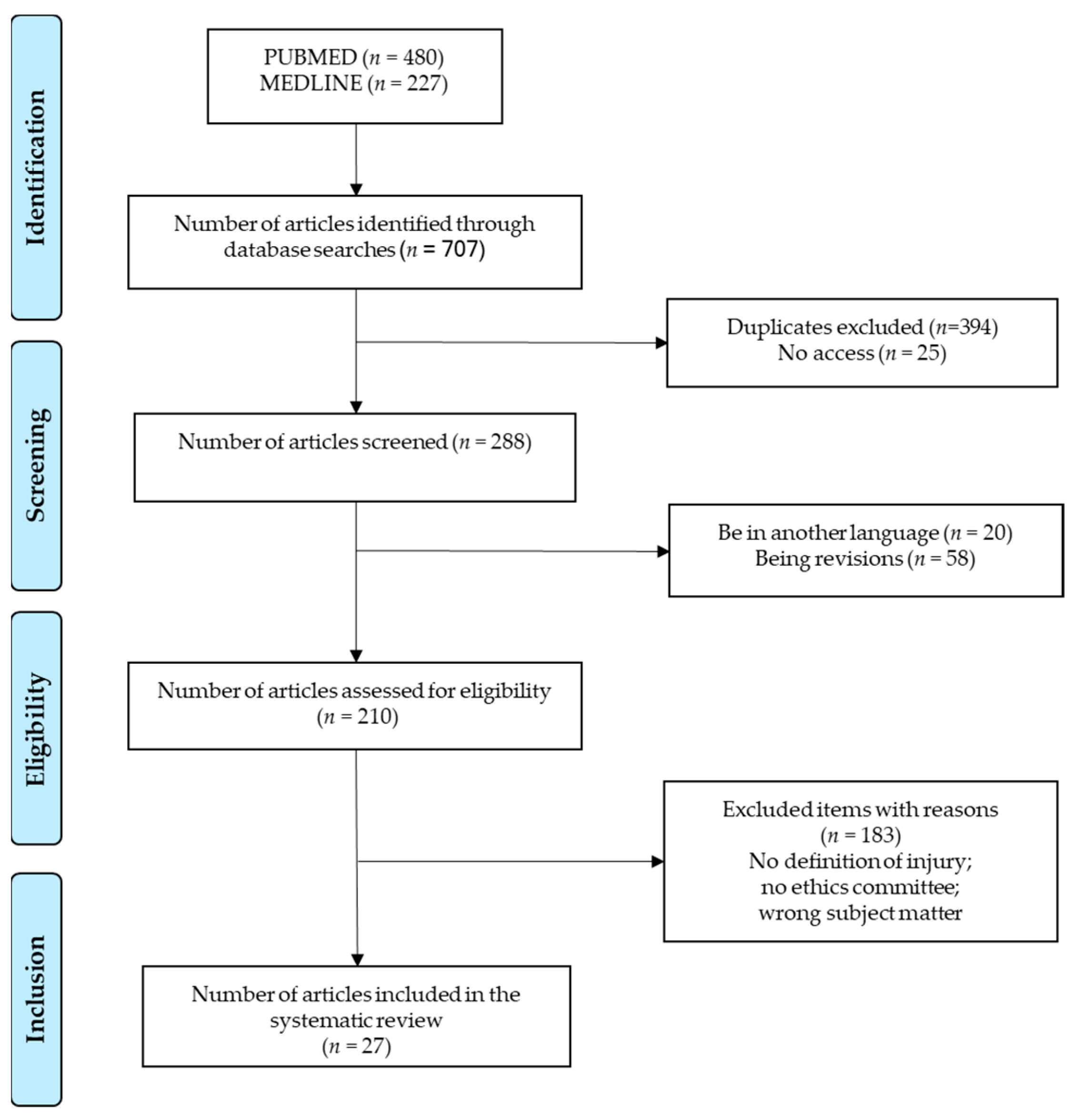
Of the 707 studies retrieved in the literature search, only 27 were deemed appropriate for the review (Figure 1).
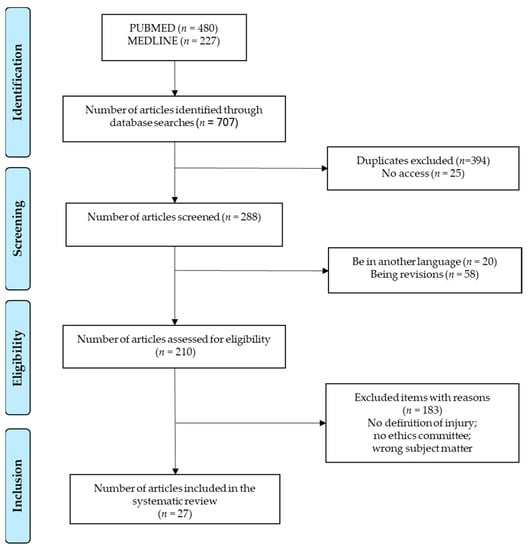
Figure 1.
Flow diagram based on the PRISMA guidelines [11] of information flow through the different phases of a systematic review.
The 27 studies obtained quality scores ranging from 10 to 26 out of a maximum of 28 points (Table 2). The main characteristics of each of the selected articles are listed in Table 3. The largest samples refer to professional players.
Table 2.
Methodological quality of the selected studies [12].
Table 3.
Characteristics of selected studies.
4. Discussion
4.1. Epidemiology and Relationship to Injury Definition
In the review of the studies, a great diversity of injury definitions was found, which was one of the handicaps when addressing an epidemiological profile of handball injuries. Of the 27 articles selected to be part of the review, 12 of them have a similar definition (in a broad sense), each with its own nuances. Some of the authors [3,5,16,23,26,30,33] define injury by referring to “a physical complaint”. Others such as Aman et al. [28] and Aman et al. [32] use the words “physical damage” to describe injury. Giroto et al. [31] in their article use “musculoskeletal pain”. Anderson et al. [27] and Clarsen et al. [35] make use of the adjectives “pain, distress, stiffness, instability and weakness” to give their definition. However, other articles present more open definitions. This is the case of Ruehlemann et al. [20] (2019) and Monaco et al. [22] define injury as damage that causes absence in training or competition. In the case of Asker et al. [2] and Aasheimen et al. [1] we are told that it causes a moderate or severe reduction in training volume, performance or even total capacity. In the case of Luig et al. [17] defines contact injury as any injury due to external forces and non-contact injury as injury without contact with another player or object.
Considering the different injury definitions used for data analysis, a rigorous epidemiological profile cannot be drawn up, but in general, the highest number of injuries occur in the lower extremities, but without reaching a consensus on which has the highest incidence. In relation to upper limb injuries, shoulder injuries are the most frequent. It seems that the greatest number of injuries are caused by contact with another player, without identifying whether they occur more during competition or during training.
4.2. Injury Location in Handball
Handball is among the sports with the highest injury rates (82.2%) within Olympic sports [18]. Most authors identify the greatest number of injuries in the lower extremities (LES), highlighting the knee, thigh and ankle areas, but without reaching a consensus on which has the highest incidence. On the other hand, shoulder injury is the most common upper extremity (UE) injury.
In a study conducted at the World Men’s Handball Championship (MWBC) in Qatar 2015 [33], they found that 58.3% of the injuries were located in the lower extremities, mainly in the ankle, thigh and knee, while 16.7% affected the upper extremities, mainly the shoulder and fingers/thumb. In another study conducted in the same year, the knee and shoulder were shown to have a high injury rate with 20% and 22% respectively [34]. All these results were ratified with subsequent studies [14,17,21,28,30].
Along the same lines, in the 2017 French MWBC [23], they conclude that the most affected parts during this tournament were the ankle (19.3%), head/face (17.3%), knee (15.1%) and thigh (12.9%). Similar percentages to those presented by Von Rosen et al. [26]. In the study presented by Asai et al. [19], in players aged 13–14 years, the most affected body areas were the head/face, ankle, knee and wrist/hand.
4.3. Upper Extremities (UE)
Starting with the shoulder, Asker et al. [15] analyzed range of motion (ROM), as well as strength, external rotation, internal rotation and scapular dyskinesia, in relation to shoulder injuries. In the analysis of ROM, they found no association between ROM and injury. Nor was a connection observed between scapular dyskinesia during flexion and the incidence of shoulder injury. However, they did find a link between scapular dyskinesia during shoulder abduction in players. This may be explained by the fact that abduction resembles the throwing action. In contrast, no such link was found in women players. What they did find was a link between a weakness between isometric external and internal rotation of the shoulder in relation to injuries in women players.
Andersson et al. [27] found no association between overuse shoulder injury and obvious scapular dyskinesia. Contrary to what was found in the study by Asker et al. [15], these authors did obtain significant results on the ROM of internal rotation, relating increased internal rotation to overuse injury. On the other hand, they observed that being a woman may represent a risk factor for this type of injury.
According to Asker et al. [2], the prevalence of any shoulder problem was higher in women and men front row players compared to those playing closer to the 6 m line. This may perhaps be explained by the fact that the second line has more interventions and greater exposure to contact. In the same vein, these authors found a higher prevalence of injury in women players than men players in the front row.
In the retrospective study on tendinopathy by Florit et al. [21], among several sports (basketball, hockey, volleyball, …,), handball was the sport with the highest incidence of tendinopathy in the upper limbs, particularly in the shoulder, probably due to a high number of throws performed at high speed.
According to Moller et al. [29], the injury rate was higher among players who increased their handball load by more than 60% compared to those players who decreased or increased their handball load by 20%.
4.4. Lower Extremities (LE)
One of the most severe injuries leading to a long recovery period is the anterior cruciate ligament (ACL) injury. Along these lines, Oshima et al. [25] reported that those players who sustained ACL injuries had poor static balance compared to players who were not injured, concluding that balance training is effective in preventing non-contact ACL injuries. In the study presented by Ruhlemann et al. [20], they evaluated knee stability functionality with a battery of tests, finding that stability differs depending on the position on the field. The results of this study show that the pivot is the player with the best stability values in the two-legged stability test, while in the single-legged balance, it was the wingers who obtained the lowest results. In another of the tests, in the plyometric jumping test, the pivots had the longest contact time with the ground. Finally, in the one-legged countermovement jumping test, the front row jumped more than the pivots. Therefore, the data obtained can be used for an objective assessment of knee functionality and stability.
4.5. Mechanism of Injury in Handball
When analyzing the mechanism of injury in handball, studies show that the majority of injuries (>50%) are caused by contact with another player [5,14,17], with traumatic injuries being the most common, followed by overuse injuries (63% vs. 37%) [3,14,21].
In the same vein, Bere et al. [33] recorded that 61.4% of injuries were caused by player-to-player contact. The remaining were non-contact (15.9%) and overuse (12.1%). However, in another study 34% of injuries were found to be caused by contact with another player, 2% in contact with the ball and 64% non-contact [30].
Regarding the most common areas of traumatic injury, the different studies analyzed agree that ankles and knees are the most injured areas, with the percentages of occurrence of ankle injuries ranging from 19.4% in the study by Giroto et al. [31] to 24% in the one presented by Moller et al. [3] and knee injuries from 13.5% in the former to 19% in the latter.
In the latter study, it was observed that the majority of injuries were new (65%), compared to 35% that were recurrent. Furthermore, in one of the age groups analyzed in this study (U16), there was a significant relationship between a previous injury and a new injury [3]. The results are in line with those presented in Japanese grassroots players [14]. However, in the study by Raya-Gonzalez et al. [10], no significant differences were observed between the First and Second Division groups in injury recurrence, mechanism and severity.
An investigation conducted on German players [17], recorded that the most affected parts in the mechanism by direct contact were the head (87.5%), the hands (83.8%), the shoulder (70.2%) and the ankle (62.9%). In injuries caused by indirect contact, the parts most affected by this mechanism were the knee (27.7%), the shoulder (27.7%) and the thigh (21.8%). Finally, in non-contact injuries the parts most affected were the thigh 56.4%, the knee 27.8% and the ankle 19%.
In the case of overuse injuries, Aasheim et al. [1] specified that this type of injury was higher in male junior players (39%), particularly in the shoulder and knee, finding a higher prevalence in each shoulder separately while the knee had a higher prevalence in the sum of both knees (dominant and non-dominant).
In another vein, Goes et al. [16] found that muscle injuries were the most prevalent, followed by joint injuries and finally tendinopathies. Within muscle injuries the back of the thigh had the highest incidence (27.8%), followed by the shoulder and the anterior thigh (both 15.8%). In joint injuries, the most common were knee (30.5%) and ankle (33.3%). Finally, in tendinopathies, the knee had the highest incidence (42.9%) followed by the shoulder (33.3%). Other studies by are along the same lines [14,21].
4.6. Injuries by Gender and by Category
Regarding gender, in the research presented by [3], men players in the U18 age group had a higher incidence of injury than women players in the same age group. Along the same lines, in the study presented by Asai et al. [19], significant differences in injury incidence were recorded between men (32.7%) and women players (20.1%). On the contrary, [31], observed higher recurrent injuries in women players (66.7%) than men players (33.3%). These results are in line with those presented by other authors [24,28,32].
Regarding injuries recorded during competition and training, in the study conducted on Brazilian athletes [31], a higher number of injuries were recorded in competition for women players (56.2%) compared to men players (46.3%), while during training the behavior was the inverse.
Along the same lines, women players had a higher number of injuries with more than 7 days lost compared to men players, i.e., they had more severe injuries [5]. In another study, they found that the majority of injuries, 41.4% were of moderate severity (2–7 days), but women players presented a lower percentage in this type of injury than men players [31]. Bere et al. [33], state that the injuries that caused the longest player recovery times were head/face (82.4%), knee (80%) and ankle (65.2%) injuries.
In terms of category, older players were more at risk of injury than younger players [23]. In relation to severity, the senior category had moderate severity injuries (8–28 days) with an incidence of 12.3%, followed by minimal severity injuries (1–3 days) with an incidence of 9.6% and minor injuries (4–7 days) with an incidence of 7.2%. In comparison, the U18 and U16 categories had a higher incidence of moderate severity, followed by mild and finally minimal [3]. In terms of injury severity, moderate injuries (8–28 days) had the highest incidence at 32%, followed by minor (4–7 days) at 27% and severe (>28 days) at 26% [30]. In the study presented by Mashimo et al. [14], 38.2% of the injuries had the athlete lose more than 28 days of training, and among that percentage 35.4% were produced by contact with another player.
4.7. Incidence of Injury by Specific Position
Regarding the incidence of injury according to playing position, it could be said that the pivot position has the highest risk of injury. As for the wingers and the second line, it is not clear which has the highest incidence.
According to Bere et al. [33] the players with the highest incidence of injury were those playing on the 6-m line, followed by the wingers, the first line and finally the goalkeepers. In the study published by Rafnsson et al. [30], it is observed that the most injured players were the goalkeepers with 67% of the injuries caused by overuse and 33% by acute injury, followed by the wingers, who were injured half by overuse and half by acute injury. Finally, the front line accounted for 38% of injuries due to overuse and 62% due to acute injury.
In terms of the position players occupy on the field, a similar incidence of injury is observed between the different playing positions, as well as categories, with the second line presenting more knee and cartilage problems [22]. However, other studies found that the players most likely to be injured are the front row followed by the 6-m players [14,23].
Luig et al. [17] go a little deeper and relate playing position to a particular injury mechanism, finding that pivots (58.4%) and wingers (56.9%) are the players with the highest proportion of injury by the mechanism of direct contact with another player (51.4% of injuries). This is followed by the front line (56.9%) and finally goalkeepers with 44.4%. Twenty-six per cent of injuries are caused by indirect contact, with the front row being the most affected (31.5%). Finally, 22.6% of injuries were non-contact, with goalkeepers having the highest percentage of injuries (48.9%).
4.8. Timing of Injury
Finally, there seems to be no consensus on when most handball injuries occur, whether in training or in competition. According to Engebretsen et al. [5], at the London Olympic Games, most injuries occurred during competition. The same conclusions were reached by other authors [22,26,30]. In the study of Brazilian men and women players [31], 59.9% of injuries were recorded during training compared to 48.1% during matches. In this same line of thought, the study presented by Mashimo et al. [14] also coincides, following a competitive season, in young Japanese players, a percentage of 28.4% injuries in competition were recorded, compared to 71.6% during training.
In the study presented by Raya-González et al. [10], the injury rate of the same team was analyzed during two seasons, in which they played in two different categories (first division vs. second division). A significantly higher incidence of injury was observed in the second division group in training and match play.
Analyzing the competition further, during the 2015 MWBC in Qatar [33], most injuries were recorded during the second part of the first half. However, Luig et al. [17] found no difference between the first and second half of the match. What they did find was that more injuries were identified in the last 10 min of each half, especially in the last minutes of the second half. Moreover, most of the injuries occurred in the offensive area and the area of the pitch with the highest proportion of injuries was the central area between 6 and 9 m.
4.9. Injury Prevention
Regarding aspects related to injury prevention, information is limited, with the warm-up being the appropriate place to work on this aspect. Andersson et al. [27] report that coaches consider that there is a risk of shoulder injury for youth handball players. These authors raise the importance of implementing an OSTRC Shoulder Injury Prevention Program as it works on several risk factors associated with shoulder injuries. The coaches consulted consider that it is a suitable program to introduce in the warm-up, but express difficulties in its use, as they consider it more relevant to use training time to work on specific content. Asker et al. [2] highlight the importance of introducing a clinical follow-up program on a routine basis and improving medical support, taking into consideration gender aspects in training stages. In aspects related to shoulder training load, Moller et al. [29], identify that rate above 60% increase the injury rate, even in youth players with normal shoulder characteristics. Youth players with scapular dyskinesia or reduced external rotation strength do not appear to be more likely to suffer a shoulder injury if the training load is not increased by more than 20%. For female players, the study presented by Oshima et al. [25] identifies the need for static balance work to reduce the risk of preventing cruciate knee ligament injuries in female players, when injuries are not caused by contact with another player. They propose that this work should be carried out during warm-up.
5. Conclusions
The most frequent injuries in handball players are located in the lower limbs (ankle, knee and thigh), and in the shoulder in the upper limb. In terms of playing position, the results suggest that there is a prevalence and pattern of injuries according to the specific position, with senior players playing at 6 m being the most affected by injuries. Women players are more likely to be injured. No data are presented to confirm that more injuries occur during competition than in training. However, the last 10 min or so of each of the two halves of a match seem to be the most frequent time for an injury to occur. As to whether the first or second half of the match is the time when more injuries occur, there are insufficient data to support one side or the other. Regarding injury prevention, the right time to work on it is during the warm-up phase. For cruciate ligament knee injury in female players, static balance work reduces the risk of injury.
Finally, one of the main limitations of this study is the diversity of methodologies used in the different studies, as well as the differences in the definitions of injuries and their severity. This has been one of the handicaps in approaching the review of the data.
Author Contributions
Conceptualization, H.V. and A.B.; methodology, H.V., C.A. and C.F.; validation, H.V., C.A. and C.F.; formal analysis, C.F.; investigation, H.V. and A.B.; resources, C.A.; data curation, C.A.; writing—original draft preparation, H.V.; writing—review and editing, A.A.; visualization, A.A.; supervision, H.V. and A.A. All authors have read and agreed to the published version of the manuscript.
Funding
This research has been partially subsidized by the Aid for Research Groups (GR21149) from the Regional Government of Extremadura (Department of Economy, Science and Digital Agenda), with a contribution from the European Union from the European Funds for Regional Development.
Institutional Review Board Statement
Not applicable.
Informed Consent Statement
Not applicable.
Data Availability Statement
Not applicable.
Conflicts of Interest
The authors declare no conflict of interest.
References
- Aasheim, C.; Stavenes, H.; Andersson, S.H.; Engbretsen, L.; Clarsen, B. Prevalence and burden of overuse injuries in elite junior handball. BMJ Open Sport Exerc. Med. 2018, 4, e000391. [Google Scholar] [CrossRef] [PubMed]
- Asker, M.; Holm, L.W.; Källberg, H.; Waldén, M.; Skillgate, E. Female adolescent elite handball players are more susceptible to shoulder problems than their male counterparts. Knee Surg. Sports Traumatol. Arthrosc. 2018, 26, 1892–1900. [Google Scholar] [CrossRef] [PubMed]
- Moller, M.; Attermann, J.; Myklebust, G.; Wedderkopp, N. Injury risk in Danish youth and senior elite handball using a new SMS text messages approach. Br. J. Sports Med. 2012, 46, 531–537. [Google Scholar] [CrossRef] [PubMed]
- Nielsen, A.B.; Yde, J. An Epidemiologic and Traumatologic Study of Injuries in Handball. Endoscopy 1988, 9, 341–344. [Google Scholar] [CrossRef] [PubMed]
- Engebretsen, L.; Soligard, T.; Steffen, K.; Alonso, J.M.; Aubry, M.; Budgett, R.; Dvorak, J.; Jegathesan, M.; Meeuwisse, W.H.; Mountjoy, M.; et al. Sports injuries and illnesses during the London Summer Olympic Games 2012. Br. J. Sports Med. 2013, 47, 407–414. [Google Scholar] [CrossRef]
- Antúnez, A.; Ibáñez, S.J.; Feu, S. Analysis of the Research Methodology in Spanish Doctoral Theses on Handball. A Systematic Review. Int. J. Environ. Res. Public Health 2021, 18, 10579. [Google Scholar] [CrossRef]
- Ferrari, W.R.; Sarmento, H.; Vaz, V. Match Analysis in Handball: A Systematic Review. Montenegrin J. Sports Sci. Med. 2019, 8, 63–76. [Google Scholar] [CrossRef]
- Vila, H.; Ferragut, C. Throwing speed in team handball: A systematic review. Int. J. Perform. Anal. Sport 2019, 19, 724–736. [Google Scholar] [CrossRef]
- Martín-Guzón, I.; Muñoz, A.; Lorenzo-Calvo, J.; Muriarte, D.; Marquina, M.; de la Rubia, A. Injury Prevalence of the Lower Limbs in Handball Players: A Systematic Review. Int. J. Environ. Res. Public Health 2022, 19, 332. [Google Scholar] [CrossRef]
- Raya-González, J.; Clemente, F.M.; Beato, M.; Castillo, D. Injury Profile of Male and Female Senior and Youth Handball Players: A Systematic Review. Int. J. Environ. Res. Public Health 2020, 17, 3925. [Google Scholar] [CrossRef]
- Moher, D.; Shamseer, L.; Clarke, M.; Ghersi, D.; Liberati, A.; Petticrew, M.; Shekelle, P.; Stewart, L.A. Preferred reporting items for systematic review and meta-analysis protocols (PRISMA-P) 2015 statement. Syst. Rev. 2015, 4, 1–9. [Google Scholar] [CrossRef] [PubMed]
- Pfirrmann, D.; Herbst, M.; Ingelfinger, P.; Simon, P.; Tug, S. Analysis of Injury Incidences in Male Professional Adult and Elite Youth Soccer Players: A Systematic Review. J. Athl. Train. 2016, 51, 410–424. [Google Scholar] [CrossRef] [PubMed]
- Anguera, T.; Hernandez-Mendo, A. Observational methodology in sport sciences. E-Balonmano 2013, 9, 135–160. [Google Scholar]
- Mashimo, S.; Yoshida, N.; Takegami, A.; Suzuki, K.; Onishi, S. Injury pattern according to player position in Japanese youth handball: A cross-sectional study among 2377 players. Phys. Ther. Sport 2021, 50, 7–14. [Google Scholar] [CrossRef] [PubMed]
- Asker, M.; Waldén, M.; Källberg, H.; Holm, L.W.; Skillgate, E. Preseason Clinical Shoulder Test Results and Shoulder Injury Rate in Adolescent Elite Handball Players: A Prospective Study. J. Orthop. Sports Phys. Ther. 2020, 50, 67–74. [Google Scholar] [CrossRef]
- Goes, R.A.; Lopes, L.R.; Cossich, V.R.A.; de Miranda, V.A.R.; Coelho, O.N.; Bastos, R.D.C.; Domenis, L.A.M.; Guimarães, J.A.M.; Grangeiro-Neto, J.A.; Perini, J.A. Musculoskeletal injuries in athletes from five modalities: A cross-sectional study. BMC Musculoskelet. Disord. 2020, 21, 122. [Google Scholar] [CrossRef] [PubMed]
- Luig, P.; Krutsch, W.; Henke, T.; Klein, C.; Bloch, H.; Platen, P.; Achenbach, L. Contact—But not foul play—Dominates injury mechanisms in men’s professional handball: A video match analysis of 580 injuries. Br. J. Sports Med. 2020, 54, 984–990. [Google Scholar] [CrossRef]
- Palmer, D.; Cooper, D.J.; Emery, C.; E Batt, M.; Engebretsen, L.; E Scammell, B.; Schamasch, P.; Shroff, M.; Soligard, T.; Steffen, K.; et al. Self-reported sports injuries and later-life health status in 3357 retired Olympians from 131 countries: A cross-sectional survey among those competing in the games between London 1948 and PyeongChang 2018. Br. J. Sports Med. 2021, 55, 46–53. [Google Scholar] [CrossRef]
- Asai, K.; Nakase, J.; Shimozaki, K.; Toyooka, K.; Kitaoka, K.; Tsuchiya, H. Incidence of injury in young handball players during national competition: A 6-year survey. J. Orthop. Sci. 2020, 25, 677–681. [Google Scholar] [CrossRef]
- Rühlemann, A.; Mayer, C.U.; Götte, L.; Behringer, M.; Jäger, M. Funktionelle Kniestabilität im Handball: Ein unverzichtbares Kriterium für sicheren Sport. Sportverletz. Sportschaden 2019, 33, 87–95. [Google Scholar] [CrossRef]
- Florit, D.; Pedret, C.; Casals, M.; Malliaras, P.; Sugimoto, D.; Rodas, G. Incidence of Tendinopathy in Team Sports in a Multidisciplinary Sports Club Over 8 Seasons. J. Sports Sci. Med. 2019, 18, 780–788. [Google Scholar] [PubMed]
- Mónaco, M.; Rincón, J.A.G.; Ronsano, B.J.M.; Whiteley, R.; Sanz-Lopez, F.; Rodas, G. Injury incidence and injury patterns by category, player position, and maturation in elite male handball elite players. Biol. Sport 2019, 36, 67–74. [Google Scholar] [CrossRef]
- Tabben, M.; Landreau, P.; Chamari, K.; Juin, G.; Ahmed, H.; Farooq, A.; Bahr, R.; Popovic, N. Age, player position and 2 min suspensions were associated with match injuries during the 2017 Men’s Handball World Championship (France). Br. J. Sports Med. 2019, 53, 436–441. [Google Scholar] [CrossRef]
- Åman, M.; Forssblad, M.; Larsén, K. National injury prevention measures in team sports should focus on knee, head, and severe upper limb injuries. Knee Surg. Sports Traumatol. Arthrosc. 2019, 27, 1000–1008. [Google Scholar] [CrossRef]
- Oshima, T.; Nakase, J.; Kitaoka, K.; Shima, Y.; Numata, H.; Takata, Y.; Tsuchiya, H. Poor static balance is a risk factor for non-contact anterior cruciate ligament injury. Arch. Orthop. Trauma. Surg. 2018, 138, 1713–1718. [Google Scholar] [CrossRef] [PubMed]
- von Rosen, P.; Heijne, A.; Frohm, A.; Fridén, C.; Kottorp, A. High Injury Burden in Elite Adolescent Athletes: A 52-Week Prospective Study. J. Athl. Train. 2018, 53, 262–270. [Google Scholar] [CrossRef] [PubMed]
- Andersson, S.H.; Bahr, R.; Clarsen, B.; Myklebust, G. Risk factors for overuse shoulder injuries in a mixed-sex cohort of 329 elite handball players: Previous findings could not be confirmed. Br. J. Sports Med. 2018, 52, 1191–1198. [Google Scholar] [CrossRef]
- Åman, M.; Forssblad, M.; Larsén, K. Incidence and body location of reported acute sport injuries in seven sports using a national insurance database. Scand. J. Med. Sci. Sports 2017, 28, 1147–1158. [Google Scholar] [CrossRef]
- Møller, M.; Nielsen, R.O.; Attermann, J.; Wedderkopp, N.; Lind, M.; Sørensen, H.; Myklebust, G. Handball load and shoulder injury rate: A 31-week cohort study of 679 elite youth handball players. Br. J. Sports Med. 2017, 51, 231–237. [Google Scholar] [CrossRef]
- Rafnsson, E.T.; Valdimarsson, Ö.; Sveinsson, T.; Árnason, Á. Injury Pattern in Icelandic Elite Male Handball Players. Clin. J. Sport Med. 2019, 29, 232–237. [Google Scholar] [CrossRef]
- Giroto, N.; Junior, L.C.H.; Gomes, M.R.C.; Lopes, A.D. Incidence and risk factors of injuries in Brazilian elite handball players: A prospective cohort study. Scand. J. Med. Sci. Sports 2017, 27, 195–202. [Google Scholar] [CrossRef] [PubMed]
- Åman, M.; Forssblad, M.; Henriksson-Larsén, K. Incidence and severity of reported acute sports injuries in 35 sports using insurance registry data. Scand. J. Med. Sci. Sports 2016, 26, 451–462. [Google Scholar] [CrossRef] [PubMed]
- Bere, T.; Alonso, J.-M.; Wangensteen, A.; Bakken, A.; Eirale, C.; Dijkstra, H.P.; Ahmed, H.; Bahr, R.; Popovic, N. Injury and illness surveillance during the 24th Men’s Handball World Championship 2015 in Qatar. Br. J. Sports Med. 2015, 49, 1151–1156. [Google Scholar] [CrossRef] [PubMed]
- Clarsen, B.; Bahr, R.; Heymans, M.; Engedahl, M.; Midtsundstad, G.; Rosenlund, L.; Thorsen, G.; Myklebust, G. The prevalence and impact of overuse injuries in five Norwegian sports: Application of a new surveillance method. Scand. J. Med. Sci. Sports 2015, 25, 323–330. [Google Scholar] [CrossRef] [PubMed]
- Clarsen, B.; Bahr, R.; Andersson, S.H.; Munk, R.; Myklebust, G. Reduced glenohumeral rotation, external rotation weakness and scapular dyskinesis are risk factors for shoulder injuries among elite male handball players: A prospective cohort study. Br. J. Sports Med. 2014, 48, 1327–1333. [Google Scholar] [CrossRef]
Publisher’s Note: MDPI stays neutral with regard to jurisdictional claims in published maps and institutional affiliations. |
© 2022 by the authors. Licensee MDPI, Basel, Switzerland. This article is an open access article distributed under the terms and conditions of the Creative Commons Attribution (CC BY) license (https://creativecommons.org/licenses/by/4.0/).