


Abstract
Interest in analyzing physically active behaviors during school recesses has grown in recent years as the school environment has consolidated (recess, physical education classes, lunch-time, before and after school) as a crucial space to bring these levels towards those recommended through intervention programs and improvements in the school environment. Unfortunately, in most of these studies, children do not achieve the 60 min a day of moderate to vigorous physical activity (MVPA) recommended by the World Health Organization. The aim of this systematic review is to analyze the cross-sectional, longitudinal, and intervention studies objectively measured with accelerometers that have emerged in recent years to determine the amount of MVPA of children at recess. This systematic review followed the PRISMA guidelines. The extraction process for the studies included in this systematic review yielded a total of 43 articles. The studies were classified according to the methodological nature of the research: cross-sectional (n = 34), longitudinal (n = 3) and quasi-experimental (n = 6). The results of the studies confirm that during the recess period younger children are physically more active than older ones and that in general, boys are more physically active than girls. In addition, the data show that the school contributes to more than 40% of the total MVPA. The intervention programs led to an increase in MVPA of up to 5%. Providing schools with equipment and facilities shows that intervention programs are beneficial for raising children’s levels of physical activity.
1. Introduction
The low levels of physical activity in the younger population are considered one of the main factors that cause health problems such as obesity or overweight, these levels being below the daily recommendations for moderate to vigorous physical activity [1]. In the United States, only about 42% of children between 6 and 11 years old meet the daily recommendations of 60 min a day, so it is necessary to study strategies to promote physical activity and health among children and adolescents [2]. Recent studies show that the environment affects the physical activity of children, since those who have large spaces, adequate equipment or a marking system in the schoolyard register higher levels of physical activity [3]. Children spend a very important proportional part of their daily work in the school environment, making school a great opportunity to influence levels of physical activity. However, each country is influenced by a series of important factors such as school policies, the programs that take place or the time allocated to recess [4]. Physical education classes, like recesses, are also periods that help students to reach the daily recommendations [5]. All these factors make physical activity levels vary from one country to another. In Japan, the proportion of moderate to vigorous physical activity performed by children is lower, around 18%, compared to European countries such as England or France where studies reported levels between 23.7% and 32.9% [3].
Most studies reveal that the levels of physical activity decrease with age, and that the physical activity of boys is higher than that of girls [6], since in general boys are more dominant in the yard during recess [7]. Other studies have also shown that there are no gender differences, although there are in the time spent in the different recess spaces, each one associated with different levels of physical activity [8]. There are many variables that influence the physical activity carried out by adolescents: the socioeconomic level of the parents, the intrinsic individual motivation and environmental factors such as the environment close to the subject, natural weather conditions or lack of time due to weather conditions, daily activities, and all of them can act in favor or to the detriment of the practice of physical activity [9]. In spite of everything, the opportunities offered by the school have improved in recent years and public health professionals have identified that schools, and specifically recess time, are a great setting for increasing the practice of physical activity by younger students [1]. Interventions in the schoolyard offer a good opportunity to improve students’ levels of physical activity [10]. Increasingly, children have the facilities to increase their daily physical activity at recess, this break time contributing around 40% of total activity and, in recent years, physical activity has been promoted in schools through different programs and strategies, such as marking the playground [11].
The use of accelerometry devices has allowed both physical activity professionals and the research community to extract quantifiable data on the real and objective amount of physical activity performed, and many studies use this instrument to objectively measure the physical activity in domains such as school [12]. With the help of emerging technology and research on this topic, an important challenge today is to try to take advantage of the spaces offered by the environment and the free time available to promote and encourage the active behaviors of those youngest [13].
The latest systematic reviews focused on the analysis of the literature on studies related to physical activity during school recess were carried out by Ridgers et al., in 2012 [4] and Parrish et al., in 2013 [11], for cross-sectional and intervention research, respectively. For this reason, the present systematic review took the indicated dates as its starting point, carrying out the search and analysis process until now (July 2020). More specifically, the objective of this study was to update the current state of knowledge about the determinants of active behavior during school recess. The systematic review adopted a three-fold approach to analysis, classifying the extracted studies according to their methodological nature: cross-sectional, longitudinal and quasi-experimental.
2. Methods
2.1. Search Strategy
This systematic review followed the PRISMA guidelines. The process of searching and the systematic review of the existing literature began in February 2020 and lasted approximately six months. The rigorous identification processes of the studies associated with the objective made it possible to group the most outstanding findings in a structured and organized way.
This systematic review of the scientific literature took as its starting point two previous ones carried out by Ridgers et al., in 2012 [4] and Parrish et al., in 2013 [11], corresponding to cross-sectional and intervention studies respectively. The reason that encouraged the realization of this work was the lack of updating in the large amount of scientific literature generated on the realization of physical activity during school recess. That is why for this documentary search, a screening of all the research articles between May 2011 and July 2020 was carried out for cross-sectional and longitudinal studies, and from April 2013 to July 2020 for quasi-experimental studies.
The Web of Science (WOS) database was mainly used for this literature review, although nine electronic literature databases were also involved in the process (Scopus, MedLine, SciELO, KCI, RSCI, Eric, PubMed, Dialnet and Google Scholar). The search strategies in the different databases were carried out by establishing descriptors (Table 1) in four large groups: population (child, children, youth, young, adolescent, student, students), school context (school, primary, elementary, middle school, high school, secondary school), recess time (break, breaks, recess, playtime, free play, free time), physical activity (physical activity). Only articles published in scientific journals were selected, excluding abstracts, books and conferences.
Table 1.
Systematic review categories and search terms.
To guarantee the rigor of the research, a search was carried out with boolean markers using the following keywords [(“child” OR “children” OR “youth” OR “young” OR “adolescent” OR “student” OR “students”) AND (“School” OR “primary” OR “elementary” OR “middle school” OR “high school” OR “secondary school”) AND (“break” OR “breaks” OR “recess” OR “playtime” OR “free play” OR “free time”) AND (“physical activity” OR “physical activities”)]. In this way, it was possible to guarantee the non-exclusion of any results related to the research topic. It is important to note that regardless of the nature of the studies (cross-sectional, longitudinal or quasi-experimental) the keywords were the same for all search engines.
2.2. Inclusion/Exclusion Criteria
The inclusion criteria (Table 2) that were used to define the set of papers in this systematic review were the following: (1) Scientific journal publications in English; (2) Research published from the latest systematic reviews carried out; (3) Participants aged between 6 and 18 years; (4) Framed in the context of school recess; (5) Accelerometry as an instrument for measuring physical activity; (6) Contribution of values of physical activity of moderate to vigorous intensity (MVPA); (7) Exclusion of those intervention studies that do not include randomized controlled trials (RCT).
Table 2.
Inclusion/exclusion criteria.
2.3. Data Extraction and Risk of Bias
The potentially eligible studies were initially screened by two reviewers (with previous experience in systematic reviews on physical activity in children and adolescents) independently by reading titles and abstracts, following the stipulated criteria prepared in advance, included in the search protocol [14]. In those studies with unclear abstracts or titles, a peer review was performed and the articles were agreed, resolving discrepancies through discussion and consensus [15]. In a second phase, the two reviewers independently read the full text of the studies preselected in the previous phase, creating the final list of potentially eligible studies, going to a third external investigator, when no consensus was reached regarding acceptability [16]. Finally, the full texts of the screened articles were carefully examined and analyzed.
3. Results
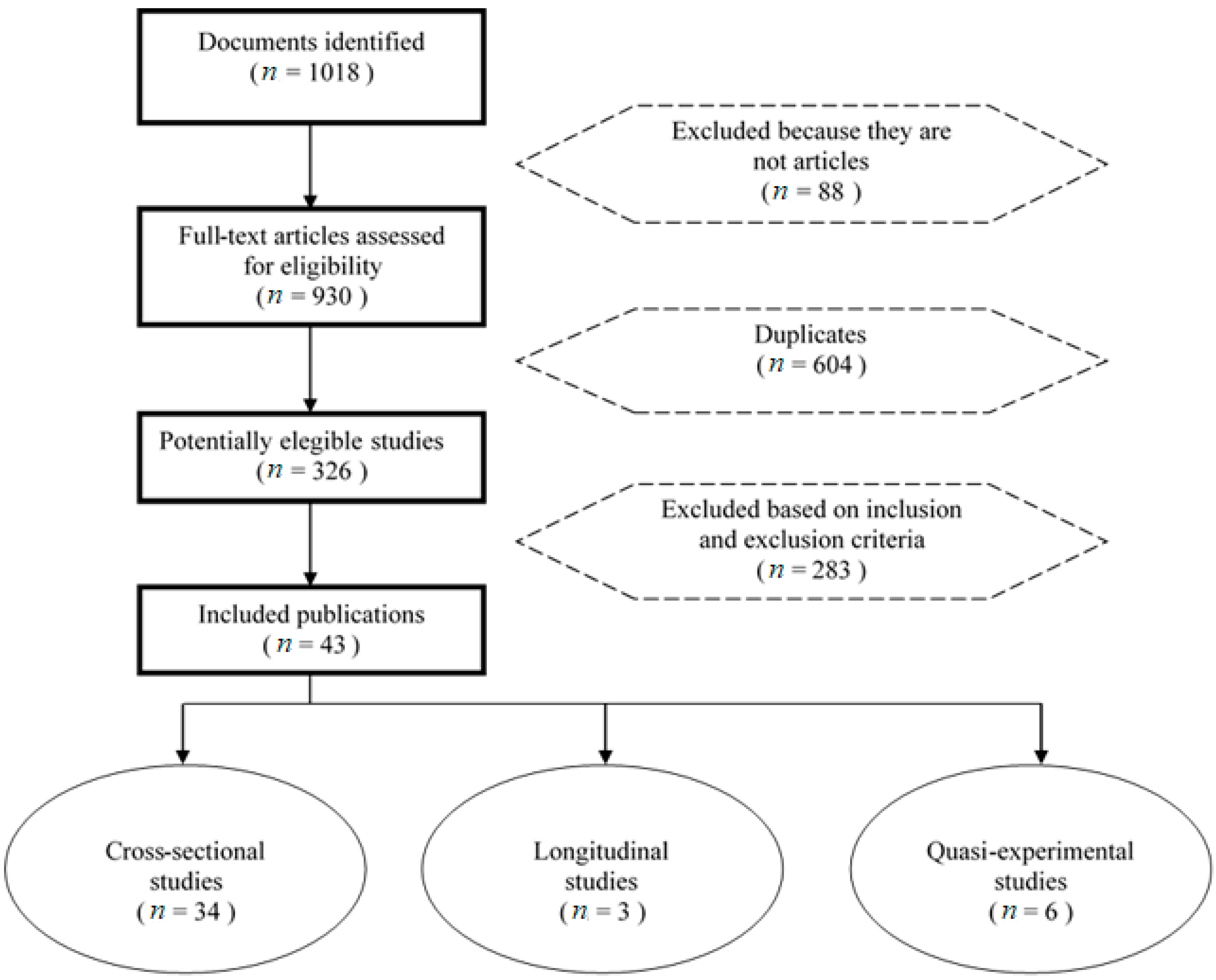
This systematic review yielded a total of 1018 search results, of which 998 were within the time period delimited by the inclusion/exclusion criteria. The extraction process for the studies included in this systematic review yielded a total of 43 articles. The studies were classified according to the methodological nature of the research: cross-sectional (n = 34), longitudinal (n = 3) and quasi-experimental (n = 6). A summary of the PRISMA flowchart of each stage of the search can be seen in Figure 1.
Figure 1.
PRISMA flow diagram of systematic search and included studies.
Table 3 shows the main characteristics of the 34 cross-sectional studies found. A global analysis allows identifying a large set of variables related to this research topic (SED, PA, LPA, MPA, VHPA, MVPA, obesity, overweight, parental education level, ambulatory and non-ambulatory activity, ethnic groups), all of them conditioning the amount of physical activity that the subjects perform during recess. In general, younger children have higher levels of MVPA. It is also worth highlighting the evident difference that exists between sexes, since the levels of MVPA in boys are higher than those of girls. In some studies carried out by different authors in relation to the MVPA, girls performed 30.5%, while boys 47.0% [17]. Others studies found that the AFMV for boys was 17.9% and for girls 15.5% [4]. On the other hand, values of 30.1% versus 19.7%, respectively, were also found [18].
There were also significant effects in relation to programs and courses. Children’s MVPA at recess was higher than in physical education classes. In the lower grades, a lower sedentary behavior was demonstrated, accompanied by an increase in the MVPA of the first grade children during recess. The MVPA performed at recess is up to 39% higher than that performed in physical education classes [2] and the same happens in another study where PE only contributed to the 6.4% of the overall MVPA of children, while recess time contributed 18.7% and the results indicate that more than half of the children are reaching the daily recommendations and that recess and PE contribute to 43% of the total activity, so they are important moments for conducting MVPA [19].
Table 3.
Main characteristics of cross-sectional studies.
Table 4 shows the main characteristics of the 3 longitudinal studies found. More specifically, a study on a marking program in the schoolyard, another on physical activity in the different seasons of the year and finally another that relates physical activity to recess and lunchtime. In general, over time, benefits are achieved in terms of increased physical activity. The marking system in the patio or the improvement of the patio areas favors the practice of physical activity, with significant changes just six months after the start [45]. Regarding the seasons of the year, the data reveal that the physical activity carried out decreases in the summer months (19.5%) and spring (24.4%), with the highest levels being in winter (27.7%) [46]. The analysis of the data also allows us to observe that girls are more active in dance activities, a low court or a climbing structure, while boys are more active in an obstacle course [47]. As can be seen, the duration of recess time varies from one study to another depending on the country where they were carried out, being 30 min in a single period in some studies [46] and 60 min distributed in four periods in other studies [47].
Table 4.
Main characteristics of longitudinal studies.
Table 5 shows the main characteristics of the six intervention studies found. Two of the studies are based on the “Ready for recess” program, two on the “Playworks” program, one on a marking system in play areas and the last one on changes in the playing environment. Thanks to these programs, five of the six studies corroborate the importance of designing recess programs to increase the practice of physical activity, in which increases in physical activity carried out by students of up to 19.4% are observed. However, one of the studies, despite indicating that these interventions are positive, does not show a significant increase in the physical activity of the sample in the accelerometry devices [48].
According to “Ready for Recess” program, boys in FP + EQ increased their MVPA by 14.1% while girls remain slightly more sedentary after the intervention [49]. In another study, a significant increase in MVPA was also observed in the experimental group compared to the control group [7]. Furthermore, teachers in schools that made use of the “Playworks” program reported an increase in levels of physical activity, but accelerometry measures and student surveys did not show significant impacts [48]. Nevertheless, future studies should redirect their analysis in such a way that they can explore the underlying mechanisms in the intervention proposals that are carried out in schools [7].
Table 5.
Main characteristics of quasi-experimental studies.
4. Discussion
The aim of this systematic review was to investigate the determining factors of active behavior during school recess, analyzing the levels of physical activity performed by children in this time frame and their impact on the global values of daily physical activity of the school-age population. Although the results of these studies show heterogeneity and not all of them provide significant evidence on the potential of the school as an institution that promotes physical activity, we can observe that most of the investigations agree that recess is a key moment to promote the levels of physical activity towards the recommended 60 min of daily MVPA. Other variables of physical activity that are reflected on in this research topic are light physical activity (LPA), moderate physical activity (MPA), vigorous physical activity (VPA) and sedentary behaviors (SED), expressed in minutes or in percentage, always in relation to the 60 min recommended by the World Health Organization and that guarantee objective measures that allow knowing real data about what is happening in schoolyards.
The realization of this update of the existing literature has had a triple approach, collecting cross-sectional, longitudinal and quasi-experimental studies, which implies an important strength of this systematic review, focused specifically on physical activity during school recess. The sample of students from the different schools has presented a great variety from some studies to others, ranging between 25 and 2024 subjects. Of the studies analyzed, 14 of them have been carried out in the United States, with the vast majority of the rest coming mainly from countries of the European Union.
From a global point of view we can appreciate the wide range of variables that are collected in the scientific literature and how each of them influences in relation to the levels of physical activity measured objectively with accelerometry, most of them being individual variables that directly affect the active behavior of the subject, such as age and gender. First, boys engage in more physical activity than girls, probably due to their nature, since boys tend to spend most of their time doing physical activities and competing with each other, while girls spend their time mostly in social activities [17,18]. In addition, it is recorded in numerous studies that boys tend to occupy the vast majority of play spaces and that the violence of their activities relegates girls to being located in the corners of the patio [4]. Second, we find that age is also a limiting factor. Younger children are generally significantly more active than older children. This is because as many of them grow up they lose interest and motivation in the practice of physical activity and that day-to-day activities considerably reduce the time they have for it [41]. That is why the need arises to design intervention programs that encourage physical activity both within the school environment and outside.
Although the objective of this study is to examine the amount of physical activity that children perform in relation to MVPA, we can find other variables that have been included by other studies presented here and that may be related with levels of physical activity at recess (such as the socioeconomic status of students or disorders such as obesity and autism).Children from families with a higher socioeconomic level perform more MVPA than those who live in families with a low socioeconomic level [30]. Other students who find their physical condition limited by the different disorders that are collected in the studies (whether they refer to eating disorders or others such as autism or the loss of some sense) also present lower levels of MVPA than those students exempt from them. The need arises to devise programs to adapt the centers to the different needs of their students and to create habits in students that allow them to develop physical activities both inside and outside of school [29].
The duration of recess is also a variable that we can find in all studies. In some schools, the recess time is divided into the morning recess and the lunch time recess, being typical of the schools that have a split day. Other studies are carried out in schools with up to four recess periods, which positively favors the performance of physical activity by students, since more than 40% of the children’s MVPA is carried out at school. The time for recess for the sample of articles is between 10 and 60 min.
Regarding the intervention studies, it should be noted that all of them correspond to studies carried out under the RCT premise so that their results are not biased by manipulation of the groups and the results are obtained by a randomized controlled trial. The six quasi-experimental studies analyzed in this review sought to increase the physical activity of students through intervention programs or improvements in the school environment (i.e., “Ready for recess” program, “Playworks” program, “marking system in play areas”). It is clear that teachers and school policies can have a significant impact on the physical activity carried out by children during school recesses. Most of the strategies reported benefits for students regardless of gender. The work of teachers is necessary to carry out these programs to prevent boys from dominating the entire play space and to compensate for the difference that exists with girls in increasing levels of physical activity. Some strategies such as the implementation of markings in the playground, the remodeling of the play areas or the implementation of play equipment are configured as potential strategies to increase the levels of physical activity in the school environment, but there is a need to continue working on it. The findings currently found are on the right track.
5. Conclusions
School recess is a space to potentially improve levels of daily physical activity in the lives of children. Gender and age are determinants, as at all levels girls are significantly less active than boys and prone to develop sedentary behaviors. As they grow, levels of physical activity also decreased, the smallest people performing the greatest MVPA. There are other variables that act positively or negatively related to physical activity levels present in children. Socioeconomic status is a variable to be highlighted because children with higher SES spend more time in MVPA. There is a need to advocate for interventions at school to promote moderate to vigorous physical activity (i.e., “Ready for recess” program, “Playworks” program, “marking system in play areas”). Environmental changes are as strong as the staff implements. Supervision is crucial because if it is not interactive, it can be detrimental to the PA, especially girls. Teachers should pay special attention to schedules to have more control of the variables of physical activity.
In conclusion, the school context is configured as a key space to meet the daily recommendations for physical activity. Studies show that by improving the conditions of the courtyard, providing it with equipment equipped according to the needs of students, improve play areas and designing programs that promote physical activity are to achieve positive improvements in levels of MVPA. For future research, it would be very useful for the scientific community to continue studying the relationship between the variables of physical activity and school recess, specifically in quasi-experimental studies, in which the capacity of these intervention programs to increase the levels of physical activity up to those recommended is analyzed, since most of the articles are cross-sectional in nature but there are very few longitudinal and intervention ones, in which this need for RCTs should be qualified as a criterion for the research design.
Author Contributions
Conceptualization, S.P.S. and D.I.G.; methodology, S.P.S. and D.I.G.; software, S.P.S.; formal analysis, S.P.S.; investigation, S.P.S. and D.I.G.; data curation, S.P.S. and D.I.G.; writing—original draft preparation, S.P.S. and D.I.G.; writing—review and editing, S.P.S. and D.I.G.; visualization, D.I.G.; supervision, D.I.G.; project administration, D.I.G. All authors have read and agreed to the published version of the manuscript.
Funding
This research received no external funding.
Institutional Review Board Statement
Not applicable.
Informed Consent Statement
Not applicable.
Conflicts of Interest
The authors declare no conflict of interest.
References
- Tercedor, P.; Segura-Jiménez, V.; Ávila García, M.; Huertas-Delgado, F.J. Physical activity during school recess: A missed opportunity to be active? Health Educ. J. 2019, 78, 988–999. [Google Scholar] [CrossRef] [Scilit]
- Gao, Z.; Chen, S.; Stodden, D.F. A comparison of children’s physical activity levels in physical education, recess, and exergaming. J. Phys. Act. Health 2015, 12, 349–354. [Google Scholar] [CrossRef] [Scilit] [PubMed]
- Ishii, K.; Shibata, A.; Sato, M.; Oka, K. Recess physical activity and perceived school environment among elementary school children. Int. J. Environ. Res. Public Health 2014, 11, 7195–7206. [Google Scholar] [CrossRef] [Scilit] [PubMed]
- Ridgers, N.D.; Salmon, J.; Parrish, A.M.; Stanley, R.M.; Okely, A.D. Physical activity during school recess: A systematic review. Am. J. Prev. Med. 2012, 43, 320–328. [Google Scholar] [CrossRef] [Scilit] [PubMed]
- Grao-Cruces, A.; Segura-Jiménez, V.; Conde-Caveda, J.; García-Cervantes, L.; Martínez-Gómez, D.; Keating, X.D.; Castro-Piñero, J. The Role of School in Helping Children and Adolescents Reach the Physical Activity Recommendations: The UP&DOWN Study. J. Sch. Health 2019, 89, 612–618. [Google Scholar] [CrossRef] [Scilit]
- Hubáčková, R.; Groffik, D.; Skrzypnik, L.; Frömel, K. Physical activity and inactivity in primary and secondary school boys’ and girls’ daily program. Acta Gymnica 2016, 46, 193–200. [Google Scholar] [CrossRef] [Scilit]
- Yildirim, M.; Arundell, L.; Cerin, E.; Carson, V.; Brown, H.; Crawford, D.; Hesketh, K.D.; Ridgers, N.D.; TeVelde, S.J.; Chinapaw, M.J.M.; et al. What helps children to move more at school recess and lunchtime? Mid-Intervention results from Transform-Us! Cluster-randomised controlled trial. Br. J. Sports Med. 2014, 48, 271–277. [Google Scholar] [CrossRef] [Scilit]
- Wood, C.; Gladwell, V.; Barton, J. A repeated measures experiment of school playing environment to increase physical activity and enhance self-esteem in UK school children. PLoS ONE 2014, 9. [Google Scholar] [CrossRef] [Scilit]
- Béghin, L.; Vanhelst, J.; Drumez, E.; Migueles, J.H.; Androutsos, O.; Widhalm, K.; Julian, C.; Moreno, L.A.; De Henauw, S.; Gottrand, F.; et al. Gender influences physical activity changes during adolescence: The HELENA study. Clin. Nutr. 2019, 38, 2900–2905. [Google Scholar] [CrossRef] [Scilit]
- Blaes, A.; Ridgers, N.D.; Aucouturier, J.; Van Praagh, E.; Berthoin, S.; Baquet, G. Effects of a playground marking intervention on school recess physical activity in French children. Prev. Med. 2013, 57, 580–584. [Google Scholar] [CrossRef] [Scilit]
- Parrish, A.M.; Okely, A.D.; Stanley, R.M.; Ridgers, N.D. The effect of school recess interventions on physical activity: A systematic review. Sports Med. 2013, 43, 287–299. [Google Scholar] [CrossRef] [Scilit] [PubMed]
- Klinker, C.D.; Schipperijn, J.; Christian, H.; Kerr, J.; Ersbøll, A.K.; Troelsen, J. Using accelerometers and global positioning system devices to assess gender and age differences in children’s school, transport, leisure and home based physical activity. Int. J. Behav. Nutr. Phys. Act. 2014, 11, 1–10. [Google Scholar] [CrossRef] [Scilit] [PubMed]
- Silva, P.; Sousa, M.; Sá, C.; Ribeiro, J.; Mota, J. Physical activity in high school during ‘free-time’ periods. Eur. Phys. Educ. Rev. 2015, 21, 135–148. [Google Scholar] [CrossRef] [Scilit]
- Viswanathan, M.; Patnode, C.D.; Berkman, N.D.; Bass, E.B.; Chang, S.; Hartling, L.; Murad, M.H.; Treadwell, J.R.; Kane, R.L. Recommendations for assessing the risk of bias in systematic reviews of health-care interventions. J. Clin. Epidemiol. 2018, 97, 26–34. [Google Scholar] [CrossRef] [Scilit]
- Higgins, J.P.T.; López-López, J.A.; Becker, B.J.; Davies, S.R.; Dawson, S.; Grimshaw, J.M.; McGuinness, L.A.; Moore, T.H.M.; Rehfuess, E.A.; Thomas, J.; et al. Synthesising quantitative evidence in systematic reviews of complex health interventions. BMJ Glob. Health 2019, 4, e000858. [Google Scholar] [CrossRef] [Scilit]
- Van Sluijs, E.M.; McMinn, A.M.; Griffin, S.J. Effectiveness of interventions to promote physical activity in children and adolescents: Systematic review of controlled trials. BMJ 2007, 335, 703. [Google Scholar] [CrossRef] [Scilit]
- Bailey, D.P.; Fairclough, S.J.; Savory, L.A.; Denton, S.J.; Pang, D.; Deane, C.S.; Kerr, C.J. Accelerometry-assessed sedentary behaviour and physical activity levels during the segmented school day in 10–14-year-old children: The HAPPY study. Eur. J. Pediatr. 2012, 171, 1805–1813. [Google Scholar] [CrossRef] [Scilit]
- Tanaka, C.; Tanaka, M.; Inoue, S.; Okuda, M.; Tanaka, S. Gender differences in physical activity and sedentary behavior of Japanese primary school children during school cleaning time, morning recess and lunch recess. BMC Public Health 2019, 19, 1–9. [Google Scholar] [CrossRef] [Scilit]
- Rooney, L.; McKee, D. Contribution of physical education and recess towards the overall physical activity of 8–11 year old children. J. Sport Health Res. 2018, 10, 303–316. [Google Scholar]
- Wang, L. Accelerometer-determined physical activity of children during segmented school days: The Shanghai perspective. Eur. Phys. Educ. Rev. 2019, 25, 816–829. [Google Scholar] [CrossRef] [Scilit]
- Weaver, R.G.; Crimarco, A.; Brusseau, T.A.; Webster, C.A.; Burns, R.D.; Hannon, J.C. Accelerometry-Derived Physical Activity of First Through Third Grade Children During the Segmented School Day. J. Sch. Health 2016, 86, 726–733. [Google Scholar] [CrossRef] [Scilit] [PubMed]
- Saint-Maurice, P.F.; Welk, G.J.; Silva, P.; Siahpush, M.; Huberty, J. Assessing children’s physical activity behaviors at recess: A multi-method approach. Pediatr. Exerc. Sci. 2011, 23, 585–599. [Google Scholar] [CrossRef] [Scilit] [PubMed]
- Saint-Maurice, P.F.; Welk, G.J.; Bartee, R.T.; Heelan, K. Calibration of context-specific survey items to assess youth physical activity behaviour. J. Sports Sci. 2017, 35, 866–872. [Google Scholar] [CrossRef] [Scilit] [PubMed]
- Viciana, J.; Mayorga-Vega, D.; Martínez-Baena, A. Moderate-to-vigorous physical activity levels in physical education, school recess, and after-school time: Influence of gender, age, and weight status. J. Phys. Act. Health 2016, 13, 1117–1123. [Google Scholar] [CrossRef] [Scilit]
- Klinker, C.D.; Schipperijn, J.; Kerr, J.; Ersbøll, A.K.; Troelsen, J. Context-specific outdoor time and physical activity among school-children across gender and age: Using accelerometers and GPS to advance methods. Front. Public Health 2014, 2, 1–15. [Google Scholar] [CrossRef] [Scilit]
- Pollard, T.M.; Hornby-Turner, Y.C.; Ghurbhurrun, A.; Ridgers, N.D. Differences between 9–11 year old British Pakistani and White British girls in physical activity and behavior during school recess. BMC Public Health 2012, 12, 1. [Google Scholar] [CrossRef] [Scilit]
- Ridgers, N.D.; Saint-Maurice, P.F.; Welk, G.; Siahpush, M.; Huberty, J.L. Differences in Physical Activity duringSchool Recess. J. Sch. Health 2011, 81, 545–551. [Google Scholar] [CrossRef] [Scilit]
- Kobel, S.; Kettner, S.; Erkelenz, N.; Kesztyüs, D.; Steinacker, J.M. Does a Higher Incidence of Break Times in Primary Schools Result in Children Being More Physically Active? J. Sch. Health 2015, 85, 149–154. [Google Scholar] [CrossRef] [Scilit]
- Galloway, R.; Booker, R.; Owens, S. Factors Leading to Discrepancies in Accumulated Physical Activity during School Hours in Elementary School Students. J. Teach. Phys. Educ. 2019, 38, 338–346. [Google Scholar] [CrossRef] [Scilit]
- Cohen, K.E.; Morgan, P.J.; Plotnikoff, R.C.; Callister, R.; Lubans, D.R. Fundamental movement skills and physical activity among children living in low-income communities: A cross-sectional study. Int. J. Behav. Nutr. Phys. Act. 2014, 11. [Google Scholar] [CrossRef] [Scilit]
- Massey, W.V.; Stellino, M.B.; Fraser, M. Individual and environmental correlates of school-based recess engagement. Prev. Med. Rep. 2018, 11, 247–253. [Google Scholar] [CrossRef] [Scilit] [PubMed]
- Ridgers, N.D.; Saint-Maurice, P.F.; Welk, G.J.; Siahpush, M.; Huberty, J.L. Non-overweight and overweight children’s physical activity during school recess. Health Educ. J. 2014, 73, 129–136. [Google Scholar] [CrossRef] [Scilit]
- Baquet, G.; Ridgers, N.D.; Blaes, A.; Aucouturier, J.; Van Praagh, E.; Berthoin, S. Objectively assessed recess physical activity in girls and boys from high and low socioeconomic backgrounds. BMC Public Health 2014, 14, 192. [Google Scholar] [CrossRef] [Scilit] [PubMed]
- Andersen, H.B.; Klinker, C.D.; Toftager, M.; Pawlowski, C.S.; Schipperijn, J. Objectively measured differences in physical activity in five types of schoolyard area. Landsc. Urban Plan. 2015, 134, 83–92. [Google Scholar] [CrossRef] [Scilit]
- McWhannell, N.; Triggs, C.; Moss, S. Perceptions and measurement of playtime physical activity in English primary school children: The influence of socioeconomic status. Eur. Phys. Educ. Rev. 2019, 25, 438–455. [Google Scholar] [CrossRef] [Scilit]
- Pan, C.Y.; Hsu, P.J.; Chung, I.C.; Hung, C.S.; Liu, Y.J.; Lo, S.Y. Physical activity during the segmented school day in adolescents with and without autism spectrum disorders. Res. Autism Spectr. Disord. 2015, 15–16, 21–28. [Google Scholar] [CrossRef] [Scilit]
- Vanhelst, J.; Béghin, L.; Duhamel, A.; De Henauw, S.; Molnar, D.; Vicente-Rodriguez, G.; Manios, Y.; Widhalm, K.; Kersting, M.; Polito, A.; et al. Relationship between school rhythm and physical activity in adolescents: The HELENA study. J. Sports Sci. 2017, 35, 1666–1673. [Google Scholar] [CrossRef] [Scilit]
- Martin, K.; Bremner, A.; Salmon, J.; Rosenberg, M.; Giles-Corti, B. School and individual-level characteristics are associated with children’s moderate to vigorous-intensity physical activity during school recess. Aust. N. Z. J. Public Health 2012, 36, 469–477. [Google Scholar] [CrossRef] [Scilit]
- Van Kann, D.H.H.; de Vries, S.I.; Schipperijn, J.; de Vries, N.K.; Jansen, M.W.J.; Kremers, S.P.J. Schoolyard Characteristics, Physical Activity, and Sedentary Behavior: Combining GPS and Accelerometry. J. Sch. Health 2016, 86, 913–921. [Google Scholar] [CrossRef] [Scilit]
- Dessing, D.; Pierik, F.H.; Sterkenburg, R.P.; van Dommelen, P.; Maas, J.; de Vries, S.I. Schoolyard physical activity of 6–11 year old children assessed by GPS and accelerometry. Int. J. Behav. Nutr. Phys. Act. 2013, 10, 1–9. [Google Scholar] [CrossRef] [Scilit]
- Nettlefold, L.; McKay, H.A.; Warburton, D.E.R.; McGuire, K.A.; Bredin, S.S.D.; Naylor, P.J. The challenge of low physical activity during the school day: At recess, lunch and in physical education. Br. J. Sports Med. 2011, 45, 813–819. [Google Scholar] [CrossRef] [Scilit] [PubMed]
- Suzuki, I.; Okuda, M.; Tanaka, M.; Inoue, S.; Tanaka, S.; Tanaka, C. Variability in school children’s activity occurs in the recess and before-school periods. Pediatr. Int. 2018, 60. [Google Scholar] [CrossRef] [Scilit] [PubMed]
- Woods, A.M.; McLoughlin, G.M.; Kern, B.D.; Graber, K.C. What’s Physical Activity Got to Do with It? Social Trends in Less Active Students at Recess. J. Sch. Health 2018, 88, 500–507. [Google Scholar] [CrossRef] [Scilit] [PubMed]
- Viciana, J.; Mayorga-Vega, D.; Parra-Saldías, M. Within and between-day differences in adolescents’ objectively-measured physical activity and sedentary behavior. Kinesiology 2019, 51, 227–237. [Google Scholar] [CrossRef] [Scilit]
- Baquet, G.; Aucouturier, J.; Gamelin, F.X.; Berthoin, S. Longitudinal Follow-Up of Physical Activity during School Recess: Impact of Playground Markings. Front. Public Health 2018, 6, 1–7. [Google Scholar] [CrossRef] [Scilit]
- Ridgers, N.D.; Salmon, J.; Timperio, A. Seasonal changes in physical activity during school recess and lunchtime among Australian children. J. Sports Sci. 2018, 36, 1508–1514. [Google Scholar] [CrossRef] [Scilit]
- Andersen, H.B.; Christiansen, L.B.; Pawlowski, C.S.; Schipperijn, J. What we build makes a difference—Mapping activating schoolyard features after renewal using GIS, GPS and accelerometers. Landsc. Urban Plan. 2019, 191, 103617. [Google Scholar] [CrossRef] [Scilit]
- Beyler, N.; Bleeker, M.; James-Burdumy, S.; Fortson, J.; Benjamin, M. The impact of Playworks on students’ physical activity during recess: Findings from a randomized controlled trial. Prev. Med. 2014, 69, S20–S26. [Google Scholar] [CrossRef] [Scilit]
- Huberty, J.L.; Beets, M.W.; Beighle, A.; Saint-Maurice, P.F.; Welk, G. Effects of ready for recess, an environmental intervention, on physical activity in third-through sixth-grade children. J. Phys. Act. Health 2014, 11, 384–395. [Google Scholar] [CrossRef] [Scilit]
- Huberty, J.L.; Beets, M.W.; Beighle, A.; Welk, G. Environmental modifications to increase physical activity during recess: Preliminary findings from ready for recess. J. Phys. Act. Health 2011, 8 (Suppl. 2), 249–256. [Google Scholar] [CrossRef] [Scilit]
- Bleeker, M.; Beyler, N.; James-Burdumy, S.; Fortson, J. The Impact of Playworks on Boys’ and Girls’ Physical Activity during Recess. J. Sch. Health 2015, 85, 171–178. [Google Scholar] [CrossRef] [Scilit] [PubMed]


Publisher’s Note: MDPI stays neutral with regard to jurisdictional claims in published maps and institutional affiliations. |
© 2021 by the authors. Licensee MDPI, Basel, Switzerland. This article is an open access article distributed under the terms and conditions of the Creative Commons Attribution (CC BY) license (http://creativecommons.org/licenses/by/4.0/).