

You are currently viewing a new version of our website. To view the old version click .

Marine Drugs, Volume 23, Issue 2

February 2025 - 40 articles

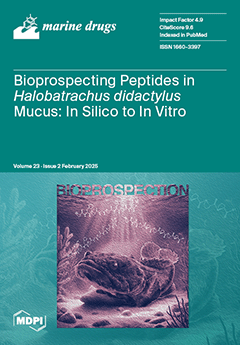
Cover Story: Bioprospection explores natural bioresources for therapeutic compounds, with the marine environment emerging as a promising reservoir. In this study, Halobatrachus didactylus (Lusitanian Toadfish) was investigated for its abundant mucus, which exhibited antioxidant, antimicrobial, and antihypertensive properties. Within the peptide mucus fraction, five peptides with potential bioactivity were identified via in silico analysis. The work integrated experimental and computational approaches to screen and validate these peptides while addressing challenges such as aggregation and stability, thereby underscoring a promising strategy for novel molecule discovery. View this paper
  • Issues are regarded as officially published after their release is announced to the table of contents alert mailing list .
  • You may sign up for email alerts to receive table of contents of newly released issues.
  • PDF is the official format for papers published in both, html and pdf forms. To view the papers in pdf format, click on the "PDF Full-text" link, and use the free Adobe Reader to open them.

Articles (40)

  • Article
  • Open Access
1,272 Views
15 Pages

19 February 2025

Carrageenan oligosaccharides (COSs) possess versatile activities and have drawn increasing attention in recent years. Due to their unique structures, COSs have been considered to be potential antibacterial agents and immune stimulators. Herein, we ai...

  • Review
  • Open Access
2,061 Views
15 Pages

Living Coral Displays, Research Laboratories, and Biobanks as Important Reservoirs of Chemodiversity with Potential for Biodiscovery

  • Ricardo Calado,
  • Miguel C. Leal,
  • Ruben X. G. Silva,
  • Mara Borba,
  • António Ferro,
  • Mariana Almeida,
  • Diana Madeira and
  • Helena Vieira

19 February 2025

Over the last decades, bioprospecting of tropical corals has revealed numerous bioactive compounds with potential for biotechnological applications. However, this search involves sampling in natural reefs, and this is currently hampered by multiple e...

  • Article
  • Open Access
1 Citations
1,213 Views
17 Pages

Discovery of MK8383s with Antifungal Activity from Mangrove Endophytic Fungi Medicopsis sp. SCSIO 40440 Against Fusarium Wilt of Banana

  • Tianyu Zhou,
  • Yulei Qiao,
  • Lu Wang,
  • Zifeng Li,
  • Haibo Zhang,
  • Liping Zhang,
  • Shengrong Liao,
  • Minhui Li,
  • Changsheng Zhang and
  • Wenjun Zhang

18 February 2025

Fusarium wilt of banana (FWB), caused by Fusarium oxysporum f. sp. cubense (Foc) tropical race 4 (TR4), poses a severe threat to the global banana industry. The screening of endophytic fungi from the mangrove plant led to the identification of M...

  • Article
  • Open Access
1,154 Views
11 Pages

Statins Diversity Revealed by the Deep-Sea-Derived Fungus Penicillium viridicatum

  • Meng Zhang,
  • Rong Chao,
  • Jia-Jian Wang,
  • Zi-Han Xu,
  • Ji-Hong Zhang,
  • Da-Li Meng,
  • Tai-Zong Wu and
  • Xian-Wen Yang

17 February 2025

Seven new (1–7) and six known (8–13) statin derivatives were obtained from the deep-sea-derived fungus Penicillium viridicatum MCCC 3A00265. The structures assigned to the new compounds were based on a comprehensive analysis of the spectr...

  • Review
  • Open Access
2,088 Views
23 Pages

Marine Phytoplankton Bioactive Lipids and Their Perspectives in Clinical Inflammation

  • Edoardo Andrea Cutolo,
  • Rosanna Campitiello,
  • Valeria Di Dato,
  • Ida Orefice,
  • Max Angstenberger and
  • Maurizio Cutolo

17 February 2025

Marine phytoplankton is an emerging source of immunomodulatory bioactive lipids (BLs). Under physiological growth conditions and upon stress challenges, several eukaryotic microalgal species accumulate lipid metabolites that resemble the precursors o...

  • Article
  • Open Access
1,676 Views
21 Pages

16 February 2025

Sea anemone peptides represent a valuable class of biomolecules in the marine toxin library due to their various structures and functions. Among these, ShK domain peptides are particularly notable for their selective inhibition of the Kv1.3 channel,...

  • Review
  • Open Access
3 Citations
10,243 Views
41 Pages

Omega-3 Fatty Acids for the Treatment of Bipolar Disorder Symptoms: A Narrative Review of the Current Clinical Evidence

  • Evmorfia Psara,
  • Sousana K. Papadopoulou,
  • Maria Mentzelou,
  • Gavriela Voulgaridou,
  • Theophanis Vorvolakos,
  • Thomas Apostolou and
  • Constantinos Giaginis

15 February 2025

Background: Bipolar disorder is a chronic mental disease that is characterized by depressive and manic episodes. Antipsychotics and mood stabilizers are known therapies that work, but their restrictions and disadvantages resulted in the need for comp...

  • Article
  • Open Access
3 Citations
1,860 Views
25 Pages

Antiaging Potential of Lipophilic Extracts of Caulerpa prolifera

  • Gonçalo P. Rosa,
  • Maria Carmo Barreto,
  • Ana M. L. Seca and
  • Diana C. G. A. Pinto

14 February 2025

The cosmeceutical industry has increasingly turned its attention to marine macroalgae, recognizing their significant bioactive potential as sources of natural compounds for skincare applications. A growing number of products now incorporate extracts...

  • Article
  • Open Access
1 Citations
1,456 Views
25 Pages

Bioprospecting Bioactive Peptides in Halobatrachus didactylus Body Mucus: From In Silico Insights to Essential In Vitro Validation

  • Marta Fernandez Cunha,
  • Ezequiel R. Coscueta,
  • María Emilia Brassesco,
  • Frederico Almada,
  • David Gonçalves and
  • Maria Manuela Pintado

13 February 2025

Fish body mucus plays a protective role, especially in Halobatrachus didactylus, which inhabits intertidal zones vulnerable to anthropogenic contaminants. In silico predicted bioactive peptides were identified in its body mucus, namely, EDNSELGQETPTL...

  • Article
  • Open Access
3 Citations
1,985 Views
15 Pages

13 February 2025

Background: Hypertension has been identified as a significant risk factor for cardiovascular disease. Given the prevalence of the adverse effects of angiotensin-converting enzyme-inhibitory (ACEI) drugs, natural and effective alternatives to these me...

of 4

Get Alerted

Add your email address to receive forthcoming issues of this journal.

XFacebookLinkedIn
Mar. Drugs - ISSN 1660-3397