
You are currently viewing a new version of our website. To view the old version click .

Marine Drugs, Volume 15, Issue 6

June 2017 - 47 articles

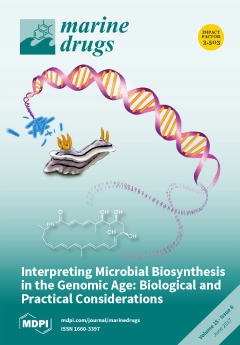
Cover Story: The sequencing of biosynthetic pathways allows their biochemistry to be investigated, and in some circumstances bioinformatics can be used to predict configurations, aiding structure determination. Along with the rest of the genome of a producing organism, sequencing can also potentially shed light on chemical ecology, mechanism of action of small molecules and evolution, especially in the case of culture-independent sequencing (metagenomics). In this review, we outline the biological and practical issues to consider when embarking on a sequencing project that aims to uncover small molecule biosynthetic pathways. We outline potential challenges in such an endeavor, such as the use of metagenomics for uncultured microbes, pathway fragmentation, and difficulties in assembling repetitive pathways. We also discuss how the pathway and symbiont evolution may affect sequencing and assembly. View this paper
  • Issues are regarded as officially published after their release is announced to the table of contents alert mailing list .
  • You may sign up for email alerts to receive table of contents of newly released issues.
  • PDF is the official format for papers published in both, html and pdf forms. To view the papers in pdf format, click on the "PDF Full-text" link, and use the free Adobe Reader to open them.

Articles (47)

  • Article
  • Open Access
45 Citations
6,508 Views
14 Pages

Cembrene Diterpenoids with Ether Linkages from Sarcophyton ehrenbergi: An Anti-Proliferation and Molecular-Docking Assessment

  • Mohamed-Elamir F. Hegazy,
  • Abdelsamed I. Elshamy,
  • Tarik A. Mohamed,
  • Ahmed R. Hamed,
  • Mahmoud A. A. Ibrahim,
  • Shinji Ohta and
  • Paul W. Paré

21 June 2017

Three new cembrene diterpenoids, sarcoehrenbergilid A–C (1–3), along with four known diterpenoids, sarcophine (4), (+)-7α,8β-dihydroxydeepoxysarcophine (5), sinulolide A (6), and sinulolide B (7), and one steroid, sardisterol (8), were isolated and c...

  • Article
  • Open Access
22 Citations
7,283 Views
10 Pages

The Sea Urchin Arbacia lixula: A Novel Natural Source of Astaxanthin

  • Paola Cirino,
  • Christophe Brunet,
  • Martina Ciaravolo,
  • Christian Galasso,
  • Luigi Musco,
  • Tomás Vega Fernández,
  • Clementina Sansone and
  • Alfonso Toscano

21 June 2017

Several echinoderms, including sea urchins, are valuable sources of bioactive compounds but their nutraceutical potential is largely unexplored. In fact, the gonads of some sea urchin species contain antioxidants including carotenoids and polyhydroxy...

  • Article
  • Open Access
31 Citations
9,532 Views
13 Pages

Effects of Tetrodotoxin in Mouse Models of Visceral Pain

  • Rafael González-Cano,
  • Miguel Ángel Tejada,
  • Antonia Artacho-Cordón,
  • Francisco Rafael Nieto,
  • José Manuel Entrena,
  • John N. Wood and
  • Cruz Miguel Cendán

21 June 2017

Visceral pain is very common and represents a major unmet clinical need for which current pharmacological treatments are often insufficient. Tetrodotoxin (TTX) is a potent neurotoxin that exerts analgesic actions in both humans and rodents under diff...

  • Article
  • Open Access
43 Citations
9,604 Views
12 Pages

The Identification of a SIRT6 Activator from Brown Algae Fucus distichus

  • Minna K. Rahnasto-Rilla,
  • Padraig McLoughlin,
  • Tomasz Kulikowicz,
  • Maire Doyle,
  • Vilhelm A. Bohr,
  • Maija Lahtela-Kakkonen,
  • Luigi Ferrucci,
  • Maria Hayes and
  • Ruin Moaddel

21 June 2017

Brown seaweeds contain many bioactive compounds, including polyphenols, polysaccharides, fucosterol, and fucoxantin. These compounds have several biological activities, including anti-inflammatory, hepatoprotective, anti-tumor, anti-hypertensive, and...

  • Article
  • Open Access
33 Citations
5,724 Views
8 Pages

Asperentin B, a New Inhibitor of the Protein Tyrosine Phosphatase 1B

  • Jutta Wiese,
  • Hülya Aldemir,
  • Rolf Schmaljohann,
  • Tobias A. M. Gulder and
  • Johannes F. Imhoff

21 June 2017

In the frame of studies on secondary metabolites produced by fungi from deep-sea environments we have investigated inhibitors of enzymes playing key roles in signaling cascades of biochemical pathways relevant for the treatment of diseases. Here we r...

  • Article
  • Open Access
49 Citations
6,500 Views
14 Pages

21 June 2017

Zeaxanthin is a xanthophyll pigment that is regarded as one of the best carotenoids for the prevention and treatment of degenerative diseases. In the worldwide natural products market, consumers prefer pigments that have been produced from biological...

  • Article
  • Open Access
20 Citations
5,176 Views
16 Pages

The Novel Mechanisms Concerning the Inhibitions of Palmitate-Induced Proinflammatory Factor Releases and Endogenous Cellular Stress with Astaxanthin on MIN6 β-Cells

  • Atsuko Kitahara,
  • Kazuto Takahashi,
  • Naru Morita,
  • Toshitaka Murashima,
  • Hirohisa Onuma,
  • Yoshikazu Sumitani,
  • Toshiaki Tanaka,
  • Takuma Kondo,
  • Toshio Hosaka and
  • Hitoshi Ishida

20 June 2017

Astaxanthin, an antioxidant agent, can protect pancreatic β-cells of db/db mice from glucotoxicity and resolve chronic inflammation in adipose tissue. Nonetheless, the effects of astaxanthin on free-fatty-acid-induced inflammation and cellular stress...

  • Article
  • Open Access
46 Citations
6,715 Views
16 Pages

Crude Fucoidan Extracts Impair Angiogenesis in Models Relevant for Bone Regeneration and Osteosarcoma via Reduction of VEGF and SDF-1

  • Fanlu Wang,
  • Harald Schmidt,
  • Dijana Pavleska,
  • Thees Wermann,
  • Andreas Seekamp and
  • Sabine Fuchs

20 June 2017

The marine origin polysaccharide fucoidan combines multiple biological activities. As demonstrated by various studies in vitro and in vivo, fucoidans show anti-viral, anti-tumor, anti-oxidant, anti-inflammatory and anti-coagulant properties, although...

  • Article
  • Open Access
22 Citations
7,476 Views
17 Pages

Biotechnological Potential of Cold Adapted Pseudoalteromonas spp. Isolated from ‘Deep Sea’ Sponges

  • Erik Borchert,
  • Stephen Knobloch,
  • Emilie Dwyer,
  • Sinéad Flynn,
  • Stephen A. Jackson,
  • Ragnar Jóhannsson,
  • Viggó T. Marteinsson,
  • Fergal O’Gara and
  • Alan D. W. Dobson

19 June 2017

The marine genus Pseudoalteromonas is known for its versatile biotechnological potential with respect to the production of antimicrobials and enzymes of industrial interest. We have sequenced the genomes of three Pseudoalteromonas sp. strains isolate...

  • Article
  • Open Access
46 Citations
6,716 Views
19 Pages

18 June 2017

Fucoidan, a fucose-containing sulfated polysaccharide with diverse biological functions, is mainly recovered from brown algae. In this study, we utilized a compressional-puffing process (CPP) to pretreat Sargassum crassifolium (SC) and extracted fuco...

of 5

Get Alerted

Add your email address to receive forthcoming issues of this journal.

XFacebookLinkedIn
Mar. Drugs - ISSN 1660-3397