


Abstract
Dopamine (DA) plays an extremely crucial role in the metabolic processes of the human body. Accurate detection of DA is of great significance for many major diseases. This study reports an innovative synthesis method for composite material in which sulfur (S) and nitrogen (N) are incorporated into multi-walled carbon nanotubes (MWCNTs), and platinum (Pt) nanoparticle sensors (Pt/CNTs-N-S) are loaded for the highly sensitive and selective electrochemical detection of DA. The linear range of this sensor is from 0.0078 to 2 mM, and the limit of detection (LOD) is 0.73 μM (S/N = 3) for DA detection. The outstanding detection performance exhibited by Pt/CNTs-N-S is mainly attributed to the co-doping of N and S, which improves the surface properties of MWCNTs, and the dispersion of Pt nanoparticles (5.22 nm), which significantly increases the electrochemically active surface area (ESCA). In addition, the Pt/CNTs-N-S sensor also exhibits excellent stability and anti-interference performance. Overall, this study provides a simple and practical strategy for the potential application of Pt-based sensors in the detection of DA.
1. Introduction
Dopamine (DA), a crucial neurotransmitter, plays a pivotal role in the central nervous system, regulating various physiological functions including mood, cognition, and motor control [1,2,3]. Abnormal levels of DA are closely associated with numerous neurological disorders such as Parkinson’s disease, Schizophrenia, and Depression [4,5]. Therefore, the development of reliable, sensitive, and selective methods for DA quantification is of paramount significance in clinical diagnosis and neurochemical research [6,7,8]. Among various analytical techniques (chromatography, mass spectrometry, spectroscopy, electrochemical method and so on), electrochemical sensors have garnered tremendous attention due to their inherent advantages of high sensitivity, rapid response, simple operation, and low cost [9,10,11].
In electrochemical sensors, the material of the modified electrode plays a crucial role in the response to DA [12]. As an electrochemical method, the selection and optimization of sensing materials are also key factors influencing the sensing performance [13,14]. Multi-walled carbon nanotubes (MWCNTs), as a kind of nanomaterial with unique structure and properties, are widely applied due to their excellent electrical conductivity, high specific surface area, good thermal stability and chemical stability [15,16,17]. These characteristics give them a significant advantage in enhancing the performance of electrochemical sensors. However, disadvantages such as poor dispersion and inaccurate sensing sensitivity have restricted its wide application [18]. So far, scholars have adopted strategies such as metal loading, chemical modification, element doping, and material composites to enhance their electrochemical performance [19,20,21]. Recently, the co-doping of two heteroatoms, such as S and N, has been demonstrated to induce a synergistic effect, generating more pronounced electronic modulation and structural defects than single doping, thereby further boosting the electrocatalytic activity [22,23,24]. For instance, Wu et al. successfully fabricated a one-dimensional N-doped porous carbon nanotube array (1D CNTs@NPC) that exhibited excellent electrochemical response to DA [23]. Korusenko et al. prepared a titanium-based S-doped carbon nanotube (S-MWCNTs/Ti) electrocatalyst, demonstrating that S doping enhanced the electrochemical performance of the catalyst [24]. At present, there are relatively few studies on synthesizing S and N dual-doped carbon nanomaterials based on conductive polymers. Especially in terms of using this material for electrochemical detection of DA, the research is even more scarce [25].
In order to further enhance the electrochemical analysis performance of MWCNTs, various electrode modification materials have been designed and utilized to strengthen the electrochemical signals, such as noble metal nanoparticles (Au, Pt, and Pd) and molybdenum disulfide (MoS2), zinc oxide (ZnO), silicon dioxide (SiO2), etc. [26,27,28,29]. For instance, Feng et al. synthesized a COF/Pt/MWCNT-COOH nanocomposite material for the sensitive detection of DA using electrochemical sensors [30]. Zhang et al. successfully constructed a Pt@g-C3N4/N-CNTs nanocomposite material, which exhibited a sensitive electrochemical response behavior to DA [31]. The Pt nanoparticles can be uniformly dispersed on the surface of MWCNT, increasing the specific surface area and the number of active sites of the electrode [32]. More active sites mean that more DA molecules can be adsorbed, thereby enhancing the sensor’s ability. In conclusion, loading Pt in the form of nanoparticles onto the S- and N-doped CNTs of the conductive polymer increases the specific surface area and also enhances its adsorption capacity, thereby improving the sensitivity of the sensor [33,34,35].
This study reports a novel synthesis method for a new type of composite material, which involves incorporating sulfur and nitrogen into multi-walled carbon nanotubes (Pt/CNTs-N-S) and then loading Pt nanoparticles to obtain the material. It is used for high-sensitivity and selectivity in DA electrochemical detection. The CNTs-N-S matrix serves not only as a highly conductive scaffold, but also, more importantly, it provides abundant anchoring sites for the uniform dispersion and stabilization of Pt nanoparticles. The electronic synergy between S, N co-dopants and Pt nanoparticles is expected to significantly enhance the electrocatalytic activity towards the oxidation of DA. The as-prepared Pt/CNTs-N-S-modified electrode demonstrates outstanding analytical performance, including a wide linear range and a remarkably low detection limit. The performance of Pt/CNTs-N-S in detecting DA was evaluated through several electrochemical tests.
2. Experimental Methods
2.1. Experimental Materials
MWCNTs (outer diameter: 8 nm; length: 10–30 μm), chloroplatinic acid hexahydrate (H2PtCl6·6H2O, 99%), sodium dodecyl sulfate (SDS, 98%), Ploy 3,4-ethylenedioxythiophene (PEDOT, 98%), Polyaniline (PANI, 98%), ammonium persulfate, and dopamine hydrochloride were purchased from Beijing Inokai Technology Co., Ltd. (Beijing, China). Sulfuric acid (H2SO4, 98%) and nitric acid (HNO3, 68%) were purchased from Hunan Huihong Reagent Co., Ltd. (Changsha, China), and Sodium borohydride (NaBH4, 98%) was obtained from China National Pharmaceutical Chemical Reagent Co., Ltd., Shanghai, China. The phosphate-buffered solution (PBS, 0.2 M) is composed of disodium hydrogen phosphate (NaH2PO4, 0.2 M) and dihydrogen phosphate disodium (Na2HPO4, 0.2 M).
2.2. Methods
2.2.1. Preparation of Acidified MWCNTs
First, 0.5 g of MWCNTs was added to a mixture of 30 mL of concentrated H2SO4 and HNO3 (with a volume ratio of 1:1). Then, this was refluxed at 140 °C for 3 h. The sample was repeatedly washed with water until the pH was neutral and then dried at 80 °C. The acidified MWCNTs were obtained and labeled as CNTs-AO.
2.2.2. Preparation of Pt/CNTs
Next, 10 mg of MWCNTs-AO was added to 20 mL of deionized water before undergoing ultrasonic stirring and dispersing. Then, 0.024 mL of the hexahydrate chloroplatinic acid (H2PtCl6·6H2O) saline, prepared with deionized water (containing 2.5 mg of Pt), was added. Finally, 100 mg of sodium borohydride was added. The mixture was reacted at 80 °C for 6 h. After cooling, it was washed alternately with water and ethanol, filtered, and dried under vacuum at 60 °C to obtain the catalyst-labeled Pt/CNTs.
2.2.3. Preparation of Pt/CNTs-N-S
Next, 2.307 g of SDS was dissolved in 20 mL of water and stirred to dissolve. Then, 180 μL of PEDOT and 120 μL of PANI were added to the above saline and vigorously stirred for 2 h. The saline was quickly injected into (NH4)2S2O8 saline (20 mL, 0.04 M) and then stirred for 24 h. The sample was washed at 60 °C and dried overnight to obtain the PEDOT-PANI-coated MWCNT composite material. Subsequently, the obtained PEDOT-PANI/CNTs were calcined at 800 °C for 3 h. The final product was named Pt/CNTs-N-S.
2.3. Materials Characterization
The morphology of the products was observed via transmission electron microscopy (TEM). Their crystal structures and elemental composition were analyzed using X-ray diffraction (XRD, Bruker D8, Karlsruhe, Germany). Conventional phase scanning was performed within the range of 10° to 80°, with a continuous scan rate of 2°/min and X-ray photoelectron spectroscopy (XPS, Thermo Kalpha, Waltham, MA, USA).
2.4. Electrochemical Testing of DA
To evaluate the performance of Pt/CNTs-N-S, a three-electrode system, which consisted of a platinum working electrode, a bare glassy carbon reference electrode (GCE), and a saturated calomel reference electrode (SCE), was used. The preparation steps of the Pt/CNTs-N-S/GCE are as follows: Firstly, the GCE is pre-treated. Then, it is polished successively with 5.0, 1.0 and 0.3 μm of Al2O3 powder. Subsequently, it is ultrasonically cleaned with water and ethanol for 10 min. Finally, 5 μL of the Pt/CNTs-N-S saline (600 μL of ethanol, 3 mg of Pt/CNTs-N-S catalyst, and 5 μL of Nafion) is dropped onto the pre-treated GCE and dried in a desiccator to obtain the Pt/CNTs-N-S/GCE. The CHI660E electrochemical workstation (Shanghai Chenhua, Shanghai, China) was employed. Cyclic voltammetry (CV, initial potential: 0.6 mV, high potential: −0.6 mV, scan rate: 50 mV/s, quiet period: 2 s), Electrochemical Impedance Spectroscopy (EIS, 0.1 Hz–100 kHz, 10 mV), differential pulse voltammetry (DPV, the pulse amplitude is 50 mV, the pulse width is 50 ms, and the step potential is 2 mV), and other techniques were carried out in a 10 mL electrochemical cell containing 0.2 M phosphate-buffered saline (PBS, PH = 7.0) with an appropriate concentration of DA.
3. Results and Discussion
3.1. Characterization and Analysis of Pt/CNTs-N-S Materials
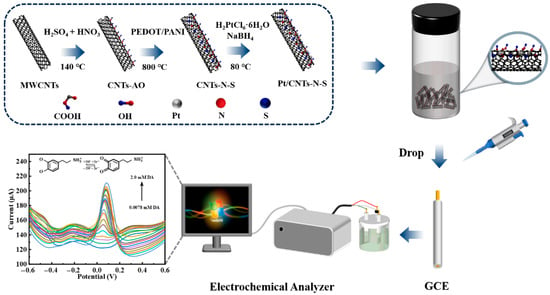
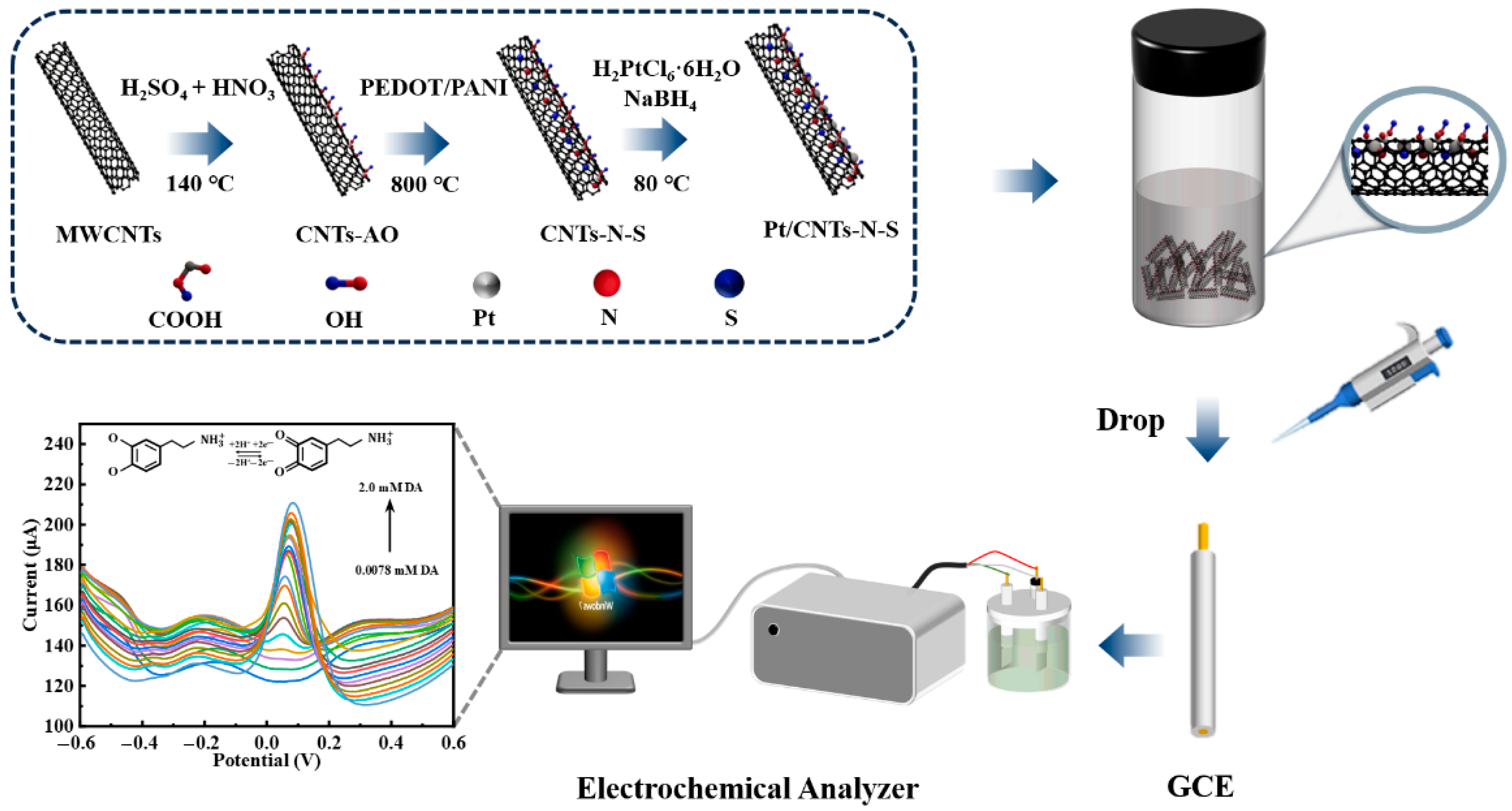
In the electrode preparation, as shown in Scheme 1, MWCNTs-AO (CNTs) were doped with S and N (CNTs-N-S). In the aqueous suspension of CNTs-N-S, after injecting H2PtCl6·6H2O, Pt was reduced by NaBH4 and was then loaded on the surface of CNTs-N-S, resulting in Pt/CNTs-N-S. The synergistic effect of Pt NPs and S- and N-doped CNTs (CNTs-N-S) significantly enhanced the electronic conductivity of the electrode, thereby achieving highly sensitive detection of DA.
Scheme 1.
Schematic diagram of Pt/CNTs-N-S synthesis and electrochemical detection of DA.
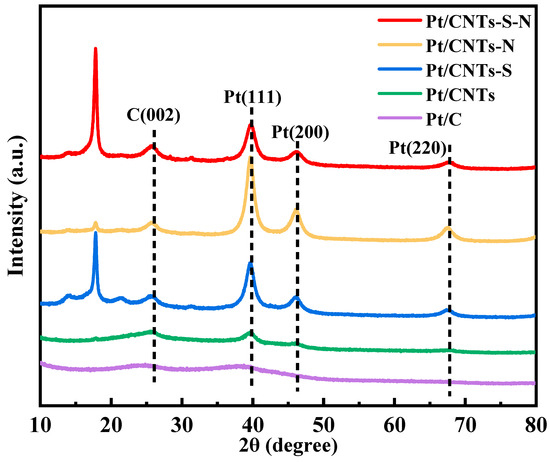
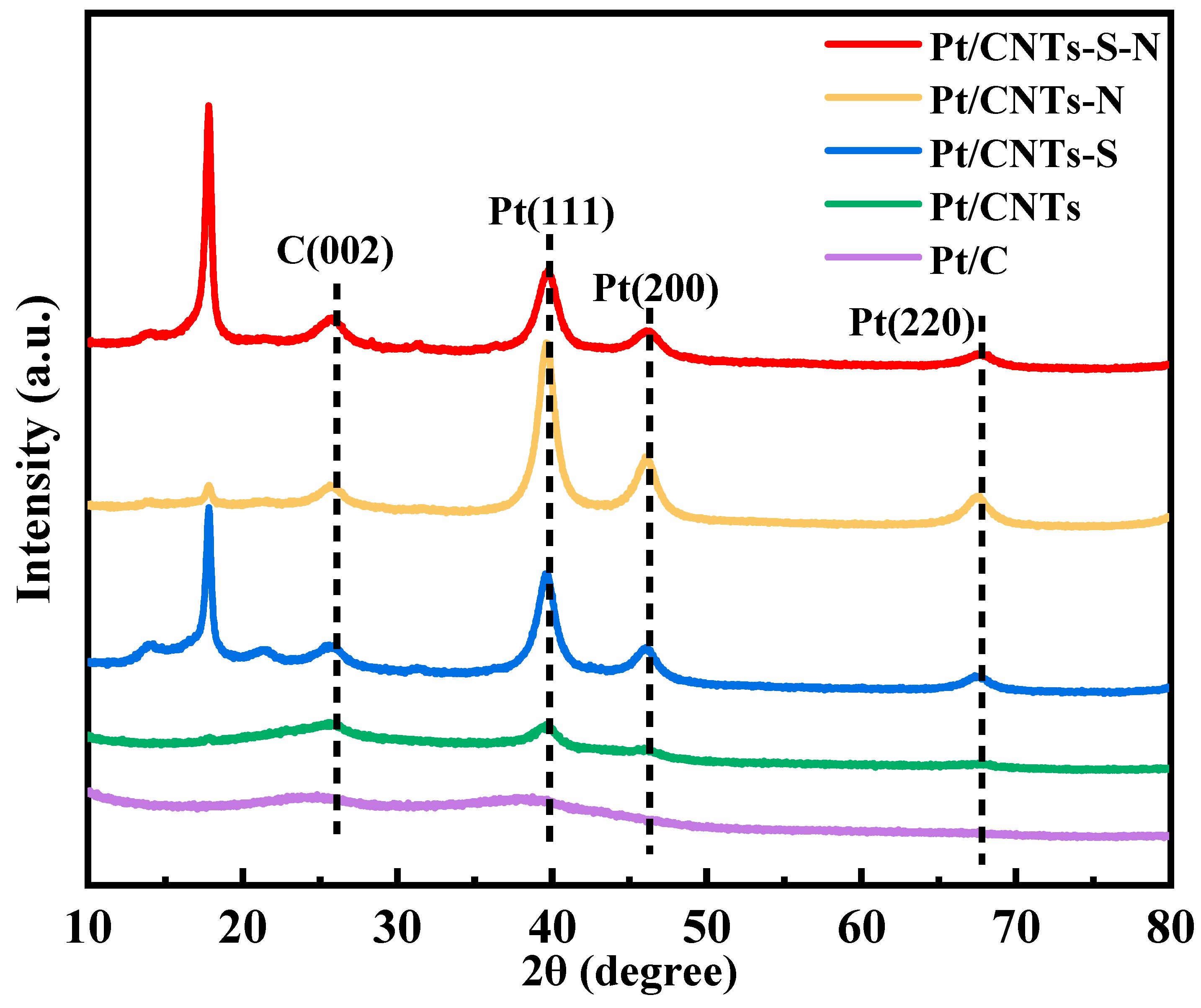
Figure 1 displays the XRD patterns of all materials, Pt/CNTs-N-S, Pt/CNTs-S, Pt/CNTs-N, Pt/CNTs and Pt-C. The C (002) crystal plane diffraction peak at 2θ = 26.2° corresponds to the layered structure of MWCNTs. This characteristic C (002) peak is present in all samples, indicating the integrity of the carrier structure. The three typical Pt diffraction peaks observed, Pt (111), (200), and (220), appear near 39.8°, 46.4°, and 67.6°, respectively, consistent with the FCC (face-centered cubic) structure standard card for metallic Pt (PDF#04-0802) [36]. Among the five materials, all the Pt peaks of Pt/CNTs-N-S exhibited higher intensity and sharper peak shapes, indicating that the main reason was the strong synergistic effect of S and N co-doping. This substantially enhanced the crystallinity and grain size of Pt particles, potentially forming more ordered Pt nanostructures. Next in intensity were the Pt peaks of Pt/C, followed by Pt/CNTs-N. The Pt peaks in the two single-doped samples (Pt/CNTs-S and Pt/CNTs-N) were markedly higher than those in the undoped Pt/CNTs but lower than those in the double-doped Pt/CNTs-N-S. This indicates that both S and N contribute to improving Pt distribution, though their effects are weaker than the peak intensity enhancement achieved through simultaneous doping.
Figure 1.
XRD patterns of all samples.
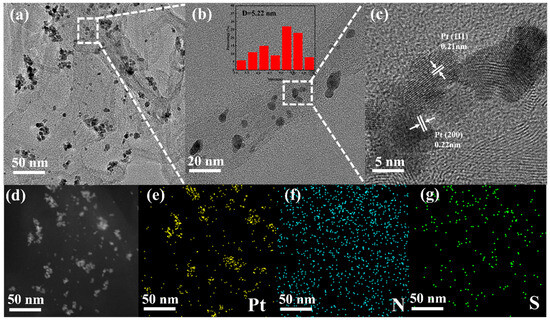
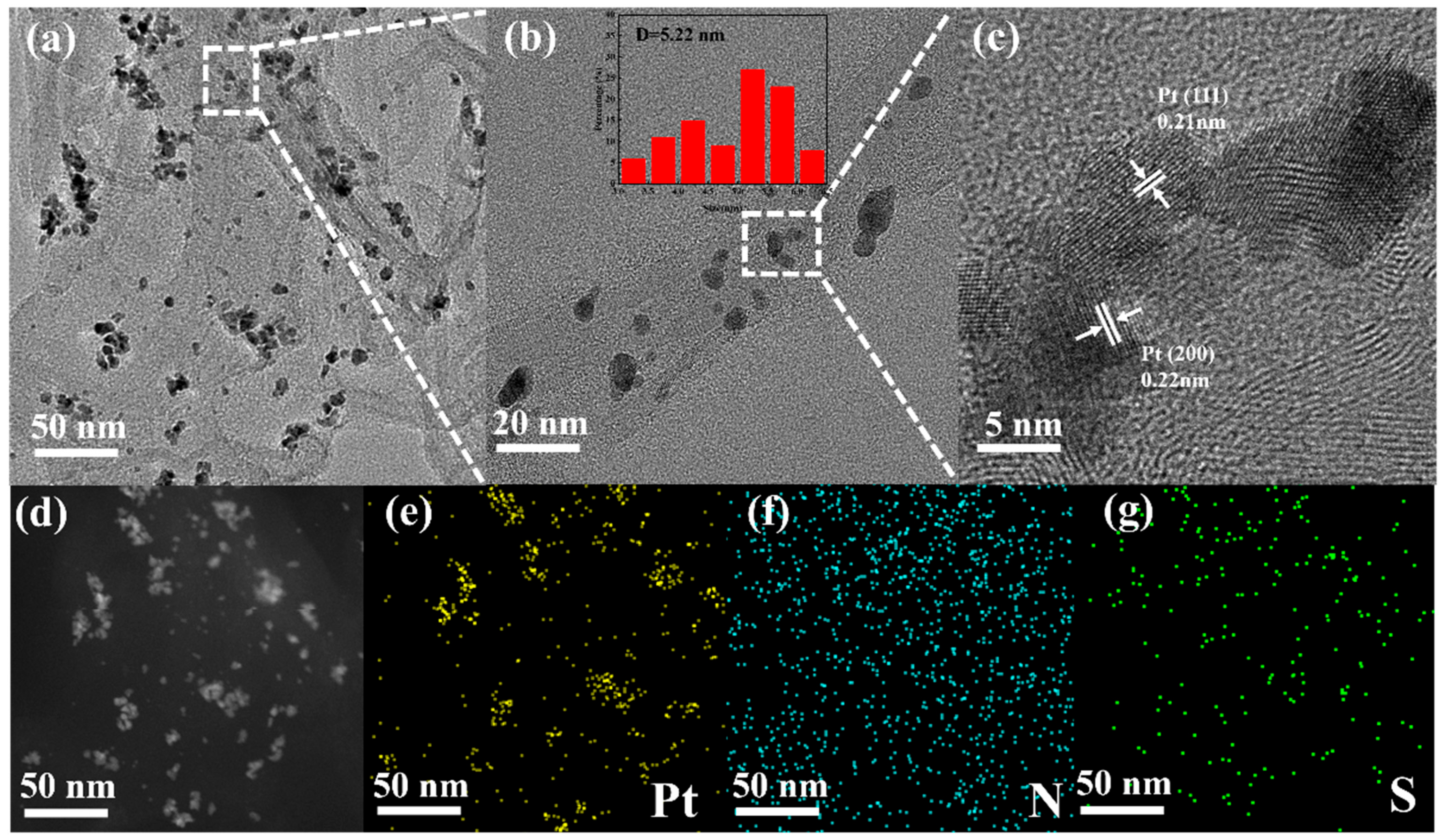
To observe the size and morphology of the Pt/CNTs-N-S, as well as the loading state of Pt, we conducted TEM testing, which clearly reveals the presence of CNTs exhibiting typical tubular structures with diameters typically ranging from 10 to 30 nm (Figure 2a). This indicates that the CNTs maintained excellent morphological and structural integrity during preparation, providing the foundation for the composite material’s superior mechanical and electrical properties. TEM and HR-TEM images of Pt/CNTs-N-S (Figure 2b) clearly reveal Pt nanoclusters loaded onto the CNTs. The Pt (111) interplanar spacing in Pt/CNTs-N-S is 0.21 nm (Figure 2c), corresponding to the Pt (111) crystal plane, indicating good crystallinity of the Pt nanoparticles. As shown in the inset of Figure 2b, the average particle size of the loaded Pt nanoparticles is 5.22 nm, indicating that the Pt nanoparticles are uniformly loaded onto CNTs-N-S. The elemental distribution map in Figure 2d–g clearly and intuitively shows that S and N are uniformly distributed within the CNTs, indicating successful doping of S and N into the CNTs. The EDX analysis of Pt/CNTs-N-S materials is shown in Figure S1. The TEM and mapping diagrams of Pt/CNTs-N and Pt/CNTs-S materials are shown in Figures S2 and S3. All the Pt nanoparticles are evenly distributed on the surface of CNTs, indicating that Pt has been successfully loaded.
Figure 2.
(a,b) TEM of Pt/CNTs-N-S (inset of (b)); particle size chart of Pt; (c) HRTEM of Pt/CNTs-N-S; (d–g) element mapping diagram of Pt, N, and S in the Pt/CNTs-N-S.
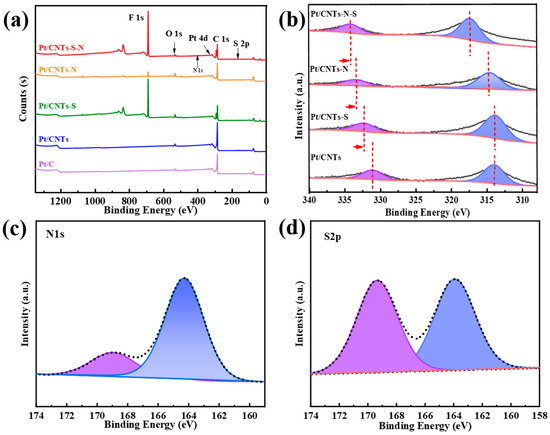
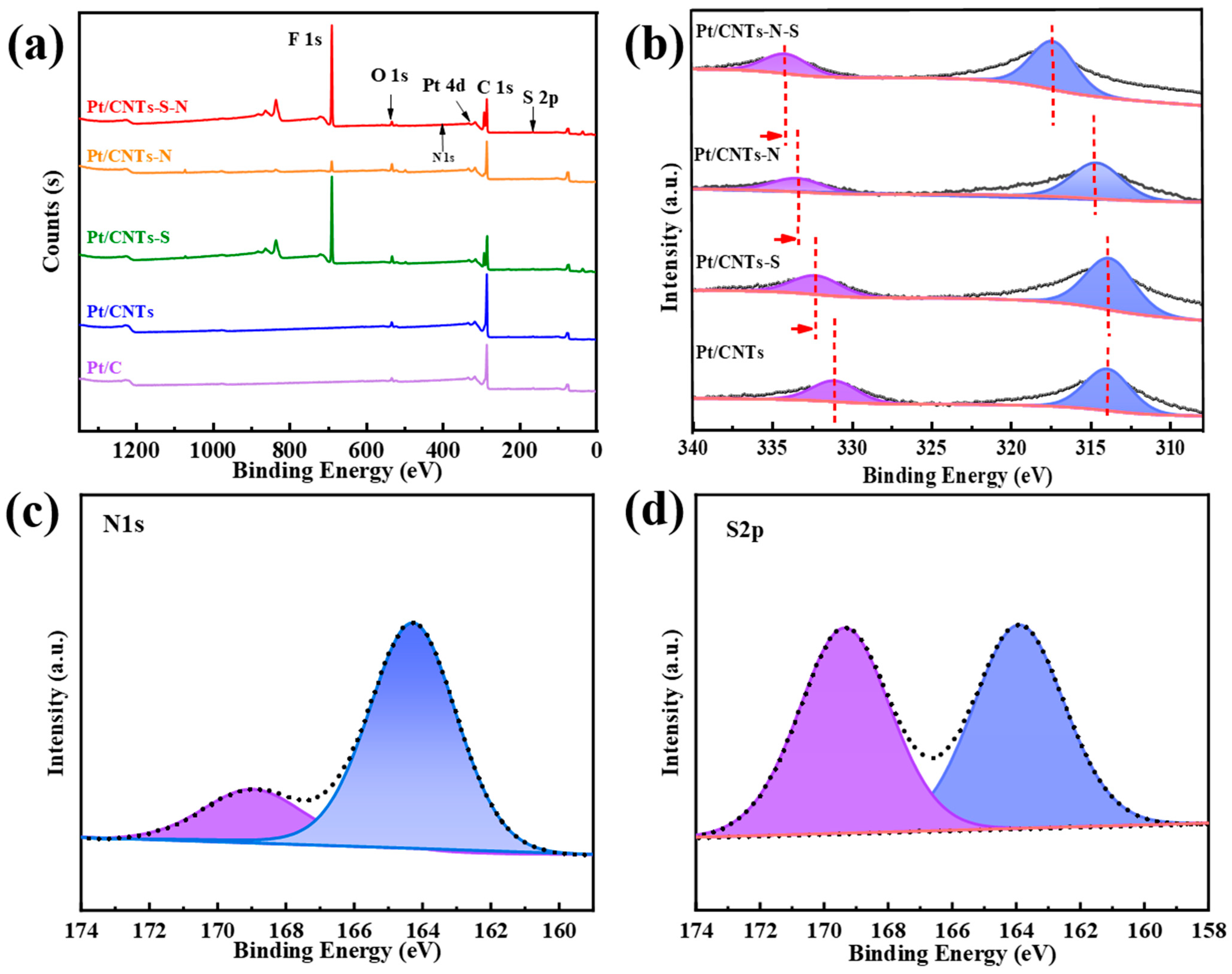
The elemental composition and chemical structure of the catalytic surface elements were characterized by XPS. Figure 3a shows the XPS spectra of Pt/CNTs-N-S, Pt/CNTs-S, Pt/CNTs-N, Pt/CNTs, and Pt-C. XPS signal peaks for C 1s (284.8 eV), O 1s (531.2 eV), and Pt 4d (315.0 eV) are observed. Additionally, S 2p (164.3 eV, 168.9 eV) for Pt/CNTs-N-S and Pt/CNTs-S further confirms the covalent doping of sulfur (S2) and nitrogen (e.g., pyridine/amide nitrogen) on the carbon tube surface, which enhances electron transport and surface activity. The Pt (4d) spectrum for Pt/CNTs, Pt/CNTs-N, Pt/CNTs-S, and Pt/CNTs-N-S (Figure 3b) presents different peaks that indicate the existence of different Pt oxidation states. For Pt/CNTs-N-S, the binding energies of metallic Pt (0) and Pt (+2) states were 316.9 eV (Pt4d5/2) and 334.6 eV (Pt4d3/2). Similarly, for Pt/CNTs-N, the binding energies of 315.3 eV (Pt4d5/2) originate from the metal Pt (0), while the binding energies of 334.5 eV (Pt4d3/2) come from the Pt (+2) state. For Pt/CNTs-S, the binding energies of 314.8 eV (Pt4d5/2) and 332.4 eV (Pt4d3/2) correspond to the metallic Pt (0) and Pt (+2), respectively. For Pt/CNTs, the 314.7 eV (Pt4d5/2) and 331.4 eV (Pt4d3/2) binding energies are associated with the metallic Pt (+2) and Pt (0) states. The comparative analysis indicates that the peak of the 4d energy level of Pt has shifted, suggesting that the doping of sulfur and nitrogen has affected the formation of Pt-O bonds and changed the electronic structure [37,38]. This is also supported by the calculated results of XPS (Table S1), where the area ratio of Pt (0) over Pt (+2) in Pt/CNTs-N-S (0.63) is greater than that of Pt/CNTs-S (0.61), Pt/CNTs-N (0.60) and Pt/CNTs (0.59). Figure 3c,d demonstrate that the N1s (400.48 eV) and S2p (164.18 ev,169.32 eV) spectra confirm that sulfur (S2−) and nitrogen (such as pyridine/amide nitrogen) are covalently doped onto the carbon tube surface, enhancing electron transport and surface activity [39].
Figure 3.
(a,b) The full-spectrum XPS and Pt4d spectra of Pt/CNTs-N-S, Pt/CNTs-N, Pt/CNTs-S, Pt/CNTs-N; (c) the N 1s spectrum of Pt/CNTs-N-S; (d) the S 2p spectra of Pt/CNTs-N-S.
3.2. Electrode Modification and Electrochemical Studies
3.2.1. Different pH Optimization
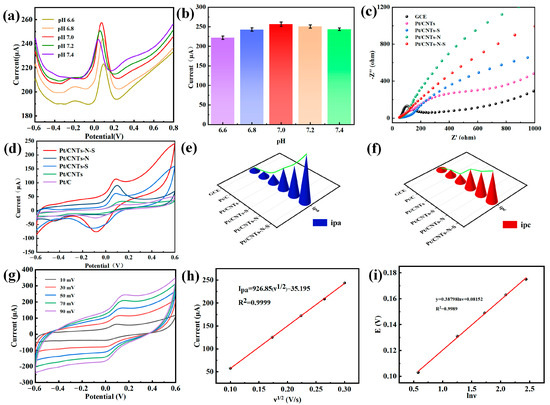
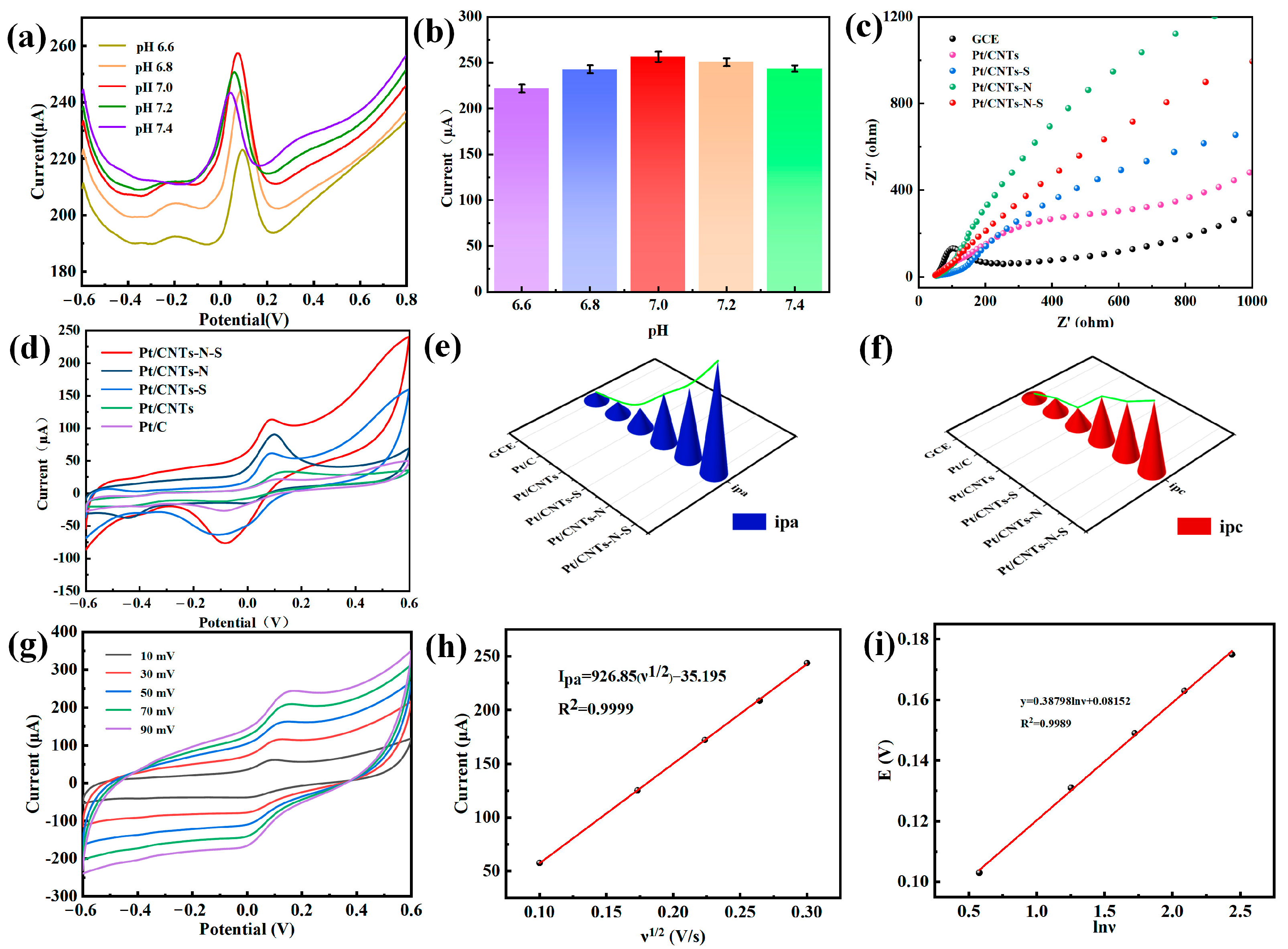
Firstly, the detection performance of the modified electrode Pt/CNTs-N-S was evaluated in PBS solutions with pH values of 6.6, 6.8, 7.0, 7.2 and 7.4. Figure 4a shows that the differential pulse voltammogram (DPV; the pulse amplitude is 50 mV, the pulse width is 50 ms, and the step potential is 2 mV) response value of DA on the Pt/CNTs-N-S electrode in the PBS solution with pH = 7.0 is the highest. The results show that when the PBS solution (pH = 7.0) is used, the uniform distribution of Pt nanoparticles on the surface of CNTs increases the active area of the electrode and also enhances its adsorption capacity for DA, allowing more DA molecules to approach the electrode surface and participate in the reaction. Subsequent tests were conducted under this condition. The corresponding currents of the working electrode to DA at different pH values are shown in Figure 4b. After repeated comparisons, we found that when the pH value of PBS was 7.0, the Pt/CNTs-N-S sensor had the highest response value.
Figure 4.
(a) DPV of Pt/CNTs-N-S at different pH values in 0.2 M PBS containing DA; (b) DA response current at different pH values; (c) EIS measurements of several electrodes in a 5 mM K3[Fe(CN)6] saline; (d) CV of GCE, Pt-C, Pt/CNTs and Pt/CNTs-N-S in the presence of DA; (e,f) data graph of oxidation–reduction peaks of different materials; (g) CV curves of the response of Pt/CNTs-N-S to DA at different scanning rates electrodes; (h) the linear relationship between peak current and the root of scanning rate; (i) the linear relationship between potential and scan logarithm.
3.2.2. Electrochemical Property Analysis
The error bar data were obtained through three sets of parallel experiments. As shown in Figure 4c, the electrodes were studied for their conductivity and other properties in a 5 mM K3[Fe(CN)6] solution using electrochemical impedance spectroscopy (EIS, 0.1 Hz–100 kHz, 10 mV). The bare GCE is shown as a semi-circle, indicating that the bare GCE has the characteristics of high resistivity and low conductivity. Compared with Pt/CNTs (63 Ω), Pt/CNTs-S (58 Ω), and Pt/CNTs-N (53 Ω), Pt/CNTs-N-S (50 Ω) has a higher conductivity. The S or N doping of carbon nanotubes essentially alters the electronic structure and surface chemical properties of the carbon framework, thereby enabling Pt/CNTs-N-S (50 Ω) to exhibit higher conductivity and lower charge resistance. This result indicates that the resistivity of Pt/CNTs-N-S is lower, allowing electrons to transfer more easily to the surface of the modified electrode and participate in the reaction with DA. Compared with Pt/CNTs, the conductivities of doped materials Pt/CNTs-S, Pt/CNTs-N and Pt/CNTs-N-S are higher, suggesting that the doping of S and N can significantly improve the detection performance.
3.2.3. The Electrochemical Properties of the DA Electrode
We measured the DA response signals of each material using the CV method at a sweep speed of 40 mV. As shown in Figure 4d, in the PBS (0.2 M) containing 1 M DA, all the electrodes, namely Pt/C, Pt/CNTs, Pt/CNTs-N, Pt/CNTs-S and Pt/CNTs-N-S, exhibited typical characteristic oxidation peaks of DA, which were located at approximately 0.1 V. Thus, it can be concluded that these electrodes have catalytic effects on the oxidation reaction of DA and can effectively detect the presence of DA. Under the same conditions, compared with the above-mentioned Pt/C and other types of electrodes, the current response of dopamine to the Pt/CNTs-N-S electrode is significantly enhanced. The cyclic voltammogram results in Figure 4e,f show that the Pt/CNTs without S and N doping only present low-amplitude redox peaks, indicating that the surface charge transfer kinetics is limited and the density of catalytic sites is insufficient; meanwhile, the Pt/CNTs-N-S electrode after S-N co-doping shows significantly enhanced anode/cathode peak currents within the same potential window, and the peak shape is sharper and more symmetrical. This indicates that the doping of Pt, S, and N synergistically enhanced the electrocatalytic performance of CNTs for DA [40,41]. The electrochemically active surface areas of several modified electrodes were compared, and the specific method is shown in Figure S4. The final calculated ECSA values for Pt/CNTs-N-S, Pt/CNTs-N, Pt/CNTs-S, Pt/CNTs and Pt/C were 35.2 m2 g−1, 27.1 m2 g−1, 8.5 m2 g−1, 7.2 m2 g−1 and 5.1 m2 g−1, respectively. Among them, the Pt/CNTs-N-S/GCE has the highest electrochemically active area.
It can be seen from Figure 4g that at a potential of 0.23 V, as the scanning rate increases from 10 to 90 mV/s, the peak current gradually increases. There is a good linear relationship between the peak current obtained through linear fitting and the scanning rate (Figure 4h), which is represented by Ipa = 926.86v1/2 − 35.195 (R2 = 0.9999), indicating that the electrocatalytic oxidation of DA on the Pt/CNTs-N-S/GCE surface is a diffusion-controlled process. The (Epa, Epc) and (Ipa, Ipc) of Pt/CNTs-N-S at different sweep rates are shown in Figures S5 and S6. Furthermore, the oxidation peak potential shows a linear relationship with the logarithm of the sweep rate, and the linear relationship is given by y = 0.38978 ln(v) + 0.08152 (R2 = 0.9989) (Figure 4i). This indicates that the DA reaction system is controlled by diffusion when the Pt/CNTs-N-S/GCE working electrode is used. According to the formula:
where T is for the Kelvin temperature, R is for the ideal gas constant, k° is for the heterogeneous electron transfer rate, F is for the Faraday constant, P° is for the formal potential, a is 0.5 for a quasi-reversible process, and n is for the number of electrons. Then, n is calculated to be approximately 2. Therefore, the oxidation of dopamine is a quasi-reversible process of electron transfer.
P = P° + (RT/αnF)ln(RTk°/αnF) + (RT/αnF)lnv
3.2.4. The Detection of Different Concentrations of DA and the Anti-Interference Ability of Pt/CNTs-N-S/GCE
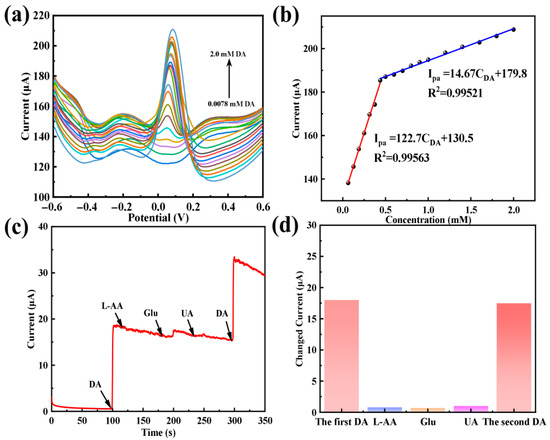
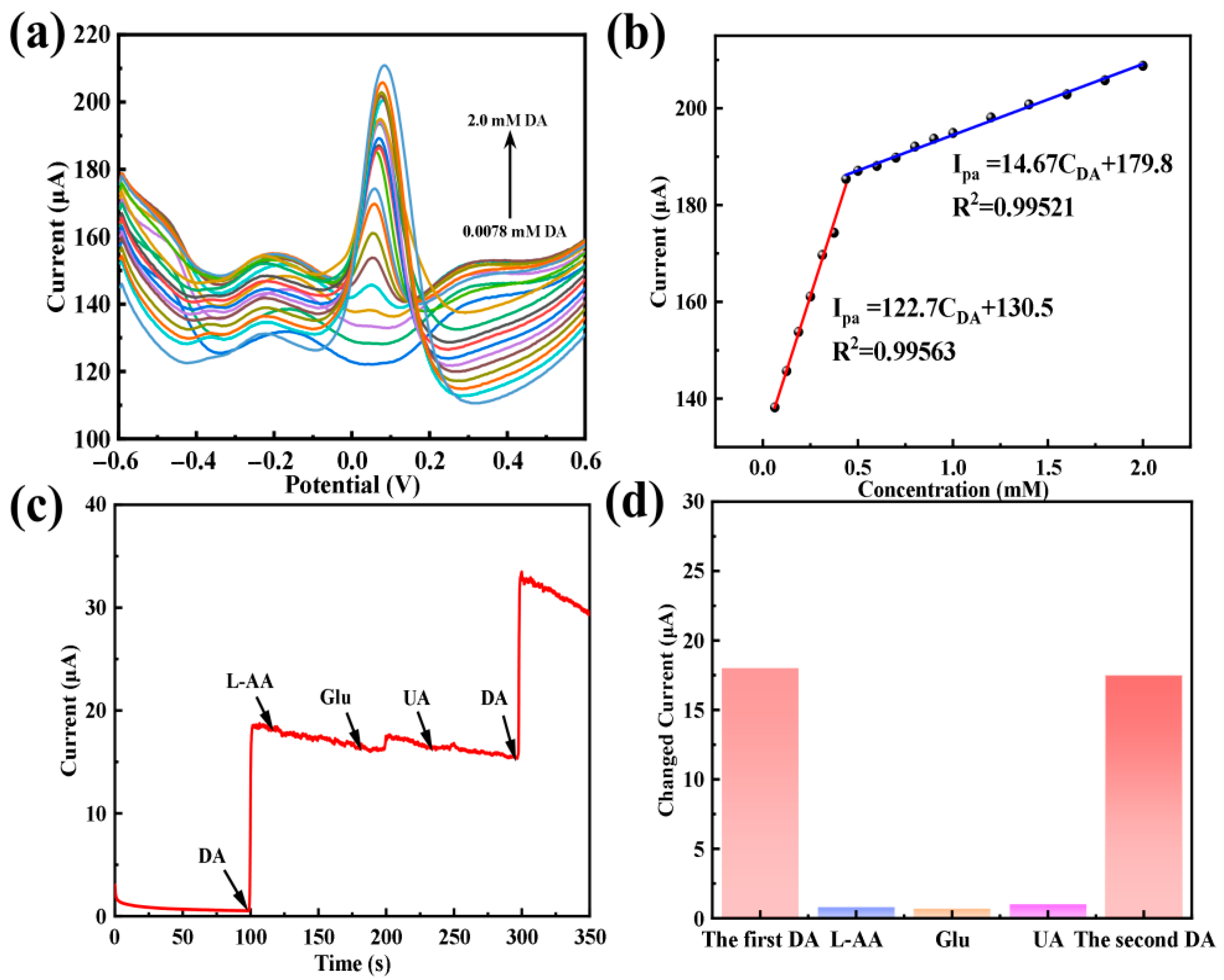
The DPV responses of Pt/CNTs-N-S under different concentrations of DA were quantitatively analyzed. As shown in Figure 5a, the Pox significantly increased with the increase in DA concentration, indicating that the sensor has excellent electrochemical response sensitivity to DA. Figure 5b presents a two-segment linear relationship between Pox and DA concentration, and the corresponding linear regression equations are Ipa = 122.7CDA + 130.5 (R2 = 0.99563) and Ipa = 14.67CDA + 179.8 (R2 = 0.99521), indicating good linear response characteristics in both high and low concentration ranges. The corresponding LOD was calculated as 0.73 μM (S/N = 3). Compared with the latest research results on Pt-based catalysts for DA, the developed Pt/CNTs-N-S/GCE exhibits superior performance (Table 1).
Figure 5.
(a) DPV curves of Pt/CNTs-N-S/GCE response to different concentrations of DA saline; (b) linear relationship between the peak current value and the concentration of DA; (c) I-t curve in the presence of various interfering substances; (d) the corresponding changed current value as the addition of DA and interfering substances.
The anti-interference ability of electrochemical sensors is of crucial importance. We assess this characteristic using the I-t curve method. The experimental operation involves sequentially injecting interfering substances, such as DA, into a 0.2 M PBS saline, and then recording the corresponding I-t curves. As shown in Figure 5c, the current rose rapidly after the addition of DA. There was no significant change after the addition of the interfering substance. After adding DA again, the current rose rapidly and stabilized, proving that Pt/CNTs-N-S has good sensitivity and a stable response to DA. Even in the presence of interfering substances that are 10 times higher than the DA concentration, such as ascorbic acid (L-AA, 3 mM), uric acid (UA, 3 mM), and glucose (GLU, 3 mM), the current change was negligible, highlighting its outstanding anti-interference performance. Although UA caused a slight increase in the current, the impact was negligible and could be ignored. The response values of the interfering substances are shown in Figure 5d. The results indicate that the sensor we have fabricated has a good anti-interference ability.
3.3. Analysis of Sensitivity, Reproducibility and Stability Performance
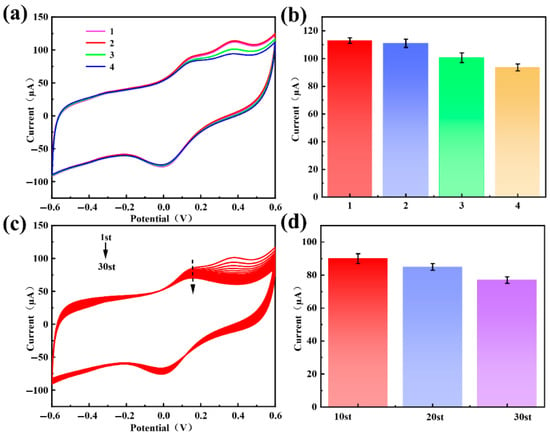
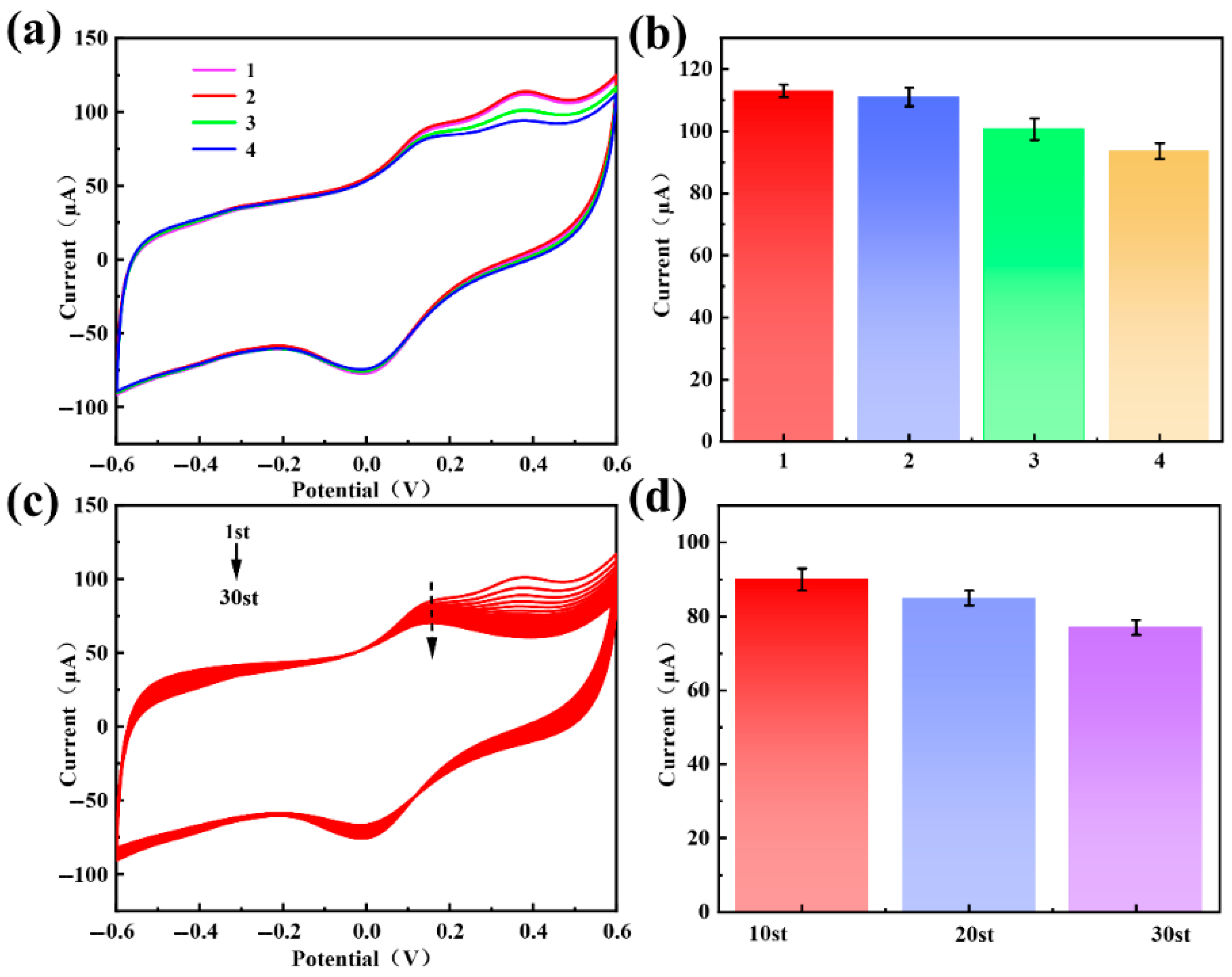
Repeatability and stability are two crucial characteristics of electrochemical sensors. To evaluate the repeatability of Pt/CNTs-N-S, four parallel experiments were conducted. The experimental results showed no significant variation. Current values consistently remained around 112 μA, with a relative standard deviation of 7.5% (Figure 6a,b), indicating excellent repeatability. Based on the experimental data in Figure 6c,d, after 30 cycles of experiments, the current value decreased by only 9.2%, indicating good experimental stability. These results are derived from three independent parallel experiments, verifying the reliability and repeatability of the data.
Figure 6.
(a) CV curves and (b) current values obtained from four independent Pt/CNTs-N-S/GCE; (c) cyclic voltammetry curves and (d) current values obtained from cycle tests.
3.4. Mechanism Analysis of DA Detection by Pt-CNTs-S-N Electrochemistry
The sensitivity of electrochemical sensors is influenced by the electrochemically active surface area (ECSA) and active sites on the electrode surface [42,43]. A larger ECSA means more active sites, which can accelerate the oxidation–reduction reactions of the target analyte and enhance the catalytic efficiency [44,45,46]. The Pt/CNTs-N-S electrochemical sensor, with its composite nanostructure, combines the catalytic activity of Pt with the conductive property of nitrogen–sulfur-co-doped carbon nanotubes, optimizing the catalytic ability and mass transfer efficiency of the electrode surface, thereby enabling efficient and sensitive detection of dopamine. This design synergistically combines the advantages of each component: CNTs provide high specific surface area and electron transport pathways; N and S doping introduces catalytic sites and modulates electron distribution; and Pt nanoparticles further enhance the electrode’s catalytic activity and selectivity. DA molecules are adsorbed onto the surface of the Pt/CNTs-N-S-modified electrode. The S- and N-doped CNTs effectively adsorb DA molecules through chemical bonding and electrostatic interactions [47,48]. Furthermore, based on the experimental results, a mechanism was inferred. The presence of Pt nanoparticles enhanced the adsorption capacity of DA. At the same time, Pt formed stable coordination bonds with the phenolic hydroxyl groups of DA [49,50]. Its anti-interference ability is attributed to the synergistic effect between Pt and the sulfur- and nitrogen-doped carbon nanotubes.
Table 1.
Comparison of different modified electrodes.
3.5. Detection in Actual Samples
By detecting the content of DA in the serum, the applicability of the Pt/CNTs-N-S sensor to actual samples was evaluated. Different concentrations of DA standard samples were added to the PBS solution containing serum (0.2 M, pH = 7.0). The results are shown in Table S2. The recovery rate was between 99–103.3%. The experiment demonstrated that Pt/CNTs-N-S can accurately detect the content of DA in actual samples. However, our study has certain limitations. Specifically, if we want to describe the physiological range of dopamine in the human body, the detection range (0.0078–2 mM) and detection limit (0.73 μM) of the sensor we prepared would face significant challenges. Additionally, the presence of neurotransmitters in the human body would also interfere with the detection.
4. Conclusions
In this study, the constructed Pt/CNTs-N-S exhibited excellent detection performance and anti-interference ability in the electrochemical detection of DA. The linear current response range and the detection limit were 0.0078–2 mM and 0.73 μM (S/N = 3). When interfering substances such as L-ascorbic acid (L-AA), uric acid (UA), and glucose (Glu), at 10 times the concentration of DA, were added, the current value did not show any significant change. The improved performance of the Pt/CNTs-N-S/GCE sensor is attributed to the introduction of S and N dopants, which optimized the structure and surface properties of the CNTs carrier, and the dispersion and electrochemical surface area of these Pt nanoparticles. This sensor enables the quick, easy, and selective detection of DA while also providing a novel platform for biosensor applications.
Supplementary Materials
The following supporting information can be downloaded at: https://www.mdpi.com/article/10.3390/s26061879/s1, Figure S1: EDX analysis of Pt/CNTs-N-S; Figure S2: The TEM (a–c) and mapping diagrams (d–f) of Pt/CNTs-N; Figure S3: The TEM (a–c) and mapping diagrams (d–f) of Pt/CNTs-S; Figure S4: CV curves of Pt/CNTs-N-S, Pt/CNTs-N, Pt/CNTs-S, Pt/CNTs and Pt/C in 0.5 M H2SO4; Figure S5: The Epa and Epc curves of Pt/CNTs-N-S at different sweep rates; Figure S6:The Ipa and Ipc curves of Pt/CNTs-N-S at different sweep rates; Table S1: The results of these mateirals measured by XPS; Table S2:Determination of DA in human serum samples (n = 3).
Author Contributions
L.X.: Supervision, funding acquisition, writing—review and editing; P.Y., Z.L. and Y.L. (Yinchen Liu): Investigation and methodology; Y.T., L.Z. and T.D.: Data curation; J.D.: Resources, funding acquisition; J.X., Z.D., S.D., Q.Z. and Y.L. (Yabing Lu): Conceptualization, methodology, and writing—original draft preparation. All authors have read and agreed to the published version of the manuscript.
Funding
This research was funded by the National Natural Science Foundation of China (grant numbers 52474378 and 52374387), Hunan Province’s “Peony Plan” Leading Talent in Scientific and Technological Innovation (2025RC1060), the Hunan Provincial Natural Science Foundation (2025JJ50334 and 2025JJ70008), and the Undergraduate Innovation Project (202512604002 and S202512604007).
Institutional Review Board Statement
Not applicable.
Informed Consent Statement
Not applicable.
Data Availability Statement
The original contributions presented in this study are included in the article.
Conflicts of Interest
The authors declare that they have no known competing financial interests or personal relationships that could have appeared to influence the work reported in this paper.
References
- Hsine, Z.; Mlika, R.; Jaffrezic-Renault, N.; Korri-Youssoufi, H. Review—Recent progress in graphene based modified electrodes for electrochemical detection of dopamine. Chemosensors 2022, 10, 249. [Google Scholar] [CrossRef] [Scilit]
- Jiang, J.; Ding, D.; Wang, J.; Lin, X.; Diao, G. Three-dimensional nitrogen-doped graphene-based metal-free electrochemical sensors for simultaneous determination of ascorbic acid, dopamine, uric acid, and acetaminophen. Analyst 2020, 146, 964–970. [Google Scholar] [CrossRef] [Scilit]
- Burns, G.; Ali, Y.; Howlader, M.M. Advanced functional materials for electrochemical dopamine sensors. TrAC Trends Anal. Chem. 2023, 169, 117367. [Google Scholar] [CrossRef] [Scilit]
- Bekmezci, M.; Ozturk, H.; Akin, M.; Bayat, R.; Sen, F.; Darabi, R.; Karimi-Maleh, H. Bimetallic biogenic Pt-Ag nanoparticle and their application for electrochemical dopamine sensor. Biosensors 2023, 13, 531. [Google Scholar] [CrossRef] [Scilit] [PubMed]
- Liang, X.-H.; Yu, A.-X.; Bo, X.-J.; Du, D.-Y.; Su, Z.-M. Metal/covalent-organic frameworks-based electrochemical sensors for the detection of ascorbic acid, dopamine and uric acid. Coord. Chem. Rev. 2023, 497, 215427. [Google Scholar] [CrossRef] [Scilit]
- Gülderen, A.T.; Öztürk, G.; Ulukuş, D.; Yıldırım, M.; Oztekin, Y. A feasible 3D printed electrode modiffed with ZnO nanoparticles for the detection of dopamine. Inorg. Chem. Commun. 2024, 167, 112801. [Google Scholar] [CrossRef] [Scilit]
- Mwaurah, M.M.; Mathiyarasu, J.; Mohan, A.V. MWCNTs-Beta-Cyclodextrin-reduced graphene oxide gel based electrochemical sensor for simultaneous detection of dopamine and uric acid in human sweat samples. Carbohydr. Polym. 2024, 350, 123060. [Google Scholar] [CrossRef] [Scilit]
- Yuan, Z.; Zhu, Y.; Wu, H.; Wang, F.; Yin, Y.; Qian, L.; Dai, Y.; Zhang, T.; Xue, S.; Yu, L.; et al. Metal organic framework modified with carbon nanotube as an electrochemical sensor: Fabrication, excellent stability and sensitive detection of dopamine. Microchem. J. 2025, 208, 112327. [Google Scholar] [CrossRef] [Scilit]
- Üğe, A.; Zeybek, D.K.; Zeybek, B. An electrochemical sensor for sensitive detection of dopamine based on MWCNTs/CeO2-PEDOT composite. J. Electroanal. Chem. 2018, 813, 134–142. [Google Scholar] [CrossRef] [Scilit]
- Wan, M.; Jimu, A.; Yang, H.; Zhou, J.; Dai, X.; Zheng, Y.; Ou, J.; Yang, Y.; Liu, J.; Wang, L. MXene quantum dots enhanced 3D-printed electrochemical sensor for the highly sensitive detection of dopamine. Microchem. J. 2023, 184, 108180. [Google Scholar] [CrossRef] [Scilit]
- Guan, Q.; Guo, H.; Xue, R.; Wang, M.; Zhao, X.; Fan, T.; Yang, W.; Xu, M.; Yang, W. Electrochemical sensor based on covalent organic frameworks-MWCNT-NH2/AuNPs for simultaneous detection of dopamine and uric acid. J. Electroanal. Chem. 2021, 880, 114932. [Google Scholar] [CrossRef] [Scilit]
- He, W.; Ye, X.; Cui, T. Flexible electrochemical sensor with graphene and gold nanoparticles to detect dopamine and uric acid. IEEE Sens. J. 2021, 21, 26556–26565. [Google Scholar] [CrossRef] [Scilit]
- Li, S.-N.; Zhang, J.; Liu, Y.-Q.; Zhou, K.-P.; Jiang, X.-Y.; Yu, J.-G. Cobalt vanadate intertwined in carboxylated multiple-walled carbon nanotubes for simultaneous electrochemical detection of ascorbic acid, dopamine and uric acid. Talanta 2025, 282, 127038. [Google Scholar] [CrossRef] [Scilit]
- Elugoke, S.E.; Fayemi, O.E.; Adekunle, A.S.; Mamba, B.B.; Nkambule, T.T.; Ebenso, E.E. Electrochemical sensor for the detection of dopamine using carbon quantum dots/copper oxide nanocomposite modified electrode. FlatChem 2022, 33, 100372. [Google Scholar] [CrossRef] [Scilit]
- Wang, G.; Tang, T.; Liu, R.; Li, J.; Xu, Y.; Liao, S. Novel electrochemical sensor based on Cu-MOF/MWCNT-COOH for the simultaneous detection of ascorbic acid and dopamine. Langmuir 2025, 41, 4102–4112. [Google Scholar] [CrossRef] [Scilit] [PubMed]
- Yang, P.; Zhang, L.; Wei, X.; Dong, S.; Cao, W.; Ma, D.; Ouyang, Y.; Xie, Y.; Fei, J. A “Special” solvent to prepare alloyed Pd2Ni1 nanoclusters on a MWCNT catalyst for enhanced electrocatalytic oxidation of formic acid. Nanomaterials 2023, 13, 755. [Google Scholar] [CrossRef] [Scilit]
- Yang, P.; Wei, L.; Xiao, X.; Zhou, Z.; Li, J.; Zhang, Y.; Xie, Y.; Yang, N.; Fei, J. Electrocatalytic oxidation of formic acid on Pd/CNTs nanocatalysts synthesized in special “non-aqueous” system. J. Electroanal. Chem. 2022, 906, 115980. [Google Scholar] [CrossRef] [Scilit]
- Yang, P.; Zhang, L.; Wei, X.; Dong, S.; Ouyang, Y. Pd3Co1 alloy nanocluster on the MWCNT catalyst for efficient formic acid electro-oxidation. Nanomaterials 2022, 12, 4182. [Google Scholar] [CrossRef] [Scilit]
- Batish, S.; Rajput, J.K. CuX/Sulfur-Doped C3N4 nanocomposite-modiffed glassy carbon electrode for electro-chemical detection of dopamine. ACS Appl. Nano Mater. 2024, 7, 15104–15115. [Google Scholar] [CrossRef] [Scilit]
- Gíslason, P.M.; Skúlason, E. Catalytic trends of nitrogen doped carbon nanotubes for oxygen reduction reaction. Nanoscale 2019, 11, 18683–18690. [Google Scholar] [CrossRef] [Scilit]
- Thakur, N.; Chaturvedi, A.; Mandal, D.; Nagaiah, T.C. Ultrasensitive and highly selective detection of dopamine by a NiFeP based flexible electrochemical sensor. Chem. Commun. 2020, 56, 8448–8451. [Google Scholar] [CrossRef] [Scilit] [PubMed]
- Liu, W.; Liu, M.; Liu, X.; Gao, C.; Xia, Y.; Guo, C.; Wang, S.; Kong, F. Novel nitrogen-doped bamboo-structure carbon nanotubes as superior sulfur host for high-performance lithium-sulfur batteries. J. Alloys Compd. 2022, 923, 166376. [Google Scholar] [CrossRef] [Scilit]
- Wu, F.-H.; Ren, M.-J.; Wang, M.; Sun, W.-B.; Wu, K.-L.; Cheng, Y.-S.; Yan, Z. One-dimensional nitrogen doped porous carbon nano-array arranged by carbon nanotubes for electrochemical sensing ascorbic acid, dopamine and uric acid simultaneously. Nanotechnology 2021, 32, 255601. [Google Scholar] [CrossRef] [Scilit]
- Korusenko, P.M.; Knyazev, E.V.; Vinogradov, A.S.; Kharisova, K.A.; Filippova, S.S.; Rodionova, U.M.; Levin, O.V.; Alekseeva, E.V. Structure and Electrocatalytic Properties of Sulfur-Containing Multi-Walled Carbon Nanotubes on a Titanium Substrate Modified by a Helium Ion Beam. Nanomaterials 2024, 14, 1948. [Google Scholar] [CrossRef] [Scilit] [PubMed]
- Zhong, J.; Huang, K.; Xu, W.; Tang, H.; Waqas, M.; Fan, Y.; Wang, R.; Chen, W.; Wang, Y. New strategy of S,N co-doping of conductive-copolymer-derived carbon nanotubes to effectively improve the dispersion of PtCu nanocrystals for boosting the electrocatalytic oxidation of methanol. Chin. J. Catal. 2021, 42, 1205–1215. [Google Scholar] [CrossRef] [Scilit]
- Li, Y.; Yan, H.; Zhao, Z.; Wang, P.; Tang, F.; Chu, Q.; Yang, Z.; Wang, S.; Liu, Q.; Li, Y. Electrochemical immunosensor based on sea urchin-like PdAg and Au NPs/N-C@CNTs for ultrasensitive detection of CEA. Bioelectrochemistry 2026, 168, 109124. [Google Scholar] [CrossRef] [Scilit]
- Sun, J.; Ma, Z.; Cai, H.; Di, J. A photoelectrochemical sensor for ultrasensitive dopamine detection based on composites of BiOI and Au-Ag nanoparticles. Colloids Surf. A Physicochem. Eng. Asp. 2023, 666, 131291. [Google Scholar] [CrossRef] [Scilit]
- Ahmad, K.; Raza, W.; Alsulmi, A.; Kim, H. Fabrication of electrochemical sensor for metronidazole using MoS2/graphite-like carbon nitride composite modified glassy carbon electrode. Diam. Relat. Mater. 2023, 138, 110178. [Google Scholar] [CrossRef] [Scilit]
- Razavi, R.; Nejad, F.G.; Ahmadi, S.A.; Beitollahi, H. Synthesis of ZnO@TiO2 nanoparticles and its ap-plication to construct an electrochemical sensor for determination of hydrazine. Electrochem. Commun. 2024, 159, 107639. [Google Scholar] [CrossRef] [Scilit]
- Feng, S.; Yan, M.; Xue, Y.; Huang, J.; Yang, X. An electrochemical sensor for sensitive detection of dopamine based on a COF/Pt/MWCNT–COOH nanocomposite. Chem. Commun. 2022, 58, 6092–6095. [Google Scholar] [CrossRef] [Scilit] [PubMed]
- Zhang, L.; Yu, L.; Peng, J.; Hou, X.; Du, H. Highly sensitive and simultaneous detection of ascorbic acid, dopamine, and uric acid using Pt@g-C3N4/N-CNTs nanocomposites. iScience 2024, 27, 109241. [Google Scholar] [CrossRef] [Scilit]
- Li, K.; Li, M.; Sun, L.; Fang, J.; Wang, C.; Wang, X.; Qiao, Z.; Ruan, D. Ultrasensitive composite electrochemical sensor with printed wrinkled CNTs nanostructure for simultaneous detection. Mater. Today Chem. 2024, 39, 102156. [Google Scholar] [CrossRef] [Scilit]
- Ab Latif, F.E.; Numan, A.; Mubarak, N.M.; Khalid, M.; Abdah, M.A.A.M.; Wong, W.P. Enhanced dopamine detection using Ti3C2Tx/rGO/Pt ternary composite synthesized via microwave-assisted hydrothermal method. Mater. Today Sustain. 2024, 28, 100996. [Google Scholar] [CrossRef] [Scilit]
- Tsierkezos, N.G.; Karagianni, A.; Reddmann, E.F.; Ritter, U.; Sanchez, D.E.; Terrones, M.; Kordatos, K.V. Multi-walled carbon nanotubes co-doped with sulfur and nitrogen as sensors for the simultaneous electrochemical determination of biomolecules. J. Solid State Electrochem. 2024, 29, 1945–1961. [Google Scholar] [CrossRef] [Scilit]
- Ma, Y.; Ren, Y.; Sun, D.; Wang, B.; Wu, H.; Bian, H.; Cao, J.; Cao, X.; Ding, F.; Lu, J.; et al. High entropy alloy nanoparticles dual-decorated with nitrogen-doped carbon and carbon nanotubes as promising electrocatalysts for lithium–sulfur batteries. J. Mater. Sci. Technol. 2024, 188, 98–104. [Google Scholar] [CrossRef] [Scilit]
- Jiao, J.; Zuo, J.; Pang, H.; Tan, L.; Chen, T.; Ma, H. A dopamine electrochemical sensor based on Pd-Pt alloy nanoparticles decorated polyoxometalate and multiwalled carbon nanotubes. J. Electroanal. Chem. 2018, 827, 103–111. [Google Scholar] [CrossRef] [Scilit]
- Xu, M.; Yu, Z.; Wei, Q.; Tang, D. Probing trace of intracellularly-originated hydrogen peroxide based Pt–Cd bimetallic nanozyme on an enzyme-free electrochemical sensor. Anal. Chim. Acta 2024, 1324, 343096. [Google Scholar] [CrossRef] [Scilit] [PubMed]
- Wen, W.; Dang, Y.; Tang, J.; Su, C.; Yu, S.; Ma, J.; Zhou, Y. A Novel MXene@MOF@Pt NPs-based enzyme-free electrochemical sensor for highly sensitive detection of hydrogen peroxide released from living cells. J. Electrochem. Soc. 2024, 171, 57514. [Google Scholar] [CrossRef] [Scilit]
- Lian, M.; Shi, Y.; Zhang, W.; Zhao, J.; Chen, D. Nitrogen and sulfur co-doped Nb2C-MXene nanosheets for the ultrasensitive electrochemical detection dopamine under acidic conditions in gastric juice. J. Electroanal. Chem. 2022, 904, 115849. [Google Scholar] [CrossRef] [Scilit]
- Yang, P.-P.; Wu, J.-H.; Hou, R.-N.; Tang, S.-J.; Tan, H.-H.; Du, J.-J.; Xu, L.-J.; Tang, Z.-M. A novel Cu–Cu2O junction structure for the ultrasensitive detection of dopamine. Chem. Pap. 2024, 78, 7845–7853. [Google Scholar] [CrossRef] [Scilit]
- Wu, B.; Li, M.; Ramachandran, R.; Niu, G.; Zhang, M.; Zhao, C.; Xu, Z.; Wang, F. GQDs Incorporated CoPc Nanorods for Electrochemical Detection of Dopamine and Uric Acid. Adv. Mater. Interfaces 2022, 10, 2200738. [Google Scholar] [CrossRef] [Scilit]
- Akin, M.; Bayat, R.; Bekmezci, M.; Coguplugil, Z.K.; Sen, F.; Baghayeri, M.; Kaffash, A.; Tehranejad-Javazmi, F.; Sheikhshoaie, I. The use of polymer/carbon based material as an efficient and low-cost electrochemical sensor for rapid electrochemical detection of dopamine. Carbon Lett. 2023, 33, 1993–2001. [Google Scholar] [CrossRef] [Scilit]
- Yang, X.; He, C.; Qiu, Y.; Bao, J.; Li, P.; Chen, Y.; Zhou, X.; Huang, B.; Zheng, X. Electrochemical sensing based on biomass-derived, hierarchical, porous carbon for simultaneous detection of dopamine and uric acid. Mater. Chem. Phys. 2022, 292, 126825. [Google Scholar] [CrossRef] [Scilit]
- Paramparambath, S.; Shafath, S.; Maurya, M.R.; Cabibihan, J.-J.; Al-Ali, A.; Malik, R.A.; Sadasivuni, K.K. Nonenzymatic Electrochemical Sensor Based on CuO-MgO Composite for Dopamine Detection. IEEE Sens. J. 2021, 21, 25597–25605. [Google Scholar] [CrossRef] [Scilit]
- Kavya, K.; Muthu, D.; Pattappan, D.; Vargheese, S.; Gokila, N.; Sivaramkumar, M.; Kumar, R.T.R.; Haldorai, Y. Palladium nanoparticles decorated Ni-MOF nanocomposite as an electrochemical platform for the selective detection of dopamine. Mater. Lett. 2022, 306, 130926. [Google Scholar] [CrossRef] [Scilit]
- Xing, Y.; Lv, C.; Fu, Y.; Luo, L.; Liu, J.; Xie, X.; Chen, F. Sensitive sensing platform based on Co, Mo doped electrospun nanofibers for simultaneous electrochemical detection of dopamine and uric acid. Talanta 2024, 271, 125674. [Google Scholar] [CrossRef] [Scilit]
- Bai, Q.; Luo, H.; Yi, X.; Shi, S.; Wang, L.; Liu, M.; Du, F.; Yang, Z.; Sui, N. Nitrogen-doped graphdiyne quantum-dots as an optical-electrochemical sensor for sensitive detection of dopamine. Microchem. J. 2022, 179, 107521. [Google Scholar] [CrossRef] [Scilit]
- Yang, Z.; Sun, L.; Guo, H.; Yang, W. A novel electrochemical sensing platform based on diplopore covalent organic framework for sensitively and accurately detecting dopamine. Microchem. J. 2025, 218, 115416. [Google Scholar] [CrossRef] [Scilit]
- Wang, Y.; Wang, D.; Dong, S.; Qiao, J.; Zeng, Z.; Shao, S. A visible-light-driven photoelectrochemical sensing platform based on the BiVO4/FeOOH photoanode for dopamine detection. Electrochim. Acta 2022, 414, 140207. [Google Scholar] [CrossRef] [Scilit]
- Yang, S.; Yang, R.; He, J.; Zhang, Y.; Yuan, Y.; Yue, T.; Sheng, Q. Au Nanoparticles Functionalized Covalent-Organic-Framework-Based Electrochemical Sensor for Sensitive Detection of Ractopamine. Foods 2023, 12, 842. [Google Scholar] [CrossRef] [Scilit]
- Arif, H.; Sajid, A.; Ali, A.; Ahmed, N.; Iqbal, M.; Akyürekli, S.; Kaleli, M.; Alwadai, N.; Shafique, U.; Nazir, A. Selective non-enzymatic electrochemical detection of dopamine using nickel molybdate nano-dots anchored on CNT fiber microelectrodes. RSC Adv. 2025, 15, 36596–36606. [Google Scholar] [CrossRef] [Scilit]
- Bahrami, E.; Amini, R.; Vardak, S. Electrochemical detection of dopamine via pencil graphite electrodes modified by Cu/CuxO nanoparticles. J. Alloys Compd. 2021, 855, 157292. [Google Scholar] [CrossRef] [Scilit]
- Şen, M.; Azizi, E.; Avcı, İ.; Aykaç, A.; Ensarioğlu, K.; Ok, I.; Yavuz, G.F.; Güneş, F. Screen printed carbon electrodes modified with 3D nanostructured materials for bioanalysis. Electroanalysis 2022, 34, 1463–1471. [Google Scholar] [CrossRef] [Scilit]
- Guţoiu, S.; Pogăcean, F.; Măgeruşan, L.; Miclăuş, M.O.; Grad, O.; Pană, I.-O.; Pruneanu, S. Enhancement of dopamine electrochemical detection with manganese doped crystalline copper oxide. Coatings 2023, 13, 1014. [Google Scholar] [CrossRef] [Scilit]
- Şen, M.; Oğuz, M.; Avcı, İ. Non-toxic ffexible screen-printed MWCNT-based electrodes for non-invasive bio-medical applications. Talanta 2024, 268, 125341. [Google Scholar] [CrossRef] [Scilit] [PubMed]
- Jaryal, V.B.; Kumar, S.; Singh, D.; Gupta, N. Thiourea-modified multiwalled carbon nanotubes as electrochemical biosensor for ultra-precise detection of dopamine. ChemNanoMat 2024, 10, e202300637. [Google Scholar] [CrossRef] [Scilit]
- Yao, W.; Guo, H.; Liu, H.; Li, Q.; Wu, N.; Li, L.; Wang, M.; Fan, T.; Yang, W. Highly electrochemical performance of Ni-ZIF-8/N S-CNTs/CS composite for simultaneous determination of dopamine, uric acid and L-tryptophan. Microchem. J. 2020, 152, 104357. [Google Scholar] [CrossRef] [Scilit]
Disclaimer/Publisher’s Note: The statements, opinions and data contained in all publications are solely those of the individual author(s) and contributor(s) and not of MDPI and/or the editor(s). MDPI and/or the editor(s) disclaim responsibility for any injury to people or property resulting from any ideas, methods, instructions or products referred to in the content. |
© 2026 by the authors. Licensee MDPI, Basel, Switzerland. This article is an open access article distributed under the terms and conditions of the Creative Commons Attribution (CC BY) license.