Article

Particle Swarm Optimization and Multiple Stacked Generalizations to Detect Nitrogen and Organic-Matter in Organic-Fertilizer Using Vis-NIR

1
College of Biosystems Engineering and Food Science, Zhejiang University, 866 Yuhangtang Road, Hangzhou 310058, China
2
Department of Agricultural and Bioresource Engineering, Abubakar Tafawa Balewa University, Bauchi 0248, Nigeria
3
Key Laboratory of Spectroscopy Sensing, Ministry of Agriculture and Rural Affairs, Hangzhou 310058, China
*
Author to whom correspondence should be addressed.
Sensors 2021, 21(14), 4882; https://doi.org/10.3390/s21144882
Submission received: 20 June 2021 / Revised: 13 July 2021 / Accepted: 16 July 2021 / Published: 17 July 2021
(This article belongs to the Section Physical Sensors)

Abstract

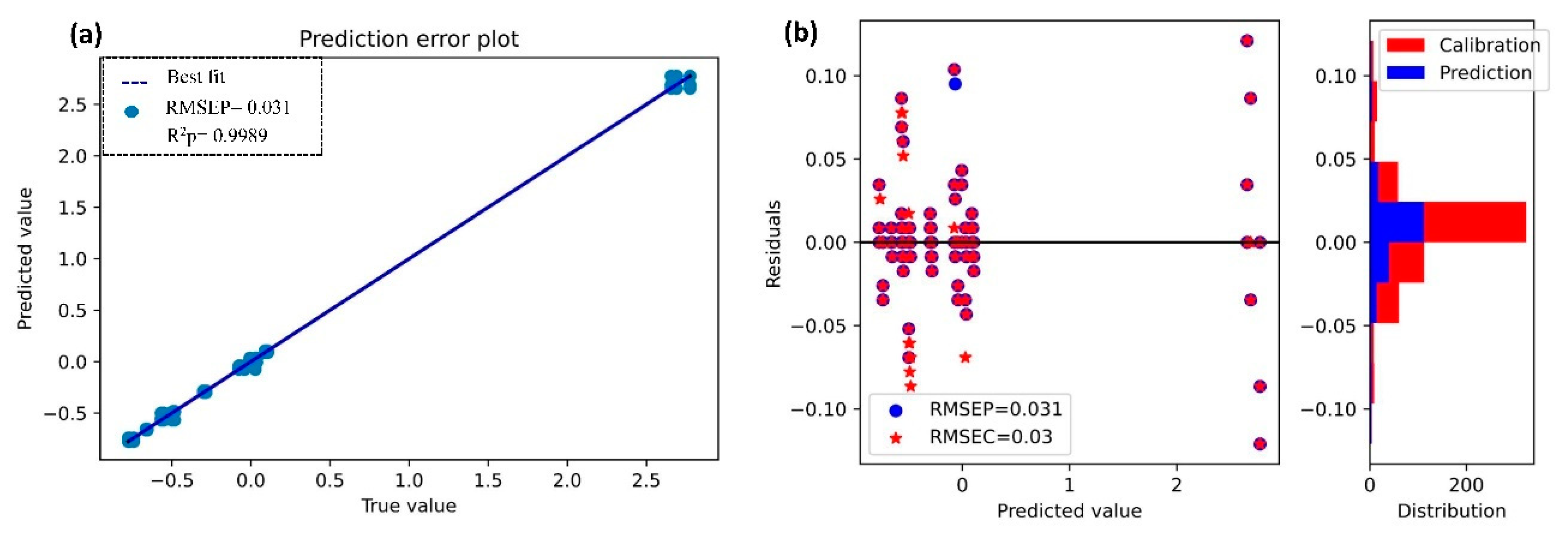
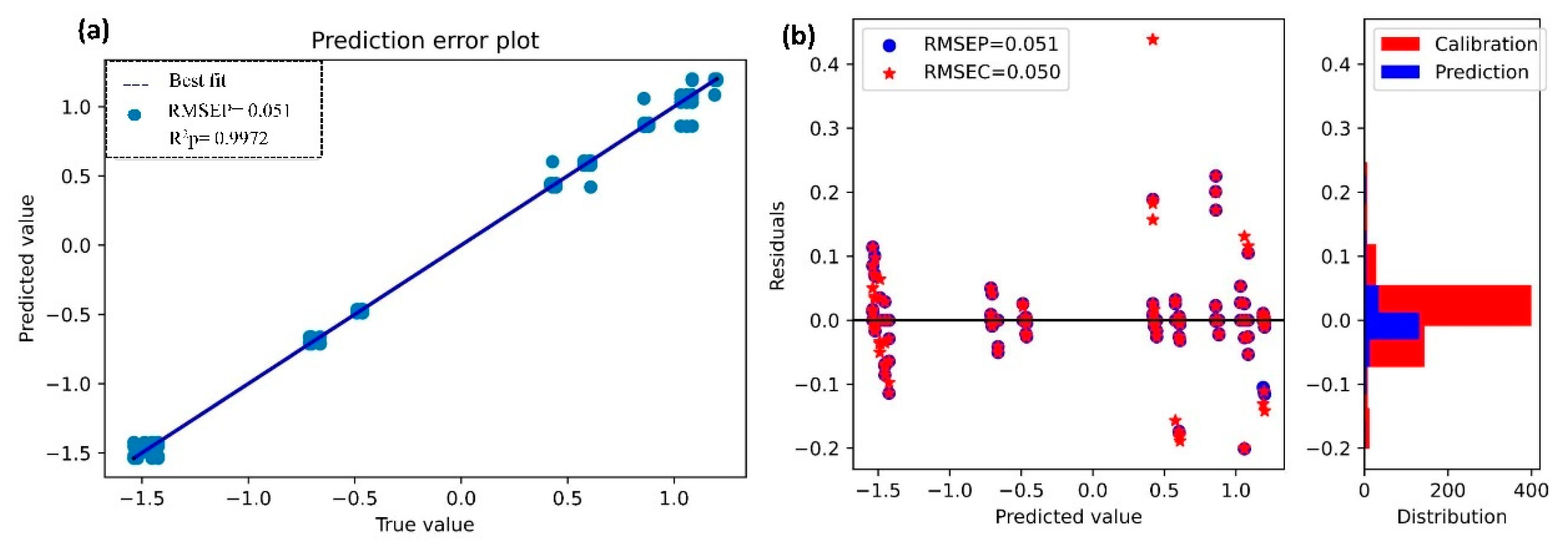
Organic fertilizer is a key component of agricultural sustainability and significantly contributes to the improvement of soil fertility. The values of nutrients such as organic matter and nitrogen in organic fertilizers positively affect plant growth and cause environmental problems when used in large amounts. Hence the importance of implementing fast detection of nitrogen (N) and organic matter (OM). This paper examines the feasibility of a framework that combined a particle swarm optimization (PSO) and two multiple stacked generalizations to determine the amount of nitrogen and organic matter in organic-fertilizer using visible near-infrared spectroscopy (Vis-NIR). The first multiple stacked generalizations for classification coupled with PSO (FSGC-PSO) were for feature selection purposes, while the second stacked generalizations for regression (SSGR) improved the detection of nitrogen and organic matter. The computation of root means square error (RMSE) and the coefficient of determination for calibration and prediction set (R2) was used to gauge the different models. The obtained FSGC-PSO subset combined with SSGR achieved significantly better prediction results than conventional methods such as Ridge, support vector machine (SVM), and partial least square (PLS) for both nitrogen (R2p = 0.9989, root mean square error of prediction (RMSEP) = 0.031 and limit of detection (LOD) = 2.97) and organic matter (R2p = 0.9972, RMSEP = 0.051 and LOD = 2.97). Therefore, our settled approach can be implemented as a promising way to monitor and evaluate the amount of N and OM in organic fertilizer.
Keywords: PSO; multiple-stacked generalizations; Vis-NIR; nitrogen; organic-matter; organic fertilizer PSO; multiple-stacked generalizations; Vis-NIR; nitrogen; organic-matter; organic fertilizer