


Abstract
Legal forms of nature conservation rarely take invertebrates into account, including soil fauna, and therefore they are of limited effectiveness for this group of organisms. The aim of this study was to assess how natural heterogeneity of nature reserves influences preservation of the biodiversity of soil invertebrates. The research was conducted in the period 2024–2025 in ten habitat-diverse nature reserves located in north-western Poland. The model group used in this study were ptyctimous mites (Acari: Oribatida), which are among the best-studied free-living mites in Poland. In 176 samples collected from 20 types of habitats, 21 species were identified, representing 50% of all ptyctimous mites known from Poland. The number of species recorded in each reserve ranged from 12 in Przełom rzeki Dębnicy reserve to 16 in Dęby Wilczkowskie reserve. The highest Shannon–Weaver diversity index, has been recorded for Nad Jeziorem Liptowskim reserve. None of the species recorded in the examined sites was very frequent or highly abundant, which indicates a balanced community structure and absence of major disturbances in the soil environment of the examined reserves. The species occurring in all ten reserves and in the majority of habitats were common in the whole area of Poland: Euphthiracarus cribrarius (Berlese, 1904), Phthiracarus laevigatus (C. L. Koch, 1841), Phthiracarus longulus (C. L. Koch, 1841), and Phthiracarus nitens (Nicolet, 1855). In contrast, Mesotritia nuda (Berlese, 1887) and Microtritia minima (Berlese, 1904) were the two stenotopic species. The species diversity of communities in the examined reserves was determined mostly by the habitat diversity within the reserves and by their history. The results indicate that in order to protect diverse communities of soil fauna it is crucial to protect many small, yet habitat-diverse, areas.
1. Introduction
Traditional, conservation-oriented approaches, such as legally protected areas and species protection, rarely take invertebrates into account. This is mainly because legal species protection applies to relatively few invertebrate species, mainly insects and mollusks [1], while neglecting the majority of other invertebrates, which in fact constitute the overwhelming majority of all animal species [2,3,4,5,6]. Soil fauna are among the groups which are almost never included in conservation plans for parks or nature reserves, as they are not legally protected [1,7,8,9,10,11,12]. However, these organisms may to some extent benefit from umbrella protection in some protected areas established for other species or values [13,14,15,16,17], but effective protection of soil fauna is difficult mainly due to insufficient knowledge about their biology and ecology. It is known that most invertebrates are much more demanding in terms of their habitat requirements than vertebrates, especially with regard to microhabitats [3,13]. The decisive factors for these organisms are species composition of the tree stand, age of the forest, internal heterogeneity of habitats, humidity, shading, and other specific combinations of environmental factors, many of which have not yet been fully defined [18,19,20]. A number of previous studies have shown that in legally protected areas both the species diversity and abundance of soil mites are usually higher than in non-protected areas [18,21,22,23,24], which indicates that area-based forms of nature protection and its duration also have an impact on the species diversity of soil fauna in a given region [25,26]. However, such studies are still quite scarce, especially with regard to some groups of soil fauna, including oribatid mites. Many previous studies published so far are mainly faunistic and they do not include a larger number of examined sites and do not discuss the relationships between the communities occurring there and the habitat heterogeneity within them.
Based on these considerations, we decided to assess how the environmental diversity of selected existing nature reserves may influence the preservation of soil invertebrate biodiversity. We decided to use ptyctimous mites (Acari: Oribatida) as a model group, which are among the best taxonomically studied groups of free-living mites in Poland [27,28]. Currently, 43 native species of these mites and five introduced species (found in Polish palm houses) are known from Poland [27,29,30,31]. Ptyctimous mites occur frequently and in high abundance in various types of habitats and microhabitats, where they constitute an important component of soil mesofauna. For this reason they are the right model group for any ecological research. Like other oribatid mites, ptyctimous mites play a significant role in the process of mechanical fragmentation of organic matter, its accumulation, and humus formation [32]. Previous studies indicate that in the whole area of Poland the most abundant species of all ptyctimous mites are subdominants, constituting approximately 2–7% of all the total number of oribatid mites [33]. However, little is still known about the biology and ecology of individual species within this group, as well as the community structure in different habitats. The earlier studies published so far represent only a small portion of all studies devoted to these mites [22,23]. It is also unknown how habitat heterogeneity and duration of area protection can influence species diversity and community structure of these mites.
Accordingly, we decided to fill this void and conduct the research in the area of 10 selected forest reserves in the West Pomeranian Province (N-W Poland). It should be noted that in this region no comprehensive acarological studies have been conducted so far. Although some records of mites from this province can be found in several monograph studies concerning various mite groups in Poland [27,34,35,36,37], they do not provide any comprehensive information on of the biodiversity of the acarofauna in this area.
The major objectives of this study were as follows: (i) to determine species diversity and differences in the structure of ptyctimous mite communities in the selected reserves and in the habitats and microhabitats examined within them, and (ii) to identify the habitat preferences of the recorded species and the factors which determine the ptyctimous mites’ community structure in the examined nature reserves. Regarding the framework of the current study, the following research hypotheses were tested: (i) the reserves with greater habitat heterogeneity are characterized by higher species diversity of ptyctimous mites; (ii) the duration of reserve protection affects the structure of the examined mite communities.
The present study is in fact a pilot research project and may serve as comparative material for the future monitoring procedures and measures for the invertebrate fauna in the examined reserves. It is expected that this study will also make it possible to assess both the scale and the direction of changes occurring in this group of mites in individual reserves in the future.
2. Materials and Methods
2.1. Study Area
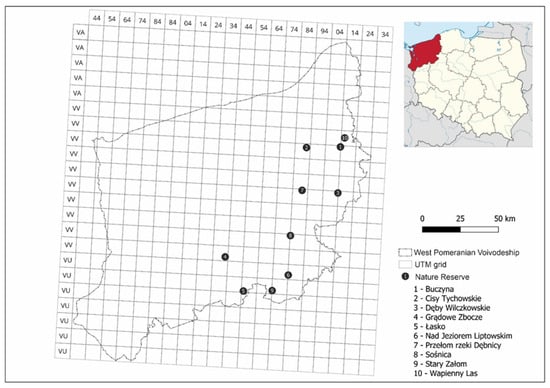
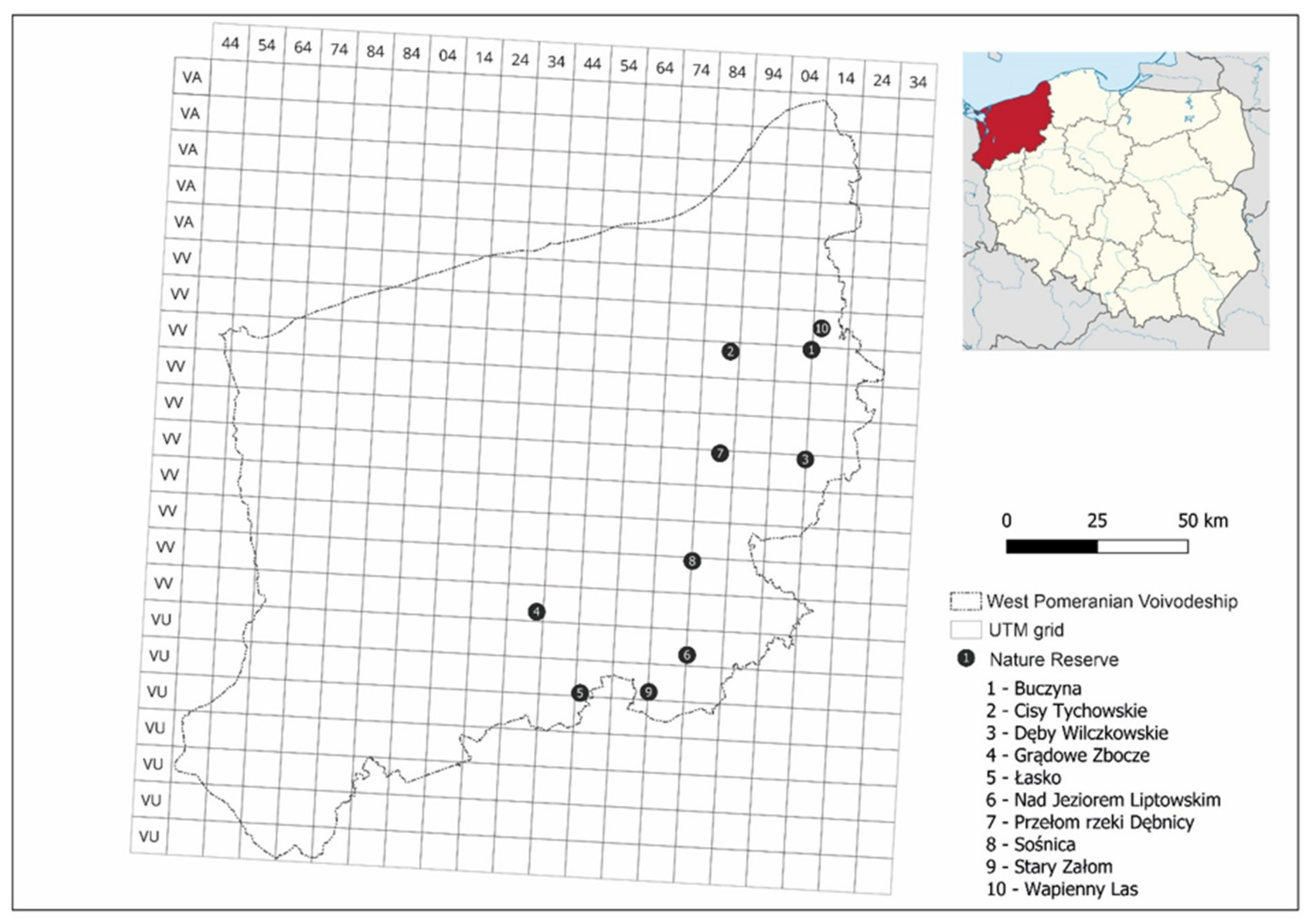
The study was conducted in 10 selected nature reserves located in the West Pomeranian Province (north-western Poland), at the Baltic Sea coast (Figure 1). Six of the investigated sites were forest reserves, while the remaining ones include floristic reserves and one of them was a landscape reserve:
Figure 1.
Distribution of examined nature reserves (black dots) in the area of West Pomeranian Province (north-western Poland).
Buczyna [53°56′58″ N, 16°40′22″ E] is a forest reserve established in 1984 covering an area of 9.81 ha [38]. It was established to preserve a fragment of a beech forest of the acid lowland beech type (Luzulo pilosae-Fagetum), having features of a primeval forest.
Cisy Tychowskie [53°56′18″ N, 16°20′0″ E] is a floristic reserve established in 1980 with an area of 10.28 ha [39]. The reserve contains regenerating populations of the yew (Taxus baccata), including about 70 individuals aged 120–140 years. In addition to that, the area is covered by a beech stand with admixtures of hornbeam trees (Carpinus sp.), oaks (Quercus sp.), alder (Alnus sp.), birches (Betula sp.), and spruce trees (Picea).
Dęby Wilczkowskie [53°40′36″ N, 16°39′45″ E] is a small floristic reserve with an area of 1.62 ha, established in 1974 [40]. It protects an old-growth oak stand with an acid lowland beech forest (Luzulo pilosae-Fagetum) and a subatlantic oak–hornbeam forest (Stellario holosteae-Carpinetum betuli), including valuable populations of protected plants such as Gagea spathacea. The analysis of archival materials, including historical maps, indicates that the reserve was established in an area of a former forest or monastic park, which had existed there since at least the second half of the 19th century.
The forest reserve called Grądowe Zbocze [53°16′18″ N, 15°34′20″ E] was established in 1996 and covers 33.22 ha [41]. It was established to preserve ecosystems of fertile deciduous forests and spring complexes, along with their natural dynamics.
Łasko [53°4′30″ N, 15°46′0″ E] is a strictly protected forest reserve, established in 1964, covering 16.98 ha [42]. The major objective to establish it was to preserve the biocenotic and landscape values of the forest peninsula of Lake Przytoczno, including the valuable phytocoenoses such as the acid lowland beech forest and the habitats important for the bird fauna.
Nad Jeziorem Liptowskim [53°10′50″ N, 16°12′3″ E] is a quite new reserve, which was established in 2010, with an area of 54.04 ha [43]. It protects the peatland, spring, and forest ecosystems, including EU-protected habitats such as the local transition mires, quaking bogs, and alkaline fens. It also includes fertile beech forests (Galio odorati-Fagetum) with well-preserved old-growth stands occurring on slopes, along with a subatlantic oak–hornbeam forest (Stellario holosteae-Carpinetum betuli). There are also small streams, which flow into the lake, with alder–ash riparian forests (Fraxino-Alnetum) growing in the valleys, while spring-fed alder woods dominate along the shoreline. The central part of the reserve contains a low peat bog with sedge vegetation and willows (Salix sp.).
The landscape reserve Przełom rzeki Dębnicy [53°41′4″ N, 16°18′20″ E] was established in 2009 and covers 138.59 ha [44]. It was created to preserve a young glacial landscape, featuring a breakthrough section of a river with a submontane character cutting through a terminal moraine ridge. The reserve includes Dębnica River valley with diverse flora and fauna.
Sośnica [53°24′52″ N, 16°12′26″ E] is a forest reserve, established in 1974, with an area of 12.42 ha [45]. It was established to preserve the old, near-natural beech–oak forest with numerous monumental trees, which are approximately 250–300 years old.
Wapienny Las [54°0′13″ N, 16°42′45″ E] is a forest reserve, which was established relatively recently, i.e., in 2018. The reserve covers an area of 21.71 ha [46]. It was established to preserve a complex of beech, oak–hornbeam, and riparian forests on a calcareous substrate, including rare vegetation of fertile orchid beech forests (Cephalanthero-Fagenion) and numerous spring areas. The reserve is dominated by orchid-rich beech forests interspersed with peatlands and alder woods. The substrate contains a lot of calcium, accumulated in the form of calcareous tufa deposits, which occur both on the surface and within the soil.
The floristic reserve Stary Załom [53°5′5.4″ N, 16°2′55.8″ E] was established in 1966 and covers 5.62 ha [47]. It was established to preserve the ecosystem of habitat- and biocenotically diverse xerothermic grasslands and periodically wet meadows on a calcareous substrate, with numerous populations of protected, endangered, and rare plant species.
2.2. Materials
The study material consisted of 176 qualitative soil samples and samples from various types of microhabitats collected within the selected nature reserves described above (Figure 1). In each reserve, from 6 to 30 samples (soil and litter sievings and unsieved samples from dead wood, all of volume about 0.8 L) were collected once during the period 2024–2025 (Table 1). The differences in the number of samples collected in individual reserves result primarily from the qualitative nature of the study, whose major aim was to provide a preliminary assessment of the soil fauna biodiversity in the investigated reserves. From each reserve at least six samples were collected; however, the sampling intensity reflected the habitat diversity within these reserves and the aim was to collect material from all available habitats, i.e., fewer samples were collected from the environmentally homogeneous sites and more from the heterogeneous ones.
Table 1.
List of reserves and habitats where the study material was collected: E: 5—meadows; E: 11—alder forests; E: 12—marshy forests; E: 13a—oak-hornbeam forests; E: 13b—other mixed deciduous forests; E: 14a—Pomeranian beech forests; E: 15—oak forests; E: 17b—other spruce forests; E: 19—larch forests; E: 19a—yew habitats; E: 20c—mixed forests with spruce; E: 22—shrubs; and microhabitats: M: 24—anthills; M: 25—mammal nests; M: 26—bird nests; M: 28—rotten stumps; M: 29—tree hollows; M: 35—beach wrack; M: 36—bark; M: 37—bracket fungi.
The collected samples were extracted with Tullgren funnels for 4 to 5 days, depending on the humidity of the material. The extracted specimens were preserved in 75% ethanol. The relative humidity of the samples was assessed by means of the gravimetric method—the samples were weighed twice: immediately after the arrival at the laboratory and soon after the extraction, on a MXX-2001 (Denver Instruments Company, Denver, CO, USA) semi-analytical balance. The preliminary selection of the mites from the studied group was carried out with an OLYMPUS SZX16 (Olympus Corporation, Shinjuku–ku, Japan) stereomicroscope, and the collected ptyctimous mite specimens were identified to the species level by the fourth author on the basis of the key by Niedbała [27].
The data were stored in the Analizator 2.0 database (Invertebrate Fauna Bank) in the Natural History Collections (Faculty of Biology) at Adam Mickiewicz University in Poznań. A detailed description of the samples is provided in Part III of the Catalogue of Soil and Microhabitat Samples in the Natural History Collections of the Faculty of Biology, Adam Mickiewicz University [48].
2.3. Data Analysis Methods
The structure of the analyzed communities of ptyctimous mites recorded in the examined reserves was analyzed with the dominance (D) and frequency of occurrence (F) indices. The dominance scale includes the following classes by Błoszyk [49]: D5—eudominants (>30.0%), D4—dominants (15.1–30.0%), D3—subdominants (7.1–15.0%), D2—recedents (3.0–7.0%), and D1—subrecedents (<3.0%). The frequency scale comprises: F5—euconstants (>50.0%), F4—constants (30.1–50.0%), F3—subconstants (15.1–30.0%), F2—accessory species (5.0–15.0%), and F1—accidental species (<5.0%).
The ecological importance of individual species in the examined environments was calculated with the ecological importance index (Q). This index integrates the information on the abundance (dominance) and frequency of occurrence:
where D—dominance and F—frequency.
Q = √(D × F),
The values of Q are divided into five classes followed by Kasprzak and Niedbała [50]:
- Q5—very high (>30.00%);
- Q4—high (15.01–30.00%);
- Q3—medium (10.01–15.00%);
- Q2—low (5.01–10.00%);
- Q1—very low (<5.00%).
The Shannon–Weaver Diversity Index was calculated with the following equation [51]:
S—number of species;
—the proportion (n ÷ N) of individuals representing species i (where n is the number of individuals of species i, and N is the total number of all individuals);
Σ—the sum from the first category to the last.
The similarity of species composition among the ptyctimous mite communities in the 10 nature reserves and across different habitat types was calculated with the Marczewski–Steinhaus species similarity index:
where c is the number of species shared by both compared communities, and a and b are the total numbers of the species in each community. A cluster analysis using the full linkage (furthest neighbor) method was used to draw the dendrogram [52].
S = c/(a + b − c),
All statistical analyses were performed in R, version 4.6.0, under RStudio 2026.05.1 Build 225. The permutation tests were conducted with 999 permutations which were restricted and stratified by blocks of data coding each of the reserves to limit the effects of pseudoreplication. The species data were log-transformed to reduce the influence of the most abundant species on the results, stabilize the variance and reduce the potential heteroscedasticity. Three species occurring in only 2–4 samples were excluded from the analyses because their sparse occurrence was likely stochastic, and rare species can disproportionately influence the multivariate analyses. These species were P. boresetosus, M. minima and M. nuda. In all the analyses p < 0.05 was used as the threshold for the statistical significance. The graphs were generated with the ggplot2 package [53].
The Permutational Analysis of Variance (PERMANOVA) was also used to check whether there are any differences in the mite communities among the examined nature reserves, as well as between the habitat types and merocenosis types. The Bray–Curtis dissimilarity index was used because it uses abundance information, ignores uninformative shared absences, handles sparse ecological data well, and provides an ecologically meaningful measure of community compositional differences. These analyses were performed with the adonis2 function of the vegan package [54] and the pairwise.adonis2 function of the pairwiseAdonis package [55] for multiple pairwise comparisons, with Holm correction applied.
The relationships between the mite community structure and the habitat type were analyzed with the Canonical Correspondence Analysis (CCA). The samples lacking any mite individuals were excluded from the analyses, and the counts of mites per sample in all remaining samples were used as the dependent variables. The habitat type and merocenosis type, coded as nominal variables, were used as the explanatory variables. The model significance was assessed with permutation tests, implemented with the cca function of the vegan package [54]. Then, the multi-level pattern analysis was conducted by means of the multipatt function of the indicspecies package [56] to assess the indicator value of mite species with respect to the habitat and merocenosis type.
In order to test how the reserve age, area, and soil humidity explain the variation in the mite communities, these three variables were introduced as explanatory variables in the subsequent CCA on the mite count data. The model significance was again evaluated with permutation tests, and the contribution of the three variables was assessed with the stepwise selection, with the ordistep function in the vegan package.
The map showing the distribution of the examined reserves in Poland is original and was drawn with CorelDRAW 2020 software.
3. Results
3.1. Characteristics of Ptyctimous Mite Communities in Examined Reserves
In the 10 examined reserves of the West Pomeranian Province, 21 species of ptyctimous mites were recorded, with a total of 7620 specimens (Table 2). In the analyzed communities, there were no species with frequency higher than 50%, and dominance over 30% (Table 2). Thus, no species could be considered very frequent and highly abundant. The only species that was both abundant and frequent was E. cribrarius, whereas P. laevigatus, S. (S.) magnus, P. longulus, and P. globosus were relatively frequent and moderately abundant. Additionally, A. duplicata was moderately abundant but rare. The majority (15) of the species recorded in these reserves should be regarded as rare or very rare and sparsely represented.
Table 2.
List of ptyctimous mite species recorded in 10 selected reserves of the West Pomeranian Province: N—number of specimens, D%—dominance, F%—frequency, Ave.—mean number of specimens per positive sample, SD—standard deviation, Max.—maximum number of specimens per sample.
Despite the different number of samples collected in the examined reserves, the number of recorded species was similar and ranged from 12 in Przełom rzeki Dębnicy reserve to 16 in Dęby Wilczkowskie reserve (Table A1). There are four species, i.e., E. cribrarius, P. laevigatus, P. longulus, and P. nitens, which were found in all examined reserves, and the other four species, such as A. ardua, A. duplicata, P. crinitus, and P. globosus, which were recorded in nine of them. In spite of the fact that these species were common in the analyzed material, they did not dominate in all the communities. For example, in Buczyna and Przełom rzeki Dębnicy reserves S. (S.) magnus was the eudominant species. In contrast, in Dęby Wilczkowskie and Łasko reserves E. monodactylus and S. (T.) carinatus constituted more than 50% of the total community. There was also a group of species which were not numerous in the communities but they were very frequently recorded. These species were E. cribrarius, P. laevigatus, P. longulus, P. bryobius, and P. clavatus in Buczyna reserve, S. (S.) magnus in Cisy Tychowskie, P. longulus in Wapienny Las, and P. nitens, which was found in all the collected samples in Przełom rzeki Dębnicy reserve. The results of the PERMANOVA test show that the differences in the mite communities between these reserves were highly significant (F= 4.9418, p = 0.001).
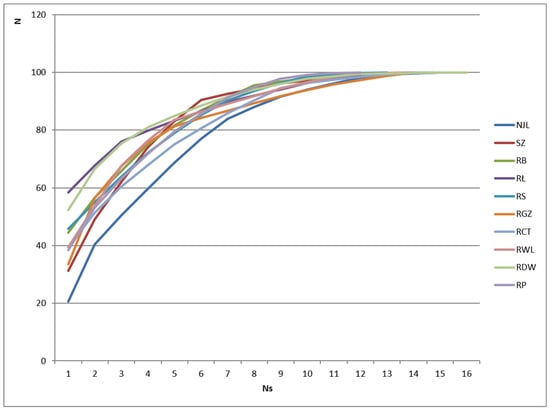
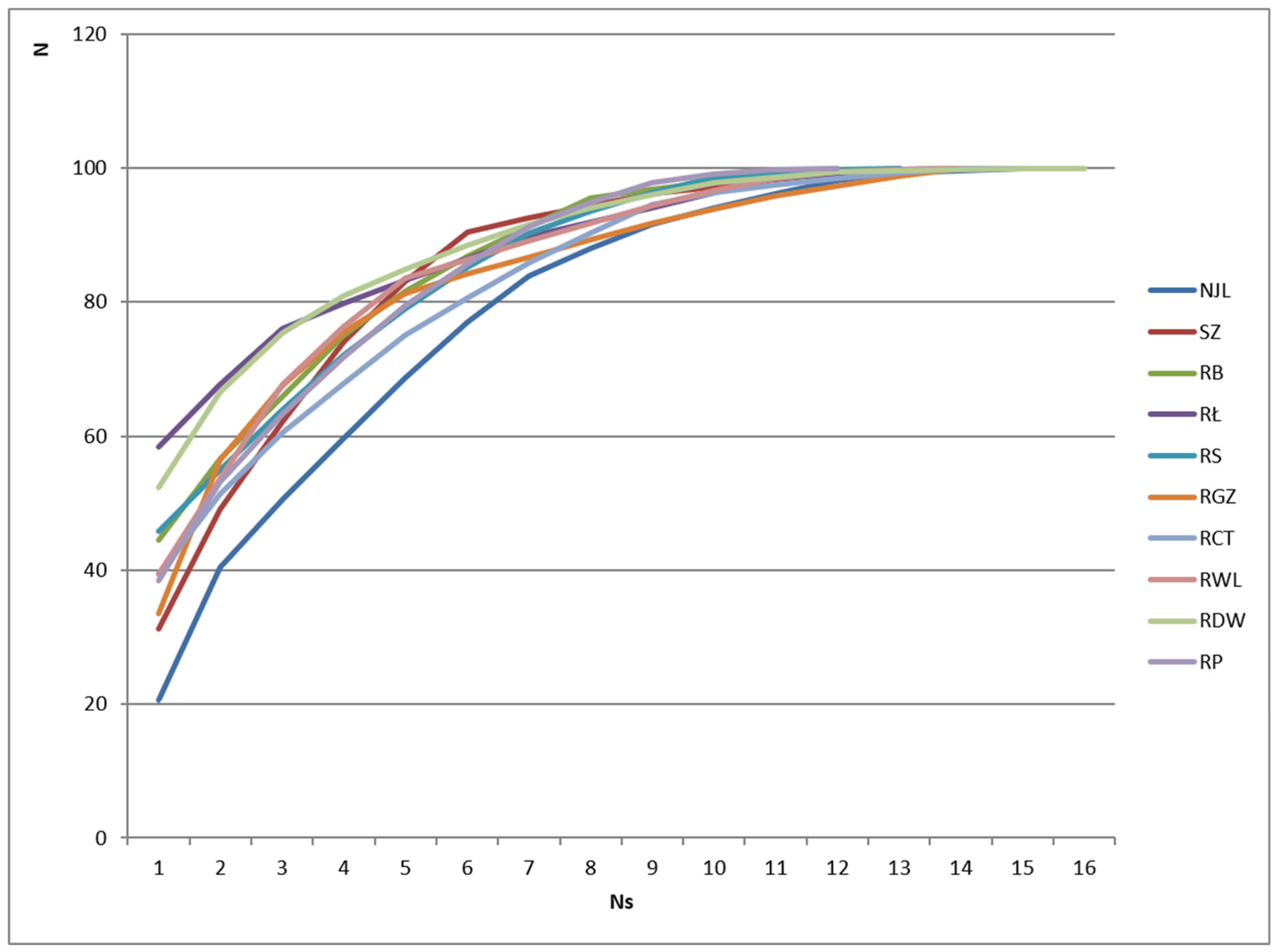
The analysis of the cumulative dominance curves of (Figure 2) the analyzed ptyctimous mites communities shows that in Nad Jeziorem Liptowskim reserve the community structure is most consistent, without species which are eudominants in the community. The next two reserves with a relatively balanced dominance structure are Stary Załom and Grądowe Zbocze reserves. However, in the cases of the two above-mentioned reserves, as well the rest of them, the percentage of the most numerous species exceeds 30% which means that they were eudominants. In the Dęby Wilczkowskie and Łasko reserves, the curves indicate that the community structure is predominated by one species, which constitutes over 50% of the whole community. The results shown in this graph were confirmed by the Shannon–Weaver diversity index, which had the highest value for Nad Jeziorem Liptowskim reserve, and the lowest for Dęby Wilczkowskie and Łasko reserves (Table A1).
Figure 2.
Cumulative dominance curves for ptyctimous mite communities in the examined reserves: NJL—Nad Jeziorem Liptowskim reserve, SZ—Stary Załom reserve, RB—Buczyna reserve, RŁ—Łasko reserve, RS—Sośnica reserve, GZ—Grądowe Zbocze reserve, CT—Cisy Tychowskie reserve, WL—Wapienny Las reserve, DW—Dęby Wilczkowskie reserve, RP—Przełom rzeki Dębnicy reserve, N—number of specimens, Ns—number of samples.
3.2. Diversity of Ptyctimous Mite Communities in Habitats and Microhabitats of the Examined Reserves
The material for the analysis was collected in 20 types of habitats and microhabitats in the area of 10 nature reserves. The presence of ptyctimous mites was recorded in 16 of them, whereas in four microhabitats, such as anthills, mammal nests, tree hollows and beach wrack, there were no ptyctimous mites. The structure of the mite communities differs between habitats, as shown by PERMANOVA: F = 3.7183, and between microhabitats, F = 4.4347 p = 0.001.
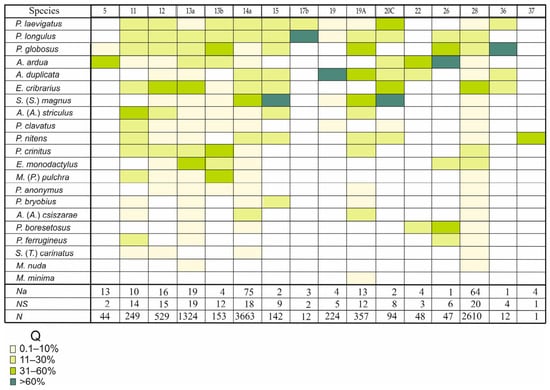
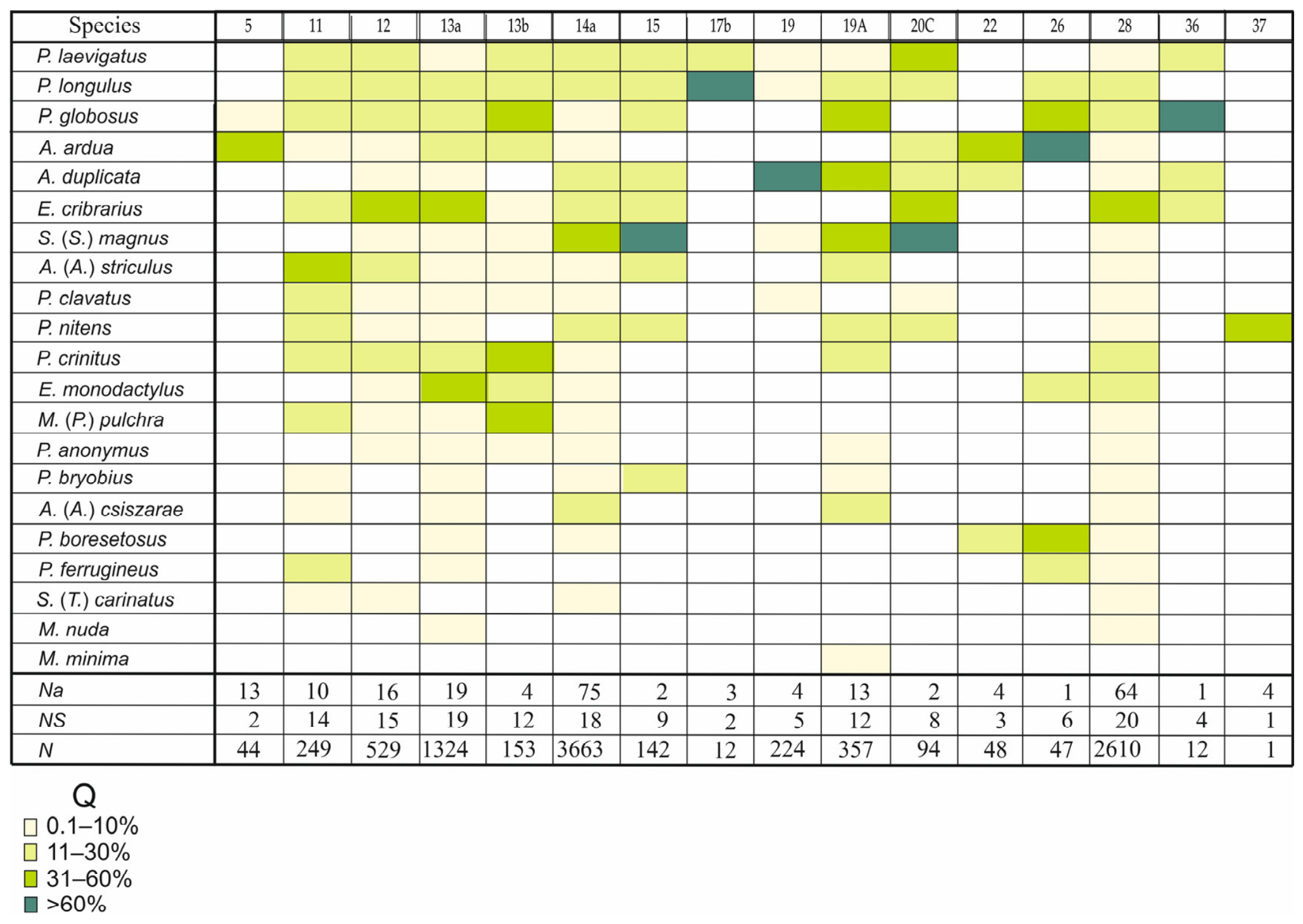
The highest number of species (20) was recorded in the microhabitat of dead wood, followed by the litter from oak–hornbeam forests and Pomeranian beech forests (18 species each) (Figure 3). In contrast, the lowest number of species (1–4) has been observed in bracket fungi, meadows, spruce forests, shrubs, and bark. In the latter habitats, mainly common species were found, which occurred in almost all of the other habitats. The highest ecological significance index (Q > 60%) was recorded for P. globosus in the bark collected in Sośnica reserve. The mite community in this microhabitat was very poor, consisting of only four species, with the dominance of the above-mentioned species. Additionally, P. globosus also had a very high ecological significance in the examined bird nests, as well as in the habitats of riparian forests and oak–hornbeam forests. A very high ecological significance index was also recorded for A. duplicata in the larch stands (>60%) and in the yew stands (>30%) in Cisy Tychowskie reserve. Similarly, P. longulus had a very high Q index (over 60%) in the spruce forests. This species was very common across the examined reserves, occurring in 12 habitats, and in all of them (except the larch stands) its Q index was high (>15%). Another common species in the analyzed material was A. ardua, which occurred in 10 habitats. It had the highest Q index in the bird nests, shrubs, and meadows (34%), although in the case of the meadows it was one of only two recorded species. Another species with a very high ecological importance in the examined environments was S. (S.) magnus, which occurred in nine habitats. In four of them (i.e., the oak forests, mixed forests with spruce, yew stands, and beech forests), the Q index for it was very high, ranging from 31% to 75%. There were also some species with high Q values (>30%), but only in a few or one habitat, and they were P. crinitus (in mixed deciduous forests and marshy forests) and E. monodactylus (in oak–hornbeam forests).
Figure 3.
Heat map presenting the ecological significance index Q (%) of ptyctimous mite species in particular habitats: E: 5—meadows, E: 11—alder forests, E: 12—marshy forests, E: 13a—oak-hornbeam forests, E: 13b—other mixed deciduous forests, E: 14a—Pomeranian beech forests, E: 15—oak forests, E: 17b—other spruce forests, E: 19—larch forests, E: 19a—yew, E: 20c—mixed forests with spruce, E: 22—shrubs, and microhabitats, M: 26—bird nests, M: 28—rotten stumps, M: 36—bark, M: 37—bracket fungi. Na—number of samples, Ns—number of species, N—number of specimens.
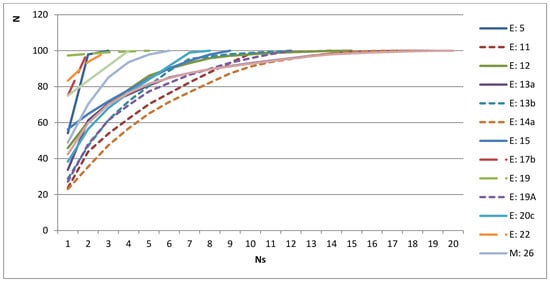
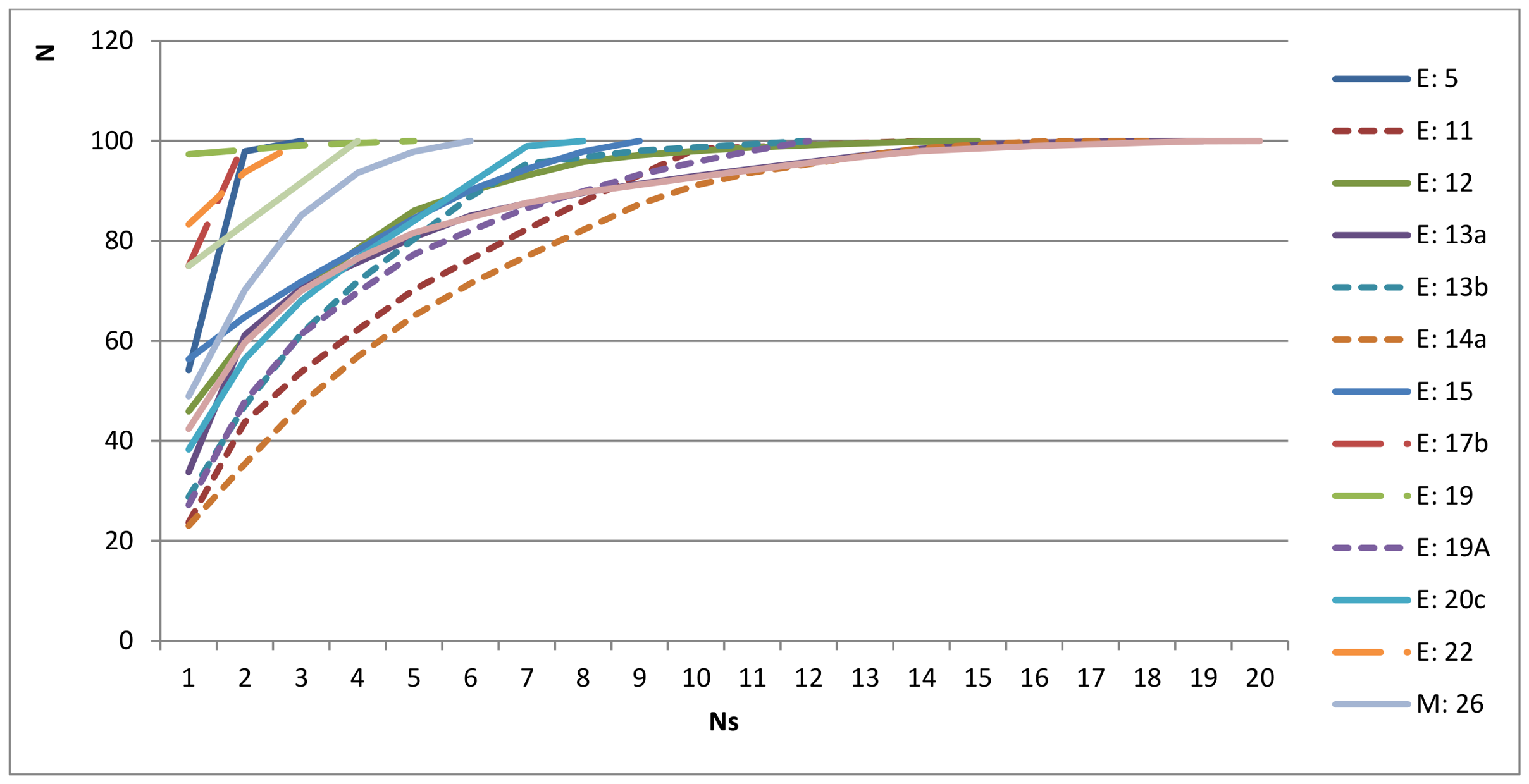
The analysis of cumulative dominance curves of the examined habitats and microhabitats (Figure 4) shows three groups of the communities within the analyzed habitats. The first group contains the communities where the dominance of the most numerous species does not exceed 30%; they are the communities collected from the Pomeranian beech forests, alder forests, mixed deciduous forests and yew tree stands. The second group consists of the communities predominated by one species in more than 70%. These communities were found in the spruce forests, larch forests, shrubs and in bark material. The third group comprises the rest of the habitats, in which the community structure was relatively balanced and dominance of the most numerous species was not higher than 60%.
Figure 4.
Cumulative dominance curves for ptyctimous mite communities in the examined habitats and microhabitats: E: 5—meadows, E: 11—alder forests, E: 12—marshy forests, E: 13a—oak-hornbeam forests, E: 13b—other mixed deciduous forests, E: 14a—Pomeranian beech forests, E: 15—oak forests, E: 17b—other spruce forests, E: 19—larch forests, E: 19a—yew, E: 20c—mixed forests with spruce, E: 22—shrubs, and microhabitats, M: 26—bird nests, M: 28—rotten stumps, M: 35—tree stumps fields, M: 36—bark, M: 37—bracket fungi, N—number of specimens, Ns—number of samples.
3.3. Frequency of Occurrence of Ptyctimous Mites in Examined Reserves and Habitats
The analysis of the frequency of occurrence of individual species in the selected reserves and habitats made it possible to distinguish four major categories of eco-elements: stenotopic, oligotopic, politopic, and eurytopic species (Table 3).
Table 3.
Distinguished eco-elements: Nr—number of reserves in which a given species occurred: 9–10 reserves (eurytopic species), 6–8 reserves (politopic species), 3–5 reserves (oligotopic species), 1–2 reserves (stenotopic species), Er—eco-element in reserves, Nh—number of habitats in which a species occurred: 12–15 habitats (eurytopic species), 8–11 habitats (politopic species), 4–7 habitats (oligotopic species), 1–3 habitats (stenotopic species), Eh—eco-element in habitats.
The analysis of occurrence of particular species in the examined habitats and reserves shows that the eurytopic species constitute the largest group in the analyzed communities (38% of the recorded species). This group includes eight species that were found in all or nearly all (nine out of ten) of the reserves under scrutiny (Table 3). Among those, there are species that are either eurytopic (i.e., P. laevigatus and P. longulus) or politopic (E. cribrarius, P. nitens, A. ardua, A. duplicata, P. globosus) in terms of their habitat preferences. Within this group, only P. crinitus occurred in just seven out of the fifteen examined habitats and therefore it was classified as an oligotopic species. The politopic species constituted a smaller percentage (24%) in these reserves; they were species recorded in six to eight reserves. This group includes five species (Table 3), three of which are also politopic with respect to their habitat preferences, while two—E. monodactylus and P. bryobius—were classified as oligotopic because they were found in less than seven habitats. The remaining eight species were oligo- and stenotopic in terms of their frequency in the examined reserves because they have been recorded in at most half of the investigated sites and in no more than seven habitats. The stenotopic species, which were found only in two reserves or habitats, were M. minima, which was found in a yew stand in Cisy Tychowskie reserve, and M. nuda, found in the oak–hornbeam forest litter in Grądowe Zbocze reserve (Table A1).
3.4. Similarity of Ptyctimous Mite Communities in the Selected Reserves
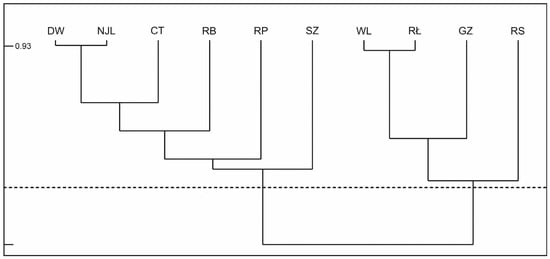
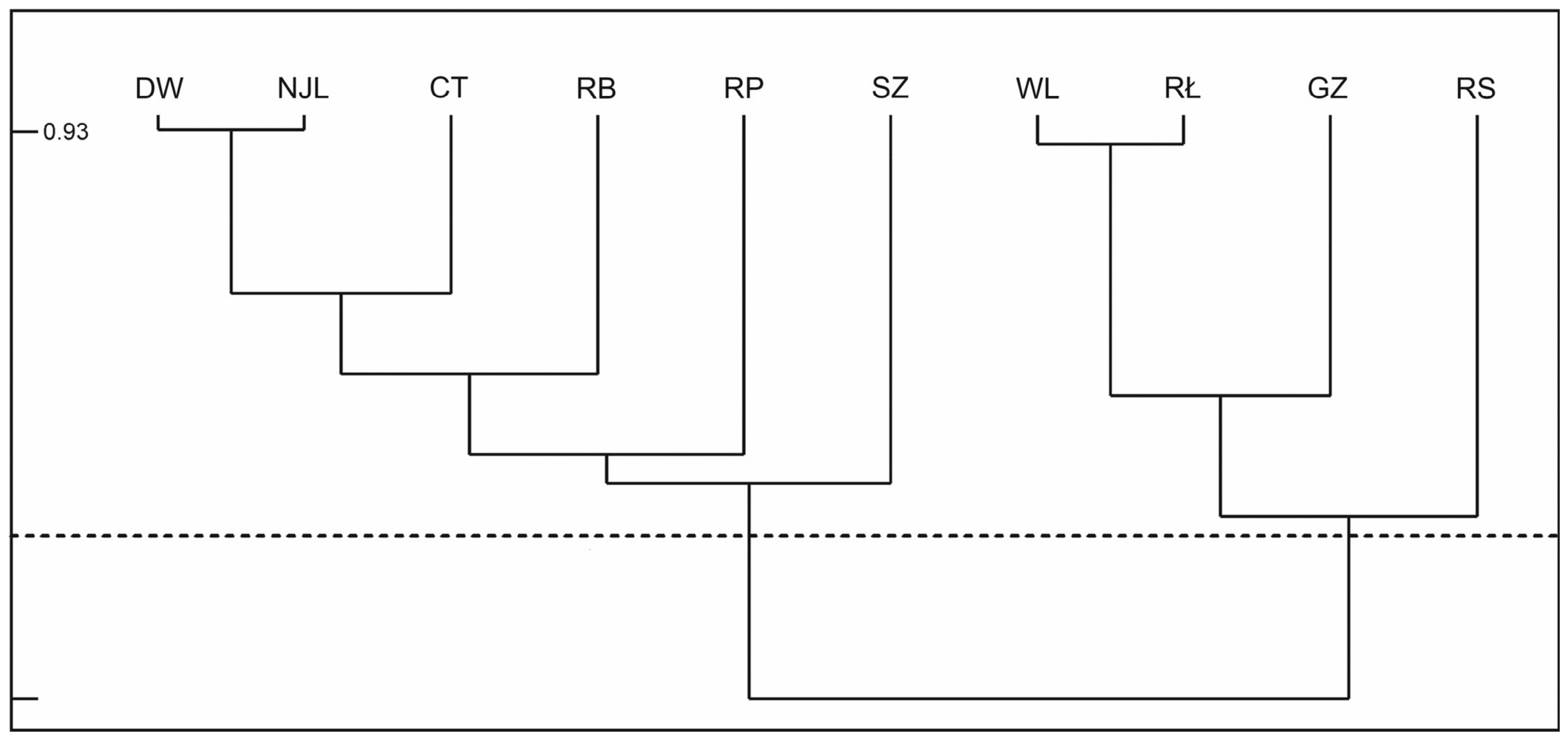
The examined reserves can be classified into two groups, whose mutual similarity was very low (Figure 5). The first group includes the Dęby Wilczkowskie, Nad Jeziorem Liptowskim, Cisy Tychowskie, Buczyna, Przełom rzeki Dębnicy, and Stary Załom reserves, whereas the second group comprises Wapienny Las, Łasko, Grądowe Zbocze, and Sośnica reserves. In the first group, the most similar communities (93%) were found in Dęby Wilczkowskie and Nad Jeziorem Liptowskim reserve. The species composition in Cisy Tychowskie reserve was also similar to these two. The first pair of reserves may appear quite different; Dęby Wilczkowskie is one of the oldest reserves examined in this study, established over 50 years ago, with an acid lowland beech forest and sub-Atlantic oak–hornbeam forest, in which only seven samples were collected (in oak–hornbeam forest and from dead wood). In contrast, Nad Jeziorem Liptowskim is one of the younger reserves, established only 16 years ago, but it exhibited high habitat diversity and it also protects many habitats of European importance. Due to this diversity, the largest number of samples (38) was collected right there.
Figure 5.
Similarity (S) of habitats and microhabitats of the selected reserves: NJL—Nad Jeziorem Liptowskim reserve, SZ—Stary Załom reserve, RB—Buczyna reserve, RŁ—Łasko reserve, RS—Sośnica reserve, GZ—Grądowe Zbocze reserve, CT—Cisy Tychowskie reserve, WL—Wapienny Las reserve, DW—Dęby Wilczkowskie reserve, RP—Przełom rzeki Dębnicy reserve.
In the other three reserves, only about two-thirds of the species were similar. In the second group, the highest similarity (>90% of species composition) has been observed between Wapienny Las and Łasko. The community in Grądowe Zbocze reserve was the next most similar (approximately 70% similarity), followed by Sośnica, with about 50% similarity in the species composition. The second pair of the most similar reserves also differs in terms of their age and habitat type. In both cases a similar number of samples was collected (12 and 15), and 14 species of ptyctimous mites were recorded in each of them. The samples in both sites were taken from the deciduous forest stands differing in terms of their humidity—such as the beech forests, riparian forests, and alder forests—as well as from the dead wood microhabitats. In this case, the high faunistic similarity probably results from the similarity of the sampled habitats. In contrast to these, in the case of Dęby Wilczkowskie and Nad Jeziorem Liptowskim, the high species diversity and similarity of the communities may stem from the high habitat diversity and internal heterogeneity of the environments sampled in Nad Jeziorem Liptowskim reserve, as well as from the long protection history of Dęby Wilczkowskie reserve.
3.5. Multivariate Analysis of Ptyctimous Mite Preferences in Relation to Habitat Types and Reserve Characteristics
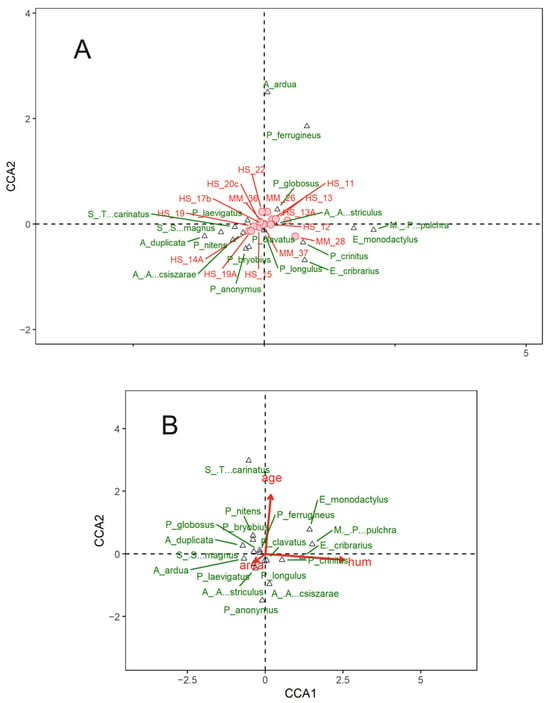
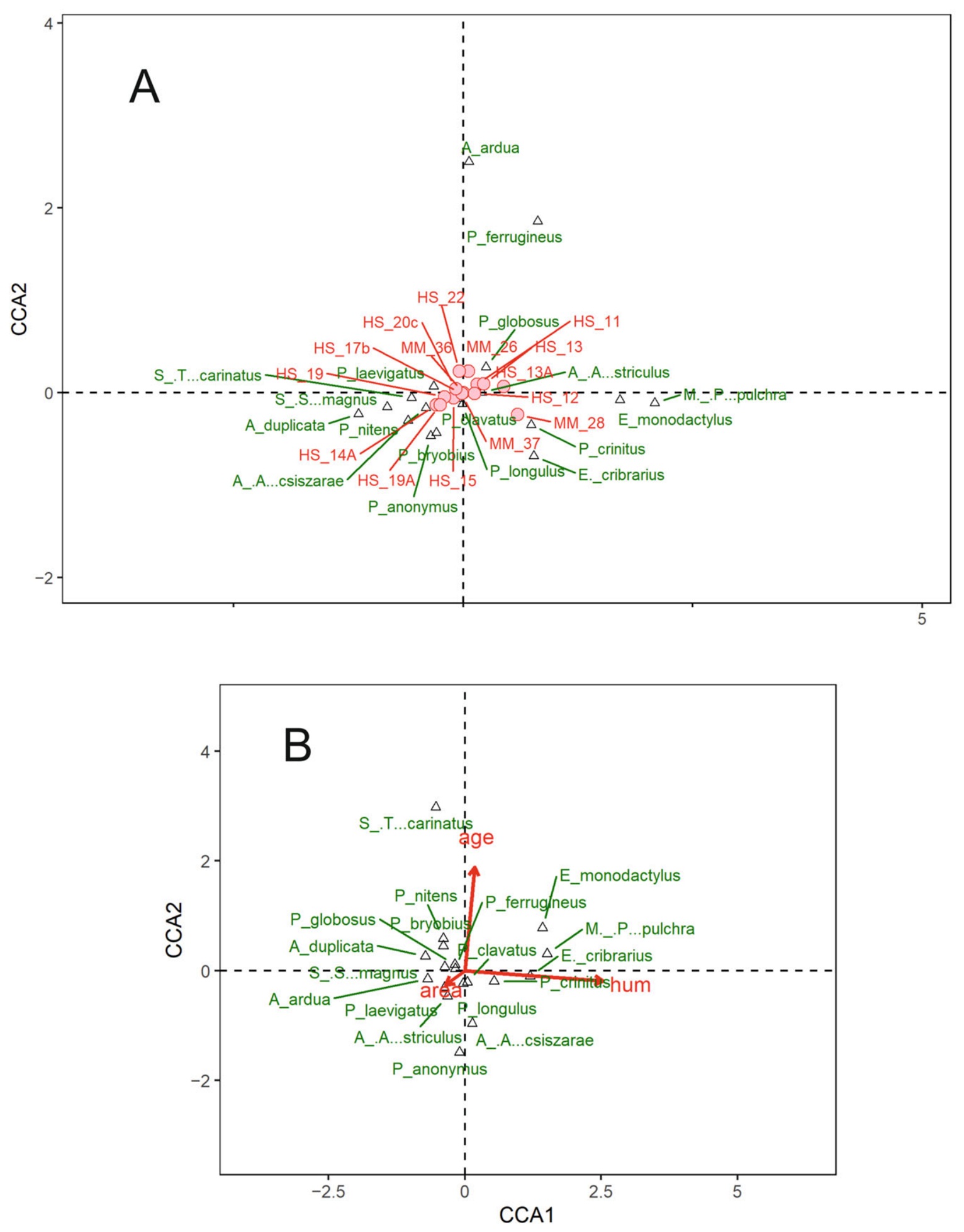
The observed differences are confirmed by the results of the CCA on the mite communities in the examined habitat and merocenoses types (Figure 6A). The first canonical axis (CCA1) represents the main gradient of variation in the ptyctimous mite communities among the studied habitats, separating the communities associated with E. monodactylus and habitat type 13A from those characterized by S. (S.) magnus and A. duplicata. The second canonical axis (CCA2) separates the communities containing A. ardua and P. ferrugineus from those characterized by P. bryobius and P. longulus. The model was statistically significant at F = 4.0713 p = 0.001 (eigenvalue of the first axis: 0.28752; second axis: 0.21241, the variances explained: 0.3016 and 0.2228, respectively). Despite the differences between the mite communities in the examined habitats, a relatively low number of mite species had a significant indicator value: E. monodactylus was indicative towards habitats 13 and S_13A (F = 0.872 p = 0.03), and S. (S.) magnus to the group of habitats S_15 + S_20c (F = 0.847 p = 0.01). Two other species with a significant indicator value were A. ardua to the group of very similar S_13 + S_20c + S_22 + S_5 (0.862 0.005), and A. duplicata to S_15 + S_19 + S_20c + S_22 (F = 0.947; p = 0.01).
Figure 6.
(A) CCA diagram illustrating the preferences of individual ptyctimous mite species in relation to selected habitats and microhabitats: HS_11—alder forests, HS_12—marshy forests, HS_13a—oak–hornbeam forests, HS_13—other mixed deciduous forests, HS_14a—Pomeranian beech forests, HS_15—oak forests, HS_17b—other spruce forests, HS_19—larch forests, HS_19a—yew, HS_20c—mixed forests with spruce, HS_22—shrubs; and microhabitats: MM_26—bird nests, MM_28—rotten stumps, MM_36—bark, MM_37—bracket fungi, triangle—species, circle—habitat; (B) CCA diagram of the preferences of ptyctimous mite species in relation to selected factors: area—reserve area, age—reserve age, hum—soil humidity, triangle—species.
The relationships between the mite communities, the age of the reserve and the area, as well as the soil humidity level, are presented in Figure 6B. The first canonical axis (CCA1) was primarily associated with the soil humidity and separated the communities occurring in the moist habitats from those characteristic of drier conditions. The second axis (CCA2) was mainly related to the reserve age, distinguishing the communities associated with the older reserves from those inhabiting the younger ones. The model was significant at F = 4.7503 p < 0.001 (eigenvalues: 0.1718 and 0.07684; variance explained: 0.6330 and 0.28311 for axes 1 and 2 respectively). All three explanatory variables were found to improve the model significantly: age of the reserve F = 4.0062, p = 0.004; its area F = 1.8440, p = 0.043; and soil humidity F = 8.8726, p = 0.001.
4. Discussion
In the examined reserves of the West Pomeranian Province, 21 species of ptyctimous mites were recorded in the area of 304.29 ha. This means that in the area constituting only 0.001% of the whole area of the province, 50% of all species from this group known so far from the area of Poland [27,31] are legally protected. This value is nearly the same as that recorded for Białowieża National Park, which is one of the most valuable natural forests in Europe, where 22 species of ptyctimous mites have been found (in twice as many samples [22] as in those collected in the reserves discussed here). It should be noted that the species recorded in this study are mostly common and abundant ptyctimous mites in Poland [27]. However, there are two species, i.e., Phthiracarus opacus (Niedbała, 1986) and Phthiracarus compressus (Jacot, 1930), which are also frequent and abundant in Poland [34], but they were absent in the examined area. Their absence in the collected material may result from the insufficient sampling. The other ptyctimous mite species known from Poland were not recorded in these reserves due to the geographical and environmental constraints. Four of them are submontane or montane species, e.g., Euphthiracarus reticulatus (Berlese, 1913), Phthiracarus spadix Niedbała, 1983, Steganacarus (Steganacarus) spinosus (Sellnick, 1920), and Austrophthiracarus pavidus (Berlese, 1913). One species (Steganacarus (Steganacarus) applicatus (Sellnick, 1920)) is known mainly from north-eastern Poland, and Hoplophthiracarus illinoisensis (Ewing, 1909) is typical of peatlands [27]. The other 14 species not recorded in the examined area are considered rare or very rare in Poland, and they usually occur in a low number. However, further studies embracing some additional habitats, microhabitats, and nature reserves may reveal their presence in the future.
Regarding the structure of ptyctimous mite communities in the examined area, the absence of very abundant and very frequent species is particularly noteworthy. The absence of eudominant species in the community indicates a balanced community structure [52]. Such a structure is typical of areas with high habitat and microhabitat diversity and without strong disturbances [57,58]. The analysis of the cumulative dominance curve (Figure 2) indicates that the community in Nad Jeziorem Liptowskim reserve has the most balanced structure. This pattern also suggests that the soil environment in this reserve is well preserved and is not exposed to serious disturbances. In this reserve 15 species of ptyctimous mites have been found. This reserve also had the highest Shannon–Weaver diversity index. The values of these results may stem from the fact that this is a quite large reserve (over 50 ha) with a relatively short protection history (16 years), but it is characterized by high habitat diversity, especially in terms of humidity—ranging from peatlands to various forest ecosystems. The samples were collected there from five types of habitat, including meadows, riparian forests, beech forests, spruce forests, and larch forests. This plethora of habitats in this case is tantamount to the high species diversity, and the balanced community structure observed in this reserve confirms the hypothesis that greater habitat heterogeneity means higher species diversity of ptyctimous mites. The second reserve with the highest diversity index and a high number of species (15) was Cisy Tychowskie reserve. This is a relatively small reserve (10.3 ha), legally protected for over 46 years, with tree stands containing over 120-year-old yew trees and beech forests with oak and hornbeam admixture. The samples from this reserve were collected from a riparian forest, beech forest, and yew tree stands. For example, in Cisy Staropolskie im. Leona Wyczółkowskiego reserve 24 species of ptyctimous mites were recorded (a research paper in progress). Cisy Staropolskie reserve is unique in this respect because it protects the largest compact lowland yew stand in Europe, and it is also the oldest reserve in Poland and the second oldest reserve in Europe [59,60]. In the area of this reserve, very diverse communities of Uropodina mites, with a lot of rare species, have been found [25,61]. The results obtained in the area of Cisy Tychowskie reserve confirm that the presence of the yew increases species diversity also in ptyctimous mite communities.
The highest number of ptyctimous mite species (16) has been recorded in Dęby Wilczkowskie reserve. This is a small floristic reserve, which was established over 50 years ago, and it protects an oak–beech stand, which developed within a forest complex existing since at least the second half of the 19th century. Due to the low habitat diversity, the samples were collected only from the oak–hornbeam forest and the community was predominated by one species, i.e., E. monodactylus, and this is why the Shannon–Weaver diversity index for this reserve was quite low. However, the long history of legal protection probably enabled the development of a stable environment therein, supporting a species-diverse community of ptyctimous mites. It should be noted that the timespan of area protection is not always tantamount to the duration of formal protection, but rather it often depends on the history of the existing ecosystem. The importance of the duration of protection has also been confirmed in this study by the results of the multivariate analyses (Figure 5), which have revealed that this factor was considerably significant. These results confirm the hypothesis formulated in this study, which assumes that the duration of protection affects the communities of soil fauna. The results are also consistent with the previous study on communities of ptyctimous mites in Białowieża National Park and those on Uropodina [25,28,29].
In the case of the Nad Jeziorem Liptowskim reserve discussed previously, the high diversity of habitats coincided with the large area of the site. In the current study, the site area, similarly to the reserve age and moisture conditions, proved to be a factor significantly affecting the structure of the mite communities under investigation (Figure 6B). The issue of the effect of site area on mite communities has received little attention so far. One of the few studies devoted to this topic focusing on Uropodina, demonstrating that site size significantly differentiates the structure of such mite communities [28]. An interesting study conducted at the microhabitat scale was reported by Brückner et al. [62]. The authors analyzed, among other things, microhabitats functioning as “habitat islands” (leaf litter, mosses, and dead wood) and showed that the structure of oribatid mite communities changes with the habitat size and the extent of habitat fragmentation.
Considerably more studies have examined the effects of habitat heterogeneity and moisture conditions on oribatid mite communities, including ptyctimous mites. These studies have shown that greater habitat and microhabitat heterogeneity increases the species diversity of Oribatida at both the local site level and regional scale [63,64,65,66]. Furthermore, a number of studies conducted in forests in Norway, differing in moisture conditions [66,67], demonstrated that both at the level of entire forest complexes and on small “habitat islands” composed of bryophyte communities varying in moisture, habitat type and moisture are the two major factors determining potential differences in the composition of oribatid mite communities. As noted in the introduction section, the knowledge of ecology and habitat requirements of ptyctimous mites is still limited, and therefore all studies addressing this aspect should be of great importance. In the current study, the habitat preference analysis of ptyctimous mites was also performed by means of the ecological importance index (Q), which incorporates both the abundance and frequency of species within a community. The major drawback of this parameter is that it can yield similar values for rare yet abundant species and for common yet scarce species. Nevertheless, in both cases a high Q value indicates a major ecological role for the species—in the first case due to the high abundance, and in the second due to the common occurrence [50]. The species with the highest Q index in the examined reserves are P. globosus, A. duplicata, and P. longulus, which were recorded in all or in most of the habitats or microhabitats. This in turn confirms the previous observations regarding the wide ecological valence of these species, both nationally [27] and within other protected areas in Poland, such as Białowieża and Bory Tucholskie national parks [22,23]. Another species of high importance in the examined reserves was A. ardua, which, although frequent and abundant across Poland [27], is rare in Białowieża Primeval Forest. As the obtained results show, this species occurred in the soil and dead wood of the Białowieża forest, but exclusively within the protected areas [22]. In the material from the reserves discussed here, this species was found in the samples from humid habitats, such as meadows, alder swamps, and riparian forests, as well as in highly dry ones, such as bird nests [68], which proves its wide ecological valence. Moreover, S. (S.) magnus, which was common in the habitats of 10 reserves, is relatively rare and moderately abundant in the whole area of Poland [27], and rare and scarce in Białowieża and Bory Tucholskie National Parks [22,23]. These examples show that the frequency of a particular species may be different depending on the scale of research, and their importance within individual communities may vary across their entire distribution range, depending on the local habitat conditions. Furthermore, it should be noted that a detailed analysis of the spatial distribution of ptyctimous mites across Poland has not yet been conducted, but this factor might play a significant role in the species occurrence within specific areas.
The analysis of cumulative dominance curves for ptyctimous mite communities across the studied habitats reflects the extent of environmental transformation within these ecosystems. The habitats that can be regarded as the most natural, characterized by the most balanced community structure, include the Pomeranian beech forests, alder swamp forests, deciduous forests, and yew stands (Figure 4). In contrast to the above, in the structures of the communities found in the soil and litter of spruce and larch plantings, as well as in shrubs, the habitat is strongly predominated by one species. Such a structure suggests that the soil environment in these habitats is transformed or, more possibly, its origin is anthropogenic. In the case of tree bark, however, the community predominated by one species may be attributed to its nature as a microhabitat. Such a community structure, strongly dominated by a single species, is typical of microhabitats and has previously been reported for ptyctimous mite communities inhabiting dead wood and tree bark in studies conducted in the forest of Białowieża [22].
The extent of species similarity among the ptyctimous mite communities in the examined reserves and habitats reflects the configuration of factors which are favorable or limiting the occurrence of individual species. These factors are difficult to define, especially in such field studies, but the more similar the species composition of the mesofauna communities between individual areas is, the more similar are the environmental factors between them. In our study these favorable factors for the communities of ptyctimous mites were the diversity of habitats and duration of legal protection. This is why the analysis has revealed that the highest value of similarity has been observed in the case of the communities in Nad Jeziorem Liptowskim and Dęby Wilczkowskie. However, it should also be noted that the total number of species in each of the compared areas is in fact the key factor for the Marczewski–Steinhaus similarity index. The smaller the difference between the number in particular communities is, the higher the similarity will be when the same species occur.
There is no doubt that the different number of samples collected in the examined reserves and single sampling had some influence on the obtained results. However, it appears that this did not substantially affect the number of recorded species because the number of identified species differed only slightly despite the quite different number of collected samples. Furthermore, it has been already proved that just a few (3–4) litter siftings can be sufficient to determine which species form a mite community in a given area [69]. It should also be taken into account that the current study is in fact a pilot study, aimed primarily at assessing the biodiversity of the acarofauna in the investigated nature reserves rather than at conducting advanced quantitative analyses, which would require a larger and more uniform number of samples from each area.
5. Conclusions
As a matter of fact, many organisms of soil mesofauna are often neglected in the context of nature conservation. This problem stems from the insufficient knowledge of their biology, ecology, and distribution, as well as from the lack of appropriate protection methods and legal regulations. In the case of ptyctimous mites, only fragmentary data derived from individual faunistic studies provide a very limited insight into their habitat preferences and spatial distribution, e.g., [27].
This study provides data on the community structure and species diversity of mite communities in 10 reserves located in the West Pomeranian region, and it also confirms the hypotheses regarding the positive effects of habitat heterogeneity and duration of legal protection on the diversity of the mite group discussed here. Despite the varying levels of examination among the sites, the number of recorded species was similar, and the community structure was well balanced. This in turn suggests the absence of significant disturbances in the soil of the examined nature reserves.
Furthermore, the results also indicate that the duration of legal protection is a key factor in maintaining high biodiversity and that it plays a dual role. First, it allows ecosystems to function without anthropogenic interference. Second, a long and continuous period of existence of a forest complex enables the development of stable conditions, as well as the diversification of habitats and microhabitats, including the presence of dead wood, etc., in a given area. Thus, it seems that effective conservation of soil invertebrates requires legal protection of as many areas as possible, even those small ones, provided that they are environmentally heterogeneous, with special emphasis laid on the older parts of their tree stands.
Author Contributions
Conceptualization, J.B.; Methodology, J.B.; Software, J.B.; Validation, J.B.; Formal Analysis, A.N. and J.B.; Investigation, J.B., T.R., and W.N.; Resources, J.B., A.N. and T.R.; Data Curation, J.B.; Writing—Original Draft Preparation, A.N., J.B., T.R. and W.N.; Writing—Review and Editing, A.N., and T.R.; Visualization, A.N. and J.B.; Supervision, J.B.; Project Administration, A.N. and J.B.; Funding Acquisition, A.N. All authors have read and agreed to the published version of the manuscript.
Funding
This research was partly financed from the grant obtained from the International Union for Conservation of Nature—IUCN (Grant number SMA-G00-GG-0000000779). Agnieszka Napierała was granted research support.
Institutional Review Board Statement
Not applicable.
Data Availability Statement
The data presented in this study are stored in platform GBIF (Global Biodiversity Information Facility) Available online: https://www.gbif.org/dataset/5eb880de-6188-48b5-a000-4a3b52666204, DOI: 10.15468/keg6u3 (accessed on 10 August 2026) and Katalog prób glebowych i prób z mikrośrodowisk w Zbiorach Przyrodniczych Wydziału Biologii UAM. Część III. Próby z Polski o różnych akronimach zebrane w latach 1982–2025 [48].
Acknowledgments
The authors of this study would like to thank the Regional Directorate for Environmental Protection in Szczecin for the permission for sample collection (permit no. WOPN.6205.47.2024.AS). We would also like to thank Bartłomiej Gołdyn for his help in conducting the statistical analysis.
Conflicts of Interest
The authors declare no conflicts of interest.
Appendix A
Table A1.
Comparison of the structure of ptyctimous mite communities recorded in 10 selected reserves of the West Pomeranian Province: NJL—Nad Jeziorem Liptowskim reserve, SZ—Stary Załom reserve, RB—Buczyna reserve, RŁ—Łasko reserve, RS—Sośnica reserve, GZ—Grądowe Zbocze reserve, CT—Cisy Tychowskie reserve, WL—Wapienny Las reserve, DW—Dęby Wilczkowskie Reserve, RP—Przełom rzeki Dębnicy Reserve; D%—dominance, F%—frequency, Na—number of samples, Ns—number of species, N—number of specimens, H′—Shannon-Weaver diversity index.
References
- Rozporządzenie Ministra Środowiska z Dnia 16 Grudnia 2016 r. w Sprawie Ochrony Gatunkowej Zwierząt. (Dz.U. 2016 Poz. 2183). Available online: https://isap.sejm.gov.pl/isap.nsf/DocDetails.xsp?id=WDU20160002183 (accessed on 11 May 2026).
- Scott, E. Protected areas poorly represent insects. Nat. Rev. Earth Environ. 2023, 4, 358. [Google Scholar] [CrossRef] [Scilit]
- Adamski, P. Ochrona owadów—Chronić gatunek czy siedlisko? In Integralna Ochrona Przyrody, 1st ed.; Grzegorczyk, M., Ed.; Instytut Ochrony Przyrody PAN: Kraków, Poland, 2007; pp. 125–126. [Google Scholar]
- Zając, K. Ochrona bezkręgowców na przykładzie mięczaków. In Integralna Ochrona Przyrody, 1st ed.; Grzegorczyk, M., Ed.; Instytut Ochrony Przyrody PAN: Kraków, Poland, 2007; pp. 127–131. [Google Scholar]
- Morris, R.K.A.; Welch, M.D. Is invertebrate conservation in Great Britain best achieved by policies that increase species protection? J. Insect Conserv. 2023, 27, 527–531. [Google Scholar] [CrossRef] [Scilit]
- Chowdhury, S.; Zalucki, M.P.; Hanson, J.O.; Tiatragul, S.; Green, D.; Watson, J.E.M.; Fuller, R.A. Three quarters of insect species are insufficiently represented by protected areas. One Earth 2023, 6, 139–146. [Google Scholar] [CrossRef] [Scilit]
- Sullivan, G.T.; Ozman-Sullivan, S. Alarming evidence of widespread mite extinctions in the shadows of plant, insect and vertebrate extinctions. Austral Ecol. 2021, 46, 163–176. [Google Scholar] [CrossRef] [Scilit]
- Wilson, E.O. The little things that run the world (the importance and conservation of invertebrates). Conserv. Biol. 1987, 1, 344–346. [Google Scholar] [CrossRef] [Scilit]
- Lavelle, P.; Decaëns, T.; Aubert, M.; Barot, S.; Blouin, M.; Bureau, F.; Margerie, P.; Mora, P.; Rossi, J.-P. Soil invertebrates and ecosystem services. Eur. J. Soil Biol. 2006, 42, S3–S15. [Google Scholar] [CrossRef] [Scilit]
- Wu, D.; Du, E.; Eisenhauer, N.; Mathieu, J.; Chu, C. Global engineering effects of soil invertebrates on ecosystem functions. Nature 2025, 640, 120–129. [Google Scholar] [CrossRef] [Scilit] [PubMed]
- Błoszyk, J.; Krysiak, D.; Napierała, A.; Markowicz, M. 1.3. Ocena stanu środowiska glebowego wybranych rezerwatów leśnych województwa wielkopolskiego w oparciu o zgrupowania roztoczy z podrzędu Uropodina (Acari: Mesostigmata). [W:] 1. Ochrona przyrody. In Raport o Stanie Środowiska w Wielkopolsce w Roku 2001; Biblioteka Monitoringu Środowiska: Warsaw, Poland, 2002; pp. 21–31. [Google Scholar]
- Chowdhury, S.; Jennions, M.D.; Zalucki, M.P.; Maron, M.; Watson, J.E.; Fuller, R.A. Protected areas and the future of insect conservation. Trends Ecol. Evol. 2023, 38, 85–95. [Google Scholar] [CrossRef] [Scilit] [PubMed]
- Gulvik, M.E. Mites (Acari) as indicators of soil biodiversity and land use monitoring: A review. Pol. J. Ecol. 2007, 55, 415–440. [Google Scholar]
- Roland, E.; Kościelska, A.; Massalska, J.; Koperwas, K.; Gabryś, G. New data on Trombidia (Acari: Prostigmata: Parasitengona) in protected areas in Lubuskie Province (Western Poland). Zesz. Nauk. Acta Biol. Univ. Szczec. 2015, 22, 224–243. [Google Scholar] [CrossRef] [Scilit]
- Marić, I.; Međo, I.; Jovanović, S.; Petanović, R.; Marčić, D. Spider mites (Acari: Tetranychidae) in protected natural areas of Serbia. Syst. Appl. Acarol. 2018, 23, 2033–2053. [Google Scholar] [CrossRef] [Scilit]
- Błoszyk, J.; Niedbała, W.; Wendzonka, J.; Rutkowski, T.; Kulczak, M.; Napierała, A. Selected Acari groups in the Czarne Doły nature reserve as a model group for studying the impact of an umbrella species. Acarologia 2025, 65, 947–961. [Google Scholar] [CrossRef] [Scilit]
- Coletta, M.; Monticelli, M.; D’Alessandro, A.; Gentili, C.; Torresi, A.; Waris, N.; La Terza, A. Managing soil to support soil biodiversity in protected areas agroecosystems: A comparison between arable lands, olive groves, and vineyards in the Conero Park (Italy). Environ. Monit. Assess. 2025, 197, 200. [Google Scholar] [CrossRef] [Scilit] [PubMed]
- Napierała, A.; Błoszyk, J.; Bruin, J. Communities of uropodine mites (Acari: Mesostigmata) in selected oak-hornbeam forests of the Wielkopolska region (Poland). Exp. Appl. Acarol. 2009, 49, 291–303. [Google Scholar] [CrossRef] [Scilit] [PubMed]
- Napierała, A.; Błoszyk, J.; Gołdyn, B. Are the long-term fluctuations of the number and community structure of Uropodina (Acari: Mesostigmata) in Poland an effect of climate changes and anthropogenic transformations of environment, or natural fluctuations? In XIII International Congress of Acarology, 1st ed.; Morales, G.J., Castilho, R.C., Flechtmann, C.H.W., Eds.; Recife, Brazil, 2010; p. 170. [Google Scholar]
- Staab, M.; Gossner, M.M.; Simons, N.K.; Achury, R.; Ambarlı, D.; Bae, S.; Schall, P.; Weisser, W.W.; Blüthgen, N. Insect decline in forests depends on species’ traits and may be mitigated by management. Commun. Biol. 2023, 6, 338. [Google Scholar] [CrossRef] [Scilit] [PubMed]
- Napierała, A. Struktura Zgrupowań i Rozkład Przestrzenny Uropodina (Acari: Mesostigmata) w Wybranych Kompleksach Leśnych Wielkopolski (Community Structure and Spatial Pattern of Uropodina (Acari: Mesostigmata) in Selected Forest Complexes of the Greater Poland Region). Ph.D. Thesis, Adam Mickiewicz University, Poznań, Poland, 2008. [Google Scholar]
- Niedbała, W.; Błoszyk, J.; Gutowski, J.M.; Konwerski, S.Z.; Napierała, A. A characteristic of communities of ptyctimous mites (Acari: Acariformes: Oribatida) in the Białowieża Primeval Forest, Central Europe. In Mites (Acari) of the Białowieża Primeval Forest, 1st ed.; Błoszyk, J., Napierała, A., Eds.; Kontekst: Poznań, Poland, 2020; pp. 61–127. [Google Scholar]
- Niedbała, W.; Napierała, A.; Wendzonka, J.; Lubińska, K.; Kulczak, M.; Błoszyk, J. Species diversity and spatial distribution of some Oribatid mites in Bory Tucholskie National Park (N Poland). Diversity 2024, 16, 678. [Google Scholar] [CrossRef] [Scilit]
- Cooke, R.; Mancini, F.; Boyd, R.J.; Evans, K.L.; Shaw, A.; Webb, T.J.; Isaac, N.J.B. Protected areas support more species than unprotected areas in Great Britain, but lose them equally rapidly. Biol. Conserv. 2023, 278, 109884. [Google Scholar] [CrossRef] [Scilit]
- Rutkowski, T. Unikatowe Zgrupowanie Roztoczy z Podrzędu Uropodina (Acari: Mesostigmata) Rezerwatu Cisy Staropolskie Im. Leona Wyczółkowskiego w Wierzchlesie (A Unique Community of Uropodina Mites (Acari: Mesostigmata) in the Leon Wyczółkowski “Cisy Staropolskie” Nature Reserve, Wierzchlas). Ph.D. Thesis, Uniwersytet Zielonogórski, Zielona Góra, Poland, 2024. [Google Scholar]
- Vogelfänger, L.; Weisser, W.W.; Gossner, M.M.; Morinière, J.; Rieker, D.; Schall, P.; Ammer, C.; Seibold, S. Metabarcoding reveals time after tree death as main driver of diversity and composition of invertebrate communities in deadwood. For. Ecol. Manag. 2025, 593, 122880. [Google Scholar] [CrossRef] [Scilit]
- Niedbała, W. Ptyctimous mites (Acari, Oribatida) of Poland. Fauna Pol. 2008, 3, 1–242. [Google Scholar]
- Niedbała, W. Ptyctimous mites (Acari: Oribatida) of the Palearctic Region, Systematic part. Fauna Mundi 2011, 4, 1–472. [Google Scholar]
- Niedbała, W. Contribution to the knowledge of ptyctimous mites (Acari, Oribatida) in the palm house in Poznań. Biol. Lett. 2010, 47, 87–92. [Google Scholar] [CrossRef] [Scilit]
- Niedbała, W. New data about ptyctimous mites (Acari, Oribatida) in Polish palm houses. Turk. J. Zool. 2014, 38, 1–5. [Google Scholar] [CrossRef] [Scilit]
- Niedbała, W.; Liu, D. Systematic, synonymic and biogeographical list of ptyctimous mites (Acari, Oribatida) in the world (1799–2022). Zootaxa 2023, 5265, 1–442. [Google Scholar] [CrossRef] [Scilit] [PubMed]
- Pande, Y.D.; Berthet, P. Studies on the food and feeding habits of soil Oribatei in a Black Pine plantation. Oecologia 1973, 12, 413–426. [Google Scholar] [CrossRef] [Scilit] [PubMed]
- Niedbała, W. Phthiracaroidea (Acari, Oribatida). Systematic Studies; Elsevier: Amsterdam, The Netherlands; Oxford, UK; New York, NY, USA; Tokyo, Japan; PWN: Warszawa-Kraków, Poland, 1992; p. 612. [Google Scholar]
- Błaszak, C. Zerconidae (Acari, Mesostigmata) Polski; PWN: Warszawa-Kraków, Poland, 1974; p. 315. [Google Scholar]
- Niedbała, W. Brachychthoniidae Polski (Acari, Oribatei). Studium Ekologicznofaunistyczne; Państwowe Wydawnictwo Naukowe: Warszawa, Poland, 1976; p. 144. [Google Scholar]
- Błoszyk, J. Rodzaj Trachytes Michael, 1894 (Acari: Mesostigmata) w Polsce (The Genus Trachytes Michael, 1894 (Acari: Mesostigmata) in Poland). Pr. Kom. Biol. PTPN 1980, 54, 5–52. [Google Scholar]
- Michocka, S. Polskie Roztocze (Acari) z Rodzin Bdellidae i Cunaxidae (Polish Mites (Acari) of the Families Bdellidae and Cunaxidae); PWN: Warszawa-Kraków, Poland, 1987; p. 130. [Google Scholar]
- Buczyna. Zarządzenie Ministra Leśnictwa i Przemysłu Drzewnego z Dnia 4 Lipca 1984 r. w Sprawie Uznania Za Rezerwaty Przyrody (M.P. 1984 Nr 17 Poz. 125). Available online: https://isap.sejm.gov.pl/isap.nsf/DocDetails.xsp?id=WMP19840170125 (accessed on 11 May 2026).
- Cisy Tychowskie. Zarządzenie Ministra Leśnictwa i Przemysłu Drzewnego z Dnia 11 Sierpnia 1980 r. w Sprawie Uznania Za Rezerwaty Przyrody (M. P. z 1980 r. Nr 19, Poz. 94). Available online: https://isap.sejm.gov.pl/isap.nsf/DocDetails.xsp?id=WMP19800190094 (accessed on 11 May 2026).
- Dęby Wilczkowskie. Zarządzenie Ministra Leśnictwa i Przemysłu Drzewnego z Dnia 12 Lipca 1974 r. w Sprawie Uznania Za Rezerwaty Przyrody (M.P. 1974 Nr 28 Poz. 172, par. 4). Available online: https://isap.sejm.gov.pl/isap.nsf/DocDetails.xsp?id=WMP19740280172 (accessed on 11 May 2026).
- Grądowe Zbocze. Zarządzenie Ministra Ochrony Środowiska, Zasobów Naturalnych i Leśnictwa z Dnia 14 Czerwca 1996 r. w Sprawie Uznania Za Rezerwat Przyrody (M.P. 1996 Nr 41 Poz. 400). Available online: https://isap.sejm.gov.pl/isap.nsf/DocDetails.xsp?id=WMP19960410400 (accessed on 11 May 2026).
- Łasko. Zarządzenie Ministra Leśnictwa i Przemysłu Drzewnego z Dnia 30 Czerwca 1964 r. w Sprawie Uznania Za Rezerwat Przyrody (M.P. z 1964 r. Nr 47, Poz. 231). Available online: https://isap.sejm.gov.pl/isap.nsf/DocDetails.xsp?id=WMP19640470231 (accessed on 11 May 2026).
- Nad Jeziorem Liptowskim. Zarządzenie Nr 10/2010 Regionalnego Dyrektora Ochrony Środowiska w Szczecinie z Dnia 22 Marca 2010 r. w Sprawie Uznania Za Rezerwat Przyrody “Nad Jeziorem Liptowskim” (DZ. URZ. WOJ. 2010.70.1288). Available online: https://e-dziennik.szczecin.uw.gov.pl/legalact/2010/1288/ (accessed on 11 May 2026).
- Przełom Rzeki Dębnicy Zarządzenie Nr 7/2009 Regionalnego Dyrektora Ochrony Środowiska w Szczecinie z Dnia 9 Stycznia 2009 r. w Sprawie Uznania Za Rezerwat Przyrody “Przełom Rzeki Dębnicy” (Dz. Urz. z Dnia 20 Lipca 2010 r. Nr 70, Poz. 1288). Available online: https://e-dziennik.szczecin.uw.gov.pl/WDU_Z/2016/1797/oryginal/akt.pdf (accessed on 11 May 2026).
- Sośnica. Zarzadzenie Ministra Leśnictwa i Przemysłu Drzewnego z Dnia 12 Lipca 1974 r. w Sprawie Uznania Za Rezerwaty Przyrody (M.P. z 1974 r. Nr 28, Poz. 172, par. 8). Available online: https://isap.sejm.gov.pl/isap.nsf/DocDetails.xsp?id=WMP19740280172 (accessed on 11 May 2026).
- Wapienny Las. Zarządzenie Regionalnego Dyrektora Ochrony Środowiska w Szczecinie z Dnia 11 Lipca 2018 r. w Sprawie Uznania Za Rezerwat Przyrody. (DZ. URZ. WOJ. 2018.3344). Available online: https://e-dziennik.szczecin.uw.gov.pl/legalact/2018/3344/ (accessed on 11 May 2026).
- Stary Załom. Zarządzenie Ministra Leśnictwa i Przemysłu Drzewnego z Dnia 30 Grudnia 1966 r. w Sprawie Uznania Za Rezerwat Przyrody (M.P. 1967 Nr 14 Poz. 70). Available online: https://isap.sejm.gov.pl/isap.Nsf/DocDetails.xsp?id=WMP19670140070 (accessed on 11 May 2026).
- Błoszyk, J.; Nowak, M.; Gogol, J.; Napierała, A. (Eds.) Katalog Prób Glebowych i Prób z Mikrośrodowisk w Zbiorach Przyrodniczych Wydziału Biologii UAM. Część III. Próby z Polski o Różnych Akronimach Zebrane w Latach 1982–2025 (Catalogue of Soil Samples and Microhabitat Samples in the Natural History Collections of the Faculty of Biology, Adam Mickiewicz University. Part III. Samples from Poland with Different Acronyms Collected in 1982–2025), 1st ed.; Wydawnictwo Naukowe Kontekst: Poznań, Poland, 2026; p. 242. [Google Scholar]
- Błoszyk, J. Geograficzne i Ekologiczne Zróżnicowanie Zgrupowań Roztoczy z Kohorty Uropodina (Acari: Mesostigmata) w Polsce: Uropodina Lasów Grądowych (Carpinion betuli) (Geographical and Ecological Differentiation of Uropodina Mite Communities (Acari: Mesostigmata) in Poland: Uropodina of Oak-Hornbeam Forests (Carpinion betuli)); Kontekst: Poznań, Poland, 1999. [Google Scholar]
- Kasprzak, K.; Niedbała, W. Wskaźniki biocenotyczne stosowane przy porządkowaniu i analizie danych w badaniach ilościowych (Biocenotic Indices Used in the Organization and Analysis of Data in Quantitative Studies). In Metody Stosowane w Zoologii Gleby (Methods Used in Soil Zoology), 2nd ed.; Górny, M., Grüm, L., Eds.; PWN: Warszawa, Poland, 1981; pp. 379–416. [Google Scholar]
- Krebs, C.J. Ekologia. Eksperymentalna Analiza Rozmieszczenia i Liczebności; PWN: Warszawa, Poland, 1996; p. 639. [Google Scholar]
- Magurran, A.E. Measuring Biological Diversity; Blackwell Publishing: Oxford, UK, 2004; p. 256. [Google Scholar]
- Wickham, H. ggplot2: Elegant Graphics for Data Analysis; Springer-Verlag: New York, NY, USA, 2016. [Google Scholar]
- Oksanen, J.; Simpson, G.; Blanchet, F.; Kindt, R.; Legendre, P.; Minchin, P.; O’Hara, R.; Solymos, P.; Stevens, M.; Szoecs, E.; et al. vegan: Community Ecology Package. 2026. Available online: https://cran.r-project.org/web/packages/vegan/index.html (accessed on 10 August 2026).
- Martinez Arbizu, P. pairwiseAdonis: Pairwise Multilevel Comparison Using Adonis. 2017, Version 0.4.1. Available online: https://github.com/pmartinezarbizu/pairwiseAdonis (accessed on 10 August 2026).
- De Cáceres, M.; Legendre, P. Associations between species and groups of sites: Indices and statistical inference. Ecology 2009, 90, 3566–3574. [Google Scholar] [CrossRef] [Scilit] [PubMed]
- Tews, J.; Brose, U.; Grimm, V.; Tielbörger, K.; Wichmann, M.C.; Schwager, M.; Jeltsch, F. Animal species diversity driven by habitat heterogeneity/diversity: The importance of keystone structures. J. Biogeogr. 2004, 31, 79–92. [Google Scholar] [CrossRef] [Scilit]
- Hillebrand, H.; Bennett, D.M.; Cadotte, M.W. Consequences of dominance: A review of evenness effects on local and regional ecosystem processes. Ecology 2008, 89, 1510–1520. [Google Scholar] [CrossRef] [Scilit] [PubMed]
- Conwentz, H. Die Eibe in Westpreussen, ein aussterbender Waldbaum. Abh. Landeskd. Prov. Westpreuss. 1892, 3, 1–67. [Google Scholar]
- Nowicki, J. Beitrag zu Preussens Flora. Preuss. Prov.-Bl. 1839, 21, 393–405. [Google Scholar]
- Błoszyk, J.; Krysiak, D. Uropodina (Acari: Mesostigmata) rezerwatu “Cisy Staropolskie im. Leona Wyczółkowskiego” w Wierzchlesie (Uropodina (Acari: Mesostigmata) of the “Leon Wyczółkowski Cisy Staropolskie” Nature Reserve in Wierzchlas). Park. Nar. Rez. Przyr. 2000, 19, 115–121. [Google Scholar]
- Brückner, A.; Heethoff, M.; Norton, R.A.; Wehner, K. Body Size Structure of Oribatid Mite Communities in Different Microhabitats. Int. J. Acarol. 2018, 44, 367–373. [Google Scholar] [CrossRef] [Scilit]
- Gong, T.; Yin, X.; Liu, W.; Chen, H.; Shi, Z. Differences of Oribatid Mite Community and Trophic Structure between Karst Caves and Surface Different Moss Habitats. PLoS ONE 2023, 18, e0290144. [Google Scholar] [CrossRef] [Scilit] [PubMed]
- Erdmann, G.; Scheu, S.; Maraun, M. Regional Factors Rather than Forest Type Drive the Community Structure of Soil Living Oribatid Mites (Acari, Oribatida). Exp. Appl. Acarol. 2012, 57, 157–169. [Google Scholar] [CrossRef] [Scilit] [PubMed]
- Zaitsev, A.S. Oribatid Mite Communities (Acari: Oribatida) in Different Habitats of the Polistovsky Nature Reserve (Pskov Region, Russia). Est. J. Ecol. 2013, 62, 276–286. [Google Scholar] [CrossRef] [Scilit]
- Seniczak, A.; Niedbała, W.; Iturrondobeitia, J.C.; Seniczak, S.; Roth, S.; Jordal, B.H. Type of broadleaf forest matters most for ptyctimous mite communities (Acari, Oribatida) in Norway. Biodivers. Conserv. 2021, 30, 2929–2953. [Google Scholar] [CrossRef] [Scilit]
- Seniczak, A.; Seniczak, S.; Graczyk, R.; Kaczmarek, S.; Jordal, B.H.; Kowalski, J.; Djursvoll, P.; Roth, S.; Bolger, T. A Forest Pool as a Habitat Island for Mites in a Limestone Forest in Southern Norway. Diversity 2021, 13, 578. [Google Scholar] [CrossRef] [Scilit]
- Kulczak, M.; Wendzonka, J.; Lubińska, K.; Napierała, A.; Błoszyk, J. Remarkable Stability of Uropodina (Acari: Mesostigmata) Communities in Artificial Microhabitats: A Case Study of Bird Nest Boxes in Bory Tucholskie National Park. Diversity 2025, 17, 544. [Google Scholar] [CrossRef] [Scilit]
- Błoszyk, J.; Napierała, A. Community structure of mesofauna in the light of qualitative and quantitative research on soil mites. Eur. J. Biol. Res. 2018, 8, 252. [Google Scholar]

Disclaimer/Publisher’s Note: The statements, opinions and data contained in all publications are solely those of the individual author(s) and contributor(s) and not of MDPI and/or the editor(s). MDPI and/or the editor(s) disclaim responsibility for any injury to people or property resulting from any ideas, methods, instructions or products referred to in the content. |
© 2026 by the authors. Licensee MDPI, Basel, Switzerland. This article is an open access article distributed under the terms and conditions of the Creative Commons Attribution (CC BY) license.