


Abstract
China harbors a diverse array of macrofungi, yet its fungal diversity remains inadequately documented, particularly in under-explored regions such as the temperate forests of the northeast and the subtropical highlands of the southwest. In this study, four agaric species are reported as new records for China based on morphological observations and multilocus phylogenetic analyses. Phylogenetic analyses of the internal transcribed spacer (ITS) and nuclear large subunit (nrLSU) ribosomal RNA gene regions confirmed their generic and species-level placements. Cortinarius infidus was collected from mixed coniferous and broadleaf forests in Liaoning Province, Pseudolaccaria fellea from Pine-dominated forests in Liaoning Province, Volvariella clavocystidiata from pine-dominated coniferous forests in Liaoning Province, and Gerhardtia borealis from mixed coniferous–broadleaf forests in Guizhou Province. Comprehensive macro and micromorphological descriptions, color photographs, line drawings, scanning electron micrographs, and comparisons with closely related taxa and original literature are provided to confirm these identifications. These findings contribute to a better understanding of the distribution patterns of these genera and expand the known fungal diversity of China.
1. Introduction
China is recognized as one of the global hotspots of macrofungal diversity, yet vast regions, particularly northeastern and southwestern China, remain underexplored. The genera Cortinarius (Pers.) Gray, Pseudolaccaria Vizzini, Contu & Z.W. Ge, Volvariella Speg., and Gerhardtia Bon are widespread and ecologically significant, but their diversity in China is still incompletely documented. Recent surveys in Liaoning and Guizhou provinces have yielded collections that, based on morphological observations and molecular phylogenetic analyses of ITS and nrLSU sequences, are identified as new records for China [1]. This study documents four newly recorded species from China—Cortinarius infidus Armada, Bellanger & P.-A. Moreau, Pseudolaccaria fellea (Peck) Vizzini, Matheny, Consiglio & M. Marchetti, and Volvariella clavocystidiata Kapitonov & E.F. Malysheva from Liaoning Province, and Gerhardtia borealis (Fr.) Contu & A. Ortega from Guizhou Province. Detailed descriptions, illustrations, and comparisons with closely related taxa are provided, thereby contributing to a better understanding of the distribution and diversity of these genera in East Asia.
Cortinarius infidus is a recently described species belonging to the Cortinarius subgenus Telamonia (Fr.) Trog, section Verni Kytöv, Niskanen & Liimat [2]. It forms part of a cryptic species complex together with C. inops J. Favre and C. suberythrinus Moënne-Locc and C. suberythrinus, from which it can be differentiated by subtle morphological features, such as slightly longer basidiospores, as well as fixed nucleotide polymorphisms in the ITS and rpb2 loci [2,3]. The species was initially recognized as an unnamed phylogenetic lineage, referred to as “group 3”, in studies focusing on boreal Salix-associated Telamonia species [3]. Currently, C. infidus is known only from alpine snowbeds in the French and Swiss Alps, where it exhibits a strict ecological association with dwarf Salix species (S. herbacea, S. retusa, S. reticulata) and occasionally Polygonum viviparum [2]. C. infidus has now been found in Liaoning Province, which expands its known range from the European Alps to northeastern China.
A different pattern of distributional expansion is seen in Pseudolaccaria fellea, a species originally described from North America as Clitocybe fellea Peck [4,5,6]. Long considered an enigmatic taxon within Clitocybe [6], its phylogenetic affinities were clarified by molecular analyses. Multigene studies by Lavorato [7] and Sánchez-García [8] demonstrated that C. fellea belongs to the genus Pseudolaccaria within the family Callistosporiaceae Vizzini, Consiglio, M. Marchetti & P. Al-varado, where it is closely related to the European P. pachyphylla (Fr.) Staude (Bigelow 1985), Vizzini & Contu. In a comprehensive phylogenetic revision by Vizzini [9] based on ITS, LSU, 18S, tef1, and rpb2 sequence data, P. fellea forms a well-supported lineage distinct from P. pachyphylla. The two species can be distinguished by subtle morphological differences: P. fellea lacks cheilocystidia and caulocystidia (both present in P. pachyphylla), has slightly larger basidiospores on average (7.0–8.4 × 4.8–5.8 μm vs. 6.5–9.0 × 4.5–6.0 μm), and exhibits a weak but positive amyloid reaction in the spore wall [9]. Ecologically, P. fellea is terrestrial, fruiting among grass or moss on soil in open coniferous woodlands, and is currently known from North America, with possible reports also from Asia (Pakistan). The discovery of P. fellea in Liaoning represents a considerable eastward range extension, linking its previously disjunct North American and Pakistani records.
Volvariella clavocystidiata is a recently described species from Western Siberia, Russia, first reported from a lowland bog based on morphological and molecular phylogenetic analyses [10]. The genus Volvariella is easily recognized by its basal volva, free lamellae, and pink spore print [11,12]. Although traditionally placed in the Pluteaceae Kotl. & Pouzar, molecular evidence places some species, including those with short basidiospores and a non-gelatinous cutis, in a separate lineage [13,14]. Volvariella clavocystidiata is distinguished by its small basidiocarps with a silky-fibrillose whitish pileus, a whitish volva, predominantly clavate cheilocystidia and pleurocystidia, and basidiospores averaging 6.6 × 4.8 μm [10]. The species was originally found in a lowland bog, but the Chinese collection from Liaoning Province expands its known ecological range to coniferous forests. This study reports V. clavocystidiata for the first time in China.
The fourth species, Gerhardtia borealis (Fr.) Contu & A. Ortega, belongs to a genus with a somewhat complex taxonomic history. Erected by Bon [15] with G. incarnatobrunnea (Ew. Gerhardt) Bon as its type, the genus is distinguished by finely verrucose basidiospores, siderophilous basidia, an epithelial to cutis-type pileipellis, and the absence of clamp connections. Later, Vizzini refined the concept, describing the spores as irregular, undulate to nodulose rather than distinctly verrucose. Fruiting bodies of G. borealis are medium-sized [16]. Although several Gerhardtia species—G. sinensis T.H. Li, Ting Li, C.Q. Wang & W.Q. Deng, G. yunnanensis M. Mu & L.P. Tang, G. tomentosa X.D. Yu & H.B. Guo (Li et al. 2017) [17]—have been reported from China, G. borealis has not. This study documents G. borealis for the first time from Guizhou Province, China.
2. Materials and Methods
2.1. Collection of Specimens
All samples were collected from Haitangshan Nature Reserve and Santagou Nature Reserve in western Liaoning Province, China, as well as Tongren City, Guizhou Province. These were dried overnight using an electric oven at 45 °C [18]. The specimens were preserved in the Herbarium of Mycology of Jilin Agricultural Science and Technology University (HMJU).
2.2. Morphological Observation
Photographs of fresh basidiocarps were taken with a Canon 80D camera (Tokyo, Japan). The color name and code were recorded according to Methuen Handbook of Color with Kornerup and Wanscher [19]. The micromorphology of the specimens was studied at 4×, 10×, 40×, 60× and 100× magnifications with the help of an Olympus BX 53 (Tokyo, Japan) optical microscope (measurements were carried out at 1000× oil immersion). Sections of dried specimens were fixed in 3% potassium hydroxide (KOH), 1% Congo red and Melzer’s reagent for observation. Dimensions for basidiospores are given using the notation of the form ‘(a–)b–av–c(–d)’. The range of ‘b–c’ contains a minimum of 90% of the measured values. Extreme values, ‘a’ and ‘d’, are given in parentheses, while ‘av’ is the average value. Factor Q is the ratio of spore length to width, Qm is the average of factor Q [20]. Scanning Electron Microscope (SEM) images of basidiospores were obtained from dried, freehand sections of lamellae. These sections were directly mounted on double-sided adhesive tape, which was pasted onto a metallic specimen stub, and then scanned at different magnifications in high-vacuum mode [18].
2.3. DNA Extraction, PCR, Sequencing and Phylogenetic Analyses
Genomic DNA was extracted from 20 to 30 mg of dried basidiomata using the M5 Fungal Genomic DNA Kit (Mei5 Biotechnology Co., Ltd., Beijing, China) following the manufacturer’s protocols. The internal transcribed spacer (ITS) region of the nuclear ribosomal DNA was amplified with primer pairs ITS1/ITS4 [21]. The large subunit (nrLSU) ribosomal RNA gene was amplified using primer combinations LR0R/LR5 and LR0R/LR7 [22]. PCR amplifications were performed in a total volume of 25 μL, containing 2 μL of DNA template, 1 μL of each primer (10 μM), 12.5 μL of 2× Taq PCR Master Mix (Tiangen Biotech Co., Ltd., Beijing, China), and 8.5 μL of ddH2O. The thermal cycling parameters were as follows: initial denaturation at 94 °C for 5 min (ITS) or 4 min (nrLSU); followed by 30 cycles of denaturation at 94 °C for 30 s (ITS) or 40 s (nrLSU), annealing at 53 °C (ITS) or 52 °C (nrLSU) for 30 s (ITS) or 45 s (nrLSU), and extension at 72 °C for 30 s (ITS) or 40 s (nrLSU); and a final extension at 72 °C for 5 min. PCR products were checked by electrophoresis on 1% agarose gels stained with ethidium bromide and visualized under UV light using a JY 600 electrophoresis system (Beijing JUNYI Electrophoresis Co., Ltd., Beijing, China). Sequencing was performed bidirectionally with the same primers used for amplification on an ABI 3730xl DNA Analyzer (Applied Biosystems, Foster City, CA, USA) at BGI Co., Ltd. (Beijing, China). Raw sequence data were assembled and edited using SeqMan v.7.0 (DNASTAR, Madison, WI, USA). Newly generated sequences were deposited in GenBank under the accession numbers provided in Table 1. Phylogenetic analyses were conducted based on concatenated ITS+nrLSU datasets. Detailed methods for alignment, model selection, and tree inference are described in the Results section (Section 3).
Table 1.
Names, voucher numbers, and corresponding GenBank accession numbers of the taxa used in the phylogenetic analysis.
2.4. Phylogenetic Analyses
Reference ITS and nrLSU sequences of closely related taxa were retrieved from GenBank based on BLASTn searches and previous phylogenetic studies [23,24,25]. For each of the four newly recorded species, we assembled separate datasets that included their own sequences, those of their respective relatives, and a universal outgroup, Hygrophorus brunneodiscus C.Q. Wang & T.H. Li. Sequence alignment was performed using MAFFT v7.0, and ambiguous regions were trimmed manually with MEGA12 [26,27,28,29].
Phylogenetic reconstruction was carried out using both maximum likelihood (ML) and Bayesian inference (BI). The best-fit nucleotide substitution model for each dataset was selected with ModelFinder [30] based on the Bayesian Information Criterion (BIC); the GTR+F+I+G4 model was chosen for all datasets. ML analyses were run with IQ-TREE v2.2.0 [31] using 1000 ultrafast bootstrap replicates. BI analyses were performed with MrBayes v3.2.2 [32], running two independent MCMC chains for 10 million generations, sampling every 1000 generations. The first 25% of sampled trees were discarded as burn-in, and a 50% majority-rule consensus tree was built from the remaining trees. Nodes with ML bootstrap values (MLBP) ≥ 70% and Bayesian posterior probabilities (BPP) ≥ 0.95 were considered well supported [33]. The sequences used in this study are listed in Table 1.
3. Results
3.1. Phylogenetic Analyses
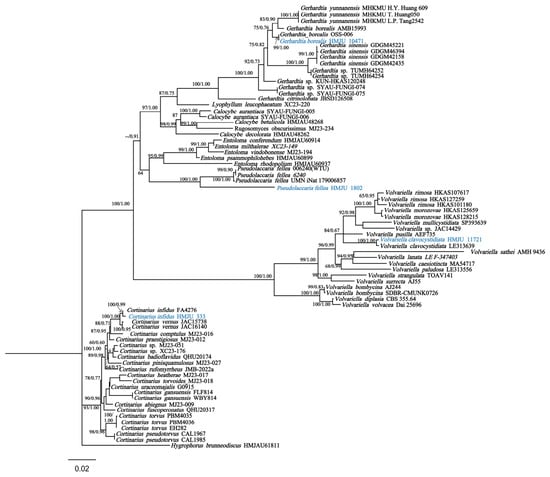
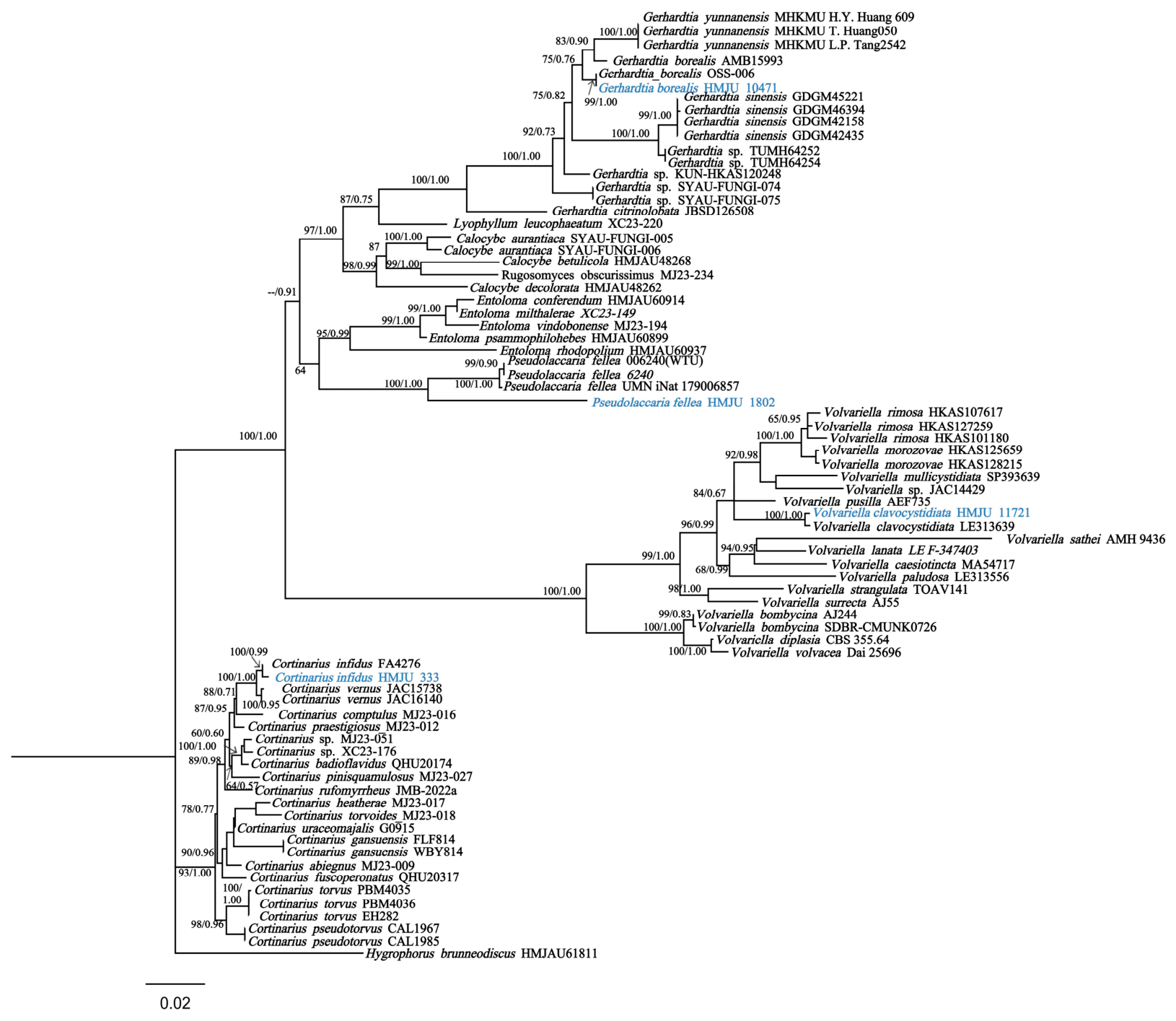
We combined ITS and nrLSU sequences for 75 taxa and used ModelFinder to select the GTR+F+I+G4 model under BIC. Both maximum likelihood (IQ-TREE, 1000 bootstrap replicates) and Bayesian inference (MrBayes, 10 million generations) gave essentially the same topology; only the ML tree is shown in Figure 1. Each of our four Chinese collections fell into a distinct, well-supported clade with its respective reference sequence. Specifically, Cortinarius infidus (HMJU 333) clustered with the holotype Cortinarius infidus FA4276 (MLBP = 100%, BPP = 0.99); Pseudolaccaria fellea (HMJU 1802) grouped with Pseudolaccaria fellea UMN iNat 179,006,857 (MLBP = 100%, BPP = 1.00); Volvariella clavocystidiata (HMJU 11721) formed a monophyletic group with the Volvariella clavocystidiata LE313639 (MLBP = 100%, BPP = 1.00); and Gerhardtia borealis (HMJU 10471) lied within the Gerhardtia borealis OSS-006 (MLBP = 99%, BPP = 1.00). These results strongly support the identification of all four collections as new country records for China.
Figure 1.
ML and Bayesian phylogenetic analysis of Cortinarius infidus, Pseudolaccaria fellea, Volvariella clavocystidiata, and Gerhardtia borealis, based on ITS and nrLSU sequences. Newly generated sequences are indicated in bold blue.
3.2. Taxonomy
- Cortinarius infidus Armada, Bellanger & P.-A. Moreau, J. Fungi 9 (9, no. 942): 5 (2023)
- MycoBank: 849752
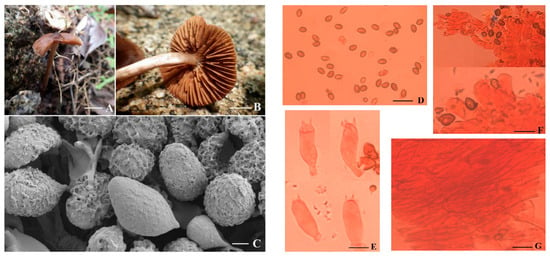
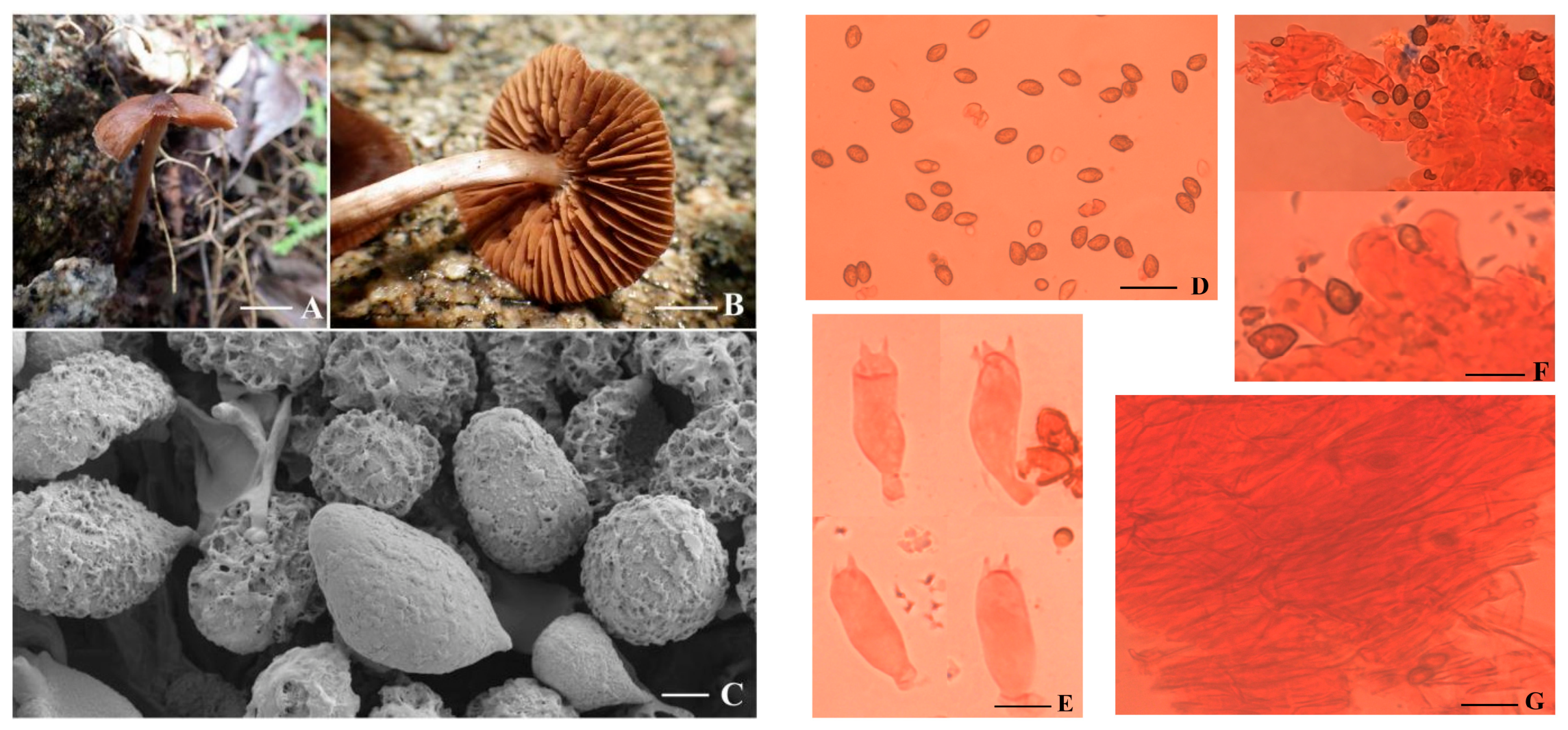
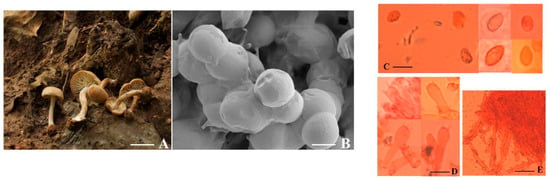
- Figure 2. Cortinarius infidus (HMJU 333). (A,B) Basidiocarps; (C) SEM images of basidiospores; (D) Basidiospores; (E) Basidia; (F) Cheilocystidia; (G) Pileipellis. Scale bar: 2 cm (A,B); 2 μm (C); 20 μm (D–G).
Description. Basidiocarps small-sized. Pileus 1.5–2.5 cm in diam, 6D6 (brown), applanate with a distinct umbo at the center, surface hygrophanous, margin wavy and slightly incurved. Lamellae adnate, moderately dense, with numerous tiers of lamellulae, edges entire, 6C5 (orange-brown). Stipe 25–40 × 5–10 mm, slender-cylindrical, hollow, equal, surface smooth with fine longitudinal striations, 5C4 (pale brown).
Basidiospores [30/1/1] (7.8–)8.6–10.1(–) × (4.9–)5.0–5.6–6.1(–6.4) μm, Q = 1.4–1.5–1.8 Qm = 1.54, pale brown to yellowish-brown in 3% KOH, spore wall slightly darker, ovoid to broadly ellipsoid, one end slightly pointed, the other rounded, containing oil droplets. Basidia (20.4–)20.5–29.4–43.8(–44.3) × (6.3–)7.1–9.1–11.6(–12.0) μm, Q = 2.6–3.3–4.2, Qm = 3.25, clavate to broadly clavate, 2-spored or 4-spored. Cheilocystidia predominantly clavate, occasionally subcapitate, with a narrow base and rounded or inflated apex, thin-walled, smooth. Pleurocystidia absent. Pileipellis is a cutis composed of subparallel to slightly interwoven, subcylindrical hyphae, thin-walled, smooth. Clamp connections present.
Habitat. Solitary on soil in deciduous broadleaf forests.
Type locality: France. Specimen examined: Liaoning Province, Fuxin City, Haitangshan National Nature Reserve, 6 August 2016, J.Z. XU HMJU 333.
Comments. Cortinarius infidus was originally described from the French Alps, where it grows in alpine snowbeds in strict association with dwarf Salix species [2]. It is characterized by a small-sized basidiocarp, a brown, applanate pileus with a distinct umbo, adnate lamellae, a slender stipe with fine longitudinal striations, and microscopically by ovoid to broadly ellipsoid, pale brown basidiospores measuring (7.5–)8.0–9.0–10.0(–10.5) × (5.0–)5.25–5.5–6.0(–6.25) μm (Q = 1.4–1.8, Qm = 1.54), clavate basidia, abundant clavate to subcapitate cheilocystidia, and a cutis-type pileipellis with clamp connections. The Chinese collection from Liaoning Province (HMJU 333) closely matches the original description in both macro-and micromorphological characters. Phylogenetically, our ITS and nrLSU sequences cluster with the holotype sequence of C. infidus (FA4276) with high support (MLBP = 100%, BPP = 0.99). This discovery represents the first record of C. infidus in China and extends its known distribution from the European Alps to northeastern Asia.
- Pseudolaccaria fellea (Peck) Vizzini, Matheny, Cons. & M. Marchetti, Fungal Diversity 101: 238 (2020)
- MycoBank: 831402
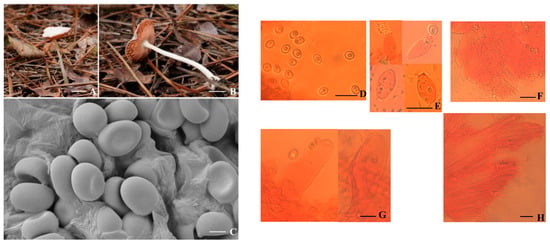
- Figure 3. Pseudolaccaria fellea (HMJU 1802). (A) Basidiocarps; (B) SEM images of basidiospores; (C) Basidiospores; (D) Basidia; (E) Pileipellis. Scale bar: 2 cm (A); 2 μm (B); 20 μm (C–E).
Description. Basidiocarps are small-sized and gregarious. Pileus 1.5–3.5 cm in diam, 5B3 (light brown), slightly darker at the center, surface dry, covered with minute squamules, initially convex, becoming applanate with age, margin slightly incurved. Lamellae adnate, distant, unequal, with numerous tiers of lamellulae, edges entire, 4A3 (pale cream). Stipe 30–45 × 4–9 mm, cylindrical, equal, curved, hollow, with sparse light brown squamules near the base, surface 4A2 (off-white).
Basidiospores [40/2/3] (5.6–)6.0–7.8–10.8(–11.0) × (3.3–)4.3–5.4–7.1(–7.2) μm, Q = 1.2–1.4–1.7, Qm = 1.43, ovoid to broadly ellipsoid, some spores with a germ pore. Exospore smooth, spore wall pale brown to yellowish-brown, margin darker and thickened in some spores. Pale brown to yellowish-brown in 3% KOH, most spores with a central oil droplet. Basidia [30/2/3] (24.8–)27.1–35.7–48.7(–51.1) × (6.7–)7.8–10.6–14.7 μm, Q = 2.8–3.4–4.3, Qm = 3.41, clavate to broadly clavate, 4-spored or occasionally 2-spored.
Pileipellis is an epithelium, composed of repent, subcylindrical, interwoven hyphae 4–12 μm wide, variable in length, thin-walled, smooth, hyaline to pale yellowish-brown in 3% KOH. Hymenophoral trama regular, composed of subparallel to interwoven filamentous hyphae, subcylindrical to fusiform, thin-walled, smooth. Cystidia or specialized differentiated structures are absent. Habitat. Scattered on soil in mixed coniferous-broadleaf forests.
Type locality: United States. Specimen examined: Liaoning Province, Fuxin City, Haitangshan National Nature Reserve, 6 August 2016, J.Z. XU HMJU 1802.
Comments. Pseudolaccaria fellea was originally described from North America by Peck as Clitocybe fellea, and later transferred to Pseudolaccaria by Vizzini based on phylogenetic evidence. It is characterized by a collybioid habit, a minutely scaly pale yellowish-brown pileus (5B3), adnate to subdistant pale cream lamellae (4A3), a stipe with sparse brownish squamules near the base, and a very bitter taste [4,6]. Microscopically, it has ellipsoid to broadly ellipsoid basidiospores (6.0–10.8 × 4.3–7.1 μm) with a germ pore, pale brown to yellowish-brown in KOH, mostly with a central oil droplet; clavate basidia (27.1–48.7 × 7.8–14.7 μm), 4-spored or occasionally 2-spored; and a pileipellis composed of repent, subcylindrical, interwoven hyphae (epithelium). Hymenial cystidia are absent. The Chinese collection from Liaoning Province (HMJU 1802) matches the original description in all key morphological features, except that the pileipellis in our material is an epithelium [9], but this difference may be due to interpretation or intraspecific variation. Ecologically, the specimen was found scattered on soil in mixed coniferous-broadleaf forests, which is consistent with the typical habitat of this species in open conifer woodlands. The present finding represents the first record of P. fellea in China, extending its known distribution from North America and Pakistan to northeastern Asia.
- Volvariella clavocystidiata Kapitonov & E.F. Malysheva, Phytotaxa 538 (2): 144 (2022)
- MycoBank: 841252
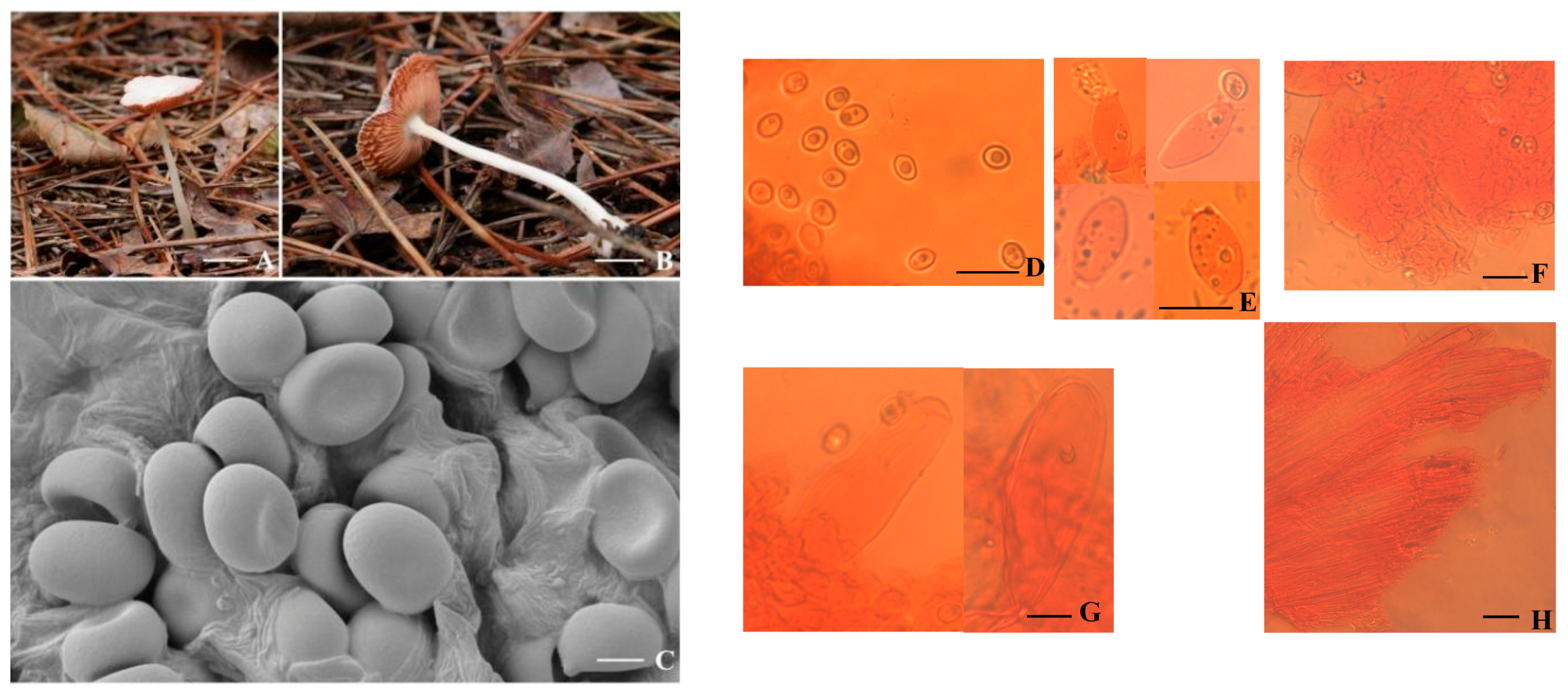
- Figure 4. Volvariella clavocystidiata (HMJU 11721). (A,B) habitat and basidiocarps; (C) SEM images of basidiospores; (D) Basidiospores; (E) basidia; (F) cheilocystidia; (G) pleurocystidia; (H) pileipellis. Scale bars: 2 cm (A,B); 2 μm (C); 20 μm (D–H).
Description. Basidiocarps small-sized, solitary, growing on leaf litter in coniferous forests. Pileus 1.2–1.6 cm in diam., applanate to slightly depressed at the disk, margin wavy and sulcate; surface dry, covered with silky fibrils, 4A1 (silvery white), disk 5B3 (pale yellow). Lamellae free, moderately dense, unequal, with numerous tiers of lamellulae, edges entire, 6C4 (light orange-brown). Stipe 40–55 × 0.2–0.5 mm, slender-cylindrical, hollow, slightly broadening downwards, surface covered with fine white pruina, overall 4A2 (off-white). Volva shallow cup-shaped, 4A2 (off-white), surface adhering to soil.
Basidiospores [30/1/1] (5.3–)5.4–6.0–7.4(–8.0) × (4.1–)4.2–4.7–5.4(–5.7) μm, Q= 1.2–1.3–1.4, Qm = 1.28, globose to subglobose, smooth, without germ pore, containing a central oil droplet. Basidia (11.3–)11.4–15.3–21.3(-22.6) × (3.5–)5.0–6.9–9.5(–9.8) μm, Q = 1.7–2.3–3.4, Qm = 2.27, clavate to broadly clavate, 2–4-spored. Cheilocystidia (11.0–)15.0–29.0–48.0(–54.5) × (6.0–)7.0–12.5–18.0(–23.0) μm, Q = 1.62–2.30–2.97, clavate to subclavate, some with slightly inflated apex, rounded to subcapitate, often densely clustered at the lamellar edge, forming a continuous sterile margin; pleurocystidia few, similar in shape to cheilocystidia, narrowly to broadly clavate. Pileipellis is a cutis composed of subparallel to slightly interwoven, filamentous hyphae, subcylindrical, thin-walled, smooth. Clamp connections are absent.
Habitat. Solitary in coniferous forests dominated by pine trees.
Type locality: Russia. Specimen examined: Liaoning Province, Fuxin City, Santagou Nature Reserve, 7 August 2024, J.Z. XU HMJU 11721.
Comments. Volvariella clavocystidiata was originally described from Western Siberia, Russia, based on material collected in a lowland minerotrophic sedge-horsetail-moss bog, where it grows solitary in waterlogged soil among green mosses and decaying remains of herbaceous plants [10]. The Chinese collection from Liaoning Province (HMJU 11721) closely matches the original description in all key morphological features, including the silky-fibrillose pileus, clavate hymenial cystidia, and absence of clamp connections. However, the Chinese specimen differs ecologically, having been found solitary in a pine-dominated coniferous forest on leaf litter, whereas the type locality is a lowland bog. In addition, the basidiospores in our material are slightly smaller, measuring (5.3–)5.4–6.0–7.4(–8.0) × (4.1–)4.2–4.7–5.4(–5.7) μm (average 6.0 × 4.7 μm), compared to (6.0–)6.2–6.6–7.0(–8.2) × (4.1–)4.4–4.8–5.0(–5.4) μm (average 6.6 × 4.8 μm) in the type, but this variation falls within the expected intraspecific range. Phylogenetically, our ITS and nrLSU sequences cluster with the holotype sequence of Volvariella clavocystidiata LE313639 with high support (BPP = 1.00, MLBP = 100%). This discovery represents the first record of V. clavocystidiata in China and extends its known distribution from Western Siberia to northeastern Asia, also broadening its known ecological range from palustrine wetlands to coniferous forests.
- Gerhardtia borealis (Fr.) Contu & A. Ortega, Bol. Soc. Micol. Madrid 26: 176 (2001)
- MycoBank: 515158
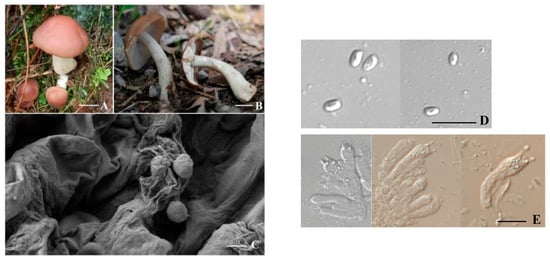
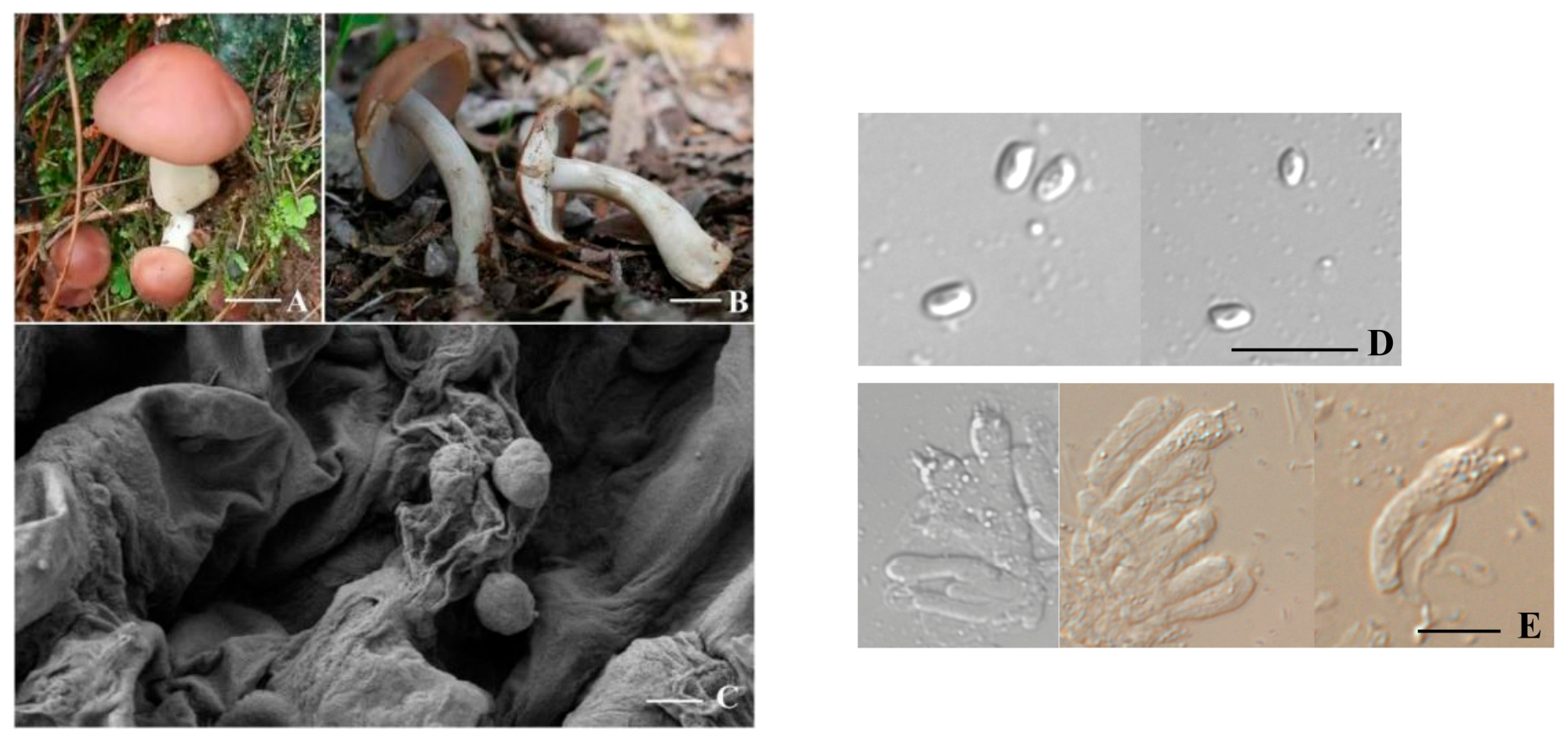
- Figure 5. Gerhardtia borealis (HMJU 10471). (A,B) Basidiocarps; (C) SEM images of basidiospores; (D) Basidiospores; (E) Basidia. Scale bar: 2 cm (A,B); 2 μm (C); 20 μm (D,E).
Description. Basidiocarps are medium-sized, gregarious in mixed coniferous and broad-leaved forests. Pileus 2.5–4.0 cm in diam., initially slightly hemispherical, becoming plano-convex at maturity, margin slightly incurved, surface smooth, glabrous, slightly viscid at the center, initially 7A5 (light flesh pink), gradually becoming 6D5 (light brownish) at maturity. Lamellae adnexed to sinuate, crowded, unequal, with numerous tiers of lamellulae, edges even, 4A1 (milky white). Stipe 40–50 × 8–13 mm, cylindrical, slightly curved, tapering downwards and slightly enlarged at the base, cream to pale yellowish-brown, 4A2 (off-white) to 5C4 (pale brownish), surface with silky fibrils at the base. Context white, unchanging when injured.
Basidiospores (4.3–)4.8–5.7(–5.9) × 2.7–3.2(–3.6) μm, Q = (1.31)1.49–1.95(2.17), Qm =1.73, cylindric-ellipsoid, finely verrucose or not. Basidia (18.2–)19.4–26.1(–29.9) × (4.1–)4.3–5.5(–6.0) μm, clavate, siderophilous, 2–4-spored; sterigmata up to 4.2 μm long. Hymenial cystidia absent. Hymenophoral trama regular, parallel, composed of hyphae 4.0–7.9 μm in diam., hyaline, cylindrical. Clamp connections are absent in all hyphae.
Habitat. Gregarious on soil in pine forests.
Type locality: France. Specimen examined: Guizhou Province, Tongren City, 17 April 2024, J.Z. XU HMJU 10471.
Comments. First described by Fries from Sweden as Agaricus borealis, this species was later moved to Gerhardtia by Contu & A. Ortega. It is now treated as the same biological entity as G. incarnatobrunnea (Ew. Gerhardt) Bon, and the two names have been used as synonyms in various taxonomic treatments [9,15]. According to Bon, the genus Gerhardtia is defined by a combination of traits: finely verrucose to smooth basidiospores, siderophilous basidia, an epithelial, trichodermal or cutis-type pileipellis and a consistent lack of clamp connections. Later work, however, has shifted the emphasis: Vizzini described the spores as irregular in outline, undulate to nodulose, rather than distinctly verrucose. Macroscopically, the fruiting bodies are medium-sized. The pileus is smooth, glabrous, initially light flesh pink (7A5) and turning light brownish (6D5) with age. The lamellae are adnexed to sinuate, milky white (4A1). The stipe has silky fibrils at the base. Microscopically, the basidiospores are cylindric-ellipsoid, finely verrucose, measuring (4.3–)4.8–5.7(–5.9) × 2.7–3.2(–3.6) μm. Basidia are clavate and siderophilous. Clamp connections are completely absent. The Chinese specimen from Guizhou (HMJU 10471) agrees well with all these diagnostic features, especially the absence of clamp connections and the finely verrucose spore surface. To our knowledge, this is the first time G. borealis has been recorded in China, representing a considerable eastward extension of its known European range.
4. Discussion
In this study, four agaric species—Cortinarius infidus, Pseudolaccaria fellea, Volvariella clavocystidiata, and Gerhardtia borealis—are reported as new records for China based on morphological observations and phylogenetic analyses of ITS and nrLSU sequences. These findings expand the known distribution ranges of these species and provide new insights into the diversity of agaricoid fungi in East Asia.
Originally described from alpine snowbeds of the French Alps, where it grows in strict association with dwarf Salix species [2], Cortinarius infidus is now documented from northeastern China. The specimen collected in Liaoning Province (HMJU 333) closely resembles the protologue in most morphological respects. Phylogenetically, our sequences fall within the same well-supported clade as the holotype (OR420012), confirming the identification. To our knowledge, this is the first record of C. infidus in China, considerably expanding its known range from the European Alps to northeastern Asia.
A different pattern of distributional expansion is observed in Pseudolaccaria fellea. First described from North America as Clitocybe fellea (Peck 1898) [4], this species was later transferred to Pseudolaccaria based on molecular evidence [9]. It is easily recognized by its collybioid habit, minutely scaly pale yellowish-brown pileus, adnate to subdistant pale cream lamellae, a stipe with sparse brownish squamules near the base, and an intensely bitter taste. The Chinese collection from Liaoning (HMJU 1802) agrees with the original description in all key features, except that the pileipellis in our material is an epithelium, whereas Vizzini reported a cutis. This minor discrepancy may be attributable to intraspecific variation or to differences in microscopic interpretation, and does not detract from the overall identification. Our finding represents the first record of P. fellea in China, extending its known distribution from North America and Pakistan to northeastern Asia.
Among the four species reported here, Volvariella clavocystidiata presents an interesting case of ecological divergence. Originally described from a lowland minerotrophic bog in Western Siberia [10], this species is morphologically defined by its small basidiocarps, a silky-fibrillose whitish to silvery-white pileus, whitish volva, predominantly clavate cheilocystidia and pleurocystidia, and ellipsoid to broadly ellipsoid basidiospores. The Chinese specimen from Liaoning (HMJU 11721) matches these morphological characters, including the silky-fibrillose pileus, clavate hymenial cystidia, and absence of clamp connections. Ecologically, however, it differs markedly: the Chinese collection was found solitary in a pine-dominated coniferous forest on leaf litter, in contrast to the bog habitat of the type locality. Phylogenetically, our ITS and nrLSU sequences cluster with the holotype (OK256901, OK256955) with strong support, confirming the species identity. This discovery represents the first record of V. clavocystidiata in China and extends its known distribution from Western Siberia to northeastern Asia.
The genus Gerhardtia has a somewhat complex taxonomic history. Originally described from Germany as Lyophyllum incarnatobrunneum, the species was later designated as the type of Gerhardtia by Bon [15], who emphasized finely verrucose basidiospores, siderophilous basidia, an epithelial, trichodermal or cutis-type pileipellis, and the absence of clamp connections as diagnostic features [16]. Subsequent studies have treated G. incarnatobrunneum as conspecific with G. borealis (Fr.) Contu & A. Ortega. The Chinese collection from Guizhou Province (HMJU 10471) conforms well to this concept: it exhibits a smooth, glabrous pileus that is initially light flesh pink and becomes light brownish at maturity, adnexed to sinuate milky white lamellae, a stipe with silky fibrils at the base, and, microscopically, cylindric-ellipsoid, finely verrucose basidiospores, clavate siderophilous basidia, and an absence of clamp connections. This represents the first record of G. borealis in China, extending its known distribution from Europe to East Asia.
The discovery of these four species as new records for China underscores the value of continued field surveys in under-explored regions, particularly in northeastern and southwestern China. The integration of morphological observation with molecular phylogenetic analysis remains essential for accurate species identification and for revealing previously overlooked diversity. Further sampling across East Asia, combined with multi-locus sequencing, will undoubtedly contribute to a more complete understanding of the distribution and evolutionary relationships of these and related species.
Author Contributions
Writing—original draft: W.Z.; Writing—review and editing: C.Z.; Writing—review and technical guidance: J.X.; Data curation: Y.J. All authors have read and agreed to the published version of the manuscript.
Funding
This work was supported by the Jilin Provincial Department of Science and Technology. Plan projects (No: 20260601060RC).
Institutional Review Board Statement
Not applicable.
Informed Consent Statement
Not applicable.
Data Availability Statement
The original contributions presented in this study are included in the article.
Acknowledgments
This work was supported by the Jilin Provincial Department of Science and Technology Plan Projects. The authors are grateful to the relevant teachers for their valuable assistance during the study. We also thank the editors and reviewers for their constructive comments.
Conflicts of Interest
The authors declare no conflict of interest.
References
- Xu, J.Z.; Zhang, C.L.; Kasuya, T.; Moodley, O.; Liu, B.A.O.; Gong, L.E.I.; Li, Y.U. A new species of Tricholosporum (Agaricales, Tricholomataceae) from Liaoning Province of China. Phytotaxa 2018, 374, 63–70. [Google Scholar] [CrossRef] [Scilit]
- Bellanger, J.-M.; Armada, F.; Fellin, A.; Moreau, P.-A. New insights into alpine Cortinariaceae (Basidiomycota): Three new species, two type revisions, and a new record for the alpine zone. J. Fungi 2023, 9, 942. [Google Scholar] [CrossRef] [Scilit]
- Kokkonen, K. Diversity of boreal small species of Cortinarius subgenus Telamonia with Salix. Karstenia 2020, 58, 60–117. [Google Scholar] [CrossRef] [Scilit]
- Peck, C.H. Report of the State Botanist (1897). Annu. Rep. N. Y. State Mus. Nat. Hist. 1898, 51, 265–321. [Google Scholar]
- Smith, A.H. Unusual North American agarics. Am. Midl. Nat. 1944, 32, 669–698. [Google Scholar] [CrossRef] [Scilit]
- Bigelow, H.E. North American species of Clitocybe, part II. Beih. Nova Hedwig. 1985, 81, 281–471. [Google Scholar]
- Lavorato, C.; Vizzini, A.; Ge, Z.W.; Contu, M. Redescription of Clitocybe umbrinopurpurascens (Basidiomycota, Agaricales) and revision of Neohygrophorus and Pseudoomphalina. Phytotaxa 2015, 219, 43–57. [Google Scholar] [CrossRef] [Scilit]
- Sánchez-García, M.; Matheny, P.B.; Palfner, G.; Lodge, D.J. Deconstructing the Tricholomataceae (Agaricales) and introduction of the new families Clitocybaceae, Fayodiaceae, Hydnangiaceae, Lyophyllaceae, and Omphalinaceae. Taxon 2016, 65, 933–957. [Google Scholar]
- Vizzini, A.; Consiglio, G.; Marchetti, M.; Alvarado, P. Insights into the Tricholomatineae (Agaricales, Agaricomycetes): A new arrangement of Biannulariaceae and Callistosporium, Callistosporiaceae fam. nov., Xerophorus stat. nov., and Pleurocollybia incorporated into Callistosporium. Fungal Divers. 2020, 101, 211–259. [Google Scholar] [CrossRef] [Scilit]
- Malysheva, E.; Kapitonov, V.; Malysheva, V. A new species of Volvariella (Pluteaceae, Basidiomycota) from Western Siberia, Russia. Phytotaxa 2022, 538, 139–148. [Google Scholar] [CrossRef] [Scilit]
- Orton, P.D. Volvariella. In British Fungus Flora. Agarics and Boleti; Henderson, D.M., Orton, P.D., Watling, R., Eds.; Pluteaceae: Pluteus & Volvariella; Royal Botanic Garden: Edinburgh, UK, 1986; Volume 4, pp. 77–105. [Google Scholar]
- Boekhout, T. Volvariella. In Flora Agaricina Neerlandica 2; Bas, C., Kuyper, T.W., Noordeloos, M.E., Vellinga, E.C., Eds.; A.A. Balkema: Rotterdam, The Netherlands, 1990; pp. 56–64. [Google Scholar]
- Moncalvo, J.M.; Vilgalys, R.; Redhead, S.A.; Johnson, J.E.; James, T.Y.; Aime, M.C.; Hofstetter, V.; Verduin, S.J.W.; Larsson, E.; Baroni, T.J.; et al. One hundred and seventeen clades of euagarics. Mol. Phylogenetics Evol. 2002, 23, 357–400. [Google Scholar] [CrossRef] [Scilit]
- Justo, A.; Minnis, A.M.; Ghignone, S.; Menolli, N., Jr.; Capelari, M.; Rodríguez, O.; Malysheva, E.; Contu, M.; Vizzini, A. Species recognition in Pluteus and Volvopluteus (Pluteaceae, Agaricales): Morphology, geography and phylogeny. Mycol. Prog. 2011, 10, 453–479. [Google Scholar]
- Bon, M. Deux Lyophylloideae interessantes et le genre Gerhardtia st. et nom. nov. Doc. Mycol. 1994, 24, 65–68. [Google Scholar]
- Vizzini, A.; Angelini, C.; Ercole, E. Is the species diversity in the Lyophylloid genera Calocybella and Gerhardtia (Agaricales, Basidiomycota) underestimated? Two new species from the Dominican Republic. Phytotaxa 2017, 291, 241–252. [Google Scholar] [CrossRef] [Scilit]
- Li, T.; Li, T.; Wang, C. Gerhardtia sinensis (Agaricales, Lyophyllaceae), a new species and a newly recorded genus for China. Phytotaxa 2017, 332, 172–180. [Google Scholar] [CrossRef] [Scilit]
- Zhang, A.Q.; Jin, R.; Zhang, X.C.; Tarafder, E.; Xu, J.Z. Two new species of genus Leucoagaricus and Leucocoprinus (Agaricaceae, Agaricales) from China. MycoKeys 2025, 125, 33. [Google Scholar] [CrossRef] [Scilit] [PubMed]
- Kornerup, A.; Wanscher, J.H. Methuen Handbook of Colour, 3rd ed.; Eyre Methuen: London, UK, 1978; 252p. [Google Scholar]
- Zhang, D.; Peng, J.J.; Wang, J.J.; Priyashnatha, A.H.; Liao, J.P.; Luo, H.X.; Huang, S.C.; Xu, J.Z. Morphological characteristics and phylogenetic analyses revealed two new species from China and a new record from Jilin Province of Agaricales. MycoKeys 2024, 109, 73–90. [Google Scholar] [CrossRef] [Scilit] [PubMed]
- White, T.J.; Bruns, T.; Lee, S.; Taylor, J. Amplification and direct sequencing of fungal ribosomal RNA genes for phylogenetics. In PCR Protocols; Elsevier: Amsterdam, The Netherlands, 1990; p. 315322. [Google Scholar]
- Vilgalys, R.; Hester, M. Rapid genetic identification and mapping of enzymatically amplified ribosomal DNA from several Cryptococcus species. J. Bacteriol. 1990, 172, 4238–4246. [Google Scholar] [CrossRef] [Scilit] [PubMed]
- Matheny, P.B.; Curtis, J.M.; Hofstetter, V.; Aime, M.C.; Moncalvo, J.M.; Ge, Z.W.; Yang, Z.L.; Slot, J.C.; Ammirati, J.F.; Baroni, T.J.; et al. Major clades of agaricales: A multilocus phylogenetic overview. Mycologia 2006, 98, 982–995. [Google Scholar] [CrossRef] [Scilit] [PubMed]
- Liu, H.; Mao, N.; Fan, L.; Guo, S. Stropharia populicola (strophariaceae, agaricales), a new species from China. Phytotaxa 2021, 518, 251–260. [Google Scholar] [CrossRef] [Scilit]
- Tian, E.J.; Matheny, P.B. A phylogenetic assessment of Pholiota and the new genus Pyrrhulomyces. Mycologia 2021, 113, 146–167. [Google Scholar] [PubMed]
- Xu, J.; Zhao, W.; Yu, X.; Idrees, M.; Li, Y.; Qin, J. Infundibulicybe trachyspora, a New Species from Northeastern China Based on Morphology and Molecular Phylogeny. Curr. Microbiol. 2022, 79, 130. [Google Scholar] [CrossRef] [Scilit] [PubMed]
- Jiang, Y.; Zhang, D.; Idrees, M.; Li, X.; Zhou, J.; Xu, J. Two New Records of Agaricales (Psilocybe papuana and Cystoagaricus populinus) from China. Chiang Mai J. Sci. 2023, 50, e2023005. [Google Scholar] [CrossRef] [Scilit]
- Li, X.; Qin, Y.; Kong, Y.; Karunarathna, S.C.; Liang, Y.; Xu, J. Optimization of protoplast preparation conditions in Lyophyllum decastes and transcriptomic analysis throughout the process. J. Fungi 2024, 10, 886. [Google Scholar] [CrossRef] [Scilit]
- Katoh, K.; Standley, D.M. MAFFT multiple sequence alignment software version 7: Improvements in performance and usability. Mol. Biol. Evol. 2013, 30, 772–780. [Google Scholar] [CrossRef] [Scilit] [PubMed]
- Kalyaanamoorthy, S.; Minh, B.Q.; Wong, T.K.F.; Von Haeseler, A.; Jermiin, L.S. ModelFinder: Fast model selection for accurate phylogenetic estimates. Nat. Methods 2017, 14, 587–589. [Google Scholar] [CrossRef] [Scilit] [PubMed]
- Nguyen, L.T.; Schmidt, H.A.; von Haeseler, A.; Minh, B.Q. IQ-TREE: A fast and effective stochastic algorithm for estimating maximum-likelihood phylogenies. Mol. Biol. Evol. 2015, 32, 268–274. [Google Scholar] [PubMed]
- Ronquist, F.; Teslenko, M.; van der Mark, P.; Ayres, D.L.; Darling, A.; Hohna, S.; Larget, B.; Liu, L.; Suchard, M.A.; Huelsenbeck, J.P. MrBayes 3.2: Efficient Bayesian phylogenetic inference and model choice across a large model space. Syst. Biol. 2012, 61, 539–542. [Google Scholar] [CrossRef] [Scilit] [PubMed]
- Miao, L.; Dong, Q.; Jin, Y.; Priyashantha, A.H.; Jiang, W.; Zhang, C.; Xu, J. Evaluation of germplasm resources of Sarcomyxa edulis in the Changbai Mountains of Northeast China. N. Z. J. Bot. 2025, 63, 2051–2071. [Google Scholar]

Disclaimer/Publisher’s Note: The statements, opinions and data contained in all publications are solely those of the individual author(s) and contributor(s) and not of MDPI and/or the editor(s). MDPI and/or the editor(s) disclaim responsibility for any injury to people or property resulting from any ideas, methods, instructions or products referred to in the content. |
© 2026 by the authors. Licensee MDPI, Basel, Switzerland. This article is an open access article distributed under the terms and conditions of the Creative Commons Attribution (CC BY) license.