1. Introduction
Colombia is recognized as one of the most biodiverse countries in the world, hosting 28 species of freshwater and terrestrial turtles [
1,
2,
3,
4,
5]. This richness places Colombia among the leading nations globally in turtle diversity [
6]. Despite this richness, turtles—characterized by longevity, delayed maturity, and slow demographic responses—are increasingly imperiled by anthropogenic pressures. Illegal trafficking, habitat alteration, and urban expansion have intensified risks for these taxa, whose evolutionary success is now threatened by human-mediated translocation and exploitation [
7,
8,
9].
Although wildlife trade in Colombia is regulated [
10,
11,
12,
13], illegal trafficking remains widespread [
14,
15,
16]. In 2021 alone, authorities confiscated 18,636 individuals linked to illicit trade, including two turtle species—
Trachemys callirostris and
Chelus fimbriata—among the most trafficked reptiles nationwide [
17,
18]. Turtles are primarily traded as pets due to their distinctive morphology, but they are also exploited for meat and eggs [
19,
20]. Once translocated into urban systems, these species can establish persistent populations, alter ecological dynamics and threaten native biodiversity [
7,
8,
9,
21].
Cali, Colombia’s third largest city and the principal urban center of the Pacific region, exemplifies this challenge. Two native turtle species—
Kinosternon leucostomum and
Chelydra acutirostris—are naturally present in the upper Cauca River basin [
5,
22], where Cali is located. In contrast, several non-native taxa, either translocated or exotic, including
Rhinoclemmys melanosterna,
R. nasuta,
R. annulata,
T. callirostris,
Podocnemis vogli,
P. expansa,
P. unifilis, and
Ch. fimbriata, have been introduced through trafficking and are frequently released into wetlands and urban parks of the city [
19,
20]. These urban habitats, recorded as turtle refuges in 87% of Cali’s municipal parks [
23], now host both native and non-native species, creating novel assemblages shaped by human activity.
This distinction between native and introduced species is critical for conservation planning in anthropogenic landscapes [
24]. Native taxa embody the ecological heritage of the basin, whereas exotic and translocated turtles often establish persistent populations that reshape community composition, compete with local species, and introduce pathogens [
25,
26]. Recognizing which species are naturally distributed versus those introduced through human activity provides a foundation for targeted management, including habitat restoration, enforcement against trafficking, and public awareness campaigns to reduce pet abandonment [
27,
28]. Such differentiation is essential to anticipate long-term ecological impacts and to design strategies that safeguard native biodiversity in urbanized Neotropical environments.
Beyond the direct impacts of trafficking, the persistence of translocated or exotic turtles in urban wetlands reflects broader ecological processes associated with biological invasions. Urban ecosystems, characterized by habitat fragmentation, altered hydrology, and high human disturbance, often provide niches where non-native species can thrive while native taxa decline [
28,
29,
30]. Translocated and exotic turtles may outcompete native species for food and basking sites, alter trophic interactions, and introduce pathogens that compromise local populations [
28,
31,
32]. Their longevity and capacity to survive in suboptimal conditions further enhance their potential to establish viable populations in human-altered environments. These dynamics underscore the importance of viewing urban wetlands not only as biodiversity refuges but also as arenas where anthropogenic pressures accelerate ecological change [
33,
34,
35,
36]. Understanding how non-native turtles integrate into these systems is therefore essential to anticipate long-term consequences for community composition, ecosystem functioning, and conservation planning in Neotropical cities.
Cali provides a critical case study for examining how illegal trade, urban habitat availability, and the persistence of non-native species intersect in shaping turtle assemblages. We hypothesize that Cali’s urban wetlands function as reservoirs for native, translocated, and exotic turtles, with their persistence reinforced by confiscation records clustered in hotspots of illegal trade. To evaluate this, the study integrates ecological surveys in urban wetlands with confiscation records from the Wildlife Rescue Center (WRC) to assess the current status of freshwater and terrestrial turtles in the city. Specifically, we address three key questions: (1) Which translocated and exotic turtle species are established in Cali’s urban wetlands? (2) Are confiscation records disproportionately concentrated in particular urban hotspots? (3) To what extent do confiscated species correspond to those observed in wetlands, indicating links between trafficking dynamics and local assemblages? By combining ecological monitoring with enforcement data, this research highlights how urban wetlands act simultaneously as biodiversity refuges and arenas of ecological change, underscoring the need for targeted management strategies to safeguard native biodiversity in Neotropical cities.
2. Materials and Methods
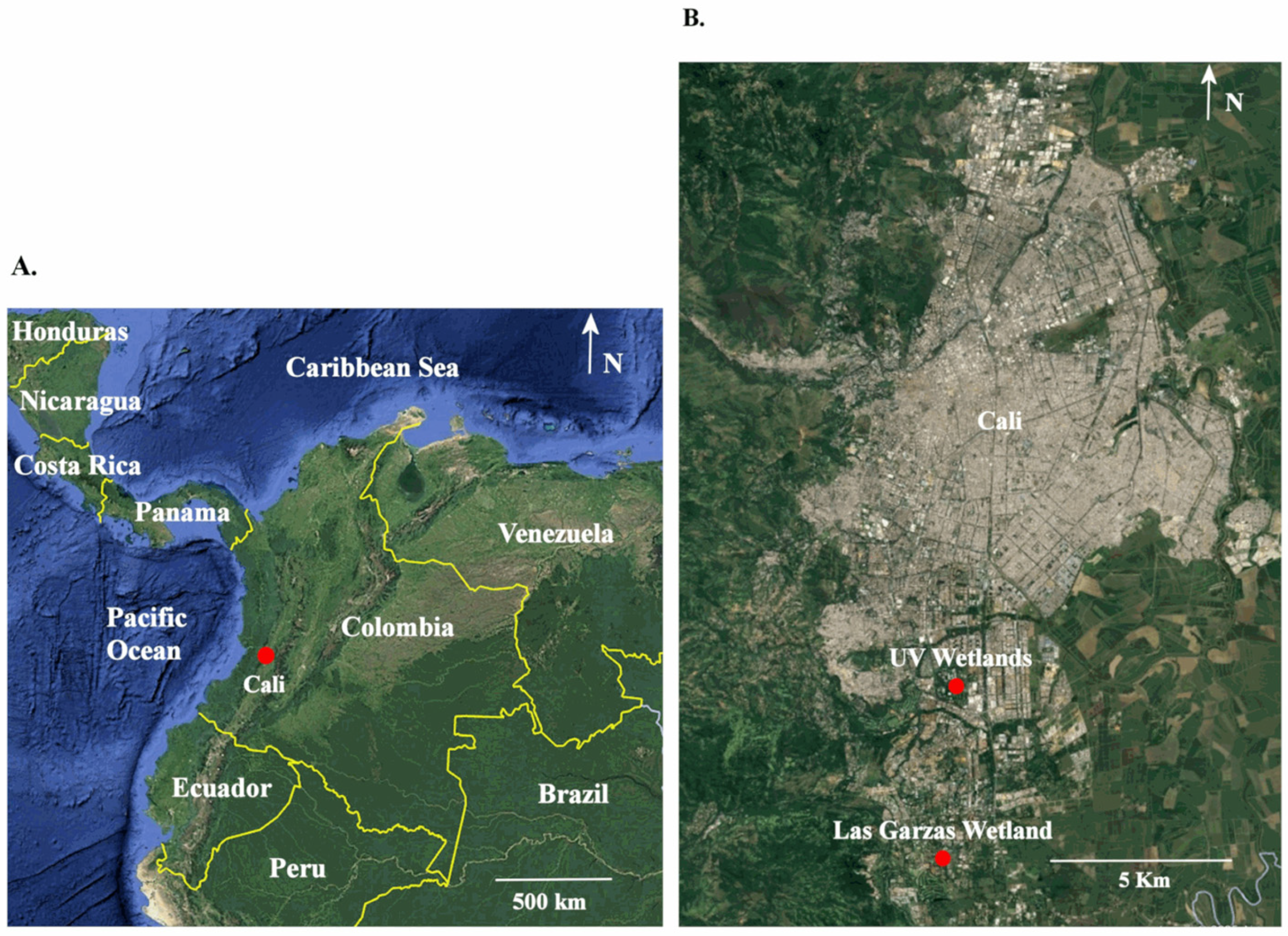
Cali, the capital of the department of Valle del Cauca, Colombia (3°30′00″ N, 76°30′00″ W; 995 m a.s.l.), is situated in the upper region of the Cauca River Basin (
Figure 1). The city lies within the Tropical Dry Forest (TDF) life zone, a biome characterized by marked seasonality, with pronounced dry periods alternating with rainy seasons. The mean annual temperature is approximately 24 °C, with a bimodal rainfall regime (March–May and October–December) and annual precipitation ranging from 1000 to 1300 mm. This ecological setting is shaped by the hydrological dynamics of the Cauca River and its tributaries, which sustain a mosaic of wetlands, riparian corridors, and remnant forest patches embedded within a densely urbanized matrix.
The combination of high human disturbance, habitat fragmentation, and altered hydrology has created conditions where native biodiversity coexists with translocated and exotic species. These features make Cali’s urban wetlands particularly relevant for studying how anthropogenic pressures influence species persistence, community composition, and conservation challenges in Neotropical cities. For this study, three wetlands were selected based on prior turtle records and accessibility: (1) Ecoparque Lago de las Garzas (ELGW), a 4.7 ha urban park with a 0.8 ha wetland fed by the Pance River [
37]; and (2) two wetlands on the Universidad del Valle’s Meléndez Campus (CUVW and ESUVW), measuring 0.79 ha and 0.35 ha, respectively, and fed by discharges from artificial wetlands of the Club Campestre de Cali [
38] (
Figure 1). These sites represent focal habitats where native and non-native turtles coexist within human-altered environments.
Field surveys were conducted in December 2024, coinciding with the October–December wet season of Cali’s bimodal rainfall regime. In each wetland, captures were performed manually by two persons over five consecutive nights, with each session standardized to three hours (11:00–18:00). Turtles were attracted using salted bait (sardines in oil) and sweet bait (mango), placed in floating containers or along shorelines, and subsequently captured by hand. Each individual was measured (carapace and plastron length), temporarily marked with nail polish to avoid recapture during the sampling period, and released immediately after data collection. This standardized protocol minimized stress and ensured comparability across wetlands.
Species identification followed diagnostic keys provided by Páez et al. [
5] and Corredor et al. [
22]. From capture records, we calculated observed captures per hectare (Obs/ha), a relative abundance index derived from raw capture counts divided by wetland area. This metric facilitates comparisons among wetlands and species but does not represent true population densities. We acknowledge that restricting sampling to a single month limits the ability to assess seasonal variation in turtle activity and detectability, and future studies should incorporate multi-seasonal sampling to determine whether the observed patterns reflect consistent ecological processes or seasonal biases.
Confiscation records were obtained from the Wildlife Rescue Center (WRC), managed by Cali’s environmental authority (DAGMA), covering the period 2015–2023. Admissions were classified into seven mutually exclusive categories: preventive apprehension (PA), preventive seizure (PS), voluntary surrenders (VS), confiscations (C), rescues (R), relocations (RE), and individuals born at the center (WRC Birth) (
Table S1). Georeferenced addresses were standardized using the Cali city map from Google Maps (desktop version) on March 4, 2024, and the dataset was systematically cleaned to remove duplicates and incomplete entries. Causes of admission were then categorized to evaluate the relative importance of different pathways through which turtles enter urban systems.
Given that Cali is located in the upper Cauca River Basin, species status was assessed exclusively at this spatial scale. We distinguished three categories: (i) native species naturally distributed within the basin, (ii) species native to Colombia but absent from the basin, occurring through translocation or extralimital introductions, and (iii) genuinely exotic species, foreign to the Cauca River Basin fauna, with no plausible natural dispersal by land or river, introduced primarily via trade or trafficking. This framework prevents conflation of the terms “exotic,” “translocated,” and “native,” ensuring terminological precision and conceptual clarity throughout the manuscript.
A chi-square test of independence was performed to statistically assess whether species composition varied significantly among wetlands, providing quantitative support for observed differences. The test was applied to contingency tables of species counts by site, with results reported as chi-square statistic, degrees of freedom, and associated p-value. To evaluate spatial clustering of confiscation records, we applied kernel density estimation (KDE) using ArcGIS Pro 3.2 (ESRI, Redlands, CA, USA). The analysis was performed on georeferenced confiscation points, with a bandwidth (search radius) of 1 km selected based on the average inter-point distance to balance sensitivity and generalization. Output cell size was set to 100 m to provide adequate spatial resolution while maintaining computational efficiency. The resulting density surface highlights relative hotspots of confiscation activity, expressed as the number of records per unit area.
All procedures were conducted under permits issued by the National Authority of Environmental Licenses (ANLA), specifically the framework collection permit established by Resolution 1070 of 28 August 2015, and in strict accordance with ethical guidelines for reptile handling. Individuals were released immediately after measurement to minimize disturbance, and the sampling design was structured to prevent repeated stress on populations. By integrating ecological monitoring with official confiscation records, the methodology was designed not only to document species presence but also to provide actionable insights for conservation authorities. This approach ensures that results are directly applicable to management strategies aimed at mitigating the impacts of non-native turtles in urban ecosystems.
3. Results
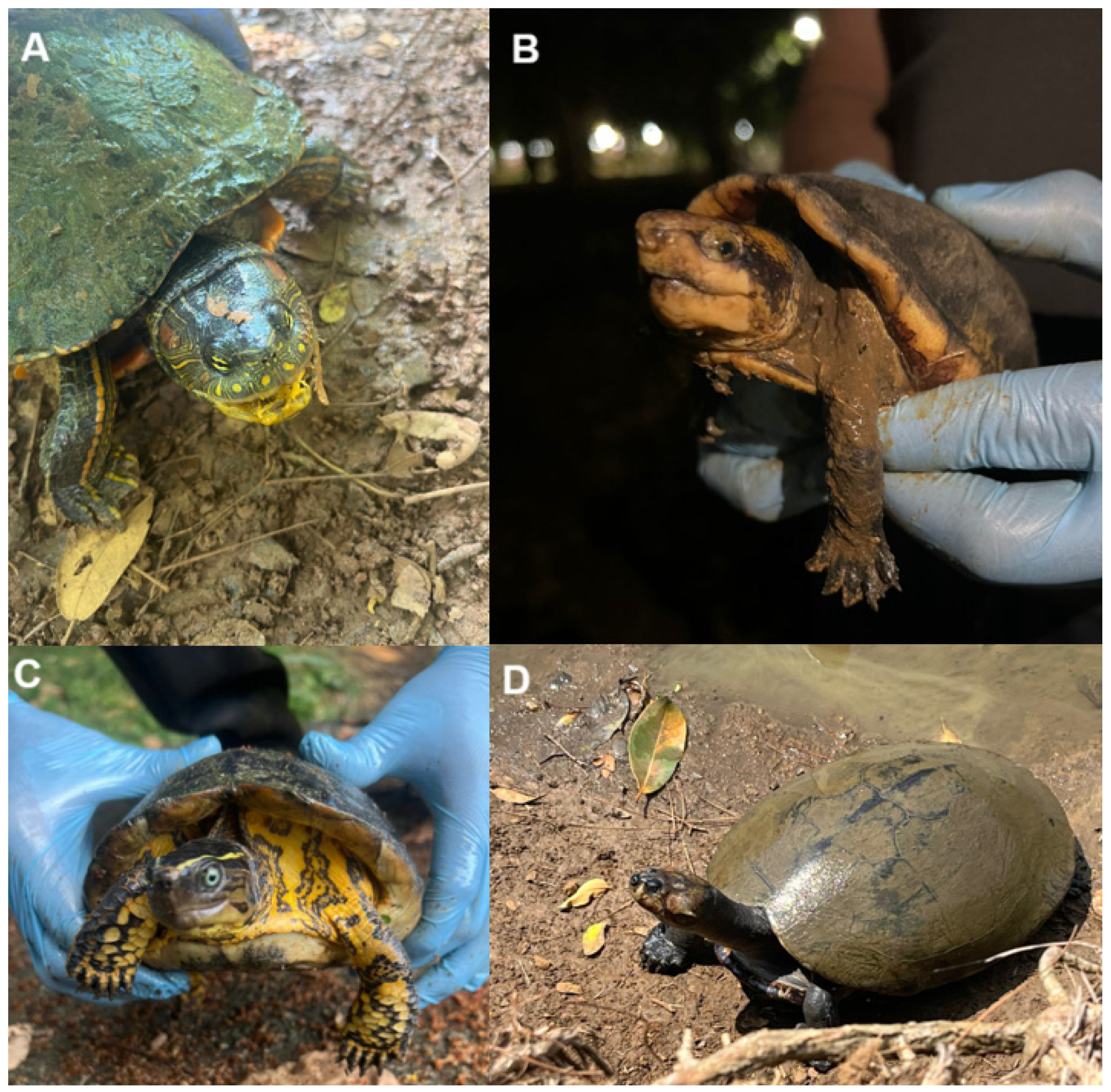
Field surveys across three urban wetlands yielded 109 individuals representing four species:
Trachemys callirostris,
Podocnemis unifilis,
Kinosternon leucostomum, and
Rhinoclemmys melanosterna (
Figure 2).
Observed captures per hectare (Obs/ha), used here as a relative abundance index, differed significantly among wetlands (
Table 1, χ
2 = 155.4, df = 6,
p < 0.0001), reflecting distinct assemblage structures and possible habitat influences. In the Central Universidad del Valle Wetland (CUVW, 0.79 ha),
Trachemys callirostris reached 39.2 obs/ha, while
Podocnemis unifilis and
Kinosternon leucostomum were recorded at much lower values (2.5 and 1.3 Obs/ha, respectively), and
Rhinoclemmys melanosterna was absent. In contrast, the smaller Experimental Station Universidad del Valle Wetland (ESUVW, 0.35 ha) exhibited the highest overall capture intensity (117.1 Obs/ha), driven by exceptionally high values for
K. leucostomum (82.9 Obs/ha) and
R. melanosterna (31.4 Obs/ha), whereas
T. callirostris was scarce (2.9 Obs/ha) and
P. unifilis absent. At Ecoparque Lago de las Garzas (ELGW, 0.8 ha),
T. callirostris again dominated (23.8 Obs/ha), followed by
P. unifilis (13.8 Obs/ha) and
K. leucostomum (5.0 Obs/ha), with no
R. melanosterna detected. These patterns indicate that
T. callirostris tends to dominate larger wetlands, whereas
K. leucostomum and
R. melanosterna achieve higher representation in smaller, more confined habitats.
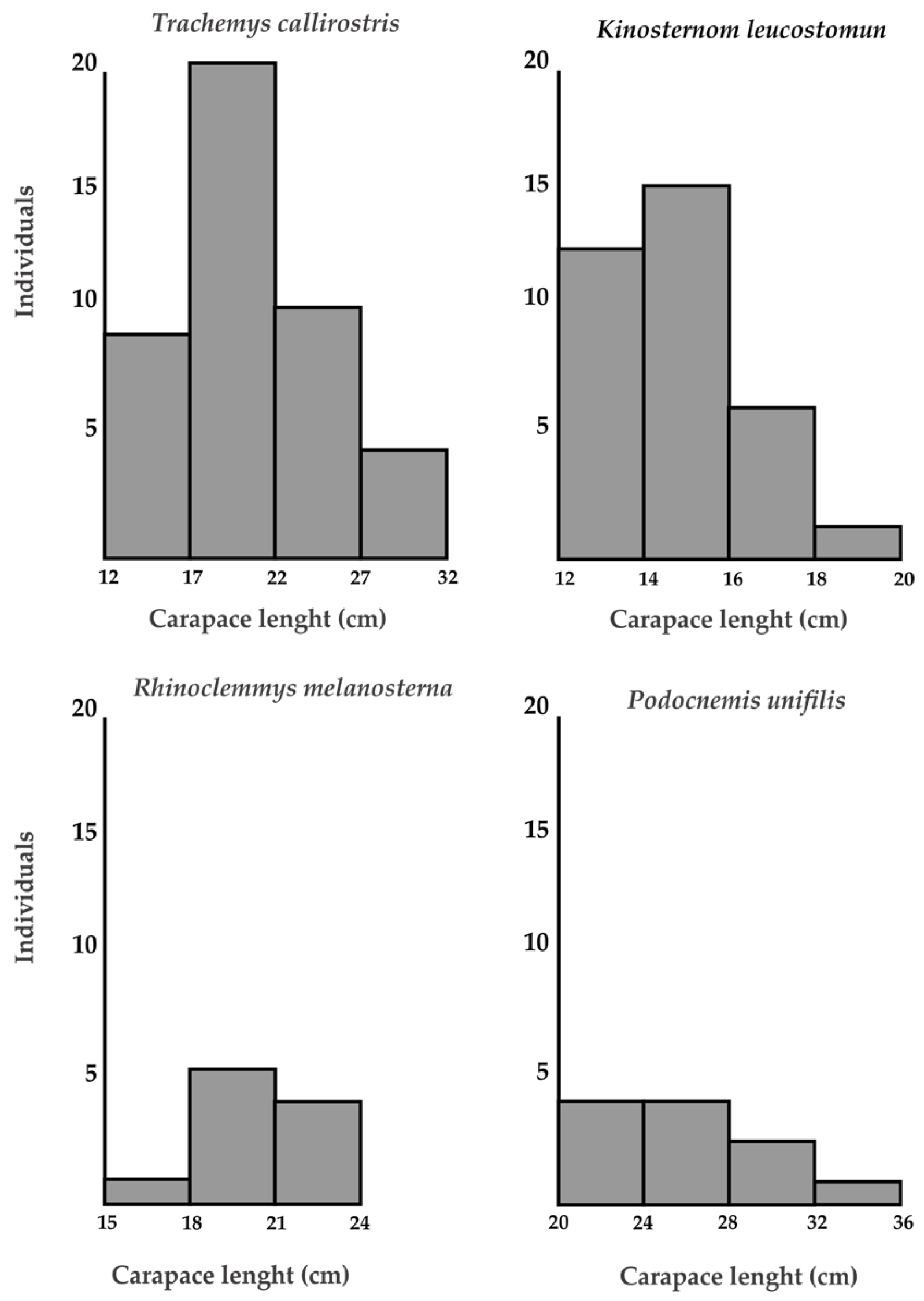
Morphometric measurements revealed a wide range of size classes, including juveniles and adults (
Figure 3). While this pattern is consistent with recruitment, juveniles are also common in the pet trade and may reflect abandonment. Thus, these observations should be interpreted as indicative of potential recruitment rather than conclusive evidence of self-sustaining populations. The overlap in species composition among wetlands highlights both consistency and divergence in assemblages, reinforcing the role of urban habitats as reservoirs for non-native taxa. The heterogeneity in densities and demographic structures underscores differences in habitat suitability and human-mediated introductions, emphasizing the need for site-specific monitoring to understand how non-native turtles persist and interact within urban environments.
Complementary records from the Wildlife Rescue Center (WRC) documented 2751 individuals between 2015 and 2023, representing 11 species (
Table 2).
Five taxa—T. callirostris, Chelonoidis carbonaria, P. unifilis, R. melanosterna, and K. leucostomum—accounted for more than 96% of admissions, with T. callirostris again predominating. Voluntary surrenders were the most frequent cause of admission, underscoring the role of pet abandonment in shaping urban turtle populations. Rescue events, although less frequent overall, were particularly important for C. carbonaria, often linked to confiscations associated with enforcement actions. These differences highlight how distinct admission pathways provide complementary insights: voluntary surrenders emphasize the impact of pet abandonment, rescues reflect targeted enforcement against trafficking, and confiscations expand the species list by documenting taxa absent from field surveys.
Of the 11 continental turtle species reported in Wildlife Rescue Center (WRC) records, only five (
Trachemys callirostris,
Kinosternon leucostomum,
Podocnemis unifilis,
Rhinoclemmys melanosterna, and
Rhinoclemmys nasuta) were directly observed in Santiago de Cali’s urban wetlands (
Table 3). The remaining six species (
Chelonoidis carbonaria,
Chelus fimbriata,
Chelydra acutirostris,
Podocnemis expansa,
Kinosternon scorpioides, and
Rhinoclemmys annulata) were recorded exclusively through WRC admissions, reflecting confiscations, rescues, or voluntary surrenders (
Table 3). Applying the basin-scale classification framework (
Table 4), the five wetland species include native taxa (
Kinosternon leucostomum), extralimital/translocated species (
Rhinoclemmys melanosterna and
Rhinoclemmys nasuta), and exotic (
Trachemys callirostris and
Podocnemis unifilis). The six WRC-only species comprise exotic introductions (
Chelonoidis carbonaria,
Chelus fimbriata,
Kinosternon scorpioides, and
Podocnemis expansa), extralimital/translocated taxa (
Rhinoclemmys annulata), and native taxa (
Chelydra acutirostris). This classification highlights the dual pathways by which turtles enter urban systems—natural presence in wetlands versus introductions through trade and translocation—providing a consistent framework for interpreting assemblage composition.
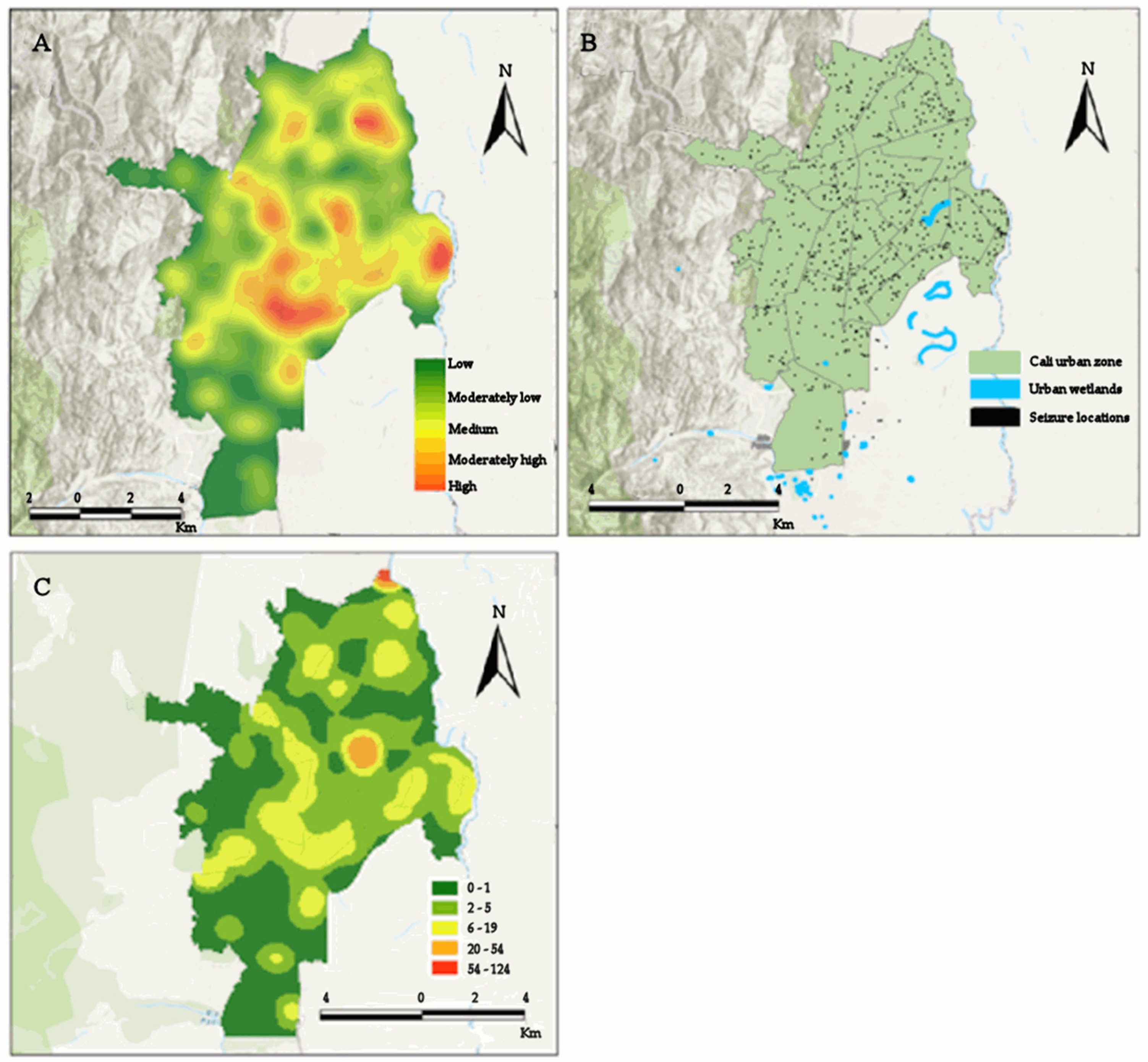
Spatial analysis of turtle trafficking records reported at the WRC revealed clear geographic patterns of enforcement activity across Cali (
Figure 4). The concentration of seizure points highlights distinct hotspots where confiscations, preventive apprehensions, and rescues were most frequently recorded, particularly in areas associated with high commercial activity. When overlaid with wetland distribution, these seizure points demonstrate the proximity of trafficking events to urban aquatic systems, suggesting that wetlands may serve as common release or abandonment sites. The quantitative distribution of seizures by location further emphasizes the uneven intensity of enforcement, with certain sites accounting for disproportionately high numbers of confiscations. Together, these spatial patterns underscore the role of urban landscapes in shaping trafficking dynamics and reinforce the importance of integrating enforcement data with ecological monitoring to identify priority areas for management and conservation.
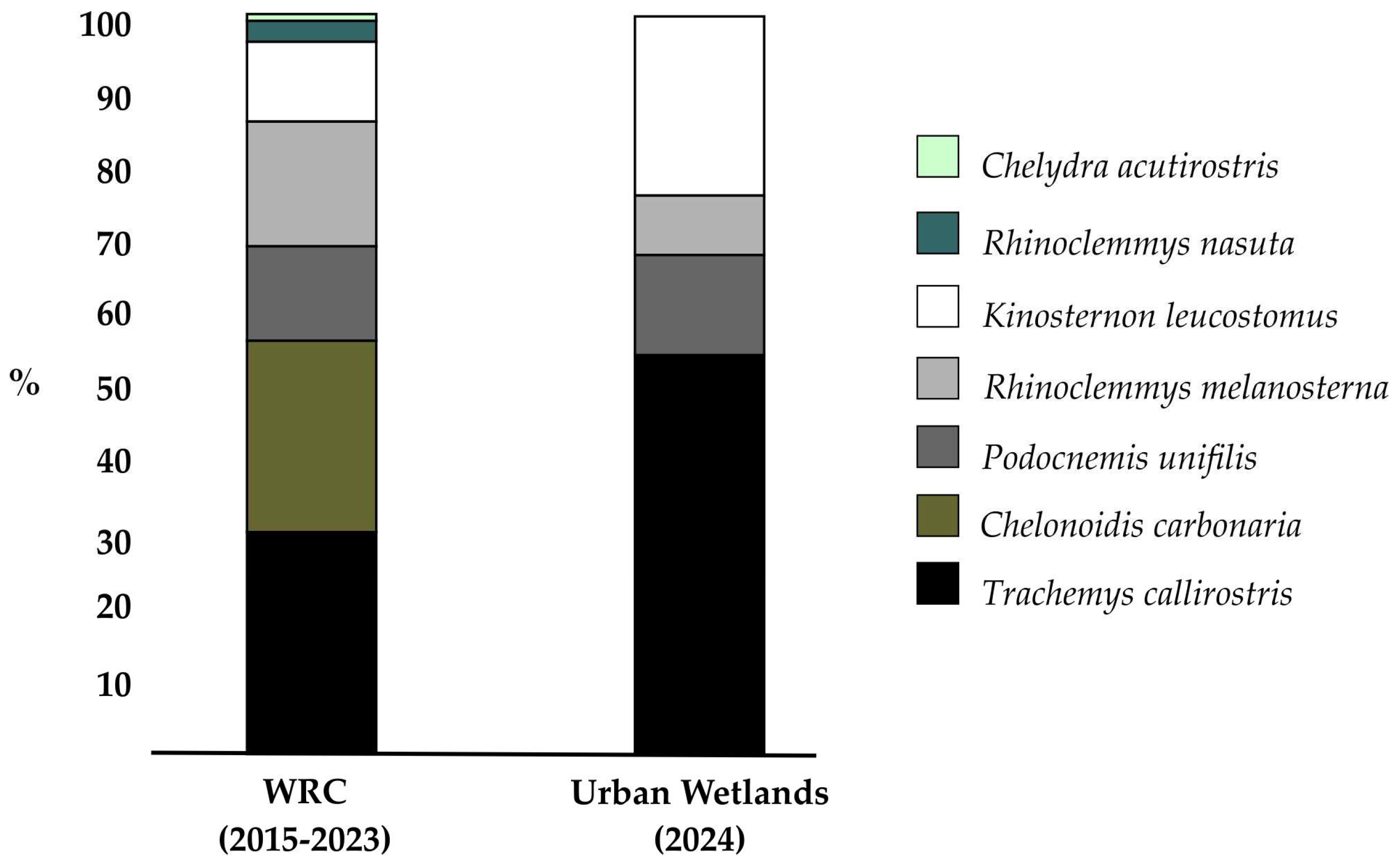
Beyond species composition, the demographic structure observed in wetlands provides additional insight into population dynamics. The presence of juveniles alongside adults suggests that Cali’s wetlands may support self-sustaining populations of non-native turtles, raising concerns about long-term ecological impacts such as competition with native taxa and disruptions to food web interactions. The strong convergence between WRC records and wetland sampling (
Figure 5) underscores the reliability of enforcement data as a proxy for ecological presence. Both datasets revealed the dominance of a small number of non-native species, particularly
T. callirostris, which has become emblematic of how trafficking and abandonment reshape urban assemblages. The prevalence of voluntary surrenders suggests that non-native turtles are often acquired as pets and may subsequently be released into wetlands, reflecting the potential influence of human behavior on species translocation.
4. Discussion
Our findings confirm that non-native turtles are firmly established in Cali’s urban wetlands, with Trachemys callirostris consistently dominating assemblages. The presence of juveniles alongside adults suggests possible recruitment, yet this evidence remains circumstantial. Juveniles are frequently traded and abandoned, and without nests, eggs, or multi-year cohort tracking, claims of self-sustaining populations remain speculative. The overlap between field observations and confiscation records underscores the reliability of enforcement data as a proxy for ecological presence, illustrating how trafficking and abandonment directly reshape urban community composition.
Illegal wildlife trafficking, recognized globally as one of the most profitable illicit activities, remains a major driver of turtle declines [
57]. Records from the Wildlife Rescue Center (WRC) revealed 2751 individuals representing 11 species between 2015 and 2023, with five taxa—
T. callirostris,
Chelonoidis carbonaria,
Podocnemis unifilis,
Rhinoclemmys melanosterna, and
Kinosternon leucostomum—accounting for over 96% of admissions. This pattern mirrors national trends [
19] and parallels invasion dynamics elsewhere, such as
Trachemys scripta elegans populations established in Argentina [
58] and Colombia [
59]. These translocations carry ecological risks including competition, altered food webs, disease transmission, and hybridization [
21,
31,
60,
61].
Relative abundance indices (Obs/ha) should be interpreted as CPUE metrics rather than absolute densities. Our sampling design, based on five sessions without mark–recapture estimation, provides relative abundance indices influenced by species-specific differences in catchability, bait type, and habitat structure. Nevertheless, contrasts among wetlands suggest potential interactions between ecological niche partitioning and anthropogenic drivers. Larger wetlands such as CUVW and ELGW were dominated by
T. callirostris, reflecting its generalist habits and adaptability to open aquatic environments, whereas the smaller ESUVW wetland exhibited exceptionally high values for
K. leucostomum and
R. melanosterna. These preliminary patterns point to possible niche segregation, with
T. callirostris exploiting expansive basking and foraging opportunities, while
K. leucostomum and
R. melanosterna thrive in dense vegetation with reduced competition [
49,
54,
56]. However, these observations are based on a single sampling round at only three sites and should therefore be interpreted with caution.
Most urban wetlands in our study are isolated or semi-isolated systems, with limited hydrological connectivity. Occasional dispersal may occur through indirect connections with the Pance River (ELGW) and the Lili River (CUVW and ESUVW), particularly during flooding. For native species such as
K. leucostomum and
Chelydra acutirostris, natural colonization through these pathways cannot be excluded. However, for exotic and extralimital taxa (e.g.,
T. callirostris,
Podocnemis unifilis), natural dispersal is implausible given their absence from the basin’s native fauna, reinforcing the role of anthropogenic drivers in shaping assemblage composition. Beyond ecological factors, WRC admissions highlight the decisive role of human behavior. The predominance of voluntary surrenders reveals a plausible recurring trajectory: exotic and translocated turtles are frequently acquired as pets and subsequently abandoned, facilitating their introduction into novel environments. This convergence of enforcement records and ecological surveys underscores the multifaceted, human-mediated drivers underpinning the persistence of non-native turtles in urban ecosystems [
62,
63,
64,
65].
Effective management of turtles in Cali’s wetlands requires distinguishing between species naturally part of the upper Cauca River basin and those introduced through human activity. Exotic introductions via the pet trade, such as
T. scripta and
P. unifilis, must be managed under invasive species frameworks to prevent establishment and ecological disruption. In contrast, extralimital translocations of native taxa (e.g.,
R. nasuta,
R. melanosterna,
R. annulata) call for strategies that balance regional conservation status with local ecological integrity. Larger wetlands require monitoring of generalist invaders such as
T. callirostris [
26,
59], while smaller wetlands demand closer attention to niche overlap and competition, where spatial constraints intensify displacement dynamics [
29,
66].
Enforcement actions targeting trafficking hotspots remain critical, particularly where confiscation records cluster near marketplaces and pet trade hubs [
67]. Complementary measures are equally important: habitat restoration can mitigate anthropogenic pressures and strengthen resilience of native assemblages [
68]; awareness campaigns can reduce pet abandonment [
69]; and welfare-sensitive handling of confiscated individuals is necessary to prevent pathogen spillover and safeguard both native populations and public health [
30,
70]. By linking enforcement data with ecological monitoring, this study advances understanding of how human-altered environments transform turtle communities and informs conservation planning in Neotropical cities, aligning with broader goals of biodiversity management in anthropogenic landscapes [
32,
34,
35,
36,
71,
72].
Non-native freshwater turtles have been widely reported as invasive across multiple regions, and Cali’s urban wetlands reflect these broader dynamics. The presence of exotic species such as
P. unifilis and
T. callirostris suggests potential ecological interactions, including competition, altered trophic dynamics, and displacement of native taxa. Moreover, the overlap between confiscation records and wetland assemblages suggests that illegal trade may facilitate introductions and reinforce persistence, generating feedback loops that sustain non-native populations. Comparable invasion dynamics have been documented globally: in Europe,
T. scripta elegans remains widespread despite restrictions under Regulation (EU) No. 1143/2014 [
73]; in Asia, urban wetlands in China and Japan have become focal points for exotic turtle persistence [
74]; and in South America, populations of
T. scripta elegans and
T. callirostris have established in Argentina and Colombia following pet releases [
58,
59].
5. Conclusions
Findings from this study suggest that Cali’s urban wetlands may act as reservoirs for both native and non-native turtles, with Trachemys callirostris appearing as the most frequent species across assemblages. Although juveniles were observed, the absence of nests, hatchlings, or long-term demographic surveys prevents confirmation of self-sustaining populations, leaving recruitment as a hypothesis that requires further validation. The overlap between field observations and Wildlife Rescue Center (WRC) records indicates potential links between enforcement data and ecological presence, while pet abandonment and illegal trafficking appear to be important drivers of introductions.
Differences in relative abundance among wetlands point to possible interactions between niche partitioning and anthropogenic pressures: larger wetlands tended to support generalist invaders such as T. callirostris, whereas smaller, structurally complex habitats favored K. leucostomum and R. melanosterna. These preliminary patterns highlight the importance of habitat-specific monitoring and integrated management. Strategies that combine enforcement, ecological surveys, habitat restoration, welfare-sensitive handling, and citizen education may help mitigate biological invasions and support native biodiversity in Neotropical urban ecosystems.
Supplementary Materials
The following supporting information can be downloaded at:
https://www.mdpi.com/article/10.3390/d18070401/s1, Table S1: Wildlife Rescue Center (WRC) admission categories (2015–2023). Admissions were classified into seven mutually exclusive categories at the point of entry.
Author Contributions
Conceptualization, J.S.C.-C. and A.G.; methodology, J.S.C.-C. and A.G.; software, J.S.C.-C. and A.F.A.-A.; validation, A.G.; formal analysis, J.S.C.-C. and A.G.; investigation, J.S.C.-C. and A.F.A.-A.; resources, J.S.C.-C. and A.G.; data curation, J.S.C.-C.; writing—original draft preparation, J.S.C.-C. and A.G.; writing—review and editing, A.G.; visualization, J.S.C.-C. and A.F.A.-A.; supervision, A.G.; project administration, J.S.C.-C. and A.G.; funding acquisition, A.G. All authors have read and agreed to the published version of the manuscript.
Funding
The study was partially supported by the Office of the Vice Rector for Research at Universidad del Valle, through internal funding for the project “Surveys for Rhinoclemmys annulata in tropical forest habitat” (CI 71379), awarded to Alan Giraldo. APC was funded by Diversity MDPI journal.
Institutional Review Board Statement
The study was conducted under permit Res–1070 of 28 August 2015, issued by the National Authority of Environmental Licenses (ANLA), which provides the framework permit for the collection of specimens of wild species of biological diversity for non-commercial scientific research purposes to the Animal Ecology Research Group at Universidad del Valle.
Data Availability Statement
The data that support the findings of this study are available from the corresponding author [A.G.] upon reasonable request.
Acknowledgments
We express our sincere gratitude to the staff of the Wildlife Rescue Center of DAGMA in Cali and their collaborators for their invaluable support during the recovery of turtle’s information. We also thank the director of Ecoparque Lago de las Garzas for authorizing the sampling sessions conducted at this locality, which were essential for the development of this study.
Conflicts of Interest
The authors declare no conflicts of interest. The funders had no role in the design of the study; in the collection, analyses, or interpretation of data; in the writing of the manuscript; or in the decision to publish the results.
References
- Paez, V.P. Generalidades y estado de conservación del orden Testudines. In Biología y Conservación de las Tortugas Continentales de Colombia; Páez, V.P., Morales-Betancourt, M., Lasso, C., Castaño-Mora, O., Bock, B., Eds.; Instituto de Investigación de Recursos Biológicos Alexander von Humboldt (IAvH): Bogotá, Colombia, 2012; pp. 57–69. [Google Scholar]
- Morales, M.A.; Páez, V.; Lasso, C.A. Conservación de las Tortugas Continentales de Colombia: Evaluación 2012–2013 y Propuesta 2015–2020; Instituto de Investigación de Recursos Biológicos Alexander von Humboldt; Asociación Colombiana de Herpetología y Ministerio de Ambiente y Desarrollo Sostenible: Bogotá, Colombia, 2015; pp. 1–28. [Google Scholar]
- Forero-Medina, G.; Páez, V.; Garcés-Restrepo, M.; Carr, J.; Giraldo, A.; Vargas-Ramírez, M. Research and conservation priorities for tortoises and freshwater turtles of Colombia. Trop. Conserv. Sci. 2016, 9, 1940082916673708. [Google Scholar] [CrossRef]
- Bock, B.; Páez, V. Meta-analysis of the history of the study of the freshwater turtle and tortoise fauna of Colombia. Acta Biol. Colomb. 2017, 22, 67–76. [Google Scholar] [CrossRef]
- Paez, V.P.; Bock, B.C.; Alzate-Estrada, D.A.; Barrientos-Munoz, K.G.; Cartagena-Otalvaro, V.M.; Echeverry-Alcendra, A.; Gómez-Rincón, M.T.; Ramírez-Gallego, C.; Sofía del Río, J.; Vallejo-Betancur, M.M. Turtles of Colombia: An annotated analysis of their diversity, distribution, and conservation status. Amphib. Reptile Conserv. 2022, 16, 106–135. [Google Scholar]
- Rhodin, A.G.; Iverson, J.B.; Bour, R.; Fritz, U.; Georges, A.; Shaffer, H.B.; Van Dijk, P. Turtles of the world. In Annotated Checklist and Atlas of Taxonomy, Synonymy, Distribution, and Conservation Status, 8th ed.; Chelonian Research Monographs: Arlington, VT, USA, 2017; Volume 7, pp. 1–292. [Google Scholar]
- Lockwood, J.L.; Hoopes, M.F.; Marchetti, M.P. Invasion Ecology, 2nd ed.; Wiley-Blackwell: Oxford, UK, 2013; pp. 246–275. [Google Scholar]
- Pyšek, P.; Hulme, P.E.; Simberloff, D.; Bacher, S.; Blackburn, T.M.; Carlton, J.T.; Dawson, W.; Essl, F.; Foxcroft, L.C.; Genovesi, P.; et al. Scientists’ warning on invasive alien species. Biol. Rev. 2020, 95, 1511–1534. [Google Scholar] [CrossRef] [PubMed]
- Vilà, M.; Hulme, P.E. Non-native Species, Ecosystem Services, and Human Well-Being. In Impact of Biological Invasions on Ecosystem Services; Vilà, M., Hulme, P., Eds.; Springer: Cham, Switzerland, 2017; Volume 12, pp. 1–14. [Google Scholar] [CrossRef]
- Mancera Rodríguez, N.J.; Reyes García, O. Comercio de fauna silvestre en Colombia. Rev. Fac. Nac. Agron. 2008, 61, 4618–4645. [Google Scholar]
- González, C.V. Fauna silvestre en Colombia: Entre la ilegalidad y las oportunidades del comercio internacional en la CITES. Rev. Virtual Univ. Catol. Norte 2018, 55, 128–145. [Google Scholar] [CrossRef]
- Goyes, D.R.; Sollund, R. Contesting and contextualising cites: Wildlife trafficking in Colombia and Brazil. Int. J. Crime Justice Soc. Democr. 2016, 5, 87–102. [Google Scholar] [CrossRef]
- Noboa, K.; Cao, R.; Mosig, P.; Brown, L. Informe Sobre el Tráfico de vida Silvestre en Colombia; TRAFFIC International: Cambridge, UK, 2024; pp. 1–57. [Google Scholar]
- Castro Cortes, A.A.; Brieva, C.; Witte, C. Implications of wildlife trafficking on the health and conservation efforts of an endangered turtle species in Colombia. Conserv. Sci. Pract. 2022, 4, e595. [Google Scholar] [CrossRef]
- Bonilla-Liberato, E.D.; Ojeda-Rojas, M.C.; Briggs-Gonzalez, V.; Mazzotti, F.J.; Balaguera-Reina, S.A. Illegal trade of crocodylians in Colombia: Spatiotemporal dynamics and implications on conservation efforts. Conserv. Sci. Pract. 2025, 7, e70064. [Google Scholar] [CrossRef]
- Cassolis, N.M.; Rieder, F.P.; Montoya, J.H.; MacMillan, D.; Arias, M. Trafficking in silence: The overlooked illegal trade of small felids in Colombia. Biol. Conserv. 2026, 314, 111639. [Google Scholar] [CrossRef]
- Tráfico Ilegal, Ministerio de Ambiente y Desarrollo Sostenible. Available online: https://www.minambiente.gov.co/por-trafico-ilegal-en-2021-han-sido-incautadas-300-783-especies-de-fauna-y-flora/ (accessed on 16 February 2026).
- Animales más Traficados en Colombia. Available online: https://www.elespectador.com/ambiente/bibo/estos-son-algunos-de-los-animales-mas-traficados-en-colombia/ (accessed on 24 February 2026).
- Arroyave-Bermudez, F.J.; Romero-Goyeneche, O.; Bonilla-Gómez, M.A.; Hurtado-Heredia, R.G. Tráfico ilegal de tortugas continentales (Testudinata) en Colombia: Una aproximación desde el análisis de redes. Acta Biol. Colomb. 2014, 19, 381–392. [Google Scholar] [CrossRef]
- Morales-Betancourt, M.A.; Lasso, C.A.; Trujillo, F.; De La Ossa, J.; Forero, G.; Páez, V.P. Amenazas a las poblaciones de tortugas continentales en Colombia. In Biología y Conservación de las Tortugas Continentales de Colombia; Páez, V.P., Morales-Betancourt, M., Lasso, C., Castaño-Mora, O., Bock, B., Eds.; Instituto de Investigación de Recursos Biológicos Alexander von Humboldt (IAvH): Bogotá, Colombia, 2012; pp. 453–492. [Google Scholar]
- Brown, J.; Williams, N.S.; Soanes, K. Conservation translocations in urban environments: State of the knowledge and future directions. Basic Appl. Ecol. 2024, 81, 85–95. [Google Scholar] [CrossRef]
- Corredor, G.; Gustavo, K.; Galvis, C.; Amorocho, D. Tortugas del Valle del Cauca; Corporación Autónoma Regional del Valle del Cauca-CVC: Cali, Colombia, 2006; pp. 1–74.
- Departamento Administrativo de Gestión del Medio Ambiente—DAGMA. Actualización de Inventario de Humedales Urbanos de Santiago de Cali y Lineamientos para su Conservación en Predios Privados; DAGMA: Cali, Colombia, 2018; pp. 1–44.
- de Carvalho, C.A.; Raposo, M.; Pinto Gomes, C.; Matos, R. Native or exotic: A bibliographical review of the debate on ecological science methodologies—Valuable lessons for urban green space design. Land 2022, 11, 1201. [Google Scholar] [CrossRef]
- Pino Vera, R.; Abreu Acosta, N.; Afonso, O.; Foronda, P. Potentially zoonotic bacteria in exotic freshwater turtles from the Canary Islands (Spain). Biology 2025, 14, 1753. [Google Scholar] [CrossRef] [PubMed]
- Winter, J.M.; Moorhead, K.; Grochowski-Grum, K.; Anchor, C.; Landolfi, J.A.; Adamovicz, L.A.; Allender, M.C. Health assessment of non-native red eared sliders (Trachemys scripta elegans) and their impact potential on native species. PLoS ONE 2025, 20, e0333786. [Google Scholar] [CrossRef] [PubMed]
- Berberi, A.; Guay, J.D.; Bulté, G.; Cooke, S.J.; Davy, C.M.; Nguyen, V.M. Interactions between inland water-based recreation and freshwater turtles: A review. Aquat. Conserv. Mar. Freshw. Ecosyst. 2024, 34, e4088. [Google Scholar] [CrossRef]
- Rocha, S.B.; Grou, C.E.V.; Rouco, C.; Tobajas, J. Water body type explains the occupancy of co-occurring native and invasive freshwater turtles in a tropical assemblage. J. Vertebr. Biol. 2025, 74, 25053. [Google Scholar] [CrossRef]
- Rocha, S.B.; Rouco, C.; Grou, C.E.V.; Ferreira, V.L. Freshwater turtle assemblage from an urban protected Atlantic Forest remnant: Population density, movement and habitat preference. Zoologia 2025, 42, e24009. [Google Scholar] [CrossRef]
- Esposito, G.; Di Tizio, L.; Prearo, M.; Dondo, A.; Ercolini, C.; Nieddu, G.; Ferrari, A.; Pastorino, P. Non-Native Turtles (Chelydridae) in Freshwater Ecosystems in Italy: A Threat to Biodiversity and Human Health? Animals 2022, 12, 2057. [Google Scholar] [CrossRef] [PubMed]
- Sullivan, B.; Nowak, E.; Kwiatkowski, M. Problems with migration translocation of herpetofauna. Conserv. Biol. 2015, 29, 12–18. [Google Scholar] [CrossRef] [PubMed]
- Rato, J.; Xavier, R.; Harris, D.J.; Banha, F.; Anastácio, P. A Comprehensive Review of Disease-Causing Agents in Freshwater Turtles: Implications for Conservation and Public Health. Diversity 2024, 16, 171. [Google Scholar] [CrossRef]
- Franch, M.; Llorente, G.A.; Rieradevall, M.; Montori, A.; Cañedo-Argüelles, M. Coexistence of Native and Invasive Freshwater Turtles: The Llobregat Delta (NE Iberian Peninsula) as a Case Study. Land 2022, 11, 1582. [Google Scholar] [CrossRef]
- Santoro, A.; Chambers, J.M.; Robson, B.J.; Beatty, S.J. Land use surrounding wetlands influences urban populations of a freshwater turtle. Aquat. Conserv. Mar. Freshw. Ecosyst. 2020, 30, 1050–1060. [Google Scholar] [CrossRef]
- Dupuis-Desormeaux, M.; Davy, C.; Lathrop, A.; Followes, E.; Ramesbottom, A.; Chreston, A.; MacDonald, S.E. Colonization and usage of an artificial urban wetland complex by freshwater turtles. PeerJ 2018, 6, e5423. [Google Scholar] [CrossRef] [PubMed]
- Gebreselassie, S.S.; Lechner, A.M.; Hill, M.J.; Teo, F.Y.; Gibbins, C.N. A review of current knowledge and research priorities for conservation of lentic biodiversity in tropical wet and monsoonal urban landscapes. Freshw. Biol. 2022, 67, 1671–1689. [Google Scholar] [CrossRef]
- Departamento Administrativo de Gestión del Medio Ambiente—DAGMA. Plan de Manejo Humedal Ecoparque Lago de las Garzas, Cali, Colombia; DAGMA: Cali, Colombia, 2012; pp. 1–179.
- Departamento Administrativo de Gestión del Medio Ambiente—DAGMA. Plan de Manejo Ambiental Humedales de la Universidad del Valle, Sede Meléndez, Cali, Colombia; DAGMA: Cali, Colombia, 2018; pp. 1–341.
- Departamento Administrativo de Gestión del Medio Ambiente—DAGMA. Plan de Manejo Ambiental Humedal la Babilla-Zanjón del Burro, Cali, Colombia; DAGMA: Cali, Colombia, 2012; pp. 1–226.
- Departamento Administrativo de Gestión del Medio Ambiente—DAGMA. Plan de Manejo Ambiental Humedal El Retiro, Cali, Colombia; Enriquez Echeverry y CIA LTDA: Cali, Colombia, 2012; pp. 1–214. [Google Scholar]
- Fundación para el desarrollo social humano y ambiental—OIKOS. Plan de Manejo Ambiental de la Laguna Charco Azul, Municipio de Santiago de Cali; OIKOS-CVC: Cali, Colombia, 2012; pp. 1–226. [Google Scholar]
- Coorporación para la Gestión Ambiental Biodiversa. Plan de Manejo Ambiental del Humedal Isaías Duarte Cancino; CVC: Cali, Colombia, 2017; pp. 1–330.
- Coorporación para la Gestión Ambiental Biodiversa. Plan de Manejo Ambiental del Humedal Cañasgordas; CVC: Cali, Colombia, 2017; pp. 1–316.
- Coorporación para la Gestión Ambiental Biodiversa. Plan de Manejo Ambiental del Humedal el Pondaje; CVC: Cali, Colombia, 2017; pp. 1–330.
- Registro de la Reserva Natural de la Sociedad Civil Club Campestre de Cali. Available online: https://idesc.cali.gov.co/download/pot_2014/resolucion_0182_2015_rnsc_club_campestre.pdf (accessed on 21 February 2026).
- Gallego-García, N.; Cárdenas-Arévalo, G.; Castaño-Mora, O.V. Chelonoidis carbonaria (Spix 1824). In Biología y Conservación de las Tortugas Continentales de Colombia; Páez, V.P., Morales-Betancourt, M., Lasso, C., Castaño-Mora, O., Bock, B., Eds.; Instituto de Investigación de Recursos Biológicos Alexander von Humboldt (IAvH): Bogotá, Colombia, 2012; pp. 406–411. [Google Scholar]
- Morales-Betancourtm, M.A.; Lasso, C.A. Chelus fimbriatus (Schneider 1783). In Biología y Conservación de las Tortugas Continentales de Colombia; Páez, V.P., Morales-Betancourt, M., Lasso, C., Castaño-Mora, O., Bock, B., Eds.; Instituto de Investigación de Recursos Biológicos Alexander von Humboldt (IAvH): Bogotá, Colombia, 2012; pp. 243–246. [Google Scholar]
- Regalado-Tabares, A.C.; Botero-Botero, A.; Múnera-Isaza, C.; Ortega-Guio, A.F.; Restrepo-Isaza, A. Chelydra acutirostris (Peters 1862). In Biología y Conservación de las Tortugas Continentales de Colombia; Páez, V.P., Morales-Betancourt, M., Lasso, C., Castaño-Mora, O., Bock, B., Eds.; Instituto de Investigación de Recursos Biológicos Alexander von Humboldt (IAvH): Bogotá, Colombia, 2012; pp. 275–278. [Google Scholar]
- Giraldo, A.; Garcés-Restrepo, M.F.; Carr, J.L. Kionsternon leucostomun (Dumeril y Bribon). In Biología y Conservación de las Tortugas Continentales de Colombia; Páez, V.P., Morales-Betancourt, M., Lasso, C., Castaño-Mora, O., Bock, B., Eds.; Instituto de Investigación de Recursos Biológicos Alexander von Humboldt (IAvH): Bogotá, Colombia, 2012; pp. 332–339. [Google Scholar]
- Berry, J.F.; Iverson, J.B.; Forero-Medina, G. Kionsternon scorpioides (Linnaeus 1766). In Biología y Conservación de las Tortugas Continentales de Colombia; Páez, V.P., Morales-Betancourt, M., Lasso, C., Castaño-Mora, O., Bock, B., Eds.; Instituto de Investigación de Recursos Biológicos Alexander von Humboldt (IAvH): Bogotá, Colombia, 2012; pp. 340–348. [Google Scholar]
- Ceballos, C.P.; Hernández, O.; Morales- Betancourt, M.A.; Trujillo, F. Podocnemis expansa (Schweigger 1812). In Biología y Conservación de las Tortugas Continentales de Colombia; Páez, V.P., Morales-Betancourt, M., Lasso, C., Castaño-Mora, O., Bock, B., Eds.; Instituto de Investigación de Recursos Biológicos Alexander von Humboldt (IAvH): Bogotá, Colombia, 2012; pp. 367–374. [Google Scholar]
- Escalona, T.; Conway-Gómez, K.; Morales-Betancourt, M.A.; Arbeláez, F.; Antelo, R. Podocnemis unifilis (Troschel 1848). In Biología y Conservación de las Tortugas Continentales de Colombia; Páez, V.P., Morales-Betancourt, M., Lasso, C., Castaño-Mora, O., Bock, B., Eds.; Instituto de Investigación de Recursos Biológicos Alexander von Humboldt (IAvH): Bogotá, Colombia, 2012; pp. 387–398. [Google Scholar]
- Giraldo, A.; Garcés-Restrepo, M.F.; Carr, J.L. Rhinoclemmys annulata (Gray 1860). In Biología y Conservación de las Tortugas Continentales de Colombia; Páez, V.P., Morales-Betancourt, M., Lasso, C., Castaño-Mora, O., Bock, B., Eds.; Instituto de Investigación de Recursos Biológicos Alexander von Humboldt (IAvH): Bogotá, Colombia, 2012; pp. 300–304. [Google Scholar]
- Echeverri-García, L.P.; Carr, J.L.; Garcés-Restrepo, M.F.; Galvis-Rizo, C.A.; Giraldo, A. Rhinoclemmys melanosterna (Gray 1861). In Biología y Conservación de las Tortugas Continentales de Colombia; Páez, V.P., Morales-Betancourt, M., Lasso, C., Castaño-Mora, O., Bock, B., Eds.; Instituto de Investigación de Recursos Biológicos Alexander von Humboldt (IAvH): Bogotá, Colombia, 2012; pp. 315–322. [Google Scholar]
- Giraldo, A.; Garcés-Restrepo, M.F.; Carr, J.L. Rhinoclemmys nasuta (Boulenger 1902). In Biología y Conservación de las Tortugas Continentales de Colombia; Páez, V.P., Morales-Betancourt, M., Lasso, C., Castaño-Mora, O., Bock, B., Eds.; Instituto de Investigación de Recursos Biológicos Alexander von Humboldt (IAvH): Bogotá, Colombia, 2012; pp. 315–322. [Google Scholar]
- Bock, B.C.; Páez, V.P.; Daza, J.M. Thrachemys callirostris (Gray 1856). In Biología y Conservación de las Tortugas Continentales de Colombia; Páez, V.P., Morales-Betancourt, M., Lasso, C., Castaño-Mora, O., Bock, B., Eds.; Instituto de Investigación de Recursos Biológicos Alexander von Humboldt (IAvH): Bogotá, Colombia, 2012; pp. 283–291. [Google Scholar]
- Sollund, R.; Maher, J. The illegal wildlife trade. In A Case Study Report on the Illegal Wildlife Trade in the United Kingdom, Norway, Colombia and Brazil; EFFACE project; University of Oslo and University of South Wales: Oslo, Norway, 2015; pp. 1–46. [Google Scholar]
- Sánchez, R.M.; Semeñiuk, M.B.; Cassano, M.J.; Alcalde, L.; Leynaud, G.C.; Moreno, L. Review of chelid and emydid turtle distributions in southern South America with emphasis on extralimital populations and new records for Argentina. Herpetol. J. 2019, 29, 219–229. [Google Scholar] [CrossRef]
- Arango-Lozano, J.; Patiño-Siro, D.; Toro-Cardona, F. Reaching new environments through illegal trade: Evidence of a widely traded turtle in Colombia. Aquat. Ecol. 2023, 57, 471–480. [Google Scholar] [CrossRef]
- Bobadilla Suarez, M.; Ewen, J.G.; Groombridge, J.J.; Beckmann, K.; Shotton, J.; Masters, N.; Hopkins, T.; Sainsbury, A.W. Using qualitative disease risk analysis for herpetofauna conservation translocations transgressing ecological and geographical barriers. EcoHealth 2017, 14, 47–60. [Google Scholar] [CrossRef] [PubMed]
- Berger-Tal, O.; Blumstein, D.; Swaisgood, R. Conservation translocations: A review of common difficulties and promising directions. Anim. Conserv. 2020, 23, 121–131. [Google Scholar] [CrossRef]
- Badziukiewicz, J.; Bors, M.; Maciaszek, R.; Świderek, W. Turtles for Sale: Species Prevalence in the Pet Trade in Poland and Potential Introduction Risks. Animals 2025, 15, 2711. [Google Scholar] [CrossRef] [PubMed]
- Kalaentzis, K.; Kazilas, C.; Strachinis, I.; Tzoras, E.; Lymberakis, P. Alien Freshwater Turtles in Greece: Citizen Science Reveals the Hydra-Headed Issue of the Pet Turtle Trade. Diversity 2023, 15, 691. [Google Scholar] [CrossRef]
- Zhang, Y.; Song, T.; Jin, Q.; Huang, Y.; Tang, X.; Sun, X.; Liu, F.; Zhang, Z.; Bao, W. Status of an alien turtle in city park waters and its potential threats to local biodiversity: The red-eared slider in Beijing. Urban Ecosyst. 2020, 23, 147–157. [Google Scholar] [CrossRef]
- Brum, P.H.R.; Gonçalves, S.R.A.; Strüssmann, C.; Teixido, A.L. A global assessment of research on urban ecology of reptiles: Patterns, gaps and future directions. Anim. Conserv. 2023, 26, 1–13. [Google Scholar] [CrossRef]
- Zhang, C.; Xu, Y.; Hua, Y.; Li, P.; Storey, K.B.; Zhang, W. Greater physiological resistance to heat may favour an invasive freshwater turtle, enabling it to outcompete native species in a changing climate. Freshw. Biol. 2023, 68, 1588–1601. [Google Scholar] [CrossRef]
- Patoka, J.; Magalhães, A.L.B.; Kouba, A.; Faulkes, Z.; Jerikho, R.; Simões-Vitule, J.R. Invasive aquatic pets: Failed policies increase risks of harmful invasions. Biodivers. Conserv. 2018, 27, 3037–3046. [Google Scholar] [CrossRef]
- Stemle, L.R.; Searcy, C.A. Habitat characteristics favoring native freshwater turtles in the highly invaded urban turtle community of Miami-Dade County. Biol. Invasions 2024, 26, 1181–1194. [Google Scholar] [CrossRef]
- Masin, S.; Bonardi, A.; Padoa-Schioppa, E.; Bottoni, L.; Ficetola, G.F. Risk of invasion by frequently traded freshwater turtles. Biol. Invasions 2014, 16, 217–231. [Google Scholar] [CrossRef]
- Martínez-Ríos, M.; Martín-Torrijos, L.; Dieguez-Uribeondo, J. The invasive alien red-eared slider turtle, Trachemys scripta, as a carrier of STEF-disease pathogens. Fungal Biol. 2022, 126, 113–121. [Google Scholar] [CrossRef] [PubMed]
- Wang, S.; Yu, H.; Shentu, H.; Gu, C.; Huang, S.; Wang, L.; Zheng, H.; Ma, J.; Wang, J.; Wei, J. Biodiversity conservation and restoration of wetlands in suburban areas: Challenges and prospects. Mar. Freshw. Res. 2024, 75, MF24090. [Google Scholar] [CrossRef]
- Speight, O.; Morgan, W.H.; White, T.B.; Sainsbury, K.A.; Bouskila, A.; Rotem, G.; Smith, R.K.; Sutherland, W.J.; Watson, M.J.; Christie, A.P. Exploring gaps, biases, and research priorities in the evidence for reptile conservation actions. Conserv. Biol. 2025, 39, e70073. [Google Scholar] [CrossRef] [PubMed]
- Nekrasova, O.; Pupins, M.; Marushchak, O.; Tytar, V.; Martinez-Silvestre, A.; Škute, A.; Čeirāns, A.; Theissinger, K.; Georges, J.-Y. Present and future distribution of the European pond turtle versus seven exotic freshwater turtles, with a focus on Eastern Europe. Sci. Rep. 2024, 14, 21149. [Google Scholar] [CrossRef] [PubMed]
- Taniguchi, M.; Lovich, J.E.; Mine, K.; Ueno, S.; Kamezaki, N. Unusual population attributes of invasive red-eared slider turtles (Trachemys scripta elegans) in Japan: Do they have a performance advantage? Aquat. Invasions 2017, 12, 97–108. [Google Scholar] [CrossRef]
Figure 1.
Composited map of the study area. (A) Location of Cali city within the Neotropical region. (B) Detailed map of Cali showing location of the sampled urban wetlands. Source: Google Earth®, Imagen: Landsat/Copernicus, Date: 14 February 2024, Center: 3°26′ N–76°32′ W, Height: 36 km.
Figure 1.
Composited map of the study area. (A) Location of Cali city within the Neotropical region. (B) Detailed map of Cali showing location of the sampled urban wetlands. Source: Google Earth®, Imagen: Landsat/Copernicus, Date: 14 February 2024, Center: 3°26′ N–76°32′ W, Height: 36 km.
Figure 2.
Species identified in urban wetlands sampled in Cali, Colombia. (A) Trachemys callirostris; (B) Kinosternon leucostomum; (C) Rhinoclemmys melanosterna; (D) Podocnemis unifilis. These photographs illustrate the most representative taxa encountered during field surveys, including native and non-native species. Their occurrence underscores the ecological role of urban wetlands as habitats supporting diverse turtle assemblages within anthropogenic landscapes.
Figure 2.
Species identified in urban wetlands sampled in Cali, Colombia. (A) Trachemys callirostris; (B) Kinosternon leucostomum; (C) Rhinoclemmys melanosterna; (D) Podocnemis unifilis. These photographs illustrate the most representative taxa encountered during field surveys, including native and non-native species. Their occurrence underscores the ecological role of urban wetlands as habitats supporting diverse turtle assemblages within anthropogenic landscapes.
Figure 3.
Size-class distribution of freshwater turtles (carapace length, cm) recorded across surveyed wetlands in Cali, Colombia (December 2024).
Figure 3.
Size-class distribution of freshwater turtles (carapace length, cm) recorded across surveyed wetlands in Cali, Colombia (December 2024).
Figure 4.
Kernel density maps of turtle confiscations and voluntary surrenders in Cali, georeferenced from reporting addresses. (A) the spatial concentration of seizure points across the city (n = 2751 records), (B) the overlap between wetlands and seizure locations, and (C) the relative quantity of seizures per site. Hotspots reflect reporting intensity rather than precise ecological introduction points. Numbers indicate the administrative units (communes) of the city.
Figure 4.
Kernel density maps of turtle confiscations and voluntary surrenders in Cali, georeferenced from reporting addresses. (A) the spatial concentration of seizure points across the city (n = 2751 records), (B) the overlap between wetlands and seizure locations, and (C) the relative quantity of seizures per site. Hotspots reflect reporting intensity rather than precise ecological introduction points. Numbers indicate the administrative units (communes) of the city.
Figure 5.
Comparative species composition of turtles recorded at the Wildlife Rescue Center (WRC) of DAGMA in Cali (2015–2023) and during field sampling of urban wetlands in December 2024. The figure highlights the predominance of a few non-native taxa, particularly Trachemys callirostris, and illustrates the convergence between enforcement records and ecological surveys in shaping urban turtle assemblages.
Figure 5.
Comparative species composition of turtles recorded at the Wildlife Rescue Center (WRC) of DAGMA in Cali (2015–2023) and during field sampling of urban wetlands in December 2024. The figure highlights the predominance of a few non-native taxa, particularly Trachemys callirostris, and illustrates the convergence between enforcement records and ecological surveys in shaping urban turtle assemblages.
Table 1.
Observed captures (Ind) and captures per hectare (Obs/ha) of turtles in the urban wetlands of Cali. Values represent relative abundance indices derived from raw captures divided by wetland area. CUVW: Central Universidad del Valle Wetland; ESUVW: Experimental Station Universidad del Valle Wetland; ELGW: Ecopark Lago de las Garzas Wetland.
Table 1.
Observed captures (Ind) and captures per hectare (Obs/ha) of turtles in the urban wetlands of Cali. Values represent relative abundance indices derived from raw captures divided by wetland area. CUVW: Central Universidad del Valle Wetland; ESUVW: Experimental Station Universidad del Valle Wetland; ELGW: Ecopark Lago de las Garzas Wetland.
| Wetland | Area (ha) | Ind | T. callirostris | P. unifilis | K. leucostomum | R. melanosterna | Total |
|---|
| | | | Obs/ha | Ind | Obs/ha | Ind | Obs/ha | Ind | Obs/ha | Ind | Obs/ha |
|---|
| CUVW | 0.79 | 34 | 39.2 | 31 | 2.5 | 2 | 1.3 | 1 | 0.0 | 0 | 43.0 |
| ESUVW | 0.35 | 41 | 2.9 | 1 | 0.0 | 0 | 82.9 | 29 | 31.4 | 11 | 117.1 |
| ELGW | 0.80 | 34 | 23.8 | 19 | 13.8 | 11 | 5.0 | 4 | 0.0 | 0 | 42.5 |
Table 2.
Composition of turtle admission records and causes of entry by species at the Wildlife Rescue Center (WRC) of DAGMA in Cali, 2015–2023. Columns indicate the total number of individuals (n), their relative abundance (Ab, %), and the proportion of admission causes by species (%). Admission categories include: PA = Preventive apprehension; PS = Preventive Seizure; VS = Voluntary surrenders; C = Confiscations; WCR Birth = Individuals born at the center; R = Rescues; RE = Relocation.
Table 2.
Composition of turtle admission records and causes of entry by species at the Wildlife Rescue Center (WRC) of DAGMA in Cali, 2015–2023. Columns indicate the total number of individuals (n), their relative abundance (Ab, %), and the proportion of admission causes by species (%). Admission categories include: PA = Preventive apprehension; PS = Preventive Seizure; VS = Voluntary surrenders; C = Confiscations; WCR Birth = Individuals born at the center; R = Rescues; RE = Relocation.
| Species | n
(ind) | Ab
(%) | Causes of Entry at WRC (%) |
|---|
| PA | PS | VS | C | WRC Birth | R | RE |
|---|
| Chelonoidis carbonaria | 568 | 20.65 | 0.70 | 21.39 | 38.26 | 0.35 | 0.00 | 39.30 | 0.00 |
| Chelus fimbriata | 2 | 0.07 | 0.00 | 0.00 | 50.00 | 0.00 | 0.00 | 50.00 | 0.00 |
| Chelydra acutirostris | 27 | 0.98 | 0.00 | 0.00 | 29.63 | 0.00 | 0.00 | 70.37 | 0.00 |
| Kinosternon leucostomum | 368 | 13.38 | 0.00 | 0.00 | 44.29 | 0.82 | 0.00 | 54.89 | 0.00 |
| Kinosternon scorpioides | 2 | 0.07 | 0.00 | 0.00 | 100.00 | 0.00 | 0.00 | 0.00 | 0.00 |
| Podocnemis expansa | 1 | 0.04 | 0.00 | 0.00 | 100.00 | 0.00 | 0.00 | 0.00 | 0.00 |
| Podocnemis unifilis | 469 | 17.05 | 0.43 | 0.00 | 54.80 | 0.00 | 0.00 | 44.78 | 0.00 |
| Rhinoclemmys annulata | 7 | 0.25 | 0.00 | 0.00 | 28.57 | 0.00 | 0.00 | 71.43 | 0.00 |
| Rhinoclemmys melanosterna | 408 | 14.83 | 0.00 | 0.49 | 46.08 | 0.74 | 0.00 | 50.74 | 1.96 |
| Rhinoclemmys nasuta | 59 | 2.14 | 0.00 | 3.39 | 35.59 | 0.00 | 0.00 | 61.02 | 0.00 |
| Trachemys callirostris | 840 | 30.53 | 0.47 | 0.12 | 51.42 | 2.37 | 0.36 | 40.76 | 4.50 |
Table 3.
Continental turtle species reported in urban wetlands and at the Wildlife Rescue Center (WRC) in Santiago de Cali. Records were compiled from environmental authorities and recent field surveys. Wetland abbreviations: ELG = Ecopark Lago de las Garzas [
37]; HB = La Babilla Wetland [
39]; HR = El Retiro Wetland [
40]; UVW = Universidad del Valle Wetlands [
38]; LCZ = Charco Azul Lagoon [
41]; HIDC = Isaías Duarte Cancino Wetland [
42]; HCG = Cañas Gordas Wetland [
43]; HEP = El Pondaje Wetland [
44]; CCC = Cali Country Club [
45]; WRC = Wildlife Rescue Center. “This study” indicates species confirmed through recent field sampling.
Table 3.
Continental turtle species reported in urban wetlands and at the Wildlife Rescue Center (WRC) in Santiago de Cali. Records were compiled from environmental authorities and recent field surveys. Wetland abbreviations: ELG = Ecopark Lago de las Garzas [
37]; HB = La Babilla Wetland [
39]; HR = El Retiro Wetland [
40]; UVW = Universidad del Valle Wetlands [
38]; LCZ = Charco Azul Lagoon [
41]; HIDC = Isaías Duarte Cancino Wetland [
42]; HCG = Cañas Gordas Wetland [
43]; HEP = El Pondaje Wetland [
44]; CCC = Cali Country Club [
45]; WRC = Wildlife Rescue Center. “This study” indicates species confirmed through recent field sampling.
| | | | | | | | | | | This Study |
|---|
| Species | ELG | HB | HR | UVW | LCZ | HIDC | HCG | HEP | CCC | WRC | ELG | UVW |
|---|
| C. carbonaria | | | | | | | | | | X | | |
| C. fimbriata | | | | | | | | | | X | | |
| C. acutirostris | | | | | | | | | | X | | |
| K. leucostomum | X | X | | | X | X | X | X | X | X | X | X |
| K. scorpioides | | | | | | | | | | X | | |
| P. expansa | | | | | | | | | | X | | |
| P. unifilis | X | X | X | | | | | | | X | X | X |
| R. annulata | | | | | | | | | | X | | |
| R. melanosterna | X | | | X | | | | | | X | | X |
| R. nasuta | | | | X | | | | | | X | | |
| T. callirostris | X | X | | X | | X | | | | X | X | X |
Table 4.
Status classification of continental turtle species reported in Santiago de Cali’s urban wetlands and Wildlife Rescue Center (WRC) records.
Table 4.
Status classification of continental turtle species reported in Santiago de Cali’s urban wetlands and Wildlife Rescue Center (WRC) records.
| Specie | Native Distribution in Colombia | Status in Upper
Cauca River Basin | Classification |
|---|
| Chelonoidis carbonaria [46] | Amazon and Orinoco lowlands, Caribbean savannas | Absent naturally; introduced via trade | Exotic |
| Chelus fimbriata [47] | Amazon and Orinoco River systems | Absent naturally; introduced via trade | Exotic |
| Chelydra acutirostris [48] | Pacific coast drainages, Cauca and Magdalena River Basin lowlands | Present naturally | Native |
| Kinosternon leucostomum [49] | Pacific and Caribbean River systems, Cauca and Magdalena River Basin | Present naturally | Native |
| Kinosternon scorpioides [50] | Caribbean, Amazon and Orinoco basins | Absent naturally; introduced via trade | Exotic |
| Podocnemis expansa [51] | Amazon and Orinoco basins | Absent naturally; introduced via trade | Exotic |
| Podocnemis unifilis [52] | Amazon and Orinoco basins | Absent naturally; introduced via trade | Exotic |
| Rhinoclemmys annulata [53] | Pacific lowlands | Absent naturally from upper Cauca Basin | Translocated/extralimital |
| Rhinoclemmys melanosterna [54] | Pacific and Caribbean lowlands | Absent naturally from upper Cauca Basin | Translocated/extralimital |
| Rhinoclemmys nasuta [55] | Pacific lowlands | Absent naturally from upper Cauca Basin | Translocated/extralimital |
| Trachemys callirostris [56] | Caribbean basin | Absent naturally; introduced via trade | Exotic |
| Disclaimer/Publisher’s Note: The statements, opinions and data contained in all publications are solely those of the individual author(s) and contributor(s) and not of MDPI and/or the editor(s). MDPI and/or the editor(s) disclaim responsibility for any injury to people or property resulting from any ideas, methods, instructions or products referred to in the content. |