


Abstract
Rice (Oryza sativa L.) grain quality is a critical determinant of market value, consumer acceptance, and nutritional security. This multifaceted trait is governed by the dynamic interaction of genotype (G), environment (E), and management practices (M). In this review, we synthesize recent advances in understanding these multifaceted determinants. We first delineate the genetic architecture, emphasizing key genes and quantitative trait loci (QTLs) such as Wx, ALK, Chalk5, and the GS3/GW families, which control starch composition, gelatinization temperature, chalkiness, and grain dimensions, forming the foundational blueprint for quality potential. We examine how this genetic potential is influenced by environmental factors, focusing on the detrimental impacts of abiotic stresses, particularly high temperatures during grain filling and drought, which impair milling yield, increase chalkiness, and modify starch and protein profiles. Furthermore, we discuss how optimized agronomic strategies—including precision water management (e.g., alternate wetting and drying), balanced nitrogen fertilization, and targeted micronutrient (e.g., silicon) application—can mitigate these adverse effects and potentially improve specific quality parameters. Post-harvest handling is identified as the final determinant of product quality. We conclude that achieving high and stable rice quality under climate variability requires an integrated G × E × M approach. Prospects include next-generation breeding for climate-resilient quality, precision agronomy guided by real-time sensing, synergistic soil health management, and the integration of systems biology with digital agriculture to design sustainable, high-quality rice production systems.
1. Introduction
Rice (Oryza sativa L.) is a staple food for more than half of the world’s population, making its yield and quality essential to global food security [1]. While significant efforts have historically concentrated on increasing grain production, grain quality has emerged as an equally vital trait governing consumer preference, market value, and nutritional health. Rice grain quality is not a singular attribute but a complex, multifaceted concept encompassing four primary categories: milling quality, appearance quality, cooking and eating quality, and nutritional quality [2]. The inherent complexity of these traits arises from the intricate interaction between the plant’s genotype and the environment in which it is cultivated. The genetic control of quality traits has been progressively decoded with the advancement of molecular biology. Major quantitative trait loci (QTLs) and genes regulating key quality parameters have been identified and cloned. For instance, the Waxy (Wx) gene encodes granule-bound starch synthase (GBSS), which is the determinant of amylose content, a core factor influencing eating and cooking quality [3]. Similarly, genes such as Chalk5, which encodes a vacuolar H+-translocating pyrophosphatase, are associated with chalkiness formation. That is, an appearance quality defect [4].
However, the expression of these genetic potentials is profoundly modulated by environmental factors and agronomic practices. Climate change-induced abiotic stresses, such as high temperature during the grain-filling period, significantly increase chalkiness and reduce milling recovery, thereby compromising appearance and commercial quality [5]. Conversely, post-anthesis moderate heat stress has been found to alter the expression of starch synthesis genes, resulting in a decrease in amylose content and potentially softer texture [6]. Water management, particularly alternate wetting and drying (AWD), can enhance eating quality by reducing amylose content and protein content [7]. Nutrient management, particularly nitrogen fertilization, plays a dual role; while essential for yield, excessive application often increases protein content at the cost of eating quality [8]. Recent studies have emphasized the role of silicon fertilization in reducing heavy metal accumulation and improving grain nutritional safety [9]. Furthermore, harvest timing is crucial, as it directly affects moisture content and milling quality [10]. Post-harvest handling, including drying, storage, and milling, constitutes the final critical phase determining the quality reaching consumers. Inadequate drying conditions can cause fissured kernels, drastically reducing head rice yield [11]. Therefore, achieving high and stable rice quality demands an integrated approach that combines superior genetics, favorable environmental conditions and careful post-harvest practices. This review aims to synthesize recent advances in understanding the determinants of rice grain quality, focusing particularly on new genetic insights, the impact of changing climate conditions, and innovative agronomic strategies. By integrating findings from molecular physiology, genomics, and agronomy, we aim to provide a comprehensive framework for guiding the breeding and cultivation of high-quality rice sustainably.
2. Determinants of Rice Grain Quality
2.1. Genetic Influences on Grain Quality
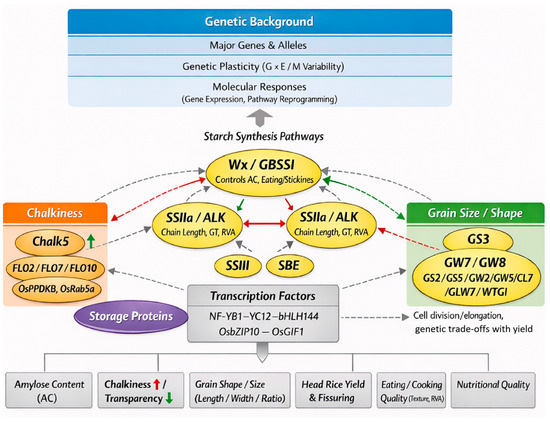
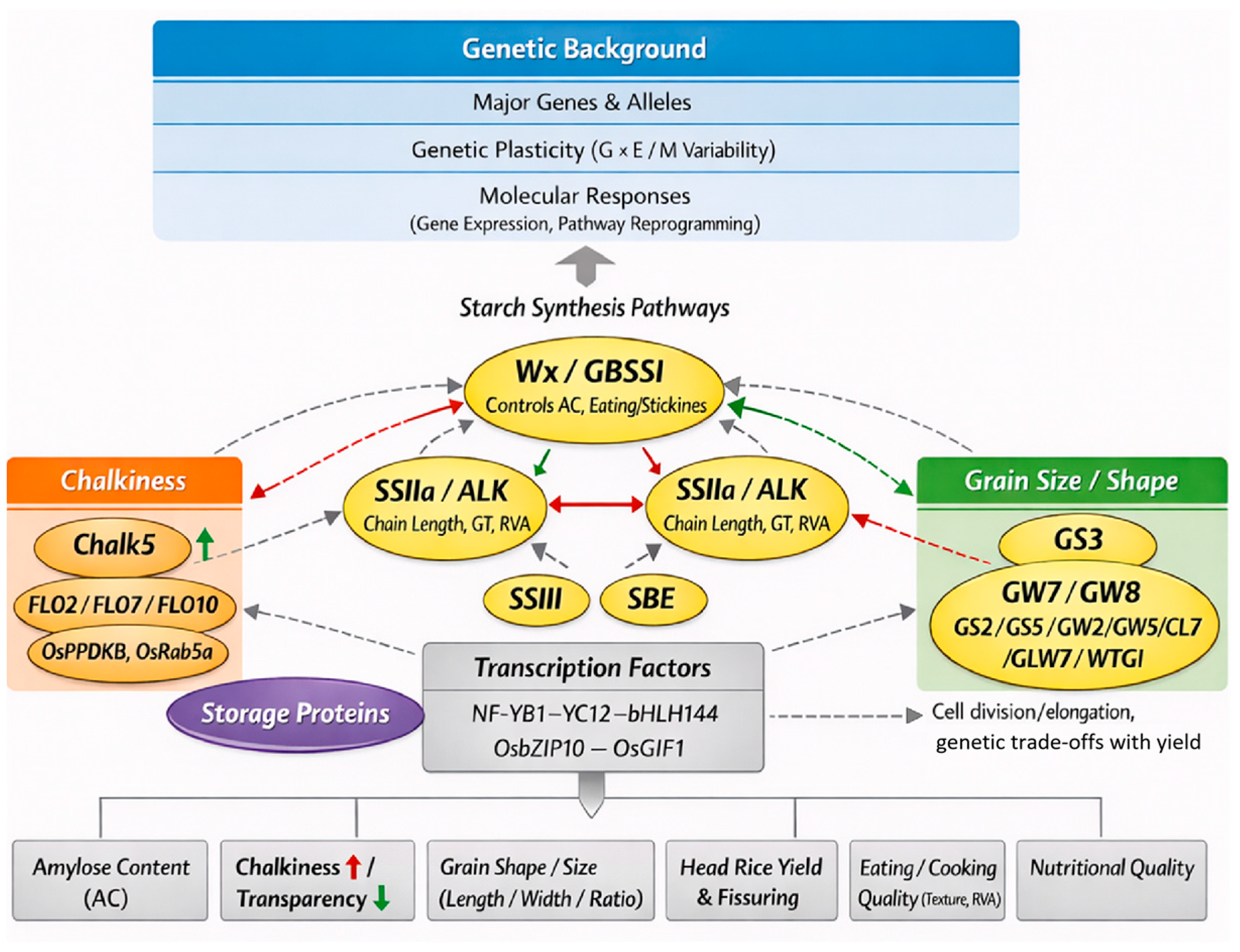
Rice grain quality can be conceptualized as a three-tier structure: (i) the genetic background, which sets the upper limits and baseline phenotypes via major genes and allele combinations; (ii) genetic plasticity, which reflects variability across environments and management; (iii) molecular responses, which involves gene expression and metabolic pathway reprogramming for short-term phenotypic adjustments (Figure 1). Framing the varietal foundation as the starting point contextualizes subsequent environmental and management effects within an interpretable genetic framework [12,13,14].
Figure 1.
Genetic regulatory network of key determinants influencing rice grain quality. Legend: (1) Solid green arrows (+) indicate positive regulation or activation. (2) Solid red arrows indicate negative regulation or inhibition. (3) Dashed green arrows (+) indicate indirect regulation or activation. (4) Dashed red arrows (+) indicate indirect regulation or activation. (5) Dashed gray arrows indicate indirect associations, pleiotropic effects, genetic trade-offs, or genotype × environment (G × E) sensitivity.
Numerous genes influence the quality of rice (Table 1). Eating and cooking quality are primarily regulated by starch synthesis pathways. The Wx gene (encoding GBSS) regulates amylose content, serving as the major determinant of eating quality and stickiness in japonica/indica types [15,16]. Secondary enzymes like Starch Synthase IIa (SSIIa) are encoded by Alkali degeneration gene (ALK).
Starch Synthase III (SSIII) and Starch Branching Enzyme (SBE 99) influence starch chain-length distribution, gelatinization temperature and Rapid Visco Analyzer (RVA) profiles [17,18,19]. Functional validation and natural variation studies reveal that Wx alleles significantly alter amylose content and exhibit differential heat sensitivity, resulting in quality degradation under high night temperature or grain-filling heat stress [20,21]. Recent functional genomics has identified floury endosperm genes and Heat Shock Protein (HSP)-related proteins in endosperm starch biosynthesis and heat tolerance, emphasizing protein stability’s role in maintaining starch synthesis under heat stress [22].
Grain shape and size are regulated by loci such as Grain Size 3 (GS3) and GW7 (also called GL7)/GW8 (also called OsSPL16), which often trade off with yield traits in breeding [23,24]. Chalkiness arises from abnormal endosperm cell structure and starch granule arrangement; genes such as Chalk5 directly influence endosperm redox and protein folding environments, altering transparency [4]. Head rice yield and grain fissuring are influenced by pericarp structure, 1000-grain weight, and starch-protein complexes, correlating with drying and processing sensitivity [25]. Beyond structural enzyme genes, transcription factor complexes directly regulate key enzyme expression, altering quality phenotypes. For example, the NF-YB1–YC12–bHLH144 complex activates Wx to regulate amylose content [26], while OsbZIP10 influences grain shape and eating quality via regulation of Grain Incomplete Filling 1 (OsGIF1), which catalyzes the breakdown of sucrose into glucose and fructose in developing grains [27]. These modules exhibit transcriptional-translational coupling, intersecting with hormone signaling and heat/oxidative stress responses [28].
Increasing evidence shows that effects of genes such as Wx and SSIIa are not constant—they exhibit varying sensitivity to high temperature and drought [29]. Certain Wx alleles reduce amylose content or alter molecular structure under heat, changing gelatinization behavior and sensory scores [3,21]. Nitrogen can indirectly lower eating quality by increasing grain protein (interacting with amylose content/Rapid Visco Analyzer), with effects varying by genotype, emphasizing the need to incorporate environmental/management responsiveness in breeding targets [30].
Table 1.
Selected Genes Associated with Rice Quality and Their Functions.
2.2. Environmental Factors Influencing Grain Quality
2.2.1. Temperature Stress
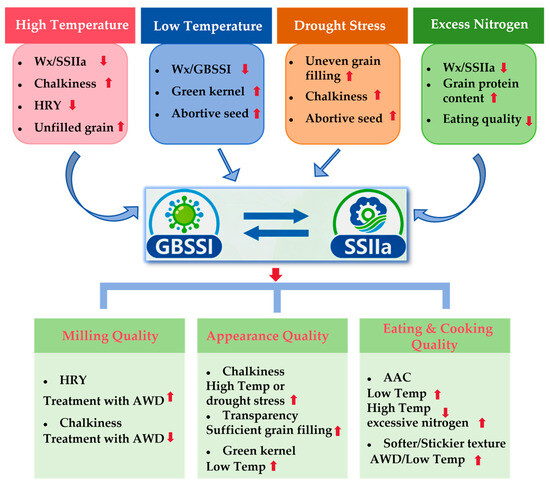
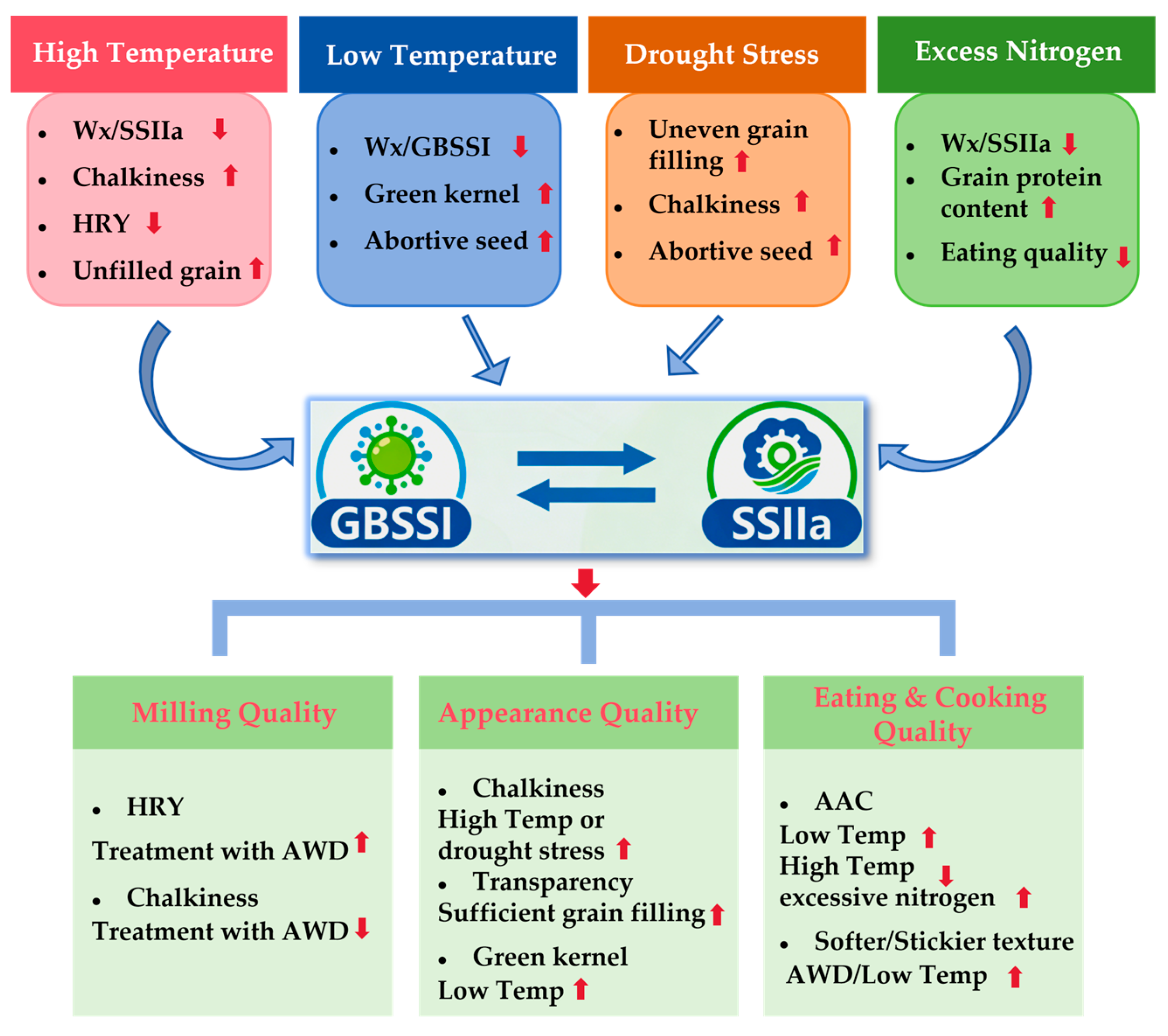
Environmental factors play a decisive role in rice grain quality formation (Figure 2): they directly affect starch and protein deposition, endosperm structure, and grain appearance, while interacting in complex ways with the varietal genotype and management to determine seasonal quality outcomes [54,55,56]. High temperature, particularly during post-flowering grain filling stage and high night temperature (HNT), is a major climatic factor degrading rice appearance and eating quality. Extensive field and controlled experiments demonstrate that grain-filling heat significantly increases chalkiness, reduces head rice yield and grain uniformity, and often compromises eating quality [21,57]. HNT disrupts starch deposition, modifying GT and RVA profiles, typically lowering GT and transparency [58,59].
Figure 2.
Simplified regulatory network illustrating the major environmental factors influencing rice grain quality during the grain-filling stage. This schematic diagram depicts the key regulatory pathways through which high temperature, low temperature, drought stress, alternate wetting and drying (AWD), and excess nitrogen fertilization affect rice grain quality (Temp: temperature).
Heat stress inhibits or imbalances starch synthase complex activity and assembly (affecting GBSSI/Wx, ALK, SBE enzyme activity and expression), modifying AC, branch-chain length distribution, and starch granule arrangement, resulting in endosperm voids and chalkiness. Additionally, heat induces protein synthesis and heat shock protein/folding demands, elevating grain protein ratios and further impacting texture. Genotypic variation is pronounced: certain Wx or SSIIa alleles perform worse under heat, emphasizing gene-temperature interactions in heat sensitivity [6,60,61].
Low-temperature stress, particularly during the sensitive grain-filling stage, severely compromises rice grain quality. It disrupts key physiological processes, resulting in incomplete grain development and maturation. This directly results in an increase in the percentage of green kernels and abortive seeds due to impaired starch and protein deposition in the endosperm. Consequently, these immature and structurally weak grains are highly susceptible to breakage during milling, resulting in a significant reduction in head rice yield, which severely undermines milling quality [62,63,64]. Regarding cooking and eating quality, low-temperature stress often exerts an opposite effect to that of high-temperature stress. It typically results in a decrease in apparent amylose content, a primary determinant of cooked rice hardness. This reduction in amylose content is linked to the suppressed activity of key starch synthesis enzymes, especially granule-bound starch synthase (GBSS) encoded by the Wx gene [65]. While lower amylose content generally contributes to a softer and stickier texture—a preferred trait in some markets—the overall eating quality under severe cold stress is often offset by the undesirable appearance and high percentage of immature grains. Furthermore, cold stress alters the amylopectin chain-length distribution and can lead to inconsistent gel consistency, creating unpredictable cooking results [66].
2.2.2. Water Management and Drought Stress
Water management is a crucial agricultural practice that significantly influences rice grain quality, particularly milling and appearance attributes [67,68,69]. Water scarcity is one of the primary abiotic stresses limiting global rice production. Beyond significantly reducing yield, drought stress profoundly alters the final quality of rice by affecting a series of physiological and biochemical processes, including grain filling, substance translocation, and metabolism, encompassing milling, appearance, cooking and eating quality, and nutritional aspects [70,71]. Milling quality, particularly head rice yield (HRY), demonstrates particular sensitivity to water stress during critical growth stages [72,73]. Moderate water deficit during grain filling typically increases HRY by 3–8% compared to continuous flooding, primarily through improved panicle architecture and enhanced remobilization of pre-stored carbohydrates [74]. However, severe water stress at any reproductive stage causes irreversible damage, reducing HRY by up to 15% [75]. Systematic reviews and meta-analyses show that filling-stage drought reduces head rice yield, increases chalkiness, alters amylose content and branch ratios, and compromises eating quality [76,77]. Drought stress, particularly during the grain-filling stage, disrupts starch and protein synthesis and deposition in the endosperm [75]. This leads to inadequate and uneven grain filling, resulting in increased chalkiness, significantly elevating the chalky grain rate and chalkiness degree, which severely compromises the appearance quality and commercial value of rice [78].
Alternate wetting and drying (AWD) has been recognized as a water-saving technology in rice production systems [79,80]; however, pre- and post-flowering AWD may induce changes in yield, quality and aroma biosynthesis in fragrant rice [81]. The interaction between water management and temperature further influences quality outcomes. Under high temperature conditions, maintained flooding provides evaporative cooling that mitigates heat-induced chalkiness, whereas under moderate temperatures, AWD generally produces superior quality [82]. This interaction emphasizes the need for context-specific water management strategies tailored to local climate conditions [83]. Research has demonstrated that controlled AWD implementation during mid-grain filling increased HRY by optimizing grain filling uniformity and enhancing endosperm structural integrity through modified starch deposition patterns [84,85].
2.2.3. Soil Properties and Nutrient Management
Soil characteristics and fertilization practices constitute fundamental determinants of rice grain quality, influencing both physical attributes and chemical composition through complex soil–plant interactions [9,86,87]. These factors influence nutrient availability, root development, and physiological processes that ultimately define grain quality parameters. Soil characteristics directly influence grain quality [88,89,90,91]. Heavy clay soils with poor drainage can induce hypoxia during critical growth stages, hindering nutrient uptake and assimilate translocation to developing grains [92]. Soil compaction reduces head rice yield, primarily through impaired nutrient uptake that weakens endosperm cell walls. Conversely, well-structured loamy soils with optimal bulk density promote uniform grain filling and reduce chalkiness through balanced water and nutrient availability [93]. Soil pH represents another critical factor affecting mineral availability and grain composition [94,95]. Acidic soils (pH < 5.5) increase cadmium toxicity while reducing phosphorus and molybdenum availability, conditions that elevate grain chalkiness and reduce milling recovery [96].
Nitrogen (N) fertilization exhibits complex relationships with grain quality [97,98,99]. While essential for yield formation, excessive nitrogen application consistently degrades eating quality through multiple mechanisms [100,101]. Elevated N availability during grain filling increases protein content by 15–30%, primarily through upregulated synthesis of glutelins and prolamins. This increase in protein content correlates strongly with harder-cooked rice texture and reduced consumer acceptability [102,103]. Recent findings reveal that high N levels suppress the expression of starch biosynthesis genes (particularly GBSSI and SSIIa) while upregulating storage protein genes, resulting in an unfavorable starch-to-protein ratio for eating quality [104,105]. The timing of N application is crucial for quality optimization. Basal and tillering stage applications primarily affect yield components, while panicle initiation and grain filling applications directly influence quality parameters [106,107]. Research demonstrates that splitting N application maintains yield while reducing protein content by 12% compared to conventional two-split applications, significantly improving eating quality scores [108,109].
Specific micronutrients provide targeted approaches for quality enhancement. Silicon (Si) fertilization has proven to be particularly valuable for both general quality improvement and safety enhancement [9]. Previous research demonstrates the effects of different Si application methods on cadmium (Cd) accumulation and rice yield in two typical paddy soils in Chongqing, revealing that foliar spray, especially with Se-containing Si fertilizer, most effectively reduces grain Cd content and improves nutritional quality while enhancing productivity, providing a practical strategy for safe rice production in Cd-contaminated areas [110]. Research has investigated the effects of Si on the yield and quality of fragrant rice, focusing on its regulatory mechanisms in the accumulation of the key aroma compound 2-acetyl-1-pyrroline (2AP), by analyzing proline content and the expression of related synthesis and transport genes (including Badh2, DAO, OAT, ProDH, and P5CS), to explore the potential of Si as a beneficial nutrient in breeding high-quality aromatic rice [111]. Research has studied the mitigating effect of Si fertilization on Cd toxicity in both selenium-enriched (Z3055B) and non-selenium-enriched (G46B) rice genotypes, demonstrating that Si application enhances growth, yield, and grain quality by reducing Cd accumulation and improving selenium content [112]. Additionally, other studies suggest that zinc supplementation and light intensity affect 2-acetyl-1-pyrroline (2AP) formation in fragrant rice [113].
2.2.4. Post-Harvest Handling
Rice quality—encompassing appearance, milling, cooking, and sensory attributes—is governed by the interplay between genetic potential and post-harvest management. Even elite varieties with superior genetic backgrounds are susceptible to irreversible quality deterioration when subjected to improper harvesting, drying, storage, or milling, ultimately compromising market value and consumer acceptance. Harvest timing is critical for preserving quality. For most indica and japonica rice, harvesting at 20–24% moisture content minimizes grain fissuring, chalkiness, and bran discoloration, while stabilizing apparent amylose content and gel consistency [114]. Delayed harvesting accelerates grain aging, increases fat acidity, and reduces transparency, leading to significant deterioration in eating quality [115]. Mechanical harvesting at optimal maturity also reduces physical grain damage, benefiting subsequent processing.
Drying is the most influential post-harvest operation affecting milling quality. Low-temperature (35–40 °C) uniform drying safely reduces paddy moisture to 13–14%, avoiding moisture-gradient-induced cracking. Recirculating dryers outperform traditional sun drying in preserving head rice yield and grain transparency [116], and post-drying tempering further alleviates fissuring and improves milling efficiency. Storage conditions largely determine long-term quality stability. Hermetic storage effectively suppresses pests, microbial activity, and moisture fluctuations, preserving apparent amylose content, gelatinization temperature, and sensory freshness. Conventional open storage accelerates lipid oxidation and flavor deterioration, whereas eco-friendly radiofrequency treatment offers effective pest control without compromising quality [117]. Gentle multi-stage milling maintains grain integrity, nutritional value, and appearance, whereas excessive polishing increases breakage and nutrient loss. Implementing precise post-harvest management is essential to fully realize the genetic quality potential of rice.
3. Conclusions
Rice grain quality is a multifaceted trait governed by a complex interplay of genetic, environmental, and management factors. Genetic architecture provides the foundational framework, with key genes such as Wx, ALK, Chalk5 and GS3/GW families determining the potential for starch composition, gelatinization properties, chalkiness, and grain dimensions. However, the expression of this genetic potential is highly plastic and strongly influenced by environmental conditions. Abiotic stresses, particularly elevated temperatures during grain filling and water deficit, consistently reduce milling yield, increase chalkiness, and alter starch and protein profiles, thereby impairing appearance, cooking, and eating quality. Conversely, optimized agronomic practices, including precise water management (e.g., AWD), balanced and split N fertilization, and strategic micronutrient (e.g., silicon) application, can mitigate these adverse effects and potentially enhance specific quality parameters. The integration of post-harvest handling further determines the final quality delivered to consumers. This synthesis emphasizes that high and stable rice quality in variable conditions cannot rely on genetics or management alone. It requires an integrated approach that synergizes resilient genetic backgrounds, climate-smart field management, and careful post-production processing.
4. Prospect
Future research and innovation should focus on developing integrated and sustainable strategies to enhance rice grain quality resilience. Several promising frontiers emerge: (1) Next-generation breeding for quality resilience: Leveraging advanced genomic tools (e.g., CRISPR-based gene editing, genomic selection) to pyramid favorable alleles for multiple quality traits while incorporating climate resilience genes. A key target is developing varieties with “built-in” stability—genotypes in which quality-related pathways (e.g., starch biosynthesis, protein deposition, endosperm development) are less sensitive to fluctuations in temperature, water, and nitrogen. Exploring natural variation and engineered alleles of master regulators (e.g., transcription factor complexes like NF-YB1–YC12–bHLH144) that coordinate multiple quality-related processes under stress holds great promise. (2) Precision agronomy for targeted quality enhancement: Moving beyond uniform field management to dynamic, sensor-based precision agronomy. This involves real-time monitoring of canopy microclimate, soil moisture, and plant nitrogen status to tailor irrigation, fertilization, and even harvest timing. Developing models that predict quality outcomes based on genotype × environment × management (G × E × M) interactions will be crucial for providing decision-support tools to farmers to optimize both yield and quality. (3) Synergistic nutrient and soil health management: Further investigation into the role of microbiome-plant interactions in shaping grain quality under various soil and nutrient regimes is needed. Optimizing integrated nutrient management (INM) packages that combine organic amendments, silicon, zinc, and other beneficial elements to not only improve yield and quality but also reduce heavy metal accumulation (e.g., cadmium) and enhance nutritional safety (e.g., selenium) will be vital for sustainable production. (4) Post-harvest technology integration: Enhancing the quality chain requires innovation in adaptive post-harvest technologies. Research should focus on developing drying and storage protocols that are responsive to the initial quality status of harvested grains (influenced by pre-harvest conditions) to minimize fissuring and preserve aroma, nutritional content, and cooking characteristics. (5) Systems-level modeling and digital agriculture: Finally, a systems biology approach integrating omics data (genomics, transcriptomics, proteomics, metabolomics) with physiological and agronomic data is essential to fully decode the G × E × M nexus. This knowledge should be integrated into digital agriculture platforms, enabling the design of region-specific, climate-resilient rice production systems that reliably deliver high-quality grain to meet diverse consumer preferences and market demands in the face of global change. By converging advances in molecular biology, data science, and sustainable agronomy, the future of rice quality improvement lies in creating robust systems that ensure nutritional security, economic viability, and resilience to environmental challenges.
Author Contributions
L.T. conceived the project, consulted literature and collected data, wrote the manuscript. J.S. prepared the figures. H.F., J.W., K.Z., H.T., F.D., L.W., J.S., and M.H. revised the manuscript. All authors have read and agreed to the published version of the manuscript.
Funding
This research was funded by the Breeding and Application of New Elite Rice Varieties in the Taihu Lake Basin, grant number 2025XZZD07.
Data Availability Statement
The data and related conclusions presented in this article are all derived from https://pubmed.ncbi.nlm.nih.gov/ (accessed on 26 January 2026).
Conflicts of Interest
The authors declare no conflicts of interest.
References
- Ren, D.; Ding, C.; Qian, Q. Molecular bases of rice grain size and quality for optimized productivity. Sci. Bull. 2023, 68, 314–350. [Google Scholar] [CrossRef] [Scilit] [PubMed]
- Li, W.; Yang, K.; Hu, C.; Abbas, W.; Zhang, J.; Xu, P.; Cheng, B.; Zhang, J.; Yin, W.; Shalmani, A.; et al. A natural gene on-off system confers field thermotolerance for grain quality and yield in rice. Cell 2025, 188, 3661–3678. [Google Scholar] [CrossRef] [Scilit] [PubMed]
- Zhao, P.; Liu, Y.; Deng, Z.; Liu, L.; Yu, T.; Ge, G.; Chen, B.; Wang, T. Creating of novel Wx allelic variations significantly altering Wx expression and rice eating and cooking quality. J. Plant Physiol. 2024, 303, 154384. [Google Scholar] [CrossRef] [Scilit]
- Li, Y.; Fan, C.; Xing, Y.; Yun, P.; Luo, L.; Yan, B.; Peng, B.; Xie, W.; Wang, G.; Li, X.; et al. Chalk5 encodes a vacuolar H(+)-translocating pyrophosphatase influencing grain chalkiness in rice. Nat. Genet. 2014, 46, 398–404, Erratum in Nat. Genet. 2014, 46, 657. [Google Scholar] [CrossRef] [Scilit]
- Lu, B.; Xu, C.; Li, Z.; Tang, X.; Yang, F.; Xu, D.; Zhu, G.; Zhang, J.; Jiang, Y.; Li, W.; et al. Influence of the temperature during grain filling stage and nitrogen application rate on yield and quality of indica hybrid rice. Field Crop. Res. 2024, 309, 109333. [Google Scholar] [CrossRef] [Scilit]
- Chandran, A.K.N.; Sandhu, J.; Irvin, L.; Paul, P.; Dhatt, B.K.; Hussain, W.; Gao, T.; Staswick, P.; Yu, H.; Morota, G.; et al. Rice Chalky Grain 5 regulates natural variation for grain quality under heat stress. Front. Plant Sci. 2022, 13, 1026472. [Google Scholar] [CrossRef] [Scilit]
- Xiong, R.; Xie, J.; Chen, L.; Yang, T.; Tan, X.; Zhou, Y.; Pan, X.; Zeng, Y.; Shi, Q.; Zhang, J.; et al. Water irrigation management affects starch structure and physicochemical properties of indica rice with different grain quality. Food Chem. 2021, 347, 129045. [Google Scholar] [CrossRef] [Scilit]
- Chen, G.; Duan, Q.; Wu, C.; He, X.; Hu, M.; Li, C.; Ouyang, Y.; Peng, L.; Yang, H.; Zhang, Q.; et al. Optimizing rice yield, quality and nutrient use efficiency through combined application of nitrogen and potassium. Front. Plant Sci. 2024, 15, 1335744. [Google Scholar] [CrossRef] [Scilit]
- Yuan, S.; Han, Y.; Cui, C.; Chen, P.; Tu, N.; Rang, Z.; Yi, Z. Silicon-calcium fertilizer increased rice yield and quality by improving soil health. Sci. Rep. 2024, 14, 13088, Correction in Sci. Rep. 2024, 14, 19956. [Google Scholar] [CrossRef] [Scilit]
- Teng, M.; Duan, X.; Feng, R.; Zhang, D.; Guo, W.; Sun, H.; Liu, X. Effects of Harvest Time on Grinding Quality, Appearance Quality and Physical and Chemical Quality of Japonica Rice. Foods 2024, 13, 2869. [Google Scholar] [CrossRef] [Scilit]
- Azuka, C.E.; Nkama, I.; Asoiro, F.U. Physical properties of parboiled milled local rice varieties marketed in South-East Nigeria. J. Food Sci. Technol. 2021, 58, 1788–1796. [Google Scholar] [CrossRef] [Scilit]
- Zhao, X.; Duan, P.; Fan, C.; Wang, X.; Su, J.; Wang, X.; Li, X.; Wang, Z.; Peng, Y. Correlations Between the Inherent Components of Grains in Various Rice Varieties and the Quality of Sweet Rice Wine. Foods 2026, 15, 179. [Google Scholar] [CrossRef] [Scilit]
- Yu, T.; Chang, Z.; Chen, B.; Liu, L.; Deng, Z.; Wang, Z.; Wang, T. OsMYB99 Modulates Grain Wax Biosynthesis and Redox Homeostasis to Control Head Rice Yield and Chalkiness. Plant Biotechnol. J. 2025; Epub ahead of print. [CrossRef] [Scilit]
- Guo, E.; Wang, L.; Shi, Y.; Jiang, S.; Cheng, X.; Chen, X.; Ma, H.; Wan, N.; Bai, F.; Zhang, Z.; et al. Response of rice yield, grain quality to chilling at grain filling stages. J. Sci. Food Agric. 2024, 104, 9312–9323. [Google Scholar] [CrossRef] [Scilit] [PubMed]
- Kharshiing, G.; Chrungoo, N.K. Wx alleles in rice: Relationship with apparent amylose content of starch and a possible role in rice domestication. J. Genet. 2021, 100, 65. [Google Scholar] [CrossRef] [Scilit] [PubMed]
- Zhang, C.; Hao, W.; Lu, Y.; Yang, Y.; Chen, Z.; Li, Q.; Fan, X.; Luo, J.; Liu, Q. A comparative evaluation of the effect of SSI and Wx allelic variation on rice grain quality and starch physicochemical properties. Food Chem. 2022, 371, 131205. [Google Scholar] [CrossRef] [Scilit] [PubMed]
- Chen, Z.; Lu, Y.; Feng, L.; Hao, W.; Li, C.; Yang, Y.; Fan, X.; Li, Q.; Zhang, C.; Liu, Q. Genetic Dissection and Functional Differentiation of ALK(a) and ALK(b), Two Natural Alleles of the ALK/SSIIa Gene, Responding to Low Gelatinization Temperature in Rice. Rice 2020, 13, 39. [Google Scholar] [CrossRef] [Scilit]
- Yang, B.; Xu, S.; Xu, L.; You, H.; Xiang, X. Effects of Wx and Its Interaction With SSIII-2 on Rice Eating and Cooking Qualities. Front. Plant Sci. 2018, 9, 456. [Google Scholar] [CrossRef] [Scilit]
- Wang, A.; Jing, Y.; Cheng, Q.; Zhou, H.; Wang, L.; Gong, W.; Kou, L.; Liu, G.; Meng, X.; Chen, M.; et al. Loss of function of SSIIIa and SSIIIb coordinately confers high RS content in cooked rice. Proc. Natl. Acad. Sci. USA 2023, 120, e2220622120. [Google Scholar] [CrossRef] [Scilit]
- Feng, L.; Lu, C.; Yang, Y.; Lu, Y.; Li, Q.; Huang, L.; Fan, X.; Liu, Q.; Zhang, C. The Physicochemical Properties of Starch Are Affected by Wx(lv) in Indica Rice. Foods 2021, 10, 3089. [Google Scholar] [CrossRef] [Scilit]
- Xia, D.; Wang, Y.; Shi, Q.; Wu, B.; Yu, X.; Zhang, C.; Li, Y.; Fu, P.; Li, M.; Zhang, Q.; et al. Effects of Wx Genotype, Nitrogen Fertilization, and Temperature on Rice Grain Quality. Front. Plant Sci. 2022, 13, 901541. [Google Scholar] [CrossRef] [Scilit]
- Wu, H.; Ren, Y.; Dong, H.; Xie, C.; Zhao, L.; Wang, X.; Zhang, F.; Zhang, B.; Jiang, X.; Huang, Y.; et al. FLOURY ENDOSPERM24, a heat shock protein 101 (HSP101), is required for starch biosynthesis and endosperm development in rice. New Phytol. 2024, 242, 2635–2651. [Google Scholar] [CrossRef] [Scilit] [PubMed]
- Liu, L.; Zhou, Y.; Mao, F.; Gu, Y.; Tang, Z.; Xin, Y.; Liu, F.; Tang, T.; Gao, H.; Zhao, X. Fine-Tuning of the Grain Size by Alternative Splicing of GS3 in Rice. Rice 2022, 15, 4. [Google Scholar] [CrossRef] [Scilit] [PubMed]
- Wang, S.; Li, S.; Liu, Q.; Wu, K.; Zhang, J.; Wang, S.; Wang, Y.; Chen, X.; Zhang, Y.; Gao, C.; et al. The OsSPL16-GW7 regulatory module determines grain shape and simultaneously improves rice yield and grain quality. Nat. Genet. 2015, 47, 949–954. [Google Scholar] [CrossRef] [Scilit]
- Deng, Z.; Liu, Y.; Gong, C.; Chen, B.; Wang, T. Waxy is an important factor for grain fissure resistance and head rice yield as revealed by a genome-wide association study. J. Exp. Bot. 2022, 73, 6942–6954. [Google Scholar] [CrossRef] [Scilit] [PubMed]
- Bello, B.K.; Hou, Y.; Zhao, J.; Jiao, G.; Wu, Y.; Li, Z.; Wang, Y.; Tong, X.; Wang, W.; Yuan, W.; et al. NF-YB1-YC12-bHLH144 complex directly activates Wx to regulate grain quality in rice (Oryza sativa L.). Plant Biotechnol. J. 2019, 17, 1222–1235. [Google Scholar] [CrossRef] [Scilit]
- Jiang, M.; Zhang, H.; Song, Y.; Chen, J.; Bai, J.; Tang, J.; Wang, Q.; Fotopoulos, V.; Zhu, Q.H.; Yang, R.; et al. Transcription factor OsbZIP10 modulates rice grain quality by regulating OsGIF1. Plant J. Cell Mol. Biol. 2024, 119, 2181–2198. [Google Scholar] [CrossRef] [Scilit]
- Wang, J.D.; Wang, J.; Huang, L.C.; Kan, L.J.; Wang, C.X.; Xiong, M.; Zhou, P.; Zhou, L.H.; Chen, C.; Zhao, D.S.; et al. ABA-mediated regulation of rice grain quality and seed dormancy via the NF-YB1-SLRL2-bHLH144 Module. Nat. Commun. 2024, 15, 4493. [Google Scholar] [CrossRef] [Scilit]
- You, H.; Zhang, O.; Xu, L.; Liang, C.; Xiang, X. Effects of soluble starch synthase IIa allelic variation on rice grain quality with different Waxy backgrounds. J. Sci. Food Agric. 2020, 100, 5344–5351. [Google Scholar] [CrossRef] [Scilit]
- Yang, G.; Peng, Y.; Liu, R.; Huang, M.; Xiao, Y.; Yang, Z.; Sun, Y.; Hu, Y.; Chen, H.; Ma, J. Effect of chemical fertilizer reduction on the quality of hybrid rice of different amylose contents. J. Food Biochem. 2022, 46, e14066. [Google Scholar] [CrossRef] [Scilit]
- She, K.C.; Kusano, H.; Koizumi, K.; Yamakawa, H.; Hakata, M.; Imamura, T.; Fukuda, M.; Naito, N.; Tsurumaki, Y.; Yaeshima, M.; et al. A novel factor FLOURY ENDOSPERM2 is involved in regulation of rice grain size and starch quality. Plant Cell 2010, 22, 3280–3294. [Google Scholar] [CrossRef] [Scilit]
- Lin, L.; Qiu, J.; Zhang, L.; Wei, C. Identification and analysis of nine new flo2 allelic mutants in rice. J. Plant Physiol. 2024, 301, 154300. [Google Scholar] [CrossRef] [Scilit] [PubMed]
- Zhang, L.; Ren, Y.; Lu, B.; Yang, C.; Feng, Z.; Liu, Z.; Chen, J.; Ma, W.; Wang, Y.; Yu, X.; et al. FLOURY ENDOSPERM7 encodes a regulator of starch synthesis and amyloplast development essential for peripheral endosperm development in rice. J. Exp. Bot. 2016, 67, 633–647. [Google Scholar] [CrossRef] [Scilit] [PubMed]
- Wu, M.; Ren, Y.; Cai, M.; Wang, Y.; Zhu, S.; Zhu, J.; Hao, Y.; Teng, X.; Zhu, X.; Jing, R.; et al. Rice FLOURY ENDOSPERM10 encodes a pentatricopeptide repeat protein that is essential for the trans-splicing of mitochondrial nad1 intron 1 and endosperm development. New Phytol. 2019, 223, 736–750. [Google Scholar] [CrossRef] [Scilit]
- Wang, Y.; Ren, Y.; Liu, X.; Jiang, L.; Chen, L.; Han, X.; Jin, M.; Liu, S.; Liu, F.; Lv, J.; et al. OsRab5a regulates endomembrane organization and storage protein trafficking in rice endosperm cells. Plant J. Cell Mol. Biol. 2010, 64, 812–824. [Google Scholar] [CrossRef] [Scilit]
- Gao, Z.; Zeng, D.; Cheng, F.; Tian, Z.; Guo, L.; Su, Y.; Yan, M.; Jiang, H.; Dong, G.; Huang, Y.; et al. ALK, the key gene for gelatinization temperature, is a modifier gene for gel consistency in rice. J. Integr. Plant Biol. 2011, 53, 756–765. [Google Scholar] [CrossRef] [Scilit] [PubMed]
- Hui, S.; Li, H.; Mawia, A.M.; Zhou, L.; Cai, J.; Ahmad, S.; Lai, C.; Wang, J.; Jiao, G.; Xie, L.; et al. Production of aromatic three-line hybrid rice using novel alleles of BADH2. Plant Biotechnol. J. 2022, 20, 59–74. [Google Scholar] [CrossRef] [Scilit]
- Yang, Y.; Guo, M.; Sun, S.; Zou, Y.; Yin, S.; Liu, Y.; Tang, S.; Gu, M.; Yang, Z.; Yan, C. Natural variation of OsGluA2 is involved in grain protein content regulation in rice. Nat. Commun. 2019, 10, 1949. [Google Scholar] [CrossRef] [Scilit]
- Peng, B.; Kong, H.; Li, Y.; Wang, L.; Zhong, M.; Sun, L.; Gao, G.; Zhang, Q.; Luo, L.; Wang, G.; et al. OsAAP6 functions as an important regulator of grain protein content and nutritional quality in rice. Nat. Commun. 2014, 5, 4847. [Google Scholar] [CrossRef] [Scilit]
- Wang, S.; Yang, Y.; Guo, M.; Zhong, C.; Yan, C.; Sun, S. Targeted mutagenesis of amino acid transporter genes for rice quality improvement using the CRISPR/Cas9 system. Crop J. 2020, 8, 457–464. [Google Scholar] [CrossRef] [Scilit]
- Duan, P.; Ni, S.; Wang, J.; Zhang, B.; Xu, R.; Wang, Y.; Chen, H.; Zhu, X.; Li, Y. Regulation of OsGRF4 by OsmiR396 controls grain size and yield in rice. Nat. Plants 2015, 2, 15203, Corrigendum in Nat. Plants 2016, 2, 15226. [Google Scholar] [CrossRef] [Scilit]
- Li, S.; Gao, F.; Xie, K.; Zeng, X.; Cao, Y.; Zeng, J.; He, Z.; Ren, Y.; Li, W.; Deng, Q.; et al. The OsmiR396c-OsGRF4-OsGIF1 regulatory module determines grain size and yield in rice. Plant Biotechnol. J. 2016, 14, 2134–2146. [Google Scholar] [CrossRef] [Scilit]
- Fan, C.; Xing, Y.; Mao, H.; Lu, T.; Han, B.; Xu, C.; Li, X.; Zhang, Q. GS3, a major QTL for grain length and weight and minor QTL for grain width and thickness in rice, encodes a putative transmembrane protein. Theor. Appl. Genet. 2006, 112, 1164–1171. [Google Scholar] [CrossRef] [Scilit] [PubMed]
- Nan, J.; Feng, X.; Wang, C.; Zhang, X.; Wang, R.; Liu, J.; Yuan, Q.; Jiang, G.; Lin, S. Improving rice grain length through updating the GS3 locus of an elite variety Kongyu 131. Rice 2018, 11, 21. [Google Scholar] [CrossRef] [Scilit]
- Xu, C.; Liu, Y.; Li, Y.; Xu, X.; Xu, C.; Li, X.; Xiao, J.; Zhang, Q. Differential expression of GS5 regulates grain size in rice. J. Exp. Bot. 2015, 66, 2611–2623. [Google Scholar] [CrossRef] [Scilit] [PubMed]
- Li, Y.; Fan, C.; Xing, Y.; Jiang, Y.; Luo, L.; Sun, L.; Shao, D.; Xu, C.; Li, X.; Xiao, J.; et al. Natural variation in GS5 plays an important role in regulating grain size and yield in rice. Nat. Genet. 2011, 43, 1266–1269. [Google Scholar] [CrossRef] [Scilit]
- Zhao, D.S.; Li, Q.F.; Zhang, C.Q.; Zhang, C.; Yang, Q.Q.; Pan, L.X.; Ren, X.Y.; Lu, J.; Gu, M.H.; Liu, Q.Q. GS9 acts as a transcriptional activator to regulate rice grain shape and appearance quality. Nat. Commun. 2018, 9, 1240. [Google Scholar] [CrossRef] [Scilit] [PubMed]
- Hao, J.; Wang, D.; Wu, Y.; Huang, K.; Duan, P.; Li, N.; Xu, R.; Zeng, D.; Dong, G.; Zhang, B.; et al. The GW2-WG1-OsbZIP47 pathway controls grain size and weight in rice. Mol. Plant 2021, 14, 1266–1280. [Google Scholar] [CrossRef] [Scilit]
- Song, X.J.; Huang, W.; Shi, M.; Zhu, M.Z.; Lin, H.X. A QTL for rice grain width and weight encodes a previously unknown RING-type E3 ubiquitin ligase. Nat. Genet. 2007, 39, 623–630. [Google Scholar] [CrossRef] [Scilit]
- Abbas, W.; Shalmani, A.; Zhang, J.; Sun, Q.; Zhang, C.; Li, W.; Cui, Y.; Xiong, M.; Li, Y. The GW5-WRKY53-SGW5 module regulates grain size variation in rice. New Phytol. 2024, 242, 2011–2025. [Google Scholar] [CrossRef] [Scilit]
- Si, L.; Chen, J.; Huang, X.; Gong, H.; Luo, J.; Hou, Q.; Zhou, T.; Lu, T.; Zhu, J.; Shangguan, Y.; et al. OsSPL13 controls grain size in cultivated rice. Nat. Genet. 2016, 48, 447–456. [Google Scholar] [CrossRef] [Scilit]
- Wang, Y.; Xiong, G.; Hu, J.; Jiang, L.; Yu, H.; Xu, J.; Fang, Y.; Zeng, L.; Xu, E.; Xu, J.; et al. Copy number variation at the GL7 locus contributes to grain size diversity in rice. Nat. Genet. 2015, 47, 944–948. [Google Scholar] [CrossRef] [Scilit]
- Huang, K.; Wang, D.; Duan, P.; Zhang, B.; Xu, R.; Li, N.; Li, Y. WIDE AND THICK GRAIN 1, which encodes an otubain-like protease with deubiquitination activity, influences grain size and shape in rice. Plant J. Cell Mol. Biol. 2017, 91, 849–860. [Google Scholar] [CrossRef] [Scilit] [PubMed]
- Sanghamitra, P.; Sah, R.P.; Bagchi, T.B.; Sharma, S.G.; Kumar, A.; Munda, S.; Sahu, R.K. Evaluation of variability and environmental stability of grain quality and agronomic parameters of pigmented rice (O. sativa L.). J. Food Sci. Technol. 2018, 55, 879–890. [Google Scholar] [CrossRef] [Scilit] [PubMed]
- Sreenivasulu, N.; Butardo, V.M., Jr.; Misra, G.; Cuevas, R.P.; Anacleto, R.; Kavi Kishor, P.B. Designing climate-resilient rice with ideal grain quality suited for high-temperature stress. J. Exp. Bot. 2015, 66, 1737–1748. [Google Scholar] [CrossRef] [Scilit]
- Kumar, A.; Thomas, J.; Gill, N.; Dwiningsih, Y.; Ruiz, C.; Famoso, A.; Pereira, A. Molecular mapping and characterization of QTLs for grain quality traits in a RIL population of US rice under high nighttime temperature stress. Sci. Rep. 2023, 13, 4880. [Google Scholar] [CrossRef] [Scilit] [PubMed]
- Zhang, H.; Xu, H.; Jiang, Y.; Zhang, H.; Wang, S.; Wang, F.; Zhu, Y. Genetic Control and High Temperature Effects on Starch Biosynthesis and Grain Quality in Rice. Front. Plant Sci. 2021, 12, 757997. [Google Scholar] [CrossRef] [Scilit] [PubMed]
- Bahuguna, R.N.; Solis, C.A.; Shi, W.; Jagadish, K.S. Post-flowering night respiration and altered sink activity account for high night temperature-induced grain yield and quality loss in rice (Oryza sativa L.). Physiol. Plant. 2017, 159, 59–73. [Google Scholar] [CrossRef] [Scilit] [PubMed]
- Impa, S.M.; Raju, B.; Hein, N.T.; Sandhu, J.; Prasad, P.V.V.; Walia, H.; Jagadish, S.V.K. High night temperature effects on wheat and rice: Current status and way forward. Plant Cell Environ. 2021, 44, 2049–2065. [Google Scholar] [CrossRef] [Scilit]
- Zhang, X.; Zhang, Q.; Yang, J.; Jin, Y.; Wu, J.; Xu, H.; Xiao, Y.; Lai, Y.; Guo, Z.; Wang, J.; et al. Comparative Effects of Heat Stress at Booting and Grain-Filling Stage on Yield and Grain Quality of High-Quality Hybrid Rice. Foods 2023, 12, 4093. [Google Scholar] [CrossRef] [Scilit]
- Li, J.Y.; Yang, C.; Xu, J.; Lu, H.P.; Liu, J.X. The hot science in rice research: How rice plants cope with heat stress. Plant Cell Environ. 2023, 46, 1087–1103. [Google Scholar] [CrossRef] [Scilit] [PubMed]
- Yang, J.; Zhang, X.; Wang, D.; Wu, J.; Xu, H.; Xiao, Y.; Xie, H.; Shi, W. The deterioration of starch physiochemical and minerals in high-quality indica rice under low-temperature stress during grain filling. Front. Plant Sci. 2023, 14, 1295003. [Google Scholar] [CrossRef] [Scilit] [PubMed]
- Ai, X.; Xiong, R.; Tan, X.; Wang, H.; Zeng, Y.; Huang, S.; Shang, Q.; Pan, X.; Shi, Q.; Zhang, J.; et al. Low temperature and light combined stress after heading on starch fine structure and physicochemical properties of late-season indica rice with different grain quality in southern China. Food Res. Int. 2023, 164, 112320. [Google Scholar] [CrossRef] [Scilit]
- Xiong, R.; Wang, H.; Mao, F.; Tao, L.; Tan, X.; Pan, X.; Zeng, Y.; Zeng, Y. The mechanism of carbon and nitrogen metabolism under low temperature and low light stress after heading in late indica rice. Plant Physiol. Biochem. PPB 2025, 218, 109316. [Google Scholar] [CrossRef] [Scilit]
- Wang, W.; Wei, X.; Jiao, G.; Chen, W.; Wu, Y.; Sheng, Z.; Hu, S.; Xie, L.; Wang, J.; Tang, S.; et al. GBSS-BINDING PROTEIN, encoding a CBM48 domain-containing protein, affects rice quality and yield. J. Integr. Plant Biol. 2020, 62, 948–966. [Google Scholar] [CrossRef] [Scilit]
- Tu, D.; Jiang, Y.; Salah, A.; Cai, M.; Peng, W.; Zhang, L.; Li, C.; Cao, C. Response of Source-Sink Characteristics and Rice Quality to High Natural Field Temperature During Reproductive Stage in Irrigated Rice System. Front. Plant Sci. 2022, 13, 911181. [Google Scholar] [CrossRef] [Scilit] [PubMed]
- Fujimura, K.; Shima, A. Water properties and quality of the largest rice production region in Japan and their influence on the reproduction of zebrafish. Environ. Sci. Pollut. Res. Int. 2024, 31, 21857–21868. [Google Scholar] [CrossRef] [Scilit]
- Harisankar, S.; Vishnu Mohan, R.; Choudhary, V.; Vinu, R. Effect of water quality on the yield and quality of the products from hydrothermal liquefaction and carbonization of rice straw. Bioresour. Technol. 2022, 351, 127031. [Google Scholar] [CrossRef] [Scilit]
- Brunet-Loredo, A.; López-Belchí, M.D.; Cordero-Lara, K.; Noriega, F.; Cabeza, R.A.; Fischer, S.; Careaga, P.; Garriga, M. Assessing Grain Quality Changes in White and Black Rice under Water Deficit. Plants 2023, 12, 21. [Google Scholar] [CrossRef] [Scilit]
- Yang, X.; Wang, B.; Chen, L.; Li, P.; Cao, C. The different influences of drought stress at the flowering stage on rice physiological traits, grain yield, and quality. Sci. Rep. 2019, 9, 3742. [Google Scholar] [CrossRef] [Scilit]
- Yang, Y.; Yu, J.; Qian, Q.; Shang, L. Enhancement of Heat and Drought Stress Tolerance in Rice by Genetic Manipulation: A Systematic Review. Rice 2022, 15, 67. [Google Scholar] [CrossRef] [Scilit]
- Liu, R.; Yu, Z.L.; Sun, Y.L.; Tong, L.T.; Liu, L.Y.; Wang, L.L.; Zhou, X.R.; Zhou, S.M. Quality improvement effects of electrolyzed water on rice noodles prepared with semidry-milled rice flours. Food Sci. Biotechnol. 2021, 30, 823–832. [Google Scholar] [CrossRef] [Scilit]
- Geng, D.H.; Liang, T.; Yang, M.; Wang, L.; Zhou, X.; Sun, X.; Liu, L.; Zhou, S.; Tong, L.T. Effects of Lactobacillus combined with semidry flour milling on the quality and flavor of fermented rice noodles. Food Res. Int. 2019, 126, 108612. [Google Scholar] [CrossRef] [Scilit]
- Gautam, A.; Kendra, K.V. Irrigation Water productivity in Rice Crop through Alternate Wetting and Drying method. Agric. Assoc. Text. Chem. Crit. Rev. 2024, 12, 193–195. [Google Scholar] [CrossRef] [Scilit]
- Mondal, K.; Singh, R.K.; Dey, N. Combined drought and heat stress affect starch synthesis and grain quality-related traits during the grain-filling stage of rice (Oryza sativa L.). J. Sci. Food Agric. 2025, 105, 8511–8524. [Google Scholar] [CrossRef] [Scilit] [PubMed]
- Chen, G.; Peng, L.; Gong, J.; Wang, J.; Wu, C.; Sui, X.; Tian, Y.; Hu, M.; Li, C.; He, X.; et al. Effects of water stress on starch synthesis and accumulation of two rice cultivars at different growth stages. Front. Plant Sci. 2023, 14, 1133524. [Google Scholar] [CrossRef] [Scilit] [PubMed]
- Wang, X.; Fu, J.; Min, Z.; Zou, D.; Liu, H.; Wang, J.; Zheng, H.; Jia, Y.; Yang, L.; Xin, W.; et al. Response of Rice with Overlapping Growth Stages to Water Stress by Assimilates Accumulation and Transport and Starch Synthesis of Superior and Inferior Grains. Int. J. Mol. Sci. 2022, 23, 11157. [Google Scholar] [CrossRef] [Scilit] [PubMed]
- Zhang, Z.; Hu, Y.; Yu, S.; Zhao, X.; Dai, G.; Deng, G.; Bao, J. Effects of drought stress and elevated CO(2) on starch fine structures and functional properties in indica rice. Carbohydr. Polym. 2022, 297, 120044. [Google Scholar] [CrossRef] [Scilit]
- Bo, Y.; Wang, X.; van Groenigen, K.J.; Linquist, B.A.; Müller, C.; Li, T.; Yang, J.; Jägermeyr, J.; Qin, Y.; Zhou, F. Improved alternate wetting and drying irrigation increases global water productivity. Nat. Food 2024, 5, 1005–1013. [Google Scholar] [CrossRef] [Scilit]
- Gonçalves, J.M.; Nunes, M.; Ferreira, S.; Jordão, A.; Paixão, J.; Eugénio, R.; Russo, A.; Damásio, H.; Duarte, I.M.; Bahcevandziev, K. Alternate Wetting and Drying in the Center of Portugal: Effects on Water and Rice Productivity and Contribution to Development. Sensors 2022, 22, 3632. [Google Scholar] [CrossRef] [Scilit]
- Ashraf, U.; Hussain, S.; Naveed Shahid, M.; Anjum, S.A.; Kondo, M.; Mo, Z.; Tang, X. Alternate wetting and drying modulated physio-biochemical attributes, grain yield, quality, and aroma volatile in fragrant rice. Physiol. Plant. 2022, 174, e13833. [Google Scholar] [CrossRef] [Scilit]
- Zheng, E.; Hu, J.; Zhu, Y.; Xu, T. Effects of different water management and fertilizer methods on soil temperature, radiation and rice growth. Sci. Rep. 2022, 12, 16342. [Google Scholar] [CrossRef] [Scilit]
- Srivastav, A.L.; Dhyani, R.; Ranjan, M.; Madhav, S.; Sillanpää, M. Climate-resilient strategies for sustainable management of water resources and agriculture. Environ. Sci. Pollut. Res. Int. 2021, 28, 41576–41595. [Google Scholar] [CrossRef] [Scilit]
- Jiang, M.; Tian, J.; Li, L.; Zhang, J.; Ji, G.; Luo, D.; Li, M. Enhancing rice grain yield and quality synergistically through controlled irrigation and increased planting density in nitrogen-reduced systems. J. Sci. Food Agric. 2026, 106, 438–447. [Google Scholar] [CrossRef] [Scilit] [PubMed]
- Song, T.; Das, D.; Hu, Q.; Yang, F.; Zhang, J. Alternate wetting and drying irrigation and phosphorus rates affect grain yield and quality and heavy metal accumulation in rice. Sci. Total Environ. 2021, 752, 141862. [Google Scholar] [CrossRef] [Scilit] [PubMed]
- Liu, Y.; Chu, G.; Stirling, E.; Zhang, H.; Chen, S.; Xu, C.; Zhang, X.; Ge, T.; Wang, D. Nitrogen fertilization modulates rice seed endophytic microbiomes and grain quality. Sci. Total Environ. 2023, 857, 159181. [Google Scholar] [CrossRef] [Scilit] [PubMed]
- Zhang, R.; Wang, Y.; Hussain, S.; Yang, S.; Li, R.; Liu, S.; Chen, Y.; Wei, H.; Dai, Q.; Hou, H. Study on the Effect of Salt Stress on Yield and Grain Quality Among Different Rice Varieties. Front. Plant Sci. 2022, 13, 918460. [Google Scholar] [CrossRef] [Scilit]
- Zhang, L.; Tang, Q.; Li, L.; Xu, H.; Zheng, H.; Wang, J.; Hua, Y.; Ren, L.; Tang, J. Ratoon rice with direct seeding improves soil carbon sequestration in rice fields and increases grain quality. J. Environ. Manag. 2022, 317, 115374. [Google Scholar] [CrossRef] [Scilit]
- He, J.; Liu, T.; Wang, W.; Wu, X.; Wang, J.; Yan, W. Comprehensive improvement of soil quality and rice yield by flooding-midseason drying-flooding. Appl. Microbiol. Biotechnol. 2022, 106, 7347–7359. [Google Scholar] [CrossRef] [Scilit]
- Peralta Ogorek, L.L.; Gao, Y.; Farrar, E.; Pandey, B.K. Soil compaction sensing mechanisms and root responses. Trends Plant Sci. 2025, 30, 565–575. [Google Scholar] [CrossRef] [Scilit]
- Fu, M.; Xiong, P.; Zhang, Z.; Peng, X. Responses of root hairs to soil compaction: A review. Plant Sci. Int. J. Exp. Plant Biol. 2025, 355, 112461. [Google Scholar] [CrossRef] [Scilit]
- Syafrullah, S. Improvement of Soil Quality and Yield of Rice to Achieve Food-Self Sufficiency Through Sustainable Agriculture by Applying Coal-Based Organic Fertilizer (Baranik Fertilizer) on Paddy Field; Gedung Rektorat Universitas Lampung: Banderlampung, Indonesia, 2019. [Google Scholar]
- Huang, G.; Kilic, A.; Karady, M.; Zhang, J.; Mehra, P.; Song, X.; Sturrock, C.J.; Zhu, W.; Qin, H.; Hartman, S.; et al. Ethylene inhibits rice root elongation in compacted soil via ABA- and auxin-mediated mechanisms. Proc. Natl. Acad. Sci. USA 2022, 119, e2201072119. [Google Scholar] [CrossRef] [Scilit]
- Park, M.; Wee, J.; Son, J.; Lee, Y.; Cho, K.; Hyun, S. Soil pH and Rice Chlorophyll Content as Indicators of Grain Productivity and Microbial Community in Acid-Exposed Paddy Mesocosms. Bull. Environ. Contam. Toxicol. 2025, 114, 46. [Google Scholar] [CrossRef] [Scilit] [PubMed]
- He, L.L.; Huang, D.Y.; Zhang, Q.; Zhu, H.H.; Xu, C.; Li, B.; Zhu, Q.H. Meta-analysis of the effects of liming on soil pH and cadmium accumulation in crops. Ecotoxicol. Environ. Saf. 2021, 223, 112621. [Google Scholar] [CrossRef] [Scilit] [PubMed]
- Wang, Y.; Wang, K.; Liang, T.; Wang, T.; Liu, J.; Chen, X.; Xu, C.; Cao, W.; Fan, H. Milk vetch returning combined with lime materials alleviates soil cadmium contamination and improves rice quality in soil-rice system. Sci. Total Environ. 2024, 951, 175770. [Google Scholar] [CrossRef] [Scilit]
- Teixeira, L.S.; Pimenta, T.M.; Brito, F.A.L.; Malheiros, R.S.P.; Arruda, R.S.; Araújo, W.L.; Ribeiro, D.M. Selenium uptake and grain nutritional quality are affected by nitrogen fertilization in rice (Oryza sativa L.). Plant Cell Rep. 2021, 40, 871–880. [Google Scholar] [CrossRef] [Scilit]
- Ndlovu, N.; Spillane, C.; McKeown, P.C.; Cairns, J.E.; Das, B.; Gowda, M. Genome-wide association studies of grain yield and quality traits under optimum and low-nitrogen stress in tropical maize (Zea mays L.). Theor. Appl. Genet. 2022, 135, 4351–4370. [Google Scholar] [CrossRef] [Scilit] [PubMed]
- Xu, Y.; Guan, X.; Han, Z.; Zhou, L.; Zhang, Y.; Asad, M.A.U.; Wang, Z.; Jin, R.; Pan, G.; Cheng, F. Combined Effect of Nitrogen Fertilizer Application and High Temperature on Grain Quality Properties of Cooked Rice. Front. Plant Sci. 2022, 13, 874033. [Google Scholar] [CrossRef] [Scilit]
- Hu, Y.; Sun, L.; Xue, J.; Cai, Q.; Xu, Y.; Guo, J.; Wei, H.; Huo, Z.; Xu, K.; Zhang, H. Reduced Nitrogen Application with Dense Planting Achieves High Eating Quality and Stable Yield of Rice. Foods 2024, 13, 3017. [Google Scholar] [CrossRef] [Scilit]
- Liu, C.; Chen, F.; Li, Z.; Cocq, K.L.; Liu, Y.; Wu, L. Impacts of nitrogen practices on yield, grain quality, and nitrogen-use efficiency of crops and soil fertility in three paddy-upland cropping systems. J. Sci. Food Agric. 2021, 101, 2218–2226. [Google Scholar] [CrossRef] [Scilit]
- Guo, C.; Yuan, X.; Yan, F.; Xiang, K.; Wu, Y.; Zhang, Q.; Wang, Z.; He, L.; Fan, P.; Yang, Z.; et al. Nitrogen Application Rate Affects the Accumulation of Carbohydrates in Functional Leaves and Grains to Improve Grain Filling and Reduce the Occurrence of Chalkiness. Front. Plant Sci. 2022, 13, 921130. [Google Scholar] [CrossRef] [Scilit]
- Guo, C.; Zhang, L.; Jiang, P.; Yang, Z.; Chen, Z.; Xu, F.; Guo, X.; Sun, Y.; Ma, J. Grain Chalkiness Is Decreased by Balancing the Synthesis of Protein and Starch in Hybrid Indica Rice Grains under Nitrogen Fertilization. Foods 2024, 13, 855. [Google Scholar] [CrossRef] [Scilit]
- Ali, A.; Raddatz, N.; Pardo, J.M.; Yun, D.J. HKT sodium and potassium transporters in Arabidopsis thaliana and related halophyte species. Physiol. Plant. 2021, 171, 546–558. [Google Scholar] [CrossRef] [Scilit]
- Cao, X.; Sun, H.; Wang, C.; Ren, X.; Liu, H.; Zhang, Z. Effects of late-stage nitrogen fertilizer application on the starch structure and cooking quality of rice. J. Sci. Food Agric. 2018, 98, 2332–2340. [Google Scholar] [CrossRef] [Scilit] [PubMed]
- Hu, Q.; Liu, Q.; Jiang, W.; Qiu, S.; Wei, H.; Zhang, H.; Liu, G.; Xing, Z.; Hu, Y.; Guo, B.; et al. Effects of mid-stage nitrogen application timing on the morphological structure and physicochemical properties of japonica rice starch. J. Sci. Food Agric. 2021, 101, 2463–2471. [Google Scholar] [CrossRef] [Scilit] [PubMed]
- Tuiwong, P.; Cho, H.K.; Rouached, H.; Prom, U.T.C. Synergistic Effects of Nitrogen and Zinc Foliar Application on Yield and Nutrient Accumulation in Rice at Various Growth Stages. Plants 2024, 13, 3274. [Google Scholar] [CrossRef] [Scilit] [PubMed]
- Liu, Y.; Zhu, X.; He, X.; Li, C.; Chang, T.; Chang, S.; Zhang, H.; Zhang, Y. Scheduling of nitrogen fertilizer topdressing during panicle differentiation to improve grain yield of rice with a long growth duration. Sci. Rep. 2020, 10, 15197. [Google Scholar] [CrossRef] [Scilit]
- Shen, Z.; Ma, S.; Huang, S.; Dai, Z.; Li, X. Optimizing nitrogen fertilizer application protocol to minimize the risk of nitrogen loss while maintaining high yields of direct-seeded rice. J. Sci. Food Agric. 2025, 105, 7987–8000. [Google Scholar] [CrossRef] [Scilit]
- Li, N.; Feng, A.; Liu, N.; Jiang, Z.; Wei, S. Silicon application improved the yield and nutritional quality while reduced cadmium concentration in rice. Environ. Sci. Pollut. Res. Int. 2020, 27, 20370–20379. [Google Scholar] [CrossRef] [Scilit]
- Chan-In, P.; Jamjod, S.; Prom, U.T.C.; Rerkasem, B.; Russell, J.; Pusadee, T. Application of Silicon Influencing Grain Yield and Some Grain Quality Features in Thai Fragrant Rice. Plants 2024, 13, 1336. [Google Scholar] [CrossRef] [Scilit]
- Su, Y.; Huang, X.; Li, L.; Muhammad, Z.A.; Li, M.; Zheng, T.; Guo, Z.; Zhang, Y.; Luo, D.; Ye, X.; et al. Comparative Responses of Silicon to Reduce Cadmium and Enrich Selenium in Rice Varieties. Foods 2023, 12, 1656. [Google Scholar] [CrossRef] [Scilit]
- Shuochen, J.; Lihe, Z.; Fenqin, H.; Xiangru, T.; Bin, D. Zinc supplementation and light intensity affect 2-acetyl-1-pyrroline (2AP) formation in fragrant rice. BMC Plant Biol. 2023, 23, 194. [Google Scholar] [CrossRef] [Scilit]
- Kyani, J.; Ghasemi-Nejad-Raeini, M.; Marzban, A. Enhancing food security through reducing Champa rice losses: Assessing the impact of crop moisture and harvesting methods on yield quantity and quality. PLoS ONE 2025, 20, e0326846. [Google Scholar] [CrossRef] [Scilit] [PubMed]
- Wilson, L.T.; Samonte, S.; Yang, Y. Multi-Decadal Analysis on the Impact of Climate Change, Genetic Gain, Cultivar Type, and Harvest Timing on Main and Ratoon Rice Yield and Quality. Glob. Change Biol. 2026, 32, e70679. [Google Scholar] [CrossRef] [Scilit] [PubMed]
- Wang, Y.; Wu, W.; Xu, J.; Gao, M.; Wu, Z.; Wang, R.; Liu, H. Changes in Quality and Safety Indexes During Rice Harvest and Discussion on Drying Technology. Foods 2025, 14, 1225. [Google Scholar] [CrossRef] [Scilit]
- Cai, C.; Zhao, Z.; Zhang, Y.; Li, M.; Li, L.; Cheng, P.; Shen, W. Molecular Hydrogen Improves Rice Storage Quality via Alleviating Lipid Deterioration and Maintaining Nutritional Values. Plants 2022, 11, 2588. [Google Scholar] [CrossRef] [Scilit] [PubMed]
Disclaimer/Publisher’s Note: The statements, opinions and data contained in all publications are solely those of the individual author(s) and contributor(s) and not of MDPI and/or the editor(s). MDPI and/or the editor(s) disclaim responsibility for any injury to people or property resulting from any ideas, methods, instructions or products referred to in the content. |
© 2026 by the authors. Licensee MDPI, Basel, Switzerland. This article is an open access article distributed under the terms and conditions of the Creative Commons Attribution (CC BY) license.