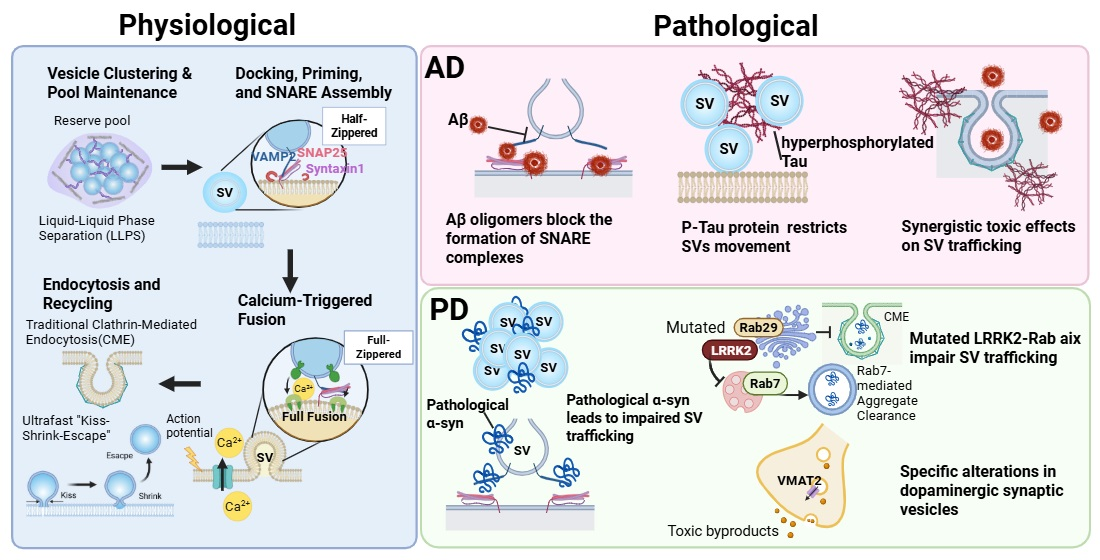
Disruption of Synaptic Vesicle Trafficking in Alzheimer’s and Parkinson’s Disease: Mechanisms and Therapeutic Implication
Abstract
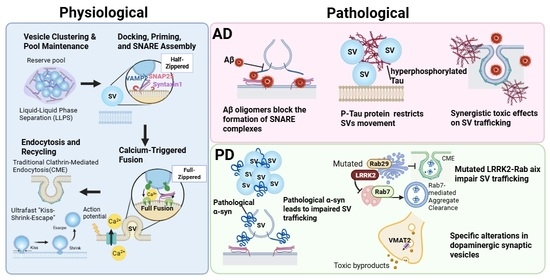
1. Introduction
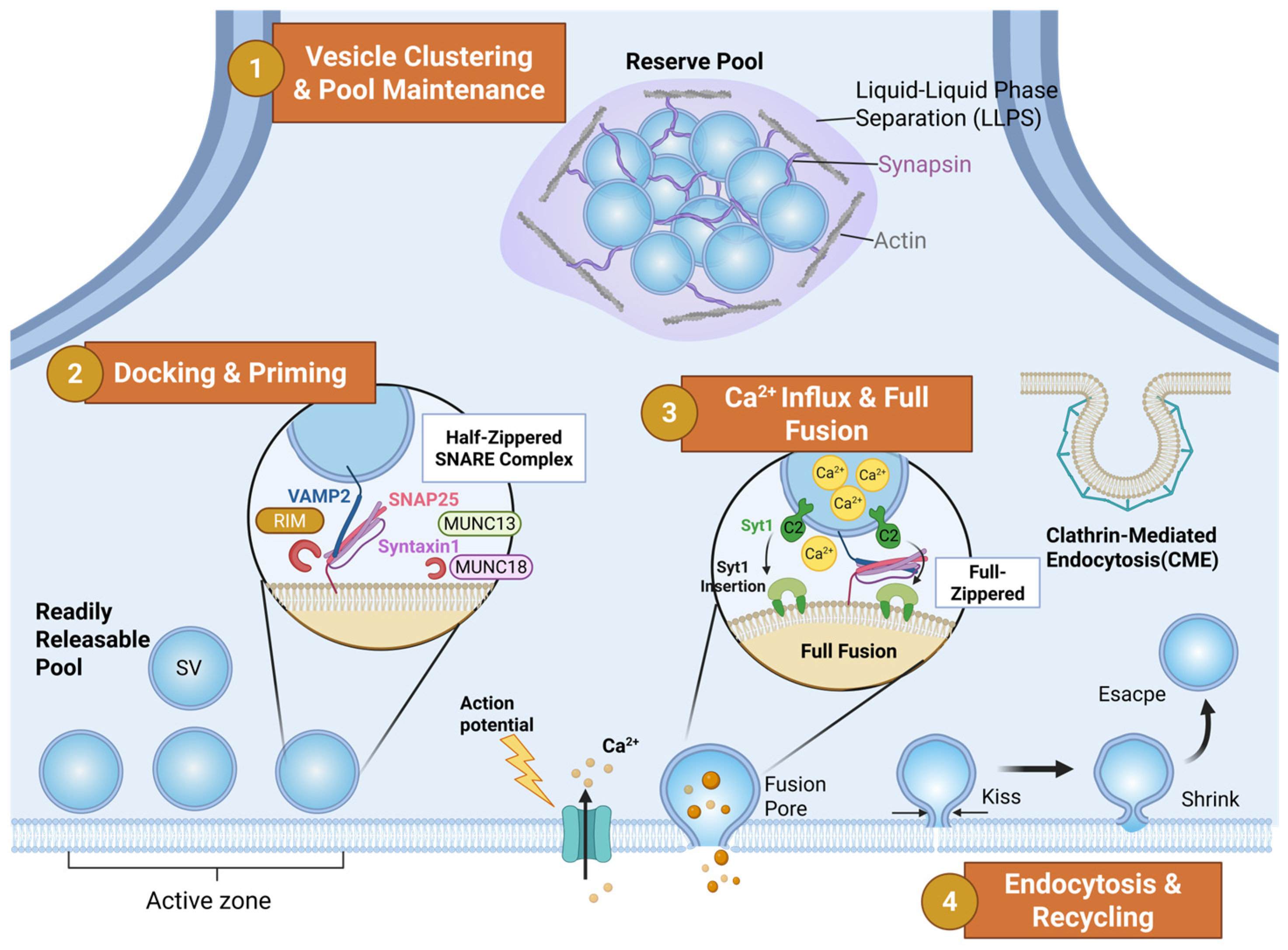
2. The Physiological Mechanisms of SV Recycling
2.1. Vesicle Clustering and Pool Maintenance
2.2. Docking, Priming, and SNARE Assembly
2.3. Calcium-Triggered Fusion
2.4. Endocytosis and Recycling
2.5. Physiological Functions of Synapse-Related Proteins in SV Trafficking
3. SV Trafficking and Neurodegenerative Diseases
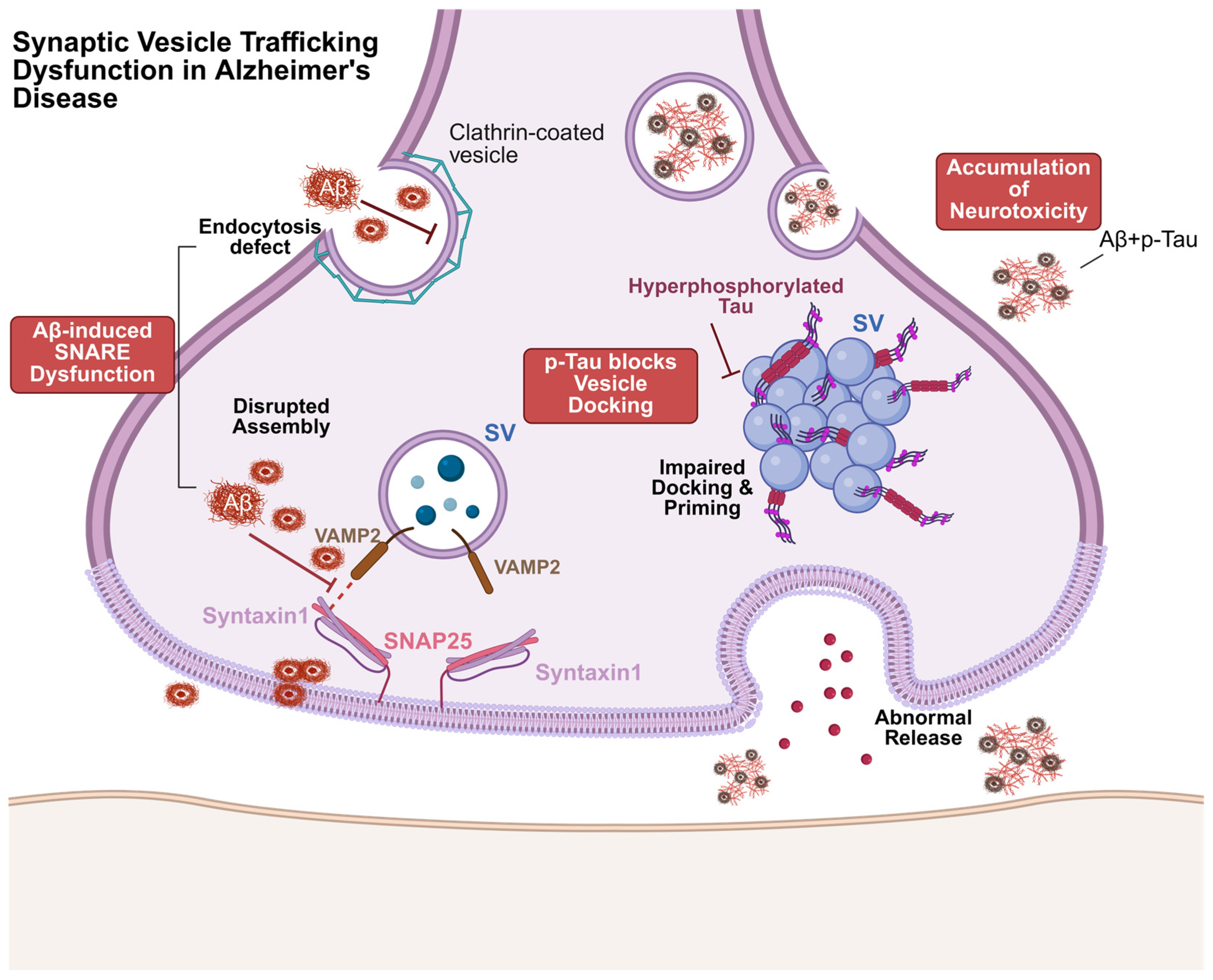
3.1. Alzheimer’s Disease
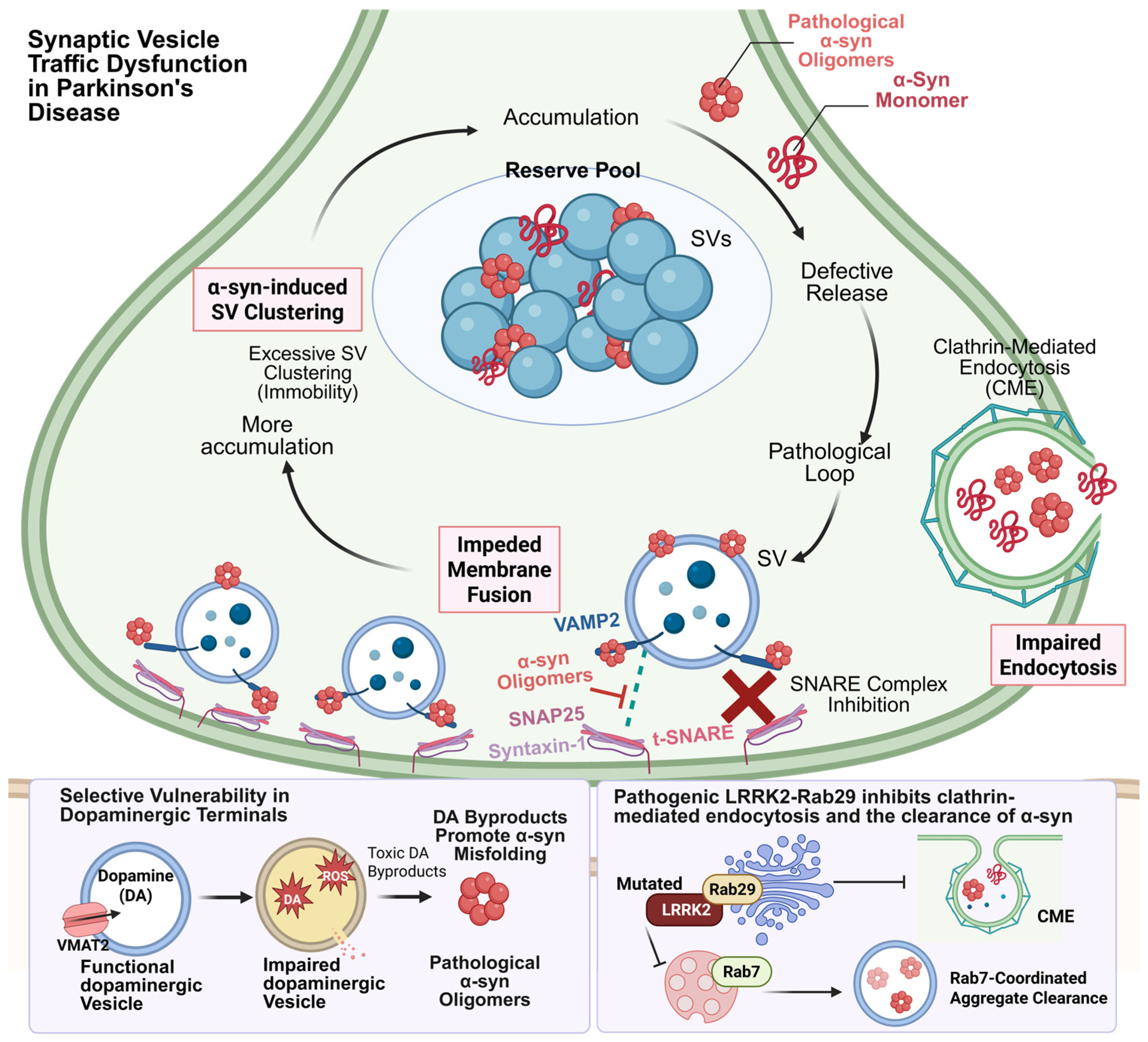
3.2. Parkinson’s Disease
4. Intervention Strategies Targeting Presynaptic Mechanisms
5. Conclusions
Author Contributions
Funding
Institutional Review Board Statement
Informed Consent Statement
Data Availability Statement
Acknowledgments
Conflicts of Interest
Abbreviations
| SV | Synaptic vesicle |
| AD | Alzheimer’s disease |
| PD | Parkinson’s disease |
| APP | Amyloid precursor protein |
| Aβ | β-amyloid |
| α-Syn | α-synuclein |
| RRP | Readily releasable pool |
| STXBP1 | Syntaxin-binding protein 1 |
| SNAREs | Soluble N-ethylmaleimide-sensitive factor attachment protein receptors |
| VAMP2 | Vesicle-associated membrane protein 2 |
| SNAP25 | 25 kDa synaptosomal-associated protein |
| STX-1 | Syntaxin-1 |
| CaMKIV | Calmodulin kinase IV |
| DNM | Dynamin. |
References
- Del Castillo, J.; Katz, B. Quantal components of the end-plate potential. J. Physiol. 1954, 124, 560–573. [Google Scholar] [CrossRef] [Scilit]
- Südhof, T.C. Neurotransmitter release: The last millisecond in the life of a synaptic vesicle. Neuron 2013, 80, 675–690. [Google Scholar] [CrossRef] [Scilit]
- Rizo, J. Mechanism of neurotransmitter release coming into focus. Protein Sci. 2018, 27, 1364–1391. [Google Scholar] [CrossRef] [Scilit]
- Xu, J.; Liang, Y.; Li, N.; Dang, S.; Jiang, A.; Liu, Y.; Guo, Y.; Yang, X.; Yuan, Y.; Zhang, X.; et al. Clathrin-associated carriers enable recycling through a kiss-and-run mechanism. Nat. Cell Biol. 2024, 26, 1652–1668. [Google Scholar] [CrossRef] [Scilit] [PubMed]
- Zanetti, L.; Regoni, M.; Ratti, E.; Valtorta, F.; Sassone, J. Presynaptic AMPA Receptors in Health and Disease. Cells 2021, 10, 2260. [Google Scholar] [CrossRef] [Scilit] [PubMed]
- Monteiro, A.R.; Barbosa, D.J.; Remião, F.; Silva, R. Alzheimer’s disease: Insights and new prospects in disease pathophysiology, biomarkers and disease-modifying drugs. Biochem. Pharmacol. 2023, 211, 115522. [Google Scholar] [CrossRef] [Scilit]
- Stocchi, F.; Bravi, D.; Emmi, A.; Antonini, A. Parkinson disease therapy: Current strategies and future research priorities. Nat. Rev. Neurol. 2024, 20, 695–707. [Google Scholar] [CrossRef] [Scilit] [PubMed]
- Dejanovic, B.; Sheng, M.; Hanson, J.E. Targeting synapse function and loss for treatment of neurodegenerative diseases. Nat. Rev. Drug Discov. 2024, 23, 23–42. [Google Scholar] [CrossRef] [Scilit]
- Terry, R.D.; Masliah, E.; Salmon, D.P.; Butters, N.; DeTeresa, R.; Hill, R.; Hansen, L.A.; Katzman, R. Physical basis of cognitive alterations in Alzheimer’s disease: Synapse loss is the major correlate of cognitive impairment. Ann. Neurol. 1991, 30, 572–580. [Google Scholar] [CrossRef] [Scilit]
- Ribarič, S. Detecting Early Cognitive Decline in Alzheimer’s Disease with Brain Synaptic Structural and Functional Evaluation. Biomedicines 2023, 11, 355. [Google Scholar] [CrossRef] [Scilit]
- Burré, J.; Sharma, M.; Tsetsenis, T.; Buchman, V.; Etherton, M.R.; Südhof, T.C. Alpha-synuclein promotes SNARE-complex assembly in vivo and in vitro. Science 2010, 329, 1663–1667. [Google Scholar] [CrossRef] [Scilit]
- Wang, Y.; Mandelkow, E. Tau in physiology and pathology. Nat. Rev. Neurosci. 2016, 17, 5–21. [Google Scholar] [CrossRef] [Scilit]
- Vargas, K.J.; Makani, S.; Davis, T.; Westphal, C.H.; Castillo, P.E.; Chandra, S.S. Synucleins regulate the kinetics of synaptic vesicle endocytosis. J. Neurosci. 2014, 34, 9364–9376. [Google Scholar] [CrossRef] [Scilit]
- Hoffmann, C.; Sansevrino, R.; Morabito, G.; Logan, C.; Vabulas, R.M.; Ulusoy, A.; Ganzella, M.; Milovanovic, D. Synapsin Condensates Recruit alpha-Synuclein. J. Mol. Biol. 2021, 433, 166961. [Google Scholar] [CrossRef] [Scilit]
- Zhou, L.; McInnes, J.; Wierda, K.; Holt, M.; Herrmann, A.G.; Jackson, R.J.; Wang, Y.C.; Swerts, J.; Beyens, J.; Miskiewicz, K.; et al. Tau association with synaptic vesicles causes presynaptic dysfunction. Nat. Commun. 2017, 8, 15295. [Google Scholar] [CrossRef] [Scilit]
- Fouke, K.E.; Wegman, M.E.; Weber, S.A.; Brady, E.B.; Román-Vendrell, C.; Morgan, J.R. Synuclein Regulates Synaptic Vesicle Clustering and Docking at a Vertebrate Synapse. Front. Cell Dev. Biol. 2021, 9, 774650. [Google Scholar] [CrossRef] [Scilit] [PubMed]
- Leal-Ortiz, S.; Waites, C.L.; Terry-Lorenzo, R.; Zamorano, P.; Gundelfinger, E.D.; Garner, C.C. Piccolo modulation of Synapsin1a dynamics regulates synaptic vesicle exocytosis. J. Cell Biol. 2008, 181, 831–846. [Google Scholar] [CrossRef] [Scilit]
- Zhang, M.; Augustine, G.J. Synapsins and the Synaptic Vesicle Reserve Pool: Floats or Anchors? Cells 2021, 10, 658. [Google Scholar] [CrossRef] [Scilit] [PubMed]
- Ramella, M.; Ribolla, L.M.; de Curtis, I. Liquid-Liquid Phase Separation at the Plasma Membrane-Cytosol Interface: Common Players in Adhesion, Motility, and Synaptic Function. J. Mol. Biol. 2022, 434, 167228. [Google Scholar] [CrossRef] [Scilit] [PubMed]
- Sansevrino, R.; Hoffmann, C.; Milovanovic, D. Condensate biology of synaptic vesicle clusters. Trends Neurosci. 2023, 46, 293–306. [Google Scholar] [CrossRef] [Scilit]
- Choi, J.; Rafiq, N.M.; Park, D. Liquid-liquid phase separation in presynaptic nerve terminals. Trends Biochem. Sci. 2024, 49, 888–900. [Google Scholar] [CrossRef] [Scilit]
- Milovanovic, D.; Wu, Y.; Bian, X.; De Camilli, P. A liquid phase of synapsin and lipid vesicles. Science 2018, 361, 604–607. [Google Scholar] [CrossRef] [Scilit] [PubMed]
- Guzikowski, N.J.; Kavalali, E.T. Functional specificity of liquid-liquid phase separation at the synapse. Nat. Commun. 2024, 15, 10103. [Google Scholar] [CrossRef] [Scilit] [PubMed]
- Paul, M.M.; Dannhäuser, S.; Morris, L.; Mrestani, A.; Hübsch, M.; Gehring, J.; Hatzopoulos, G.N.; Pauli, M.; Auger, G.M.; Bornschein, G.; et al. The human cognition-enhancing CORD7 mutation increases active zone number and synaptic release. Brain 2022, 145, 3787–3802. [Google Scholar] [CrossRef] [Scilit]
- Silva, M.; Tran, V.; Marty, A. A maximum of two readily releasable vesicles per docking site at a cerebellar single active zone synapse. eLife 2024, 12, RP91087. [Google Scholar] [CrossRef] [PubMed]
- Baker, R.W.; Hughson, F.M. Chaperoning SNARE assembly and disassembly. Nat. Rev. Mol. Cell Biol. 2016, 17, 465–479. [Google Scholar] [CrossRef] [Scilit]
- Yoon, T.Y.; Munson, M. SNARE complex assembly and disassembly. Curr. Biol. 2018, 28, R397–R401. [Google Scholar] [CrossRef] [Scilit]
- Ma, C.; Su, L.; Seven, A.B.; Xu, Y.; Rizo, J. Reconstitution of the vital functions of Munc18 and Munc13 in neurotransmitter release. Science 2013, 339, 421–425. [Google Scholar] [CrossRef] [Scilit]
- Stepien, K.P.; Rizo, J. Synaptotagmin-1-, Munc18-1-, and Munc13-1-dependent liposome fusion with a few neuronal SNAREs. Proc. Natl. Acad. Sci. USA 2021, 118, e2019314118. [Google Scholar] [CrossRef] [Scilit]
- Lai, Y.; Choi, U.B.; Leitz, J.; Rhee, H.J.; Lee, C.; Altas, B.; Zhao, M.; Pfuetzner, R.A.; Wang, A.L.; Brose, N.; et al. Molecular Mechanisms of Synaptic Vesicle Priming by Munc13 and Munc18. Neuron 2017, 95, 591–607.e510. [Google Scholar] [CrossRef] [Scilit]
- Bouazza-Arostegui, B.; Camacho, M.; Brockmann, M.M.; Zobel, S.; Rosenmund, C. Deconstructing Synaptotagmin-1′s Distinct Roles in Synaptic Vesicle Priming and Neurotransmitter Release. J. Neurosci. 2022, 42, 2856–2871. [Google Scholar] [CrossRef] [Scilit] [PubMed]
- Ramakrishnan, S.; Bera, M.; Coleman, J.; Rothman, J.E.; Krishnakumar, S.S. Synergistic roles of Synaptotagmin-1 and complexin in calcium-regulated neuronal exocytosis. eLife 2020, 9, e54506. [Google Scholar] [CrossRef] [Scilit]
- Wu, Z.; Ma, L.; Courtney, N.A.; Zhu, J.; Landajuela, A.; Zhang, Y.; Chapman, E.R.; Karatekin, E. Polybasic Patches in Both C2 Domains of Synaptotagmin-1 Are Required for Evoked Neurotransmitter Release. J. Neurosci. 2022, 42, 5816–5829. [Google Scholar] [CrossRef] [Scilit] [PubMed]
- Xiang, Y.; Cui, L.; Yao, J.; Lou, X.; Wu, M.; Huo, J.; Fan, J.; Li, H.; Li, K.; Wang, X.; et al. Synaptotagmin-1 serves as a primary Zn(2+) sensor to mediate spontaneous neurotransmitter release under pathological conditions. Nat. Commun. 2025, 16, 7113. [Google Scholar] [CrossRef] [Scilit] [PubMed]
- Cui, L.; Li, H.; Xi, Y.; Hu, Q.; Liu, H.; Fan, J.; Xiang, Y.; Zhang, X.; Shui, W.; Lai, Y. Vesicle trafficking and vesicle fusion: Mechanisms, biological functions, and their implications for potential disease therapy. Mol. Biomed. 2022, 3, 29. [Google Scholar] [CrossRef] [Scilit]
- Milosevic, I. Revisiting the Role of Clathrin-Mediated Endoytosis in Synaptic Vesicle Recycling. Front. Cell. Neurosci. 2018, 12, 27. [Google Scholar] [CrossRef] [Scilit]
- Kaksonen, M.; Roux, A. Mechanisms of clathrin-mediated endocytosis. Nat. Rev. Mol. Cell Biol. 2018, 19, 313–326. [Google Scholar] [CrossRef] [Scilit]
- Granseth, B.; Odermatt, B.; Royle, S.J.; Lagnado, L. Clathrin-mediated endocytosis is the dominant mechanism of vesicle retrieval at hippocampal synapses. Neuron 2006, 51, 773–786. [Google Scholar] [CrossRef] [Scilit]
- Picco, A.; Kaksonen, M. Quantitative imaging of clathrin-mediated endocytosis. Curr. Opin. Cell Biol. 2018, 53, 105–110. [Google Scholar] [CrossRef] [Scilit]
- Watanabe, S.; Rost, B.R.; Camacho-Pérez, M.; Davis, M.W.; Söhl-Kielczynski, B.; Rosenmund, C.; Jorgensen, E.M. Ultrafast endocytosis at mouse hippocampal synapses. Nature 2013, 504, 242–247. [Google Scholar] [CrossRef] [Scilit] [PubMed]
- Watanabe, S.; Boucrot, E. Fast and ultrafast endocytosis. Curr. Opin. Cell Biol. 2017, 47, 64–71. [Google Scholar] [CrossRef] [Scilit]
- Tao, C.L.; Tian, C.L.; Liu, Y.T.; Lu, Z.H.; Qi, L.; Li, X.W.; Li, C.; Shen, X.; Gu, M.L.; Huang, W.L.; et al. “Kiss-shrink-run” unifies mechanisms for synaptic vesicle exocytosis and hyperfast recycling. Science 2025, 390, eads7954. [Google Scholar] [CrossRef] [Scilit] [PubMed]
- Athar, T.; Al Balushi, K.; Khan, S.A. Recent advances on drug development and emerging therapeutic agents for Alzheimer’s disease. Mol. Biol. Rep. 2021, 48, 5629–5645. [Google Scholar] [CrossRef] [Scilit] [PubMed]
- Zhang, J.; Zhang, Y.; Wang, J.; Xia, Y.; Zhang, J.; Chen, L. Recent advances in Alzheimer’s disease: Mechanisms, clinical trials and new drug development strategies. Signal Transduct. Target. Ther. 2024, 9, 211. [Google Scholar] [CrossRef] [Scilit]
- Fagiani, F.; Lanni, C.; Racchi, M.; Pascale, A.; Govoni, S. Amyloid-β and Synaptic Vesicle Dynamics: A Cacophonic Orchestra. J. Alzheimer’s Dis. 2019, 72, 1–14. [Google Scholar] [CrossRef] [Scilit]
- Park, J.; Jang, M.; Chang, S. Deleterious effects of soluble amyloid-β oligomers on multiple steps of synaptic vesicle trafficking. Neurobiol. Dis. 2013, 55, 129–139. [Google Scholar] [CrossRef] [Scilit]
- Sharma, M.; Burré, J.; Südhof, T.C. Proteasome inhibition alleviates SNARE-dependent neurodegeneration. Sci. Transl. Med. 2012, 4, 147ra113. [Google Scholar] [CrossRef] [Scilit]
- Yang, Y.; Kim, J.; Kim, H.Y.; Ryoo, N.; Lee, S.; Kim, Y.; Rhim, H.; Shin, Y.K. Amyloid-β Oligomers May Impair SNARE-Mediated Exocytosis by Direct Binding to Syntaxin 1a. Cell Rep. 2015, 12, 1244–1251. [Google Scholar] [CrossRef] [Scilit] [PubMed]
- Park, D.; Na, M.; Kim, J.A.; Lee, U.; Cho, E.; Jang, M.; Chang, S. Activation of CaMKIV by soluble amyloid-β(1-42) impedes trafficking of axonal vesicles and impairs activity-dependent synaptogenesis. Sci. Signal. 2017, 10, eaam8661. [Google Scholar] [CrossRef] [Scilit]
- Pizzarelli, R.; Pediconi, N.; Di Angelantonio, S. Molecular Imaging of Tau Protein: New Insights and Future Directions. Front. Mol. Neurosci. 2020, 13, 586169. [Google Scholar] [CrossRef] [Scilit]
- Robbins, M.; Clayton, E.; Kaminski Schierle, G.S. Synaptic tau: A pathological or physiological phenomenon? Acta Neuropathol. Commun. 2021, 9, 149. [Google Scholar] [CrossRef] [Scilit]
- Talmat-Amar, Y.; Arribat, Y.; Parmentier, M.L. Vesicular Axonal Transport is Modified In Vivo by Tau Deletion or Overexpression in Drosophila. Int. J. Mol. Sci. 2018, 19, 744. [Google Scholar] [CrossRef] [Scilit] [PubMed]
- McInnes, J.; Wierda, K.; Snellinx, A.; Bounti, L.; Wang, Y.C.; Stancu, I.C.; Apóstolo, N.; Gevaert, K.; Dewachter, I.; Spires-Jones, T.L.; et al. Synaptogyrin-3 Mediates Presynaptic Dysfunction Induced by Tau. Neuron 2018, 97, 823–835.e8. [Google Scholar] [CrossRef] [Scilit] [PubMed]
- Teng, Z.; Kartalou, G.I.; Dagar, S.; Fraering, P.C.; Lessmann, V.; Gottmann, K. A delay in vesicle endocytosis by a C-terminal fragment of N-cadherin enhances Aβ synaptotoxicity. Cell Death Discov. 2023, 9, 444. [Google Scholar] [CrossRef] [Scilit]
- Sardar Sinha, M.; Ansell-Schultz, A.; Civitelli, L.; Hildesjö, C.; Larsson, M.; Lannfelt, L.; Ingelsson, M.; Hallbeck, M. Alzheimer’s disease pathology propagation by exosomes containing toxic amyloid-beta oligomers. Acta Neuropathol. 2018, 136, 41–56. [Google Scholar] [CrossRef] [Scilit]
- Polanco, J.C.; Hand, G.R.; Briner, A.; Li, C.; Götz, J. Exosomes induce endolysosomal permeabilization as a gateway by which exosomal tau seeds escape into the cytosol. Acta Neuropathol. 2021, 141, 235–256. [Google Scholar] [CrossRef] [Scilit]
- Ruan, Z.; Pathak, D.; Venkatesan Kalavai, S.; Yoshii-Kitahara, A.; Muraoka, S.; Bhatt, N.; Takamatsu-Yukawa, K.; Hu, J.; Wang, Y.; Hersh, S.; et al. Alzheimer’s disease brain-derived extracellular vesicles spread tau pathology in interneurons. Brain 2021, 144, 288–309, Erratum in Brain 2021, 144, e42. https://doi.org/10.1093/brain/awaa452. [Google Scholar] [CrossRef] [Scilit] [PubMed]
- Huang, M.; Tallon, C.; Bell, B.J.; Kapogiannis, D.; Haughey, N.J.; Rais, R.; Slusher, B.S. Inhibition of EV biogenesis reduces tau propagation in Alzheimer’s Disease mouse models. Alzheimer’s Dement. 2023, 19, e078341. [Google Scholar] [CrossRef] [Scilit]
- Du, B.; Zou, Q.; Wang, X.; Wang, H.; Yang, X.; Wang, Q.; Wang, K. Multi-targeted engineered hybrid exosomes as Aβ nanoscavengers and inflammatory modulators for multi-pathway intervention in Alzheimer’s disease. Biomaterials 2025, 322, 123403. [Google Scholar] [CrossRef] [Scilit]
- Deng, H.; Wang, P.; Jankovic, J. The genetics of Parkinson disease. Ageing Res. Rev. 2018, 42, 72–85. [Google Scholar] [CrossRef] [Scilit]
- Gcwensa, N.Z.; Russell, D.L.; Cowell, R.M.; Volpicelli-Daley, L.A. Molecular Mechanisms Underlying Synaptic and Axon Degeneration in Parkinson’s Disease. Front. Cell Neurosci. 2021, 15, 626128. [Google Scholar] [CrossRef] [Scilit]
- Tan, L.Y.; Tang, K.H.; Lim, L.Y.Y.; Ong, J.X.; Park, H.; Jung, S. α-Synuclein at the Presynaptic Axon Terminal as a Double-Edged Sword. Biomolecules 2022, 12, 507. [Google Scholar] [CrossRef] [Scilit]
- Gao, V.; Briano, J.A.; Komer, L.E.; Burré, J. Functional and Pathological Effects of α-Synuclein on Synaptic SNARE Complexes. J. Mol. Biol. 2023, 435, 167714. [Google Scholar] [CrossRef] [Scilit]
- Runwal, G.M.; Edwards, R.H. The role of α-synuclein in exocytosis. Exp. Neurol. 2024, 373, 114668. [Google Scholar] [CrossRef] [Scilit]
- Wang, C.; Zhang, K.; Cai, B.; Haller, J.E.; Carnazza, K.E.; Hu, J.; Zhao, C.; Tian, Z.; Hu, X.; Hall, D.; et al. VAMP2 chaperones α-synuclein in synaptic vesicle co-condensates. Nat. Cell Biol. 2024, 26, 1287–1295. [Google Scholar] [CrossRef] [Scilit] [PubMed]
- Fusco, G.; Pape, T.; Stephens, A.D.; Mahou, P.; Costa, A.R.; Kaminski, C.F.; Kaminski Schierle, G.S.; Vendruscolo, M.; Veglia, G.; Dobson, C.M.; et al. Structural basis of synaptic vesicle assembly promoted by α-synuclein. Nat. Commun. 2016, 7, 12563, Correction in Nat. Commun. 2017, 11, 15667. [Google Scholar] [CrossRef] [Scilit] [PubMed]
- Yoo, G.; Shin, Y.K.; Lee, N.K. The Role of α-Synuclein in SNARE-mediated Synaptic Vesicle Fusion. J. Mol. Biol. 2023, 435, 167775. [Google Scholar] [CrossRef] [Scilit]
- Logan, T.; Bendor, J.; Toupin, C.; Thorn, K.; Edwards, R.H. α-Synuclein promotes dilation of the exocytotic fusion pore. Nat. Neurosci. 2017, 20, 681–689. [Google Scholar] [CrossRef] [Scilit] [PubMed]
- Yoo, G.; An, H.J.; Yeou, S.; Lee, N.K. α-Synuclein Disrupts Vesicle Fusion by Two Mutant-Specific Mechanisms. Mol. Cells 2022, 45, 806–819. [Google Scholar] [CrossRef] [Scilit]
- Yoo, G.; Yeou, S.; Son, J.B.; Shin, Y.K.; Lee, N.K. Cooperative inhibition of SNARE-mediated vesicle fusion by α-synuclein monomers and oligomers. Sci. Rep. 2021, 11, 10955. [Google Scholar] [CrossRef] [Scilit]
- Fonseca-Ornelas, L.; Viennet, T.; Rovere, M.; Jiang, H.; Liu, L.; Nuber, S.; Ericsson, M.; Arthanari, H.; Selkoe, D.J. Altered conformation of α-synuclein drives dysfunction of synaptic vesicles in a synaptosomal model of Parkinson’s disease. Cell Rep. 2021, 36, 109333. [Google Scholar] [CrossRef] [Scilit]
- Brolin, E.; Ingelsson, M.; Bergström, J.; Erlandsson, A. Altered Distribution of SNARE Proteins in Primary Neurons Exposed to Different Alpha-Synuclein Proteoforms. Cell. Mol. Neurobiol. 2023, 43, 3023–3035. [Google Scholar] [CrossRef] [Scilit]
- Bárcenas, O.; Estivill-Alonso, M.; Ventura, S. Determinants of alpha-synuclein pathogenesis in Parkinson’s disease. Neural Regen. Res. 2026, 21, 1568–1569. [Google Scholar] [CrossRef] [Scilit]
- Nemani, V.M.; Lu, W.; Berge, V.; Nakamura, K.; Onoa, B.; Lee, M.K.; Chaudhry, F.A.; Nicoll, R.A.; Edwards, R.H. Increased expression of alpha-synuclein reduces neurotransmitter release by inhibiting synaptic vesicle reclustering after endocytosis. Neuron 2010, 65, 66–79. [Google Scholar] [CrossRef] [Scilit]
- Song, D.Y.; Yuan, L.; Cui, N.; Feng, C.; Meng, L.; Wang, X.H.; Xiang, M.; Liu, D.; Wang, C.; Zhang, Z.; et al. α-Synuclein induces deficiency in clathrin-mediated endocytosis through inhibiting synaptojanin1 expression. J. Neurochem. 2023, 167, 461–484. [Google Scholar] [CrossRef] [Scilit]
- Xiao, B.; Tan, E.K. Targeting LRRK2 in Parkinson’s disease. Cell Rep. Med. 2022, 3, 100778. [Google Scholar] [CrossRef] [Scilit] [PubMed]
- Boecker, C.A. The Role of LRRK2 in Intracellular Organelle Dynamics. J. Mol. Biol. 2023, 435, 167998. [Google Scholar] [CrossRef] [Scilit] [PubMed]
- Rivero-Ríos, P.; Gómez-Suaga, P.; Fernández, B.; Madero-Pérez, J.; Schwab, A.J.; Ebert, A.D.; Hilfiker, S. Alterations in late endocytic trafficking related to the pathobiology of LRRK2-linked Parkinson’s disease. Biochem. Soc. Trans. 2015, 43, 390–395. [Google Scholar] [CrossRef] [Scilit]
- Pan, P.Y.; Li, X.; Wang, J.; Powell, J.; Wang, Q.; Zhang, Y.; Chen, Z.; Wicinski, B.; Hof, P.; Ryan, T.A.; et al. Parkinson’s Disease-Associated LRRK2 Hyperactive Kinase Mutant Disrupts Synaptic Vesicle Trafficking in Ventral Midbrain Neurons. J. Neurosci. 2017, 37, 11366–11376. [Google Scholar] [CrossRef] [Scilit] [PubMed]
- Brzozowski, C.F.; Hijaz, B.A.; Singh, V.; Gcwensa, N.Z.; Kelly, K.; Boyden, E.S.; West, A.B.; Sarkar, D.; Volpicelli-Daley, L.A. Inhibition of LRRK2 kinase activity promotes anterograde axonal transport and presynaptic targeting of α-synuclein. Acta Neuropathol. Commun. 2021, 9, 180. [Google Scholar] [CrossRef] [Scilit]
- Bellucci, A.; Longhena, F.; Spillantini, M.G. The Role of Rab Proteins in Parkinson’s Disease Synaptopathy. Biomedicines 2022, 10, 1941. [Google Scholar] [CrossRef] [Scilit]
- Boecker, C.A.; Goldsmith, J.; Dou, D.; Cajka, G.G.; Holzbaur, E.L.F. Increased LRRK2 kinase activity alters neuronal autophagy by disrupting the axonal transport of autophagosomes. Curr. Biol. 2021, 31, 2140–2154.e6. [Google Scholar] [CrossRef] [Scilit]
- Mulligan, R.J.; Winckler, B. Regulation of Endosomal Trafficking by Rab7 and Its Effectors in Neurons: Clues from Charcot-Marie-Tooth 2B Disease. Biomolecules 2023, 13, 1399. [Google Scholar] [CrossRef] [Scilit] [PubMed]
- Scholz, K.; Pattanayak, R.; Ekkatine, R.; Pair, F.S.; Nobles, A.; Stone, W.J.; Yacoubian, T.A. Rab27b Promotes Lysosomal Function and Alpha-Synuclein Clearance in Neurons. J. Neurosci. 2025, 45, e1579242025. [Google Scholar] [CrossRef] [Scilit]
- Szegö, E.M.; Van den Haute, C.; Höfs, L.; Baekelandt, V.; Van der Perren, A.; Falkenburger, B.H. Rab7 reduces α-synuclein toxicity in rats and primary neurons. Exp. Neurol. 2022, 347, 113900. [Google Scholar] [CrossRef] [Scilit]
- Parray, Z.A. A review on evolution, structural characteristics, interactions, and regulation of the membrane transport protein: The family of Rab proteins. Int. J. Biol. Macromol. 2025, 296, 139828. [Google Scholar] [CrossRef] [Scilit]
- Flores-Ponce, X.; Velasco, I. Dopaminergic neuron metabolism: Relevance for understanding Parkinson’s disease. Metabolomics 2024, 20, 116. [Google Scholar] [CrossRef] [Scilit]
- Bucher, M.L.; Dunn, A.R.; Bradner, J.M.; Egerton, K.S.; Burkett, J.P.; Johnson, M.A.; Miller, G.W. Synaptic vesicle glycoprotein 2C enhances vesicular storage of dopamine and counters dopaminergic toxicity. Eur. J. Neurosci. 2024, 59, 2483–2501. [Google Scholar] [CrossRef] [Scilit] [PubMed]
- Wang, Y.; Zhang, P.; Chao, Y.; Zhu, Z.; Yang, C.; Zhou, Z.; Li, Y.; Long, Y.; Liu, Y.; Li, D.; et al. Transport and inhibition mechanism for VMAT2-mediated synaptic vesicle loading of monoamines. Cell Res. 2024, 34, 47–57. [Google Scholar] [CrossRef] [Scilit] [PubMed]
- Zhao, M.; Zhou, Y.; Sheng, R.; Zhang, H.; Xiang, J.; Wang, J.; Li, P.; Ma, T.; Liu, P.; Chen, Q.; et al. Gastrodin relieves Parkinson’s disease-related motor deficits by facilitating the MEK-dependent VMAT2 to maintain dopamine homeostasis. Phytomedicine 2024, 132, 155819. [Google Scholar] [CrossRef] [Scilit]
- Zhu, W.; Tao, M.; Hong, Y.; Wu, S.; Chu, C.; Zheng, Z.; Han, X.; Zhu, Q.; Xu, M.; Ewing, A.G.; et al. Dysfunction of vesicular storage in young-onset Parkinson’s patient-derived dopaminergic neurons and organoids revealed by single cell electrochemical cytometry. Chem. Sci. 2022, 13, 6217–6223. [Google Scholar] [CrossRef] [Scilit] [PubMed]
- Zhou, Z.D.; Yi, L.X.; Wang, D.Q.; Lim, T.M.; Tan, E.K. Role of dopamine in the pathophysiology of Parkinson’s disease. Transl. Neurodegener. 2023, 12, 44. [Google Scholar] [CrossRef] [Scilit]
- Calabresi, P.; Di Lazzaro, G.; Marino, G.; Campanelli, F.; Ghiglieri, V. Advances in understanding the function of alpha-synuclein: Implications for Parkinson’s disease. Brain 2023, 146, 3587–3597. [Google Scholar] [CrossRef] [Scilit]
- Minkeviciene, R.; Rheims, S.; Dobszay, M.B.; Zilberter, M.; Hartikainen, J.; Fülöp, L.; Penke, B.; Zilberter, Y.; Harkany, T.; Pitkänen, A.; et al. Amyloid beta-induced neuronal hyperexcitability triggers progressive epilepsy. J. Neurosci. 2009, 29, 3453–3462. [Google Scholar] [CrossRef] [Scilit] [PubMed]
- Stokin, G.B.; Lillo, C.; Falzone, T.L.; Brusch, R.G.; Rockenstein, E.; Mount, S.L.; Raman, R.; Davies, P.; Masliah, E.; Williams, D.S.; et al. Axonopathy and transport deficits early in the pathogenesis of Alzheimer’s disease. Science 2005, 307, 1282–1288. [Google Scholar] [CrossRef] [Scilit] [PubMed]
- Laurén, J.; Gimbel, D.A.; Nygaard, H.B.; Gilbert, J.W.; Strittmatter, S.M. Cellular prion protein mediates impairment of synaptic plasticity by amyloid-beta oligomers. Nature 2009, 457, 1128–1132. [Google Scholar] [CrossRef] [Scilit]
- Tu, S.; Okamoto, S.; Lipton, S.A.; Xu, H. Oligomeric Aβ-induced synaptic dysfunction in Alzheimer’s disease. Mol. Neurodegener. 2014, 9, 48. [Google Scholar] [CrossRef] [Scilit]
- Diao, J.; Burré, J.; Vivona, S.; Cipriano, D.J.; Sharma, M.; Kyoung, M.; Südhof, T.C.; Brunger, A.T. Native α-synuclein induces clustering of synaptic-vesicle mimics via binding to phospholipids and synaptobrevin-2/VAMP2. eLife 2013, 2, e00592. [Google Scholar] [CrossRef] [Scilit]
- Fortin, D.L.; Troyer, M.D.; Nakamura, K.; Kubo, S.; Anthony, M.D.; Edwards, R.H. Lipid rafts mediate the synaptic localization of alpha-synuclein. J. Neurosci. 2004, 24, 6715–6723. [Google Scholar] [CrossRef] [Scilit]
- Pemberton, S.; Madiona, K.; Pieri, L.; Kabani, M.; Bousset, L.; Melki, R. Hsc70 protein interaction with soluble and fibrillar alpha-synuclein. J. Biol. Chem. 2011, 286, 34690–34699. [Google Scholar] [CrossRef] [Scilit]
- Choi, B.K.; Choi, M.G.; Kim, J.Y.; Yang, Y.; Lai, Y.; Kweon, D.H.; Lee, N.K.; Shin, Y.K. Large α-synuclein oligomers inhibit neuronal SNARE-mediated vesicle docking. Proc. Natl. Acad. Sci. USA 2013, 110, 4087–4092. [Google Scholar] [CrossRef] [Scilit]
- Danzer, K.M.; Haasen, D.; Karow, A.R.; Moussaud, S.; Habeck, M.; Giese, A.; Kretzschmar, H.; Hengerer, B.; Kostka, M. Different species of alpha-synuclein oligomers induce calcium influx and seeding. J. Neurosci. 2007, 27, 9220–9232. [Google Scholar] [CrossRef] [Scilit]
- Vargas, K.J.; Wallace, J.N.; Mooney, I.; Owen, D.J.; Morgan, J.R. α-Synuclein interacts directly with AP2 and regulates its binding to synaptic membranes. J. Biol. Chem. 2025, 301, 108502. [Google Scholar] [CrossRef] [Scilit]
- Purlyte, E.; Dhekne, H.S.; Sarhan, A.R.; Gomez, R.; Lis, P.; Wightman, M.; Martinez, T.N.; Tonelli, F.; Pfeffer, S.R.; Alessi, D.R. Rab29 activation of the Parkinson’s disease-associated LRRK2 kinase. EMBO J. 2018, 37, 1–18. [Google Scholar] [CrossRef] [Scilit]
- Zhu, H.; Tonelli, F.; Turk, M.; Prescott, A.; Alessi, D.R.; Sun, J. Rab29-dependent asymmetrical activation of leucine-rich repeat kinase 2. Science 2023, 382, 1404–1411. [Google Scholar] [CrossRef] [Scilit] [PubMed]
- Hao, Y.; Song, H.; Zhou, Z.; Chen, X.; Li, H.; Zhang, Y.; Wang, J.; Ren, X.; Wang, X. Promotion or inhibition of extracellular vesicle release: Emerging therapeutic opportunities. J. Control. Release 2021, 340, 136–148. [Google Scholar] [CrossRef] [Scilit] [PubMed]
- Xie, Y.; Sun, W.; Han, A.; Zhou, X.; Zhang, S.; Shen, C.; Xie, Y.; Wang, C.; Xie, N. Novel strategies targeting mitochondria-lysosome contact sites for the treatment of neurological diseases. Front. Mol. Neurosci. 2024, 17, 1527013. [Google Scholar] [CrossRef] [Scilit]
- Li, Y.C.; Kavalali, E.T. Synaptic Vesicle-Recycling Machinery Components as Potential Therapeutic Targets. Pharmacol. Rev. 2017, 69, 141–160. [Google Scholar] [CrossRef] [Scilit] [PubMed]
- Kong, Y.; Zhang, S.; Huang, L.; Zhang, C.; Xie, F.; Zhang, Z.; Huang, Q.; Jiang, D.; Li, J.; Zhou, W.; et al. Positron Emission Computed Tomography Imaging of Synaptic Vesicle Glycoprotein 2A in Alzheimer’s Disease. Front. Aging Neurosci. 2021, 13, 731114. [Google Scholar] [CrossRef] [Scilit]
- Sarkis, R.A. Levetiracetam in Alzheimer’s Disease: Do Epileptologists Already Have the Cure? Epilepsy Curr. 2022, 22, 225–227, Correction in Epilepsy Curr. 2023, 23, 61–62. [Google Scholar] [CrossRef] [Scilit]
- Xiao, R. Levetiracetam might act as an efficacious drug to attenuate cognitive deficits of Alzheimer’s disease. Curr. Top. Med. Chem. 2016, 16, 565–573. [Google Scholar] [CrossRef] [Scilit]
- Vossel, K.; Ranasinghe, K.G.; Beagle, A.J.; La, A.; Ah Pook, K.; Castro, M.; Mizuiri, D.; Honma, S.M.; Venkateswaran, N.; Koestler, M.; et al. Effect of Levetiracetam on Cognition in Patients With Alzheimer Disease with and Without Epileptiform Activity: A Randomized Clinical Trial. JAMA Neurol. 2021, 78, 1345–1354. [Google Scholar] [CrossRef] [Scilit] [PubMed]
- Jennings, D.; Huntwork-Rodriguez, S.; Vissers, M.; Daryani, V.M.; Diaz, D.; Goo, M.S.; Chen, J.J.; Maciuca, R.; Fraser, K.; Mabrouk, O.S.; et al. LRRK2 Inhibition by BIIB122 in Healthy Participants and Patients with Parkinson’s Disease. Mov. Disord. 2023, 38, 386–398. [Google Scholar] [CrossRef] [Scilit] [PubMed]
- Silveira, C.R.A.; Coleman, K.K.L.; Borron, K.; Tirona, R.G.; Rupar, C.A.; Zou, G.; Hegele, R.A.; Wellington, C.; Stukas, S.; Finger, E.C.; et al. Ambroxol as a Treatment for Parkinson Disease Dementia: A Randomized Clinical Trial. JAMA Neurol. 2025, 82, 797–807. [Google Scholar] [CrossRef] [Scilit]
- Yee, K.K.L.; Kumamoto, J.; Inomata, D.; Suzuki, N.; Harada, R.; Yumoto, N. Harnessing synaptic vesicle release and recycling with antibody shuttle for targeted delivery of therapeutics to neurons. Mol. Ther. Methods Clin. Dev. 2025, 33, 101476. [Google Scholar] [CrossRef] [Scilit]
- Mori, Y.; Takamori, S. Molecular Signatures Underlying Synaptic Vesicle Cargo Retrieval. Front. Cell. Neurosci. 2017, 11, 422. [Google Scholar] [CrossRef] [Scilit]
- Bandura, J.; Feng, Z.P. Dynamin independent mechanism of exo-endocytosis coupling. J. Physiol. 2025, 603, 5869–5870. [Google Scholar] [CrossRef] [Scilit] [PubMed]
- De Camilli, P. Roles in physiology and disease of the inositol phosphatase synaptojanin 1. Biochim. Biophys. Acta Mol. Cell Biol. Lipids 2026, 1871, 159708. [Google Scholar] [CrossRef] [Scilit]
- Stern, S.; Lau, S.; Manole, A.; Rosh, I.; Percia, M.M.; Ben Ezer, R.; Shokhirev, M.N.; Qiu, F.; Schafer, S.; Mansour, A.A.; et al. Reduced synaptic activity and dysregulated extracellular matrix pathways in midbrain neurons from Parkinson’s disease patients. npj Park. Dis. 2022, 8, 103. [Google Scholar] [CrossRef] [Scilit]
- Olszewska, D.A.; Lang, A.E. Endoplasmic Reticulum Proteostasis/Protein Trafficking Enhancement: A Novel Synergistic Approach to Tackling α-Synuclein. Mov. Disord. 2022, 37, 1803–1805. [Google Scholar] [CrossRef] [Scilit]
- Arotcarena, M.L.; Soria, F.N.; Cunha, A.; Doudnikoff, E.; Prévot, G.; Daniel, J.; Blanchard-Desce, M.; Barthélémy, P.; Bezard, E.; Crauste-Manciet, S.; et al. Acidic nanoparticles protect against α-synuclein-induced neurodegeneration through the restoration of lysosomal function. Aging Cell 2022, 21, e13584. [Google Scholar] [CrossRef] [Scilit]
- Wojewska, D.N.; Kortholt, A. LRRK2 Targeting Strategies as Potential Treatment of Parkinson’s Disease. Biomolecules 2021, 11, 1101. [Google Scholar] [CrossRef] [Scilit]
- Xiong, Y.; Yu, J. LRRK2 in Parkinson’s disease: Upstream regulation and therapeutic targeting. Trends Mol. Med. 2024, 30, 982–996. [Google Scholar] [CrossRef] [Scilit]
- Rossi, R.; Arjmand, S.; Bærentzen, S.L.; Gjedde, A.; Landau, A.M. Synaptic Vesicle Glycoprotein 2A: Features and Functions. Front. Neurosci. 2022, 16, 864514. [Google Scholar] [CrossRef] [Scilit]
- Kong, Y.; Huang, L.; Li, W.; Liu, X.; Zhou, Y.; Liu, C.; Zhang, S.; Xie, F.; Zhang, Z.; Jiang, D.; et al. The Synaptic Vesicle Protein 2A Interacts With Key Pathogenic Factors in Alzheimer’s Disease: Implications for Treatment. Front. Cell Dev. Biol. 2021, 9, 609908. [Google Scholar] [CrossRef] [Scilit] [PubMed]
- Kasatkina, L.A.; Gumenyuk, V.P.; Lisakovska, O.O.; Trikash, I.O. Targeting hippocampal amyloidogenesis with SV2A protein modulator levetiracetam. Biochem. Pharmacol. 2022, 197, 114927. [Google Scholar] [CrossRef] [Scilit]
- Liu, S.; Chao, Y.; Zhou, Z.; Yang, C.; Zhu, Z.; Wang, Y.; Qu, Q. Recognition of antiepileptic brivaracetam by synaptic vesicle protein 2A. Cell Discov. 2024, 10, 56. [Google Scholar] [CrossRef] [Scilit]
- Pagano, G.; Monnet, A.; Reyes, A.; Ribba, B.; Svoboda, H.; Kustermann, T.; Simuni, T.; Postuma, R.B.; Pavese, N.; Stocchi, F.; et al. Sustained effect of prasinezumab on Parkinson’s disease motor progression in the open-label extension of the PASADENA trial. Nat. Med. 2024, 30, 3669–3675. [Google Scholar] [CrossRef] [Scilit] [PubMed]
- Xin, X.; Wang, Y.; Zhang, L.; Zhang, D.; Sha, L.; Zhu, Z.; Huang, X.; Mao, W.; Zhang, J. Development and therapeutic potential of adaptor-associated kinase 1 inhibitors in human multifaceted diseases. Eur. J. Med. Chem. 2023, 248, 115102. [Google Scholar] [CrossRef] [Scilit] [PubMed]
- Khvotchev, M.; Soloviev, M. SNARE Modulators and SNARE Mimetic Peptides. Biomolecules 2022, 12, 1779. [Google Scholar] [CrossRef] [Scilit]
- Biasetti, L.; Rey, S.; Fowler, M.; Ratnayaka, A.; Fennell, K.; Smith, C.; Marshall, K.; Hall, C.; Vargas-Caballero, M.; Serpell, L.; et al. Elevated amyloid beta disrupts the nanoscale organization and function of synaptic vesicle pools in hippocampal neurons. Cereb. Cortex 2023, 33, 1263–1276. [Google Scholar] [CrossRef] [Scilit] [PubMed]
- Østergaard, M.; Barbagallo, P.; Frederiksen, H.R.S.; Chung, W.K.; Møller, R.S.; Larsen, M.R.; Freude, K.; Verhage, M.; Sørensen, J.B. SNAP25 variant I67N: Synaptic phenotypes, drug response and proteome changes in human neurons. Brain 2025, 148, 3300–3313. [Google Scholar] [CrossRef] [Scilit] [PubMed]
- Chen, F.; Chen, H.; Chen, Y.; Wei, W.; Sun, Y.; Zhang, L.; Cui, L.; Wang, Y. Dysfunction of the SNARE complex in neurological and psychiatric disorders. Pharmacol. Res. 2021, 165, 105469. [Google Scholar] [CrossRef] [Scilit]
- Xu, C.; Chen, S.; Chen, X.; Ho, K.H.; Park, C.; Yoo, H.; Lee, S.H.; Park, H. Altered exocytosis of inhibitory synaptic vesicles at single presynaptic terminals of cultured striatal neurons in a knock-in mouse model of Huntington’s disease. Front. Mol. Neurosci. 2023, 16, 1175522. [Google Scholar] [CrossRef] [Scilit]
- Wu, C.; Yin, H.; Fu, S.; Yoo, H.; Zhang, M.; Park, H. Altered anterograde axonal transport of mitochondria in cultured striatal neurons of a knock-in mouse model of Huntington’s disease. Biochem. Biophys. Res. Commun. 2024, 691, 149246. [Google Scholar] [CrossRef] [Scilit]
- White, J.A., 2nd; Krzystek, T.J.; Hoffmar-Glennon, H.; Thant, C.; Zimmerman, K.; Iacobucci, G.; Vail, J.; Thurston, L.; Rahman, S.; Gunawardena, S. Excess Rab4 rescues synaptic and behavioral dysfunction caused by defective HTT-Rab4 axonal transport in Huntington’s disease. Acta Neuropathol. Commun. 2020, 8, 97. [Google Scholar] [CrossRef] [Scilit]
- Beckers, J.; Tharkeshwar, A.K.; Fumagalli, L.; Contardo, M.; Van Schoor, E.; Fazal, R.; Thal, D.R.; Chandran, S.; Mancuso, R.; Van Den Bosch, L.; et al. A toxic gain-of-function mechanism in C9orf72 ALS impairs the autophagy-lysosome pathway in neurons. Acta Neuropathol. Commun. 2023, 11, 151. [Google Scholar] [CrossRef] [Scilit] [PubMed]
- Tang, B.L. C9orf72′s Interaction with Rab GTPases-Modulation of Membrane Traffic and Autophagy. Front. Cell. Neurosci. 2016, 10, 228. [Google Scholar] [CrossRef] [Scilit]
- Tosolini, A.P.; Sleigh, J.N.; Surana, S.; Rhymes, E.R.; Cahalan, S.D.; Schiavo, G. BDNF-dependent modulation of axonal transport is selectively impaired in ALS. Acta Neuropathol. Commun. 2022, 10, 121. [Google Scholar] [CrossRef] [Scilit]



| Disease | Pathogenic Protein | Key Impaired Stage | Primary Mechanism of Action | Characteristics of SV Trafficking Dysfunction | Reference |
|---|---|---|---|---|---|
| AD | Aβ | Vesicle Clustering and Pool Maintenance | Mitochondrial Trafficking Defect | Impairs mitochondrial transport to synapses, causing local ATP depletion and failure of ATP-dependent vesicle pool maintenance. | [94] |
| AD | Aβ | Vesicle Clustering and Pool Maintenance | Kinesin Phosphorylation | Induces GSK-3β-mediated phosphorylation of Kinesin light chains, detaching motor proteins and halting vesicle delivery. | [95] |
| AD | Aβ | Vesicle Clustering and Pool Maintenance | Prion Protein Interaction | High-affinity binding to PrP© disrupts synaptic plasticity and vesicle stability signaling. | [96] |
| AD | Aβ | Docking, Priming, and the SNARE Assembly | Steric Hindrance of SNARE | Binds directly to the N-terminal domain of Syntaxin-1a, physically blocking the zippering of the SNARE complex. | [48] |
| AD | Aβ | Calcium-Triggered Fusion | Causes NMDAR/AMPAR dysfunction and Ca2+ imbalance | Leads to dysfunction of postsynaptic NMDAR/AMPAR, causing Ca2+ overload and temporal disruption; short-term may increase spontaneous release, while long-term results in Ca2+-related damage and reduced fusion capacity. | [97] |
| AD | Aβ | Endocytosis and Recycling | N-cadherin Endocytosis | Delays endocytosis of N-cadherin, indirectly disrupting the structural stability required for vesicle recycling. | [54] |
| AD | Tau | Vesicle Clustering and Pool Maintenance | “Velcro” Effect | N-terminal domain binds vesicles and crosslinks them into static clusters, restricting their movement to the active zone. | [15] |
| AD | Tau | Docking, Priming, and the SNARE Assembly | Synaptogyrin-3 Interaction | Binds physically to vesicle protein Synaptogyrin-3, preventing vesicles from entering the Readily Releasable Pool (RRP). | [53] |
| PD | α-Synuclein | Vesicle Clustering and Pool Maintenance | Liquid–Liquid Phase Separation (LLPS) | Pathological aggregation disrupts the physiological phase separation of Synapsin, sequestering vesicles and preventing mobilization from the reserve pool. | [14] |
| PD | α-Synuclein | Vesicle Clustering and Pool Maintenance | Membrane Binding and Crosslinking | Crosslinks vesicles via N-terminal membrane binding domains; overexpression leads to excessive clustering and restricts mobility. | [98] |
| PD | α-Synuclein | Vesicle Clustering and Pool Maintenance | Lipid Raft Disruption | Binds to lipid rafts and alters cholesterol distribution, destabilizing the membrane domains required for vesicle clustering. | [99] |
| PD | α-Synuclein | Vesicle Clustering and Pool Maintenance | Hsc70 Sequestration | Reduces available Hsc70 chaperone levels, which are necessary for maintaining the proper conformation of vesicle cluster proteins. | [100] |
| PD | Dopamine vesicle machinery | Vesicle Clustering and Pool Maintenance | SV2C-related vesicular storage defect | SV2C supports vesicular dopamine storage and helps counter dopaminergic toxicity, suggesting a vesicle-specific vulnerability in nigrostriatal terminals. | [88] |
| PD | Dopamine vesicle machinery | Vesicle Clustering and Pool Maintenance | VMAT2-dependent dopamine sequestration failure | Impaired vesicular loading increases cytosolic dopamine, enhances oxidative stress, and amplifies α-syn-related presynaptic toxicity. | [89] |
| PD | α-Synuclein | Docking, Priming, and the SNARE Assembly | Chaperone Loss-of-Function | Physiological α-syn promotes SNARE assembly; pathological aggregates lose this function, impairing complex formation. | [11] |
| PD | α-Synuclein | Docking, Priming, and the SNARE Assembly | Membrane Surface Coating | Oligomers coat the vesicle surface, creating a steric barrier that prevents close contact (docking) with the plasma membrane. | [66] |
| PD | α-Synuclein | Docking, Priming, and the SNARE Assembly | Directly or indirectly binds to SNARE components | Blocking vesicle docking/priming significantly reduces RRP, leading to a substantial decrease in evoked release and synaptic transmission efficiency. | [101] |
| PD | α-Synuclein | Calcium-Triggered Fusion | Fusion Pore Constriction | Mutants or oligomers interfere with pore dilation, favoring “kiss-and-run” over full fusion and slowing neurotransmitter release. | [68] |
| PD | α-Synuclein | Calcium-Triggered Fusion | Co-condensation Hardening | Pathological LLPS with VAMP2 leads to vesicle “hardening,” preventing the membrane fluidity required for fusion. | [65] |
| PD | α-Synuclein | Calcium-Triggered Fusion | Oligomeric Pores | Annular oligomers permeabilize membranes, causing uncontrolled Ca2+ leakage and spontaneous vesicle fusion. | [102] |
| PD | α-Synuclein | Endocytosis and Recycling | Synaptojanin-1 Inhibition | Reduces Synaptojanin-1 levels/activity, leading to accumulation of PI(4,5)P2 and failure of vesicle uncoating. | [75] |
| PD | α-Synuclein | Endocytosis and Recycling | Curvature Sensing Defect | Overexpression disrupts the membrane curvature generation required for the initiation of clathrin-mediated endocytosis. | [13] |
| PD | α-Synuclein | Endocytosis and Recycling | Directly interacts with AP2, regulating its binding to membranes and SV membrane proteins. | Leads to a decrease in the efficiency of clathrin-coated pit formation and SV endocytosis, resulting in reduced SV recycling and ultimately causing a gradual depletion of the functional vesicle pool. | [103] |
| PD | LRRK2 | Endocytosis and Recycling | Hyperactive kinase-dependent SV endocytosis defect | Pathogenic LRRK2, especially G2019S, slows SV endocytosis in ventral midbrain neurons, including dopaminergic neurons, and this defect can be rescued by kinase inhibition. | [79] |
| PD | LRRK2 | Endocytosis and Recycling | Rab-dependent trafficking dysregulation | Increased LRRK2 kinase activity perturbs Rab-regulated membrane trafficking, altering presynaptic vesicle handling and endolysosomal transport. | [80] |
| PD | Rab29–LRRK2 axis | Endocytosis and Recycling | Membrane recruitment and activation of LRRK2 | Rab29 recruits LRRK2 to membrane organelles and stimulates its kinase activity, thereby acting upstream of trafficking defects rather than as a simple downstream effector. | [104,105] |
| PD | Rab7 | Endocytosis and Recycling | Late endosomal–lysosomal clearance of α-syn | Rab7 promotes autolysosomal degradation of α-syn aggregates, reduces α-syn toxicity, and links presynaptic dysfunction to impaired degradative trafficking. | [85] |
| Therapeutic Focus | Representative Therapeutic Drugs/Methods | Disease | Proposed Relevance to SV Trafficking | Reference |
|---|---|---|---|---|
| SV2A/vesicle-associated synaptic stabilization | Levetiracetam | AD | Binds SV2A and may stabilize vesicle-associated synaptic function; also reduces network hyperexcitability linked to presynaptic stress | [112] |
| SV2A/vesicle-associated synaptic stabilization | Brivaracetam | Potentially AD/PD-related | Higher-affinity SV2A ligand than levetiracetam; supports the druggability of vesicle protein SV2A, but direct AD/PD evidence remains limited | [127] |
| LRRK2-Rab trafficking regulation | BIIB122 (DNL151) | PD | Targets LRRK2, an upstream regulator of Rab-dependent membrane trafficking; may improve vesicle recycling and endolysosomal transport | [113] |
| Lysosomal support linked to vesicle turnover | Ambroxol | PD | Improves glucocerebrosidase-related lysosomal function, which may support turnover of vesicle-associated proteins and α-syn cargo | [114] |
| α-Syn burden reduction upstream of vesicle recycling defects | Prasinezumab | PD | Does not directly target SV machinery, but may reduce α-syn-related presynaptic stress that impairs docking, fusion, and recycling | [128] |
| Dopamine vesicle loading/VMAT2-dependent vesicle protection | Gastrodin | PD | Upregulates VMAT2 through MEK-dependent signaling, helping maintain dopamine vesicle storage and reduce cytosolic dopamine toxicity | [90] |
| Lysosome–vesicle interface/α-syn clearance | Acidic nanoparticles | PD | Restore lysosomal function and may indirectly improve vesicle turnover in α-syn-driven synaptic pathology | [121] |
| Extracellular vesicle trafficking/pathogenic cargo removal | Engineered hybrid exosomes as Aβ nano scavengers | AD | Multi-target extracellular vesicle-based strategy that may improve pathological cargo handling linked to vesicle trafficking | [59] |
| Extracellular vesicle secretion/tau propagation pathway | P2RX7-related extracellular vesicle modulation | AD | Affects tau and mitochondrial loading into extracellular vesicles; relevant to pathological vesicle-mediated spread rather than classical synaptic SV cycling | [58] |
| Clathrin-mediated endocytosis kinase | AAK1 inhibitors | Potential AD/PD relevance | Support the druggability of endocytosis pathways that control vesicle internalization | [129] |
| Direct fusion machinery modulation | SNARE-modulating peptides/SNARE mimetics | Conceptual for AD/PD | Experimental tools that can modify SNARE-binding interfaces and directly modulate vesicle docking/fusion | [130] |
Disclaimer/Publisher’s Note: The statements, opinions and data contained in all publications are solely those of the individual author(s) and contributor(s) and not of MDPI and/or the editor(s). MDPI and/or the editor(s) disclaim responsibility for any injury to people or property resulting from any ideas, methods, instructions or products referred to in the content. |
© 2026 by the authors. Licensee MDPI, Basel, Switzerland. This article is an open access article distributed under the terms and conditions of the Creative Commons Attribution (CC BY) license.
Share and Cite
Zhu, Y.; Zhao, L.; Li, Y.; Tian, M.; Liao, Y.; Huang, J.; Guo, P.; Xie, Y. Disruption of Synaptic Vesicle Trafficking in Alzheimer’s and Parkinson’s Disease: Mechanisms and Therapeutic Implication. Int. J. Mol. Sci. 2026, 27, 3089. https://doi.org/10.3390/ijms27073089
Zhu Y, Zhao L, Li Y, Tian M, Liao Y, Huang J, Guo P, Xie Y. Disruption of Synaptic Vesicle Trafficking in Alzheimer’s and Parkinson’s Disease: Mechanisms and Therapeutic Implication. International Journal of Molecular Sciences. 2026; 27(7):3089. https://doi.org/10.3390/ijms27073089
Chicago/Turabian StyleZhu, Youyang, Lianna Zhao, Yingming Li, Miao Tian, Yingdi Liao, Jinqing Huang, Peixin Guo, and Yuhuan Xie. 2026. "Disruption of Synaptic Vesicle Trafficking in Alzheimer’s and Parkinson’s Disease: Mechanisms and Therapeutic Implication" International Journal of Molecular Sciences 27, no. 7: 3089. https://doi.org/10.3390/ijms27073089
APA StyleZhu, Y., Zhao, L., Li, Y., Tian, M., Liao, Y., Huang, J., Guo, P., & Xie, Y. (2026). Disruption of Synaptic Vesicle Trafficking in Alzheimer’s and Parkinson’s Disease: Mechanisms and Therapeutic Implication. International Journal of Molecular Sciences, 27(7), 3089. https://doi.org/10.3390/ijms27073089