


Abstract
Nitrophenols, despite their wide synthetic utility in the specialty chemical industry, are recognized as toxic and can pose a serious environmental hazard. A popular strategy for the purification of wastewater containing nitrophenols is their catalytic reduction to the corresponding aminophenols in the presence of supported transition metal catalysts. However, the practical application of such systems is hindered by tedious catalyst manufacturing protocols and strong dependence on the catalyst/support microstructure. Herein, a series of CoOx@SiO2 composites was prepared by a direct reduction of aqueous solutions of Co(II) salts (Co(OAc)2, CoCl2, and CoF2) with fumed silica having a triethoxysilane-modified surface. The prepared composites, despite the observed low cobalt content (0.1–0.2 wt%), proved highly effective in reducing 2-nitrophenol to 2-aminophenol, demonstrating a cost-effective, readily available non-precious-metal-based system for the remediation of nitrophenols from contaminated water.
1. Introduction
Nitrophenols are widely used in the manufacture of various chemical products, including dyes, pigments, pesticides, fungicides, and other specialty chemicals [1]. Due to their extensive applications in the chemical industry and their recognized toxicity, nitrophenols can pose a serious environmental hazard when released into wastewater and soil [2]. Thus, the U.S. Environmental Protection Agency (U.S. EPA) has listed nitrophenols among the top-rated pollutants to humans and living organisms [3]. While traditional wastewater treatment methods exhibit relatively low efficacy in removing highly soluble and stable nitrophenols [4], their catalytic reduction to the corresponding aminophenols has emerged as a promising approach [5]. Among various catalytic systems for the reduction of nitrophenols, supported metal catalysts have received particular attention due to their simplicity of preparation, ease of separation from reaction mixtures, and reusability [5,6]. Silica-based supports have emerged as one of the most versatile and widely used materials, owing to their high surface area, thermal stability, chemical inertness, the ease of surface functionalization, and tunable structure [5,6,7,8]. Silica-supported metal catalysts for the reduction of nitrophenols include transition metals such as palladium [9,10,11,12], platinum [9,11,13,14,15], gold [9,11,16,17,18,19,20], nickel [21,22,23,24,25,26], cobalt [6,27,28,29], or copper [30,31,32,33,34] impregnated onto mesoporous or amorphous silica frameworks. The choice of support and the deposition method strongly influence particle size, dispersion of metal species, metal–support interactions, and, hence, the accessibility of catalyst active sites, collectively determining the catalytic performance of the system [35]. Overall, despite significant recent developments in silica-supported metal catalysts for the reduction of nitrophenols, most such systems rely on precious metals (Ru, Pd, Pt, Au, etc.), and catalytic trials are largely limited to 4-nitrophenol (4-NPh) [6,9,10,11,12,13,14,15,16,17,18,19,20]. Indeed, 4-NPh is widely used in the manufacture of pharmaceuticals (such as acetaminophen), fungicides, insecticides, and dyes, and its catalytic reduction to 4-aminophenol (4-APh) is an important industrial transformation [5,36]. Similarly, 3-aminophenol (3-APh) and 2-aminophenol (2-APh) serve as valuable precursors for synthetic dyes and heterocyclic compounds with wide-ranging applications [37]; however, compared to 4-NPh, the reduction of 3-NPh and 2-NPh to the corresponding aminophenols has been less studied [11,38,39,40,41]. In particular, the ortho-isomer is considered less reactive in catalytic reduction due to steric hindrance and intramolecular hydrogen bonding between the adjacent hydroxyl and nitro groups, leading to lower reaction rates and higher activation barriers [38,41].
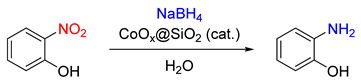
A popular approach to reduce nitrophenols is their treatment with NaBH4 as the reducing agent, which generates reactive metal hydride species on the catalyst surface, thereby promoting hydrogenation of the nitro group [5]. Such transformations have been reported for many noble metal catalysts, including Ru, Pd, Pt, Ag, and Au [5,6,9,10,11,12,13,14,15,16,17,18,19,20]. In recent years, significant research efforts have been focused on improving the sustainability of catalysts for nitrophenol reduction by replacing noble metals with earth-abundant metals and employing cost-effective synthetic methods for catalyst preparation [6,21,22,23,24,25,26,27,28,29,30,31,32,33,34,42]. However, examples of such systems remain scarce, and their practical applications are still hindered [43]. Herein, we report the facile synthesis of cobalt oxide–silica composite catalysts (CoOx@SiO2) and their use for the efficient reduction of 2-NPh to 2-APh in water. The developed materials are readily accessible from inexpensive cobalt(II) salts (Co(OAc)2, CoCl2, and CoF2) and fumed silica and demonstrate high performance in the reduction of 2-NPh, with reaction rates comparable to those of precious metal surrogates [11].
2. Results and Discussion
2.1. Preparation and Characterization of Co–O@SiO2 Composites
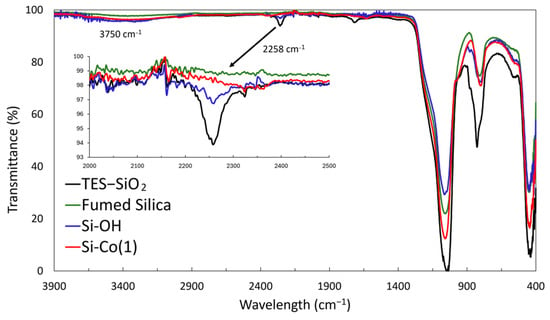
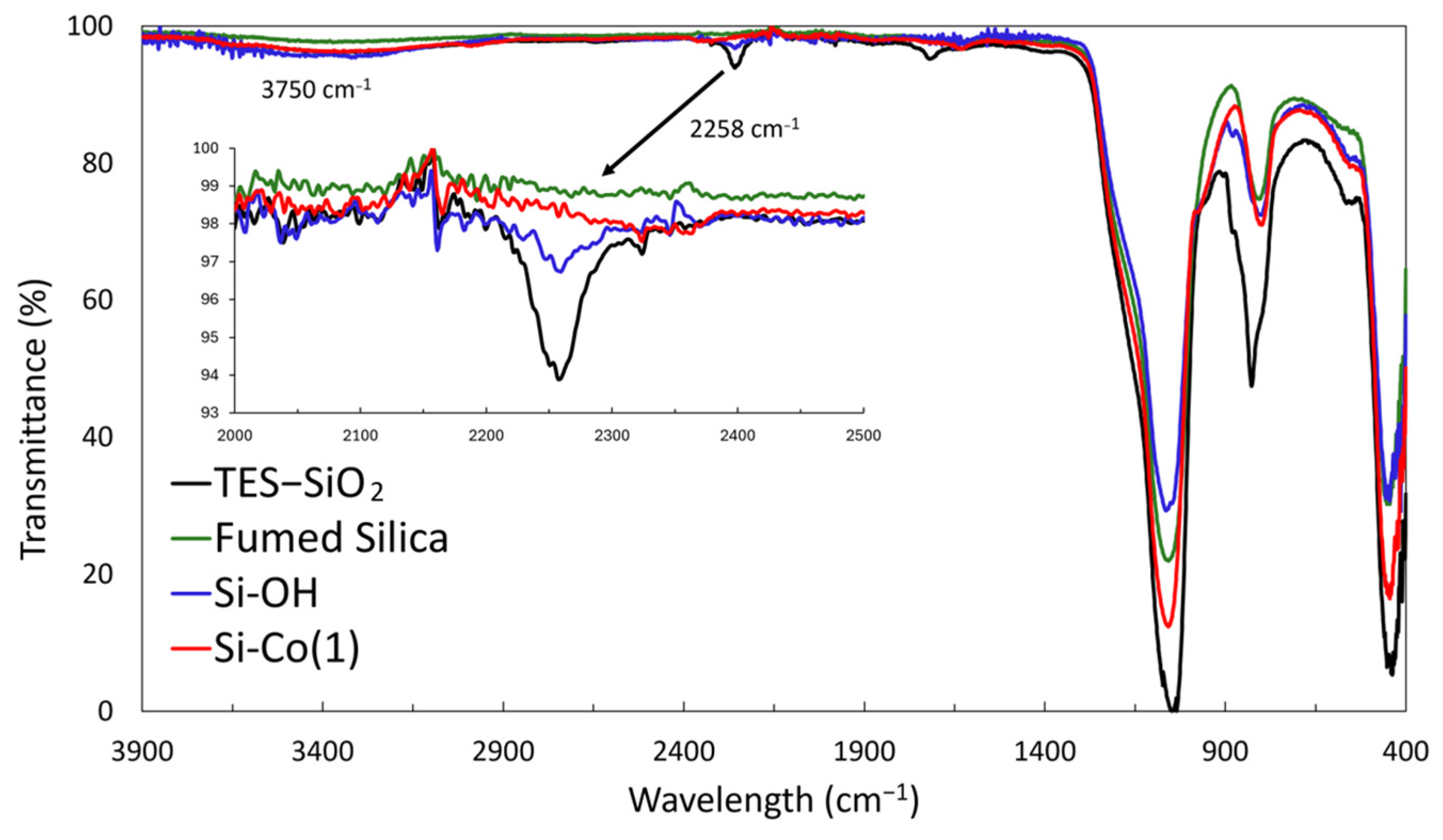
The strategy for preparing CoOx@SiO2 composite catalysts was based on a previously developed method for synthesizing noble metal nanoparticles (NPs) on fumed silica [11]. Thus, the commercial fumed silica (395 ± 25 m2/g) was first treated with NaOH to increase the Si-OH content (confirmed by Fourier transform infrared spectroscopy (FTIR), showing increased silanol stretching at υ 3750 cm−1 [44,45,46]), followed by the silica surface modification with triethoxysilane (HSi(OEt)3, TES) in glacial acetic acid to generate the Si-H surface groups. The presence of the Si-H functional groups on the silica surface was confirmed by FTIR, which showed the disappearance of O–H stretching vibrations of free surface silanol groups at υ 3750 cm−1 and revealed a characteristic Si-H stretch at υ 2258 cm−1 [44,45,46] (Figure 1). The concentration of surface Si-H groups was determined by iodometric titration [45,47], which revealed that 1.1 mmol of ≡Si-H groups per gram of silica were generated.
Figure 1.
FTIR spectra of fumed silica (green), Si-OH-modified silica (blue), TES–SiO2 (black), and Si-Co(1) composite (red).
Given the previously reported application of TES–SiO2 as a reductant in the preparation of noble metal NPs/silica composites [11], the prepared TES–SiO2 was treated with aqueous solutions of Co(II) salts, Co(OAc)2 (OAc = acetate), CoCl2, and CoF2. These cobalt precursors were selected based on their commercial availability in the region and their likely reactivity with the surface Si-H groups of TES–SiO2 due to the affinity of silicon for oxygen and halogens. FTIR analysis of the resulting materials revealed the disappearance of the Si-H stretch (see Figure 1), suggesting the in situ reduction of Co(II) to Co(0), analogous to that of previously tested noble metals (Ru, Pd, Pt, Ag, and Au) [11,46]. The obtained materials were subsequently washed with deionized (DI) water and dried for 18 h at 100 °C under aerobic conditions, which, given the well-known surface instability of Co(0) particles to oxidation [48], afforded the cobalt oxide composites Si-Co(1) (derived from Co(OAc)2), Si-Co(2) (derived from CoCl2), and Si-Co(3) (derived from CoF2).
The content and the oxidation state of the cobalt species in composites Si-Co(1), Si-Co(2), and Si-Co(3) were determined using inductively coupled plasma mass spectrometry (ICP–MS), inductively coupled plasma optical emission spectroscopy (ICP-OES), and X-ray photoelectron spectroscopy (XPS), respectively. Based on ICP-MS and/or ICP-OES, the cobalt content in all prepared composite materials ranged from 1.7·10−2 mmol·g−1 to 3.4·10−2 mmol·g−1, with the highest cobalt loading of (2.9 ± 0.5)·10−2 mmol·g−1 ((1.7 ± 0.3)·10−1 wt%) for Si-Co(1), derived from Co(OAc)2 (Table 1, entry 1). This was followed by the Si-Co(2) composite formed with CoCl2, which showed (2.2 ± 0.2)·10−2 mmol·g−1 ((1.3 ± 0.1)·10−1 wt%) of cobalt (Table 1, entry 2). The material derived from CoF2 exhibited the lowest cobalt content, at (2.0 ± 0.3)·10−2 mmol·g−1 ((1.1 ± 0.2)·10−1 wt%; Table 1, entry 3). SEM-EDS (scanning electron microscopy–energy dispersive X-ray spectroscopy) analysis of all three composites showed a similar cobalt content of about 0.1 wt% (see Figures S13–S15 in the Supplementary Materials). Characterization of the Si-Co(1) composite by powder X-ray diffraction analysis (XRD) was also attempted but revealed unresolved spectral bands due to the low Co content (Figure S11). Furthermore, transmission electron microscopy (TEM) of Si-Co(1) showed no agglomeration of cobalt nanoparticles, suggesting dispersion of cobalt species on the silica surface (see Figure S20).
Table 1.
Cobalt content in Si-Co(1), Si-Co(2), and Si-Co(3) determined by ICP-MS/OES 1.
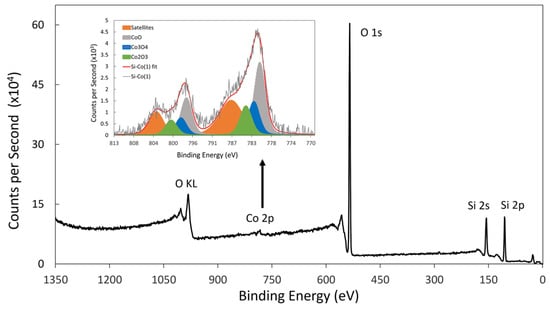
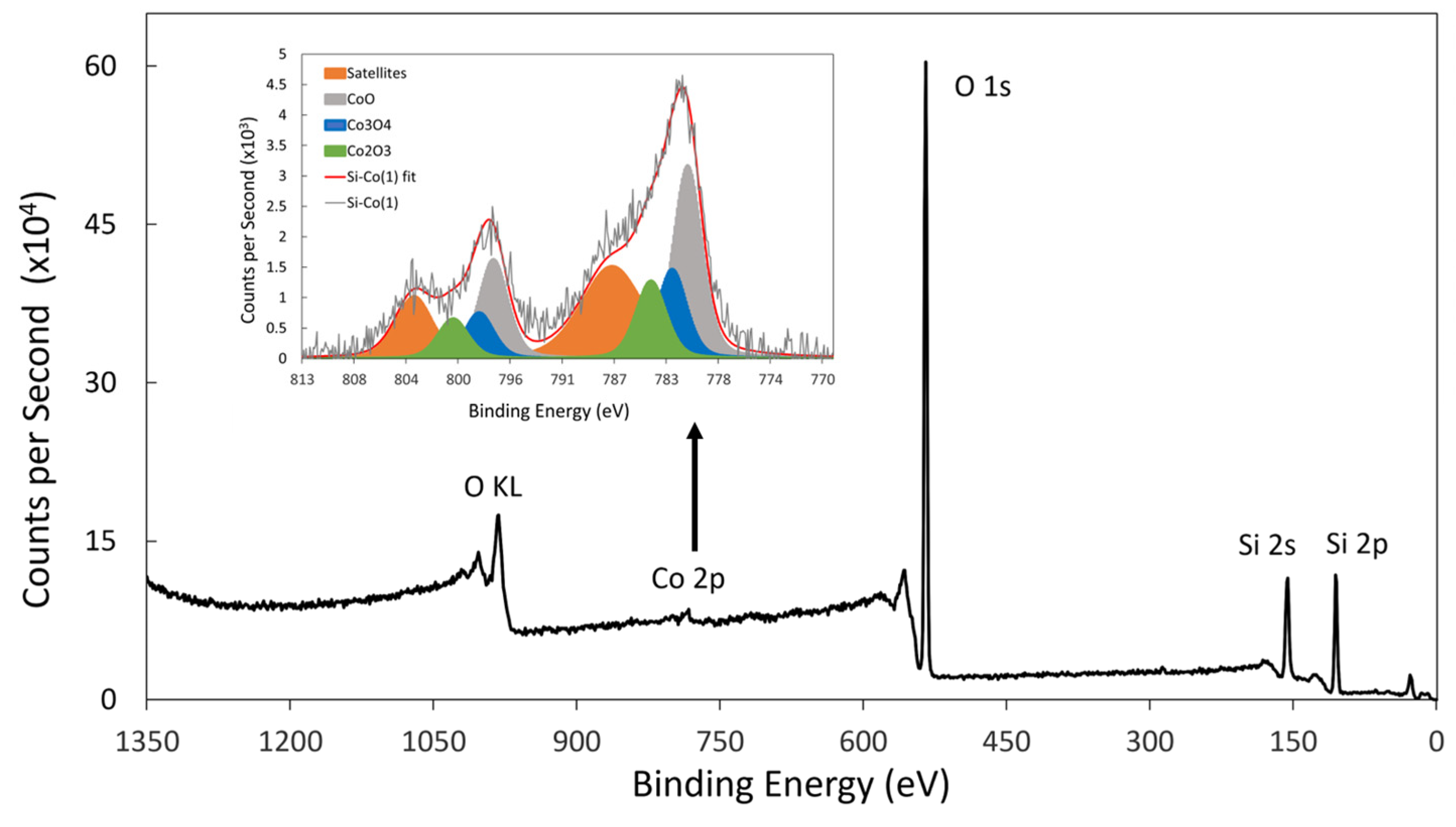
The XPS analysis (Figure 2) provided further insights into the identity of the cobalt species present on the silica surface. Thus, the Co 2p XPS spectrum for Si-Co(1) showed characteristic peaks for oxidic Co [49,50,51,52], with binding energies of 781.2 eV and 797.0 eV for Co 2p3/2 and Co 2p1/2 electrons, respectively (Figure 2). Satellite peaks for oxidic Co were also observed at 787.1 eV and 803.5 eV. The deconvolution of the Co 2p XPS spectrum of Si-Co(1) suggested the presence of a mixture of oxidic Co2+ and Co3+ species on the surface (61.4% and 38.6%, respectively, based on peak areas for CoO (780.9 eV and 796.9 eV), Co2O3 (783.9 eV and 800.3 eV), and Co3O4 (782.2 eV and 798.1 eV) from Co 2p XPS spectrum deconvolution [53]). In contrast, for Si-Co(2) and Si-Co(3) composites, unresolved XPS spectra were observed, presumably due to the comparatively low cobalt surface content of these materials. Therefore, further analysis was performed on the Si-Co(1) composite, which had the highest surface concentration of cobalt oxide species among the three prepared composites.
Figure 2.
XPS spectra of the Si-Co(1) composite: survey scan and Co 2p spectrum (inset).
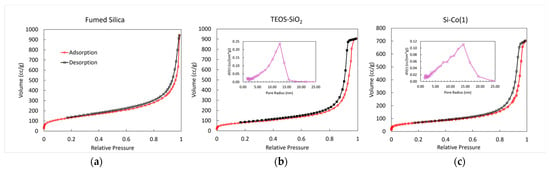
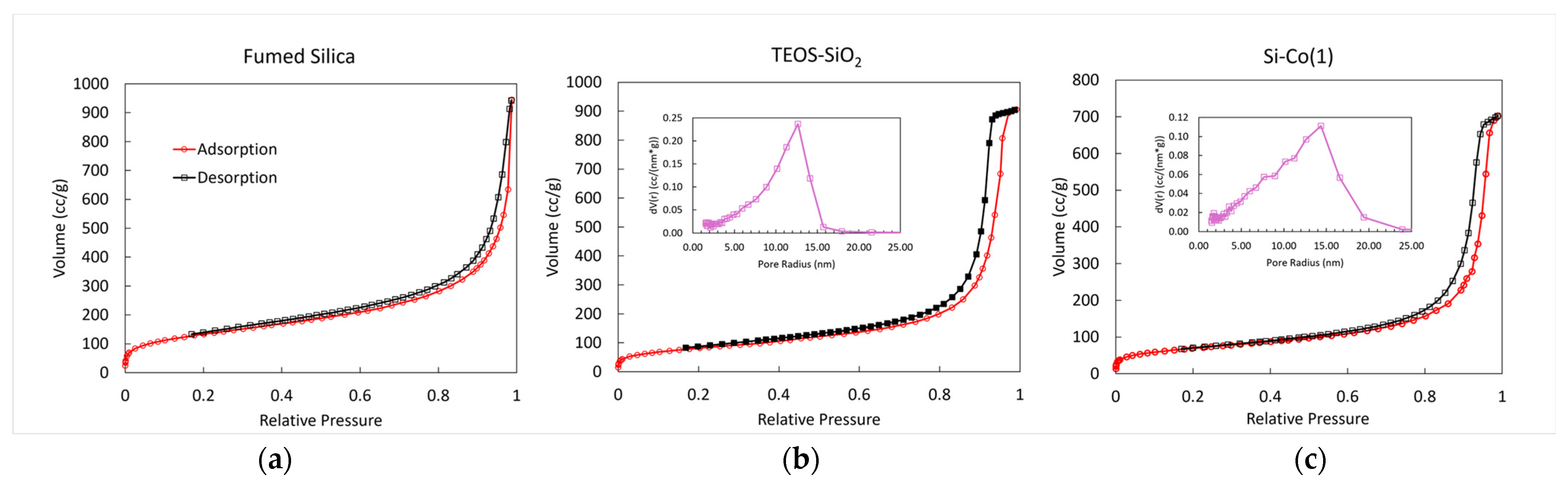
Nitrogen adsorption/desorption isotherms of the starting fumed silica, TES–SiO2, and Si-Co(1) composite were recorded at 77 K (Figure 3). Consistent with the nature of unmodified fumed silica, its adsorption/desorption isotherms belong to Type III, characteristic of non-porous materials (Figure 3a). In contrast, nitrogen adsorption/desorption isotherms for TES–SiO2 and Si-Co(1) composites indicated mesoporous structures (Type IV isotherms; Figure 3b and Figure 3c, respectively). Thus, the pore radius of the TES–SiO2 material was found to be 12.7 nm, with a pore volume of 1.39 cm3·g−1. Compared to fumed SiO2 (395 m2·g−1) and consistent with the increased pore size, the TES–SiO2 sample showed a significantly decreased specific surface area of 285 m2·g−1, determined by DFT (density functional theory) method [54,55] (the BET (Brunauer–Emmett–Teller) method [56] showed an analogous trend with specific surface areas for TES–SiO2 and fumed SiO2 of 299 m2·g−1 and 486 m2·g−1, respectively). For Si-Co(1), the specific surface area (228 m2·g−1 and 249 m2·g−1 by DFT and BET methods, respectively) was found to be smaller compared to that of TES–SiO2 and almost half that of the initial fumed SiO2 sample (vide supra), suggesting the fusion of silica primary particles upon the synthesis of the composite. This is also reflected in the decreased pore volume of the Si-Co(1) composite measured at saturation (1.07 cm3·g−1 vs. 1.39 cm3·g−1 for TES–SiO2), whereas the pore radius for Si-Co(1) somewhat increased to 14.4 nm (vs. 12.7 nm for TES–SiO2).
Figure 3.
Nitrogen adsorption/desorption isotherms for fumed SiO2 (a), TES–SiO2 (b), and Si-Co(1) (c), and the pore size distribution (inset) for TES–SiO2 and Si-Co(1).
The thermogravimetric analysis (TGA) of freshly prepared TES–SiO2 and the Si-Co(1) composite (temperature range 30–1000 °C; heating rate 10 °C/min; argon atmosphere) revealed only small amounts of moisture in both samples. The observed mass loss for both samples below 200 °C was approximately 1 wt%, attributed to the loss of physisorbed water (Figures S21 and S22). Overall, both TES-SiO2 and Si-Co(1) exhibited high thermal stability, with low weight loss up to 1000 °C, and final residue weights of 98.2% and 96.7%, respectively. To ensure no changes in the moisture content in TES–SiO2 and CoOx@SiO2 composites, all prepared materials were stored under an argon atmosphere.
2.2. Catalytic Reduction of 2-Nitrophenol
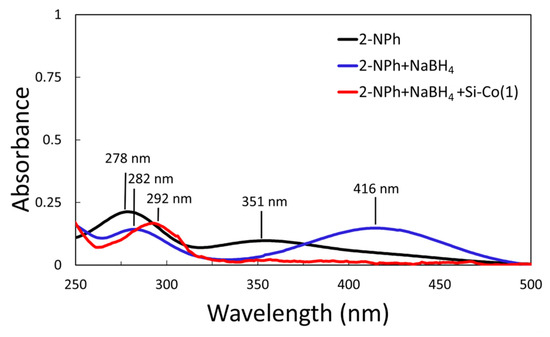
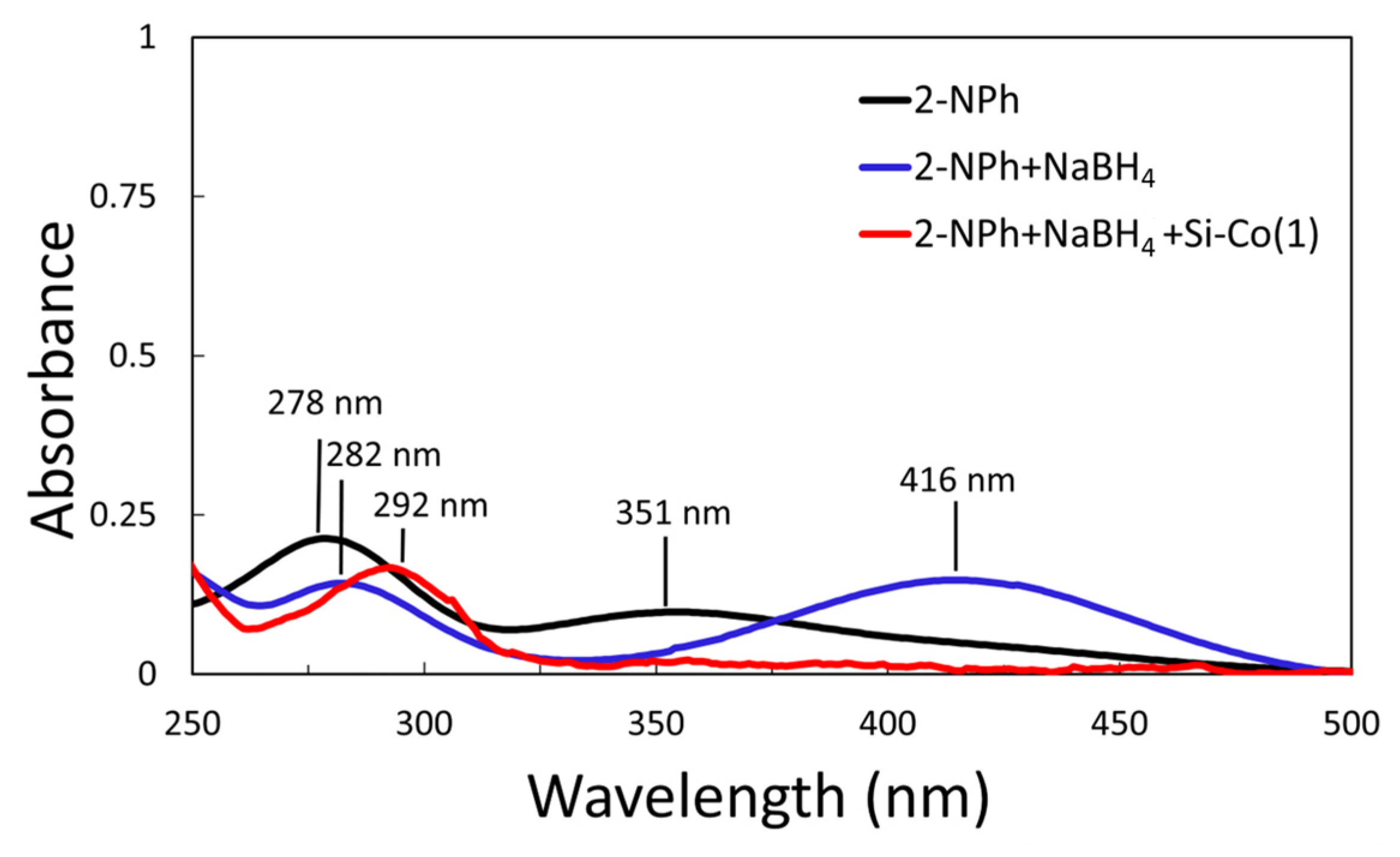
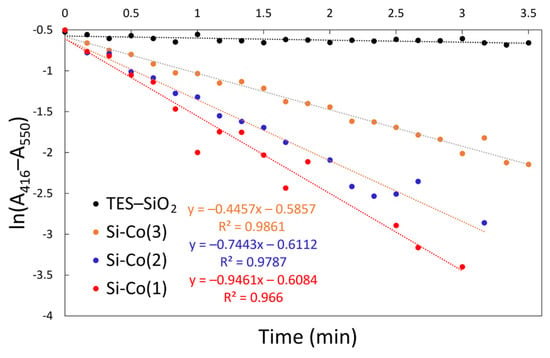
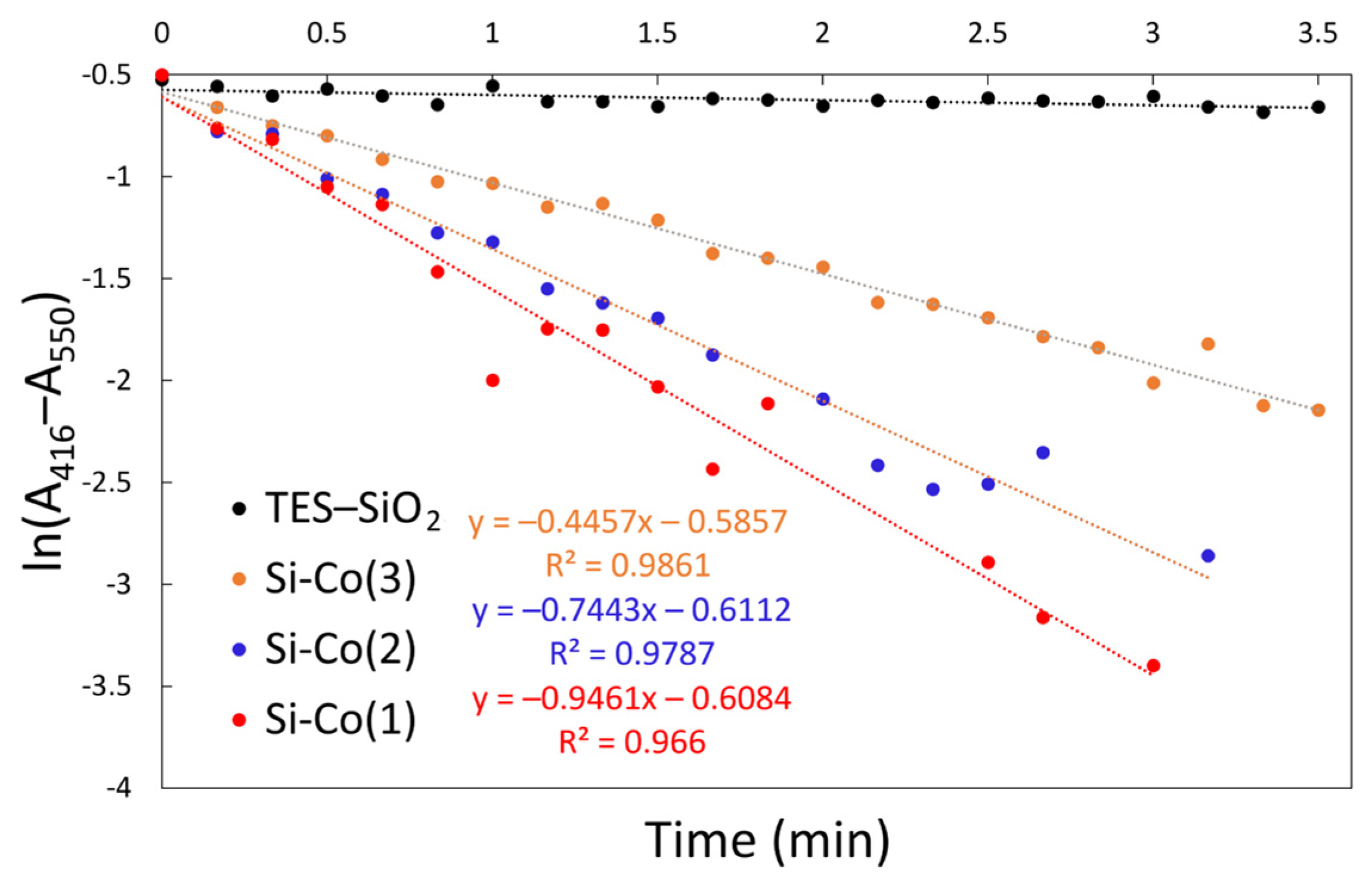
The reduction of 2-NPh with NaBH4 was carried out in water using all three prepared composites, Si-Co(1), Si-Co(2), and Si-Co(3). TES–SiO2 was also subjected to 2-NPh reduction and showed no catalytic activity, indicating the necessity of the cobalt species in the catalyst material. In contrast, rapid reduction reactions were observed in the presence of CoOx@SiO2 composites, accompanied by discoloration of the yellow aqueous 2-NPh solution (Figure S24). The 1H-NMR analysis of the solid residue after evaporation of water from the reaction mixtures revealed the complete conversion of 2-NPh and the formation of 2-APh as the sole reaction product (Figure S25). The efficiency of the prepared composite pre-catalysts in reducing 2-NPh with NaBH4 was assessed using UV-Vis spectroscopy. The reactions were performed in a 10 mm path-length quartz UV-Vis cuvette at a 0.75 μmol 2-NPh scale (C = 0.15 mmol·L−1), using 0.75 mmol of NaBH4 and 7.7 mg of CoOx@SiO2 composites, and the progress of the reaction was monitored by UV-Vis spectroscopy. The UV-Vis spectrum of an aqueous solution of 2-NPh showed two distinct absorbance bands at 278 nm and 351 nm [11]. The addition of NaBH4 to the aqueous solution of 2-NPh led to the formation of 2-nitrophenolate, resulting in shifts in the absorbance bands to 282 nm and 416 nm, respectively (Figure 4) [57]. In the absence of CoOx@SiO2 composites or in the presence of TES–SiO2, these absorbance bands remained unaffected. In contrast, the addition of composites Si-Co(1), Si-Co(2), and/or Si-Co(3) facilitated the disappearance of the absorbance band at 416 nm and the shift of the absorbance peak at 282 nm to 291 nm, indicating the formation of 2-APh (Figure 4) [11,58]. Consistent with the highest cobalt loading (vide supra), Si-Co(1) proved to be the most efficient pre-catalyst, resulting in the disappearance of the absorbance band at 416 nm and discoloration of the reaction mixture in 3 min at room temperature (vs. 4.5 min and 7.5 min for composites Si-Co(2) and Si-Co(3), respectively). Continuous monitoring of the absorbance at 416 nm during the CoOx@SiO2-catalyzed reduction of 2-NPh and plotting the absorbance changes expressed as ln(A416–A550) (where A416 and A550 are absorbances at 416 nm and 550 nm, respectively; the absorbance at 550 nm was chosen as a baseline reference point [11], as no features were observed at this wavelength) vs. the reaction time revealed the pseudo-first-order kinetics for the reactions with the rate constants (k) for Si-Co(1), Si-Co(2), and Si-Co(3) of 9.5·10−1 min−1, 7.4·10−1 min−1, and 4.6·10−1 min−1, respectively (Figure 5; Table 2, entries 1–3). Notably, these values of the rate constants are comparable to those previously reported for analogous noble metal NPs/SiO2-catalized (metal = Pt, Ru, and Au) transformations (found within the range of 1.3·10−1 min−1–8.6·10−1 min−1) [11]. At 1.5 μmol loading of 2-NPh (C = 0.5 mmol·L−1), keeping the same amounts of all other components (0.75 mmol of NaBH4 and 7.7 mg of Si-Co(1)), the disappearance of the 2-NPh absorbance at 416 nm in the Si-Co(1)-catalyzed reaction was observed within 5.5 min at room temperature (k = 5.3·10−1 min−1; Table 2, entry 4; Figures S5 and S6), whereas the same reactions with 0.15 mmol and 15 μmol of NaBH4 took 18.5 min (k = 1.6·10−1 min−1; Table 2, entry 5; Figures S3 and S4) and 1.5 h (k = 0.4·10−1 min−1; Table 2, entry 6; Figure S2), respectively. Importantly, no catalytic activity was observed for TES–SiO2 (Figure 5, black data points), the bare TES-modified silica without cobalt, under the same experimental conditions as described above. Moreover, under identical reaction conditions (Table 2, entry 1), the reduction of 2-NPh with NaBH4 under argon atmosphere using a composite prepared similarly to Si-Co(1) but under anaerobic conditions was found to be faster (k = (13.3 ± 1.03)·10−1 min−1; Figure S27) than the analogous “in air” transformation catalyzed by Si-Co(1) (k = (9.5 ± 0.49)·10−1 min−1). Assuming a lower content of oxidized cobalt vs. low-oxidation-state cobalt compounds in the composite prepared under inert atmosphere, the observed lower reaction rate of Si-Co(1)-catalyzed reduction of 2-NPh under aerobic conditions is likely associated with the activation of the oxidic cobalt species with NaBH4 to form catalytically active Co(0) [59,60,61,62] or/and cobalt borides, CoxB [63,64] (vide infra).
Figure 4.
UV-Vis spectra taken from an aqueous solution of 2-NPh before NaBH4 addition (black), after NaBH4 addition (blue), and 3 min after addition of Si-Co(1) and NaBH4 (red).
Figure 5.
Reaction kinetics analysis for the CoOx@SiO2-catalyzed reduction of 2-NPh (0.15 mmol·L−1) with NaBH4 (0.15 mol·L−1).
Table 2.
Reaction times (t) and rate constants (k) of 7.7 mg CoOx@SiO2-catalyzed reduction of 2-NPh with NaBH4.
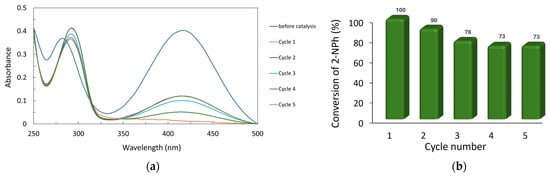
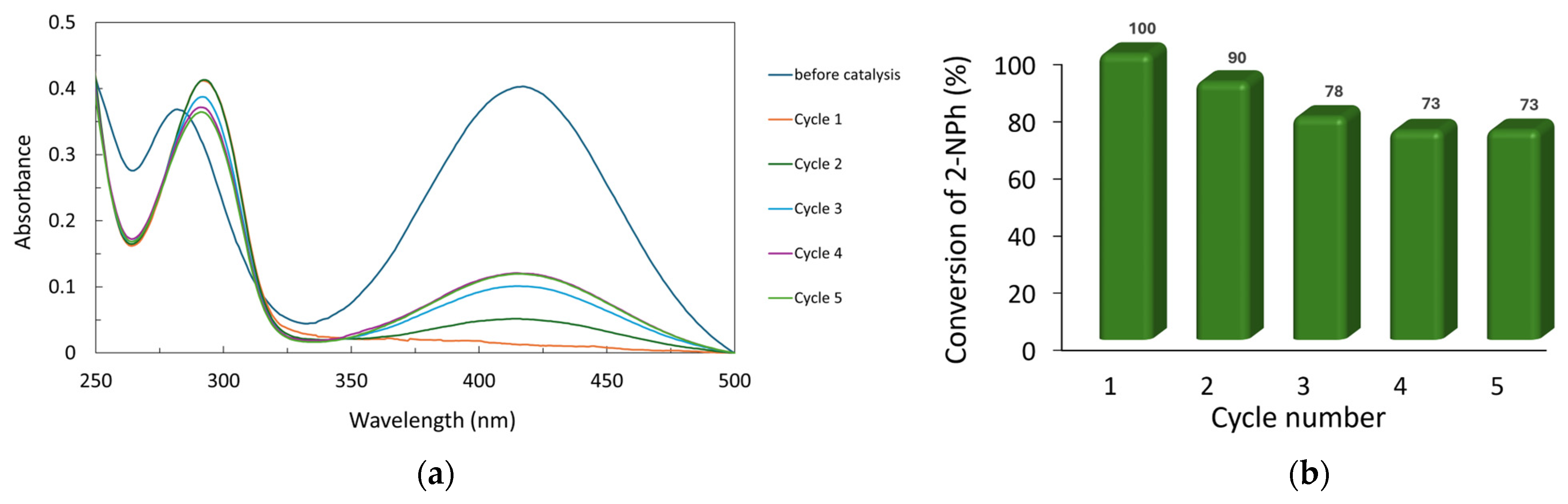
The reusability and recyclability of Si-Co(1) in the reduction of 2-NPh were also tested (Figure 6). The reaction was carried out for five consecutive cycles, with the catalyst separated by centrifugation of the reaction mixture after each cycle. Each catalytic cycle was carried out at room temperature for 10 min using the conditions listed in Table 2, entry 4 (7.7 mg of Si-Co(1), 3 mL of H2O, 1.5 μmol of 2-NPh, 0.75 mmol of NaBH4). The conversion of 2-NPh to 2-APh was calculated based on the UV-Vis spectra recorded after each cycle (Figure 6a). Overall, the catalyst maintained its activity throughout the five 2-NPh reduction cycles, although a decrease in the conversion of 2-NPh to 73–78% was observed after the second cycle (Figure 6b). Analogous conversions of 2-NPh were perceived when the catalyst reusability/recyclability test was repeated on a larger scale using 4.5 μmol of 2-NPh, 2.25 mmol of NaBH4, and 23.1 mg of Si-Co(1) in 9 mL of H2O (see Figure S28). However, the ICP-OES analysis of the catalyst material recovered after the fifth cycle of the latter experiment showed about 30% of the cobalt loss compared to the starting Si-Co(1).
Figure 6.
The reusability and recyclability of Si-Co(1) in the reduction of 2-NPh (conditions: 7.7 mg of Si-Co(1), 3 mL of H2O, C(2-NPh) = 0.5 mmol·L−1, C(NaBH4) = 0.25 mol·L−1, 5 cycles, each 10 min at room temperature): (a) UV-Vis spectra for reduction cycles 1–5, and (b) conversion of 2-NPh for reduction cycles 1–5.
A possible scenario for triggering the CoOx@SiO2-catalyzed conversion of 2-NPh to 2-APh is the reduction of the surface Co2+/Co3+ with NaBH4 to Co(0) [59,60,61,62] and/or CoxB boride species [63,64,65]. Indeed, vigorous hydrogen evolution was observed during the CoOx@SiO2-catalyzed reduction of 2-NPh with NaBH4, whereas in the absence of 2-NPh, the Si-Co(1) composite was found to effectively mediate the release of H2 gas from an aqueous solution of NaBH4 [60,61], possibly through intermediate formation of a cobalt boride species as a hydrogen mediator [63,64]. The reduction of Co2+/Co3+ by NaBH4 is likely followed by cobalt-mediated H transfer to the nitro group of 2-NPh to yield 2-APh [66,67]. Indeed, the catalytic activity of supported Co(0) NPs in the reduction of the related 4-NPh by NaBH4 has been documented in the literature [27,68]. Moreover, free Co(0) NPs, generated in situ from an aqueous Co(OAc)2 solution (30 mol% Co), also proved active in the reduction of 2-NPh with NaBH4, showing complete reduction of 2-NPh within 8 min at room temperature (k = (7.9 ± 0.21)·10−1 min−1; Figures S10 and S23). On the other hand, cobalt boride intermediates, CoxB, formed by the reaction of surface Co2+/Co3+ with NaBH4 can also mediate the reduction of the nitro group of 2-NPh by NaBH4, and such transformations have been previously described in the literature [67]. In addition, for comparison with Si-Co(1), Si-Co(2), and Si-Co(3), a cobalt oxide–silica composite, Si-Co(4) derived from unmodified commercial fumed silica, was prepared, following a slightly modified protocol reported in the literature [69,70]. For this, fumed SiO2 (395 m2/g) was impregnated with Co(OAc)2, and the resulting material was dried at 100 °C for 18 h and calcined at 500 °C for 2 h under aerobic conditions. However, in contrast to Si-Co(1), Si-Co(2), and Si-Co(3), the Si-Co(4) composite showed no catalytic activity in the reduction of 2-NPh with NaBH4 (Figure S26), suggesting an important role of the surface silicon hydride groups in the surface stabilization and/or dispersion of cobalt species in TES-SiO2-derived composites.
3. Materials and Methods
3.1. Materials
Commercially available fumed Silica (Sigma-Aldrich, Saint Louis, MO, USA, 395 m2/g), Co(OAc)2·4H2O (Sigma-Aldrich), CoF2 (Sigma, Saint Louis, MO, USA), CoCl2 (Acros Organics, Geel, Belgium), NaOH (Sigma-Aldrich, >98%), triethoxysilane (Sigma-Aldrich, 95%), glacial acetic acid (Sigma-Aldrich), methanol (Sigma-Aldrich, 99.9% (GC)), nitric acid (Sigma-Aldrich, ACS reagent, 70%), hydrofluoric acid (Sigma-Aldrich; 48 wt.%), 2-nitrophenol (Acros Organics, 99%), NaBH4 (Sigma-Aldrich, >98%), and D2O (Aldrich; 99.9 atom% D) were used as received without further purification. Deionized (DI) water was obtained using the Thermo Barnstead 7155 reverse osmosis system (Thermo Fisher, Waltham, MA, USA).
3.2. Characterization Techniques
FTIR (Fourier transform infrared spectroscopy) was performed using a Nicolet iS10 FT-IR spectrometer (Thermo Fisher, Waltham, MA, USA). SEM (scanning electron microscopy) analysis was carried out using Crossbeam 540 (Carl Zeiss, Jena, Germany). TEM (transmission electron microscopy) was performed using a JEM-1400 Plus (JEOL, Tokyo, Japan). ICP-MS (inductively coupled plasma mass spectrometry) was performed using iCAP RQ ICP-MS (Thermo Scientific, Waltham, MA, USA); conc. HNO3 and conc. HF were used for sample digestion. ICP-OES (inductively coupled plasma optical emission spectroscopy) was carried out using Icap 6300 (Thermo Scientific); conc. HNO3 and conc. HF were used for sample digestion. Powder XRD (X-ray diffraction) was carried out using SmartLab XRD (Rigaku, Tokyo, Japan). XPS (X-ray photoelectron spectroscopy) was carried out using the Thermo Scientific Nexsa XPS System. The XPS spectra were collected using an AlKα source, 400 µm spot size, 0.10 eV step size, and 50 eV band pass energy for regions, and 1.0 eV step size and 100 eV band pass energy for surveys. Thermo Avantage (version 5.9931 build 06755, Thermo Fisher Scientific, Waltham, MA, USA) was used for peak fitting and quantitative data analysis. Binding energies (BEs) were calibrated against the C 1s line of 284.8 eV [71]. Symmetric line shapes were fitted using a mixed Gaussian/Lorentzian (GL(30)) model. For each Co electronic state, the Co 2p1/2 BE position was restricted to Co 2p3/2 +14.99 eV, and the Co 2p1/2 peak area was restricted to Co 2p3/2 × 0.514. TGA (thermal gravimetric analysis) curves were recorded under argon using a STA 449 F3 Jupiter TGA (Netzsch, Selb, Germany) analyzer at a heating rate of 10 °C/min from 30 to 1000 °C. Nitrogen adsorption–desorption isotherms were recorded using the Autosorb iQ Nitrogen porosimeter (Anton Paar, Graz, Austria). Absorbance was monitored to track the progress of the catalytic reactions using an Evolution 300 UV-Vis spectrophotometer with a double-beam optical design and a Xenon flash lamp (Thermo Fisher Scientific, Waltham, MA, USA). 1H-NMR (Proton Nuclear Magnetic Resonance) spectra were recorded in D2O (Aldrich, Saint Louis, MO, USA, 99.9 atom % D) using JEOL ECA-500 MHz spectrometer (1H: 500 MHz) (JEOL, Tokyo, Japan), the spectra were referenced to residual 1H resonance of D2O (δ 4.79 ppm [72]).
3.3. Preparation of Cobalt Oxide–Silica Composites
3.3.1. Synthesis of TES-SiO2
Silica was prepared following a slightly modified procedure from the literature [11]. For this, 6 g of commercial fumed silica (Sigma-Aldrich, 395 m2/g) was dispersed in an aqueous solution of NaOH (1:0.01 w/w ratio of silica to NaOH) and stirred at 65 °C for 24 h. The mixture was then cooled down to room temperature, and glacial CH3COOH was added to neutralize the unreacted NaOH. The solid was separated by vacuum filtration, then washed three times with 10 mL of methanol, and dried at 100 °C for 48 h. A total of 3.0 g of this material was placed in a round-bottom flask equipped with a reflux condenser and immersed in an oil bath maintained at 90 °C. A solution of triethoxysilane (0.65 mL, 3.5 mmol) in 60 mL of glacial acetic acid was added, and the suspension was stirred for 2 h. After cooling to room temperature, the product, TES–SiO2 silica, was collected by vacuum filtration and dried at 100 °C for 48 h (2.5 g).
3.3.2. Synthesis of CoOx@SiO2
TES–SiO2 silica (100 mg) was suspended in 10 mL of 10 mmol·L−1 aqueous Co(OAc)2 solution. The obtained suspension was stirred at room temperature in the dark for 1 h and then centrifuged (4000 rpm, 10 min). The supernatant was decanted, and the solid was washed three times with 10 mL of DI water, centrifuging after each wash. The obtained solid material of Si-Co(1) was dried in an oven at 100 °C for 18 h (50 mg). CoOx@SiO2 composites Si-Co(2) (derived from CoCl2) and Si-Co(3) (derived from CoF2) were prepared analogously to Si-Co(1), yielding 47 mg and 51 mg of products, respectively. The prepared composite materials were stored under an argon atmosphere in a single-station LC Technologies Solutions (Salisbury, MA, USA) inert-atmosphere glovebox.
For comparative studies, an oxidic cobalt–silica composite derived from commercial fumed silica was prepared following a slightly modified procedure from the literature [63,64]. Specifically, fumed silica (100 mg; Sigma-Aldrich, 395 m2/g) was suspended in 10 mL of 10 mmol·L−1 aqueous Co(OAc)2 solution, and the resulting suspension was stirred at room temperature in the dark for 1 h. Then, the mixture was centrifuged (4000 rpm for 10 min), the supernatant was decanted, and the remaining solid was washed three times with 10 mL of DI water, centrifuging after each wash. The obtained solid material was dried in an oven at 100 °C for 18 h. Afterward, the dried sample was placed in a muffle furnace at 500 °C for 2 h, and the solid material of Si-Co(4) (42 mg) was obtained.
3.4. CoOx@SiO2-Catalyzed Reduction of 2-Nitrophenol
The catalytic reduction of 2-NPh was performed directly in a 1 cm path-length quartz UV-Vis cuvette, and the reaction was monitored by UV-Vis spectroscopy, tracking the disappearance of the 2-NPh absorbance band at 416 nm. For this, a stock aqueous solution of 2-NPh (0.3 mmol·L−1, 100 mL) was prepared. 2.5 mL of this solution, along with 7.7 mg of CoOx@SiO2 (all four composite materials, Si-Co(1), Si-Co(2), Si-Co(3), and Si-Co(4) were tested), were placed in a UV-Vis cuvette. A total of 2.5 mL of a freshly prepared aqueous NaBH4 solution (0.3 mol·L−1) was added to the mixture, and the reaction progress was monitored by UV-Vis using LabSolutions UV-Vis software (version 1.11, 2020 Shimadzu Corporation, Kyoto, Japan), with continuous absorbance measurements at 416 and 550 nm to check the conversion of 2-NPh to 2-APh. The absorbance difference at 416 nm and 550 nm was calculated, and this data was used for further kinetic analysis and to calculate the reaction rate constants (see Figure 5). Si-Co(1)-catalyzed reactions at 1.5 μmol loading of 2-NPh (C = 0.5 mmol·L−1) and 0.75 mmol, 0.15 mmol and 15 μmol loading of NaBH4 (C = 0.25 mol·L−1, 50 mmol·L−1 and 5.0 mmol·L−1, respectively) were performed analogously, monitoring the disappearance of the 2-NPh absorbance band by UV-Vis spectroscopy (see Figures S2–S6). The latter experiments were done to match the conditions and for the more direct comparison of the catalytic activities of this study to the literature results [11]. The obtained reaction rate constants are summarized in Table 2.
3.5. Reusability and Recyclability of Si-Co(1) in the Catalytic Reduction of 2-Nitrophenol
The catalytic reduction of 2-NPh was performed in a centrifuge tube, and the reaction was monitored by UV-Vis spectroscopy, tracking the disappearance of the 2-NPh absorbance band at 416 nm. For this, a stock aqueous solution of 2-NPh (C = 1.0 mmol·L−1, 100 mL) was prepared. 1.5 mL of this solution and 7.7 mg of the Si-Co(1) composite were placed in a tube. 1.5 mL of a freshly prepared aqueous NaBH4 solution (C = 0.5 mol·L−1) was added to the mixture. The resulting reaction mixture was left at room temperature for 10 min, then centrifuged for 5 min at 4000 rpm. The solution was decanted, transferred to a 1 cm path-length quartz UV-Vis cuvette, and analyzed using LabSolutions UV-Vis software (version 1.11, 2020 Shimadzu Corporation) over the range of 200 to 500 nm. Then, new portions of 2-NPh solution (1.5 mL, C = 1.0 mmol·L−1) and NaBH4 solution (1.5 mL, C = 0.5 mol·L−1) were added to the catalyst remaining in the centrifuge tube. The procedure was repeated for five consecutive cycles, with the catalyst separated after each cycle. UV-Vis spectra from the reaction mixture were recorded after each cycle to monitor the conversion of 2-NPh to 2-APh (see Figure 6a). The conversion of 2-NPh (see Figure 6b) was calculated based on the difference between the initial absorbance at 416 nm before the catalysis and the measured absorbance at the same wavelength after a given reaction time for each consecutive cycle. Each resulting UV-Vis spectrum was background corrected at 550 nm, as no features were observed at this wavelength [11]. The catalyst reusability and recyclability test (5 cycles) was repeated on larger scale (4.5 μmol of 2-NPh, 2.25 mmol of NaBH4, and 23.1 mg of Si-Co(1) in 9 mL of H2O) and showed conversions of 2-NPh, analogous to those observed in the small-scale experiment above (see Figure S28). In the latter experiment, the catalyst material recovered after the 5th cycle was subjected to ICP-OES analysis, which showed a 30% decrease in the concentration of cobalt, compared to Si-Co(1).
3.6. Reduction of 2-Nitrophenol Using Co(OAc)2 as Pre-Catalyst
A stock aqueous solution of 2-NPh (1.0 mM, 50 mL) was prepared. A total of 1.5 mL of this solution was mixed with 45 µL of 10.0 mM aqueous Co(OAc)2 solution in a UV-Vis cuvette. In total, 1.5 mL of a freshly prepared aqueous NaBH4 solution (50.0 mM) was added to the mixture, and the reaction progress was monitored by UV-Vis using LabSolutions UV-Vis software, with continuous absorbance measurements at 416 and 550 nm to confirm the full conversion of 2-NPh to 2-APh. The reaction was completed within 8 min at room temperature. The absorbance difference at 416 nm and 550 nm was calculated, and this data was used for further kinetic analysis and to calculate the reaction rate constants (see Figure S10).
4. Conclusions
To summarize, CoOx@SiO2 composites were prepared via the sequential in situ reduction of Co(II) salts (Co(OAc)2, CoCl2, and CoF2) with TES-modified fumed silica having surface silicon hydride groups, followed by the rapid aerobic oxidation of surface Co(0) to Co2+/Co3+ oxide species. The prepared CoOx@SiO2 composites were tested as catalysts for the reduction of 2-NPh with NaBH4. Despite the low cobalt content of approximately 0.2 wt%, the composite derived from Co(OAc)2 exhibited the highest efficiency in reducing 2-NPh to 2-APh, offering a cost-effective, readily available, non-precious-metal-based system for the remediation of nitrophenols from contaminated water. Moreover, given the simplicity of the developed method and widespread applications of the first-row transition metal oxides in heterogeneous catalysis, environmental remediation, and materials science, this methodology can now be applied to the fabrication of silica-supported composites with other 3D metal oxides. Preparation of such materials and their catalytic activities in environmentally and industrially relevant reduction processes are currently under investigation in our laboratories.
Supplementary Materials
The following supporting information can be downloaded at: https://www.mdpi.com/article/10.3390/molecules31132282/s1, Figure S1. UV-Vis spectra taken from an aqueous solution of 2-NPh before NaBH4 addition (black), after NaBH4 addition (blue), and 3 min after addition of Si-Co(1) and NaBH4 (red). Figure S2. Reaction kinetics analysis for the Si-Co(1)-catalyzed reduction of 2-NPh (mmol·L−1) with NaBH4 (5.0 mmol·L−1). Figure S3. Reaction kinetics analysis for the Si-Co(1)-catalyzed reduction of 2-NPh (0.5 mmol·L−1) with NaBH4 (50 mmol·L−1). Figure S4. Reaction kinetics analysis with linear regression analysis for the Si-Co(1)-catalyzed reduction of 2-NPh (0.5 mmol·L−1) with NaBH4 (50 mmol·L−1). Figure S5. Reaction kinetics analysis for the Si-Co(1)-catalyzed reduction of 2-NPh (0.5 mmol·L−1) with NaBH4 (0.25 mol·L−1). Figure S6. Reaction kinetics analysis with linear regression analysis for the Si-Co(1)-catalyzed reduction of 2-NPh (0.5 mmol·L−1) with NaBH4 (0.25 mol·L−1). Figure S7. Reaction kinetics analysis with linear regression analysis for the Si-Co(1)-catalyzed reduction of 2-NPh (0.15 mmol·L−1) with NaBH4 (0.15 mol·L−1). Figure S8. Reaction kinetics analysis with linear regression analysis for the Si-Co(2)-catalyzed reduction of 2-NPh (0.15 mmol·L−1) with NaBH4 (0.15 mol·L−1). Figure S9. Reaction kinetics analysis with linear regression analysis for the Si-Co(3)-catalyzed reduction of 2-NPh (0.15 mmol·L−1) with NaBH4 (0.15 mmol·L−1). Figure S10. Reaction kinetics analysis with linear regression analysis for the cobalt (II) acetate (30 mol% Co) catalyzed reduction of 2-NPh (0.5 mmol·L−1) with NaBH4 (50 mmol·L−1). Figure S11. Powder XRD spectrum for Si-Co(1). Figure S12. SEM-EDS analysis for TES–SiO2. Figure S13. SEM-EDS analysis for Si-Co(1). Figure S14. SEM-EDS analysis for Si-Co(2). Figure S15. SEM-EDS analysis for Si-Co(3). Figure S16. SEM images of TES–SiO2. Figure S17. SEM images of Si-Co(1). Figure S18. SEM images of Si-Co(2). Figure S19. SEM images of Si-Co(3). Figure S20. TEM images of fumed SiO2 (a), TES–SiO2 (b), and Si-Co(1) (c). Figure S21. TGA curve for TES–SiO2. Figure S22. TGA curve for Si-Co(1). Figure S23. Reaction mixture of 2-NPh with NaBH4 and cobalt (II) acetate as catalysts (30 mol% Co) at the beginning (left) and the end (after 8 min at room temperature) of the reaction (right). Figure S24. Reaction mixture of 2-NPh with NaBH4 and Si-Co(1) as catalysts at the beginning (left) and the end (after 3 min at room temperature) of the reaction (right). Figure S25. 1H-NMR spectra (in D2O) of 2-NPh (top) and the solid residue after Si-Co(1)-catalyzed reduction of 2-NPh with NaBH4, showing complete conversion of 2-NPh and formation of 2-APh (bottom). Figure S26. UV-Vis spectra taken from an aqueous solution of 2-NPh after NaBH4 addition (black), and 10 min after addition of Si-Co(4) and NaBH4 (red). Figure S27. Reaction kinetics analysis with linear regression analysis for the reduction of 2-NPh (0.15 mmol·L−1) with NaBH4 (0.15 mol·L−1) performed under argon atmosphere (in degassed water) using a composite prepared analogously to Si-Co(1) but under anaerobic conditions. Figure S28. The reusability and recyclability of Si-Co(1) in the reduction of 2-NPh (conditions: 23.1 mg of Si-Co(1), 9 mL of H2O, C(2-NPh) = 0.5 mmol·L−1, C(NaBH4) = 0.25 mol·L−1, 5 cycles, each cycle is 10 min at room temperature (conversions of 2-NPh: cycle 1—100%, cycle 2—87±5%, cycle 3—78 ± 1%, cycle 4—71 ± 3%, cycle 5—68 ± 7%). Note that concentrations of 2-NPh and NaBH4 did not change from the experiment described in Figure 6, the volume of each solution was increased three times along with the loading of catalyst. Additional analytical data supporting the manuscript, including UV-Vis spectra, 1H-NMR spectra, and kinetics analysis plots for CoOx@SiO2-catalyzed reduction of 2-NPh, XRD spectrum of Si-Co(1), SEM-EDS analysis and SEM images of TES-SiO2 and CoOx@SiO2 composites, TGA of TES-SiO2 and Si-Co(1), and the photographs of reaction mixtures before and after Si-Co(1)- and Co(OAc)2-mediated reduction of 2-NPh, TEM images of fumed SiO2, TES-SiO2, and Si-Co(1).
Author Contributions
Conceptualization, A.Y.K. and V.J.I.; methodology, A.Y.K. and V.J.I.; validation, A.Y.K. and A.G.; formal analysis, A.Z., A.G. and A.Y.K.; investigation, A.Z., A.G., and A.Y.K.; resources, A.Y.K.; data curation, A.Z., A.G. and A.Y.K.; writing—original draft preparation, A.Z., A.G., and A.Y.K.; writing—review and editing, A.Z., A.G., A.Y.K. and V.J.I.; visualization, A.Z. and A.G.; supervision, A.Y.K.; project administration, A.Y.K.; funding acquisition, A.Y.K. All authors have read and agreed to the published version of the manuscript.
Funding
This research was funded by the Science Committee of the Ministry of Science and Higher Education of the Republic of Kazakhstan, project number AP23486987 to A.Y.K., and Nazarbayev University, grant number 201223FD8826 to A.Y.K. The APC was funded by the Science Committee of the Ministry of Science and Higher Education of the Republic of Kazakhstan under project number AP23486987 for A.Y.K.
Institutional Review Board Statement
Not applicable.
Informed Consent Statement
Not applicable.
Data Availability Statement
Data supporting the reported results are available in the Supplementary Materials for this article and from the authors.
Acknowledgments
The authors thank Nazarbayev University Core Facilities for assistance with the analysis of composite materials and catalytic reactions. We also thank Alibek Nurseiit (Department of Chemical and Materials Engineering, School of Engineering and Digital Sciences (SEDS), Nazarbayev University) for preliminary testing of the catalytic activity of CoOx@SiO2 composites.
Conflicts of Interest
The authors declare no conflicts of interest. The funders had no role in the design of the study; in the collection, analyses, or interpretation of data; in the writing of the manuscript; or in the decision to publish the results.
References
- Qian, M.; Zhang, Y.; Bian, Y.; Feng, X.; Zhang, Z. Nitrophenols in the environment: An update on pretreatment and analysis techniques since 2017. Ecotoxicol. Environ. Saf. 2024, 281, 116611. [Google Scholar] [CrossRef] [Scilit] [PubMed]
- Cañizares, P.; Sáez, C.; Lobato, J.; Rodrigo, M.A. Electrochemical Treatment of 4-Nitrophenol-Containing Aqueous Wastes Using Boron-Doped Diamond Anodes. Ind. Eng. Chem. Res. 2004, 43, 1944–1951. [Google Scholar] [CrossRef] [Scilit]
- Toxic and Priority Pollutants Under the Clean Water Act. Available online: https://www.epa.gov/eg/toxic-and-priority-pollutants-under-clean-water-act (accessed on 5 May 2026).
- Ma, Y.; Wu, X.; Zhang, G. Core-shell Ag@Pt nanoparticles supported on sepiolite nanofibers for the catalytic reduction of nitrophenols in water: Enhanced catalytic performance and DFT study. Appl. Catal. B Environ. 2017, 205, 262–270. [Google Scholar] [CrossRef] [Scilit]
- Cardoso Juarez, A.O.; Ocampo Lopez, E.I.; Kesarla, M.K.; Bogireddy, N.K.R. Advances in 4-Nitrophenol detection and reduction methods and mechanisms: An updated review. ACS Omega 2024, 9, 33335–33350. [Google Scholar] [CrossRef] [Scilit] [PubMed]
- Din, I.M.; Khalid, R.; Hussain, Z.; Hussain, T.; Mujahid, A.; Najeeb, J.; Izhar, F. Nanocatalytic Assemblies for Catalytic Reduction of Nitrophenols: A Critical Review. Crit. Rev. Anal. Chem. 2020, 50, 322–338. [Google Scholar] [CrossRef] [Scilit] [PubMed]
- Ying, J.Y.; Mehnert, C.P.; Wong, M.S. Synthesis and Applications of Supramolecular-Templated Mesoporous Materials. Angew. Chem. Int. Ed. 1999, 38, 56–77. [Google Scholar] [CrossRef] [Scilit]
- Zheng, A.L.T.; Teo, E.Y.L.; Seenivasagam, S.; Hung, Y.P.; Boonyuen, S.; Chung, E.L.T.; Lease, J.; Andou, Y. Nanostructures embedded on porous materials for the catalytic reduction of nitrophenols: A concise review. J. Porous Mater. 2024, 31, 1557–1575. [Google Scholar] [CrossRef] [Scilit]
- El-Sheikh, S.M.; Ismail, A.A.; Al-Sharab, J.F. Catalytic reduction of p-nitrophenol over precious metals/highly ordered mesoporous silica. New J. Chem. 2013, 37, 2399–2407. [Google Scholar] [CrossRef] [Scilit]
- Le, X.; Dang, Z.; Li, X.; Zhang, W.; Le, M.; Ma, J. Fibrous nano-silica supported palladium nanoparticles: An efficient catalyst for the reduction of 4-nitrophenol and hydrodechlorination of 4-chlorophenol under mild conditions. Catal. Commun. 2015, 59, 21–25. [Google Scholar] [CrossRef] [Scilit]
- Korobeinyk, A.V.; Whitby, R.D.L.; Mikhalovsky, S.V.; Inglezakis, V.J. In situ production of high purity noble metal nanoparticles on fumed silica and catalytic activity towards 2-nitrophenol reduction. J. Phys. Chem. Solids 2019, 127, 28–34. [Google Scholar] [CrossRef] [Scilit]
- Khormi, A.Y.; Al-Shehri, B.M.; Al-Zahrani, F.A.M.; Hamdy, M.S.; Fouda, A.; Shaaban, M.R. Palladium Nanoparticles Incorporated Fumed Silica as an Efficient Catalyst for Nitroarenes Reduction via Thermal and Microwave Heating. Catalysts 2023, 13, 445. [Google Scholar] [CrossRef] [Scilit]
- Bogireddy, N.K.R.; Sahare, P.; Pal, U.; Méndez, S.F.O.; Gomez, L.M.; Agarwal, V. Platinum nanoparticle-assembled porous biogenic silica 3D hybrid structures with outstanding 4-nitrophenol degradation performance. Chem. Eng. J. 2020, 388, 124237. [Google Scholar] [CrossRef] [Scilit]
- Subhan, F.; Aslam, S.; Yan, Z.; Yaseen, M.; Marwat, A.; Ahmad, A. Catalytic reduction of nitrophenol and MB waste water using homogeneous Pt NPs confined in hierarchically porous silica. J. Environ. Chem. Eng. 2021, 9, 105567. [Google Scholar] [CrossRef] [Scilit]
- Daware, K.D.; Shinde, R.N.; Khedkar, C.V.; Patil, S.I.; Pandey, A.K.; Ashokkumar, M.; Gosavi, S.W. Enhanced catalytic activity of platinum decorated silica nanocrystals in rapid reduction of organic dyes. Chem. Phys. Impact 2022, 5, 100109. [Google Scholar] [CrossRef] [Scilit]
- Wang, Z.; Fu, H.; Han, D.; Gu, F. The effects of Au species and surfactant on the catalytic reduction of 4-nitrophenol by Au@SiO2. J. Mater. Chem. A 2014, 2, 20374–20381. [Google Scholar] [CrossRef] [Scilit]
- Mohanta, J.; Satapathy, S.; Si, S. Porous Silica-Coated Gold Nanorods: A Highly Active Catalyst for the Reduction of 4-Nitrophenol. ChemPhysChem 2016, 17, 364–368. [Google Scholar] [CrossRef] [Scilit] [PubMed]
- Mehta, A.; Sharma, M.; Kumar, A.; Basu, S. Gold Nanoparticles Grafted Mesoporous Silica: A Highly Efficient and Recyclable Heterogeneous Catalyst for Reduction of 4-Nitrophenol. Nano 2016, 11, 1650104. [Google Scholar] [CrossRef] [Scilit]
- Kalyan, I.; Pal, T.; Pal, A. Immobilization of size variable Au nanoparticles on surfactant-modified silica and their catalytic application toward 4-nitrophenol reduction: A comparative account of catalysis. Surf. Interfaces 2021, 26, 101423. [Google Scholar] [CrossRef] [Scilit]
- Hu, R.; Xu, R.; Wang, Z.; Wang, J.; Zhou, S. Enhanced catalytic nitrophenol reduction via highly porous hollow silica nanospheres stabilized Au nanoclusters. Chem. Eng. J. 2023, 471, 144780. [Google Scholar] [CrossRef] [Scilit]
- Jiang, Z.; Xie, J.; Jiang, D.; Jing, J.; Qin, H. Facile route fabrication of nano-Ni core mesoporous-silica shell particles with high catalytic activity towards 4-nitrophenol reduction. CrystEngComm 2012, 14, 4601–4611. [Google Scholar] [CrossRef] [Scilit]
- Niu, Z.; Zhang, S.; Sun, Y.; Gai, S.; He, F.; Dai, Y.; Li, L.; Yang, P. Controllable synthesis of Ni/SiO2 hollow spheres and their excellent catalytic performance in 4-nitrophenol reduction. Dalton Trans. 2014, 43, 16911–16918. [Google Scholar] [CrossRef] [Scilit] [PubMed]
- Zhang, S.; Gai, S.; He, F.; Ding, S.; Li, L.; Yang, P. In situ assembly of well-dispersed Ni nanoparticles on silica nanotubes and excellent catalytic activity in 4-nitrophenol reduction. Nanoscale 2014, 6, 11181–11188. [Google Scholar] [CrossRef] [Scilit] [PubMed]
- Pan, W.; Zhang, S.; He, F.; Gai, S.; Sun, Y.; Yang, P. A cheap and efficient catalyst with ultra-high activity for reduction of 4-nitrophenol. CrystEngComm 2015, 17, 5744–5750. [Google Scholar] [CrossRef] [Scilit]
- Ghimire, P.P.; Zhang, L.; Kinga, U.A.; Guo, Q.; Jinag, B.; Jaroniec, M. Development of nickel-incorporated MCM-41–carbon composites and their application in nitrophenol reduction. J. Mater. Chem. A 2019, 7, 9618–9628. [Google Scholar] [CrossRef] [Scilit]
- Ghiat, I.; Saadi, A.; Bachari, K.; Coville, N.J.; Boudjemaa, A. Catalytic reduction of 4-nitrophenol to 4-aminophenol over Ni/SiO2 catalyst made from reduced SiO2@NiPhy. Res. Chem. Intermed. 2023, 49, 4349–4365. [Google Scholar] [CrossRef] [Scilit]
- Yan, N.; Zhao, Z.; Li, Y.; Wang, F.; Zhong, H.; Chen, Q. Synthesis of Novel Two-Phase Co@SiO2 Nanorattles with High Catalytic Activity. Inorg. Chem. 2014, 53, 9073–9079. [Google Scholar] [CrossRef] [Scilit] [PubMed]
- Meziane, D.; Benadda-Kordjani, A.; Nezzal, G.; Benammar, S.; Djadoun, A. Para-nitrophenol reduction on solvothermally prepared cobalt@silica core–shell catalysts. React. Kinet. Mech. Catal. 2017, 122, 1145–1158. [Google Scholar] [CrossRef] [Scilit]
- Huo, H.; Jiang, Y.; Wang, Z.; Hu, Y.; Zhao, T.; Liu, X.; Xu, X.; Lin, K. Carbonyl oxygen-coordinated metallic cobalt nanoparticles anchored on hybrid mesoporous silica matrix to enhance 4-nitrophenol hydrogenation. J. Mater. Sci. 2021, 56, 364–379. [Google Scholar] [CrossRef] [Scilit]
- Jiang, J.; Lim, Y.S.; Park, S.; Kim, S.-H.; Yoon, S.; Piao, L. Hollow porous Cu particles from silica-encapsulated Cu2O nanoparticle aggregates effectively catalyze 4-nitrophenol reduction. Nanoscale 2017, 9, 3873–3880. [Google Scholar] [CrossRef] [Scilit] [PubMed]
- Schlichter, S.; Rocha, M.; Peixoto, A.F.; Pires, J.; Freire, C.; Alvarez, M. Copper mesoporous materials as highly efficient recyclable catalysts for the reduction of 4-nitrophenol in aqueous media. Polyhedron 2018, 150, 69–79. [Google Scholar] [CrossRef] [Scilit]
- Das, R.; Ghosh, S.; Naskar, M.K. Metallic CuNPs confined in hollow silicalite-1: Excellent catalytic efficiency in p-nitrophenol reduction. New J. Chem. 2018, 42, 476–482. [Google Scholar] [CrossRef] [Scilit]
- Belkaid, N.; Boukoussa, B.; Mokhtar, A.; Hachemaoui, M.; Beldjilali, M.; Mekki, A.; Haichi, S.; Bengueddach, A.; Hamacha, R. Antibacterial Activity and Catalytic Reduction of 4-Nitrophenol and Methylene Blue on MCM-41 Modified by CuNPs. Silicon 2022, 14, 8505–8516. [Google Scholar] [CrossRef] [Scilit]
- Aslam, S.; Subhan, F.; Waqas, M.; Zifeng, Y.; Yaseen, M.; Naeem, M. Cu nanoparticles confined within ZSM-5 derived mesoporous silica (MZ) with enhanced stability for catalytic hydrogenation of 4-nitrophenol and degradation of azo dye. Microporous Mesoporous Mater. 2023, 354, 112547. [Google Scholar] [CrossRef] [Scilit]
- Munnik, P.; de Jongh, P.E.; de Jong, K.P. Recent Developments in the Synthesis of Supported Catalysts. Chem. Rev. 2015, 115, 6687–6718. [Google Scholar] [CrossRef] [Scilit] [PubMed]
- Park, J.; Maier, J.S.; Evans, C.; Hatzell, M.; France, S.; Sievers, C.; Bommarius, A.S. One-pot mechanochemical hydrogenation and acetylation of 4-nitrophenol to 4-aminophenol and paracetamol. Green. Chem. 2024, 26, 4079–4091. [Google Scholar] [CrossRef] [Scilit]
- Mitchell, S.C.; Carmichael, P.; Waring, R. Aminophenols. In Kirk-Othmer Encyclopedia of Chemical Technology, 5th ed.; Kirk-Othmer, Ed.; Wiley: Hoboken, NJ, USA, 2003. [Google Scholar] [CrossRef] [Scilit]
- Thawarkar, S.R.; Thombare, B.; Munde, B.S.; Khupse, N.D. Kinetic investigation for the catalytic reduction of nitrophenol using ionic liquid stabilized gold nanoparticles. RSC Adv. 2018, 8, 38384–38390. [Google Scholar] [CrossRef] [Scilit] [PubMed]
- Brown, H.K.; El Haskouri, J.; Marcos, M.D.; Ros-Lis, J.V.; Amorós, P.; Úbeda Picot, M.Á.; Pérez-Pla, F. Synthesis and Catalytic Activity for 2, 3, and 4-Nitrophenol Reduction of Green Catalysts Based on Cu, Ag and Au Nanoparticles Deposited on Polydopamine-Magnetite Porous Supports. Nanomaterials 2023, 13, 2162. [Google Scholar] [CrossRef] [Scilit] [PubMed]
- Avalos-Ballester, V.; Acosta, B.; Smolentseva, E. Remarkable Enhancement of Catalytic Reduction of Nitrophenol Isomers by Decoration of Ni Nanosheets with Cu Species. ACS Omega 2024, 9, 37981–37994. [Google Scholar] [CrossRef] [Scilit] [PubMed]
- Mahmoud, M.E.; Amira, M.F.; Abouelanwar, M.E.; Seleim, S.M. Catalytic reduction of nitrophenols by a novel assembled nanocatalyst based on zerovalent copper-nanopolyaniline-nanozirconium silicate. J. Mol. Liq. 2020, 299, 112192. [Google Scholar] [CrossRef] [Scilit]
- Formenti, D.; Ferretti, F.; Schamagl, F.K.; Beller, M. Reduction of Nitro Compounds Using 3d-Non-Noble Metal Catalysts. Chem. Rev. 2019, 119, 2611–2680. [Google Scholar] [CrossRef] [Scilit] [PubMed]
- Hernandez Ortega, J. Earth Abundant Catalysts For Environmental Sustainability Applications. Ph.D. Thesis, University of Texas at El Paso, El Paso, TX, USA, May 2024. Available online: https://scholarworks.utep.edu/open_etd/4104/ (accessed on 26 June 2026).
- Bellamy, A.L.J. The Infra-Red Spectra of Complex Molecules, 3rd ed.; Chapman and Hall: London, UK, 1975; pp. 374–383. [Google Scholar]
- Katok, K.V.; Whitby, R.L.D.; Fayon, F.; Bonnamy, S.; Mikhalovsky, S.V.; Cundy, A.B. Synthesis and Application of Hydride Silica Composites for Rapid and Facile Removal of Aqueous Mercury. ChemPhysChem 2013, 14, 4126–4133. [Google Scholar] [CrossRef] [Scilit] [PubMed]
- Katok, K.V.; Whitby, R.L.D.; Fukuda, T.; Maekawa, T.; Bezverkhyy, I.; Mikhalovsky, S.V.; Cundy, A.B. Hyperstoichiometric Interaction Between Silver and Mercury at the Nanoscale. Angew. Chem. Int. Ed. 2012, 51, 2632–2635. [Google Scholar] [CrossRef] [Scilit] [PubMed]
- Crompton, T.R. Analysis of Organoaluminium and Organozinc Compounds, 1st ed.; Pergamon: Oxford, UK, 1968; pp. 252–264. [Google Scholar]
- Zhang, X.-H.; Ho, K.M.; Wu, A.-H.; Wong, K.H.; Li, P. Hydrothermal Microemulsion Synthesis of Oxidatively Stable Cobalt Nanocrystals Encapsulated in Surfactant/Polymer Complex Shells. Langmuir 2010, 26, 6009–6014. [Google Scholar] [CrossRef] [Scilit] [PubMed]
- Stemmler, T.; Westerhaus, F.A.; Surkus, A.-E.; Pohl, M.-M.; Junge, K.; Beller, M. General and selective reductive amination of carbonyl compounds using a core–shell structured Co3O4/NGr@C catalyst. Green Chem. 2014, 16, 4535–4540. [Google Scholar] [CrossRef] [Scilit]
- Biesinger, M.C.; Payne, B.P.; Grosvenor, A.P.; Lau, L.W.M.; Gerson, A.R.; Smart, R.S.C. Resolving surface chemical states in XPS analysis of first row transition metals, oxides and hydroxides: Cr, Mn, Fe, Co and Ni. Appl. Surf. Sci. 2011, 257, 2717–2730. [Google Scholar] [CrossRef] [Scilit]
- Chen, L.; Yin, Z.-H.; Cui, J.-Y.; Li, C.-Q.; Song, K.; Liu, H.; Wang, J.-J. Unlocking Lattice Oxygen on Selenide-Derived NiCoOOH for Amine Electrooxidation and Efficient Hydrogen Production. J. Am. Chem. Soc. 2024, 146, 27090–27099. [Google Scholar] [CrossRef] [Scilit] [PubMed]
- Chen, L.; Tan, H.; Zhang, Y.-P.; Song, K.; Liu, H.; Wang, J.-J. Orthogonal Control of Lattice Oxygen Activation and Oxygen Evolution Reaction Suppression via “Molecular Gates” for High-Efficiency Nitrile Electrosynthesis. Angew. Chem. Int. Ed. 2025, 64, e202513640. [Google Scholar] [CrossRef] [Scilit] [PubMed]
- Moulder, J.F.; Stickle, W.F.; Sobol, P.E.; Bomben, K.D. Handbook of X-Ray Photoelectron Spectroscopy; Perkin-Elmer: Eden Prairie, MN, USA, 1992. [Google Scholar]
- Landers, J.; Gor, G.Y.; Neimark, A.V. Density functional theory methods for characterization of porous materials. Colloids Surf. A Physicochem. Eng. Asp. 2013, 437, 3–32. [Google Scholar] [CrossRef] [Scilit]
- Olivier, J.P.; Occelli, M.L. Surface Area and Microporosity of a Pillared Interlayered Clay (PILC) from a Hybrid Density Functional Theory (DFT) Method. J. Phys. Chem. B 2001, 105, 623–629. [Google Scholar] [CrossRef] [Scilit]
- Fagerlund, G. Determination of specific surface by the BET method. Mat. Constr. 1973, 6, 239–245. [Google Scholar] [CrossRef] [Scilit]
- Liu, H.; Yang, Q. Facile fabrication of nanoporous Au–Pd bimetallic foams with high catalytic activity for 2-nitrophenol reduction and SERS property. J. Mater. Chem. 2011, 21, 11961–11967. [Google Scholar] [CrossRef] [Scilit]
- Makkar, P.; Gogoi, D.; Roy, D.; Ghosh, N.N. Dual-Purpose CuFe2O4-rGO-Based Nanocomposite for Asymmetric Flexible Supercapacitors and Catalytic Reduction of Nitroaromatic Derivatives. ACS Omega 2021, 6, 28718–28728. [Google Scholar] [CrossRef] [Scilit] [PubMed]
- Rysak, V.; Descamps-Mandine, A.; Simon, P.; Blanchard, F.; Burylo, L.; Trentesaux, M.; Vandewall, M.; Collière, V.; Agbossou-Niedercorn, F.; Michon, C. Selective ligand-free cobalt-catalysed reduction of esters to aldehydes or alcohols. Catal. Sci. Technol. 2018, 8, 3504–3512. [Google Scholar] [CrossRef] [Scilit]
- Khan, M.N.; Bashir, O.; Khan, T.A.; Al-Thabaiti, S.A.; Khan, Z. Catalytic Activity of Cobalt Nanoparticles for Dye and 4-Nitro Phenol Degradation: A Kinetic and Mechanistic Study. Int. J. Chem. Kinet. 2017, 49, 438–454. [Google Scholar] [CrossRef] [Scilit]
- Demirci, U.B.; Miele, P. Cobalt-based catalysts for the hydrolysis of NaBH4 and NH3BH3. Phys. Chem. Chem. Phys. 2014, 16, 6872–6885. [Google Scholar] [CrossRef] [Scilit] [PubMed]
- Zhang, J.; Li, X.; Liu, J.; Liu, J.; Zhang, J. Enhanced impacts of reduction on Co3O4 model catalysts by NaBH4 in the hydrolysis of ammonia borane. Fuel 2025, 381, 133716. [Google Scholar] [CrossRef] [Scilit]
- Hammud, H.H.; Aljamhi, W.A.; AlAbdullah, K.; Humayun, M.; Shawish, I. Carbon and Silica Supports Enhance the Durability and Catalytic Performance of Cobalt Oxides Derived from Cobalt Benzene-1,3,5-Tricarboxylate Complex. Catalysts 2025, 15, 881. [Google Scholar] [CrossRef] [Scilit]
- Hammud, H.H.; Traboulsi, H.; Karnati, R.K.; Hussain, S.G.; Bakir, E.M. Hierarchical Graphitic Carbon-Encapsulating Cobalt Nanoparticles for Catalytic Hydrogenation of 2,4-Dinitrophenol. Catalysts 2022, 12, 39. [Google Scholar] [CrossRef] [Scilit]
- Netskina, O.V.; Kochubey, D.I.; Prosvirin, I.P.; Malykhin, S.E.; Komova, O.V.; Kanazhevskiy, V.V.; Chukalkin, Y.G.; Bobrovskii, V.I.; Kellerman, D.G.; Ishchenko, A.V.; et al. Cobalt-boron catalyst for NaBH4 hydrolysis: The state of the active component forming from cobalt chloride in a reaction medium. Mol. Catal. 2017, 441, 100–108. [Google Scholar] [CrossRef] [Scilit]
- Baye, A.F.; Appiah-Ntiamoah, R.; Kim, H. Synergism of transition metal (Co, Ni, Fe, Mn) nanoparticles and “active support” Fe3O4@C for catalytic reduction of 4-nitrophenol. Sci. Total Environ. 2020, 712, 135492. [Google Scholar] [CrossRef] [Scilit] [PubMed]
- Lundevall, F.J.; Elumalai, V.; Drageset, A.; Totland, C.; Bjørsvik, H.-R. A Co2B Mediated NaBH4 Reduction Protocol Applicable to a Selection of Functional Groups in Organic Synthesis. Eur. J. Inorg. Chem. 2018, 2018, 3416–3425. [Google Scholar] [CrossRef] [Scilit]
- Sahiner, N.; Ozay, H.; Ozay, O.; Aktas, N. A Soft Hydrogel Reactor for Cobalt Nanoparticle Preparation and Use in the Reduction of Nitrophenols. Appl. Catal. B 2010, 101, 137–143. [Google Scholar] [CrossRef] [Scilit]
- Karandikar, P.R.; Lee, Y.-J.; Kwak, G.; Woo, M.H.; Park, S.-J.; Park, H.-G.; Ha, K.-S.; Jun, K.-W. Co3O4@Mesoporous Silica for Fischer–Tropsch Synthesis: Core–Shell Catalysts with Multiple Core Assembly and Different Pore Diameters of Shell. J. Phys. Chem. C 2014, 118, 21975–21985. [Google Scholar] [CrossRef] [Scilit]
- Mehrbod, M.; Martinelli, M.; Watson, C.D.; Cronauer, D.C.; Kropf, A.J.; Jacobs, G. Fischer-Tropsch Synthesis: The Characterization and Testing of Pt-Co/SiO2 Catalysts Prepared with Alternative Cobalt Precursors. Reactions 2021, 2, 129–160. [Google Scholar] [CrossRef] [Scilit]
- Grey, L.H.; Nie, H.-Y.; Biesinger, M.C. Defining the nature of adventitious carbon and improving its merit as a charge correction reference for XPS. Appl. Surf. Sci. 2024, 653, 159319. [Google Scholar] [CrossRef] [Scilit]
- Fulmer, G.R.; Miller, A.J.M.; Sherden, N.H.; Gottlieb, H.E.; Nudelman, A.; Stolz, B.M.; Bercaw, J.E.; Goldberg, K.I. NMR Chemical Shifts of Trace Impurities: Common Laboratory Solvents, Organics, and Gases in Deuterated Solvents Relevant to the Organometallic Chemist. Organometallics 2010, 29, 2176–2179. [Google Scholar] [CrossRef] [Scilit]

Disclaimer/Publisher’s Note: The statements, opinions and data contained in all publications are solely those of the individual author(s) and contributor(s) and not of MDPI and/or the editor(s). MDPI and/or the editor(s) disclaim responsibility for any injury to people or property resulting from any ideas, methods, instructions or products referred to in the content. |
© 2026 by the authors. Licensee MDPI, Basel, Switzerland. This article is an open access article distributed under the terms and conditions of the Creative Commons Attribution (CC BY) license.