


Abstract
The proliferation of livestream e-commerce has positioned gamification as a powerful factor of impulse buying. Extant studies have paid much attention to the positive affective reactions that are associated with gamification, yet whether and how gamification can impact impulse buying through negative affective states, such as fear of missing out (FoMO), has not been fully explored. Guided by the Stimulus-Organism-Response framework, this study develops a moderated mediation model to examine the conditional mediating effect of FoMO under two moderators, that is, perceived self-congruity and electronic word-of-mouth (eWOM). Using a valid sample of 796 respondents in Indonesia, empirical results reveal that gamification significantly and positively affects impulse buying, with FoMO partially mediating this effect. Importantly, both perceived self-congruity and eWOM can significantly attenuate the link between gamification and FoMO. The indirect effect of gamification on impulse buying via FoMO becomes weaker when perceived self-congruity or eWOM levels are high. These findings contribute to existing literature by uncovering a negative affective pathway to impulse buying, and by identifying perceived self-congruity and eWOM as critical buffers that mitigate the effect of gamification on FoMO. The validated moderated mediation model offers a more granular understanding of when gamified tactics are less effective, helping practitioners advance the design of gamified strategies.
1. Introduction
The rapid development of livestreaming has fundamentally reshaped the global digital commerce landscape. Livestream e-commerce has been advocated as a paradigm for its capacity to attract users and monetize content [1,2]. According to a report, the global livestream e-commerce market will increase to approximately USD 258.76 billion by 2034, expanding at a CAGR of 33.01% from 2025 to 2034 (https://www.precedenceresearch.com/livestream-e-commerce-market, accessed on 20 April 2026). Platforms such as TikTok and Shopee have attracted more than 1.5 billion monthly active users, a figure projected to double by 2027 (https://www.emarketer.com/topics/category/short-form%20video, accessed on 20 April 2026). Within this highly engaging environment empowered by algorithm-curated and immersive video content, consumer impulse buying has become increasingly prominent in livestream e-commerce [3,4].
Impulse buying exhibits unique characteristics and prevalence in the research setting of livestream e-commerce. In contrast to traditional e-commerce contexts, livestream e-commerce creates an emotionally charged experience, in which product presentations are embedded in dynamic narratives, live interactions, and social proof cues [2,5,6]. The swipe-based, infinite scroll architecture drastically lowers the threshold for spontaneous purchase decisions, as consumers are exposed to limited-time promotions [7]. In such a context, platform-embedded gamification features, such as limited-time lucky draws, tiered progress challenges with rewards, and accumulating points for discounts, have become core factors for impulse behavior [8,9,10].
Prior research has generated meaningful insights regarding the importance of gamification, with a focus on how gamified features improve perceived enjoyment, perceived value, and engagement, which subsequently foster impulse buying [9,11,12]. Among these valuable studies, scholars largely emphasize the role of gamification in shaping affective and cognitive factors while overlooking its influence on potential negative reactions [13]. In the context of livestream e-commerce, gamified elements such as point accumulation, voucher rewards, daily check-in tasks, and participation incentives are explicitly designed to create an engaging, reward-rich shopping environment [4,14]. Recently, fear of missing out (FoMO), a scarcity-specific emotional state characterized by anxiety that one might forgo a valuable opportunity [15], has emerged as a prevalent negative affective response in digital commerce [16,17,18]. However, limited studies have examined its role as an underlying mechanism mediating the effect of gamification on impulse buying. In livestream commerce, where gamification is tied to reward and participation, FoMO may act as a key psychological mechanism that translates reward-based gamified design into impulse behavior. This study, accordingly, attempts to investigate the mediating effect of FoMO on gamification and answer the following research question:
R1.
Whether and how does gamification affect consumers’ impulse buying via the mediating mechanism of FoMO in livestream e-commerce?
Furthermore, in order to deepen the understanding around FoMO, this study goes further to explore the boundary conditions. In particular, two moderators, grounded in consumer psychology and social influence, are drawing attention. The first, perceived self-congruity, which reflects the extent to which the product fits with an individual’s self-concept [19], can shape how an individual responds to external stimuli. When a product aligns well with a consumer’s self-image, the consumer’s purchase decision is more driven by intrinsic demand rather than the extrinsic incentives embedded in gamified features, which may weaken the effect of gamified features on FoMO. Second, electronic word-of-mouth (eWOM), defined as the perceived credibility and influence of product comments, functions as a powerful social information source that enhances informational transparency [20,21]. Credible eWOM reduces perceived ambiguity and uncertainty about the product value, and thus may dampen FoMO associated with gamified promotions [13,22]. These two moderators represent complementary perspectives on consumer decision-making, drawing respectively on internal congruence and external information. Perceived self-congruity explains how internal self-concept standards shape responses to external stimuli, while eWOM explains how external peer information shapes judgment. Despite their theoretical relevance, existing studies have not clearly examined whether and how these factors moderate the mechanism of gamification on FoMO. Thus, this study proposes perceived self-congruity and eWOM as important moderators, integrates them into our research model, and answers the second research question:
R2.
Whether and how do perceived self-congruity and eWOM moderate the influence of gamification on FoMO, thereby exerting an effect on impulse buying in livestream e-commerce?
Indonesia provides a particularly valuable context for this study. As a fast-growing market of the digital economy in Southeast Asia, Indonesia possesses a large young digital consumer base and high social commerce penetration [22]. Indonesia is characterized by high collectivism and moderate uncertainty avoidance [23]. Such cultural traits make consumers responsive to reward-based gamified features and peer-generated information [24,25].
This study accordingly develops a moderated mediation model to explain how and when gamification impacts impulse buying in livestream e-commerce through FoMO. Using a valid sample of 796 respondents collected in Indonesia, the empirical results reveal that FoMO significantly mediates the relationship between gamification and impulse buying. Both perceived self-congruity and eWOM show negative moderating effects, such that the effect of gamification on FoMO becomes weaker among consumers with higher perceived self-congruity or eWOM. Furthermore, the mediating effect of FoMO becomes stronger when consumers have lower levels of perceived self-congruity or eWOM, providing evidence for the moderated mediation paths that align with our theoretical expectations.
This study makes several contributions to extant literature in contrast with related studies. First, this study extends the gamification and consumer behavior literature with a focus on positioning FoMO as a psychological mechanism through which gamified stimuli translate into impulse behavior. Besides positive reactions, some negative emotions have attracted the attention of scholars [13,18]. For example, Zhang et al. [16] find that scarcity makes consumers generate high levels of FoMO, positively related to impulse buying. However, extant studies lack clear evidence of whether and how reward-oriented gamified elements would affect FoMO among consumers. By examining the mediating effect of FoMO, this study extends the gamification literature beyond its traditional focus on positive affective mediators. Second, by identifying perceived self-congruity and eWOM as moderators, this study delineates boundary conditions that attenuate the gamification–FoMO link. Despite the recognition of perceived self-congruity and eWOM in extant studies [11,26], their roles as boundary conditions for the affective mechanism linking gamification and FoMO have not been systematically examined. Drawing respectively on internal congruence and external information, the two moderators provide a dual contingency view of gamification’s effect on FoMO. Third, this study further clarifies the conditional indirect effects of FoMO when consumers perceive different levels of self-congruity and eWOM. Testing results of the moderated mediation model confirm that the mediating role of FoMO varies across different levels of perceived self-congruity and eWOM. By developing a moderated mediation model, this study offers a more complete theoretical lens to unpack contingent gamification consumption mechanisms in livestream e-commerce. Finally, these findings also provide actionable guidance for platform operators, streamers, and consumers. For platforms and streamers, it helps them design more reasonable gamified promotion strategies and optimize information disclosure mechanisms, while for consumers, it raises awareness of how external stimuli impact negative emotional responses and irrational consumption, helping them make more rational purchasing decisions.
2. Theoretical Background and Hypotheses
2.1. Impulse Buying
Impulse buying is a kind of irrational buying experience that is driven by an individual’s sudden desire to buy something without advance planning or careful consideration [5,27]. Unlike planned purchasing, which is typically rational and goal-oriented, impulse buying is often emotionally driven and influenced by external stimuli [28]. With the development of livestream e-commerce, consumers are continuously exposed to personalized recommendations, immersive interfaces, and gamified designs that lower the threshold for acquisition and make the transition from browsing to purchasing almost frictionless [3,29]. In such a context, impulse buying is an important behavioral outcome [7,30].
Existing studies have drawn extensively on the Stimulus-Organism-Response (SOR) model to explore how environmental stimuli affect individuals’ cognitive and affective states, which in turn influence their behavioral responses [5,31]. In livestream e-commerce, gamification elements are important stimuli that affect emotional reactions and impulse buying [32]. Prior research has identified enjoyment, arousal, and flow as key organismic states that mediate the effect of gamification on impulse purchases [4,14]. For example, the study of Fayola et al. [33] suggests that gamification elements can affect impulse behavior by increasing consumers’ sense of presence and immersion.
Besides these positive emotional reactions, a growing stream of research acknowledges that gamified designs can also evoke negative emotions such as anxiety and pressure [16,18,34]. In particular, the reward-based gamified features are likely to stimulate FoMO, that is, the feeling of anxiety or fear that arises from the possibility of missing out on a valuable opportunity [35,36]. However, empirical evidence linking gamification to FoMO, and subsequently to impulse buying, remains limited. This gap is particularly salient in livestream e-commerce, where gamified elements are embedded in the highly immersive environment. Thus, this study tries to explore the mediating role of FoMO for the relationship between gamification design in livestream e-commerce and consumers’ impulse buying.
2.2. Theoretical Framework
The SOR model serves as the theoretical framework of this study. Herein, gamification constitutes the environmental stimulus (S), FoMO represents the affective organismic state (O), and impulse buying is the behavioral response (R). According to the SOR logic, exposure to reward-based gamified features influences an internal emotional state of anxiety about missing a shopping opportunity, which then affects impulse buying.
While the SOR framework effectively specifies the mediating pathway, it remains relatively silent on the boundary conditions that may moderate the stimulus-organism link. Understanding such contingencies is critical because gamification is not universally impactful [4,37]. For instance, Hamari [38] notes that there is no significant effect between gamification and consumer participation. Thus, this study combines the SOR model with self-congruity theory and social influence theory to respectively explain the boundary mechanisms for the stimulus-organism link by introducing two moderators, that is, perceived self-congruity and eWOM.
Self-congruity theory suggests that individuals tend to maintain consistency between their behavior and their self-concept [39]. When confronted with external reward-based gamification, consumers who perceive high self-congruity with the product may be more likely to evaluate the purchase through the lens of product-self fit rather than through extrinsic gamified incentives. In the context of gamified livestream e-commerce, where reward-oriented features are designed to attract attention and encourage participation, perceived self-congruity functions as an internal reference. It provides a theoretical rationale for why some consumers can resist the anxiety associated with missing rewards and thus experience weaker FoMO. Despite its relevance, perceived self-congruity has rarely been integrated into the link between gamification and FoMO, representing a valuable theoretical opportunity.
Electronic word-of-mouth (eWOM) serves as a critical social-informational moderator. According to social influence theory [20,40], consumers utilize user-generated comments to reduce product uncertainty and assess deal value. In gamified livestream e-commerce, eWOM provides an alternative informational basis for evaluating the purchase, diminishing the perceived uncertainty surrounding product value and the potential benefits of gamified offers. This reduces consumers’ reliance on gamified cues for forming judgments, thereby undercutting the anxiety associated with missing out. This social influence framework further suggests that information from credible peers can override situational pressures [41]. Thus, eWOM acts as an external informational shield that attenuates the association between gamification and FoMO.
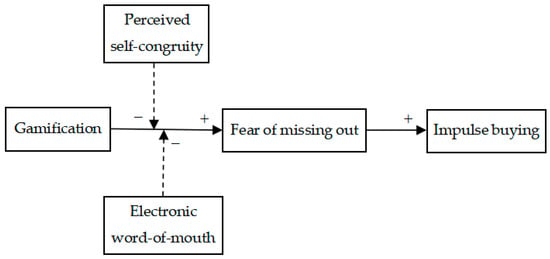
Overall, the SOR model offers a theoretical framework linking gamification to impulse buying through FoMO. Perceived self-congruity and eWOM are integrated, respectively, drawing on self-congruity theory and social influence theory, to examine the boundary conditions of this relationship. The theoretical research framework is shown in Figure 1. Gamification is expected to positively relate to FoMO, which in turn is positively associated with impulse buying. Perceived self-congruity is expected to weaken the positive relationship between gamification and FoMO. Similarly, eWOM is also hypothesized to buffer this relationship, such that the positive association between gamification and FoMO is weaker at higher levels of eWOM.
Figure 1.
Theoretical research model.
2.3. Hypothesis Development
2.3.1. The Effect of Gamification on Impulse Buying
Gamification is an important tool that stimulates consumers to engage in desirable behaviors (e.g., buying more products) by introducing gamified elements and mechanisms [11,34]. In livestream e-commerce, gamification elements are designed to capture consumer attention, generate excitement, and shorten the purchase decision timeline. Features such as point accumulation, voucher rewards, and participation incentives introduce task-oriented goals and reward-seeking dynamics that immerse consumers in the shopping process, thereby reducing the cognitive resources available for deliberate evaluation [4,42]. The rewarding sensation of completing a task (e.g., winning a discount or reaching a milestone) and the social validation from observing other participants collectively lower the psychological barriers to unplanned spending.
Prior studies have demonstrated that gamified cues increase perceived playfulness and impulse buying in online and mobile e-commerce [9,43,44]. In the highly immersive livestream e-commerce environment, these effects are likely to be magnified. Therefore, this study proposes the following hypothesis.
H1.
Gamification has a positive effect on consumers’ impulse buying in livestream e-commerce.
2.3.2. Mediating Effect of FoMO
Fear of missing out (FoMO) is a negative emotional state characterized by anxiety that one might forgo a valuable experience or opportunity that others are gaining [15,35]. Herein, FoMO is defined as purchase-related anxiety that the consumer may miss a valuable purchase opportunity. In livestream e-commerce, reward-based gamified features indicate attainable benefits, such as accumulated points, vouchers, or limited participation opportunities. Such reward-oriented cues remind consumers of the potential loss of rewards if they do not act immediately, thereby generating an anxious state of FoMO [16].
Consumers experiencing FoMO are compelled to act quickly to alleviate the discomfort of potential loss, making them highly susceptible to impulse buying. Prior research has supported the link between FoMO and impulse buying [45,46]. For example, Zhang et al. [16] found that scarcity appeals in gamified e-commerce enhanced impulse buying through FoMO. Based on these arguments, we suggest that FoMO serves as a key mediating mechanism that transmits the effect of gamification on impulse buying, and propose the following hypothesis.
H2.
FoMO mediates the relationship between gamification and impulse buying in livestream e-commerce.
2.3.3. Moderating Effects of Perceived Self-Congruity and eWOM
The effect of gamification on FoMO is unlikely to be uniform across all consumers and contexts [4]. Based on the self-congruity theory and social influence theory, we identify perceived self-congruity and eWOM as two moderators for the relationship between gamification and FoMO.
Perceived self-congruity refers to the match between an individual’s self-concept and the product [47]. Individuals are likely to buy products for their symbolic meanings, as they have an inner need to achieve a match between the product image and their self-image [39]. When consumers perceive a strong alignment between their self-concept and a product, they may perceive the opportunity as more personally relevant and thus experience FoMO about missing out on it. Thus, perceived self-congruity is expected to positively relate to consumers’ FoMO.
When exposed to reward-oriented gamified features, consumers with high perceived self-congruity are more likely to assess whether the purchase is consistent with their self-image, instead of responding impulsively to extrinsic game-based incentives. Because their evaluation is anchored in the perceived match between the product and self-concept, they are less influenced by the anxiety generated by potential loss of rewards or missed participation opportunities. In contrast, consumers with low perceived self-congruity lack a strong internal reference point for the product and are therefore more likely to rely on external gamified cues when assessing the offer, which strengthens the link between gamification and FoMO. Therefore, this study proposes the following hypothesis.
H3.
Perceived self-congruity negatively moderates the effect of gamification on FoMO in livestream e-commerce.
Electronic word-of-mouth (eWOM), comprising user-generated comments and ratings, serves as a credible source of product information that reduces uncertainty and perceived transaction risk [20,41]. Credible and influential eWOM provides consumers with reassurance that the product is of acceptable quality. For such products, consumers may feel anxious about potential losses. Thus, eWOM is expected to be positively associated with FoMO.
In the livestream e-commerce environment, eWOM is often displayed alongside gamified offers. For instance, ratings may appear overlaid on a gamified promotional video, or viewer comments evaluating a product scroll in real time. When gamification intensifies, credible and influential eWOM provides an alternative source of information. This reduces consumers’ reliance on reward-based gamified cues and lowers the uncertainty surrounding the promotion, thereby weakening the influence of gamification on FoMO [48]. Conversely, when eWOM is less credible or influential, consumers lack this alternative information and must rely more on gamified cues. As a result, their uncertainty about the product’s value increases, which amplifies the anxiety that is associated with gamified reward features. Under this condition, the effect of gamification on FoMO becomes stronger. Hence, this study argues that eWOM acts as a negative moderator for the relationship between gamification and FoMO, and proposes the following hypothesis.
H4.
eWOM negatively moderates the effect of gamification on FoMO in livestream e-commerce.
2.3.4. Moderated Mediation Effects
Taken together, the mediating and moderating hypotheses describe a moderated mediation model in which the indirect effect of gamification on impulse buying through FoMO is contingent on either perceived self-congruity or eWOM.
Specifically, consumers with higher perceived self-congruity, whose self-concept aligns more closely with the product, are less susceptible to the anxiety of missing out when exposed to reward-based gamified features. This diminishes the indirect effect of gamification on impulse buying via FoMO. Perceived self-congruity functions as an internal psychological reference that reduces dependency on external gamified incentives, which are key factors of FoMO. These rationales suggest that the indirect effect of gamification on impulse buying through FoMO will depend on the level of consumers’ perceived self-congruity.
Similarly, when eWOM is highly credible and influential, the same gamified features lower FoMO because informational reassurance mitigates uncertainty about product value and the necessity of immediate action. In such high-eWOM contexts, the indirect pathway through FoMO is consequently attenuated. Thus, this study proposes the following hypotheses.
H5.
Perceived self-congruity negatively moderates the indirect effect of gamification on impulse buying through FoMO, such that the indirect effect becomes weaker at a higher level of perceived self-congruity in livestream e-commerce.
H6.
eWOM negatively moderates the indirect effect of gamification on impulse buying through FoMO, such that the indirect effect becomes weaker at a higher level of eWOM in livestream e-commerce.
3. Methodology
3.1. Research Design and Data Collection
To empirically test the proposed hypotheses, this study adopted a structured survey methodology. The research design follows a cross-sectional survey design, targeting consumers who had purchase experience on Shopee Live in Indonesia. As one of the leading e-commerce platforms in Southeast Asia, Shopee incorporates comprehensive gamified interface mechanics theorized in our research model, thereby making it an appropriate platform for examining the effects of gamification on consumer behavior.
We distributed an online survey in May 2025 via Google Forms, with respondents recruited through multiple channels, including social media platforms and online community forums focused on e-commerce and livestream shopping in Indonesia. Participants were not offered monetary compensation, but they could voluntarily enter a lucky draw for small e-vouchers as a token of appreciation after completing the survey. Eligible respondents were required to be at least 18 years old and to have purchased at least once through Shopee Live within the three months preceding the survey.
A convenience sampling method was used to invite respondents to fill out the survey. The objective of the survey and the requirements for recruitment were introduced at the beginning of the survey. Also, we explicitly stated that there were no right or wrong answers in the survey opening, encouraging participants to provide objective, authentic responses without response consistency pressure. The participation was fully anonymous, with no collection of personally identifiable information. Individuals who had at least one purchase experience on Shopee Live were encouraged to participate in the survey. At the start of the survey, participants were required to recall their latest purchase decisions made on Shopee Live in the past three months. If they did not have any such experience, the questionnaire would be marked as invalid. A filtering question was also incorporated in the questionnaire to check whether the respondent was answering the question seriously. The filtering question was “Please choose the second answer for this question.” Regarding this filtering question, respondents who failed to select the second option were excluded.
Altogether, 1032 questionnaires were received. 43 responses were removed because respondents did not have purchase experience in the past three months. A further 52 responses were excluded due to failure on the attention-filter question. We additionally eliminated three types of problematic responses: (a) surveys completed in less than one minute (77 responses), (b) duplicate submissions from the same IP address, which were automatically recorded by Google Forms and used only for duplicate checking (8 responses), and (c) straight-lining responses in which respondents gave the same scores to all scale items (56 responses). 796 valid responses were finally obtained with a valid response rate of 77.13%.
3.2. Measurement
We developed the measurements on the basis of existing scales and modified them slightly to fit our research context using the back-translation method [49]. Original English scales were translated into Bahasa Indonesia by one bilingual researcher. Another bilingual researcher back-translated these items into English. Discrepancies were discussed and reconciled between translators to guarantee semantic equivalence.
This study defines impulse buying as an unplanned purchase experience that encompasses a strong urge to buy, the intention to act on that urge, and the immediate purchase itself. This operationalization treats impulse buying as a holistic construct reflecting the phenomenological sequence of an impulsive purchase episode, and is measured with three items [46,50]. Gamification refers to reward-oriented gamified features that make customers feel more engaged in interaction and in gaining rewards, and is measured with four items [42,51]. Fear of missing out (FoMO) is defined as a perceived anxiety and pressure about potentially missing a shopping opportunity, and is measured with four items [17]. Perceived self-congruity is defined as the match between a consumer’s self-concept and the perceived image of products, and is measured with four items adapted from Kim [26]. Electronic word-of-mouth (eWOM) is defined as the perceived credibility and influence of product-related comments, and is measured with three items adapted from Le & Ngoc [52] and Fernandes et al. [53]. A 5-point Likert scale was used in this study, anchored from 1 (strongly disagree) to 5 (strongly agree). Table 1 shows the specific measurement items.
Table 1.
Measurement items.
4. Data Analysis and Results
This study applied the Partial Least Squares (PLS) method to validate the measurements and test the proposed hypotheses. PLS relaxes the multivariate normality requirements for survey data when estimating the model [54]. Moreover, PLS is particularly suitable for examining complex models when the research objective is to predict and explain target constructs [55], which aligns with the aim of this study. The sample size of 796 valid responses exceeds the requirement suggested by the ten-times rule for PLS-SEM [55]. Furthermore, power analysis based on the guidelines of Cohen [56] indicates that this sample size provides sufficient statistical power (≥80%) to detect medium effect sizes (f2 = 0.15) at a significance level of 0.05. SmartPLS 3.0 was specifically used to analyze the data.
4.1. Descriptive Statistical Analysis
The demographics of the respondents are summarized in Table 2. The majority of respondents are female (50.5%), and the majority of respondents are younger than 35 (75.89%). In terms of education level, respondents with a bachelor’s degree account for the largest proportion, reaching 49.25%. 69.97% of respondents were employed, and 29.02% of respondents were students. Most respondents had buying experience 1–5 times (84.17%). The Fashion & Beauty category accounts for the largest proportion of products (38.07%), followed by the Electronic Devices category (25.75%).
Table 2.
Demographic description.
4.2. Common Method Bias
Given that this study uses the same measurement context and approach, common method bias (CMB) may occur when all data are collected from the same respondents through self-reported questionnaires. In order to address this potential issue, as recommended by Liang et al. [57], we first conducted a common method factor (CMF) test with SmartPLS 3.0. A unified global method latent variable was added to the measurement model, where all indicators simultaneously loaded onto their respective constructs and the shared method factor. The results in Table 3 indicate that most of the method factor loadings are insignificant, and the indicators’ substantive variances are substantially greater than their method variances. The average value of substantively explained variance is 0.772, while the average value of method-based variance is 0.004. Second, we conducted the full collinearity test of the full structural model recommended by Kock [58]. All inner variance inflation factor (VIF) values range from 1.020 to 2.375, below the threshold of 3.3, indicating no severe collinearity risk. Additionally, Harman’s single-factor test was implemented as recommended by Podsakoff et al. [59] by loading all measurement items into an exploratory factor analysis. It checks whether a single factor can explain the majority of the total variance. The results show that the first extracted factor explains 38.64% of the total variance, below the 50% threshold. Overall, we can conclude that common method bias is unlikely to be a concern in this study.
Table 3.
Common method factor analysis.
4.3. Measurement Model Test
We first examined the VIF values to check for potential multicollinearity among the measurements. As shown in Table 4, the VIF values range from 2.032 to 2.842, all below the threshold value of 5.0 [60]. This test suggests that there is no serious concern of multicollinearity.
Table 4.
Convergent validity, reliability, and VIF.
Second, we evaluated the convergent validity and reliability using the indicator loadings, Cronbach’s alpha, composite reliability (CR), and Average Variance Extracted (AVE) values. As shown in Table 4, the loading of each indicator on its corresponding construct is above 0.70; the values of Cronbach’s alpha range from 0.847 to 0.903, and all the CR scores exceed 0.9. All the values exceed the recommended threshold of 0.70 [54,61]. The AVE values for all constructs are greater than 0.5 as presented in Table 4. This suggests that the indicators explain more variance of their respective constructs than measurement error [54].
Third, discriminant validity was evaluated using the Fornell-Larcker Criterion and the Heterotrait–Monotrait Ratio (HTMT). Table 5 shows the Fornell–Larcker criterion results, where the bold diagonal entries display the square root of AVE for each construct, and the off-diagonal entries display the correlations between each pair of constructs. The results reveal that the square root of the AVE of every construct is larger than all of its cross-correlation coefficients with other constructs. The HTMT test results presented in Table 6 demonstrate that all HTMT values are below the 0.85 acceptable threshold (maximum = 0.762), which indicates sufficient discriminant validity among the constructs [62].
Table 5.
Fornell-Larcker discriminant validity.
Table 6.
HTMT ratios.
4.4. Structural Model Test
4.4.1. Explanatory Power and Model Fit
The explanatory power of the structural model was assessed. As shown in Table 7, the effect size (f2) results indicate that GA and FoMO contribute to the explanation of IB, and GA contributes to the explanation of FoMO. For the interaction terms, the f2 values are 0.216 (GA × SC) and 0.188 (GA × eWOM), which exceed the conventional threshold for medium effects according to the guidelines of Cohen [63]. The Q2 values were further examined using the blindfolding procedure in SmartPLS 3.0 with an omission distance of 7. The cross-validated redundancy Q2 values for FoMO and IB are 0.608 and 0.480, respectively, all of which are above zero, thereby confirming the predictive relevance of the model [60]. Finally, model fit was assessed. The standardized root mean square residual (SRMR) value is 0.059, which meets the recommended threshold of 0.08, indicating that the model fits the data well and is suitable for subsequent analysis [62]. The adjusted R2 values for FoMO and impulse buying are 0.625 and 0.468, respectively.
Table 7.
F2 effect size results.
4.4.2. Test of Direct and Indirect Effects
We used SmartPLS 3.0 to construct the structural equation model and evaluate the proposed hypotheses. All significance tests were conducted using 5000 bootstrap resamples with the bias-corrected and accelerated confidence interval method and a two-tailed test at the 0.05 significance level [60]. Demographic variables, including age, sex, education, monthly income, occupation, buying frequency, and product category, were added to the assessment model as controls. None of the control variables exert statistically significant effects on impulse buying.
Table 8 presents the testing results of direct paths. Gamification has a significant positive effect on impulse buying (β = 0.624, p < 0.001). 39.1% of the variance in impulse buying is explained by gamification. Hypothesis 1 is thus empirically supported. Additionally, gamification also has a significant positive effect on FoMO (β = 0.682, p < 0.001) and explains 46.8% of its variance. These results suggest that gamification is associated with FoMO among consumers. FoMO, in turn, has a significant positive effect on impulse buying (β = 0.391, p < 0.001), indicating that FoMO positively impacts impulse buying. Totally, 47.5% of the variance in impulse buying is explained by gamification and FoMO. These findings therefore provide preliminary support for hypothesis 2.
Table 8.
Results of path testing.
For the mediating effect of FoMO, we evaluated the indirect effect using the built-in bootstrap resampling procedure in SmartPLS 3.0 with 5000 bootstrap resamples [60]. Consistent with the recommendations of Preacher and Hayes [64], the indirect effect was tested directly rather than relying on the causal steps approach. Results in Table 9 show that the indirect effect via FoMO is significant (Std. Estimate = 0.266, 95% CI [0.193, 0.348], not including zero). Meanwhile, the direct effect of gamification on impulse buying is also significant (Std. Estimate = 0.359, 95% CI [0.197, 0.353], not including zero). As shown in Table 9, the total effect of gamification on impulse buying is 0.625, with the mediating effect of FoMO accounting for approximately 42.56% of the total effect. H2 is thus empirically supported.
Table 9.
Results of direct and mediating effects.
4.4.3. Test of Moderating Effects
To reduce multicollinearity caused by multiplicative interaction terms, the predictor and moderators were mean-centered before generating the interaction terms [60]. Bootstrap resampling with 5000 subsamples in SmartPLS 3.0 was used to test the moderating effects. According to the results of the common method bias test in the above section, we see that all inner VIF values are below the threshold of 3.3, indicating no severe collinearity in the structural model.
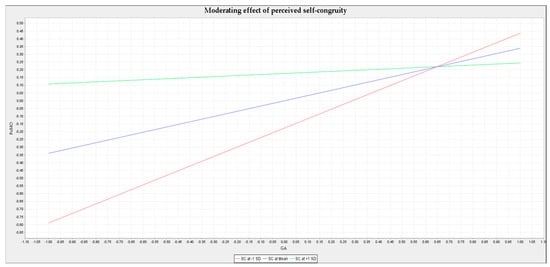
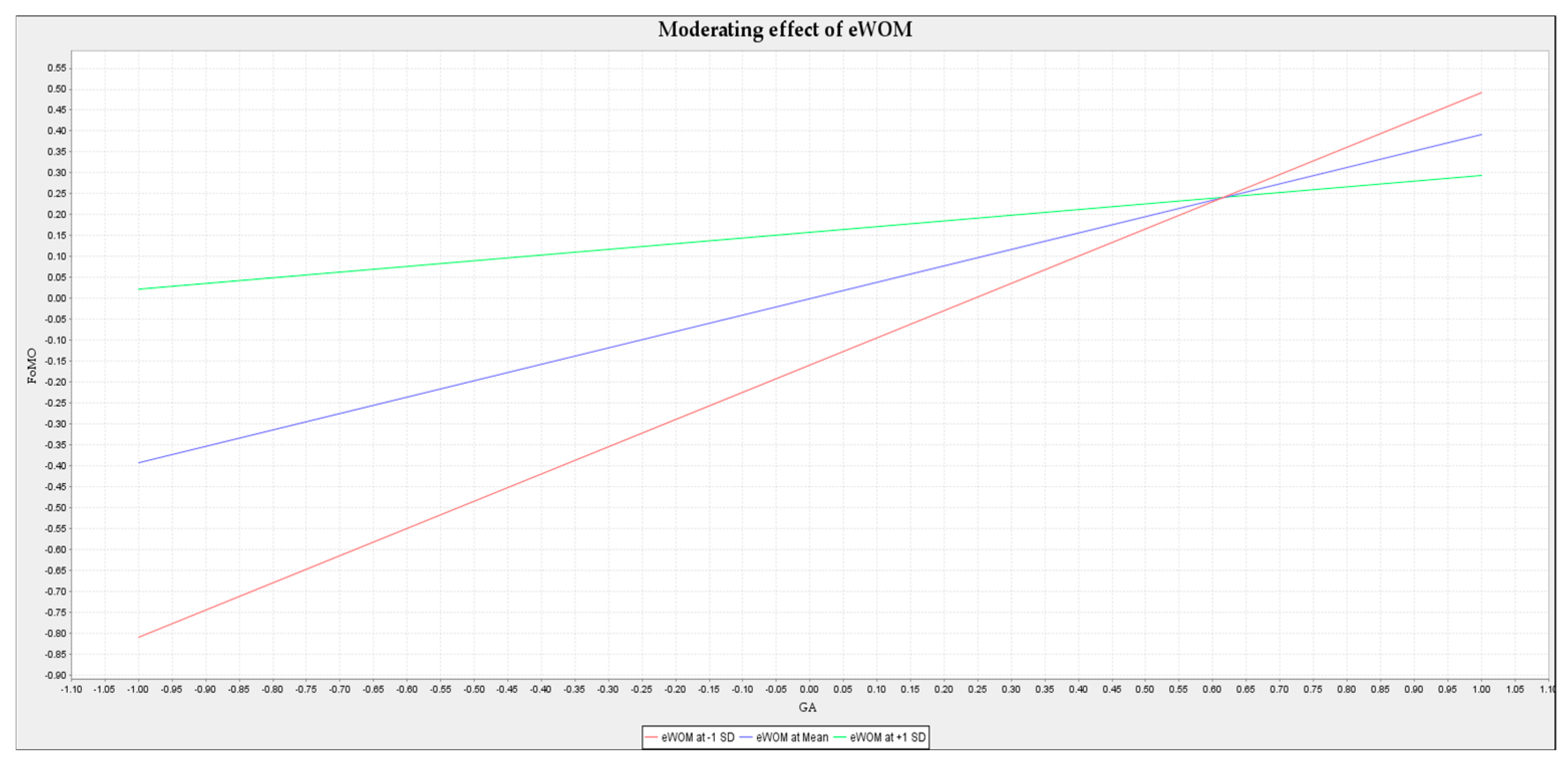
Testing results are summarized in Table 10. As shown, the interaction term of gamification and perceived self-congruity is negatively significant (β = −0.260, p < 0.001), and the interaction term of gamification and eWOM also presents a negative and significant result (β = −0.254, p < 0.001). These results suggest that both perceived self-congruity and eWOM negatively moderate the relationship between gamification and FoMO. Further simple slope analysis shows that the predictive effect of gamification on FoMO varies across different levels of perceived self-congruity (Figure 2) and eWOM (Figure 3). The simple slopes were plotted at mean ± 1 SD of the mean-centered moderators, following the default procedure in SmartPLS 3.0. This mean ± 1 SD approach is consistent with conventional practice for probing interactions and provides interpretable low and high reference points. Specifically, the simple slope is 0.608 at low perceived self-congruity and is 0.088 at high perceived self-congruity and the simple slope is 0.602 at low eWOM and is 0.094 at high eWOM. The influence of gamification on FoMO becomes weaker when perceived self-congruity or eWOM is at a high level. H3 and H4 are thus empirically supported. The moderated structural model totally explains 62.7% of the variance in FoMO with the effect of the predictor, two moderators, and their interaction effects. The increased variance in FoMO suggests that perceived self-congruity and eWOM serve as meaningful boundary conditions in this research setting, which is characterized by high collectivism and moderate uncertainty avoidance [23,24].
Table 10.
Results of moderating effects.
Figure 2.
Moderating effect of perceived self-congruity.
Figure 3.
Moderating effect of eWOM.
4.4.4. Test of Moderated Mediating Effects
To examine the conditional indirect effects and the overall moderated mediation indices, we supplemented the SmartPLS 3.0 analysis with the SPSS 31.0 PROCESS macro (Model 7; Hayes [65]). This is because SmartPLS 3.0 does not directly output the moderated mediation index, whereas PROCESS is specifically designed for conditional process modeling. All PROCESS analyses were conducted with 5000 bootstrap resamples and bias-corrected 95% confidence intervals, following the recommendations of Hayes [65]. Following the convention of probing interactions in non-experimental research [65], the conditional indirect effects were estimated at the 16th, 50th, and 84th percentiles of each moderator, which correspond to low, medium, and high levels, respectively. This percentile-based approach is preferred when the moderator distribution may deviate from normality [65].
The moderated mediation indices for perceived self-congruity and eWOM are both significant, with their 95% Bootstrap CIs excluding zero, as shown in Table 11. As shown in Table 12, when consumers have a low level of perceived self-congruity, the 95% Bootstrap CIs exclude zero and the mediating effect is 0.236. When the level of perceived self-congruity becomes higher, the mediating effect still remains significant but with smaller magnitude, decreasing to 0.063. That is, the magnitude of the mediating effect gradually decreases as perceived self-congruity increases. Regarding the conditional indirect effect of eWOM, when eWOM is at low, medium, and high levels respectively, the indirect effect of gamification on impulse buying through FoMO remains statistically significant. However, the magnitude of this mediating effect gradually decreases as eWOM increases, falling from 0.248 to 0.046. These results suggest that the indirect influence of gamification on impulse buying through FoMO becomes weaker among consumers with higher perceived self-congruity and stronger eWOM. The moderated mediating effects of perceived self-congruity (H5) and eWOM (H6) are both empirically supported.
Table 11.
Index of moderated mediating effects.
Table 12.
Conditional indirect effects.
5. Discussion
This study focuses on impulse buying in livestream e-commerce as the rapid commercialization of livestream has elevated impulse buying to a central mechanism of revenue generation. Specifically, we examine whether and how gamification design affects consumers’ impulse buying by focusing on the role of FoMO, particularly in contexts with different levels of perceived self-congruity and eWOM. Drawing on a valid sample of 796 users in Indonesia, we test the theoretical hypotheses.
Empirical results confirm that gamification can directly and positively influence impulse buying in livestream e-commerce. This aligns with prior evidence that reward-oriented gamified features, such as points and vouchers, enhance affective reactions and reduce deliberative control, thereby influencing unplanned purchases [14,34]. Importantly, a theoretically significant finding is the partial mediation of this relationship by FoMO. While existing research has emphasized positive mediators, such as perceived enjoyment, flow, and interactivity, for the effect of gamification [12,43], our study demonstrates that an anxiety-driven mechanism plays a critical mediating role. This finding resonates with arguments that livestream e-commerce platforms can engineer reward-based participation incentives [16,36], and it extends this reasoning by empirically linking reward-oriented gamification to FoMO and subsequently influencing impulse buying.
Another key finding of this study lies in identifying perceived self-congruity and eWOM as significant moderators for the relationship between gamification and FoMO. The interaction term of perceived self-congruity and gamification is significant and negative (β = −0.260, p < 0.001). This moderating effect suggests that consumers with a high level of perceived self-congruity are less susceptible to the anxiety associated with reward-based gamified features. This is because they rely more on self-relevant product evaluation rather than external participation pressures when consumers have high perceived self-congruity. eWOM is also found to serve as another significant moderator (β = −0.254, p < 0.001), indicating that a high level of eWOM helps consumers experience a weaker FoMO that is associated with gamified features. Notably, both perceived self-congruity and eWOM exert positive direct effects on FoMO (β = 0.173, p < 0.001; β = 0.156, p < 0.001), which stands in apparent tension with their negative interaction effects. These results are consistent with our theoretical arguments when proposing the moderating effects of perceived self-congruity and eWOM. Consumers who perceive high product-self congruence may regard the purchase as highly self-relevant and therefore experience FoMO about missing a personally meaningful purchase opportunity. Similarly, when eWOM is highly credible, consumers may perceive the deal as socially validated and thus feel greater anxiety about forgoing it. In both cases, the positive effects reflect heightened baseline concern about missing an opportunity that appears congruent or credible. However, as gamification intensifies, these evaluative and informational resources appear to shift into a protective role. Drawing on regulatory fit theory [66] as a post hoc explanatory lens, we suggest that gamified pressure may create a motivational mismatch for consumers who perceive high self-congruity. Specifically, externally imposed reward-seeking pressure conflicts with their internally anchored product evaluation. This mismatch may disrupt motivational engagement and thereby weaken the link between gamification and FoMO. Likewise, credible eWOM provides an alternative informational basis that reduces reliance on gamified cues, thereby attenuating the anxiety they would otherwise generate.
More importantly, this study integrates these two moderators to examine how the indirect effect of gamification on impulse buying through FoMO varies when consumers have different levels of perceived self-congruity or eWOM. Empirical results show that the magnitude of the indirect effect decreases monotonically as either perceived self-congruity or eWOM increases. These results provide a more nuanced understanding of when gamification translates into impulse buying via FoMO. Specifically, the indirect effect via FoMO becomes stronger among consumers with low perceived self-congruity or low eWOM. In such cases, reward-based gamified features exert their impact on FoMO, which in turn influences impulse buying. Conversely, when perceived self-congruity or eWOM is high, the mediating mechanism weakens. These findings illustrate that the gamification effect is contingent on both the perceived fit between product and self-concept and the informational environment.
5.1. Theoretical Contributions
This study makes several contributions to the extant literature by developing and empirically validating a moderated mediation model in the emerging market of Indonesia.
First, this study expands the research stream of gamification in e-commerce by revealing the mediating mechanism of FoMO. Prior research on gamification and impulse buying mainly employs positive valence mediators [10,33,42], which implicitly treat gamification as a source of hedonic value that fosters buying through pleasurable experiences. However, these studies overlook the possibility that gamification may also operate through negative emotional pathways. For example, Zhang et al. [16] demonstrate that FoMO plays a mediating effect on impulse buying, with a focus on scarcity cues. However, their investigation is situated in the context of the COVID-19 pandemic and focuses specifically on the scarcity of medical protective equipment. In contrast, this study is situated in livestream e-commerce, where reward-oriented gamified features are routinely designed to stimulate engagement and purchase. Thus, our study extends Zhang et al. [16] by moving from a context-specific scarcity cue to a more generalizable set of gamified stimuli in a mainstream digital commerce setting. By theorizing and demonstrating that gamification is significantly and positively related to FoMO, this study directly answers the question of whether reward-oriented gamified elements can affect FoMO. In doing so, we move beyond framing gamification solely as a mechanism for elevating hedonic enjoyment and instead acknowledge its capacity to activate consumers’ anxiety over foregone value. This enriches the literature and provides a more complete picture of the emotional mechanisms at play in gamified livestream e-commerce.
Second, this study integrates perceived self-congruity and eWOM as dual boundary moderators, complementing contingent research on gamification effects. On the one hand, while self-congruity theory has been applied to brand preference and loyalty [26], its integration into the gamification and impulse buying literature is still limited. Our findings reveal that consumers with high perceived self-congruity are less likely to experience FoMO when exposed to reward-based gamified features, because their evaluation is anchored in self-relevant product attributes rather than external pressures. This extends the literature by showing that the perceived congruence between product and self-concept can function as a boundary condition. It also refines the understanding that gamification effects are not uniform. By contrast, prior work has focused primarily on moderators such as impulsivity or hedonic orientation [28], which share conceptual ground with the dependent variable. Perceived self-congruity provides a counterbalance rooted in the perceived match between product image and self-concept, offering a fresh perspective.
On the other hand, while eWOM has been extensively studied as a direct antecedent of purchase intention and trust [20,24,41], its capacity to moderate emotional reactions to gamification has been overlooked. Our results indicate that a high level of eWOM reduces perceived uncertainty, thereby dampening the FoMO associated with reward-based gamified features. This finding contributes to the social influence literature by demonstrating that eWOM can serve as a protective factor that attenuates anxiety-driven marketing effects, expanding its conceptual function beyond persuasion to emotional regulation. Together, the dual moderators, drawing respectively on internal congruence and external information, provide a comprehensive contingency view for the effect of gamification on FoMO.
Third, this study further reveals the conditional indirect effects of FoMO for the relationship between gamification and impulse buying. Existing research on gamification and impulse buying mainly addresses either mediation or moderation in isolation, which limits the understanding of its effects and boundary conditions. Our study goes beyond by formally testing whether the indirect effect of gamification on impulse buying through FoMO varies as a function of self-congruity and eWOM. The significant indices of moderated mediation confirm that the mediation mechanism itself is contingent on these moderators, providing a more nuanced and holistic picture. These findings address the growing demand for complex models that capture the interplay of mediation and moderation. The decreasing magnitude of the indirect effect at higher levels of perceived self-congruity and eWOM suggests that these factors can act as independent buffers, each independently weakening the link between gamification and FoMO.
5.2. Practical Implications
This study offers several practical implications for the rapidly expanding livestream e-commerce industry.
First, although gamification is positively related to impulse buying, it is also positively associated with FoMO. To balance the effects on buying and FoMO, a responsible design approach would embed transparency tools that preserve the excitement of earning rewards while reducing deceptive uncertainty. For instance, platforms could display the conditions and expiration rules for vouchers, the actual probability of winning a lucky draw, or the requirements for completing a point-based challenge, thereby helping consumers make more informed assessments of reward attainability. Additionally, platforms could implement user-controlled alerts, allowing consumers to set personal thresholds for gamified notifications. Critically, these tools should be designed with privacy by default. They should not require additional intrusive data collection, and users should be able to adjust their notification preferences through clear, accessible settings. Any data collected to calibrate such alerts should be limited to what is strictly necessary and processed in accordance with applicable data protection regulations.
Second, the negative moderating effect of perceived self-congruity implies that the effectiveness of gamified incentives varies depending on consumers’ perceived fit between the promoted product and their self-concept. For consumers with high perceived self-congruity, gamification tactics emphasizing self-expression, product-self alignment, and value-added experiences may be more effective than tactics relying primarily on extrinsic reward pressure. Platforms can offer user-directed personalization options, for example, allowing consumers to indicate their preferences, values, or product interests, and then align gamified features accordingly.
Third, the moderating role of eWOM highlights the importance of cultivating a transparent and trustworthy informational environment as a strategic counterbalance to FoMO. Livestream e-commerce platforms should therefore design mechanisms that encourage genuine user feedback. For instance, this can be done by highlighting verified purchase reviews directly within video streams, integrating real-time aggregate ratings into gamified banners, and deploying review-solicitation prompts after purchase. Our study suggests that although eWOM dampens the effect of gamification on FoMO, it is simultaneously positively associated with FoMO. Platforms can leverage this dual role by adopting a context-sensitive approach. For example, in low gamification settings, eWOM can act as a primary factor of purchase intention. By contrast, in high gamification settings, eWOM may help offset the anxiety associated with reward-based gamified features.
Fourth, the conditional indirect effects reveal that the gamification-FoMO-impulse buying pathway becomes stronger for consumers who have low levels of perceived self-congruity or low levels of eWOM. This implies that a segmented gamification strategy may be more effective. When targeting consumers who perceive low product-self fit or low eWOM, platforms may deploy reward-based gamified features to promote purchases. Conversely, for consumers with high perceived product-self congruence or eWOM, marketers might emphasize value-added experiences rather than relying solely on extrinsic reward pressure.
5.3. Limitations and Future Research Directions
Despite some valuable contributions, several limitations remain in current research.
First, the data was collected from a single platform (Shopee) in one geographic region (Indonesia). Although this focused design enhances internal validity and contextual relevance, it may restrict the generalizability of the findings. Future research could test the proposed research model across different livestream platforms and cultural settings to extend the scope of conclusions.
Second, the cross-sectional questionnaire data cannot capture dynamic changes in consumer psychological states during real-time live broadcasts. Furthermore, such a research design precludes definitive causal inferences among our focal constructs, as all variables are measured at a single time point. Future research can adopt longitudinal tracking or experimental designs to collect multi-period data that addresses this gap.
Third, although the reliability and validity of our sample data have been verified, the absence of a pilot test is another limitation of this study. This limitation may introduce certain unknown interference into the accuracy of the measurement results. Future research is advised to conduct a small-scale pilot test with representative respondents before the formal investigation. In addition, although all respondents had purchase experience through Shopee Live, where gamified features are pervasive, we did not include a screening item specifically checking exposure to gamification. Future research could add such a screening criterion to ensure direct exposure to gamified features before data collection, thereby further improving the precision of sample selection.
Fourth, this study operationalizes gamification as a unitary variable. However, heterogeneous gamified elements may enhance FoMO through slightly different underlying mechanisms. Future studies could examine how specific gamification mechanics influence emotional and behavioral outcomes.
Fifth, to clearly explain the mediating effect of FoMO, this study solely focuses on this negative affective factor. We acknowledge that gamification can activate multiple emotional pathways simultaneously, including both positive and negative reactions, such as engagement and psychological reactance. Future research could simultaneously examine the mediating roles of multiple positive and negative emotions to clarify how different emotional responses work together to influence impulse buying in livestream e-commerce.
6. Conclusions
This study investigates the negative psychological mechanism, i.e., FoMO, through which gamification influences impulse buying in livestream e-commerce, as well as the boundary conditions that attenuate this process. Drawing on a sample of 796 active Shopee users, we tested a moderated mediation model that positions FoMO as a mediator and perceived self-congruity and eWOM as moderators. The empirical results confirm that gamification is significantly related to impulse buying both directly and indirectly through FoMO. Furthermore, this indirect effect is significantly weaker when perceived self-congruity or eWOM is at high levels. These findings contribute to the literature by identifying FoMO as an affective mediator and by showing that perceived self-congruity and eWOM each independently buffer the influence of gamification on FoMO. From a practical standpoint, this study suggests that livestream e-commerce platforms and marketers in Southeast Asia can strategically calibrate reward-based gamified features, foster authentic eWOM ecosystems, and adopt segmented approaches that respect consumers’ perceived product-self fit.
Author Contributions
Conceptualization, M.W.; Software, M.W. and X.M.; Investigation, M.W.; Resources, M.W.; Data curation, B.W.; Writing—original draft, M.W. and B.W.; Writing—review & editing, M.W. and X.M.; Supervision, M.W.; Funding acquisition, M.W. All authors have read and agreed to the published version of the manuscript.
Funding
This research was funded by the Jiangsu Office of Philosophy and Social Science, grant number 25GLC028.
Institutional Review Board Statement
The study was conducted in accordance with the Declaration of Helsinki, and approved by the School of Business, Nanjing University of Information Science and Technology (date of approval: 20 April 2025).
Informed Consent Statement
Informed consent was obtained from all subjects involved in the study.
Data Availability Statement
The data presented in this study are available on request from the corresponding author.
Conflicts of Interest
The authors declare no conflicts of interest.
References
- Zhang, M.; Qin, F.; Wang, G.A.; Luo, C. The impact of live video streaming on online purchase intention. Serv. Ind. J. 2020, 40, 656–681. [Google Scholar] [CrossRef] [Scilit]
- Huang, W.; Wang, X.; Zhang, Q.; Han, J.; Zhang, R. Beyond likes and comments: How social proof influences consumer impulse buying on short-form video platforms. J. Retail. Consum. Serv. 2025, 84, 104199. [Google Scholar] [CrossRef] [Scilit]
- Fu, J.R.; Hsu, C.W. Live-streaming shopping: The impacts of para-social interaction and local presence on impulse buying through shopping value. Ind. Manag. Data Syst. 2023, 123, 1861–1886. [Google Scholar] [CrossRef] [Scilit]
- Yang, C.; Feng, Y.; Li, X.; Niu, B. Play to Participate: Effects of Gamification Affordances on Consumer Participation in Livestreaming Commerce. J. Theor. Appl. Electron. Commer. Res. 2025, 20, 84. [Google Scholar] [CrossRef] [Scilit]
- Chan, T.K.H.; Cheung, C.M.K.; Lee, Z.W.Y. The state of online impulse-buying research: A literature analysis. Inf. Manag. 2017, 54, 204–217. [Google Scholar] [CrossRef] [Scilit]
- Wongkitrungrueng, A.; Assarut, N. The role of live streaming in building consumer trust and engagement with social commerce sellers. J. Bus. Res. 2020, 117, 543–556. [Google Scholar] [CrossRef] [Scilit]
- Moghddam, H.A.; Carlson, J.; Wyllie, J.; Rahman, S.M. Scroll, Stop, Shop: Decoding impulsive buying in social commerce. J. Bus. Res. 2024, 182, 114776. [Google Scholar] [CrossRef] [Scilit]
- Livanto, M.; Tjhin, V.U. Enhancing user satisfaction and system trust through gamification in e-commerce platforms. J. Comput. Sci. 2026, 22, 1175–1188. [Google Scholar] [CrossRef] [Scilit]
- Zhang, L.; Shao, Z.; Li, X.; Feng, Y. Gamification and online impulse buying: The moderating effect of gender and age. Int. J. Inf. Manag. 2021, 61, 102267. [Google Scholar] [CrossRef] [Scilit]
- Hsu, C.L.; Chen, M.C. How gamification marketing activities motivate desirable consumer behaviors: Focusing on the role of brand love. Comput. Hum. Behav. 2018, 88, 121–130. [Google Scholar] [CrossRef] [Scilit]
- Al-Adwan, A.S.; Yaseen, H.; Alkkhwaldi, A.F.; Jafar, R.M.S.; Fauzi, M.A.; Abdullah, A. Treasure hunting for brands: Metaverse marketing gamification effects on purchase intention, WOM, and loyalty. J. Glob. Mark. 2025, 38, 392–416. [Google Scholar] [CrossRef] [Scilit]
- Xi, N.; Hamari, J. Does gamification affect brand engagement and equity? A study in online brand communities. J. Bus. Res. 2020, 109, 449–460. [Google Scholar] [CrossRef] [Scilit]
- Feng, Z.; Mamun, A.A.; Masukujjaman, M.; Wu, M.; Yang, Q. Impulse buying behavior during livestreaming: Moderating effects of scarcity persuasion and price perception. Heliyon 2024, 10, e28347. [Google Scholar] [CrossRef] [Scilit]
- Chang, S.E.; Yu, C. Exploring gamification for live-streaming shopping: Influence of reward, competition, presence and immersion on purchase intention. IEEE Access 2023, 11, 57503–57513. [Google Scholar] [CrossRef] [Scilit]
- Przybylski, A.K.; Murayama, K.; DeHaan, C.R.; Gladwell, V. Motivational, emotional, and behavioral correlates of fear of missing out. Comput. Hum. Behav. 2013, 29, 1841–1848. [Google Scholar] [CrossRef] [Scilit]
- Zhang, J.; Jiang, N.; Turner, J.J. The impact of scarcity on consumers’ impulse buying based on the S-O-R theory. Front. Psychol. 2022, 13, 792419. [Google Scholar] [CrossRef] [Scilit]
- Hussain, S.; Raza, A.; Haider, A.; Ishaq, M.I.; Talpur, Q. Fear of missing out and compulsive buying behavior: The moderating role of mindfulness. J. Retail. Consum. Serv. 2023, 75, 103512. [Google Scholar] [CrossRef] [Scilit]
- Tang, X.; Shao, F.; Zhang, Y. The effect of product scarcity appeals on consumers’ impulse buying intentions. Curr. Psychol. 2025, 44, 17831–17845. [Google Scholar] [CrossRef] [Scilit]
- Malär, L.; Krohmer, H.; Hoyer, W.D.; Nyffenegger, B. Emotional brand attachment and brand personality: The relative importance of the actual and the ideal self. J. Mark. 2011, 75, 35–52. [Google Scholar] [CrossRef] [Scilit]
- Cheung, C.M.K.; Thadani, D.R. The impact of electronic word-of-mouth communication: A literature analysis and integrative model. Decis. Support Syst. 2012, 54, 461–470. [Google Scholar] [CrossRef] [Scilit]
- Park, J.; Ye, C.; Chen, Y. Enablers and inhibitors of word-of-mouth in ridesharing apps: A dual perspective on user involvement. J. Retail. Consum. Serv. 2026, 93, 104896. [Google Scholar] [CrossRef] [Scilit]
- Kemp, S. Digital 2024: Indonesia. 2024. Available online: https://wearesocial.com/id/wp-content/uploads/sites/19/2024/02/Digital_2024_Indonesia.pdf (accessed on 2 September 2026).
- Hofstede, G. Culture’s Consequences: Comparing Values, Behaviors, Institutions, and Organizations Across Nations, 2nd ed.; Sage: Thousand Oaks, CA, USA, 2001. [Google Scholar]
- Dang, A.; Raska, D. National cultures and their impact on electronic word of mouth: A systematic review. Int. Mark. Rev. 2021, 39, 1182–1225. [Google Scholar] [CrossRef] [Scilit]
- Chen, J.L.; Dermawan, A. The influence of YouTube beauty vloggers on Indonesian consumers’ purchase intention of local cosmetic products. Int. J. Bus. Manag. 2020, 15, 100–116. [Google Scholar] [CrossRef] [Scilit]
- Kim, J.J. Brand personality of global chain hotels, self-congruity, and self-discrepancy on customer responses. Int. J. Hosp. Manag. 2023, 114, 103565. [Google Scholar] [CrossRef] [Scilit]
- Iyer, G.R.; Blut, M.; Xiao, S.H.; Grewal, D. Impulse buying: A meta-analytic review. J. Acad. Mark. Sci. 2020, 48, 384–404. [Google Scholar] [CrossRef] [Scilit]
- Liu, M.; Chen, X.; Yang, B.; Gao, Y. The role of social presence in impulsive buying during live streaming E-commerce: Exploring the mechanisms of customer inspiration and positive emotion. BMC Psychol. 2025, 13, 1414. [Google Scholar] [CrossRef] [Scilit]
- Wu, I.L.; Chen, K.W.; Chiu, M.L. Defining key drivers of online impulse purchasing: A perspective of both impulse shoppers and system users. Int. J. Inf. Manag. 2016, 36, 284–296. [Google Scholar] [CrossRef] [Scilit]
- Li, Y.; García-de-Frutos, N.; Ortega-Egea, J.M. Impulse buying in live streaming e-commerce: A systematic literature review and future research agenda. Comput. Hum. Behav. Rep. 2025, 19, 100676. [Google Scholar] [CrossRef] [Scilit]
- Redine, A.; Deshpande, S.; Jebarajakirthy, C.; Surachartkumtonkun, J. Impulse buying: A systematic literature review and future research directions. Int. J. Consum. Stud. 2022, 47, 3–41. [Google Scholar] [CrossRef] [Scilit]
- Qian, T.Y.; Yu, B.; Matz, R.; Luo, L.; Xu, C. Gamification for consumer loyalty: An exploration of unobserved heterogeneity in gamified esports social live streaming. Telemat. Inform. 2023, 85, 102062. [Google Scholar] [CrossRef] [Scilit]
- Fayola, F.; Graciela, V.; Chandra, V.; Sukmaningsih, D.W. Impact of gamification elements on live streaming E-commerce (Live Commerce). Procedia Comput. Sci. 2024, 245, 1065–1074. [Google Scholar] [CrossRef] [Scilit]
- Tobon, S.; Ruiz-Alba, J.L.; Garcia-Madariaga, J. Gamification and online consumer decisions: Is the game over? Decis. Support Syst. 2020, 128, 113167. [Google Scholar] [CrossRef] [Scilit]
- Abel, J.P.; Buff, C.L.; Burr, S.A. Social media and the fear of missing out: Scale development and assessment. J. Bus. Econ. Res. 2016, 14, 33–44. [Google Scholar] [CrossRef] [Scilit]
- Hodkinson, C. ‘Fear of Missing Out’ (FoMO) marketing appeals: A conceptual model. J. Mark. Commun. 2019, 25, 65–88. [Google Scholar] [CrossRef] [Scilit]
- Mavletova, A. A gamification effect in longitudinal web surveys among children and adolescents. Int. J. Mark. Res. 2015, 57, 413–438. [Google Scholar] [CrossRef] [Scilit]
- Hamari, J. Transforming homo economicus into homo ludens: A field experiment on gamification in a utilitarian peer-to-peer trading service. Electron. Commer. Res. Appl. 2013, 12, 236–245. [Google Scholar] [CrossRef] [Scilit]
- Sirgy, M.J. Self-concept in consumer behavior: A critical review. J. Consum. Res. 1982, 9, 287–300. [Google Scholar] [CrossRef] [Scilit]
- Sussman, S.W.; Siegal, W.S. Informational Influence in Organizations: An Integrated Approach to Knowledge Adoption. Inf. Syst. Res. 2003, 14, 47–65. [Google Scholar] [CrossRef] [Scilit]
- Hennig-Thurau, T.; Gwinner, K.P.; Walsh, G.; Gremler, D.D. Electronic word-of-mouth via consumer-opinion platforms: What motivates consumers to articulate themselves on the Internet? J. Interact. Mark. 2004, 18, 38–52. [Google Scholar] [CrossRef] [Scilit]
- Hwang, J.; Choi, L. Having fun while receiving rewards?: Exploration of gamification in loyalty programs for consumer loyalty. J. Bus. Res. 2020, 106, 365–376. [Google Scholar] [CrossRef] [Scilit]
- Che, T.; Peng, Y.; Zhou, Q.; Dickey, A.; Lai, F. The impacts of gamification designs on consumer purchase: A use and gratification theory perspective. Electron. Commer. Res. Appl. 2023, 59, 101268. [Google Scholar] [CrossRef] [Scilit]
- Paschmann, J.W.; Bruno, H.A.; van Heerde, H.J.; Völckner, F.; Klein, K. Driving mobile app user engagement through gamification. J. Mark. Res. 2025, 62, 249–273. [Google Scholar] [CrossRef] [Scilit]
- Djamhari, S.I.; Mustika, M.D.; Sjabadhyni, B.; Ndaru, A.R.P. Impulsive buying in the digital age: Investigating the dynamics of sales promotion, FoMO, and digital payment methods. Cogent Bus. Manag. 2024, 11, 2419484. [Google Scholar] [CrossRef] [Scilit]
- Du, Y.; Deng, K.; Liu, Z. Consumer and Market Antecedents of Repurchase Intention: Fear of Missing Out and Impulsive Buying as Serial Mediators. Behav. Sci. 2026, 16, 871. [Google Scholar] [CrossRef] [Scilit]
- Sirgy, M.J.; Grewal, D.; Mangleburg, T.F.; Park, J.O.; Chon, K.S.; Claiborne, C.B.; Johar, J.S.; Berkman, H. Assessing the predictive validity of two methods of measuring self-image congruence. J. Acad. Mark. Sci. 1997, 25, 229–241. [Google Scholar] [CrossRef] [Scilit]
- Park, D.H.; Lee, J.; Han, I. The effect of on-line consumer reviews on consumer purchasing intention: The moderating role of involvement. Int. J. Electron. Commer. 2007, 11, 125–148. [Google Scholar] [CrossRef] [Scilit]
- Brislin, R.W. Back-translation for cross-cultural research. Int. J. Psychol. 1970, 5, 185–216. [Google Scholar] [CrossRef] [Scilit]
- Li, L.; Chen, X.; Zhu, P. How do e-commerce anchors’ characteristics influence consumers’ impulse buying? An emotional contagion perspective. J. Retail. Consum. Serv. 2024, 76, 103587. [Google Scholar] [CrossRef] [Scilit]
- Ngo, T.T.A.; Tran, T.T.; An, G.K.; Nguyen, P.T. Investigating the influence of augmented reality marketing application on consumer purchase intentions: A study in the E-commerce sector. Comput. Hum. Behav. Rep. 2025, 18, 100648. [Google Scholar] [CrossRef] [Scilit]
- Le, T.M.H.; Ngoc, B.M. Consumption-related social media peer communication and online shopping intention among Gen Z consumers: A moderated-serial mediation model. Comput. Hum. Behav. 2024, 153, 108100. [Google Scholar] [CrossRef] [Scilit]
- Fernandes, S.; Panda, R.; Venkatesh, V.G.; Swar, B.N.; Shi, Y. Measuring the impact of online reviews on consumer purchase decisions: A scale development study. J. Retail. Consum. Serv. 2022, 68, 103066. [Google Scholar] [CrossRef] [Scilit]
- Chin, W.W. The partial least squares approach to structural equation modeling. In Modern Methods for Business Research; Marcoulides, G.A., Ed.; Lawrence Erlbaum Associates: Mahwah, NJ, USA, 1998. [Google Scholar]
- Hair, J.F.; Risher, J.J.; Sarstedt, M.; Ringle, C.M. When to use and how to report the results of PLS-SEM. Eur. Bus. Rev. 2019, 31, 2–24. [Google Scholar] [CrossRef] [Scilit]
- Cohen, J. A power primer. Psychol. Bull. 1992, 112, 155–159. [Google Scholar] [CrossRef]
- Liang, H.; Saraf, N.; Hu, Q.; Xue, X.Y. Assimilation of enterprise systems: The effect of institutional pressures and the mediating role of top management. MIS Q. 2007, 31, 59–87. [Google Scholar] [CrossRef] [Scilit]
- Kock, N. Common method bias in PLS-SEM: A full collinearity assessment approach. Int. J. e-Collab. 2015, 11, 1–10. [Google Scholar] [CrossRef] [Scilit]
- Podsakoff, P.M.; MacKenzie, S.B.; Lee, J.Y.; Podsakoff, N.P. Common method biases in behavioral research: A critical review of the literature and recommended remedies. J. Appl. Psychol. 2003, 88, 879–903. [Google Scholar] [CrossRef] [Scilit]
- Hair, J.F.; Hult, G.T.M.; Ringle, C.M.; Sarstedt, M. A Primer on Partial Least Squares Structural Equation Modeling (PLS-SEM), 3rd ed.; SAGE Publications: Thousand Oaks, CA, USA, 2021. [Google Scholar]
- Chin, W.W.; Marcolin, B.L.; Newsted, P.R. A partial least squares latent variable modeling approach for measuring interaction effects: Results from a Monte Carlo simulation study and an electronic mail emotion/adoption study. Inf. Syst. Res. 2003, 14, 189–217. [Google Scholar] [CrossRef] [Scilit]
- Henseler, J.; Ringle, C.M.; Sarstedt, M. A new criterion for assessing discriminant validity in variance-based structural equation modeling. J. Acad. Mark. Sci. 2015, 43, 115–135. [Google Scholar] [CrossRef] [Scilit]
- Cohen, J. Statistical Power Analysis for the Behavioral Sciences, 2nd ed.; Lawrence Erlbaum Associates: Hillsdale, NJ, USA, 1988. [Google Scholar]
- Preacher, K.J.; Hayes, A.F. Asymptotic and resampling strategies for assessing and comparing indirect effects in multiple mediator models. Behav. Res. Methods 2008, 40, 879–891. [Google Scholar] [CrossRef] [Scilit]
- Hayes, A.F. Introduction to Mediation, Moderation, and Conditional Process Analysis: A Regression-Based Approach, 2nd ed.; Guilford Press: New York, NY, USA, 2018. [Google Scholar]
- Higgins, E.T. Making a good decision: Value from fit. Am. Psychol. 2000, 55, 1217–1230. [Google Scholar] [CrossRef]

Disclaimer/Publisher’s Note: The statements, opinions and data contained in all publications are solely those of the individual author(s) and contributor(s) and not of MDPI and/or the editor(s). MDPI and/or the editor(s) disclaim responsibility for any injury to people or property resulting from any ideas, methods, instructions or products referred to in the content. |
© 2026 by the authors. Licensee MDPI, Basel, Switzerland. This article is an open access article distributed under the terms and conditions of the Creative Commons Attribution (CC BY) license.