


Abstract
While data-driven targeted advertisement enhances content platform profitability, it exacerbates consumer privacy concerns. Transferring privacy control rights to consumers is considered effective in alleviating consumer privacy concerns but risks reducing data disclosure and subsequently weakening personalized-service utility and advertisement effectiveness. This paper investigates a platform’s strategic motivation to transfer privacy control rights and evaluates its economic implications for platform advertisement strategies, platform profit, consumer surplus and platform–consumer welfare. Our findings show that transferring privacy control rights to consumers increases the advertisement intensity targeted to non-privacy-sensitive consumers, while the advertisement intensity targeted to privacy-sensitive consumers may increase or decrease, depending on the utility loss of personalized service caused by non-disclosure. More importantly, the effects of transferring privacy control rights depend jointly on the utility loss of personalized service and the advertisement-efficiency reduction caused by non-disclosure. When both effects are limited, transferring privacy control rights simultaneously increases platform profit, consumer surplus, and platform–consumer welfare. When the utility loss remains limited but the advertisement-efficiency reduction becomes moderate, consumer surplus and platform–consumer welfare increase while platform profit decreases, indicating that the platform lacks a profit incentive to transfer privacy control rights voluntarily. When either effect becomes sufficiently large, retaining privacy control rights increases platform profit, consumer surplus, and platform–consumer welfare. These findings indicate that transferring privacy control rights can serve as a strategic governance mechanism, but it is not a one-size-fits-all solution to solve the privacy-personalization paradox in data-driven marketing.
1. Introduction
The proliferation of big data analytics has transformed modern marketing practices. It enables platforms to infer consumer preferences from consumers’ digital footprints, including browsing, search, purchase, and interaction histories. These data can enhance personalized service levels, recommendation quality, and targeted advertisement accuracy. These improvements significantly improve customer engagement and conversion rates, which effectively helps the platform gain more economic benefits. As a result, digital platforms prioritize the acquisition and utilization of consumer information. Among the various data-driven marketing applications, targeted advertisement represents one of the most important mechanisms through which platforms monetize consumer information.
Empirical evidence and managerial practice indicate that consumer information improves the matching between advertisements and consumers, thereby enhancing targeted advertisement effectiveness and increasing expected advertisement profit [1,2]. Content platforms such as TripAdvisor and Airbnb have incorporated this mechanism into their data-driven monetization models by using consumer preferences to support more precise audience targeting. These practices illustrate the central role of consumer information in improving advertisement performance and platform profitability. Meanwhile, the application of consumer information can also benefit consumers. By improving the match between advertisements and consumers’ preferences, consumer information enables platforms to deliver more relevant advertisements and reduces consumers’ exposure to irrelevant content and advertisements. This improved matching can lower consumers’ search and information-processing costs and help them identify products or services that better fit their needs.
These benefits depend critically on consumers’ willingness to allow platforms to collect and use their personal information. When consumers become concerned about how their information is collected, processed, or used for targeted advertisements, they may become less willing to disclose information and less receptive to targeted advertisements. Such privacy concerns can therefore reduce consumer participation in targeted advertisements and alter firms’ optimal information-collection and advertisement strategies [3,4]. Consequently, the economic value of consumer information depends not only on its ability to improve advertisement targeting accuracy, but also on how data-governance arrangements shape consumers’ privacy concerns, participation decisions, and perceived utility.
In practice, however, platforms generally retain substantial control over the collection and use of consumers’ personal information, leaving consumers with limited ability to determine whether and how their information is used for targeted advertisement. Such limited control may heighten perceived intrusiveness and privacy concerns, particularly when consumers feel that their information is collected or used without sufficient transparency or authorization. To alleviate consumers’ privacy concerns and improve advertisement effectiveness, some content platforms, such as RedNote and TikTok, have introduced privacy-control mechanisms that give consumers greater control over their personal information. Under these arrangements, consumers can make more autonomous decisions regarding the collection, use, storage, and sharing of their information.
Consumer privacy control therefore becomes an important governance mechanism in data-driven targeted advertisements by content platforms. Prior empirical research suggests that greater perceived control can reduce privacy concerns and influence consumers’ responses to personalized advertisement [5,6]. However, granting consumers greater control may also lead privacy-sensitive consumers to withhold their personal information. Although such non-disclosure can reduce privacy-related disutility, it also limits the information available for personalized services and advertisement activities. Consequently, transferring privacy control rights creates an important trade-off for content platforms between alleviating consumers’ privacy concerns and preserving the economic value generated from consumer information.
Regulatory authorities have also placed increasing emphasis on the supervision and protection of consumers’ personal information. Major regulations, including the European Union’s General Data Protection Regulation (GDPR), the California Consumer Privacy Act (CCPA), and China’s Personal Information Protection Law (PIPL), require firms to give consumers greater control over their personal information [7,8,9]. However, transferring privacy control rights to consumers may reduce their willingness to disclose personal information and weaken advertisement effectiveness. Some platforms may therefore be reluctant to transfer such rights. They may adopt inconspicuous privacy settings or impose cumbersome procedures. Even more, they may display prominent warnings that withholding personal information could reduce service quality. Therefore, transferring privacy control rights to consumers involves an important trade-off.
Existing studies provide important insights into privacy regulation, targeted advertisement, consumer profiling, and privacy-protection. However, they have not jointly examined the platform’s endogenous privacy-governance choice, how consumer disclosure behavior reveals consumer types based on consumer privacy concern, or how non-disclosure simultaneously reduces personalized-service utility and advertisement effectiveness. These unresolved issues make it necessary to examine privacy control not only as a mechanism for protecting consumer information, but also as a strategic governance decision that can reshape consumer disclosure behavior and the platform’s targeted advertisement strategy. To address these issues, we develop a game-theoretic model to examine how the allocation of privacy control rights affects the content platform and consumers. The detailed research questions include: (1) How does the platform’s targeted advertisement strategy differ between a scenario in which the platform retains privacy control rights and a scenario in which it transfers those rights to consumers? (2) Can the content platform get more advertisement profit by transferring privacy control rights to consumers? (3) Does privacy control rights transfer increase consumer surplus or/and platform–consumer welfare?
2. Literature Review
The literature related to this paper resides at the intersection of information systems and marketing science and primarily branches into two interconnected streams. The first stream focuses on the impact of consumer privacy concerns on targeted advertisement strategies, and the second stream evaluates the economic implications of privacy protection measures on consumers and firms.
Malhotra et al. [10] conceptualize consumer privacy concern as the degree of attention Internet users allocate to the collection and application of their personal information. Extant research establishes that this concern is highly heterogeneous across the market and is driven by diverse characteristics such as past experiences, network trust, and self-protection awareness [11,12,13]. Heightened privacy concerns fundamentally alter consumer behaviors and necessitate strategic adaptations from firms in terms of information collection [14,15], pricing [16], and personalized services [17,18].
Given that targeted advertisement is a primary monetization mechanism, the literature has increasingly examined how privacy concerns shape advertisement strategies [1,19]. Kox et al. [20] conclude that even when consumers exhibit high privacy concerns, competitive firms default to maximum delivering, though empowering consumers with privacy control rights can maximize consumer surplus. Gal-Or et al. [3] find that the heterogeneity of privacy concerns induces differentiated advertisement competition, and awarding consumers control reduces both delivered differentiation and operational costs. Similarly, Rafieian and Yoganarasimhan [2] demonstrate that maximizing delivering accuracy does not necessarily maximize advertisement network profits due to privacy backlash. From a competitive pricing perspective, Duan et al. [21] reveal that platform advertisement prices increase with information collection efficiency only when privacy concerns remain low. Shen et al. [22] show that under high advertisement costs and a large proportion of privacy-sensitive users, competing firms diverge in strategy, where one firm delivers the entire market and the other focuses strictly on identifiable consumers. Zhang et al. [4] confirm that targeted advertisement loses effectiveness among highly privacy-conscious consumers, while Voorveld et al. [23] emphasize that privacy concerns supersede demographic factors in identifying viable deliver groups. Furthermore, Zhang and Zhong [24] analyze asymmetric persuasive advertisement and find that the anchoring effect of privacy concerns can paradoxically benefit a disadvantaged firm. Finally, Zhang et al. propose that escalating concerns drive consumers toward multihoming to mitigate risk, which can eventually reduce competitive intensity and benefit platforms.
In summary, this stream of literature establishes that the monetization of consumer data inflames privacy concerns and dampens consumers’ willingness to disclose information. While these studies robustly model how firms adjust delivering strategies to balance commercial benefits against consumer backlash, they predominantly treat platform service value and prevailing network externalities as exogenous variables. This leaves a critical gap in understanding how platforms jointly optimize endogenous service utility and advertisement intensity.
The second stream of relevant literature evaluates the efficacy and economic impact of specific privacy protection measures. Implementing protections such as transparent policies, data control rights, and privacy insurance effectively alleviates consumer privacy concerns [25,26,27]. However, the academic literature largely characterizes privacy protection as a double-edged sword. Some researchers argue that protections incentivize consumers to disclose more information, which enhances personalized services and benefits firms [28,29]. Conversely, a competing perspective asserts that strict protections degrade the effectiveness of collected data, resulting in an inferior consumer experience and harmed firm profitability [30,31,32].
Recently, transferring consumer privacy control rights has emerged as a focal point in content platform research. Through a randomized field experiment, Tucker [5] finds that enhanced perceived control increases users’ likelihood of clicking on delivered ads, particularly among highly privacy-conscious individuals. Chen et al. [33] find that a lack of user identity management forces firms to indiscriminately harvest data and intensify competition, whereas empowering users mitigates this friction. Bornschein et al. [6] emphasize that providing granular data collection options alleviates perceived risks and improves consumer purchase intentions. Cooper et al. [34] suggest that consumer attitudes toward privacy control dictate optimal ad formats and propose contextual advertisement for those seeking to prevent data collection. Ullah et al. [35] advocate for restructuring the advertisement ecosystem to enable consumer control while minimizing financial externalities. Macha et al. [29] provide a methodological approach to personalized data obfuscation that reduces concerns without compromising advertiser utility. Additionally, Feng et al. [36] analyze optimal privacy protection models and derive that an opt-out fee is optimal when privacy infringement is high, whereas subsidizing consumers is optimal under moderate costs and low infringement.
Taken together, the existing literature demonstrates that privacy protection can mitigate consumers’ perceived risks, but may also restrict data availability and weaken data-driven personalization and advertisement effectiveness. Nevertheless, the closest analytical studies leave an important gap. Kox et al. [20] examine targeted advertisement and privacy protection under competition between websites, emphasizing how competitive incentives and the inability to commit to lower targeting intensity shape firms’ privacy policies. Koh et al. [37] investigate voluntary consumer profiling in a seller–consumer setting, where information disclosure facilitates personalized pricing and affects consumer and social welfare. Feng et al. [36] compare alternative privacy-protection business models on ad-supported platforms, including traditional, subscription, and data-compensation arrangements. Although these studies provide important insights, they do not jointly examine a content platform’s voluntary decision to transfer privacy control rights to consumers, consumers’ subsequent disclosure-based self-selection, and the platform’s ability to condition advertisement intensity on observable disclosure behavior. Moreover, they do not simultaneously capture the two distinct consequences of information withholding: a reduction in personalization level and a decline in advertisement effectiveness.
Despite these advances, the existing literature has not fully explained how a content platform should allocate privacy control rights when consumer information simultaneously supports personalized services and targeted advertisement. Prior studies typically examine privacy protection, consumer disclosure, or advertising decisions separately, and therefore do not capture how transferring privacy control rights changes consumer disclosure behavior, the platform’s ability to identify heterogeneous consumers, and the value of consumer information for both personalization and advertisement effectiveness. This creates an unresolved trade-off between alleviating privacy-related disutility and preserving the economic value of consumer information. To address this gap, we develop a game-theoretic model that explicitly compares a scenario in which the platform retains privacy control rights with one in which those rights are transferred to consumers, thereby allowing us to characterize how privacy-control allocation affects differentiated advertisement strategies, platform profit, consumer surplus, and platform–consumer welfare.
3. Model Setup
We consider an ad-supported content platform, hereafter referred to as the platform, that provides personalized services to consumers freely. These services include personalized content recommendations, targeted advertisement, and personalized content displays. The platform earns advertisement profit from targeted advertisement services to advertisers. To focus on the impact of platform–consumer interaction on privacy control, in this paper, we consider that advertisers are not a strategic agent. The platform earns per successful targeted advertisement from the advertisers. Referring to Koh et al. [37], consumers differ in privacy preferences. A proposition of consumers are privacy-sensitive, whereas the remaining proportion are non-privacy-sensitive. Privacy-sensitive consumers incur additional disutility when their information is used without effective control, whereas non-privacy-sensitive consumers do not incur this additional privacy-related disutility.
Depending on the allocation of privacy control rights, we consider two scenarios. Under Scenario 0, the platform retains privacy control rights and applies a uniform information collection arrangement to consumers. Under Scenario 1, the platform transfers privacy control rights to consumers, allowing them to determine whether their personal information is disclosed and used by the platform. For analytical tractability, refer to the assumption in Refs. [38,39]; we maintain a binary disclosure behavior under Scenario 1. Privacy-sensitive consumers withhold their personal information when they obtain effective control, whereas non-privacy-sensitive consumers continue to disclose it. This assumption captures a setting in which the privacy disutility from disclosure exceeds the associated personalization benefit for privacy-sensitive consumers, while non-privacy-sensitive consumers do not incur such privacy disutility. Accordingly, disclosure behavior differs systematically across the two consumer groups and becomes observable to the platform. To distinguish the two scenarios, we adopt subscripts 0 and 1 to denote the two situations in the rest of this paper, respectively.
3.1. The Role of Targeted Advertisement
The platform chooses its targeted advertisement strategy according to the allocation of privacy control rights. Under Scenario 0, the platform retains control over consumers’ personal information and collects complete personal information from all consumers. Privacy-sensitive consumers experience privacy concerns when they realize that their information is being used for targeted advertisement. Because all consumers are subject to the same information-collection arrangement, the platform cannot infer their privacy types from their disclosure behavior. It therefore sets a uniform targeted advertisement intensity for the entire market. We interpret as the probability that a consumer receives a targeted advertisement. Under Scenario 1, privacy-sensitive consumers withhold their personal information, whereas non-privacy-sensitive consumers disclose it. The platform can therefore infer consumers’ privacy types from their disclosure decisions. It then sets the targeted advertisement intensity for privacy-sensitive consumers and for non-privacy-sensitive consumers. Under Scenario 0, the expected advertisement profit generated by each consumer is . Under Scenario 1, the expected advertisement profit generated by each non-privacy-sensitive consumer is . Since privacy-sensitive consumers do not disclose personal information in this scenario, the resulting loss of information reduces targeting accuracy and advertisement efficiency. We capture this loss using the advertisement-efficiency reduction coefficient . Accordingly, the expected advertisement profit generated by each privacy-sensitive consumer is .
Targeted advertisement imposes an advertisement-viewing cost because advertisements interrupt content consumption. Advertisement-viewing cost is heterogenous across consumers and follows a uniform distribution, . Under Scenario 0, a privacy-sensitive consumer perceives an additional privacy-related disutility, his advertisement viewing cost from advertisement exposure are , whereas the corresponding costs for a non-privacy-sensitive consumer is . The parameter captures the additional privacy-related disutility experienced by privacy-sensitive consumers. Specifically, it measures the extent to which privacy concerns increase their advertisement-viewing costs. Several mechanisms support this assumption. First, privacy-sensitive consumers may perceive targeted advertisements as intrusive when the platform uses their personal information without giving them effective control over its collection and use. Second, stronger privacy concerns may generate greater anxiety and resistance to targeted advertisement. These psychological responses increase the disutility associated with advertisement exposure. Third, privacy-sensitive consumers may pay closer attention to the data-collection and tracking mechanisms underlying targeted advertisements. They may scrutinize how advertisements are generated and how their personal information is used. This additional cognitive effort increases the time and mental resources required to process advertisements. It therefore raises their advertisement-viewing costs.
3.2. The Utility Function of Consumers
Referring to the assumption in Lee and Mendelson [40], the perceived utility brought to consumers by the platform’s personalized service is denoted as . This perceived utility consists of two parts: one is the utility generated by the platform’s standard service based on complete consumer information, and the other is the utility brought by the network externality created by platform consumers. That is, as more consumers join the platform, each consumer derives greater utility from using it. For analytical tractability, we normalize the platform’s cost of providing personalized services to zero. Then, consumer perceived utility on the platform can be expressed as
Here, represents the number of consumers who join the platform. Because the market consists of a unit mass of consumers, also represents the platform’s market share. Moreover, and denote the number of privacy-sensitive and non-privacy-sensitive consumers on the platform, respectively, such that . measures the strength of the network externality parameter. A larger implies that an increase in platform participation generates greater utility for each consumer.
The level of the platform’s personalized services depends on the amount of personal information disclosed by consumers. When privacy-sensitive consumers withhold their personal information, their privacy concerns are alleviated. However, the platform has less information with which to personalize its services. This information loss reduces the utility that privacy-sensitive consumers derive from the platform. We denote this reduction in personalized service utility by . Thus, a consumer who does not disclose personal information incurs a utility loss of . In this paper, we define it as the utility loss coefficient.
Consumers choose between the focal platform and an alternative platform. To simplify the analysis, we normalize the utility obtained from the alternative platform to . To ensure that consumers may still find the focal platform attractive even when they withhold their personal information, we assume . Moreover, we require so that the equilibrium advertisement intensities are positive. Following the standard welfare treatment in discrete-choice models [41,42], consumer surplus is defined as the incremental utility obtained from choosing the focal platform relative to the outside option. Accordingly, a participating consumer obtains incremental surplus , whereas a consumer who chooses the outside option obtains zero incremental surplus. We retain explicitly throughout the analysis because it captures the attractiveness of the outside option and therefore affects consumers’ participation decisions and the platform’s equilibrium outcomes. Consumer surplus and the welfare measures reported below are thus evaluated relative to the outside-option benchmark rather than as absolute utility levels. This treatment is consistent with the standard incremental-surplus approach in discrete-choice welfare analysis [41,43].
3.3. Timing Sequence
The decision-making sequence of the game is as follows. In Stage 1, the platform decides whether to retain privacy control rights or transfer them to consumers. In Stage 2, after making this decision, the platform chooses its targeted advertisement intensity. Under Scenario 0, the platform chooses a uniform advertisement intensity . Under Scenario 1, the platform chooses for privacy-sensitive consumers and for non-privacy-sensitive consumers. In Stage 3, consumers observe the allocation of privacy control rights and the advertisement intensity chosen by the platform and then decide whether to join the focal platform.
4. Equilibrium Analysis
In this section, we derive the equilibrium strategy of the platform under different scenarios and compare the equilibrium outcomes.
4.1. Equilibrium Strategy Under Scenario 0
Based on the assumptions, the utility functions of privacy-sensitive and non-privacy-sensitive consumers under Scenario 0 are given as follows:
Consumers join the platform only if and hold, respectively. Thus, privacy-sensitive consumers with advertisement-viewing costs satisfying join the platform. Non-privacy-sensitive consumers with advertisement-viewing costs satisfying also join the platform.
Then the decision-making problem of the platform is as follows:
Because personalized-service utility affects the participation of both types of consumers, we consider two cases. First, the platform provides a low level of personalized service, that is, . In this case, only part of privacy-sensitive and non-privacy-sensitive consumers perceive a positive utility from joining the platform. Second, the platform provides a high level of personalized service, that is, . In this case, all non-privacy-sensitive consumers perceive a positive utility and join the platform, whereas only some privacy-sensitive consumers perceive a positive utility and join the platform. When , all consumers join the platform. Since consumer-type differences no longer affect participation in this case, we exclude it from the following analysis and focus on the role of privacy control rights.
When the consumer’s perceived utility on the platform is low, the masses of different types of consumers are as follows:
Combining Equations (5) and (6), we yield:
Since consumer utility on the platform should be non-negative, it is implied that
Substituting Equation (7) into Equations (5) and (6) gives the solutions of and . Then, substituting and into Equation (4) yields the profit function of the platform:
The optimal advertisement decision-making problem of the platform is therefore:
Using the Lagrangian method, we derive the platform’s optimal advertisement intensity:
When consumers perceive high utility from the platform, the masses of different types of consumers on the platform are, respectively, as follows:
Substituting Equations (11) and (12) into Equation (1), we obtain
Since consumers join the platform when their utility is non-negative, that is , we deduce that
For the convenience of analysis, we define the lower and upper feasible advertisement intensities implied by Equation (14) as and , respectively.
Substituting Equation (13) into Equation (11) gives . Then, substituting and into Equation (4), then we yield the platform’s profit function:
The optimal advertisement decision-making problem of the platform is expressed as follows:
The Lagrangian analysis gives and . Apparently, is linear and strictly increasing in over the feasible interval. The unique optimum to maximize Equation (15) is therefore the upper endpoint . Substituting gives . At this equilibrium, all non-privacy-sensitive consumers join the platform, while the participating mass of privacy-sensitive consumers is .
Theorem 1.
Under Scenario 0, the platform’s optimal advertisement strategy and equilibrium profit are and .
Theorem 1 shows that when the platform retains privacy control rights, its optimal advertisement intensity is determined by the consumer participation constraint. Because the platform applies a uniform advertisement intensity to both consumer groups, a higher advertisement intensity increases advertisement profit but also makes participation less attractive, especially for privacy-sensitive consumers who incur additional privacy-related disutility. The platform therefore chooses the highest advertisement intensity that is consistent with the equilibrium participation of privacy-sensitive and non-privacy-sensitive consumers. At this equilibrium, all non-privacy-sensitive consumers remain on the platform, whereas only a fraction of privacy-sensitive consumers join the platform. The following corollaries characterizes the comparative statics:
Corollary 1.
Under Scenario 0, , , , and .
Corollary 1 illustrates how the platform’s service value, network externality, advertisement return, and consumer privacy characteristics affect its optimal advertisement intensity under Scenario 0. A higher standard service value or a stronger network externality increases consumers’ utility from joining the platform and therefore allows the platform to sustain a higher advertisement intensity. In contrast, a higher outside-option utility reduces consumers’ willingness to remain on the focal platform and leads the platform to adopt a lower advertisement intensity. The unit advertisement profit affects equilibrium profit but does not affect the optimal advertisement intensity because it scales advertisement profit without changing consumers’ participation constraints. In contrast, a larger proportion of privacy-sensitive consumers reduces the optimal advertisement intensity because a greater proportion of privacy-sensitive consumers experience additional privacy-related disutility under Scenario 0. Stronger privacy concern has a similar effect by increasing the disutility experienced by privacy-sensitive consumers. Both effects reduce consumer participation and weaken the network externality, thereby the platform reduces the advertisement intensity.
Corollary 2.
Under Scenario 0, , , , and .
Corollary 2 shows that the platform’s equilibrium profit increases with the standard service value, the strength of the network externality, and the unit advertisement profit, but decreases with the proportion of privacy-sensitive consumers and the privacy-related disutility.
A higher standard service value increases consumers’ utility from using the focal platform, which supports a higher advertisement intensity and increases advertisement profit. A stronger network externality further increases consumer utility as platform participation rises. This effect allows the platform to maintain a higher advertisement intensity and therefore increases its equilibrium profit. A larger unit advertisement profit directly raises the profit generated from each successful targeted advertisement and consequently increases platform profit, although it does not change the optimal advertisement intensity.
In contrast, a larger proportion of privacy-sensitive consumers reduces platform profit because a greater share of consumers experiences additional privacy-related disutility under platform control. Stronger privacy concern has a similar effect. An increase in either the proportion of privacy-sensitive consumers or the privacy-related disutility reduces the participation of privacy-sensitive consumers and weakens the network externality. As shown in Corollary 1, the platform also responds by lowering its advertisement intensity. The combination of lower consumer participation and lower advertisement intensity therefore reduces equilibrium advertisement profit.
4.2. Equilibrium Strategy Under Scenario 1
Under Scenario 1, privacy-sensitive consumers withhold their personal information, while non-privacy-sensitive consumers still disclose it. These different disclosure decisions allow the platform to infer consumer types and adopt differentiated advertisement intensities. The perceived utilities of the two types of consumers are, respectively
As in Section 4.1, consumers join the platform only if and hold, respectively. Thus, privacy-sensitive consumers with advertisement-viewing costs satisfying join the platform. Non-privacy-sensitive consumers with advertisement-viewing costs satisfying also join the platform.
The decision-making problem of the platform can be expressed as follows:
The masses of the two consumer types on the platform are, respectively
Since consumer’s perceived utility need to be non-negative. That is, , , consumers of both types join the platform. The differentiated advertisement intensities must therefore satisfy:
Substituting Equations (19) and (20) into Equation (1), we can obtain
Substituting Equation (23) into Equations (19) and (20) gives and . Substituting them into the platform’s profit function yields the following:
The platform’s optimal advertisement problem is
Since , based on the Lagrange method, the reaction functions of the platform’s optimal advertisement strategy are as follows:
By solving Equations (25) and (26) simultaneously, we derive the platform’s optimal advertisement intensities.
Theorem 2.
Under Scenario 1, the platform’s optimal advertisement strategy and equilibrium profit are: , , and .
Under Scenario 1, the platform adopts differentiated targeted advertisement strategies for the two types of consumers. Theorem 2 shows that the platform’s optimal advertisement strategy is only affected by the network externality and the reference effect of the platform’s standard service level. The proportion of each consumer type does not directly affect the intensity chosen for the other group. Moreover, the loss of advertisement efficiency caused by non-disclosure of privacy-sensitive consumers does not change the optimal advertisement intensity for privacy-sensitive consumers. This result arises because the participation constraint leads the platform to choose the lowest feasible advertisement intensity for privacy-sensitive consumers.
Corollary 3.
Under Scenario 1, (1) , , , , ; (2) , , , .
Corollary 3 shows that the optimal advertisement intensities for both consumer groups increase with the platform’s standard service value and the strength of the network externality. A higher service value or a stronger network externality increases consumers’ utility from joining the focal platform and therefore allows the platform to sustain a higher advertisement intensity. By contrast, a higher outside-option utility makes the alternative option more attractive and reduces the advertisement intensity that can be sustained for both consumer groups.
The personalization loss affects only the advertisement intensity targeted to privacy-sensitive consumers. When privacy-sensitive consumers withhold their information, a larger utility loss coefficient reduces the utility they obtain from the platform. The platform therefore lowers the advertisement intensity targeted to privacy-sensitive consumers to maintain their participation. Non-privacy-sensitive consumers continue to disclose their information and do not experience this personalization loss, so the utility loss coefficient does not affect the advertisement intensity targeted to non-privacy-sensitive consumers.
The optimal advertisement intensities are independent of the proportion of privacy-sensitive consumers, unit advertisement profit, and advertisement-efficiency reduction coefficient. The proportion of each consumer group does not change the participation condition faced by an individual consumer group once the platform can set differentiated advertisement intensities. Similarly, the unit advertisement profit, and advertisement-efficiency reduction coefficient affect the advertisement profit generated by consumers but do not directly change their utility from advertisement exposure. In addition, the privacy concern level does not affect the optimal advertisement intensities under Scenario 1 because privacy-sensitive consumers obtain control over their personal information and no longer incur the additional privacy-related disutility associated with platform-controlled information use in targeted advertisement.
Corollary 4.
Under Scenario 1, , , , , , , and .
Corollary 4 shows that the platform’s equilibrium profit under Scenario 1 increases with the standard service value, the strength of the network externality, and the unit advertisement profit, but decreases with the outside-option utility, the proportion of privacy-sensitive consumers, the utility loss coefficient of personalized service, and the advertisement-efficiency reduction coefficient.
A higher standard service value or a stronger network externality increases consumers’ utility from joining the focal platform. As shown in Corollary 3, the platform can therefore sustain higher advertisement intensities for both consumer groups, which increases equilibrium advertisement profit. A larger unit advertisement profit directly increases the profit generated from successful targeted advertisements and thus raises platform profit. By contrast, a higher outside-option utility makes the alternative option more attractive and requires the platform to lower the advertisement intensities for both consumer groups, thereby reducing equilibrium profit.
A larger proportion of privacy-sensitive consumers reduces platform profit because a greater proportion of consumers withholds personal information under Scenario 1. These consumers generate advertisement profit subject to the advertisement-efficiency loss and, because of the utility loss of personalized service, receive a lower advertisement intensity than non-privacy-sensitive consumers. A larger utility loss of personalized service further reduces the advertisement intensity targeted to privacy-sensitive consumers and therefore lowers the advertisement profit generated from this group. Similarly, a larger advertisement-efficiency reduction coefficient directly reduces the effectiveness of advertisement targeted to privacy-sensitive consumers and decreases platform profit.
Finally, the privacy-related disutility does not affect equilibrium profit under Scenario 1. Once privacy-sensitive consumers receive control over their personal information and withhold it, they no longer incur the additional privacy-related disutility associated with information use without control. Therefore, the economic effects of privacy-sensitive consumers under Scenario 1 operate through the utility loss of personalized service and the advertisement-efficiency loss, rather than through privacy-related disutility.
Corollary 5.
Under Scenario 1,
.
Corollary 5 indicates that under Scenario 1, the platform sets a higher advertisement intensity for non-privacy-sensitive consumers than for privacy-sensitive consumers. The platform adopts differentiated advertisement strategy in different consumers, it could use the information disclosed by non-privacy-sensitive consumers while limiting the adverse effects of privacy concerns. More detailly, a lower intensity targeted to privacy-sensitive consumers helps retain privacy-sensitive consumers. Whereas a higher intensity targeted to non-privacy-sensitive consumers generates additional advertisement profit.
4.3. Comparative Analysis
By comparing the equilibrium advertisement strategies in Theorems 1 and 2, Theorem 3 can be obtained.
Theorem 3.
If , ; otherwise, .
Theorem 3 shows that transferring privacy control rights does not uniformly reduce targeted advertisement intensity. Instead, it changes how advertisements are allocated across consumer groups. The platform always sets a higher advertisement intensity for non-privacy-sensitive consumers under Scenario 1 than under Scenario 0. Because these consumers continue to disclose information and do not incur additional privacy-related disutility, the platform can sustain a higher advertisement intensity for this group.
For privacy-sensitive consumers, the effect depends on the utility loss caused by non-disclosure. When the utility loss coefficient of personalized service is lower than a threshold, the benefit from removing privacy-related disutility is sufficiently large to offset the loss of personalized service utility. The platform can therefore set an advertisement intensity that is no lower than under Scenario 0. When the utility loss coefficient of personalized service is higher than the threshold, the personalization loss becomes dominant. The platform then lowers the advertisement intensity targeted to privacy-sensitive consumers in order to maintain their participation. Thus, the transfer of privacy control rights leads to differentiated advertisement rather than a uniform reduction in advertisement intensity.
From a managerial perspective, platforms should pay particular attention to the personalization loss caused by non-disclosure when determining advertisement intensity for privacy-sensitive consumers. Reducing this loss through privacy-preserving personalization or less data-intensive targeting technologies can help platforms maintain relatively high advertisement intensities for privacy-sensitive consumers even when they choose not to disclose personal information.
Comparing the equilibrium profits in Theorems 1 and 2 yields the conditions under which the platform transfers privacy-control rights to consumers, as stated in Theorem 4.
Theorem 4.
If and , ; otherwise, .
Where , .
Theorem 4 shows that the platform’s decision to transfer privacy control rights depends jointly on the utility loss coefficient of personalized service and the advertisement-efficiency reduction coefficient caused by non-disclosure. When the utility loss coefficient of personalized service is below a threshold specified in Theorem 4, transferring privacy control rights can increase platform profit, but only when the advertisement-efficiency reduction coefficient is also sufficiently small. Specifically, when the advertisement-efficiency reduction coefficient is lower than a threshold, the benefit from reducing privacy-related disutility and applying a differentiated advertisement strategy outweighs the losses caused by non-disclosure, and the platform earns a higher profit under Scenario 1. When the advertisement-efficiency reduction coefficient is greater than the threshold, the loss of advertisement effectiveness becomes sufficiently large that the platform earns a higher profit by retaining privacy control rights.
The utility loss coefficient of personalized service also directly affects the profitability of transferring privacy control rights. A larger utility loss coefficient of personalized service reduces the personalized service utility of privacy-sensitive consumers who withhold their information and requires the platform to lower the advertisement intensity targeted at this group. As the utility loss coefficient of personalized service increases, the threshold of the advertisement-efficiency reduction coefficient decreases, indicating that the platform can tolerate less advertisement-efficiency loss when non-disclosure already causes a substantial loss in personalized-service utility. If the utility loss coefficient of personalized service exceeds the threshold specified in Theorem 4, Scenario 0 becomes more profitable, because the utility loss of personalized service is sufficiently large to offset the benefits generated by transferring privacy control rights.
Theorem 4 therefore identifies three cases. When both the utility loss coefficient of personalized service and the advertisement-efficiency reduction coefficient are sufficiently small, the platform should transfer privacy control rights to consumers. When the utility loss coefficient of personalized service remains relatively small but the advertisement-efficiency reduction coefficient is large, the platform needs to retain privacy control rights. When the utility loss coefficient of personalized service is sufficiently large, the platform should retain privacy control rights regardless of the level of the advertisement-efficiency reduction coefficient.
5. Consumer Surplus and Platform–Consumer Welfare Analysis
The above analysis shows that transferring privacy control rights can alleviate privacy concerns among privacy-sensitive consumers without necessarily reducing platform profit. Building on this result, this section evaluates consumer surplus and platform–consumer welfare (PCW, for short). The role of advertiser in our model is represented by the reduced-form profit parameter , which captures the platform’s profit from successfully delivered targeted advertisements but does not include advertiser surplus. Consistent with analytical studies [44,45] that evaluate welfare based on the surplus of the economic agents modeled in the market, we therefore focus on platform profit and consumer surplus and define their sum as platform–consumer welfare. Referring to Choi & Jeon [46], the treatment of PCW is appropriate, because advertiser surplus constitutes an additional component of full social welfare in our model. Accordingly, PCW captures the welfare effects on the two parties explicitly modeled in our analysis rather than claiming to represent traditional social welfare.
5.1. Consumer Surplus and PCW Under Scenario 0
When the platform retains consumer privacy rights, the consumer surplus and PCW are expressed as follows:
Substituting the optimal advertisement intensity under Scenario 0 into Equations (27) and (28) separately, and we derive Theorem 5.
Theorem 5.
Under Scenario 0, the consumer surplus and PCW are: and .
Based on Theorem 5, by further analyzing the influence of the proportion of privacy-sensitive consumers and the degree of privacy concern on consumer surplus and PCW, Corollary 6 can be obtained.
Corollary 6.
Under Scenario 0, (1) , , , , , . (2) , , , , , .
Corollary 6 shows that, under Scenario 0, both consumer surplus and PCW increase with the platform’s standard service value and the strength of the network externality but decrease with the attractiveness of the outside option, the proportion of privacy-sensitive consumers, and the privacy-related disutility. A higher service value or stronger network externality increases the utility consumers obtain from joining the focal platform and also allows the platform to sustain greater advertisement profit. In contrast, a more attractive outside option reduces consumers’ incremental benefit from participation.
A larger proportion of privacy-sensitive consumers or stronger privacy concerns reduces the participation of privacy-sensitive consumers. The resulting decline in participation weakens the network externality and limits the advertisement intensity that the platform can sustain, thereby reducing both consumer surplus and PCW. The unit advertisement profit does not affect consumer surplus because it does not influence consumer utility, but it increases PCW through higher platform profit.
5.2. Consumer Surplus and PCW Under Scenario 1
Under Scenario 1, the consumer surplus and PCW are, respectively, expressed as
By substituting the platform’s optimal advertisement intensity under Scenario 1 into Equations (29) and (30), the equilibrium consumer surplus and PCW are shown in Theorem 6.
Theorem 6.
Under Scenario 1, the consumer surplus and PCW are respectively and .
Based on Theorem 6, by further analyzing the impact of the proportion of privacy-sensitive consumers on consumer surplus and PCW, Corollary 6 can be obtained.
Corollary 7.
Under Scenario 1, (1) , , , , , . (2) , , , , , , , .
Corollary 7 shows that, under Scenario 1, consumer surplus increases with the platform’s standard service value and the strength of the network externality but decreases with the outside-option utility, the proportion of privacy-sensitive consumers, and the utility loss of personalized service caused by non-disclosure. A larger privacy-sensitive segment reduces consumer surplus because a greater proportion of consumers withholds personal information and consequently experiences a loss in personalized service utility. A greater utility loss of personalized service further reduces the utility obtained by these consumers.
PCW is affected by the same consumer-side factors and is also influenced by advertisement profit. A higher unit advertisement profit increases PCW, whereas a greater advertisement-efficiency loss reduces it by lowering the profit generated from privacy-sensitive consumers. Privacy concern no longer affects either consumer surplus or platform–consumer welfare under Scenario 1 because privacy-sensitive consumers obtain control over their personal information and therefore avoid the additional privacy-related disutility associated with platform-controlled information use.
The comparison between Corollaries 6 and 7 highlights two important differences between the two scenarios. First, privacy concern, which is characterized by the utility loss of personalized service, reduces both consumer surplus and PCW when the platform retains privacy control rights, but this effect disappears after privacy control rights are transferred to consumers. This result reflects the direct benefit of consumer control in eliminating the additional privacy-related disutility associated with the platform’s use of personal information.
Second, the two information losses under Scenario 1 affect welfare through different channels. The personalization loss reduces both consumer surplus and PCW because it directly lowers the utility obtained by privacy-sensitive consumers. In contrast, the advertisement-efficiency loss does not affect consumer surplus but reduces PCW by lowering the advertisement profit generated from consumers who withhold their information. These results distinguish the consumer-side consequence of reduced personalization from the platform-side consequence of lower advertisement effectiveness.
5.3. The Impact of the Transfer of Privacy Control Rights on Consumer Surplus and PCW
The above analysis indicates that consumer surplus and PCW differ across the two privacy-control regimes. By comparing the outcomes in Theorems 5 and 6, the following conclusion can be drawn.
Theorem 7.
(1) If , ; otherwise, . (2) If and , ; otherwise, .
Where .
Theorem 7 shows the effects of transferring privacy control rights on consumer surplus and PCW. Consumer surplus depends primarily on the utility loss of personalized service caused by non-disclosure. When this loss is below a threshold, the reduction in privacy-related disutility and the increase in participation are sufficient to offset the loss of personalized service utility, and consumers benefit from receiving privacy control rights. Once the utility loss of personalized service exceeds this threshold, the loss of personalized service utility dominates and consumer surplus decreases.
PCW additionally depends on the advertisement efficiency loss. When the utility loss coefficient of personalized service is below the threshold, transferring privacy control rights improves PCW only if the advertisement-efficiency reduction coefficient remains below a threshold. A larger advertisement-efficiency reduction coefficient reduces the advertisement profit generated from privacy-sensitive consumers and can therefore offset the consumer-surplus benefit from privacy control. If the utility loss coefficient of personalized service exceeds the threshold, transferring privacy control rights reduces PCW regardless of the advertisement-efficiency reduction coefficient.
Comparing the platform profit threshold in Theorem 4 with the social welfare and PCW thresholds in Theorem 7 reveals a potential divergence between the platform’s private incentive and platform–consumer welfare, as summarized in Theorem 8.
Theorem 8.
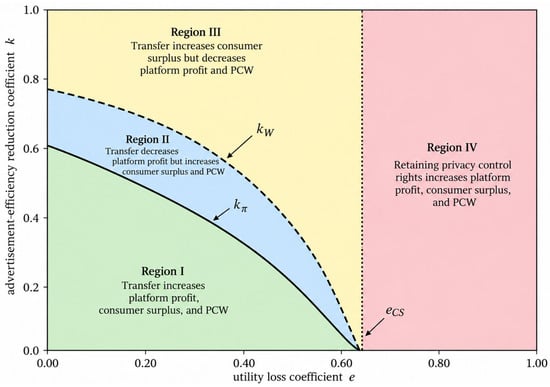
If and , transferring privacy control rights increases platform profit, consumer surplus, and PCW. If
and , transferring privacy control rights decreases platform profit but increases both consumer surplus and PCW. If
and , transferring privacy control rights increases consumer surplus but decreases both platform profit and PCW. If
, retaining privacy control rights increases platform profit, consumer surplus, and PCW.
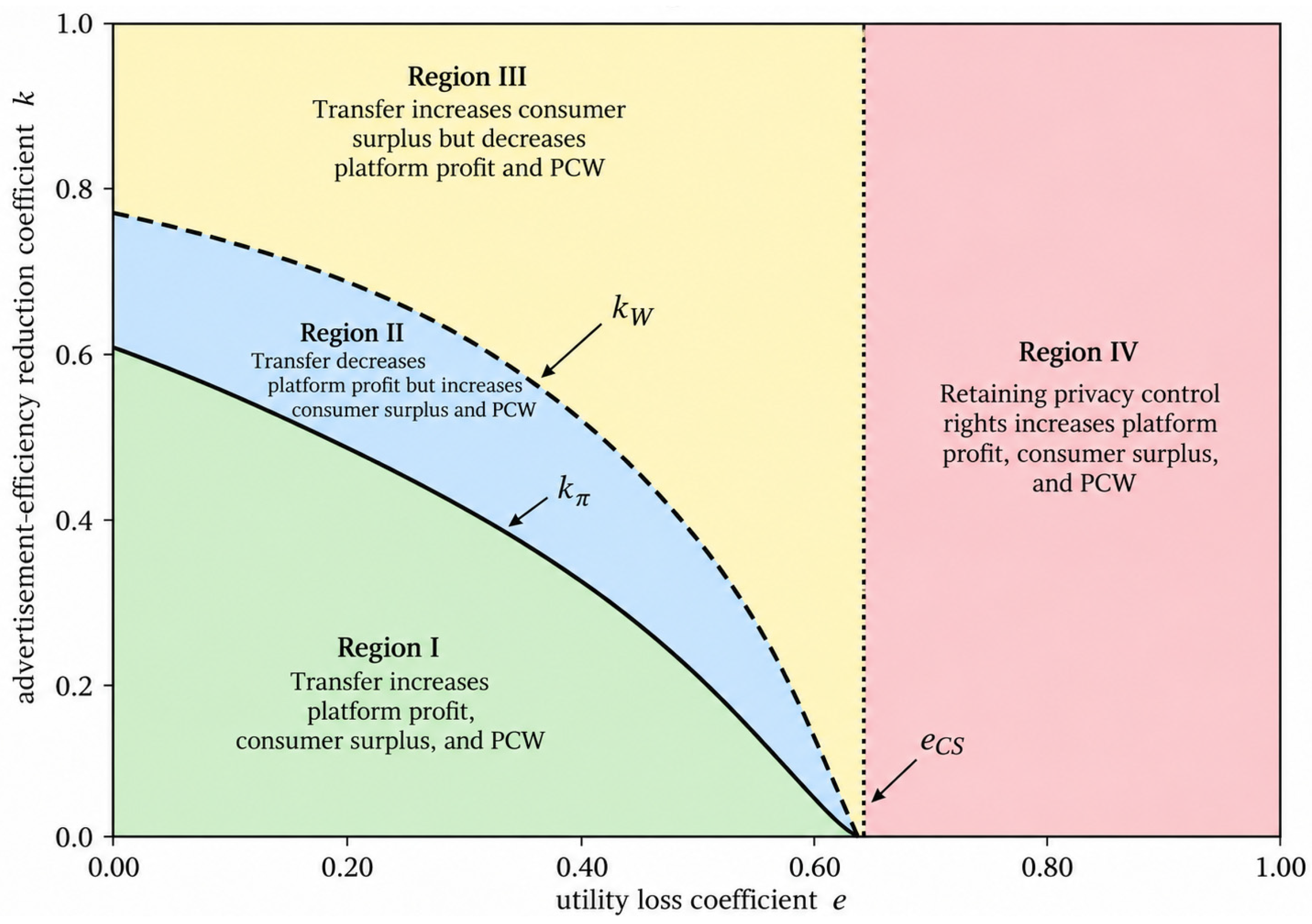
Theorem 8 shows that the desirability of transferring privacy control rights depends on whether the losses caused by consumer non-disclosure are sufficiently small. When both the utility loss coefficient and the advertisement-efficiency reduction coefficient are low, transferring privacy control rights benefits all parties considered in the model. Consumers benefit from reduced privacy-related disutility, while the platform can preserve sufficient personalized service quality and advertisement effectiveness to earn a higher profit. Consequently, consumer surplus, platform profit, and PCW all increase. In this region, the platform has a direct economic incentive to voluntarily provide consumers with greater privacy control. To better illustrate Theorem 8, we simulate the results in Figure 1.
Figure 1.
The impact of the transfer of privacy control rights on consumers and platform. We assign the value of the variables as follows: , , , , , , and .
When the utility loss from non-disclosure remains low but the advertisement efficiency reduction becomes moderately large, transferring privacy control rights continues to increase consumer surplus and PCW but reduces platform profit. Consumers still benefit because the privacy-related benefit of obtaining control exceeds the loss of personalized service utility. However, the decline in advertisement effectiveness reduces the platform’s profit sufficiently to make the transfer privately unattractive. This result identifies the parameter range in which the platform is unlikely to voluntarily provide privacy control even though doing so improves the joint interests of the platform and consumers. In this case, regulators can encourage privacy-control adoption through appropriate requirements or incentives, while platforms can reduce the associated profit loss by improving privacy-preserving advertisement technologies and maintaining targeting effectiveness with less personal information.
If the advertisement-efficiency reduction becomes even larger, transferring privacy control rights may still increase consumer surplus but reduces both platform profit and PCW. In this region, consumers value the reduction in privacy-related disutility, but the loss of advertisement profit is too large for the transfer to improve the combined outcome of the platform and consumers. Therefore, privacy-control requirements should not be evaluated solely on the basis of consumer-surplus gains. Regulators should also consider whether platforms have access to technologies that can maintain advertisement effectiveness when consumers withhold personal information. For platforms, reducing the advertisement-efficiency reduction coefficient becomes essential before transferring privacy control rights can generate broader economic benefits.
Finally, when the utility loss caused by non-disclosure is sufficiently large, retaining privacy control rights yields higher platform profit, consumer surplus, and PCW. In this case, allowing consumers to withhold information substantially reduces the quality of personalized services, and this service loss outweighs the privacy benefit generated by consumer control. For platforms whose services rely heavily on consumer information, the priority should therefore be to reduce the service quality loss associated with non-disclosure before expanding privacy-control options. Regulators should likewise avoid treating the transfer of privacy control rights as universally welfare-improving and should account for the extent to which limited information reduces the quality of services received by consumers.
In summary, Theorem 8 indicates that platforms can make privacy-control provision more economically sustainable through two complementary approaches. They can reduce the utility loss from non-disclosure by developing personalization methods that require less personal information and reduce the loss of advertisement effectiveness through contextual or privacy-preserving targeting technologies. From a policy perspective, the results suggest that privacy regulation should distinguish between cases in which platforms already have an incentive to transfer privacy control rights and cases in which consumer surplus and PCW improve but platform profit declines. Regulatory encouragement is most justified in the latter case, whereas mandatory transfer is less appropriate when non-disclosure causes substantial losses in personalized service quality or advertisement effectiveness.
6. Conclusions
In the digital era, the collection and application of consumers’ personal information can improve targeted advertisement effectiveness, but they can also intensify privacy concerns. Transferring privacy control rights to consumers may alleviate such concerns. However, it can reduce information disclosure, weaken advertisement efficiency, and lower platform profit. Platforms must therefore balance the benefits of consumer control against the value of consumer information. This study develops a game-theoretic model of an ad-supported content platform to examine whether the platform should retain privacy control rights or transfer them to consumers. We further investigate how this decision affects the platform’s advertisement strategy, platform profit, consumer surplus, and platform–consumer welfare. Several interesting conclusions are obtained:
- (1)
- Transferring privacy control rights is not uniformly beneficial. Its effects depend jointly on the utility loss of personalized service and the advertisement-efficiency reduction caused by non-disclosure. When both losses are sufficiently small, transferring privacy control rights increases platform profit, consumer surplus, and PCW simultaneously. When the utility loss remains limited but the advertisement-efficiency loss becomes moderately large, consumers and PCW still benefit, whereas platform profit decreases. If the advertisement-efficiency loss becomes sufficiently large, transferring privacy control rights continues to benefit consumers but reduces both platform profit and PCW. When the utility loss from non-disclosure is sufficiently large, retaining privacy control rights yields higher platform profit, consumer surplus, and PCW. These results identify the conditions under which the platform’s private incentive is consistent with, or differs from, consumer and welfare outcomes.
- (2)
- Transferring privacy control rights does not simply reduce advertisement intensity. Instead, it changes the allocation of advertisement strategy across consumer groups. The platform always sets a higher advertisement intensity for non-privacy-sensitive consumers who continue to disclose information. For privacy-sensitive consumers, advertisement intensity may increase or decrease depending on the personalized-service utility loss caused by non-disclosure. Thus, privacy control enables differentiated advertisement strategies rather than a uniform reduction in targeted advertisement.
- (3)
- The non-disclosure of personal information by privacy-sensitive consumers affects the platform and consumers in two distinct ways: the utility loss coefficient captures the reduction in personalized-service utility caused by less information being available for personalized service, whereas the advertisement-efficiency reduction coefficient captures the decline in targeting accuracy and advertisement effectiveness caused by reduced information disclosure. A larger utility loss coefficient reduces the utility obtained by privacy-sensitive consumers and constrains the advertisement intensity that the platform can sustain, while a larger advertisement-efficiency reduction coefficient directly lowers the advertisement profit generated from these consumers. Consequently, the platform is more willing to transfer privacy control rights when both effects are limited, while a larger utility loss coefficient reduces the maximum advertisement-efficiency reduction under which transferring privacy control rights remains profitable.
These findings provide several managerial and policy implications. Platforms should not regard retaining privacy control rights and collecting more consumer information as inherently more profitable. Instead, the allocation of privacy control rights should depend on the utility loss of personalized service and the advertisement-efficiency reduction caused by non-disclosure. When both effects are limited, transferring privacy control rights can reduce privacy-related disutility while allowing the platform to use consumers’ disclosure decisions to distinguish privacy-sensitive from non-privacy-sensitive consumers and implement differentiated targeted advertisement intensities. Platforms can further improve the economic viability of privacy control by reducing the personalized-service utility loss associated with non-disclosure and maintaining advertisement effectiveness with less consumer information. In addition, providing more granular choices over whether personal information is used for personalized services and targeted advertisement may help alleviate privacy concerns while preserving the informational value of disclosure decisions. From a policy perspective, regulatory intervention is most relevant when transferring privacy control rights increases consumer surplus and PCW but reduces platform profit, because the platform lacks a profit incentive to transfer privacy control rights voluntarily. In this case, appropriate requirements or incentives can encourage platforms to provide effective privacy control. However, mandatory transfer should be applied cautiously when non-disclosure causes substantial losses in personalized-service utility or advertisement effectiveness, because transferring privacy control rights may then reduce both platform profit and PCW.
Our research has some limitations for further research. Firstly, it only considers the platform’s privacy control and targeted advertisement strategies in a monopoly situation. In future research, the problems in a competitive situation can be studied to check the robustness of our findings. Secondly, this paper divides consumers into privacy-sensitive consumers and non-privacy-sensitive consumers according to their different levels of privacy concerns. However, in reality, some consumers are willing to provide personal information under certain external incentives. In future research, the consumer groups can be further subdivided to analyze the platform’s privacy control and targeted advertisement strategies. Thirdly, advertisers are represented through a reduced-form advertisement-profit parameter rather than modeled as strategic agents. Accordingly, the present welfare analysis focuses on PCW rather than traditional social welfare. Future research could explicitly incorporate advertiser participation, advertisement pricing, and advertiser surplus to examine how privacy control affects welfare across all participants in the advertisement market.
Author Contributions
Conceptualization, Y.Z., W.Z., and Y.S.; methodology, Y.Z. and Y.S.; formal analysis, Y.Z. and Y.S.; investigation, Y.Z. and Y.S.; writing—original draft preparation, Y.Z. and Y.S.; writing—review and editing, Y.S. and W.Z.; supervision, W.Z.; funding acquisition, W.Z. All authors have read and agreed to the published version of the manuscript.
Funding
This research was funded by National Natural Science Foundation of China, grant number 72371069, and Major Project of Philosophy and Social Science Research in Colleges and Universities of Jiangsu Province grant number 2025SJZD036.
Institutional Review Board Statement
Not applicable.
Informed Consent Statement
Not applicable.
Data Availability Statement
The original contributions presented in this study are included in the article. Further inquiries can be directed to the corresponding author.
Conflicts of Interest
The authors declare no conflict of interest.
References
- Marotta, V.; Wu, Y.; Zhang, K.; Acquisti, A. The welfare impact of targeted advertisement technologies. Inf. Syst. Res. 2022, 33, 131–151. [Google Scholar] [CrossRef] [Scilit]
- Rafieian, O.; Yoganarasimhan, H. Targeting and privacy in mobile advertisement. Mark. Sci. 2021, 40, 193–218. [Google Scholar] [CrossRef] [Scilit]
- Gal-Or, E.; Gal-Or, R.; Penmetsa, N. The role of user privacy concerns in shaping competition among platforms. Inf. Syst. Res. 2018, 29, 698–722. [Google Scholar] [CrossRef] [Scilit]
- Zhang, D.; Voorveld, H.; Boerman, S.C. Privacy concerns matter, knowledge does not: Investigating effects of online behavioral advertisement among Chinese and Dutch adults. J. Curr. Issues Res. Advert. 2023, 44, 392–410. [Google Scholar] [CrossRef] [Scilit]
- Tucker, C.E. Social networks, personalized advertisement, and privacy controls. J. Mark. Res. 2014, 51, 546–562. [Google Scholar] [CrossRef] [Scilit]
- Bornschein, R.; Schmidt, L.; Maier, E. The effect of consumers’ perceived power and risk in digital information privacy: The example of cookie notices. J. Public Policy Mark. 2020, 39, 135–154. [Google Scholar] [CrossRef] [Scilit]
- Regulation (EU) 2016/679 (General Data Protection Regulation). 2016, L119, pp. 1–88. Available online: https://eur-lex.europa.eu/eli/reg/2016/679/oj (accessed on 14 September 2026).
- California Consumer Privacy Act of 2018, Cal. Civ. Code §1798.100 et seq. 2018. Available online: https://leginfo.legislature.ca.gov/faces/codes_displayText.xhtml?lawCode=CIV&division=3.&title=1.81.5.&part=4 (accessed on 14 September 2026).
- Personal Information Protection Law of the People’s Republic of China. 2021. Available online: http://www.npc.gov.cn/npc/c30834/202108/a8c4e3672c74491a80b53a172bb753fe.shtml (accessed on 14 September 2026).
- Malhotra, N.K.; Kim, S.S.; Agarwal, J. Internet users’ information privacy concerns (IUIPC): The construct, the scale, and a causal model. Inf. Syst. Res. 2004, 15, 336–355. [Google Scholar] [CrossRef] [Scilit]
- Gouthier, M.H.; Nennstiel, C.; Kern, N.; Wendel, L. The more the better? Data disclosure between the conflicting priorities of privacy concerns, information sensitivity and personalization in e-commerce. J. Bus. Res. 2022, 148, 174–189. [Google Scholar] [CrossRef] [Scilit]
- Zhu, Y.; Lu, Y.; Gupta, S.; Wang, J.; Hu, P. Promoting smart wearable devices in the health-AI market: The role of health consciousness and privacy protection. J. Res. Interact. Mark. 2023, 17, 257–272. [Google Scholar] [CrossRef] [Scilit]
- Tseng, H.-T.; Nadeem, W.; Hajli, M.S.; Featherman, M.; Hajli, N. Understanding consumers’ interest in social commerce: The role of privacy, trust and security. Inf. Technol. People 2025, 38, 472–496. [Google Scholar] [CrossRef] [Scilit]
- Cichy, P.; Salge, T.O.; Kohli, R. Privacy concerns and data sharing in the internet of things: Mixed methods evidence from connected cars. MIS Q. 2021, 45, 1863–1891. [Google Scholar] [CrossRef] [Scilit]
- Zhang, C.; Chen, J.; Raghunathan, S. Two-sided platform competition in a sharing economy. Manag. Sci. 2022, 68, 8909–8932. [Google Scholar] [CrossRef] [Scilit]
- Lei, Y.; Miao, S.; Momot, R. Privacy-preserving personalized profit management. Manag. Sci. 2024, 70, 4875–4892. [Google Scholar] [CrossRef] [Scilit]
- Lee, D.-J.; Ahn, J.-H.; Bang, Y. Managing consumer privacy concerns in personalization: A strategic analysis of privacy protection. MIS Q. 2011, 35, 423–444. [Google Scholar] [CrossRef] [Scilit]
- Wang, W.; Li, B. Learning personalized privacy preference from public data. Inf. Syst. Res. 2025, 36, 761–780. [Google Scholar] [CrossRef] [Scilit]
- Lv, L.; Huang, M. Can personalized recommendations in charity advertisement boost donation? The role of perceived autonomy. J. Advert. 2024, 53, 36–53. [Google Scholar] [CrossRef] [Scilit]
- Kox, H.; Straathof, B.; Zwart, G. Targeted advertisement, platform competition, and privacy. J. Econ. Manag. Strategy 2017, 26, 557–570. [Google Scholar] [CrossRef] [Scilit]
- Duan, Y.; Ge, Y.; Feng, Y. Pricing and personal data collection strategies of online platforms in the face of privacy concerns. Electron. Commer. Res. 2022, 22, 539–559. [Google Scholar] [CrossRef] [Scilit]
- Shen, Y.; Zhong, W.; Mei, S. Advertisement strategies of competing firms considering consumer privacy concerns. Manag. Decis. Econ. 2023, 44, 2424–2437. [Google Scholar] [CrossRef] [Scilit]
- Voorveld, H.A.; Meppelink, C.S.; Boerman, S.C. Consumers’ persuasion knowledge of algorithms in social media advertisement: Identifying consumer groups based on awareness, appropriateness, and coping ability. Int. J. Advert. 2024, 43, 960–986. [Google Scholar] [CrossRef] [Scilit]
- Zhang, Y.; Zhong, W. “Anchoring Effect” of Privacy in Targeted Persuasive Advertisement Competition. SAGE Open 2024, 14, 21582440241257152. [Google Scholar] [CrossRef] [Scilit]
- Cheng, Y.; Mei, S.; Zhong, W.; Gao, X. Managing consumer privacy risk: The effects of privacy breach insurance. Electron. Commer. Res. 2023, 23, 807–841. [Google Scholar] [CrossRef] [Scilit]
- Kircher, T.; Foerderer, J. Ban targeted advertisement? An empirical investigation of the consequences for app development. Manag. Sci. 2024, 70, 1070–1092. [Google Scholar] [CrossRef] [Scilit]
- Lefrere, V.; Warberg, L.; Cheyre, C.; Marotta, V.; Acquisti, A. Does privacy regulation harm content providers? A longitudinal analysis of the impact of the GDPR. Manag. Sci. 2026, 72, 1727–1747. [Google Scholar] [CrossRef] [Scilit]
- Shin, W.; Kang, H. Adolescents’ privacy concerns and information disclosure online: The role of parents and the Internet. Comput. Hum. Behav. 2016, 54, 114–123. [Google Scholar] [CrossRef] [Scilit]
- Macha, M.; Foutz, N.Z.; Li, B.; Ghose, A. Personalized privacy preservation in consumer mobile trajectories. Inf. Syst. Res. 2024, 35, 249–271. [Google Scholar] [CrossRef] [Scilit]
- Goldfarb, A.; Tucker, C.E. Privacy regulation and online advertisement. Manag. Sci. 2011, 57, 57–71. [Google Scholar] [CrossRef] [Scilit]
- Conti, C.; Reverberi, P. Price discrimination and product quality under opt-in privacy regulation. Inf. Econ. Policy 2021, 55, 100912. [Google Scholar] [CrossRef] [Scilit]
- Xu, F.; Wang, X.; Zhang, F. Consumer privacy in online retail supply chains. Manag. Sci. 2025, 71, 8371–8389. [Google Scholar] [CrossRef] [Scilit]
- Chen, Z.; Choe, C.; Matsushima, N. Competitive personalized pricing. Manag. Sci. 2020, 66, 4003–4023. [Google Scholar] [CrossRef] [Scilit]
- Cooper, D.A.; Yalcin, T.; Nistor, C.; Macrini, M.; Pehlivan, E. Privacy considerations for online advertisement: A stakeholder’s perspective to programmatic advertisement. J. Consum. Mark. 2023, 40, 235–247. [Google Scholar] [CrossRef] [Scilit]
- Ullah, I.; Boreli, R.; Kanhere, S.S. Privacy in targeted advertisement on mobile devices: A survey. Int. J. Inf. Secur. 2023, 22, 647–678. [Google Scholar] [CrossRef] [Scilit] [PubMed]
- Feng, N.; Zhu, J.; Zhang, W.; Feng, H. Traditional, subscription, or data compensation: An economic analysis of optimal privacy protection models on ad-supported platforms. Decis. Support Syst. 2026, 209, 114733. [Google Scholar] [CrossRef] [Scilit]
- Koh, B.; Raghunathan, S.; Nault, B.R. Is voluntary profiling welfare enhancing? MIS Q. 2017, 41, 23–41. [Google Scholar] [CrossRef] [Scilit]
- Casadesus-Masanell, R.; Hervas-Drane, A. Competing with privacy. Manag. Sci. 2015, 61, 229–246. [Google Scholar] [CrossRef] [Scilit]
- Choi, J.P.; Jeon, D.-S.; Kim, B.-C. Privacy and personal data collection with information externalities. J. Public Econ. 2019, 173, 113–124. [Google Scholar] [CrossRef] [Scilit]
- Lee, D.; Mendelson, H. Adoption of information technology under network effects. Inf. Syst. Res. 2007, 18, 395–413. [Google Scholar] [CrossRef] [Scilit]
- Small, K.A.; Rosen, H.S. Applied welfare economics with discrete choice models. Econom. J. Econom. Soc. 1981, 49, 105–130. [Google Scholar] [CrossRef] [Scilit] [PubMed]
- Dorsey, J. Solar market frictions: The role of platforms and policies. Rev. Econ. Stat. 2024, 1–45. [Google Scholar] [CrossRef] [Scilit]
- Döpper, H.; MacKay, A.; Miller, N.H.; Stiebale, J. Rising markups and the role of consumer preferences. J. Political Econ. 2025, 133, 2462–2505. [Google Scholar] [CrossRef] [Scilit]
- Choe, C.; Matsushima, N.; Shekhar, S. The bright side of the GDPR: Welfare-improving privacy management. Manag. Sci. 2025, 71, 6836–6858. [Google Scholar] [CrossRef] [Scilit]
- Piolatto, A.; Schuett, F. Platform design and rent extraction. J. Ind. Econ. 2025, 73, 124–166. [Google Scholar] [CrossRef] [Scilit]
- Choi, J.P.; Jeon, D.S. Platform design biases in ad-funded two-sided markets. RAND J. Econ. 2023, 54, 240–267. [Google Scholar] [CrossRef] [Scilit]
Disclaimer/Publisher’s Note: The statements, opinions and data contained in all publications are solely those of the individual author(s) and contributor(s) and not of MDPI and/or the editor(s). MDPI and/or the editor(s) disclaim responsibility for any injury to people or property resulting from any ideas, methods, instructions or products referred to in the content. |
© 2026 by the authors. Licensee MDPI, Basel, Switzerland. This article is an open access article distributed under the terms and conditions of the Creative Commons Attribution (CC BY) license.