
Emotional Responses to AI Chatbots in Online Travel Agencies: An S-O-R Perspective


Abstract
1. Introduction
2. Literature Review and Development of Hypothesis
2.1. Stimulus–Organism–Response (S-O-R) Model
2.2. Online Travel Agency (OTA) AI Chatbots
2.3. Empathy as a Stimulus That Affects Emotional Reactions
2.4. Emotional Credibility as an Antecedent of the Emotional Response
2.5. Emotional Reaction and Emotional Attachment
2.6. Emotional Response and Satisfaction
2.7. Emotional Reactions and Customer Experience
2.8. Organism Outcomes and Purchase Intention
3. Methodology
3.1. Measures and Measurements
- (a)
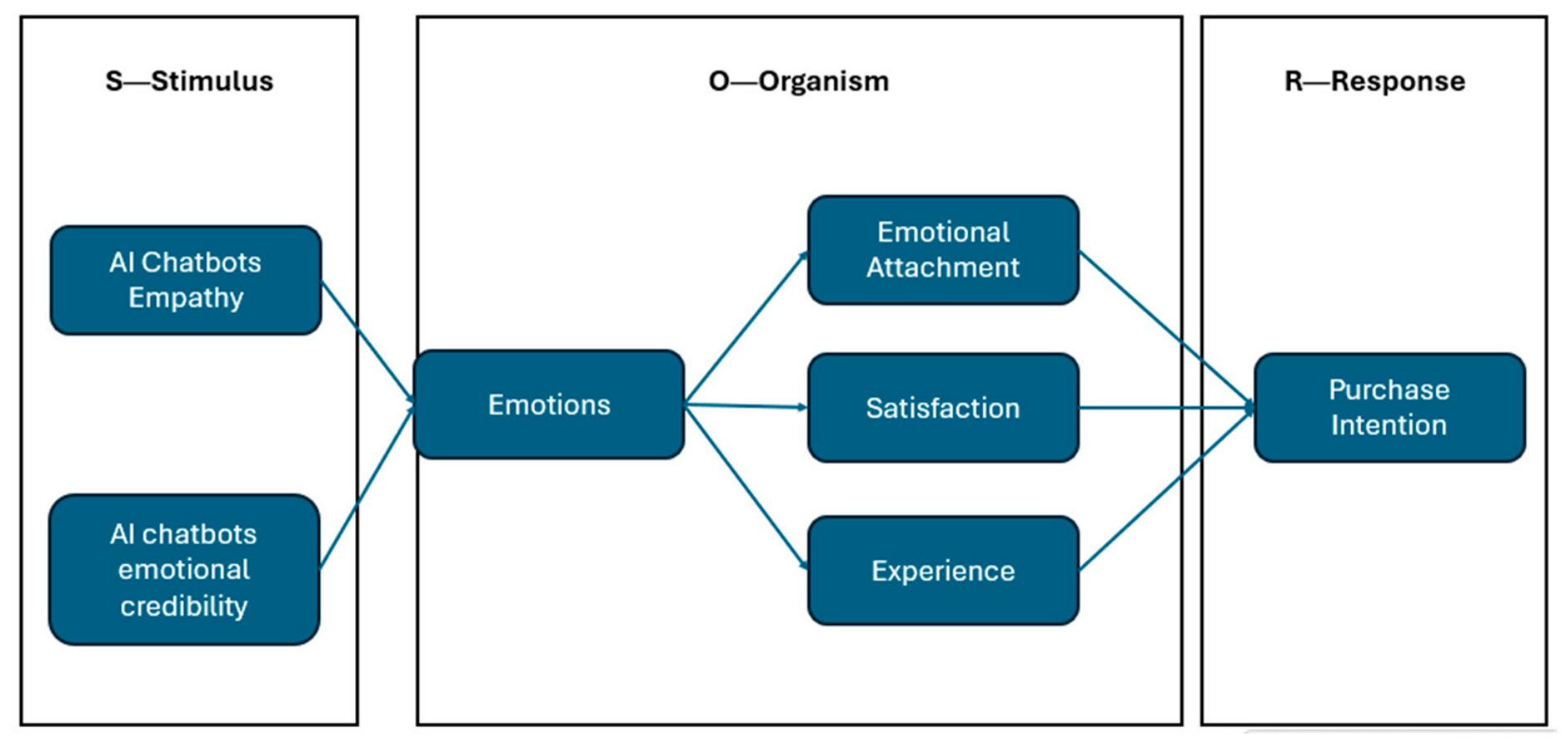
- Stimulus (S)—AI Chatbot Characteristics: This section measured key attributes of AI chatbots, specifically empathy and emotional credibility. Empathy was assessed using items adapted from Kim and Hur [38], capturing the chatbot’s ability to understand users’ needs, show concern, and provide individualized attention. Emotional credibility was measured using a multi-item scale adapted from Lee, Pan and Hsieh [39], reflecting the chatbot’s ability to recognize, express, and appropriately respond to the user’s emotions in a credible and trustworthy way. In the present study, emotional credibility refers specifically to the perceived genuineness, believability, authenticity, and trustworthiness of the chatbot’s emotional expressions and responses.
- (b)
- Organism (O)—Emotional Responses: The organism component captured consumers’ emotional reactions resulting from their interaction with AI chatbots. Emotions were operationalized through both emotional and informational support dimensions, adapted from Lee, Pan and Hsieh [39], as well as affective perception items from Chen, Gong, Lu and Luo [40]. These measures captured the positive emotional and supportive reactions experienced by the user as a result of interacting with the OTA AI chatbot. Internal Evaluative States: The organism component included emotional attachment, satisfaction, and customer experience as internal relational, evaluative, and experiential states associated with the chatbot interaction. Emotional attachment was measured using items adapted from Kostka and Zhou [41] and Lee, Pan and Hsieh [39], capturing the degree of users’ emotional bonding with the AI chatbot in the OTA interaction context. User satisfaction was assessed using a scale adapted from Chen, Lu, Gong and Xiong [42] as described at Fang et al. [43]. Customer experience was measured using three items adapted from Trivedi [44] and Chen, Lu, Gong and Xiong [42], focusing on the enjoyment, interest, and overall evaluation of the experience of interacting with the AI chatbot.
- (c)
- Response (R)—Behavioral Outcomes: The response section included key consumer outcomes influenced by emotional states. Finally, purchase intention was measured using a validated scale from Chen, Lu, Gong and Xiong [42], assessing the likelihood that the user will purchase or book a travel product/service recommended by the OTA AI chatbot.
3.2. Sample and Data Collection Method
3.3. Tool for Data Analysis
4. Data Analysis and Interpretation
4.1. Respondent Profile
4.2. Reliability and Validity
4.3. Structural Model Analysis
4.4. Mediation Analysis
5. Discussion
The Effect of the Emotional Attachment
6. Conclusions
6.1. Managerial Implications
6.2. Limitations and Future Research
Funding
Institutional Review Board Statement
Informed Consent Statement
Data Availability Statement
Acknowledgments
Conflicts of Interest
Appendix A

| Original Sample (O) | Sample Mean (M) | 2.5% | 97.5% | |
|---|---|---|---|---|
| Emotional Credibility <-> Emotional Attachment | 0.364 | 0.364 | 0.208 | 0.509 |
| Emotions <-> Emotional Attachment | 0.730 | 0.730 | 0.656 | 0.794 |
| Emotions <-> Emotional Credibility | 0.417 | 0.418 | 0.277 | 0.547 |
| Empathy <-> Emotional Attachment | 0.308 | 0.309 | 0.160 | 0.453 |
| Empathy <-> Emotional Credibility | 0.253 | 0.255 | 0.115 | 0.402 |
| Empathy <-> Emotions | 0.404 | 0.405 | 0.268 | 0.532 |
| Experience <-> Emotional Attachment | 0.700 | 0.700 | 0.605 | 0.783 |
| Experience <-> Emotional Credibility | 0.425 | 0.425 | 0.284 | 0.559 |
| Experience <-> Emotions | 0.611 | 0.610 | 0.498 | 0.705 |
| Experience <-> Empathy | 0.328 | 0.328 | 0.167 | 0.477 |
| Purchase Intention <-> Emotional Attachment | 0.698 | 0.697 | 0.597 | 0.782 |
| Purchase Intention <-> Emotional Credibility | 0.429 | 0.429 | 0.302 | 0.550 |
| Purchase Intention <-> Emotions | 0.737 | 0.736 | 0.640 | 0.818 |
| Purchase Intention <-> Empathy | 0.292 | 0.293 | 0.146 | 0.439 |
| Purchase Intention <-> Experience | 0.788 | 0.788 | 0.709 | 0.853 |
| Satisfaction <-> Emotional Attachment | 0.849 | 0.849 | 0.790 | 0.901 |
| Satisfaction <-> Emotional Credibility | 0.426 | 0.427 | 0.289 | 0.554 |
| Satisfaction <-> Emotions | 0.743 | 0.743 | 0.659 | 0.815 |
| Satisfaction <-> Empathy | 0.337 | 0.338 | 0.194 | 0.475 |
| Satisfaction <-> Experience | 0.680 | 0.679 | 0.574 | 0.768 |
| Satisfaction <-> Purchase Intention | 0.782 | 0.782 | 0.697 | 0.851 |
References
- Malik, G.; Singh, D.; Jha, A. Navigating the Digital Horizon: How AI-Powered Chatbots Are Redefining Engagement in Online Travel Agencies (OTAs). J. Hosp. Tour. Technol. 2026, 1–31. [Google Scholar] [CrossRef] [Scilit]
- Dwivedi, Y.K.; Kshetri, N.; Hughes, L.; Slade, E.L.; Jeyaraj, A.; Kar, A.K.; Baabdullah, A.M.; Koohang, A.; Raghavan, V.; Ahuja, M.; et al. So What If ChatGPT Wrote It? Multidisciplinary Perspectives on Opportunities, Challenges and Implications of Generative Conversational AI. Int. J. Inf. Manag. 2023, 71, 102642. [Google Scholar] [CrossRef] [Scilit]
- Van Doorn, J.; Mende, M.; Noble, S.M.; Hulland, J.; Ostrom, A.L.; Grewal, D.; Petersen, J.A. Domo Arigato Mr. Roboto: Emergence of Automated Social Presence in Organizational Frontlines and Customers’ Service Experiences. J. Serv. Res. 2017, 20, 43–58. [Google Scholar] [CrossRef] [Scilit]
- Odinukaeze, I.M. Application of Artificial Intelligence in Tourism Organisation. Doctoral Dissertation, Lietuvos Sporto Universitetas, Kaunas, Lithuania, 2025. [Google Scholar]
- Wut, T.M.; Lee, S.W.; Xu, J.; Kwok, M.L.J. Do Trusting Belief and Social Presence Matter? Service Satisfaction in Using AI Chatbots: Necessary Condition Analysis and Importance-Performance Map Analysis. Informatics 2025, 12, 91. [Google Scholar] [CrossRef] [Scilit]
- Kumar, S. How Does Anthropomorphism of AI-Powered Chatbots Shape Emotions and Brand Love? A Study on Online Travel Agencies. Asia Pac. J. Tour. Res. 2026, 31, 174–192. [Google Scholar] [CrossRef] [Scilit]
- Le, M.T.H.; Tran, C.M.; Pham, T.T.M.; Pham, C.N.L.; Nguyen, D.P. AI Chatbot: Increasing Emotional Efficacy in Tourism through Anthropomorphic Theory of Acceptance Model. Int. J. Tour. Anthropol. 2024, 9, 300–331. [Google Scholar] [CrossRef] [Scilit]
- Ku, E.C. Anthropomorphic Chatbots as a Catalyst for Marketing Brand Experience: Evidence from Online Travel Agencies. Curr. Issues Tour. 2024, 27, 4165–4184. [Google Scholar] [CrossRef] [Scilit]
- Chiengkul, W.; Kumjorn, P.; Tantipanichkul, T.; Suphan, K. Engaging with AI in Tourism: A Key to Enhancing Smart Experiences and Emotional Bonds. Asia Pac. J. Bus. Adm. 2025, 17, 1421–1440. [Google Scholar] [CrossRef] [Scilit]
- Huang, Z.A.; Sun, J.; Dai, B. Building Trust with AI Chatbots in Tourism: A Review of Functional and Emotional Design Challenges. In Proceedings of the AIoT Global Summit 2025: Economic Growth, Online, 15–16 July 2025; pp. 46–51. [Google Scholar]
- Ben Cheikh, A.; Zarrad, H. Investigating tourism chatbot adoption: The moderating role of privacy concerns. J. Hosp. Tour. Insights 2026, 9, 298–318. [Google Scholar] [CrossRef] [Scilit]
- Mohammed, A.; Ferraris, A. Exploring motivational drivers of AI chatbot adoption in emerging markets: Insights from the stimulus-organism-response model for service automation. Bottom Line 2025, 39, 299–319. [Google Scholar] [CrossRef] [Scilit]
- Huang, Y.; Gursoy, D. The impact of chatbots’ artificial intelligence type on customer engagement: Moderating role of tourism service context. J. Hosp. Tour. Technol. 2025, 1–21. [Google Scholar] [CrossRef] [Scilit]
- Donovan, R.J.; Rossiter, J.R. Store atmosphere: An environmental psychology approach. J. Retail. 1982, 58, 34–57. [Google Scholar] [CrossRef] [Scilit]
- Wu, S.; Wong, I.K.A.; Lin, Z.C. Understanding the role of atmospheric cues of travel apps: A synthesis between media richness and stimulus–organism–response theory. J. Hosp. Tour. Manag. 2021, 49, 226–234. [Google Scholar] [CrossRef] [Scilit]
- Mehrabian, A.; Russell, J.A. The basic emotional impact of environments. Percept. Mot. Ski. 1974, 38, 283–301. [Google Scholar] [CrossRef] [Scilit] [PubMed]
- Alharbi, A.; Pandit, A.; Rosenberger, P.J., III; Miah, S. Understanding AI-enabled conversational agent customer experiences in religious tourism. J. Islam. Mark. 2025, 16, 2569–2595. [Google Scholar] [CrossRef] [Scilit]
- Ghasemi, V.; Yarahmadi, P.; Kuhzady, S. AI-powered live chatbots and smart tour guide apps in tourism: A literature review and future research directions. Turyzm/Tourism 2025, 35, 217–227. [Google Scholar] [CrossRef] [Scilit]
- Alharbi, A.; Pandit, A.; Wilk, V.; Rosenberger, P.J., III; Miah, S. Artificial intelligence-enabled conversational agents in tourism & hospitality: A systematic literature review & future research directions. Asia Pac. J. Tour. Res. 2025, 31, 21–52. [Google Scholar] [CrossRef] [Scilit]
- Riedl, A. AI Applications in Tourism—Exploring Tourists’ Perspectives Across the Customer Journey. Doctoral Dissertation, University of Innsbruck, Innsbruck, Austria, 2025. [Google Scholar]
- Al-Aamri, M.S.H.; Alkoud, S.; Gulvady, S. The role of artificial intelligence and chatbots in customer engagement in tourism. In Exploring AI and Consumer Decision-Making in Tourism and Marketing; IGI Global Scientific Publishing: Hershey, PA, USA, 2026; pp. 207–232. [Google Scholar]
- Wüst, K.; Bremser, K. Artificial intelligence in tourism through chatbot support in the booking process—An experimental investigation. Tour. Hosp. 2025, 6, 36. [Google Scholar] [CrossRef] [Scilit]
- Pang, H.; Hu, Z.; Wang, L. How perceived motivations influence user stickiness and sustainable engagement with AI-powered chatbots—Unveiling the pivotal function of user attitude. J. Theor. Appl. Electron. Commer. Res. 2025, 20, 228. [Google Scholar] [CrossRef] [Scilit]
- Orden-Mejía, M.; Carvache-Franco, M.; Huertas, A.; Carvache-Franco, O.; Carvache-Franco, W. Analysing how AI-powered chatbots influence destination decisions. PLoS ONE 2025, 20, e0319463. [Google Scholar] [CrossRef] [Scilit] [PubMed]
- Crolic, C.; Thomaz, F.; Hadi, R.; Stephen, A.T. Blame the bot: Anthropomorphism and anger in customer–chatbot interactions. J. Mark. 2022, 86, 132–148. [Google Scholar] [CrossRef] [Scilit]
- Balamurali, O.; Sai, A.A.; Anand, S. Advancing tourism chatbots: Understanding irony, sarcasm, and negative emotions of users. In Proceedings of the 2024 15th International Conference on Computing Communication and Networking Technologies (ICCCNT), Kamand, India, 24–28 June 2024; pp. 1–7. [Google Scholar]
- Abou-Shouk, M.; Elbaz, A.M.; Al-Leheabi, S.M.Z.M.; AbuElEnain, E.; Shabana, M.M. Trusting ChatGPT Usage in Personalized Travel Planning: The Moderating Role of Privacy and Data Security. Tour. Hosp. Res. 2024, onlinefirst. [Google Scholar] [CrossRef] [Scilit]
- Pham, T.N. Investigating the impact of online reviews, virtual reality, and AI chatbots on first-time hotel bookings in rural destinations: The role of sense of presence and trust. Geoj. Tour. Geosites 2025, 61, 1845–1858. [Google Scholar] [CrossRef] [Scilit]
- Magano, J.; Quintela, J.A.; Banerjee, N. Driving consumer engagement through AI chatbot experience: The mediating role of satisfaction across generational cohorts and gender in travel tourism. Sustainability 2025, 17, 7673. [Google Scholar] [CrossRef] [Scilit]
- Filrando, A.; Fahlevi, R.; Sinambela, F.A. Exploring the factors influencing user attitudes and AI chatbot use in the tourism sector: Evidence from Indonesia. J. Enterp. Dev. 2026, 8, 70–83. [Google Scholar] [CrossRef] [Scilit]
- Zhu, Y.; Zhang, R.; Zou, Y.; Jin, D. Investigating customers’ responses to artificial intelligence chatbots in online travel agencies: The moderating role of product familiarity. J. Hosp. Tour. Technol. 2023, 14, 208–224. [Google Scholar] [CrossRef] [Scilit]
- Akdemir, D.M.; Bulut, Z.A. Business and customer-based chatbot activities: The role of customer satisfaction in online purchase intention and intention to reuse chatbots. J. Theor. Appl. Electron. Commer. Res. 2024, 19, 2961–2979. [Google Scholar] [CrossRef] [Scilit]
- Chatzopoulou, E.; Tsogas, M. The role of emotions to brand attachment and brand attitude in a retail environment. In Creating Marketing Magic and Innovative Future Marketing Trends: Proceedings of the 2016 Academy of Marketing Science (AMS) Annual Conference; Springer: Cham, Switzerland, 2017; pp. 43–47. [Google Scholar]
- De Keyser, A.; Verleye, K.; Lemon, K.N.; Keiningham, T.L.; Klaus, P. Moving the customer experience field forward. J. Serv. Res. 2020, 23, 433–455. [Google Scholar] [CrossRef] [Scilit]
- Chatzopoulou, E.; Poulis, A.; Rizomyliotis, I.; Konstantoulaki, K. Influencers as brand architects: Co-creation and customer experience in tourism. Rev. Mark. Sci. 2025. [Google Scholar] [CrossRef] [Scilit]
- Meng, H.; Lu, X.; Xu, J. The impact of chatbot response strategies and emojis usage on customers’ purchase intention: The mediating roles of psychological distance and performance expectancy. Behav. Sci. 2025, 15, 117. [Google Scholar] [CrossRef] [Scilit] [PubMed]
- Poulis, A.; Chatzopoulou, E. The role of social media influencers to tourists’ travel decisions. In Proceedings of the European Marketing Academy, Athens, Greece, 27–29 September 2023; Volume 117244. [Google Scholar]
- Kim, W.B.; Hur, H.J. What makes people feel empathy for AI chatbots? Assessing the role of competence and warmth. Int. J. Hum. Comput. Interact. 2024, 40, 4674–4687. [Google Scholar] [CrossRef] [Scilit]
- Lee, C.; Pan, L.-Y.; Hsieh, S.H. Artificial intelligent chatbots as brand promoters: A two-stage structural equation modeling–artificial neural network approach. Internet Res. 2021, 32, 1329–1356. [Google Scholar] [CrossRef] [Scilit]
- Chen, Q.; Gong, Y.; Lu, Y.; Luo, X. The golden zone of AI’s emotional expression in frontline chatbot service failures. Internet Res. 2024, 35, 1065–1103. [Google Scholar] [CrossRef] [Scilit]
- Kostka, G.; Zhou, H. Emotional attachment to AI chatbots: Evidence from Germany, China, South Africa, and the United States. Technol. Soc. 2026, 87, 103379. [Google Scholar] [CrossRef] [Scilit]
- Chen, Q.; Lu, Y.; Gong, Y.; Xiong, J. Can AI chatbots help retain customers? The impact of AI service quality on customer loyalty. Internet Res. 2022, 33, 2205–2243. [Google Scholar] [CrossRef] [Scilit]
- Fang, Y.; Qureshi, I.; Sun, H.; McCole, P.; Ramsey, E.; Lim, K.H. Trust, satisfaction, and online repurchase intention: The moderating role of perceived effectiveness of e-Commerce institutional mechanisms. MIS Q. 2014, 38, 407–428. [Google Scholar] [CrossRef] [Scilit]
- Trivedi, J. Examining the customer experience of using banking chatbots and its impact on brand love: The moderating role of perceived risk. J. Internet Commer. 2019, 18, 91–111. [Google Scholar] [CrossRef] [Scilit]
- Bougie, R.; Sekaran, U. Research Methods for Business: A Skill-Building Approach; Wiley: Hoboken, NJ, USA, 2025. [Google Scholar]
- Ringle, C.M.; Wende, S.; Becker, J.M. SmartPLS 4; SmartPLS: Oststeinbek, Germany, 2022; Available online: https://www.smartpls.com (accessed on 10 August 2026).
- Hair, J.F.; Sharma, P.N.; Sarstedt, M.; Ringle, C.M.; Liengaard, B.D. The shortcomings of equal weights estimation and the composite equivalence index in PLS-SEM. Eur. J. Mark. 2024, 58, 30–55. [Google Scholar] [CrossRef] [Scilit]
- Reinartz, W.; Haenlein, M.; Henseler, J. An empirical comparison of the efficacy of covariance-based and variance-based SEM. Int. J. Res. Mark. 2009, 26, 332–344. [Google Scholar] [CrossRef] [Scilit]
- Fornell, C.; Larcker, D.F. Evaluating structural equation models with unobservable variables and measurement error. J. Mark. Res. 1981, 18, 39–50. [Google Scholar] [CrossRef] [Scilit]
- Henseler, J.; Ringle, C.M.; Sarstedt, M. A new criterion for assessing discriminant validity in variance-based structural equation modeling. J. Acad. Mark. Sci. 2015, 43, 115–135. [Google Scholar] [CrossRef] [Scilit]
- Hair, J.F.; Hult, G.T.M.; Ringle, C.; Sarstedt, M. A Primer on Partial Least Squares Structural Equation Modeling (PLS-SEM), 2nd ed.; SAGE Publishing: Thousand Oaks, CA, USA, 2019. [Google Scholar]
- Cohen, J. Set correlation and contingency tables. Appl. Psychol. Meas. 1988, 12, 425–434. [Google Scholar] [CrossRef] [Scilit]
- Henseler, J.; Hubona, G.; Ray, P.A. Using PLS path modeling in new technology research: Updated guidelines. Ind. Manag. Data Syst. 2016, 116, 2–20. [Google Scholar] [CrossRef] [Scilit]
- McLean, G.; Osei-Frimpong, K. Chat now: Examining the variables influencing the use of online live chat. Technol. Forecast. Soc. Change 2019, 146, 55–67. [Google Scholar] [CrossRef] [Scilit]
- Fickers, A.; Dessart, L.; El Midaoui, Y. The Dark Side of Customer Engagement in AI-Driven Interactions: The Case of Chatbots in the Tourism Industry; University of Liège: Liège, Belgium, 2023; Available online: https://www.scirp.org/reference/referencespapers?referenceid=4209602 (accessed on 18 April 2026).
- Pentina, I.; Hancock, T.; Xie, T. Exploring relationship development with social chatbots: A mixed-method study of Replika. Comput. Hum. Behav. 2023, 140, 107600. [Google Scholar] [CrossRef] [Scilit]
- Chi, N.T.K.; Vu, N.H. Investigating the customer trust in artificial intelligence: The role of anthropomorphism, empathy response, and interaction. CAAI Trans. Intell. Technol. 2023, 8, 260–273. [Google Scholar] [CrossRef] [Scilit]
- Hu, Y.; Xiao, Y.; Hua, Y.; Fan, Y.; Li, F. The more realism, the better? How does the realism of AI customer service agents influence customer satisfaction and repeat purchase intention in service recovery. Behav. Sci. 2024, 14, 1182. [Google Scholar] [CrossRef] [Scilit] [PubMed]
- Huang, Z.A.; Sun, J.J.; Dai, B.; Fan, B. Friend, guide, or frustration? Understanding trust in AI chatbots for tourism and hospitality. Rere Āwhio-J. Appl. Res. Pract. 2025, 5, 1–11. [Google Scholar] [CrossRef] [Scilit]


| Constructs | Adapted Item | SL | α | CR | AVE |
|---|---|---|---|---|---|
| Empathy (EMP)—Kim & Hur [38] | This AI chatbot understands my specific travel needs. | 0.826 | 0.922 | 0.941 | 0.762 |
| This AI chatbot shows that it takes my travel interests and preferences seriously. | 0.868 | ||||
| This AI chatbot gives me individualized attention based on my travel needs. | 0.883 | ||||
| This AI chatbot understands my feelings and concerns regarding my travel plans. | 0.893 | ||||
| This AI chatbot responds appropriately to my travel-related needs and concerns. | 0.893 | ||||
| Emotional Credibility (EC)—Lee et al. [39] | This AI chatbot’s emotional responses feel genuine to me, during our interaction. | 0.799 | 0.891 | 0.899 | 0.645 |
| I find this AI chatbot’s emotional expressions believable for the situation. | 0.804 | ||||
| I trust the emotional responses of this AI chatbot when providing travel-related assistance. | 0.847 | ||||
| This AI chatbot expresses emotions appropriately for the travel situation. | 0.815 | ||||
| I believe that this AI chatbot responds to my emotions in a sincere and trustworthy way, in order to help solve my travel-related problems. | 0.800 | ||||
| This AI chatbot’s emotional expressions seem authentic rather than artificial. | 0.751 | ||||
| This AI chatbot handles my feelings sensitively and effectively (removed). | |||||
| Emotions (EMO)—Lee et al. [39] and Chen, Gong et al. [40] | Interacting with this AI chatbot makes me feel confident about my travel-related decisions. | 0.880 | 0.948 | 0.950 | 0.763 |
| Interacting with this AI chatbot makes me feel optimistic about my travel plans. | 0.853 | ||||
| Interacting with this AI chatbot makes me feel happy. | 0.911 | ||||
| Interacting with this AI chatbot makes me feel relieved about my travel-related concerns. | 0.850 | ||||
| I feel emotionally supported when interacting with this AI chatbot. | 0.857 | ||||
| I feel that this AI chatbot cares about my feelings during our interaction. | 0.892 | ||||
| Interacting with this AI chatbot makes me feel positive about my travel planning. | 0.869 | ||||
| Emotional Attachment (EA)—Kostka&Zhou [41]; Lee et al. [39] | This AI chatbot means a lot to me. | 0.899 | 0.944 | 0.945 | 0.816 |
| I feel emotionally attached to this AI chatbot. | 0.913 | ||||
| I feel a strong sense of connection with this AI chatbot. | 0.916 | ||||
| I feel that chatbots are not just a technical tool but also a good friend of mine (removed). | |||||
| I feel that this AI chatbot has become personally meaningful to me. | 0.924 | ||||
| I miss the chatbot when I have not interacted with it for several days. | 0.864 | ||||
| Satisfaction (SAT)—Chen et al., [42] & Fang et al. [43] | Overall, I am extremely satisfied with this AI chatbot. | 0.935 | 0.911 | 0.916 | 0.850 |
| This AI chatbot has met my expectations for travel-related assistance. | 0.936 | ||||
| Overall, I am satisfied with the service provided by this AI chatbot. | 0.894 | ||||
| Experience (EXP)—Trivedi [44] | I enjoy using this AI chatbot when planning or managing my travel. | 0.870 | 0.853 | 0.872 | 0.771 |
| My experience of using this AI chatbot for travel-related tasks is interesting. | 0.883 | ||||
| I am happy with my overall experience of using this AI chatbot. | 0.881 | ||||
| Purchase Intention (PI)—Lee, Pan, & Hsieh [39] | It is likely that I will purchase a travel product or service recommended by this AI chatbot. | 0.922 | 0.917 | 0.919 | 0.857 |
| It is possible that I will purchase a travel product or service recommended by this AI chatbot. | 0.935 | ||||
| It is probable that I will book a travel product or service recommended by this AI chatbot. | 0.920 |
| EA | EC | EMO | EMP | EXP | PI | SAT | |
|---|---|---|---|---|---|---|---|
| EA | 0.903 | ||||||
| EC | 0.336 | 0.803 | |||||
| EMO | 0.694 | 0.389 | 0.874 | ||||
| EMP | 0.293 | 0.236 | 0.387 | 0.873 | |||
| EXP | 0.634 | 0.370 | 0.562 | 0.295 | 0.878 | ||
| PI | 0.652 | 0.390 | 0.689 | 0.273 | 0.712 | 0.926 | |
| SAT | 0.789 | 0.385 | 0.694 | 0.318 | 0.605 | 0.719 | 0.922 |
| EA | EC | EMO | EMP | EXP | PI | SAT | |
|---|---|---|---|---|---|---|---|
| EA | |||||||
| EC | 0.364 | ||||||
| EMO | 0.730 | 0.417 | |||||
| EMP | 0.308 | 0.253 | 0.404 | ||||
| EXP | 0.700 | 0.425 | 0.611 | 0.328 | |||
| PI | 0.698 | 0.429 | 0.737 | 0.292 | 0.788 | ||
| SAT | 0.849 | 0.426 | 0.743 | 0.337 | 0.680 | 0.782 |
| β | M | S.E. | T Stats | p Values | 95% CI LL | 95% CI UL | VIF | Result | |
|---|---|---|---|---|---|---|---|---|---|
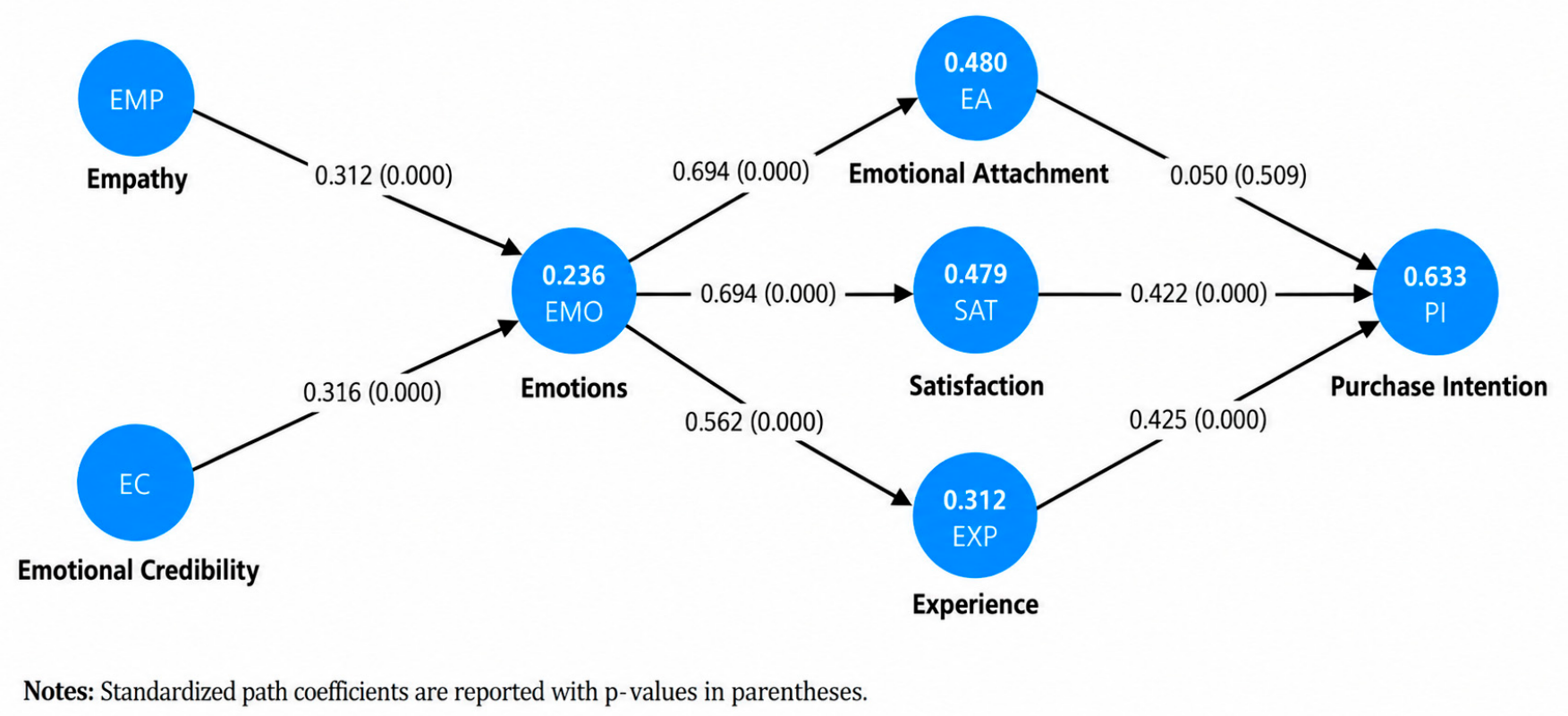
| H1: EMP → EMO | 0.312 | 0.314 | 0.062 | 4.998 | <0.001 | 0.189 | 0.433 | 1.059 | Supported |
| H2: EC → EMO | 0.316 | 0.321 | 0.060 | 5.238 | <0.001 | 0.202 | 0.437 | 1.059 | Supported |
| H3: EMO → EA | 0.694 | 0.695 | 0.035 | 19.976 | <0.001 | 0.623 | 0.758 | 1.000 | Supported |
| H4: EMO → SAT | 0.694 | 0.694 | 0.038 | 18.060 | <0.001 | 0.614 | 0.764 | 1.000 | Supported |
| H5: EMO → EXP | 0.562 | 0.563 | 0.048 | 11.720 | <0.001 | 0.460 | 0.651 | 1.000 | Supported |
| H6a: EA → PI | 0.050 | 0.050 | 0.075 | 0.660 | 0.509 | −0.097 | 0.197 | 2.952 | Not Supported |
| H6b: SAT → PI | 0.422 | 0.420 | 0.076 | 5.531 | <0.001 | 0.267 | 0.572 | 2.784 | Supported |
| H6c: EXP → PI | 0.425 | 0.427 | 0.062 | 6.909 | <0.001 | 0.302 | 0.542 | 1.759 | Supported |
| Specific Indirect Effects | |||||||||
| EMO → SAT → PI | 0.293 | 0.293 | 0.061 | 4.785 | <0.001 | 0.174 | 0.415 | ||
| EMP → EMO → EA | 0.217 | 0.219 | 0.045 | 4.802 | <0.001 | 0.131 | 0.306 | ||
| EC → EMO → EXP | 0.177 | 0.181 | 0.038 | 4.627 | <0.001 | 0.108 | 0.258 | ||
| EMO → EXP → PI | 0.239 | 0.241 | 0.040 | 5.984 | <0.001 | 0.165 | 0.321 | ||
| EC → EMO → SAT | 0.219 | 0.223 | 0.044 | 4.927 | <0.001 | 0.136 | 0.311 | ||
| EMP → EMO → EXP | 0.175 | 0.177 | 0.039 | 4.495 | <0.001 | 0.103 | 0.255 | ||
| EMO → EA → PI | 0.034 | 0.036 | 0.053 | 0.653 | 0.514 | −0.067 | 0.141 | ||
| EMP → EMO → SAT | 0.216 | 0.218 | 0.046 | 4.677 | <0.001 | 0.128 | 0.309 | ||
| EC → EMO → EA -> PI | 0.011 | 0.012 | 0.018 | 0.620 | 0.535 | −0.021 | 0.048 | ||
| EMP → EMO → EA → PI | 0.011 | 0.011 | 0.017 | 0.625 | 0.532 | −0.022 | 0.047 | ||
| EC → EMO → EXP → PI | 0.075 | 0.077 | 0.020 | 3.861 | <0.001 | 0.042 | 0.119 | ||
| EMP → EMO → EXP → PI | 0.075 | 0.076 | 0.020 | 3.782 | <0.001 | 0.041 | 0.117 | ||
| EC → EMO → SAT → PI | 0.092 | 0.094 | 0.026 | 3.501 | <0.001 | 0.048 | 0.151 | ||
| EMP → EMO → SAT → PI | 0.091 | 0.092 | 0.027 | 3.358 | 0.001 | 0.044 | 0.153 | ||
| EC → EMO → EA | 0.219 | 0.224 | 0.045 | 4.894 | <0.001 | 0.137 | 0.312 | ||
Disclaimer/Publisher’s Note: The statements, opinions and data contained in all publications are solely those of the individual author(s) and contributor(s) and not of MDPI and/or the editor(s). MDPI and/or the editor(s) disclaim responsibility for any injury to people or property resulting from any ideas, methods, instructions or products referred to in the content. |
© 2026 by the author. Licensee MDPI, Basel, Switzerland. This article is an open access article distributed under the terms and conditions of the Creative Commons Attribution (CC BY) license.
Share and Cite
Chatzopoulou, E. Emotional Responses to AI Chatbots in Online Travel Agencies: An S-O-R Perspective. J. Theor. Appl. Electron. Commer. Res. 2026, 21, 326. https://doi.org/10.3390/jtaer21090326
Chatzopoulou E. Emotional Responses to AI Chatbots in Online Travel Agencies: An S-O-R Perspective. Journal of Theoretical and Applied Electronic Commerce Research. 2026; 21(9):326. https://doi.org/10.3390/jtaer21090326
Chicago/Turabian StyleChatzopoulou, Evi. 2026. "Emotional Responses to AI Chatbots in Online Travel Agencies: An S-O-R Perspective" Journal of Theoretical and Applied Electronic Commerce Research 21, no. 9: 326. https://doi.org/10.3390/jtaer21090326
APA StyleChatzopoulou, E. (2026). Emotional Responses to AI Chatbots in Online Travel Agencies: An S-O-R Perspective. Journal of Theoretical and Applied Electronic Commerce Research, 21(9), 326. https://doi.org/10.3390/jtaer21090326