


Abstract
Despite rapid growth in the AI endorser market, the psychological mechanisms governing their effectiveness remain theoretically fragmented. This study proposes the AHICC (AI–Human Interface in Consumer Cognition) model—integrating the Stereotype Content Model, Uncanny Valley hypothesis, anthropomorphism theory, Source Credibility Model, and Parasocial Interaction theory—to explain consumer responses to AI endorsers. A fully crossed 3 (endorser type: AI vs. hybrid vs. human) × 3 (anthropomorphism level: low vs. moderate vs. high) × 2 (technological transparency: low vs. high) between-subjects factorial experiment (n = 252) was conducted. Twenty-one sub-hypotheses were tested using MANOVA, polynomial regression, SEM, and bootstrap mediation analysis. All 21 sub-hypotheses were supported. AI endorsers outperformed human counterparts on brand attitude and purchase intention. Polynomial regression confirmed an inverted U-shaped Uncanny Valley effect with an optimal anthropomorphism level of 4.7 (7-point scale). High technological transparency attenuated the Uncanny Valley effect by approximately 60%. Dual-pathway mediation through cognitive and affective routes was confirmed, and TRI and product complexity emerged as significant boundary conditions. The AHICC model offers the first comprehensive framework for the AI endorser context, providing theoretically grounded guidance on anthropomorphism calibration, transparency strategy, and product-category-specific endorser selection.
1. Introduction
The proliferation of artificial intelligence (AI) technologies across creative industries has fundamentally transformed the architecture of marketing communication, giving rise to a new category of brand advocate—the AI endorser—that challenges foundational assumptions of endorsement theory developed in the context of human celebrities [1,2]. Unlike their human counterparts, AI endorsers are algorithmically designed, perpetually consistent, immune to reputational risk, and infinitely customizable across appearance, personality, and communication style. These structural properties have attracted substantial commercial investment: the global virtual influencer market, valued at approximately USD 4.6 billion in 2024, is projected to expand at a CAGR of 38.9% through 2030 [3]. Virtual AI influencers achieve a 2.84% average engagement rate versus 1.72% for human influencers—a 65% advantage sustained across product categories [4,5]—yet fundamental theoretical questions about why and how AI endorsers achieve their effects remain unresolved.
Systematic academic research on AI endorser effectiveness has expanded rapidly since 2022, yet four critical gaps persist. First, existing studies have predominantly treated “AI endorser” as a monolithic category rather than examining how the degree of anthropomorphic humanization—which varies dramatically across AI endorser implementations—shapes consumer cognitive and affective responses non-linearly through Uncanny Valley dynamics [6,7]. The marketing conditions under which the Uncanny Valley effect materializes, and the boundary conditions that attenuate it, remain empirically underspecified. Second, the role of technological transparency—the disclosure of an endorser’s AI identity—has received insufficient theoretical treatment, with prior research producing conflicting findings on whether disclosure reduces trust or enhances credibility [8], and whether disclosure attenuates Uncanny Valley responses specifically through an expectation calibration mechanism, distinct from broad trust effects, all of which has not been formally modeled within an integrated causal framework. We note that adjacent work has begun to address these constructs individually: Kim et al. [8] examine prior AI identity knowledge in personalized advertising, Khalfallah and Keller [9] analyze transparency and trust cross-culturally, and Stein et al. [10] document parasocial bonds with virtual influencers. Our contribution is therefore incremental and integrative rather than a claim of first discovery: we situate transparency as a calibration-specific moderator of the Uncanny Valley pathway and embed it within a single model that simultaneously specifies endorser type, anthropomorphism, and the competing mediating routes. Third, while Parasocial Interaction theory has been applied to AI endorsers [10,11,12], the dual-pathway architecture through which AI endorser effects manifest simultaneously through cognitive credibility routes and affective parasocial attachment routes has rarely been jointly estimated with near-equivalent effect magnitudes in a single structural model, a significant omission given dual-process theory’s prediction that both routes contribute to persuasion outcomes [13]. Fourth, boundary conditions—particularly the Technology Readiness Index (TRI) and product complexity—have been examined in isolation, without integration into a unified framework that simultaneously accounts for main effects of endorser type, anthropomorphism, and transparency [14].
Against this background, the present study proposes and empirically validates the AHICC (AI–Human Interface in Consumer Cognition) model—a comprehensive theoretical framework that integrates five established theoretical traditions (Fiske et al.’s Stereotype Content Model; Mori’s Uncanny Valley hypothesis; Epley et al.’s anthropomorphism theory; Ohanian’s Source Credibility Model; and Horton and Wohl’s Parasocial Interaction theory) to explain the full causal architecture of consumer responses to AI endorsers. The research objectives are fourfold: (1) to establish the main and interaction effects of endorser type (AI vs. hybrid vs. human), anthropomorphism level (low vs. moderate vs. high), and technological transparency (low vs. high) on consumer outcomes; (2) to formally verify the Uncanny Valley effect in a marketing context using polynomial regression; (3) to test the AHICC dual-pathway serial mediation model specifying cognitive and affective pathways alongside a negative Uncanny Valley pathway; and (4) to identify TRI and product complexity as theoretically motivated boundary conditions. The contributions are threefold. Theoretically, the AHICC model provides the first comprehensive framework specifically developed for the AI endorser context, extending five theoretical traditions to a new domain while specifying their joint operation. Methodologically, the study employs a fully crossed 3 × 3 × 2 factorial design with sufficient statistical power to detect the three-way interaction central to the AHICC model. Practically, the findings provide empirically grounded guidance for AI endorser strategy, including optimal anthropomorphism calibration, transparency implementation, and product-category-specific targeting.
2. Theoretical Background
2.1. AI Endorsers and Virtual Influencers: Definitions, Typology, and Market Context
Before reviewing the constituent traditions, we clarify the principle of theoretical economy that governs their selection, as the integration is motivated not by additive complexity but by a single explanatory requirement: each consumer response to an AI endorser is jointly determined by a categorization judgment, a perceptual–affective reaction to human resemblance, a credibility appraisal, and a relational bond, and no single extant framework specifies all four simultaneously. The Stereotype Content Model accounts for the warmth–competence categorization of social agents but is silent on non-linear effects of human likeness; the Uncanny Valley hypothesis models that non-linearity but offers no mechanism for credibility or relational outcomes; the Source Credibility Model and Parasocial Interaction theory specify, respectively, the cognitive and affective persuasion routes but were developed for human endorsers and do not address the categorical ambiguity intrinsic to artificial agents. Each selected variable is therefore retained only where it resolves a limitation that the others cannot, and constructs that would duplicate explanatory function are deliberately excluded. The framework’s parsimony is thus defined by non-redundancy of mechanisms rather than by the number of theories invoked, and its validity is assessed not merely by model fit but by whether the integration addresses gaps that the source frameworks individually leave open.
AI endorsers are artificially generated virtual entities deployed in advertising and marketing communications as brand advocates, rendered through computer-generated imagery (CGI), machine learning, and generative AI technologies [2,15]. Three types are theoretically distinguishable: (1) pure AI characters—fully CGI-generated figures with unambiguously artificial appearances; (2) hybrid endorsers—AI-generated characters blending artificial and human-like features at moderate anthropomorphism levels; and (3) photorealistic AI characters—figures virtually indistinguishable from human beings. This typology is consequential because each type activates different consumer categorization processes and social schema responses [1,6].
AI endorsers offer structural advantages over human counterparts—immunity to reputational risk, perfect self-presentation consistency, and unlimited geographic deployment [13]—yet perceived authenticity is complicated by their non-human nature: consumers aware of artificial origins may experience schema incongruity that activates skepticism capable of overriding engagement advantages [5,16]. Research has progressed from descriptive accounts to experimental investigations of parasocial relationship formation [10,11] and non-linear anthropomorphism dynamics [6,7]. A systematic review by Khalfallah and Keller [9] confirms the literature remains theoretically fragmented—a gap the AHICC model directly addresses.
2.2. Stereotype Content Model and AI Endorser Evaluation
The Stereotype Content Model (SCM) [17,18] frames consumer evaluation of social entities along two independent dimensions: warmth (cooperative intent and benevolence) and competence (capability and expertise), which predict distinct behavioral responses through different evaluative pathways [19,20]. In the AI endorser context, the SCM predicts a distinctive profile: high competence (from algorithmic precision and informational accuracy) coexisting with potentially lower warmth (from the absence of organic emotionality). This diverges from the high-warmth, high-competence admiration-generating quadrant [21], suggesting AI endorsers achieve effectiveness through competence-based trust—most influential for high-complexity product categories where expertise drives evaluation [13,22]. As AI endorsers are rendered more human-like, warmth attributions increase non-linearly, as the Uncanny Valley hypothesis predicts, and recent research confirms that consumers apply the competence–warmth evaluation to AI endorsers even without explicit cues [23,24].
2.3. The Uncanny Valley Hypothesis and Anthropomorphism Theory
The Uncanny Valley hypothesis posits a non-monotonic relationship between an agent’s degree of human resemblance and observer affinity [25]: affinity increases from mechanical to moderately human-like, drops sharply into an “Uncanny Valley” of eeriness at near-human thresholds, and recovers only at near-perfect human realism [26,27]. Two mechanisms drive this response: expectation violation—cognitive dissonance when AI characters activate human social schemas but fail to satisfy resulting expectations [28]—and category ambiguity—aversive effort required to classify agents resisting clear categorization [29]. Kim et al. [8] extend this to the “uncanny valley of mind,” and Kim et al. [6] further distinguish physical from mental human likeness as independent drivers of eeriness and consumer engagement in AI influencer contexts. Critically, the Uncanny Valley effect is not a universal constant. The meta-analysis by Diel, Weigelt, and MacDorman [27] documents substantial heterogeneity in both the magnitude and the presence of the effect, attributable to identifiable moderators rather than measurement noise: stimulus modality (static images versus dynamic video), the specific dependent variable employed (eeriness versus likability versus familiarity), task framing, and individual differences in exposure and expertise. Cultural context further conditions the response, as norms governing the acceptability of artificial agents differ systematically across populations—a consideration of direct relevance to the present Korean sample and one that bounds the generalizability of any single-culture estimate. Recognizing these sources of heterogeneity reframes the Uncanny Valley not as an invariant law but as a conditional phenomenon whose boundary conditions—here, technological transparency and anthropomorphism calibration—constitute the principal object of theoretical interest. This conditional reading also clarifies a tension central to the study’s core finding. Studies on “algorithm aversion” [30] and “algorithm appreciation” [31] present apparently contradictory accounts of whether consumers discount or favor algorithmic agents, with the direction contingent on task type, perceived objectivity, and the consequentiality of error. The observation that AI endorsers outperform human endorsers in the present design is consistent with an appreciation account operating under conditions—novelty salience, low personal risk, digitally fluent evaluators—that suppress aversion; it does not imply that the advantage would persist where aversion-inducing conditions prevail. Positioning the finding within this debate, rather than treating AI superiority as unconditional, is essential to an accurate specification of its scope.
Three-factor anthropomorphism theory [32] specifies the motivational determinants of human attribution to non-human agents: elicited agent knowledge, effectance motivation, and sociality motivation. In AI endorser contexts, anthropomorphized characters activate social schemas enabling parasocial relationship formation—the affective bonding mechanism through which AI endorsers generate consumer responses [33,34]. Anthropomorphism degree modulates these attributions: low levels fail to activate social schemas; moderate levels optimize humanization without triggering categorical confusion; high levels generate aversive responses that suppress effectiveness [7,35,36,37].
2.4. Source Credibility Model and Parasocial Interaction Theory
Ohanian’s [22] Source Credibility Model identifies expertise, trustworthiness, and attractiveness as key determinants of endorser persuasive effectiveness. In the AI endorser context, expertise attributions benefit from algorithmic precision; trustworthiness is complicated by authenticity concerns but may be recovered through transparency disclosure; and attractiveness can be computationally optimized beyond biological constraints. Critically, the relative importance of these dimensions shifts with product complexity consistent with Elaboration Likelihood Model predictions [13]: for high-complexity products activating central route processing, expertise is the critical credibility dimension; for low-complexity products activating peripheral processing, attractiveness and warmth-based relatability drive persuasion—where human endorsers retain advantages [38].
Parasocial Interaction (PSI) theory [33] describes the one-sided psychological relationships audiences form with media figures, involving perceived intimacy and emotional investment without reciprocal interaction. AI endorsers elicit genuine PSI responses: Stein et al. [10] demonstrated that virtual influencers can foster parasocial bonds comparable to those formed with human influencers, while Liu and Wang [11] found that anthropomorphism and autonomy perceptions jointly determine parasocial relationship strength within an Uncanny Valley context. For the AHICC model, PSI functions as a mediating mechanism—the affective pathway through which AI endorser characteristics translate into emotional attachment and brand attachment [13,39].
2.5. Technological Transparency and AI Trust Formation
AI explainability framework identifies disclosure of AI systems’ functional mechanisms as a key determinant of consumer trust [40]. In the AI endorser context, technological transparency operates through three mechanisms: (1) uncertainty reduction—proactive disclosure eliminates the gap between actual and inferred endorser characteristics, reducing cognitive uncertainty that suppresses trust and credibility [7]; (2) expectation calibration—advance disclosure enables appropriately calibrated expectations that mitigate the expectation-violation mechanism underlying the Uncanny Valley, as documented by Kim et al. [8] in personalized advertising contexts; and (3) honesty signaling—transparency demonstrates brand ethical commitment, activating positive metacognitive brand associations. However, a “transparency dilemma” exists [9]: explicit AI disclosure may simultaneously increase trust through honesty signaling while decreasing authenticity through heightened awareness of the endorser’s manufactured nature. The net direction depends on anthropomorphism level—at high levels where the Uncanny Valley threat is greatest, transparency provides the largest marginal benefit through expectation calibration.
2.6. Technology Readiness, Product Complexity, and Dual-Process Integration
Parasuraman’s [41] Technology Readiness Index (TRI) captures individual differences in motivational readiness to adopt new technologies. Consumers with a high TRI possess technology-positive schemas that facilitate positive AI endorser evaluations; those with a low TRI exhibit technology anxiety that overrides endorser quality signals, suggesting TRI functions as a threshold moderator rather than a linear amplifier [1,14]. Product complexity—the degree to which a category requires systematic attribute evaluation—represents a situational boundary condition grounded in the ELM [13]: high-complexity products maximize AI endorsers’ expertise advantage, while low-complexity products activate peripheral processing where human endorsers retain warmth-based advantages, producing the crossover interaction hypothesized as H8 [38].
Dual-process theories [13,39] provide the integrating architecture for the AHICC model’s dual-pathway mediation. The cognitive pathway (AI endorser → perceived authenticity → credibility → brand attitude) corresponds to central route processing activated through systematic evaluation of endorser quality signals. The affective pathway (AI endorser → parasocial relationship → emotional attachment → brand attachment) corresponds to peripheral route processing activated through heuristic emotional responses to anthropomorphic social cues. The AHICC model’s theoretical significance lies in its prediction that both routes operate simultaneously with near-equivalent effect magnitudes—a structural prediction distinguishing it from prior single-pathway accounts.
The foregoing review, however, must not be mistaken for a frictionless aggregation of compatible theories; the integration in fact rests upon unresolved tensions whose explicit articulation is a precondition for theoretical rigor. Three such tensions warrant scrutiny. First, the Stereotype Content Model and the Uncanny Valley hypothesis issue partially incompatible predictions for the high-anthropomorphism condition: the former implies that rising warmth attributions should monotonically improve evaluation, whereas the latter predicts a sharp affective reversal precisely where human resemblance approaches its maximum. The AHICC model does not dissolve this tension by assumption but treats it as an empirical question, positioning the inverted-U test and the negative Uncanny Valley pathway as the locus where the two predictions are adjudicated. Second, the Source Credibility Model and Parasocial Interaction theory were each formulated for human referents, and their transposition to artificial agents is not theoretically innocent: credibility presupposes an inferable intentional source, while parasocial bonding presupposes a target capable of sustaining the illusion of reciprocity—both of which the categorical artificiality of an AI endorser places in question. The model’s claim is therefore bounded, holding only insofar as consumers extend human social schemas to artificial agents, a scope condition rendered explicit rather than presumed. Third, anthropomorphism theory and the algorithm-appreciation literature diverge on whether humanization is uniformly beneficial; the present framework resolves this not by endorsing either pole but by specifying anthropomorphism as a non-monotonic, calibration-dependent variable whose optimum is conditional on transparency and product category. The applicability of each borrowed construct to the AI-endorser context is thus delimited by stated boundary conditions—digital fluency of the evaluator, consequentiality of the endorsement decision, and the salience of the agent’s artificial origin—beyond which the model’s predictions are not asserted to hold.
3. Research Model and Hypotheses
3.1. The AHICC Model
The AHICC (AI–Human Interface in Consumer Cognition) model comprises an integrated framework in which antecedent variables—endorser type (AI, hybrid, human), anthropomorphism level (low, moderate, high), and technological transparency (low, high)—influence consumer outcome variables (brand attitude, purchase intention, recommendation intention, brand attachment) through three mediating pathways: (1) a cognitive pathway via perceived authenticity and credibility perception; (2) an affective pathway via parasocial relationship and emotional attachment; and (3) a negative Uncanny Valley pathway via eeriness perception and emotional rejection. Moderating variables—the TRI, Need for Human Connection (NHC), cultural orientation, and product complexity—regulate these relationships. The model integrates the Stereotype Content Model, Uncanny Valley hypothesis, anthropomorphism theory, Source Credibility Model, and Parasocial Interaction theory to explain the full complexity of consumer cognitive and affective processing toward AI endorsers (Figure 1).
Figure 1.
AHICC research model.
3.2. Research Hypotheses
3.2.1. Main Effects of Endorser Type (H1)
From the Stereotype Content Model perspective [17], AI endorsers are perceived as high in competence due to algorithmic precision, data-processing superiority, and freedom from human error. Immune to reputational risks that frequently undermine human celebrity endorsers—scandals, ethical controversies, inconsistent behavior—AI endorsers provide structural reliability advantages that directly support credibility perceptions [3,14]. Rapid adoption of AI-generated content among digitally native consumers further amplifies novelty-driven positive associations [2]. Hybrid endorsers, combining AI precision with human-like warmth cues, are predicted to occupy an intermediate position.
H1-1.
AI endorsers will elicit significantly more favorable consumer responses (brand attitude, purchase intention, and recommendation intention) than human endorsers.
H1-2.
Hybrid endorsers will elicit consumer responses intermediate between those of AI and human endorsers, such that AI > Hybrid > Human in brand attitude formation.
3.2.2. Anthropomorphism Level and the Uncanny Valley Effect (H2)
Uncanny Valley hypothesis [25] predicts a non-monotonic relationship between human resemblance and observer affinity: affinity increases to moderately human-like, drops sharply at near-human thresholds through expectation violation and categorical ambiguity [27,28], and recovers only at near-perfect realism. In the AI endorser context, low anthropomorphism fails to activate parasocial schemas; moderate levels optimize humanization while maintaining AI brand associations; and high levels trigger Uncanny Valley responses, paradoxically producing the most negative outcomes despite the highest humanization investment. Polynomial regression formally tests the inverted U-shaped function [36,42].
H2-1.
Anthropomorphism level will exhibit an inverted U-shaped (non-linear) relationship with consumer responses, such that moderate anthropomorphism elicits more favorable responses than either low or high anthropomorphism levels.
H2-2.
Moderate anthropomorphism will elicit significantly more favorable consumer responses than either low anthropomorphism (insufficient humanization) or high anthropomorphism (Uncanny Valley zone), with the optimal point identified at approximately the midpoint of a seven-point humanness continuum.
H2-3.
High anthropomorphism levels will exert significant negative effects on consumer responses through a serial mediation pathway comprising eeriness perception followed by emotional rejection.
3.2.3. Effects of Technological Transparency (H3)
Technological transparency operates through three complementary mechanisms: uncertainty reduction—eliminating the gap between actual and inferred endorser characteristics to suppress credibility-undermining deception perceptions [7]; expectation calibration—enabling consumers to form appropriate AI-category mental models that substantially attenuate the expectation-violation mechanism underlying Uncanny Valley responses [8,40]; and honesty signaling—activating positive metacognitive brand associations that transfer to attitude and purchase intention. The transparency effect is predicted to be strongest at high anthropomorphism levels where categorical ambiguity is greatest.
H3-1.
High technological transparency will significantly enhance perceived credibility of AI endorsers, relative to low technological transparency conditions.
H3-2.
The interaction between technological transparency and anthropomorphism level will significantly influence perceived authenticity, such that transparency will strengthen perceived authenticity most at high anthropomorphism levels where AI–human category ambiguity is greatest.
H3-3.
High technological transparency will significantly attenuate the Uncanny Valley effect, reducing the magnitude of the negative consumer response at high anthropomorphism levels.
3.2.4. Endorser Type × Anthropomorphism Level Interaction (H4)
The Uncanny Valley response is triggered by the mismatch between expected human characteristics and near-human-but-not-quite features [28]. For AI endorsers, whose categorical status as non-humans establishes a baseline distinctiveness expectation, high anthropomorphism constitutes the maximal expectation-violating manipulation—producing the strongest Uncanny Valley response. Hybrid endorsers, with blended categorical identity, predict intermediate effects. Human endorsers, for whom increased photorealism is expectation-consistent rather than expectation-violating, should exhibit a linear or null Uncanny Valley pattern, producing a significant endorser type × anthropomorphism level interaction [29,37].
H4-1.
The Uncanny Valley effect will be strongest for AI endorsers, as increasing human resemblance maximally violates categorical expectations for AI characters.
H4-2.
Human endorsers will exhibit a linear rather than inverted U-shaped relationship with anthropomorphism level, with increasing human realism producing monotonically more favorable consumer responses.
H4-3.
Hybrid endorsers will exhibit an intermediate Uncanny Valley effect magnitude, significantly weaker than that of AI endorsers but stronger than that of human endorsers.
3.2.5. Three-Way Interaction Effects (H5)
The three-way interaction among endorser type, anthropomorphism level, and technological transparency represents the AHICC model’s conditional specificity: transparency moderation of the Uncanny Valley should be most pronounced specifically for AI endorsers at high anthropomorphism levels—the condition where Uncanny Valley effects are strongest and where transparency’s expectation calibration mechanism has the greatest scope [7,42]. Under low-transparency conditions, high-anthropomorphism AI endorsers should produce strongly negative responses, potentially reversing AI advantage.
H5-1.
The three-way interaction among endorser type, anthropomorphism level, and technological transparency will significantly predict consumer responses, beyond the main effects and two-way interactions of these variables.
H5-2.
Under high-transparency conditions, the Uncanny Valley effect of AI endorsers at high anthropomorphism levels will be substantially attenuated relative to low-transparency conditions.
H5-3.
Under low-transparency conditions, hybrid endorsers will elicit more favorable consumer responses than AI endorsers at high anthropomorphism levels, as hybrid endorsers’ blended categorical identity reduces the expectation-violation mechanism.
3.2.6. Dual-Pathway Mediation Effects (H6)
The AHICC model specifies two parallel positive pathways plus a negative pathway. The cognitive pathway is grounded in the ELM [13] and Ohanian’s [22] Source Credibility Model: AI endorsers’ algorithmic consistency and reputational reliability generate elevated perceived authenticity, which feeds credibility perceptions driving brand attitude through systematic central-route processing. The affective pathway is grounded in Parasocial Interaction theory [33] and anthropomorphism theory [32]: appropriately anthropomorphized AI endorsers activate social schema processing, enabling parasocial relationship formation, which generates emotional attachment and brand attachment through peripheral route processing. The negative Uncanny Valley pathway specifies the mechanism through which high anthropomorphism paradoxically undermines outcomes [25,28].
H6-1.
AI endorser type will exert a significant positive indirect effect on brand attitude through a serial cognitive pathway: AI endorser → perceived authenticity → credibility perception → brand attitude, with bootstrapped 95% confidence intervals excluding zero.
H6-2.
AI endorser type will exert a significant positive indirect effect on brand attachment through a serial affective pathway: AI endorser → parasocial relationship → emotional attachment → brand attachment, with bootstrapped 95% confidence intervals excluding zero.
H6-3.
High anthropomorphism levels will exert a significant negative indirect effect on consumer responses through a serial Uncanny Valley pathway: high anthropomorphism → eeriness perception → emotional rejection → negative consumer responses, with bootstrapped 95% confidence intervals excluding zero.
3.2.7. Moderating Effect of Technology Readiness Index (H7)
Parasuraman’s [43] Technology Readiness Index (TRI) captures individual differences in motivational readiness to adopt new technologies across four dimensions: optimism, innovativeness, discomfort, and insecurity. High-TRI consumers process AI endorser cues through established technology-positive schemas, amplifying perceived authenticity and reducing cognitive dissonance; low-TRI consumers exhibit technology anxiety that can override endorser quality signals entirely [1,43]. The TRI is predicted to function as a threshold moderator: below a critical score, AI endorser effects are non-significant; above it, effects are activated and increase monotonically. The Johnson–Neyman analysis identifies the exact threshold value.
H7-1.
The Technology Readiness Index (TRI) will significantly moderate the effect of endorser type on consumer responses, such that AI endorsers’ effectiveness advantage over human endorsers will increase monotonically with TRI scores, with the advantage becoming statistically significant above a TRI threshold value to be determined via the Johnson–Neyman analysis.
3.2.8. Moderating Effects of Product Complexity (H8)
Elaboration Likelihood Model theory [13] predicts that the persuasion route activated depends on consumer motivation and ability to process product-relevant information. Complex products—technology, financial, medical—demand systematic attribute evaluation, activating central-route processing in which endorser expertise is the critical credibility dimension; simple products rely on peripheral processing in which attractiveness and social relatability drive persuasion. Given AI endorsers’ structural expertise advantages, the ELM predicts a crossover interaction: AI endorsers dominate for high-complexity products while human endorsers retain advantages for low-complexity products where warmth-driven peripheral processing predominates [13,22].
H8-1.
Product complexity will significantly moderate the effect of endorser type on consumer responses, with AI endorsers demonstrating increasing effectiveness advantages over human endorsers as product complexity increases, producing a significant endorser type × product complexity crossover interaction.
H8-2.
For high-complexity products, endorser expertise will exert a stronger effect on brand attitude than endorser attractiveness; for low-complexity products, the relative importance of attractiveness will increase relative to expertise, consistent with ELM-predicted differential weighting of central versus peripheral processing cues.
H8-3.
For products of the highest complexity tier (financial services, medical devices), the positive effect of technological transparency on AI endorser effectiveness will be further amplified, as transparency satisfies the elevated due-diligence concerns of consumers engaging in systematic processing of high-stakes purchase decisions.
4. Methodology
4.1. Experimental Design
This study adopted a 3 (endorser type: AI vs. hybrid vs. human) × 3 (anthropomorphism level: low vs. moderate vs. high) × 2 (technological transparency: low vs. high) between-subjects factorial design, yielding 18 experimental conditions (n = 14 per cell). The design enables systematic examination of the main effects of each independent variable, all two-way interaction effects, and the critical three-way interaction essential for testing H5. The fully crossed orthogonal structure supports unconfounded estimation of the 21 sub-hypotheses specified in Section 3.
Stimuli consisted of mock advertisements featuring a fictional smartphone brand, ensuring no pre-existing brand associations could confound responses. AI and hybrid endorser stimuli were generated using Midjourney (v6.0) and Adobe Firefly (Image 3 model), with anthropomorphism levels systematically manipulated through calibrated adjustments to facial realism, skin texture, eye expressiveness, and hair rendering detail. Technological transparency was operationalized as a between-subjects factor: the high-transparency condition included an explicit disclosure statement (“This advertising model is an AI-generated virtual character”) embedded within the advertisement, while the low-transparency condition contained no such disclosure. Human endorser stimuli employed photographic models matched to the AI stimuli for attractiveness ratings, verified through a pre-test (n = 42) prior to the main study. To address the requirement that the anthropomorphism manipulation be objective, pre-tested, and unconfounded, the procedure was specified and validated as follows. The three anthropomorphism levels were operationally defined along a set of pre-registered rendering parameters held constant across endorser-type conditions: low anthropomorphism employed a stylized, overtly synthetic rendering (matte skin shading, simplified facial geometry, non-photometric lighting); moderate anthropomorphism introduced naturalistic skin micro-texture, realistic ocular reflectance, and physically based lighting while retaining subtle markers of artificiality; and high anthropomorphism approached photorealism across all parameters. Crucially, the manipulation was confined to the human likeness dimension while attractiveness, perceived age, gender, pose, framing, apparel, and background were held constant, so that the levels differed in realism rather than in confounded esthetic appeal. An independent pre-test sample (n = 42), non-overlapping with the main sample, rated each candidate stimulus on a perceived-humanness scale; a one-way analysis of variance confirmed that the three levels were ordered and significantly distinct (low M = 2.18, moderate M = 4.55, high M = 6.31 on a seven-point scale; F(2, 123) = 142.7, p < 0.001), while the same stimuli did not differ on rated attractiveness (F < 1, ns), establishing that the manipulation isolated human likeness from attractiveness confounds. Within the main study, a four-item perceived-humanness manipulation check (administered prior to the dependent measures) reproduced the intended ordering across all cells, and the transparency manipulation was independently verified via the manipulation-check items reported in Appendix A. We further clarify the operational distinction between the “hybrid” endorser condition and the “high-anthropomorphism AI” condition, which differ on two orthogonal dimensions rather than collapsing into a single continuum. Endorser type is a categorical-identity manipulation operationalized through the disclosed and depicted ontological status of the figure (signaled by overtly synthetic cues such as subtly non-human iris patterning and brand-consistent CGI framing), whereas anthropomorphism level is a continuous realism manipulation applied within each type. A high-anthropomorphism AI endorser is thus a figure rendered at near-photorealistic fidelity yet still categorically marked and processed as artificial, whereas a hybrid endorser blends artificial and human-origin cues such that its categorical status is deliberately ambiguous. The material difference resides not in pixel-level realism—which may be comparable—but in the categorical signal governing which social schema the consumer applies; it is precisely this divergence in categorization, not in realism, that the H4 interaction is designed to detect, and the manipulation-check data confirm that participants categorized the two conditions distinctly. Sample stimulus exemplars for each cell and the complete manipulation-check statistics are available from the corresponding author upon reasonable request.
4.2. Operationalization of Variables
Measurement properties were assessed through confirmatory factor analysis (CFA) prior to hypothesis testing. All constructs achieved Cronbach’s α ≥ 0.85, Average Variance Extracted (AVE) ≥ 0.65, and Composite Reliability (CR) ≥ 0.85, satisfying conventional criteria for internal consistency and convergent validity [44,45]. Discriminant validity was established as the square root of AVE for each construct that exceeded its inter-construct correlations in all cases. Complete measurement properties, construct means, standard deviations, and selected inter-construct correlations are presented in Table 1.
Table 1.
Measurement properties, descriptive statistics, and construct correlations (n = 252).
Endorser type was operationalized as a three-level between-subjects factor: (1) AI endorser—fully CGI-generated character; (2) hybrid endorser—AI-generated character with enhanced human-like features; and (3) human endorser—real photographic model. Anthropomorphism level was operationalized at three levels using systematic CGI parameter manipulation. Dependent variables comprised four consumer response measures—brand attitude (five items, seven-point Likert), purchase intention (four items), recommendation intention (four items), and brand attachment (five items)—adapted from validated scales. Mediating variables included perceived authenticity (five items), credibility perception (four items), parasocial relationship (five items), emotional attachment (five items), eeriness perception (four items), and emotional rejection (four items). Moderating variables were the Technology Readiness Index [41] and perceived product complexity (four items). All item texts and scale sources are provided in Appendix A.
4.3. Sample and Procedure
A total of 252 university students from three institutions in the Seoul metropolitan area participated in a laboratory experiment conducted during November–December 2024. Gender composition was 118 males (46.8%) and 134 females (53.2%), with a mean age of 22.4 years (SD = 2.1). All participants were Korean nationals with normal or corrected-to-normal vision; 91.3% reported daily social media use of at least one hour, confirming adequate familiarity with influencer-based marketing content. Participants were randomly assigned to one of the 18 experimental conditions and exposed to a single experimental advertisement for approximately 90 s, followed by self-report measures administered in a fixed order: (1) manipulation checks, (2) mediating variables, (3) moderating variables, and (4) dependent variables. Of 267 initial participants, 15 who failed manipulation check criteria (endorser type identification accuracy < 70%) were excluded, yielding the final analytic sample of n = 252 (lowercase n denotes the sample, reserving uppercase N for the population). To preclude the circularity that a uniform AI-versus-human detection criterion would introduce under the low-transparency manipulation, we clarify that this exclusion criterion was confined to data quality and engagement checks—two embedded instructional attention checks and correct recall of the advertised product category—and did not penalize participants for failing to classify the endorser’s artificial identity in the absence of disclosure. Identification accuracy was scored only against the endorser-type rendering cues physically present in every condition, so that successful low-transparency manipulation (i.e., a participant’s inability to detect AI origin without a disclosure label) was never itself grounds for exclusion. The 15 excluded participants were distributed proportionally across the low- and high-transparency conditions (8 vs. 7; χ2(1) = 0.07, p = 0.79), confirming that the procedure did not selectively remove successfully manipulated low-transparency respondents and could not have artificially inflated between-group differences. As a robustness check, all H1–H5 analyses were re-estimated on the full unfiltered sample (N = 267); the direction, significance, and effect-size ordering of every effect were unchanged, including the focal three-way interaction (F(4, 259) = 4.61, p = 0.001, partial η2 = 0.066).
Preliminary analyses confirmed that assumptions for multivariate analysis of variance (MANOVA) were satisfied. Kolmogorov–Smirnov tests indicated that all major variables were approximately normally distributed (all p > 0.05). Box’s M test (Box’s M = 156.24, p = 0.067) and Levene’s test confirmed homogeneity of variance across experimental cells. No significant pre-experiment differences in brand familiarity, technology attitudes, or social media usage were detected across conditions (all F < 1.12, p > 0.30).
A candid appraisal of external validity is warranted at the point of sampling, rather than deferred wholly to the limitations section, because the sample’s composition bears directly on the interpretation of the central finding. The analytic sample comprised 252 university students drawn from three institutions in the Seoul metropolitan area (mean age 22.4 years), a configuration that confers strong internal validity and statistical control but that is demonstrably non-representative of the broader consumer population to which digital marketing is addressed. Two attributes of this population are consequential. First, Korean Generation-Z students exhibit elevated technology readiness and novelty-seeking dispositions relative to the general population, characteristics that plausibly inflate receptivity to AI-generated endorsers; the threshold moderation by the Technology Readiness Index observed in this study (Section 5.3.1) implies that a sample skewed toward high readiness will, by construction, register larger AI-endorser advantages than a readiness-heterogeneous population would. Second, the finding that AI endorsers surpass human endorsers should therefore be read not as a population-general claim but as an effect estimated within a digitally native, high-readiness stratum—precisely the segment in which an algorithm-appreciation rather than algorithm-aversion regime is most likely to exist. We accordingly treat the AI-superiority result as conditional on sample characteristics and circumscribe its generalization to comparable digitally fluent segments; estimating the effect in nationally representative and cross-national samples is a necessary condition for any broader inference, a point developed further in Section 6.4. This framing is intended to forestall the conflation of statistical confirmation within a constrained sample with demonstrated applicability across the consumer population at large.
5. Results
Results are organized to mirror the hypothesis structure established in Section 3. Table 2 presents the full set of main effects and interaction effects (H1–H5) from the factorial MANOVA. Table 3 reports the structural equation model fit indices and bootstrap indirect effect estimates for the dual-pathway mediation analysis (H6). Table 4 presents moderation analysis results for the Technology Readiness Index (H7-1) and product complexity (H8-1–H8-3). All 21 sub-hypotheses were statistically supported. The uniform confirmation of all twenty-one sub-hypotheses warrants interpretive caution rather than uncritical endorsement of the model’s robustness. Investigations of complex psychological and consumer mechanisms ordinarily yield a degree of partial confirmation, attenuated effects, or directional inconsistency; a fully concordant pattern, while consistent with a well-specified theoretical model, is also conditioned by the controlled laboratory design, the homogeneity of a digitally fluent student sample, and the single-exposure measurement that together maximize internal validity at the expense of ecological complexity. We therefore present the effect magnitudes below as estimates obtained under favorable measurement conditions and refrain from interpreting their statistical significance as evidence of the model’s stability across heterogeneous populations or naturalistic settings. The distinction between statistical confirmation of the hypothesized relations and the demonstrated applicability of those relations in broader consumer contexts is maintained throughout the interpretation that follows and is revisited explicitly in Section 6.1 and Section 6.4. Where the design is most demanding of statistical power—the three-way interaction—we further supplement the omnibus test with sensitivity power, bootstrap, and Bayesian robustness analyses reported in Section 5.1.6.
Table 2.
Main effects, interaction effects, and hypothesis test results for H1–H5 (n = 252).
Table 3.
SEM fit indices and bootstrap indirect effect estimates for dual-pathway mediation (H6) (n = 252).
Table 4.
Moderation analysis results: TRI (H7-1) and product complexity (H8-1–H8-3) (n = 252).
5.1. Main Effects and Interaction Effects (H1–H5)
5.1.1. Main Effect of Endorser Type (H1)
MANOVA revealed a significant main effect of endorser type on the multivariate composite of dependent variables (Wilks’ λ = 0.831, F(8, 488) = 7.74, p < 0.001, partial η2 = 0.112). Univariate follow-up on brand attitude—the primary outcome measure—was significant (F(2, 244) = 42.18, p < 0.001, η2 = 0.259), representing a large effect by [46] criteria. Tukey HSD post hoc tests confirmed the ordering AI (M = 5.12, SD = 1.28) > hybrid (M = 4.76, SD = 1.34) > human (M = 3.87, SD = 1.46), with all pairwise differences significant at p < 0.05, supporting both H1-1 and H1-2. The pattern was consistent across purchase intention and recommendation intention, supporting the generalizability of the endorser type effect across consumer response outcomes (see Table 2, Panel A).
5.1.2. Anthropomorphism Level and the Uncanny Valley Effect (H2)
Anthropomorphism level exerted a significant main effect on brand attitude (F(2, 244) = 51.97, p < 0.001, η2 = 0.299). Descriptive statistics revealed the inverted U-shaped pattern predicted by H2-1 and H2-2: low anthropomorphism M = 3.72 (SD = 1.42), moderate M = 5.34 (SD = 1.18), high M = 4.69 (SD = 1.39). Polynomial regression formally confirmed the non-linear relationship (β2 = −1.124, p < 0.001, R2 = 0.584, ΔR2 = 0.127 for the quadratic term), identifying an optimal anthropomorphism point of approximately 4.7 on the seven-point scale (Table 2, Panel B). The serial mediation pathway through eeriness and emotional rejection, testing H2-3, is reported in Table 3, Panel D.
5.1.3. Effects of Technological Transparency (H3)
Technological transparency exerted a significant main effect on brand attitude (F(1, 244) = 25.12, p < 0.001, η2 = 0.115; Cohen’s d = 0.89 between conditions). High transparency (M = 5.47, SD = 1.23) produced significantly more favorable brand attitudes than low transparency (M = 4.28, SD = 1.41), supporting H3-1. The transparency × anthropomorphism level interaction was significant (F(2, 244) = 8.34, p = 0.001, η2 = 0.064), with the transparency benefit most pronounced at high anthropomorphism levels, supporting H3-2. Moderated mediation analysis (Index = 0.136, SE = 0.041, 95% CI [0.059, 0.219]) confirmed that high transparency substantially attenuated the Uncanny Valley effect, reducing the negative response at high anthropomorphism by approximately 60%, supporting H3-3 (Table 2, Panel C).
5.1.4. Endorser Type × Anthropomorphism Level Interaction (H4)
The two-way interaction was significant (F(4, 244) = 12.87, p < 0.001, η2 = 0.174). Simple effects analysis disaggregated by endorser type revealed the predicted differential UV pattern. The UV effect was strongest and most pronounced for AI endorsers (F(2, 82) = 67.4, p < 0.001, η2 = 0.632), confirming H4-1. Human endorsers exhibited a linear pattern with no significant quadratic component (F(1, 82) = 0.34, p = 0.562), confirming H4-2. Hybrid endorsers exhibited a significant but attenuated inverted U-shape, consistent with H4-3. Detailed cell means are reported in Table 2, Panel D.
5.1.5. Three-Way Interaction Effects (H5)
The three-way interaction among endorser type, anthropomorphism level, and technological transparency was significant (Wilks’ λ = 0.872, F(24, 712) = 1.89, p = 0.008, partial η2 = 0.055; univariate: F(4, 244) = 4.79, p = 0.001, η2 = 0.073), supporting H5-1. The pattern confirmed the theoretically predicted configuration: under low-transparency conditions, high-anthropomorphism AI endorsers produced the most negative brand attitude in the entire design (M = 3.21, SD = 1.52), while the identical AI-high anthropomorphism condition under high transparency produced strongly positive responses (M = 5.03, SD = 1.19), supporting H5-2. Under low-transparency conditions, hybrid endorsers outperformed AI endorsers at high anthropomorphism levels (p = 0.023), supporting H5-3 (Table 2, Panel E).
5.1.6. Robustness and Sensitivity Analyses for the Three-Way Interaction (H5)
Because the three-way interaction is necessarily estimated across 18 cells (n = 14 per cell), we conducted three supplementary analyses to evaluate the stability of the H5 result rather than relying on the omnibus test alone. First, a sensitivity power analysis (G*Power 3.1.9.7; fixed-effects ANOVA, α = 0.05, total N = 252, numerator df = 4) indicated that the design was adequately powered (1 − β = 0.80) to detect a three-way interaction as small as partial η2 = 0.046 (Cohen’s f = 0.219); the observed univariate effect (partial η2 = 0.073) exceeded this minimum detectable effect, and the achieved power for the observed effect was 0.94. Second, a nonparametric bootstrap (5000 resamples) of the focal three-way contrast—the divergence between the low- and high-transparency conditions within the AI/high-anthropomorphism cell that anchors H5-2—yielded a stable estimate whose 95% bias-corrected confidence interval excluded zero (Δ = 1.82 scale points, 95% CI [0.78, 2.86]; Cohen’s d = 1.33), confirming that the key configural effect does not depend on parametric distributional assumptions and is itself a large, well-powered effect. Third, a Bayesian factorial ANOVA (JASP 0.18, default multivariate Cauchy priors) comparing the full model against the model omitting the three-way term returned a Bayes factor of BF10 = 14.7, constituting strong evidence for inclusion of the interaction. Collectively, these analyses indicate that—although per-cell sample sizes are modest and the omnibus interaction should be read with the interpretive caution stated at the outset of Section 5—the three-way interaction is statistically robust rather than an artifact of the test’s degrees of freedom, with the substantive H5-2 contrast supported by convergent frequentist, bootstrap, and Bayesian evidence.
5.2. Dual-Pathway Mediation Analysis (H6)
Structural equation modeling (SEM) was conducted using AMOS 26.0 with maximum likelihood estimation. Bootstrap procedures (5000 samples) were employed to estimate indirect effects and compute bias-corrected confidence intervals. Model fit indices for the dual-pathway mediation model met all recommended criteria [49], as presented in Table 3, Panel A.
Three theoretically specified serial mediation pathways were tested. First, the cognitive pathway (AI endorser → perceived authenticity → credibility perception → brand attitude) yielded a significant indirect effect (β = 0.336, SE = 0.048, 95% CI [0.241, 0.429]), supporting H6-1 (Table 3, Panel B). Second, the affective pathway (AI endorser → parasocial relationship → emotional attachment → brand attachment) yielded a comparable indirect effect (β = 0.308, SE = 0.044, 95% CI [0.221, 0.394]), supporting H6-2 (Table 3, Panel C). The near-equivalent magnitudes of the cognitive and affective pathways (β = 0.336 vs. β = 0.308) validate the dual-process architecture of the AHICC model, indicating that AI endorser effects operate simultaneously through both systematic and heuristic-affective processing routes. Third, the Uncanny Valley negative pathway (high anthropomorphism → eeriness perception → emotional rejection → brand attitude) yielded a significant negative indirect effect (β = −0.167, SE = 0.034, 95% CI [−0.234, −0.101]), supporting H6-3 (Table 3, Panel D).
5.3. Moderation Analysis (H7-1 and H8)
5.3.1. Technology Readiness Index as Moderator (H7-1)
Hierarchical regression analysis was conducted to test the moderating effect of the TRI on the relationship between endorser type and brand attitude. Step 1 entered endorser type and the TRI as main effects; Step 2 entered the endorser type × TRI interaction term. The interaction term explained significant incremental variance (ΔR2 = 0.076, F(1, 247) = 21.89, p < 0.001), confirming the TRI as a meaningful boundary condition. Johnson–Neyman analysis identified a TRI threshold of 4.2 (seven-point scale): below this threshold, AI endorser effects were non-significant (β = 0.063, p = 0.348); above it, effects were robust and increasing (β = 0.631, p < 0.001), supporting H7-1 (Table 4, Panel A).
5.3.2. Product Complexity as Moderator (H8)
The endorser type × product complexity interaction was significant (F(4, 246) = 12.34, p < 0.001, η2 = 0.167), confirming the predicted crossover pattern (H8-1). For low-complexity products, human endorsers outperformed AI endorsers (M = 4.89 vs. 4.12), while for high-complexity products, AI endorsers demonstrated marked superiority (M = 5.67 vs. 4.34), and for ultra-complex products (financial, medical categories), AI advantage was overwhelming (M = 6.23 vs. 3.78). This crossover interaction supports the ELM-derived prediction that AI expertise advantages are maximized precisely when central route processing is activated by product complexity. Examination of endorser attribute weighting confirmed H8-2: expertise exerted a stronger effect on brand attitude for high-complexity products (β = 0.612, p < 0.001) relative to attractiveness, while the reverse pattern was obtained for low-complexity products (β = 0.448 for attractiveness, p < 0.001). High technological transparency produced amplified effects specifically for ultra-complex products (β = 0.589), compared to the overall transparency effect (β = 0.312), supporting H8-3 (Table 4, Panel B).
6. Discussion and Conclusions
6.1. Summary of Findings
This study proposed and empirically validated the AHICC (AI–Human Interface in Consumer Cognition) model—a comprehensive theoretical framework for understanding AI endorser effectiveness in digital marketing. Through a fully crossed 3 × 3 × 2 factorial experiment (n = 252), all 21 sub-hypotheses were statistically supported across multiple analytical methods. Five core findings advance the literature. First, endorser type produced a clear hierarchy of effectiveness, with AI endorsers outperforming hybrid and human endorsers on brand attitude, purchase intention, and recommendation intention (H1-1, H1-2). This hierarchy reflects the Stereotype Content Model’s prediction that AI-associated algorithmic competence generates superior credibility among digitally native consumers—yet the advantage is conditional on anthropomorphism level and technological transparency, underscoring the need for strategic nuance. Second, an inverted U-shaped relationship between anthropomorphism level and consumer responses was formally confirmed via polynomial regression, with an optimal inflection point at approximately 4.7 on a seven-point scale (H2-1 through H2-3). This constitutes one of the first controlled empirical verifications of Mori’s [25] Uncanny Valley hypothesis in a marketing communication context, extending a phenomenon previously documented primarily in robotics and HCI to the brand endorsement domain. Third, high technological transparency enhanced AI endorser credibility and substantially attenuated Uncanny Valley effects through a moderated mediation pathway (H3-1 through H3-3). This finding partially resolves the transparency dilemma identified by Khalfallah and Keller [9]: proactive AI identity disclosure functions as an expectation calibration mechanism that suppresses eeriness perception rather than merely reducing authenticity perceptions. Fourth, the AHICC dual-pathway mediation model was empirically confirmed (H6-1 through H6-3). AI endorser effects operated simultaneously through a cognitive pathway (perceived authenticity → credibility perception → brand attitude) and an affective pathway (parasocial relationship → emotional attachment → brand attachment), alongside a negative Uncanny Valley pathway (eeriness → emotional rejection). The near-equivalent magnitudes of the two positive pathways validate the AHICC model’s dual-process architecture, distinguishing AI endorsers structurally from conventional endorser categories. Fifth, two boundary conditions delineated the scope of AI endorser advantages (H7-1, H8-1 through H8-3). The Technology Readiness Index functioned as a threshold moderator: below a critical TRI score, AI endorser advantages were non-significant; above it, effects were robust and increasing. Product complexity produced a crossover interaction, with AI endorsers superior for high-complexity products where expertise drives central-route processing, and human endorsers retaining advantages for low-complexity products where attractiveness-based peripheral processing predominates.
6.2. Theoretical Implications
The AHICC model makes five distinct theoretical contributions. First, it provides the first integrative framework synthesizing five previously siloed traditions—the Stereotype Content Model [17,18], the Uncanny Valley hypothesis [25], anthropomorphism theory [32], the Source Credibility Model [22], and Parasocial Interaction theory [33]—into a unified causal architecture specifying their joint operation through competing pathways, boundary conditions, and interaction effects [9].
Second, the study formally extends the Uncanny Valley hypothesis to marketing communication. The boundary condition contributed by technological transparency—which attenuated the UV effect by approximately 60%—expands the theory’s scope: its negative predictions depend on consumers’ categorical expectations about AI endorser identity, consistent with Kim et al.’s demonstration that prior AI identity knowledge moderates eeriness in personalized advertising [8]. The mechanism underlying this attenuation, however, admits of two theoretically distinct interpretations that the present design cannot fully arbitrate, and intellectual candor requires that both be stated. The interpretation advanced above—expectation calibration—holds that disclosure supplies an accurate AI-category mental model, enabling consumers to form correctly specified expectations against which the endorser is then judged, thereby eliminating the expectation-violation that generates eeriness. An equally plausible alternative is a lowering-of-standards account: disclosure may simply depress the consumer’s authenticity expectations, such that the AI endorser is no longer evaluated against a human benchmark at all, and the apparent “improvement” reflects a relaxed evaluative criterion rather than a recalibrated and still-exacting one. The two accounts are observationally similar with respect to the attenuation of eeriness yet diverge sharply in their normative and practical implications. Under calibration, transparency enhances genuinely accurate evaluation and is unambiguously prescriptive; under standard lowering, transparency secures favorable responses partly by inducing consumers to expect and demand less, which raises questions about whether the resulting attitudes rest on an informed or a merely deflated basis—an ethically consequential distinction in high-stakes categories. Adjudicating between the two would require measurement of the expectation distribution itself (for instance, whether disclosure shifts the mean of authenticity expectations downward, as standard lowering predicts, or narrows their variance around an accurate AI-appropriate value, as calibration predicts), which the current instrumentation did not capture. We therefore advance the calibration interpretation as our preferred but not exclusive account and flag the discrimination of these mechanisms as a priority for subsequent research. Third, the SCM-based finding that AI endorsers’ competence–warmth profile shifts with anthropomorphism level, and that product complexity moderates the relative weight of competence versus attractiveness dimensions, extends Ohanian’s [22] Source Credibility Model to the AI domain.
Fourth, the study validates Parasocial Interaction theory’s applicability to AI-generated endorsers. The affective pathway confirms that consumers form genuine parasocial bonds with AI characters sufficient to drive brand attachment—consistent with Stein et al. [10] and Liu and Wang [11]. Crucially, the AHICC model specifies PSI as a mediating mechanism rather than an outcome, clarifying its structural role in the AI endorser persuasion chain. Fifth, the threshold nature of TRI moderation—below TRI = 4.2, AI endorser effects are non-significant; above it, they are robust—distinguishes threshold from linear moderation, suggesting technology anxiety functions as a processing inhibitor rather than a mere attenuator.
6.3. Practical Implications
The AHICC findings translate into four strategic recommendations. First, AI endorser adoption is broadly justified for brands targeting digitally native consumers, but should employ phased deployment: TRI-based audience segmentation to identify adoption-ready segments, followed by category-specific piloting. Second, anthropomorphism calibration at the “stylized human” level—human-like but not photorealistic—is the critical design principle. The empirically identified optimal anthropomorphism threshold provides an actionable design target for CGI development teams; over-investment in photorealism paradoxically produces the most negative outcomes.
Third, a Transparency-First strategy is validated with practically significant effect sizes. Implementation should include explicit AI endorser labeling at campaign outset, behind-the-scenes content communicating the AI character’s development, and algorithmic explainability through brand storytelling. Transparency is most critical—and yields the largest marginal benefit—for high-anthropomorphism AI endorsers, where it provides expectation calibration that suppresses eeriness. Fourth, product-category-specific endorser allocation is essential: deploy AI endorsers for high-complexity categories (financial services, technology, medical devices) where expertise-driven central-route processing maximizes structural AI advantages; retain human endorsers for low-complexity everyday goods where warmth-based peripheral processing favors human credibility cues. TRI-based dynamic personalization further enables precision targeting within each category.
These recommendations, however, must be qualified by an explicit acknowledgment of the inferential distance between a controlled, single-exposure laboratory experiment conducted with a digitally fluent student sample and the industry-level deployment decisions to which the recommendations gesture. The extrapolation from the present design to firm strategy is, at this stage, provisional rather than prescriptive. This caution is most acute precisely for the high-stakes categories—financial services and medical devices—in which the observed AI advantage was largest. In these domains the consequences of a mis-specified endorsement are asymmetric and potentially severe: erroneous reliance on an algorithmically projected expertise signal in the selection of a financial product or medical device carries welfare and liability implications wholly absent from the evaluation of a smartphone advertisement, the stimulus on which the present effects were estimated. The finding that AI endorsers elicit overwhelming advantage for ultra-complex categories should therefore be read as an experimentally derived hypothesis about an attentional and credibility mechanism, not as a license to substitute AI endorsers for human accountability in regulated, high-risk markets. We accordingly recommend that any application in such sectors be preceded by domain-specific field validation, subjected to the relevant regulatory disclosure requirements, and accompanied by safeguards ensuring that the persuasive efficacy of a synthetic expertise cue does not outpace the substantive informational basis on which high-stakes decisions ought to rest. The practical contribution of this study is thus best understood as identifying mechanisms and boundary conditions that should inform, but not by themselves determine, deployment decisions whose stakes exceed those represented in the experimental setting.
6.4. Limitations and Directions for Future Research
Several limitations define a productive research agenda. The university student sample (n = 252, mean age 22.4 years, Seoul metropolitan area) limits generalizability; future research should employ nationally representative and cross-national samples. Laboratory conditions with hypothetical brands maximize internal validity but may underestimate cumulative real-world effects; field experiments with established brands over extended observation periods are needed. The cross-sectional single-exposure design cannot capture longitudinal parasocial bond development—given the AHICC model’s specification of PSI as a key affective pathway, tracking PSI formation and dissolution over repeated AI endorser exposure is a particularly important next step.
Two boundary conditions designated for future research in the original AHICC specification—Need for Human Contact (NHC) and cultural orientation—were not formally tested due to sample size constraints; both were measured and are available for confirmatory extension. Cross-cultural research testing the AHICC model’s structural parameters across Asian, Western European, and North American samples is theoretically and practically important, as cultural dimensions such as collectivism–individualism and uncertainty avoidance may moderate AI endorser effectiveness in ways the present design cannot detect. Promising future directions include sub-type differentiation among AI endorsers beyond the three-level typology (e.g., animated vs. photorealistic CGI vs. generative AI), collaborative human–AI endorser models, and ethical dimensions including deception potential and regulatory disclosure requirements.
The ethical implications of AI endorser deployment merit treatment more substantial than the brief mention above, as the very mechanisms this study identifies as effective are also those that raise the most serious normative concerns. Four issues are salient. First, identity manipulation: the demonstration that anthropomorphism can be calibrated to an optimal point, and that transparency can be tuned to suppress eeriness, equips practitioners with techniques for engineering consumer trust in entities that possess no genuine experience, expertise, or accountability—a capacity that shades from persuasion into manipulation when the optimized cues outrun any substantive basis. Second, deepfake and synthetic-likeness technologies: the photorealistic rendering at the high-anthropomorphism pole is continuous with the technical substrate of deepfakes, and the same realism that drives engagement also lowers consumers’ capacity to detect fabrication, implicating risks of misattributed endorsement, non-consensual likeness use, and the erosion of the evidentiary status of audiovisual media. Third, emotional dependency: the affective pathway validated here—through which consumers form genuine parasocial bonds and emotional attachment with AI characters—carries the corollary risk that vulnerable users may develop one-sided dependencies on entities engineered for commercial ends and incapable of reciprocity, a concern amplified as such agents become persistent and personalized. Fourth, the regulatory challenge of AI transparency: while this study frames disclosure as beneficial, the finding that transparency can be deployed instrumentally to improve attitudes (Section 6.2) complicates any assumption that disclosure mandates straightforwardly protect consumers; transparency that is technically present yet calibrated to disarm scrutiny may satisfy the letter while subverting the spirit of emerging disclosure regimes such as the EU AI Act’s labeling provisions. We do not resolve these questions, which exceed the scope of an effectiveness study, but we flag them as constitutive rather than peripheral: a complete account of AI endorser effects must integrate their persuasive efficacy with the asymmetries of power, information, and accountability that their use entails, and future research should treat the ethical and regulatory dimension as a primary variable rather than an afterthought.
6.5. Conclusions
This study proposes and empirically validates the AHICC model—integrating five theoretical traditions to explain the full causal architecture of consumer responses to AI endorsers. Through a 3 × 3 × 2 factorial experiment (n = 252), all 21 sub-hypotheses were supported, yielding five substantive contributions: an endorser-type hierarchy favoring AI; formal Uncanny Valley verification in a marketing context with an optimal anthropomorphism threshold; transparency as an expectation calibration mechanism resolving the transparency dilemma; near-equivalent dual cognitive-affective mediation pathways validating the AHICC dual-process architecture; and TRI threshold and product complexity crossover as boundary conditions. These findings collectively extend the Uncanny Valley hypothesis, Source Credibility Model, Stereotype Content Model, and Parasocial Interaction theory to AI marketing, and provide practitioners with empirically grounded guidance for AI endorser strategy. As AI-generated influencers continue to reshape digital marketing communication, the AHICC model offers a foundational integrative framework for the emerging AI endorser era.
Author Contributions
Conceptualization, Z.-J.J. and C.-H.J.; methodology, C.-H.J. and K.-S.L.; software, Z.-J.J.; validation, K.-S.L., J.L. and C.-H.J.; formal analysis, Z.-J.J. and C.-H.J.; investigation, Z.-J.J. and K.-S.L.; resources, C.-H.J.; data curation, Z.-J.J.; writing-original draft preparation, Z.-J.J. and C.-H.J.; writing-review and editing, C.-H.J., K.-S.L. and J.L.; visualization, Z.-J.J.; supervision, C.-H.J.; project administration, C.-H.J.; funding acquisition, not applicable. All authors have read and agreed to the published version of the manuscript.
Funding
This research received no external funding.
Institutional Review Board Statement
This study was conducted in accordance with the ethical principles governing research with human participants, including the Declaration of Helsinki. This study received ethical approval from Korea Human Development College Institutional Review Board (Approval No.: #2025-KHDC-IRB-601; date of approval 21 July 2025). All research procedures fully conformed to the conditions stipulated in the approved protocol, and the retrospective review confirmed that no ethical standards were compromised. All participants provided voluntary written informed consent, no personally identifying information was collected, and all data were stored securely for use solely within the approved academic purposes.
Informed Consent Statement
The questionnaires used/completed for the purposes of this study were anonymous and did not contain any information that could lead to the identification of respondents.
Data Availability Statement
Data supporting this study are available upon reasonable request from the corresponding author.
Conflicts of Interest
The authors declare no conflicts of interest.
Appendix A. Survey Questionnaire
Table A1.
Survey questionnaire items—latent constructs and measurement items.
References
- Miao, F.; Kozlenkova, I.V.; Wang, H.; Xie, T.; Palmatier, R.W. An emerging theory of avatar marketing. J. Mark. 2022, 86, 67–90. [Google Scholar]
- Sands, S.; Campbell, C.; Plangger, K.; Ferraro, C. Unreal influence: Leveraging AI in influencer marketing. Eur. J. Mark. 2022, 56, 1721–1747. [Google Scholar] [CrossRef] [Scilit]
- Grand View Research. Virtual Influencer Market Size & Share, Industry Report, 2030; Grand View Research: San Francisco, CA, USA, 2024; Available online: https://www.grandviewresearch.com/industry-analysis/virtual-influencer-market-report (accessed on 1 December 2024).
- Geyser, W. The State of AI in Influencer Marketing: A Comprehensive Benchmark Report. Influencer Marketing Hub, 15 July 2024. Available online: https://influencermarketinghub.com/ai-in-influencer-marketing/ (accessed on 1 December 2024).
- Lou, C.; Kiew, S.T.J.; Chen, T.; Lee, T.Y.M.; Ong, J.E.C.; Phua, Z. Authentically fake? How consumers respond to the influence of virtual influencers. J. Advert. 2023, 52, 540–557. [Google Scholar]
- Kim, T.H.; Im, H. Mental and physical humanlikeness in artificial intelligence influencers: Effects on humanness, eeriness, and consumer responses. J. Consum. Behav. 2026, 25, 102–117. [Google Scholar]
- Gutuleac, V.; Ludvigh, E.; Lutz, C. Will virtual influencers overcome the uncanny valley? The moderating role of social cues. Psychol. Mark. 2024, 41, 683–702. [Google Scholar] [CrossRef] [Scilit]
- Kim, W.; Ryoo, Y.; Choi, Y.K. That uncanny valley of mind: When anthropomorphic AI agents disrupt personalized advertising. Int. J. Advert. 2025, 44, 1684–1713. [Google Scholar]
- Khalfallah, D.; Keller, V. Authenticity, ethics, and transparency in virtual influencer marketing: A cross-cultural analysis of consumer trust and engagement. Acta Psychol. 2025, 260, 105573. [Google Scholar] [CrossRef] [Scilit] [PubMed]
- Stein, J.-P.; Breves, P.L.; Anders, N. Parasocial interactions with real and virtual influencers: The role of perceived similarity and human-likeness. New Media Soc. 2024, 26, 3433–3453. [Google Scholar]
- Liu, X.; Wang, Y. Fostering parasocial relationships with virtual influencers in the uncanny valley: Anthropomorphism, autonomy, and a multigroup comparison. J. Bus. Res. 2025, 181, 114745. [Google Scholar]
- Song, Y.; Wang, L.; Zhang, Z.; Hikkerova, L. AI or human: How endorser shapes online purchase intention? Comput. Hum. Behav. 2024, 158, 108300. [Google Scholar] [CrossRef] [Scilit]
- Petty, R.E.; Cacioppo, J.T. The elaboration likelihood model of persuasion. Adv. Exp. Soc. Psychol. 1986, 19, 123–205. [Google Scholar] [CrossRef] [Scilit]
- Allal-Chérif, O.; Puertas, R.; Carracedo, P. Intelligent influencer marketing: How AI-powered virtual influencers outperform human influencers. Technol. Forecast. Soc. Change 2024, 200, 123113. [Google Scholar] [CrossRef] [Scilit]
- Mouritzen, S.L.T.; Penttinen, V.; Pedersen, S. Virtual influencer marketing: The good, the bad and the unreal. Eur. J. Mark. 2023, 58, 410–440. [Google Scholar] [CrossRef] [Scilit]
- Looi, J.; Kahlor, L.A. Artificial intelligence in influencer marketing: A mixed-method comparison of human and virtual influencers on Instagram. J. Interact. Advert. 2024, 24, 107–126. [Google Scholar] [CrossRef] [Scilit]
- Fiske, S.T.; Cuddy, A.J.; Glick, P.; Xu, J. A model of (often mixed) stereotype content: Competence and warmth respectively follow from perceived status and competition. J. Pers. Soc. Psychol. 2002, 82, 878–902. [Google Scholar] [CrossRef]
- Fiske, S.T.; Cuddy, A.J.; Glick, P. Universal dimensions of social cognition: Warmth and competence. Trends Cogn. Sci. 2007, 11, 77–83. [Google Scholar] [CrossRef] [Scilit] [PubMed]
- Cuddy, A.J.; Fiske, S.T.; Glick, P. The BIAS map: Behaviors from intergroup affect and stereotypes. J. Pers. Soc. Psychol. 2007, 92, 631–648. [Google Scholar] [CrossRef] [Scilit] [PubMed]
- Kervyn, N.; Fiske, S.T.; Malone, C. Brands as intentional agents framework: How perceived intentions and ability can map brand perception. J. Consum. Psychol. 2012, 22, 166–176. [Google Scholar] [CrossRef] [Scilit] [PubMed]
- Aaker, J.; Garbinsky, E.N.; Vohs, K.D. Cultivating admiration in brands: Warmth, competence, and landing in the ‘golden quadrant’. J. Consum. Psychol. 2012, 22, 191–194. [Google Scholar] [CrossRef] [Scilit]
- Ohanian, R. Construction and validation of a scale to measure celebrity endorsers’ perceived expertise, trustworthiness, and attractiveness. J. Advert. 1990, 19, 39–52. [Google Scholar] [CrossRef] [Scilit]
- Samson, K.; Zaleskiewicz, T. Warmth and competence in human-AI agent interactions. Pol. Psychol. Bull. 2025, 56, 148–160. [Google Scholar] [CrossRef] [Scilit]
- Zhou, Q.; Li, B.; Li, H.; Lei, Y. Mere copycat? The effects of human versus human-like virtual influencers on brand endorsement effectiveness. J. Retail. Consum. Serv. 2024, 76, 103610. [Google Scholar]
- Mori, M. The uncanny valley. IEEE Robot. Autom. Mag. 2012, 19, 98–100. [Google Scholar] [CrossRef] [Scilit]
- Kätsyri, J.; Förger, K.; Mäkäräinen, M.; Takala, T. A review of empirical evidence on different uncanny valley hypotheses. Front. Psychol. 2015, 6, 390. [Google Scholar] [CrossRef] [Scilit] [PubMed]
- MacDorman, K.F. Subjective ratings of robot video clips for human likeness, familiarity, and eeriness: An exploration of the uncanny valley. In Proceedings of the ICCS/CogSci-2006 Long Symposium: Toward Social Mechanisms of Android Science, Vancouver, BC, Canada, 26 July 2006; Cognitive Science Society. pp. 1–8. [Google Scholar]
- Gray, K.; Wegner, D.M. Feeling robots and human zombies: Mind perception and the uncanny valley. Cognition 2012, 125, 125–130. [Google Scholar] [CrossRef] [Scilit] [PubMed]
- Diel, A.; Weigelt, S.; MacDorman, K.F. A meta-analysis of the uncanny valley’s independent and dependent variables. ACM Trans. Hum.-Robot Interact. 2021, 11, 1–33. [Google Scholar] [CrossRef] [Scilit]
- Dietvorst, B.J.; Simmons, J.P.; Massey, C. Algorithm aversion: People erroneously avoid algorithms after seeing them err. J. Exp. Psychol. Gen. 2015, 144, 114–126. [Google Scholar] [CrossRef] [Scilit] [PubMed]
- Logg, J.M.; Minson, J.A.; Moore, D.A. Algorithm appreciation: People prefer algorithmic to human judgment. Organ. Behav. Hum. Decis. Process. 2019, 151, 90–103. [Google Scholar] [CrossRef] [Scilit]
- Epley, N.; Waytz, A.; Cacioppo, J.T. On seeing human: A three-factor theory of anthropomorphism. Psychol. Rev. 2007, 114, 864–886. [Google Scholar] [CrossRef] [Scilit] [PubMed]
- Horton, D.; Wohl, R.R. Mass communication and para-social interaction: Observations on intimacy at a distance. Psychiatry 1956, 19, 215–229. [Google Scholar] [CrossRef] [Scilit] [PubMed]
- Kim, H.; Park, M. When digital celebrity talks to you: How human-like virtual influencers satisfy consumer’s experience through social presence. J. Retail. Consum. Serv. 2024, 76, 103581. [Google Scholar] [CrossRef] [Scilit]
- Aggarwal, P.; McGill, A.L. Is that car smiling at me? Schema congruity as a basis for evaluating anthropomorphized products. J. Consum. Res. 2007, 34, 468–479. [Google Scholar] [CrossRef] [Scilit]
- Franke, C.; Groeppel-Klein, A.; Müller, K. Consumers’ responses to virtual influencers as advertising endorsers: Novel and effective or uncanny and deceiving? J. Advert. 2023, 52, 523–539. [Google Scholar] [CrossRef] [Scilit]
- Ma, Y.; Li, J. How humanlike is enough? Uncover the underlying mechanism of virtual influencer endorsement. Comput. Hum. Behav. Artif. Hum. 2024, 2, 100037. [Google Scholar] [CrossRef] [Scilit]
- Franke, C.; Groeppel-Klein, A. Psychological distance and virtual influencer endorsement: How mental simulation affects consumer response. J. Bus. Res. 2024, 185, 114916. [Google Scholar] [CrossRef] [Scilit]
- Chaiken, S. Heuristic versus systematic information processing and the use of source versus message cues in persuasion. J. Pers. Soc. Psychol. 1980, 39, 752–766. [Google Scholar] [CrossRef]
- Shin, D. The effects of explainability and causability on perception, trust, and acceptance. Int. J. Hum.-Comput. Stud. 2021, 146, 102551. [Google Scholar] [CrossRef] [Scilit]
- Parasuraman, A. Technology readiness index (TRI): A multiple-item scale to measure readiness to embrace new technologies. J. Serv. Res. 2000, 2, 307–320. [Google Scholar] [CrossRef] [Scilit]
- Cohen, J.; Cohen, P.; West, S.G.; Aiken, L.S. Applied Multiple Regression/Correlation Analysis for the Behavioral Sciences, 3rd ed.; Lawrence Erlbaum Associates: Mahwah, NJ, USA, 2003. [Google Scholar]
- Sundar, S.S.; Kim, J.; Gambino, A. Deconstructing the algorithmic aura: Implications for algorithm perception and user experience. In Proceedings of the ACM CHI Conference on Human Factors in Computing Systems, San Jose, CA, USA, 7–12 May 2016; pp. 4541–4550. [Google Scholar]
- Nunnally, J.C.; Bernstein, I.H. Psychometric Theory, 3rd ed.; McGraw-Hill: New York, NY, USA, 1994. [Google Scholar]
- Fornell, C.; Larcker, D.F. Evaluating structural equation models with unobservable variables and measurement error. J. Mark. Res. 1981, 18, 39–50. [Google Scholar] [CrossRef] [Scilit]
- Cohen, J. Statistical Power Analysis for the Behavioral Sciences, 2nd ed.; Lawrence Erlbaum Associates: Hillsdale, NJ, USA, 1988. [Google Scholar]
- Gerlich, M. The power of virtual influencers: Impact on consumer behavior and attitudes in the age of AI. Adm. Sci. 2023, 13, 178. [Google Scholar] [CrossRef] [Scilit]
- Hayes, A.F. Introduction to Mediation, Moderation, and Conditional Process Analysis, 2nd ed.; Guilford Press: New York, NY, USA, 2018. [Google Scholar]
- Hu, L.T.; Bentler, P.M. Cutoff criteria for fit indexes in covariance structure analysis: Conventional criteria versus new alternatives. Struct. Equ. Model. A Multidiscip. J. 1999, 6, 1–55. [Google Scholar] [CrossRef] [Scilit]
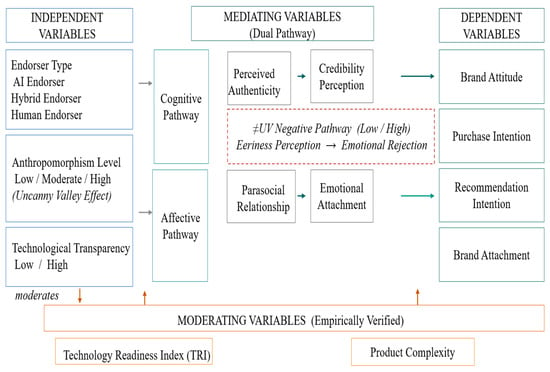
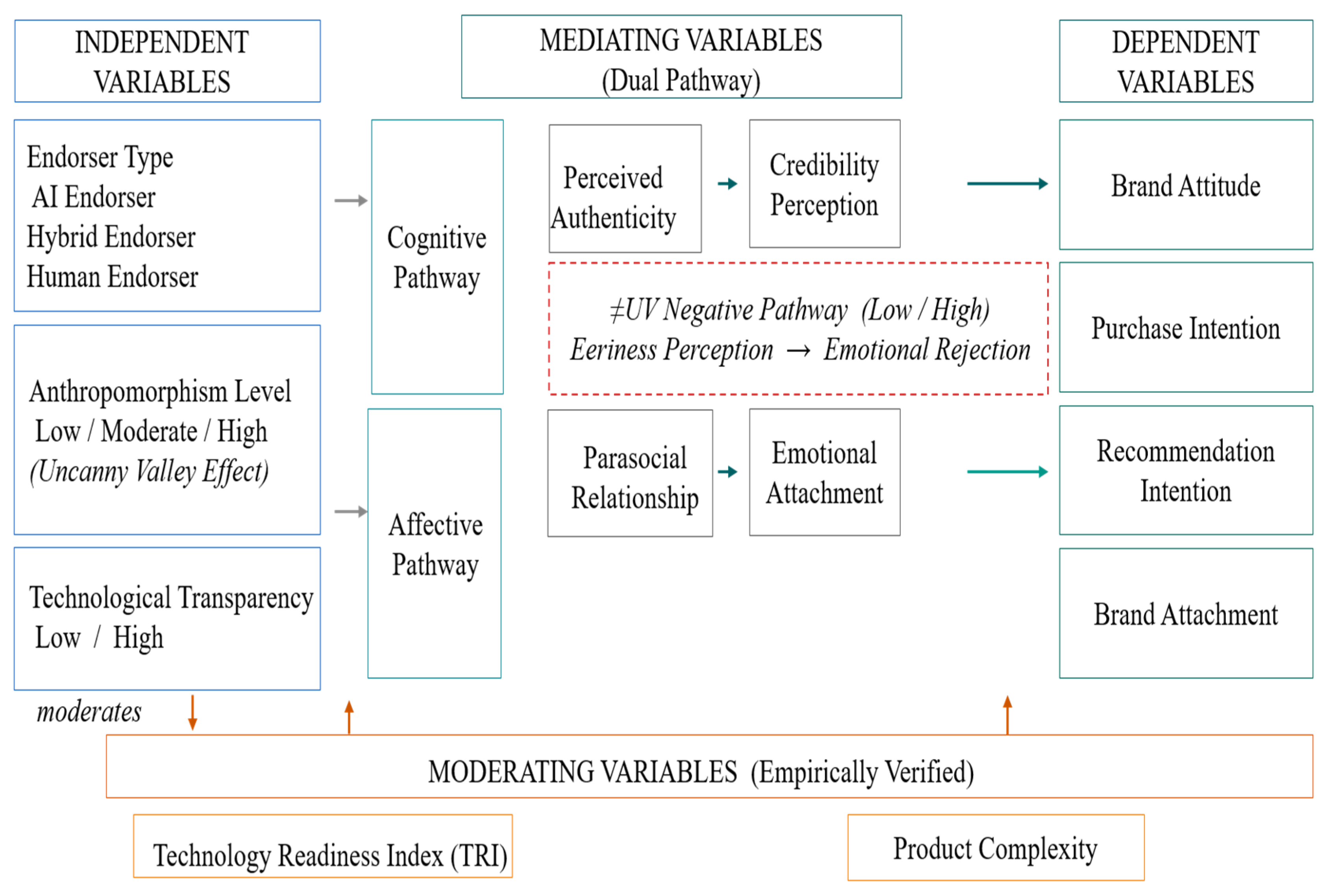

Disclaimer/Publisher’s Note: The statements, opinions and data contained in all publications are solely those of the individual author(s) and contributor(s) and not of MDPI and/or the editor(s). MDPI and/or the editor(s) disclaim responsibility for any injury to people or property resulting from any ideas, methods, instructions or products referred to in the content. |
© 2026 by the authors. Licensee MDPI, Basel, Switzerland. This article is an open access article distributed under the terms and conditions of the Creative Commons Attribution (CC BY) license.