1. Introduction
Electronic commerce ecosystems increasingly rely on social media platforms where influencers function not only as content creators but as real-time sales intermediaries. Within this environment, hashtags have emerged as a crucial linguistic interface that shapes both algorithmic visibility and consumer interpretation. Since the rise of Twitter in 2006, hashtags have become an integral feature of social media communication, allowing users to link posts to other content related to the same topic across platforms [
1]. Hashtags have become a central mechanism for organizing, categorizing, and discovering content on social media platforms, increasing content visibility while also shaping how users express identity and meaning through digital posts [
2,
3,
4]. By tagging content with relevant hashtags, users and brands can categorize their posts within broader discussions and connect with both existing and potential audiences, as hashtags allow users to access collections of posts centered on specific topics through clicks or searches [
5].
While extensive research documents the visibility-enhancing function of hashtags, emerging studies highlight that their strategic value extends far beyond exposure. Hashtags influence consumer engagement, signal message relevance, and serve as expressive cues that complement the tone and intention of the associated caption [
6,
7]. Recent research increasingly views hashtags not merely as metadata but as socio-semantic devices that shape content interpretation and algorithmic visibility [
8]. Building on this perspective, studies on hashtag recommendation and networked co-occurrence indicate that hashtag effectiveness is grounded in two fundamental dimensions. First, semantic similarity, reflecting the extent to which hashtags coherently reinforce the caption or visual message [
9,
10]. Influencers and marketers must often balance multiple hashtags with subtle semantic nuances to satisfy audience expectations and maintain coherent message framing [
9,
11]. Second, frequency, which governs algorithmic amplification on platforms while simultaneously shaping how audiences interpret the strategic intent behind a post or the discursive prominence of particular hashtags [
8].
This research gap becomes particularly salient in the context of Instagram-based group-buying campaigns, which are typically organized by influencers or small-scale sellers offering followers limited-time discounts through collective purchasing. Prior to the official opening of a sales window, influencers deploy strategically curated hashtags such as #launching today, #limited stock, or #group-buying in progress to stimulate anticipation, enhance visibility, and signal exclusivity within their online communities. These campaigns rely heavily on opening-related hashtags as both discoverability cues and social signals. Prior research indicates that hashtag usage facilitates social media engagement [
12] and that posts containing positive hashtags increase perceived source trustworthiness [
3]. In group-buying contexts, hashtags may further function as affiliative cues that help mobilize communal participation. Despite their growing importance, however, empirical research examining how hashtag semantic similarity or hashtag frequency influences actual sales outcomes in group-buying campaigns remains limited.
Beyond platform-level effects, influencers’ personality, which manifests on social media through their linguistic patterns and tonal choices, plays a critical role in shaping how audiences respond to hashtag strategies, as personality-driven expressive tendencies influence both the manner and intensity with which hashtags are used. Personality research increasingly shows that such expression styles are not fixed traits, but adaptive behavioral signals inferred from linguistic features [
13,
14,
15,
16]. Building on this perspective, the study employs personality-based typologies to capture influential variation in expressive patterns. Among various frameworks, the Myers–Briggs Type Indicator (MBTI) is particularly relevant because it captures decision-orientation and behavioral structuring tendencies that are observable in textual communication [
13,
17]. Within this framework, the Judging–Perceiving (J/P) dimension offers a text-based marker of structured versus spontaneous expressive styles: J-like expressions often display organized, goal-directed, and sequential patterns, whereas P-like expressions reflect flexible, affective, and intuitive tones. Because hashtags themselves function as linguistic cues, their effectiveness may depend on the degree to which they align with or contradict an influencer’s underlying expressive signature.
Despite these theoretical possibilities, the interaction between hashtag strategy and expressive style remains largely unexplored in influencer-driven e-commerce. This gap is particularly consequential in group-buying contexts, where individual posts often generate immediate and concentrated purchase activity. Accordingly, this study examines how the two dimensions of hashtag strategy—semantic similarity and frequency—interact with influencers’ adaptive, MBTI-based expressive styles to influence sales performance in Instagram group-buying campaigns.
2. Research Background & Hypothesis
2.1. Strategic Role of Hashtags in Influencer Marketing
Hashtags, represented by the ‘#’ symbol preceding words or phrases, function as social media metadata that simultaneously structure content visibility within platform algorithms and signal semantic meaning to human audiences. Although hashtags were originally introduced to facilitate topic aggregation and information retrieval on early social media platforms [
18], their role has substantially expanded into multifunctional tools for expressing personal interests, sharing emotions, and engaging wider audiences, becoming integral components across diverse platforms, such as Instagram, Facebook, and TikTok [
19]. Particularly on visually oriented platforms such as Instagram, hashtags no longer serve merely as classification tools but operate as strategic interface elements that connect multimedia content to searchable discourse networks, shaping both content discoverability and audience interpretation [
19]. Yet the growing reliance on hashtags has created a fundamental tension between algorithmic optimization and communicative coherence. While increasing hashtag use may improve platform visibility, excessive or poorly structured hashtag deployment can simultaneously disrupt message clarity and audience trust. This tension highlights that hashtag strategy involves more than maximizing exposure; it requires balancing technical reach with persuasive communication effectiveness.
Prior research consistently demonstrates that hashtag usage enhances content discoverability, facilitates information diffusion, and increases audience engagement by improving searchability and surfacing posts within recommendation feeds [
8,
9,
18]. Hashtags also support the formation of niche communities and accelerate viral diffusion by clustering content around shared themes. However, most existing studies focus on visibility and engagement outcomes, offering limited insight into how hashtag strategies translate into economic performance in transactional influencer contexts. In e-commerce environments where influencer-generated content increasingly mediates consumer purchase decisions, posts often function as direct points of sale rather than mere branding touchpoints. Within this context, hashtag strategies are embedded within persuasive communication processes that shape trust, credibility, and purchase readiness. Accordingly, understanding how different dimensions of hashtag usage influence commercial outcomes requires moving beyond aggregate visibility metrics and examining how structural and semantic design choices jointly affect sales performance.
2.1.1. Structural Fit: Hashtag Frequency and Diminishing Returns
While hashtags enhance visibility and engagement when used strategically, excessive hashtag frequency within a single post can diminish their effectiveness in commercial communication contexts. This phenomenon, often referred to as “hashtag fatigue,” occurs when long strings of hashtags overwhelm users and reduce perceived message quality, particularly when hashtags appear repetitive, weakly relevant, or indiscriminately applied [
20,
21,
22]. From a consumer perception perspective, overly dense hashtag usage can increase visual clutter and reduce readability, potentially weakening perceived authenticity and source credibility (American Marketing Association (2024). Hashtags in 2025: Do they work?
https://www.ama.org/marketing-news/social-media-hashtags/ accessed on 19 August 2024). This effect is especially pronounced in social commerce environments, where purchase decisions rely heavily on trust and perceived recommendation sincerity rather than anonymous advertising signals. In addition to credibility concerns, excessive hashtag frequency introduces cognitive friction by increasing visual clutter and processing effort, diverting attention away from the core message and product information. On Instagram, where aesthetic coherence and message clarity strongly influence user response, such disruption can reduce persuasive effectiveness and transactional efficiency [
21].
Empirical evidence further suggests that the marginal benefits of increasing hashtag volume exhibit diminishing returns. Beyond a certain threshold, additional hashtags no longer generate proportional gains in engagement and may even produce negative performance effects [
22]. In e-commerce contexts, this pattern implies a non-linear trade-off in which informational visibility gains are outweighed by reputational costs, attentional overload, and reduced message credibility. Taken together, these findings indicate that hashtag frequency represents a structural dimension of content design that must be strategically calibrated rather than maximized. In influencer-mediated e-commerce environments, excessive hashtag usage is therefore expected to weaken commercial effectiveness by undermining trust signals and increasing cognitive and perceptual frictions at the point of purchase. Accordingly, we propose the following hypothesis:
H1. Influencers’ use of higher hashtag frequency in their posts negatively affects sales performance.
2.1.2. Semantic Fit: Hashtag–Posting Similarity and Effects on Engagement
While hashtag frequency captures the quantitative intensity of hashtag use, semantic similarity reflects the qualitative coherence between hashtags and promotional message content. Despite extensive research on hashtag popularity and trend dynamics [
23,
24,
25], relatively little attention has been paid to semantic similarity as a driver of commercial effectiveness. More recent studies suggest that the commercial effectiveness of hashtags depends less on sheer visibility and more on semantic similarity, that is, the degree to which hashtags meaningfully correspond with the core narrative, topical focus, and communicative intent of a post, thereby enhancing algorithmic categorization and audience relevance rather than merely maximizing exposure [
20,
26]. Prior influencer marketing research also suggests that consumers respond more positively when influencer communication appears coherent, relevant, and aligned with audience expectations rather than fragmented or inconsistent [
27]. Hashtags that are semantically aligned with the surrounding content improve message fluency, reinforce thematic consistency, and enhance audience perceptions of authenticity [
28].
Semantically aligned hashtags enhance message fluency by reinforcing coherence between captions, visuals, and auxiliary textual cues. Prior research shows that such coherence facilitates cognitive processing, reduces interpretive ambiguity, and strengthens perceived authenticity, leading to more favorable audience evaluations [
26,
28]. From a persuasion perspective, this similarity supports narrative transportation, enabling viewers to more easily immerse themselves in the content and emotionally connect with the underlying message [
29,
30]. In influencer-mediated e-commerce environments, these perceptual advantages extend beyond engagement metrics. When hashtags reinforce the central narrative of a post, they reduce perceived persuasive intent, lower psychological resistance, and increase message credibility at the point of purchase. As a result, semantic similarity functions not merely as a stylistic choice but as a commercial signal that enhances purchase readiness and transactional efficiency. Conversely, weak semantic similarity between hashtags and post content can disrupt narrative coherence and create interpretive dissonance. Hashtags that appear opportunistic, loosely related, or contextually mismatched may trigger skepticism regarding influencer authenticity and strategic intent, thereby weakening persuasion effectiveness and reducing commercial impact [
20,
31]. This risk is particularly salient in influencer commerce contexts, where audience trust and perceived sincerity play central roles in driving purchasing behavior.
Moreover, semantic similarity interacts with platform dynamics. Recent evidence suggests that platform algorithms increasingly reward content coherence and engagement potential, making semantically aligned hashtag strategies more likely to improve content distribution and visibility [
32]. At the same time, micro-influencers with high semantic consistency are perceived as more authentic and credible, which further amplifies engagement and conversion effectiveness within niche communities [
33]. By reinforcing coherence, credibility, and emotional resonance, semantically aligned hashtags enhance persuasive effectiveness and facilitate downstream purchasing behavior. Accordingly, we propose the following hypothesis:
H2. Influencers’ use of more semantically aligned hashtags in their posts positively affects sales performance.
2.2. Adaptive Self-Presentation on Social Media
Self-presentation refers to the strategic regulation of expressive cues through which individuals shape others’ perceptions and communicate desired identities [
34,
35]. More broadly, human behavior is inherently self-presentational in that actions convey socially interpretable signals about the actor; importantly, many such acts are selectively designed to project a preferred image rather than an objective self-representation [
35,
36]. Accordingly, self-presentation reflects a form of motivated selectivity, whereby individuals calibrate what to reveal, emphasize, or conceal in response to goals, social norms, and audience expectations. This process is inherently context-sensitive: when prompted or incentivized, individuals systematically adapt how they describe and display themselves to align with situational demands and audience characteristics [
37,
38,
39].
Building on this logic, studies of within-person variability find that people’s momentary expressions are not random but follow predictable patterns across situations. Individuals behave more similarly in contexts that serve comparable functional purposes than in dissimilar contexts, suggesting stable person–situation contingencies in responses to situational cues [
40]. In applied contexts, this means that actors selectively activate tendencies that fit situational demands, showing more conscientious and organized patterns in structured tasks, but greater openness and spontaneity when creativity or flexibility is required [
41]. Such patterns reflect behavioral plasticity, the capacity to modulate personality-relevant behaviors to meet situational goals.
Accumulating evidence indicates that adaptive shifts in expressive orientation are systematically associated with superior performance outcomes [
42]. Grant [
16] shows that ambiverts, individuals with moderate levels of extraversion, outperform both introverts and extraverts in sales contexts by flexibly balancing assertiveness and responsiveness during customer interactions. Related research connects adaptability in cognitive and emotional regulation to better leadership effectiveness, negotiation results, and social influence [
43,
44]. These mechanisms jointly support a view of social-media self-presentation as adaptive in practice. Influencers maintain recognizable expressive styles while adjusting what they present and how they phrase content in response to situational goals and audience feedback [
14,
15]. In this regard, adaptive self-presentation does not imply random behavioral fluctuation; rather, individuals tend to exhibit contextually dominant expressive orientations at particular moments or interaction episodes. Following the density distribution perspective, personality-relevant expressions can therefore be understood as fluctuating across situations while still displaying temporarily dominant presentation modes within specific events [
14,
15].
In online environments, posts are persistent, publicly visible, and easily editable, enabling creators to iteratively refine expressive strategies based on observable engagement signals [
45,
46,
47,
48]. Such platform affordances amplify self-presentation dynamics by facilitating feedback-driven calibration of future content [
49].
2.2.1. Self-Presentation Tactics in Influencer Content
Social media influencers become pivotal intermediaries, shaping consumer attitudes and purchases through their content [
50,
51,
52]. As influencer marketing has become a dominant mode of brand communication, influencers’ posts now serve as a critical point of sale, where product exposure, engagement, and actual purchase behavior converge [
53,
54]. Because influencers’ income and reputation are often directly tied to the sales performance of their promoted products, crafting the right kind of post, linguistically and emotionally aligned with both audience expectations and product characteristics, has become strategically essential. Studies show that post framing, tone, and language style significantly affect consumers’ perceptions of credibility, authenticity, and purchase intention [
55,
56,
57]. Consequently, influencers function not merely as content endorsers but as adaptive communicators who actively adjust expressive strategies to optimize persuasive effectiveness across promotional contexts.
Extant research has identified a range of self-presentation tactics, including ingratiation, self-promotion, exemplification, intimidation, and supplication, that individuals use to manage impressions and pursue short-term goals [
58,
59]. These tactics are not confined to face-to-face settings; they translate robustly to computer-mediated environments where identity cues are curated and distributed through profiles, posts, and interactions [
60]. In influencer settings, such tactics are operationalized through concrete content design choices, including hashtag selection and placement, caption structure, emoji usage, media format, and audience engagement behaviors. Because posts simultaneously perform communicative and commercial functions, effective influencer self-presentation typically combines (a) structural clarity that lowers processing effort and signals reliability with (b) affective resonance that heightens desire and identification.
These content design choices are most directly reflected in how promotional messages are linguistically structured within post captions. Prior research shows that communication styles vary systematically along dimensions of structure, intentionality, and spontaneity, which influence how audiences interpret message clarity, credibility, and persuasive intent [
61]. To operationalize these expressive differences at scale, this study adopts the Judging–Perceiving (J/P) dimension of the Myers–Briggs framework as a linguistic proxy capturing systematic variation in message organization style [
62,
63,
64,
65]. The Myers–Briggs Type Indicator (MBTI) is a personality typology developed by Briggs and Myers based on Jung’s theory of psychological types, which explains individual differences in preferences for energy orientation (Extroverted–Introverted), information processing (Sensing–Intuition), decision making (Thinking–Feeling), and behavioral organization (Judging–Perceiving) across four dichotomous dimensions [
66]. Among these, the Judging–Perceiving (J–P) dimension reflects the extent to which individuals present messages in a structured and planned manner versus a flexible and spontaneous manner, making it particularly well-suited for capturing differences in expressive styles in text-based communication [
66]. Accordingly, this study focuses on the J–P dimension as the MBTI dimension that most directly reflects variation in the linguistic structure and expressive strategies of social media posts. Judging-oriented expression reflects planned, structured, and goal-directed communication patterns associated with deliberation, cognitive control, and systematic information presentation, whereas Perceiving-oriented expression emphasizes flexible, exploratory, and spontaneous tendencies linked to impulsivity, affective engagement, and adaptive spontaneity [
64,
65,
67,
68]. These expressive orientations are particularly relevant in influencer-mediated e-commerce, where communication structure and emotional tone jointly shape trust formation and purchase-related decision processes.
2.2.2. The Moderating Role of Self-Presentation on Hashtag Strategy
Building on the premise that self-presentation is contextually adaptive, we argue that it shapes how audiences interpret and process hashtag-based informational cues. As a result, self-presentation is expected to moderate the relationship between hashtag strategy and downstream sales performance. Specifically, we consider how self-presentational style of posts, whether Judging (J) or Perceiving (P), influences the effectiveness of hashtag frequency. Consumers rarely interpret hashtags in isolation; rather, they evaluate hashtag cues within the broader communicative context established by the influencer’s self-presentational style. Prior research on processing fluency and cue congruence suggests that persuasive effectiveness increases when multiple message elements are perceived as stylistically coherent and cognitively consistent [
69,
70,
71]. When communication cues align with audience expectations, information becomes easier to process, leading to greater perceptions of credibility, intentionality, and message quality. In contrast, stylistic incongruence across message components may generate cognitive disfluency, increasing perceptions of clutter, inauthenticity, or persuasive intent.
Although prior research suggests that higher hashtag frequency may generate diminishing returns on average, this relationship is unlikely to be uniform across expressive styles because audiences evaluate message signals through style-consistent cognitive frameworks. Posts reflecting Judging-oriented self-presentation tend to emphasize structure, organization, and goal-directed communication. Within such contexts, higher hashtag frequency may function as a congruent extension of an already information-dense communication style. Because the presence of multiple hashtags is stylistically aligned with audiences’ expectations of organized and deliberate messaging, audiences are more likely to process these cues fluently and interpret them as signals of preparation, informational completeness, and professionalism rather than promotional excess [
69,
70].
In contrast, posts reflecting Perceiving-oriented self-presentation emphasize spontaneity, flexibility, and less structured expression. Under these conditions, excessive hashtag use may create stylistic incongruence between the post’s expressive tone and its informational density, increasing cognitive processing burden and perceived promotional clutter. This mismatch may reduce message fluency and weaken persuasive effectiveness [
69,
70]. Thus, we expect Judging-type self-presentation to attenuate—and potentially reverse—the otherwise negative association between hashtag frequency and sales performance, thereby functioning as a positive moderator of the hashtag frequency–sales relationship.
H3. Influencers’ self-presentation style moderates the relationship between hashtag frequency and sales performance, such that the negative effect of hashtag frequency on sales is significantly weaker—and is expected to turn positive—for posts reflecting a Judging (J)-type self-presentation than for posts reflecting a Perceiving (P)-type self-presentation.
Extending this moderation logic beyond hashtag frequency, we argue that self-presentational style also conditions the effectiveness of semantic hashtag–posting similarity. While prior arguments (H2) suggest a general positive effect of semantic similarity, this effect is not uniform across expressive styles. For Judging-oriented self-presentation, semantic similarity between hashtags and caption content reinforces narrative coherence and communicative intentionality. Because audiences perceive hashtags as integrated extensions of the post’s central message, aligned hashtags strengthen message clarity and reduce interpretive ambiguity. This coherence enhances persuasive effectiveness by facilitating smoother cognitive integration between textual content and hashtag cues.
In contrast, under Perceiving-oriented self-presentation, the overall communication style is less structured and less narratively integrated. As a result, even semantically aligned hashtags may contribute less to message coherence because audiences are less likely to perceive strong organizational relationships between hashtags and core message content. Accordingly, we propose that the positive effect of hashtag–posting similarity on sales performance is contingent on self-presentational style embedded in influencer content.
H4. Influencers’ self-presentation style moderates the relationship between hashtag–posting similarity and sales performance, such that the positive effect of hashtag–posting similarity on sales is significantly stronger for posts reflecting a Judging (J)-type self-presentation than for posts reflecting a Perceiving (P)-type self-presentation.
3. Methodology
3.1. Data Analysis
The data used in this study consist of two major types: influencer social media data and sales data. First, the influencer social media data were collected from both commercial and non-commercial posts uploaded to influencers’ social media accounts. These data include information such as posting dates, post content, comment content, number of comments, comment length, number of likes, number of images, number of videos, and number of hashtags.
Second, the influencer sales data were obtained from an influencer marketing agency. These data include not only the sales amount generated during promotional events, but also product- and event-related information such as event names, product names, product categories (large, medium, and small classifications), prices, and quantities sold were provided.
The operational context of the influencer group-buying campaigns used in this study is as follows. Prior to launching a group-buying event, influencers continuously promote products through social media postings. Once the group-buying event begins, influencers upload a purchase link connected to the influencer agency’s Payment platform in their social media bio, allowing followers to purchase the promoted products. In general, influencer group-buying promotions are exposed through social media approximately seven days prior to the start of the event, during which influencers actively engage in promotional activities through their postings [
72,
73]. The postings generated during this period include not only commercial posts intended to promote product sales, but also non-commercial posts related to influencers’ daily lives.
Accordingly, this study defines the relevant social media activity period affecting each event-level sales outcome as the seven days preceding the event date. Furthermore, this study assumes that all postings generated during the seven-day period prior to the event, regardless of whether they are commercial or non-commercial, may influence product sales performance. Specifically, the social media data generated during the seven-day pre-event window were aggregated and matched with each event-level sales outcome to analyze the relationship between influencers’ social media activities and sales performance. Thus, the final dataset consists of 932 observations, and both the social media data and sales data were collected over a two-year period from August 2018 to May 2020.
3.2. Measures
3.2.1. Dependent Variable
The dependent variable,
, represents the natural logarithm of total product sales generated by each influencer during a given promotional event. Log transformation was applied to reduce skewness and mitigate the influence of extreme outliers, consistent with prior studies in influencer marketing and electronic commerce [
54,
56]. The mean value of
was 14.41 (SD = 1.68), indicating substantial variation in sales performance across events (see
Table 1).
3.2.2. Hashtags Frequency
To capture the structural intensity of hashtag usage, this study constructed the variable
, defined as the natural logarithm of the total number of hashtags used by influencer
in posts uploaded during the seven-day period preceding the event date
. This log transformation was applied to account for the highly skewed distribution of hashtag counts, in which a relatively small number of posts contained unusually large numbers of hashtags. Accordingly, higher values of
indicate greater hashtag usage intensity during the pre-event period. The mean value of
was 0.93 (SD = 1.67), reflecting substantial variation in hashtag usage across posts (see
Table 1).
3.2.3. Hashtag–Posting Semantic Similarity
To measure semantic similarity between hashtags and caption content, this study operationalized Hashtag–Content Semantic Similarity using cosine similarity derived from multilingual Sentence-BERT embeddings [
74]. Unlike exact string-matching approaches, the present method captures semantic relatedness between caption text and hashtags even when identical lexical expressions are not directly repeated.
For each Instagram post, hashtags beginning with the “#” symbol were first extracted and concatenated into a single hashtag text, while the remaining non-hashtag text was treated as the caption content. Semantic embedding vectors for both the caption text and hashtag text were generated using the multilingual Sentence-BERT model “paraphrase-multilingual-MiniLM-L12-v2,” which is designed to capture semantic similarity across multilingual short-text contexts.
This study calculated semantic similarity scores using cosine similarity between the caption embedding vector and the hashtag embedding vector. Cosine similarity measures directional similarity between two vectors, such that higher values indicate stronger semantic relatedness between caption content and hashtags. Formally, the semantic similarity score was computed as follows:
where
represents the embedding vector of the caption text for post
at time
, and
represents the embedding vector of the corresponding hashtag text. Korean captions were processed directly using the multilingual Sentence-BERT model without machine translation, allowing the model to capture semantic relationships in naturally occurring Korean social media language.
The resulting semantic similarity score was subsequently aggregated using a seven-day pre-event window and employed as a key independent variable in the panel regression analyses. The mean value of the semantic similarity score was 0.295, indicating a moderate level of semantic similarity overall (see
Table 1).
3.2.4. Self-Presentation
To operationalize self-presentation, this study measured the Judging (J) and Perceiving (P) tendencies reflected in influencers’ linguistic expression patterns using social media caption text. MBTI-related expressive orientations were inferred from the combined text of all captions posted by each influencer during the seven-day period preceding each promotional event. Because the classification model was trained on English-language MBTI text data, Korean Instagram captions were first translated into English using the googletrans library prior to classification. The translated captions were then aggregated into a single text string for each influencer-event observation and used as input for MBTI-based linguistic inference.
Personality classification was conducted using a transformer-based DistilBERT classifier fine-tuned on large-scale MBTI-labeled Reddit text data [
75]. To assess predictive validity, an additional supervised binary classification validation was conducted using the MBTI 500 dataset, a publicly available corpus of Reddit posts annotated with self-reported MBTI types. MBTI labels were converted into a binary J/P classification task, with types ending in J coded as 1 and types ending in P coded as 0. The fine-tuned classifier achieved acceptable predictive performance on a held-out test set, with an accuracy of 73.75% and an F1-score of 0.6842, supporting the use of the J/P dimension as a linguistic operationalization of self-presentational tendencies in text-based research (see
Table 2).
Because the primary theoretical interest of this study lies in the J/P distinction, self-presentation was operationalized based on the dominant expressive orientation reflected at the event level. Although self-presentation is theoretically adaptive and continuous, prior social media personality prediction studies have commonly modeled MBTI-related personality expressions as categorical outcomes in order to predict dominant personality types from users’ social media posts [
76]. This approach is particularly useful in noisy text-based environments because categorical indicators improve interpretability and allow personality-relevant linguistic signals to be incorporated more effectively into empirical models. Accordingly, influencers’ event-level MBTI outputs were binarized such that Judging-oriented self-presentation was coded as 1 and Perceiving-oriented self-presentation was coded as 0. Approximately 30% of the posts reflected Judging-type self-presentation, while approximately 12.4% simultaneously exhibited Judging tendencies and high hashtag–content semantic similarity (see
Table 1).
3.2.5. Control Variables
Potential confounding factors were addressed by incorporating control variables across three dimensions: content features, engagement-linked signals, and event-level attributes. Variables such as
,
,
,
,
, and
capture the linguistic and multimedia characteristics of influencer posts. Engagement-linked measures, including
,
,
,
, and
, reflect the extent of interaction between influencers and followers. Event-level variables, such as
,
, and
, were also included, as differences in promotional intensity and campaign scale may independently affect sales performance beyond hashtag strategy (see
Table 3).
The empirical models further incorporated both influencer fixed effects and time fixed effects. This specification helps account for unobserved time-invariant influencer characteristics, including baseline expertise, long-term content style, and stable follower base, while also controlling for common temporal shocks.
MBTI-based self-presentation tendencies may capture broader strategic characteristics beyond communication style alone, including campaign planning tendencies, content management approaches, and product selection strategies. To reduce this concern, the analysis incorporated a broad set of behavioral and engagement-related controls. Variables such as , , , , , , and partially reflect differences in influencers’ content management and follower engagement practices. Similarly, , , and were included to capture variation in promotional strategy and group-buying campaign execution.
3.3. Analysis
3.3.1. Empirical Model for Primary Analysis I (Hashtag Frequency)
This study employs panel fixed effects regression models to examine the relationship between hashtag strategies and sales performance, as well as the moderating role of influencers’ personality-driven self-presentation. The main analysis focuses on the structural dimension of hashtag strategies by examining how variations in hashtag frequency, combined with Judging (J)-type self-presentation, influence sales performance. The empirical analysis is conducted at the level of repeated promotional events initiated by influencers, and the main empirical model is specified as follows.
The model includes an interaction term between hashtag frequency and Judging-type self-presentation in order to examine the moderating effect of J-type self-presentation on the relationship between hashtag strategies and sales performance. In addition, the model incorporates a vector of control variables, , which captures post-related characteristics such as media type (e.g., video), product categories, and engagement indicators (e.g., comments and replies).
Influencer fixed effects,
, control for unobserved time-invariant heterogeneity across influencers, including typical posting style, follower characteristics, and baseline engagement tendencies. Time fixed effects,
, are included to account for common external shocks associated with event timing, such as seasonal fluctuations, platform algorithm changes, and broader macroeconomic trends. Finally,
denotes the idiosyncratic error term. The empirical model for the main analysis is specified as follows:
3.3.2. Empirical Model for Primary Analysis II (Hashtag–Posting Similarity)
The primary analysis II focused on hashtag–posting similarity, measured using multilingual Sentence-BERT embeddings and cosine similarity between caption text and hashtag text. This analysis was intended to capture the semantic quality dimension of hashtag strategy by examining the extent to which hashtags are semantically related to the meaning and narrative of post content. In other words, the purpose of the additional analysis was to provide a more nuanced examination of how semantically similar hashtag strategies influence sales performance. More specifically, the additional analysis investigated whether semantically similar hashtag strategies become more effective when interacting with personality-driven self-presentation (See Equation (2)). In contrast, the main analysis focused on hashtag frequency, emphasizing the quantitative intensity and structural dimension of hashtag usage.
Accordingly, the analyses for H1/H3 and H2/H4 were estimated separately because the two sets of hypotheses capture different dimensions of hashtag strategy. Specifically, hashtag–posting similarity in the additional analysis reflects the semantic quality dimension of hashtag strategy, whereas hashtag frequency in the main analysis reflects the quantitative intensity of hashtag usage. In addition, hashtag frequency was included as an additional control variable in all semantic similarity models in order to distinguish semantic similarity effects from the quantitative intensity of hashtag usage. The empirical model for the additional analysis is specified as follows:
4. Results
Consistent with the dual-dimensional framework developed in
Section 2, this study treats hashtag frequency (structural dimension) and hashtag–posting similarity (semantic dimension) as theoretically co-equal expressions of hashtag strategy. Accordingly, the results are organized around two parallel primary analyses, each of which tests one of the main effects (H1, H2) together with its corresponding interaction with influencers’ Judging-type self-presentation (H3, H4).
Section 4.1 reports Primary Analysis I on hashtag frequency and its moderation (
Table 4), and
Section 4.2 reports Primary Analysis II on hashtag–posting similarity and its moderation (
Table 5). Robustness checks for both analyses are reported in
Section 5.
4.1. Primary Analysis I: Hashtag Frequency and Sales Performance
The results of the main analysis examine the effects of hashtag strategies and self-presentation on influencer-driven sales performance. The analysis focuses on both the direct effects of hashtag strategies and their interaction with Judging-type self-presentation. The findings support Hypothesis 1 and Hypothesis 3 (see
Table 4 and
Table A1), highlighting the important role of hashtag usage and personality-driven self-presentation in shaping sales outcomes in influencer-driven electronic commerce.
In particular, Model 3 presents the full specification, including the interaction effect between hashtag frequency and Judging-type self-presentation and serves as the primary model for testing the proposed hypotheses. First, the coefficient of
is negative and statistically significant (
), suggesting that excessive hashtag usage may reduce sales performance. This finding supports Hypothesis 1, which proposed that higher hashtag frequency negatively affects sales performance. The result is also consistent with prior research on “hashtag fatigue” [
21], suggesting that excessive hashtag use may generate visual or cognitive overload and reduce perceived authenticity.
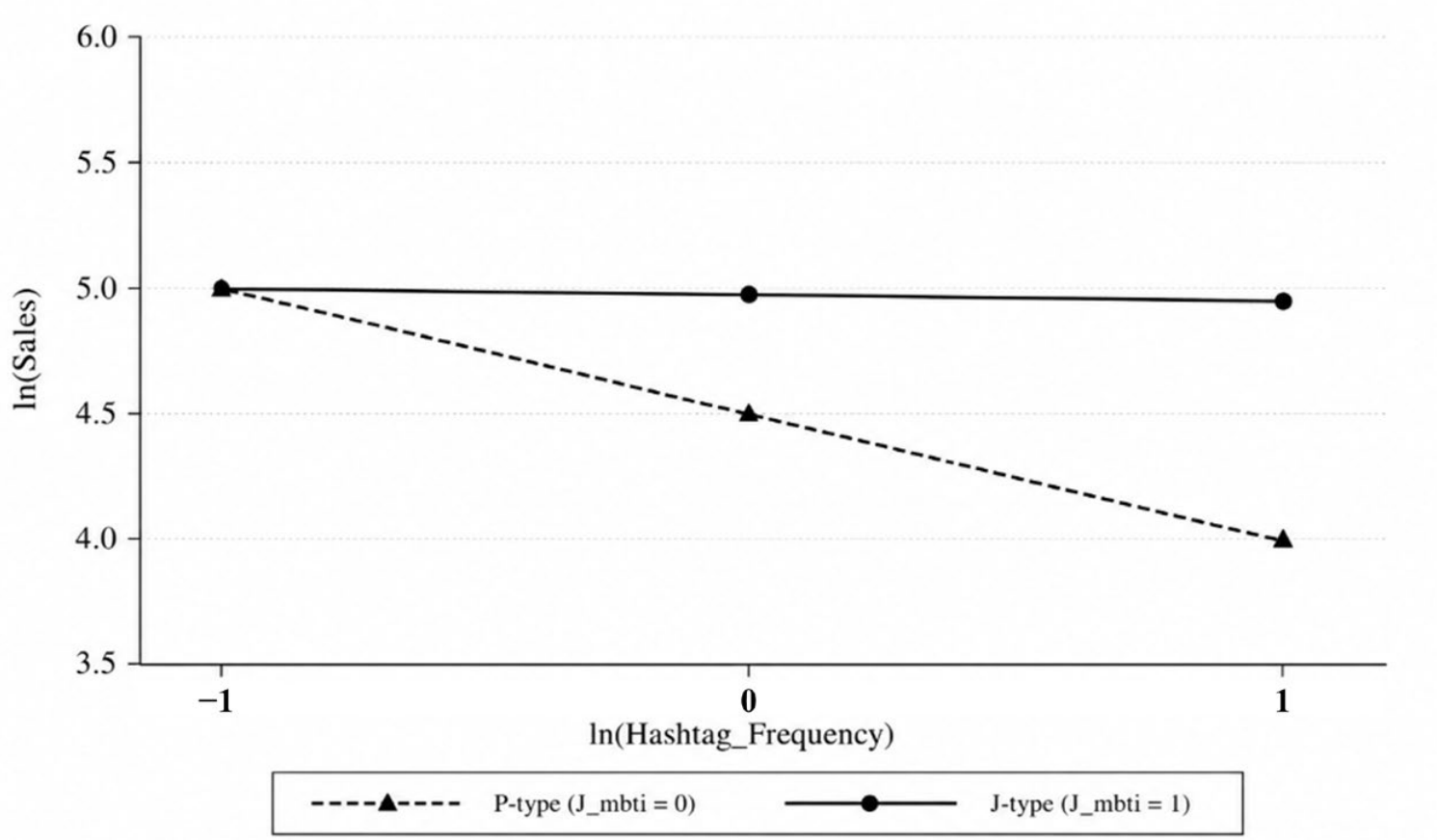
In contrast, the interaction term is positive and statistically significant (
) (See
Figure 1). This finding indicates that the negative effect of frequent hashtag use is mitigated when posts reflect stronger Judging-type self-presentation. In other words, when influencers adopt a more structured and deliberate communication style, frequent hashtag use is less likely to be perceived as excessive or disorganized and may instead signal a more intentional and strategically designed content structure. This result supports Hypothesis 3, which proposed that hashtag frequency positively affects sales performance when the content reflects Judging-type self-presentation.
In addition, the relatively low R-squared values observed in this study may be attributable to the characteristics of panel fixed-effects models. Ozili [
77] noted that fixed-effects specifications in panel-data research often exhibit relatively lower explanatory power because time-invariant between-unit variation is absorbed by the fixed effects themselves. Therefore, this study places greater emphasis on the statistical significance, theoretical consistency, and robustness of the estimated coefficients rather than on the absolute magnitude of the R-squared values.
4.2. Primary Analysis II: Hashtag–Posting Similarity and Sales Performance
The results of the primary analysis II can be interpreted primarily through Model 3, which includes the interaction effect between hashtag–posting similarity and Judging-type self-presentation (see
Table 5 and
Table A2). First,
shows a positive and statistically significant effect on sales performance (
), suggesting that semantically similar hashtag strategies can enhance sales performance. This finding supports Hypothesis 2, which proposed that semantically similar hashtag usage positively affects sales performance.
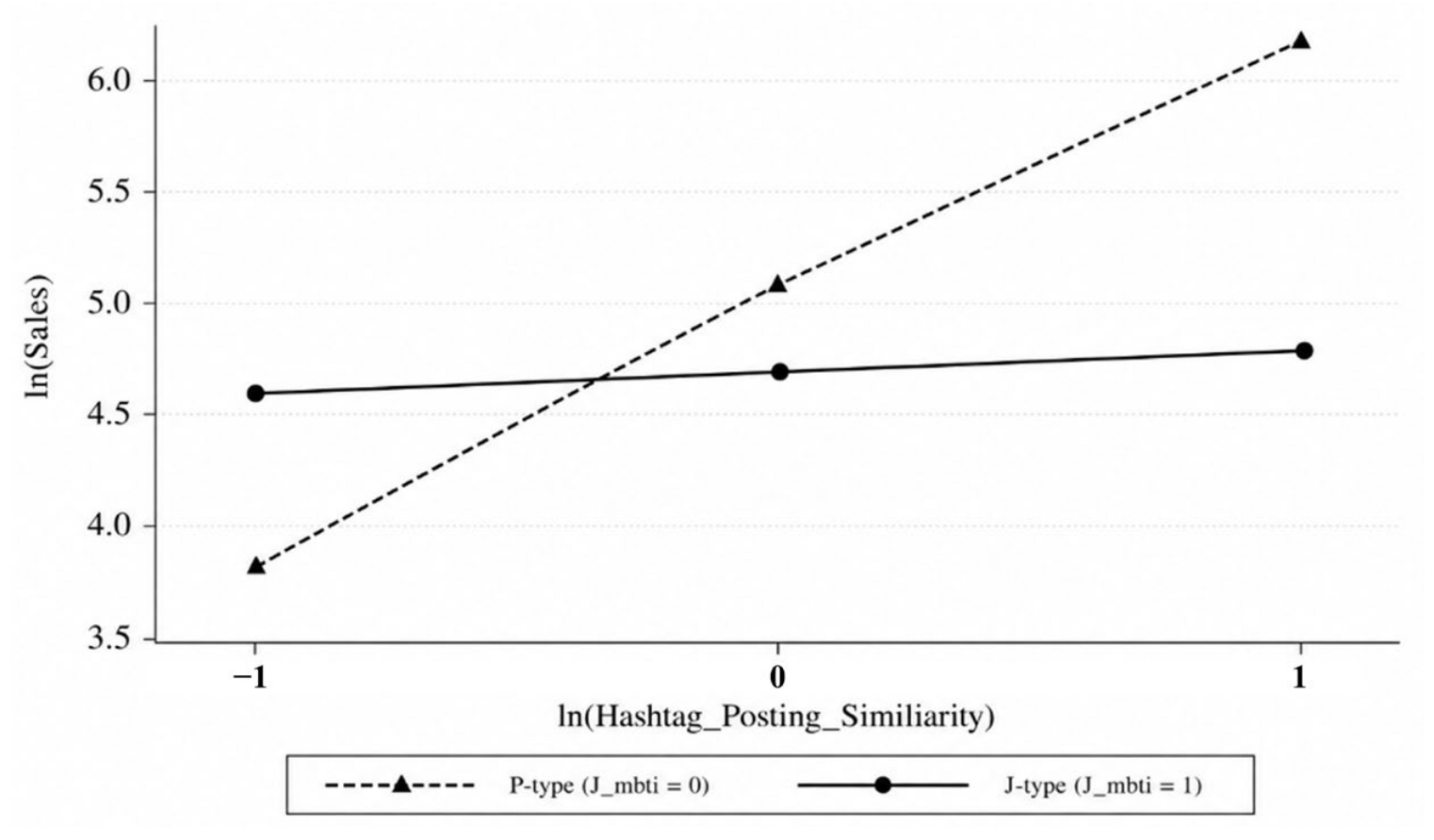
Notably, the interaction term between
and
is positive and statistically significant (
) (See
Figure 2). This result indicates that the positive effect of semantically similar hashtag strategies becomes stronger when posts reflect stronger Judging-type self-presentation. In other words, semantically coherent hashtags appear to function more effectively when embedded within a structured and goal-oriented self-presentation style. This finding supports Hypothesis 4, which proposed that the positive effect of hashtag–posting similarity on sales performance would be strengthened when the content reflects Judging-type self-presentation.
5. Robustness Check
5.1. Robustness Check for Primary Analysis I
Robustness was assessed by separating campaigns into 2018–2019 and 2020 subsamples and conducting time-based robustness checks. As shown in
Table 6, the interaction effect between hashtag frequency and J-type self-presentation remained positive across both periods.
5.2. Robustness Check for Primary Analysis II
A similar pattern emerged for the semantic dimension of hashtag strategy. As reported in
Table 7, hashtag–posting similarity maintained a statistically significant relationship with sales performance across both temporal subsamples. This finding suggests that semantic consistency between hashtags and post content remained an important predictor of sales outcomes over time.
Meanwhile, the interaction effect between semantic similarity and Judging-type self-presentation was statistically significant during the 2018–2019 period but became weaker in the 2020 subsample. One possible explanation is that the COVID-19 pandemic substantially altered consumer purchasing behavior and platform dynamics during 2020. In particular, external factors such as product availability, logistics uncertainty, and pandemic-driven consumption patterns may have become more influential, thereby reducing the relative importance of self-presentation-based communication styles.
In addition, the 2020 subsample contained a relatively smaller number of Judging-oriented promotional events, which may have reduced the statistical power to detect interaction effects. Nevertheless, the direction of the interaction effect remained consistent across both periods, providing partial support for the temporal robustness of the moderating mechanism proposed in this study.
6. Discussion
This study set out to clarify when hashtag strategies drive not only visibility but also actual sales outcomes in influencer-mediated electronic commerce. By separating the structural and semantic dimensions of hashtags and embedding them within influencers’ adaptive self-presentation styles, the findings collectively point to a more contingent view of “what works” in electronic commerce than is typically assumed. In particular, the results show that hashtag–posting similarity is a robust commercial lever, whereas the benefits of higher hashtag frequency depend strongly on whether the surrounding expressive context is structured in a Judging (J)-type manner or remains more flexible and Perceiving (P)-like.
6.1. Positioning the Findings Within Hashtag and eWOM Research
Our findings extend, and in several respects depart from, three streams in the literature that have hitherto examined hashtag use and consumer response in largely separate silos.
First, the broader hashtag research has consistently shown that hashtag use enhances content discoverability, topical clustering, and audience engagement [
8,
18,
19,
23,
24,
25]. Hashtags have been characterized as motivational devices for self-expression and community signaling [
23], while positive effects of hashtag visibility on engagement and brand-related outcomes have been documented [
7,
19]. Our results complement this evidence by linking hashtag design choices directly to transactional outcomes—group-buying sales conversion—rather than to upstream visibility metrics. We further depart from this stream in three ways: (a) we show that more is not more—the main effect of hashtag frequency on sales is negative, consistent with diminishing-return and hashtag-fatigue arguments [
21,
22] but with the stronger consequence of revenue loss; (b) we separate the structural dimension (frequency) from the semantic dimension (posting similarity) and demonstrate that similarity carries the dominant commercial signal (β = 0.826 vs. −0.165 in our estimates); and (c) we add a personality-stylistic boundary condition that the hashtag literature has not previously incorporated.
Second, our results connect hashtag scholarship with the electronic word-of-mouth (eWOM) literature, which has established that the valence and volume of consumer-generated content influence product sales [
78,
79,
80]. The eWOM literature has predominantly focused on consumer-generated reviews and on the cumulative volume–valence configuration of those reviews. Our study contributes by reframing influencer-generated hashtags as a form of producer-side eWOM whose persuasive force is governed not by aggregate volume but by qualitative coherence with the surrounding narrative.
Third, in relation to the rapidly growing influencer marketing literature [
33,
50,
51,
52,
53,
54,
81,
82], our findings advance the conversation in two directions. Prior studies on influencer effectiveness have emphasized follower size, parasocial relationships, and source credibility as the principal drivers of conversion. We show that, holding influencer fixed effects constant, expressive style itself—operationalized through the linguistic Judging–Perceiving (J/P) dimension—systematically conditions which content tactics translate into sales. This positions self-presentation style as an interpretive frame through which audiences decode tactical signals such as hashtag bundles, rather than as a static trait that exerts only an additive effect on outcomes.
6.2. Rethinking Hashtag Strategy Beyond Exposure
A further implication concerns the role of hashtags in commercial content design. Much of the existing literature conceptualizes hashtags primarily as tools for boosting reach, engagement, or topical visibility; in contrast, this study provides empirical evidence that hashtag choices are systematically associated with downstream sales performance, particularly in short-horizon, campaign-driven group-buying settings—a context underexplored in prior hashtag research. The negative main effect of hashtag frequency on sales suggests that “more” hashtags are not automatically better and may even erode trust and clarity when they disrupt message coherence or appear indiscriminately applied. At the same time, strong hashtag–posting similarity reliably enhances sales, indicating that the commercial value of hashtags lies less in volume and more in how well they reinforce the central narrative and purchasing cues of a post.
These findings suggest that hashtag strategies should be evaluated in terms of their contribution to persuasive processing, not only their contribution to platform algorithms. Commercially effective hashtags act as interpretive guides that support narrative fluency, authenticity, and perceived relevance at the point of purchase. When misused, however, they become noise that increases cognitive friction, dilutes the focal message, and weakens the perceived sincerity of influencer endorsements.
6.3. Self-Presentation as a Boundary Condition for Hashtag Effects
A second implication concerns the role of adaptive self-presentation as a boundary condition for content-level tactics. The moderating patterns around Judging (J)-type expression indicate that the same numerical level of hashtag frequency can be processed very differently depending on whether it is embedded in a structured, goal-directed communication style. For J-type posts, dense hashtag bundles may be interpreted as deliberate and well-organized curation, signaling preparation and thoroughness rather than opportunistic clutter. For P-type posts, by contrast, similar bundles are more likely to be seen as stylistically inconsistent and commercially heavy-handed, which in turn undermines clarity and persuasion.
Conceptually, this pattern positions self-presentation as a “frame” within which technical tactics such as hashtag choices become meaningful. Rather than viewing personality-linked styles as static traits that uniformly predict performance, the results support a more contextual view in which expressive orientation shapes how audiences decode and evaluate specific content features. This aligns with emerging evidence that adaptive expression—rather than trait extremity—underpins superior outcomes in sales and influence contexts.
6.4. Personality-Aware Design of Influencer Campaigns
The findings also speak to how influencer campaigns might be designed in a more personality-aware fashion. Instead of issuing platform-generic rules (e.g., “use at least 10–15 hashtags per post”), agencies and brands could develop guidelines that differentiate between structured and flexible expressive styles. For creators whose content naturally aligns with Judging-type patterns, campaigns may benefit from moderately higher, tightly curated sets of semantically aligned hashtags that reiterate product attributes, scarcity cues, or group-buying conditions in a systematic way. For creators with more Perceiving-oriented styles, by contrast, a smaller number of highly congruent hashtags may better preserve perceived authenticity, spontaneity, and relational intimacy with followers.
More broadly, the methodological approach—combining large-scale text traces, personality-related classifiers, and transaction data—illustrates how personality-aware design principles can be operationalized without relying on self-report inventories or intrusive profiling. This opens avenues for data-driven tools that help creators and managers test how alternative hashtag configurations interact with expressive style to influence conversion, rather than optimizing hashtags in isolation.
6.5. Implications for Research on Electronic Commerce
Finally, the study contributes to electronic commerce research by reframing how platform-level signals and psychological processes are integrated. The results demonstrate that algorithmically meaningful signals (such as hashtags) cannot be fully understood without considering the interpretive context in which human audiences encounter them. Structural features that may be beneficial for visibility can become liabilities when they conflict with expectations about authenticity or coherence at the influencer–follower interface.
This suggests that future work on electronic commerce should more systematically integrate platform analytics with theories of self-presentation, narrative persuasion, and interpersonal trust. In particular, research that treats hashtag strategies, expressive styles, and economic outcomes as a jointly determined system—rather than as separate objects of study—may offer more precise guidance for both scholars and practitioners seeking to understand what drives conversion in increasingly crowded digital marketplaces.
7. Conclusions
This study examined how two core dimensions of hashtag strategy—usage frequency and semantic similarity with posting—interact with influencers’ adaptive self-presentation styles to shape sales performance in Instagram-based group-buying campaigns. Using event-level panel models that link social media posts to transaction outcomes, the analysis showed that hashtag–posting similarity exerts a consistent positive effect on sales, while hashtag frequency alone tends to exhibit diminishing or negative returns unless embedded in a structured, Judging-type expressive context. Together, these findings underscore that both what hashtags say and how many are used matter for commercial impact, but their effectiveness is conditional on the broader expressive frame of influencer content.
The research makes three main contributions. First, it extends hashtag scholarship from visibility and engagement outcomes to concrete sales metrics, positioning hashtag decisions as part of the commercial core of influencer marketing rather than as a purely technical optimization problem. Second, by incorporating a linguistic proxy for the MBTI Judging–Perceiving dimension, the study demonstrates how personality-linked communication styles can be inferred from text at scale and used to explain why identical content tactics yield different economic results across creators. Third, it offers a personality-aware view of social commerce in which adaptive self-presentation functions as a boundary condition for the success of structural and semantic design choices.
At the same time, several limitations qualify the scope of these conclusions. The data are drawn from a single platform, within a specific cultural and temporal context, and focus on short-term group-buying events, which may limit generalizability to other formats such as long-term brand ambassadorships or cross-platform campaigns. Self-presentation styles are inferred via MBTI-based text classification; alternative personality frameworks or multimodal indicators (e.g., image style, video pacing, vocal tone) may capture additional facets of expressive variability that matter for commercial outcomes. Moreover, the study does not explicitly model competitive dynamics among influencers or the role of algorithmic changes over time, both of which could condition the observed effects.
Future research could build on this work in several directions. Comparative studies across platforms and markets could test whether the moderating role of Judging-type expression generalizes to environments with different content formats and recommendation logics. Methodological extensions might integrate richer multimodal data and alternative personality models, enabling a more granular understanding of how visual and textual cues jointly convey self-presentation styles. Finally, experimental or quasi-experimental designs that manipulate hashtag bundles and expressive cues could complement the current observational evidence by isolating causal mechanisms. By advancing such lines of inquiry, subsequent studies may help marketers, platforms, and creators design hashtag strategies that are not only algorithm-aware but also psychologically coherent and commercially effective.
Author Contributions
Conceptualization, H.S. and H.-D.Y.; methodology, Y.-Y.K.; software, S.K.; validation, Y.-Y.K. and H.-D.Y.; formal analysis, S.K.; investigation, S.K.; resources, H.-D.Y.; data curation, S.K.; writing—original draft preparation, H.S.; writing—review and editing, H.S.; visualization, S.K.; supervision, H.-D.Y.; project administration, H.-D.Y.; funding acquisition, H.-D.Y. All authors have read and agreed to the published version of the manuscript.
Funding
This research was supported by the Ministry of Education of the Republic of Korea and the National Research Foundation of Korea (NRF-2022S1A5A2A01047368) (KRW 51,760,000). This research was supported by the Sungkonghoe University Research Grant of 2024 (KRW 6,000,000).
Institutional Review Board Statement
Not applicable.
Informed Consent Statement
Not applicable.
Data Availability Statement
The datasets referenced or generated in connection with Wired Company’s services are not publicly available because they may contain personal information, confidential client materials, or proprietary business information, and may be subject to contractual confidentiality obligations.
Conflicts of Interest
The authors declare no conflicts of interest.
Appendix A. Correlation Matrix for Primary Analysis I (Hashtag Frequency)
Table A1.
Correlation Matrix for Primary Analysis I.
Table A1.
Correlation Matrix for Primary Analysis I.
| | (1) * | (2) | (3) | (4) | (5) | (6) | (7) | (8) | (9) | (10) | (11) | (12) | (13) | (14) | (15) | (16) | (17) |
|---|
| (1) | 1 | | | | | | | | | | | | | | | | |
| (2) | −0.0583 | 1 | | | | | | | | | | | | | | | |
| (3) | −0.0552 | −0.0573 | 1 | | | | | | | | | | | | | | |
| (4) | −0.0015 | 0.4910 | −0.0066 | 1 | | | | | | | | | | | | | |
| (5) | −0.0193 | 0.8191 | −0.0906 | 0.2190 | 1 | | | | | | | | | | | | |
| (6) | −0.0760 | 0.6205 | −0.0919 | −0.0976 | 0.7378 | 1 | | | | | | | | | | | |
| (7) | 0.0577 | −0.1083 | −0.1560 | −0.1043 | −0.0724 | −0.0321 | 1 | | | | | | | | | | |
| (8) | 0.0540 | −0.0544 | −0.1356 | −0.0906 | −0.0336 | −0.0091 | 0.5897 | 1 | | | | | | | | | |
| (9) | −0.0359 | 0.0309 | 0.0885 | −0.0601 | 0.0372 | 0.0698 | −0.0055 | 0.0551 | 1 | | | | | | | | |
| (10) | 0.1396 | −0.1708 | −0.1794 | −0.1092 | −0.1202 | −0.1023 | 0.7809 | 0.4049 | −0.1324 | 1 | | | | | | | |
| (11) | −0.0263 | −0.0390 | 0.1394 | −0.0882 | −0.0320 | −0.0142 | −0.0031 | 0.0811 | 0.4054 | −0.0514 | 1 | | | | | | |
| (12) | −0.0041 | −0.0624 | 0.0158 | −0.0233 | −0.0668 | −0.0561 | 0.0890 | 0.0909 | 0.0609 | 0.0521 | 0.3530 | 1 | | | | | |
| (13) | 0.0795 | −0.2187 | 0.3214 | −0.1945 | −0.1842 | −0.1276 | 0.1258 | 0.1050 | 0.0819 | 0.2459 | 0.0916 | 0.0737 | 1 | | | | |
| (14) | 0.1229 | −0.1678 | 0.1815 | −0.2714 | −0.0933 | −0.0118 | 0.3451 | 0.3400 | 0.3202 | 0.2511 | 0.3116 | 0.1254 | 0.5918 | 1 | | | |
| (15) | 0.1886 | −0.0751 | −0.0400 | −0.0965 | −0.1129 | −0.0520 | 0.0075 | 0.1353 | 0.3513 | −0.1762 | 0.3039 | 0.1092 | −0.0277 | 0.3397 | 1 | | |
| (16) | −0.0176 | 0.0692 | −0.2444 | −0.0491 | 0.0950 | 0.1348 | 0.4652 | 0.4615 | 0.1869 | 0.1555 | 0.1830 | 0.0669 | −0.3725 | 0.2243 | 0.3151 | 1 | |
| (17) | 0.0912 | −0.0581 | −0.0681 | −0.1034 | −0.0184 | 0.0245 | 0.0492 | −0.0531 | −0.1298 | 0.0523 | −0.1154 | −0.0235 | −0.0491 | −0.0891 | −0.0629 | −0.0627 | 1 |
Appendix B. Correlation Matrix for Primary Analysis II (Hashtag–Posting Similarity)
Table A2.
Correlation Matrix for Primary Analysis II.
Table A2.
Correlation Matrix for Primary Analysis II.
| | (1) * | (2) | (3) | (4) | (5) | (6) | (7) | (8) | (9) | (10) | (11) |
|---|
| (1) | 1 | | | | | | | | | | |
| (2) | −0.0707 | 1 | | | | | | | | | |
| (3) | 0.6298 | −0.0447 | 1 | | | | | | | | |
| (4) | 0.0715 | 0.0647 | 0.0676 | 1 | | | | | | | |
| (5) | 0.0759 | 0.0684 | 0.0288 | 0.0797 | 1 | | | | | | |
| (6) | 0.0556 | 0.0407 | 0.0121 | 0.1551 | 0.4043 | 1 | | | | | |
| (7) | 0.0833 | 0.0679 | 0.0599 | 0.0007 | 0.6682 | 0.4361 | 1 | | | | |
| (8) | 0.1262 | −0.0140 | 0.1197 | 0.3818 | 0.4331 | 0.3965 | 0.4403 | 1 | | | |
| (9) | 0.0541 | −0.0739 | 0.0062 | 0.0361 | 0.3341 | 0.3674 | 0.3650 | 0.7096 | 1 | | |
| (10) | 0.0529 | 0.0701 | 0.03544 | 0.0888 | 0.7966 | 0.4164 | 0.8673 | 0.4409 | 0.3447 | 1 | |
| (11) | −0.0282 | 0.0076 | −0.0461 | −0.0193 | 0.3833 | 0.2831 | 0.3816 | 0.3511 | 0.3112 | 0.3840 | 1 |
References
- Rauschnabel, P.A.; Sheldon, P.; Herzfeldt, E. What motivates users to hashtag on social media? Psychol. Mark. 2019, 36, 473–488. [Google Scholar] [CrossRef]
- Dereń, K. How to Find Trending Hashtags on X (Twitter) in 2026? [+List]. Available online: https://brand24.com/blog/trending-hashtags-on-twitter/ (accessed on 6 March 2026).
- Khurana, P.; Krishnan, A. Communicating through #hashtags: Influencing perceptions of personality and trust. Comput. Hum. Behav. 2025, 168, 108623. [Google Scholar] [CrossRef]
- Park, K.K.-C.; Kim, H.-J. Understanding Brand Image from Consumer-generated Hashtags. Asia Mark. J. 2020, 22, 4. [Google Scholar] [CrossRef]
- Zangerle, E.; Gassler, W.; Specht, G. On the impact of text similarity functions on hashtag recommendations in microblogging environments. Soc. Netw. Anal. Min. 2013, 3, 889–898. [Google Scholar] [CrossRef]
- Celuch, K. Hashtag usage and user engagement on instagram: The case of #foodfestivals. J. Phys. Educ. Sport 2021, 21, 966–973. [Google Scholar] [CrossRef]
- Stathopoulou, A.; Borel, L.; Christodoulides, G.; West, D. Consumer Branded #Hashtag Engagement: Can Creativity in TV Advertising Influence Hashtag Engagement? Psychol. Mark. 2017, 34, 448–462. [Google Scholar] [CrossRef]
- La Rocca, G.; Boccia Artieri, G. Research using hashtags: A meta-synthesis. Front. Sociol. 2022, 7, 1081603. [Google Scholar] [CrossRef]
- Chakrabarti, P.; Malvi, E.; Bansal, S.; Kumar, N. Hashtag recommendation for enhancing the popularity of social media posts. Soc. Netw. Anal. Min. 2023, 13, 21. [Google Scholar] [CrossRef]
- Loukianov, A.; Burningham, K.; Jackson, T. The patterning of the discursive space in search for the #goodlife: A network analysis of the co-occurrence of Instagram hashtags. Inf. Soc. 2023, 39, 62–78. [Google Scholar] [CrossRef]
- Bansal, S.; Gowda, K.; Rehman, M.Z.U.; Raghaw, C.S.; Kumar, N. A hybrid filtering for micro-video hashtag recommendation using graph-based deep neural network. Eng. Appl. Artif. Intell. 2024, 138, 109417. [Google Scholar] [CrossRef]
- Lin, B.; Lee, W.; Choe, Y. Social media engagement of hashtag users in the context of local events: Mixed method approach. J. Hosp. Tour. Technol. 2023, 15, 254–270. [Google Scholar] [CrossRef]
- Choong, E.J.; Varathan, K.D. Predicting judging-perceiving of Myers-Briggs Type Indicator (MBTI) in online social forum. PeerJ 2021, 9, e11382. [Google Scholar] [CrossRef] [PubMed]
- Fleeson, W. Toward a structure- and process-integrated view of personality: Traits as density distributions of states. J. Pers. Soc. Psychol. 2001, 80, 1011–1027. [Google Scholar] [CrossRef]
- Fleeson, W.; Jayawickreme, E. Whole Trait Theory. J. Res. Pers. 2015, 56, 82–92. [Google Scholar] [CrossRef]
- Grant, A.M. Rethinking the Extraverted Sales Ideal: The Ambivert Advantage. Psychol. Sci. 2013, 24, 1024–1030. [Google Scholar] [CrossRef]
- Hirsh, J.B.; Peterson, J.B. Personality and language use in self-narratives. J. Res. Pers. 2009, 43, 524–527. [Google Scholar] [CrossRef]
- Nam, M.; Lee, E.; Shin, J. A Method for User Sentiment Classification using Instagram Hashtags. J. Korea Multimed. Soc. 2015, 18, 1391–1399. [Google Scholar] [CrossRef]
- Kumar, N.; Qiu, L.; Kumar, S. A Hashtag Is Worth a Thousand Words: An Empirical Investigation of Social Media Strategies in Trademarking Hashtags. Inf. Syst. Res. 2022, 33, 1403–1427. [Google Scholar] [CrossRef]
- Baltaci, S.; Ersoz, A.R. Social Media Engagement, Fear of Missing Out and Problematic Internet Use in Secondary School Children. Int. Online J. Educ. Sci. 2022, 14, 197–210. [Google Scholar]
- Pilař, L.; Kvasničková Stanislavská, L.; Kvasnička, R.; Bouda, P.; Pitrová, J. Framework for Social Media Analysis Based on Hashtag Research. Appl. Sci. 2021, 11, 3697. [Google Scholar] [CrossRef]
- Yoo, J.J. Hashtags for #fashion on Instagram: Examining hashtag utilization and customer engagement. Fash. Style Pop. Cult. 2024, 11, 573–600. [Google Scholar] [CrossRef]
- Erz, A.; Marder, B.; Osadchaya, E. Hashtags: Motivational drivers, their use, and differences between influencers and followers. Comput. Hum. Behav. 2018, 89, 48–60. [Google Scholar] [CrossRef]
- Mahfouz, I.M. The Linguistic Characteristics and Functions of Hashtags: #Is it a New Language? Arab World Engl. J. (AWEJ) 2020, 6, 84–101. [Google Scholar] [CrossRef]
- Saxton, G.D.; Niyirora, J.; Guo, C.; Waters, R. #AdvocatingForChange: The Strategic Use of Hashtags in Social Media Advocacy. Adv. Soc. Work. 2015, 16, 154–169. [Google Scholar]
- Omena, J.J.; Rabello, E.T.; Mintz, A.G. Digital Methods for Hashtag Engagement Research. Soc. Media Soc. 2020, 6, 2056305120940697. [Google Scholar] [CrossRef]
- Vrontis, D.; Makrides, A.; Christofi, M.; Thrassou, A. Social media influencer marketing: A systematic review, integrative framework and future research agenda. Int. J. Consum. Stud. 2021, 45, 617–644. [Google Scholar] [CrossRef]
- Peters, K.; Chen, Y.; Kaplan, A.M.; Ognibeni, B.; Pauwels, K. Social Media Metrics—A Framework and Guidelines for Managing Social Media. J. Interact. Mark. 2013, 27, 281–298. [Google Scholar] [CrossRef]
- Green, M.C.; Brock, T.C. The role of transportation in the persuasiveness of public narratives. J. Pers. Soc. Psychol. 2000, 79, 701–721. [Google Scholar] [CrossRef]
- van Laer, T.; de Ruyter, K.; Visconti, L.M.; Wetzels, M. The Extended Transportation-Imagery Model: A Meta-Analysis of the Antecedents and Consequences of Consumers’ Narrative Transportation. J. Consum. Res. 2013, 40, 797–817. [Google Scholar] [CrossRef]
- Ibrahimli, N.; Aghazadeh Tabrizi, H. The Role of Emotional Content on Consumer Engagement: Evaluating the role of Emotional Content on Consumer Engagement. Master’s thesis, Jönköping University, Jönköping, Sweden, 2024. [Google Scholar]
- Feng, Y.; Xie, Q. Influencer Marketing in Web 3.0: How Algorithm-Related Influencer following Norms Affect Influencer Endorsement Effectiveness. J. Promot. Manag. 2024, 30, 444–472. [Google Scholar] [CrossRef]
- de Brito Silva, M.J.; Silva, C.J.; Pinheiro, M.M.A. Be authentic! analyzing the image management of digital nano-influencers. Rev. Bras. Mark. 2023, 22, 1127–1190. [Google Scholar] [CrossRef]
- Leary, M.R.; Kowalski, R.M. Impression management: A literature review and two-component model. Psychol. Bull. 1990, 107, 34–47. [Google Scholar] [CrossRef]
- Goffman, E. The Presentation of Self in Everyday Life; The Overlook Press: New York, NY, USA, 1959. [Google Scholar]
- Sullivan, H.S. The Interpersonal Theory of Psychiatry, 1st ed.; Routledge: Oxfordshire, UK, 1953. [Google Scholar]
- Godfrey, D.K.; Jones, E.E.; Lord, C.G. Self-promotion is not ingratiating. J. Pers. Soc. Psychol. 1986, 50, 106–115. [Google Scholar] [CrossRef]
- Holden, R.R.; Evoy, R.A. Personality inventory faking: A four-dimensional simulation of dissimulation. Pers. Individ. Differ. 2005, 39, 1307–1318. [Google Scholar] [CrossRef]
- Paulhus, D.L.; Bruce, M.N.; Trapnell, P.D. Effects of Self-Presentation Strategies on Personality Profiles and their Structure. Pers. Soc. Psychol. Bull. 1995, 21, 100–108. [Google Scholar] [CrossRef]
- Horstmann, K.T.; Rauthmann, J.F.; Sherman, R.A.; Ziegler, M. Unveiling an Exclusive Link: Predicting Behavior With Personality, Situation Perception, and Affect in a Preregistered Experience Sampling Study. J. Pers. Soc. Psychol. 2021, 120, 1317–1343. [Google Scholar] [CrossRef]
- Judge, T.A.; Zapata, C.P. The person-situation debate revisited: Effect of situation strength and trait activation on the validity of the big five personality traits in predicting job performance. Acad. Manag. J. 2015, 58, 1149–1170. [Google Scholar] [CrossRef]
- Sherman, R.A.; Rauthmann, J.F.; Brown, N.A.; Serfass, D.G.; Jones, A.B. The independent effects of personality and situations on real-time expressions of behavior and emotion. J. Pers. Soc. Psychol. 2015, 109, 872–888. [Google Scholar] [CrossRef]
- Pulakos, E.D.; Arad, S.; Donovan, M.A.; Plamondon, K.E. Adaptability in the workplace: Development of a taxonomy of adaptive performance. J. Appl. Psychol. 2000, 85, 612–624. [Google Scholar] [CrossRef] [PubMed]
- Cheng, B.; Ioannou, I.; Serafeim, G. Corporate social responsibility and access to finance. Strateg. Manag. J. 2014, 35, 1–23. [Google Scholar] [CrossRef]
- Boyd, D.M.; Ellison, N.B. Social Network Sites: Definition, History, and Scholarship. J. Comput.-Mediat. Commun. 2007, 13, 210–230. [Google Scholar] [CrossRef]
- Toma, C.L.; Hancock, J.T. Self-Affirmation Underlies Facebook Use. Pers. Soc. Psychol. Bull. 2013, 39, 321–331. [Google Scholar] [CrossRef]
- Walther, J.B. Computer-mediated communication: Impersonal, interpersonal, and hyperpersonal interaction. Comm. Res. 1996, 23, 3–43. [Google Scholar] [CrossRef]
- Walther, J.B.; Parks, M.R. Cues Filtered Out, Cues Filtered In: Computer-Mediated Communication and Relationships. In Handbook of Interpersonal Communication, 3rd ed.; Knapp, M.L., Daly, J.A., Eds.; Sage: Thousand Oaks, CA, USA, 2002; pp. 529–563. [Google Scholar]
- Chen, B.; Marcus, J. Students’ self-presentation on Facebook: An examination of personality and self-construal factors. Comput. Hum. Behav. 2012, 28, 2091–2099. [Google Scholar] [CrossRef]
- Abidin, C. Visibility labour: Engaging with Influencers’ fashion brands and #OOTD advertorial campaigns on Instagram. Media Int. Aust. 2016, 161, 86–100. [Google Scholar] [CrossRef]
- Ki, C.-W.C.; Cuevas, L.M.; Chong, S.M.; Lim, H. Influencer marketing: Social media influencers as human brands attaching to followers and yielding positive marketing results by fulfilling needs. J. Retail. Consum. Serv. 2020, 55, 102133. [Google Scholar] [CrossRef]
- Lou, C.; Yuan, S. Influencer marketing: How message value and credibility affect consumer trust of branded content on social media. J. Interact. Advert. 2019, 19, 58–73. [Google Scholar] [CrossRef]
- Casaló, L.V.; Flavián, C.; Ibáñez-Sánchez, S. Influencers on Instagram: Antecedents and consequences of opinion leadership. J. Bus. Res. 2020, 117, 510–519. [Google Scholar] [CrossRef]
- Jin, S.V.; Ryu, E. “I’ll buy what she’s #wearing”: The roles of envy toward and parasocial interaction with influencers in Instagram celebrity-based brand endorsement and social commerce. J. Retail. Consum. Serv. 2020, 55, 102121. [Google Scholar] [CrossRef]
- Djafarova, E.; Rushworth, C. Exploring the credibility of online celebrities’ Instagram profiles in influencing the purchase decisions of young female users. Comput. Hum. Behav. 2017, 68, 1–7. [Google Scholar] [CrossRef]
- Ki, C.W.C.; Kim, Y.K. The mechanism by which social media influencers persuade consumers: The role of consumers’ desire to mimic. Psych. Mark. 2019, 36, 905–922. [Google Scholar] [CrossRef]
- Sokolova, K.; Kefi, H. Instagram and YouTube bloggers promote it, why should I buy? How credibility and parasocial interaction influence purchase intentions. J. Retail. Consum. Serv. 2020, 53, 101742. [Google Scholar] [CrossRef]
- Lee, S.-J.; Quigley, B.M.; Nesler, M.S.; Corbett, A.B.; Tedeschi, J.T. Development of a self-presentation tactics scale. Pers. Individ. Differ. 1999, 26, 701–722. [Google Scholar] [CrossRef]
- Lewis, M.A.; Neighbors, C. Social norms approaches using descriptive drinking norms education: A review of the research on personalized normative feedback. J. Am. Coll. Health 2006, 54, 213–218. [Google Scholar] [CrossRef]
- Zhao, S.; Grasmuck, S.; Martin, J. Identity construction on Facebook: Digital empowerment in anchored relationships. Comput. Hum. Behav. 2008, 24, 1816–1836. [Google Scholar] [CrossRef]
- Leary, M.R.; Allen, A.B. Personality and Persona: Personality Processes in Self-Presentation. J. Pers. 2011, 79, 1191–1218. [Google Scholar] [CrossRef]
- Garden, A.M. Relationships Between MBTI Profiles, Motivation Profiles, and Career Paths. J. Psychol. Type 1997, 41, 3–16. [Google Scholar]
- Kuipers, B.S.; Higgs, M.J.; Tolkacheva, N.V.; de Witte, M.C. The Influence of Myers-Briggs Type Indicator Profiles on Team Development Processes:An Empirical Study in the Manufacturing Industry. Small Group. Res. 2009, 40, 436–464. [Google Scholar] [CrossRef]
- McCrae, R.R.; Costa, P.T. Reinterpreting the Myers-Briggs Type Indicator from the perspective of the five-factor model of personality. J. Pers. 1989, 57, 17–40. [Google Scholar] [CrossRef]
- Moyle, P.; Hackston, J. Personality assessment for employee development: Ivory tower or real world? J. Pers. Assess. 2018, 100, 507–517. [Google Scholar] [CrossRef]
- Opt, S.K.; Loffredo, D.A. Rethinking communication apprehension: A Myers-Briggs perspective. J. Psychol. Interdiscip. Appl. 2000, 134, 556–570. [Google Scholar] [CrossRef]
- Panait, C. Myers-Briggs Type Indicator Influence in Team Buildings. Rev. Air Force Acad. 2018, 16, 89–94. [Google Scholar] [CrossRef]
- Pelau, C.; Serban, D.; Chinie, A.C. The influence of personality types on the impulsive buying behavior of a consumer. Proc. Int. Conf. Bus. Excell. 2018, 12, 751–759. [Google Scholar] [CrossRef]
- Alter, A.L.; Oppenheimer, D.M. Uniting the Tribes of Fluency to Form a Metacognitive Nation. Pers. Soc. Psychol. Rev. 2009, 13, 219–235. [Google Scholar] [CrossRef]
- Lee, A.Y.; Aaker, J.L. Bringing the Frame Into Focus: The Influence of Regulatory Fit on Processing Fluency and Persuasion. J. Pers. Soc. Psychol. 2004, 86, 205–218. [Google Scholar] [CrossRef]
- Park, C.W.; Eisingerich, A.B.; Pol, G.; Park, J.W. The role of brand logos in firm performance. J. Bus. Res. 2013, 66, 180–187. [Google Scholar] [CrossRef]
- Kim, S.; Choi, H.S.; Lee, M.; Lee, H. Parasocial Interactions and Parasocial Relationships between Influencers and Followers in Social Media. In Proceedings of the ICIS 2024, Bangkok, Thailand, 15–18 December 2024. [Google Scholar]
- Kim, S.; Lee, H.; Yang, H.-d. An Empirical Analysis of Influencer’s Posting Strategies in Social Media. Knowl. Manag. Res. 2020, 21, 41–57. [Google Scholar]
- Reimers, N.; Gurevych, I. Sentence-BERT: Sentence Embeddings using Siamese BERT-Networks. In Proceedings of the 2019 Conference on Empirical Methods in Natural Language Processing and the 9th International Joint Conference on Natural Language Processing (EMNLP-IJCNLP), Hong Kong, China, 3–7 November, 2019; pp. 3982–3992. [Google Scholar]
- Sanh, V.; Debut, L.; Chaumond, J.; Wolf, T. DistilBERT, a distilled version of BERT: Smaller, faster, cheaper and lighter. arXiv 2019. [Google Scholar] [CrossRef]
- Al-Fallooji, A.S.; Al-Azawei, A. Predicting Users Personality on Social Media: A Comparative Study of Different Machine Learning Techniques. Karbala Int. J. Mod. Sci. 2022, 8, 5. [Google Scholar] [CrossRef]
- Ozili, P.K. The Acceptable R-Square in Empirical Modelling for Social Science Research. In Social Research Methodology and Publishing Results: A Guide to Non-Native English Speakers; Saliya, C.A., Ed.; IGI Global Scientific Publishing: Hershey, PA, USA, 2023; pp. 134–143. [Google Scholar]
- Chevalier, J.A.; Mayzlin, D. The Effect of Word of Mouth on Sales: Online Book Reviews. J. Mark. Res. 2006, 43, 345–354. [Google Scholar] [CrossRef]
- Babić Rosario, A.; Sotgiu, F.; De Valck, K.; Bijmolt, T.H.A. The Effect of Electronic Word of Mouth on Sales: A Meta-Analytic Review of Platform, Product, and Metric Factors. J. Mark. Res. 2016, 53, 297–318. [Google Scholar] [CrossRef]
- Park, D.-H.; Kim, S. The effects of consumer knowledge on message processing of electronic word-of-mouth via online consumer reviews. Electron. Commer. Res. Appl. 2008, 7, 399–410. [Google Scholar] [CrossRef]
- Hughes, C.; Swaminathan, V.; Brooks, G. Driving Brand Engagement Through Online Social Influencers: An Empirical Investigation of Sponsored Blogging Campaigns. J. Mark. 2019, 83, 78–96. [Google Scholar] [CrossRef]
- Leung, F.F.; Gu, F.F.; Palmatier, R.W. Online influencer marketing. J. Acad. Mark. Sci. 2022, 50, 226–251. [Google Scholar] [CrossRef]
| Disclaimer/Publisher’s Note: The statements, opinions and data contained in all publications are solely those of the individual author(s) and contributor(s) and not of MDPI and/or the editor(s). MDPI and/or the editor(s) disclaim responsibility for any injury to people or property resulting from any ideas, methods, instructions or products referred to in the content. |